Article Contents:
- What is a baluster and why you shouldn't choose it just by photo
- Key characteristics of wooden balusters for stairs
- Turned, carved, geometric and turned-carved balusters: what's the difference
- Turned balusters
- Carved newels
- Geometric balusters
- Turned-carved balusters
- Shape: round, square or rectangular
- Height: why you can't choose it 'by eye'
- Installation step: how many balusters are needed for a staircase
- Style: the baluster should speak the same language as the staircase
- For a new staircase in a country house
- For replacing old balusters
- For a classic staircase
- For Modern Interiors
- For Commercial Space
- For DIY assembly or repair
- Size
- Material
- Installation location
- Purpose
- Hall and entrance area
- Living room with an open staircase
- Double-height space and balustrade
- Country veranda or terrace
- Staircase in a classic house
- Baluster and post
- Baluster and finial
- Baluster and furniture support
- Baluster and decorative column
- Need to design a new staircase in the house
- Need to replace part of the old railing
- Need to select balusters for an already chosen handrail
- Need to make the staircase expressive but not overloaded
- You need to assemble a kit for a classic interior
- You need to buy balusters for a small staircase
- Choosing only by a beautiful photo
- Purchase without calculating the quantity
- Ignoring the height
- Incorrect combination with the handrail
- Mixing different styles
- Buying one part instead of a kit
- Inattention to the product card
- Expecting unconfirmed characteristics
- How to choose balusters for a staircase?
- Which balusters are best for a wooden staircase?
- What is the difference between turned and carved balusters?
- How to choose balusters for a handrail?
- How many balusters are needed for a staircase?
- Do I need to buy balusters together with posts?
- Are wooden finials needed for a staircase?
- Can I replace only part of the balusters?
- Which balusters to choose for a classic staircase?
- Which balusters to choose for a modern interior?
- What to check before ordering balusters?
- Can I buy balusters separately and choose a handrail later?
- Why you shouldn't buy random wooden blanks instead of balusters
- Where to buy wooden balusters for stairs
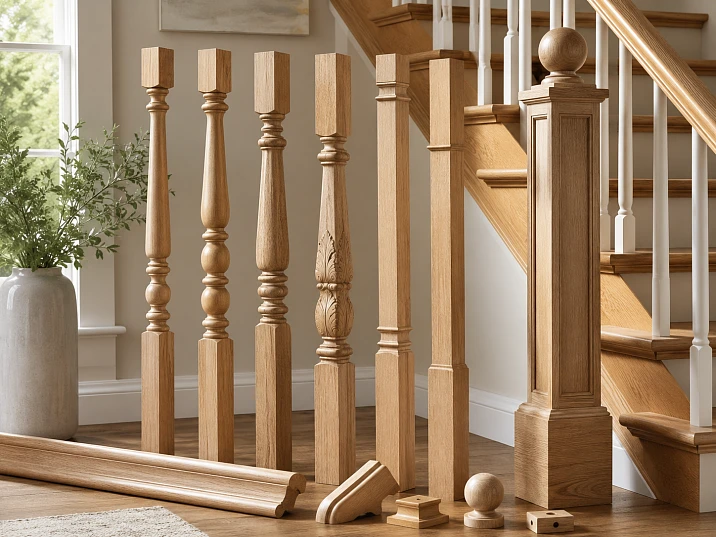
A baluster is not just 'some beautiful detail'; it's understood within the entire stair composition: railing height, handrail shape, installation spacing, interior style, material, and the role of support posts. A baluster on a staircase is more noticeable than it seems from a single photo. In a row, it sets the rhythm of the railing, supports the handrail, closes dangerous gaps, and helps make the staircase not a random structure but part of the interior.
A buyer often starts with a simple question: which balusters are best for a wooden staircase? But behind this question almost always lies a whole set of decisions. Are turned or carved ones needed? Round, square, or rectangular? Will they fit the already chosen handrail? How many balusters are needed for the staircase? Should posts, finials, and other elements be purchased at the same time? That's why choosing balusters is better considered not as buying a single part, but as assembling a stair kit.
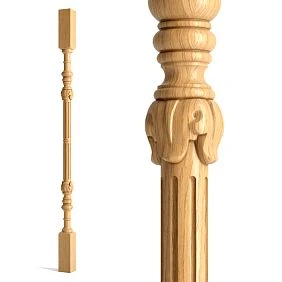
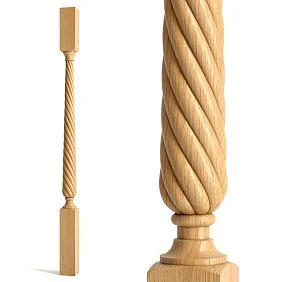
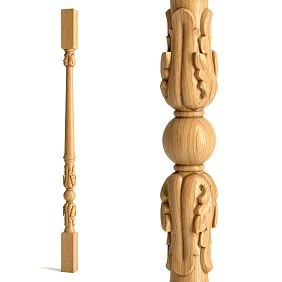
In the STAVROS catalog you can buying wooden balusters for stairs in different shapes, collections, and types: turned, carved, geometric, turned-carved. This approach is convenient for those designing a new staircase, updating a railing, selecting elements for an existing handrail, or wanting to assemble a kit in one style without random mismatches.
What is a baluster and why you can't choose it just by photo
A baluster is a vertical element of a stair railing that is installed between the stair base and the handrail. In everyday conversation, it is often perceived as a decorative post, but in a real staircase, a baluster has several tasks at once. It helps fill the space under the handrail, supports the visual and structural rhythm of the railing, makes the staircase safer, and connects the handrail, steps, posts, and finishing into one system.
The error begins when a baluster is chosen as a single beautiful figurine. In a photo, one model may look expressive, but in a row of twenty or thirty pieces, it may turn out to be too heavy, small, sparse, or stylistically out of place. A stair railing works through repetition. If the form is overloaded, repetition amplifies the overload. If the form is too simple for a classic interior, the staircase looks unfinished. If the height does not match the handrail, the entire structure loses its proportions.
Therefore, the question "how to choose balusters for a staircase" starts not with the design, but with the overall task. For a grand staircase in a classic home, more expressive carved or turned-carved elements are often needed. For a calm, modern interior, geometric and minimalist forms are suitable. For a wooden staircase in a country house, it is important to consider the material, future finishing, and compatibility with the handrail. For repairing an old railing, you need to look not only at aesthetics but also at mounting dimensions, height, width, and compatibility with existing parts.
Balusters are especially important in interiors where the staircase is visible: in the hall, living room, double-height space, or on the second-floor gallery. There, the railing becomes part of the architecture. It is visible not only when climbing but also from the lower level, from the seating area, and from the entrance. If the balusters are chosen correctly, the staircase looks cohesive. If not, even expensive steps and a beautiful handrail can lose their impact.




Key characteristics of wooden balusters for staircases
In the STAVROS balusters section, wooden products of the L-series are presented, and selection can be made by collections, shapes, and execution types. This is important for the buyer: instead of chaotically browsing dozens of similar parts, you can immediately filter models by style, shape, and structural character.
| Parameter | What to consider when choosing |
|---|---|
| Product group | Wooden balusters for stairs |
| Main Scenario | Stair railings, balustrades, interior staircases, terraces, and other railings where vertical elements are needed |
| Product types | Turned, carved, geometric, turned-carved |
| Product shapes | Square, round, rectangular |
| Collections in selection | Art Deco, Grape, Classic, Modern, Russian Style, Contemporary, Eclectic |
| Type of product | Baluster |
| Model examples | Wooden baluster L-019, L-020, L-056, L-021, L-097, L-117, round wooden baluster L-118 and other L-series models |
| Material | Wood; exact material options for a specific model should be checked in the product card |
| Dimensions | Dimensions A, B, C are specified in the category cards and filters; they should be verified against the staircase project before ordering |
| Related elements | Handrails, stair posts, wooden finials |
| Main section for selection | buying wooden balusters for stairs |
This table helps quickly understand the main point: a baluster is not purchased separately from the staircase logic. Even if you need to replace a few old posts, you will have to check the shape, height, cross-section, style, spacing between elements, and how the new part will look next to the handrail and posts.
Wooden balusters have an important advantage: they are well perceived in a residential interior. Wood is visually warmer than metal, more natural than plastic, and looks softer in classical architecture. But this advantage is only realized with proper selection. A too thin post may get lost under a massive handrail. A too large one will conflict with the steps and posts. Too ornate carving in a minimalist interior will start to look out of place.
Our factory also produces:
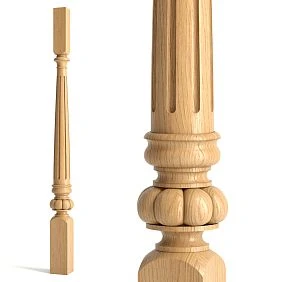
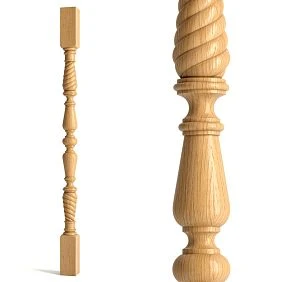
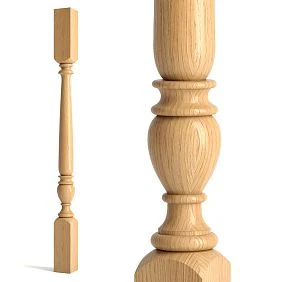
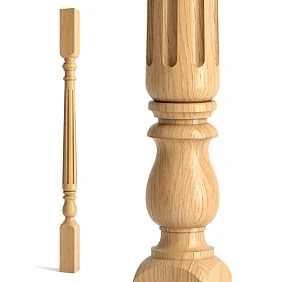
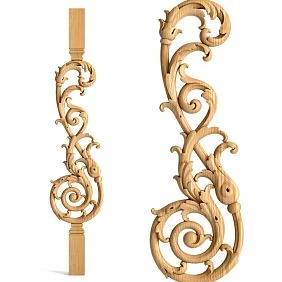
Turned, carved, geometric, and turned-carved balusters: how they differ
To buy balusters for a staircase without mistakes, you need to understand the difference between execution types. The names in the filters help to quickly select suitable models, but behind each type lies not only technology but also a different visual character.
Get Consultation
Turned balusters
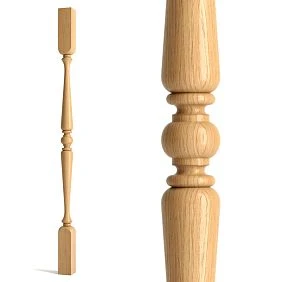
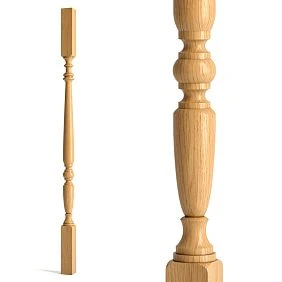
Turned balusters are typically built on a smooth alternation of thickenings, grips, necks, and rounded transitions. They look good in wooden staircases where a classic but not overly complex line is needed. Such models are often chosen for country houses, cottages, calm interiors with natural wood, and staircases in the hall or to the second floor.
The main advantage of a turned shape is that it reads in a row. One element may seem restrained, but repetition creates a neat rhythm. If the handrail also has a soft profile, turned posts help tie the railing into a cohesive line. For the buyer, this is a convenient option when they want a wooden staircase without overloaded carving but with a noticeable shape.
Carved balusters
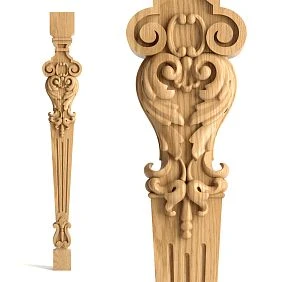
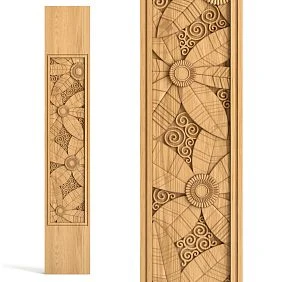
Carved balusters are chosen when the staircase should become an expressive part of the interior. The carving can support classic furniture, massive door portals, carved architraves, decorative wall elements, or the overall historical style of the house. Such balusters are especially appropriate in interiors with scale: a spacious hall, a large stairwell, a country house, a formal area.
But a carved baluster requires caution. In a small space, an overly complex shape can look heavy. If there is already a lot of active decor nearby, it is better not to overload the stair railing. In this case, it is worth choosing a calmer carving or switching to a turned-carved option, where decorativeness is combined with clearer geometry.
Geometric balusters
Geometric shapes are suitable for modern and restrained interiors. They work well where clean lines, clear cross-sections, repetition, and neat proportions are valued. Such balusters are easier to combine with minimalist handrails, modern steps, smooth walls, and furniture without carved decor.
Geometry does not mean dullness. In a row, such balusters can look very expressive due to strict repetition. They help make the railing calm, cohesive, and architectural. For a modern home, this is often better than a random imitation of classics.
Turned-carved balusters
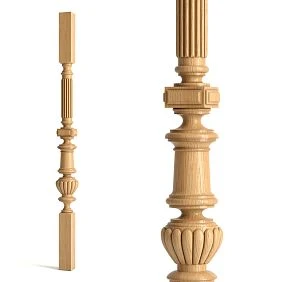
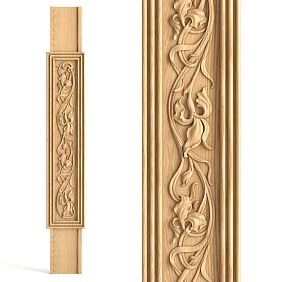
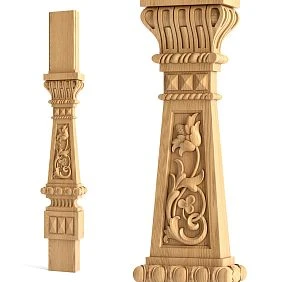
Turned-carved balusters occupy an intermediate position. They have both a voluminous turned shape and decorative details. This option is suitable when the buyer needs a staircase with character but without excessive formality. They look good in neoclassicism, Art Nouveau, eclecticism, interiors with wooden furniture and more complex finishes.
If it's difficult to decide which balusters to choose for a classic staircase, turned-carved models often become a reasonable compromise. They are more noticeable than simple turned ones, but calmer than complex carved ones. The main thing is to compare them with the handrail and posts: if all elements are too active, the railing will become heavy.
Comparison of options: which baluster suits your staircase
| Baluster type | How it looks in the railing | Where best to use | What to pay attention to |
|---|---|---|---|
| Turned | Smooth rhythm, soft transitions, classic wooden line | Country house, wooden staircase, calm classic, interior with natural finish | Check the height, cross-section, and combination with the handrail profile |
| Carved | More elegant, expressive, noticeable in the row | Grand staircase, classic hall, interior with carved decor | Do not overload a small space; connect the pattern with other elements |
| Geometric | Strict repetition, clear form, modern look | Modern interior, minimalist staircase, calm architecture | Check the scale with the handrail and steps so the balusters don't look too thin |
| Turned-carved | Balance of volume and decor | Neoclassicism, Art Nouveau, Eclecticism, stairs with moderate decor | Match the style of the posts and finials so the set doesn't clash |
This table does not replace a staircase design, but helps narrow down the choice. If the staircase is already built, it's better to look not at the most beautiful individual item, but at how the baluster fits into the existing scale. If the staircase is only being designed, it's more convenient to first determine the style of the entire group: balusters, handrail, posts, finials, and only then choose specific models.
How to choose balusters for a staircase: shape, height, spacing, and style
Choosing balusters starts with shape, but doesn't end there. Shape determines style, height determines fit under the handrail, width and cross-section determine the visual density of the railing, installation spacing determines safety and rhythm. If one parameter is off, the staircase can look sloppy even with good individual parts.
Shape: round, square, or rectangular
Round balusters feel softer in an interior. They suit classic handrails, wooden steps, smooth profiles, and furniture with rounded lines. In a row, the round shape creates a soft rhythm and looks good in country houses.
Square balusters look stricter. They pair better with geometric handrails, modern staircases, and straight lines of walls and furniture. If the interior is built on flat planes, the square shape helps maintain the purity of the overall composition.
Rectangular balusters can appear more architectural. They are suitable where the stair railing should be not just decorative but a noticeable structural element. However, for the rectangular shape, it is important to check the orientation and cross-section: in one position it looks lighter, in another — more massive.
Height: why it can't be chosen 'by eye'
The height of the baluster is related to the height of the handrail and the staircase structure. If the post is too low, the handrail will not get the desired line. If it is too high, you will have to change the fit or trim it, which can spoil the proportions and decorative areas. For shaped models, it is especially important not to disrupt the pattern: if you cut in the wrong place where a flat part is intended, the baluster will lose its neatness.
Before purchasing, you need to check the design height of the railing, installation location, handrail thickness, fastening method, and the dimensions of the baluster itself. In STAVROS product cards, parameters are specified by model, so before ordering, you need to open the specific card and check dimensions A, B, C. If the staircase is non-standard, it's better to discuss the selection with a manager in advance.
Installation spacing: how many balusters are needed for a staircase
The question 'how many balusters are needed for a staircase' cannot be answered solely by the length of the flight. You need to consider the distance between posts, the width of the balusters themselves, safety clearance requirements, step shape, turns, landings, and visual rhythm. On a straight section, the calculation is simpler, but on turns and near starting posts, nuances often arise.
A common mistake is to buy balusters strictly based on an approximate quantity, without leaving a reserve for complex areas. Another mistake is to space them too far apart to save money. As a result, the railing looks empty and may perform its protective function worse. It is better to calculate the set by sections: lower flight, turn, landing, upper flight, second-light balustrade, if present.
Style: the baluster should speak the same language as the staircase
If the staircase is classic but without complex carved decor, turned balusters often look more convincing than overly rich carving. If the interior is formal, carved elements can support the scale. If the house is modern, geometry and a calm form will help avoid stylistic conflict.
When choosing, it is useful to look not only at the staircase but also at neighboring elements: doors, architraves, baseboards, furniture, walls, ceiling decor. Balusters are in the center of attention, so they should connect the interior, not argue with it.
How to choose balusters for a handrail
The handrail and balusters are perceived together. The handrail sets the top line of the railing, while the balusters support it visually and structurally. Therefore, the question 'how to choose balusters for a handrail' is more important than selecting a beautiful model on its own.
If the handrail is massive, too thin balusters will look weak. If the handrail is light, large carved posts may overwhelm it. If the handrail has a smooth rounded profile, a round or turned baluster usually looks more natural. If the handrail is strict and straight, geometric models often support it better.
At STAVROS, you can not only choose balusters but also match balusters to the handrail by shape, type of execution, and style. This approach is especially useful if the handrail has already been purchased or selected in the project. Then balusters need to be chosen not abstractly, but for a specific top line of the railing.
If the handrail has not yet been selected, it is better to consider the set more broadly. First, determine the style of the staircase, then choose the type of balusters, after that Buy a handrail for stairs with a suitable profile. This way, there is less risk that the handrail will be too rough, too thin, or mismatched in shape.
Balusters and stair posts: why a set looks better than a random selection
Posts are the supporting and accent elements of a staircase. They are placed at key points: at the start of a flight, on turns, on landings, and where the handrail changes direction. Balusters fill the row between them. If posts and balusters are chosen from different stylistic worlds, the staircase looks like it was assembled from random parts.
For a classic staircase, it is especially important that the post is the senior element of the composition. It can be larger, more expressive, more complex in shape. Balusters support it but do not try to compete. If the balusters are carved, the post should also be sufficiently expressive. If the balusters are geometric, it is better to choose a calm post with a clear shape and without unnecessary decoration.
When you need to assemble a railing with a start, turn, and finish, it is worth buy wooden stair newel posts in the same stylistic logic as the balusters. This helps avoid inconsistency in scale. The post should look like part of the staircase, not like a separate decorative column accidentally placed nearby.
A good set is built on hierarchy. Posts set the main points. Balusters maintain the rhythm between them. The handrail unites the entire line. Finials complete the verticals. When these elements are connected, the staircase looks more expensive and calmer, even if it lacks overly complex decoration.
Wooden finials: when does a staircase need them
A finial is a decorative finishing element that is installed on a post or used in other interior tasks. In a staircase, the finial helps complete the vertical, especially if the post is large and prominent. Without it, the top of the post may look unfinished, and with an unsuitable finial, it may look random.
Finials work especially well in classic and country interiors where detail matters. They can support the shape of the balusters, repeating their roundness, geometry, or carved motif. If the stair post plays the role of an accent, the finial makes it more cohesive.
When selecting, it is important not to overdo it. For a calm staircase, a laconic finish is sufficient. For a formal composition, a more expressive shape can be considered. If the railing already has a lot of carving, the finial should complete, not add extra noise. When the set is built around the posts, it is better to immediately select wooden finials for the staircase and match them with the shape of the post, balusters, and handrail.
What to buy together with balusters
Balusters are rarely purchased completely separately. Even if the main task is to replace old posts, related questions almost always arise: will the old handrail fit, are new posts needed, what to cover the top of the post with, how to maintain a unified style. If the staircase is being created from scratch, buying as a set becomes even more important.
Along with balusters, handrails, stair posts, and finials are usually considered. The handrail is needed for the top line of the railing. Posts are for the beginning, turns, and support points. Finials are for completing the posts and decorative integrity. Such a set helps avoid the main problem of stair decor: when each individual detail is beautiful, but together they do not match.
If the task is — balusters for staircase to buy for a new project, it is better to consider the railing as a whole right away. At the selection stage, you need to check not only the number of balusters but also the number of posts, the need for finials, the shape of the handrail, the method of connecting elements, and the overall style.
| What to add to the purchase | Why this is needed | Which scenario it suits | What to pay attention to | Link |
|---|---|---|---|---|
| Handrail | Unites the balusters into the top line, makes the railing comfortable for the hand and visually complete | New staircase, replacement of old railing, selection of a set | Profile, width, material, compatibility with baluster height | Buy a handrail for stairs |
| Staircase posts | Set the support points, beginning, turns, and completion of the railing | Staircase with a turn, landing, pronounced start of the flight | Post scale, style, execution type, combination with balusters | buy wooden stair newel posts |
| Finials | They complete the pillars and make the composition more cohesive | Classic staircases, grand halls, country houses | Shape, size, matching the pillar and overall style | select wooden finials for the staircase |
| Additional balusters | Needed for spare, complex sections, turns, landings | Stairs with complex configuration, balustrades, double-height spaces | Do not count the quantity only 'approximately'; check the step and sections | buying wooden balusters for stairs |
This bundled approach does not mean buying everything indiscriminately. On the contrary, it helps save time and avoid repeat orders. The buyer immediately sees which elements are related and can check compatibility in advance.
How to choose balusters for different buyer scenarios
There is no one-size-fits-all staircase. One buyer is updating an old railing, another is designing a new home, a third is decorating a staircase in a classic hall, and a fourth wants a calm modern line. Below are practical scenarios to help understand which balusters to look at first.
For a new staircase in a country house
If the staircase is being designed from scratch, it is better not to start with a single favorite model. First, determine the overall railing style: classic, modern, Russian, eclectic, more decorative or restrained. Then choose the type of balusters, handrail shape, posts, and finials. This order helps assemble a set rather than a collection of individual purchases.
For a country house, wooden balusters are often chosen because they naturally match the steps, furniture, doors, baseboards, and other wooden details. But it's important not to mix too many different shapes. If the staircase is calm and warm, turned balusters will look soft. If the hall is spacious, carved or turned-carved models can be considered.
For replacing old balusters
When replacing old elements, the main task is to match the dimensions and style. You need to measure the height of the existing railing, the distance between the base and handrail, the cross-section of the old posts, the installation spacing, and the fastening method. If you simply buy a model that looks similar in a photo, it may turn out to be taller, shorter, wider, or narrower.
In this scenario, it is especially important to open the product card and check the dimensions. If part of the old railing remains, the new balusters should not clash with it. Sometimes it is better to replace not only the posts but also the handrail if the old profile does not pair well with the new parts.
For a classic staircase
A classic staircase requires proportion. It is not necessary to choose the most complex decor here. What matters more is that the balusters, posts, handrail, and finials maintain a single scale. If the interior is calm, turned or turned-carved models can look more noble than overly carved ones. If the staircase is grand, a carved option can help support the architectural character.
For a classic interior, it is worth deciding in advance whether the railing will be the main accent or a support for other details. If there are already carved doors, architraves, furniture, and ceiling decor nearby, it is better to choose balusters carefully. If the interior is restrained, the staircase can take on a more decorative role.
For modern interior
In a modern interior, balusters work differently. Here, clear rhythm, clean form, and the absence of unnecessary decorative noise are important. Geometric models often look more appropriate than complex carvings. They help maintain the calm architecture of the staircase and do not turn the railing into an alien classic fragment.
At the same time, wood in a modern interior does not look old-fashioned if the shape is chosen correctly. Square, rectangular, and minimalist round elements can pair well with smooth walls, modern steps, neutral shades, and simple furniture.
For commercial spaces
In a restaurant, salon, hotel, or showroom, the staircase often works as part of the experience. Here, not only convenience is important, but also the recognizability of the space. Balusters can support a classic atmosphere, emphasize the status of the entrance area, or make the interior warmer.
For commercial premises, it is especially important to calculate the number of elements in advance and check the stability of the visual solution in a long row. What looks expressive in a private home can become too active in a long balustrade. It is better to choose a model considering the scale of the space and the overall flow of people.
For DIY assembly or repair
If the buyer is assembling the railing themselves, they need to pay special attention to dimensions and compatibility. A ready-made baluster helps avoid carving a complex shape from scratch, but it still requires proper installation, base preparation, handrail selection, and careful finishing.
In this scenario, you should not buy elements on the principle of 'we'll adjust later.' Shaped areas, cross-sections, and decorative transitions do not always allow for painless height changes. It's better to check the project in advance, review product cards, and compile a list of all parts.
Selection by size, material, installation location, and purpose
To buy wooden balusters for a staircase without unnecessary rework, you need to go through several practical checks. This is not complex theory, but normal preparation before ordering.
Size
Size affects three things at once: safety, fit under the handrail, and the appearance of the row. The height must match the railing design. Width and cross-section affect the density of repetition. If the balusters are wide, fewer may be needed, but the row will become heavier. If narrow, the railing will be lighter, but you need to monitor gaps and rhythm.
Before ordering, it is worth checking dimensions A, B, C in the specific model's card. You cannot rely only on the photo. In a photo, a large baluster may appear compact, and a small one may look expressive due to the shooting scale.
Material
Wood is well-suited for stairs because it can be combined with wooden steps, handrails, posts, and interior finishes. But the specific material needs to be checked in the product card. Different models may have different available options, and you should not assume the wood species or finish without checking.
Material is important not only for appearance. It affects processing, future finishing, the feel of density, and compatibility with other wooden elements. If the staircase is being matched to existing steps or a handrail, you need to consider color, texture, and the final finish.
Installation location
Balusters can be used on flights, landings, galleries, balustrades, and terraces. But installation conditions differ. Indoors, style, safety, and compatibility play the main role. On open or semi-open areas, it is especially important to consider operating conditions and finishing, but specific limitations are best clarified based on the chosen model and project.
The installation location also affects perception. On a narrow staircase, overly large balusters can compress the space. In a large hall, thin posts may get lost. On a two-story balustrade, the row is visible from afar, so not only the individual pattern but also the overall rhythm matters.
Purpose
Sometimes balusters are needed for a new staircase, sometimes for restoration, sometimes for a decorative railing. In each case, the choice will be different. For restoration, it is more important to match the existing style. For a new project, you can choose the shape more freely. For a decorative railing, it is important that the balusters do not look too heavy and do not create a feeling of unnecessary structure.
Application of wooden balusters in interior design
Balusters are most often associated with stairs, but within this topic there are many scenarios. They can change the impression of a home, work in different zones, and be perceived differently depending on lighting, scale, and surroundings.
Hall and entrance area
In the hallway, the staircase often greets a person first. If the railing is well-chosen, the house immediately seems well-thought-out. The balusters here are not just for filling the space under the handrail. They shape the first impression: classic, warm, modern, grand, or intimate.
For the entrance area, it is especially important not to overload the staircase. If the hall is small, it is better to choose a proportional shape. If the space is spacious, more expressive balusters and posts can be allowed.
Living room with an open staircase
If the staircase opens into the living room, its railing becomes part of the living area. The balusters should match the furniture, doors, wall panels, baseboards, and floor color. Here, it is risky to choose a model separately from the interior. Even a beautiful baluster can look out of place if it does not support the overall line.
In the living room, solutions where balusters do not compete with furniture work well. If the furniture is classic, carved or turned-carved elements can support the style. If the interior is modern, it is better to look at geometry and calm forms.
Second light and balustrade
The balustrade of the second light requires special calculation. The row of balusters there is visible from afar and often occupies a long horizontal section. At such a distance, fine carving may be almost unreadable, and an overly complex shape can turn into visual noise. The overall rhythm and correct scale are more important.
If the balustrade is long, you need to be especially careful in calculating the number of elements and the distance between them. An error in the spacing will be immediately noticeable because the row is in plain sight.
Country veranda or terrace
For a veranda and terrace, wooden balusters can support the architecture of the house, especially if the facade, porch, or windows are designed in a warm wooden style. But you cannot transfer interior logic here without checking the operating conditions. You need to consider the base, humidity, finish, wood protection, and recommendations for specific products.
If balusters are chosen for such areas, it is better to clarify the suitable material, treatment, and application conditions for the selected model before ordering.
Staircase in a classic house
In a classic house, balusters help support the architectural language. They can match the architraves, door portals, baseboards, cornices, and carved furniture. But classic does not mean mandatory overload. Sometimes it is better to choose turned balusters with good proportions than complex carving that will compete with the rest of the decor.
How not to confuse balusters with similar products
In staircase decor, there are many vertical and decorative elements, so buyers often confuse balusters with posts, finials, decorative columns, or furniture parts. This mistake can lead to an incorrect order: beautiful elements are purchased, but they are not suitable for the intended location.
Baluster and post
A baluster is a repeating element between support points. A post is a larger and more significant element that is placed at the beginning, on a turn, at the end, or in another important area of the staircase. If a baluster is used instead of a post, the support point may look weak. If posts are placed along the entire row instead of balusters, the railing will become heavy and unnecessarily expensive.
Baluster and finial
A finial does not replace a baluster. It completes a post or is used as a decorative top element. It has a different role, a different scale, and a different place in the composition. Therefore, when ordering, you need to count balusters separately and separately check whether finials are needed for the posts.
Baluster and furniture support
Some wooden elements may outwardly resemble columns or legs, but that does not mean they are suitable for staircase railings. A baluster is selected based on the handrail height, row, installation step, and staircase task. A furniture support operates on a different logic: it supports furniture, not forms a railing.
Baluster and decorative column
A decorative column can be used in furniture or interior design, but a baluster must fit into a stair railing. Its repeatability, fit under the handrail, cross-section, height, and compatibility with posts are important. If you buy just a similar part, you might not fit into the structure.
Practical selection for specific situations
Need to design a new staircase in the house
Start with the overall look. Decide what the staircase should be: calm, classic, grand, modern, rustic, neoclassical. Then choose the type of balusters. After that, select the handrail, posts, and finials. Do not buy balusters until the top line of the railing and the installation points of the posts are clear.
Need to replace part of the old railing
First, measure the old elements. You need height, width, cross-section, distance between balusters, height to the handrail, and base shape. Then look for a model close in scale. If there is no exact match, it is better to consider replacing the entire row, otherwise the new balusters will be noticeably different.
Need to select balusters for an already chosen handrail
Look at the handrail profile. A massive handrail requires more substantial posts. A light handrail pairs better with thinner and calmer balusters. If the handrail is round, a round or turned shape often looks natural. If the handrail is strict, geometry may be more successful.
Need to make the staircase expressive but not overloaded
Choose balusters with character, but not maximum complexity. Turned-carved models can provide the right balance. Posts can be made a bit more expressive, while the row of balusters remains calmer. This way the staircase will look rich but not heavy.
Need to assemble a set for a classic interior
For classics, unity is important. Balusters, handrails, posts, and finials should follow the same stylistic logic. If you choose carved balusters, look for posts with sufficient expressiveness. If the balusters are turned, do not place overly complex finials next to them without support in other details.
You need to buy balusters for a small staircase
In a compact space, it's best to avoid overly large and complex models. They can visually narrow the staircase. Look for lighter forms, a neat rhythm, and a calm cross-section. The installation step is especially important here: too frequent a row will feel heavy, too sparse a row will feel empty.
Mistakes when choosing wooden balusters
Choosing only based on a beautiful photo
A photo shows the shape, but it doesn't show how the baluster will look in your row, with your lighting, with your handrail and steps. Before buying, you need to look at the dimensions and imagine the repetition. One expressive post and twenty such posts on a staircase are different impressions.
Purchasing without calculating the quantity
If you estimate the number of balusters roughly, there is almost always a risk of error. A few pieces missing for the landing, a turn not accounted for, a second-floor balustrade forgotten, the step incorrectly calculated — and the order has to be supplemented. It's better to calculate by sections and immediately account for complex areas.
Ignoring the Height
The height of the baluster is related to the handrail and the overall height of the railing. If it does not fit, installation becomes more complicated, and the appearance suffers. It is especially dangerous to trim shaped models without understanding where adjustment is permissible.
Incorrect Combination with the Handrail
The handrail and balusters should be connected in scale. Weak posts under a heavy handrail look unsteady. Large carved balusters under a thin handrail create an imbalance. Therefore, it's better to choose the handrail simultaneously with the balusters, or at least check them for shape and size.
Mixing different styles
Classic carved balusters, a modern handrail, an overly simple post, and a random finial may seem normal individually, but together they create a mismatch. The staircase requires a unified logic. If you want to mix styles, it must be done deliberately, not due to random selection.
Buying one part instead of a set
Balusters are part of the railing. If you buy only them and then look for a handrail and posts, you may encounter mismatches. It's better to check related sections in advance and understand which kit you need.
Inattention to the product card
Before ordering, you need to check the current dimensions, material, availability, price, and other parameters in the specific product's card. The category helps choose the direction, but the final decision is made based on the model's card.
Expecting unconfirmed characteristics
Do not assume material, finish, or configuration without checking. If the card does not specify what is important for the project, it is better to clarify with a STAVROS manager. This is easier than redoing the stair railing after purchase.
Who wooden balusters are suitable for, and who should choose a different solution
Wooden balusters are suitable for those who want a warm, expressive, and durable staircase with a natural character. They are especially appropriate in private homes, cottages, interiors with wooden steps, classic furniture, carved decor, door portals, baseboards, and other wooden details.
They are suitable for customers who want to assemble a staircase not from random parts, but from a well-thought-out kit. If handrails, posts, finials, and a unified style are important, wooden balusters provide a good foundation for such a solution.
They are also suitable for those doing restoration or replacing an old railing. But here you need to carefully check the dimensions and compatibility. If the old handrail remains, the balusters must match it in height and shape.
Wooden balusters may not be suitable if you need a maximally unobtrusive modern barrier without a decorative role. In such cases, glass, metal, or other solutions are sometimes chosen. They can also be unnecessary if the staircase is designed in a very strict minimalist style and any repetitive wooden railing would conflict with the architecture.
Another case where caution is needed is a very small staircase with a narrow flight. There, large carved models can look heavy. But this does not mean that wood is not suitable. It is just worth considering more restrained forms.
How to buy balusters on STAVROS and what to check before ordering
It's best to start shopping from the main category, where you can buying wooden balusters for stairs and filter models by type, shape, and collection. After that, you need to open the cards of the products you like and check the dimensions.
The checking order can be as follows. First, determine the staircase style. Then decide what shape is needed: round, square, rectangular. After that, choose the execution type: turned, carved, geometric, or turned-carved. Then check the height, cross-section, dimensions A, B, C, and compare them with the project. Only after that calculate the quantity.
If the staircase is being assembled completely, don't stop at the balusters. Immediately check what handrail will be on top, where posts are needed, and whether finials are needed. For this, it's convenient to go to the related sections: Buy a handrail for stairs, buy wooden stair newel posts, select wooden finials for the staircase.
If the project is non-standard, it's better to clarify details with a STAVROS manager in advance. Especially if the staircase has turns, complex landings, a double-height ceiling, a non-standard handrail, or existing elements that need to be matched in size and style.
FAQ: frequently asked questions about wooden balusters
How to choose balusters for a staircase?
First, determine the style of the staircase and the shape of the handrail, then choose the type of balusters: turned, carved, geometric, or turned-carved. After that, check the height, cross-section, dimensions, and installation spacing. Don't choose based only on photos: the baluster should look good in a row and match the handrail, posts, and interior.
Which balusters are best for a wooden staircase?
For wooden stairs, wooden balusters are most often chosen because they naturally match the steps, handrails, and other details. Turned balusters suit calm classics, carved ones suit a more formal interior, geometric ones suit a modern solution, and turned-carved ones suit a balance between decor and restraint.
What is the difference between turned and carved balusters?
Turned balusters are built on smooth volumetric shapes, grips, and rounded transitions. Carved ones have a more complex decorative pattern and are more noticeable as stair decorations. Turned balusters are easier to fit into different interiors, while carved ones require more attention to style and scale.
How to choose balusters for a handrail?
You need to compare the scale. Don't choose too thin posts for a massive handrail, or too large and heavy ones for a light handrail. Also, the combination of shapes is important: a rounded handrail is well supported by turned and round elements, while a strict profile is supported by geometric ones.
How many balusters are needed for a staircase?
The quantity is calculated by sections: flight, landing, turn, balustrade, second light. You need to consider the length of the section, the width of the balusters, safe clearance, installation spacing, and post locations. Don't calculate based only on the total length of the staircase, because turns and landings introduce additional nuances.
Is it necessary to buy balusters together with posts?
If the staircase is being assembled from scratch, it's better to look at newel posts right away. They are needed at the start, at turns, at endpoints, and other support points. Balusters fill the row, while newel posts set the structure. If they don't match in style, the railing looks random.
Are wooden finials needed for the staircase?
Finials are not always necessary, but in classic and expressive staircases they help complete the posts. If the posts are large and prominent, a finial makes the composition more cohesive. The main thing is to choose a shape that matches the post, balusters, and handrail.
Is it possible to replace only part of the balusters?
Yes, if the new elements match in height, width, shape, and style. But if the old balusters are very different, a partial replacement will be noticeable. In that case, it is sometimes better to replace the entire row or choose a model that is as close as possible after taking precise measurements.
Which balusters should I choose for a classic staircase?
For a classic staircase, turned, carved, and turned-carved balusters are suitable. The choice depends on the scale of the interior. In a small space, a restrained shape is better; in a spacious hall, more expressive decor can be used. It is important that the balusters match the posts, handrail, and overall finish.
Which balusters should I choose for a modern interior?
For a modern interior, geometric, square, rectangular, or minimalist round models are usually more suitable. They maintain a clean line and do not overload the staircase. Intricate carving should only be used when it is supported by other details in the interior.
What should I check before ordering balusters?
Check the dimensions, shape, product type, material from the product card, quantity, compatibility with the handrail and posts, installation location, and future finish. If the staircase is non-standard, it is worth clarifying the parameters with a STAVROS manager in advance.
Can I buy balusters separately and choose the handrail later?
You can, but this increases the risk of mismatch. It's better to at least know in advance which handrail will be used: its profile, width, installation height, and style. Otherwise, the balusters may turn out to be too light or too massive for the top line of the railing.
Why you shouldn't buy random wooden blanks instead of balusters
A random blank may not be suitable in terms of height, cross-section, shape, and repeatability. Balusters are designed to work in a row and must match the handrail, posts, and staircase structure. Ready-made models are easier to select for a specific style and set.
Where to buy wooden balusters for stairs?
At STAVROS, you can select and buy wooden balusters in the profile category, as well as choose handrails, stair posts, and finials to match them. Before ordering, it's better to check product cards, dimensions, and compatibility of parts.
Conclusion: it's better to choose balusters as part of a staircase set
Wooden balusters affect the staircase more than it seems at first glance at the catalog. They set the rhythm of the railing, support the style, help make the staircase safer, and connect the handrail, posts, steps, and decorative elements into a single composition. Therefore, they should be chosen not only by eye but also by parameters: shape, height, cross-section, type of execution, quantity, and compatibility.
If you need a calm wooden staircase, you should look at turned models. If you need an expressive classic look, go for carved or turned-carved ones. If the interior is modern, choose geometric and minimalist shapes. In any case, before ordering, you need to check the dimensions in the product card, calculate the quantity by sections, and think in advance about which handrails, posts, and finials will work together with the balusters.
STAVROS helps you assemble a staircase railing not from random elements, but from interconnected wooden parts. It's convenient to start the selection in the section where you can buying wooden balusters for stairsand then move on to the handrails, posts, and finials so that the staircase looks cohesive and serves not just as a passage between floors, but as a full-fledged part of the interior.