































































Article Contents:
- Material features: enhanced strength technology
- Molecular structure and composition
- Physical and mechanical properties
- Chemical resistance and durability
- Ecological safety
- Comparison with alternative materials
- Technology of producing high-quality profiles
- Application areas: where impact resistance is critical
- Entry zones and corridors
- Commercial and public spaces
- Kitchen areas
- Children's rooms and play areas
- Bathrooms and toilets
- Balconies and loggias
- Basements and technical rooms
- Wall decoration examples: from classic to modern
- Classic panel cladding
- Wall frame compositions
- Vertical zoning of space
- Accent walls with geometric compositions
- Framing of functional elements
- Ceiling borders and multi-level compositions
- Modern minimalism with moldings
- Combining with other materials
- Profile calculation and selection: accuracy and harmony
- Determining the optimal profile width
- Selecting the degree of relief
- Calculating required quantity
- Selecting complementary elements
- Coordinating profiles of different elements
- Samples and testing
- Budget Planning
- Assembly and Mounting: Professional Secrets
- Wall surface preparation
- Precise marking - foundation for even installation
- Choosing and applying adhesive
- Technique for cutting corners
- Adhesion and fixation process
- Sealing Joints and Gaps
- Additional mechanical fastening
- Installation features on various bases
- Painting and maintenance: preserving original appearance
- Preparation for painting
- Choosing paint
- Paint application techniques
- Creating Decorative Effects
- Current care for painted moldings
- Local Repair of Damage
- Recoating
- Practical recommendations: experience of professionals
- Material acclimatization
- Working with long elements
- Installation in challenging conditions
- Compatibility with stretch ceilings
- Working with "Warm Floor" and "Warm Walls" systems
- Savings without loss of quality
- Common Mistakes and How to Avoid Them
- When to consult professionals
- Combining with other decorative elements
- Popular questions about wall moldings made of impact-resistant polystyrene
- Conclusion
Modern interiors require not only beauty but also practicality. Imagine: you’ve just finished renovation, installed elegant moldings on the walls, and within a few months, they already have scratches from accidental door impacts or scuffs from furniture rearrangement. A familiar situation? That’s precisely whyImpact-resistant polystyrene wall moldingbecomes the choice of those who understand the value of durable decor.
Wall molding made of modified polystyrene is not merely a fashion trend for decorative elements. It is a technological solution that combines the aesthetic appeal of classical molding with modern requirements for strength and durability. In an era when every interior detail must serve for years without losing its original appearance, choosing impact-resistant materials becomes not a luxury, but a rational necessity.
STAVROS company, in collaboration with manufacturer Hi Wood, offers a wide range of durable moldings that withstand the test of time and intensive use. These products are designed for those unwilling to compromise between beauty and reliability.


Material features: technology of enhanced strength
What makes polystyrene molding impact-resistant? The secret lies in the material’s structure, modified at the molecular level. This is not a marketing trick, but a real technological advantage that can be measured and verified.




Molecular structure and composition
Impact-resistant polystyrene, also known as HIPS (High Impact Polystyrene), is obtained by adding rubber-like additives—polybutadiene—to regular polystyrene. These elastic inclusions make up 5 to 15 percent of the total mass and radically change the material’s behavior under mechanical loads.
When regular polystyrene is subjected to impact, critical stresses arise at the point of force application, leading to cracking. Modified material behaves differently—the elastic inclusions act as microscopic shock absorbers, distributing impact energy throughout the volume. Impact-resistant polystyrene molding deforms locally but does not break, and after the load is removed, it often restores its original shape.
The material’s density is 1040–1050 kg/m³, which is only 3–5 percent higher than standard polystyrene. This means that a strong molding remains sufficiently lightweight for easy installation, yet acquires the necessary mass and solidity in the interior.
Our factory also produces:


Physical and mechanical properties
Numbers speak louder than words. The impact toughness of modified polystyrene reaches 50–70 kJ/m², while standard material shows only 6–8 kJ/m². The difference is almost tenfold—this is not merely improvement, but a qualitative leap in operational properties.
The bending strength is 75–80 MPa, the modulus of elasticity is 3500 MPa. The Vicat softening temperature ranges from 91–97°C, allowing impact-resistant wall polystyrene molding to be used over a wide temperature range—from minus 40 to plus 60°C without changes in properties.
The material’s frost resistance is a critically important characteristic for the Russian climate. Wall polystyrene molding retains elasticity and strength even at significant negative temperatures, making it suitable for use on glazed balconies and in unheated rooms.
Get Consultation
Chemical resistance and durability
Impact-resistant polystyrene demonstrates high resistance to exposure to diluted acids, alkalis, alcohols, and most cleaning agents. This is critically important for wall moldings, which inevitably come into contact with various substances during cleaning and maintenance.
The material does not absorb moisture, maintaining dimensional stability at any air humidity level. Unlike wood, which swells in humid environments and dries out in dry ones, or MDF, prone to deformation when wet, polystyrene molding remains unchanged for decades.
Biological resistance is another important advantage. Mold, fungi, and bacteria do not develop on the surface of impact-resistant polystyrene. The material is not attractive to insects. This makes it an ideal choice for rooms with high humidity and for facilities with stringent sanitation requirements.
Ecological safety
Modern polystyrene moldings comply with all ecological standards and sanitary norms. At normal operating temperatures, the material is chemically inert and does not emit harmful substances. The Hi Wood manufacturer holds all necessary certificates confirming the safety of its products for residential spaces, educational institutions, and medical facilities.
An important aspect is the possibility of secondary recycling. Production waste and old items can be ground and reused, making the material an environmentally responsible choice in the era of conscious consumption.
Comparison with alternative materials
Why is impact-resistant polystyrene molding worth buying for most projects? Let’s compare it with the main alternatives:
Polyurethane moldings are stronger and more durable, but weigh 1.5–2 times more and cost 40–60 percent more. For many projects, this excessive strength is unnecessary, and paying extra for it is not justified.
Gypsum molding is beautiful and traditional, but brittle under impact, afraid of moisture, weighs 3–4 times more. Installing gypsum elements requires professional skills and special fasteners.
Wooden moldings are natural and noble, but susceptible to humidity, may crack, require protective coating, and cost significantly more.Decorative finishingWooden molding is justified in luxury interiors, but excessive for most projects.
Foam moldings are the cheapest, but extremely fragile, easily break, deform under heating, have a coarse-grained structure that shows through paint.
Impact-resistant polystyrene occupies the golden middle ground—an optimal combination of strength, weight, price, and operational characteristics.
High-quality profile production technology
Hiwood manufacturer uses extrusion method to create moldings. Modified polystyrene granules are loaded into the extruder, where they are heated to 200-220 degrees and transformed into a viscous mass. Under pressure, this mass passes through a shaped nozzle - die - which forms the molding profile.
The feature of producing impact-resistant profiles is strict control of the temperature regime and extrusion speed. This ensures uniform distribution of rubber inclusions throughout the volume and guarantees equal strength of each centimeter of the strip.
After forming, the profile passes through a cooling tank, where its final shape is fixed. Then the molding is cut into standard 2-meter strips, packaged, and sent to market. The entire process from granule to finished product is automated, ensuring stable product quality.
Applications: where impact resistance is critical
Material selection must correspond to operating conditions. There are rooms where impact resistance of wall molding becomes not just desirable, but a critically necessary characteristic.
Entry zones and corridors
Hallway - a place where decor is exposed to maximum risk of damage. Here, large items are regularly carried, coats are removed and put on, bags and umbrellas are placed. The edge of an opening door may strike the wall. The back of a chair or the edge of a side table may touch wall elements.
Installing wall molding made of impact-resistant polystyrene in the hallway solves several tasks simultaneously. A horizontal profile at a height of 85-100 centimeters protects the wall from mechanical damage and serves as a visual boundary for creating panel finishes. The lower part can be painted in practical dark tones, the upper part - in light tones that expand the space.
In narrow corridors of multi-apartment buildings, vertical corners are especially vulnerable. Installing molding with a large profile as corner protection will preserve walls from damage for many years. Company Stavros offers specially designed reinforced corner profiles for exactly such situations.
Commercial and public spaces
Offices, shopping centers, hotels, medical facilities - everywhere where dozens and hundreds of people pass daily, decor operates under extreme loads. Buying polystyrene wall molding for commercial facilities is not a matter of aesthetics, but an economic necessity.
Office buildings and business centers: rearranging furniture during space reorganization, document carts, accidental impacts while moving equipment - all this creates risks for decor. Impact-resistant molding with a high profile withstands such loads without visible damage. Property management companies note a 40-50 percent reduction in cosmetic repair costs after switching to impact-resistant materials.
Hotels and guesthouses: hotel corridors are zones of maximum load. Suitcases on wheels, baggage carts, constant guest movement. Many chain operators include impact-resistant moldings in corporate interior standards, understanding the economic efficiency of such a solution.
Medical facilities: hospitals and clinics require materials resistant to regular wet cleaning with disinfectants. Impact-resistant polystyrene withstands contact with chlorine-containing solutions, does not yellow, does not lose strength. This is an ideal material for hospital corridors, waiting halls, examination rooms.
Educational institutions: schools, kindergartens, colleges - places where decor is subjected to tests of children's and adolescent activity. Durable molding withstands accidental impacts, bumps, countless touches, maintaining an attractive appearance for years.
Retail spaces: stores, showrooms, salons require flawless presentation despite high risk of accidental damage from moving goods, customers with carts and bags. Interior solutions using impact-resistant moldings preserve aesthetics under intensive use.
Kitchen areas
Kitchen - an area where decor faces a complex set of challenging conditions. Cabinet doors regularly strike wall elements. Splashes from the sink hit the walls. Steam from pots creates localized temperature and humidity increases. Grease deposits settle on all surfaces.
Impact-resistant relief molding made of polystyrene in the kitchen solves multiple tasks. A horizontal profile at the working surface level protects the wall from mechanical damage and visually separates functional and decorative zones. Moldings around the exhaust hood create architectural framing, transforming a utilitarian element into a decorative accent.
An important advantage of the material is ease of maintenance. Polystyrene does not absorb grease and is easily cleaned with any kitchen cleaning agents. A molding painted with quality latex paint can be wiped with a damp sponge containing mild abrasive without risk of damaging the surface.
Hiwood manufacturer recommends using smooth profiles without deep relief for kitchens. A wide-profile molding with a minimalist design is easier to clean from grease deposits and at the same time creates a striking architectural accent.
Children's rooms and play areas
Children's room - a space where decor must withstand tests of children's activity. Playing with balls, experimenting with paints, accidental hits from toys - all this creates increased risks for finishes.
Using impact-resistant molding in children's rooms is a sensible solution in terms of safety and durability. The material does not shatter into sharp fragments upon impact. Painted in bright colors, it becomes part of the play area, helps zone the room, and creates visual accents.
Hiwood partner produces profiles with rounded edges and increased wall thickness specifically for children's rooms. These moldings are certified for use in children's facilities and meet all safety requirements.
Bathrooms and toilets
Bathrooms combine high humidity with the risk of mechanical damage. Door impacts from cabinets, falling cosmetics, accidental collisions in confined spaces require durable decor.
Impact-resistant polystyrene does not absorb moisture and does not swell even with direct contact with water. Moldings can be installed in high-humidity zones, around bathtubs, shower cabins, and sinks. The key is quality painting with moisture-resistant latex paint, which will protect joints from water penetration.
Balconies and loggias
Glazed balconies are zones with extreme temperature fluctuations. In summer, the surface can heat up to 50-60 degrees, and in winter, cool down to minus 20-30. Impact-resistant polystyrene retains its properties over a wide temperature range, making it suitable for heated loggias and insulated balconies.
Basements and technical rooms
Utility rooms, workshops, garages, storerooms — places where functionality is more important than aesthetics, but a certain level of finishing is still necessary. Here, there is a high risk of mechanical damage from tools, equipment, and stored items. Impact-resistant molding is a practical solution that protects walls and creates a neat appearance at minimal cost.
Wall decoration examples: from classic to modern
The strength and durability of the material open up wide opportunities for creativity. Designers create compositions that cannot be achieved with fragile materials, knowing that the decor will withstand the test of time.
Classic paneling
Horizontal division of the wall using molding at a height of 80-100 centimeters — a technique originating from palace interiors of the 18th-19th centuries. Today, it is experiencing a new rebirth thanks to modern materials.
The lower part of the wall is traditionally painted in a darker, practical color or covered with washable wallpaper. The upper part remains light, visually raising the ceiling and increasing the sense of space. Molding serves as a clear boundary between zones and simultaneously protects the wall at the level of chair backs and other furniture.
For paneling, the manufacturer Haywood recommends using profiles 5-8 centimeters wide with moderate relief. Too narrow strips will disappear on the wall surface, while too wide ones will look bulky.
Framed compositions on walls
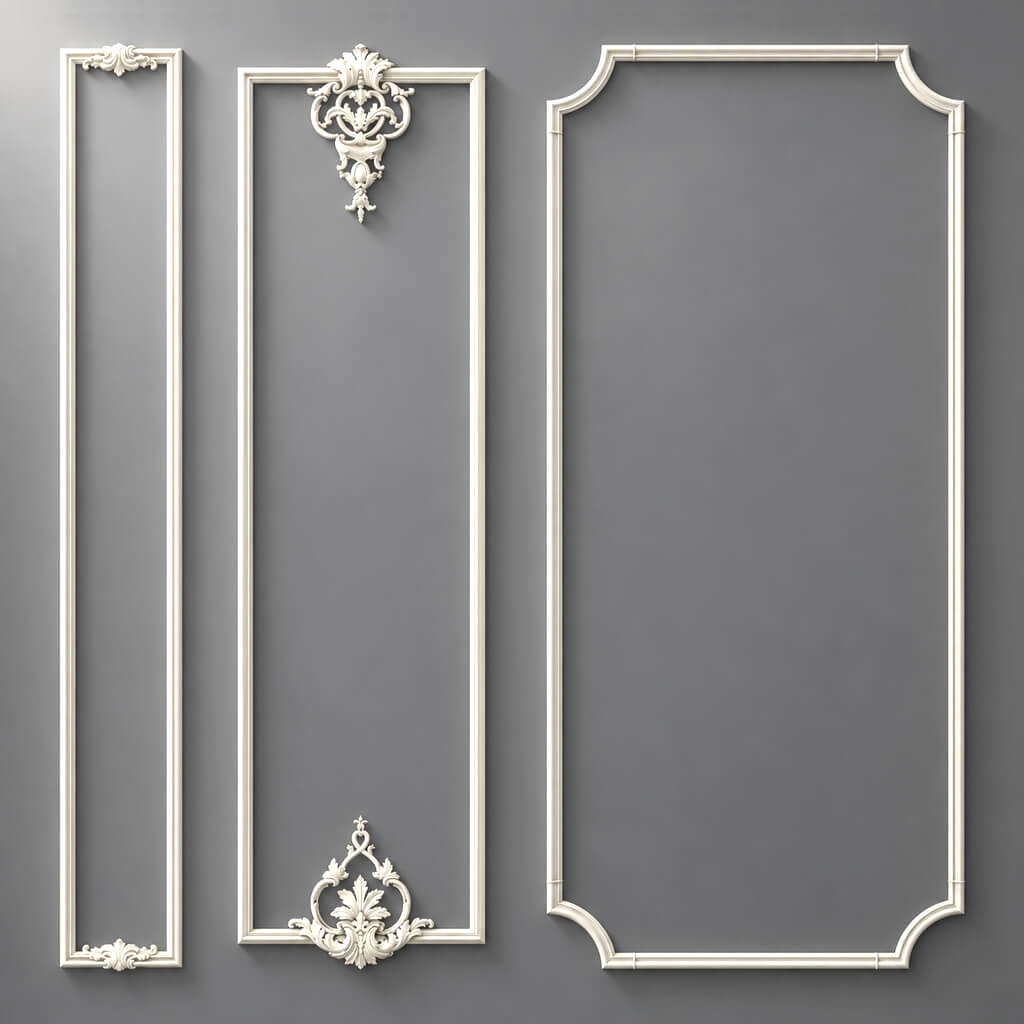
Creating rectangular or square frames from molding on the wall — an effective way to structure space. Inside the frames, you can use contrasting paint, patterned wallpaper, decorative plaster, creating visual accents.
In the bedroom, a frame behind the headboard forms a striking accent and visually highlights the sleeping area. In the living room, framed compositions are used to zone the TV area, fireplace, and bookshelves. In the dining room, symmetrical frames on the walls create a sense of formality and completeness.
For framed compositions, use high-profile molding 6-10 centimeters wide. It is important to maintain proportions — the height of the frame should relate to its width approximately as 1.618 to 1 (golden ratio). This creates a harmonious composition, pleasing to the eye.
Vertical zoning of space
Vertical moldings visually raise the ceiling, making the room appear taller and more slender. This technique is especially effective in rooms with low ceilings — vertical lines create an illusion of greater height.
You can create a rhythmic composition using several vertical elements placed at equal distances from each other. This is especially effective in long corridors and elongated living rooms — the repeating rhythm organizes space, making it more readable.
Accent walls with geometric compositions
A modern trend — creating complex geometric compositions from molding. Hexagons, rhombuses, trapezoids, forming a three-dimensional geometric pattern on the wall. Such an accent wall becomes the main decorative element of the interior, requiring no additional embellishments.
For geometric compositions, it is better to use smooth profiles without relief — wide-profile molding with minimalist design. Complex geometry itself creates visual interest; additional decoration would be excessive.
Framing functional elements
Doors, windows, niches, arches — all architectural elements of the room can be emphasized and enhanced using molding. Framing a door opening creates a portal effect, visually increasing the significance of the opening. Decorating a niche transforms a utilitarian element into a decorative accent.
Especially effective is framing mirrors and paintings. Instead of traditional frames, you can create framing directly on the wall using molding. This creates an effect of built-in decor, integrated into the room’s architecture.
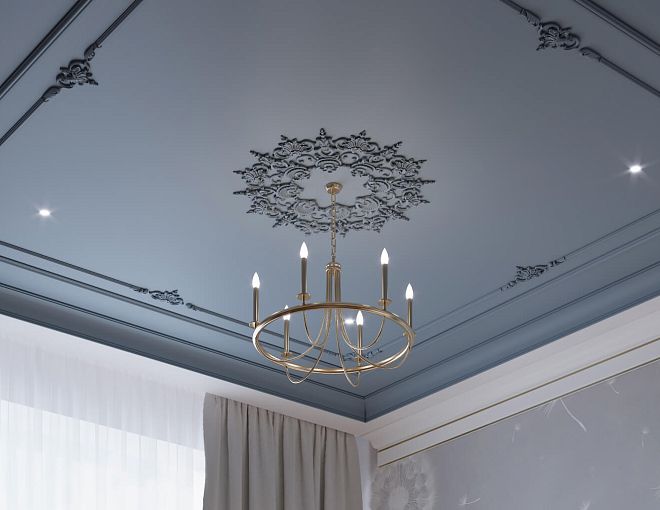
Ceiling moldings and multi-level compositions
Although we are talking about wall moldings, it is impossible not to mention the possibility of creating complex compositions that combine walls and ceilings. A wide cornice under the ceiling visually connects with vertical moldings on the walls, creating a unified architectural system.
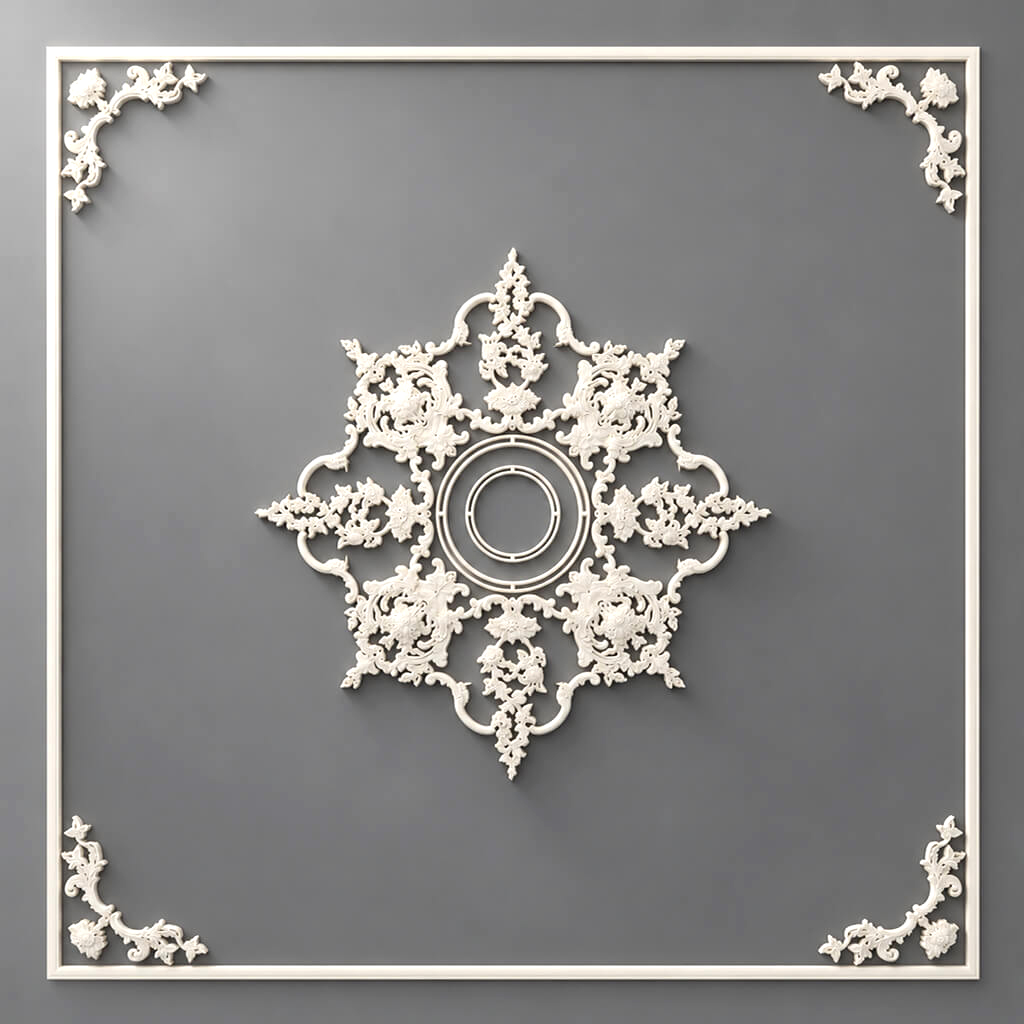
Multi-level compositions are especially effective, where moldings of different widths and profiles create an element hierarchy. Narrow strips frame large zones, while wide ones create main accents. Such an approach requires careful planning, but the result justifies the effort — the interior gains architectural complexity and depth.
Modern minimalism with moldings
Who said moldings are only for classic interiors? In modern minimalism, smooth, sleek profiles create clear graphics, structure space, without overloading it with details.
White moldings on white walls, visible only due to shadow play. Contrasting black strips on a light background, creating strict geometry. Moldings in wall color but with different textures — matte on glossy surfaces or vice versa. All of this — modern interpretations of classic techniques.
Combining with other materials
Moldings combine beautifully with various finishing materials. Wooden panels at the lower part of the wall, framed by molding, and painted upper part. Ceramic tiles in the bathroom with molding framing. Brickwork or concrete imitation, framed with polystyrene profiles.
Such combinations create interesting textural contrasts and allow using expensive materials sparingly, on small areas, framed by more affordable moldings.
Calculation and selection of profile: precision and harmony
Correct profile selection and accurate material calculation — the foundation of a successful project. Errors at this stage either lead to material shortages during installation or to excess material that remains unused.
Definition of optimal profile width
The molding width should correspond to the room's scale and ceiling height. There is a simple rule: the higher the ceiling, the wider the profile can be.
For rooms with ceilings 2.5-2.7 meters high: the optimal width for horizontal moldings is 5-8 centimeters. Wider profiles will visually overload the space. Vertical elements can be wider—up to 10 centimeters.
For high ceilings 3-3.5 meters: here you can use moldings with wide profiles up to 12-15 centimeters. In spacious rooms, such large elements look proportionate and create a sense of monumentality.
For low ceilings up to 2.5 meters: it is better to limit yourself to narrow profiles of 3-5 centimeters or entirely avoid horizontal moldings in favor of vertical ones, which visually elongate the space.
Choosing the degree of relief
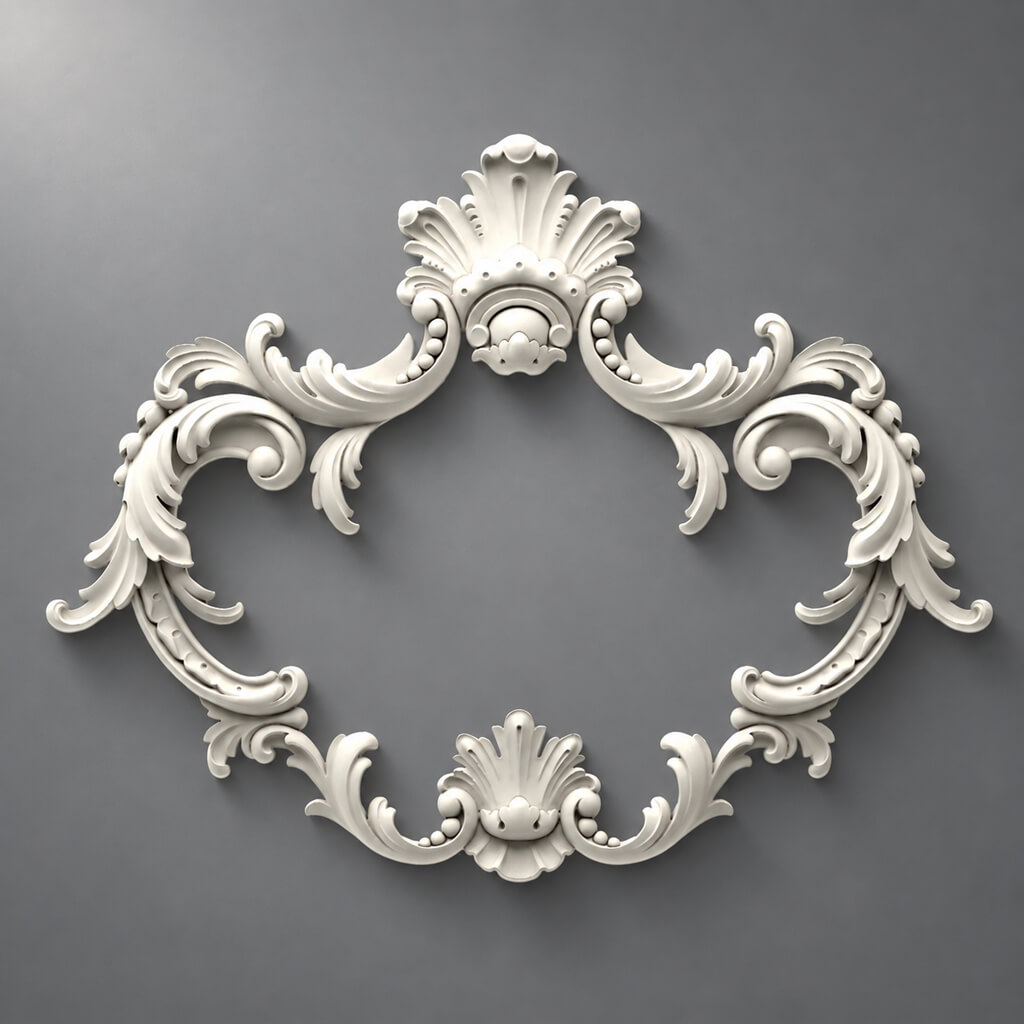
Relief molding with rich decoration suits classical and neoclassical interiors. Deep ornamentation creates play of light and shadow, adds volume and complexity. However, such profiles require careful maintenance—dust accumulates in the relief grooves.
Smooth or slightly relief profiles are universal. They suit both classical and modern interiors, are easy to maintain, and create clear graphics without excessive ornamentation.
When choosing, consider the overall interior style. In a minimalist space, heavily decorated molding will look out of place. In a classical interior, a too simple profile may appear dull.
Calculation of required quantity
Calculating horizontal molding: measure the room's perimeter (sum of all wall lengths) and add 10% for cutting angles and possible defects. If the room's perimeter is 18 meters, you will need approximately 20 meters of molding.
With a standard plank length of 2 meters, this will be 10 planks. However, it is better to take 11— one extra plank compensates for possible errors in cutting or accidental damage.
Calculating framed compositions is more complex. Draw a diagram of frame placement with dimensions, calculate the perimeter of each frame, add them up, and add 15% reserve. There are more angles, more cutting, and a higher risk of errors.
Selecting complementary elements
In addition to straight planks, corner elements may be needed for installation. The manufacturer hi wood produces ready-made internal and external corners for many popular profiles. Using such elements simplifies installation and guarantees perfect alignment.
If your profile does not have ready-made corners, you will need to cut the planks at 45 degrees using a miter saw. This requires precision, but with proper care, it yields excellent results.
Coordinating profiles of different elements
If moldings are used in the project,Baseboards and moldingsit is important to coordinate their profiles. They do not have to be identical, but should harmonize in style, degree of relief, and proportions.
Classic rule: the ceiling cornice should be wider than the wall molding, and the floor skirting should be wider or equal to the cornice. This creates visual stability—the base is stronger than the top.
Samples and testing
Before purchasing a large amount of material, order a sample—a small piece of molding. Attach it to the wall in the room and evaluate how it looks under real lighting conditions. What looks perfect on a picture or in a store may be perceived very differently in a specific interior.
Especially important when choosing profile width. The difference between a 6 cm and 8 cm wide molding seems insignificant on paper, but in a real room, these 2 centimeters can dramatically change perception.
Budget planning
How to cut polystyrene molding and how to cut polystyrene molding—questions that affect the project budget. For cutting, use a standard saw with fine teeth (1-1.5 mm), a miter saw for angles, and a stationery knife for finishing. This is simple and accessible equipment that is available in every household.
Professionals use a miter saw, which provides a perfectly straight cut. If you don't have such a tool, you can rent it for the installation period—it will cost 500-1000 rubles per day and significantly simplify the work.
In addition to the moldings, the budget must include adhesive (300-500 rubles per 10 meters of molding), sealant for joints (150-250 rubles per tube), primer, and paint for finishing.
Mounting and fastening: professional secrets
The quality of installation determines the durability and appearance of the decoration. The technology for installing wall moldings involves many nuances, knowledge of which distinguishes a professional result from an amateur one.
Wall surface preparation
The quality of adhesion depends 70% on the preparation of the base. The wall must be dry, strong, clean of dust, grease, and peeling coatings. Any defects in the base will become visible after installation as unevenness, gaps, or peeling.
If the wall has wallpaper, remove a strip 2-3 centimeters wider than the molding element at the mounting points. You can glue the molding over wallpaper, but the reliability of such mounting is questionable—you are gluing to the wallpaper, and the strength of the connection depends on the quality of wallpaper adhesion.
Loose, crumbling surfaces require strengthening with a deep-penetration primer. Apply the primer in two layers with an intermediate drying time of 4-6 hours. This creates a strong base capable of reliably holding the glued element.
Non-porous surfaces—ceramic tiles, oil-based paint, plastic panels—must be degreased with alcohol or special agents. You can lightly sand the surface with fine-grit sandpaper to create a microtexture for improved adhesion.
Accurate marking—foundation for even installation
Use a laser level to create a horizontal line at the desired height. If a laser level is not available, a water level can be used — mark a point at the required height on one wall, transfer this height to all corners of the room using a level, and connect the points with a line.
Mark not only the bottom edge of the molding but also the top — two parallel lines will help control horizontal alignment during installation. Do not rely on the ceiling or floor — they may be uneven. Trust only the level.
When creating framed compositions, mark the entire layout of all elements on the wall. Check for symmetry, equal distances, and correct angles. It is easy to correct errors during the marking stage, but difficult after gluing.
Choosing and Applying Adhesive
Use water-based adhesives to mount polystyrene moldings. Absolutely forbidden are compositions based on organic solvents — they destroy polystyrene.
Polymer adhesive for polystyrene is the optimal choice. It creates a strong, elastic bond, sets quickly (20–40 minutes), and allows for adjusting the position of the element.
Acrylic putty — a traditional method used by professionals. Apply putty to the back of the molding in a 3–5 mm layer, press it against the wall. Excess is squeezed out and immediately removed. The putty simultaneously adheres and fills irregularities, creating a perfect fit.
Acrylic-based mounting adhesive provides rapid setting and high strength. Apply in a zigzag pattern to the back of the molding, press the element against the wall, and secure with painter’s tape until drying.
Apply adhesive in a thin line with a 3–5 mm diameter. If the molding is wide (more than 8 cm), apply two parallel lines closer to the edges. Do not overdo it — excess adhesive will squeeze out during pressing and cause problems.
Technique for cutting angles
The most critical moment — creating corner joints. What tool to cut polystyrene molding for a perfect angle? For both internal and external corners, each element is cut at a 45-degree angle using a miter box.
Place the molding in the miter box with the front side up, press it tightly against the back wall. Carefully saw along the desired angle using a fine-toothed hacksaw. Saw smoothly without pressing down to avoid chipping the edge.
Before gluing, lay the cut elements against the wall dry, check the accuracy of the joints. If there is a small gap (up to 1 mm), this is acceptable — it will be sealed by the sealant. If the gap is larger, adjust the cutting angle.
Straight joints on long walls are made at a 90-degree angle. The ends must be perfectly flat and perpendicular. Place joints where they are less noticeable — behind curtains, above doors, or on wall sections covered by furniture.
Adhesive application and fixation process
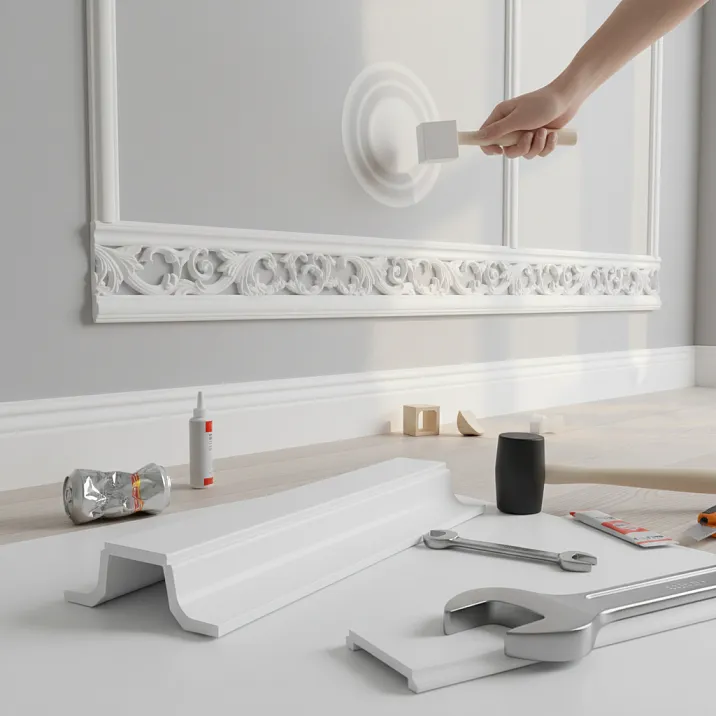
Apply adhesive to the back of the molding, press it against the wall, aligning the bottom edge with the marking. Press firmly along the entire length, checking the fit.
Some masters use the double-gluing technique: apply adhesive, press against the wall, wait 1–2 minutes, peel off, wait another minute, and press firmly. This technique increases bond strength, especially when using polymer adhesives.
Secure the molding with painter’s tape — one end on the molding, the other on the wall above. The tape will prevent the element from sliding under its own weight. After 12–24 hours, when the adhesive is fully dry, the tape can be removed.
Immediately wipe away excess adhesive squeezed out at the edges with a damp cloth. Do not wait for it to dry — it will be much harder to remove later.
Filling joints and gaps
After the adhesive dries, fill all joints and gaps with acrylic sealant or putty. Squeeze sealant directly into the joint from the tube, remove excess with a rubber putty knife or damp finger, forming a neat concave surface.
If a gap forms between the molding and the wall (due to an uneven base), fill it with sealant. For wide gaps, apply in multiple layers, allowing each layer to dry completely.
If using putty, apply it with a putty knife, smooth it, and after drying, sand it with fine-grit sandpaper (grit 180–220). Putty provides a stronger joint but requires additional finishing.
Additional mechanical fastening
For very wide and heavy moldings (wider than 12 cm), additional fixation may be required. Use thin finishing nails or decorative-headed screws.
Install fasteners at 50–70 cm intervals, driving the heads into the molding body by 1–2 mm. Fill the indentations with putty and sand after drying. After painting, the fastener locations become invisible.
Features of installation on different bases
Concrete and plastered walls: Standard base. The key is proper priming and a smooth surface.
Gypsum board: Lightweight moldings adhere without problems. Wide, heavy profiles are better mounted at locations of the frame studs with additional mechanical fastening.
Ceramic tile: Smooth, non-porous surface. Mandatory degreasing with alcohol and use of adhesive for non-porous surfaces.
Wooden panels: Use combined fastening — adhesive plus finishing nails. This ensures maximum reliability.
Painting and maintenance: Preserving the original appearance
Proper finishing protects moldings and gives them a finished look. Painting requires care, but the technology is simple and accessible even to non-professionals.
Preparation for painting
After the adhesive is fully dry and all joints are filled, prepare the surface. Light sanding with fine-grit sandpaper (grit 180–220) removes minor irregularities and improves paint adhesion.
Wipe moldings with a damp cloth to remove dust after sanding. Allow the surface to dry completely. Protect adjacent surfaces with painter’s tape — apply it tightly against the molding on the wall.
Apply primer. Acrylic primer creates an even, absorbent surface, reduces paint consumption, and improves adhesion of the final coating. Apply primer in a thin layer using a brush or mini roller, and allow to dry for 2-4 hours.
Paint Selection
Only water-based paints are suitable for painting polystyrene moldings. Organic solvent-based paints damage the material.
Acrylic paints are a universal choice. They dry quickly, have no odor, and create a durable finish. For interiors, matte or satin finishes are typically used—they create a noble surface without glare.
Latex paints form a stronger and more elastic coating. They are more expensive than acrylics but offer greater resistance to abrasion and moisture. Moldings painted with latex paint can be washed—ideal for kitchens and bathrooms.
Water-emulsion paints are a budget-friendly option with decent performance. However, the coating is less durable. Use this paint in rooms with low traffic.
Paint application technique
Apply paint in 2-3 thin layers with intermediate drying. The first layer is a base coat and may not be evenly applied—this is normal. Wait for it to dry and apply the second layer. A third layer is required when painting in dark, saturated colors.
Use a brush with a soft bristle width of 30-50 millimeters or a velvet mini roller. Brush strokes should follow the molding’s length to avoid crosswise streaks. Carefully paint textured areas, ensuring no paint accumulates in grooves.
Work carefully and without rushing. It is better to apply three thin layers than one thick layer. A thick layer causes runs, takes longer to dry, and may crack as it dries.
Creating Decorative Effects
Patina: After applying the base color, paint the recesses of the relief with a darker paint. Then partially wipe with a damp cloth, leaving the dark tone only in the recesses. This creates an aged, vintage effect.
Metallic finishes: Paints with metallic sheen (gold, silver, bronze) give moldings a luxurious look. Apply these paints over a white base in 2-3 layers for even coverage.
Two-tone painting: Paint the main body of the molding in one color, and the raised relief elements in another. This highlights the profile’s complexity and creates an interesting decorative effect.
Current care for painted moldings
Regular dust cleaning is the foundation of care. Wipe moldings with a dry or slightly damp soft cloth every 2-3 weeks. A vacuum cleaner with a soft attachment can also be used.
For stains, use mild cleaning agents—soap solution or dishwashing liquid. Wipe with a cloth, rinse with clean water, and dry thoroughly. Avoid abrasive cleaners and stiff brushes—they scratch the painted surface.
In kitchens, where moldings are exposed to grease, more intensive cleaning may be required. Use specialized kitchen degreasers, but avoid solvent-based products.
Local repair of damage
Minor scratches and scuffs can be easily repaired with local touch-ups. Clean the damaged area, lightly sand with fine-grit sandpaper, and apply paint in a thin layer with a brush. If you have leftover paint from the initial application, the color will match perfectly.
For deep chips and dents, fill with acrylic putty, level, and let dry. Sand, prime, and repaint. With proper execution, the repair area will be almost invisible.
Recoating
Over time, paint on moldings may fade, become dirty, or lose its freshness. Refreshing the coating is easy—lightly sand the surface with fine-grit sandpaper to improve adhesion, wipe away dust, and apply 1-2 layers of fresh paint.
Over time, paint on moldings may fade, become dirty, or lose its freshness. Refreshing the coating is easy—lightly sand the surface with fine-grit sandpaper to improve adhesion, wipe away dust, and apply 1-2 layers of fresh paint.
Complete removal of old paint is not required. STAVROS recommends repainting moldings simultaneously with wall repairs, every 5-7 years, or as needed.
Practical recommendations: tips from professionals
Years of working with the material have revealed many subtleties that may not be obvious to beginners but are critically important for achieving a high-quality result.
Material acclimatization
Delivered moldings must acclimate in the room where installation will occur for at least 24 hours. This is especially important if the material was stored in a cold warehouse and installation is being done in a heated room. Temperature acclimation prevents deformation after installation.
Unpack the strips and lay them horizontally on a flat surface. Do not leave them leaning vertically against a wall—long moldings may sag under their own weight.
Working with long elements
Two-meter-long strips are convenient for transport, but sometimes longer elements without joints are needed. Some manufacturers, including partner hi wood, can produce custom-length moldings up to 3-4 meters.
If working with standard two-meter strips, position joints as inconspicuously as possible. The ideal location for a joint is above a door frame, behind curtains, or on a wall section that will be covered by furniture.
Installation in challenging conditions
On uneven walls: If the wall has significant irregularities, the molding will not lie flat. Either level the wall with putty before installation, or use an elastic adhesive with high filling capacity. Fill wide gaps between the molding and wall with sealant in multiple applications.
On curved walls: Polystyrene molding has a certain degree of flexibility and can follow gentle curves with a radius greater than 2 meters. To replicate the curve, apply adhesive to the wall in 30-40 cm sections, press the molding into place, secure with tape, then move to the next section.
In humid areas: Use moisture-resistant adhesive and paint. Pay special attention to sealing joints — moisture must not penetrate under the molding. Use silicone sealant instead of acrylic.
Combination with stretch ceilings
When installing molding in a room with a suspended ceiling, remember: the molding must be attached only to the wall, not touching the ceiling. The suspended fabric is flexible, and if the molding is pressed against it, it will either detach from the wall or deform the ceiling.
Leave a 2-3 millimeter gap between the molding and the ceiling. This gap will be invisible, especially if the molding and ceiling are the same color.
Working with "warm floor" and "warm walls" systems
If wall heating systems are installed in the room, ensure that surface temperature does not exceed 50-60 degrees. At higher temperatures, polystyrene may soften and deform.
In areas of intense heating (above radiators, near fireplaces) it is better to use more heat-resistant materials — polyurethane ordurable polymer moldingwhich withstands temperatures up to 80-90 degrees without changing properties.
Savings without loss of quality
If budget is limited, you can use a combined approach: install impact-resistant molding in high-risk zones (hallway, kitchen), and in bedrooms and offices where loads are minimal — standard polystyrene. This will save 15-20 percent of the budget without significant loss of functionality.
Another way to save money — using simpler profiles. Smooth moldings without complex relief are 20-30 percent cheaper for comparable sizes and strength characteristics.
Typical mistakes and how to avoid them
Installing without marking leads to uneven installation, misalignment, and asymmetrical compositions. Always use a level and make precise marking.
Using inappropriate adhesive (on solvents) destroys the material. Check the adhesive composition before application.
Insufficient fixation during drying leads to sliding of wide moldings. Use painter’s tape or supports.
Thick paint layers cause runs and uneven coverage. Better to apply three thin layers than one thick one.
Ignoring material acclimatization may lead to deformations after installation. Allow moldings to acclimate in the room for 24 hours.
When to consult professionals
Simple projects — horizontal molding around the room perimeter, a few frames on the wall — are suitable for DIY. Complex compositions with many elements, curved structures, and large volumes of work are better entrusted to professionals.
Assess your capabilities realistically. Poorly executed installation will cost more — you’ll have to dismantle, buy new material, and redo the work. Sometimes it’s wiser to pay professionals upfront rather than save money and get unsatisfactory results.
Combining with other decorative elements
Moldings combine beautifully with other decorative elements. Light switch plates under chandeliers, pilasters in room corners, cornices under ceilings — all can be unified into a single system. The hi wood manufacturer produces comprehensive collections where all elements are designed in a unified style.
Do not overdo it. Excessive decoration may overload the interior, making it look tacky. Follow the principle: "better less, but better." A few expressive accents are more effective than many small details.
Popular questions about impact-resistant polystyrene wall moldings
How does impact-resistant polystyrene differ from standard?
Impact-resistant material contains rubber additives (polybutadiene), which increase viscosity and resistance to destruction under impact by 8-10 times. Visually, moldings are practically indistinguishable; the difference becomes apparent during use.
Can such moldings be used on facades?
Not recommended. Polystyrene degrades under ultraviolet exposure; even with protective coating, its service life on facades will be 2-3 years. For outdoor use, use facade molding made of polyurethane, phytopolymer, or composite materials specifically designed for extreme conditions.
What adhesive is best for installation?
The optimal choice is a specialized water-based polymer adhesive for polystyrene or acrylic putty. Organic solvent-based compositions are strictly prohibited — they destroy the material. The hi wood manufacturer recommends using acrylic or MS-polymer-based adhesives.
How long does installation take?
In a standard 18-20 square meter room, installing horizontal molding around the perimeter takes 4-6 hours including marking and trimming. Complex framed compositions may require 1-2 days of work. Plus 24 hours for adhesive drying and another day for painting.
When can you paint after installation?
You can paint after 24 hours from application, when the adhesive has fully polymerized. If you use putty to fill joints, wait for it to dry — usually another 12-24 hours depending on layer thickness and room humidity.
How to care for moldings in the kitchen?
Regularly wipe with a damp cloth and mild detergent, removing grease deposits. Do not use abrasive cleaners or solvent-based products. For kitchens, choose smooth profiles without deep relief — they are easier to clean from dirt.
Can moldings be installed on wallpaper?
Technically possible, but the reliability of the mounting will depend on the quality of the adhesive bond of the wallpaper itself. For a long-lasting result, it is better to remove wallpaper in the mounting areas using a strip slightly wider than the molding element, ensuring direct contact between the adhesive and the wall.
What to do if the walls are uneven?
Minor irregularities are compensated by adhesive or spackle. In case of significant defects, it is better to level the wall before installation. Wide gaps between molding and wall should be filled with acrylic sealant or spackle in several stages with intermediate drying.
How long do impact-resistant moldings last?
With proper installation and under normal operating conditions — 15–20 years in residential spaces, 10–15 years in commercial spaces with high traffic. These are real service life durations, confirmed by practice. With careful handling, service life can reach 25–30 years.
Do you need to remove the moldings during the next renovation?
Not necessary. If the moldings are in good condition, they can simply be repainted along with the new wall finish. This saves time, money, and materials. Demolition is required only in case of serious damage or complete change of interior concept.
What distinguishes duro-polymer from regular polystyrene?
Duro-polymer molding and fito-polymer molding are trade names for modified polymer materials with increased density and strength. They are heavier than regular polystyrene but lighter than polyurethane, occupying an intermediate position in terms of characteristics and price. The main advantage is increased resistance to mechanical loads and temperature effects.
Conclusion
Wall molding made of impact-resistant polystyrene is a technologically advanced solution for creating a durable and aesthetically perfect interior. The material’s strength and longevity combine with an affordable price, ease of installation, and wide possibilities for creative realization of design ideas.
Interior solutions using impact-resistant moldings open new horizons for space design. From classic panel finishes to modern geometric compositions — the material allows any concept to be realized. Molding large, molding high profile, molding wide profile, molding relief — the variety of shapes and sizes offers freedom of choice for any interior style.
Decorative wall finishing with impact-resistant moldings is an investment in quality of life. In commercial spaces, it saves on maintenance and repairs. In residential interiors — assurance that beauty will remain unchanged for many years. Installing wall molding is accessible even to non-professionals, and the result looks like work by an experienced craftsman.
The strength and durability of impact-resistant polystyrene have been proven over time and intensive use in thousands of installations. The material withstands accidental impacts, temperature fluctuations, humidity, regular cleaning — all the tests encountered in real life. At the same time, it retains the ease of installation and accessibility characteristic of polymer materials.
Company STAVROS, in partnership with leading manufacturer Hi Wood, offers professional solutions for decorative interior finishing. Wide assortmentmoldings made of polystyrene and polyurethaneincludes profiles of various widths, relief levels, and styles — from classic ornamental to modern minimalist.
Expert consultation from STAVROS specialists will help select the optimal type of molding for a specific project, calculate the required amount of material, choose complementary elements and consumables. The quality of the products, certified and proven by years of practice, guarantees successful implementation of projects of any complexity.
Buy polystyrene molding today — it means ensuring your interior with reliable protection and flawless aesthetics for many years. Create spaces where beauty is indestructible and elegance is eternal. Choose materials proven by time and trusted by professionals. Invest in quality that pays off every day through flawless interiors.