








































































Article Contents:
- An author's table starts with an idea, not with a random purchase of parts
- What can be created from STAVROS components
- Which components are involved in the project
- Project base: wooden table legs
- Straight Legs
- Turned legs
- Carved legs
- Curved and expressive legs
- Underframe for a stable table
- Individual legs for a light silhouette
- Underframe for round tabletop
- Legs for a square or rectangular tabletop
- Classic
- Neoclassicism
- Art Deco
- Modern style
- Vintage and Restoration Project
- Choose unusual legs
- Add carved overlays
- Use wooden rosettes as an accent
- Paint the components in a single color
- Combine wood with stone, glass, or a ready-made tabletop
- Need to make a coffee table for the living room
- Need to make a round coffee table
- Need to make a side table
- Need to make a table for a salon or showroom
- Need to make a table for painting
- Need to create an item for a design project
- Start with decor, not with construction
- Choose legs only based on a photo
- Overload the table with carving
- Not thinking through the tabletop
- Confuse the overlay with the load-bearing part
- Not accounting for finishing
- Expecting a fully finished table
- Is it possible to make a custom table using only STAVROS components?
- What is better for a coffee table: legs or a base?
- Which legs to choose for a classic table?
- Which legs to choose for a modern interior?
- Can carved overlays be used on the table?
- How do rosettes differ from overlays?
- How to make a coffee table yourself without it looking homemade?
- Can I use a ready-made tabletop?
- What to buy together with wooden legs?
- Is such a project suitable for a cafe or salon?
- Do I need to choose all details in one color?
- What should I check before ordering?
- Can I make a round coffee table?
- When is it better to avoid carved decor?
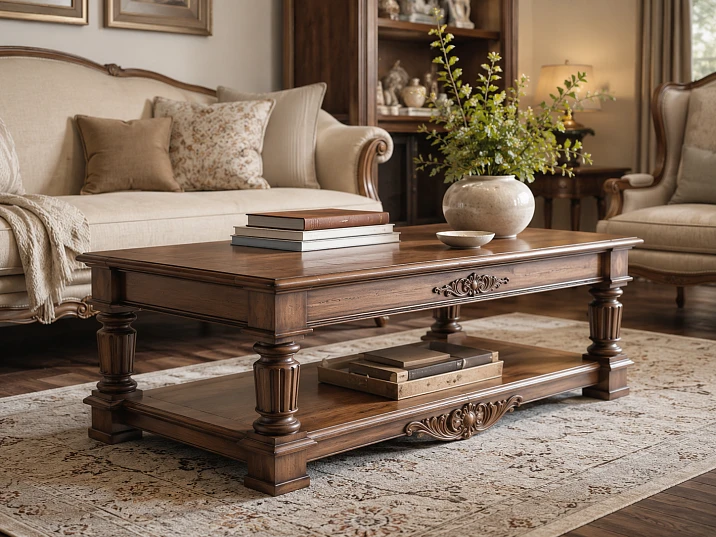
A coffee table is rarely the main item in a room, but it often gathers the entire interior around itself. A coffee cup is placed on it, a book is laid on it, and next to it stand a sofa, an armchair, a rug, a floor lamp, and a decorative vase. If the table is chosen randomly, it just takes up space. If it is carefully thought out, it connects the furniture, finishes, and mood of the room into one cohesive picture.
When a person wants to buy table legs, it is often not just about repairing old furniture. More and more often, the buyer is looking for a way to create a custom piece: a coffee table for the living room, a side table next to an armchair, a small coffee table for a salon, a decorative item for a showroom, hotel, or apartment with an individual interior. In such a project, legs, underframes, tabletops, and carved decor work together, not separately.
STAVROS components allow you not to start complex furniture work from scratch. You can choose ready-made wooden legs, select an underframe, add carved overlays or rosettes, and then connect these parts with a tabletop of the desired shape. This path is especially interesting for designers, craftsmen, decorators, and those who want not a standard table from a store, but a piece made for a specific space.
A custom table begins not with the question “what to buy,” but with an idea: what it should look like, where it will stand, what role it will play, how noticeable it will become in the room. One interior needs a light table on thin legs. Another needs a sturdy wooden underframe for a round tabletop. A third needs an expressive carved support that turns the furniture into an accent. The more precisely the idea is formulated, the easier it is to choose components and not overload the table with unnecessary details.
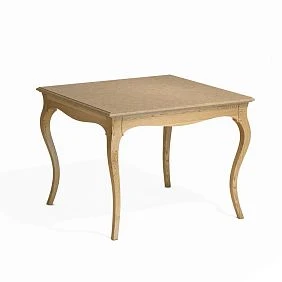
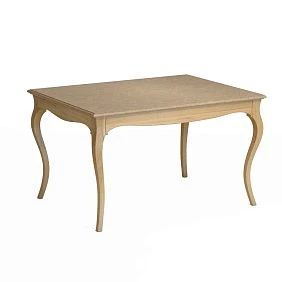
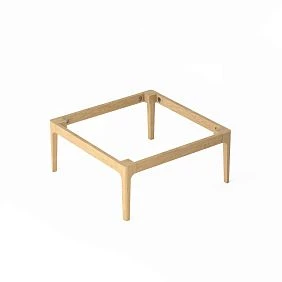
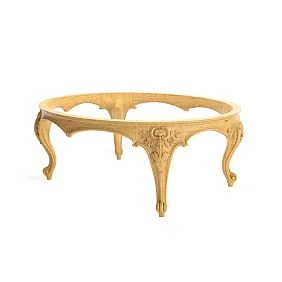
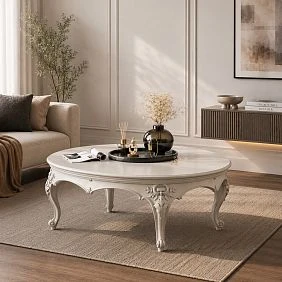
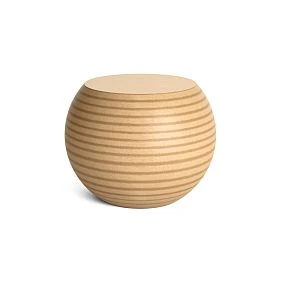
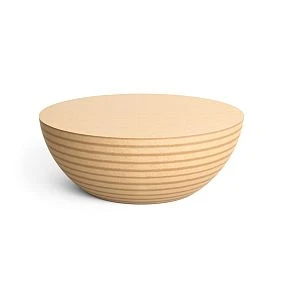
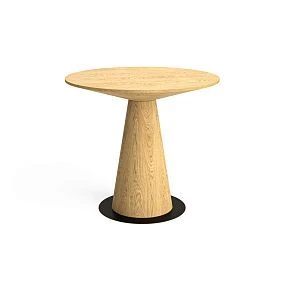
A custom table starts with an idea, not with a random purchase of parts
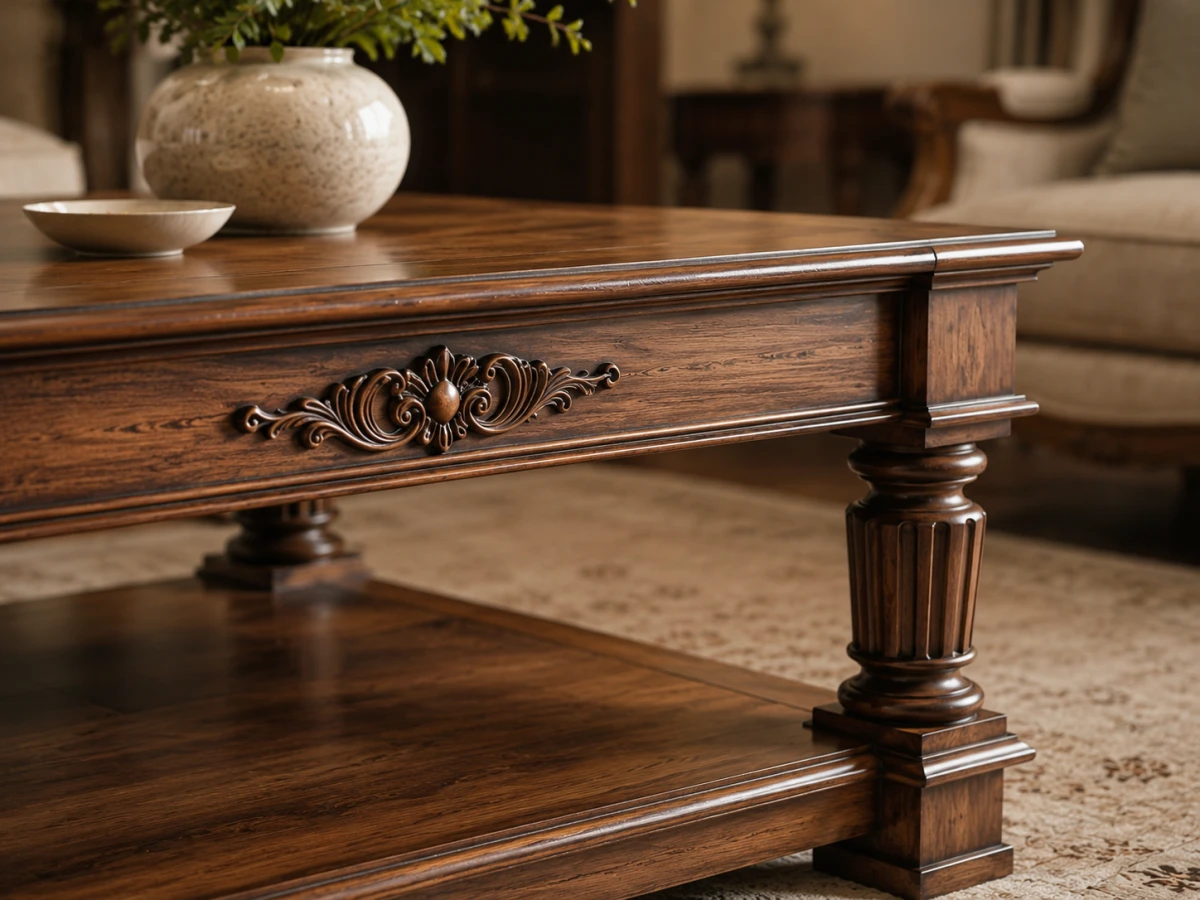
An ordinary coffee table is bought by size, color, and price. A custom table is assembled differently. First, an image appears: a low table by the sofa, a round table in the relaxation area, a decorative piece for a lounge zone, a pair for armchairs, a small table by a display case, or an expressive centerpiece in the living room. And only then are the legs, underframe, tabletop, and decor selected to match this image.
The main difference between standard furniture and a custom piece is in thoughtfulness. A standard table simply fits the dimensions. A custom table answers the interior's task: makes the room warmer, emphasizes the style, adds wooden texture, supports carved decor, connects the sofa with armchairs, helps create an atmosphere in a salon or showroom.
That is why you should not start a project with the first detail you like. A carved leg may be beautiful on its own but not suit the tabletop. An underframe may look solid but turn out too heavy for a small coffee table. A decorative rosette may look good in a photo but get lost on a massive base or, conversely, overload a small table.
Ready-made components speed up the work but do not eliminate the choice. They provide a foundation to move forward from: not carving a complex leg by hand, not searching for random supports, not assembling a base from unsuitable parts, but focusing on shape, proportions, finish, and the overall composition.




What can be created from STAVROS components
From wooden legs, underframes, and decorative elements, you can assemble not only a classic coffee table. There are more possibilities, and each requires its own logic.
A coffee table for the living room should be comfortable next to the sofa. It should not obstruct passage, visually weigh down the carpet, or clash with the upholstered furniture. Height, stability, tabletop shape, and base character are important for it. If the living room is calm, the legs can be minimalist. If the interior is classic or neoclassical, turned or carved elements can be added.
A side table works differently. It often stands next to an armchair, sofa, bed, or in a corner of the room. Its task is to be light, mobile in perception, and not overload the space. Here, individual legs can be better than a massive underframe if the tabletop is small and the project is calculated correctly.
A console table is closer to decorative furniture. It can stand in the hallway, behind the sofa, in the bedroom, hall, salon, or showroom. Its silhouette is especially important. The legs and underframe here are often more visible than the tabletop itself, so the base must be chosen with particular care.
A small coffee table for a cafe, hotel, waiting area, or salon should be not only beautiful but also practical. It is seen by different people, used frequently, and people move around it. In such a project, stability, finish, ease of maintenance, and the correct scale of decor are important.
A decorative table for a showroom, boutique, or interior exhibition can be bolder. Expressive legs, carved base, accent rosettes, and contrasting finishes are acceptable here. But even such an item should not turn into a set of decorations. Decor only works when it is subordinated to the overall idea.
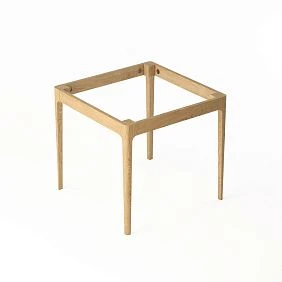
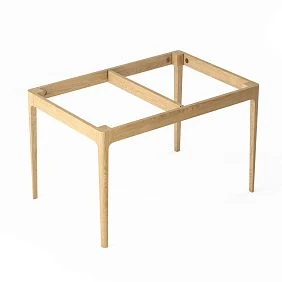
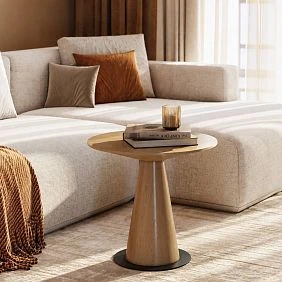
Our factory also produces:

Which components are involved in the project
To make the table cohesive, it is useful to understand the role of each detail in advance. Legs hold the tabletop and define the silhouette. The underframe helps assemble a stable base. Overlays add relief. Rosettes provide a point decorative accent. All of this can be combined, but not necessarily used all at once.
| Project detail | What it's for | When it is especially useful | What to check before ordering |
|---|---|---|---|
| Wooden table legs | Support the tabletop, set the height and character of the table | For coffee, side, cocktail, or decorative tables | Height, shape, material, attachment method, compatibility with tabletop |
| Underframe | Helps assemble a stable base | For round, heavy, or more substantial tables | Dimensions, shape, purpose, compatibility with tabletop |
| Unpainted legs | Suitable for painting, tinting, and finishing per project | For custom furniture, designer tables, designer interiors | Preparation for finishing and current parameters in the card |
| Carved overlays | They decorate the tsarga, side part, base or decorative panel | For classic, neoclassic, vintage and expressive projects | Size, relief, installation location, compatibility with legs |
| Wooden rosettes | Create a small accent | For facades, side panels, tsargas, decorative surfaces | Size, shape, placement location |
| Specific leg models | Help choose the exact character of the base | When you need not an abstract idea, but a real detail for the project | Article number, dimensions, material, finish and purpose in the product card |
This table shows the main thing: a table is not assembled from random beautiful parts. Each part has its own job. A leg does not replace the underframe, an overlay does not hold the tabletop, a socket does not work as a load-bearing element. The clearer the roles, the calmer and more expensive the finished furniture looks.
Get Consultation
Project foundation: wooden table legs
Legs are the most noticeable way to change the character of a table. The same tabletop on different supports will look different. On straight legs, it will become calm and modern. On turned legs, it will be soft and more classic. On carved legs, it will be expressive. On curved or unusually shaped legs, it will be closer to a designer piece.
If a project starts with finding a base, it is worth first buy wooden table legs and only then selecting the tabletop, finish, and decor. This is especially important for small coffee tables, where the legs are almost at eye level of a seated person and greatly influence the perception of the entire piece of furniture.
For a wider selection, you can look at furniture legs and supports STAVROS. This section is convenient when the project is not yet limited to just a coffee table: perhaps a console, cabinet, decorative stand, or another item in the same style will appear nearby.
Straight legs
Straight legs are suitable for calm interiors. They do not take all the attention, work well with rectangular and square tabletops, support a modern style, and do not overload a small room.
This option is especially appropriate if the tabletop itself is expressive: made of wood with a beautiful texture, stone, glass, or a material with a noticeable pattern. In this case, the base should support the shape, not compete with the top part of the table.
Straight legs are also good for those assembling a table with their own hands for the first time. With them, it is easier to imagine the final silhouette, easier to calculate the visual mass, and easier to avoid excessive decorativeness.
Turned legs
Turned legs add softness and a traditional character to furniture. They are well suited for classic, neoclassic, calm vintage, interiors with wooden doors, frames, moldings, carved elements, and warm finishes.
If you need a neat but noticeable option, you can consider a detail such as turned furniture leg MN-124. Before ordering, you need to check its parameters in the product card and understand whether the height and shape are suitable for the future tabletop.
Turned legs look especially good paired with painted or tinted finishes. If the entire set will be customized for the project, it is useful to choose unfinished solid wood furniture legsso that the legs, apron, underframe, and decorative details do not clash in color.
Carved legs
A carved leg makes the table more expressive. It is suitable where the base should be not just a support but part of the image. This could be a coffee table for a classic living room, a decorative table for a hotel, an accent piece for a salon, or custom furniture for a showroom.
For example, if the project requires a more prominent base, you can look at the carved furniture leg MN-035. But carving requires moderation. If the legs are already active, it is better to keep the tabletop and additional decor more subdued.
A carved leg does not tolerate random neighbors well. A too modern tabletop, unsuitable finish, or extra decorative elements can ruin the impression. Therefore, you first need to decide what will be the main accent: the shape of the legs, the tabletop, the color, or the carved decor.
Curved and expressive legs
Curved legs help make the table more lively. They can add movement, softness, almost a sculptural character. This option is interesting for a custom coffee table where the base should stand out.
But an expressive form requires precise balance. If the tabletop is round, curved legs can support its softness. If the tabletop is rectangular, they can create an interesting contrast. But if you add more active overlays, sockets, and complex finishes, the table will quickly become heavy in appearance.
When to choose an underframe, and when to choose separate legs
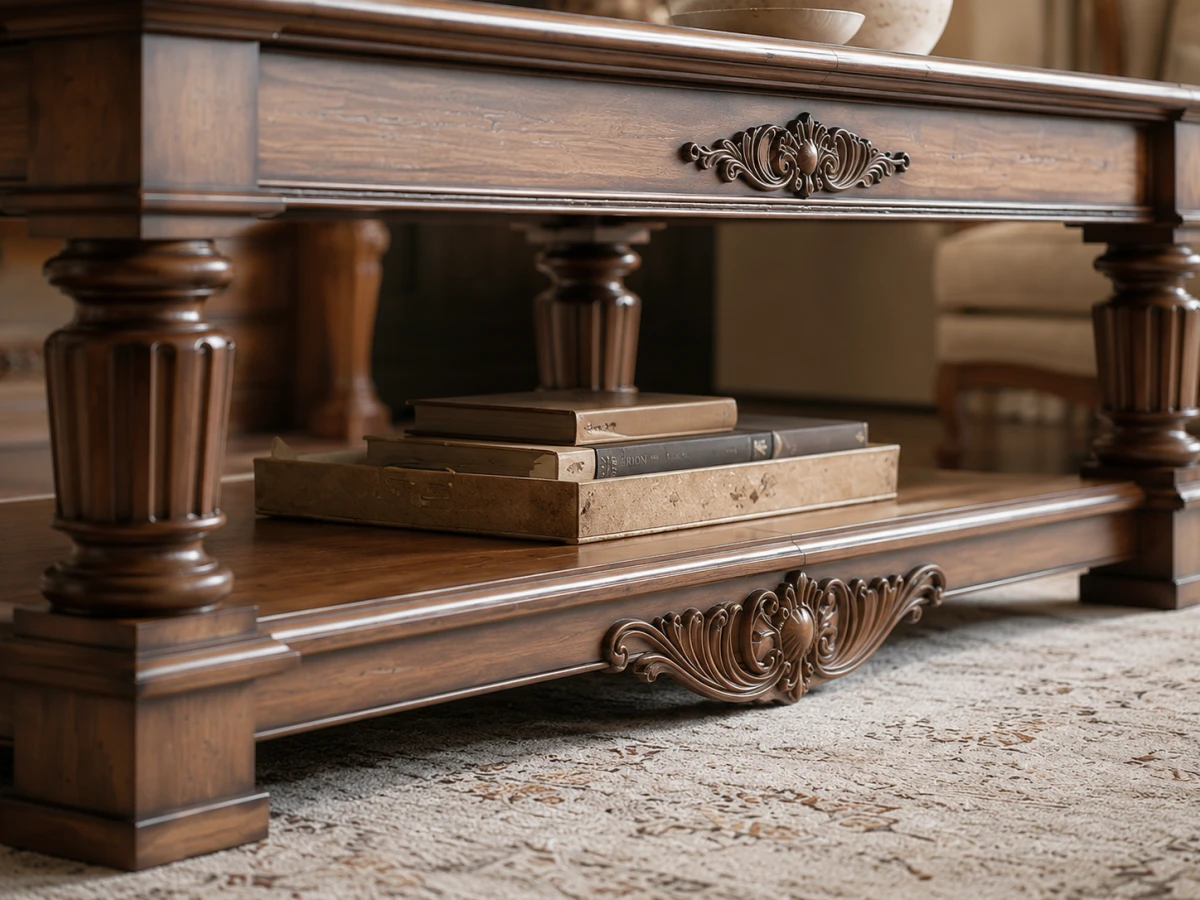
Individual legs and an underframe solve different tasks. Legs provide freedom of form. An underframe helps to quickly obtain a solid base and stable geometry. The choice depends on the size of the tabletop, weight, shape, style, and the craftsman's experience.
If you need a lightweight coffee table with a unique silhouette, individual legs offer more flexibility. They can be arranged under a specific tabletop, choosing the shape, height, and character. This is especially interesting for custom pieces where not only stability but also the image matters.
If you need a more cohesive structure, consider buying a wooden table underframe. An underframe helps avoid assembling the base from random individual elements and often looks more finished.
For a wider selection of furniture bases, it's useful to look at furniture frames and solid wood underframes. This option is suitable if the table is part of a larger project: a cabinet, console, bench, counter, or other item made from wooden components is planned nearby.
Underframe for a stable table
An underframe is especially useful if the tabletop is heavy, round, large, or needs to stand very securely. It helps distribute the load and makes the base visually cohesive. For a coffee table, this is important because it is often used in the center of the room, near a sofa, armchairs, rug, and walkway area.
When choosing a table base, you need to look not only at beauty. It is important to understand whether it is suitable in size, height, purpose, and attachment method. It is better to check the relevant parameters in the product card or clarify with a STAVROS manager.
Individual legs for a light silhouette
Individual legs give more air. A table on such supports seems lighter, especially if the tabletop is small. This is a good path for a side table, a small coffee table, a low table by the sofa, or a pair of tables of different heights.
Proportions are especially important here. A thin leg under a heavy tabletop looks unsteady. Too massive a leg makes a small table rough. The leg must match not only the weight but also the visual scale of the item.
Underframe for a round tabletop
A round tabletop requires a careful base. If the legs are poorly positioned, the table may look random or be uncomfortable. The table base often helps to gather the center and make the furniture calmer.
A round coffee table looks good in a lounge area with a sofa, armchairs, a rug, and soft lighting. It has no sharp corners and fits more easily into the room's flow. But the base must support this softness: too sharp or heavy details can disrupt the balance.
Legs for a square or rectangular tabletop
A square or rectangular tabletop is easier to read in an interior. It is easier to choose straight or turned legs for it, and easier to work with corners and offsets. Such a table can be calm, strict, classic, or decorative — it all depends on the shape of the supports and the finish.
For a rectangular coffee table, it is important not to make the base too sparse. If the tabletop is long, you need to consider stability and load distribution. Sometimes individual legs must be supplemented with a more rigid structure or a different attachment method.
How to choose the style of the future table
The style of a table is defined not only by the shape of its legs. It is influenced by the tabletop, finish, color, decor, height, proportions, and even its place in the room. But the legs and underframe do give the first strong signal.
Classic
A classic table loves clear proportions, warm wood, turned or carved forms. Expressive legs, a calm tabletop, and decorative overlays on the apron or side are appropriate here. But classic does not mean excess. Even in such a style, the piece needs room to breathe.
If carved legs are chosen, overlays should be used sparingly. If the base is calmer, the decor can be slightly more noticeable. The main thing is not to turn the table into a collection of separate decorations.
Neoclassicism
Neoclassicism requires a finer balance. Turned legs, a neat underframe, restrained finish, one expressive detail instead of several work well here. The table should look thoughtful but not heavy.
For a neoclassical interior, a scheme often works: a wooden base, a neat tabletop, a calm color, and one decorative accent. This could be an overlay, a rosette, or a beautiful leg shape.
Art Deco style is renowned for its love of ornamentation, symmetry, and refined details. The molded decoration NPU-422 can become an excellent complement to geometric motifs and contrasting color combinations characteristic of this style. Try highlighting it with metallic paint or patina — and you’ll get an eye-catching detail that’s hard to look away from.
Art Deco loves expressiveness, geometry, contrasts, and confident forms. For such a project, you can choose bolder legs, contrasting finishes, an interesting tabletop. Carved decor is also possible, but it should look like part of the overall image, not random classicism.
Here it is especially important not to mix too many motifs. If there is strong geometry, the carved decor must be very precise. If the base is already complex, it is better for the tabletop to be calmer.
Modern Style
A modern coffee table can be very different. Sometimes it is a simple wooden construction. Sometimes it is a combination of wood with glass, stone, or a painted tabletop. Straight or geometric legs, a calm underframe, and a minimum of carved decor work well in this style.
If you want to add an authorial character, you can do it not with the number of decorations, but with the precise shape of the base, contrast of materials, or neat finishing.
Vintage and restoration project
A vintage table requires respect for the character of the piece. If an old tabletop or a restored element is used, new legs should not argue with it but support it. Turned and carved forms can be very appropriate here.
But a restoration project can easily be ruined by excessive decor. It's better to keep one main line: age, wood, shape, carving, or finish. The other details should help, not argue.
How to make a coffee table expressive
Expressiveness doesn't always mean a lot of decor. Sometimes unusual legs are enough. Sometimes the right underframe. Sometimes a single carved detail that supports the overall style. A good table doesn't shout about itself, but confidently takes its place.
Choose unusual legs
Legs can become the main accent. This works especially well if the tabletop is simple: round wooden, rectangular painted, glass, or stone. Then the eye calmly moves down to the base, and it is this that makes the piece authorial.
If the legs are expressive, there's no need to immediately add many overlays and rosettes. It's better to first assess the silhouette. Sometimes the very shape of the supports already makes the table interesting enough.
Add carved overlays
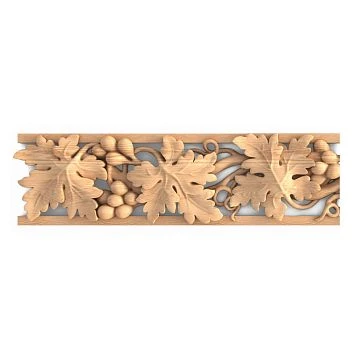
Carved overlays can be used on the apron, side parts, decorative panel, or base. They should not bear load, but help make the structure look richer. Before ordering, it's worth choose carved overlays for furniture and understanding exactly where they will be placed.
If you need a ready-made expressive set for the decorative part of the project, you can look at C-030 Decorative Set for FurnitureBefore purchasing, it is important to check the dimensions and ensure that the components fit the future base.
Use wooden rosettes as an accent
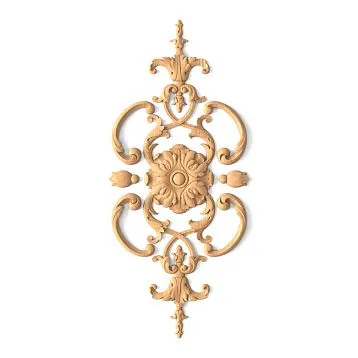
Rosettes work well where a large overlay is already unnecessary. They can decorate the center of the apron, side panel, decorative insert, or a small surface under the tabletop. If you need to add an accent without overloading, you can buy wooden rosettes for furniture decoration.
The rosette should have a clear place. If placed randomly, it will look like decoration for decoration's sake. It is better to draw or at least imagine the base facade in advance: where the legs are, where the apron is, where the free field is, and where the relief will be.
Paint the components in a single color
One powerful way to make the table cohesive is to finish the components in a single color. Legs, underframe, overlays, and rosettes can be brought to the same tone if the selected items are suitable for such work.
This approach is especially good for design projects where the table must match an exact shade: milky, graphite, warm wood, dark, light, or colored. If parts are purchased without coating, preparation and final finishing need to be planned in advance.
Combine wood with stone, glass, or a ready-made tabletop
A wooden base pairs well not only with a wooden tabletop. Stone makes the table more substantial, glass lightens the look, and a painted tabletop allows matching the interior color. But the more active the tabletop, the calmer the base should be.
If the tabletop is heavy, stability becomes the main concern. Beautiful legs must support not only the visual task but also the actual structure. Therefore, dimensions, fastening, and compatibility need to be checked before purchase.
What you don't have to make from scratch
An author's project doesn't mean every detail has to be cut by hand. On the contrary, ready-made elements help make the work more precise. The buyer or craftsman can focus on the tabletop, finishing, assembly, and the overall idea, while taking complex details as ready-made.
You don't have to make a carved leg yourself if you can choose a ready-made model. You don't have to look for random supports without a clear purpose. You don't have to cut decorative overlays by hand if you can select ready-made elements to match the style. You don't have to assemble a base from parts that aren't designed for furniture tasks.
This is especially important for those who want to make a coffee table themselves. DIY work shouldn't turn into a struggle with every complex operation. It's much smarter to take ready-made legs, underframe, or decor, and direct your attention to proportions, finishing, fastening, and neat assembly.
This approach helps avoid the main mistake of home projects: when the table is interesting in concept but looks amateurish due to random parts. Ready-made components provide a more confident foundation.
What to buy together for an author's table
Buying one detail rarely covers the entire project. If you choose only legs, you need to figure out how they will connect to the tabletop. If you choose an underframe, you need to decide if decor is needed. If you add overlays, it's worth checking if a rosette or unified finish is required.
| Main detail | What to add | Why this is needed | Which project it suits |
|---|---|---|---|
| Wooden table legs | Underframe or frame part | To make the table stable and geometrically aligned | Coffee table, side table, living room table |
| Underframe | Carved overlays | To make the base look more expressive | Classic, neoclassical, designer furniture |
| Carved legs | Wooden rosettes | To add a point accent without overloading | Decorative table, salon, hotel, showroom |
| Unpainted legs | Uncoated overlays | To finish the set in one color | Custom furniture, designer project |
| Simple legs | Decorative rosettes | To add a small detail without heavy carving | Modern interior with a soft accent |
| Underframe | Tabletop of the right shape | To make the project not only beautiful but also convenient | Round, rectangular, or square table |
| Turned legs | Calm tabletop | To maintain balance between the shape and the top surface | Classic living room, bedroom, study |
You don't have to buy everything at once. But you need to think in terms of a set from the very beginning. If you first buy active carved legs, then large overlays, then a tabletop with a bright pattern, the result may be too heavy. It's better to choose one main accent and subordinate the rest of the details to it.
How not to confuse similar elements
Furniture components are easy to confuse, especially if the project is being done for the first time. Legs, underframes, frames, overlays, rosettes, and brackets can be wooden and decorative, but their purpose is different.
Table legs are load-bearing elements. The tabletop rests on them. They affect height, stability, and silhouette. They cannot be replaced with a carved overlay, baluster, or random blank without checking their purpose.
The underframe is the base of the table. It helps assemble the structure, provides geometry, and supports the tabletop. The underframe is especially useful if a more confident base is needed or if the tabletop requires a stable foundation.
Furniture legs are a broader concept. They can be used not only for a table but also for a cabinet, chest of drawers, sofa, armchair, or other furniture. Therefore, when choosing, you need to look at the purpose of the specific model.
Carved overlays are decorative details. They adorn the base, apron, side, front, or panel, but are not a load-bearing structure. They cannot be used instead of a support.
Wooden rosettes are point decor. They are suitable for a small accent on the front, apron, decorative panel, or side. A rosette does not replace an overlay where an extended relief is needed and does not function as a fastener.
Brackets are better considered for shelves, consoles, and wall-mounted solutions. For the main structure of a coffee table, they do not replace legs or an underframe.
Practical selection for different tasks
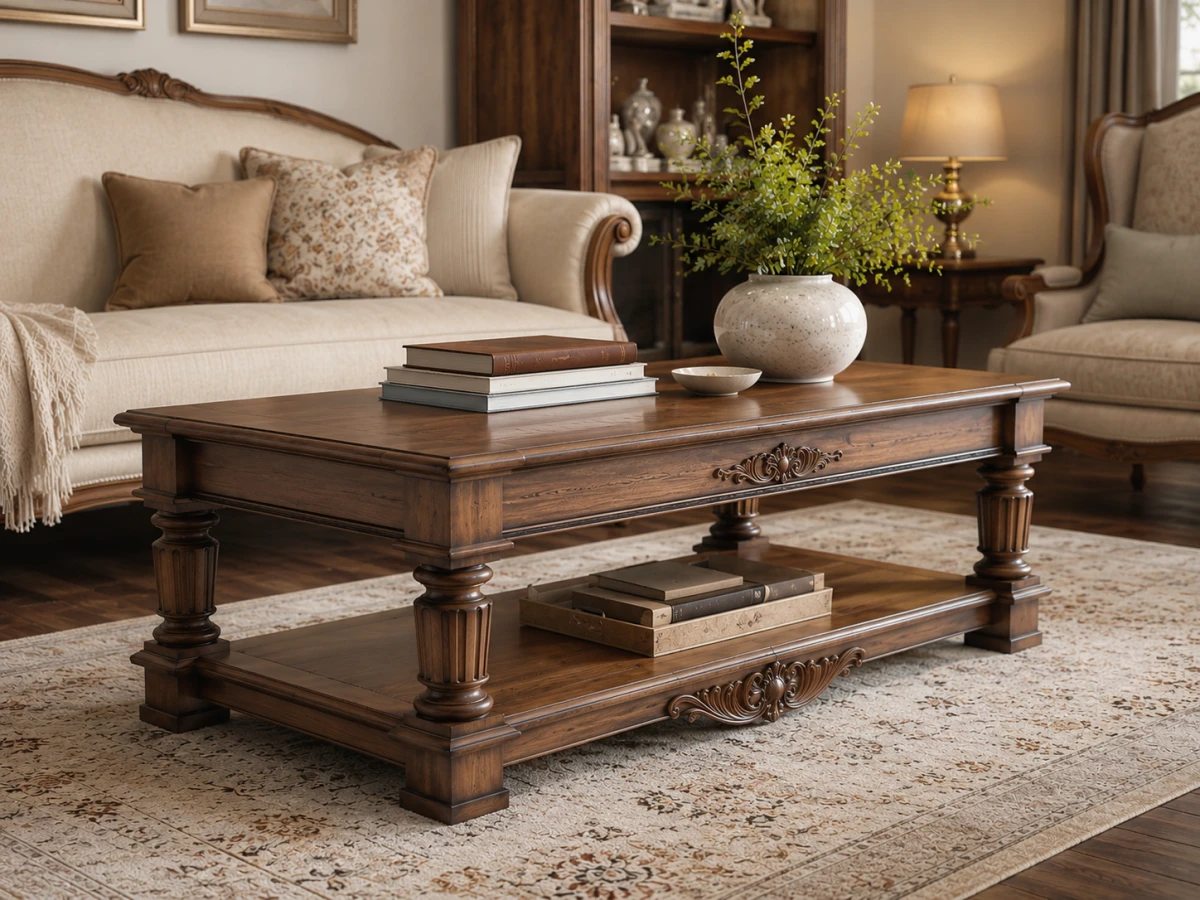
Need to make a coffee table for the living room
For the living room, the proportion with the entire seating area is important. The table should not be too high next to the sofa, too massive on a small rug, or too decorative next to active furniture. If the interior is calm, you can emphasize the shape of the legs. If the living room is already saturated with details, it is better to choose a more restrained base.
A good scheme for a first project is wooden legs, a simple tabletop, and neat finishing. Decor is added only when the table really lacks expressiveness.
Need to make a round coffee table
A round tabletop requires a harmonious base. If lightness is desired, individual legs can be used. If a more assembled and stable base is needed, it is better to look at an underframe. For a round table, it is especially important that the base does not look randomly offset or too weak.
It is better to place the decor symmetrically here. Rosettes and overlays should support the center, not compete with the round shape.
You need to make a side table
A side table is usually smaller than a coffee table. It stands next to an armchair, sofa, bed, or in a corner. It does not need overly massive legs. It is better to choose a light base that will not overload the space.
Neat wooden legs and a calm tabletop work especially well for such a table. Carved decor can only be used sparingly.
You need to make a table for a salon or showroom
In a salon, boutique, showroom, or hotel, the table should look memorable. It can be part of a waiting area, exhibition, meeting area, or decorative scene. Here you can be bolder in using carved legs, under-table supports, overlays, and rosettes.
But commercial space requires practicality. The table will be used by different people. Therefore, stability, finish, and ease of maintenance are no less important than appearance.
The table needs to be made for painting.
If the project involves painting, it is better to choose parts that are convenient to finish together. Legs, overlays, rosettes, and under-table supports should match the chosen technology. Before ordering, you need to check the material, surface preparation, and current parameters in the product card.
A unified finish helps to assemble different parts into one item. Even if the legs and decor differ in shape, a common color makes the table more cohesive.
You need to create an item for a design project
It is important for a designer not just to choose a beautiful detail, but to fit into the interior concept. A table can support the shape of a sofa, repeat the color of doors, echo decorative panels, continue the line of wooden furniture, or be the only bright object in the room.
In such a project, it is convenient to first determine the role of the table: background, accent, connecting link, or art object. Then the legs, underframe, and decor are selected. This way, the purchase becomes part of the concept, not a random set of components.
Size, load, and finish: what to check before ordering
Even the most beautiful table must be comfortable and stable. Therefore, before purchasing parts, several parameters need to be assessed.
Height depends on the purpose. A coffee table is usually placed next to a sofa, so it should not be inconveniently high. A side table can be taller if placed next to an armchair or bed. A decorative table for a showroom may be designed not only for household use but also for display.
The size of the tabletop affects the choice of base. The larger and heavier the tabletop, the more carefully you need to select the legs or underframe. A light, small tabletop allows for more elegant supports. A heavy one requires a more robust base.
The material of the tabletop is also important. Wood, glass, stone, MDF, painted surface — each option has its own weight, method of attachment, and visual character. If the material is heavy, the base must be designed for such a task.
The finish ties all the details together. Unpainted elements are convenient when the project will be adjusted to a specific color. A ready-made coating is more convenient if you need to assemble the item faster, but it requires an exact match with the rest of the furniture.
Before ordering, you need to check the product cards: dimensions, material, purpose, coating, application features. If the project is complex, it is better to clarify compatibility with a STAVROS manager in advance.
Mistakes that ruin a designer table
Start with decor, not with construction
Carved overlays and rosettes catch the eye, but the table starts with the base. If the legs or underframe are chosen incorrectly, decor won't save the project. First, you need to decide on the structure, height, and stability, then move on to decoration.
Choosing legs only from a photo
It's hard to understand the scale from a photo. A leg may seem suitable but turn out to be too massive for a small tabletop or too light for a heavy one. Before ordering, you need to check the parameters in the product card and match them with the project.
Overloading the table with carving
Carved legs, overlays, rosettes, a complex tabletop, and contrasting finish all at once can make the table heavy. It's better to choose one main accent. If the legs are expressive, the decor should be calmer. If the base is simple, you can add an overlay or rosette.
Not planning the tabletop
The tabletop is not part of the 'we'll find something later' idea. Its shape, size, weight, and material affect the choice of base. If the tabletop already exists, legs or an underframe are selected for it. If it doesn't exist yet, you first need to determine at least the shape and approximate size.
Confusing an overlay with a load-bearing part
A carved overlay decorates but does not support the table. It cannot be used as part of the structure if the product is not intended for that. The same applies to rosettes. Decor should remain decor.
Not accounting for the finish
If some parts are painted and others remain with a ready-made coating, the table may look mismatched. It's better to decide in advance what will be in one color, what will be a contrast, and what will remain natural.
Expecting a fully finished table
Components help create a table but do not replace the entire project. A tabletop, fasteners, assembly, finishing, height calculation, and stability are needed. If a buyer wants a completely finished item without further work, they should look for a ready-made table, not components.
Who this project is especially suitable for
This approach suits interior designers who want to offer their client not standard furniture, but a piece tailored to a specific room. Legs, underframe, and decor help control the style, height, shape, and character of the table.
For furniture workshops, components provide the opportunity to assemble an expressive project faster. There is no need to start by manufacturing every complex part. You can choose ready-made elements and invest craftsmanship into the tabletop, finishing, assembly, and precise fitting.
For decorators and restorers, this format helps update furniture or create pieces with a historical, classic, or vintage feel. Ready-made carved elements allow adding relief without accidental imitation.
For owners of showrooms, cafes, hotels, and salons, a custom table helps make the space more memorable. In such interiors, furniture works not only functionally but also emotionally.
For private buyers, the project is interesting if they want to create a piece for their own interior. Not just buy a table that many others have, but assemble an item with the desired legs, tabletop, finish, and accent.
When this project may not be suitable
If a completely finished table without assembly, finishing, and tabletop selection is needed, components alone will not solve the task. They provide a foundation for the project but require further work.
If there is no understanding of what the tabletop will be like, it is better not to rush into buying the base. The legs and underframe must match the shape, size, and weight of the top part.
If the interior requires absolute simplicity, carved decor may be unnecessary. In that case, it is better to choose simple legs or an underframe without additional embellishments.
If only the lowest price matters, a custom design may seem excessive. Its purpose is not to replace a standard table in the simplest way, but to create an item for a specific interior.
If the space involves high humidity or challenging operating conditions, wooden parts must be selected with particular care. The material, finish, and protection should match the location of use.
How to choose components for STAVROS
It is better to follow a clear path. First, determine what type of table is needed: coffee, side, cocktail, console, or decorative. Then decide on the tabletop: round, square, rectangular, light, heavy, wooden, glass, stone, or painted.
After that, you can choose the base. If a light silhouette is needed, it is worth buy wooden table legs. If you want to explore broader options, you can open furniture legs and supports STAVROS. If the project will be painted, it is reasonable to choose unfinished solid wood furniture legs.
If a more compact base is needed, you can buying a wooden table underframe or look at furniture frames and solid wood underframes. For a specific character of the base, you can proceed to models: turned furniture leg MN-124 or Carved Furniture Leg MN-035.
Once the base is selected, you can move on to decor. For relief, it is worth choose carved overlays for furniture, for a more cohesive decorative solution — look C-030 Decorative Set for Furniture, for accent points — buy wooden rosettes for furniture decoration.
Before ordering, you need to check the dimensions, material, finish, and purpose
FAQ
Can I make a custom table using only STAVROS components?
You can assemble the base and decorative concept: choose legs, underframe, carved overlays, and rosettes. The tabletop needs to be selected separately or use an existing one. Before assembly, it's important to check the dimensions, weight, and attachment method.
What is better for a coffee table: legs or an underframe?
If you need a light, custom silhouette, individual legs will work. If a more cohesive and stable base is important, consider an underframe. The choice depends on the shape and weight of the tabletop.
Which legs to choose for a classic table?
For classic style, turned or carved legs work well. They support the traditional character of the furniture and pair nicely with wood finishes. But decor should be used sparingly so the table doesn't look heavy.
Which legs to choose for a modern interior?
For a modern interior, simpler straight or geometric shapes are better suited. They maintain a clean silhouette but add natural wood and make the piece warmer.
Can carved overlays be used on the table?
Yes, but only as decorative elements. They can be placed on the apron, side part, base, or decorative panel. They should not replace the load-bearing structure.
How do rosettes differ from overlays?
Rosettes are a point accent. Overlays often work as a more extended decorative element. A rosette is appropriate when you need to add a small detail without a large relief.
How to make a coffee table yourself without it looking amateurish?
It's better not to assemble the base from random parts. Take ready-made legs or an underframe, plan the tabletop in advance, check the dimensions, and choose the finish. Add decor only after the structure is clear.
Can I use a ready-made tabletop?
Yes. A ready-made tabletop can be a good basis for the project. You just need to select legs or an underframe for it according to size, weight, style, and attachment method.
What to buy together with wooden legs?
Most often, an underframe or frame part is selected for the legs if stability is needed. For a decorative project, you can add carved overlays or wooden rosettes. It all depends on the style and shape of the tabletop.
Would such a project be suitable for a cafe or salon?
Yes, if you consider durability, finish, and usage conditions in advance. For a commercial space, the table must be not only beautiful but also practical.
Do all parts need to be chosen in the same color?
Not necessarily, but the color logic should be clear. You can make all wooden elements in the same finish or create contrast. The main thing is not to mix too many random shades.
What should be checked before ordering?
Check the dimensions, material, finish, purpose, attachment method, and compatibility with the future tabletop. If the project is complex, it's better to clarify details with a STAVROS manager.
Can I make a round coffee table?
Yes. For a round tabletop, it's especially important to choose the base correctly. You can use individual legs or an underframe, but the structure must be stable and visually balanced.
When is it better to avoid carved decor?
If the tabletop is already very expressive, the base is complex, or the interior is minimalist, carved decor may be unnecessary. In such a case, it's better to focus on the shape of the legs and the quality of the finish.
Conclusion
An author's coffee table is not necessarily a complex furniture structure. Sometimes it's enough to choose the right wooden legs, think through the underframe, select a tabletop, and add one neat decorative element. The point of such a project is to create an item for the interior, not to adapt the room to ready-made furniture.
STAVROS components help make this journey easier: choose a base, select wooden parts, add carved decor, and assemble a table with a clear concept. For a designer, this is a way to create a piece for a project. For a craftsman, it's an opportunity to work with ready-made elements and focus on assembly and finishing. For a private buyer, it's a chance to get a table that is not available in standard furniture lines.
Before ordering, it's important not to rush: determine the tabletop shape, height, style, load, finish, and the table's role in the interior. Then buying legs, underframes, overlays, or rosettes becomes not a random choice, but a step towards a beautiful and meaningful piece of furniture.