Article Contents:
- What exactly are we buying: NPU-325 is a small decorative overlay, not part of the arch structure
- Why two small overlays can work better than a full stucco portal
- How to place a pair of NPU-325 on a finished arch
- Where the correct point for NPU-325 is: not "roughly on the side," but the transition from vertical to the arch
- Why two templates are needed for checking at once, not one
- Two identical NPU-325 do not automatically become a mirror pair
- How to determine the distance from NPU-325 to the first slat
- 18 mm is the most underrated size of NPU-325
- Wood texture next to slat panels: support the material or hide the pattern in the wall color
- Option 1. Paint NPU-325 in the wall and arched passage color
- Option 2. Match the shade of the slat panels
- Option 3. Make NPU-325 contrasting
- Why NPU-325 cannot be used instead of technical junction detailing
- Which surface to glue to: the plane matters more than a pretty point on the arc
- Why two NPU-325 for 900 ₽ is not a "cheap portal replacement" but a different type of solution
- When two NPU-325 units are truly enough
- The arch itself has good finished geometry
- Slat panels are already the main wall accent
- There is a flat free zone between the arch and the slats
- The left and right transition points are visually comparable
- Decor is needed precisely as an accent
- When two small overlays look random
- When it is better to leave the arch without molding altogether
- When a full molded frame is more logical than two overlays
- If the slat panels on the left and right start at different distances
- Maintain symmetry relative to the arch
- Slightly adjust the position of both parts as a single pair
- Abandon the overlays
- Change the boundary of the slat finish
- What to do if the arch is asymmetrical after finishing
- Installation on an already painted wall: first compatibility, then glue
- How much does the cart cost
- How to paint two overlays so they don't look glued after renovation
- Important question: install NPU-325 on both sides of the arch or only on the side of one room
- Mistake 1. Ordering two pieces before checking both mounting points
- Mistake 2. Checking only the planar size of 77 × 55 mm
- Mistake 3. Assuming identical SKUs are automatically mirrored
- Mistake 4. Gluing the overlay directly onto the start of the curved slope
- Mistake 5. Adjusting the position of each side separately to the nearest rail
- Mistake 6. Using NPU-325 to mask poor finishing
- Mistake 7. Automatically buying a full set of related products
- Elongated or elliptical arch
- Arch with a complex or intentionally asymmetric shape
- Local measurement is more important than the overall width of the opening
- How to understand that NPU-325 is too close to the rails without a made-up standard
- Contour test
- Shadow test
- Removal test
- Light can change the decision even with perfect geometry
- First mark the entire pair, then install the first part
- What to do with the joint after gluing
- Two overlays or four: the quantity is determined not by the "richness" of the decor, but by the number of points
- Wood next to wood imitation: when it's better not to try to match the tone exactly
- Can NPU-325 be installed on only one side of the arch if the other side is covered by furniture?
- Are four NPU-325 needed if the arched passage is visible from two rooms?
- Can NPU-325 be glued over wallpaper?
- Do I need to sand the wood texture before painting?
- Can NPU-325 be placed not at the start of the arch, but higher on the arch?
- What to do if the left and right pads seem different due to lighting?
- Do I need to buy a special left and right version of the NPU-325?
- Will the NPU-325 fit if the slats are installed flush against the arched opening?
- Can two NPU-325s be used in a modern interior, not just in a classic one?
- What matters more when ordering: the size of the arch or the distance from the arc to the slat panels?
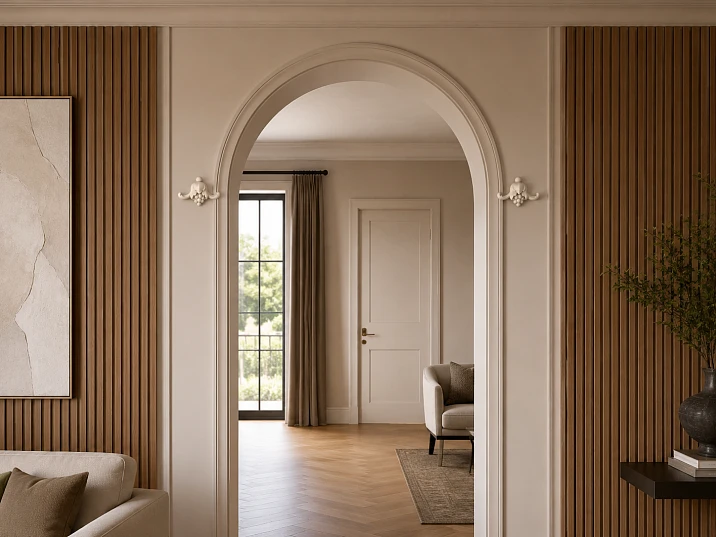
The arched passage is already plastered, painted, and technically finished. On both sides of it there are slat panels, so the wall already has a pronounced vertical rhythm even without additional molding. There is no desire to redo the finished arch, lay a flexible molding along the arc, add pilasters, or assemble a heavy portal. But in two places where the straight side sections of the opening transition into the arc, the composition seems empty.
In such a scenario, you can consider not a full framing, but two identical decorative NPU-325 pads made of polyurethane — one on each side of the arched passage. The NPU-325 has one size: 77 × 55 × 18 mm. The current price is 450 ₽ per piece, so a pair costs 900 ₽. The manufacturer directly indicates arch decoration among the applications of this pad.
But the answer to "is two enough?" depends not on the price or even the size of the opening as such. For a finished arch, four things matter more: whether there is a flat area at the point where the arc begins to place the pad, whether the two pieces can truly be installed as a pair, whether a visual pause remains between the decor and the first slat, and whether the relief with a depth of 18 mm becomes too active when viewed from the side.
If these conditions are met, two NPU-325s can solve the task without a full stucco portal. If not, it is better to leave the arch clean or switch to another decoration system, rather than trying to make a small pad do the work of a molding, trim, or keystone.
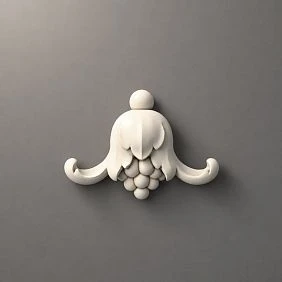
What exactly are we buying: NPU-325 is a small decorative pad, not a part of the arch structure
NPU-325 must be called precisely: decorative polyurethane trim. This is fundamental, because around the arched opening there are simultaneously structural and decorative elements, and their functions cannot be mixed.
The trim does not form the arch radius, does not reinforce the opening, does not automatically cover mounting seams, and is not a mandatory element of slope finishing. It is installed after the geometry of the passage is already complete, and the decorative piece has only one job left — to create a local relief accent.
Current product parameters:
| Parameter | NPU-325 |
|---|---|
| Type | Decorative overlay |
| Size A × B × C | 77 × 55 × 18 mm |
| Material | Polyurethane |
| Price per 1 pc. | 450 ₽ |
| Price per 2 pcs. | 900 ₽ |
| Price per 4 pcs. | 1 800 ₽ |
| Made to order | On average 3–7 days |
| Surface | wood texture |
| Finish | product ready for painting |
| Application as specified by the manufacturer | walls, doors, furniture facades, fireplaces, arch decoration |
For a specific scenario, first of all, a set of two identical NPU-325 units is needed. Four pieces make sense for a different composition: for example, if two identical arched passages are being decorated, or if the project deliberately uses additional points of ornament repetition.
Buy decorative overlay NPU-325 can be a separate line item. For one arch in the scheme under consideration, two pieces are placed in the cart, not one set with unclear contents.
There is another useful check. NPU-325 is also part of more complex STAVROS compositions — for example, the wall-mounted set CPU-9-1 "Brussels", which uses four such elements. This confirms that the overlay can work as a small repeating detail within a large system. But for a finished arch next to slat panels, copying the entire CPU-9-1 system is not required. Here the task is deliberately different: minimal intervention and only two local points.




Why two small overlays can work better than a full stucco portal
Slat panels already create a strong decorative environment around the arch. Their vertical rhythm visually assembles the wall, emphasizes the height, and forms its own frame around the open passage. If you add a full stucco framing with vertical posts, arched molding, capitals, and a central accent on top of this, two independent systems may collide on the same wall.
The first system is the slats. It is built on the repetition of narrow vertical lines.
The second is a classic stucco portal. It is built on its own perimeter, symmetry, profile, and ornamental nodes.
Both can be expressive on their own. But next to each other, they do not automatically have to enhance each other. In an already finished interior, it is sometimes more useful not to add a third and fourth line around the opening, but to find just two points where the decor helps the eye understand the transition from vertical to arc.
This is exactly what makes NPU-325 interesting. With a flat dimension of only 77 × 55 mm, it does not turn into a new frame around the entire arch. Two pieces can be perceived as short decorative "punctuation marks" in two symmetrical places.
Let's compare three solutions.
| Solution | What changes on the wall | Pros | Limitations |
| Arch without molding | only the finished geometry of the opening and the rhythm of the slats remain | as calm as possible, nothing needs to be installed | the transition to the arch may seem visually empty |
| 2 × NPU-325 | two local relief accents appear | minimum new details, price of a pair 900 ₽, no frame assembly required | need to accurately find the position and check the 18 mm thickness |
| Full stucco framing | an independent architectural system appears along the arch contour | strong classic design, can emphasize the entire radius | more elements, more mounting points, higher risk of competition with rails |
For the topic of this article, the central option is the second one. It is not declared universally better. It is good precisely when the arch itself is already finished, and the owner does not need a new architectural portal.
Our factory also produces:
How to place a pair of NPU-325 on a finished arch
Get Consultation
Where the correct point for NPU-325 is: not "approximately on the side," but the transition of the vertical into the arc
An arched passage has a natural geometric point where the vertical section ends and the curved part begins. In architectural terminology, the area where the vault begins is associated with the springing of the arch, but for marking on site it is easier to use a clear formulation: the point where the straight side line transitions into the arc.
It is near this zone that two small overlays can be logical. They should not imitate a load-bearing element and do not have to lie exactly on the geometric boundary. Their task is to visually mark the transition.
Before purchasing, do not rely only on a photo of the arch. Find the actual point where the curvature begins on both sides and ask yourself three questions.
First: is there enough flat frontal wall surface near it for the overlay to rest with its entire working area?
Second: are the left and right sides arranged identically after finishing?
Third: does the chosen spot already fall on the curved slope itself?
The last question is especially important. NPU-325 is a ready-made rigid decorative piece. If its base is designed for flat contact, you cannot assume that its small size will automatically allow the overlay to be glued onto any curve without issues. On a highly curved surface, the edges may lose contact with the base, a noticeable gap will appear, and trying to press the item down with force will only worsen the fit.
Therefore, the correct zone is not necessarily the most beautiful spot in the photo. It is the place where both composition and the physical possibility of installation coincide.
Why two templates are needed for checking, not just one
For a single wall overlay, one paper template is often sufficient. For paired arch decoration, it is not.
Make two identical templates of the size 77 × 55 mm and try them on simultaneously. The card size is marked as A × B × C, so before final marking, you should not arbitrarily declare 77 mm as the "width" and 55 mm as the "height" without reference to the actual orientation of the ornament. In the template, what matters is the confirmed flat dimension of 77 × 55 mm and the position in which the item will be placed on the wall.
Two templates at once show what is not visible during a single fitting:
-
whether the height of the left and right pieces matches;
-
whether they are equally spaced from the opening;
-
whether they relate equally to the first battens;
-
whether one side is not "creeping" upward due to the error of the arch itself;
-
whether one element does not look closer to the arc due to different thickness of the finish;
-
whether the overall symmetry is preserved when viewed from the adjacent room.
This is especially important for an already finished arch. Construction geometry can be very good, but plaster, painting, and panel joints introduce their own millimeter-level deviations. If you mark each overlay independently, two small errors can add up and become more noticeable than the parts themselves.
A convenient sequence is this: first temporarily secure both templates with painter's tape, then step back a few meters, look at the arch frontally, and only then evaluate individual distances with a tape measure.
Two identical NPU-325 units do not automatically become a mirror pair
NPU-325 has a single article number. The name has no L and R, unlike specially manufactured left-hand and right-hand overlays. This means that for the solution in question, the cart indeed needs two identical items.
But there is a subtlety here.
Two identical products and a mirror pair are not the same thing.
If the ornament has a directional movement, two identical parts after rotation may be perceived differently than specially designed L/R elements. Therefore, a dry fit should answer not only the question "is the height the same," but also the question "do I like how the pattern works on the left and right."
There are several options:
-
both parts are installed in the same orientation, and the pattern is perceived as a repeat;
-
one of the parts is rotated relative to the other, and the composition becomes more symmetrical;
-
with any rotation, the directionality of the ornament irritates the eye — then the NPU-325 pair is simply not suitable for this spot;
-
instead, it is worth looking at Polyurethane decorative appliques with clearly defined left and right versions.
This is a good example of a situation where a cheap purchase should not be made automatically. The pair costs only 900 ₽, but if the two parts are wrong, you will still have to remove them, restore the paint, and look for another solution.
How to determine the distance from NPU-325 to the first batten
There is no point in inventing a universal standard like "leave strictly 30 mm" in this article. For such a decorative element, it is not confirmed by the manufacturer and would still depend on the width of the battens themselves, the spacing between them, the wall color, the thickness of the opening, and the viewing point.
It is more correct to check the visual pause.
Imagine three consecutive zones:
arched opening → NPU-325 → calm wall section → first batten.
If the overlay almost touches the nearest batten, the two systems merge. The eye stops understanding whether the ornament belongs to the arch or is a random ending of the slat panel.
If the distance is too large, the NPU-325 may "detach" from the opening and start to look like an independent small detail on an empty wall section.
Therefore, the measurement is done in two stages.
First, a tape measure records the actual available field between the arch contour and the start of the slat panel.
Then two templates are moved within this field to find a position where the connection with the arch is preserved, but a noticeable background remains between the relief and the slats.
It is important to look not only from the front. Slat panels have their own depth and cast shadows. The NPU-325 overlay also protrudes from the wall by 18 mm. With side lighting, these shadows can visually reduce the actual gap.
Therefore, the final decision is made after viewing under the lighting that is actually used in the evening.
Relief, color, and perception next to slat panels
18 mm is the most underestimated size of NPU-325
When choosing a small decorative overlay, a buyer usually looks at two numbers: 77 and 55 mm. They indicate how much space the product will take up on the wall surface.
But NPU-325 has a third dimension — 18 mm. For a part of such a small format, this is a noticeable relief.
That is why a flat paper template only solves half the problem.
You also need to assess how much the part will protrude from the wall.
A simple mockup can be made without accurately reproducing the ornament. Cut out two rectangles of the required planar size from foam board, corrugated cardboard, or another material and build up a thickness close to 18 mm. Such a three-dimensional mockup will show:
-
how noticeable the overlay is from the side;
-
whether the eye catches on the two protruding "bumps" next to the smooth arch;
-
how the shadow falls;
-
whether the relief conflicts with the depth of adjacent slats;
-
doesn't a small detail become visually heavier than expected from the catalog photo.
Volumetric fitting is especially useful if the arch is visible not only strictly from the front. The passage between the kitchen and living room, hall and corridor, living room and dining room is usually viewed at an angle. And then 18 mm start to work much more strongly.
A scenario is considered successful not when two templates look nice in a frontal photo, but when they look logical even when passing sideways by the arch.
Wood texture next to slatted panels: support the material or hide the pattern in the wall color
The NPU-325 card describes the product as a decorative overlay with a wood texture and indicates readiness for painting. Next to slatted panels, this offers an interesting choice.
Option 1. Paint NPU-325 in the color of the wall and the arch opening
This is the most calm strategy.
The texture remains, but works through shadow rather than color contrast. From a distance, the two overlays almost dissolve into the architecture. Upon closer approach, the relief becomes noticeable.
This method is suitable if the slats are already expressive enough and you don't want to add two more colored spots to them.
It is also good when the meaning of NPU-325 is only to mark the beginning of the arc.
Option 2. Match the shade of the slat panels
The wood texture allows the overlays to be stylistically linked to the adjacent wood theme. But "matching" does not mean automatically painting the polyurethane in the first brown color that comes to hand.
If the slats have a complex wood grain pattern, a simple uniform brown may look poorer than the natural or decorative surface of the panel. Therefore, before painting, a test is done on a separate sample or on an inconspicuous area.
The goal is not to imitate wood at any cost, but to achieve a convincing connection between materials.
Option 3. Make NPU-325 contrasting
This scenario is possible, but it turns two small parts into an independent decorative gesture.
For example, on a light wall, dark overlays will be much more noticeable than white ones. With a relief of 18 mm, the effect is further enhanced by shadows.
Contrast only makes sense when the interior already has elements of that color: door hardware, light fixtures, furniture handles, metal, or other ornamental decor.
If there are no such connections, two contrasting overlays may look random.
Base and installation on already finished surfaces
Why NPU-325 cannot be used instead of the technical finishing of the junction
The arch in this topic is already finished. This is a mandatory condition for a good scenario.
Before installing decorative trims, the following must be resolved:
-
geometry of the opening;
-
finish treatment of the slopes;
-
junction of the wall and the arch;
-
painting or other final coating of the base;
-
junction of slat panels.
NPU-325 should not mask a poorly drawn arc or an accidental crack just because the problem location coincides with the start point of the radius.
If the base requires repair, repair the base first.
If the joint between the slat panel and the plastered wall is uneven, it is also corrected separately.
A decorative overlay works well on a finished and clear background. Then it is perceived as a deliberate accent.
If it covers a construction defect, the position of the piece begins to be dictated by the defect, not by the composition. As a result, the left and right overlays may end up at different heights or at different distances from the opening.
What surface to glue to: the plane matters more than a beautiful point on the arc
Before ordering, apply a rigid template or a flat plate to the intended installation location.
If the plate touches the wall with its entire area, the area is suitable for further fitting.
If one edge hangs over the arc, a gap appears, or the base changes curvature right under the future overlay, there are three reasonable options:
-
move the NPU-325 slightly onto the flat part of the wall;
-
abandon this position;
-
choose a different type of decor designed for the required geometry.
Do not try to "stretch" a rigid overlay with glue through a large gap. A thick adhesive layer should not become a way to model new wall geometry without a proven technology.
The same applies to slat panels. In the scheme under consideration, NPU-325 is installed on a prepared surface next to the arch, not over protruding slats. If there is no free wall between the arch and the slats at all, the task changes: you either need to rework the panel boundary or choose a different decorative scenario.
When two overlays are enough, and when a different solution is better
Why two NPU-325 for 900 ₽ is not a "cheap replacement for a portal," but a different type of solution
Comparing a pair of NPU-325 with a full frame only by price is incorrect.
A full portal solves one task: it creates a standalone architectural frame around the arched passage.
Two overlays solve another: they emphasize two points of geometry transition, leaving the main arch shape and slat finish unchanged.
Therefore, the purchase logic is as follows:
not "how to make a portal cheaper," but "is a portal needed at all."
If a full frame is truly necessary for the interior, two small overlays will not replace it.
If full framing seems excessive, then a pair for 900 ₽ becomes not a compromise, but a deliberately lighter system.
This is especially important next to slat panels. There is already large-scale decor there. Adding another large-scale decor is not necessary.
When two NPU-325 are truly enough
A pair of small overlays works best under a combination of conditions.
The arch itself has good finished geometry
The arc is even, the slopes are finished, and the surface around the opening does not require masking.
Slat panels are already the main wall accent
Then small stucco decor should not compete with them for dominance.
Slatted wall panels for interior finishing They form a repeating rhythm, and a pair of local overlays can act as a rare exception in that rhythm.
There is a flat free zone between the arch and the slats
The detail fits not only physically, but also compositionally.
The left and right transition points are visually comparable
If one side of the arch almost adjoins the cabinet, while the other opens onto a wide wall, identical overlays may only emphasize the asymmetry.
The decor is needed precisely as an accent
Not as a trim, not as a molding, not as a load-bearing element, and not as a way to hide a finishing problem.
When all these conditions coincide, two NPU-325 units may be quite sufficient.
When two small overlays look random
A small size is an advantage only at the right scale.
On a very large arch with a wide empty wall, two NPU-325 units may get lost. They will be physically present, but the eye will not understand why exactly two small ornamental objects appeared in these places.
This impression often arises when:
-
the arch is very tall and wide;
-
there are no other small decorative details nearby;
-
a huge empty plane remains between the overlay and the slats;
-
the outline of the opening is visually weak by itself;
-
the overlays are painted contrastingly, but nothing else repeats this color.
In this situation, you don't need to automatically buy four NPU-325 instead of two. Doubling the quantity does not fix the incorrect scale.
First, it's worth checking two alternatives:
leave the arch completely clean;
or switch to a system that works with the outline itself: moldings and other elements for a full arched framing.
If the second path is chosen, you can look at Moldings made of polyurethane и Decor for polyurethane moldingsBut that's a different composition and a different budget.
When it's better to leave the arch without stucco molding altogether
Refusing to buy is a normal result of trying on.
A clean arch is preferable if the slat panels already come very close to the passage and themselves form a convincing frame.
Another case is an interior with a minimal number of decorative details. If the room has no moldings, rosettes, ornamental handles, carved decor, or other plastic elements, two NPU-325s may be the only classical details. Then the question is not about size, but about stylistic connection.
It's also worth refusing when the two starting points of the arch are seen differently. For example, one side is constantly blocked by an open door of a neighboring cabinet or tall furniture, while the other remains fully open. A formally symmetrical pair will be perceived as one random overlay in real use.
Also, a clean arch is usually better than a questionable installation on a curved surface. If there is no flat area, there's no need to glue NPU-325 "as it turns out" just because the product has already been chosen.
When a full stucco frame is more logical than two overlays
A full frame is worth considering when the arch itself should become the main architectural object of the room.
For example:
-
the slat panels are far away and are not perceived as its frame;
-
the room already has pronounced classical molding;
-
it is necessary to run a single profile along the entire contour of the arch;
-
it is required to connect the arch with the baseboard, cornice, or other architectural lines;
-
small decor at two points looks insufficient;
-
the opening has a grand scale and should be perceived as a portal.
In that case, NPU-325 can be not used at all. It should not be included in the project just because the card allows decorating arches.
For a complete solution, it is more useful to immediately consider polyurethane molding as a system: profiles, overlays, corner elements, and, if necessary, decor for walls.
How to check the scale of NPU-325 next to specific slat panels
The pair should be evaluated on the finished wall, not separately from the slats.
Take a photo of the arch strictly from the front. Then mark on it:
-
the contour of the opening;
-
the starting points of the arc;
-
boundaries of the slat panels;
-
presumed centers of two NPU-325 units.
After that, proceed to a 1:1 physical mockup.
The first viewing is from a distance of about one step from the arch. Here, the quality of the joint and the relief are assessed.
The second is from the main entry point of the room. Here, the overall scale matters.
The third is from the adjacent room through the opening itself. Here, it becomes visible whether the two overlays work as a pair.
The fourth is from the side during normal movement. Here, the 18 mm depth and shadows are checked.
There is no need to turn these points into a mathematical standard. Their purpose is to show the product in real perception scenarios.
If the slat panels on the left and right start at different distances
This is one of the most useful edge cases.
Suppose there remains a noticeable smooth strip on the left before the first batten, and on the right the panels almost reach the opening. If you place two overlays strictly mirror-symmetrically relative to the arch, one will be surrounded by a calm background, and the other will be squeezed between the arc and the battens.
There are several solutions.
Maintain symmetry relative to the arch
Suitable if the difference is small and the rhythm of the panels is not too contrasting.
Slightly adjust the position of both pieces as a single pair
Not each separately, but specifically the pair. For example, check a small symmetrical shift upward or closer to the opening.
Abandon the overlays
Sometimes this is better than ruining the symmetry of the arch to align the distance to the battens.
Change the boundary of the batten finish
This option only makes sense if the panels can still be refined without destroying the finished renovation. In the original scenario, the arch is already finished, so specially redoing the wall for two overlays is usually irrational.
The main rule: do not treat wall asymmetry with two different positions of identical decorative pieces. If the left and right overlays start living by their own rules, the very idea of a paired accent disappears.
What to do if the arch is asymmetrical after finishing
Minor deviations occur even on high-quality completed projects.
First, determine what exactly is asymmetrical:
-
the geometry of the opening itself;
-
the thickness of the plaster layer;
-
the position of the slat panels;
-
furniture nearby;
-
light and shadow;
-
only visual perception from the main viewpoint.
If the actual difference is minimal, it is better to align the overlays to a single visual axis of the arch rather than to random local millimeters.
However, if one side starts an arch noticeably higher than the other, the NPU-325 pair can emphasize this defect. In such a case, a clean opening often looks calmer: without two identical markers, the eye compares the left and right points less.
That is why two small details sometimes impose higher symmetry requirements on an arch than the absence of decor.
Installation on an already painted wall: first compatibility, then adhesive
The NPU-325 card shows KUDO HIGH TACK based on hybrid polymers, 280 ml, in related products. This is a useful reference when placing an order, but the mere presence of the product in the recommendations block does not eliminate the need to check the substrate.
Before installation, you need to know:
-
what paint is applied to the wall;
-
how firmly it adheres;
-
whether there is dust or a weak layer of putty;
-
whether the chosen adhesive allows working with polyurethane and the specific coating;
-
whether degreasing or another preparatory action is required according to the adhesive's instructions.
It cannot be assumed that a strong mounting compound compensates for a weak substrate. If paint peels off from putty, the adhesive may remain on the paint along with the applique, and the finishing layer itself will tear away from the wall.
For a pair of small elements, the load is low, but the quality of the substrate is still more important than the advertised name of the adhesive.
If you need to purchase a mounting compound together with decor, you can look at KUDO HIGH TACK 280 ml. The consumption for a specific pair is not calculated in this article: it depends on the application method and the requirements of the manufacturer's instructions for the compound.
Quantity, cost, and order set
How much does the cart cost
Basic decorative order for one arch:
| Position | Quantity | Price per unit | Sum |
| NPU-325 | 2 pcs. | 450 ₽ | 900 ₽ |
| Total decorative elements | 900 ₽ |
If one package of KUDO HIGH TACK is purchased simultaneously at the current price of 990 ₽, the arithmetic sum of the items will be:
900 + 990 = 1 890 ₽.
But this does not mean that one tube is a mandatory consumption rate for two overlays. The buyer may already have a suitable mounting compound, use it for other elements, or choose another product compatible with polyurethane and the base.
Therefore, the honest commercial conclusion is:
a pair of NPU-325 costs 900 ₽; mounting material is calculated separately.
For two identical arches:
4 × 450 = 1,800 ₽ for the overlays themselves.
This simple estimate is more useful than a pseudo-precise calculation of glue, which the product card does not specify for this scheme.
How to paint two overlays so they don't look glued after renovation
Since the arch is already ready, decorative details are added after the main finishing. Sequence is important here.
If the overlays are to be painted in the wall color, it is more convenient to first make a test paint on one piece or on a sample, check the shade under real lighting, and then perform the final finishing.
The color "same by code" does not always look the same on a smooth wall and a textured surface. The recesses of NPU-325 darken, the protrusions catch light, so the ornament may appear slightly darker or lighter than the background wall.
If the goal is to integrate the overlay as much as possible, look not at the paint can, but at the installed mock-up in daylight and artificial light.
If connection with slatted panels is planned, do not try to evaluate the color from a small catalog photo. Wood panels can have a complex pattern and shade variation along the length.
An important question: install NPU-325 on both sides of the arch or only on the side of one room
The arched passage connects two spaces. The overlays are mounted on the plane of a specific wall, so the same arch can have decorative finishing on one side and remain completely clean on the other.
This is normal.
You don't need to automatically buy two more NPU-325 for the back side of the passage.
First, evaluate the second room:
-
are there slat panels there;
-
is the same style repeated;
-
is the back side of the arch visible from the main viewpoints;
-
is additional decor even needed there.
If the design is required on both sides, then the quantity indeed increases to four pieces, and the cost of the overlays — up to 1,800 ₽.
If the slat composition exists only on one wall, it is logical to leave the two NPU-325 only on that side.
Main mistakes when choosing two NPU-325 for a finished arch
Mistake 1. Ordering two pieces before checking both mounting points
Why it happens: the item is small and inexpensive, it seems that a place will be found.
Consequence: after receiving, it turns out that one side of the arch has a flat area, while the second already goes into a radius or rests against the slats.
How to avoid: two rigid templates before ordering.
Mistake 2. Checking only the planar size of 77 × 55 mm
Why it happens: the depth seems secondary.
Consequence: the 18-millimeter relief is too actively visible from the side.
How to avoid: a voluminous layout of approximate thickness.
Error 3. Considering identical SKUs as automatically mirrored
Why it occurs: two identical parts are purchased.
Consequence: the directional pattern works differently on the left and right.
How to avoid: check both rotation options on the template and product photo.
Error 4. Gluing the overlay directly onto the start of a curved slope
Why it occurs: compositionally, that's where you want to see the accent.
Consequence: incomplete adhesion and gaps.
How to avoid: check the flatness with a rigid plate; if necessary, shift the overlay onto the wall.
Error 5. Adjusting the position of each side separately to the nearest rail
Why it occurs: the distances on the left and right differ.
Consequence: the pair loses its common axis and emphasizes asymmetry.
How to avoid: first mark the arch as a single object, then check interaction with the rails.
Error 6. Using NPU-325 to mask poor finishing
Why it occurs: it is easier to cover a defect with a decorative detail.
Consequence: the position is dictated by a crack or unevenness, not by the composition.
How to avoid: first restore the base.
Error 7. Automatically buying a full set of related products
Why it occurs: the block "bought with this product" is perceived as mandatory equipment.
Consequence: unnecessary expenses.
How to avoid: the cart is built from the actual scheme — 2 × NPU-325 plus only the necessary installation materials.
Practical algorithm: from a finished arch to ordering
Step 1. Look at the arch without decor. If it already looks finished, record it as a complete option, not as an "unfinished" stage.
Step 2. Find the transition points from the straight line of the opening to the arch on the left and right.
Step 3. Check the wall surface at the intended installation points.
Step 4. Measure the distance from the opening to the first rail on both sides.
Step 5. Make two templates of the flat dimension 77 × 55 mm.
Step 6. Place both at the same time.
Step 7. Check the orientation options of the ornament. Do not automatically consider identical parts as a mirror pair.
Step 8. Perform a volumetric depth check of about 18 mm.
Step 9. Look at the arch from the front, from the adjacent room, and from a side angle.
Step 10. Choose a color strategy: matching the wall, connecting with the slat trim, or a deliberate contrast.
Step 11. Compare three final options: a clean arch, two NPU-325s, or full framing.
Step 12. If the pair of overlays wins, add 2 × NPU-325 to the cart.
Step 13. Check the compatibility of the mounting material with polyurethane and the actual substrate.
Step 14. After receiving, do a dry fit of the actual parts again before applying adhesive.
This order protects against the main mistake: buying a decorative element before its exact placement is clear.
What can be ordered together with NPU-325, and what is optional to buy
For the very idea of "two overlays at the start of the arch," only two NPU-325s are required.
Other items appear as needed.
If you need an assembly compound, choose a compatible adhesive; in the product card among related items, KUDO HIGH TACK is listed.
If after trying it on it becomes clear that two parts are too small and a real arch contour is needed, you can go to the section of polyurethane moldings.
If you want to compare NPU-325 with other small decorative solutions, it is more useful to open Polyurethane appliqués catalog, rather than buying random elements of the same ornamental series.
For a broader wall decoration system, there is
Elongated or elliptical arch
In an elongated arch, the side sections can gradually transition into the vault. A small NPU-325 can look convincing only with sufficient free background. If slat panels come close, the piece may end up squeezed between two strong lines.
An arch with a complex or deliberately asymmetric shape
Here, the pairing of NPU-325 should no longer be taken by default. Two identical overlays emphasize symmetry, so on an asymmetric arch they may conflict with the very concept.
If the opening's shape is deliberately offset, it's better to first check the clean version. Not every arch requires mirrored decor.
The main conclusion: the size of NPU-325 is constant, but the way it is placed depends on the geometry of the passage. Therefore, the article does not specify a single universal installation height from the floor or from the top of the arch.
Local measurement is more important than the overall width of the opening
For full framing, you really need the overall width, height, radius, and contour length. For two small overlays, the set of initial data is different.
Record for each side:
-
the length of the flat zone from the edge of the arched opening to the first protruding batten;
-
the height of the section where the vertical already ends, but the wall surface still remains flat;
-
the distance to the nearest joint, switch, wall lamp, trim of an adjacent door, or another object;
-
the actual unevenness of the wall, if it is noticeable;
-
the depth of the slat panel relative to the painted plane.
Then compare the left and right sides.
A simple object table is useful:
| Check | Left side | Right side | What should result |
| Flat area for the template | Measure | Measure | The template fits without overlapping curvature |
| Distance to the first rail | Measure | Measure | Both sides are visually comparable |
| Height of the arc start point | Mark | Mark | The pair does not look skewed |
| Side obstructions | Mark | Mark | no conflicts with furniture, lighting, or hardware |
| Viewing at an angle | Check | Check | the 18 mm relief does not look excessive |
Here, there is no need to look for the "correct number from the internet." The value of the measurement lies elsewhere: it shows whether identical conditions actually exist on both sides.
If on the left the template fits confidently on a flat surface, but on the right it has to overlap a rail or a curved section, the project cannot be considered complete just because the average width of the arch looks sufficient.
How to understand that the NPU-325 is too close to the rails without a made-up standard
Instead of a fixed gap, use three visual tests.
Contour test
Look only at the silhouettes: the arch, the overlay, the edge of the slatted zone.
If the three lines almost merge, the decor lacks its own background.
Shadow test
Turn on side lighting or the light scenario used in the evening. Both the slat panel and NPU-325 cast a relief shadow. Sometimes in daylight there seems to be enough space between them, but in the evening the shadows visually merge.
Removal test
Step back to the main viewing distance. If the small overlay stops reading as part of the arch and starts to look like an end element of the slat panel, its position is poorly chosen.
These three checks are more useful than pseudo-precision. They account for the actual thickness, color, and light of a specific wall.
Light can change the decision even with perfect geometry
NPU-325 has a relief of 18 mm, which means lighting becomes part of the composition.
With frontal diffused light, the texture will read softly.
With side light, the relief becomes more contrasty: one side of the ornament is lit, the other goes into shadow.
If the sconce is located on only one side of the arch, two identical overlays may visually appear different. This does not mean that one is installed incorrectly.
Before final installation, it is useful to do an evening check of the templates with the lights on. If painting in the wall color is planned, shadows can provide exactly the delicate effect for which the overlays are installed. If a contrasting color is chosen, a deep shadow will be added to the color accent.
Particular care should be taken with spot lighting from above. It can emphasize the top edge of one piece more strongly due to a slight difference in the wall angle or the position of the light fixture.
If the pair looks inconsistent due to lighting, first check the lighting and only then change the layout.
First, mark out the entire pair, then install the first piece
A typical installation mistake with a paired composition: the craftsman carefully installs the left NPU-325, and starts marking the right one only after the first is already glued.
This is inconvenient. The first piece becomes immovable, and any misalignment found later has to be compensated with the second.
It is better to proceed as follows:
-
mark a common horizontal reference line or another confirmed landmark;
-
mark the anchor points of the left and right pads;
-
apply both actual parts;
-
check them from the front;
-
remove both;
-
prepare the base;
-
only then perform the final gluing.
After fixing the first pad, the second one is still installed according to the pre-made common marking, not "by eye relative to the first."
This is especially important if the arch itself has slight deviations. The common reference system prevents accidentally repeating the construction error of each side separately.
What to do with the joint after gluing
The small size does not mean that the contact contour can be left as it turns out.
After installation, evaluate:
-
whether the edges of both overlays fit evenly;
-
whether there is a visible dark gap around the perimeter;
-
whether the mounting compound has oozed out;
-
whether the already finished wall paint is damaged;
-
whether the contour is perceived evenly under side light.
Further treatment depends on the chosen mounting and painting system. There is no need to universally assign one sealant or one putty without considering the materials.
If the overlays are painted in the wall color after installation, the task is simpler: carefully prepared joints can be visually unified with a common finish.
If the NPU-325 is already painted contrastingly before installation, any traces of glue and contour inaccuracies will be more noticeable. In this case, dry fitting and clean installation are especially important.
Two overlays or four: the quantity is determined not by the "richness" of the decor, but by the number of points
The product has a low price, so there is a temptation to add two more NPU-325 "for completeness."
But the number of parts should follow the geometry.
In the original scheme, there are two semantic points: the left and right beginnings of the arc. Therefore, two overlays are required.
Four are needed if four independent positions appear. For example:
-
the arch is finished on both sides of the wall;
-
there are two identical arched passages;
-
the designer composition deliberately includes another paired group.
Placing two parts on top and two more on the bottom just for the sake of quantity is not worth it. The lower elements will already have a different architectural function, and the entire scheme will require separate verification.
Therefore, 2 × 450 ₽ = 900 ₽ is not only a convenient price, but also a logical quantity for the stated scenario.
Wood next to wood imitation: when it is better not to try to match the tone exactly
The NPU-325 texture "wood-like" creates a clear association with slat panels, but the materials are still different: the overlay is polyurethane, while the surface of the slats can be natural, veneered, laminated, painted, or have another decorative layer.
Attempting to achieve an absolute color match sometimes only emphasizes the difference in textures.
There are more sustainable strategies:
-
make the NPU-325 the color of the wall and connect it with the arch;
-
take a shade from the wood range, but deliberately make it a tone darker or lighter;
-
repeat the color of another interior element, not the slats themselves;
-
use monochrome and let the texture work only through light and shadow.
Before painting, compare samples side by side, not from memory or from a screen.
Decision tree before purchase
If you want to decide quickly, go through the sequence.
Is the arch finished and do you like it without decor?
Yes → compare the clean version with two templates.
No → first find out whether the problem is decorative or structural.
Are there flat areas on both sides for 77 × 55 mm?
Yes → moving on.
No → NPU-325 is not suitable at this point without changing the circuit.
Do the two templates read as a pair?
Yes → checking the volume.
No → trying a different orientation or giving up.
Does 18 mm of relief look normal from the side?
Yes → we check the connection with the slats.
No → a flatter decor or a clean arch is better.
Do the slats leave the overlays their own visual space?
Yes → we can move on to color and installation.
No → do not try to fix the tightness with contrasting paint.
After comparing with a clean arch, does the decor really improve the composition?
Yes → order two NPU-325.
No → buying nothing is also the right decision.
Such a decision tree is much more useful than the rule “two overlays are mandatory for an arch”: it allows rejecting the product if the specific wall does not benefit from it.
Result: two NPU-325 are sufficient if the arch needs a sign, not a new portal.
For a finished arched passage next to slat panels, a pair of NPU-325 is a rational solution not because it costs only 900 ₽, but because it allows you to avoid building a second decorative system on top of an already active wall.
The product has one confirmed size — 77 × 55 × 18 mm, the material is polyurethane, and the price is 450 ₽/piece. The card provides for decorating arches, describes a wood texture, and the possibility of painting.
But two elements should only be purchased after a real paired fitting.
Correct sequence:
finished arch → arc start points → checking the flat area → two templates 77 × 55 mm → checking pairing and orientation → 18 mm depth → distance to slats → color selection → 2 × NPU-325 → installation.
If after such a fitting the parts look natural, two overlays are enough: they mark the transition to the arch, while the slat panels continue to serve as the main rhythm of the wall.
If the NPU-325 looks random, cramped, or too small, there is no need to "save" the solution with two additional parts. Leave the arch clean or move to full framing. It is the ability to forgo extra molding that makes this scenario practical.
After checking the mockup, you can order two NPU-325 overlays for the arched passage.
FAQ
Can NPU-325 be installed on only one side of the arch if the other side is covered by furniture?
Technically, one overlay can be used as a standalone decorative element, but that would be a different compositional scenario. In the theme of marking the arch start, pairing is what works. If the other side is permanently covered, first consider whether it would be better to leave the arch without NPU-325 altogether. A single piece must have its own visual justification.
Are four NPU-325 needed if the arched passage is visible from two rooms?
Only if you want to decorate both wall planes identically. For one side of the passage, two are enough. If the reverse side also requires paired accents, you will need four pieces, and the cost of the overlays themselves will be 1,800 ₽ at the current price of 450 ₽ per piece.
Can NPU-325 be glued over wallpaper?
The card confirms polyurethane and the possibility of adhesive mounting, but the suitability of a specific substrate must be checked separately. Weak, embossed, or poorly adhered wallpaper can become a weak layer of the entire system. The mounting compound must be compatible with both the polyurethane and the actual surface. If there is doubt about the strength of the wallpaper, it is better to get a recommendation for the specific substrate before installation.
Do I need to sand the wood texture before painting?
Do not automatically remove the factory texture: it is part of the NPU-325 design. Surface preparation is performed based on the actual condition of the product and the requirements of the chosen painting system. Aggressive sanding can smooth out the relief that the overlay is purchased for.
Can NPU-325 be placed not at the beginning of the arc, but higher on the arch?
A different position can be considered as an independent design, but first the flatness of the base and the orientation of the element are checked. The higher the overlay goes into the curved part, the greater the risk that the flat base of the part will not match the wall surface. For such a scheme, a dry fit is mandatory.
What to do if the left and right overlays seem different due to lighting?
Check them with accent lighting turned off and in daylight. The 18 mm relief creates its own shadow, so side lighting can visually change the shape. If the installation geometry is the same and only the light fixture creates the difference, the problem may need to be solved not by shifting one overlay, but by adjusting the light direction or choosing a calmer color.
Do I need to buy a special left and right version of NPU-325?
The NPU-325 card shows one article without L/R markings. For the considered scheme, two identical items are purchased. However, this does not guarantee mirror symmetry of the pattern, so the orientation of the two actual parts must be checked before gluing.
Will NPU-325 fit if the slats are installed close to the arched opening?
Not necessarily. If there is no flat free area between the opening and the first slat, the overlay may simply not have enough space of its own. Do not glue it over the relief of the slats or partially onto different bases without a separate design for the joint. In such a case, a clean arch is often better.
Can two NPU-325 be used in a modern interior, not just a classic one?
The product card allows the overlay to be used in both classic and modern interiors. But the decisive factor will not be the style name, but the finish. In the color of the wall, the relief reads more calmly; a contrasting or "wooden" paint makes it much more noticeable. For a modern interior, restraint in the overall amount of decor is usually especially important.
What is more important when ordering: the size of the arch or the distance from the arc to the slat panels?
For this specific scheme, the latter is often more useful. NPU-325 does not frame the entire opening and is not calculated as a fraction of the arc length. You need to understand whether there is a suitable flat area for each overlay and whether there is enough background around it. Therefore, along with the overall size of the arch, be sure to take local measurements at two mounting points.