Article Contents:
- Confirmed specifications of SVPU-005 and SVPU-006
- Direct comparison: classic or minimalist exhibition stand
- Why a themed stand differs from a universal one
- When a universal stand is more useful
- When a themed stand is more useful
- How to choose between a themed and a universal stand
- SVPU-005 for a classic furniture showroom
- SVPU-005 for a neoclassical studio
- SVPU-005 for country projects
- SVPU-005 for architectural firm
- SVPU-005 for regional dealer
- When SVPU-005 is not suitable
- SVPU-006 for modern design studio
- SVPU-006 for city apartments
- SVPU-006 for furnishing office
- SVPU-006 for architectural firm
- SVPU-006 for regional dealer
- When SVPU-006 is not suitable
- How to analyze the last 20–50 projects
- Which metrics to use instead of guesses
- How to account for average room area
- How to consider ceiling height
- How to account for client type
- Which objections does “Versailles” address
- Which objections does “Japandi” address
- How to determine if one stand is needed
- When two thematic stands are needed
- Universal plus thematic stand
- Two thematic stands in different zones
- How to avoid two stands with the same task
- When a third thematic stand is needed
- How to choose a location for a 2500 × 900 mm stand
- How to check the room height
- How much space to leave in front of the stand
- How not to block the stand with furniture
- How to arrange side lighting
- Lighting SVPU-005 "Versailles"
- Lighting SVPU-006 "Japandi"
- How to ensure access to nameplates
- How to protect the stand from damage
- How to store the stand in a rigid box
- Can I use the stand at the exhibition
- How to transport the stand to the site
- How to conduct a consultation at SVPU-005
- How to conduct a consultation at SVPU-006
- How not to overload the client with samples
- How to compare decor under different lighting
- How to link a sample to a product card
- How to use the stand together with KATALOG-PU
- Why a catalog without a stand may not be enough
- Why a stand without a catalog may not be enough
- How to use OMLD-005
- Stand or compact kit for an off-site meeting
- How to create a specification based on samples
- How to record client decisions
- How to train managers to work with the stand
- How to update staff knowledge
- How to update the exhibition display
- How to photograph the stand for an online presentation
- How to use the stand in a video call
- How to determine ROI without fabricated promises
- Which metrics to track after installation
- When the stand doesn't pay off
- How to determine the second stand based on the results of the first
- How to divide a showroom into style zones
- How to work with a mixed client request
- How to compare 'Versailles' and 'Japandi' correctly<What to buy together with the stand
- What to buy together with the stand
- Practical matrix for choosing a stand for a showroom
- Mistake: choosing a stand by card color
- Mistake: considering stands identical due to size
- Mistake: buying 'Versailles' for a minimalist audience
- Mistake: buying 'Japandi' for a heavy classic salon
- Error: do not analyze recent orders
- Error: do not allocate space 2500 × 900 mm
- Error: place the stand in a dark corner
- Error: cover nameplates
- Error: show the stand without a catalog
- Error: do not link the sample to the product card
- Error: promise sales growth in percentages
- Error: buy multiple stands for one task
- Error: use the stand as a sample warehouse
- Error: do not train staff
- Error: not checking logistics
- Error: placing both stands close together
- Error: evaluating only the overall appearance
- Error: not updating specifications
- Who is SVPU-005 "Versailles" suitable for
- Who is SVPU-006 "Japandi" suitable for
- Who the thematic stand may not suit
- When it's better to postpone the purchase
- Stand for a new showroom
- Stand for an existing salon
- Stand for a design studio
- Stand for an architectural firm
- Stand for a sales office
- Stand for a dealer
- Stand for interior exhibition
- Stand for off-site presentation
- How to purchase SVPU-005
- How to purchase SVPU-006
- What to check before payment
- How to accept the stand
- How to store the stand
- How to maintain the exhibition
- How to save data for reordering
- How to make a final decision
- What does a chipboard base mean
- Why is a hinge construction needed
- What does matte enamel show
- Why stand colors should not be compared to interior paint
- How to use nameplates without errors
- Why a rigid box does not cancel the transportation plan
- How not to confuse an exhibition stand with an advertising structure
- How not to confuse a thematic stand with a display for other materials
- How to prepare the wall and exhibition background
- How to create an internal regulation for working with a stand
- FAQ: questions about SVPU-005 "Versailles" and SVPU-006 "Japandi"
- How is SVPU-005 different from SVPU-006?
- What is the size of both stands?
- What do the stands demonstrate?
- What is the base made of?
- Are the samples labeled?
- How are the stands transported?
- Are there hinges?
- What color is SVPU-005?
- What color is SVPU-006?
- Which stand to choose for classic style?
- Which stand to choose for minimalism?
- Is SVPU-005 suitable for a small apartment?
- Is SVPU-006 suitable for a country house?
- Do I need one stand or two?
- Can I combine a thematic and a universal stand?
- How is a thematic stand different from a universal one?
- Where should I place the stand?
- How much space should I leave in front of the stand?
- Is side lighting necessary?
- Can the stand be placed in a dark corner?
- Can I take the stand to an exhibition?
- Can I use the stand at a site?
- What to buy together with the stand?
- Why is a printed catalog needed?
- What is OMLD-005 for?
- How to work with nameplates?
- Can I place an order only for the stand?
- How to evaluate payback?
- Do I need to train managers?
- What is the average production time for custom orders?
- Can I buy "Versailles" and "Japandi" together?
- When is a universal stand better?
- Who is SVPU-007 suitable for?
- Who is SVPU-008 suitable for?
- How to accept the stand?
- How to care for the stand?
- Where to buy both stands?
- What should I check before ordering?
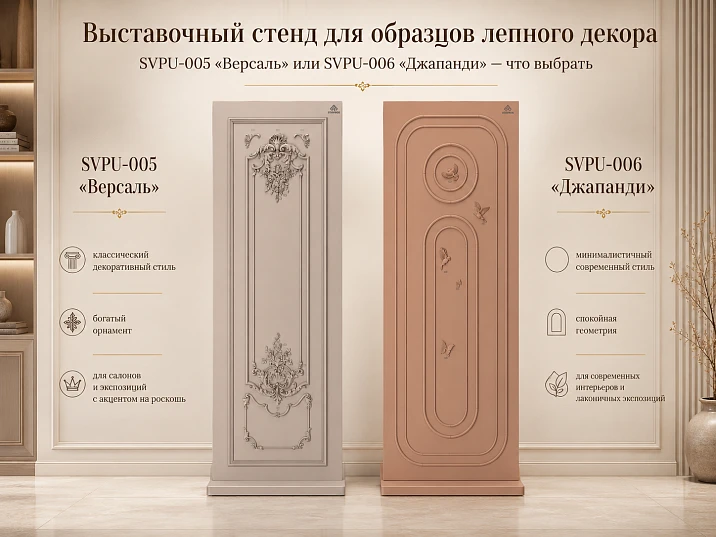
An exhibition stand for samples of stucco decor should be bought not based on the color of the photo or just an empty wall in the showroom. SVPU-005 "Versailles" and SVPU-006 "Japandi" have the same size 2500 × 900 × 16 mm, but work with opposite style audiences. The first helps sell classic and neoclassical styles through rich relief, ornament, and traditional profiles. The second showcases minimalism and Japandi through calm geometry, clean lines, and delicate chiaroscuro.
For a classic furniture salon, a studio with a large share of neoclassical projects, or a dealer who regularly equips homes with high ceilings, it is more reasonable to buy the exhibition stand SVPU-005 "Versailles". For a studio of modern interiors, city apartments, natural palettes, and clients who fear overloaded stucco, the more accurate choice is to buy the exhibition stand SVPU-006 "Japandi".
The size of the stands is the same, so the choice cannot be made by simply checking the dimensions. You need to study recent projects, the share of classic and modern styles, typical room footage, ceiling height, client objections, and products that are hardest to approve on screen. If the flow is mixed, two thematic stands can complement each other, and a small showroom can start with one specialized stand and a universal display.
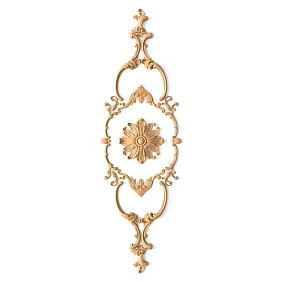
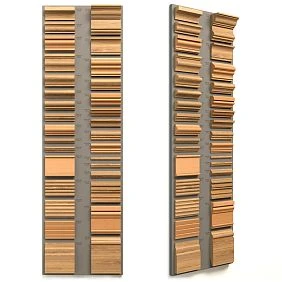
Both stands showcase polyurethane decor in real scale. The structure is hinged, the base is chipboard, the samples and base are coated with enamel, and next to the elements there are nameplates with article numbers and sizes. A rigid box is needed for storage and transportation. These features turn the stand not just into salon decoration, but into a working consultation tool: the client sees the relief, the manager notes the article number, and the printed catalog helps transition from the sample to the full specification.
Short answer. Classic, neoclassical, large relief, and traditional profiles — SVPU-005 "Versailles". Minimalism, Japandi, modern apartments, and calm geometry — SVPU-006 "Japandi".
Mixed audience — one universal and one thematic stand, or two thematic stands in different zones. Before ordering, allocate space for the exhibition 2500 × 900 mm, check lighting, viewing distance, and access to nameplates.
Select SVPU-005 "Versailles" Select SVPU-006 "Japandi" Buy a sample stand Compare with universal stands
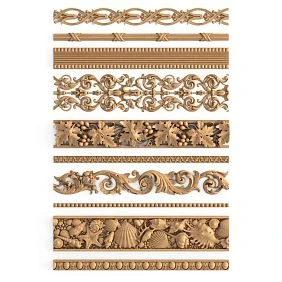
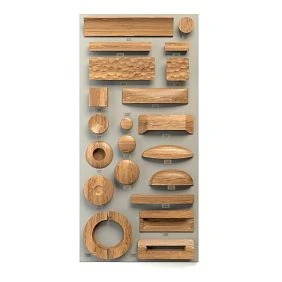
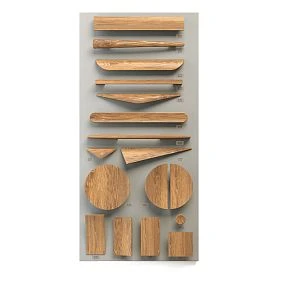

Confirmed characteristics of SVPU-005 and SVPU-006
| Parameter | SVPU-005 "Versailles" | SVPU-006 "Japandi" |
|---|---|---|
| Size | 2500 × 900 × 16 mm | 2500 × 900 × 16 mm |
| Format | Thematic exhibition | Thematic exhibition |
| Demonstrated group | Polyurethane decor | Polyurethane decor |
| Main style | Classic and neoclassical | Minimalism and Japandi |
| Visual character | Rich relief, ornament, traditional profiles | Calm geometry, clean lines, delicate relief |
| Card color | Matte enamel NCS S 2005-Y60R | Matte enamel NCS S 3020-Y50R |
| Base | Particleboard | Particleboard |
| Construction | Hinged | Hinged |
| Exposure coating | Enamel | Enamel |
| Labeling | Nameplates with article numbers and sizes | Nameplates with article numbers and sizes |
| Transportation | Rigid box | Rigid box |
| Average production time for made-to-order items | 3–7 days; the current timeframe is specified in the product card | 3–7 days; the current timeframe is specified in the product card |
| Main audience | Classic and neoclassical projects | Modern and minimalist projects |




Direct comparison: classic or minimalist exhibition stand
| Criterion | SVPU-005 "Versailles" | SVPU-006 "Japandi" | Practical conclusion |
|---|---|---|---|
| Style request | Classic and neoclassical | Minimalism and Japandi | The choice is determined by the audience, not the size |
| Typical object | Spacious house, high ceiling, representative interior | Modern apartment, quiet country house, laconic studio | See the latest completed projects |
| Manager's task | Show the richness of the relief and the system of classical decor | Show precision of proportions and restraint of decor | The consultation scenario should differ |
| Main client objection | Won't the decor be too massive | Won't minimalism be too empty | Physical samples remove various doubts |
| Lighting | Need to reveal complex relief and ornament | Need to show delicate shadow and clean lines | Side light is useful for both stands |
| Risk of error | Purchase for an audience that needs simplicity | Purchase for clients expecting rich classics | Analyze the order structure |
| One stand in a small salon | If classics provide the main share of orders | If modern style prevails | Profile selection is more important than versatility |
| Two stands | Classic area | Modern zone | Useful for a mixed flow of clients |
Our factory also produces:




Why a thematic stand differs from a universal one
A universal display shows the breadth of assortment: different profiles, sizes, and purposes are placed together without a single style scenario. This format is convenient when the client has not yet decided or comes with different tasks.
A thematic stand works differently. It collects samples into a ready visual language and helps to show not a single molding, but an entire direction. SVPU-005 sells a classic image, SVPU-006 sells a minimalist one. Therefore, comparison with universal models should be based on function, not just area.
Get Consultation
When a universal stand is more useful
A small showroom with very mixed demand can start with a universal stand to show more types of products in a limited space. It is also convenient for initial consultation when the client's style is not yet defined.
After identifying the request, the manager shifts the conversation to a thematic display or catalog. This route is especially useful if one stand cannot cover all sales directions.
When a thematic stand is more useful
A thematic display is needed where clients come with a ready style request. A designer of classic interiors does not need a mixed set of minimalist and ornamental profiles; they need a system that immediately confirms the salon's competence.
For a Japandi studio, the same logic works in reverse. The more precisely the stand matches the portfolio, the faster the client recognizes their project in physical samples.
How to choose between a thematic and universal stand
Open the statistics of recent consultations and divide them into three groups: classic, modern trends, and uncertain request. If one group noticeably prevails, a thematic stand addresses the main task more precisely.
If the shares are close, a combination is reasonable: a universal stand for initial acquaintance and one thematic stand for the key audience. A second thematic stand is added after checking demand and space in the showroom.
SVPU-005 for a classic furniture salon
A client of a classic furniture salon is already accustomed to large cornices, panels, pilasters, and ornamentation. SVPU-005 helps connect furniture with wall and ceiling decor, showing profiles in a unified style.
It is better to place the stand next to a classic furniture composition, but not to block it with tall display cases. The client should see the samples entirely and have access to the nameplates.
SVPU-005 for a neoclassical studio
Neoclassicism requires a balance between relief and calm architecture. The "Versailles" stand helps show which profiles look expressive and which may be overly active for a specific room.
The manager should explain the scale: the same cornice works differently with a ceiling height of 2.7 and 4 meters. A physical sample helps discuss this concretely.
SVPU-005 for country projects
Country houses often feature spacious halls, high ceilings, stair areas, and large living rooms. A classic stand allows you to showcase decor that appears too large in photos but is actually proportionate to the room in real scale.
During a consultation, it is useful to compare the sample with the floor plan, wall height, and molding frame width. The stand becomes a starting point, not a replacement for project calculations.
SVPU-005 for an architectural firm
For an architectural firm, not only individual samples are important, but also quick specification generation. Labels allow you to record article numbers right at the meeting, and a printed catalog helps find additional sizes and related items.
The stand is suitable for a meeting room where representative interiors, hotels, private residences, and public spaces with a classic character are discussed.
SVPU-005 for a regional dealer
A regional dealer can use "Versailles" as a permanent display or a mobile tool for meetings with partners. The rigid case helps transport the stand, but the route, loading method, and securing must be planned in advance.
If classic style makes up only a small portion of orders, it is better to supplement the stand with a universal set rather than building the entire display around one style.
When SVPU-005 is not suitable
If most clients prefer smooth walls, narrow profiles, and neutral natural palettes, a rich classic display may be off-putting and create a wrong impression of the assortment.
In that case, SVPU-006 or a universal stand is better, and add "Versailles" only when there is a steady demand for classics.
SVPU-006 for a modern design studio
A studio working with minimalism needs samples that prove restrained decor is not equal to a blank wall. SVPU-006 shows thin lines, calm profiles, and real chiaroscuro.
The client sees how a delicate molding structures the surface without rich ornamentation. This reduces the fear of using stucco decor in a modern interior.
SVPU-006 for city apartments
In city apartment projects, moderate scale, clean lines, and saving visual space are often important. The "Japandi" stand helps explain why a narrow or calm profile is not lost but creates rhythm.
The manager can input data on room area, ceiling height, and furniture layout, then select samples that do not overload the space.
SVPU-006 for a procurement office
A procurement specialist needs quick solutions for several projects simultaneously. The thematic stand reduces initial selection time, and labels help immediately record items in the specification.
The printed catalog complements the stand where the display lacks the required size or related element. The physical sample and catalog work as a single system.
SVPU-006 for an architectural bureau
Modern bureaus often work with natural materials, calm colors, and concise geometry. SVPU-006 supports this language and does not create the feel of a classic salon.
In the meeting room, the stand can be used to compare profiles under different lighting. This helps to agree not only on the shape but also on the expected light and shadow.
SVPU-006 for a regional dealer
If the demand for modern apartments and country houses with natural minimalism is growing in the region, the "Japandi" stand becomes a precise entry point for consultation.
Before purchasing, the dealer should check if there are enough related items in the assortment and promotional materials. One stand without a catalog and a ready sales script works less effectively.
When SVPU-006 is not suitable
A salon that primarily sells rich classics, large cornices, and ornamental compositions may find that "Japandi" looks too restrained for its audience.
In such a situation, it is more reasonable to use SVPU-005, SVPU-008, or a universal display with a separate small block of modern decor.
How to analyze the last 20–50 projects
Create a table with the project, style, area, ceiling height, client type, and final decor set. Separately note cases where approval was delayed due to the absence of physical samples.
Such an analysis shows not the tastes of the salon owner, but the real requests of the audience. The stand is purchased for working with clients, so the portfolio is more important than personal preferences.
Which metrics to use instead of guesses
The share of classic and modern styles, average order value, number of repeat consultations, frequent objections, and the number of projects where the client refused decor after viewing only photos are useful.
There is no need to promise a specific conversion increase. The stand is evaluated by whether it reduces the number of iterations and helps to fix SKUs faster.
How to account for the average area of premises
Large spaces more easily accept large classic decor, so SVPU-005 is more often suitable for projects of houses, halls, and representative interiors. Small apartments are usually closer to SVPU-006.
This is not a strict rule. Ceiling height, number of free walls, and overall style are important, but area helps form an initial hypothesis.
How to account for ceiling height
Classic cornices and ornamental compositions are especially convincing in rooms with greater height. The "Versailles" stand helps show their real scale.
In an ordinary city apartment, the client more often needs more delicate profiles. "Japandi" makes such a choice clearer and reduces the risk of a too massive solution.
How to account for client type
A private client often reacts to a finished sample and atmosphere. A designer or architect additionally looks at article numbers, sizes, compatibility, and the ability to assemble a system.
SVPU-005 works better with a client who expects expressive classics. SVPU-006 works with someone looking for calm structure and afraid of visual noise.
What objections does 'Versailles' address
Clients of classic interiors doubt the scale, depth of relief, and combination of multiple ornaments. At the stand, they see samples side by side and can compare them under real lighting.
The manager should not just show the decor, but explain which element will be the main one and which will be supporting. Otherwise, a rich display may overload the consultation.
What objections does 'Japandi' address
The main fear of a minimalist audience is that stucco decor will look foreign or too classic. SVPU-006 shows concise profiles and explains how they structure the wall without ornamental excess.
Physical chiaroscuro helps prove that a calm profile remains noticeable even in a neutral color.
How to understand if one stand is needed
One thematic stand is suitable for a salon with a clear positioning and limited space. It should match the main share of orders, while other directions can be supported with a catalog and compact samples.
If a salon chooses one stand due to budget, it is important not to take a compromise style. It is better to hit the key audience precisely than an exposition that convinces no one.
When two thematic stands are needed
Two stands are justified with stable demand for classic and modern style, sufficient wall space, and the ability to separate consultation routes.
SVPU-005 and SVPU-006 should not be mixed on the same plane. Different zones help the client find their direction faster and avoid comparing incomparable profiles.
Universal plus thematic stand
This combination is suitable for a salon with a mixed flow. The universal stand shows the breadth of the assortment, while the thematic one deepens work with the most profitable or complex audience.
Before purchasing, it is useful to study how a universal stand differs from a thematic one, and then determine which format should be first in the consultation route.
Two thematic stands in different zones
"Versailles" is placed next to classic furniture, molding frames, or samples of ornamental profiles. "Japandi" is placed next to modern panels, neutral materials, and calm furniture.
The division should not turn into two isolated stores. A shared navigation and catalog link the zones into one STAVROS system.
How to avoid two stands with the same purpose
Before ordering, compare not the names, but the audience and function. If both stands showcase similar neoclassicism, they may compete for the same space.
SVPU-005 and SVPU-006 are more separated than similar classic collections. Therefore, purchasing them together is logical for a mixed portfolio.
When a third thematic stand is needed
The third stand makes sense if the salon consistently works with a separate natural or light neoclassical audience. It should not appear just to fill the wall.
For botanical and organic projects, you can check out the botanical stand SVPU-007 "Summer Garden". For calmer classic — view the SVPU-008 "Neoclassic Light" stand.
How to choose a location for a 2500 × 900 mm stand
A free vertical zone is needed where the stand's dimensions are not obstructed by furniture, a manager's desk, doors, or storage boxes. The wall size must account not only for the 900 mm width but also for working access.
The exact installation method and the necessary space for opening the hinged structure are clarified before ordering. The article does not prescribe a universal mounting.
How to check the room height
The stand height of 2500 mm requires checking the ceiling, cornice, pendant lights, and engineering elements. In a room with a low ceiling, the upper part of the display may be too close to the light or inaccessible for viewing.
Make a paper outline of 2500 × 900 mm and attach it to the planned wall. The mockup quickly shows the real scale.
How much space to leave in front of the stand
A universal distance cannot be assigned without a layout. The client must step back to see the overall composition, then approach the nameplates and samples.
Check the passage during peak hours, door openings, and the possibility of consulting two or three people simultaneously. The stand should not create a bottleneck.
How not to block the stand with furniture
A low console can support the display if it does not block lower samples or hinder access. A tall cabinet or sales stand can make some nameplates inaccessible.
Plan furniture after placing the stand or use a full-size template before purchasing.
How to organize side lighting
Relief is read through shadow. Side or oblique light reveals the depth of classic ornament and the delicacy of a minimalist profile better than uniform ceiling lighting.
The light fixture should not create harsh glare on matte enamel or overexpose nameplates. The angle is checked on a sample.
Lighting SVPU-005 "Versailles"
A classic stand requires light that reveals several levels of relief and ornament. Too frontal light makes the surface flat, while overly contrasty light turns details into dark spots.
It is useful to have general soft light and an additional directional source for demonstrating individual profiles.
Lighting SVPU-006 "Japandi"
Minimalist decor is built on subtle shadow, so lighting should be calm and precise. Too dramatic light contradicts the character of the display.
The manager can show the client how changing the light angle alters the perception of a narrow molding or cornice.
How to ensure access to nameplates
Nameplates with article numbers and dimensions should be readable without bending over furniture and without needing to disassemble the display. It is useful for the client to see the connection between the sample and the product code.
Before opening the showroom, conduct a test: a new employee should be able to find a selected article and transfer it to the specification within a few minutes.
How to protect the stand from damage
The display should not be placed in an area of constant cart traffic, near the entrance door, or in the unloading zone. Clients should have access to the samples but should not lean on the structure.
The care routine and permissible cleaning agents are agreed upon with the coating. For transportation, a rigid box provided with cards is used.
How to store the stand in a rigid box
Before packing, the surface is cleaned, nameplates are checked, and moving parts are secured in the manner provided by the design. The box is stored in a dry place where heavy objects are not placed on it.
If the stand is used infrequently, periodically check the condition of the enamel, hinges, and markings until the next meeting.
Can the stand be used at an exhibition
The rigid box and hinge construction make the themed stand suitable for mobile presentations. However, the size of 2500 × 900 mm requires checking the transport, entrances, elevator, and exhibition space area in advance.
Do not promise deployment without preparation. The logistics plan is drawn up based on the actual box and site conditions.
How to transport the stand to the site
The route is checked from the warehouse to the client's premises: transport, doorways, stairs, elevator, and unloading area. The box must remain secured and protected from impacts.
At the site, the stand is installed only in a safe area where construction work will not damage the enamel and samples.
How to conduct a consultation at SVPU-005
Start not by listing samples, but with the client's room: ceiling height, area, number of free walls, and desired level of decorativeness. Then show one main profile and two close options.
After selecting the shape, find the article number on the nameplate, transfer it to the specification, and open the catalog for related cornices, moldings, and decorative elements.
How to conduct a consultation at SVPU-006
First, find out what the client fears more: an empty wall or an overloaded decor. Then show how a calm profile creates structure through light and shadow, without turning minimalism into classic.
Record not only the article number, but also the element's task: cornice, frame, plinth, or transition. This way, the client understands the system rather than buying a random profile.
How not to overwhelm the client with samples
Showing ten similar profiles at once makes decision-making difficult. It's better to start with three options of different scales, then narrow the choice down to two.
A thematic stand already performs primary filtering by style. The manager's task is not to revert the consultation to a chaotic review of the entire assortment.
How to compare decor under different lighting
Show the sample under general light, then turn on a side light source. The client will see how much stronger the relief works and how the depth of shadow changes.
For 'Versailles', this helps evaluate the ornament; for 'Japandi', it proves the expressiveness of a delicate profile.
How to link a sample to a product card
The label provides the article number and size, after which the manager finds the corresponding card and checks current options, price, and availability. The stand does not replace the current information on the website.
The specification records the exact article number, quantity, place of application, and related items. A photo of the label helps avoid errors during transfer.
How to use the stand with KATALOG-PU
The stand gives a physical impression, and the printed catalog of polyurethane decor expands the selection and helps find related items. The current catalog card indicates A4 format, 122 pages, and dimensions 300 × 210 × 10 mm.
The scenario is simple: choose a sample on the stand, write down the article number, find it in the catalog, show additional sizes, and assemble a set.
Why a catalog without a stand may not be enough
A printed photo shows the composition and assortment but does not convey the real profile depth, tactility, and behavior under side light.
The catalog is convenient for navigation, and the stand is for confirming the decision. Together, they cover different stages of the consultation.
Why a stand without a catalog may not be enough
It is physically impossible to display the entire assortment and all sizes on a thematic exhibition. The client can choose the profile character but may not see the related item for another room.
The catalog allows continuing the selection without turning the stand into an overloaded display.
How to use OMLD-005
Buy OMLD-005 molding sample set useful for on-site meetings and comparing wooden profiles. The current card confirms the size 375 × 315 × 125 mm and a compact show case with a handle.
This set does not replace SVPU-005 or SVPU-006: it solves a mobile task and shows a different group of materials. In a large showroom, the tools complement each other.
Stand or compact set for on-site meeting
A full-size thematic stand creates a stronger style context and shows the system. A compact set is easier to carry and use on site.
If meetings are held mainly in the studio, the stand becomes the main tool. With constant on-site visits, the set and catalog can be the first step, and the stand for final approval.
How to create a specification based on samples
In the table, indicate the room, element function, article number, size, quantity, color, installation location, and related position. Create separate rows for different rooms.
The stand helps to choose a sample but does not calculate linear footage. Measurements and the final specification are done according to the project.
How to record client decisions
During the meeting, photograph the selected sample together with the nameplate, record a comment, and mark it on the plan. A single profile photo without an article number is not enough.
After the meeting, the client receives a brief summary, and the manager checks the cards and prepares a commercial proposal.
How to train managers to work with the stand
A new employee must know the style logic of the stand, be able to find nameplates, explain the scale, and navigate to the catalog. Learning collection names is not enough.
Role-playing consultation is useful: one employee plays a classic-style client, another plays a minimalist client. Mistakes are recorded and turned into a working scenario.
How to update staff knowledge
When new items appear, managers compare the display with the catalog and product cards. If the article number has changed or been discontinued, the labeling cannot be left unchecked.
Regular training maintains the connection between the physical stand and the current assortment.
How to update the exhibition display
The stand should not become a surface for random additional samples. Any update must preserve the concept and readability of the nameplates.
Changes are coordinated with the current lineup and visual logic. If a different style is needed, a separate stand or compact set is better.
How to photograph a stand for an online presentation
Shoot the overall view frontally, then details under side lighting and nameplates of selected samples. The camera must not distort the 2500 mm vertical.
Photos help continue the consultation after the meeting, but do not replace a physical viewing.
How to use the stand in a video call
The manager checks the lighting, angle, and access to SKUs in advance. The camera should first show the overall concept, then a specific profile.
During the call, it is useful to keep a catalog nearby to immediately demonstrate related items and sizes.
How to determine payback without fabricated promises
Compare the cost of the stand with the number of consultations where a physical sample helped reduce repeat meetings or expand the set. Evaluate the salon's actual data over several months.
It is impossible to promise a universal payback period or sales growth percentage. The result depends on traffic, manager skills, and how well the stand matches the audience.
Which metrics to track after installation
Record the number of consultations at the stand, selected SKUs, subsequent orders, repeat meetings, and reasons for rejection. Compare with the period when only the catalog was used.
It is also useful to note which stand attracts the client on its own more often and which requires explanation from the manager.
When the stand does not pay off
The display works poorly if placed in a dark corner, does not match the assortment, is blocked by furniture, or the staff does not know how to link samples to orders.
The problem is not always with the model. First, check the placement, consultation script, and relevance of the labels.
How to determine the second stand based on the results of the first
After a few months of operation, see which requests remain without physical support. If 'Versailles' covers the classics, but modern projects are still only approved on screen, 'Japandi' could be next.
The decision is based on data, not on the desire to fill an empty wall.
How to divide a showroom into style zones
The classic zone can include SVPU-005, furniture with panels, and samples of rich profiles. The modern zone — SVPU-006, calm materials, and minimalist furniture.
A general catalog and navigation unite the zones. The client should understand that both displays belong to the same product system.
How to work with a mixed client request
Some projects combine a modern base with neoclassical details. There is no need to immediately choose one stand as the only correct one.
Show a minimalist base on SVPU-006, then one or two more expressive profiles on SVPU-005, and check where the boundary of acceptable relief lies.
How to compare "Versailles" and "Japandi" corr<What to buy together with the stand
A thematic stand provides a living style context, but a full consultation requires a catalog, mobile samples, and access to the entire collection. The kit is chosen based on the business format: permanent showroom, design studio, on-site meetings, or regional dealer.
| What to add | Why | For which scenario | What to Check | Link |
|---|---|---|---|---|
| SVPU-005 "Versailles" | Create a classic thematic zone | Neoclassical, large relief, high ceilings | 2500 × 900 × 16 mm, space and light | Classic stand for stucco samples |
| SVPU-006 "Japandi" | Create a modern minimalist zone | City apartments, japandi, calm profiles | 2500 × 900 × 16 mm, passage and lighting | Minimalist stand for stucco decor |
| Sample category | Compare universal and thematic formats | The salon has not yet determined the configuration | Do not duplicate one task across multiple stands | Exhibition stands for samples |
| KATALOG-PU | Expand selection beyond the exhibition | Specification formation and on-site meetings | Current SKUs and related items | Buy a printed catalog of polyurethane decor |
| OMLD-005 | Get a mobile set of profiles | Objects, meeting rooms, on-site consultations | Size 375 × 315 × 125 mm and material group | Buy OMLD-005 molding sample set |
| Polyurethane decor category | Move from a sample to a full product group | Selection of moldings, cornices, rosettes, and other elements | Sizes, purpose, and relevant cards | View STAVROS polyurethane decor |
| SVPU-007 "Summer Garden" | Add a natural and botanical audience | Countryside, organic, and plant-based concepts | Does it duplicate the task of an existing zone | check out the botanical stand SVPU-007 "Summer Garden" |
| SVPU-008 "Neoclassic Light" | Show lightweight neoclassicism | Clients between rich classic and minimalism | Real style gap with SVPU-005 | view the SVPU-008 "Neoclassic Light" stand |
Practical matrix for choosing a showroom stand
| Situation | Preliminary selection | Why | What to Check |
|---|---|---|---|
| More than half of projects are classic | SVPU-005 | Stand matches the core audience | Location, light, and linked catalog |
| More than half of projects are modern style | SVPU-006 | Calm geometry is closer to the portfolio | Presence of related minimalist items |
| Mixed flow and one free wall | Universal + one thematic | Broad primary selection and precise deepening | Which style is harder to coordinate |
| Mixed flow and large showroom | SVPU-005 + SVPU-006 | Two clear style zones | Navigation and absence of visual conflict |
| Primarily off-site meetings | Catalog + OMLD-005, stand for final meetings | Compact set is more convenient for constant transportation | Where the full-size exhibition will be stored |
| Opening of a classic salon | SVPU-005 | Immediately sets the desired image | Does the stand block the passage and furniture |
| Opening of a modern design studio | SVPU-006 | Supports minimalist positioning | Lighting, background, and meeting area |
| Frequent projects with high ceilings | SVPU-005 | Large classic decor is easier to show in context | Real scale of samples |
| Frequent small apartments | SVPU-006 | Delicate profiles are closer to the task | Do not promise universality for all rooms |
| Clients between classic and minimalism | SVPU-008 or comparison of two zones | Need an intermediate visual language | Actual portfolio and place |
| Natural botanical projects | SVPU-007 | Separate style audience | Do not buy a third stand without demand |
| No order data | First, audit the consultations | Buying based on the owner's taste is risky | 20–50 latest projects and objections |
Mistake: choosing a stand by the color of the card
NCS color helps create an exhibition background, but does not determine the commercial function. The client primarily reacts to the style of samples, relief, and connection to the project.
The choice between SVPU-005 and SVPU-006 is based on the audience. Color can be considered when placing, but not turned into the main criterion.
Mistake: considering stands identical due to size
Both have dimensions 2500 × 900 × 16 mm, but one shows classic, the other — japandi. Same area does not mean the same consultation scenario.
If a salon buys either of the two just because it fits on the wall, the risk of a style mismatch remains high.
Mistake: buying "Versailles" for a minimalist audience
A client who is afraid of rich decor might see a classic stand and decide that the salon does not work with modern interiors.
Such a flow needs SVPU-006 or a universal display with a clear modern zone.
Mistake: buying "Japandi" for a heavy classic salon
Restrained profiles do not show the richness of ornamentation that a classic audience expects. The manager will have to constantly explain the solutions missing from the stand.
SVPU-005 more accurately matches such a portfolio and helps sell a set, not a single laconic profile.
Mistake: not analyzing recent orders
The owner's personal tastes, the showroom interior, and actual sales may not align. Without statistics, the stand becomes a decorative purchase.
Before ordering, they study the last 20–50 projects, the share of styles, and cases where the client lacked physical samples.
Mistake: not allocating a space of 2500 × 900 mm
The size is checked together with the ceiling, furniture, passage, lighting, and possible structure opening. A free rectangle on the plan does not guarantee convenience.
A full-size paper mockup helps to see the conflict before delivery.
Error: placing the stand in a dark corner
Without side lighting, classic relief loses depth, and a minimalist profile seems too weak. The consultation again comes down to words.
Lighting is designed before installation, not attempted to be fixed afterward.
Error: covering nameplates
If furniture or decor blocks the labeling, the manager cannot quickly transfer the article number to the specification. The stand loses its working function.
Access to each label is checked from the usual consultation point.
Error: showing the stand without a catalog
The display does not contain the entire assortment and all sizes. Without a catalog, the client chooses the character but cannot always assemble a complete set.
A printed KATALOG-PU or an up-to-date product card should be nearby.
Error: do not link the sample to the product card
A physical sample shows the shape, but price, availability, and options may change. The decision cannot be made based solely on the label.
The manager checks the current product card before making a commercial offer.
Error: promise sales growth in percentages
A stand can speed up consultation and make the choice more specific, but the result depends on traffic, assortment, and staff performance.
You need to evaluate the actual salon metrics, not an advertising figure without basis.
Error: buying multiple stands for one task
Two similar classic stands can compete for the same audience, leaving the modern request unsupported.
Each new display should cover a separate segment or consultation stage.
Error: using the stand as a sample storage
Randomly added profiles, catalogs, and packages disrupt the concept and obscure the labeling. The client stops seeing the style image.
A separate table, case, or universal stand is needed for additional samples.
Error: not training staff
Even a precise display doesn't work if the manager doesn't know article numbers, styles, and the catalog navigation. The client gets a beautiful backdrop instead of a consultation.
Training and test meetings are conducted before launch.
Error: failing to check logistics
A height of 2500 mm requires careful transportation planning, door clearance, and storage space for the box. You cannot rely solely on the width of 900 mm.
The route is checked before ordering, especially for exhibitions and off-site meetings.
Error: placing both stands flush together
When placed too close, rich classic and calm japandi styles can visually clash. It becomes harder for the client to understand the zone boundaries.
A transition, navigation, or independent furniture group is needed between the exhibits.
Error: evaluate only the overall appearance
The overall image is important, but a B2B tool should allow reading the nameplate, finding the position, and placing an order.
Check the stand simultaneously as an interior object and a working system.
Error: do not update specifications
Cards and assortment may change. If a manager uses an old record without checking the site, there is a risk of an error in the order.
The nameplate serves as a search point, not a perpetual guarantee of commercial terms.
Who is SVPU-005 "Versailles" suitable for
The stand is suitable for classic furniture showrooms, neoclassical studios, architectural firms with representative projects, and dealers who regularly sell rich relief.
It is especially useful when clients find it difficult to imagine the scale of cornices and ornamental moldings from a screen.
Who is the SVPU-006 "Japandi" for
The stand is suitable for modern design studios, specification offices, showrooms of minimalist materials, and dealers working with city apartments.
It helps explain how delicate decor creates structure without visual heaviness.
Who the thematic stand may not suit
If a salon sells very different styles, rarely consults offline, or lacks a wall and lighting, a single thematic stand may be too narrow a tool.
In that case, a universal display, printed catalog, and mobile sample set are more useful.
When to postpone the purchase
The purchase should be postponed if there is no portfolio data, the location is not determined, the staff is not trained, and there is no script linking to the catalog.
The stand does not fix organizational issues. The consultation process must be prepared first.
Stand for a new showroom
A new showroom can build its exposition around its positioning. If the brand promises classic, SVPU-005 should be visible from the entrance; if modern minimalism — SVPU-006.
Before opening, check the lighting, aisles, furniture, and the manager's performance during a test consultation.
Stand for an existing showroom
In an existing showroom, first identify the gap: which style is harder to coordinate and where the client more often leaves without a solution. The new stand should address a specific problem.
After installation, compare consultation metrics before and after, without changing too many processes simultaneously.
Stand for a design studio
In a studio, what matters is not a display window but hands-on work during the meeting. Place the stand next to the meeting table, catalog, and project materials.
The client should be able to step back, examine the composition, and then approach the selected sample.
Stand for an architectural firm
Architects use the stand as part of a material library. It helps coordinate profile, light and shadow, and style system before including items in documentation.
Storing specifications and photos of selected samples makes the work repeatable.
Stand for the sales office
In a sales office, a thematic exposition helps quickly segment the client. The manager asks a few questions about style and directs the visitor to the appropriate stand.
If the space is small, the stand should not block workstations and employee routes.
Stand for a dealer
Mobility and the ability to showcase the assortment to a partner are important for a dealer. A rigid box helps with transportation, but its size requires suitable transport.
For frequent trips, it is better to supplement the stand with a catalog and a compact set, so as not to carry a full-size display to every meeting.
Stand for an interior exhibition
At the exhibition, a thematic display quickly communicates to the audience which style the company works with. "Versailles" attracts a classic audience, "Japandi" attracts a modern one.
Before the event, check the fastening rules, space dimensions, and the organizer's lighting.
Stand for an off-site presentation
At the site, the stand allows you to evaluate samples under real light and next to finishing materials. This is useful during final approval.
In a construction zone, protection from dust, impacts, and wet processes is needed.
How to place an order for SVPU-005
Open the card, check the size 2500 × 900 × 16 mm, current price, lead time, and delivery conditions. Then add the catalog and, if necessary, mobile samples.
Before payment, confirm the location, transport route, and readiness of the classic zone.
How to place an order for SVPU-006
Check the same dimensions, current commercial terms, and availability of space for the modern zone. Link the stand to the catalog and collection assortment.
If the studio only works on-site, assess whether a compact kit would be more reasonable first.
What to check before payment
Need the exact article number, size, color, construction, box, nameplates, lead time, delivery, and list of accompanying materials. Commercial data is checked in the card on the order date.
Also record who is responsible for acceptance, installation, lighting, and staff training.
How to accept a stand
Upon receipt, check the box, surface, hinges, enamel, nameplates, and compliance with the article number. Record packaging damage before unpacking.
Do not put the stand into operation until all samples and signatures have been verified.
How to store the stand
Keep the display and box in a dry room, protect from impacts and direct load. If the stand is not used for a long time, inspect the surface periodically.
Do not place heavy materials on the box or use it as a storage shelf.
How to care for the display
Remove dust with a soft cloth without damaging the enamel and nameplates. Use aggressive agents only after confirming compatibility.
Regular care is important: the client evaluates not only the samples but also the salon's attitude toward materials.
How to save data for reordering
Save cards, photos of the stand, a list of related catalogs, and the internal consultation script. When purchasing a second stand, this will help avoid duplication.
Documents also simplify training new employees.
How to make the final decision
Compare the portfolio, audience, location, lighting, and work format. If most projects are classic — SVPU-005; if minimalist — SVPU-006.
For mixed demand, decide whether you need one thematic stand next to a universal one or two separate zones.
What does a chipboard base mean
The base forms the working plane of the display and holds the samples. It does not mean that the entire stand is made of polyurethane: the material field in the card refers to the product group being demonstrated.
During transportation and storage, the base is protected from impacts and moisture. The exact weight and installation method should not be invented without a card or a manager's response.
Why is a hinge structure needed
Hinges help organize the working structure and access to stand sections. They also require careful handling during carrying and opening.
The angle, fixation method, and installation diagram must be clarified before placement. The article does not declare the stand as wall-mounted, floor-standing, or self-supporting without confirmation.
What does matte enamel show
A matte surface reduces sharp glare and helps to see the chiaroscuro of the relief. The NCS color creates a background for the thematic display but does not limit the buyer to only that shade of decor in the project.
The client chooses the profile and scale, and checks the future finish of the specific product separately.
Why stand colors should not be compared like interior paint
NCS S 2005-Y60R at "Versailles" and NCS S 3020-Y50R at "Japandi" relate to the exhibition design. They help set the atmosphere of the stand, but are not a recommendation for each client's room.
The main choice remains stylistic and commercial: which set of samples is closer to the salon's actual portfolio.
How to use nameplates without errors
The article number and size are rewritten accurately, then checked against the product card. You cannot rely on memory or photograph only the sample itself.
If the marking is damaged or hard to read, the stand must be put in order before the next consultation.
Why a rigid box does not replace a transport plan
The box protects the exhibition, but does not solve the issues of transport dimensions, stair lifting, and cargo securing. The route is calculated before departure.
It is especially important to check the height and length of the loading area for a 2500 mm stand.
How not to confuse an exhibition stand with an advertising structure
SVPU-005 and SVPU-006 are designed for physical samples of polyurethane decor and professional selection by article numbers. They are not roll-ups, banners, or information boards.
The customer receives a thematic material display, not a surface for arbitrary printed advertising.
How not to confuse a thematic stand with a showcase for other materials
The stands are designed for polyurethane decor. They are not automatically intended for tiles, wallpaper, doors, or flooring.
If the showroom works with multiple product groups, each requires its own sample format and separate consultation logic.
How to prepare the wall and display background
The background should not clash with the stand's color, nameplates, or sample relief. Too busy wallpaper, large patterns, or mirrored surfaces make the display less readable. Before installation, it is useful to apply a full-size outline and check the combination under lighting.
The exact mounting method, permissible wall load, and need for additional supports are confirmed separately. The size 2500 × 900 × 16 mm alone does not describe the mounting assembly, so the article does not prescribe universal anchors or mounting height.
How to create an internal regulation for working with the stand
The regulation specifies the consultation sequence, catalog storage location, card checking procedure, person responsible for nameplate condition, and method for recording selected items. This is especially important if multiple managers work with the stand.
Once a month, it is useful to check the display: cleanliness, readability of markings, condition of hinges, relevance of associated cards, and consultation statistics. The regulation turns a beautiful panel into a sustainable working tool, not just a backdrop for the meeting room.
For quality control, conduct a test consultation with an employee who has not worked with the exposition before. They must determine the client's style, show three relevant samples, find article numbers, open related items in the catalog, and prepare a brief specification without hints. This test identifies placement and training issues before meeting a real customer.
Check in advance.
FAQ: questions about SVPU-005 "Versailles" and SVPU-006 "Japandi"
How is SVPU-005 different from SVPU-006?
The size is the same, but SVPU-005 showcases classic and neoclassical styles, while SVPU-006 showcases minimalism and Japandi.
What is the size of both stands?
The confirmed size of each model is 2500 × 900 × 16 mm.
What do the stands demonstrate?
Physical samples of polyurethane decor: moldings, cornices, and other elements of the corresponding style concept.
What is the base made of?
The card descriptions indicate a chipboard base. The displayed product group is polyurethane decor.
Are the samples labeled?
Yes. Next to the elements, there are nameplates with article numbers and dimensions.
How are the stands transported?
The cards indicate a rigid shipping box. The specific route and transport need to be calculated in advance.
Are there hinges?
Yes, both structures are on hinges. The installation and fixation method is clarified before ordering.
What color is SVPU-005?
Matte enamel NCS S 2005-Y60R.
What color is SVPU-006?
Matte enamel NCS S 3020-Y50R.
Which stand to choose for classics?
SVPU-005 "Versailles", if classic and neoclassical projects make up the main part of the portfolio.
Which stand to choose for minimalism?
SVPU-006 "Japandi", if the studio works with modern apartments and calm natural concepts.
Will SVPU-005 suit a small apartment?
The stand can help choose classic elements, but the manager should carefully explain the scale and not transfer large solutions without checking.
Will SVPU-006 suit a country house?
Yes, if the project is based on modern natural minimalism, calm lines, and moderate decor.
Do you need one stand or two?
One — with a clear niche demand. Two — with a stable classic and modern audience and sufficient space.
Is it possible to combine a thematic and a universal stand?
Yes. The universal shows the breadth of the assortment, the thematic deepens the consultation on the key style.
How is a thematic stand different from a universal one?
The thematic creates a ready-made style context, the universal demonstrates a wider assortment without a single concept.
Where to place the stand?
In a well-lit accessible area where samples and labels are not blocked and there is room for general and close viewing.
How much space should be left in front of the stand?
There is no universal distance. You need to check the flow of people, consultation of several participants, and access to labeling.
Is side lighting needed?
It is useful for revealing relief and chiaroscuro, but the angle and brightness need to be tested on site.
Can the stand be placed in a dark corner?
Not recommended: the relief will be less readable, and the consultation will lose the main advantage of physical samples.
Can the stand be taken to an exhibition?
Yes, a rigid case helps with transportation, but you need to check the transport, entrances, location, and installation rules.
Can the stand be used on site?
Yes, for sample approval, if it is protected from construction dust, impacts, and wet processes.
What should I buy together with the stand?
Printed KATALOG-PU, compact set OMLD-005, and if necessary, a universal or additional thematic stand.
Why is a printed catalog needed?
It shows a more complete assortment and helps transition from the selected sample to related items and specifications.
Why is OMLD-005 needed?
The compact set is convenient for off-site meetings and profile demonstrations, but does not replace a full-size thematic display.
How to work with nameplates?
Rewrite or photograph the article and size, then check the current product card.
Can I place an order based only on the stand?
No. The current price, availability, options, and conditions must be verified in the product card.
How to evaluate the payback?
Based on the actual number of consultations, reduction of repeat meetings, complete orders, and manager performance, without universal promises.
Is it necessary to train managers?
Yes. The employee must understand the style logic, find articles, and translate the selection into a catalog and specification.
What is the average production time for custom orders?
Current cards indicate 3–7 days. The specific date is checked before payment.
Can I buy "Versailles" and "Japandi" together?
Yes, if the showroom has a mixed audience, two zones, and consultation scenarios for each.
When is a universal stand better?
When demand is highly mixed, space is limited, and the client usually starts without a formed style request.
Who is SVPU-007 suitable for?
For projects with natural, botanical, and organic themes, if such a segment is confirmed by the portfolio.
Who is SVPU-008 suitable for?
For clients who need a lightweight neoclassicism between the rich "Versailles" and strict minimalism.
How to accept the stand?
Check the box, enamel, hinges, samples, nameplates, size, and compliance with the article before operation.
How to care for the stand?
Remove dust with a soft cloth and use only products compatible with the coating.
Where can I buy both stands?
In the official cards SVPU-005 and SVPU-006 and in the product samples category on the STAVROS website.
What should be checked before ordering?
Audience, location, lighting, transport route, article number, size, box, labeling, catalog, and staff training.
Result: "Versailles" or "Japandi" for the showroom
SVPU-005 "Versailles" and SVPU-006 "Japandi" have the same size 2500 × 900 × 16 mm, but are not interchangeable. "Versailles" helps work with classical and neoclassical projects where large relief, ornament, and traditional profiles are important. "Japandi" showcases modern minimalism, clean geometry, and delicate chiaroscuro.
A small profile salon can choose one thematic stand. A mixed showroom — a universal plus thematic or two separate zones. The decision should be based on the last 20–50 projects, not on personal taste or card color.
The stand works stronger together with KATALOG-PU and mobile samples. The nameplate helps fix the article number, the catalog expands the selection, and the current card confirms the price, availability, and options. This route makes the consultation substantive and reduces the risk of error when transferring an item to the specification.
on the Stavros website you can order a thematic exhibition for a classic showroom, choose an exhibition for a modern showroom or view all product samples. The correct order is audience audit, style selection, venue check, lighting, catalog kit, staff training, and only then purchase.