Article Contents:
- What exactly is NPU-106 in this task
- Why it makes more sense to check the overlay on a solid panel rather than on glass
- First find the axis of the display case, not the center of the wall
- A paper template of 400 × 90 mm is mandatory before ordering
- Free space around NPU-106: you need to calculate the remainder, not invent a universal margin
- The height of the top panel is sometimes more important than its width
- Parameter C = 13 mm: why simulate volume
- Composition of the top panel: how much decorativeness can the display case handle
- Does the NPU-106 need a separate molding frame?
- How does a horizontal ornament work next to vertical slats?
- When one NPU-106 makes a simple display case more expressive
- A strict built-in display case with one classic accent
- A neoclassical display case without an elaborate carved top
- A display case next to an active slatted wall
- When the NPU-106 overloads the display case
- How to account for the width of the glass section specifically
- What changes if the glass doors are divided by a central post
- How the contents of the display case affect it
- Internal lighting can change the decision
- The color of NPU-106 allows you to adjust the degree of decorativeness
- In the color of the body
- A close shade
- Contrast
- Furniture cornice and NPU-106: two accents in one zone
- Built-in furniture changes the installation itself
- Can NPU-106 be added after the display case is fully assembled
- Very wide top panel: why "too much air" can also be a problem
- Narrow top panel: when NPU-106 becomes dominant
- How to check the solution from a photo, not just standing in front of the furniture
- Viewing distance changes the perceived size of the overlay
- What to do if the display case is placed flush against a slat wall
- What to do if there are two identical built-in display cases next to each other
- The height of the entire display case also affects the scale of NPU-106
- Why one NPU-106 can be more reasonable than remodeling furniture
- What to do if NPU-106 does not fit in scale or style
- Connection with lower blank facades
- Profile and color of glass door frames
- Service access to lighting and electrical components
- Possible replacement of glass doors in the future
- Condition of the existing coating
- Adjacent built-in modules
- What counts as a successful fitting
- Step 1. Photograph the entire display case
- Step 2. Measure the blank top panel
- Step 3. Determine what the center is
- Step 4. Make a template 400 × 90 mm
- Step 5. Calculate the actual margins
- Step 6. Simulate C = 13 mm
- Step 7. Check the doors and hardware
- Step 8. Evaluate the cornice
- Step 9. Turn on the backlight
- Step 10. Add part of the future content
- Step 11. Compare photos with and without the template
- Step 12. Check the base and installation
- Step 13. Make a decision
- Scenario 1. Panel 900 × 220 mm, simple display case
- Scenario 2. Panel 650 × 180 mm, active cornice
- Scenario 3. Panel 1200 × 250 mm, very tall display case
- Buying based on a product photo
- Centering on the wall, not on the furniture
- Counting only horizontal space
- Ignoring the third dimension C = 13 mm
- Building a frame around NPU-106 automatically
- Evaluating an empty display window
- Buying because the "top is empty"
- Control checklist before clicking "Buy"
- How to record the decision for an installer or designer
- What to do if the criteria give a contradictory result
- What exactly to add to the cart after trying on
- When the slat wall should remain the only active decor
- When NPU-106 helps connect a modern wall with more classic furniture
- How to check the decorative effect before buying the real product
- How to document the decision before ordering
- Can NPU-106 be installed above doors with fluted or tinted glass?
- Does NPU-106 make sense if there is no lighting inside the display case?
- What to do if the central mullion between glass doors is very wide?
- Will NPU-106 fit a display case with arched tops on the glass doors?
- Can the overlay be mounted on a removable top panel and then the panel be put back in place?
- Is it necessary to repeat NPU-106 on the lower solid facades of the display case?
- Can NPU-106 be placed off-center, above one glass door?
- Is it worth buying NPU-106 in advance if the display case is not yet installed?
- What to do if, after installing the display case, the color of the body is slightly different from the slat wall?
- Can the NPU-106 be used as a handle, limiter, or other functional element?
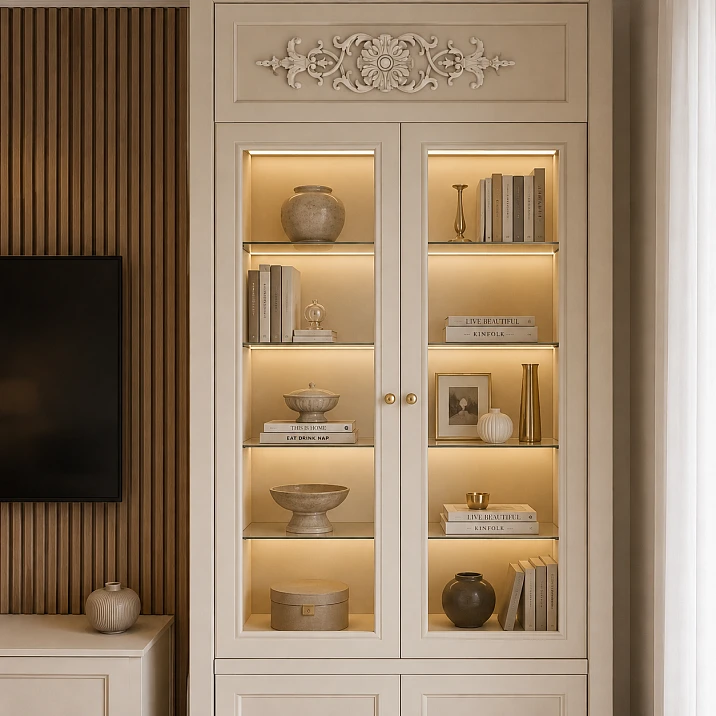
The built-in display case is already in place. Below it may be solid facades, above it — glass doors with shelves and lighting, and above them remains a solid top panel. Next to it runs a slat wall, which itself creates a strong vertical rhythm. It is at this stage that the desire often arises to add one small classic accent — a carved decorative overlay NPU-106 made of polyurethane.
For this article, we consider only one variant of NPU-106: 400 × 90 × 13 mm for 2,010 ₽. The model has other sizes, but here the task is not to compare the product line. The buyer has already chosen a specific large horizontal NPU-106 and must decide whether it is needed specifically above the glass doors of the finished display case.
The short answer: one NPU-106 is worth buying only when there is a calm field on the solid top panel for the 400 × 90 mm dimension, the overlay falls on a clear axis of the display case, the parameter C = 13 mm does not create a visual or operational conflict, and the additional ornament does not clash with the slat wall or the glass part of the furniture itself. If the pattern looks random, cramped, or overly decorative, the correct result is to leave the top panel smooth.
If after a full-size trial fitting the NPU-106 truly makes the top of the display case more cohesive, you can buy the carved decorative overlay NPU-106 made of polyurethane in the quantity of one piece. If not, there is no need to "save" the idea with additional moldings, a second overlay, or random shifting. Within the scope of this task, the product either passes the check or does not.
The commercial meaning of the article is therefore very specific: after measurements and a mockup, a person must choose one of two carts — 1 × NPU-106 = 2,010 ₽ or 0 × NPU-106 = 0 ₽.
What exactly is the NPU-106 in this task
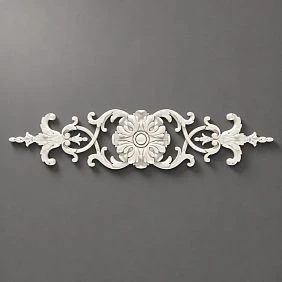
NPU-106 is a carved decorative overlay made of polyurethane. For our scenario, the variant with parameters A = 400 mm, B = 90 mm, C = 13 mm is important. The STAVROS product card shows three sizes, but the article fixes only the middle one — 400 × 90 × 13 mm.
The product is present in the section of horizontal polyurethane overlays, so for the top panel of the showcase it is logical to try it with the long side of 400 mm horizontally. At the same time, dimensional terminology cannot be simplified to unconfirmed formulations. In calculations, it is safe to say: "if in the selected horizontal orientation the product occupies 400 mm horizontally and 90 mm in the vertical overall zone." Parameter C = 13 mm is used as a confirmed third dimension, and not called "thread depth" without a drawing.
| Parameter | NPU-106 for this article |
|---|---|
| Product type | Carved decorative overlay |
| Material | Polyurethane |
| Size | 400 × 90 × 13 mm |
| Price | 2,010 RUB/pc. |
| Planned quantity | 1 pc. |
| Location | blind top panel above glass doors |
| The main question | add one overlay or leave the panel smooth |
The STAVROS card indicates the use of NPU-106 in wall panels, niches, decorative frames, and furniture inserts. That is, the furniture scenario does not assign a foreign function to the product. But the card does not answer the question of whether NPU-106 is appropriate specifically on a particular built-in showcase next to a slat wall. This is already a task of fitting, scale, and composition.
If you want to compare elements similar in purpose, you can buy horizontal polyurethane overlays in the corresponding section. But in this article, we do not turn the choice into a new comparison of sizes: the average variant NPU-106 is already fixed.




Why it is more logical to check the overlay on a solid panel rather than on glass
The main visual object of the display case is the transparent zone: glass doors, shelves, items inside, reflections, and often lighting. If you start adding ornament directly to the glass, the decorative overlay interferes with the display case's function as an exhibition object.
The solid top panel serves a different purpose. It covers the structural part of the cabinet, completes the glass section, and provides a calm plane above the active transparent zone. For one NPU-106, this is a much more logical place.
First, the ornament gets a stable background and is readable without visual noise from the contents behind the glass. Second, the decorative accent remains on the stationary part of the cabinet and is not tied to the movement of the doors. Third, the top zone allows connecting the furniture with the room's architecture: the overlay can work as a small central accent without a full cornice or molding frame. Fourth, it is here that it is easier to honestly compare two options — with and without decor.
An empty solid panel by itself is not a defect. If the glass, lighting, and slat wall already provide sufficient expressiveness, a calm top plane may be needed precisely as a visual pause. Therefore, the task is not "what to fill the emptiness with," but "does NPU-106 improve the composition."
Our factory also produces:
First, find the axis of the display case, not the center of the wall
One of the most common mistakes is aligning the overlay with the niche, room, or slat wall, even though it is installed on the furniture.
If the display case is symmetrical, has two identical glass doors and a common central post, the base axis usually becomes the center of the furniture body itself or the center of the display section. NPU-106 above the glass should primarily speak to the display case, and only then to the wall.
With two identical glass doors, the central vertical line usually runs along the seam of the doors. If the top panel is symmetrical, it is logical to check the NPU-106 template along this line. With one wide door, the reference point becomes the center of the glass section itself. With three sections, you need to understand whether the overlay gathers the entire display case or only the central module.
It is more complicated with asymmetrical built-in furniture. For example, on the left there may be a narrow solid section, and on the right — two glass doors. The geometric center of the entire body then does not have to coincide with the visual center of the display part. The question should be formulated as follows: what exactly does NPU-106 complete — the entire furniture body or the glass exhibition zone? After answering, the correct axis appears.
A slat wall can visually "pull" the composition to one side due to its strong vertical rhythm. You don't need to automatically give in to this. First the furniture axis, then the overlay axis, and only after that check the connection with the surrounding wall.
Get Consultation
A paper template 400 × 90 mm is mandatory before ordering
For NPU-106, a full-size mockup is more useful than any photo of the card. On screen, 400 mm seems like a moderate size, but on a specific top panel, the overlay may turn out to be dominant, calm, or, on the contrary, too small.
Cut out a rectangle 400 × 90 mm from paper or cardboard. Label it "NPU-106". If you want to check not only the flat surface but also the volume, add a backing that roughly mimics the third dimension of 13 mm.
Checking procedure:
-
Find the axis of the display case or display case section.
-
Secure the template with painter's tape on the blank top panel.
-
Look at the furniture strictly from the front.
-
Step back to your usual viewing distance.
-
Look at an angle from the side of the slat wall.
-
Open the glass doors.
-
Turn on the internal backlight, if available.
-
Remove the template and re-evaluate the display case without it.
The last step is crucial. You need to compare not whether you like the NPU-106, but which of the two versions of the display case is stronger — with one relief accent or with a smooth top. This is what protects against buying for the sake of buying itself.
Free space around the NPU-106: you need to calculate the remainder, not invent a universal margin.
There is no universal rule like "leave 100 mm" or "150 mm" here. It is more correct to calculate the actual space and evaluate it on the layout.
If in the selected orientation the long side of the NPU-106 occupies 400 mm horizontally, and the blank panel has a width of W, then when centered:
side space on each side = (W − 400) / 2.
| Width of the blank panel | Space on the left and right |
| 600 мм | 100 мм |
| 700 мм | 150 мм |
| 800 мм | 200 мм |
| 900 мм | 250 мм |
| 1000 мм | 300 мм |
| 1200 мм | 400 мм |
This is not a "can/cannot" table. It shows the scale. On a 600 mm panel, the NPU-106 occupies two-thirds of the horizontal zone and becomes a strong center. On a 1000 mm panel, the same overlay gets significantly more breathing room and is perceived as calmer.
Vertically, you can check the 90 mm dimension. If the panel height is H and the template is centered vertically:
Top and bottom margins = (H − 90) / 2.
With a panel height of 180 mm, 45 mm remains on each side; at 220 mm — 65 mm; at 250 mm — 80 mm. But these values are not universal standards either. Nearby may be a cornice, a glass door frame, or another profile, so a physical trial fitting decides.
The height of the top panel is sometimes more important than its width
A buyer often sees the 400 mm size and immediately thinks of width. For a display case, this is not always the main risk. In practice, a large horizontal overlay often fits in width without issues but turns out to be constrained vertically.
Imagine a top panel with a height of 180 mm. The vertical overall dimension of NPU-106 is 90 mm. When centered, 45 mm remains on each side. Formally, everything fits. But below, the glass door frame already begins, and above, there may be a furniture cornice. As a result, the actual sense of space turns out to be less than the mathematical one.
With a panel of 220–250 mm, the overlay usually gets a more comfortable field. With a very tall panel, the opposite question arises: does the 90 mm ornament become too small relative to the overall top.
Therefore, the article does not introduce a "minimum height." Instead, a mockup is needed: geometric fit and good scale are two different things.
Parameter C = 13 mm: why simulate volume
A flat paper template solves only two tasks — position and overall dimension in the facade plane. But the real NPU-106 has a third dimension C = 13 mm. It cannot be ignored.
Firstly, volume creates shadow. If there is side light nearby, the relief can look noticeably more active than a paper rectangle. Secondly, you need to look at the connection with the furniture cornice: two protruding reliefs on a small top panel can start to compete. Thirdly, on an already finished display case, it is important to ensure that the opening glass doors, handles, top hardware, or adjacent elements do not come too close to the decor area.
Finally, relief changes maintenance: a smooth panel is easier to wipe, while a carved ornament requires more careful cleaning. For a display case, which is often perceived as a "clean" exhibition object, this is a real variable.
Therefore, the second mockup is better made three-dimensional. Even a rough backing under the paper gives a more honest representation than just the 400 × 90 mm outline.
Composition of the top panel: how much decorativeness can a display case handle
Does NPU-106 need a separate molding frame
No, it is not necessary. For this topic, this is fundamental.
NPU-106 can be considered as one independent central accent on the top panel. If the display case already has its own architecture—vertical posts, glass frames, top cornice, base, handles—an additional molding frame easily becomes a second layer of decor that solves nothing new.
A frame is justified only when it addresses a separate task. For example, the top panel is very wide, and a single central ornament gets lost. Or the entire body is made in a pronounced classical system, and the top should become an independent panel. But that is already a different project: more details, more installation, different cost, different hierarchy.
In our scenario, the buyer is considering one NPU-106. Therefore, the correct sequence is as follows:
-
check the single overlay;
-
look at it together with the glass and the slats;
-
decide whether it makes the top better;
-
only if the single scenario doesn't work, don't "add a frame automatically," but redefine the task.
Very often in an interior with a slatted wall, one overlay looks more expensive than a complex frame system, precisely because there is free space around it. If a single element doesn't work, it's quite possible that the right answer is not more molding, but zero molding.
If after trying it out it becomes clear that a different principle of decor is needed, you can You can buy ready-made stucco matching the Baroque style. Calculate the quantity: linear meters of cornices and moldings, number of rosettes, pilasters, consoles, corner elements. Add a ten to fifteen percent allowance for trimming. already as the next level of choice. But this must be a new, conscious task.
How a horizontal ornament works next to vertical slats
Here the slatted wall ceases to be a background for SEO and becomes a real decision variable.
Vertical slats create repetition, direction, and shadows. NPU-106 in the orientation under consideration adds a short horizontal ornamental line. The contrast of directions can be very successful: the slats stretch the wall upward, and the overlay gathers the top of the display case across.
But such contrast works only when one rhythm is dominant and the other is supporting.
If the slat wall occupies a large area, is made of dark wood, has a deep relief and backlighting, it is already a strong decorative object. In such an environment, the NPU-106 should be presented quietly: one piece, without a frame, in the color of the housing.
If the slats are visible as a narrow strip on the side, the display case can afford a more noticeable ornament. If the furniture itself is already classic—with a cornice, paneled solid fronts, shaped handles—one NPU-106 can become a logical finishing touch.
The problem begins when the following are active simultaneously:
-
the vertical rhythm of the slats;
-
the frames of the glass doors;
-
shelves and contents behind the glass;
-
the furniture cornice;
-
handles;
-
NPU-106;
-
an additional molding frame.
Too many systems force the eye to constantly switch. Therefore, next to a slat wall, it is especially important not to confuse "more expensive" with "more decorative."
When one NPU-106 makes a simple display case more expressive
A successful single overlay most often works in three scenarios.
A strict built-in display case with one classic accent
The cabinet is simple, the glass doors are clean, the handles are laconic. The top panel looks a bit empty. NPU-106 in the furniture color adds relief and does not turn the cabinet into heavy classics.
A neoclassical display case without a complex carved top
The furniture already has a moderate cornice, symmetry, and glass frames, but no central ornament. One NPU-106 can complete the top axis and make the composition more cohesive.
A display case next to an active slatted wall
Here, a local element is often stronger than a full molding system. It gives the furniture its own character but does not try to outshout the wall.
The common condition for all three cases is air around the overlay. If the element ends up almost flush between the top cornice and the glass frame, the effect of a neat accent disappears.
When NPU-106 overloads the display case
A commercial article should directly name situations where the product is not needed.
It's better not to buy NPU-106 for a specific display case if:
-
the top panel is too low and the 90-millimeter zone ends up squeezed;
-
the furniture cornice already has an active profile or threading;
-
the glass doors themselves are decorated with muntins, figured layouts, or complex handles;
-
behind the glass there will be a rich collection that should remain the main object;
-
the slatted wall nearby is very active and itself creates sufficient decorativeness;
-
the overlay looks too small on a very wide top panel;
-
the template has to be shifted only because it conflicts with the structure in the center;
-
one element disrupts the symmetry of adjacent built-in modules.
In such cases, a smooth panel is not "unfinished." It works as a pause between the glass and the wall.
How to account for the width of the glass section specifically
The overall showcase body and the glass area can have different widths. For example, the body is 1000 mm, but the glass occupies 760 mm because there are wide side posts on both sides.
If the NPU-106 is meant to complete the glass composition specifically, it makes more sense to check it against the axis of the glass area. If the top panel is perceived as part of the overall furniture body, the body axis may be more important.
Resolution order:
-
Determine the object that the overlay completes.
-
Draw its central axis.
-
Apply the template.
-
Compare the margins relative to the side posts.
-
Step back from the furniture and look at the entire body.
Built-in furniture is often asymmetric due to a niche, wall, adjacent section, or technical gap. Therefore, the simple formula "center of the body = center of the decor" does not always work.
What changes if the glass doors are divided by a central mullion
The central mullion itself creates a strong vertical axis. This can help NPU-106: the horizontal ornament ends up above a clear center.
But you need to check the thickness of the mullion and the character of the frames. If the mullion is massive and NPU-106 has a rich ornament, too many details may gather in the center. If the mullion is thin, the overlay, on the contrary, can beautifully emphasize the axis.
A useful technique is to run a vertical line with painter's tape from the joint of the glass doors upward through the NPU-106 template. If the center of the ornament visually aligns with this line, the composition usually looks more stable.
How the contents of the display case affect things
An empty display case and a filled one are two different compositions. During renovation, the glass section seems almost neutral, and NPU-106 may look like a missing accent. After books, dishes, collectibles, or decor appear, the visual load increases sharply.
The more active the contents, the more carefully you should handle the external ornament.
If the display case is intended for colorful books, porcelain, souvenirs, or a collection, it is better to evaluate the top with part of the future contents already in place. Place a few large items inside and only then apply the template.
If the contents are kept in a calm palette and the shelves are sparsely filled, a single NPU-106 can add the needed architectural quality. If the display case turns into a bright exhibition, a smooth top panel often works better as a neutral frame.
Internal lighting can change the decision
The backlight makes the glass part brighter and visually separates it from the blind panel. Sometimes it is only after turning on the light that it becomes clear that the NPU-106 is needed: the top looks dark and empty, and a small relief helps complete the case.
But the opposite effect is also possible. Bright backlighting makes the contents the main focus, and the overlay becomes secondary. Then the question arises: is a product for 2,010 ₽ really needed if most of the time the eye goes inside the display case?
Additionally, check the external lighting fixtures. A track, sconce, or slat backlighting can cast a pronounced shadow on the parameter C = 13 mm. It is not visible on the paper template, so a three-dimensional mockup is especially useful in the evening.
The color of the NPU-106 allows you to adjust the degree of decorativeness
The quantity here is fixed: one piece or zero. But with color, you can significantly change the impact of the product on the composition.
In the color of the case
The calmest option. The overlay is read due to the relief and shadow, but does not split the top panel. Next to a slat wall, this is usually the first option worth testing.
Close shade
A slight difference in tone can emphasize the relief without a sharp contrast. This approach requires careful color selection.
Contrast
The contrasting overlay becomes an independent focal point. On a simple display case, this is sometimes appropriate, but next to active rails, the risk of overload increases.
Practical rule: if you doubt whether NPU-106 is needed at all, first model it in the color of the furniture. If even in that version it seems superfluous, contrasting coloring will not fix the problem.
Furniture cornice and NPU-106: two accents in one zone
The furniture cornice completes the top of the cabinet, while NPU-106 provides local ornamentation. They do not duplicate function, but they are too close to be considered separately.
If the cornice is smooth and thin, one overlay under it may look logical. If the cornice is wide, profiled, or carved, NPU-106 risks becoming a second focal point in the same zone.
Before purchasing, take a side photo of the mockup. Frontally, two elements may seem spaced apart, but from the side, it turns out their reliefs almost visually touch.
In a small upper field, it is better to leave one strong element: either the cornice or NPU-106.
Installing NPU-106 on an already finished built-in display case
Built-in furniture changes the installation itself
On a freestanding cabinet, the panel can sometimes be removed, laid horizontally, and calmly work with the decor. A built-in display case is already fixed in the niche, so conditions are more difficult.
Before ordering, check:
-
Is the top panel accessible for precise marking?
-
Can the overlay be pressed down properly?
-
Does the ceiling or upper cornice interfere?
-
What finish coating is applied to the furniture?
-
Is the selected mounting compound compatible with polyurethane and this coating?
-
Can touch-up painting be done locally without leaving marks?
You don't need to automatically consider any painted or laminated surface as ready for adhesive. This is already a technical issue of the specific substrate and mounting compound.
For an expensive finished display case, erroneous adhesion is more dangerous than refusing NPU-106 itself: the cost of restoring the coating may exceed the price of the overlay.
Can NPU-106 be added after the display case is fully assembled?
The article scenario itself assumes finished built-in furniture, so such refinement is possible as a concept. But its reasonableness depends on the conditions.
Suitable case:
-
blind top panel is accessible;
-
surface is prepared;
-
no need to disassemble glass doors;
-
the overlay does not conflict with the cornice and hardware;
-
painting can be done neatly.
If the display case is still being produced, NPU-106 is easier to incorporate into the project and finish together with the body. If the furniture is already in place, more precise local work is required.
The main commercial principle remains: do not buy before the mockup just because installation is technically possible.
Scale and edge cases: when geometrically there is space, but the decor still does not work
Very wide top panel: why "too much air" can also be a problem
On a panel 1200–1400 mm wide, a single 400 mm element may be too small in scale. There is plenty of free space, but the decorative task is not solved.
This is an important edge case: the problem is not always about tightness.
If a single NPU-106 gets lost, you don't automatically need to buy a second one. Two overlays are a different composition: a new rhythm, a new axis, a different quantity, and a different intent. It requires a separate layout.
Within the scope of this article, the conclusion is simple: if one NPU-106 does not hold the scale of a wide top, the single scenario is not suitable. The commercial result is 0 pieces or a transition to another type of decor.
Narrow top panel: when NPU-106 becomes dominant
On a panel 600–650 mm wide, the overlay occupies a large share of the horizontal area. At a width of 600 mm, 100 mm remains on each side.
This is not an automatic prohibition. In a neoclassical display, a large central ornament can be appropriate. But here it already becomes the main decorative object of the cabinet.
This scenario works better if:
-
there is no additional molding frame;
-
the cornice is calm;
-
simple handles;
-
NPU-106 color matches the body;
-
the slat wall is not too active.
If several conditions are violated, a large pattern quickly makes furniture look heavy.
How to check the solution by photo, not just standing in front of the furniture
A photo helps to see the hierarchy of objects better than looking up close. A person who holds a template at a display case for ten minutes gradually gets used to it and stops noticing the overload.
Take three shots from the same point and with the same framing:
-
display case without template;
-
display case with NPU-106 template;
-
display case with template when backlight is on.
After that, reduce the images on the screen. When the interior is fully visible, it's easier to understand who is the main element: the slat wall, the glass display case, the contents, or the carved overlay.
If the NPU-106 immediately draws attention away from the display, it's too active for this composition. If it almost disappears on a wide panel, the problem is scale. If it simply makes the top more cohesive and doesn't require a separate explanation, that's a strong positive signal.
It's also useful to make a black-and-white copy of the photo. Color stops being distracting, and it becomes easier to assess the chiaroscuro, size, and density of the relief.
Viewing distance changes the perceived size of the overlay
A built-in display case is rarely viewed only up close. More often, it's seen from the passage, from the sofa, from the dining area, or when entering the room.
At a distance of 1–1.5 m, an NPU-106 of 400 mm looks noticeable. At a distance of 4–5 m, the same element may be perceived as a small accent. Therefore, the mockup should be checked from at least two points:
-
the working one, from which one approaches the display case;
-
the main interior one, from which the furniture is fully visible.
If the nearby slat wall is large and readable from afar, while the NPU-106 is only noticeable up close, an unequal competition arises between them. This isn't always bad: the overlay can be a detail "for close viewing." But it's important to understand that it won't become the main architectural response to the slats.
Conversely, if the NPU-106 is already too noticeable from a distance, up close its relief may turn out to be excessive.
What to do if the display case stands flush against the slat wall
The smaller the distance between the cabinet and the slats, the more strongly the two objects are perceived as a single composition.
If the display case literally adjoins the slat panel with its side, NPU-106 must be assessed especially strictly. The vertical slats end up next to the horizontal ornament without an intermediate neutral zone.
In such a junction, the following help:
-
painting the overlay in the color of the display case;
-
absence of an additional frame;
-
a calm furniture cornice;
-
sufficient free space around NPU-106.
If there is 300–600 mm of smooth wall between the display case and the slats, the furniture gains more independence. Then a single carved accent can behave more boldly. If the display case stands on an adjacent wall and the slats are visible only at an angle, the influence of the slat rhythm is even weaker.
That is, the phrase “next to a slat wall” does not mean the same level of decorative pressure. The actual proximity of the objects must be taken into account.
What to do if there are two identical built-in display cabinets side by side
The current scenario is designed for one display cabinet and one NPU-106. But in classic interiors, paired furniture is common—two display cabinets on either side of an opening, TV, fireplace, or central niche.
If they form a mirror pair, decor on only one cabinet almost always changes the balance of the entire wall. Then the question of '1 or 0' becomes a different task: 2 identical elements or 0.
You cannot automatically transfer the solution from one cabinet to a paired system. You need to create two templates, install them simultaneously, and evaluate the entire ensemble. If two overlays start creating too much ornamentation next to the slats, it may be better to leave both cabinets smooth.
If the second cabinet is far away, on another wall, and is not perceived as a pair, repetition is not necessary.
This example shows the boundary of the article: it solves a single node and honestly stops where the compositional system itself changes.
The height of the entire cabinet also affects the scale of the NPU-106
The same overlay works differently on furniture 2100 mm high and on a built-in display cabinet up to the ceiling, 2800–3000 mm high.
On a lower cabinet, a 400-mm element may be perceived as a noticeable central accent. On a tall cabinet, it becomes a small detail, especially if the solid upper panel is large.
Therefore, it is not enough to evaluate only the rectangle that contains the NPU-106. You need to look at the proportion of the overlay relative to the entire piece of furniture.
This is another reason to photograph the entire piece. In a close-up of the top panel, an element may look perfect, but in the overall view, it can get lost.
Why one NPU-106 can be more sensible than reworking furniture
The price of one NPU-106 is 2,010 ₽. But the real commercial value of such a product for a finished display case is not that it is "inexpensive decor." It lies in the ability to make a minimal intervention.
If the display case is already installed, a major rework of the top section may require:
-
fabricating new parts;
-
dismantling the cornice;
-
repainting;
-
carpenter's work;
-
protecting the glass and hardware;
-
the risk of damaging the finished cabinet.
One overlay, if it truly fits, allows changing the top without rebuilding the entire piece of furniture.
But that's exactly why it cannot be bought without checking. If installing NPU-106 suddenly requires dismantling the cornice, repainting half the facade, or reworking the panel, the original logic of a cheap local upgrade disappears.
In this case, it's better to reject the product for this display case than to turn it into a reason for a disproportionately large rework.
What to do if NPU-106 doesn't fit in scale or style
After a full-size mockup, an honest conclusion is possible: the idea of a decorative overlay is good, but specifically NPU-106 400 × 90 × 13 mm doesn't fit.
The reasons can be different:
-
too large for a narrow panel;
-
too small for a very wide one;
-
the ornament is too classic;
-
the relief is too active;
-
the horizontal shape conflicts with the showcase architecture;
-
there is already enough decor nearby.
There is no need to try to "fix" NPU-106 with offset, contrasting color, or a random frame. What changes is not the setting, but the product scenario.
You can go to the category Buy decorative polyurethane overlays and start a new selection. If a different type of product is needed — molding, cornice, decor for molding — the type of decor itself must also be changed.
This is stronger than trying to keep one liked SKU at any cost.
What else to check on the finished showcase before deciding "1 piece or 0"
The geometry of the top panel is only part of the task. The built-in showcase is already a finished item with lower fronts, hardware, lighting, service zones, and its own finishing system. These variables can change the decision even when the 400 × 90 mm template looks successful.
Connection with lower flush fronts
If there are closed doors or drawers at the bottom of the showcase, look at how they are styled. A completely smooth bottom and a single ornament only at the top create a hierarchy: the glass zone remains the center, and NPU-106 completes the composition. But if the lower fronts already have carved overlays, molding frames, or shaped handles, the top decor can turn the furniture into a set of repeating accents.
It is useful to take a general shot from floor to cornice. If NPU-106 is perceived as the only center, everything is fine. If the eye begins to count decorative elements from bottom to top, it means the rhythm has become too frequent.
Profile and color of glass door frames
Glass rarely exists without framing. Doors can have a thin metal profile, a painted wooden frame, or a wide classic trim. The more massive the frame, the more architecture the display case already has.
On a thin profile, one NPU-106 can add the needed "top point" to the furniture. On a wide shaped frame, the same ornament sometimes becomes superfluous. It is especially important to look at the width of the top crossbar of the door: if it itself is perceived as a strong horizontal, NPU-106 should either support it or not appear at all.
Service access to lighting and electricals
In built-in display cases, lighting equipment can be located in the upper zone: there may be wiring, blocks, sensors, or removable service panels. The article does not assume that such a system exists in every piece of furniture, but if it does, the decorative overlay should not block access.
Before ordering, you need to understand whether the blind panel is truly a permanent decorative surface. If it is periodically removed or opened for maintenance, sticking NPU-106 can turn a simple service operation into a problem.
If in doubt, ask the furniture maker which part of the upper box should remain accessible.
Possible replacement of glass doors in the future
A glass door is a part that is sometimes removed for adjustment, repair, replacement of glass, or hardware. NPU-106 should not interfere with this process.
Check how the sashes are removed and whether free access from above is needed. If the installation of the overlay covers the fasteners, adjustment unit, or the door removal path, the decorative solution needs to be reconsidered.
This does not mean that molded decor cannot be placed above the glass. It means that the decor should not turn routine furniture maintenance into dismantling the decorative element.
Condition of the existing coating
On a finished built-in display case, the finish is already applied. This can be enamel, varnish, film, or another coating. Before gluing, its condition needs to be checked: whether there is dirt, peeling, wax, polish, or damage.
If the surface is questionable, the issue of the base and compatibility of the mounting material is resolved first. Buying NPU-106 just because it fits geometrically is premature.
Adjacent built-in modules
A built-in display case is often part of a large furniture wall: there may be a cabinet, TV section, closed column, or open shelves nearby. One ornament above the glass changes not only the display case but the entire system.
If the adjacent modules are strictly smooth, NPU-106 can become the logical center of the display case section. If there are already identical decorative elements across the entire wall, you need to decide whether the new overlay should continue their rhythm or, on the contrary, is not needed.
This analysis is especially important next to a slat wall: the furniture system and the slats should read as two coordinated architectures, not as a set of separate decorations.
Cost of the solution: 2,010 ₽ — this is the price of the product, but not always the full cost of the modification
Commercial evaluation should not stop at the product card. One NPU-106 costs 2,010 ₽, but the final cost of refinement may include mounting material, surface preparation, local painting, and the craftsman's work.
The article is not made up
Final check: how to move from a mockup to a purchase decision
Before the final decision, it is useful to conduct a last check not based on the principle of "like / dislike", but on priorities. A finished display case has several competing requirements: geometry, operation, style, installation, and cost. Sometimes four criteria pass perfectly, while the fifth remains weak. Then it is important to understand which of them can cancel the purchase.
A technical conflict is stronger than a decorative desire. If the overlay interferes with service access, requires questionable attachment to the surface, or complicates removing the doors, a beautiful mockup is not a sufficient reason to buy.
Scale is stronger than liking the ornament. If 400 × 90 mm gets lost on a very large panel or, conversely, squeezes a small one, the NPU-106 pattern does not fix the proportion error.
The axis is stronger than the attempt to fill emptiness. The overlay must have a clear place. If it has to be shifted until it "fits", the composition already warns of a problem.
A slat wall is context, but not the master of the furniture. There is no need to move NPU-106 just to align with the nearest slat. The display case must maintain its own axis.
The price of the product should not mask the price of intervention. 2,010 ₽ is a clear cost for one NPU-106, but if it requires complex dismantling or major repainting, the commercial logic changes.
It is useful to set priorities in exactly this order: first, the absence of technical conflicts, then geometry and scale, then composition, then the finishing method, and only after that emotional liking for a specific ornament.
What counts as a successful fitting
Success is not just "the template fits."
The NPU-106 fitting is successful if five conditions are met simultaneously:
-
the 400 × 90 mm dimension gets a comfortable field;
-
the overlay axis is clear without visual justifications;
-
parameter C = 13 mm does not create a conflict with the cornice and operation;
-
the slat wall and glass area do not start arguing with the ornament;
-
installation does not require disproportionate rework of finished furniture.
If at least one condition remains doubtful, it is better to postpone the purchase until additional verification.
Practical algorithm for checking NPU-106 before ordering
Below is a sequence after which a specific answer of "1 piece" or "0 pieces" should appear.
Step 1. Photograph the entire display case
The frame must include the slat wall, the furniture itself, and surrounding elements.
Step 2. Measure the solid top panel
You need the actual width and height of the exact surface where the NPU-106 is planned.
Step 3. Determine what constitutes the center
The entire body, glass section, middle door, or another visual zone.
Step 4. Create a template of 400 × 90 mm
Place it in the chosen horizontal orientation.
Step 5. Calculate the actual margins
Side ones — by formula (W − 400) / 2, if the overlay is centered. Vertical ones — (H − 90) / 2, if centered by height.
Step 6. Simulate C = 13 mm
Add a backing and look at the relief from the side.
Step 7. Check doors and hardware
Open the glass doors, see if any unexpected conflict arises.
Step 8. Evaluate the cornice
Understand whether two competing centers appear in one upper zone.
Step 9. Turn on the backlight
Check the display case under the evening scenario.
Step 10. Add part of the future content
Do not evaluate an empty display case if in reality it will be filled.
Step 11. Compare photos with and without the template
Preferably from the main viewing distance.
Step 12. Check the base and installation
Do not buy until it is clear how the overlay will be attached to the existing furniture covering.
Step 13. Make a decision
If NPU-106 improves the top and does not create a new conflict — one piece. If not — zero.
Only after such a pass does it make sense order NPU-106 400 × 90 × 13 mm.
Three scenarios that lead to different commercial results
Scenario 1. Panel 900 × 220 mm, simple display case
When centered horizontally around the 400-mm zone, 250 mm remains on each side. Vertically, with a 90-mm dimension, 65 mm remains on each side. The cornice is calm, the glass doors have no complex layout, the slatted wall is noticeable but not illuminated.
Here, one NPU-106 gets enough air and does not turn into a massive pediment. If the mockup in the body color looks cohesive, the commercial result is 1 piece for 2,010 ₽.
The new variable of this scenario is a comfortable field and calm architecture.
Scenario 2. Panel 650 × 180 mm, active cornice
125 mm remains on the sides, and 45 mm on the top and bottom. Formally, the dimension fits. But the cornice is already embossed, and the glass doors have a decorative frame.
Here, the problem is not mathematical fit, but the density of the upper zone. NPU-106 becomes the third relief between the cornice and the glass.
Commercial result — 0 pieces.
Scenario 3. Panel 1200 × 250 mm, very tall display case
400 mm remains on each side, 80 mm vertically. Geometrically, everything is fine. But on tall furniture up to the ceiling, a single 400-millimeter element gets lost.
Here, the reason for rejection is opposite to the second scenario: not crampedness, but loss of scale.
The commercial result within a single scenario is 0 units or a transition to a new decorative system.
These examples are not an "arithmetic ladder": each changes the reason for the decision and the purchase outcome.
Mistakes when choosing NPU-106 above glass doors
Buying based on a product photo
Why it happens: 400 mm on screen is not perceived as a real size.
Consequence: the overlay turns out to be too large or too small.
Check: template 400 × 90 mm.
How to avoid: do not form the order before a full-scale fitting.
Center relative to the wall, not the furniture
Why it occurs: a slat wall creates very strong vertical lines.
Consequence: NPU-106 appears shifted on the display itself.
Check: draw the axis of the cabinet body and the axis of the glass section.
How to avoid: first align the furniture overlay.
Count only the horizontal space
Why it occurs: the 400 mm parameter stands out more.
Consequence: the ornament becomes cramped vertically.
Check: separately assess the 90 mm overall zone.
How to avoid: check both axes.
Ignore the third dimension C = 13 mm
Why it occurs: a paper template seems safe.
Consequence: the real shadow and relief unexpectedly enhance the decor or conflict with the cornice.
Check: a three-dimensional mockup.
How to avoid: look at the display case from the side and under side lighting.
Build a frame around NPU-106 automatically
Why it occurs: a single overlay seems like too simple a solution.
Consequence: the top of the display case becomes overloaded, especially near the rails.
Check: first evaluate one overlay without a frame.
How to avoid: add a new type of decor only when there is a separate compositional reason.
Evaluating an empty display window
Why it happens: furniture is tried on immediately after installation.
Consequence: after filling with content, the decor becomes too much.
Check: temporarily add future items or their analogues.
How to avoid: make the decision in the most realistic state.
Buying because the 'top is empty'
Why it happens: an empty field is perceived as incompleteness.
Consequence: the overlay solves nothing, but simply takes up free space.
Check: compare photos with and without the template.
How to avoid: require NPU-106 to provide a specific improvement to the composition.
Control checklist before clicking "Buy"
Before ordering, answer "yes" to all items:
-
the exact size of the upper blind panel is measured on the finished furniture;
-
the NPU-106 axis is defined relative to the display case, not a random wall line;
-
the 400 × 90 mm template is attached at full scale;
-
side and vertical margins are checked;
-
parameter C = 13 mm is accounted for with a 3D mockup;
-
the furniture cornice does not compete with the overlay;
-
glass doors and their hardware maintain normal operation;
-
service access to the lighting and upper box, if required, remains free;
-
the existing display case covering is suitable for the chosen installation technology;
-
the display case is evaluated with future contents, not just empty;
-
real evening lighting is included;
-
a comparison of "with NPU-106 / without NPU-106" has been made;
-
the slat wall does not make the overall pattern overly active;
-
the installation remains a local refinement, not turning into a major rework;
-
in the overall photo, the overlay looks like an intentional centerpiece, not a random detail.
If at least one of the technical points raises doubt, it is better not to rush the purchase. If everything passes technically, but compositionally the "with" and "without" options look equivalent, then the product has no sufficient reason to appear in the display case. In that case, a smooth panel is a more economical and cleaner solution.
How to document the decision for the installer or designer
After approving the NPU-106, it is useful to provide the contractor not with a verbal phrase "centered above the glass," but with a small installation map.
It is enough to specify in it:
-
a photo of the finished display window;
-
the size of the top panel;
-
the selected axis;
-
the position of the template;
-
distances from the overall zone to the nearest landmarks;
-
the selected color;
-
information about the existing coating;
-
the need to preserve access to hardware or the service area;
-
a link to the card of a specific NPU-106.
This reduces the risk that the craftsman will understand "center" differently than the designer or owner. It is especially important to specify whether the element is centered relative to the entire body or the glass section.
If the decision is made after the photo, you can directly attach the frame with the template. It is often more informative than a long description.
What to do if the criteria give a contradictory result
It happens that geometrically NPU-106 looks great, but the slat wall makes the interior too active. Or vice versa: compositionally the overlay is needed, but installation on the existing covering is questionable.
In such situations, there is no need to average the decision.
If the conflict is technical, the technical aspect is resolved first. Without a reliable base and maintenance, the product is not purchased.
If the conflict is only decorative, a temporary mockup for a few days helps. Leave the paper NPU-106 on the display and live with it in normal mode. Look at it in the morning, in the evening, with open doors, with a filled display. After a few days, it becomes noticeable whether the element is really needed or the initial liking was a reaction to novelty.
Such a "long test" is especially useful for built-in furniture: after installing real polyurethane decor, restoring the absolutely original look can be more difficult than removing a paper mockup.
What exactly to add to the cart after trying on
This article has only two main final scenarios.
| Inspection result | Cart | Cost |
| One NPU-106 improves the composition and passes all checks | 1 pc. | 2 010 ₽ |
| NPU-106 overloads, gets lost, or conflicts | 0 pcs. | 0 ₽ |
Such a limitation is useful. It prevents turning an article into an endless catalog of alternatives.
If NPU-106 passed the check, the product is already selected. If it didn't pass, the selection starts over in another section, or the furniture remains without molding.
When the slat wall should remain the only active decor
Sometimes the best result is not adding a carved element to the display case at all.
If the slat wall occupies a large area, is finished in a rich wood tone, is backlit, and is visible immediately upon entry, it already sets the entire decorative rhythm of the zone. The glass display case nearby adds a second texture—reflection, transparency, and contents.
The smooth top panel in such a composition becomes a pause. It is not empty, but neutral.
Therefore buy wall slat panels and automatically decorating adjacent furniture with molding—is not a mandatory sequence. Slat panels and polyurethane decor should support each other, not just be present side by side.
When NPU-106 helps connect a modern wall with more classic furniture
There is a reverse scenario. The slat wall is modern, and the display case is neoclassical or classic. Without additional ornament, the cabinet may seem too neutral and stylistically detached.
One NPU-106 can become a small "translator" between systems:
-
vertical slats give a modern architecture;
-
glass doors preserve lightness;
-
the overlay adds a classic motif;
-
painting in the body color does not make this motif intrusive.
In this case, one overlay can be more precise than full moldings or a carved top cornice.
How to check the decorative effect before buying the real product
The most reliable mockup can be made slightly more complex than a regular rectangle.
Print a photo of NPU-106 at a scale close to natural size, or draw a conditional ornament inside the template. The main thing is to preserve the external dimension of 400 × 90 mm.
Then:
-
secure the mockup;
-
take a photo;
-
look at it in daylight;
-
turn on the evening one;
-
compare it with a smooth panel.
The purpose of such a test is not to imitate every detail of the carving, but to understand how much the ornamental mass differs from a simple rectangle. Sometimes it is the pattern that makes the product visually "heavier" than expected by its dimensions.
How to document the decision before ordering
Before purchasing, it is useful to save a small "fitting passport":
-
width of the top panel;
-
height of the top panel;
-
the axis relative to which the NPU-106 is centered;
-
side margins;
-
vertical margins;
-
photo with flat template;
-
photo with volumetric backing;
-
photo with backlighting;
-
result — 1 or 0.
This approach is especially useful if the decision is coordinated with a designer, furniture maker, or another family member. Instead of the phrase "I think it's better this way," a concrete comparable scheme appears.
Result: NPU-106 is needed only when one overlay truly completes the top of the display case
The carved decorative overlay NPU-106 made of polyurethane in size 400 × 90 × 13 mm costs 2,010 ₽ and can be used as a furniture decorative insert. For a built-in display case next to a slat wall, this is an interesting scenario: one horizontal ornament above the glass doors can give the cabinet character without a full molding composition.
But the very fact that the product is suitable for furniture decor does not mean that it is needed for a specific display case.
First, measure the blank top panel. Determine the axis of the cabinet or glass section. Make a template of 400 × 90 mm. Calculate the actual margins, simulate parameter C = 13 mm, check the cornice, doors, backlighting, contents, and slat wall.
If with the template the top looks more cohesive, the ornament does not overload the furniture, and installation does not require disproportionate rework, buy 1 × NPU-106 for 2,010 ₽.
If the overlay is tight, gets lost in scale, conflicts with the cornice, or simply adds another unnecessary decorative focal point, leave the top smooth.
The main takeaway: an empty top panel is not a problem in itself. NPU-106 is only needed for a display case that a specific overlay makes visually stronger and more cohesive.
FAQ
Can NPU-106 be installed above doors with fluted or tinted glass?
It can be considered, because the overlay is on a solid panel. But decorative glass itself increases visual richness, so the need for NPU-106 should be assessed more strictly.
Does NPU-106 make sense if there is no lighting inside the display case?
Yes. Lighting is not a mandatory condition. Without it, the overlay sometimes becomes even more noticeable because the glass area is calmer.
What to do if the central mullion between the glass doors is very wide?
Check whether its axis aligns with the center of the top panel and the entire display section. A wide mullion can strengthen the central axis, but at the same time make it visually heavy.
Will NPU-106 suit a display case with arched tops on the glass doors?
Only after a template. A straight horizontal ornament can beautifully complete the arched geometry or, conversely, conflict with it.
Can the overlay be mounted on a removable top panel, and then the panel be put back in place?
If the furniture design indeed allows for safe removal of this part, this method can simplify the work. But universally recommending disassembly of a built-in display case is not possible.
Is it necessary to repeat NPU-106 on the lower blind facades of the display case?
No. This is a different decorative system. The article considers one central element above the glass, and repeating it on the lower facades requires a separate check.
Can NPU-106 be placed not in the center, but above one glass door?
On a symmetrical display case, such an offset usually requires a very strong compositional reason. On asymmetrical furniture it is possible, but it is checked separately.
Is it worth buying NPU-106 in advance if the display case is not yet installed?
It is better to have exact dimensions of the finished panel and to see the display case next to the slat wall. A project mockup is useful, but a full-scale fitting is more reliable.
What to do if, after installing the display case, the color of the body differs slightly from the slat wall?
Do not try to compensate for the difference with a contrasting NPU-106 automatically. First, evaluate the overlay in the color of the body — it should belong to the furniture.
Can the NPU-106 be used as a handle, limiter, or other functional element?
No. In this article, the NPU-106 is considered specifically as a decorative overlay, not as furniture hardware.