Article Contents:
- Short answer: first determine the service contour of the acoustics, and only then build the KPU-109 frame around it
- KPU-109 and acoustic grille: what can be confirmed, and what is determined by the speaker manufacturer
- What exactly KPU-109 is
- Three contours that must not be mixed in one dimension
- The 50 mm width matters twice: for the external dimension and for the fixed platform around the grille
- Why they measure not the distance from the column to the slat, but the fixed plane from the service contour
- Next to a slat wall, the side of the frame is especially important
- The 6 mm relief needs to be checked along the trajectory of removing the grate
- First the 50 mm template, then the basket
- For a 300 × 500 mm grate, the KPU-109 frame externally becomes at least 400 × 600 mm only with zero additional service field
- Frame formula via the service contour
- Why one 2000 mm plank for a nominal 300 × 500 mm seems sufficient only on paper
- Table: how the theoretical linear footage changes with an increase in the service contour
- Cost of one and two KPU-109 planks
- Why two planks do not mean almost 2 meters of pointless waste
- Two identical built-in columns dramatically change the cutting economics
- Total length does not replace cutting four sides
- Frame corners should be designed according to drawing KPU-109, not just by 45° geometry
- A 45° right angle is a common frame scheme, but not a reason to cut all four pieces before fitting
- The frame must be geometrically more precise than the adjacent slat wall appears to the eye
- Why the inner edge of KPU-109 cannot be used for visual alignment of the curved grid
- The service contour is better marked with masking tape in a different color
- The grid should be removed with the mockup already applied, not just by placing a ruler
- Even if the grid is removed with magnets, it still does not mean zero service clearance
- The slat wall next to the KPU-109 frame creates a second rhythm that cannot be ignored.
- The distance from the outer edge of the frame to the slat panels affects the feeling of "air."
- Why 50 mm may be too wide specifically next to small speakers.
- When a regular molding is better than KPU-109.
- When a frame around built-in speakers is not needed at all.
- When KPU-109 truly improves the acoustic insert.
- A color matching the wall helps separate the service function from the decorative one.
- A contrasting KPU-109 makes the acoustics the focal point.
- If there are two identical speakers nearby, the symmetry of the entire wall is resolved first.
- Two frames allow using leftovers more efficiently, but do not guarantee three slats automatically
- If the grilles are of different sizes, you cannot make identical outer frames at any cost
- Installation of KPU-109 must remain independent of acoustic equipment
- What to measure before ordering KPU-109
- Practical algorithm: from built-in speaker to ordering trim
- Decision tree: buy KPU-109, choose another profile, or leave the acoustics without a frame
- When a single KPU-109 slat can really be sufficient
- When two slats are a normal, not an "extra" purchase
- When three slats can be more reasonable than two
- How to include a second column, subwoofer, or technical niche in the overall layout
- If there are several frames, the ornament matters more than maximum waste reduction
- What to buy if KPU-109 turned out to be too wide
- The color of the acoustic grille itself also changes the perception of the 50 mm width
- Lighting and viewing distance change the scale of KPU-109 more than it seems from the product card
- Linear backlighting in a slat wall can emphasize one side of the frame
- The frame around the speaker should be quieter than the frame around the screen if the screen is the main object
- If the speaker system can be replaced in the future
- When it is better to make the frame not around the grille, but around the entire smooth insert
- When it is better to use a smooth insert without any framing at all
- Can the inner edge of the KPU-109 be placed flush against the visible grille?
- Can the KPU-109 be glued on after the speaker is already fully tuned?
- Is an additional frame needed if the built-in speaker already has a factory bezel?
- Can the KPU-109 be placed on only three sides if the fourth side is against the slats?
- If the grille is round, is the KPU-109 suitable?
- Can the KPU-109 be used around a ceiling-mounted built-in speaker?
- What to do if the grille can only be removed with a special magnetic tool?
- Can corners be made without 45° cutting, using decorative corner elements?
- Is it necessary to leave access to the screws under the grille if they are usually not used?
- Can the remainder of the second KPU-109 strip be used for a frame around a socket or switch?
- What to do if a noticeable shadow appears on the grille after installing the frame?
- If the grille is fabric and soft, can the KPU-109 be brought closer?
- Can the frame be made first, and the column installed later?
- Is it necessary to make the same frame around the subwoofer and around a regular built-in speaker?
- Can one spare KPU-109 strip be kept for future repairs?
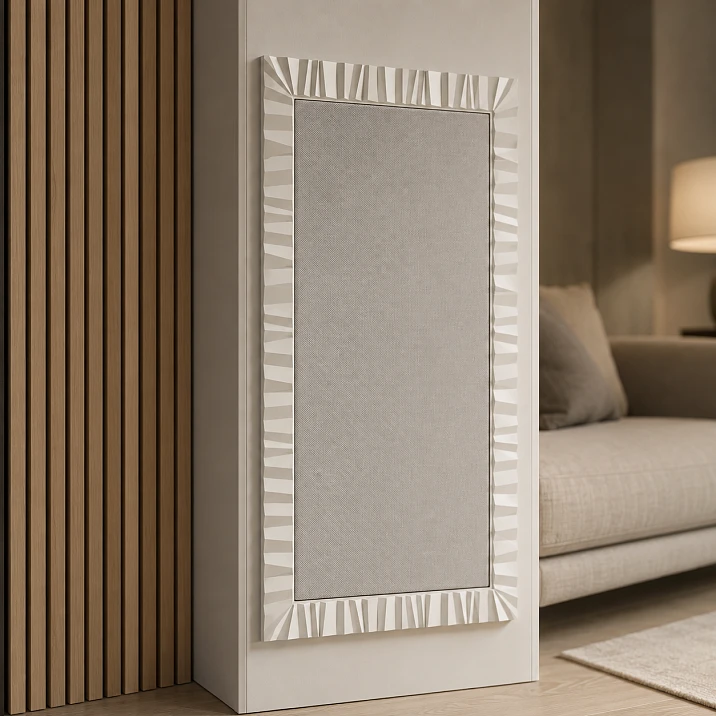
Short answer: first determine the service contour of the acoustics, and only then build the KPU-109 frame around it
If a built-in column is already installed in a smooth insert next to a slat wall, the decorative molding KPU-109 can be considered as a separate frame around the technical element. But the inner edge of this frame cannot be assigned based on a nice photo or only on the outer size of the visible grille.
First, you need to determine from the documentation of the specific acoustic system and from the actual assembly:
-
which part is actually removed during maintenance;
-
where its outer edge runs;
-
whether space is required for gripping, prying, magnetic removal, or another operation provided by the manufacturer;
-
whether the stationary wall surface remains outside this contour;
-
whether the decorative molding overlaps the openings or the working area of the acoustic grille.
Only after this can you draw the inner rectangle of the frame.
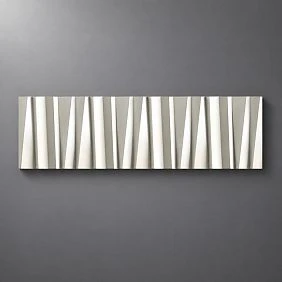
KPU-109 is precisely a decorative polyurethane molding. The current STAVROS card indicates dimensions A × C × L = 50 × 6 × 2000 mm, material — polyurethane, price — 7,750 ₽ per strip. In the molding catalog, axis A is designated as width, C as profile height. Therefore, in a wall frame, you can correctly work with a face width of 50 mm and a relief of 6 mm.
For a conventional removable grille of 300 × 500 mm, the quantity calculation is especially interesting. If the inner decorative opening of the frame were theoretically exactly 300 × 500 mm, the outer dimension with a molding width of 50 mm would be 400 × 600 mm. The sum of the four outer lengths:
2 × 400 + 2 × 600 = 2000 mm.
This is exactly the length of one KPU-109.
But such a result cannot be turned into advice to “buy one strip.” It has no allowance for cutting, trimming, matching the carved pattern, and, most importantly, for the actual service clearance around the grille. If the frame must be set back at least by the amount required by the speaker manufacturer, the actual internal opening becomes larger than 300 × 500 mm, and the theoretical linear footage immediately exceeds 2000 mm.
Therefore, for a specific built-in speaker, the quantity is calculated not by the grille size from the example, but by the confirmed service rectangle.
Buy decorative linear molding KPU-109 made of polyurethane




KPU-109 and acoustic grille: what can be confirmed, and what is determined by the speaker manufacturer
Our factory also produces:
What exactly is KPU-109
In this article, it is important to preserve the manufacturer's terminology. KPU-109 is linear molding, not a trim, rosette, or special acoustic frame.
Current specifications of the STAVROS card:
| Parameter | KPU-109 |
|---|---|
| Product type | decorative linear molding |
| Material | Polyurethane |
| Size A × C × L | 50 × 6 × 2000 mm |
| A | width 50 mm |
| C | profile height 6 mm |
| L | length 2000 mm |
| Price per 1 pc. | 7 750 ₽ |
| The task of this article | decorative frame outside the working and service contour of the acoustic grille |
The product page itself describes KPU-109 as a decorative polyurethane element for furniture, windows, doors, and other interior tasks. The card does not assign it a specialized acoustic function.
This limitation is useful: KPU-109 is responsible for visual framing, while the built-in speaker manufacturer is responsible for the working opening, grille, method of its removal, ventilation, and service requirements.
Get Consultation
Three contours that cannot be mixed in one size
The main mistake when designing such a frame is to call all dimensions "speaker size."
In fact, three different contours are needed.
1. Visible grille contour.
This is the external dimension of the part that a person sees on the wall. In our conditional example, it is 300 × 500 mm.
It is needed for scale, but by itself it does not yet define the internal size of the KPU-109 frame.
2. Service contour.
This is the area that must remain free so that the grille can be removed and the acoustic system can be serviced as intended by its manufacturer.
The service contour may coincide with the visible grille, or it may be larger. Without documentation for a specific model, the difference cannot be assigned.
3. Decorative contour of KPU-109.
This is the inner edge of the polyurethane frame.
It must be outside the service contour, not intersecting it.
It is the third contour that is used to calculate the four sides and the amount of linear footage.
This scheme protects against a situation where a beautiful frame is first glued flush, and then it turns out that the magnetic or snap-on grille cannot be removed normally.
Why doesn't the article prescribe a universal gap of 10, 15, or 20 mm.
Different built-in acoustic systems differ in:
-
grille shape;
-
method of its retention;
-
external frame design;
-
location of latches or magnets;
-
removal trajectory;
-
acceptable proximity of finishing materials.
Therefore, the advice "leave 15 mm and everything will work" would seem specific, but it would be technically unsubstantiated.
Correct sequence:
-
determine the acoustics model;
-
open the installation/maintenance manual;
-
find out the boundaries of the removable part and the required service zone;
-
check them on the finished wall;
-
only after that place the inner edge of KPU-109.
If the documentation does not provide a separate figure, you need to physically check the removal of the grille before gluing the decor and, if necessary, clarify the condition with the manufacturer or the installer of the acoustic system.
Why KPU-109 cannot be glued onto a removable grille.
The frame made of molding and the acoustic grille have different functions.
The grille must remain part of the acoustic device. KPU-109 is part of the wall finish.
If you connect them with glue, several problems arise at once:
-
the grille stops being removable in the standard way;
-
its mass and geometry change;
-
the column's service becomes dependent on the stucco decor;
-
the molding may overlap the working area;
-
when replacing the acoustics, the frame will have to be destroyed.
Therefore, KPU-109 is installed only on a fixed prepared surface around the acoustics.
It cannot be promised that KPU-109 "does not affect the sound in any way."
Such a claim would require data on the specific acoustic system, its radiation pattern, and the exact placement of the decorative frame.
The task of the article is simpler and safer.
We do not place the molding into the working open cross-section of the grille and do not use it as an acoustic element. It is located outside the confirmed service contour.
But the final decision on the acceptability of an adjacent decorative frame must take into account the documentation of the specific loudspeaker.
If the manufacturer requires a free area around the front panel or prohibits certain types of framing, this condition is more important than the design of the KPU-109.
How to check whether the KPU-109 frame fits on a finished smooth insert
The 50 mm width matters twice: for the external dimension and for the fixed area around the grille
The catalog width A = 50 mm is not only a visual characteristic of the ornament.
For the frame, it determines how much fixed wall surface the KPU-109 must occupy.
If the inner edge of the molding is already set beyond the service contour, the outer edge of each side will extend another 50 mm:
-
to the left — by 50 mm;
-
to the right — by 50 mm;
-
from above — by 50 mm;
-
from below — by 50 mm.
From this, simple geometry follows.
If the confirmed inner opening of the frame has width W and height H, the outer rectangle with a rectangular frame 50 mm wide will be:
W + 100 mm horizontally;
H + 100 mm vertically.
This is the first calculation to be done before purchasing.
It answers not only the question of quantity. It shows whether the finished frame will fit between the acoustics and the slat panels at all.
Why they measure not the distance from the speaker to the slat, but the fixed plane from the service contour
Suppose there are 70 mm of smooth wall from the visible edge of the acoustic grille to the first slat.
At first glance, it seems that the KPU-109 with a width of 50 mm fits.
But if removing the grille requires a free zone, these 70 mm are no longer fully available for decor.
The available mounting width is calculated as follows:
the distance from the confirmed service contour to the edge of the slat zone.
If after this less than the actual mounting width of the trim remains, the frame does not fit in the selected position without changing the composition.
Therefore, the tape measure is applied not to the edge of the visible grid, but to the boundary of the zone that cannot be occupied by decor.
This is one of the most useful measurements in the entire article.
Next to a slat wall, the side of the frame is especially important.
If the column is in a smooth insert right next to the slat field, the problematic part is often not the top or bottom, but one vertical side.
For example:
-
to the left of the acoustics there is a lot of smooth wall;
-
to the right, after a small gap, the slats begin.
Then theoretically a frame of four identical sides is possible, but the right KPU-109 specifically may not get enough stationary area.
In that case, there are four options:
-
increase the smooth insert if the project is not yet finished;
-
shift the acoustics if its design allows and installation is not yet complete;
-
choose a narrower decorative profile;
-
abandon the KPU-109 frame.
On a finished wall, the third and fourth options are usually more rational than redoing the technical system just for the molding.
The 6 mm relief needs to be checked along the grille removal path
C = 6 mm is a small value relative to the 50 mm width, but it still matters in the service unit.
If the grille is removed strictly forward, the adjacent relief may not interfere.
If it needs to be pried from the side first, tilted, shifted, or rotated, the protruding trim can get in the way of the trajectory.
We should not have to guess the removal method.
Practical test:
-
secure a paper frame along the future inner contour;
-
add a spacer about 6 mm thick to it;
-
remove and reinstall the grille using the standard method;
-
repeat several times on each side where grip is required;
-
check that the hand or the grille itself does not touch the mock-up.
If the 3D template gets in the way, a flat drawing alone is not enough.
First the 50 mm template, then the basket
For the first test, a real KPU-109 is not needed.
Take masking tape or paper and make four strips 50 mm wide.
They should be placed not around the visible rectangle of the grille, but around the confirmed service contour.
The template should answer five questions:
-
does the frame fit between the acoustics and the rails;
-
does the 50-millimeter ornament look too wide for a small grille;
-
is there a normal smooth zone left to adjacent materials;
-
can the grille be removed;
-
is the working part of the acoustics not blocked.
After the flat template, add 6 mm of volume on at least one side. This will show the real shadow and service trajectory.
Calculation of the frame and quantity of KPU-109 based on the confirmed service contour
For a 300 × 500 mm grille, the KPU-109 frame externally becomes at least 400 × 600 mm only with zero additional service field
If the inner edge of the frame runs exactly along the 300 × 500 mm rectangle, the geometry is simple:
-
inner opening — 300 × 500 mm;
-
KPU-109 adds 50 mm on each side;
-
outer dimension — 400 × 600 mm.
But this is a geometric example, not a ready-made project.
It is applicable only if 300 × 500 mm is already a confirmed service contour, not just the size of the visible grille.
If the acoustics manufacturer requires more free space, the already increased inner opening is substituted into the formula.
Frame formula via service contour
Let us denote:
-
Ws — width of the service contour;
-
Hs — height of the service contour;
-
P — front width of KPU-109, i.e., 50 mm.
Then the external dimensions of the frame:
Wout = Ws + 2P
Hout = Hs + 2P
For KPU-109:
Wout = Ws + 100
Hout = Hs + 100
If the four corners are made as a regular rectangular frame with matched joints, the theoretical sum of the external lengths of the four sides:
Lframe = 2 × Wout + 2 × Hout
Or:
Lframe = 2 × (Ws + Hs) + 400 mm.
This formula is convenient because it does not require substituting a made-up "gap." It is enough to obtain the real service contour of the acoustics once.
Why one 2000 mm plank for a nominal 300 × 500 mm seems sufficient only on paper
If Ws = 300 mm and Hs = 500 mm:
Lframe = 2 × (300 + 500) + 400 = 2000 mm.
Mathematically, this is exactly one factory plank KPU-109.
But such a cut has no margin at all.
Even if the service contour really matched 300 × 500 mm, in real work the following appear:
-
tool cut;
-
end alignment;
-
possible rejection of a damaged end;
-
the need to match the decorative pattern at the corners;
-
test cut;
-
technological adjustment of the actual opening.
Therefore, “2000 mm needed / 2000 mm available” is a borderline case, not a comfortable order.
If the service contour is at least slightly larger than the visible grid, the theoretical requirement will already exceed one plank.
Commercial conclusion for such an example: one KPU-109 is possible only as a mathematical minimum with a perfect contour match and zero reserve; the actual order needs to be confirmed by cutting layout, and for most service scenarios two planks will be required.
Table: how the theoretical linear footage changes with an increase in the service contour
No acoustic gap is assigned here. The table shows only the mathematics for an already known service rectangle.
| Service contour | Outer frame dimension at P = 50 mm | Theoretical sum of outer lengths | Minimum planks by total length only |
| 300 × 500 mm | 400 × 600 mm | 2000 мм | 1, borderline |
| 320 × 520 mm | 420 × 620 mm | 2080 мм | 2 |
| 340 × 540 mm | 440 × 640 mm | 2160 мм | 2 |
| 360 × 560 mm | 460 × 660 mm | 2240 мм | 2 |
| 400 × 600 mm | 500 × 700 mm | 2400 мм | 2 |
The main conclusion of the table is not that you need to choose one of these rows. It is different: for a grid around 300 × 500 mm, even a small increase in the confirmed service contour moves the project beyond the length of one two-meter strip.
Cost of one and two KPU-109 strips
At the current price of 7,750 ₽:
| Quantity | Overall length | Cost |
| 1 pc. | 2000 мм | 7 750 ₽ |
| 2 pcs. | 4000 мм | 15 500 ₽ |
| 3 pcs. | 6000 мм | 23 250 ₽ |
For one small frame, a third strip usually does not appear due to the perimeter of 300–500 mm acoustics itself. But it may be needed if:
-
there are several frames;
-
another technical element is being arranged nearby;
-
special cutting according to the pattern is required;
-
there is a large rejection rate or a complex composition.
There is no need to add a third plank "just in case." First, a cutting map is made.
Why two planks do not mean almost 2 meters of meaningless waste
If the frame requires, for example, a little more than 2000 mm, two planks give 4000 mm, and the remainder seems very large.
But it cannot be assessed only as waste.
The remainder can be used:
-
for a second identical acoustic frame;
-
for another frame of smaller size;
-
to continue the decorative line in the media zone;
-
as a sample for touch-up and repair;
-
for test joints and adjusting angles.
At the same time, you cannot invent new decorative spots just to use up material.
For a single-column project, the remainder can stay as a reserve. That's normal.
Two identical built-in columns drastically change the cutting economics.
The media zone often has left and right built-in speakers.
If the service loop of each frame requires just over 2000 mm of linear trim, one strip per frame is still not enough.
But four strips using the 'two per frame' scheme may turn out to be excessive.
Need to combine both frames into one cutting map.
Suppose each frame requires 2080 mm along the outer lengths. Two frames — 4160 mm.
Three KPU-109 give 6000 mm, which is sufficient in total length.
But then we need to check whether it is actually possible to obtain the eight required sides from three two-meter blanks, considering the specific lengths and angles.
This is where overall cutting is more useful than the mechanical rule of "two strips per column."
Total length does not replace the cutting of four sides
Even for one frame, the Lframe formula shows only the minimum linear footage.
It does not answer the question of whether specific segments fit into two-meter blanks.
For the service contour of 320 × 520 mm, the outer sides will be:
-
two horizontal ones — 420 mm each;
-
two vertical ones — 620 mm each.
Theoretically, the sum is 2080 mm.
From one plank, for example, you can get 620 + 620 + 420 = 1660 mm, and give the last 420-mm element to the second one. But such cutting leaves a large remainder on the second plank.
You can distribute the parts differently, considering:
-
ornament direction;
-
quality of the ends;
-
the possibility of a joint corner cut;
-
the saw kerf width;
-
the presence of a second object in the project.
Therefore, before ordering, a simple table is useful:
| Plank | Part 1 | Part 2 | Part 3 | Remainder |
| №1 | … | … | … | … |
| №2 | … | … | … | … |
It quickly shows whether two planks actually solve the task.
Corners, ornament, and precision of the frame around the technical grid
Frame corners should be designed according to drawing KPU-109, not just by 45° geometry
For a rectangular decorative frame, it is natural to think about four corner joints.
For a smooth profile, the main task is to get an even corner without a step.
For decorative molding, a second layer appears: the ornament should look intentional at the joint.
Card KPU-109 confirms width, relief, and length, but the text description does not specify the pattern repeat step, which could be used to calculate the ideal cut point in advance.
Therefore, before cutting, you need to:
-
look at the actual plank;
-
determine the ornament repeat;
-
mark possible cutting zones;
-
assemble one trial corner;
-
only after that mark the four finish sides.
If you cut parts strictly by external dimensions, you can get a technically accurate rectangle, but visually weak corners: the pattern breaks off on one side and starts in an unexpected phase on the other.
A 45° miter is a common frame scheme, but not a reason to cut all four parts before fitting.
For decorative frames, molding is usually joined with miter cuts at the corners, because that way the profile continues its width around the rectangle.
But the specific KPU-109 needs to be tested on a sample first.
Why this is important:
-
the profile is wide — 50 mm;
-
the front part is carved;
-
an incorrect angle is noticeable next to the technologically strict acoustic grille;
-
four corners are simultaneously within one small field of view.
If the first test corner shows that the pattern converges poorly, it is better to adjust the position of the cuts before cutting all sides.
For an expensive strip costing 7,750 ₽, a test cut on a random short offcut after the main cutting is already too late. A scheme is needed before the first finishing cut.
The frame must be geometrically more precise than the adjacent slat wall appears to the eye.
Slat panels create many vertical lines. Next to them, any small error in the frame becomes more noticeable.
Checked:
-
horizontality of the top and bottom sides;
-
verticality of the side pieces;
-
uniformity of the corners;
-
position relative to the axes of the slat insert;
-
distance to the nearest slats.
If the grille itself is installed with a slight deviation, a complex choice arises: align the KPU-109 with the grille or with the overall wall architecture.
You cannot automatically "fix" one deviation with another.
First, measure:
-
the geometry of the grille;
-
the verticality of the slats;
-
the floor/ceiling level;
-
the actual service contour.
If the grille is noticeably off-level, the decorative frame can only emphasize the problem. In that case, the issue of the acoustic installation itself must be resolved first.
Why the inner edge of the KPU-109 cannot be used for visual alignment of a curved grille
Suppose one side of the grille is deviated by a few millimeters, and you want to make a perfect rectangle of the KPU-109 around it.
Then the free field between the frame and the grille will become different on each side.
If the service contour allows such a margin, visually it may still look bad: a narrow gap on the left and a wide one on the right immediately show an error.
Therefore, a full-size template should include not only four 50-millimeter strips, but also the visible inner strip of the wall between the decor and the grille.
If this strip is meant to be a noticeable part of the design, its uniformity becomes an independent quality criterion.
It is better to apply the service contour with painter's tape in a different color
To avoid mixing technical and decorative markings, it is convenient to make two lines.
For example:
-
one tape color — the boundary of the service contour;
-
the other — the inner and outer edge of KPU-109.
This makes it immediately visible:
-
where the decor already intrudes into the service zone;
-
how much wall remains between the frame and the rails;
-
is the composition symmetrical;
-
is the 50-millimeter strip too wide.
This mockup allows discussing the project with the acoustics installer without ambiguous words like "a bit closer" or "approximately here."
The grille needs to be removed with the mockup already attached, not just by applying a ruler
Checking with a tape measure shows the size, but does not show the movement.
Perform the entire maintenance procedure exactly as it will actually be done:
-
turn off the system if the instructions require it;
-
remove the grille in the standard way;
-
move it to the side;
-
get access to the acoustics;
-
put the grille back.
The KPU-109 layout must remain in place.
If you have to bend the grille, pry it with a non-standard method, or touch the future profile of the molding, the frame is positioned too close.
The specific trajectory depends on the acoustics model; the article does not replace its manual.
If the grille is removed with magnets, this still does not mean zero service clearance.
A magnetic grille is often removed with a forward motion, so it seems that the KPU-109 can be placed almost flush.
But a person still needs a way to grip or carefully detach the grille.
Different models do this differently.
After removal, the grille also needs to be precisely put back in place.
Therefore, even with a magnetic system, the decision is made based on the actual test and instructions, not on the general assumption that "magnets = no gap needed."
How KPU-109 interacts with a slat wall and the scale of built-in acoustics
A slat wall next to the KPU-109 frame creates a second rhythm that cannot be ignored
The acoustic grille already has its own geometry — usually a strict rectangle or square. KPU-109 adds an ornamental frame. Slat panels nearby add a third layer — regular verticals.
If all three systems are equally active, the smooth insert ceases to be a calm technical zone and turns into an overloaded composition.
Therefore, before ordering, the hierarchy must be determined.
If the acoustic grille is the main element.
KPU-109 should support its contour, while the slats remain the background.
If the slat wall is the main element.
The frame should be calmer and not turn a small speaker into an independent classical portal.
If the main element is a decorative frame.
This is already a deliberate accent. Then the color, light, and position of KPU-109 need to be supported by other interior elements.
In a small media zone, one dominant technique is usually enough.
The distance from the outer edge of the frame to the slat panels affects the feeling of "air."
Even if KPU-109 technically fits, the outer edge may end up too close to the first slat.
Then the two reliefs start to visually merge:
-
the carved pattern of KPU-109;
-
the vertical rhythm of the slats.
On paper, the two elements do not intersect, but in volume, a dense shadow zone appears between them.
Therefore, another dimension is measured:
Dpanel — the distance from the outer edge of the decorative frame to the nearest edge of the slat zone.
The article does not set a universal minimum for Dpanel. It is checked visually.
It is useful to make three layouts:
-
frame almost touching the slats;
-
medium gap;
-
noticeably more spacious smooth area.
These are not three different quantity calculations, but three composition options.
Why 50 mm may be too wide specifically next to small speakers
For a 300 × 500 mm grille, 50 mm wide trim adds 100 mm to the outer dimensions in both directions.
Even without an additional service margin, the frame becomes 400 × 600 mm.
In width, the front frame occupies a significant portion of the entire unit.
This can look:
-
architectural and expensive;
-
or too heavy for a small technical grille.
This cannot be determined by formula alone.
You need to look at a full-size mockup on the wall.
If a 50-millimeter frame visually dominates over the acoustics itself, a narrower molding or trim may be more logical.
When a regular molding is better than KPU-109
KPU-109 should be chosen if an ornamental character is needed.
If the task is simply to get a clean rectangle around the grille, carved trim may be excessive.
Then, in the moldings section, you can select a profile of a different width and with a calmer pattern.
Buy polyurethane wall moldings
Changing the product type changes the project:
-
a different frame width;
-
a different outer dimension;
-
a different cut layout;
-
a different visual weight;
-
possibly a different number of slats.
Therefore, KPU-109 should not be chosen just because it was already liked in the catalog.
When a frame around the built-in acoustics is not needed at all
Sometimes the removable grille itself already has a neat factory contour and is well integrated into a smooth insert.
The KPU-109 frame may be unnecessary if:
-
the grille is painted to match the wall color;
-
slat panels already create a strong decorative background;
-
the acoustics are intended to be visually concealed;
-
the service area is cramped;
-
50 mm make the assembly too bulky;
-
there are already molding frames nearby;
-
decorative trim draws attention to the equipment that was meant to be disguised.
In that case, 0 KPU-109 slats is a fully valid result for the article.
Commercial content should help customers reject unsuitable products before purchase.
When KPU-109 actually improves the acoustic insert
A frame makes sense if it solves a specific architectural task:
-
connects the built-in speaker with the classic molding system of the room;
-
turns the technical grille into a deliberate part of the wall composition;
-
separates the smooth insert and the active slats;
-
repeats the frames around the screen, doors, or other elements;
-
supports the ornamental style of the media zone.
STAVROS in the article about a wall with a projector directly considers built-in acoustics as a technical object that can be visually integrated with molding frames. But the new task is already narrower: here it is necessary to preserve the removability of a specific grille and at the same time calculate a specific KPU-109.
A color matching the wall helps separate the service function from the decorative one
If KPU-109 is painted in the same color as the smooth insert, the frame is read through relief and shadow.
This is useful when:
-
the grille is also close to the wall color;
-
the slats are contrasting;
-
you don't want to create another color line;
-
the frame should be architectural, not graphic.
But monochrome does not reduce the physical width of 50 mm. Therefore, the scale is approved first, then the color.
Contrasting KPU-109 makes the acoustics an accent
Dark, golden, bronze, or other contrasting trim sharply increases attention to the grille.
This option is logical if the built-in acoustics are intentionally made part of the design.
It is weaker if the task was to "hide the equipment".
Contrast increases requirements for:
-
accuracy of angles;
-
uniformity of the internal field;
-
symmetry;
-
distance to the laths;
-
quality of painting.
Any error near a technologically strict grid becomes more noticeable.
Two columns and adjacent media zone elements: how not to turn frames into visual noise
If there are two identical columns nearby, the symmetry of the entire wall is decided first
For a stereo pair, frames are almost always visible simultaneously.
Therefore, it is not enough to make each one neat individually.
Need to check:
-
are the service contours the same;
-
are the outer dimensions of the frames the same;
-
whether the height matches;
-
is the ornament oriented the same;
-
are the joints located the same;
-
is the indentation to the slat panels the same;
-
are the color and gloss the same.
If one column stands at the edge of the slat zone, and another next to a smooth wall, physically identical frames may be perceived differently.
In such a case, a frontal layout of the entire media zone is useful, rather than two separate close-up photographs.
Two frames allow for more rational use of leftovers, but do not guarantee three slats automatically
Let for each frame, after confirmation of the service contour, 2080 mm of theoretical outer length be required.
Total requirement is 4160 mm.
Three planks give 6000 mm.
The total length of material is sufficient.
But there are eight separate pieces. For example, each frame has four sides 420 / 420 / 620 / 620 mm.
Need to check if these eight pieces can be laid out across three two-meter planks, considering:
-
the saw cut;
-
the quality of the ends;
-
the direction of the pattern;
-
the corner joining;
-
the need to maintain the same phase of the ornament on both frames.
If the layout works, ordering 3 planks = 23,250 ₽ may be more rational than four.
If the pattern requires rejecting sections or identical starting points, four strips may be more convenient.
That is, "two columns = four KPU-109" is just as incorrect as "one column = one KPU-109."
If the grilles are of different sizes, you cannot make identical outer frames at any cost.
In a multi-channel system, front and side built-in speakers may have different grilles.
There is a temptation to increase the inner margins so that the outer dimensions of the KPU-109 are the same.
Sometimes this creates a beautiful architectural system.
But decorative unification must not compromise service access.
If the smaller grille gets too large an empty field, it may look lost.
If the larger one requires reducing the internal clearance below the allowable limit, this cannot be done.
First, the service geometry of each model is observed, then it is decided whether the frames can be visually brought closer together.
If the column is located very close to the corner of the wall.
On one side, there may not be enough space for the frame, not because of the battens, but because of the inner corner.
KPU-109 with a width of 50 mm requires a stable plane.
If the outer edge almost touches the adjacent wall:
-
inconvenient to cut;
-
harder to paint;
-
the shadow becomes denser;
-
service access to the grille may deteriorate;
-
the frame looks squeezed.
In such a scenario, a narrower profile or no frame is usually more logical than artificially shifting the inner contour toward the grille.
If the column is located next to the door casing.
The casing is another frame element.
KPU-109 next to the door creates two adjacent vertical profiles.
Need to check:
-
whether their scales are similar;
-
whether the ornaments conflict;
-
whether the height is the same;
-
whether a smooth field remains between them.
If the speaker frame almost touches the casing, the entire composition may look like one complex portal.
This is acceptable only if it is intended.
If the door is modern and smooth, the carved KPU-109 may become too active.
If there is a screen or TV nearby.
In the media zone, the frame around the speaker almost never exists in isolation.
Nearby there may be:
-
TV;
-
projector screen;
-
a niche;
-
lighting;
-
cabinet.
If the TV is already enclosed in a molding frame, KPU-109 around the acoustics can support the overall system.
If the screen is deliberately left without decor, a separate ornament
Installation of KPU-109 must remain independent of the acoustic equipment
The decorative frame and built-in speaker should not turn into one non-detachable unit.
This means:
-
KPU-109 does not adhere to the grille;
-
the trim must not overlap screws or other service elements of the acoustics;
-
it is not used as a clamp for the front panel;
-
it must not hold the speaker in the niche;
-
removing the grille must not require removing the trim.
The KPU-109 itself must be securely attached to the wall as a decorative element.
The STAVROS card provides a general recommendation for adhesive mounting of decor, but the specific compound must be chosen based on the actual substrate.
If around the acoustics:
-
painted plaster;
-
MDF;
-
wooden panel;
-
veneer;
-
fabric surface,
adhesion conditions will be different.
The article should not replace the adhesive manufacturer's instructions with a universal recipe.
Before gluing, you need to check whether the finishing layer can support the frame itself.
Even lightweight polyurethane decor is glued not "to the wall in general," but to a specific top layer.
If the paint adheres poorly to the putty, it may peel off under load.
Check:
-
whether there are any detachments;
-
Does the surface chalk;
-
Is there any dust;
-
whether the surface is level;
-
whether any silicone or greasy contamination remains after acoustic installation;
-
whether an elastic joint runs along the future line.
Pay special attention to the four corners: two segments meet there, and any irregularities become more noticeable.
The edge of the slat panel should not serve as a random guide for the frame.
If there are vertical slats nearby, the eye easily wants to "anchor" one side of the frame to the first lamella.
But the slat itself can be:
-
slightly offset;
-
have a protruding end;
-
not run strictly according to the acoustics geometry;
-
end with a separate end element.
Therefore, the frame is built according to its own rectangle, and only then is its relation to the slats checked.
If all dimensions match nicely — good.
If matching requires reducing the acoustic service field, priority remains with the technical contour.
If the grille is recessed relative to the wall.
Built-in acoustics can have a grille that is flush, protruding, or slightly recessed.
In the recessed version, KPU-109 creates another level of depth.
From the front, this can look striking: the grille sits in a niche, the frame protrudes 6 mm and forms an architectural portal.
But from the side, shadows become stronger.
Need to check:
-
recess depth;
-
visibility of the inner slope;
-
whether KPU-109 overlaps the edge of the niche;
-
whether the ability to grip the grille is preserved.
If the trim overlaps part of the slope, the service contour changes again.
If the grille protrudes above the plane of the wall.
With a protruding grille, the adjacent KPU-109 may end up lower in relief because C = 6 mm.
Then the decorative frame does not "hug" the grille, but looks like a flat line around a more voluminous technical object.
This may be normal.
But if the idea was to create the effect of a deep classic frame, the specific profile may not be voluminous enough.
There is no need to place random spacers under the KPU-109 just to increase depth without a separate design.
In that case, it is more reasonable to compare a different profile.
If the grille is painted together with the wall.
Some acoustic grilles allow painting using the manufacturer's special technology.
If in your project the grille and the wall are the same color, KPU-109 can work very delicately.
But painting the trim must not:
-
cover the edge of the grille;
-
bind two removable parts with a layer of paint;
-
get into working holes;
-
turn the service gap into a decorative seam.
Before finishing, it is better to treat the grille as a separate system and follow its instructions.
If the grille is removable, the decorative frame should remain on the wall regardless of its painting.
Do not mask the service gap with sealant just for the sake of a perfect picture.
Between the decorative contour and the removable acoustic panel, a visible strip of wall or technical space may remain.
If it seems too noticeable, there is a desire to fill it with sealant.
But if this zone is needed for removing the grille, it cannot be filled.
First, the function is defined, then the appearance.
If the service zone visually interferes, you can:
-
choose a color;
-
change the frame width;
-
change the overall size of the decorative rectangle;
-
abandon the KPU-109.
You cannot eliminate technical access for the sake of a neat photo.
Mistakes that make the decorative frame a maintenance problem
Mistake 1. Building the frame to the size of the visible grille without determining the service contour.
Why it occurs: a size of 300 × 500 mm is easy to measure with a tape measure, and the removal information seems secondary.
Consequence: the KPU-109 ends up too close, and the grille cannot be removed in the standard way.
How to check: open the manual for the specific speaker and perform the removal procedure before installing the decor.
How to avoid: set the inner edge of the frame only after confirming the service zone.
Error 2. Deciding that one plank is definitely enough because the perimeter is "exactly two meters."
Why it occurs: for a conditional inner contour of 300 × 500 mm, the outer sides of 400 × 600 mm indeed give 2000 mm.
Consequence: the very first cut, trim, or additional service field creates a shortage.
How to check: create a map of the four parts and account for the technological reserve.
How to avoid: treat one plank only as a mathematical limit, not as an automatic basket.
Error 3. Gluing the KPU-109 partially onto the grille.
Why it occurs: you want to hide the visible gap and create a tight frame.
Consequence: the grille loses its removability, and the decor becomes part of the equipment.
How to check: remove the grille with the attached mockup.
How to avoid: attach KPU-109 only to a fixed surface.
Error 4. Ignoring the 50 mm width on the side of the slat panels.
Why it occurs: attention is focused on the column itself.
Consequence: the outer edge of the frame overlaps the first slat or leaves too narrow a strip.
How to check: draw the outer rectangle, not just the inner one.
How to avoid: measure Dpanel to the actual boundary of the slat zone.
Error 5. Considering the 6 mm relief insignificant.
Why it occurs: on the front view it is almost invisible.
Consequence: the volume interferes with gripping the grille or creates an unexpected shadow.
How to check: add a 6-millimeter volume to the template.
How to avoid: perform a service check in 3D, not just with tape.
Error 6. Cutting all four sides before checking the ornament.
Why it occurs: the dimensions seem final.
Consequence: the corners converge geometrically, but the pattern does not.
How to check: make a test corner.
How to avoid: first determine the repeat, then do the final cutting.
Error 7. Using the frame as a way to hide crookedly installed acoustics.
Why it occurs: it seems that a wide ornament will cover the defect.
Consequence: uneven internal fields make the error more noticeable.
How to check: measure the vertical and horizontal of the grid itself.
How to avoid: first fix the technical node.
Error 8. Making the frame too contrasting in the media zone.
Why it occurs: you want to emphasize expensive decorative molding.
Consequence: during viewing, the gaze constantly moves from the screen to the ornamental column.
How to check: photograph the media zone with the screen on and evening light.
How to avoid: subordinate KPU-109 to the general hierarchy, rather than making it the main one automatically.
Measurements and practical algorithm before ordering.
What to measure before ordering KPU-109
One worksheet is needed before the basket.
| Parameter | Value | Where to get it from |
| Visible width of the grille | … mm | on-site measurement |
| Visible height of the grille | … mm | on-site measurement |
| Service contour width Ws | … mm | documentation/verification |
| Service contour height Hs | … mm | documentation/verification |
| Width of KPU-109 | 50 мм | STAVROS card |
| KPU-109 relief | 6 мм | STAVROS card |
| Plank length | 2000 мм | STAVROS card |
| To the rails on the left | … mm | Object |
| To the rails on the right | … mm | Object |
| To other elements from above | … mm | Object |
| To other elements from below | … mm | Object |
| Number of identical columns | … | Project |
After filling the sheet, the outer dimension and four sides are calculated.
Practical algorithm: from built-in column to ordering linear footage
-
Write down the exact model of the acoustics.
-
Find the instructions for removing the grille.
-
Remove it once before designing the frame.
-
Determine the service contour.
-
Mark it on the wall with painter's tape.
-
Check the fixed surface around it.
-
Measure the distance to the slat panels.
-
Construct an inner rectangle KPU-109 outside the service area.
-
Add 50 mm outward on each side.
-
Check the outer dimension against the slats, door, TV, and other elements.
-
Make four paper strips 50 mm wide.
-
Add about 6 mm of relief to the layout.
-
Remove and reinstall the grille again.
-
Take a photo of the wall from a normal viewing point.
-
Compare with the version without a frame.
-
If the KPU-109 is too bulky, check a narrower profile.
-
If the frame fits, calculate the four external lengths.
-
Lay them out on 2000 mm rails.
-
Check the ornament and the corners.
-
Only after this determine the quantity and place the order.
How to determine the final configuration: 0, 1, 2, or more slats
Decision tree: buy KPU-109, choose a different profile, or leave the acoustic without a frame
Is the removable part and service contour of the acoustics known?
No → do not count or purchase KPU-109 yet.
Yes → continue.
Does the service contour leave a fixed smooth surface of sufficient width for a 50 mm profile?
No → check a narrower profile, change the smooth insert design, or leave without a frame.
Yes → continue.
After adding 50 mm on all four sides, does the outer dimension not conflict with slat panels and adjacent elements?
No → change the decor type or abandon it.
Yes → continue.
Does the grille come off and go back into place with a volumetric mockup about 6 mm thick?
No → the frame is too close; increase the service field or abandon it.
Yes → continue.
Does KPU-109 visually improve the wall compared to a neat grille without framing?
No → 0 slats.
Yes → continue.
Is the cutting of four sides confirmed?
Yes → order the calculated quantity.
For a conditional small grille near 300 × 500 mm, the result will most often be between 1 mathematically borderline and 2 actual strips, but the exact number is determined only after the service contour and cutting.
When one KPU-109 strip can really be sufficient
There is no need to create a reverse rule that the frame always requires two strips.
One two-meter KPU-109 can be sufficient if all conditions are met simultaneously:
-
the confirmed service rectangle is small enough;
-
the sum of the four required parts with technological reserve really fits into 2000 mm;
-
the pattern allows such cutting;
-
there is no rejection of ends;
-
One plank provides all four sides without questionable short sections.
For an internal opening of 300 × 500 mm, the theoretical external sum already equals the full length of 2000 mm, so this particular example is not a comfortable single-plank scenario.
But if the service contour, for example, is noticeably smaller, one plank can become a reality.
The article should not prohibit such an order in advance.
When two planks are a normal, not a "extra" purchase
Two KPU-109 are justified if:
-
the frame's total length exceeds 2000 mm;
-
the first plank does not allow maintaining the required repeat;
-
a technological allowance is needed;
-
part of the material goes to a test corner;
-
there are two complex long segments that are inconvenient to obtain from a single blank;
-
the remainder of the second plank can be rationally used in the same media zone.
The cost of two planks at the current price is 15,500 ₽.
The buyer must understand that in this scenario they are not paying for the "extra almost two meters," but for the ability to get four finished sides without extreme cutting.
When three planks can be more reasonable than two
For one small acoustic frame, three planks are rarely dictated only by the perimeter.
But such an order can be justified if:
-
there are two frames in the media zone;
-
KPU-109 is repeated around other equipment;
-
an identical ornamental start is needed on several elements;
-
part of the material is reserved in advance for repairs;
-
there is a long connected decorative line.
The third plank cannot be added automatically "just in case".
First the map of the whole project, then the quantity.
How to include a second column, subwoofer, or technical niche in the overall cutting layout
If KPU-109 is used not only around one grille, it is more cost-effective to calculate the entire interior block.
Create a list:
| Object | Internal service contour | Outer sides of KPU-109 | Number of parts |
| Column L | … | … | 4 |
| Column R | … | … | 4 |
| Technical niche | … | … | 4 |
| Another decor | … | … | … |
After that, all sides are distributed along two-meter planks.
This way, the 700–1200 mm remainder can be used not randomly, but where it covers the actual next piece.
If there are several frames, the pattern is more important than maximum waste reduction.
The most economical cutting may start each vertical and horizontal segment with a different phase of the pattern.
On a single frame, this is sometimes unnoticeable.
On two symmetrical columns, the difference can be striking.
Therefore, there is a moment when saving the remainder loses to the visual system.
Priority:
-
service access;
-
correct geometry;
-
agreed pattern;
-
technological reserve;
-
waste minimization.
Not the other way around.
What to buy if KPU-109 turned out to be too wide
If the 50 mm profile does not fit between the service loop and the rails or seems too heavy, do not reduce the technical field of the acoustics.
Switch to a wider selection of trim and moldings.
If you need a specific ornamental element, compare other trim models.
If you need a calm linear contour, look at moldings.
When changing the profile, be sure to recalculate:
-
frame width;
-
outer dimension;
-
quantity;
-
position relative to the rails;
-
angles.
The KPU-109 order must be calculated based on full two-meter strips, not waiting for cutting four ready-made sides.
The KPU-109 has a factory length L = 2000 mm. The general FAQ on the STAVROS product card states that the service of trimming or cutting the product to an individual size is not provided, and the minimum batch starts from one piece.
For the frame around the acoustic grille, this has direct commercial significance.
The buyer does not order:
-
two verticals of 620 mm;
-
two horizontals of 420 mm;
but whole strips of 2000 mm, from which the parts are then obtained on site or in the workshop.
Therefore, before the cart, it is useful to prepare not only the perimeter, but also a cutting sheet. For each side, write down:
| Part | Finished external length | Angle/joint | Plank |
| Top | … mm | As per project | №… |
| Bottom | … mm | As per project | №… |
| Left side | … mm | As per project | №… |
| Right side | … mm | As per project | №… |
After this, a real technological adjustment by the craftsman is added for the saw kerf, fitting of the ornament, and the condition of the ends.
This order eliminates two opposite errors.
The first is to order one strip because the arithmetic perimeter came out to exactly 2000 mm, but then discover a shortage during cutting.
The second is to automatically order two strips for each frame, although several built-in columns can be combined into a common cutting layout and the remnants used rationally.
For one project, it is especially useful to decide in advance what to do with the large remnant of the second KPU-109. It can be saved for repairs or used in another already planned decorative area. But the presence of a remnant should not become a reason to invent additional molding where it is not needed.
If installation is done by a contractor, it is better to agree on the cutting layout with them before ordering. If the work is done independently, first purchase or prepare the tool and test one trial corner on material that is not the finished side of the frame.
As a result, the quantity is determined not by the formula "perimeter / 2000 rounded up," but by the chain:
service contour → external dimensions → four real pieces → corners and ornament → cutting layout → full strips of 2000 mm.
Lighting, media zone, and future replacement of acoustics
The color of the acoustic grille itself also changes the perception of the 50 mm width
If the grille is contrasting and KPU-109 is painted to match the wall color, the viewer sees two layers: a strict technical rectangle and a softer relief around it. This can be a successful hierarchy.
If both the grille and the molding are contrasting, the node becomes significantly more active. Then the 50-millimeter width visually feels larger, and the adjacent slats gain another competitor.
If the grille is painted or finished to match the wall tone, the frame becomes the main visible contour. In this scenario, it is especially important to check whether KPU-109 turns a small built-in column into a too noticeable decorative object.
Therefore, the color mockup is better done after the service check, but before purchasing the full quantity. At least two shots are needed: the future color of KPU-109 and a version without the frame. This check does not affect the technical service contour, but it can completely change the commercial decision — whether to buy two planks or leave a neat grille without stucco framing.
Light and viewing distance change the scale of KPU-109 more than it seems from the card
The molding has a relief of 6 mm. In a small photo, it is almost a flat line. With side lighting, the ornament becomes noticeably more active.
This is especially important in the media zone, because lighting is often scenario-based:
-
backlighting behind the TV;
-
linear light along the slats;
-
wall sconce;
-
directional spotlights;
-
soft light during viewing.
Check the frame in at least two modes:
normal daylight;
evening viewing scenario.
If, with the main light off, the KPU-109 creates a bright shadow around the column and distracts from the screen, the solution is too active.
If, on the contrary, the frame almost disappears into the wall color and only neatly frames the technical grille, this is a good scenario for a home theater.
Linear backlighting in a slat wall can enhance one side of the frame
If the LED strip is located in the slats near the acoustics, it illuminates the KPU-109 asymmetrically.
The near vertical side gets a stronger shadow, the far side gets a weak one.
A geometrically perfect frame begins to seem asymmetric in mass.
This is only checked on a real wall.
Possible solutions:
-
bring the color KPU-109 closer to the wall;
-
increase the smooth field between the frame and the slats;
-
change the lighting scenario;
-
use a calmer profile;
-
abandon the frame.
There is no need to compensate for light asymmetry by geometrically shifting the frame without a separate project.
The frame around the acoustics should be quieter than the frame around the screen if the screen is the main object
STAVROS already uses molding frames for visual integration of equipment in the media zone. But the scale of elements should have a hierarchy.
If the central screen is framed larger, KPU-109 around the speakers can be a secondary motif.
If the columns receive a heavier ornament than the screen, the viewer begins to see two decorative "pictures" on the sides.
This is especially noticeable for a pair of built-in columns.
Compare on the common facade:
-
the width of the screen frame;
-
the width of the KPU-109;
-
color;
-
depth;
-
the distance between objects.
Sometimes the same profile on the screen and columns creates a system. Sometimes it makes the media zone too framed.
If the acoustic system can be replaced in the future
Built-in equipment changes faster than the architectural finish of the wall.
If the new column gets a grille of a different size, the KPU-109 will remain tied to the old service contour.
This does not mean that a frame cannot be made. But before expensive finishing, it is useful to assess repairability.
A more universal frame:
-
has sufficient internal margin;
-
is not glued to the equipment;
-
is mounted only on the wall;
-
can be dismantled without destroying the slat area;
-
does not depend on the unique protruding edge of a single model.
If the equipment is already non-standard and is planned for a long time, the risk is lower.
When it is better to make the frame not around the grille, but around the entire smooth insert
If the KPU-109 interacts too closely with the acoustics, the scope of the task can be changed.
Instead of a small frame directly around the grille, a decorative contour is built around the entire smooth panel, inside which the acoustics remain free.
So KPU-109:
-
further from the service area;
-
less impact on removability;
-
connects the acoustics with the wall architecture;
-
can create a transition to slat panels.
But that is a different composition and a different consumption of linear footage.
You need to re-measure the entire smooth insert and calculate the length.
If the frame becomes large, two or three slats may appear already due to the overall perimeter.
When it is better to use a smooth insert without framing at all
If the column should be as unobtrusive as possible, a calm surface works best:
slats → smooth insert → grille matching the wall color → slats.
In this solution, nothing interferes with maintenance, and the decorative role remains with the slat panels themselves.
KPU-109 should only be added if the room really needs a second ornamental language.
buy slat panels for walls for interior finishing
Final recommendation
For a built-in column with a removable grille next to a slat wall, KPU-109 can be used as a decorative frame only after the finishing task is separated from the technical one.
Correct sequence:
removable grille → service contour → fixed smooth surface → inner edge of KPU-109 → 50 mm outward → cutting → quantity.
Not the other way around.
For a conditional visible grille of 300 × 500 mm, one 2000 mm plank seems sufficient only in ideal mathematics, if those 300 × 500 already constitute the entire service contour. Then the outer frame size becomes 400 × 600 mm, and the sum of the four outer sides is exactly 2000 mm.
In practice, this is cutting without reserve. If the service contour is larger, trimming is needed or the ornament must be coordinated, and the project moves to a second plank.
At the current price:
-
1 KPU-109 — 7 750 ₽;
-
2 KPU-109 — 15 500 ₽.
If two planks provide a neat removable frame that genuinely improves the media zone, such an order is justified.
If 50 mm is too wide, the frame conflicts with the slats or interferes with service, do not reduce the technical field. Choose a narrower profile or leave the acoustics without molded framing.
After checking the service contour and cutting, you can order KPU-109 50 × 6 × 2000 mm.
FAQ
Can the inner edge of KPU-109 be placed flush against the visible grille?
Only if the documentation and the actual removal procedure for the specific grille confirm that additional free space is not required. The size of the visible part and the service contour cannot be considered the same without verification. If the grille needs to be pried, shifted, or gripped from the side, the inner edge of the decorative frame must account for this operation.
Can KPU-109 be glued after the acoustics are already fully tuned?
Yes, if the installation of the decorative molding does not affect the acoustic system itself and is performed on a stationary, prepared wall surface. Before gluing, you still need to remove the grille, check the service trajectory with a mock-up, and protect the equipment from dust and finishing materials.
Is an additional frame needed if the built-in speaker already has a factory lip?
Not necessarily. The factory lip may already visually complete the grille. KPU-109 makes sense only as a separate architectural layer. If the two contours start to compete or a narrow strip of wall forms between them, it is better not to add the decorative molding.
Can KPU-109 be placed on only three sides if the fourth side is against slats?
Such a composition can be considered, but it is no longer a classic rectangular frame. The three sides must have a clear architectural reason: for example, the acoustics adjoin another panel or built-in furniture. If the fourth side is absent only because 50 mm does not fit, it is often better to choose a narrower profile or forgo the framing.
If the grille is round, is KPU-109 suitable?
Straight two-meter trim is designed for linear sections. For a round or oval grille, bending KPU-109 along a radius cannot be automatically guaranteed. The allowable product geometry must be checked separately, or another decorative solution should be chosen.
Can KPU-109 be used around a recessed ceiling column?
The product is decorative trim and can be used in various interior applications, but the ceiling acoustic unit must be designed separately. The requirements for mounting, service, and safety differ from those for a wall frame. The calculation from this article for a wall cannot be transferred to a ceiling without verification.
What to do if the grille can only be removed with a special magnetic tool?
The actual trajectory of this tool needs to be checked. If it requires approaching the edge or surface of the grille at a specific angle, KPU-109 must not block the working area. The frame mock-up should be tested with the exact maintenance method specified by the manufacturer.
Can corners be made without 45° cuts using decorative corner elements?
Only if the selected corner element is truly compatible with the width, height, and pattern of KPU-109. A random overlay cannot be declared a factory corner just because of a similar size. If compatibility is not confirmed, it is safer to design the frame from the trim itself with a pre-verified corner joint.
Is it necessary to leave access to the screws under the grille if they are usually not used?
Yes, if these screws are part of the intended service access. The decorative frame must not force the removal or damage of KPU-109 for routine acoustic maintenance. The exact list of accessible elements is determined by the instructions for the specific model.
Can I use the remainder of the second KPU-109 strip for a frame around a socket or switch?
Technically, a short remainder can be used in another decorative project, but a frame around electrical fittings is a separate task. You cannot automatically transfer the 50 mm width, corners, and gaps from the acoustic unit there. First, service access to the electrical fittings is checked.
What to do if a noticeable shadow appears on the grille after installing the frame?
First, you need to determine whether it is caused by the KPU-109 itself or by a neighboring lighting scenario. If the frame does not overlap the working area, the problem may be purely visual. It is solved by adjusting the light position, color, or choosing a less recessed profile. Acoustic conclusions cannot be drawn from a single shadow.
If the grille is fabric and soft, can the KPU-109 be brought closer?
The softness of the grille does not allow reducing the service field. On the contrary, a fabric part may require careful handling and protection from glue or paint. The inner contour of the frame is determined by the design and instructions of this specific acoustic system.
Can the frame be made first and the speaker installed later?
This order is possible only if the acoustic project specifies the exact mounting and service contour in advance. An error of even a few millimeters can lead to a conflict. If the speaker model has not been chosen yet, it is wiser not to finalize the inner size of the KPU-109.
Is it necessary to make the same frame around a subwoofer and around a regular built-in speaker?
No. The equipment may have different sizes, service methods, ventilation, and visual roles. A common style can be supported with the same trim, but each technical object requires its own confirmed contour and separate calculation.
Is it possible to keep one spare KPU-109 batten for future repairs?
Yes, if the project requires the same batch, complex coloring, or several identical frames. But keeping an extra batten costs 7,750 ₽, so it should be included deliberately, not automatically. For one small frame, first assess the likelihood of repair and the possibility of reordering.