Article Contents:
- Skirting board PLT-001-1 120 mm: four versions of one model
- Moisture-resistant MDF skirting board: what the characteristic really means and what it does not promise
- Wet shoes in the hallway: first determine three modes of contact with water
- Mode 1. Moisture mostly remains on the floor
- Mode 2. Splashes regularly reach the skirting board
- Mode 3. Water regularly stands directly near the wall
- Moisture-resistant PLT-001-1 and regular MDF: geometry is the same, material is not
- What the "Prestige" quality means for a baseboard that will be painted
- Beech PLT-001-1: when to choose beech instead of oak or MDF
- Wood baseboard or moisture-resistant MDF: what matters more in a painted hallway
- Why a 120×16 mm baseboard needs to be tried against the actual gap at the floor
- How the length of 2600 mm for MDF and 2400 mm for solid wood changes the order
- How to organize the entry area so as not to demand the impossible from the baseboard
- How to protect the bottom edge and ends after cutting
- What happens to the project if the baseboard is to be painted after installation
- Why the material must be chosen before ordering the entire batch of PLT-001-1
- How to calculate the number of planks for the hallway
- How to compare the cost of a project, not the cost of a single plank
- How to place an order specification without ambiguity
- What to check after delivery of the moisture-resistant PLT-001-1
- What to do if the moisture-resistant option is made to order, but regular MDF is in stock
- When to buy a wooden baseboard instead of MDF
- When to buy an MDF baseboard instead of solid wood
- MDF baseboard for painting: how to choose a color for a practical hallway
- Mistake 9. Considering the average 5–10 days as a guaranteed date
- Mistake 10. Solving the standing water problem only with the baseboard material
- Edge case: wet mat touches the baseboard
- Edge case: mopping robot regularly passes along the wall
- Edge case: hallway is connected to an unheated vestibule
- Edge case: heated floor runs under the baseboard
- How to compare PLT-001-1 with another wide 120 mm baseboard
- When the query "buy wooden floor baseboard" leads not to wood, but to MDF
- How to store a spare plank after renovation
- How to run a home humidity scenario test before choosing a material
- What to check on the trim if PLT-001-1 is thicker than the wooden profile
- How to divide one apartment into dry and wet zones without chaos in purchasing
- What to do if a large puddle got on the baseboard after installation
- Is moisture-resistant MDF PLT-001-1 completely waterproof?
- Can PLT-001-1 made of moisture-resistant MDF be installed near the front door?
- What is the size of moisture-resistant PLT-001-1?
- What is the size of regular MDF PLT-001-1?
- So how does the moisture-resistant version differ from the regular one?
- What is the size of the beech and oak PLT-001-1?
- Why is the solid wood 1 mm thinner than MDF?
- How much did the moisture-resistant PLT-001-1 cost on August 31, 2026?
- How much did regular MDF cost?
- How much did beech and oak cost?
- What does 'Prestige' mean?
- What does "under enamel" mean?
- Can regular MDF be used in a hallway?
- What should I choose for an entryway — beech, oak, or moisture-resistant MDF?
- Is oak automatically better for a damp area?
- Can the moisture-resistant PLT-001-1 be painted to match the wall color?
- Will a skirting board with a height of 120 mm fit any door?
- Why can an MDF plank length of 2600 mm be more advantageous than solid wood of 2400 mm?
- Can regular MDF be installed in dry rooms, and moisture-resistant only in the hallway?
- What to do if the moisture-resistant option does not make it in time for the renovation deadline?
- Do I need to protect the ends after cutting?
- Where can I buy MDF skirting board PLT-001-1?
- Where can I buy a wooden floor skirting board if I decide to abandon MDF?
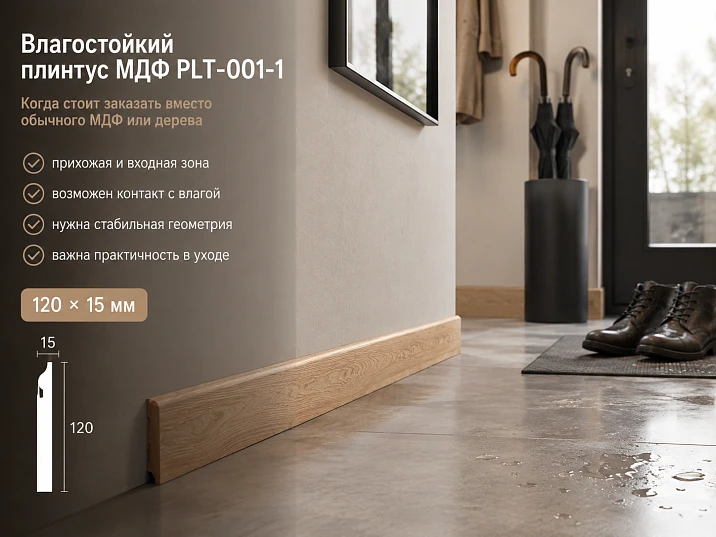
In the hallway, a tall white skirting board with a height of 120 mm has already been chosen. In winter, water from shoes appears near the front door, the mat regularly dries after snow and rain, and the floor has to be washed more often than in the bedroom or study. In the STAVROS catalog, one model PLT-001-1 is offered in four versions at once: moisture-resistant MDF, regular MDF, beech, and oak. Because of the same name, it is easy to assume that the difference comes down to price and plank length. For the hallway, this is too simplified an approach.
Direct answer: moisture-resistant MDF PLT-001-1 is reasonably considered where the skirting board periodically encounters high humidity, splashes, and regular wet cleaning, but it cannot be considered a skirting board for constant contact with water or a puddle standing against the wall. If water in normal operating conditions remains on the floor covering, is quickly removed, and the finishing is done correctly, the enhanced moisture-protective properties of the material provide a clear advantage over regular MDF. If water regularly stands near the wall, the reason for the choice should be reconsidered: the word "moisture-resistant" does not turn the product into a waterproofing element.
PLT-001-1 has four confirmed versions. Moisture-resistant MDF and regular MDF have dimensions of 120×16×2600 mm. Beech and oak are 120×15×2400 mm. For the selected moisture-resistant MDF, the card indicates the sanding quality "Prestige" and preparation "Under enamel." As of August 31, 2026, moisture-resistant MDF cost 2790 RUB per plank and was available to order with an average production time of 5–10 working days; regular MDF cost 2290 RUB, beech — 5140 RUB, oak — 7730 RUB. Before payment, this data should be checked again, as price and availability change.
Therefore, the choice for the hallway is not based on the principle "the most moisture-resistant is always the best." First, you need to determine the actual mode of contact with water, then decide whether an opaque enamel or a visible wood texture is needed, check the height of 120 mm next to trim and furniture, compare the plank length of 2600 or 2400 mm with the cutting plan, and only then choose the specific version.
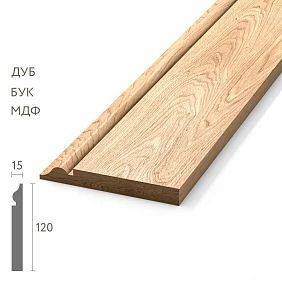
PLT-001-1 120 mm skirting board: four versions of one model
The name PLT-001-1 combines products with the same overall profile but different materials, thickness, and length. This is crucial for ordering: saying "I need PLT-001-1" is not enough.
| Execution | Size | Price as of 31.08.2026 | Status at the time of check | What determines the choice |
|---|---|---|---|---|
| Moisture-resistant MDF | 120×16×2600 mm | 2790 RUB | Made to order, average lead time 5–10 business days | increased moisture resistance, painting |
| MDF | 120×16×2600 mm | 2290 RUB | In stock | dry areas, painting |
| Beech | 120×15×2400 mm | 5140 RUB | In stock | natural wood, solid wood finishing |
| Oak | 120×15×2400 mm | 7730 RUB | In stock | pronounced oak texture, natural finish |
Moisture-resistant and regular MDF match in nominal geometry: 120 mm in height, 16 mm in thickness, 2600 mm in length. But identical geometry does not mean identical material. If the hallway truly falls into a zone of high operational humidity, replacing the moisture-resistant option with regular MDF only because it is cheaper and currently in stock should be done only after a conscious assessment of the conditions.
Solid wood also differs geometrically: beech and oak have a thickness of 15 mm and a length of 2400 mm. The 1 mm difference in thickness seems small, but in the finished assembly it affects the offset from the wall, the fit to the casing, furniture, and other profiles. The 200 mm difference in length changes the cutting layout on long walls.
If the moisture-resistant option is chosen, the purchase should be made through the product card Buy PLT-001-1 with explicit indication of material, size, quality, and preparation.




Moisture-resistant MDF baseboard: what the characteristic really means and what it does not promise
The most dangerous mistake in this topic is substituting the term. "Moisture-resistant" and "waterproof under any conditions" are not the same thing.
The product card offers a separate version made of moisture-resistant MDF and recommends such material for conditions where humidity is higher than usual. This allows considering it for a hallway where there are wet shoes, cleaning with a damp mop, and occasional splashes. But from this characteristic, one cannot infer promises that the card does not make.
One cannot write or accept as a technical guarantee:
-
"the baseboard is not afraid of water at all";
-
"it can be regularly flooded";
-
"it withstands a constant puddle";
-
"the bottom edge may remain untreated";
-
"after cutting, the ends do not need protection";
-
"suitable for any wet room without additional conditions."
For the buyer, a more useful question is: how exactly does water behave in a specific hallway? If after returning from the street a few drops reach the wall and are removed during cleaning, that is one mode. If wet boots stand close to the baseboard for hours, and water from the mat constantly collects at its bottom edge, the mode is harsher. If due to the floor slope a puddle regularly forms near the wall, the problem is not solved by simply choosing MDF with enhanced moisture-resistant properties.
Moisture resistance is a property of the material that must be used together with proper finishing, installation, and maintenance. It increases the margin of resistance to a humid environment, but does not eliminate the need to keep the assembly in conditions for which it is intended.
Our factory also produces:



Wet shoes in the hallway: first determine three modes of contact with water
The phrase "it gets wet in the hallway" is too vague for choosing a baseboard. Divide the situation into at least three modes.
Get Consultation
Mode 1. Moisture remains mainly on the floor
Wet shoes stand on a moisture-absorbing or rubber mat. Drops fall onto the floor covering, but rarely reach the wall and the bottom edge of the baseboard. The floor is regularly wiped, and water does not stand for hours.
In such an entryway, the operational load on the baseboard is moderate. Moisture-resistant MDF provides an additional margin, but it should be compared with regular MDF in terms of price, finish, and actual necessity. If the area is effectively dry, regular MDF may prove to be rational.
Mode 2. Splashes regularly reach the baseboard
When the door is opened, snow from shoes and strollers reaches the wall. During wet cleaning, the mop touches the lower part of the baseboard. After rain, individual drops end up on the profile surface.
This is already a convincing scenario to consider moisture-resistant MDF. Here, increased moisture resistance works exactly where needed: during periodic episodes of dampening in normal interior use.
Mode 3. Water regularly stands directly at the wall
The floor covering or slope directs water toward the baseboard. The mat overflows, snow melts near the wall, and a puddle may remain for a long time. Cleaning is not always done immediately.
This mode cannot be masked with the word "moisture-resistant." First, the cause of constant water must be addressed: change the organization of the entry area, floor protection, mat placement, slope, cleaning, or the joint design. If the material is chosen for constant contact with water, direct confirmation of the suitability of the specific solution must be obtained, rather than inferred from the general name of MDF.
This three-level check helps avoid overpaying in a dry area and overestimating the material's capabilities in a truly wet one.
Why moisture-resistant MDF does not eliminate the need for proper floor jointing
Even suitable material can be ruined by a bad joint.
The baseboard meets moisture in the most vulnerable places not only on the front surface. After cutting, end faces appear. Cuts are made in corners. Ends remain near trim or a cabinet. During installation, holes, locally treated areas, and joints may appear.
If the front surface is prepared and painted, but a fresh end face after trimming is left without the protection provided by the technology, the operation will get a weak spot exactly where it was not expected. Therefore, the finishing should be considered as a system: the front part, top edge, bottom zone, end faces, cut areas, and joints must be treated consistently.
The second problem is contact with the floor. The baseboard should not be used as a means to compensate for a constantly wet base. If water regularly comes from below, first assess the operational scenario and finishing requirements.
The third is cleaning. Moisture-resistant material does not mean that you can direct abundant water at it or leave wet dirt for a long time. Cleaning should match the interior finishing and the chosen coating system.
The fourth is the wall. If moisture comes not from the floor but from the wall structure, choosing a baseboard does not eliminate the source. First, you need to rule out a leak, capillary wetting, condensation, or another construction cause.
Regular MDF PLT-001-1: when overpaying for a moisture-resistant option is not necessary
The moisture-resistant option does not have to be the default choice for any room near the entrance.
Regular MDF PLT-001-1 has the same size of 120×16×2600 mm. At the time of checking, it cost 2290 RUB versus 2790 RUB for the moisture-resistant one. The difference is 500 RUB per plank.
If the project requires, for example, 10 planks, the difference only for the product will be:
10 × 500 = 5000 RUB
This arithmetic does not say that regular MDF is better. It shows that the characteristic has a specific price and it needs to be tied to real operation.
Regular MDF is logical to consider when:
-
the room is dry;
-
water almost never reaches the wall;
-
it is a bedroom, study, or living room;
-
the hallway is separated from the wet entry zone;
-
shoes are stored in a separate vestibule;
-
wet cleaning is done carefully;
-
the project does not involve an increased risk of moisture.
If we are talking specifically about an entry hallway where snow regularly melts in winter, saving 500 rubles on the plank should already be compared not only with the budget, but also with the desired margin of operational durability.
Moisture-resistant PLT-001-1 and regular MDF: geometry is the same, material is not
Coincidence 120×16×2600 mm convenient for design. If a designer has already specified the PLT-001-1 profile in this version, switching from regular MDF to moisture-resistant does not change the nominal height, thickness, or length.
But it is precisely this coincidence that provokes an error: "if everything is the same, only the price differs."
The material differs. Therefore, in the specification you need to write:
PLT-001-1 / moisture-resistant MDF / 120×16×2600 mm / Prestige / For enamel
And not:
PLT-001-1 / 120 mm
This format is especially important on sites where regular MDF is used in dry rooms, and moisture-resistant MDF in the hallway. A year after installation, painted profiles may look the same visually. If repairs are needed, a single photo will not be enough to understand which material was installed.
For a private house, it is useful to keep the specification along with the paint code. For a commercial project, include the material in the finishing schedule.
MDF skirting board for painting: what the "Under enamel" option provides
For moisture-resistant versions, the card indicates "Under enamel" preparation. This is especially logical in hallways, where a tall skirting board is often made white or painted to match the wall and door trim color.
"Under enamel" means the product is designed for opaque finishing. For the buyer, this removes the need to achieve a beautiful natural match of wood lamella shades: the final color is formed by the enamel.
There are several working schemes for the hallway.
Skirting board in the wall color. A tall 120 mm line becomes part of the architecture but does not fragment the space with contrast. Suitable when a calm, modern background is required.
White skirting board with white trim. The profiles form a unified frame system. Here, it is especially important to compare the skirting board thickness with the trim projection so that the joint looks designed.
Contrasting skirting board. For example, walls are colored, while the skirting board and doors are light. In this case, 120 mm reads more strongly, so the quality of the surface and joints becomes especially noticeable.
Skirting board in the furniture color. Possible in projects with built-in wardrobes, but the color must be coordinated in advance: "white" from different manufacturers may have different tones and gloss levels.
The card provides a general finishing sequence: dust removal, priming, matting after the primer dries, and applying the topcoat. Specific materials are chosen as a compatible system and applied according to the manufacturer's instructions.
What "Prestige" quality means for a skirting board that will be painted
For the selected moisture-resistant PLT-001-1, the sanding quality "Prestige" is specified. The STAVROS card describes "Prestige" as detailed manual sanding.
The practical meaning is not in the beautiful name, but in the amount of preparation. A high baseboard of 120 mm has a noticeable front surface. After opaque painting, side light can reveal scratches, waves, and unevenness more strongly than on untreated MDF.
But "Prestige" does not cancel acceptance. Before priming, you need to check:
-
the profile along the entire length;
-
edges;
-
end faces;
-
damage during transportation;
-
local traces of processing;
-
future cut locations;
-
the joinability of the planks.
If the craftsman refines the end after cutting, this area already requires independent preparation before finishing.
Oak baseboard PLT-001-1: when solid wood solves a different task
The oak PLT-001-1 has dimensions of 120×15×2400 mm. As of 31.08.2026, its price in the card was 7730 RUB.
Comparing oak with moisture-resistant MDF only on the scale of "better or worse at withstanding an entryway" is incorrect. Oak is often chosen because solid wood and its visible structure are needed.
This option is logical if:
-
the floor is oak and the baseboard should continue the material;
-
door casings and the portal are made of oak;
-
the project provides for tinting;
-
a pronounced porous texture is needed;
-
the interior is based on natural materials;
-
the baseboard is not planned to be covered with dense opaque enamel.
At the same time, solid wood also requires proper finishing and maintenance. The word "oak" cannot be considered an automatic permit for constant water near the wall.
There is also a geometric difference: thickness 15 mm versus 16 mm for MDF, length 2400 versus 2600 mm. If the design is already calculated for MDF, switching to oak requires re-checking joints and cutting patterns.
Beech PLT-001-1: when to choose beech instead of oak or MDF
The beech option has dimensions of 120×15×2400 mm and cost 5140 RUB at the time of checking.
Beech is also an array, so it should be chosen not as "more expensive MDF," but as a separate material. The STAVROS card characterizes beech as dense, non-porous wood, often used in products under enamel. This makes it interesting for projects where the buyer wants natural wood specifically, but the finish will be opaque.
For a hallway, beech may be appropriate when:
-
existing doors or stairs are already beech;
-
the project requires solid wood;
-
a thickness of 15 mm better matches other wooden profiles;
-
a length of 2400 mm suits the cutting layout;
-
the chosen finish system is suitable for the material.
If the entire baseboard will be covered with dense white enamel and the task does not require solid wood, one should honestly ask what additional value beech provides compared to moisture-resistant MDF. Sometimes the answer will be "solid wood is specifically needed." Sometimes — "none, wet operation and a stable painted surface are more important." This is a normal selection outcome.
Wooden baseboard or moisture-resistant MDF: what matters more in a painted hallway
For a white painted hallway, it is convenient to start the choice not with the material, but with priorities.
If priority #1 is natural wood as a value in itself, beech and oak are compared. If priority is visible texture, oak is especially logical under translucent finishes.
If priority #1 is a painted architectural profile in an area of periodic humidity, moisture-resistant MDF becomes a strong candidate. Its material meets the conditions better than regular MDF, and preparation for enamel matches the chosen visual result.
If the hallway is dry, regular MDF can accomplish the same architectural task more cheaply.
Short logic:
| Main priority | What to consider first |
|---|---|
| Periodic humidity + opaque painting | Moisture-resistant MDF |
| Dry area + opaque painting | Standard MDF |
| Natural wood under enamel/tinting | Beech |
| Pronounced oak texture | Oak |
| Constant standing water near the wall | first review the conditions and the node, rather than automatically choosing one of four options |
This table does not replace design, but it correctly lays out the reasons for the choice.
High baseboard 120 mm in the hallway: check doors and furniture before ordering
Even a material perfectly chosen for moisture resistance will not help if the profile physically conflicts with the interior.
120 mm is a noticeable height. Before ordering, make a mock-up from cardboard or painter's tape and draw a line on the wall.
Check the door casing. If its lower part is narrower than the baseboard, you need to decide the junction shape in advance. The baseboard should not unexpectedly protrude beyond the casing by 16 mm and create an accidental step.
Check the shoe cabinet. Built-in furniture may have a plinth that is lower or deeper. If the baseboard goes behind the cabinet, it can push the cabinet away from the wall. If the baseboard ends at the furniture, a neat end cap is needed.
Check the door stop. Some models are mounted low on the wall or floor. A tall profile may change the installation point.
Check the outlets and low-voltage outlets. An outlet installed too low may appear visually pressed against the baseboard or even fall within its zone.
Check the radiator pipes if they enter the hallway. Cutouts in a tall profile must be designed, not appear randomly after delivery.
Why a 120×16 mm skirting board needs to be tried against the actual gap at the floor
The PLT-001-1 has a nominal thickness of 16 mm for MDF. But the profile thickness alone does not prove that it will cover any expansion gap between the flooring and the wall.
You need to look at the cross-section. The maximum thickness of the part and the actual geometry of the lower section are not the same thing. The wall may be uneven, and the gap may vary along the length.
Therefore, before ordering, measure:
-
the maximum gap on several walls;
-
minimum clearance;
-
wall curvature;
-
plaster protrusions;
-
the actual contour of the skirting board according to the drawing;
-
the thickness of the finishing layer;
-
the position of the flooring relative to the wall.
If another article already covers a specific case with a 14 mm gap, there is no need to repeat it here. For a hallway, the principle is sufficient: the profile is selected based on the actual cross-section and real measurements, not just a single thickness figure in the name.
How the length of 2600 mm for MDF and 2400 mm for solid wood changes the order
The material changes not only the operation, but also the cutting.
Suppose one wall of the hallway has a length of 2520 mm. An MDF plank of 2600 mm can theoretically cover it with a single piece, leaving a gross remainder of 80 mm before technological trims.
For beech or oak with a length of 2400 mm, this same wall already requires a joint:
2520 − 2400 = 120 mm
Formally, only 120 mm is missing, but a separate insert and a connection point appear. Therefore, switching from MDF to solid wood cannot be assessed only by the price per plank.
On a long wall of 5100 mm:
-
two MDF planks give
2 × 2600 = 5200 mm; -
two solid wood planks give
2 × 2400 = 4800 mm, that is, 300 mm is missing.
The cut and the number of joints will be different.
If the hallway is small, a length of 2600 mm can reduce the number of joints. In a large hall, the advantage depends on the specific wall dimensions.
When it is better not to buy moisture-resistant PLT-001-1 for the hallway at all
There are situations where a product should not receive a recommendation just because the article topic is about it.
Constant water near the wall. If puddles remain regularly and for a long time, first eliminate the operational or construction scenario. Moisture-resistant MDF should not be turned into a replacement for waterproofing.
An open natural texture is needed. If the designer wants a pronounced oak grain under a clear coating, MDF for enamel solves a different task.
A height of 120 mm conflicts with trims or furniture. Even a suitable material does not save incorrect geometry.
A different length without extra joints is needed. If cutting to 2600 mm is impractical, it is better to compare an alternative profile.
The baseboard must work under conditions that the manufacturer does not explicitly state. Then you need to request written confirmation or choose another design solution.
The price of the moisture-resistant option is not justified in a dry room. For a corridor far from the entrance without water contact, regular MDF may be more rational.
The project requires an array as a fundamental material. Then beech or oak is chosen not for marketing reasons, but for the architectural concept.
Can moisture-resistant PLT-001-1 be used near the front door?
It can be considered — that is the more accurate way to phrase the answer.
The front door creates a potentially more humid zone: wet shoes, snow, water from umbrellas, frequent cleaning. Moisture-resistant MDF is logically more suitable than regular MDF for such a scenario.
But before purchasing, answer five questions.
-
Does water reach the baseboard or does it stay on the mat?
-
How quickly is it cleaned up?
-
Is there ever standing water near the wall?
-
Will the lower area and edges be finished according to the accepted technology?
-
Can the entrance organization be improved — by installing a deeper tray, a mat, or changing the shoe storage area?
If the answer shows periodic rather than constant moisture, the choice looks justified. If water stands regularly, the solution needs to be expanded beyond buying a skirting board.
How to organize the entry area so as not to demand the impossible from the skirting board
Material is only one part of the system.
Make a place for wet shoes so that water does not spread toward the wall. The mat should be large enough for the actual number of shoes belonging to the family or visitors. If four pairs of boots stand at the same time in winter, a small decorative mat does not solve the problem.
For very wet shoes, a tray or another solution that collects meltwater is useful. It is placed so that its edges do not direct water toward the skirting board.
Umbrellas need a separate area. Water from a long umbrella often hits the wall above the level of the shoe mat. If the umbrella is leaned directly against the skirting board, increased moisture resistance becomes compensation for a poor storage scenario.
During wet cleaning, do not leave a puddle along the wall. The mop or washing machine should be used in a mode that matches the floor and wall finishes.
This way, usage reduces the load on the material and extends the service life of any option.
How to protect the bottom edge and ends after cutting
The card does not specify an individual "secret" protection scheme specifically for this entryway, so you cannot invent a proprietary composition.
The principle is universal: after cutting, there should be no areas left out of the adopted finishing system.
When designing, note:
-
external corners;
-
internal corners;
-
ends of trim;
-
ends of cabinets;
-
joints along the length;
-
holes and cutouts;
-
the bottom edge;
-
areas of local sanding.
After cutting, the craftsman checks which surfaces require re-priming or finishing treatment according to the technology of the selected materials.
Especially dangerous are the "invisible" ends near the door: they are often considered insignificant, although water and cleaning can affect exactly this area.
What happens to the project if the baseboard is to be painted after installation
There are two approaches: perform a significant part of the finishing before installation, or paint the already installed baseboard. The specific technology depends on the project, wall composition, chosen enamel, and the craftsman's qualifications.
For the hallway, it is important that the final system leaves no unprotected areas after trimming.
If the planks are fully painted in advance, installation fitting may expose the ends. Then local restoration of the coating is required.
If painting is done after installation, it is more convenient to treat joints and connections with a single finish, but the floor and walls must be carefully protected.
In both cases, the sequence must be agreed upon in advance. It cannot be assumed that moisture-resistant MDF allows for violating the technology.
Price of wooden baseboard and MDF: what the buyer actually pays for
As of the check date, PLT-001-1 prices differed significantly:
-
moisture-resistant MDF — 2790 RUB;
-
regular MDF — 2290 RUB;
-
beech — 5140 RUB;
-
oak — 7730 RUB.
But comparing cost only by the price of one plank is also incorrect because the length differs: MDF — 2600 mm, solid wood — 2400 mm.
Conditional cost per linear meter excluding waste:
-
Moisture-resistant MDF:
2790 / 2.6 ≈ 1073 RUB/m; -
Regular MDF:
2290 / 2.6 ≈ 881 RUB/m; -
Beech:
5140 / 2.4 ≈ 2142 RUB/m; -
Oak:
7730 / 2.4 ≈ 3221 RUB/m.
This is approximate arithmetic based on the published price of the plank, not the final project cost. The real budget is affected by waste, joints, painting, delivery, packaging, installation, and possible reserve.
For the hallway, the value of the property also needs to be considered. The difference between moisture-resistant and regular MDF is 500 RUB per plank. If eight planks are needed:
8 × 500 = 4000 RUB
These 4000 RUB are the cost of switching to a different material within the same geometry, not counting other work. The buyer can already assess whether such a reserve is justified for specific humidity.
Buy wooden skirting or MDF skirting: a short decision matrix
| Scenario | What to check first | Likely first candidate |
|---|---|---|
| Dry bedroom or study, opaque finish | budget, color, geometry | Standard MDF |
| Entryway with wet shoes and regular damp cleaning | real water contact with the profile | Moisture-resistant MDF |
| Entryway where water regularly stands against the wall | cause of water and suitability of the entire assembly | Do not select automatically |
| Oak interior with visible texture | match of wood species and tinting | Oak |
| Solid wood interior under enamel | the necessity of wood specifically | Beech |
| Need a 2600 mm plank without a joint on a 2500–2550 mm wall | Cutting map | MDF |
| Existing wooden trim 15 mm thick | junctions and material | Beech or oak |
| Need a fully white architectural line at the entrance | humidity, painting, trim | Moisture-resistant MDF |
This matrix does not declare one material the winner. It helps start the comparison from the right criterion.
Calculation, specification, and commercial order PLT-001-1
Why the material must be chosen before ordering the entire PLT-001-1 batch
If four finishes are used in one project, marking an article without the material becomes dangerous.
Imagine an apartment: the bedroom is regular MDF, the hallway is moisture-resistant MDF, and the study is oak. After painting, the two MDF areas may look identical, and installers receive the boxes at the same time.
The list must have separate lines:
PLT-001-1 / MDF / 120×16×2600
PLT-001-1 / moisture-resistant MDF / 120×16×2600
PLT-001-1 / oak / 120×15×2400
The quantity is calculated separately for each area.
You cannot combine everything into one line "PLT-001-1 — 20 planks" and then distribute the material on site by appearance. This creates a risk of installing regular MDF in the hallway and moisture-resistant MDF in a dry room without need.
How to calculate the number of planks for the hallway
Although the article's topic is not about cutting, you still need to determine the quantity before purchasing.
First, measure each section where the baseboard will actually be installed. Do not automatically take the total perimeter: doorways, built-in furniture, and other endings are checked against the project.
For MDF, one plank has a length of 2600 mm. But dividing the total length by 2.6 and rounding up is not enough if there are several walls longer than one plank or many short sections.
Example:
-
wall A — 2450 mm;
-
wall B — 1850 mm;
-
wall C — 1320 mm;
-
wall D — 980 mm.
Total finished length:
2450 + 1850 + 1320 + 980 = 6600 mm
By overall arithmetic:
6600 / 2600 ≈ 2,54
That is, at least three planks by total length give 7800 mm. But the cutting layout needs to be checked.
One option:
-
plank 1 → 2450, remainder 150;
-
plank 2 → 1320 + 980 = 2300, remainder 300 before accounting for the cut;
-
bar 3 → 1850, remainder 750.
The scheme works theoretically. If the sections had a different combination, the same 6.6 m could require a different cutting pattern.
For beech and oak, the calculation is repeated with a length of 2400 mm.
How to compare the price of a project, not the price of a single plank
Suppose the hallway needs four MDF planks after cutting.
Regular MDF at the price as of the check date:
4 × 2290 = 9160 rub.
Moisture-resistant:
4 × 2790 = 11,160 rub.
The difference:
11,160 − 9160 = 2000 rub.
If the task is an entry area with regular moisture, these 2000 rub. can be assessed as the additional cost of choosing a material with enhanced moisture-resistant properties.
Now let's imagine that switching to oak due to a length of 2400 mm already requires five planks:
5 × 7730 = 38,650 RUB.
This is not a universal calculation for any hallway, but an example of why you cannot compare "2790 vs 7730" without quantity and cutting.
The full budget additionally includes finishing, consumables, packaging, delivery, and installation.
How to prepare an order specification without ambiguity
For the selected option, the correct line looks like this:
PLT-001-1 / Moisture-resistant MDF / 120×16×2600 mm / Prestige / For enamel / quantity ___ pcs.
If regular MDF is needed, the material is changed explicitly. If oak or beech is selected, both the size and length change.
It is useful to attach to the request:
-
wall map;
-
number of slats;
-
delivery city;
-
desired installation date;
-
information about the planned painting;
-
photos of junctions to platbands;
-
question about the actual lead time if the moisture-resistant option is made to order.
Before payment, you need to re-check the price and availability. The card indicates that data is updated daily.
What to check after delivery of moisture-resistant PLT-001-1
Before handing over to the painter or installer, verify:
-
article number;
-
material — specifically moisture-resistant MDF;
-
size 120×16×2600 mm;
-
quantity;
-
"Prestige" quality;
-
preparation "Under enamel";
-
profile integrity;
-
end condition;
-
packaging damage;
-
straightness and appearance.
If an order contains both regular and moisture-resistant MDF, batches must be labeled immediately upon receipt. You cannot rely on being able to visually identify the material after primer or enamel.
What to do if the moisture-resistant option is made to order, while regular MDF is in stock
At the time of the check, moisture-resistant PLT-001-1 was on order with an average lead time of 5–10 business days, while regular MDF was shown as in stock.
This creates a real commercial choice: wait or substitute.
The right decision depends on the schedule and conditions.
If the project opens in three days and the entryway is actually dry, regular MDF may be a deliberate alternative.
If the renovation is not tied to a strict deadline and the entry area is regularly damp, shortening the wait at the cost of changing the material may be unwise.
If the deadline is critical, you can check other moisture-resistant MDF models in the category rather than automatically changing the material within PLT-001-1.
The average lead time of 5–10 business days should not be taken as a promised date. A specific order must be confirmed with the seller.
When to buy a wooden baseboard instead of MDF
If, after analyzing the hallway, it turns out that moisture resistance is not the main criterion, and the interior requires solid wood, it makes sense to switch to wooden options.
Category allows to buy wooden baseboard and compare profiles by material, height, and length.
Wood is chosen when:
-
a natural texture is needed;
-
the baseboard must match oak doors;
-
the project is based on solid wood;
-
a translucent finish is planned;
-
the price and different cutting pattern are acceptable.
At the same time, you shouldn't present solid wood as a "permanent solution against water." It also requires appropriate finishing and maintenance.
When to buy an MDF baseboard instead of solid wood
If a highly painted profile is needed and natural texture is not the goal, MDF may be more rational.
Advantages in the context of this model:
-
length 2600 mm;
-
thickness 16 mm;
-
preparation for painting;
-
choice of regular or moisture-resistant material;
-
significantly lower market price compared to oak and beech at the date of verification.
The customer can buy MDF skirting board through the general category and compare several profiles if PLT-001-1 does not fit the design.
MDF baseboard for painting: how to choose a color for a practical hallway
Color affects not only style but also maintenance.
A white tall baseboard makes the space brighter and pairs well with white trim. However, near the entrance, dark marks from shoes and cleaning equipment are more noticeable on it.
A baseboard in the color of the wall breaks up a narrow hallway less. During local repairs, it may be easier to restore a uniform color if the coating code is preserved.
A medium or dark shade can hide some dirt, but dust and dried drops are more visible on it.
The degree of gloss also matters. A glossy surface reflects light more strongly and emphasizes unevenness. A matte one may be visually calmer, but the performance properties depend on the specific coating system.
In the article, one universal enamel cannot be assigned without confirmed data. The choice is coordinated with the manufacturer of finishing materials and the craftsman.
Mistakes when choosing PLT-001-1 for the hallwayMistake 9. Treating the average 5–10 days as a guaranteed date
Reason: the timeframe on the product card is perceived as a promise.
Consequence: installation does not fit the schedule.
How to prevent: confirm the timeframe for a specific batch before payment.
Error 10. Solving the problem of standing water only with the baseboard material
Cause: attempting to buy the 'most protected' option.
Consequence: the water source remains, and the joint continues to operate in the wrong mode.
How to prevent: first organize the entry area and eliminate constant moisture.
Boundary scenarios for PLT-001-1 operation in the hallway
Boundary scenario: wet mat touches the baseboard
This is a real household situation. The mat is laid flush against the wall, in winter its edge gets wet and stays in contact with the lower zone of the baseboard for hours.
Even if water does not form a puddle, the contact becomes prolonged. The first solution is not to argue about the material, but to change the mat placement or choose a design that does not transfer moisture directly to the baseboard.
Moisture-resistant MDF is still preferable to regular MDF for high humidity, but proper organization reduces the load more than trying to compensate for constant wet contact with a single material property.
Boundary scenario: a mopping robot regularly passes along the wall
If the robot uses a wet mop attachment, repeated contact with moisture occurs at the baseboard.
Check whether the device leaves water in a strip along the perimeter. If the attachment is only slightly damp and the surface dries quickly, this differs from a mode where the robot systematically leaves drops.
For such an entryway, a moisture-resistant material seems more logical than regular MDF, but the finish and edges must still be done correctly.
Boundary scenario: the entryway is connected to an unheated vestibule
Here, the problem may not only be wet shoes. When the door is opened, air temperature and humidity change.
You should not automatically attribute to PLT-001-1 the ability to operate under any temperature and humidity fluctuations. You need to assess whether the room is a normal internal heated zone or actually an intermediate cold space.
If conditions go beyond normal interior use, it is better to separately coordinate them with the manufacturer.
Boundary scenario: heated floor runs under the baseboard
The card contains a general recommendation for using wide baseboards with heated floors, provided the temperature regime is maintained and mounting materials are selected. But for a specific project, you need to rely on the requirements of the entire floor system.
The baseboard does not lie on the heating element like flooring, but the base temperature and room humidity affect the finish. If the heated floor is used for accelerated drying of a wet entryway, you must not sharply overheat the area contrary to the requirements of the floor system.
How to compare PLT-001-1 with another wide baseboard 120 mm
If PLT-001-1 is not suitable, an alternative is searched not by the single word "120 mm".
Compare:
-
height;
-
thickness;
-
length;
-
material;
-
face profile;
-
geometry of the bottom edge;
-
available preparation;
-
availability of moisture-resistant version;
-
price;
-
deadline;
-
cutting along the walls.
This preserves the architectural logic of the project.
If you need to view a wide range, you can buy wooden baseboards through the category and compare models by real parameters.
When the request "buy wooden floor baseboard" leads not to wood, but to MDF
A buyer may start their search with a general intention buy a wooden floor plinth, but after comparing, realize that in a specific hallway, painted profile and increased moisture resistance matter more to them.
This is a normal shift in decision within the same product category. Commercial search does not have to end with the material that was the first word in the query.
The key is that the final choice is explainable: why MDF, why moisture-resistant, why 120 mm, why 2600 mm, why under enamel.
How to store a spare plank after renovation
If a full-size spare plank remains after cutting, it makes sense to keep it for future repairs.
It should be labeled with:
PLT-001-1 / moisture-resistant MDF / 120×16×2600 / finish code
Storage should comply with the manufacturer's recommendations and normal conditions for interior material. Do not leave the plank in a damp basement or unheated room just because MDF is called moisture-resistant.
For a commercial project, a spare is especially useful: after a few years, the exact finish and shade may be harder to reproduce.
How to conduct a home humidity scenario test before choosing a material
The buyer does not need a laboratory experiment. It is enough to observe during several rainy or snowy days where the water actually ends up.
Place a regular mat in the planned location and do not change your usual routine after the family returns home. After 10–20 minutes, inspect the boundary between the floor and the wall. Record whether moisture remains only on the mat, whether drops appear near the baseboard, how far they spread, and how long the area stays wet.
Repeat the observation after wet mopping. If the mop regularly touches the wall and leaves a wet strip, that is a separate scenario.
The point of the test is not precise milliliters of water, but classification: rare splashes, repeated short-term wetting, or constant standing water. This classification is what is needed for the choice.
What to check with the trim if PLT-001-1 is thicker than the wooden profile
The MDF version has a thickness of 16 mm, solid wood — 15 mm. If the door trim protrudes from the wall, compare this protrusion with the baseboard.
If the trim protrudes, for example, only 14 mm, the MDF baseboard may nominally be 2 mm ahead. This is not automatically bad, but the joint needs to be designed. You can use a coordinated transition, change the trim, or choose a different profile.
If the trim protrudes 18–20 mm, the baseboard can neatly fit into it without protruding, but the actual solution depends on the shape of the profiles.
Measure not only the thickness of the products on paper, but also the actual protrusion after installation on the finished wall.
How to divide one apartment into dry and wet zones without chaos in procurement
If the entire apartment is finished with one profile PLT-001-1, it is not necessary to use one material everywhere. But you need to keep the order manageable.
Create a specification by rooms:
| Zone | Material | Size | Reason |
|---|---|---|---|
| Hallway | Moisture-resistant MDF | 120×16×2600 | regular moisture |
| Corridor | MDF | 120×16×2600 | dry zone |
| Bedroom | MDF | 120×16×2600 | painted profile |
| Office | Oak | 120×15×2400 | natural finish |
This scheme allows using one architectural motif, but not mixing material properties randomly.
For the installer, batches are marked by rooms before painting. For maintenance, the specification is kept so that future repairs repeat the original execution.
What to do if a large puddle gets on the baseboard after installation
Even when choosing moisture-resistant MDF, a sensible reaction is to remove the water, dry the surface in a normal way, and check the condition of the finish.
There is no need to deliberately "test" the material by leaving water overnight. Moisture resistance is a useful operational property, not an invitation to conduct destructive tests on a finished interior.
If changes in geometry, coatings, or joints appear after accidental wetting, assess the damage and the cause. In case of recurring episodes, not only the baseboard but also the source of water should be changed.
How to make a decision in five minutes if all the initial data is already known
-
If natural visible wood is needed — compare beech and oak.
-
If an opaque enamel is needed — move on to MDF options.
-
If the area is dry — regular MDF remains a candidate.
-
If there are regular splashes and wet cleaning — consider moisture-resistant MDF.
-
If water stands against the wall — stop the choice and fix the scenario.
-
Check 120 mm in height and 16 mm in projection.
-
Build a cutting layout for 2600 mm.
-
Confirm the price, quantity, and delivery time.
-
Order material with full specifications.
This algorithm does not replace the project, but helps quickly identify which question is still unresolved.
Where to buy moisture-resistant skirting board PLT-001-1 and view other options
After checking humidity conditions, geometry, and cutting layout, you can proceed to checkout moisture-resistant skirting board PLT-001-1 in the specific product card.
If you need a different MDF profile, use the category — is a horizontal element that frames the room at the bottom of the walls where the wall meets the floor. Skirting boards perform several functions: they hide the technological gap between the wall and floor covering (necessary for thermal expansion), protect the lower part of the wall from mechanical damage, create visual completion, and may conceal wiring..
If you decide to switch to solid wood, you can also do it there buy a wooden baseboard and compare beech, oak, and other profiles.
For a wider selection of architectural moldings, the section is available Buy wooden trim items from trusted manufacturers who provide care recommendations..
Control matrix before ordering PLT-001-1 for the hallway
| Question | If "yes" | If "no" |
|---|---|---|
| Does water periodically reach the baseboard? | moisture-resistant MDF has practical meaning | compare with regular MDF |
| Does water regularly stand near the wall? | first review the joint and operation | proceed to the next check |
| Do you need an opaque enamel? | MDF options are logical | compare array |
| Need visible oak texture? | consider oak | not overpay for oak just for the name |
| Is the 120 mm height verified with a mockup? | move to junctions | do a fitting |
| Does 16 mm thickness suit the trim and furniture? | move to cutting | select another profile/node |
| Is the length of 2600 mm optimal for the walls? | count the quantity | compare the alternative |
| Will all ends fit into the finishing system? | can prepare the technology | Coordinate with the finisher |
| Does the 5–10 business day timeframe fit the schedule? | confirm the order | look for an available alternative |
| Is the material clearly specified in the specification? | the risk of grade mixing is lower | fix the request before payment |
If critical lines are not closed, the purchase is premature.
Conclusion: is it worth ordering moisture-resistant PLT-001-1 for the hallway
For a hallway with wet shoes, occasional splashes, and regular damp cleaning, moisture-resistant MDF PLT-001-1 seems more justified than regular MDF if you need a tall painted profile of 120 mm. It has dimensions of 120×16×2600 mm, quality "Prestige", preparation "Under enamel", and as of 31.08.2026 cost 2790 RUB per plank. At the time of verification, the option was made to order with an average production time of 5–10 working days.
But the decisive limitation remains: moisture resistance cannot be interpreted as permission for constant water. If a puddle regularly stands near the wall, you first need to fix the operational scenario or obtain confirmation of the suitability of the selected assembly.
Regular MDF has the same geometry and is cheaper, so it is rational in dry rooms. Beech and oak are solid wood options with dimensions of 120×15×2400 mm; they are chosen when natural wood, finishing, and coordination with other wooden interior elements matter.
Before ordering, you need to do five things: determine the humidity regime, try on the 120 mm height, check the thickness near trims and furniture, plan the cutting layout for the 2600 mm length, and record the exact execution in the specifications. After that, the choice stops being a debate of "MDF or wood" and turns into a clear solution for a specific hallway.
FAQ
Is moisture-resistant MDF PLT-001-1 fully waterproof?
There is no basis to claim that. The card offers moisture-resistant MDF for more humid conditions, but this is not equivalent to a guarantee of constant contact with water or a standing puddle.
Can PLT-001-1 made of moisture-resistant MDF be installed near the entrance door?
It can be considered for such an area, especially with wet shoes and damp cleaning. You need to exclude constant water near the wall and properly perform the finishing.
What is the size of the moisture-resistant PLT-001-1?
120×16×2600 mm.
What is the size of the regular MDF PLT-001-1?
Also 120×16×2600 mm.
How then does the moisture-resistant version differ from the regular one?
By material and operational purpose. Matching dimensions do not make them identical in properties.
What is the size of the beech and oak PLT-001-1?
120×15×2400 mm.
Why is the solid wood 1 mm thinner than MDF?
The card confirms different dimensions for these versions. During design, the fact of the 15/16 mm difference matters; junctions need to be checked against the actual profile.
How much did the moisture-resistant PLT-001-1 cost on August 31, 2026?
2790 rubles per plank according to the card at the time of check.
How much did regular MDF cost?
2290 RUB per plank on the same date.
How much did beech and oak cost?
Beech — 5140 RUB, oak — 7730 RUB per plank as of the check date. The price needs to be re-verified before ordering.
What does "Prestige" mean?
The STAVROS card describes "Prestige" as detailed hand sanding.
What does "under enamel" mean?
This is a preparation option for opaque painting. For the project, a compatible primer-finish system needs to be selected.
Can regular MDF be used in a hallway?
Yes, if the hallway is actually dry and the operating conditions match regular MDF. For an entry area with regular moisture, it makes sense to compare it with moisture-resistant MDF.
What to choose for an entryway — beech, oak, or moisture-resistant MDF?
If a painted profile is needed and there is periodic moisture, moisture-resistant MDF would be the first candidate. If natural wood is essential, beech and oak are compared.
Is oak automatically better for a wet area?
No. Oak is a different material and design choice, but it also requires proper protective finishing and maintenance.
Can moisture-resistant PLT-001-1 be painted to match the wall color?
Yes, the product card offers a selected version with "Under enamel" preparation. The color and specific material system are agreed upon separately.
Will a 120 mm high baseboard fit any door?
No. You need to check the door casing, its thickness, width, and the shape of the joint.
Why might an MDF plank length of 2600 mm be more advantageous than solid wood at 2400 mm?
On walls with lengths between 2400 and 2600 mm, MDF sometimes allows avoiding an additional joint. The solution is confirmed by the cutting plan.
Can regular MDF be used in dry rooms, and moisture-resistant only in the hallway?
Yes, that is a logical zonal specification, provided the materials are clearly marked in the order and on site.
What to do if the moisture-resistant option doesn't make it in time for the renovation deadline?
Check the actual order lead time, then compare other moisture-resistant profiles. Replacing it with regular MDF just for the sake of the deadline should be done after assessing the actual humidity.
Do the cut edges need protection after cutting?
All treated and newly exposed areas must be part of the accepted finishing system. The specific composition and sequence are determined by the technology of the chosen materials.
Where can I buy MDF skirting board PLT-001-1?
The specific PLT-001-1 is ordered on the product page; other MDF skirting boards can be compared in the skirting board category.
Where can I buy a wooden floor skirting board if I've decided to go with something other than MDF?
In the general STAVROS skirting board category, you can compare products made of solid wood and MDF.