Article Contents:
- One word in the list — two completely different handles
- The series name does not replace the article number
- Why the error is detected too late
- What should be written instead of "Oscar, 18 pcs."
- Total length and parameter D are not the same number
- Why you cannot write only "264 mm" in the order
- Zebrano, wenge, rosewood, or walnut
- Stainless steel as part of the selected configuration
- 52 mm is not just a smaller scale
- Why the index 1M cannot be replaced with the word "long"
- When a T-shaped Oscar is truly appropriate
- What exactly is lost when the article number is shortened
- The 264 mm option for a dresser and drawers
- The 360 mm option for a tall cabinet
- One furniture series — two sizes
- Vertical or horizontal installation
- Double doors and central gap
- Molding frame on the facade
- Adjacent handles and repeating rhythm
- Why the article does not replace the drawing
- How to transfer data to the cabinetmaker
- Test facade before the entire batch
- What the craftsman checks and what the customer checks
- Facade list instead of counting by eye
- Example calculation for a bedroom
- Two handles on one wide drawer
- Is a spare handle needed
- Furnishing by rooms
- Checking the quantity using two independent methods
- Why the words "dark wood" are not enough
- Zebrano as active graphics
- Wenge for dark furniture
- Rosewood as a rich accent
- Walnut for a warm furniture palette
- One batch for one furniture block
- How to connect a handle with other metal parts
- A collection as a way to keep a common language
- FUR-033 should not appear on the last day of installation
- Why caps are counted separately
- What is confirmed about FUR-033 itself
- Handles with coating as a separate section
- Required fields
- Example for a cabinet
- Example for a chest of drawers
- Why sizes cannot be combined via a fraction
- Why the material cannot be moved to a general note
- The "facade" column is mandatory
- Specification version and date
- Who confirms the final line
- First the article number
- Then the size line
- Material and metal
- Quantity
- Plugs
- Delivery
- Screenshot or PDF of the cart
- Reconciliation of the invoice with the cart
- Tall wardrobe in the bedroom
- Wardrobe with framed fronts
- Dresser with wide drawers
- Narrow cabinet
- Walk-in closet made of several modules
- Study and office furniture
- Kitchen furniture
- Commercial interior
- Rectangle by full dimension
- Checking from three distances
- Check in the open position
- Check by hand
- Error 1. Only the name was left in the report
- Error 2. Only the full length was specified
- Error 3. Called D center-to-center without checking the scheme
- Error 4. Mixed 264 and 360 mm in one position
- Error 12. Did not check existing holes
- Error 13. Chose two handles per drawer after manufacturing the facade
- Error 14. Assumed the plug is automatically included in the kit
- Error 15. Did not save the approved invoice
- For tall cabinets and wardrobes
- For wide drawers
- For a furniture series with a single material
- For a project where dimensions are distributed systematically
- Small door
- Facade with dense carved decor
- Replacement without new holes
- Need a compact point accent
- Why a category does not replace a card
- Why a card does not replace a project
- When to contact the manager
- Can I order a handle by just writing "Oscar"?
- How is HL-061-1M different from HL-061-2M?
- What sizes are available for HL-061-1M?
- Can D be considered the center-to-center distance?
- What size should I choose for a cabinet?
- Will 264 mm fit for a dresser?
- Can I install 264 and 360 mm in the same room?
- What wood options are available?
- Do I need to specify the metal in the order?
- How many handles are required for the cabinet?
- Can two handles be placed on one drawer?
- Is a spare handle needed?
- What is FUR-033 used for?
- How many FUR-033 should I order?
- Can HL-061-1M be replaced with HL-061-2M without redrilling?
- What should be checked on the test facade?
- Can handles for different rooms be ordered in one batch?
- Where to see other wooden handles?
- How to check the order before payment?
- How to place a repeat order after several months?
- Can the material be chosen based on a photograph?
- Do I need to write the room in the order?
- Where to order Oscar HL-061-1M?
- Arrange the items by article numbers and sizes
- Check the material of each group
- Inspect the metal parts
- Match FUR-033 with the list
- Do not throw away the labeling until the installation is complete
- Do a test fitting from the received batch
- Hand the installer a set of documents, not a verbal instruction
- Check the first installed handle with the facade closed and open
- Save one final assembly card
- Measure the free field, not the entire facade
- Check the center not only mathematically
- Consider the opening of adjacent elements
- Match handle heights within the same room
- Check the handle next to the facade profile
- Compare two dimensions on a single printed facade
- Do not confirm color without a facade sample
- One main document instead of several unrelated lists
- A link should complement, not replace, the description
- Do not forward a screenshot instead of a table
- Prohibit automatic correction of item numbers
- Separate design approval from availability confirmation
- Record changes as a separate line
- Check the request before sending it to the supplier
- Reconcile the supplier's response with the original list
- Pass the final version to the installer, not the original one
- Close the order with an internal inspection report
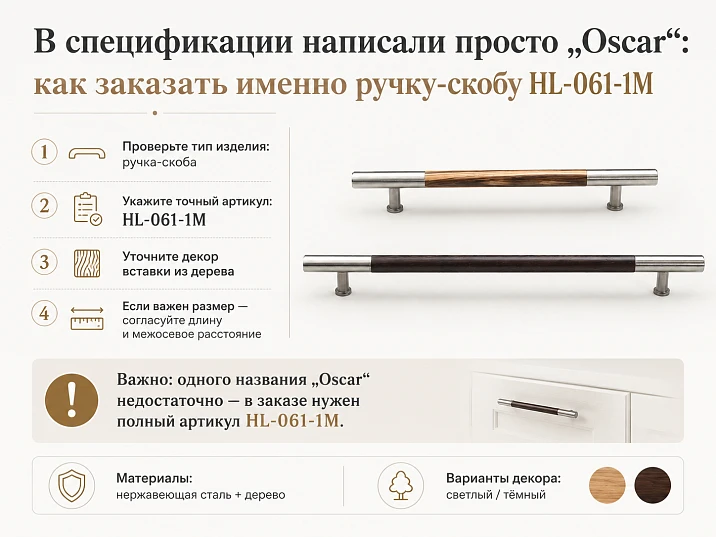
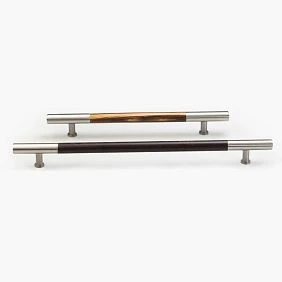
On the cabinet visualization, there is a long wooden handle with metal supports. In the furniture list, there is one short line: "Oscar, stainless steel, 18 pcs." At first glance, everything is clear. The model name is there, the metal is specified, and the quantity is calculated. But you cannot place an order based on such an entry: in the catalog, under the name Oscar, there are two handles of different designs. Oscar HL-061-1M is a long bracket handle measuring 264 or 360 mm, while Oscar HL-061-2M is a separate T-shaped model 52 mm long. One missing ending in the article number changes the appearance of the furniture, the facade drilling pattern, and the entire delivery composition.
Buyers, designers, and furniture makers often search for where buy wooden furniture handles, after the project has already been approved. It is at this moment that a beautiful idea must turn into a precise specification: full article number, size, parameter D, wood option, metal, quantity, accompanying hardware, and distribution across facades. If you leave only the series name, the supply specialist will not be able to unambiguously identify the product, and the craftsman will not be able to prepare the holes.
This article helps not to choose handles "in general," but to correctly order the specific long Oscar HL-061-1M. We will break down how it differs from the compact HL-061-2M, how to choose 264 or 360 mm, what the line A × B × C × D means, how to calculate handles for doors and drawers, why to include FUR-033 in the order, and what data to check in the cart before payment.
One word in the list — two completely different handles
Let's imagine a real furniture list:
| Room | Furniture item | Entry in the project | Quantity |
|---|---|---|---|
| Bedroom | Cabinet | Oscar | 4 pcs. |
| Bedroom | Commode | Oscar | 8 pcs. |
| Hallway | Cabinet | Oscar | 2 pcs. |
| Office | Cabinet | Oscar | 4 pcs. |
Such a table only shows the designer's intention to use the Oscar series. It does not answer the questions without which it is impossible to purchase hardware: which specific model is needed, long or T-shaped, what size is chosen, where the handle is placed vertically, where horizontally, what holes to prepare, and how many plugs to order.




The series name does not replace the article number
The word Oscar describes a designer family, but not a specific product item. The full article number acts as a product passport. You cannot drop the part after the hyphen, because HL-061-1M and HL-061-2M lead to different cards and denote different constructions.
For the main project, you need to write directly: buy the Oscar HL-061-1M handle. Such a formulation already separates the long bracket from the compact model. Next, you still need to specify the size: 264 or 360 mm.
Our factory also produces:
Why the error is detected too late
In the early visualization, the handle is perceived as a graphic line on the facade. The designer sees the proportion, but does not always transfer the full code to the list. Then the file reaches the supply specialist, who searches for Oscar in the catalog and sees several cards. If a decision is made without returning to the visualization and drawing, a product of the same series but a different type may end up in the cart.
The problem becomes obvious after one of three events:
-
the furniture maker asks for the distance between mounting points for drilling;
-
the customer sees a 52 mm handle in the invoice instead of a long bracket;
-
the finished facades are already drilled for a different structure.
any of these scenarios is more expensive and unpleasant than checking one line before payment.
Get Consultation
What should be instead of «Oscar, 18 pcs.»
The minimal entry looks like this:
Furniture bracket handle Oscar HL-061-1M, selected size A × B × C × D, selected wood, stainless steel, quantity per facade list; decorative cap FUR-033 — after checking mounting points and configuration.
This is not a universal installation instruction, but the correct structure of the entry. Specific values are selected for each facade separately.
Oscar HL-061-1M: characteristics that cannot be shortened
HL-061-1M belongs to long bracket handles. The card presents two size positions. They retain the general character of the model, but differ in total length and parameter D. Therefore, the phrase «long Oscar» is still insufficient: there are two long variants.
| Parameter | Option 1 | Option 2 |
| Article number | HL-061-1M | HL-061-1M |
| Type | Handle bracket | Handle bracket |
| Size A × B × C | 264 × 15 × 35 mm | 360 × 15 × 35 mm |
| Parameter D | 192 мм | 288 мм |
| Wood options | Zebrano, wenge, rosewood, walnut | Zebrano, wenge, rosewood, walnut |
| Metal part | Stainless steel | Stainless steel |
| Related hardware | FUR-033 | FUR-033 |
| What to check | drawing, facade, orientation, completeness | drawing, facade, orientation, completeness |
If the project is already approved, it is more convenient to immediately order the Oscar 264 mm handle-bracket or choose the 360 mm version on the same card. The transition to the product should occur after checking the facade, not instead of it.
Full length and parameter D are not the same number
The size 264 or 360 mm describes the full dimension of the handle along the corresponding axis. Parameter D in the table is 192 or 288 mm. You cannot mechanically call D the center-to-center distance without checking the letter designation against the official drawing of the product. For preparing holes, the furniture maker is given not a retelling of the article, but the drawing of the selected option itself.
The practical rule is simple: in the specification, keep all four values A × B × C × D. Then the craftsman sees which row of the card was selected and can match the letter designations with the diagram.
Why you cannot write only "264 mm" in the order
On the furniture market, the number 264 mm may refer to the total length, the distance between mounting points, the size of the mounting area, or another characteristic. Even within a single product card, several numbers are present. The notation "Oscar 264 mm" is useful as a colloquial abbreviation, but the invoice and work sheet must contain the full line: 264 × 15 × 35 × 192 mm.
The same applies to the 360 mm variant. The phrase buy Oscar 360 mm for a cabinet is understandable as a commercial query, but the technical specification must include the remaining parameters.
Zebrano, wenge, palisander, or walnut
The wood option affects not only the shade. On a long handle, the material pattern is more noticeable than on a small button. Before ordering, a sample is compared with the facade under the lighting in which the furniture will be used. Dark wenge can almost blend with a graphite door, walnut can blend more softly with warm wood, zebrano can provide an active linear pattern, and palisander can create a more saturated decorative accent.
This does not mean that one wood species is "better" than another. What is needed is an option that matches the furniture material or deliberately contrasts with it. The word "wood" cannot be left in the order line: it lacks product precision.
Stainless steel as part of the selected finish
In the HL-061-1M card, wood is combined with stainless steel. Therefore, the metal part is also recorded in the work sheet. This is especially important in a project where hinges, supports, lights, faucets, or decorative profiles of different metal shades are present nearby.
For an entire furniture series, it is better order Oscar with stainless steel in one agreed batch. This makes it easier to verify the consistency of selected rows, quantities, and distribution across rooms.
HL-061-2M appears in search results not by chance
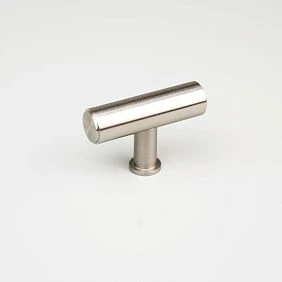
The compact Oscar HL-061-2M is needed in this article only as a source of error. It is not a "smaller size" of the long handle bracket, nor a shortened version of HL-061-1M. It has its own card, index 2M, T-shaped design, and dimensions of 52 × 15 × 35 mm.
| Feature | Oscar HL-061-1M | Oscar HL-061-2M |
| Main shape | long handle bracket | T-shaped handle |
| Size | 264 or 360 mm | 52 мм |
| Dimension line | A × B × C × D | A × B × C |
| Parameter D | 192 or 288 mm | the card of the selected model has its own diagram to verify |
| Role in the project | wide facades, doors, drawers | compact fronts and drawers |
| Can one be replaced with the other without reworking | No | No |
| Is it enough to write "Oscar" | No | No |
52 mm is not just a smaller scale
With proportional reduction, the item retains its structural logic. Here something different happens: the grip type and the pattern by which the craftsman prepares the front change. The T-shaped handle works as a compact accent; the bracket forms an extended line and requires different marking.
Therefore, before payment, it is useful to once check another handle Oscar HL-061-2M and visually note the difference. After that, in the main order, they return to HL-061-1M.
Why the index 1M cannot be replaced with the word "long"
The verbal description depends on the context. For one designer, 264 mm is a long handle; for another, only 360 mm is considered long. The article number does not depend on subjective assessment. It is preserved in correspondence, invoice, cart, waybill, and installation sheet.
The best way to eliminate substitution is to repeat the full code in every table where the product appears. Not once in a note, but in every row associated with a specific facade or size.
When a T-shaped Oscar is truly appropriate
HL-061-2M can be a standalone correct choice for a small drawer or a compact door. In this case, it is considered among models where you can buy a T-shaped furniture handle. But adding it to the project instead of HL-061-1M just because the name matches is not allowed.
What exactly is lost when shortening the article number
A missing index removes not just one letter from the order, but an entire set of data:
-
handle type;
-
length;
-
number of dimensional parameters;
-
facade preparation scheme;
-
visual scale;
-
expected number of mounting points;
-
price of a specific item;
-
related mounting hardware.
Therefore, the requirement to write the full article number is not a formality of the procurement department. It protects the already approved design and finished facades.
How to choose Oscar 264 or 360 mm
Once the article number 1M is fixed, the main dimensional choice remains. It cannot be made only on the principle of "bigger facade - bigger handle." The width and height of the door, installation direction, adjacent lines, molding frame, opening of paired doors, and the visual rhythm of the entire furniture composition are important.
Option 264 mm for a dresser and drawers
The size 264 × 15 × 35 mm with parameter D 192 mm is easier to fit into a medium-width facade. Such a handle can work horizontally on a drawer or vertically on a narrow door. Before choosing, check whether there is free space around it and whether it collides with molding, paneling, or adjacent hardware.
When an expressive Wooden drawer handle, the size 264 mm often becomes the starting point for fitting. But the final decision is made on the facade at full scale.
Option 360 mm for tall cabinet
Size 360 × 15 × 35 mm with parameter D 288 mm pulls the vertical more strongly and noticeably affects the composition. On a tall door, such a line can support the cabinet's proportions. On a small facade, the same handle can approach the edges and visually make the door narrower.
Before order long furniture handles, it is useful to print a rectangular template 360 × 35 mm and attach it to the facade with painter's tape. Even a simple paper mockup shows the scale more accurately than an image on a screen.
One furniture series — two sizes
Using 264 and 360 mm in one interior is possible if the difference is related to the furniture architecture. For example, 360 mm is placed on tall cabinet doors, and 264 mm on dresser drawers. An error appears when sizes are mixed randomly or written in one common line.
In the specification, each version gets a separate item:
| Room | Furniture | Facade | Article number | Size | Quantity |
| Bedroom | Cabinet | Tall doors | HL-061-1M | 360 × 15 × 35 × 288 mm | 4 pcs. |
| Bedroom | Commode | Wide drawers | HL-061-1M | 264 × 15 × 35 × 192 mm | 6 pcs. |
| Hallway | Cabinet | Drawers | HL-061-1M | 264 × 15 × 35 × 192 mm | 2 pcs. |
Vertical or horizontal installation
Orientation changes not only the appearance but also the position of the holes. On a cabinet, a long handle is often placed vertically, on a drawer — horizontally. In the project list, it is better to indicate this in a separate column, especially if the facades are similar in size.
You cannot rely on the installer who will "figure it out on site." They may not have the original visualization. Precise orientation protects the composition from random decisions at the object.
Pair doors and central gap
On two doors, handles form a pair. You need to check the distance from the edge of the facade, the size of the central gap, ease of grip, and symmetry. Handles placed too close may be perceived as one massive piece; too far apart — lose the connection.
Paper templates are applied to both doors at once. Evaluating one handle on one door is not enough.
Molding frame on the facade
If the door is decorated with molding, the handle should be inside the free field or occupy a pre-agreed position relative to the profile. Not only the overall width of the facade is measured, but also the inner opening of the frame.
For the 360 mm option, the length of the free vertical space is especially critical. The handle should not visually press against the corners of the frame or cross carved decor. In a tight field, the 264 mm option sometimes looks more convincing, even though the door itself is tall.
Adjacent handles and repeating rhythm
In a long furniture wall, each handle becomes part of a row. If one is higher, another lower, and a third is chosen in a different size without a logical reason, the mistake is noticeable even with quality furniture. The designer sets a single axis and fixes it on the elevation.
For a group of drawers, not only the center of each front is checked, but also the overall line. Handles can be centered on the drawers themselves or aligned along a single vertical line — these solutions yield different results.
Parameter D: what to check before drilling
In table HL-061-1M, for a 264 mm handle, parameter D is specified as 192 mm, and for a 360 mm handle — 288 mm. These values are transferred to the specification without renaming. The letter's interpretation is verified against the official drawing of the selected model.
Why the article does not replace the drawing
The text explains the ordering logic but does not define drilling coordinates. The drawing shows which points A, B, C, and D refer to. The craftsman must work according to this document, not the phrase "center distance 192 mm" written in correspondence without a diagram.
Before sending facades into production, three things are checked:
-
whether the correct HL-061-1M variant is selected;
-
whether the dimension line in the invoice and drawing matches;
-
whether the marking corresponds to the handle orientation on the facade.
How to pass data to the cabinetmaker
Attach a card or drawing to each item in the list. It is useful to keep the article number and size in the file name: HL-061-1M_264_D192 и HL-061-1M_360_D288. This system reduces the risk that the craftsman opens the wrong document.
In the letter, there is no need to write a long design explanation. A direct command is enough: "Drill only after checking the official drawing HL-061-1M and approving the test facade."
Test facade before the entire batch
When furniture is expensive and the facade has complex finishing, one trial installation is more reasonable than immediately drilling the entire batch. On the test door, check the fit, grip, position relative to the edge and molding, screw length, appearance of the front side, and neatness of the back side.
After checking, fix the template. Only then mark the remaining parts.
What the craftsman checks and what the customer checks
The craftsman is responsible for the accuracy of transferring holes, the compliance of fasteners, and the quality of installation. The customer or designer confirms the external scale, installation height, and orientation. Mixing these areas of responsibility is dangerous: a technically level-installed handle may turn out to be visually not where it was expected.
How to count the number of handles without error
The quantity is counted not by furniture items, but by opening facades and the agreed scheme. A cabinet may have two doors, four drawers, and a mezzanine; the entry "cabinet — 1 pc." says nothing about the hardware.
Facade list instead of counting "by eye"
Start with a list of all moving elements:
-
swing doors;
-
drawers;
-
flip-up facades;
-
internal drawers, if a face handle is provided on them;
-
decorative or false panels, on which there should be no handles.
For each facade, one or two handles are specified. If two pulls are designed on a wide drawer, this is reflected as a separate number, not as a note at the end.
Example calculation for a bedroom
Suppose the bedroom has a wardrobe with four tall doors and a dresser with six drawers. Oscar 360 mm is chosen for the doors, Oscar 264 mm for the drawers.
Calculation:
-
wardrobe: 4 fronts × 1 handle = 4 handles 360 mm;
-
dresser: 6 fronts × 1 handle = 6 handles 264 mm;
-
total: 10 handles, but the order has two different size items.
The entry "Oscar — 10 pcs." destroys this distinction. The correct list contains two lines.
Two handles on one wide drawer
If the designer places two handles, the quantity is multiplied by the number of points. For example, four wide drawers with two brackets each give eight handles. At the same time, the distance between the pair and symmetry relative to the center are checked.
The decision "one or two" is made before drilling. It affects the budget, the number of plugs, and the external rhythm of the dresser.
Is a spare handle needed
Spare parts are not added automatically. First, the availability of the selected version, batch size, and possibility of reordering are checked. If the project is large and identical hardware is distributed across several rooms, one agreed spare item may be reasonable. But it is included in the list explicitly: "reserve — 1 pc.", not hidden in rounding.
Kitting by rooms
For a large facility, it is convenient to split the delivery by rooms. Each box gets a label: room, furniture item, handle size, quantity. Then the installer will not confuse 264 and 360 mm.
When ordering, you can buy Oscar pens in one batch, but within the overall batch, maintain separate configuration.
Checking the quantity by two independent methods
The first method is to sum the pens by furniture. The second is to sum them by sizes. The totals should match. For example, if the rooms total 18 pens, and the sum of the 264 mm and 360 mm lines gives 17, one item is lost or counted twice.
Such a cross-check takes a few minutes and works well in large projects.
Wood and metal: how to specify the finish
The article number and size do not yet complete the selection. The HL-061-1M card features zebrano, wenge, palisander, and walnut combined with stainless steel. Each finish should get its own line if different materials are used in the project.
Why the words "dark wood" are not enough
The shade in the photo depends on the screen and lighting. The phrase "dark wood" does not define a specific option. Wenge and palisander can both be perceived as dark, but the grain and surface character differ.
In the invoice, the exact name is checked, not just the thumbnail image. The same name must appear in the designer's list.
Zebrano as active graphics
Zebrano has a noticeable linear pattern. On a handle 360 mm long, it becomes an independent part of the facade. This option works well when the furniture is minimalist and the handle is allowed to be the main decorative touch. On a facade with an active wood texture, you should check in advance whether the two patterns conflict with each other.
Wenge for dark furniture
Wenge can connect Oscar with graphite, chocolate, or almost black facades. In low lighting, the wood part becomes restrained, and stainless steel stands out more. This combination should be evaluated not only in daylight but also in the evening.
Palisander as a rich accent
Palisander is visually expressive. If the project is based on calm solid-color facades, the handle can work as a thin decorative line. In a complex composition with several wood species, it is better to compare it with samples to avoid accidental mismatch.
Walnut for a warm furniture palette
Walnut is easier to pair with warm wood tones, beige enamel, and calm modern classic style. But the word "walnut" in interior design can mean dozens of colors. Therefore, the handle is matched to the specific facade, not chosen by the shade name.
One batch for one furniture block
On the four cabinet doors, the handles are located nearby. The difference in the chosen material is immediately noticeable. Therefore, it is better to complete the entire block at once, without splitting identical items across several random orders.
This is especially important if the hardware for the bedroom, hallway, and study should form a single line. In such a situation, it is convenient to order handles for the entire furniture series after the final quantity check.
How to match a handle with other metal details
Stainless steel can support hinges, supports, profiles, lighting fixtures, or household appliances. However, matching the material name does not guarantee the same visual effect with different finishes and lighting. Evaluate the handle next to real samples, not based on two different photos.
If the interior contains both brass and steel, decide in advance which metal belongs to the furniture group. Random alternation on adjacent facades looks like a configuration error.
A collection as a way to maintain a common language
Oscar is part of the Esthete collection line. When a project requires several types of handles, it is useful to choose handles from the same collectionbut each selected item is still recorded with the full article number.
The collection helps coordinate the design. The article number ensures delivery accuracy. These functions must not be mixed.
What to order together with HL-061-1M
The main related element is the decorative metal cap FUR-033. In addition to it, the buyer needs confirmed drawings, suitable fasteners, and an agreed installation scheme. It cannot be assumed that all of the above is automatically included in the set: the order composition is checked in the product card and invoice.
| What to add to the check or order | Why it's needed | For which scenario | What to check |
| FUR-033 | cover the visible screw head from the facade side | cabinets, dressers, nightstands | quantity, nickel color, compatibility with the screw |
| Drawing HL-061-1M | correctly read A, B, C, and D | any facades | selected size 264 or 360 mm |
| Test template | check scale and placement | facades with molding, paired doors | orientation and free space |
| Facade list | exclude quantity error | furniture set | each opening element |
| Separate labeling | do not mix sizes during installation | Multiple rooms | article number, size, quantity |
FUR-033 should not appear on the last day of installation
In the card for HL-061-1M, FUR-033 is listed as necessary hardware. The cap is made in nickel color, has dimensions of 14 × 14 × 3 mm, and is intended for finishing the mounting point. Before ordering, check how many caps are required per handle according to the actual mounting scheme and what is included in the delivery set.
You can buy decorative cap FUR-033 simultaneously with the handles. But the quantity cannot be derived from assumption alone. First, verify the number of mounting points, screw type, and kit contents.
Why caps are counted separately
The handle list answers the question of how many face elements are needed. Caps belong to mounting hardware. If one line changes, the quantity of the other may also require recalculation. Therefore, in the order, they are listed as a separate item.
Good entry: “FUR-033 — according to the confirmed number of mounting points for HL-061-1M plus an explicitly agreed reserve.” Bad: “caps — set.”
What is confirmed about FUR-033 itself
The plug card indicates the nickel color and purpose for an M4 screw with a semi-round head. This helps match it to the cold metal part of Oscar. However, compatibility is still checked against the specific fastener, because the screw length depends on the facade and installation scheme.
Handles with coating as a separate section
If the customer has not yet approved Oscar, you can buy wooden handles with coating after comparing shape, size, and material. The category is useful for selection, but after model approval, the specification must return to the specific card HL-061-1M.
Correct specification: from project to invoice
The specification must be clear to the designer, cabinetmaker, manager, and customer. Each sees their part of the task, but works with the same line.
Required fields
For HL-061-1M, the table needs:
-
full name and article number;
-
size A × B × C × D;
-
wood variant;
-
metal part;
-
quantity;
-
room and furniture item;
-
orientation;
-
connected plug;
-
reference or number of the official drawing;
-
note on basket inspection.
Example for a cabinet
Furniture handle-bracket Oscar HL-061-1M, 360 × 15 × 35 × 288 mm, walnut, stainless steel, vertical installation, 4 pcs.; FUR-033 — after checking mounting points and completeness; drilling according to the official drawing after test installation.
Example for a dresser
Furniture handle-bracket Oscar HL-061-1M, 264 × 15 × 35 × 192 mm, walnut, stainless steel, horizontal installation, 6 pcs.; FUR-033 — after checking mounting points and completeness; placement according to the approved facade template.
These examples show the structure of the entry. They do not replace the specification of a specific project.
Why dimensions cannot be combined through a fraction
The line "HL-061-1M, 264/360 mm, 10 pcs." leaves the distribution unknown. The supplier may order the wrong ratio. Each line should have one size and one quantity.
Why the material cannot be moved to a general note
A general note is easy to lose when exporting a table or copying individual lines into an invoice. It is better to repeat the wood variant in each item. Repetition here is not an SEO error or bureaucratic wording, but order protection.
The "facade" column is mandatory
The facade number links the handle to the furniture drawing. If a dresser has drawers of different widths, the item name alone is not enough. It is specified on which facades 264 mm is used, where 360 mm is used, and where the handle is absent.
Specification version and date
After the dimensions are agreed upon, the table receives a version number. Otherwise, the old file may return to work. It is convenient to write the date and status in the name: handles_Oscar_version_03_approved. This order is especially useful when the project has been changed several times.
Who confirms the final line
The designer is responsible for the external selection, the cabinetmaker for the fit on the facade, the manager for compliance with the product card, and the client for the final quantity and budget. One person's signature does not replace all checks, but the project must have someone responsible for the final list.
How to check the cart before payment
The cart is the last point where an error can be corrected without redoing the facades. The check is done not by the total amount, but line by line.
First, the article number
The name must contain HL-061-1M. The presence of the word Oscar without an index is not considered confirmation. It is separately verified that HL-061-2M has not been accidentally added to the order.
Then, the size line
For the selected option, all values are checked. If the project has 264 × 15 × 35 × 192 mm, the cart must not have a line with 360 × 15 × 35 × 288 mm. An error in one number means a different item.
Material and metal
The wood name is checked against the list. Stainless steel must be specified in the selected finish. You cannot rely on the product photo.
Quantity
The amount in the cart is compared with the facade list, not with memory. It is useful to check the total using two formulas:
-
number of handles = sum of handles for all opening facades;
-
quantity of each size position = sum of only those facades where this size is specified.
Plugs
FUR-033 is checked as a separate line. The quantity must correspond to the confirmed mounting scheme and actual configuration. The size and purpose of the plug are also checked against its card.
Delivery
If the entire furniture series is supplied in one batch, it is convenient to order furniture handles with delivery as one agreed order. Terms, deadlines, and actual availability are checked before payment, because they may change.
Screenshot or PDF of the cart
After verification, the order composition is saved. This is not a replacement for the invoice, but an additional control: later you can see which size, material, and quantity were selected at the time of payment.
Reconciliation of invoice with cart
The invoice is checked again. Sometimes a line in the commercial document is recorded differently than in the cart. The full article number and size must match. If only "Oscar" remains in the invoice, the document is returned for clarification.
Practical Selection Scenarios
The same HL-061-1M looks different on a wardrobe, dresser, nightstand, and office furniture. The scenario does not change the article number, but it affects the size and orientation.
Tall wardrobe in the bedroom
On a tall smooth door, Oscar 360 mm can support the vertical proportion. Check the distance from the edge, installation height, and the interaction of two handles on paired doors. For a visual assessment, you can look at wardrobes with designer handles, and secure the technical solution on your own facade using a template.
Wardrobe with framed facades
The molding frame reduces the free field. Here, both sizes are compared: 360 mm may feel cramped, while 264 mm can preserve the air. The decision is made not by the overall door height, but by the internal geometry of the frame.
Dresser with wide drawers
Horizontal Oscar 264 mm works as an expressive line. On a very wide drawer, one or two handles are possible — this is a design decision that affects the quantity. It is useful to study in advance handle ideas for dressers and nightstands, then transfer the chosen scheme into an accurate specification.
Narrow cabinet
Even 264 mm may be too long for a compact facade. In this case, you cannot automatically switch to HL-061-2M just because of the common name Oscar. First, reconsider the handle type and composition, then create a separate item.
Wardrobe made of several modules
Here the sequence is especially noticeable. If tall doors get 360 mm and low drawers get 264 mm, the transition must be systematic. Sizes are distributed by function, not alternated randomly.
Study and office furniture
On wide cabinets and chests, a long handle creates a strict line. With frequent use, check the grip comfort on a test facade and the distance to the edge. The name Oscar in an office project also does not exempt from the full article number.
Kitchen furniture
In the kitchen, there are many different facades: tall columns, upper cabinets, lower drawers. Using one size for all elements is not mandatory. But the distribution must be described in advance and checked considering the opening of adjacent doors and appliances.
For the kitchen, the general line "Oscar handles — 24 pcs." is especially dangerous. It hides how many long brackets are needed for columns and how many for drawers.
Commercial interior
In a hotel, salon, or office, identical furniture repeats dozens of times. One mistake in the article number scales to the entire project. Here, a sample, test module, approved specification, and marking of each batch are useful.
How to check the scale without a ready handle
A photo doesn't give an accurate sense of size. Until the sample is received, a paper template can be used.
Rectangle at full overall size
For a preliminary assessment, cut a strip of 264 × 35 mm or 360 × 35 mm. It doesn't replicate the shape of the handle, but shows the space it occupies. Mark the expected points on the template according to the official drawing.
Checking from three distances
First, look up close: is it comfortable to reach with your hand, is there any conflict with the molding. Then step back two to three meters and assess the proportion. Finally, look from the doorway, where furniture is most often seen in full.
Check in the open position
The template is attached not only to the closed facade. Open the door and check whether the handle comes close to the wall, the adjacent panel, or another piece of furniture.
Hand check
A flat template doesn't convey the 35 mm depth, but helps check the height and direction of the grip. To assess the protrusion, you can make a simple 3D mock-up from cardboard. It doesn't replace the product, but reveals obvious conflicts.
Mistakes that turn an order into a redo
Mistake 1. Only the name was left in the list
Result — ambiguous search and risk of choosing HL-061-2M. Fix: full code HL-061-1M in each line. The name Oscar can be kept as a clear series name, but it is always accompanied by an index.
Error 2. Only the full length was specified
The entry "264 mm" does not contain B, C, and D. Fix: carry over the entire dimension line. Then the count, drawing, and list can be matched without guesswork.
Error 3. Called D center-to-center without checking the diagram
Even a familiar term cannot be automatically substituted for the official designation. Fix: verify the letter on the drawing and keep it in the documentation. The master receives not a verbal explanation, but a file of the selected model.
Error 4. Mixed 264 and 360 mm in one position
The quantity cannot be distributed across the facades. And
Error 12. Did not check existing holes
When replacing old hardware, you cannot rely only on the length of the new handle. Fix: measure the old layout, compare it with the official drawing HL-061-1M, and decide whether the existing holes can be used.
Error 13. Chose two handles per drawer after the facade was manufactured
The quantity and layout change too late. Fix: approve the "one or two" scheme at the design stage, not during installation.
Error 14. Assumed the plug was automatically included in the kit
A related product and a kit part are not the same thing. Fix: check the delivery contents in the card and invoice, then order the missing quantity of FUR-033.
Error 15. Did not save the approved invoice
When reordering, parameters have to be restored from memory. Fix: store the invoice, specification, and drawing together. The file name should contain the article number and date.
When HL-061-1M is truly suitable
For tall cabinets and wardrobes
The long bracket supports the vertical of the facade and provides a convenient extended grip zone. It looks especially convincing on smooth doors or in the free field of a framed facade.
For wide drawers
The 264 mm variant can become a noticeable horizontal accent. On a very wide drawer, the designer decides whether one handle or a pair is needed and checks the composition with templates.
For a furniture series with a single material
Oscar is suitable when the wood part should match the warm material of the furniture or create a deliberate contrast with solid-color enamel. Stainless steel connects the handles with other cold metal details.
For a project where dimensions are distributed systematically
Using 264 and 360 mm is justified when each size is tied to a specific type of facade. Such a system looks well-thought-out and easily transfers to the specification.
In which cases is it better to choose a different model
Small door
If the free field is smaller than the bracket's dimensions or the handle comes too close to the edges, HL-061-1M will be cramped. Then another design is considered, but it is styled as a new product, not as a shortened Oscar.
Facade with dense carved decor
A long line can intersect the ornament or conflict with it. In such a case, first determine what should be the main element: the carving or the hardware.
Replacement without new holes
If the existing drilling pattern does not match the official HL-061-1M specification, installation will require modifying the cabinet front. When reworking is undesirable, choose a model based on the actual mounting points.
A compact focal accent is needed
For a small drawer, a T-bar or another compact handle is sometimes more appropriate. This is an independent choice that does not remove the need for the full article number.
Commercial journey: from catalog to a single approved batch
The path to ordering is conveniently divided into several decisions. First, the buyer opens the general category, where they can choose wooden furniture handles by shape and size. At this stage, bar pulls, T-bar models, and other designs are compared.
Then the choice narrows down to the section where one can view bar pull handles for cabinets by size. After Oscar is approved, all further decisions are made in the HL-061-1M product page: size, wood, metal, and current price.
The next step is completeness. The buyer checks FUR-033, the drawing, fasteners, and quantity. For a large project, it is convenient to distribute items by room and calculate the delivery of the handle set in one shipment.
Why a category does not replace a product card
A category answers the question of which handles are available. A product card answers which specific item you are ordering. A commercial request like "wooden arch pull handle" leads to comparison, while the article number HL-061-1M leads to an exact purchase.
Why a product card does not replace a project
Even an exact product card does not know the width of your facade, the placement of the molding, or the number of drawers. This data is in the project. The order becomes correct only after combining product information with the furniture specification.
When to contact a manager
Consultation is needed if the configuration is unclear, a large batch is required, facade dimensions are at the limit, two versions are mixed in the project, or a repeat order is planned. The manager is not sent a question like "Which Oscar is better?" but a table with article numbers, dimensions, and quantities.
Frequently asked questions about Oscar HL-061-1M
Can I order a handle by just writing "Oscar"?
No. The catalog contains HL-061-1M and HL-061-2M, which differ in design and size. A full article number is needed.
How does HL-061-1M differ from HL-061-2M?
HL-061-1M is a long handle-bracket with a size of 264 or 360 mm. HL-061-2M is a separate T-shaped model with a size of 52 × 15 × 35 mm.
What sizes are available for HL-061-1M?
The card specifies 264 × 15 × 35 mm with parameter D of 192 mm and 360 × 15 × 35 mm with parameter D of 288 mm.
Can D be considered the center distance?
You should not call the parameter that way without checking the official drawing. First, verify which points the designation D refers to on the product diagram.
Which size should be chosen for the cabinet?
The choice depends on the free field of the facade, orientation, molding frame, and neighboring handles. On tall doors, both options are tried in full scale.
Will 264 mm fit for a dresser?
It may fit for a wide drawer if there is enough space around the handle and the position is convenient for gripping. The decision is checked with a paper template.
Can 264 and 360 mm be installed in the same room?
Yes, when the dimensions are distributed systematically: for example, 360 mm on tall doors and 264 mm on drawers. In the specification, they are listed as separate lines.
What wood options are available?
The HL-061-1M card features zebrano, wenge, rosewood, and oak combined with stainless steel.
Do I need to specify the metal in the order?
Yes. The metal part is included in the description of the selected finish and must be reflected in the specification.
How many handles are required for the cabinet?
The quantity depends on the number of opening fronts and the selected scheme. Each door and drawer is counted, not the cabinet as a single item.
Can two handles be installed on one drawer?
Yes, if it is provided by the design and verified on the front. Then the quantity is doubled, and the position of the pair is fixed by a template.
Is a spare handle needed?
This is decided for a specific project. If a reserve is needed, it is recorded as a separate line, not added as hidden rounding.
What is FUR-033 for?
FUR-033 is a decorative metal cap in nickel color for finishing a mounting point. Compatibility and quantity are checked against the screw, handle diagram, and kit contents.
How many FUR-033 should I order?
The number is calculated after confirming the mounting points and what is already included in the kit. You cannot multiply the number of handles by a random coefficient.
Can HL-061-1M be replaced with HL-061-2M without redrilling?
No. These are handles of different designs and sizes. Any replacement possibility is checked against drawings and existing holes.
What should be checked on the test facade?
Fit, grip, orientation, position relative to the edge and molding, fastener length, and appearance of the front and back sides.
Can handles for different rooms be ordered in one batch?
Yes. However, it is better to label items by room and not mix sizes 264 and 360 mm.
Where to see other wooden handles?
You can select handles by shape and size in the general category, and then go to the specific product card.
How to check an order before payment?
Match the article number, full size line, wood, metal, quantity, plugs, and delivery against the approved facade list.
How to place a repeat order after several months?
Use the saved invoice and specification, then re-check the current product card, availability, and price. Do not restore the configuration from memory.
Can I choose material based on a photo?
A photo helps to preliminarily compare options, but the final decision is better made using a sample next to the facade and under real lighting.
Do I need to specify the room in the order?
It is not always required in the invoice, but it is useful in the internal list. Marking by rooms simplifies receiving and installation.
Where to order Oscar HL-061-1M?
The model is ordered in the STAVROS product card after selecting the exact size and finish. For the entire batch, it is useful to keep the invoice, specification, and drawings in one set of documents.
Checklist before sending the order
| Check | What should be recorded |
| Model | Oscar HL-061-1M |
| Construction | Handle bracket |
| Size | 264 × 15 × 35 × 192 mm or 360 × 15 × 35 × 288 mm |
| Wood | zebrano, wenge, rosewood, or walnut |
| Metal | Stainless steel |
| Quantity | for each facade and size |
| Orientation | Vertical or horizontal |
| Drawing | official, for the selected size line |
| Test | checking one facade before the entire batch |
| Caps | FUR-033 according to the confirmed scheme |
| Cart | without random HL-061-2M |
| Delivery | conditions and composition of one batch |
If at least one cell remains empty, the order is not ready yet.
How to accept a batch of Oscar before handing it over to installers
Receiving the order does not complete the check. Before the boxes are distributed to rooms and opened on site, you need to compare the actual delivery with the approved list. The earlier a discrepancy is found, the easier it is to understand whether it relates to quantity, size, material, or labeling.
Sort items by article numbers and sizes
First, separate HL-061-1M from any other handles. Then, within the main model, create two groups: 264 × 15 × 35 × 192 mm and 360 × 15 × 35 × 288 mm. Do not put them in one box without labels just because they visually belong to the same series.
Each group is counted separately. The total is compared not only with the overall quantity but also with the quantity for each line of the specification. If 18 handles are ordered in total, that does not mean the batch is assembled correctly: instead of four long and fourteen short, a different ratio may be present.
Check the material of each group
The wood name is verified against the documents and selected items. Checking that "all handles are dark" is insufficient. Wenge, rosewood, zebrano, and walnut must correspond to specific lines. If one material is used throughout the furniture in the project, any deviation is set aside separately until clarified.
With natural variation in wood grain, handles do not have to look like copies. The task of acceptance is to ensure that one commercial variant is selected, not to artificially achieve identical grain on natural material.
Inspect the metal parts
Stainless steel must match the selected finish and have no visible damage after transportation. Parts are examined in diffused light, without removing protection earlier than necessary. If a problem is found, record the packaging, quantity, and specific item.
Do not immediately distribute disputed items to different rooms. Leave them together with labeling so that the manager can identify the product more easily.
Match FUR-033 with the inventory list
Caps are counted separately from handles. Check the model, size, nickel color, and purpose against the agreed fasteners. If FUR-033 is ordered with a reserve, it is also better to separate the main set and the reserve.
On site, small hardware is lost more easily than large handles. Therefore, caps are handed to the installer in labeled bags: "bedroom wardrobe", "bedroom dresser", "hallway cabinet". Such packaging allows quickly seeing the missing quantity even before installation.
Do not throw away labeling until installation is complete
Labels, packing lists, and documents help determine which item was used on a specific facade. This is important if damage is found, a reorder is needed, or a new furniture module is added to the project.
It is useful to photograph the label of each size group and keep the photos next to the specification. In a year, such a photo will be more reliable than the memory "I think we took the long Oscar in walnut".
Do a control fitting from the received batch
A paper template checks the scale but does not convey the real depth, mass, and tactility of the handle. Before installing the entire batch, one HL-061-1M is applied to a test facade and the position is re-evaluated.
The control fitting must confirm:
-
the selected item is indeed 1M;
-
the length matches the facade;
-
the orientation matches the layout;
-
the handle does not conflict with the molding;
-
the grip is comfortable;
-
the fastener is suitable in length and type;
-
the reverse side can be neatly finished with FUR-033.
If one item is not confirmed, the series is not assembled until the issue is resolved.
Hand the installer a set of documents, not a verbal instruction.
Along with the handles, the craftsman receives an approved list, drawing, facade elevation, orientation scheme, and distribution table by room. The phrase "long ones go on the cabinet, short ones on the dresser" is too imprecise: the word "short" could be understood as HL-061-2M, although the project uses HL-061-1M with a length of 264 mm.
In the documents, both items are named identically and strictly:
-
Oscar HL-061-1M 360 × 15 × 35 × 288 mm;
-
Oscar HL-061-1M 264 × 15 × 35 × 192 mm.
This way, colloquial abbreviations do not penetrate the installation.
Check the first installed handle with the facade closed and open.
After installing the first handle, the door is opened and closed several times. Evaluate convenience, absence of collision with adjacent furniture, and the visual axis. On paired doors, the first pair is checked together.
Only after this is serial installation confirmed. A few minutes of control protect the entire batch of facades from a recurring error.
Save one final configuration card
After completing the work, a short hardware passport for the project is created. It specifies the article number, both used sizes, wood, metal, FUR-033, order date, and room numbers. The document will be useful during repairs, moving, expanding the wardrobe, or making an additional cabinet.
For a repeat purchase, you will still need to check the current card, but the original parameters will no longer have to be restored from photos.
How to coordinate Oscar with the facade before launching furniture
The handle does not exist separately from the door or drawer. Even a correctly selected HL-061-1M may end up poorly positioned if the designer only saw the overall furniture size and did not check the actual facade field. Before ordering hardware, it is useful to go through a separate approval involving visualization, a flat layout, a handle drawing, and a finish sample.
Measure the free field, not the entire facade
The total door width includes areas occupied by the frame, panel, decorative overlay, or technological gaps. For the handle, the zone where it can actually be placed is important. On a framed facade, measure the inner field and the distance to the profile. On a smooth one, measure the offsets to the edges, adjacent doors, and division lines.
If the door is two meters high, this does not mean that the 360 mm option automatically fits. The handle may be limited by a transverse molding, decorative insert, or the level of adjacent drawers. Conversely, on a medium-height facade, a long bracket sometimes looks appropriate if there is enough space around it.
Check the center not only mathematically
The geometric center and the convenient grip point may not coincide. On a tall door, the handle is often shifted closer to the hand's working area. On a drawer, a horizontal bracket is usually placed in the center, but with a complex frame, its position is coordinated with the inner rectangle rather than the outer dimension.
The designer must show the dimension from the edge of the facade to the axis or another control line indicated on the drawing. The phrase "center it" is insufficient if the door has a complex pattern.
Consider the opening of adjacent elements
A handle may look good on closed furniture but interfere when opening. On a corner cabinet, check for collision with the adjacent door. On a drawer, check the distance to the protruding handle of the lower or upper facade. On a cabinet next to a wall, check the ability to fully open the door without contact with the finish.
The check is performed on the top view plan and on the facade elevation. For a complex joint, a simple cardboard mockup showing the 35 mm protrusion is useful.
Coordinate the height of handles in the same room
When a cabinet, dresser, and nightstand stand side by side, handles of different sizes can be united by a common line. For example, vertical pulls on the cabinet and horizontal ones on the dresser support the same visual center height. Such a solution cannot be restored from memory during installation.
In the elevation, control levels are marked. If different contractors manufacture the furniture, each receives the same scheme. Then Oscar remains part of the overall interior, not a separate beautiful detail on each piece.
Check the handle next to the facade profile
The thickness and protrusion of the molding change the perception of the pull. A narrow profile can support a thin metal line, while a massive frame can visually approach the handle. A clear gap must remain between the parts, readable both from the front and at an angle.
Especially carefully check the 360 mm option. Its length amplifies any misalignment of axes. If the top of the handle approaches one frame element and the bottom approaches another, the skew becomes noticeable even with precise installation.
Compare two sizes on one printed facade
Instead of two separate images, it is better to use one layout and overlay 264 and 360 mm templates on it. This shows how the free margin, hand position, and connection with adjacent parts change. The decision is fixed with a signature on the specific variant.
After approval, the unsuitable template is removed from the working folder. This reduces the risk that the cabinetmaker accidentally takes the old version.
Do not approve color without a facade sample
The handle material is evaluated next to the actual furniture coating. Walnut on warm enamel, wenge on graphite facade, and zebrano on calm veneer produce different effects. The screen does not show the actual gloss of stainless steel and the depth of the wood grain.
If the furniture is not yet painted, an approved color sample is used. The name of the selected Oscar wood is marked on it. This sample remains in the project folder until the installation is completed.
How to transfer an order from a designer to a supplier without data loss
Most errors occur not because someone cannot read the catalog, but because information passes through several hands. The designer shortens the name, the manager sees only a table, the supplier copies a line into the request, the cabinetmaker receives a separate drawing. At each transition, part of the meaning may disappear.
One main document instead of several unrelated lists
The project should have a single hardware list. It stores the full article number, size, material, quantity, and installation location. Separate lists for procurement, installation, and design create a risk of discrepancies.
If the procurement department uses its own form, data is copied from the master table without abbreviations. After transfer, the final version is compared line by line with the source.
The link should complement, not replace, the description
In the line, it is useful to include a link to the HL-061-1M card, but you cannot leave only the link. The page address may open later, and the selected size in the card is not saved in the link itself. Therefore, the article number and full size line are always placed next to it.
The same rule applies to FUR-033. The link leads to the product, while the quantity and purpose are recorded in the list.
Do not send a screenshot instead of a table
A screenshot is difficult to search, sort, and verify. It may not fit the end of the article number or the selected material. The working document should remain text-based, and images are used only as additional confirmation.
If the order is approved in a messenger, the final version is still attached as a file. The phrase "we take it as in the picture above" should not become a basis for payment.
Prohibit automatic correction of article numbers
Spreadsheet programs and accounting systems sometimes change text format, remove hyphens, or perceive parts of the code as separate values. The article number column must have text format. After export, check whether HL-061-1M is fully preserved.
Special attention should be paid to the ending 1M. It is what distinguishes the main bracket from 2M. If the system truncates the last characters, the export cannot be sent to the supplier.
Separate design approval from availability confirmation
The designer approves the model and execution. Availability and current cost are checked before payment. If a needed item is temporarily unavailable, the supply specialist does not replace it on their own with another Oscar. They return the question to the designer and the client.
Any replacement requires a new comparison of dimensions, drawing, and facade. Matching the series name is not considered approval.
Record changes as a separate line
If part of the handles 264 mm is replaced with 360 mm, the old value is not erased without a trace. The change log indicates which facades are affected, who approved the decision, and how the quantity changed. This helps to find old drawings and update them before production starts.
Check the request before sending it to the supplier
The responsible person reads each line aloud using a simple scheme: product, article number, size, material, metal, quantity. If the phrase sounds ambiguous, the request is returned for revision.
For Oscar, the correct line should allow understanding without additional questions that HL-061-1M is being ordered, not the T-shaped HL-061-2M.
Reconcile the supplier's response with the original list
The received invoice is not accepted automatically. It is compared with the request: whether the article numbers, sizes, and quantity match. If the description is shortened, the manager is asked to clarify the item before payment.
Two lines HL-061-1M are checked especially carefully. The invoice must show how many handles correspond to the 264 mm size and how many to the 360 mm size.
Pass the final version to the installer, not the original one
After payment, the project may change. The installer must receive the latest approved table that matches the actual delivery. Old versions are marked as inactive or moved to the archive.
At the site, next to each group of handles, place a printout of the corresponding facades. This reduces the likelihood that the correct hardware will be installed in the wrong place.
Close the order with an internal inspection act
Before installation, the responsible person notes: article numbers are checked, sizes are separated, materials match, FUR-033 is calculated, drawings are attached. Such a short act is useful in projects with high furniture cost or multiple contractors.
It does not create unnecessary bureaucracy. On the contrary, one inspection page replaces many subsequent clarifications and protects facades from an error that started with a single word "Oscar".
An accurate name saves facades, time, and budget
The main danger of the Oscar series is not in the complex design, but in too short a record. One name combines the long pull handle HL-061-1M and the separate T-shaped HL-061-2M. Therefore, the project must go from a visual image to a precise product line: full article number, 264 or 360 mm, parameter D, wood, stainless steel, quantity per facade, and FUR-033.
Before payment, open the card, select the required size position, compare the cart with the specification, and make sure there is no 52 mm handle in the order. If the project includes several cabinets, dressers, and nightstands, it is better buy wooden fittings from the manufacturer in one agreed batch and distribute it across the rooms before installation.
STAVROS allows linking a specific Oscar HL-061-1M card to handle-bracket categories, the Esthete collection, FUR-033 cap, ideas for wardrobes and dressers, and delivery conditions. The buyer's main task remains: not to reduce the product to a single beautiful name, but to order exactly the handle that is approved in the project.