Article Contents:
- Two metals in one room is not a mistake, as long as each has a role
- Don't treat all metal items as equal
- Choose not the metal of the room, but the metal of a specific furniture group
- Brass lamps are in the same visual zone
- The furniture legs have already set a warm line
- There is a brass display case profile or frame nearby
- Warm metal is needed as a link with dark wood
- The mixer and sink are located next to the lower facades
- Appliances are built into one facade row
- The steel profile of the glass doors is located nearby
- Silver hardware is already used on the furniture
- Scheme one: handles repeat the dominant metal
- Scheme two: metals are separated by furniture groups
- Scheme three: the handle repeats the nearest connecting element
- Do not combine different finishes with the word "Taurus"
- Tone-on-tone: a calm handle without a sharp outline
- Adjacent shade: the wood is connected but not disguised
- Contrast: the handle becomes part of the facade pattern
- Repeating the countertop or exposed wood
- Wood and metal are chosen together, not one after the other
- On the box, the width of the free plane is important
- On a small door, the handle should not conflict with the edge
- On a tall cabinet, a compact model may look too small
- For a heavy facade, not only the external size is checked
- Kitchen drawers
- Upper cabinets
- Commode
- Bedside table
- Display case and small cabinet
- Commercial space furniture
- Divide the furniture into groups
- Select the facade type and chosen model
- Record the combination of wood and metal
- Resolve the reserve issue before placing the order
- Control formula
- Why the plug cannot be chosen only by the words "bronze" or "nickel"
- For new furniture, work according to the handle drawing
- For replacing old handles, measure the existing holes
- First a fitting, then the final installation
- Do not mix handles during installation
- Mistake one: metal is chosen by a single item
- Mistake two: wood options are considered species without confirmation
- Mistake six: internal drawers are not taken into account
- Mistake seven: plugs are bought in arbitrary quantities
- Mistake eight: metal is compared using different photos
- Suitable for those assembling a set for facades of different scales
- Suitable for interiors where wood should soften metal
- Suitable for deliberate mixing of brass and steel
- Not suitable without checking the scale of a tall door
- Not suitable as a way to fix mismatched old holes without measurements
- Better to choose another option if fully concealed hardware is required
- Cross-check boxes against specification lines
- Look at the metal under two types of lighting
- Compare not just one handle, but a small repeat
- Check the wooden part next to the facade
- Kitchen with steel appliances and a single brass pendant light
- Kitchen with brass pendants, island legs, and hidden appliances
- Cabinet with silver profile and warm wooden body
- Dresser on brass legs in a room with steel door hardware
- Step one: compare the shape with neighboring handles
- Step two: check the Taurus card on the day of ordering
- Step three: separate compact and long handles
- Step four: add hardware after checking compatibility
- Step five: send the completed order line to the manager
- Can brass and stainless steel be used in the same room?
- Which metal should you choose if the appliances are steel and the lights are brass?
- Do all handles in an apartment have to be made of the same metal?
- What do the options "walnut," "zebrano," "wenge," and "rosewood" mean?
- Will the HL-060-2M fit a kitchen drawer?
- Can a compact Taurus be installed on a tall cabinet door?
- How is HL-060-2M different from HL-060-1M?
- How do I calculate handles for the entire kitchen?
- Is a spare Taurus needed?
- Can I order some handles now and the rest later?
- How do I know if the brass of the handle will match a brass lamp?
- Will stainless steel match black appliances?
- Do I need to buy FUR-032 and FUR-033 at the same time?
- Which cap belongs to the warm metallic range?
- Which cap suits the cold metallic range?
- Can Taurus be installed instead of an old handle without drilling?
- How to choose the position of the handle on the facade?
- Can different wood options be used with one metal?
- Where can I see Taurus in a finished furniture composition?
- Where can I order a set of wooden handles for a wardrobe, kitchen, or dresser?
- How not to confuse brass and steel upon receipt?
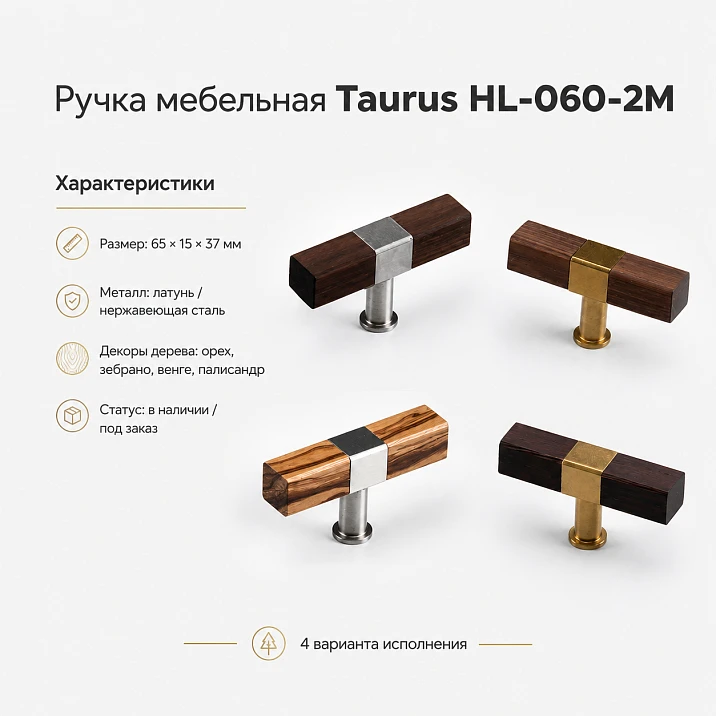
Steel fixtures are already installed in the kitchen. The faucet and sink also support the cool metallic tone. But above the table hang lamps with brass details, the island has warm furniture legs, and the door handles in the adjacent area have a golden tint. In such a room, the question is not abstract: which Taurus HL-060-2M should be ordered for furniture — with a brass base or with stainless steel?
A buyer who decides to purchase wooden furniture handles for the entire set can quickly choose the shape but hesitate on the metal. The wooden part of Taurus itself fits the facade perfectly. The compact size does not overload drawers and small doors. The option chosen is "walnut," "zebrano," "wenge," or "rosewood." The mistake occurs at the last step when the metal finish is marked at random or the order is placed in different lines and brass is accidentally mixed with steel.
Before buy Taurus HL-060-2M, you need to make four related decisions: which metal will be the main one near the specific furniture, which wood part option will support the facade, where a compact handle is needed, and where a long model of the same series, and how to record all this in a single specification. Then the handles arrive not as a scattered set of similar items, but as a coordinated set.
Two metals in one room is not a mistake, as long as each has a role
A mixed interior does not have to consist of a single metal. Steel and brass can coexist peacefully if the eye understands why they are there and which objects they belong to. The problem starts not with the combination itself, but with a lack of logic: one handle is brass, the neighboring one is steel, a third was chosen based on a photo, and a fourth was added later without checking the first batch.
It is more convenient to view the room as a system of immediate connections. A furniture handle is not in a void. Next to it are a facade, a countertop, a display case profile, a leg, a hinge, a light fixture, a faucet, appliances, or door hardware. These are the items that suggest which metal base will look meaningful.




Do not consider all metal items as equal
A refrigerator can take up a large area but stand in a niche and barely participate in the perception of the facades. A small brass display case profile, on the other hand, runs next to the handles and repeats on every module. Formally, there is more steel in the room, but visually, it is the brass that becomes the main partner of the furniture hardware.
Create not a list of metals, but a map of visibility. Note what is visible simultaneously with the furniture, what is within one to two meters, what repeats several times, and what the eye returns to most often. This is much more accurate than the rule "the kitchen has appliances, so the handles must be steel only."
Our factory also produces:
Choose not the metal of the room, but the metal of a specific furniture group
A kitchen unit, a freestanding sideboard, and a cabinet in the dining area can follow different connections. On kitchen drawers, stainless steel supports the faucet and appliances. On the sideboard, brass responds to the light fixture and metal legs. Within one open room, both solutions remain consistent because they are separated by items, not mixed on a single facade row.
This approach is especially useful when planning Buy wooden furniture handles for multiple items at once. The general category helps to see shapes and sizes, but the final list should be broken down by furniture groups: kitchen, display case, dresser, cabinet, nightstand.
Get Consultation
Taurus HL-060-2M without speculation: what is recorded in the card
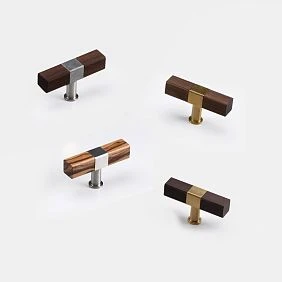
Taurus HL-060-2M — a compact furniture handle measuring 65 × 15 × 37 mm. The model is presented among handles with a ready-made coating and is included in the selection of T-shaped solutions. The wood part options in the card are designated as "walnut", "zebrano", "wenge", and "rosewood". The metal finish is chosen between brass and stainless steel.
These names should be carried over into the order exactly as they are indicated on the product page. You should not independently turn a color designation into a statement about the wood species, tinting method, or coating composition. For the buyer, the practical meaning is simpler: they choose the visual variant of the wooden part and separately fix the base metal.
| Parameter | Confirmed value | What changes when purchasing |
|---|---|---|
| Model | Taurus HL-060-2M | Allows you not to confuse the compact handle with the long HL-060-1M |
| Size | 65 × 15 × 37 mm | Helps to assess the scale on a drawer, door, or small facade |
| Type | Compact wooden furniture handle; the model is presented in the selection of T-shaped handles | Provides a reference for shape and usage scenario |
| Wood part options | Walnut, zebrano, wenge, rosewood | The choice is related to the facade, countertop, and exposed wooden parts |
| Metal finish | Brass or stainless steel | Main fork in the article and mandatory specification line |
| Related model | Taurus HL-060-1M | Needed when one compact shape is not enough for tall doors |
| Required hardware in the card | FUR-032 and FUR-033 | Specific option and quantity are verified before payment |
| Current price and availability | Checked in the product card | Not carried over into the article as constant values |
The table does not replace fitting. The 65 mm size needs to be matched with the facade width, distance to the edge, position of the adjacent handle, and opening method. Pay special attention to narrow drawers, framed facades, and doors with a pronounced profile: the free surface may be smaller than it seems from the overall dimension.
Brass finish: when warm metal brings the interior together
Brass is chosen not because the space is "classic." It can work in a modern kitchen, a strict dressing room, an office, or a minimalist bedroom. The decision depends not on a style label, but on repeated warm details near the furniture.
Brass light fixtures are in the same visual zone
If pendants hang over the island, sconces are placed near the cabinet, or a table lamp stands on the dresser, the brass base Taurus creates a clear connection. The handle becomes a small repetition of an existing material, not a new random shine.
Check the distance and viewing angle. A light fixture in another room does not have to define the kitchen hardware. But a sconce that is constantly visible above a specific cabinet has a direct relation to its handles.
Furniture legs have already set a warm line
Brass or metal legs close in temperature are at the bottom of the piece, handles are on the front. Repeating the metal at the top and bottom ties the body into a single whole. This looks especially convincing on dressers, display cabinets, and freestanding wardrobes, where the entire piece is read at a glance.
Exact matching of any golden surface is not required. A glossy yellow detail and calm brass may differ in character. Before ordering, compare real samples or at least agreed images under the same lighting, not names from two different catalogs.
There is a brass profile of a display case or a frame nearby
A thin metal line around glass is often more noticeable than household appliances. If the profile runs near the handles, the brass base supports it directly. Here the rule of the nearest partner applies: Taurus repeats the metal of the part with which it forms a single facade pattern.
Warm metal is needed as a link with dark wood
Options like "wenge" or "rosewood" can create a deep contrast on a light facade. Brass adds a warm point of light and prevents a dark handle from looking dull. This is not a universal recipe, but a working scenario for furniture that already has warm lighting, legs, or frames.
Before ordering, it is useful to see how wood and metal in furniture hardware are distributed between large and small details. The overall material provides context, but the new specification should still specify a specific Taurus, a specific wood part option, and a brass base.
Stainless steel: when cold metal continues the functional line
The steel version is chosen where there are already noticeable cold metal surfaces next to the facades. It does not have to make the interior "technical." The wooden part of Taurus softens the steel, so the handle retains tactile and visual warmth.
The faucet and sink are located next to the lower facades
For a kitchen set, this is one of the strongest connections. A person opens drawers near the sink and simultaneously sees the faucet and handles. Stainless steel in the Taurus base supports the nearest functional metal without the need to introduce an additional golden accent.
But do not automatically transfer this solution to a tall sideboard at the other end of the room. It may have its own connection with a lamp or display profile.
The equipment is built into one facade row
An oven, coffee machine, or refrigerator with noticeable steel frames form large cold rectangles. Steel handle bases break their scale into small repetitions and help the furniture be perceived as cohesive.
If the equipment is completely hidden behind facades, its internal metal has almost no effect on decorative hardware. You should focus on what is visible after the project is completed.
The steel profile of glass doors is located nearby
The cold profile and stainless steel handle work as one system. This is especially appropriate for modern display cases, kitchen tall units, and cabinets with glass. The wooden part of the handle connects the metal to the body and does not turn the facade into a set of cold lines.
Silver hardware is already used on the furniture
Hinges may be hidden, but decorative locks, exposed runners, legs, or inserts remain visible. If they are on the same piece, steel Taurus supports them better than the brass version.
In the section wooden handles with a finished coating you can compare neighboring models and understand whether Taurus is really needed. However, comparing the shape does not eliminate the need to check the metal, size, and quantity for each facade.
Brass or stainless steel: a decision table without taste slogans
| Situation near the furniture | Brass | Stainless steel | What to check before ordering |
| Nearby brass lamps | Often creates a direct connection | Can work when steel dominates in the furniture itself | Are the lamps visible simultaneously with the facades |
| Nearby steel faucet and sink | Can become a separate warm accent | Continues the nearest functional metal | How noticeable are the brass details in the same zone |
| Display case with warm metal profile | Supports the frame | Can contrast with a close profile | Compare real metal shades |
| Built-in appliances in one row | Creates intentional contrast | Connects handles with appliance frames | Appliances open or hidden by facades |
| Chest of drawers on warm metal legs | Connects the top and bottom of the item | Possible with silver details on the facade | Which metal is repeated on the same dresser |
| Open kitchen-living room with both metals | Suitable for a separate furniture group | Suitable for the kitchen functional zone | Do the versions on adjacent facades mix |
| Neutral interior without a pronounced metal | Adds a warmer note | Gives a calm cool graphic | Which metal is planned for future details |
The table does not give an automatic answer. It helps to ask the right question: what exactly will the handle interact with after installation? If the answer relates to the nearest object, repetition on the same piece of furniture, and a clear zone, the choice usually looks convincing.
When both metals are already present: three schemes that keep the order from falling apart
The most difficult situation is not an interior with only brass and not an interior with only steel. The complexity arises when both metals are already fixed in the project and it is too late or pointless to abandon one. Here, you don't need to search for an abstractly "correct" material. You need to choose a principle and apply it consistently.
Scheme one: handles repeat the dominant metal
By dominant, we mean not the most expensive or the largest item, but the metal that most often appears next to furniture facades. For example, in a kitchen, a steel sink, faucet, appliance frames, and the profile of a glass cabinet are visible. Brass is present only in the pendant above the dining table. For kitchen furniture, it is wiser to choose stainless steel, even if the brass light fixture is expressive.
In the living room, the situation may be reversed. Steel remains in the TV legs and inconspicuous equipment, while brass is repeated in the sconces, side table, and the base of the floor lamp. On a dresser or display cabinet, a brass Taurus will support precisely the residential part of the room.
The advantage of this scheme is the simplicity of specification. For each zone, one metal is chosen, and the entire furniture group receives the same finish. The disadvantage is that dominance must be determined based on the completed project, not on a single beautiful sample.
Scheme two: metals are divided by furniture groups
Steel remains in the kitchen, brass moves to the sideboard and a separate cabinet. Or stainless steel is used on the work desks of the study, and brass on the display case for the collection. Such zoning is especially convenient in open spaces where functional zones are combined but do not have to share the same hardware.
A critical condition: within one item, you cannot accidentally mix versions. If a dresser has six drawers, all six handles must be specified in one finish. An exception is possible only as a deliberate design scheme that was previously shown in the visualization. Randomly replacing two missing brass handles with steel ones does not look like a creative contrast—it looks like a configuration error.
Scheme three: the handle repeats the nearest connecting item
Sometimes you don't need to count all the metal in the room. It's enough to look at the nearest object. The handles of the kitchen island repeat the pendants above it. The handles of the display case match the profile of the glass doors. The handles of the cabinet match the base of the table lamp. The handles of the wardrobe match the metal legs or the decorative frame of the wardrobe itself.
This scheme gives the most accurate local connections, but requires a good plan. If the furniture is rearranged, the nearest partner may change. Therefore, for a mobile dresser or a freestanding cabinet, it is sometimes more reliable to rely on its own metal parts rather than on an item that can be easily removed.
One item — one finish: a rule that saves the set
Even in a complex mixed interior, it's useful to keep a simple constraint: one furniture group gets one consistent combination of wood and metal. The combination must be repeated in every order line and on every facade belonging to that group.
For example:
-
kitchen lower facades — Taurus HL-060-2M, "walnut", stainless steel;
-
upper small facades — Taurus HL-060-2M, "walnut", stainless steel;
-
tall cabinets — Taurus HL-060-1M, "walnut", stainless steel;
-
freestanding sideboard — Taurus HL-060-2M, "rosewood", brass.
Such a list immediately shows where the difference is intentional and where an error has occurred. If brass suddenly appears in the kitchen drawer line, you can notice it before payment.
Do not combine different finishes with the word "Taurus"
The entry "Taurus handles — 24 pcs." is insufficient. In one series, there are compact and long models. The card offers different wooden part options and two metals. The general name does not protect against misgrading.
The working line should include:
-
exact article number;
-
size;
-
wooden variant designation;
-
brass or stainless steel;
-
quantity;
-
furniture group or room;
-
note about reserve, if provided.
The more facades in the project, the more valuable this detail. It is needed not only by the store manager. Based on it, the installer understands which handle belongs to which item, the designer controls the compliance with the visualization, and the customer can later find the exact version for replacement.
Walnut, zebrano, wenge, or palisander: choosing the wooden part according to the facade
The names in the card should be perceived as designations of available options. Do not automatically attribute a specific wood species, stain composition, or coating technology to them. The buyer's task is to choose the visual execution that works with the facade and other wooden surfaces.
Tone-on-tone: a calm handle without a sharp contour
When the handle's shade is close to the facade, Taurus is perceived as a continuation of the furniture. The metal base remains a small accent, and the wooden part does not break up the surface. This approach suits facades with pronounced texture, where additional contrast is not needed.
Exact screen matching cannot be expected. Lighting, white balance, and monitor settings change the color. If the project is sensitive to shade, compare a physical sample, a previously purchased handle, or an approved reference position.
Adjacent shade: wood is connected but not masked
The handle can be slightly darker or warmer than the facade. It remains noticeable but does not turn into a graphic sign. This option is convenient for furniture made of several materials: painted body, wooden countertop, open shelves, and combined doors.
Here it is useful to repeat not the facade itself, but the second wooden detail. For example, the handle matches the countertop or open shelf, and the metal base matches the faucet or lamp. Two interior lines come together in one small detail.
Contrast: the handle becomes part of the facade pattern
Dark options on light enamel create clear points. A light or warmer option on a dark facade softens the surface. Contrast is justified when handles are evenly spaced and repeat with a clear step. On facades of different widths, centers need to be checked especially carefully, otherwise an expressive color will highlight an inaccurate layout.
Repeating the countertop or open wood
On a painted kitchen, wooden handles can connect facades with the work surface, shelves, or dining table. But what is repeated is not the color name, but the real visual proximity. If the countertop is far away or has a completely different pattern, the formal label "walnut" does not guarantee unity.
Wood and metal are chosen together, not one after the other
The mistake is common: first they approve the wooden part, then at the last minute they choose the metal. But the same version of "wenge" with brass and with steel is perceived differently. Brass enhances warmth and decorativeness, stainless steel adds cool graphics. You need to compare finished pairs.
For an initial search, it is convenient to select T-shaped wooden furniture handles, and then go to the Taurus product page and fix a specific combination. The category answers the question about shape, the product page about size, wood option, metal, and current purchase.
Size 65 × 15 × 37 mm: compactness needs to be checked on a real facade
A small handle looks neat, but the word "compact" does not mean "fits everywhere." The dimensions are compared with the facade, the user's hand, and the expected opening force. This is especially important for heavy doors, tall cabinets, and wide drawer systems.
On a drawer, the width of the free surface is important
A framed facade may have a total width of 500 mm, but the central panel and profile leave a limited area for mounting. You need to check where the handle base is located, whether it extends onto the bevel, and whether the fasteners fall into a thin section of the frame.
For a regular flat drawer, the task is simpler, but the question of scale remains. One Taurus in the center of a wide facade creates a point accent. Two handles can provide a more convenient grip, but such a solution requires separate calculation and visualization. You cannot double the quantity just because the facade seems wide.
On a small door, the handle should not conflict with the edge
Check the distance to the adjacent facade, wall, and protruding countertop. When opening, fingers should fit freely to the handle. If the door is located in a corner, it is important to prevent the handle from hitting the adjacent cabinet or wall.
On a tall cabinet, a compact model may look too small
The scale is assessed from the distance from which a person sees the cabinet as a whole. On a tall door, a small Taurus can work as a subtle accent, but it can also get lost. For such facades, the series includes a matching long model.
For a heavy facade, not only the external size is checked
The opening force depends on hinges, dampers, door weight, and installation location. The article should not invent permissible load or mounting method. Before ordering, verify the drawing, mounting scheme, and recommendations for the specific facade. If the furniture is already made, compare mounting points with actual holes.
Compact HL-060-2M and long HL-060-1M: a set instead of a random mix
Matching long handle Taurus HL-060-1M allows maintaining the series language on facades of different scales. For comparison, the card also shows the configuration 245 × 15 × 37 × 160 mm. Actual sizes and finishes should still be checked before ordering.
| Task | Taurus HL-060-2M | Taurus HL-060-1M | Commercial conclusion |
| Small kitchen drawer | Compact scale is usually easier to fit in | May appear visually long | First check the width of the facade and the center |
| Small cabinet door | Supports a neat rhythm | Used only when there is sufficient space | Do not choose by series name without dimensions |
| Tall cabinet door | Can work as a point handle | More often matches the vertical scale | Compare both models on the facade layout |
| Wide drawer | One or a well-thought-out pair is possible | Can provide an extended grip | The solution depends on the design and visualization |
| Chest of drawers with facades of different heights | Helps maintain identical compact points | Suitable for the largest drawers | Order both models in the same wood and metal |
| Kitchen set plus wardrobe | For most drawers and small doors | For tall cabinets and large doors | Create a unified specification for the Taurus series |
The main advantage of the pair of models is not in the mechanical distribution of "small at the bottom, long at the top." It lies in the ability to maintain the same combination of wooden part and metal, changing only the scale of the handle. The interior gets a family, not a set of similar parts.
In the project, you can see an example of Taurus HL-060-2M on a cabinet and see the compact model next to the long HL-060-1M. Such an example is useful not as a ready-made recipe for any facade, but as proof of a comprehensive approach: different handle sizes can work within one series.
Where the compact Taurus shines best
Kitchen drawers
On lower drawers, the handle becomes part of a repeating horizontal grid. Here, random differences in metal are especially noticeable. If one facade received brass and the neighboring one steel, the eye picks this up immediately. Therefore, a kitchen order is best placed as one line for each homogeneous group and the quantity checked against the facade layout.
Upper cabinets
The compact form does not overload small doors. But the placement needs to be coordinated with the opening: along the bottom edge, at the side, or in the center — the decision depends on the facade and the overall handle line. The article does not impose a universal height, because cabinet and frame sizes vary.
Chest of drawers
On a dresser, the handles are visible from the front and often become part of the symmetry. Here, the combination of dark wooden part with brass on a light facade, or calmer wood with steel on a modern body, is interesting. Before purchasing, check whether one handle per drawer will be used or a different solution is needed.
Bedside table
The small Taurus supports an intimate scale. The metal can be tied to the base of a table lamp, a sconce, or the legs of a nightstand. Since the object is located close to a person, the tactility, handle protrusion, and grip comfort are especially noticeable.
Showcase and a small cabinet
On glass and framed fronts, the handle must match the profile. Brass supports a warm frame, stainless steel a cold one. If the profile is black, the decision is made based on the nearest second metal and wooden details, rather than trying to call black brass or steel.
Furniture for commercial premises
In a showroom, salon, or hotel, a handle series helps unify different cabinets and chests. With a large number of fronts, specification matters more than stylistic description. Each model, finish, and reserve must be precisely counted, otherwise the unified series will fall apart at the first replacement.
How to count a set of handles, not an approximate quantity
Counting does not start with the phrase 'there are about twenty fronts in the kitchen.' A list is needed where each opening part of the furniture gets a separate line or mark. Then hidden drawers, internal sections, tall cabinets, and fronts requiring a long model become visible.
Divide the furniture into groups
First, list the items and zones:
-
lower kitchen drawers;
-
lower hinged doors;
-
upper cabinets;
-
high pencil cases;
-
internal drawers behind a common facade;
-
island;
-
sideboard or display case;
-
freestanding chest of drawers;
-
hallway wardrobe;
-
bedside cabinets in the bedroom.
This division does not create unnecessary bureaucracy. It shows where one metal applies to the entire group, and where a different finish is allowed. If the kitchen unit gets steel and the sideboard gets brass, these items should not be combined into one line.
Mark the facade type and the selected model
For each facade, write down: drawer, small door, tall door, wide pull-out module. Next to it, specify HL-060-2M or HL-060-1M. If the decision has not been made yet, mark "compare on the layout" rather than leaving an empty space that will later be filled in randomly.
Record the combination of wood and metal
Convenient recording format:
Taurus HL-060-2M, 65 × 15 × 37 mm, walnut option, stainless steel, lower kitchen drawers — 8 pcs.
The next group is recorded separately, even if the model matches:
Taurus HL-060-2M, 65 × 15 × 37 mm, walnut option, stainless steel, upper cabinets — 6 pcs.
Separate lines allow you to check the facade plan and simplify distribution during installation. In the final order, they can be combined only after a control summation.
Resolve the reserve issue before placing the order
A spare furniture handle can be useful for a large project, commercial space, or furniture that will be used for many years. But there is no universal reserve percentage. It depends on the total quantity, the complexity of reordering, and project requirements.
The main thing is that the reserve must have exactly the same finish. You cannot add "any Taurus as a replacement." The spare item repeats the article number, size, wood part option, and metal of the main batch.
Control formula
The total number of handles is calculated as the sum of all facades assigned to a specific model, plus the agreed reserve:
Quantity to order = compact fronts HL-060-2M + large fronts HL-060-1M + reserve for each specific configuration.
The formula looks simple, but its power lies in the words "each specific configuration." Brass and steel versions cannot be combined into one indistinguishable number.
Example of a specification for a kitchen, display case, and dresser
Suppose the project has eight lower drawers, four upper doors, two tall cabinets, a display case with two doors, and a dresser with six drawers. The kitchen is associated with a steel faucet and appliances, while the display case and dresser are associated with brass lighting fixtures.
| Furniture group | Model | Wood variant | Metal | Quantity without reserve | What to check |
| Kitchen lower drawers | HL-060-2M | Walnut | Stainless steel | 8 | Centers and grip convenience |
| Top doors | HL-060-2M | Walnut | Stainless steel | 4 | Position relative to the bottom edge |
| Tall cabinets | HL-060-1M | Walnut | Stainless steel | 2 | Size and center distance per drawing |
| Display case doors | HL-060-2M | Padauk | Brass | 2 | Connection with profile and luminaire |
| Drawer chest drawers | HL-060-2M | Padauk | Brass | 6 | Symmetry on all facades |
In this example, the word Taurus unites the series but does not cancel the five separate lines. If only the total "22 handles" is sent to the manager, information about the metal and model will be lost. If a table is sent, the order can be checked before payment.
After counting, you can order Taurus HL-060-2M by exact configuration, rather than returning to selecting the finish for each item in the cart.
What to buy together with Taurus HL-060-2M
The set is not limited to the number of compact handles. Sometimes long models of the same series, decorative caps, and a control sample of the selected combination are needed. Each additional item must serve a specific purpose, not be added automatically.
| What to add | Why | For which scenario | What to pay attention to |
| Buy long Taurus HL-060-1M | Keep the series on tall and large facades | Pencil cases, tall doors, wide modules | Verify the size and the selected wood with metal |
| Buy decorative cap FUR-032 | Cover the visible screw head with a warm metal part | Projects with a warm hardware palette | Confirm compatibility, quantity, and visual match |
| buy decorative cap FUR-033 | Cover the fastener with a silver cap | Projects with a cool metallic tone | Check the fastener and match to the selected handle |
| Control handle of the selected finish | Check color, tactility, and scale before ordering the batch | Shade-sensitive facades, large sets | Order exactly the future combination of wood and metal |
| Spare handle | Preserve exact execution for possible replacement | Kitchens, hotels, salons, large wardrobes | Do not mix reserve of different metals |
| Saved specification | Quickly find the article and execution later | Any kit | Store together with the drawing and photo of the installed handle |
The Taurus HL-060-2M card indicates FUR-032 and FUR-033 as required hardware. This does not mean that both plugs need to be purchased for each handle. Before ordering, clarify which position is required for the selected execution, how many plugs are needed per handle, and whether the fastening will be visible in the specific mounting scheme.
Why the plug cannot be chosen only by the words "bronze" or "nickel"
FUR-032 is designated as antique bronze, FUR-033 as nickel. Taurus brass and antique bronze plugs, as well as Taurus stainless steel and nickel plugs, are not automatically identical names. They should be considered as adjacent warm or cold metallic finishes, and the combination should be confirmed based on the actual product or consultation.
This approach is more honest than promising an absolute shade match. Metallic color changes depending on texture, gloss, and light. The plug's task is to neatly complete the fastener, not necessarily to disappear against the base background.
Installation begins with checking the facade, not with the drill
The article is devoted to choosing the finish, but the commercial decision cannot be separated from the installation. A beautiful combination of brass and wood will not save the order if the holes do not match, the base hits the profile, or the handle is uncomfortable for fingers to use.
For new furniture, work according to the handle drawing
Before drilling, you need to obtain the current drawing of the specific model. It checks the mounting location, dimensions, and distances. The cabinetmaker transfers the data to the facade, taking into account the frame, panel, and internal structure.
Do not replace the drawing with a general size of 65 × 15 × 37 mm. The dimension helps assess the scale but does not convey all the installation information.
For replacing old handles, measure the existing holes
If Taurus is installed instead of other hardware, compare the center-to-center distance, hole diameter, the area covered by the base, and the facade thickness. If there is a mismatch, rework may be required, so the decision is made before ordering the entire batch.
First a fitting, then the final installation
On a sensitive facade, it is wise to test one handle. The fitting shows the actual protrusion, ease of grip, proximity to the profile, and the perception of metal under room lighting. This is especially useful when choosing between brass and steel for a borderline interior.
Do not mix handles during installation
Boxes and packages are labeled by zones. Brass items for the sideboard should not end up among steel kitchen handles. If the appearance of the wooden part is similar, the difference can only be noticed after installing several facades.
Mistakes that turn a beautiful series into a random set
Mistake one: metal is chosen based on a single item
You saw a steel refrigerator—ordered steel for the whole room. Meanwhile, the handles are next to the brass display case profile and warm legs. The decision is formally explainable but locally unrelated to the furniture.
Correction: evaluate the nearest and repeated details, not the largest metal in the room.
Mistake two: wood options are considered species without confirmation
The name "walnut" or "rosewood" automatically turns into a statement about the material. The card uses these designations for variants of...
Mistake six: internal drawers are not taken into account
Additional pull-out elements may be hidden behind the common facade. They are forgotten in the count, and then handles are purchased separately. The new item risks differing in metal or the chosen option.
Fix: count not only visible facades, but all elements that actually need a handle.
Mistake seven: plugs are bought in arbitrary quantities
FUR-032 and FUR-033 are added "just in case," without checking the mounting scheme and the number of points. As a result, part of the set is redundant, or, conversely, installation stops due to a shortage.
Fix: confirm compatibility and consumption for the specific Taurus before payment.
Mistake eight: metal is compared using different photos
Brass in a warm photo and steel in a cold render may seem closer or further apart than in reality. The screen does not provide a reliable comparison of shine and temperature.
Fix: use a sample, a real product, or images taken under identical conditions.
Who Taurus HL-060-2M suits, and who needs a different route
Suitable for those assembling a set for facades of various scales
Having a related long model helps use the compact Taurus on drawers and small doors, and the HL-060-1M on large facades. With the same wood and metal, the series remains cohesive.
Suitable for interiors where wood should soften metal
A fully metal handle could intensify a cold or overly decorative line. Taurus keeps the metal base small, while the main touch connects to the wooden part.
Suitable for deliberate mixing of brass and steel
The model is available in two metal finishes, so different furniture groups can be distinguished without changing the series language. This is convenient for an open kitchen-living room, a set of cabinet and dresser, or furniture in several rooms.
Not suitable without checking the scale of a tall door
If a buyer wants one compact handle on a large tall cabinet just for the same item number, the result may be too small. First, compare the long model.
Not suitable as a way to fix mismatched old holes without measurements
The handle size does not guarantee compatibility with the existing mounting. Precise measurements and a drawing are needed.
It is better to choose a different option if fully concealed fittings are required.
Taurus remains a noticeable front detail. For a project where facades must open without visible handles, a different structural principle is considered, rather than trying to make a compact model invisible.
Check upon receipt: the metal needs to be seen before distribution across the facades.
The order is completed not at the moment of payment, but after verifying the received set. This is especially important for Taurus: wooden options can be close in tone, and brass and stainless steel under packaging lighting are sometimes perceived as less contrasting than after installation.
Check the boxes against the specification lines.
Lay out the items not by the principle of "short and long," but by full configuration. The following should be placed separately:
-
HL-060-2M, selected wooden option, brass;
-
HL-060-2M, selected wooden option, stainless steel;
-
HL-060-1M in the corresponding version;
-
reserve items;
-
FUR-032 and FUR-033, if they are included in the order.
On each group, leave a label with its purpose: kitchen, display case, dresser, wardrobe. This prevents substitution already at the site, where the installer sees several similar packages and strives to finish the work faster.
Look at the metal under two types of lighting
Daylight shows the overall temperature and shade. Evening light reveals how brass or steel interacts with the actual lamps of the room. A warm lamp can make stainless steel softer, while a cold one can mute the golden character of brass.
The check should take place near the facade where the handle will be installed. Moving the sample to the window is useful, but it does not replace inspection at the kitchen, wardrobe, or dresser. The metal was chosen based on connections with the interior, so it should be evaluated in those connections.
Compare not one handle, but a small repetition
A single brass piece looks more modest than a row of twelve identical handles. Before final installation, you can attach several items or use paper markers showing the future rhythm. This makes it clear whether the metal repeats too actively on the facade wall.
If the row seems excessively shiny, this does not mean you should chaotically replace some handles with steel. First, review the overall concept of the group, lighting, and neighboring details. Changing the finish should occur as a whole zone and be reflected in the specification.
Check the wooden part next to the facade
The option "walnut," "zebrano," "wenge," or "rosewood" is evaluated not separately on a white table, but against the background of the furniture. The same tone can look soft next to wood texture and very contrasting on smooth enamel.
A slight difference between individual items made of natural material may be perceived differently than a coating defect or an incorrect position. Do not draw conclusions based on one random area: compare several handles, packaging markings, and the approved sample. If in doubt, stop the distribution and clarify the issue with the STAVROS manager.
Selection matrix for the designer, client, and cabinetmaker
In a large project, the decision goes through several participants. The designer is responsible for visual coherence, the cabinetmaker for fit, the client for budget and usability, and the manager for accurate configuration. One short matrix helps everyone discuss the same item.
| Who checks | The main question | Document or item being checked | Result |
| Designer | Does brass or steel support the adjacent elements? | Visualization, metal samples, facade elevation | Approved metal finish by zones |
| Cabinetmaker | Will the handle fit on the specific facade? | Drawing, frame dimensions, hole layout | Confirmed fit HL-060-2M or HL-060-1M |
| Customer | Is the handle comfortable and does the combination look good in real light? | Control sample on site | Final approval of wood and metal |
| Assembler | Are all items recorded unambiguously? | Facade list and specification | Exact quantity of each configuration |
| Installer | Which handle belongs to which piece of furniture? | Marked groups and facade plan | Installation without mixing versions |
The matrix is useful for private orders too. One person can perform all roles, but the questions remain different. You cannot compensate for the lack of a drawing with good taste, or for ease of grip with beautiful visualization.
Quick solution for four typical interiors
Kitchen with steel appliances and a single brass pendant light
For the main facade row, stainless steel is usually more justified: it matches the faucet, sink, and appliances. The brass light remains a separate accent for the dining area. Before ordering, check whether the brass profile runs directly across the kitchen display cabinets — then the local connection may change the decision.
Kitchen with brass pendants, island legs, and hidden appliances
Brass Taurus can tie together the overhead lighting, island, and facades. The steel of hidden appliances barely participates in the external design. If the faucet remains cool, it can work as a functional exception rather than dictate the entire set.
Cabinet with a silver profile and warm wooden body
Stainless steel supports the profile, the wooden part of the handle is the body. This dual connection reveals the Taurus design particularly well. On the tall door, compare the compact and long models so that the metal does not become too small a point.
Dresser on brass legs in a room with steel door hardware
The closest partner to the handles is the dresser's own legs, so the brass base looks more consistent. The steel door handle belongs to the room's architecture and is further from the facade. Separating metals by items makes the interior clear.
These are the scenarios that help decide which item to add to the cart. Searching for "buy wooden furniture handles" leads to a wide assortment, but the order becomes precise only after linking the metal to specific furniture, choosing the size, and fixing the Taurus finish.
How to buy Taurus HL-060-2M on STAVROS without confusion in finishes
The buyer's journey starts not with the order button, but with a quick project check. First, they open the category to ensure the handle shape truly fits. Then they go to the Taurus card, choose the wood and metal combination, count the quantity by facades, and add the related long model where the compact size does not match the scale.
Step one: compare the shape with neighboring handles
When the task is not yet reduced to a single article, it is useful to select and buy wooden furniture handles in the general category. The comparison shows how much Taurus differs in protrusion, silhouette, and scale from other models.
There is no need to go directly from the assortment to payment. The general catalog answers the question "which type of handle is suitable," while the specific product card answers "which configuration to order."
Step two: check the Taurus card on the day of ordering
Current price, availability, and options are selected directly on the product page. The article does not fix dynamic values. Before payment, you need to check the price of Taurus HL-060-2M for the selected combination, rather than relying on the minimum price of the entire model.
Different variants of the wooden part and metal may be displayed as separate lines. What matters is not the starting figure, but the specific item that will be included in the specification.
Step three: separate compact and long handles
Make two groups: HL-060-2M and HL-060-1M. Next to them, indicate the facades, quantity, wood, and metal. If the long model is not needed, this should also be a conscious decision after comparison, not a result of skipping.
Step four: add hardware after checking compatibility
Decorative caps are chosen not by the overall mood of the room, but by the specific mounting pattern. Clarify whether FUR-032 or FUR-033 is required, how many units are needed, and whether the selected option matches the project's metal palette.
Step five: send the completed order line to the manager
In the message or specification, specify:
-
Taurus HL-060-2M;
-
size 65 × 15 × 37 mm;
-
wooden part option;
-
brass or stainless steel;
-
quantity;
-
purpose by furniture group;
-
linked HL-060-1M, if included in the set;
-
required hardware;
-
need for a control check before payment.
This way, the manager sees not a general wish like "need dark handles with metal," but an unambiguous request.
Checklist before paying for the entire set
Go through it for each furniture group, not just for the order as a whole.
-
The article number HL-060-2M is specified without errors.
-
The size 65 × 15 × 37 mm is matched with the facade.
-
The wooden part option is recorded the same way as in the card.
-
The metal is clearly selected: brass or stainless steel.
-
There is no accidental mixing of metals on adjacent facades of the same group.
-
Tall doors are checked for the need for HL-060-1M.
-
The quantity is calculated for all visible and internal facades.
-
The reserve, if needed, repeats the exact configuration.
-
Plugs and other necessary fittings have been checked separately.
-
The drawing has been matched with future or existing holes.
-
The price has been checked for the selected configuration, not for the model as a whole.
-
The specification has been saved together with the furniture project.
If at least one item still contains the word "approximately," the order is not ready yet. It is better to clarify one line before payment than to look for a matching handle after installing all the furniture.
Frequently asked questions about Taurus HL-060-2M
Can brass and stainless steel be used in the same room?
Yes, if the metals are distributed according to a clear system. For example, the kitchen gets steel handle bases near the faucet and appliances, while a freestanding sideboard gets brass ones near the lights. On a single uniform facade row, random mixing should be avoided.
Which metal should you choose if the appliances are steel and the lights are brass?
Look at what is closer to the specific furniture and is more often seen together with it. For kitchen drawers near the sink, the connection to steel is usually stronger. For an island under brass pendants or a sideboard next to warm sconces, brass may be more convincing.
Is it mandatory to make all handles in an apartment from one metal?
No. Unity can be maintained with the Taurus series and the same selection principle, while changing the metal by rooms or furniture groups. The main thing is to record the differences in the specification and avoid accidental mixing.
What do the options 'walnut', 'zebrano', 'wenge', and 'rosewood' mean?
These are designations for the wooden part options in the Taurus HL-060-2M card. They should not be interpreted as an exact indication of the wood species or finishing technology without additional confirmation. The official option name is transferred to the order.
Will HL-060-2M fit a kitchen drawer?
The model can be considered for drawers, but the fit is checked against the specific front. You need to account for the free surface, frame profile, fastener placement, grip convenience, and drawer width.
Can a compact Taurus be installed on a tall cabinet door?
Only after assessing the scale and convenience. On a tall door, a handle of 65 × 15 × 37 mm may look too small. The same series includes HL-060-1M, so it is reasonable to compare both models on the front layout.
How does HL-060-2M differ from HL-060-1M?
HL-060-2M is a compact model measuring 65 × 15 × 37 mm. HL-060-1M is a long linked handle available in larger configurations. They can be used together while maintaining the same wood and metal.
How to count handles for the entire kitchen?
Recalculate every openable facade: drawers, swing doors, tall cabinets, and internal elements. Then assign a model to each group and only after that add up identical configurations. Don't forget to separately resolve the issue of spare handles.
Is a spare Taurus needed?
For a large set or commercial furniture, a spare may be useful. There is no universal quantity. The spare handle must fully match the article number, size, wood part variant, and metal of the main item.
Can I order some handles now and the rest later?
Technically, separate purchasing is possible depending on current availability, but for a complete set it's safer to check the entire specification in advance. When buying later, you need to accurately preserve the finish designation and consider possible visual differences between batches.
How to know if the handle's brass will match the brass lamp?
By name alone, an exact match cannot be guaranteed. Compare the actual shade, gloss, texture, and lighting. For a sensitive project, a reference handle or approval based on physical samples is useful.
Will stainless steel suit black appliances?
It depends on the visible metal parts of the appliances, faucet, profiles, and hardware. The black body itself doesn't dictate the handle metal. Steel can support silver frames, while brass can add warm accents nearby.
Do I need to buy FUR-032 and FUR-033 at the same time?
Not necessarily. The card lists both items as required fittings, but the specific choice and quantity should be confirmed for the selected version and mounting scheme. There is no need to buy both options without calculation.
Which plug belongs to the warm metallic range?
FUR-032 is designated as antique bronze and belongs to the warm range. However, antique bronze and brass are not the same coating name, so the visual match with Taurus needs to be checked, not assumed to be an absolute match automatically.
Which plug suits the cool metallic range?
FUR-033 is designated as nickel and visually belongs to the silver cool direction. Compatibility with the specific handle, screw, and mounting scheme is confirmed before ordering.
Can Taurus be installed instead of an old handle without drilling?
Only if the mounting parameters match. Compare the existing holes with the current drawing, check the facade thickness and base area. One overall dimension of 65 × 15 × 37 mm is insufficient for such a conclusion.
How to choose the handle position on the facade?
The position depends on the door type, frame, opening direction, and the overall hardware line. On a series of facades, centers are marked according to a single scheme. Before drilling, it is useful to make a template and check whether it is comfortable to grip by hand.
Can different wood variants be used with one metal?
Yes, if the difference is related to different furniture groups and is shown in the project in advance. On one set, random alternation of "walnut," "wenge," and "rosewood" usually destroys unity. The difference should be fixed as a deliberate decision.
Where can I see Taurus in a finished furniture composition?
The website presents an example of Taurus in the SKF-002 wardrobe projectThe project helps to see the combined use of a compact and long model, but the dimensions of your own furniture are still checked separately.
Where to order a set of wooden handles for a wardrobe, kitchen, or dresser?
In the STAVROS catalog you can Buy wooden furniture handles and go to the card of a specific Taurus. To order a set, prepare a list of facades, the exact wood and metal finish, quantity, and the associated long model.
How not to confuse brass and steel upon receipt?
Check each package against the specification by furniture groups. Do not open or distribute the entire set chaotically. First, separate kitchen, wardrobe, and dresser items, then check the article number, wood variant, and metal.
Final decision: first the logic of metal, then one precise specification
Taurus HL-060-2M is valuable not only for the combination of wood and a metal base. The model gives the buyer a real opportunity to choose between brass and stainless steel, maintain a compact scale on drawers and small doors, and for large facades connect a long handle from the same series.
The main choice is not made by the rule "brass is warmer, steel is more modern." Look at which metal is closer to the furniture, which one is repeated on the item itself, and how the functional zones are divided. Then choose the wooden part option, compare the compact and long Taurus, count all facades, and write down each configuration as a separate line.
Before buy a Taurus HL-060-2M set, check the size 65 × 15 × 37 mm, the metal, the designation of the wooden option, the quantity, the drawing, and the necessary hardware. This order protects the interior from accidental mixing and turns two different metal lines into a conscious system.
STAVROS allows you to assemble not an abstract set of wooden handles, but a precise series for a kitchen, cabinet, display case, or dresser: compact and long Taurus, coordinated versions, verified hardware, and a preserved specification. The more precisely the decision is made before payment, the calmer the installation goes and the more cohesive the finished furniture looks.