Article Contents:
- MN-145.1: which characteristics are truly important for this coffee table
- What is included in the construction of MN-145.1
- What does "light loads" mean
- Why the 12° angle should not be perceived only as a beautiful tilt
- Brass sconces — the main decorative accent
- Chrome sofa supports — a strong lower line
- Why the number of metal items by itself decides nothing
- Two sconces form a symmetrical axis
- There is a third warm metallic repeat in the room
- The oak is left natural
- The glide is clearly visible
- Chrome sofa legs are clearly visible
- The table is painted white, gray, graphite, or black
- There are other cold metals in the living room
- What to compare instead of the name
- When the difference already gets in the way
- How to choose in this case
- Why this is useful
- Light wooden floor
- Dark floor
- Light carpet
- Dark carpet
- Checkout output
- Oak countertop with natural finish
- Stone or porcelain stoneware countertop
- Painted MDF
- Glass
- Oak + brass
- Oak + steel
- Beech + brass
- Beech + steel
- What matters in the 'Under enamel' card
- Reverse calculation
- Example without issuing a universal standard
- Why you can't simply add A to the tabletop
- What the mockup should show
- Why this is important specifically for a coffee table
- How to check
- Rectangular table
- Round table
- Oval
- Why you cannot drill from a photo
- What cannot be promised
- What can be checked
- Why the D25 color is especially noticeable on tall supports
- Parquet
- Carpet
- Stone or tile
- Why you cannot choose brass based only on the sconce
- Why four sets need to be checked side by side
- There are no screws for attaching the plate
- Why a "simple mount" on the product card doesn't cancel out the design
- How to use the matrix
- What to Check
- What happens to brass
- Possible choice
- Key question
- Brass
- Steel
- Practical test
- Where the budget really changes
- Commercial output
- Example
- When MN-145.1 is not optimal
- Why this doesn't weaken the product article
- What is important to do before installation
- Why a test coat first
- What to compare
- Why metal may be secondary
- For oak under a semi-transparent finish
- For beech under enamel
- Useful STAVROS sources
- What to check before ordering
- Why you cannot substitute a universal load capacity in kilograms
- What we evaluate
- Why you shouldn't experiment just to save one leg
- Error
- What to do
- Correct Sequence
- Why not paint two doors before the other two
- SKU
- Size
- Wood species
- Metal
- Plates
- D25
- Wood
- Meaning
- Labeling
- When beech is especially rational
- Why confusion is dangerous
- What to see
- Why
- Then steel MN-145.1 plays the role of neutral furniture metal
- Inspection
- What to Check
- The design is confirmed
- The size is chosen based on the finished height, not according to the catalog
- The 12° tilt does not create conflicts
- The sconces are indeed the main warm accent
- The actual brass matches in shade and shine
- The four supports will be identical
- What is especially worth checking
- Load not confirmed
- Need a height-adjustable support with a known range
- The table must be constantly moved
- The 12° tilt obstructs passage
- Mounting platform is too small
- Metal is already overloaded in the interior
- Suitable size A is not available
- Need a heavy dining/work table
- Mistake 1. "There are brass sconces — we buy brass"
- Mistake 2. "The sofa is chrome — steel is needed"
- Mistake 3. Choosing the metal before the height
- Mistake 4. Considering A as the final height of the entire table
- Mistake 5. Ignoring 12°
- Mistake 6. Marking the mounting plate based on a photo
- Mistake 7. Expecting self-tapping screws in the kit
- Mistake 8. Buying random self-tapping screws
- Mistake 9. Attributing load capacity in kilograms to MN-145.1 without calculating the table
- Error 10. Treating the D25 hinge as a full-fledged adjustable support
- Error 11. Mixing oak and beech for the sake of availability
- Error 12. Buying three steel 449×44 from warehouse surplus
- Error 13. Choosing oak for a clear finish based on the 'Under enamel' configuration
- Error 14. Painting the legs before a dry fitting
- Error 15. Not numbering the oak legs
- Error 16. Considering brass and bronze as the same color
- Error 17. Evaluating metal only in daylight
- Error 18. Not accounting for reflections in the mirror
- Error 19. Placing two legs on carpet and two on parquet without checking
- Error 20. Buying MN-145.1 only for the hardware, although the turned shape itself does not fit the tabletop
- Need to reproduce
- Place the table in a real living room
- Check
- Why a mockup saves money
- Option A — brass
- Option B — steel
- Compare images
- If the difference is barely visible
- Why write "brass" or "stainless steel" literally
- Why before finishing
- What to check upon receipt
- How to interpret
- Reverse case
- What to Check
- What needs to be kept the same
- But there is a limitation
- When a test purchase is especially useful
- Why metal does not change the product amount of the legs
- Why the wood species changes
- Why the height changes
- What wood species is MN-145.1 made from?
- What hardware options are available?
- Does the price of brass hardware differ from steel?
- What dimensions are shown in the product card?
- What does the 12° angle mean?
- Which thrust bearing is used?
- Does the D25 hinge adjust height?
- Can MN-145.1 be used for a coffee table?
- How many kilograms can the finished table support?
- Are the screws for the mounting plate included?
- What is included in the MN-145.1 kit?
- What should I choose for brass sconces — brass or steel?
- Is it necessary to pair brass with oak?
- Can stainless steel be combined with chrome?
- What is more important — the metal of the leg or the sofa support?
- Do I need to repeat brass in other items?
- When is it better not to repeat brass?
- How to choose the height of MN-145.1?
- Can I simply take 350 mm as a "coffee table" height?
- What should I check before drilling?
- Can MN-145.1 be used for a very heavy stone tabletop?
- How is MN-145.2 useful in this article?
- Where can I see other legs for a coffee table?
- Where can I see turned models?
- How to check the quality of oak and beech?
- How to check the current price?
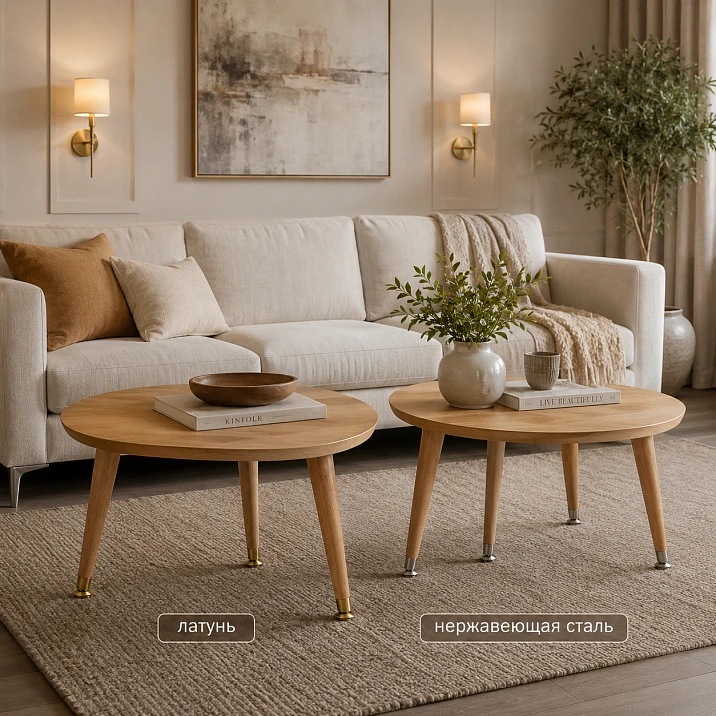
The most noticeable brass detail in the room doesn't have to dictate the metal of the coffee table.
In this living room, there are already two different metal lines. The sconces provide warm brass at eye level. The sofa legs are cool chrome near the floor. The coffee table will sit between them and add four more metal glides MN-145.1. So the question isn't reduced to "brass already exists — repeat brass" or "the table stands next to the sofa — so steel is needed."
The new glide has three possible roles:
-
support the sconces and extend warm metal downward;
-
connect the table with the sofa through cool metal;
-
remain a neutral intermediate detail if the glide is barely visible.
For MN-145.1, this is a real product choice. The product page offers visible hardware in brass or stainless steel, and the price within the same wood species and size is currently the same. So you can choose not based on savings, but on which connection in the room matters more.
But the metal is only the third decision. Before that, you need to confirm the first two: whether the MN-145.1 itself fits the design and what size A a specific coffee table needs. The manufacturer describes this turned leg as a support for light loads and frameless constructions, directly lists coffee tables as an example of use, uses an angled mounting plate M8 with a 12° angle and a metal swivel glide D25. The screws with which the plate is attached to the furniture are not included.
Therefore, the correct order sequence is:
table construction → required height → oak or beech → brass or stainless steel → set of identical legs → fasteners → finish.
If the table itself is already calculated and the selected size MN-145.1 fits, I would decide on the metal as follows:
-
brass — when two sconces are a strong symmetrical part of the composition, the warm metal is repeated in at least one more detail, and the glides are clearly visible;
-
stainless steel — when the chrome sofa legs form a noticeable lower line, the coffee table should be perceived as part of the furniture group, and the sconces should remain a separate warm accent;
-
if both metals are equally active, first do a physical comparison of the two options on the floor in daylight and evening lighting, rather than choosing by the coating name.
After this check, you can buy a turned furniture leg MN-145.1 already with a fixed size, wood species, and one metal for the entire set.
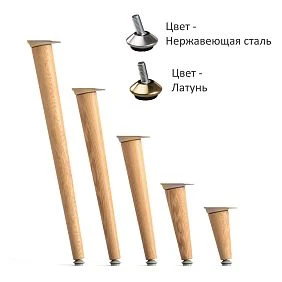
MN-145.1: which characteristics are truly important for this coffee table
The MN-145.1 card confirms several height options with a constant B=44 mm. At the time of checking, the visible table contains:
| A × B, mm | Oak, ₽/pc. | Beech, ₽/pc. |
|---|---|---|
| 104×44 | 1 050 | 900 |
| 153×44 | 1 190 | 970 |
| 252×44 | 1 600 | 1 210 |
| 350×44 | 1 920 | 1 360 |
| 449×44 | 2 280 | 1 580 |
For each of these options, the card shows the ability to choose stainless steel or brass without changing the price within the same row.




What is included in the MN-145.1 construction
According to the card, the kit includes:
-
wooden support;
-
metric stud/screw M8×60;
-
metal mounting plate M8;
-
plate tilt 12°;
-
yellow zinc coating of the plate;
-
M6×13 insert nut;
-
metal thrust washer D25 with a hinge joint.
Screws for attaching the mounting plate itself to the furniture base are not supplied.
This is more important than it seems. The buyer may receive four nice legs and only discover during assembly that the fasteners for the specific tabletop or underframe have not yet been determined.
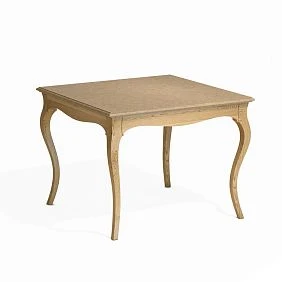
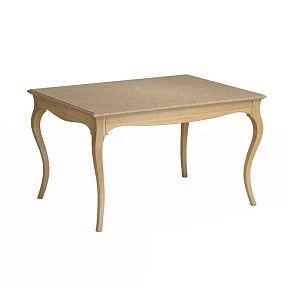
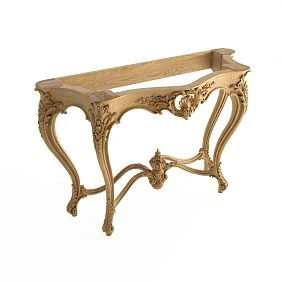
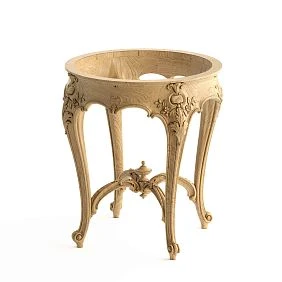
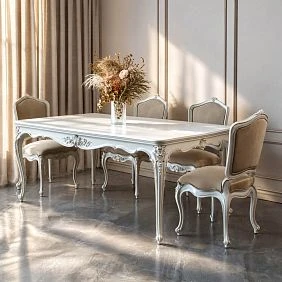
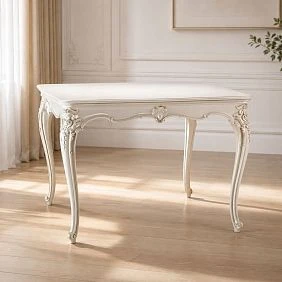
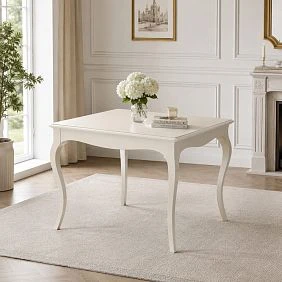
Our factory also produces:

What does "light loads" mean
In the description of the specific MN-145.1, the manufacturer associates the model with light loads and frameless constructions, including coffee tables.
This is enough to consider it in the given scenario.
But this wording is not enough to assign a specific allowable weight of the finished table in kilograms. The tabletop can be light plywood, solid oak, stone, or composite; the attachment and distance between supports also change the performance of the structure.
Therefore, the specification should record:
-
material and weight of the tabletop;
-
the underframe structure;
-
the position of the four supports;
-
real loads during operation.
If the table is heavy or unusual, the acceptability of MN-145.1 is confirmed by a furniture designer or manufacturer.
Get Consultation
Why the 12° angle should not be perceived only as a beautiful tilt
The inclined plate defines the geometry of the entire support.
The leg does not go vertically down: its lower point gets a horizontal offset relative to the mounting area. This offset affects:
-
support contour;
-
distance from the edge of the tabletop;
-
legroom;
-
the risk of hitting the footrest with the toe;
-
the visual lightness of the table.
Without an official drawing, it is impossible to reliably calculate the positions of holes and offsets from a photo alone. Before drilling, you need a real drawing of the chosen size and a full-size layout of the tabletop's underside.
Why there is no obligation to choose only one metal in this living room
An interior with brass and chrome is already mixed in terms of metals. Adding a third item does not have to "correct" this down to a single finish.
The problem arises when the metals have no hierarchy.
Let's imagine two options.
Brass wall sconces are the main decorative accent
They stand symmetrically on either side of the sofa, are clearly visible from the entrance, and give warm reflections in the evening. The chrome of the sofa is thin, almost hidden under the soft body.
In this situation, the brass glides MN-145.1 will echo the strongest accent of the room. The chrome will remain the technical line of the upholstered furniture.
The chrome sofa legs are a strong lower line
The sofa is visually raised, the legs are noticeable along the entire length, and next to it stand a metal floor lamp and cool handles. Brass is present only on the two wall sconces.
Then the stainless steel at the coffee table naturally connects the furniture group, while the sconces remain an independent light pair.
Why the number of metal objects by itself doesn't decide anything
Two large sconces can influence perception more strongly than six small handles.
And conversely: a long chrome base of a sofa can be visually stronger than two small brass details.
Need to evaluate:
-
the area of visible metal;
-
its position in the frame;
-
gloss level;
-
repeatability;
-
contrast with the background;
-
distance to the coffee table.
Four support feet MN-145.1 are not as visible as two sconces
The support foot D25 is near the floor. Its visual strength depends on the viewing point.
Sitting on the sofa, a person can constantly see the lower part of the coffee table. Standing at the entrance, they may barely notice it. In a product photo, the metal detail looks prominent because the item is shown large; in a real living room, the D25 may occupy a very small fraction of the overall frame.
Therefore, before choosing, take three photos of the room:
-
from the entrance;
-
from the sofa;
-
from the armchair or the second main seating point.
In each frame, mentally or in a simple collage, add the coffee table and assess which metals are simultaneously in view.
If the sconces and the glides are almost never seen together, the rule "must repeat brass" loses its force.
If, when seated, the chrome of the sofa and the four glides are constantly visible, the connection to steel becomes stronger.
Brass hardware MN-145.1: when warm metal truly wins
Brass should be chosen not because of the material's status, but when it solves a specific compositional task.
Two sconces form a symmetrical axis
Symmetry amplifies repetition. If identical brass sconces stand on either side of the sofa, a coffee table with four brass glides continues this motif downward.
This works especially well if the table is positioned roughly in the center between the light fixtures.
There is a third warm metallic repeat in the room
For example:
-
a brass handle on the cabinet;
-
a thin edging on the tray;
-
the mirror frame;
-
a metal detail on the chair;
-
a decorative stripe on the tabletop.
Then brass becomes a system, not just a single coincidence of "sconce + table."
The oak is left natural
Expressive oak and warm brass often work in the same temperature group. But what matters is not the name of the materials, but the actual finish.
Gray oak under a cold stain can look better with steel. Warm honey oak — with brass.
The foot is clearly visible
If the leg is tall, the table is light, and the floor is contrasting, the metal part becomes noticeable. Then it makes sense to use it as a full-fledged design accent.
When brass next to brass sconces still looks wrong
The same name of the metal does not guarantee the same color.
Sconces can be:
-
polished;
-
satin-finished;
-
aged;
-
bronze-brass;
-
painted "to look like brass."
The MN-145.1 hardware is called brass in the card, but the user should assess the actual shade and shine.
If the sconces are matte and patinated, but the foot looks bright and mirror-like, the new part may turn out more yellow and noticeable than desired.
Therefore, for a sensitive interior, a real sample, an up-to-date photo of the hardware, or viewing in a showroom is needed.
Stainless steel MN-145.1: when it is better to support the sofa rather than the sconce
Stainless steel works more strongly in the furniture group.
The coffee table and the sofa are at the same functional level: they are used simultaneously, they stand next to each other, and together they form the central zone of the living room.
The chrome sofa supports are clearly visible
If the sofa "floats" on thin shiny legs, the metal becomes an important part of the silhouette.
The steel D25 on MN-145.1 will echo the cold metallic language of the other piece.
The table is painted in white, gray, graphite, or black.
Cold hardware often pairs more easily with achromatic coloring.
For example:
-
beech MN-145.1 under graphite enamel;
-
steel foot;
-
chrome sofa legs.
In this scheme, sconces remain a warm light accent and do not need to be repeated in every detail of the room.
There are other cold metals in the living room.
Stainless steel gets additional grounding if nearby there are:
-
chrome floor lamp;
-
steel frame;
-
cold door handles;
-
metal parts of the chair.
Then the choice of the table becomes part of a broader system.
Why stainless steel and chrome don't have to match one-to-one
The chrome-plated sofa support and stainless steel fittings MN-145.1 belong to cold metals, but may differ in reflection.
Chrome often looks more mirror-like. Stainless steel can be calmer and grayer.
This does not make the combination wrong. It is important that the difference is perceived as related, not random.
What to compare instead of the name
Temperature.
Both metals should remain cold relative to brass.
gloss.
If the sofa is mirrored and the steel is matte, the new glider will be less active — sometimes that's even a plus.
Contrast with the floor.
On light oak flooring, cold steel is more noticeable. On gray stone, it's calmer.
Distance between objects.
The closer the coffee table is to the sofa, the more noticeable the difference in shades.
When the difference already bothers you
If the sofa has a warm "champagne chrome" and the new steel is clearly bluish-cold, they can look like two different metals with no connection.
Then brass sometimes proves to be a more convincing intentional contrast than a failed attempt to match the steel.
Third path: metal MN-145.1 doesn't have to be the main accent
Sometimes the "brass or steel" debate is overrated.
Let's imagine:
-
leg 104 or 153 mm;
-
dark carpet;
-
massive tabletop;
-
the bottom of the sofa blocks the view;
-
the foot is in deep shadow.
Then D25 is only visible upon close inspection.
In such a room, the metal of the leg can work as a quiet technical detail.
How to choose in this case
Don't look for the "perfect connection with everything."
Choose the option that:
-
conflicts less with the floor color;
-
matches better with the wood finish;
-
more easily supports the overall furniture group.
Why this is useful
The interior does not have to repeat every material at least twice.
If a small floor protector is barely visible, trying to build a separate system around it can complicate the project without real visual payoff.
Metal near the floor changes shade due to reflection of the coating
This is one of the reasons why the product card does not give a definitive answer.
Stainless steel on:
-
gray stone;
-
on light oak;
-
on dark parquet;
-
on colored carpet
looks different.
Brass also changes.
Light wooden floor
Brass can blend with a warm background and look calmer.
Steel can provide a sharper cold contrast.
Dark floor
Brass becomes a bright accent.
Steel can look more graphic and modern.
Light carpet
Both metals are noticeably visible.
The shine is important.
Dark carpet
The foot cap can almost disappear.
Purchase conclusion
Metals should be compared at the point of the future leg, not just next to the sconce or sofa.
The tabletop changes the metal choice more than it seems
A coffee table is not just four legs separately. The large top surface affects the perception of the entire piece.
Oak tabletop with a natural finish
If both the tabletop and MN-145.1 are oak, brass creates a warm, cohesive composition.
Steel makes it more modern and contrasting.
Both options are fine.
Stone or porcelain stoneware tabletop
A cool gray surface can enhance stainless steel.
Brass, on the other hand, will add a warm accent and tie the table to the sconce.
But before choosing MN-145.1, it must be separately confirmed that the specific table construction and its load are acceptable for this model.
Painted MDF
If the tabletop and body are solid-colored, the metal becomes more noticeable.
Black tabletop + brass — contrasting.
Black + steel — graphic and calmer.
Glass
Legs are more visible through the transparent surface.
Metal stops being just the bottom part.
Here it is especially important to make a collage or mockup in advance.
Oak or beech: first the finish is determined, then the metal.
Wood species and metal should not be chosen as a single pair.
Incorrect automatic pairs:
oak = brass
beech = steel
There is no such rule.
Oak + brass
Warm, decorative, expressive option.
Especially if the oak remains natural.
Oak + steel
More modern.
Works well with gray, smoky, or neutral tinting.
Beech + brass
If beech is painted in cream, milky, warm gray, or deep color, brass can become an accent.
Beech + steel
A strong option for cold enamel and minimalist interior.
What matters in the "Under enamel" card
The configuration selected in the card indicates the quality of the "Under enamel" lamination. The manufacturer explains that such a blank is assembled without matching lamellas by color and texture and is intended for opaque finishing.
If the buyer wants to keep the oak transparent, it is necessary to check the availability of a suitable configuration for tinting/semi-transparent finish in "All sizes and prices" before ordering, rather than relying only on the currently selected row.
Height MN-145.1: why metal is chosen only after the table's geometry
The card shows five current sizes:
104, 153, 252, 350, and 449 mm at B=44 mm.
But you cannot say:
"a coffee table needs 350 mm."
A coffee table can have:
-
a thick body;
-
a thin tabletop;
-
a high subframe;
-
a low box.
The required leg is determined by the finished height of the furniture, not by the category name.
Reverse calculation
First, the desired top mark of the table is set.
Then the following are subtracted:
-
tabletop thickness;
-
height of the body/under-table;
-
actual mounting geometry.
The remaining value is compared with the MN-145.1 size range.
Example without issuing a universal standard
Suppose, after the mock-up next to the sofa, the customer approved a finished height of 430 mm.
The structure above the leg is 80 mm.
The required vertical part of the support is approximately:
430 − 80 = 350 mm,
if the official drawing confirms that size A of the selected MN-145.1 corresponds to the required installation height in this structure.
Then 350 mm becomes a candidate.
If the structure above the support is 178 mm:
430 − 178 = 252 mm.
That's a different row in the card.
Why you can't just add A to the tabletop
The inclined mounting plate and the specific connection method require verification against the drawing.
Size A should be used as specified by the manufacturer, not turned into an arbitrary "net leg height".
Full-size mockup of the 12° angled leg before purchasing four units
A simple vertical block of height A does not show the real MN-145.1.
The tilt also needs to be reproduced.
What the mockup should show
-
the upper mounting point;
-
the 12° angle;
-
the position of the lower D25;
-
the extreme horizontal overhang;
-
the distance to the edge of the countertop;
-
the place for a person's legs at the sofa.
Why this matters specifically for a coffee table
The table stands in the leg area.
A too-wide lower contour can:
-
reduce the passage;
-
hinder getting up;
-
catch footwear;
-
visually extend beyond the tabletop.
How to check
Place four simple templates under the body mockup and step back to a normal distance.
You need to assess not only the beauty, but also where the feet actually end up on the floor.
The four inclined supports must have a single orientation system
With MN-145.1, it's easy to get furniture that looks "twisted" if one plate is turned differently.
Rectangular table
Usually, the designer sets a symmetrical spread of legs from the center to the corners.
But the specific orientation must be taken from the project.
Round table
The supports can spread radially.
Here, identical angular marking is especially important.
Oval
The position depends on the long and short axis.
Why you cannot drill using a photograph
The photo shows the appearance, but not the hole coordinates or the load scheme.
An official drawing or a physical mounting template is needed.
Articulated foot D25: what it changes in the choice of brass and steel
D25 — the lower visible metal point.
The hinge helps the plate work with an inclined leg and contact the floor.
But there is no basis in the card to attribute any desired height adjustment range to it.
What cannot be promised
-
"compensates for a 10 mm difference";
-
"levels any uneven floor";
-
"works as a threaded adjustable support,"
if this is not confirmed by the specific design and range.
What can be checked
On the finished layout:
-
does D25 stand with the entire working plane;
-
are the four legs oriented identically;
-
whether there is any rocking;
-
how the metal looks next to the floor.
Why D25 color is especially noticeable on tall supports
The higher the table is raised above the floor, the more air around the legs and the easier it is to see the metal endings.
In the low version, the glides may be more hidden in the shadow.
Floor: parquet, carpet, or stone — metal and wear are tested together
If D25 contacts the finished flooring, appearance cannot be separated from practice.
Parquet
It is necessary to check the actual contact and the absence of damaging particles.
The card does not provide a separate warranty for each type of floor finish.
Carpet
The articulated foot may be perceived visually differently; part of the metal is hidden by the pile.
If two legs are on the carpet and two on the parquet, you need to check the levelness and stability.
Stone or tile
The metal reads brighter and more contrastingly.
The seams between the slabs are also important.
Why you can't choose brass based only on the sconce
If it looks too yellow or noticeable on a particular floor, the composition doesn't work.
Completeness of MN-145.1: what to check in four boxes before finishing
Before painting/tinting, it's better to lay out the entire set.
For each leg, the following is checked:
-
article MN-145.1;
-
A×B;
-
wood species;
-
selected hardware color;
-
mounting plate;
-
stud M8×60;
-
insert M6×13;
-
floor glide D25.
Why four sets need to be checked side by side
The error "three brass and one steel" is detected immediately.
No screws for attaching the plate
This should be moved to a separate line in the BOM/specification.
Do not buy random screws at the last moment.
The choice depends on:
-
base material;
-
its thickness;
-
distance to edge;
-
diameters of plate holes;
-
design load.
Why "simple mounting" in the product card does not cancel design work
The manufacturer talks about ease of installation, but the user still has to choose the right fasteners for their furniture.
A screw that fits thick plywood may be unsuitable for another base.
Brass or steel: a selection matrix for a real living room
Instead of the subjective "I like it," you can evaluate seven parameters. This is not an automatic design algorithm, but a way to see which metal already has more connections with the room.
| Parameter | Argument for brass | Argument for stainless steel |
|---|---|---|
| Sconces | large, symmetrical, clearly visible | small or peripheral |
| Sofa supports | almost hidden | long/prominent, form the silhouette |
| Other metals | warm handles, frames, decor | chrome, nickel, steel parts |
| Wood finish | warm oak, cream enamel | gray oak, black/gray enamel |
| Floor | brass calmly blends with the warm background | cold metal supports gray/stone background |
| Visibility D25 | the footplate is clearly visible and should be an accent | the footplate connects the lower furniture line |
| Role of wall sconces | part of the overall metal system | independent warm accent |
How to use the matrix
Do not mechanically count the number of checkmarks.
If the wall sconce is the main artistic dominant, one strong argument can be more important than several minor cold details.
The matrix is needed to detect the reasons for choice, not to replace the designer with a calculator.
Scenario 1. Brass sconces are the only warm metal, but they dominate
Let's imagine a bright living room.
Two large sconces with matte brass stand on either side of the sofa. The chrome sofa legs are thin and almost disappear into the shadows. There are almost no other metals.
The brass MN-145.1 can become the second level of the same composition.
Why:
-
the sconces are symmetrical;
-
the table is between them;
-
the warm metal is repeated below;
-
the sofa does not require additional chrome reinforcement.
What to check
Is the D25 floor protector too bright relative to the matte surface of the sconce.
If it differs greatly, the connection may be weaker than the word "brass" suggests.
Scenario 2. The sofa's chrome is more visible, the sconces are small
The sofa stands on tall chrome legs, with a large gap between the floor and the body. From the entrance, the metal line is immediately noticeable.
The sconces are compact and only visible in the evening.
Here, stainless steel MN-145.1 looks more logical: the table and sofa form one furniture group.
What happens to brass
It is not prohibited.
But then the foot becomes an independent contrasting accent, rather than a connection to the lamps.
If the room already has enough accents, this may be unnecessary.
Scenario 3. Metals are mixed throughout the room
For example:
-
brass sconces;
-
chrome of the sofa;
-
black metal of the floor lamp;
-
steel fittings of the cabinet.
In such a room, you don't need to try to "beat" one metal.
It's better to keep the coffee table calm.
Possible choice
Steel, if the table should blend into the furniture group.
Brass, if the table should become an accent.
Key question
Should the coffee table draw attention?
If not, choose a less contrasting option relative to the floor and the cabinet.
Scenario 4. The sofa is on chrome, but the coffee table is made of warm oak.
Here, two systems compete:
-
the table's material pulls toward brass;
-
the adjacent sofa—toward steel.
You need to choose what matters more.
Brass
The table becomes a standalone warm piece.
Steel
Oak gets a modern cold accent and connects more strongly with the sofa.
Both solutions are professionally explainable.
Therefore, in this case, a physical sample is especially useful.
Scenario 5. Beech leg under black enamel
The black body is neutral.
Brass makes the D25 noticeable and decorative.
Steel is calmer and more technological.
If the sconces are already very expressive, steel can provide better hierarchy: one warm accent on top, one cool furniture language below.
Why you can't choose metal just from a product photo on a white background
On the card, the hardware is shown large and isolated.
In the room, it exists alongside:
-
the floor;
-
as a shadow under the tabletop;
-
with a leg;
-
the sofa;
-
with a carpet;
-
the sconce.
Color adaptation of the eye changes perception.
Practical test
Make two small rectangles/circles:
-
warm metallic tone;
-
cold.
Place them on the floor at the point of the future leg and photograph under real lighting.
Even better — physical metal samples.
Price of brass and steel MN-145.1: why budget doesn't help choose
The current card table shows the same price for two hardware options within one row.
That is, for 350×44 mm:
-
oak + steel — 1,920 ₽;
-
oak + brass — 1,920 ₽;
-
beech + steel — 1,360 ₽;
-
beech + brass — 1,360 ₽.
The choice of metal does not change the price of four legs.
This is a rare convenient situation: you can choose based on the interior.
Where the budget really changes
On the wood species and height.
Four legs:
| Size | Oak, 4 pcs. | Beech, 4 pcs. | Difference |
|---|---|---|---|
| 104×44 | 4 200 ₽ | 3 600 ₽ | 600 ₽ |
| 153×44 | 4 760 ₽ | 3 880 ₽ | 880 ₽ |
| 252×44 | 6 400 ₽ | 4 840 ₽ | 1 560 ₽ |
| 350×44 | 7 680 ₽ | 5 440 ₽ | 2 240 ₽ |
| 449×44 | 9 120 ₽ | 6 320 ₽ | 2 800 ₽ |
These amounts do not include:
-
screws for attaching plates;
-
tabletop/body;
-
finish;
-
delivery.
Commercial conclusion
If the budget is limited, it is wiser to save through a justified choice of wood species/size, rather than through metal — because brass and steel cost the same in the card.
Why the cost of four legs should only be calculated after confirming the size
Cannot compare:
beech 104 mm for 3,600 ₽
с
like two alternative designs.
These are different heights and possibly different table constructions.
First, the size is determined.
Then oak/beech is compared within the same row.
If the project confirmed 350×44 mm:
Example
oak set — 7,680 ₽;
-
beech set — 5,440 ₽.
-
The difference is 2,240 ₽.
Now an honest question:
oak 449 mm for 9,120 ₽
Is the visible natural oak texture worth these 2,240 ₽ for a specific table?
Buying coffee table legs: when MN-145.1 needs to be compared with other models
MN-145.1 is strong precisely because of the combination:
-
turned wooden shape;
-
12° tilt;
-
metal D25;
-
choice of brass/steel.
But if one of these elements is not needed, it is worth opening the section to buy legs for a coffee table and compare other supports.
When MN-145.1 is not optimal
-
metal foot cap is not needed at all;
-
need a vertical, not an inclined silhouette;
-
the table is designed for a different load scheme;
-
the selected height is not available;
-
D25 is too noticeable;
-
want a different type of mounting.
Why this does not weaken the product article
The product article should help avoid buying an unsuitable product.
If the user chooses a different leg after checking, the material has fulfilled its task.
Buy wooden furniture legs: when a general catalog is more useful than a single SKU
If the table project is not yet frozen, it is reasonable Buy wooden furniture legs only after comparison:
-
height;
-
tilt;
-
material;
-
type of fittings;
-
mounting method.
MN-145.1 should not win just because it is the only one shown in a beautiful interior.
Order unpainted wooden legs: why decide on finishing before installation
MN-145.1 is in the section of unpainted items. If the table should get a custom color, you can order unpainted wooden legs and finish the set together.
What is important to do before installation
-
check the geometry;
-
choose four identical supports;
-
confirm the orientation;
-
perform a test coat;
-
protect visible hardware from the finishing compound.
Why a test coat first
Oak, beech, and the chosen enamel/stain change the relationship with metal.
Brass can work beautifully with one tint and clash with another.
Buy turned furniture legs: when the shape technology itself matters more than metal
If you need precisely slender turned geometry, the section is useful buy turned furniture legs.
There, MN-145.1 is compared not with geometric or carved supports, but with products of similar technology.
What to compare
-
silhouette;
-
B;
-
height;
-
tilt;
-
metal part;
-
Installation.
Why metal can be secondary
Sometimes another turned leg better solves the table's proportion, even if its hardware is less "perfectly" matched with the sconce.
MN-145.2 as an alternative: when to remove the metal accent from the equation
If the interior already contains enough brass and chrome, it makes sense compare the turned leg MN-145.2.
You shouldn't automatically claim that MN-145.2 is "better" or structurally identical to MN-145.1 without separately comparing the product cards.
Its role in this article is to show an alternative branch:
if the very need to choose a third metal accent already seems like a problem, compare the similar turned model and decide whether MN-145.1 is needed specifically because of its hardware.
Oak and beech finishing: how not to get four different shades
For a coffee table, four legs are visible simultaneously.
Natural wood has variability, so the task is not about absolute identity.
For oak under a semi-transparent finish
Before finishing:
-
lay out the four legs side by side;
-
choose their orientation;
-
make a test on a separate area/sample;
-
use one tinting and protective coating system.
For beech under enamel
An opaque finish unifies the set more strongly.
But the result depends on:
-
the primer;
-
preparation;
-
layer thicknesses;
-
gloss.
Useful STAVROS sources
Before finishing, you can check the quality of oak and beech supports и study tips for finishing wooden legs.
This does not replace the technical data sheet of a specific paint, oil, or varnish, but helps correctly interpret "under enamel" and "under tinting."
Coffee table design: why the choice of metal cannot be separated from the load
The most beautiful brass MN-145.1 is not suitable for the project if the table design exceeds the purpose of this support.
The specific product card uses the phrase "light loads" and cites frameless coffee tables as an example.
This should be read literally as a scenario constraint, not as decorative text.
What to check before ordering
-
tabletop weight;
-
mass of the frame/underframe;
-
usual contents;
-
tabletop size;
-
distance between supports;
-
material of the base for the mounting plate;
-
whether there are large cantilever overhangs.
Why you cannot substitute a universal load capacity in kilograms
A finished table is a system.
Even if
What we evaluate
Not just stability.
Also:
-
passage;
-
place for legs;
-
distance to the sofa;
-
visibility of metal.
Four or three MN-145.1: the quantity is not chosen aesthetically
For a rectangular/square coffee table, four supports are most often considered, and the cost calculations in this article are made for four.
But this does not mean that any tabletop must have four MN-145.1.
Three supports on a round table can theoretically provide a different stable scheme, but it requires separate design.
Why you shouldn't experiment just to save one leg
Changes:
-
support polygon;
-
orientation 12°;
-
visual rhythm;
-
load on each support.
If the project is designed for four, you cannot buy three from the current stock.
Stock balance of 3 pieces: why this is not a ready set of four
At the time of the check, the card showed for one variant — 449×44 mm, beech, stainless steel — 3 pieces in Saint Petersburg.
For a four-support table, this means:
-
three can be obtained from the warehouse with a confirmed balance;
-
the fourth is still required;
-
its lead time may be 5–10 business days.
Error
Order three "while available", then decide that the fourth can be replaced with another metal or stone.
For one table, the set must be uniform.
What to do
Agree on the supply of four identical supports with one specification.
Production takes 5–10 business days: how to plan the finishing of the set
Most lines of the card are currently made to order.
It is convenient to account for this in advance.
Correct sequence
-
approve the size;
-
choose the stone;
-
choose the metal;
-
order the entire set;
-
get four legs;
-
check them together;
-
only then run the finish.
Why not paint two before the other two
Even with one recipe they can differ:
-
tone;
-
shine;
-
a layer of primer;
-
perception of wood.
For a small table, four parts are visible nearby, so one finishing cycle is better.
How to check four legs upon receipt
Before sanding, painting, or drilling the body:
SKU
All — MN-145.1.
Size
All of one selected height.
Wood species
Do not mix beech and oak.
Metal
Either four brass, or four steel.
Plates
Identical geometry and no visible damage.
D25
Check that the metal glides are visually of the same design.
Wood
No transport damage that would interfere with finishing.
Oak: how to distribute four legs to the corners before staining
Natural pattern varies.
Before finishing, you can place the legs around the future table and choose which side of each will face outward.
Meaning
Avoid a situation where three legs are calm, and one with a very active pattern faces the main aisle.
Marking
For example:
-
LF — left front;
-
RF — right front;
-
LR;
-
RR.
After finishing, positions do not change randomly.
Beech under enamel: why metal becomes even more important
Opaque painting removes most of the differences in wood texture.
Then the visual perception of the leg is built:
-
turned silhouette;
-
enamel color;
-
D25.
In such a project, brass/steel can influence more strongly than the choice of wood species.
When beech is especially rational
If the buyer still fully paints the legs and does not use the natural oak grain.
The difference in price of the kit can be directed towards a higher quality finish or countertop.
"Under enamel" and "under tinting": should not be read as quality of sanding
These are different characteristics.
"Under enamel" refers to the selection/regluing of wood for an opaque finish.
Sanding is a separate parameter.
Why the confusion is dangerous
The buyer may decide:
"Under enamel means that the leg is already prepared and only painting remains."
In practice, the technology of primer, interlayer sanding, and enamel is set by a specific finishing system.
Brass with warm enamel and steel with cold: a simple check instead of dogma
You can make two small wood samples:
-
selected warm;
-
selected cold.
Place a brass and a steel sample nearby.
What to see
Sometimes the result overturns the initial decision.
For example:
-
warm gray-beige enamel unexpectedly works better with steel;
-
cold dark-green color works beautifully with brass.
The psychological association "warm color = warm metal" does not replace a real sample.
When brass should remain only on the sconce
This is an important case.
The interior can be stronger if the warm metal is not repeated.
Why
Two symmetrical sconces already create a complete composition.
If you add brass:
-
on the table;
-
on the handles;
-
on the decor;
-
on the frames,
the accent loses its uniqueness.
Then steel MN-145.1 plays the role of a neutral furniture metal
It connects the sofa and the table, while the sconces remain a separate upper pair.
When chrome is better left only to the sofa
The reverse case.
Chrome supports can be specifically chosen as a modern "technical" base for the sofa.
If you repeat cold metal everywhere, the living room will become too cold.
The brass D25 on the wooden side table adds the needed warm accent and ties it to the light.
If there is a mirror in the interior: the reflection changes the number of visible metal repeats
This is a practical nuance that is often not visible on the plan.
The mirror can reflect:
-
a brass wall lamp;
-
chrome of the sofa;
-
a coffee table.
As a result, one small metal piece is visually repeated twice.
Check
Sit at the main point and look not only at objects, but also at reflections.
If brass is already doubled by the mirror, a steel table may provide better balance.
If the coffee table is on the carpet
D25 may be partially hidden by the pile.
Then choosing it as a strong accent is pointless.
What to check
-
whether the metal is visible at all;
-
whether the foot sits stably;
-
whether all four supports contact the carpet equally.
If the carpet is soft, the hinge joint should not be considered a height adjustment without a confirmed range.
If the table stands on the border between the carpet and the floor
A bad scenario is two legs on one surface, two on another without checking.
May change:
-
height;
-
tabletop tilt;
-
visual visibility of metal.
It is better to place the entire support contour on one surface or separately design a transition.
When MN-145.1 with brass fittings can already be ordered
The brass version is ready to order if several conditions are met simultaneously.
The design is confirmed
MN-145.1 is suitable for the purpose and load scheme of the specific coffee table.
The size is chosen based on the finished height, not from the catalog
A is confirmed by the drawing and the mockup.
The 12° tilt does not create conflicts.
D25 does not extend into the walkway and does not get underfoot.
The sconces are indeed the main warm accent.
They are visible together with the table at least from the main viewpoints.
The actual brass matches in shade and luster.
Not just by the word "brass."
All four supports will be identical.
One wood species, one size, one metal.
If all points are covered, the brass becomes a deliberate part of the composition, not a random repetition of the fixtures.
When steel MN-145.1 is already stronger
Stainless steel gets an advantage if:
-
the chrome of the sofa is noticeable;
-
the table and sofa should read as one furniture group;
-
the sconce is desired to be kept as a separate warm accent;
-
the table body is painted in a neutral/cool color;
-
steel looks calmer on the floor;
-
brass D25 attracts too much attention.
What is especially good to check
Place the mock-up table in position and turn on only the sconce.
Even if in the warm evening light the steel does not look alien next to the sofa, the choice is stable.
When MN-145.1 should not be bought at all
This is a mandatory filter.
Load not confirmed
If the project is heavy, and the choice is based only on appearance.
Need a height-adjustable support with a known range
The MN-145.1 card has no published range for such adjustment.
The table must be moved constantly
D25 is not a wheel.
The 12° tilt obstructs passage
For example, the lower points of the legs end up where a person places their feet when getting up from the sofa.
The mounting plate is too small
The plate does not fit without being dangerously close to the edge of the base.
The metal is already overloaded in the interior
Wall sconces, sofa, lamps, handles, and decor create enough different metal lines.
Then a model without a noticeable metal accent may be better.
There is no suitable size A
You don't need to choose the "closest height" without recalculating the body.
A heavy dining/work table is needed
The specific MN-145.1 card orients it toward light loads and frameless constructions like coffee tables.
Mistakes when buying MN-145.1 for the living room with brass and chrome
Mistake 1. "There are brass sconces — we buy brass"
Why it occurs: a simple principle of repetition.
Consequence: the floor stops compete with the more important cold furniture line.
How to prevent: compare the visibility of the sconces and the sofa from the coffee table's point of view.
Mistake 2. "The sofa is chrome — steel is needed"
Chrome and steel can differ in shine and shade.
How to prevent: live comparison at the floor level.
Mistake 3. Choosing metal before height
A beautiful hardware option does not compensate for the incorrect size A.
Error 4. Considering A as the finished height of the entire table
Need to account for the tabletop, the body, and the mounting geometry.
Error 5. Ignoring the 12°
On the plan, the table fits, but D25 extends into the walkway.
Error 6. Marking the mounting plate based on a photo
There are no exact coordinates for the holes.
Error 7. Expecting self-tapping screws to be included
The card clearly states that the fasteners for attaching the plate to the furniture are not supplied.
Error 8. Buying random self-tapping screws
The base may be too thin or have a different structure.
Error 9. Assigning MN-145.1 a load capacity in kilograms without calculating the table
The product description mentions light loads; a specific project needs separate confirmation.
Error 10. Treating the hinged D25 as a full adjustable support
The adjustment range is not published.
Error 11. Mixing oak and beech just for availability
Four legs of one table must be a single coordinated system.
Error 12. Buying three steel 449×44 from warehouse stock
Three pieces are not a set for a project that requires four.
Error 13. Choosing oak for a clear finish based on the "Under enamel" configuration
Before ordering, you need to check the required gluing/finishing option.
Error 14. Painting legs before dry fitting
After finishing, a stem conflict is discovered.
Error 15. Not numbering oak legs
After toning, the agreed texture orientation changes.
Error 16. Considering brass and bronze as the same color
Actual shades can differ noticeably.
Error 17. Evaluating metal only in daylight
In the evening, sconces change perception.
Error 18. Not accounting for reflections in the mirror
The number of visual repetitions becomes different.
Error 19. Placing two legs on the carpet and two on the parquet without checking
A difference in height and contact may appear.
Error 20. Buying MN-145.1 only because of the hardware, although the turned shape itself does not suit the tabletop
First the silhouette and construction, then the metal.
Dry fit: minimal test before finishing
Even if the drawing is ready, it is useful to assemble a temporary mock-up.
Need to reproduce
-
tabletop size;
-
final height;
-
four mounting points;
-
12° tilt;
-
lower points D25.
Place the table in a real living room
Not in the workshop.
Check
-
distance to the sofa;
-
distance to the armchair;
-
passage;
-
visibility of the glides;
-
visual connection with the sconce;
-
visual connection with the chrome.
Why the mockup saves money
It can show that the chosen height or tilt is uncomfortable before purchasing/finishing four items.
How to decide between metals without professional 3D rendering
You can do a simple A/B test.
Option A — brass
Attach small circles/pads of a similar warm metallic color to the four lower points of the mockup.
Take a photo.
Option B — steel
Repeat with cold metal.
Compare the images
Do not flip quickly.
Look at the questions:
-
which table looks like part of the room;
-
which metal catches the eye first;
-
is the bra dominant preserved;
-
does the sofa not become visually separate;
-
which option is better next to the floor.
If the difference is almost invisible
Then metal is not the main solution.
You can choose based on a calmer combination with the wood finish.
What should be in the final specification for four MN-145.1
Example:
MN-145.1 / A×B = ___×44 mm / beech or oak / glue joint quality ___ / hardware Brass or Stainless Steel / 4 pcs. / mounting plate M8 12° / D25 / coffee table / orientation diagram LF-RF-LR-RR / plate screws by separate specification / finish ___.
Why write "brass" or "stainless steel" literally
Do not use internal designations like "gold" and "silver".
This reduces the risk of errors in the order.
Delivery, warranty, and returns: check before finishing, not after
Before paying for the set, it's useful to check the delivery conditions for furniture supports и check the warranty and returns.
This is especially important for custom-made items.
Why before finishing
After custom painting or other treatment, return/claim conditions may differ from the original state of the product.
What to check upon receipt
-
quantity;
-
size;
-
metal;
-
wood species;
-
completeness;
-
damage.
Only after this should irreversible work begin.
Quick matrix "brass or steel" before ordering
If the interior is already assembled and you need to make a decision without a long discussion, fill out a short table.
| Question | Brass | Steel |
|---|---|---|
| Is the sconce visible from almost every point? | + | |
| Does the sofa chrome form a noticeable bottom line? | + | |
| Is there any warm metal? | + | |
| Is there any cold metal? | + | |
| Is the oak warm and transparent? | + | Possible |
| Beech/MDF under gray or black enamel? | Possible | + |
| Should D25 become an accent? | + | depends |
| Should D25 be calm? | depends on gender | + |
| Should the sconces remain a unique accent? | + | |
| Should the table connect primarily with the sofa? | + |
How to interpret
Do not sum mechanically.
Look at which connection relates to the main composition of the room.
If the sofa and table form the central furniture group, steel can win even with a few brass details.
If two sconces create a strong symmetrical frame around the sofa, brass may be more correct even next to chrome.
Boundary scenario: brass looks beautiful in the photo, but D25 is almost invisible
Then it's not worth overpaying attention for a solution the user won't see.
The metal price is the same, but the design effort still has a cost.
If the glides are hidden:
-
by a low tabletop;
-
with a carpet;
-
by shadow;
-
by the soft body of the sofa,
you can choose the metal based on the leg finish and the overall furniture system.
Edge case: D25 becomes the brightest element of the table
For example:
-
legs painted black;
-
dark floor;
-
polished brass;
-
The footstep is well lit.
Then four D25s form a separate decorative row.
If the sconces are also bright, the interior may get too many golden points.
Steel in such a situation can make the table calmer.
Boundary scenario: the coffee table stands far from the sofa
If the table is moved to the armchairs and is not visually connected to the chrome base of the sofa, the argument for steel weakens.
Then the sconces, floor lamp, tabletop, and other items may be more important.
This is another reason to assess the actual position of the furniture, not the list of materials in the room.
Boundary scenario: the sofa will be replaced soon
If the chrome supports belong to an item that is planned to be replaced in a year, do not build a long-term choice of MN-145.1 solely around them.
Sconces, built-in lighting, and architectural materials usually change less frequently.
In that case, brass may prove to be a more durable solution for years.
The opposite case
If the sconces are temporary and the sofa is an expensive permanent piece, the connection with steel is more durable.
Edge case: the table will be used in pairs
For example, two small coffee tables instead of one.
Then there are eight metal glides.
Brass visually stands out more strongly than in the project with four D25s.
What to check
If one table with brass looks perfect, two may turn out to be overly decorative.
Steel is sometimes lighter when repeated.
Edge case: two different table heights
If the composition consists of a high and a low tabletop, you cannot automatically use different A MN-145.1 without checking proportions and construction.
What needs to be kept the same
If both items must be from the same series:
-
wood species;
-
finish;
-
metal;
-
tilt logic.
But the acceptability of each size is confirmed separately.
What to do if four legs are needed urgently, but only three are available
Do not temporarily assemble on three if the project is designed for four.
Do not mix:
-
brass/steel;
-
oak/beech;
-
different A.
It is more correct to agree on the delivery time for the full set.
For a made-to-order product, the average time indicated on the card is 5–10 business days.
Why one test leg can be useful before ordering four
If the interior is expensive and the choice of metal is debatable, one physical MN-145.1 helps to check:
-
scale B=44;
-
tilt;
-
D25;
-
actual color of the metal;
-
texture of the wood;
-
mounting plate.
But there is a limitation
One leg does not prove the stability of the entire table.
It is a sample, not a prototype of a four-legged structure.
When a test purchase is especially useful
-
non-standard countertop;
-
expensive oak finish;
-
very metal-sensitive interior;
-
no showroom sample of the required configuration.
Full budget: what to add to the price of four MN-145.1
The price of the legs is only one line.
The final estimate includes:
-
4 MN-145.1;
-
wood finishing;
-
mounting plate screws;
-
possible body reinforcement elements;
-
tabletop;
-
delivery;
-
assembly.
Why metal does not change the item price of legs
Brass and steel within the same card line cost the same.
Why wood species changes
Oak is more expensive than beech.
Why height changes
The higher the size, the higher the price according to the current table.
When choosing oak is more justified than choosing brass metal
If the tabletop and legs form a single natural object.
Then the wood grain is visible over a large area and affects the entire silhouette.
D25 is a small detail.
In such a situation, it makes sense to first invest in the right material and finish, and only then choose the metal.
When metal matters more than wood grain
If the legs are fully painted with opaque enamel.
The texture of oak/beech almost disappears.
Then D25 remains one of the few materials that stand out visually.
Beech under enamel plus a properly chosen metal can be more logical than expensive oak that is still covered with paint.
Checklist before payment
| Parameter | Solution |
|---|---|
| Purpose | Coffee table |
| Construction | frameless / confirmed |
| A×B | ___×44 mm |
| Quantity | ___ |
| Species | Oak / beech |
| Finish | ___ |
| Metal | brass / stainless steel |
| 12° incline verified | Yes/No |
| Bottom overhang verified with mockup | Yes/No |
| D25 on floor verified | Yes/No |
| Structure load confirmed | Yes/No |
| Mounting plate fits | Yes/No |
| Screws selected separately | Yes/No |
| Delivery verified | Yes/No |
| Warranty/return verified | Yes/No |
If the line "structure load confirmed" or "12° incline verified" remains empty, the dispute about brass and steel is premature.
The last A/B test in the room before paying for four legs
If after all calculations the metal choice is still debatable, don't invent additional rules. Make two identical mockups of the future table and change only the lower metal accent.
For option A, imitate brass D25; for option B, cold steel. All other parameters must be the same: height, leg color, tabletop, position relative to the sofa and armchairs.
It's useful to compare in three modes.
Daytime. The real coexistence of metal with the floor and the sofa's chrome is visible without the dominance of sconce light.
Evening with general lighting. Check whether brass becomes too bright and whether steel 'turns blue' relative to the warm interior.
Only with sconces turned on. This is the toughest test for the brass option: warm light can either beautifully unite the glides with the fixtures or make the four lower accents excessively golden.
After each mode, it's useful to evaluate not the question 'which metal is more beautiful by itself,' but four specific things:
-
the table is perceived as part of the sofa group or as a separate accent;
-
the sconces retain their intended role;
-
D25 does not become the most noticeable element of the leg;
-
wood and metal look like a single furniture piece.
If one option consistently wins in all three modes, the decision no longer depends on catalog associations like "brass — warmth, steel — modern." It is confirmed by your living room itself.
FAQ about MN-145.1 for the coffee table
What wood species is MN-145.1 made from?
The current product card shows oak and beech.
What hardware options are available?
Brass and stainless steel.
Does the price of brass hardware differ from steel?
In the current MN-145.1 table, the price within the same size and wood species is the same for both metal options.
What sizes are shown in the card?
104×44, 153×44, 252×44, 350×44, and 449×44 mm. Before ordering, you should open the current list "All sizes and prices."
What does the 12° angle mean?
This is the tilt angle of the metal mounting plate, which forms the leg's incline. It needs to be considered in the table's geometry.
What foot pad is used?
Metal D25 with a hinge joint.
Does the D25 hinge adjust height?
The card does not publish the adjustment range, so a specific compensation for floor unevenness cannot be promised.
Can MN-145.1 be used for a coffee table?
Yes, coffee tables are directly listed by the manufacturer as an example of frameless constructions for light loads. The specific construction still requires verification.
How many kilograms will the finished table support?
Based on the data used for this article, it is not possible to correctly assign a permissible weight for a specific finished table. The entire structure must be considered and confirmation obtained for the project.
Are screws for the mounting plate included?
No. The card separately indicates that they are not supplied.
What is included in the MN-145.1 set?
Wooden support, M8×60, mounting plate M8 12°, insert M6×13, and metal D25 with hinge — according to the current card description.
What to choose for brass sconces — brass or steel?
If the sconces are the main metal accent, brass logically continues them. If the central furniture group is built around chrome sofa legs, stainless steel usually provides a more direct connection.
Is it mandatory to pair brass with oak?
No. Oak can work with steel, and painted beech with brass.
Can stainless steel be combined with chrome?
Yes, if their actual shade and luster do not conflict. They do not have to be identical.
What matters more — the metal of the sconce or the sofa legs?
The one that plays a stronger role in the main composition and is more often seen together with the coffee table.
Is it necessary to repeat brass in other items?
Not necessarily. But an additional repetition can make the metal system more coherent.
When is it better not to repeat brass?
If the sconces are meant to remain a unique warm accent, and the lower furniture group is already built on cool metal.
How to choose the height of MN-145.1?
Subtract the structure above the support from the target finished height of the table, then check the resulting size against the official drawing and size chart.
Can we simply take 350 mm as the "magazine" height?
No. The final height depends on the tabletop and the body.
What should be checked before drilling?
Official drawing, mounting plate size, four mounting points, 12° direction, and lower overhang D25.
Can MN-145.1 be used for a very heavy stone tabletop?
Only after separate confirmation of the structure and load. You cannot choose based on appearance alone.
How is MN-145.2 useful in this article?
It is an alternative turned model for comparison, if the metal accent of MN-145.1 turned out to be unnecessary or a different structural/visual logic is needed.
Where can I see other legs for a coffee table?
In the STAVROS profile category for coffee tables.
Where can I see the turned models?
In a separate selection of turned furniture legs.
How to check the quality of oak and beech?
Use the STAVROS materials and quality page and physically inspect the set before finishing.
How to check the current price?
In the MN-145.1 card, right before payment. Prices and availability change.
Final algorithm: which MN-145.1 to order — brass or steel
-
Record the dimensions and weight of the tabletop.
-
Check that MN-145.1 fits the purpose and load scheme.
-
Determine the target height of the finished coffee table.
-
Select A×B according to the official drawing.
-
Make a full-size layout with a 12° tilt.
-
Check the lower overhang D25 and the passage near the sofa.
-
Decide whether oak or beech is needed after the chosen finish.
-
Photograph the living room from the entrance, the sofa, and the armchair.
-
Determine what is visually stronger: brass sconces or the chrome of the sofa.
-
Look at what other metals are already repeated.
-
Check the actual shade/gloss of the brass hardware.
-
Compare steel with chrome not by name, but visually.
-
Place both options on the floor next to the future table.
-
Check the daylight.
-
Check the evening light and the turned-on sconces.
-
Fix one metal for all legs.
-
Check the completeness of the four supports.
-
Select screws for mounting plates separately.
-
Perform a test finish on the wood.
-
Check the current price, lead time, and availability.
-
Verify delivery and return conditions.
-
Only after that place the order.
Conclusion
In the living room with brass sconces and chrome sofa legs, MN-145.1 has no single "correct" metal by default.
Brass is better when the sconces are a strong symmetrical part of the composition, the warm metal is supported by oak or other details, and the four D25 glides should become a noticeable decorative repeat.
Stainless steel is stronger when the coffee table should be perceived as part of the furniture group together with the sofa, the chrome legs are clearly visible, and the brass sconces should remain an independent warm accent.
It is important that the price in the card does not force you to choose one option: within the same size and wood species, brass and steel currently cost the same. Therefore, the decision can be made based on the interior.
Before choosing the metal, you need to confirm the leg itself. MN-145.1 has an inclined mounting plate of 12°, a hinged metal D25, and is positioned for small loads in frameless structures, including coffee tables. Self-tapping screws for attaching the plate to the furniture are not included in the kit. The specific allowable load of the finished table cannot be assigned without calculating its tabletop, body, and fastening assembly.
The size is also chosen before the metal. The card shows 104, 153, 252, 350, and 449 mm at B=44 mm. You cannot take 350 mm just because it "looks like a coffee table": first, the finished height is calculated, then the official drawing and the actual lower overhang of the inclined leg are checked.
If the table is natural oak and brass sconces dominate, I would test brass first. If the body is painted, the sofa visually stands on noticeable chrome, and the table should continue its lower line — I would test stainless steel first. But the final decision needs to be seen at the floor in a real room under daylight and evening light.
After checking the structure, height, wood species, and four identical sets, you can order MN-145.1 in the chosen metal. Then the floor guide will not become a third random metal accent: it either consciously connects the coffee table with the sconces or makes it part of the furniture group with the sofa.