


























Article Contents:
- What Are Polyurethane Molding Corners?
- Decorative Molding Corners vs. Room Corners
- Why Use Decorative Corner Blocks?
- Wall Panel Molding Corners
- Rounded Corner Molding
- Ornamental Corner Onlays
- Left-Hand and Right-Hand Corner Elements
- MLDPU-001U: Small Decorative Corner for Fine Molding
- MLDPU-002U: More Expressive Corners for Wall Frames
- MLDPU-003U: Large Rounded Corner Detail
- MLDPU-004U: A Compact Geometric Corner
- Comparing the Four Corner Families
- MLDPU-2U-2.1L and MLDPU-2U-2.1R
- MLDPU-3U-2.1L and MLDPU-3U-2.1R
- Floral Corner Accents vs. Large Ornamental Corners
- Matching the Profile Width
- Matching Relief Depth
- Beaded Molding
- Rope Molding
- Acanthus Leaf Molding
- Floral Molding and Decorative Friezes
- Start With the Wall Layout
- Establish Frame Proportions
- Consider the Corner Ornament's Footprint
- Plan the Color and Finish
- Example: Three Frames With the MLDPU-002 Ornamental System
- Should You Order Extra Corners?
- Decorative Door Panels
- Cabinet Doors
- Dressers and Wardrobes
- Inside Wall Corners
- Outside Wall Corners
- Irregular Angles
- Inside Crown Molding Corners
- Outside Crown Molding Corners
- Decorative Ceiling Corners
- Inside Baseboard Corners
- Outside Baseboard Corners
- Coordinating Baseboards and Wall Molding
- Polyurethane vs. Plaster
- Polyurethane vs. Carved Wood
- Polyurethane vs. Polystyrene
- Polyurethane and MDF Together
- Step 1: Identify the Corner Type
- Step 2: Prepare the Surface
- Step 3: Mark the Complete Frame
- Step 4: Dry-Fit the Components
- Step 5: Cut the Straight Molding
- Step 6: Choose a Compatible Adhesive
- Step 7: Position and Secure the Corner
- Step 8: Install the Straight Profiles
- Step 9: Finish the Joints
- Step 10: Prime and Paint
- White Architectural Trim
- Tone-on-Tone Wall Molding
- Contrasting Decorative Corners
- Metallic Finishes and Patina
- Can You Use Any Paint on Polyurethane?
- Traditional American Interiors
- Neoclassical Interiors
- Baroque and Rococo-Inspired Interiors
- Art Deco Interiors
- Contemporary and Minimalist Interiors
- French Provincial and Transitional Interiors
- Larger Decorative Frames With Fewer Ornaments
- Sculptural Tone-on-Tone Details
- Layered Architectural Frames
- Selective Metallic Accents
- Coordinated Wall and Door Decoration
- Integrated Lighting
- Small Frames
- Medium Wall Frames
- Large Formal Panels
- Check the Viewing Distance
- Basic Corner Blocks vs. Ornamental Corners
- Calculate the Full Frame Cost
- Commercial Projects and Multiple Rooms
- Confirm the Product Code
- Verify Left-Hand and Right-Hand Versions
- Check the Material
- Compare the Actual Dimensions
- Check the Installation Details
- Confirm Delivery Arrangements
- What Are Polyurethane Molding Corners Used For?
- Do Decorative Corner Blocks Eliminate the Need for Miter Cuts?
- Can I Use Wall Panel Molding Corners at the Corners of a Room?
- What Is the Difference Between a Molding Corner and a Rosette Block?
- Are Polyurethane Molding Corners Paintable?
- Can Polyurethane Corner Molding Be Used in Bathrooms?
- Is Polyurethane Better Than Wood for Decorative Corners?
- Can I Install Polyurethane Corner Blocks Myself?
- How Many Corner Pieces Do I Need for Four Wall Frames?
- What Is the Best Molding for Neoclassical Wall Panels?
- Can I Use Polyurethane Corners With MDF Molding?
- Can I Use Decorative Corner Blocks With Crown Molding?
- Can Molding Corners Be Used on Cabinet Doors?
- What Is Ornamental Molding?
- What Is Acanthus Leaf Molding?
- Does STAVROS Sell Left-Hand and Right-Hand Polyurethane Corners?
- Where Can I Buy Polyurethane Molding Corners Online?

A beautifully designed interior depends on more than expensive furniture, premium flooring, or carefully selected paint colors. The architectural details connecting those elements often determine whether a room feels thoughtfully designed or simply decorated.
Consider a living room with elegant picture-frame wall molding. The straight profiles are perfectly aligned, the proportions are balanced, and the finish complements the furniture. Yet the corners of the decorative frames appear visually weak. The molding lines meet correctly, but the composition lacks the ornamental detail that would give it a distinctive architectural character.
This is where polyurethane molding corners and decorative corner blocks can make a significant difference.
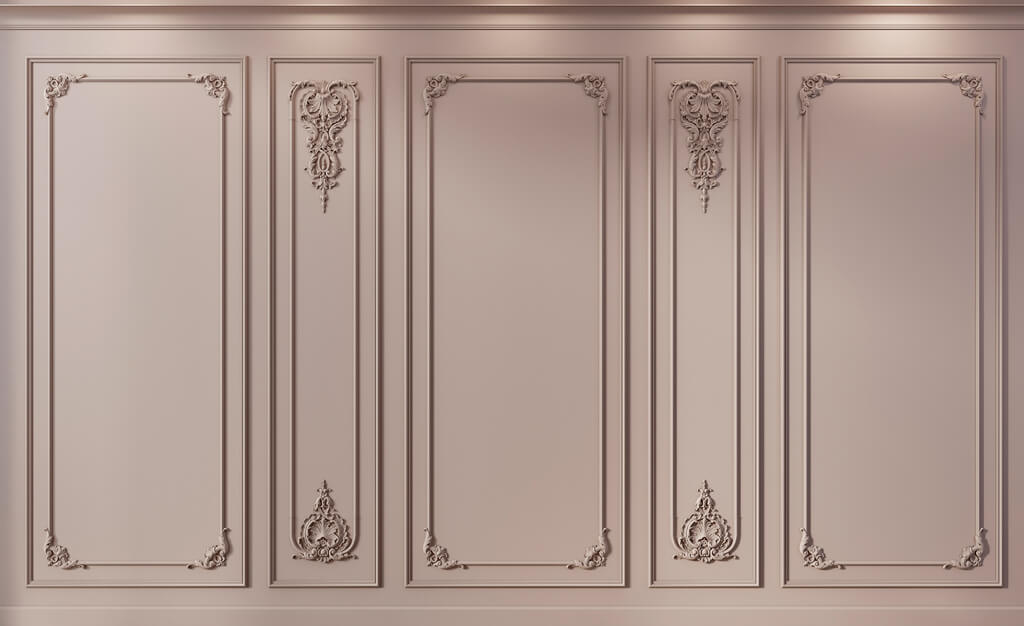
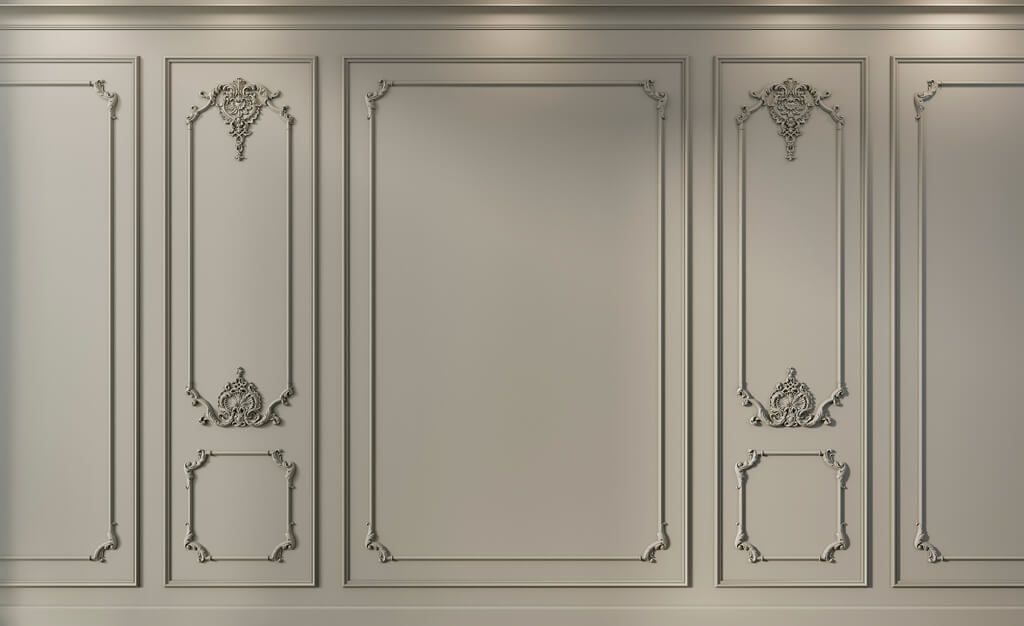
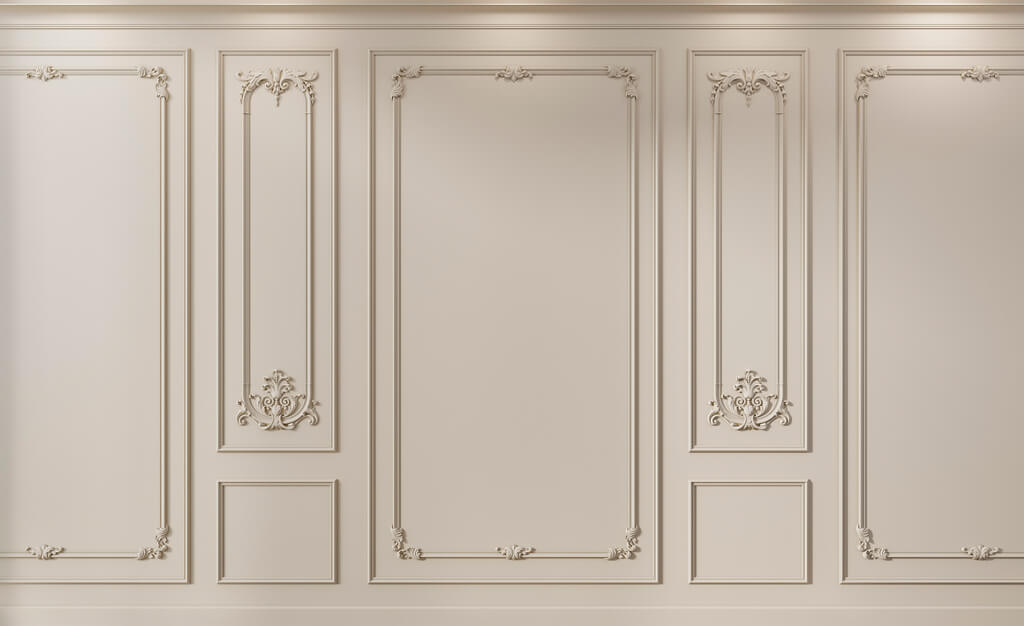
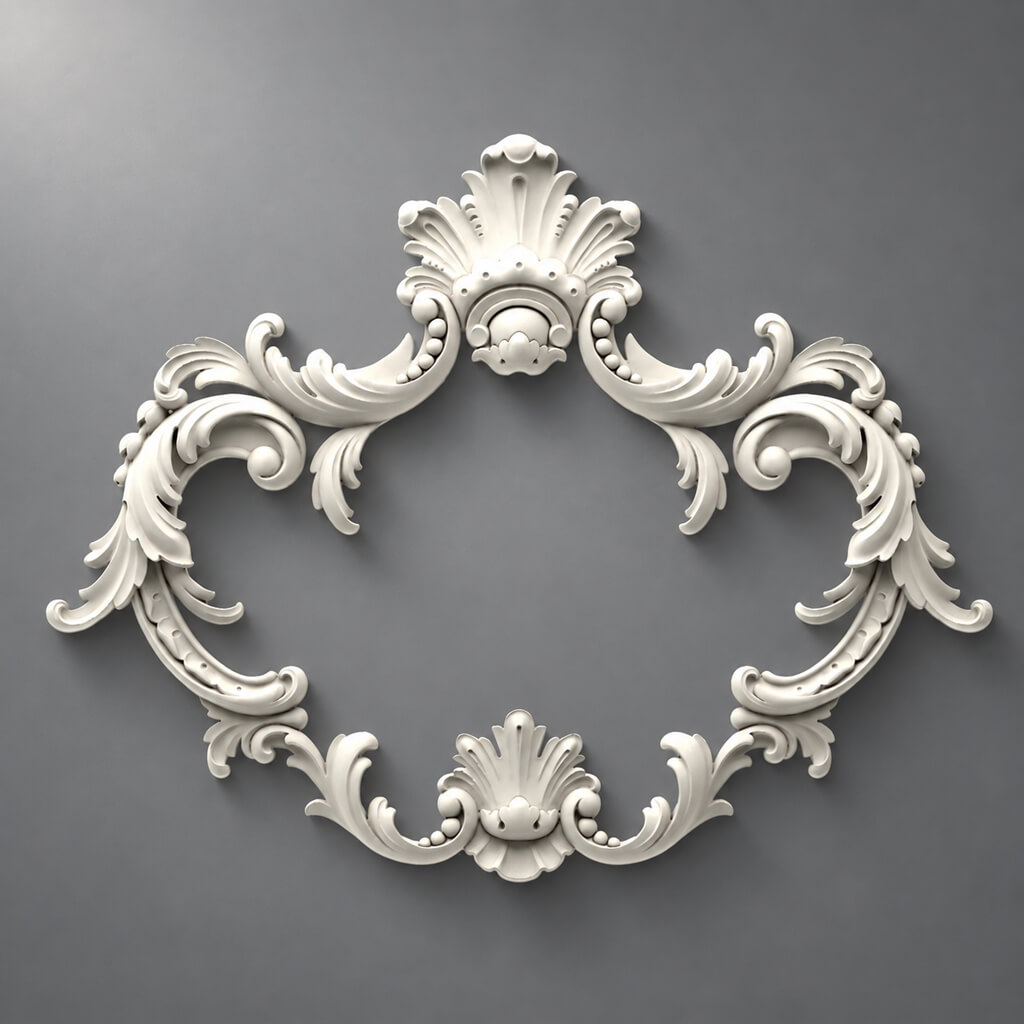
These components turn ordinary molding intersections into intentional design features. Depending on the selected product, they can introduce rounded transitions, classical scrollwork, floral ornaments, geometric details, or a more pronounced architectural relief.
For homeowners, interior designers, cabinetmakers, and remodeling contractors in the United States, decorative molding corners offer practical design possibilities for living rooms, dining rooms, bedrooms, hallways, doors, and furniture.
However, not every corner element serves the same function. A decorative corner for a picture-frame wall panel is different from an inside corner for crown molding or an outside corner for baseboards. Some products connect straight molding sections, while others are applied over completed joints.
Understanding these differences is essential before making a purchase.
This guide explains the types of polyurethane corner molding, how to select compatible profiles, calculate quantities, plan decorative wall frames, and install architectural corner accents. It also introduces specific products from the STAVROS polyurethane molding corners and decorative accents collection, with dimensions in inches and practical recommendations for American interiors.



What Are Polyurethane Molding Corners?
Polyurethane molding corners are preformed decorative components used at selected intersections, turns, or termination points within a molding system.
They are manufactured from polyurethane, a family of polymers that can be formulated for detailed architectural decoration.
Unlike a straight molding strip, a corner element is designed to define a particular point in the composition.
It may create a smooth 90-degree decorative turn, form a rounded transition, introduce an ornamental flourish, or emphasize a corner with a sculpted accent.
Some corner components are symmetrical.
Others have directional patterns and are manufactured as separate left-hand and right-hand pieces.
The correct selection depends on the molding profile, intended layout, and installation method.
Decorative Molding Corners vs. Room Corners
This distinction is fundamental.
A decorative wall frame typically consists of four molding sections arranged into a rectangle. Its corners are formed on a flat wall surface.
A decorative polyurethane corner for this application may be a flat L-shaped component, a molded overlay, or a shaped connecting element.
By contrast, an inside room corner is the junction between two walls.
An outside room corner is the projecting intersection of two wall surfaces.
A flat decorative corner block designed for a picture-frame panel will not automatically fit either of these architectural conditions.
The same applies to ceiling crown molding and floor baseboards.
These profiles have different cross-sections and installation geometries.
Always identify the actual corner condition before ordering decorative molding accessories.
Наша фабрика также производит:

Смотреть весь Каталог продукции
Why Use Decorative Corner Blocks?
A decorative corner can serve several purposes.
It may introduce an ornamental focal point at the intersection of two molding lines.
It can create a softer or more elaborate transition within a decorative frame.
It may provide a coordinated finishing detail for a particular molding collection.
In some systems, it can simplify the assembly of the frame by replacing a conventional mitered connection.
In other systems, the corner accent is installed over or alongside the molding, meaning that the underlying cuts still require accurate preparation.
The most important benefit is not necessarily eliminating the miter.
It is creating a deliberate relationship between straight architectural lines and decorative details.
Получить консультацию
Types of Decorative Molding Corners for American Interiors
Different architectural applications require different types of corner components.
Understanding these product categories makes it easier to compare decorative trim molding and avoid choosing pieces that do not fit the intended project.
| Corner component | Main application | Design consideration |
|---|---|---|
| Wall panel molding corner | Picture-frame wall molding and decorative panels | Must match the straight molding system |
| Rounded molding corner | Frames with curved or softened corners | Requires compatible profile geometry |
| Ornamental corner onlay | Classical wall frames and furniture | May overlay an existing joint |
| Directional corner ornament | Symmetrical classical compositions | Left-hand and right-hand versions may be needed |
| Rosette corner block | Traditional door and window casing | Must suit casing dimensions and junction details |
| Inside crown molding corner | Wall-to-ceiling intersections | Must match the crown profile and spring angle |
| Outside baseboard corner | Projecting wall corners | Must be designed for the selected baseboard |
| Decorative terminal | Ends of molding lines | Completes an exposed molding termination |
These components are not interchangeable merely because their dimensions appear similar.
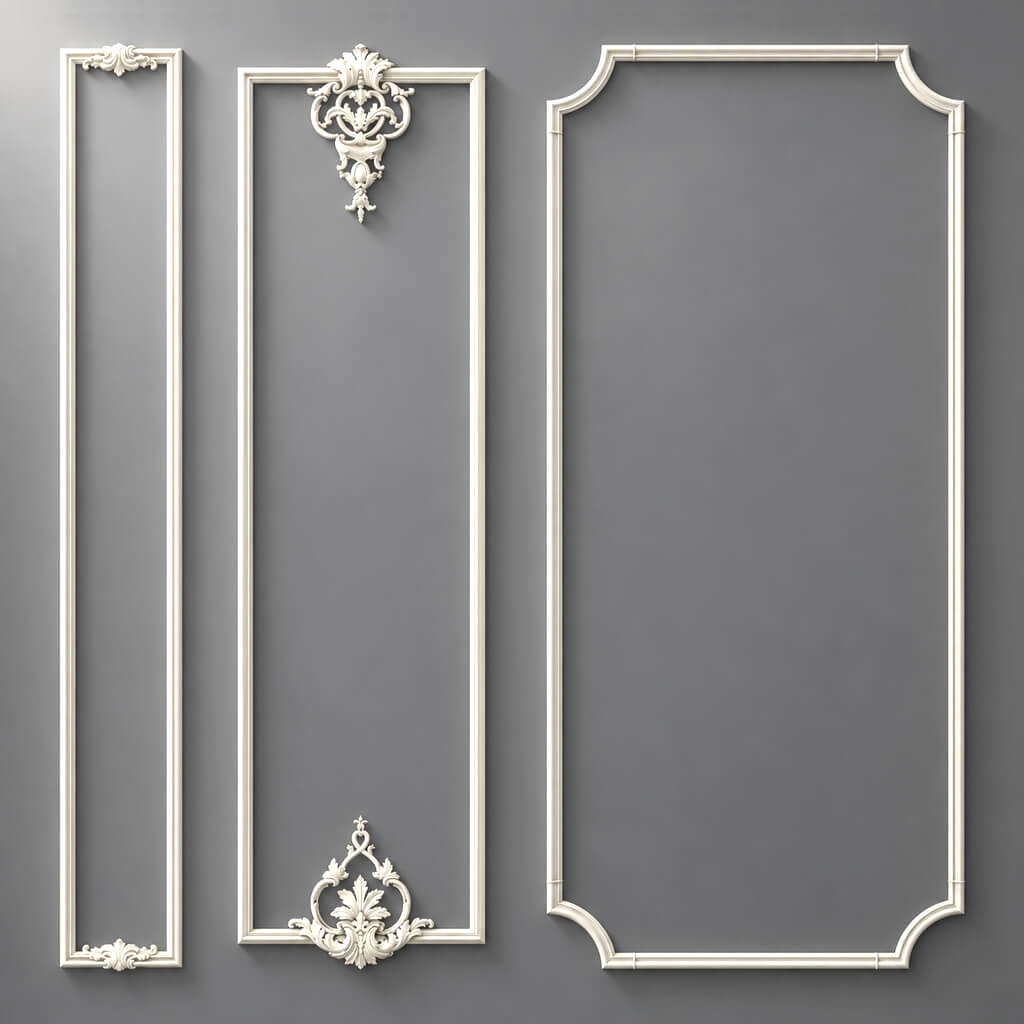
Wall Panel Molding Corners
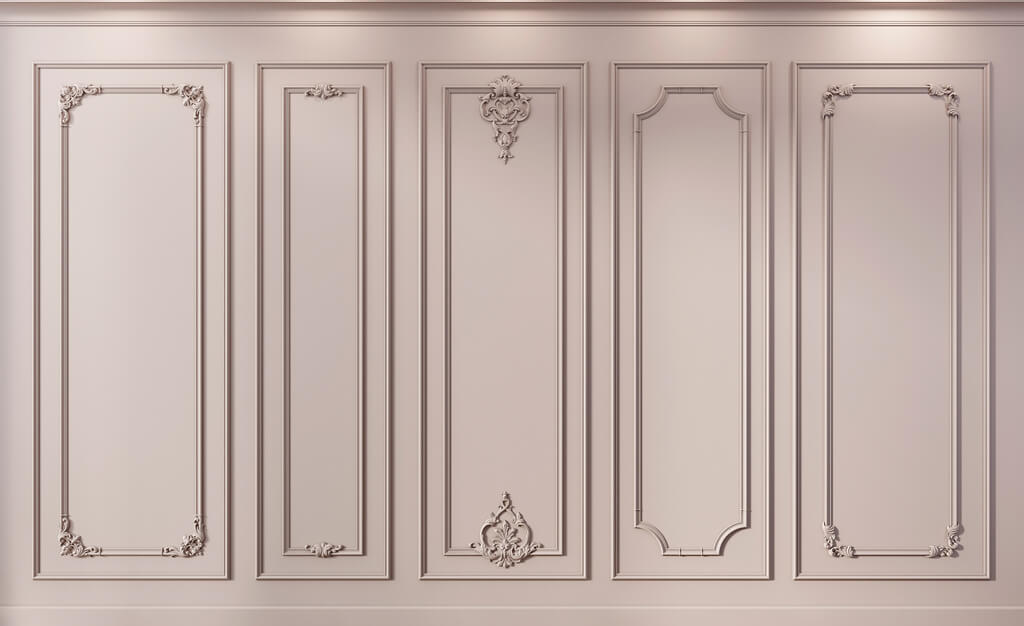
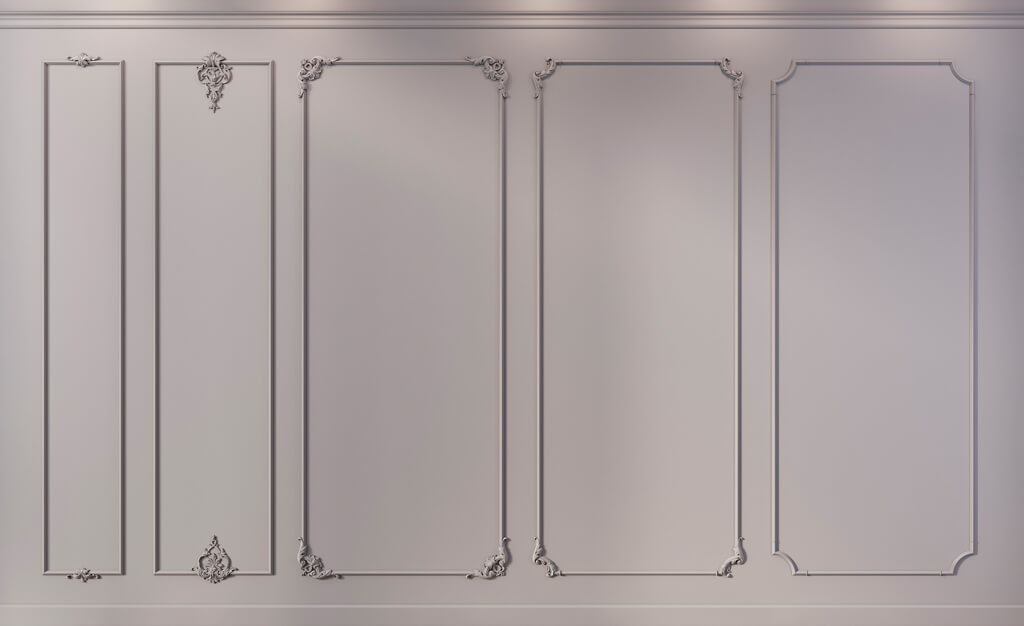
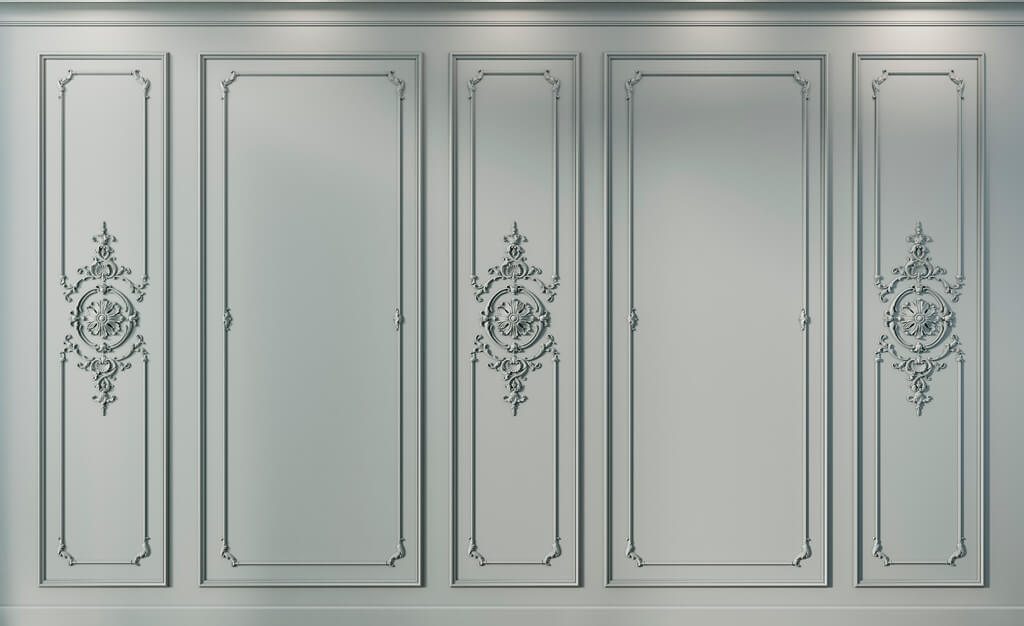
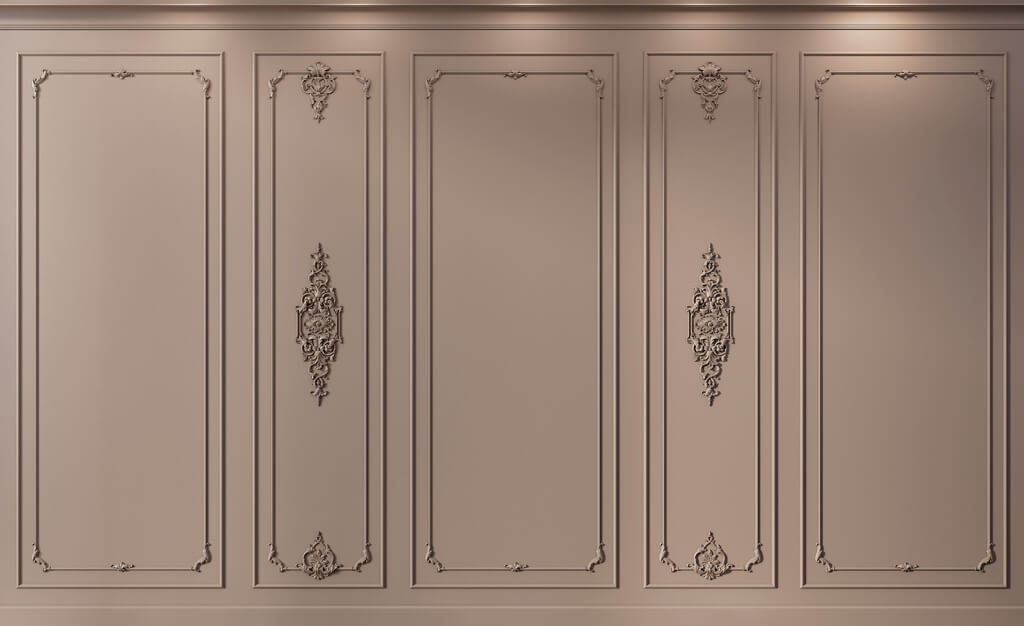
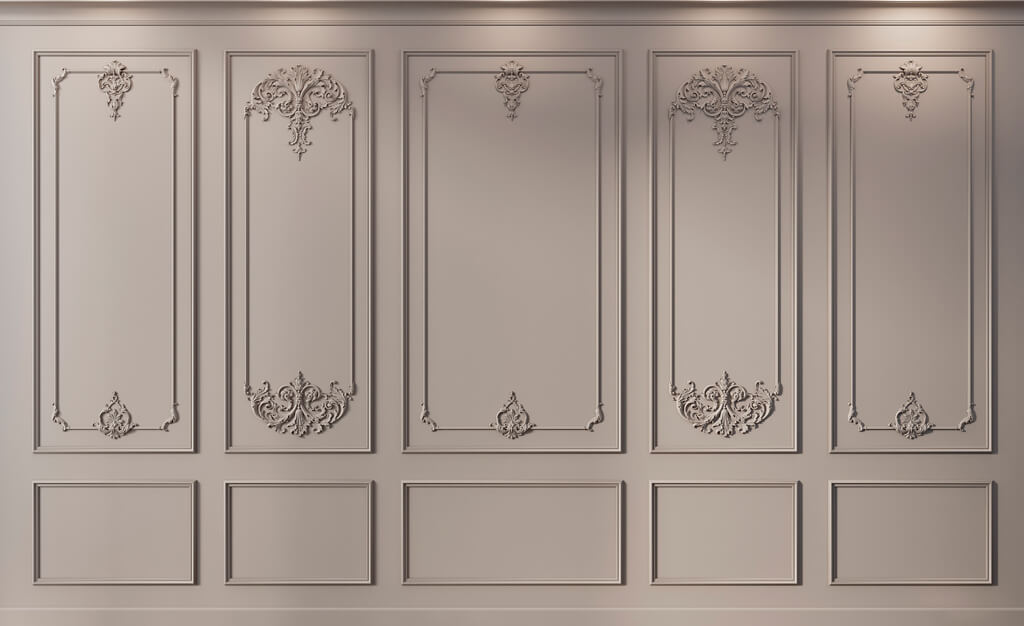
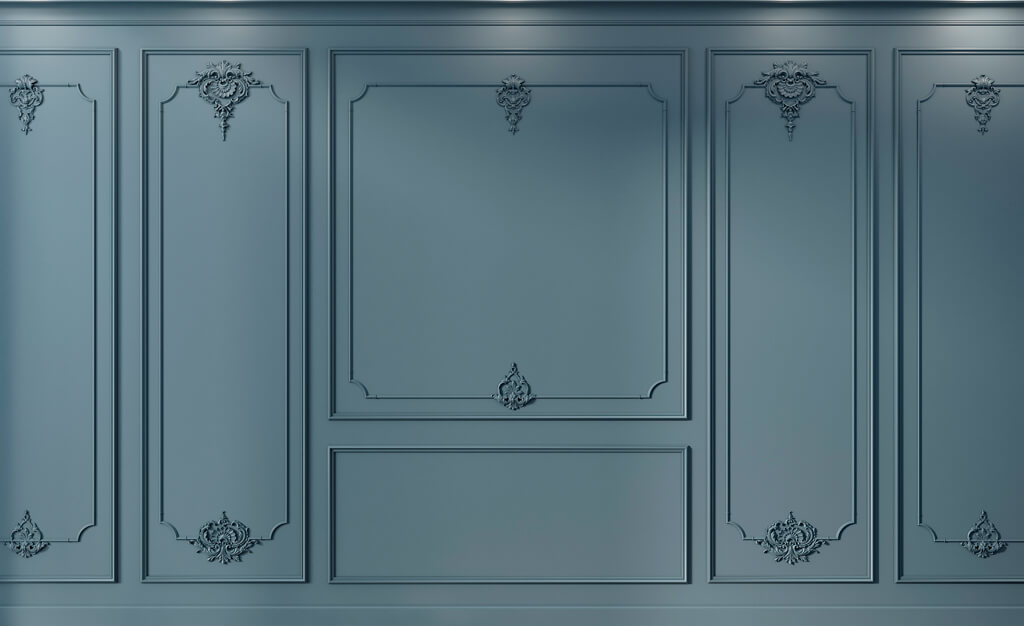
Picture-frame molding is widely used to create decorative rectangles and other geometric compositions on interior walls.
The molding itself establishes the outline.
Corner elements determine how the lines connect visually.
A simple frame may use four conventional mitered joints.
A more decorative version may feature preformed corners with curved edges or ornamental details.
For this application, STAVROS offers polyurethane wall molding corners intended for specific molding families.
These can be incorporated into decorative panels on living room walls, bedroom accent walls, hallways, and furniture fronts.
Rounded Corner Molding
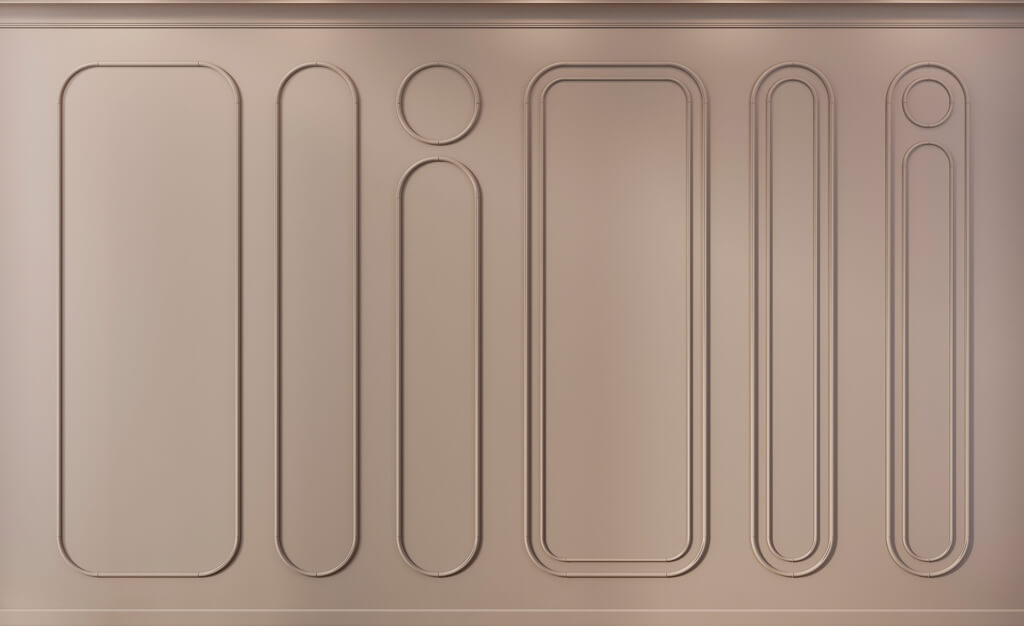
A rounded corner produces a softer transition than a sharp right-angle joint.
This can be useful in neoclassical interiors and decorative panel designs with gently curved outlines.
Instead of two straight molding pieces meeting at a point, the corner itself follows a curved path.
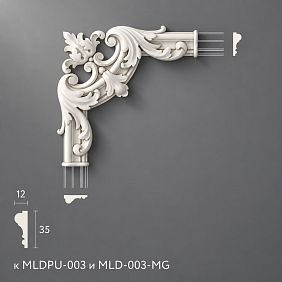
One example is the MLDPU-003U polyurethane rounded molding corner.
It is designed for the MLDPU-003 profile and its related MDF counterpart, MLD-003-MG.
The corner measures approximately 8.58 × 8.58 inches, with a projection of 0.59 inches.
Its shape provides a rounded transition between straight sections of the decorative frame.
The result can be more expressive than an ordinary mitered rectangle, particularly in larger rooms.
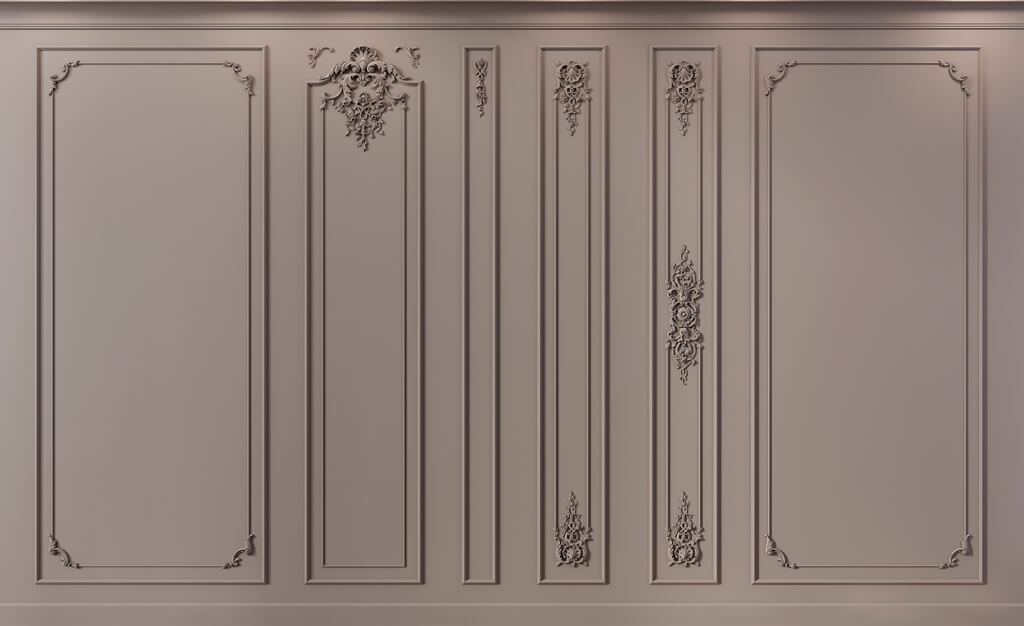
Ornamental Corner Onlays
An ornamental corner onlay introduces decorative relief at the corner position.
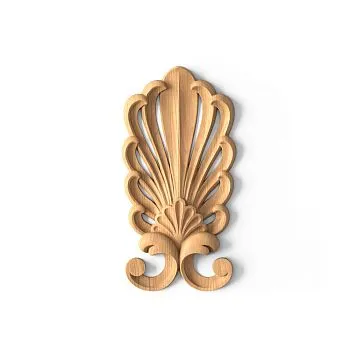
It may feature leaves, scrolls, floral patterns, geometric shapes, or other sculpted details.
The ornament can extend beyond the straight molding to create a focal point.
Unlike a simple connector, an ornamental onlay may be installed over the molding intersection or positioned as part of a larger composition.
Its exact attachment method must be checked in the manufacturer's product drawing.
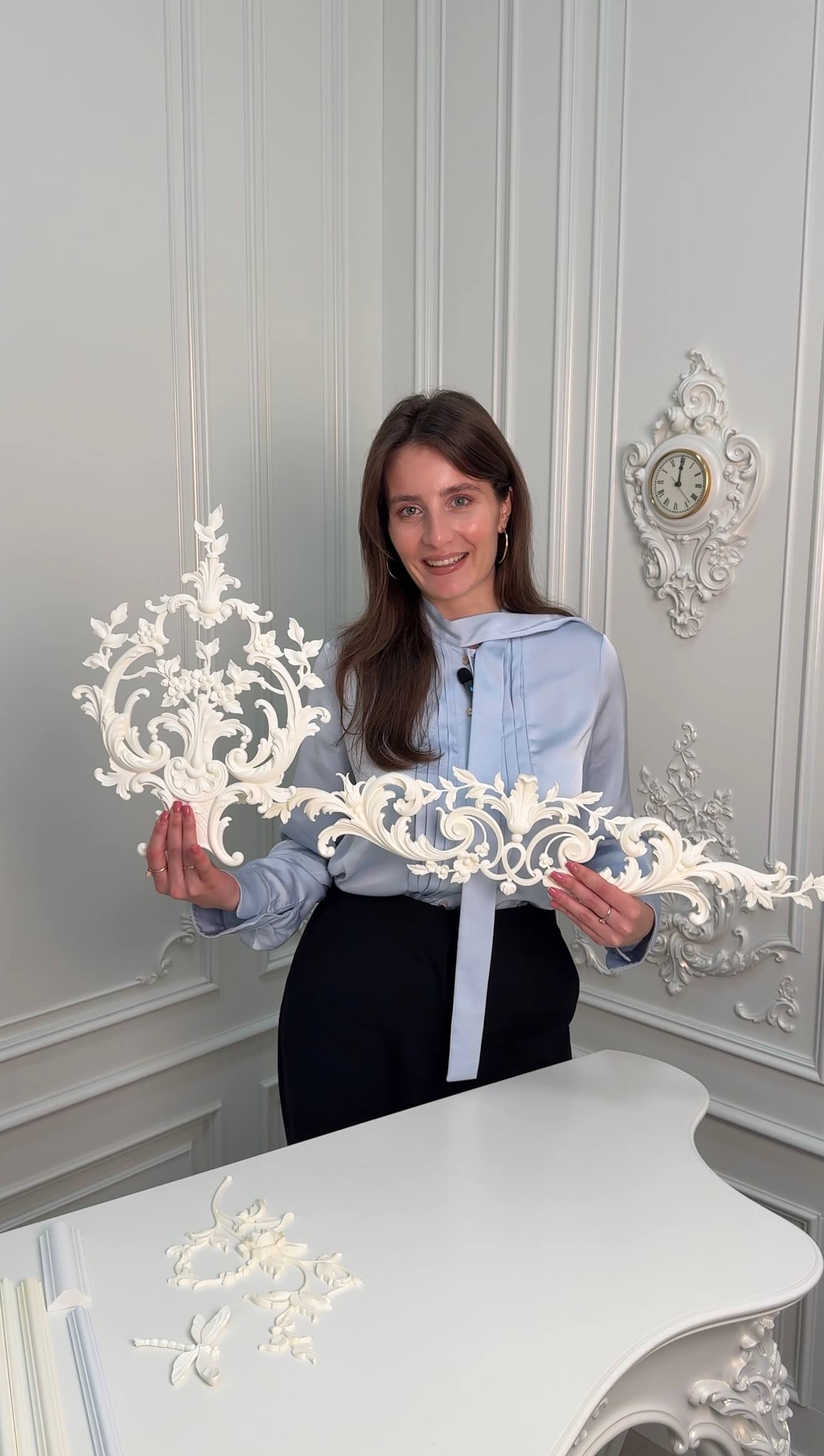
For classical and neoclassical wall treatments, ornamental polyurethane molding accessories offer designs that coordinate with various straight profiles.
Left-Hand and Right-Hand Corner Elements
Some decorative corner ornaments are directional.
Their pattern is not symmetrical.
A leaf, scroll, or floral motif may turn toward the left on one component and toward the right on its matching counterpart.
For these designs, manufacturers create separate left-hand and right-hand versions.
A complete symmetrical frame may require two pieces of each orientation, depending on the series and layout.
Ordering four left-hand components will not necessarily create the intended symmetrical design.
This is an important consideration when purchasing ornamental molding for multiple wall panels.
STAVROS Polyurethane Molding Corners: Real Profiles and Dimensions
The STAVROS catalog includes several families of polyurethane molding corners designed for coordinated architectural compositions.
The individual product codes establish which components belong together.
The following examples illustrate differences in size, ornament, and intended application.
MLDPU-001U: Small Decorative Corner for Fine Molding
The MLDPU-001U polyurethane molding corner is a compact component for delicate decorative frames.
Its listed dimensions are:
Width: 3.39 inches
Height: 3.39 inches
Projection: 0.28 inches
Material: polyurethane
The corner belongs to the 001 molding family.
It is appropriate for consideration where the design requires narrow decorative lines and relatively restrained corner details.
A matching straight profile is MLDPU-001 polyurethane molding.
This molding measures approximately 0.39 inches wide and 0.24 inches deep, with a stock length of 102.36 inches.
The combination can be used to develop fine decorative wall frames, provided the selected installation configuration matches the product drawings.
In a smaller bedroom or hallway, this scale may appear more balanced than a larger, deeply projecting corner ornament.
MLDPU-002U: More Expressive Corners for Wall Frames
The MLDPU-002U polyurethane molding corner is a larger decorative component.
Its listed dimensions are approximately:
Width: 6.77 inches
Height: 6.77 inches
Projection: 0.51 inches
Material: polyurethane
The corner is designed to work with the MLDPU-002 molding profile.
The associated MLDPU-002 polyurethane wall molding has a face width of approximately 0.87 inches and a projection of 0.43 inches.
This creates a more pronounced architectural line than the narrow 001 profile.
The combination can work well in traditional dining rooms, larger living rooms, and accent walls where the decorative frames should remain clearly visible.
Because the corner itself is relatively large, the design needs sufficient space between adjacent frames.
MLDPU-003U: Large Rounded Corner Detail
For a more substantial decorative frame, consider the MLDPU-003U rounded polyurethane molding corner.
Its dimensions are approximately:
Width: 8.58 inches
Height: 8.58 inches
Projection: 0.59 inches
This element is designed for the MLDPU-003 and MLD-003-MG molding profiles.
The associated MLDPU-003 polyurethane molding has a broader cross-section than the 001 and 002 series.
The larger corner creates a softer and more prominent visual transition.
It is best evaluated as part of the complete decorative frame rather than as an isolated ornament.
For a formal living room or larger wall composition, the generous proportions may be effective.
For a narrow corridor, the same element could occupy too much of the available wall space.
MLDPU-004U: A Compact Geometric Corner
The MLDPU-004U polyurethane corner molding provides another option.
It measures approximately:
Width: 5.31 inches
Height: 5.31 inches
Projection: 0.39 inches
It is intended to coordinate with the MLDPU-004 molding family.
The corresponding MLDPU-004 polyurethane molding measures approximately 0.59 inches wide and 0.31 inches deep.
This series can be considered for decorative panels where a relatively narrow straight profile is combined with a defined corner treatment.
The resulting appearance is more restrained than an elaborate floral corner composition.
Comparing the Four Corner Families
| STAVROS corner | Dimensions, inches | Related polyurethane molding | Character |
|---|---|---|---|
| MLDPU-001U | 3.39 × 3.39 × 0.28 | MLDPU-001 | Fine, compact |
| MLDPU-002U | 6.77 × 6.77 × 0.51 | MLDPU-002 | More prominent |
| MLDPU-003U | 8.58 × 8.58 × 0.59 | MLDPU-003 | Larger, rounded |
| MLDPU-004U | 5.31 × 5.31 × 0.39 | MLDPU-004 | Compact, geometric |
These dimensions are important because decorative corner elements occupy more wall area than the cross-section of the straight molding might suggest.
Before choosing a corner, compare its full footprint with the proposed frame dimensions.
Ornamental Polyurethane Corner Molding: Classical Floral Designs
Simple rounded corner pieces are only one approach.
More ornate architectural compositions can use directional ornaments that emphasize the upper and lower corners of a decorative frame.
This type of decoration can make an ordinary wall panel resemble more elaborate classical millwork.
MLDPU-2U-2.1L and MLDPU-2U-2.1R
STAVROS provides matching left-hand and right-hand ornamental corner elements for its 002 molding family.
The MLDPU-2U-2.1L left polyurethane corner and MLDPU-2U-2.1R right polyurethane corner measure approximately 7.87 × 5.31 × 0.79 inches.
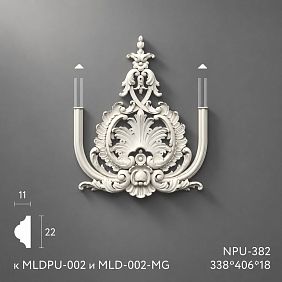
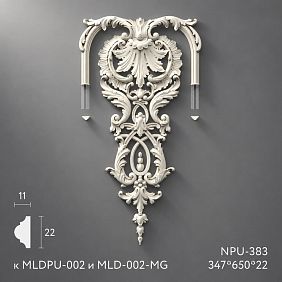
They feature directional botanical ornament.
Both are intended to coordinate with the MLDPU-002 polyurethane molding or the related MLD-002-MG primed MDF molding.
For the manufacturer's symmetrical frame arrangement, two left-hand and two right-hand corner accents are used.
That provides four ornamental corner positions.
The directional design is important.
The left and right elements are not simply identical ornaments placed in different locations.
Their mirrored patterns create the intended visual balance.
MLDPU-3U-2.1L and MLDPU-3U-2.1R
For a larger, more elaborate decorative composition, STAVROS offers the 003 series ornamental corners.
The MLDPU-3U-2.1L left ornamental corner and MLDPU-3U-2.1R right ornamental corner measure approximately 12.13 × 7.87 × 0.83 inches.
Their larger dimensions make them more appropriate for substantial decorative frames.
These pieces are associated with MLDPU-003 and MLD-003-MG molding systems.
A pair of left and right ornaments creates a deliberate symmetrical relationship.
This can be especially effective around tall wall panels, prominent door compositions, and larger furniture fronts.
However, the size requires careful planning.
Four corner ornaments of this scale occupy considerable space within a decorative arrangement.
They are not necessarily suitable for compact picture-frame molding.
Floral Corner Accents vs. Large Ornamental Corners
Not every decorative project needs a large sculpted corner.
A compact floral detail can provide enough visual emphasis.
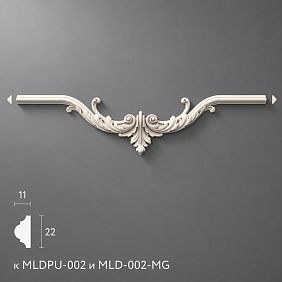
For example, the NPU-436.1L polyurethane decorative accent measures approximately 3.35 × 1.34 × 0.63 inches.
It belongs to the decorative system associated with MLDPU-002 and MLD-002-MG.
This smaller directional accent can be considered where a full-size ornamental corner would be excessive.
The choice depends on the scale of the panel and the intended design.
A narrow accent often works better for furniture and compact frames.
A larger ornamental corner may be preferable when the wall composition is intended to become a major architectural focal point.
Decorative Trim Molding: Choosing a Matching Straight Profile
A corner element is only one part of a complete molding system.
The straight profile connecting the corners determines the main architectural outline.
Choosing an incompatible profile can produce visible discontinuities even when the decorative ornaments themselves are attractive.
Matching the Profile Width
The face width of the straight molding should relate to the corner element.
A very narrow molding may look disconnected from a large corner ornament.
A very broad molding may overwhelm a small decorative corner.
This is why coordinated product families are useful.
The manufacturer has designed the components to work together visually and geometrically.
For example, the MLDPU-002 corner family is intended to coordinate with the MLDPU-002 profile.
The MLDPU-003 corner family is designed for the larger 003 molding system.
Matching Relief Depth
The decorative projection also matters.
A corner ornament may project farther from the wall than the straight profile.
That can be intentional.
The increased depth creates an architectural accent at the intersection.
However, the transition should appear controlled.
If the corner and molding meet at incompatible heights or shapes, the connection may look improvised.
Compare product drawings rather than relying only on photographs.
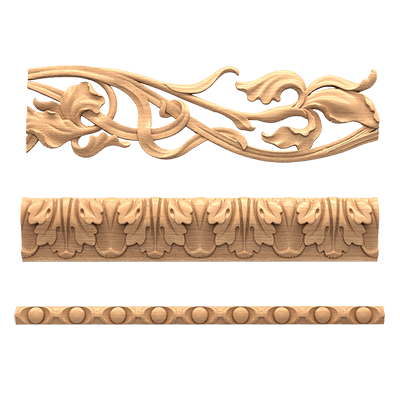
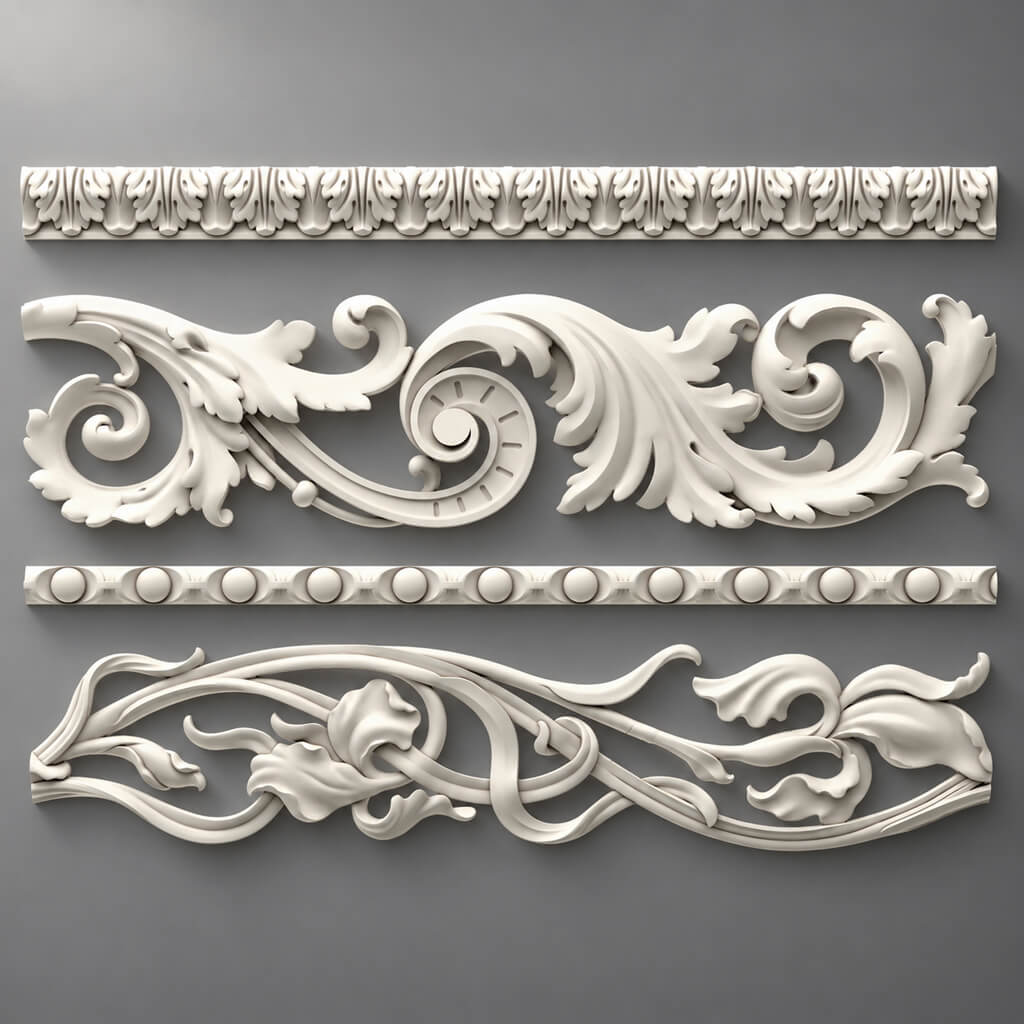
Beaded Molding
Beaded molding introduces a repeating row of rounded decorative elements.
This pattern is useful for traditional frames and furniture details.
A narrow beaded profile may complement floral corner accents, but the decorative system must remain visually balanced.
The STAVROS decorative trim molding collection includes beaded profiles that can be used for selected straight decorative borders.
When planning a corner, determine whether the pattern should continue through a matching connector or terminate against a separate corner ornament.
Do not assume that a generic square block will automatically match the bead spacing.
Rope Molding
Rope molding is another traditional decorative profile.
Its twisted or braided pattern introduces rhythm and texture.
It may be used around cabinet panels, decorative wall compositions, and other architectural details.
For example, STAVROS provides polyurethane rope-style trim within its ornamental molding range.
The important issue at corners is the continuity of the twisted pattern.
A poorly placed joint can interrupt the rhythm and make the finished frame look uneven.
Where no matching corner element exists, careful mitering or another planned termination may be preferable.
Acanthus Leaf Molding
Acanthus leaf molding has a stronger classical character.
The leaf motif is associated with traditional architectural ornament and elaborate decorative interiors.
It can be paired with selected floral or scrollwork corner elements when the scale and style are compatible.
A large acanthus pattern may be appropriate for a formal living room or decorative architectural panel.
It is less likely to work on a small frame in a narrow hallway.
For ornate designs, compare the patterns in the polyurethane ornamental molding catalog before combining elements from different collections.
Floral Molding and Decorative Friezes
Floral molding can soften the geometry of a rectangular panel.
A floral border may also connect decorative corner ornaments into a coordinated frame.
A frieze molding introduces a larger repeating design.
These details are useful in classical, Baroque-inspired, and selected neoclassical interiors.
However, not every floral profile needs additional ornamental corners.
A richly patterned molding may already provide sufficient visual complexity.
The best approach is to choose one primary decorative motif and use the corner accents to support it.
Designing Picture-Frame Wall Molding With Decorative Corners
Picture-frame molding is an effective way to introduce architectural structure to a plain wall.
It can create the appearance of decorative paneling without installing full raised wall panels.
The wall itself becomes the background inside the molding frame.
Adding polyurethane corner ornaments creates a more elaborate interpretation of this familiar technique.
Start With the Wall Layout
Measure the usable wall width and height.
Record doors, windows, outlets, switches, sconces, and furniture positions.
Determine whether the composition should be centered on the wall, the furniture, or another architectural feature.
A decorative wall behind a sofa may use one large central frame or several repeated smaller frames.
A hallway may need narrower panels to fit between door openings.
Choose the overall layout before selecting corner ornaments.
Establish Frame Proportions
Suppose a wall is 120 inches wide.
You want three identical decorative frames, each 24 inches wide.
Their total width is:
3 × 24 = 72 inches.
Remaining space:
120 − 72 = 48 inches.
If the design uses two internal gaps and two outer margins, four equal 12-inch spaces will fit mathematically.
However, this is only the starting geometry.
The decorative corner ornaments may extend beyond the straight molding.
Their full outer dimensions must be included when evaluating the actual visual spacing.
Consider the Corner Ornament's Footprint
A narrow frame may look well proportioned with ordinary mitered corners.
Add a large 12-inch ornamental corner piece, and the same frame may become visually crowded.
This is why corner selection should follow the layout.
For a compact panel, consider smaller corner elements.
For a broad formal composition, larger ornaments may be appropriate.
The relationship between the frame's interior space and the corner ornament is particularly important.
Plan the Color and Finish
Tone-on-tone painting creates a restrained architectural effect.
The molding and corner pieces are finished in the same color as the wall.
Their forms remain visible through light and shadow.
For a more traditional interior, white molding against a colored wall creates a stronger contrast.
Selected ornamental accents may also receive a compatible decorative finish.
However, the more elaborate the ornament, the more carefully the finish should be controlled.
How Many Polyurethane Molding Corners Do You Need?
The calculation starts with the actual number of decorative corner positions.
For rectangular frames, this is straightforward.
Number of corners = number of frames × corners per frame
A conventional rectangular frame has four corners.
For three frames:
3 × 4 = 12 corner positions
If the selected product is a symmetrical corner that can be used at all four positions, the initial requirement is twelve pieces.
For a directional left-and-right system, the quantities are different.
Example: Three Frames With the MLDPU-002 Ornamental System
Suppose three decorative frames use MLDPU-002 straight molding and the MLDPU-2U-2.1L/R floral corner system.
The manufacturer describes a symmetrical arrangement requiring two left-hand and two right-hand corner ornaments per frame.
For three frames:
| Component | Per frame | Three frames |
|---|---|---|
| MLDPU-2U-2.1L | 2 | 6 |
| MLDPU-2U-2.1R | 2 | 6 |
| Total ornamental corners | 4 | 12 |
The straight molding quantity must be calculated separately.
This depends on whether the ornaments replace part of the straight profile, connect to it, or overlay it.
Do not automatically subtract the full width of a corner ornament from the frame perimeter.
Use the product drawing to determine the actual straight-section cut lengths.
Should You Order Extra Corners?
For a small project, one spare corner may be reasonable when the component is difficult to replace.
For a larger project, a modest contingency can help account for accidental damage or installation mistakes.
However, a universal 10–15% allowance is not always necessary.
For directional ornaments, consider whether a spare left-hand piece and a spare right-hand piece are appropriate.
Ordering a surplus of one orientation does not solve a shortage of the other.
Also confirm the seller's return policy before purchasing extra material.
Polyurethane Corner Blocks for Doors and Cabinet Fronts
Decorative molding corners are not limited to walls.
They can also be used on furniture and doors where a raised frame is part of the design.
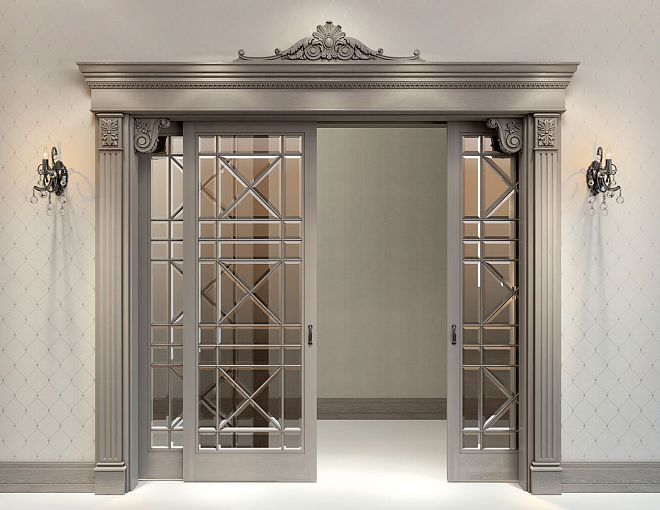
Decorative Door Panels
A plain interior door can be enhanced with applied molding.
The straight profiles establish rectangular or shaped frames.
Corner accents may soften the intersections or introduce floral detail.
Before choosing the ornaments, measure the available flat surface.
Account for handles, hinges, locks, and the door's swing clearance.
A decorative element that extends beyond the safe mounting area can interfere with normal door operation.
For doors with special fire ratings or other listed performance characteristics, modifications may be restricted.
Confirm the applicable requirements before attaching decorative products.
Cabinet Doors
Cabinet fronts are another common application.
A narrow decorative frame can create the appearance of a more traditional panel.
For a larger cabinet, ornamental corners may add a classical character.
The selected corner should match the scale of the cabinet door.
A large wall-panel corner ornament will usually be excessive on a small kitchen cabinet front.
For furniture-scale decoration, compact corner accents from the polyurethane molding decor collection may be more appropriate.
Dressers and Wardrobes
A dresser or wardrobe offers opportunities for symmetrical ornament.
A pair of decorative corner accents can frame a central panel.
Larger wardrobes may accommodate complete four-corner compositions.
However, decorative pieces should not cross moving joints or interfere with hardware.
The mounting surface must also be suitable for the selected adhesive.
For additional decorative accents, explore polyurethane furniture onlays and appliques.
These can complement molding corners when their scale and ornament are coordinated.
Inside and Outside Room Corners: Important Installation Differences
One of the most common misunderstandings concerns the use of decorative wall-frame corners at actual room corners.
They are different applications.
Inside Wall Corners
An inside room corner is formed where two wall planes meet.
A horizontal molding passing through that corner needs an appropriate transition between the profiles on the adjacent walls.
The conventional solution often involves accurately cut joints.
Some manufacturers offer dedicated inside corner components for particular molding systems.
However, a flat decorative L-shaped corner used on a picture-frame panel is not automatically suitable for a room corner.
Before selecting any prefabricated piece, confirm that its geometry is intended for the intersection of two wall planes.
Outside Wall Corners
Outside corners occur around projecting wall sections, pilasters, and similar architectural details.
These locations are generally more exposed to contact.
The selected trim or corner system should be appropriate for the installation and expected conditions.
Some designs use mitered profiles.
Others may use purpose-made outside corner components.
A decorative ornament should not be treated as an impact-protection device unless it is specifically designed and rated for that purpose.
Irregular Angles
Not all room corners measure exactly 90 degrees.
A nominally square corner may deviate enough to create visible gaps.
Do not assume that a prefabricated 90-degree corner will accommodate any deviation.
Measure the actual angle.
Check whether the selected component permits adjustment.
For highly irregular conditions, custom fitting or a different molding arrangement may be required.
Large gaps should not simply be concealed with excessive caulk.
Polyurethane Molding Corners for Crown Molding
Crown molding is installed where walls meet ceilings.
Its corner geometry is more complicated than that of flat wall molding.
A conventional crown profile is often mounted at a spring angle.
The profile contacts both the wall and ceiling.
This means the corner connection must account for the installed orientation.
Inside Crown Molding Corners
For many crown molding systems, the inside corner is formed using appropriate mitering, coping, or other specified joinery.
A purpose-made corner block may simplify some installations, but only when it is designed for the selected crown profile.
The corner block must align with the profile's projection and installed geometry.
A decorative wall-panel corner is not an appropriate substitute.
Outside Crown Molding Corners
Outside crown corners are highly visible.
A clean, accurate joint is important because the trim projects away from the wall.
Some architectural systems provide dedicated outside corner pieces.
Others rely on precise cutting.
The correct method depends on the profile and the manufacturer's installation instructions.
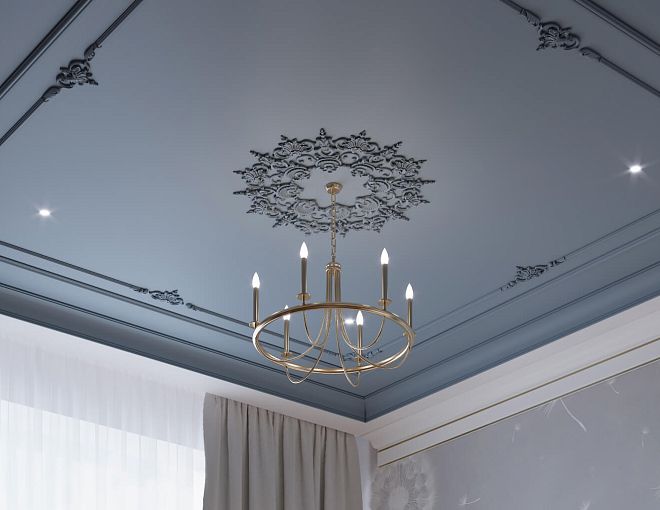
Decorative Ceiling Corners
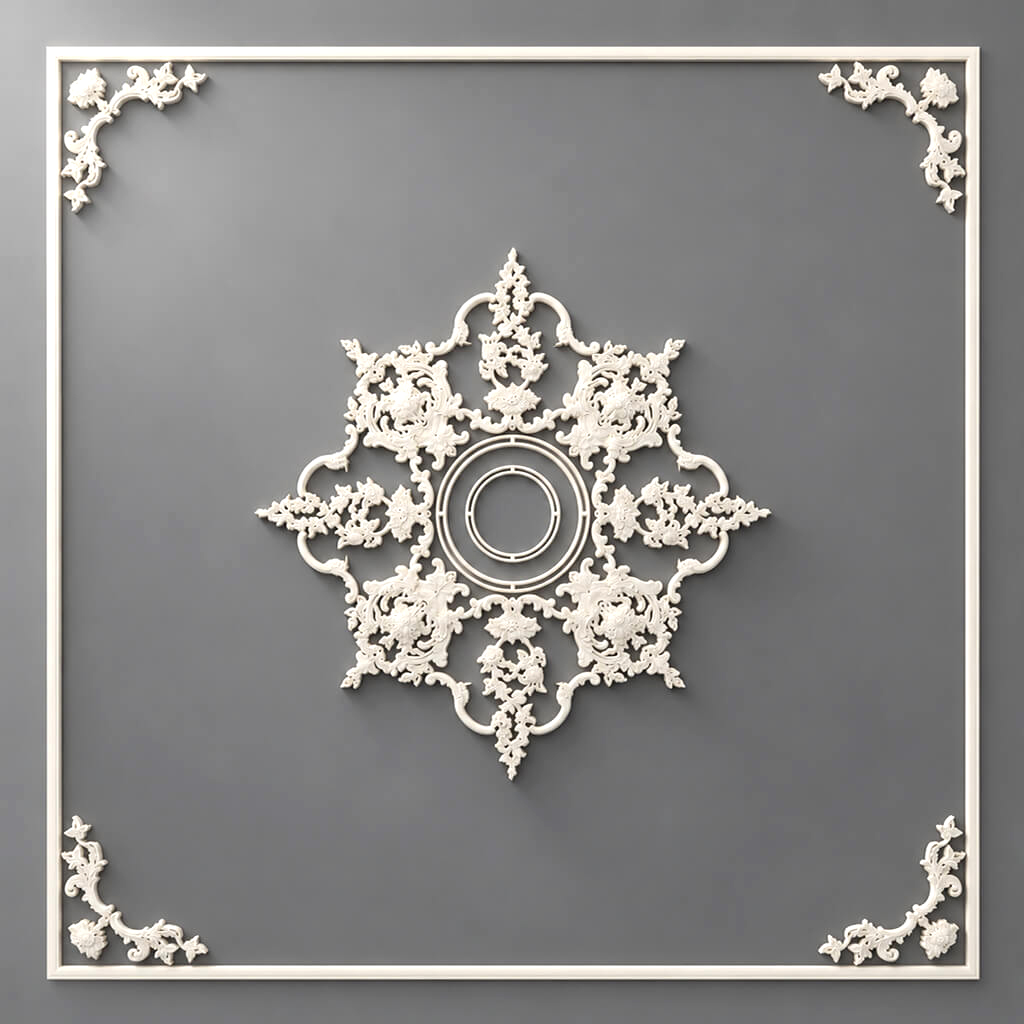
In elaborate classical interiors, additional ornamental components may be placed near the ceiling perimeter.
These may include floral accents, scrollwork, or larger architectural decorations.
However, an ornament placed near a ceiling corner should not automatically be described as a crown molding connector.
It may function solely as an applied decorative accent.
STAVROS offers ceiling decorative compositions that can be coordinated with appropriate molding systems.
Check the material and intended application of each component.
Baseboard Corners: Do You Need Decorative Corner Blocks?
Baseboards have a different function from decorative wall molding.
They finish the wall-to-floor transition and are exposed to regular household contact.
A corner component for baseboards must match the selected baseboard profile.
Inside Baseboard Corners
Many baseboards are joined using an appropriate inside-corner cutting technique.
Depending on the material and profile, coping or mitering may be used.
Some products have matching prefabricated corner accessories.
The installation method should account for the actual wall angle and profile geometry.
Outside Baseboard Corners
Outside corners are more vulnerable to impacts from shoes, furniture, and cleaning equipment.
The selected material and joint design should be appropriate for these conditions.
A decorative polyurethane wall-panel corner should not automatically be used as a baseboard corner.
Coordinating Baseboards and Wall Molding
The baseboard and the decorative wall frames can share an architectural style without using identical materials.
For example, a room may combine appropriately selected baseboard profiles with polyurethane decorative wall molding.
The important relationship is visual consistency.
The width, projection, finish, and overall proportions should work together.
Polyurethane vs. Wood, Plaster and Polystyrene Corner Elements
Architectural corner ornaments can be made from several different materials.
Polyurethane is one option, but the best choice depends on the project.
| Material | Advantages | Considerations |
|---|---|---|
| Polyurethane | Detailed molded relief, relatively lightweight, many paintable designs | Formulation, adhesive and finish compatibility vary |
| Solid wood | Natural grain and traditional architectural character | Moisture movement, cost and finishing requirements |
| Plaster | Authentic traditional sculptural appearance | Weight, brittleness and specialized installation |
| High-density polystyrene | Consistent profiles and economical decorative options | Performance varies by product grade |
| MDF | Smooth painted profiles and predictable straight geometry | Edge sealing and moisture protection |
Polyurethane vs. Plaster
Plaster has a long history in classical architectural ornament.
It can reproduce detailed decorative forms and remains a suitable material for specialist restoration work.
However, plaster ornaments may be relatively heavy and vulnerable to chipping, depending on their composition and shape.
Polyurethane can provide a lightweight molded alternative for selected nonstructural decorative applications.
It does not automatically reproduce every material characteristic of traditional plaster.
The choice depends on the project requirements and desired result.
Polyurethane vs. Carved Wood
Carved wood has a different visual and tactile character.
Natural grain, species, and finishing techniques contribute to its appearance.
For stained or clear-finished architectural work, wood may be preferable.
Polyurethane can be useful where the final finish is opaque paint and the design requires repeated detailed ornaments.
Wood remains subject to moisture-related movement, but properly manufactured and installed wood trim can provide long service.
Neither material should be described as completely immune to dimensional change.
Polyurethane vs. Polystyrene
The comparison depends on the specific products.
Low-density foam polystyrene and engineered high-density polystyrene are different materials in practical trim applications.
High-density products can provide good surface quality and impact resistance.
Polyurethane is particularly useful for cast ornamental relief.
Do not assume that every polyurethane corner is stronger or more durable than every polystyrene alternative.
Polyurethane and MDF Together
Some decorative frame systems combine polyurethane ornaments with primed MDF straight molding.
This can be a practical design approach.
The MDF provides the linear frame, while the polyurethane corner adds sculpted ornament.
However, the materials may require different preparation and have different moisture-related characteristics.
The finished assembly must be evaluated as a complete system.
STAVROS wall molding kits and decorative compositions include designs using polyurethane components and, in some cases, MDF profiles.
Always review the component list when material selection matters.
How to Install Polyurethane Molding Corners
A clean installation requires accurate layout, suitable surface preparation, compatible adhesive, and careful finishing.
The specific installation method depends on whether the corner is a connector, a rounded transition, or a decorative overlay.
Step 1: Identify the Corner Type
Before installation, determine exactly how the component interacts with the straight molding.
Does it replace the conventional corner joint?
Do the straight sections terminate against it?
Does the decorative piece cover an existing miter?
Is it intended as a separate ornamental accent?
The answers determine the installation sequence.
Consult the product drawing or manufacturer's instructions.
Step 2: Prepare the Surface
The mounting surface should be clean, dry, sound, and suitable for adhesive bonding.
Remove dust, grease, loose paint, and other contaminants.
Repair damaged plaster or drywall before adding decorative components.
If the existing coating is glossy or otherwise difficult to bond, follow the adhesive manufacturer's preparation requirements.
Do not rely on a strong adhesive to compensate for unstable paint or a deteriorating substrate.
Step 3: Mark the Complete Frame
Use a level, tape measure, and straightedge to establish the design.
Mark the outer dimensions of the decorative frames.
Then position the corner pieces.
For repeated frames, use consistent reference lines.
Check the full footprint of each ornament.
A large corner may extend beyond the straight molding and affect the perceived spacing between neighboring panels.
Step 4: Dry-Fit the Components
Position the molding and corners without adhesive.
Check the transitions.
Confirm that the decorative relief lines up as intended.
For directional ornament, verify the left-hand and right-hand positions.
If the design uses a combination of polyurethane and MDF, check that the relevant surfaces align appropriately.
This is the stage to correct size or orientation mistakes.
Step 5: Cut the Straight Molding
Use an appropriate cutting tool for the selected profile.
For conventional rectangular frames, mitered corners may be required.
For some preformed corner systems, square-cut ends may be specified.
For overlay systems, the underlying molding may still need precise cutting.
Do not assume that every decorative corner eliminates the need for a miter saw.
Follow the component's intended construction method.
Step 6: Choose a Compatible Adhesive
Use an adhesive approved for the polyurethane component and the mounting substrate.
Depending on the product and surface, the installation may involve an appropriate construction adhesive or another specified bonding system.
The correct adhesive depends on the formulation, required bond strength, application conditions, and manufacturer recommendations.
Do not assume that every product described as liquid nails, mounting adhesive, or polyurethane glue is suitable.
Check the technical data sheet.
Step 7: Position and Secure the Corner
Apply the adhesive according to the approved pattern.
Avoid excess material that might squeeze into the decorative relief.
Position the component accurately against the layout marks.
Apply the specified pressure and support.
Some small elements can be held using appropriate temporary tape.
Larger pieces may require more substantial temporary support or additional approved fastening.
Do not assume that pressing for a fixed number of seconds provides sufficient curing for every adhesive.
Step 8: Install the Straight Profiles
Position the adjoining molding as required by the system.
Maintain the intended alignment.
The molding should meet the corner component without unwanted steps or visible misalignment.
If the parts do not fit correctly, check the series compatibility and cutting dimensions.
Do not force mismatched products together.
Step 9: Finish the Joints
Once the attachment system has cured, inspect the transitions.
Use suitable joint adhesive, filler, or paintable sealant where specified.
A small surface imperfection may be corrected through careful filling and finishing.
However, large gaps or badly aligned profiles should be addressed through proper fitting rather than concealed under excessive filler.
Avoid damaging the ornamental relief when sanding or cleaning the joint.
Step 10: Prime and Paint
Check whether the molding and corner elements are factory-primed.
Follow the manufacturer's finishing recommendations.
Use compatible primer where required, then apply the approved finish coating.
Avoid excessive paint buildup.
Ornamental corners often contain small recessed details that can become less defined under thick layers of paint.
A careful finish helps the separate components read as one architectural composition.
Painting Polyurethane Corner Molding: Creating a Cohesive Finish
Polyurethane decorative elements are commonly selected for painted architectural interiors.
Their molded relief can be emphasized through color, sheen, and lighting.
However, coating compatibility should be confirmed for the actual product.
White Architectural Trim
White molding creates a familiar traditional appearance.
It works well with picture-frame wall molding, door casing, and neoclassical decorative panels.
For a cohesive finish, the straight molding and corner ornaments should be painted using compatible coatings with a consistent sheen.
Any differences in surface preparation should be addressed before painting.
Tone-on-Tone Wall Molding
Painting the molding and wall the same color emphasizes the sculptural form without creating a strong outline.
This approach can work particularly well in contemporary and transitional interiors.
A subtle satin or eggshell finish may reveal the corner relief through changing light.
The appearance will depend on the room's lighting and the profile's projection.
Contrasting Decorative Corners
A decorative corner can be finished in a different color from the straight molding.
For example, a dark frame with a restrained metallic corner accent may suit an Art Deco-inspired design.
However, contrasting every corner can create visual clutter.
Use contrast selectively and consider the entire room.
Metallic Finishes and Patina
Bronze, gold, copper, and other metallic effects can emphasize ornate details.
Patination can highlight the recesses of floral and acanthus ornaments.
Use compatible decorative coatings.
Test the effect on a sample before finishing a complete wall composition.
Avoid heavy glaze or paint that obscures the sculpted details.
Can You Use Any Paint on Polyurethane?
No.
Polyurethane products can have different coating compatibility requirements.
Water-based acrylic or latex paints are common choices for many architectural polyurethane products.
Some products may also be compatible with selected other coatings.
However, solvent-based paints, aggressive primers, and specialty finishes should not be used without checking the manufacturer’s instructions.
The correct finish is the one specified or approved for the individual product.
Decorative Corner Molding Styles for American Homes
Different interior styles call for different levels of ornament.
A carefully selected corner can reinforce the architectural character of the room.
An oversized or unrelated element can have the opposite effect.
Traditional American Interiors
Traditional interiors often feature clearly defined trim, decorative wall panels, and coordinated door casings.
Corner ornaments can introduce a refined level of detail.
A small floral accent may be sufficient for a restrained traditional living room.
More substantial corner blocks may suit formal dining rooms or larger architectural compositions.
The key is to maintain a consistent decorative language.
Neoclassical Interiors
Neoclassical design emphasizes symmetry and balanced proportions.
Wall molding can create a series of rectangular or shaped panels.
Decorative corner pieces provide controlled architectural emphasis.
For a refined result, select a matching molding and corner system rather than combining unrelated profiles.
A restrained polyurethane corner can provide ornament without overwhelming the wall.
Baroque and Rococo-Inspired Interiors
Baroque-inspired interiors use more elaborate sculptural details.
Large scrolls, floral motifs, acanthus leaves, and decorative friezes can all contribute to the composition.
In this context, ornamental molding corners can become focal points.
However, even an elaborate classical room benefits from a clear visual hierarchy.
A large decorative corner should relate to the scale of the wall and its surrounding elements.
A smaller wall frame may not have enough space to accommodate substantial scrollwork.
Art Deco Interiors
Art Deco emphasizes geometry, repetition, and strong silhouettes.
Stepped molding profiles and compact geometric corner blocks can support this style.
Metallic-looking finishes may provide selective accents.
Avoid combining heavily classical leaf ornaments with strictly geometric profiles unless the overall design intentionally supports that contrast.
Contemporary and Minimalist Interiors
Contemporary rooms generally benefit from restraint.
A simple rectangular wall frame may not need any decorative corner ornaments.
If corner blocks are used, clean geometric forms are often more appropriate than elaborate botanical relief.
Tone-on-tone finishing helps preserve the minimalist character.
The quality of alignment and joint finishing becomes particularly important because simple designs expose mistakes.
French Provincial and Transitional Interiors
French provincial-inspired interiors often combine soft ornament with painted finishes.
Rounded molding corners, delicate scrollwork, and floral accents can create an elegant effect.
In transitional interiors, a small ornamental corner may provide a connection between traditional architectural details and contemporary furniture.
The most effective designs avoid excessive decoration.
Current Design Directions: Architectural Corner Details in 2026
Decorative wall molding continues to provide opportunities for both traditional and contemporary interiors.
Several design approaches are worth considering when planning a 2026 renovation.
These are design options, not claims that every style is experiencing the same market trend.
Larger Decorative Frames With Fewer Ornaments
Instead of filling a wall with many small framed sections, a designer can use fewer and larger compositions.
This gives individual corner accents more visual importance.
Larger frames can also work well behind sofas, headboards, and dining room sideboards.
The selected ornaments should be proportionate to the available wall area.
Sculptural Tone-on-Tone Details
A molding and its decorative corner can be painted the same color as the wall.
The relief becomes visible through natural and artificial lighting.
This creates a restrained architectural effect.
It is especially useful for interiors that need depth without strong color contrast.
Layered Architectural Frames
One decorative frame can contain a smaller secondary frame.
The outer profile establishes the overall composition.
The inner profile introduces another level of detail.
Decorative corners may be concentrated on the outer frame while the inner frame remains simple.
This produces visual richness without using highly elaborate ornament everywhere.
Selective Metallic Accents
A metallic finish can be applied to selected ornamental details.
Rather than painting every corner gold or bronze, the design may use one emphasized centerpiece or a restrained set of accents.
This technique can complement Art Deco and selected classical interiors.
Coordinated Wall and Door Decoration
A consistent molding system can extend from wall panels to decorative door surfaces.
The profiles and corner ornaments do not have to be identical in every location, but they should belong to the same visual language.
This creates a more integrated interior.
Integrated Lighting
Lighting can enhance architectural molding, but ordinary corner ornaments should not be treated as electrical enclosures.
If a design includes LED strips, wiring, or other electrical components, the lighting system must be specified separately.
Use only products designed for the intended electrical application.
Power supplies and other electrical components must remain appropriately accessible and installed according to applicable requirements.
A decorative polyurethane corner should not be used to conceal electrical equipment unless the product and assembly are specifically suitable for that purpose.
How to Select the Right Decorative Corner Size
The dimensions of a decorative corner determine how it relates to the surrounding frame.
A common mistake is choosing the most elaborate ornament without checking its actual size.
Small Frames
Compact frames generally benefit from narrow profiles and smaller corner details.
A corner approximately 3–4 inches wide may be easier to integrate into a restrained composition than a large 12-inch ornament.
For this scale, a product such as MLDPU-001U may be worth evaluating.
Medium Wall Frames
A larger wall panel can accommodate more prominent corners.
The MLDPU-002U family provides one example of a medium-scale decorative transition.
The full 6.77-inch footprint should be included in the wall layout.
Large Formal Panels
Tall or broad classical frames may support larger ornamental components.
The 003 family includes corners with substantial dimensions and relief.
These products can contribute to an imposing architectural composition when the wall has sufficient space.
Check the Viewing Distance
A corner detail should be evaluated from the normal viewing position.
In a large living room, the ornament may be seen from several feet away.
In a narrow hallway, it may be viewed from close range and at an angle.
Fine relief can be more noticeable under directional lighting.
A heavily projecting ornament may appear too dominant in a confined space.
Make a full-size paper template or review product samples before ordering an entire room.
Cost of Polyurethane Molding Corners: What Affects the Price?
The cost of decorative corner molding depends on the product's size, complexity, manufacturing method, and supplier.
A small geometric corner generally requires less material and occupies a different market position from a large sculpted floral ornament.
However, price should be evaluated in the context of the complete installation.
Basic Corner Blocks vs. Ornamental Corners
A simple corner component may be used primarily to define the frame geometry.
An ornamental corner introduces an additional decorative function.
A larger, more detailed product may cost more, but it may also create an appearance that would otherwise require custom fabrication.
The correct comparison is not simply price per corner.
It is the complete installed cost of the decorative system.
Calculate the Full Frame Cost
A wall-frame project includes several components.
The straight molding establishes the main perimeter.
The corners add the desired decorative treatment.
Adhesives, filling materials, paint, and installation labor must also be considered.
If the corner ornaments cover part of the straight molding, the cutting plan may differ from a conventional mitered frame.
Do not calculate the molding and ornament quantities independently without checking how they fit together.
Commercial Projects and Multiple Rooms
For large projects, consistency becomes particularly important.
A designer or contractor may need dozens of matching corner pieces.
Record the exact product codes, left/right orientation, dimensions, and quantities.
Check availability for the entire project before scheduling installation.
For larger purchases, compare the complete order cost, including delivery and applicable fees.
An item that appears inexpensive individually may represent a substantial part of the total budget when multiplied across many wall frames.
Buying Polyurethane Molding Corners Online: What to Check
Selecting architectural trim online is convenient, but product photographs are not enough.
Before ordering, verify the actual dimensions, material, matching profile, decorative orientation, and installation method.
Confirm the Product Code
STAVROS organizes many corner components by molding family.
For example, MLDPU-002U is associated with the MLDPU-002 molding system.
The 003 family uses different dimensions and ornamental components.
Do not substitute one series for another based on a similar appearance.
Verify Left-Hand and Right-Hand Versions
Directional ornaments may require matching pairs.
For a symmetrical frame, the planned arrangement determines the quantities.
Review the manufacturer's product drawings.
Do not assume that rotating a left-hand ornament will always produce the same visual result as the right-hand version.
Check the Material
The STAVROS catalog includes polyurethane decorative products and certain coordinated systems using MDF straight molding.
If the project specification requires polyurethane throughout, check every component.
A product collection name alone does not establish that all components use the same material.
Compare the Actual Dimensions
For American projects, use the dimensions in inches.
Record the complete width, height, and projection.
A decorative corner can extend beyond the centerline of the straight molding.
Its full footprint affects the spacing between adjacent frames.
Check the Installation Details
Determine whether the corner is a connector or an overlay.
Confirm whether the straight profiles require square cuts, miters, or another preparation method.
Select compatible adhesives and finishes.
Confirm Delivery Arrangements
The English-language STAVROS website displays product information in inches and prices in U.S. dollars.
However, its published delivery information primarily refers to Russia and certain neighboring markets.
For a U.S. project, confirm international shipping availability, shipping costs, import requirements, and lead times before ordering.
Do not assume that U.S.-dollar pricing automatically means domestic U.S. inventory.
Polyurethane Molding Corners at STAVROS: Where to Start
The STAVROS catalog provides several ways to develop a coordinated decorative molding design.
For corner components, start with the polyurethane molding corners and decorative accents category.
This section includes rounded corner pieces, ornamental overlays, directional accents, and other elements designed for selected molding systems.
For straight profiles, explore polyurethane molding for walls and furniture.
This category includes the MLDPU profile families used in decorative frames.
For repeating ornaments, browse decorative polyurethane trim.
The collection includes beaded, rope-style, floral, and other decorative patterns.
For independent sculpted ornaments, consider polyurethane onlays and appliques.
These may be used as central decorative accents or in selected approved applications.
For customers who prefer to start with a complete design rather than selecting individual components, wall molding kits and decorative wall compositions provide coordinated arrangements.
The best starting point depends on whether the project requires one decorative frame, a full accent wall, furniture decoration, or a multiroom architectural treatment.
Frequently Asked Questions About Polyurethane Molding Corners
What Are Polyurethane Molding Corners Used For?
Polyurethane molding corners are used to create decorative transitions, corner accents, and selected connections within architectural molding systems. Common applications include picture-frame wall molding, decorative panels, cabinet fronts, and door decoration.
Do Decorative Corner Blocks Eliminate the Need for Miter Cuts?
Not always. Some corner connectors allow straight molding sections to terminate against them. Other products are decorative overlays installed over existing joints. Check the exact product design before deciding how to cut the adjoining molding.
Can I Use Wall Panel Molding Corners at the Corners of a Room?
Only if the specific product is designed for that geometry. Flat decorative panel corners are not automatically suitable for inside or outside room corners.
What Is the Difference Between a Molding Corner and a Rosette Block?
A molding corner may create a shaped transition or ornamental accent within a decorative frame. A rosette block is commonly used as a square or shaped decorative feature at selected trim intersections, particularly in traditional door casing.
Are Polyurethane Molding Corners Paintable?
Many polyurethane architectural corner products are paintable. Use compatible primer and finish coatings according to the manufacturer's recommendations.
Can Polyurethane Corner Molding Be Used in Bathrooms?
Suitable polyurethane products may be appropriate for certain humid interior environments. However, the adhesive, finish, substrate, and expected exposure must also be suitable. Do not assume approval for direct water exposure without product-specific documentation.
Is Polyurethane Better Than Wood for Decorative Corners?
Polyurethane can be useful for reproducing detailed molded ornaments and matching repeated components. Wood remains a strong choice where natural grain, traditional millwork, or particular joinery requirements are important.
Can I Install Polyurethane Corner Blocks Myself?
Some small decorative components are suitable for careful DIY installation when the mounting surface and product instructions permit it. Accurate layout, compatible adhesive, and proper curing remain essential.
How Many Corner Pieces Do I Need for Four Wall Frames?
Four rectangular frames contain sixteen corner positions. If each frame uses four identical corner components, sixteen pieces are needed. If the design uses two left-hand and two right-hand ornaments per frame, the order requires eight left-hand and eight right-hand components.
What Is the Best Molding for Neoclassical Wall Panels?
A coordinated molding and corner system with balanced proportions is a strong choice. The MLDPU-002 and 003 families provide different profile scales that can be evaluated for classical or neoclassical decorative frames.
Can I Use Polyurethane Corners With MDF Molding?
Yes, where the products are designed to work together. Some STAVROS corner elements are compatible with both polyurethane MLDPU profiles and related primed MDF profiles. Verify the exact series and finishing requirements.
Can I Use Decorative Corner Blocks With Crown Molding?
Only when the selected corner block is designed for the crown molding's actual cross-section and installed geometry. Flat wall-panel corner ornaments should not be substituted for crown molding corner connectors.
Can Molding Corners Be Used on Cabinet Doors?
Yes, appropriate polyurethane corner ornaments can be applied to suitable cabinet surfaces. Verify the dimensions, mounting conditions, and operating clearances before installation.
What Is Ornamental Molding?
Ornamental molding is decorative trim featuring relief patterns such as leaves, scrolls, flowers, beads, or geometric motifs. It may be used on walls, doors, furniture, and selected architectural features.
What Is Acanthus Leaf Molding?
Acanthus leaf molding features stylized foliage inspired by classical architectural ornament. It is often associated with elaborate decorative designs and can complement selected floral or scrollwork corner accents.
Does STAVROS Sell Left-Hand and Right-Hand Polyurethane Corners?
Yes. Certain STAVROS molding families include separate directional corner ornaments, such as the MLDPU-2U-2.1L/R and MLDPU-3U-2.1L/R systems. Their mirrored designs are intended for coordinated symmetrical arrangements.
Where Can I Buy Polyurethane Molding Corners Online?
You can explore polyurethane molding corners and decorative accents at STAVROS.
The catalog includes several molding families with different sizes and ornamental designs. Review compatibility, quantities, current prices, and destination-specific shipping terms before purchasing.
Final Thoughts: The Right Corner Details Complete the Architecture
Decorative molding is most effective when it forms part of a coherent architectural design.
The straight profiles establish the geometry.
The spacing determines the visual rhythm.
The corner elements define how the lines turn, connect, and become part of a larger composition.
A simple geometric corner can help create a restrained contemporary wall frame. A rounded polyurethane corner can soften a neoclassical panel. A carefully selected floral ornament can transform a plain rectangular border into a more expressive classical feature.
However, a corner component should never be chosen solely because it looks attractive in isolation.
The profile, scale, orientation, material, and installation method must work together.
For homeowners, that means planning the wall before selecting decorative details.
For designers, it means treating the corners as part of the architectural composition rather than as last-minute accessories.
For contractors and cabinetmakers, it means checking compatibility and creating an accurate cut list before ordering materials.
STAVROS offers polyurethane molding corners, decorative corner blocks, and ornamental accents that can be coordinated with matching polyurethane molding profiles and other architectural decorative elements.
By selecting the appropriate corner family, checking the actual dimensions, and finishing the components consistently, a decorative molding system can create a unified architectural appearance.
The best corner detail is not the largest or most elaborate one. It is the one that makes the entire molding composition look intentional, balanced, and complete.