Article Contents:
- Confirmed specifications of MLD-027U-1 and MLD-027U-2
- Direct comparison of U-1 and U-2
- What is the MLD-027 system
- How a ready-made corner differs from a 45-degree cut
- Why four identical corners are usually better
- Can I use U-1 on top and U-2 on bottom
- How to compare two patterns
- How to check the direction of the ornament
- Can I rotate the corner by 90 degrees
- What does the corner look like after a 180-degree rotation
- How to mark four parts
- Size 84 × 84 mm
- Size 124 × 124 mm
- Size 164 × 164 mm
- Size 204 × 204 mm
- How to choose size based on free space
- How to choose size based on frame width
- Why you cannot subtract only the outer size of the corner
- How to determine the junction point of MLD-027
- MLD-027 14 × 8 mm
- MLD-027 20 × 11 mm
- 1000 or 2400 mm from solid wood
- When to consider MDF length 2600 mm
- How to calculate one closed frame
- How to calculate several identical frames
- How many corners are needed for one frame
- Is a spare corner element needed
- How to calculate straight sections between corners
- Why the cutting map is more important than the total meterage
- How to use MLD-027 remnants
- Cutting allowance
- Dry assembly before painting
- How to check frame diagonals
- How to check the joint with a short sample
- How to choose U-1 for a large panel
- How to choose U-2 for a small door
- MLD-027U-1 on an interior door
- MLD-027U-2 on an interior door
- How to design a double-leaf door
- How to account for a door handle
- How to account for hinges and a lock
- Corner moldings for furniture fronts
- Corners for a wardrobe and dressing room
- Corners for a chest of drawers
- Corners for a sideboard
- Corners for kitchen fronts
- How to account for the gap between fronts
- Wall frame and boiserie
- Corners for an accent wall
- Corners for a small bedroom
- Corners for a hallway
- Frame around the mirror
- Frame around a painting or panel
- Decorative frame around wallpaper
- Corner for a niche
- Why U-elements are not a construction corner
- How not to confuse a corner with a regular overlay
- How not to confuse U-1 and U-2
- How not to confuse the straight MLD-027 with the old description
- Can a U-element be used with MLD-038
- Can I use a different semi-circular profile
- Why matching width alone is not enough
- Beech for enamel
- Oak for tinting
- What does "Prestige" sanding mean
- How to achieve the same color for corners and straight planks
- Test painting of the corner element
- Paint before or after assembly
- How to avoid filling the joint with enamel
- Clear finish for oak
- Can I patina the frame
- Installation on furniture facade
- Installation on an interior door
- Installation on painted wall
- Installation on drywall
- How to choose glue
- Is mechanical fixation needed
- How to press corners and straight planks
- How to treat joints
- How to carry an assembled frame
- How to store corner elements
- How to accept an order
- Error: select corner only by outer size
- Error: mix U-1 and U-2 in one frame
- Error: use old sizes of straight molding
- Error: buy molding without cutting map
- Error: not consider cut width
- Error: use leftovers on visible long side
- Error: paint before checking the joint
- Error: mix beech and oak
- Error: order different preparation qualities
- Error: overload a small facade with a size of 204 mm
- Error: choose 84 mm for a large wall without a layout
- Error: place decor in the handle area
- Error: count the corner as a protective profile
- Error: promising installation with glue only
- Error: not order the set as one batch
- Who MLD-027U-1 is suitable for
- Who U-1 may not suit
- Who MLD-027U-2 suits
- Who U-2 may not suit
- When a regular 45-degree cut is better
- When other decor for moldings is better
- How to buy MLD-027U-1 or U-2 on STAVROS
- What to check before payment
- When a design project is needed
- How to use the sample set
- How to design a wall in a classic style
- How to design a wall in neoclassical style
- How to use a frame in a modern interior
- How to design a commercial interior
- How to calculate a frame for a series of cabinets
- How to calculate frames for one wall
- How to make a control facade
- How to save data for reordering
- Why a ready-made corner saves work
- What not to do from scratch
- What to buy together with MLD-027U-1 or MLD-027U-2
- How to check the frame from a distance
- How to choose a corner for white enamel
- How to choose a corner for oak tinting
- How to calculate a set for one door
- How to calculate a set for four doors
- How to check symmetry on paired doors
- How to prepare an assembly list
- How to check the order before painting
- Why you can't fix incompatibility with a thick layer of putty
- Final check before purchase
- How to compare U-1 and U-2 on one template
- How to avoid mistakes when ordering after several months
- How to check the finish on four corners
- How to choose between expressiveness and versatility
- What makes a kit professionally assembled
- Why it's better to calculate the frame as a whole
- FAQ: questions about MLD-027U-1 and MLD-027U-2
- How does MLD-027U-1 differ from MLD-027U-2?
- Are both elements intended for MLD-027?
- What sizes are available for MLD-027U-1?
- What sizes are available for MLD-027U-2?
- How many corners are needed for a closed frame?
- Can U-1 and U-2 be combined?
- Can the corner be rotated 90 degrees?
- What size is suitable for a furniture front?
- What size should be chosen for a door?
- Which corner is suitable for a large wall panel?
- How to calculate the length of MLD-027?
- What cross-section of MLD-027 should I choose?
- Can I use a ready-made corner instead of a 45-degree miter cut?
- Will MLD-027U fit with MLD-038?
- What to choose — beech or oak?
- When should I paint the frame?
- Do I need to order the set in one batch?
- Where to buy MLD-027U-1?
- Where can I order MLD-027U-2?
- What should I check before ordering?
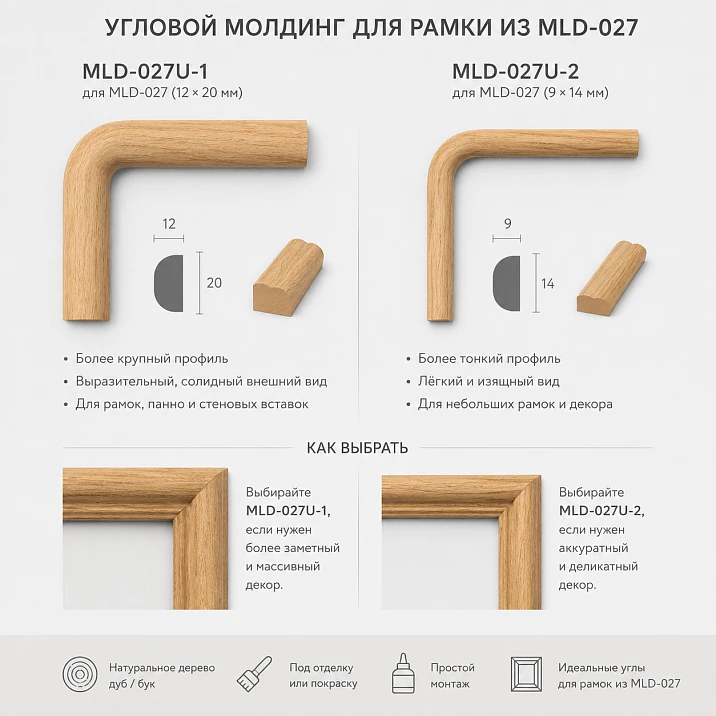
It is worth buying the corner molding MLD-027U-1 or MLD-027U-2 when the frame made of straight MLD-027 should have ready-made decorative turns rather than standard 45-degree end joints. Both elements are available in four external sizes — 84 × 84, 124 × 124, 164 × 164, and 204 × 204 mm — and are intended for walls, doors, furniture, mirrors, and decorative panels. However, the same external size does not make U-1 and U-2 interchangeable: they have different thickness and seating parameter.
Buy MLD-027U-1 available in sizes 84 × 84 × 13 × 23 × 117, 124 × 124 × 13 × 23 × 174, 164 × 164 × 13 × 23 × 231, and 204 × 204 × 13 × 23 × 287 mm. In all variants, C is 13 mm, D is 23 mm. This corner creates a deeper and more noticeable transition, so it is considered for large doors, cabinets, libraries, and wall panels.
Buy MLD-027U-2 can be in the same external formats, but with parameters C 10 mm and D 17 mm: 84 × 84 × 10 × 17 × 117, 124 × 124 × 10 × 17 × 174, 164 × 164 × 10 × 17 × 231 and 204 × 204 × 10 × 17 × 287 mm. U-2 is more compact in fit and better suited for small furniture doors, repeating facades, and lighter wall frames.
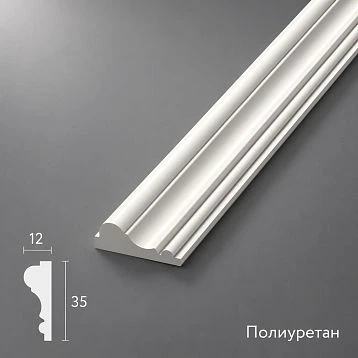
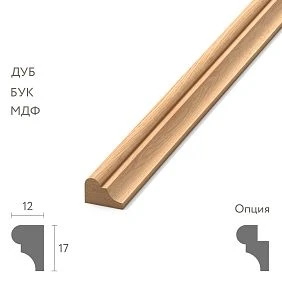
Straight sections are assembled from wooden molding MLD-027. The current card offers sections 14 × 8 and 20 × 11 mm in beech or oak with lengths of 1000 and 2400 mm, as well as MDF with a length of 2600 mm. The dimensional logic indicates two different mating scenarios, but the final correspondence of a specific angle to a specific section is verified by DWG and dry assembly, not just by similar numbers.
Short answer. For a closed rectangular frame, four identical corners of the same article and size are usually ordered. MLD-027U-1 has a larger fit C 13 and D 23 mm, MLD-027U-2 has a more compact fit C 10 and D 17 mm.
Do not mix U-1 and U-2 within the same frame without a separate project: even with the same external size, the pattern, depth, and connection point of the straight profile differ. After selecting the corners, measure the distances between the connection points and only then calculate the length of MLD-027.
Buy MLD-027U-1 Buy MLD-027U-2 Buy straight MLD-027 View all decor for MLD-027 Order frame layout
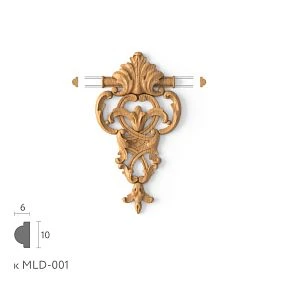
Confirmed specifications of MLD-027U-1 and MLD-027U-2
| Parameter | MLD-027U-1 | MLD-027U-2 |
|---|---|---|
| Product type | Ready decorative corner for frame | Ready decorative corner for frame |
| Size 1 A × B × C × D × L | 84 × 84 × 13 × 23 × 117 mm | 84 × 84 × 10 × 17 × 117 mm |
| Size 2 A × B × C × D × L | 124 × 124 × 13 × 23 × 174 mm | 124 × 124 × 10 × 17 × 174 mm |
| Size 3 A × B × C × D × L | 164 × 164 × 13 × 23 × 231 mm | 164 × 164 × 10 × 17 × 231 mm |
| Size 4 A × B × C × D × L | 204 × 204 × 13 × 23 × 287 mm | 204 × 204 × 10 × 17 × 287 mm |
| Material | Beech or oak | Beech or oak |
| Sanding | «Prestige» | «Prestige» |
| Preparation of beech | For enamel | For enamel |
| Oak preparation | For tinting | For tinting |
| Straight profile | MLD-027 system, interface checked per DWG | MLD-027 system, interface checked per DWG |
| Average production time for made-to-order items | 5–10 days | 5–10 days |




Direct comparison of U-1 and U-2
| Criterion | MLD-027U-1 | MLD-027U-2 | Practical conclusion |
|---|---|---|---|
| External dimensions | 84, 124, 164, 204 mm | 84, 124, 164, 204 mm | Scale can be compared directly |
| Thickness C | 13 мм | 10 мм | U-1 protrudes more |
| Mounting parameter D | 23 мм | 17 мм | Cannot use the same joint calculation |
| Frame character | Deeper and richer | More compact and lighter | Choice depends on the facade and straight profile |
| Small door | May look massive | Usually easier to place | Need a full corner template |
| Large panel | Reads more confidently | Gives a calmer outline | Both options are checked from a distance |
| Mixing in one frame | Not recommended without a project | Not recommended without a project | It is better to repeat the four corners identically |
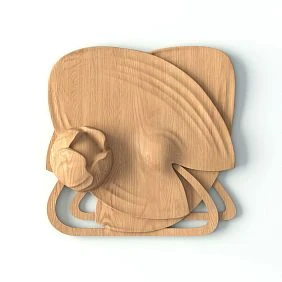
Our factory also produces:

What is the MLD-027 system
The system is built from a straight semi-circular profile and ready-made corner pieces. The straight MLD-027 forms the sides of the frame, while U-1 or U-2 create a decorative turn and simultaneously cover the joint.
This approach frees the buyer from attempting to cut a complex corner from two straight strips. The frame gets a repeating pattern on all four turns.
The system is suitable for walls, doors, furniture, and decorative panels, but requires precise calculation of the interface, number of corners, and length of straight sections.
Get Consultation
How a ready-made corner differs from a 45-degree miter cut
A regular miter cut joins two straight strips and maintains profile continuity. A ready-made U-element adds an independent decorative pattern and increases the external size of the corner.
With a miter cut, the main difficulty is the precision of the two ends. With a ready-made corner, the task of correctly calculating the junction point of the straight MLD-027 is added.
A ready-made element should be chosen when an expressive turn and repeatability across a series of frames are needed, not just a technical connection.
Why four identical corners are usually better
A closed rectangular frame is perceived as a single system when all four corners have the same pattern, size, depth, and finish.
If U-1 is placed on top and U-2 on the bottom, the difference between C and D becomes noticeable in the shadow and joints. Even identical external dimensions do not eliminate this difference.
Mixing is only acceptable as a separate project where asymmetry or hierarchy of corners is shown in advance on the facade.
Can U-1 be used on top and U-2 on the bottom
Technically, such a composition is only possible after a separate check, but it is not recommended for a standard frame.
The top and bottom will differ in thickness, fit, and pattern. On a small door, this looks like a configuration error; on a wall panel, it looks like a random mix.
If the project requires different corners, a full-size layout and four joint drawings need to be prepared.
How to compare two patterns
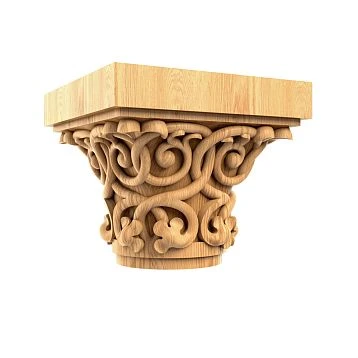
The card photo shows the general character of the ornament but does not replace the actual scale. Contours of 84, 124, 164, and 204 mm are printed at full size.
U-1 and U-2 are placed on the same facade next to the selected MLD-027. This shows which pattern is stronger, where the apex passes, and how much free space remains.
For a furniture series, it is useful to order a sample or one control set before the full production run.
How to check the direction of the ornament
The corner element rotates at each corner of the frame, so the pattern must be evaluated in all four orientations.
On the template, mark the top, bottom, left, and right sides. This helps to understand whether symmetry is preserved when rotated by 90 and 180 degrees.
Before painting, mark the four parts by position: top left, top right, bottom right, and bottom left.
Can the corner be rotated by 90 degrees
For a rectangular frame, rotation is a natural part of assembly, but the geometry and pattern are still checked against the DWG.
If the ornament is asymmetrical relative to the bisector, the visual character may change after rotation.
You cannot assume each side is completely identical just because the external dimensions A and B match.
What does a corner look like after a 180-degree rotation
A 180-degree rotation changes the direction of the pattern relative to the center of the frame.
On paired doors, this can be useful for mirroring, but the decision is made based on the layout, not automatically.
Photos of four unfolded corners help to preview the future composition in advance.
How to mark four parts
After dry assembly, the frame number and specific position are indicated on the back side or packaging.
Marking is especially important for oak intended for tinting, where the wood grain and shade of individual elements may differ.
After painting, identical corners can be easily confused, so the assembly diagram must be preserved until work is completed.
Size 84 × 84 mm
The most compact format is suitable for a small furniture door, drawer, narrow door panel, and small wall frame.
U-1 in this size maintains a deeper fit of C 13 and D 23 mm, U-2 — C 10 and D 17 mm.
On a small facade, even a 3 mm difference in thickness is noticeable, so the two templates should be compared next to the handle and edges.
Size 124 × 124 mm
The 124 mm format is suitable for medium cabinet doors, chests of drawers, sideboards, and door frames.
It already reads as an independent decorative corner, but does not take up too much of the facade.
For a series of identical doors, this size is convenient because it maintains a noticeable pattern without excessively enlarging the outer contour.
Size 164 × 164 mm
The 164 mm format is suitable for a tall interior door, a wide furniture panel, and a medium-scale wall frame.
U-1 creates a richer turn, U-2 — a lighter one at the same external size.
Before ordering, check that the corner does not approach the handle, trim, adjacent frame, or switch.
Size 204 × 204 mm
The large format is intended for wall panels, large doors, libraries, and accent frames.
On small furniture, such an angle can overload the facade and leave too little straight section between turns.
It is evaluated from a distance because up close the scale seems more justified than in the overall view of the room.
How to choose the size based on the free field
First, set the outer rectangle of the frame and mark handles, hinges, gaps, sockets, and other elements.
Then apply the corner templates. There should be enough space between the corner and the edge of the surface so that the pattern does not look cramped.
There is no universal offset: it depends on the size of the facade, the chosen corner, and the straight profile.
How to choose the size based on the frame width
A large corner requires sufficiently long straight sections between turns. If the frame is narrow, two adjacent corners begin to visually compress the profile.
On a wide wall panel, a large format helps maintain scale, while on a small facade, 84 or 124 mm works better.
The calculation is done at the connection points, not just by the external dimensions A and B.
Why you cannot subtract only the external size of the corner
The external dimension shows the overall size of the part, but the straight molding may not adjoin the very edge.
The seating parameter D and the drawing determine the actual connection point.
If you simply subtract two external dimensions from the frame width, the straight segment may turn out too short or too long.
How to determine the connection point of MLD-027
The point is found from the DWG of the corner element and profile, then confirmed with a short physical sample.
For U-1 and U-2 it differs because D is 23 and 17 mm.
All frame side calculations must use the same reference point.
MLD-027 14 × 8 mm
The compact section is available in beech and oak in lengths of 1000 and 2400 mm, as well as in MDF in lengths of 2600 mm.
It is suitable for light furniture and wall frames. In terms of dimensional logic, it is more often compared to the more compact U-2 fit, but the final match is confirmed by the drawing.
It cannot be automatically connected to any corner just because the profile is called MLD-027.
MLD-027 20 × 11 mm
The larger section is also available in beech and oak in lengths of 1000 and 2400 mm, and in MDF in lengths of 2600 mm.
It provides a more noticeable straight line and is more often considered alongside the deep U-1 fit.
Before placing a full order, you need to check the height of the front surfaces, the width of the rebate, and the absence of a step.
1000 or 2400 mm from solid wood
Planks 1000 mm long are convenient for small frames, samples, and short sides.
The length of 2400 mm allows cutting long verticals and reducing the number of intermediate joints.
The choice is made based on the cutting map, not on the assumption that a long plank is always more economical.
When considering MDF with a length of 2600 mm
MDF is available for direct MLD-027 in sections 14 × 8 and 20 × 11 mm with a length of 2600 mm.
It can be convenient for a long wall frame under opaque finishing, but corner elements U-1 and U-2 are made of beech or oak.
Mixing materials requires checking the finish, joint, and behavior of elements. Under transparent tinting, such a combination does not provide the same wood texture.
How to calculate one closed frame
For a rectangle, usually four identical corners and four straight segments of MLD-027 are needed.
First, set the external size of the frame, then determine the attachment points of the profile to each corner according to the drawing.
The lengths of the two horizontals and two verticals are calculated between these points, not between the outer edges of the corners.
How to calculate several identical frames
After approving one control size, a repeatable specification is created: four corners, two horizontals, and two verticals for each frame.
The number of frames is multiplied by the set, counting U-1 or U-2 and straight MLD-027 separately.
Before a serial order, one assembled frame is checked to prevent the error from repeating on the entire wall or furniture.
How many corners are needed for one frame
For a regular closed rectangle, four corner elements are needed.
An open composition, top decorative arch, or U-shaped frame may require two corners, but this is a separate scenario.
The order specifies not just the quantity of pieces, but the number of complete frames and the selected article.
Is a spare corner element needed
A spare may be useful for a large number of identical frames, complex finishing, or remote installation.
The universal rule for the percentage of reserve is not confirmed. The decision depends on the print run, deadlines, and risk of damage.
For a single frame, it is more rational to ensure precise packaging and careful installation than to automatically buy an extra part.
How to calculate straight sections between corners
On the drawing, mark the control point where the molding exits each corner.
The distance between two such points is the net length of the straight segment.
Then add a technological allowance for trimming, which the craftsman determines based on the chosen joint method.
Why the cutting map is more important than the total meterage
The same total meterage can be cut efficiently or result in many short leftovers.
The map shows which sides of the frames are cut from planks of 1000, 2400, or 2600 mm.
For oak, it also helps distribute the wood grain and assemble sides with similar tones.
How to use MLD-027 leftovers
Short leftovers are suitable for trial finishing, joint checking, and small frames.
They cannot be used on the long side just for savings if a noticeable intermediate seam appears.
Each leftover is marked by cross-section, material, and batch.
Margin for trimming
Stock is needed for end processing, trial joints, and possible chips.
It cannot be assigned as a single percentage without frame dimensions and a cutting map.
The more short elements and corners, the more important a preliminary layout is, rather than a mechanical increase in total length.
Dry assembly before painting
Four corners and straight sections are laid out on a flat surface without glue.
Check geometry, joints, diagonals, and pattern direction.
If one corner or profile does not match, the problem is resolved before enameling, tinting, and installation.
How to check the diagonals of the frame
In a rectangular frame, the diagonals must match.
The difference indicates a skew, incorrect side length, or corner displacement.
The check is performed on a dry assembly and after temporary transfer to a wall or facade.
How to check the joint with a short sample
A small piece of the selected MLD-027 section is applied to each U-element.
The face line should continue without a noticeable step or gap.
One sample is checked on all four corners, because even identical parts may be oriented differently.
How to choose U-1 for a large panel
U-1 has a deeper fit and protrudes more above the surface.
It is suitable where the angle needs to be readable from a distance and maintain a noticeable straight profile.
On a large wall, a size of 164 or 204 mm often looks more convincing, but the scale is still checked with a template.
How to choose U-2 for a small door
U-2 is more compact in thickness and fit, so it fits more easily into a limited space.
A size of 84 or 124 mm is suitable for a furniture door, a small drawer, and a repeating frame.
Before ordering, check the distance to the handle, the edge of the facade, and the adjacent sash.
MLD-027U-1 on an interior door
A deep angle creates a noticeable paneled composition on a smooth surface.
It is suitable for a tall door and a large central frame, where a small detail could get lost.
The markup is linked to the handle, lock, casing, and opening direction.
MLD-027U-2 on an interior door
The compact option suits a medium-sized door and multiple frames on one panel.
It provides a decorative turn without excessive thickness.
On a double door, all corners must be repeated identically on both leaves.
How to design a double door
You can create a separate frame on each leaf or a common mirrored system.
In the first case, eight identical corners are required; in the second, the quantity depends on the approved geometry.
Marking is done with the doors closed and adjusted.
How to account for the door handle
The frame must not enter the working area of the hand.
A large corner of 164 or 204 mm may approach the handle even with a sufficient external field.
The handle and corner templates are applied simultaneously, checking the grip and movement of the blade.
How to account for hinges and lock
The decor is installed on the front side, but fasteners and trimming must not weaken the hinge and lock areas.
On a thin blade, it is important to understand the internal structure.
Before drilling and mechanical fixation, the scheme is coordinated with the door manufacturer or craftsman.
Corner moldings for furniture facade
On a cabinet, sideboard, chest of drawers, and bookcase, ready-made corners help assemble repeatable frames without manually forming each turn.
U-2 is more often suitable for compact furniture, U-1 for large facades and central sections.
Ready-made examples can be viewed in the section select moldings and corners for the wardrobe.
Corners for wardrobe and dressing room
A tall wardrobe door allows using size 164 or 204 mm if the frame remains proportional.
On mezzanines and small drawers, 84 or 124 mm work better.
All facades in one group must have the same article number, size, material, and finish.
Corners for a chest of drawers
On a chest of drawers, frames are located close to handles and adjacent drawers.
U-2 helps maintain a lighter protrusion, especially on small facades.
U-1 is suitable for a wide central drawer if the handle and gaps allow for a deep corner.
Corners for the sideboard
The sideboard allows for richer decor and a combination of frames with a cornice, base, and glass sections.
U-1 can support massive architecture, U-2 can make the side doors calmer.
Mixing two options on one piece of furniture is only allowed with a clear hierarchy.
Corners for kitchen fronts
In the kitchen, repeatability, easy cleaning, and a free zone around the handle are important.
For many small doors, U-2 is often more convenient, but the choice depends on the frame size and straight profile.
The finish must protect the wood and be compatible with the room conditions.
How to account for the gap between fronts
The corner should not extend beyond the clean field of the door and approach the adjacent front in a way that hinders opening.
The template size is compared to the actual gap and door trajectory.
On a corner kitchen or cabinet, adjacent doors are opened simultaneously.
Wall frame and wainscoting
On the wall, ready-made corners form complete panels around a painted area, wallpaper, mirror, or painting.
U-1 creates a more pronounced architectural relief, U-2 creates a light frame for a series of panels.
In this section, you can view ideas for wall frames made of wooden moldings and assess the scale of finished compositions.
Corners for an accent wall
On a large wall, one small corner may get lost, so consider 164 or 204 mm.
Deep U-1 is better read in side light, U-2 looks calmer and suits multiple repetitions.
The number of frames and the distances between them are calculated on the full facade of the wall.
Corners for a small bedroom
In a small room, overly large decor fragments the surface and makes the frames heavy.
Sizes 84 or 124 mm are more often suitable for the bedside area, the wall behind the headboard, and a small mirror.
U-2 helps maintain a lighter chiaroscuro.
Corners for a hallway
In a narrow passage, it is important to consider the frame protrusion and the proximity of doors.
U-2 with a thickness of 10 mm is usually less noticeable in protrusion, but the straight profile and installation also affect the overall volume.
The template is checked from the side, not just from the front.
Frame around the mirror
Ready-made corners can form a decorative contour around the mirror, but are not a load-bearing frame.
The mirror mounting is calculated separately, while the molding and corners are installed as decor.
The corner size is chosen based on the free space around the mirror and the width of the wall.
Frame around a painting or panel
Corner elements help connect straight sides and highlight the central image.
U-1 is suitable for a large panel, U-2 for a small painting and a calm frame.
The decor should not overlap the baguette or the artwork's fastening.
Decorative frame around wallpaper
The wallpaper insert gets a finished contour if the corners and straight profile follow the same system.
The frame color can be made close to the wall or contrasting.
Before installation, check that the glue and finish do not damage the wallpaper surface.
Corner for niche
In a niche, the frame emphasizes the border and makes the inner field more cohesive.
Deep U-1 requires sufficient slope width and free space.
U-2 fits more easily into a compact niche, but the exact size is determined by a template.
Why U-elements are not construction corner beads
MLD-027U-1 and U-2 are designed for decorative turning of the frame on a flat surface.
They do not protect the external wall corner from impacts and do not replace plaster or metal profiles.
The buyer should search for them using queries for decorative corner molding, not construction trim.
How not to confuse a corner with a regular overlay
The corner element has geometry for rotating the straight MLD-027.
A regular overlay can work as a center or side decor, but does not necessarily have the required connection points.
The card checks the U article, drawing, and connection to the MLD-027 system.
How not to confuse U-1 and U-2
Identical external dimensions create a risk of ordering the wrong variant.
The specification must include C and D: 13/23 for U-1 and 10/17 for U-2.
The full article is written on the packaging and installation list.
How not to confuse the straight MLD-027 with the old description
The current table shows cross-sections of 14 × 8 and 20 × 11 mm.
Old materials may contain 14 × 9 or 20 × 12 mm, but orders are placed according to the current card and DWG.
The installer must obtain the current drawing along with the specification.
Can a U-element be used with MLD-038
Compatibility with MLD-038 is not confirmed.
Even similar width or shape does not guarantee a matching fit.
For a different system, choose the appropriate corner decor or design a special joint.
Can another semicircular profile be used
The name of the shape is not proof of compatibility.
You need to compare width, height, radius, back side, and attachment point.
If the drawings do not match, random trimming can ruin the finished corner.
Why matching width alone is not enough
Profiles with the same width can have different heights and curvatures.
The corner should continue the face line without a step or gap.
Only dry assembly shows the real result.
Beech under enamel
Beech is chosen for opaque finishes and frames that must match the door, furniture, or wall.
U-1, U-2, and straight MLD-027 are ordered in the same wood species and same preparation.
The enamel should evenly cover the relief and joints without smoothing the decorative pattern.
Oak under tinting
Oak is suitable for translucent finishes when the natural wood texture is important.
All four corners and straight planks are best ordered in one batch and tinted together.
Differences in wood grain are acceptable, but the shade and gloss must be coordinated.
What does "Prestige" sanding mean?
"Prestige" means detailed manual surface preparation.
This is not a ready-made enamel, stain, or varnish, so a finishing cycle is still required.
Before painting, check the joints and, if necessary, perform only agreed local finishing.
How to get the same color on corners and straight planks
All elements are painted or tinted with one system and one batch of composition.
A test coat is done on the corner relief and straight profile because light distributes differently on them.
After drying, the set is examined together under real lighting.
Test coat of the corner element
The corner has more recesses and transitions than a straight molding, so it is better to check patina and enamel thickness on it.
Too thick a coating can fill in the fine pattern and alter the joint.
The sample is approved before painting all four parts.
Paint before or after assembly
Pre-finishing is convenient for side edges and deep relief areas.
Painting after assembly helps blend seams but complicates access to internal areas.
Often the main cycle is done before installation, and joints and local spots are touched up after a dry fit.
How to avoid flooding the joint with enamel
Excess layer on the mating surface reduces joint accuracy.
Contact areas are controlled separately and enamel is not used as a gap filler.
Geometry must match first, only then is finishing done.
Clear finish for oak
Staining and varnish emphasize the grain but also make differences between individual parts more noticeable.
Before assembly, the four corners are arranged in the most harmonious order.
The ends and joints are treated so that they do not appear darker than the front surface.
Can the frame be patinated
Patina suits classic and neoclassical compositions if its intensity is coordinated with the size of the corner.
On U-1, deep relief gives a more contrasting effect; on U-2, the patina may appear lighter.
Any complex finishing is calculated separately and is not considered automatically included.
Installation on a furniture front
The base must be level, durable, and compatible with the chosen adhesive or fasteners.
The frame is assembled and marked before installing handles, if the hardware is not yet secured.
The decor should not interfere with opening, hinges, or facade adjustment.
Installation on an interior door
The panel is checked for evenness, thickness, and internal structure.
The frame must not conflict with the lock, handle, or casing.
Before fixing, the door is fully opened and the trajectory of the corner decor is checked.
Installation on a painted wall
The paint must adhere firmly to the base. If the layer peels, the decor will come off with it.
Marking is done by level, checking diagonals and the uniform position of all frames.
For a large composition, the fixing method is chosen based on weight and wall type.
Installation on drywall
The fastening must rest on a suitable structure, not just on a thin sheet.
Light decor is sometimes mounted with glue, but a universal scheme without base assessment is not confirmed.
Before drilling, check the location of profiles and hidden utilities.
How to choose glue
The composition is selected based on the wood, base, and future coating.
In the catalog you can Buy materials for installing and finishing the frame after checking the instructions.
Adhesive should not be used as a thick leveling layer.
Is mechanical fixation needed
The solution depends on the frame size, base, and operating conditions.
Finish nails or other fasteners cannot be placed in thin relief without calculation.
Different schemes are used for walls, doors, and furniture.
How to press corners and straight strips
Pressure is distributed through soft pads over strong areas.
Do not clamp thin ornament or shift the corner relative to the marking.
Temporary stops are removed only after the curing time specified for the selected composition.
How to process joints
Small technological seams are filled with compatible material after geometry check.
A large gap cannot be hidden with a thick layer of putty: first, the length or profile must be corrected.
All four corners must have the same joint quality.
How to transport an assembled frame
A large frame is best assembled and mounted in sections or on a rigid base.
When transported without support, diagonals may change and joints may open.
The method is chosen based on size, material, and installation location.
How to store corner elements
Parts are stored on a flat surface and the relief is protected from point pressure.
Four corners of one frame are kept together with marking of article, size, and position.
Beech and oak from different batches are not mixed without checking.
How to accept an order
They check the article U-1 or U-2, the full set A × B × C × D × L, the material and the quality of sanding.
Straight MLD-027 is checked by cross-section, length and wood species.
Before painting, a dry assembly of one full corner is performed.
Error: select the corner only by external size
U-1 and U-2 have the same A, B and L, so they appear the same by the first numbers.
Differences in C and D determine the thickness and fit.
In the order, you need to check the full five-digit size.
Error: mix U-1 and U-2 in the same frame
Different thickness, fit, and pattern break symmetry
Error: using old sizes of straight molding
Old descriptions mention 14 × 9 and 20 × 12 mm.
Current card indicates 14 × 8 and 20 × 11 mm.
Order and calculation are based on current data.
Error: buying molding without a cutting map
The total meter count does not show how many planks of 1000 or 2400 mm are actually needed.
Long sides may not fit the selected length.
A cutting map reduces waste and the number of unnecessary joints.
Error: not accounting for cut width
Each cut reduces the useful length of the plank.
On a series of frames, the accumulated loss becomes noticeable.
The technological allowance is determined before ordering.
Error: using remnants on the visible long side
An intermediate joint can ruin the continuity of the profile.
It is more rational to use remnants on short sides, samples, and test corners.
Savings should not compromise appearance.
Error: painting before checking the joint
After enamel or tinting, trimming is more difficult and may damage the coating.
First, assemble the corner dry.
Only a confirmed set is sent to finishing.
Error: mix beech and oak
The species differ in texture and behavior under a transparent coating.
Corners and the straight profile of one frame are selected from the same material.
Mixing under enamel also requires separate approval and is usually not needed.
Error: order different preparation qualities
U-elements and straight MLD-027 must have a consistent surface.
Different sanding affects staining and the joint.
The specification records "Prestige" and preparation for enamel or tinting.
Error: overload a small facade with a size of 204 mm
A large corner occupies a significant part of the door and shortens straight sections.
The frame becomes visually heavy and may conflict with the handle.
First, check the 204 × 204 mm template.
Error: choose 84 mm for a large wall without a layout
A compact corner may get lost on an accent panel.
Repeating many small elements sometimes works, but requires a common wall facade.
One size does not fit all.
Error: place decor in the handle area
The hand will touch the relief, and the coating will get dirty faster.
The working grip is tested with real hardware.
When there is a conflict, the size is reduced or the position of the frame is changed.
Error: consider the corner as a protective profile
MLD-027U is designed for a decorative frame on a flat surface.
It does not reinforce the external building corner.
To protect the wall, choose a different system.
Error: promise installation only with glue
The method of fixation depends on the base, size, and operating conditions.
On furniture, doors, and walls, the requirements differ.
Glue can be part of the solution, but not a universal answer.
Error: not ordering the kit as one batch
Individual reorders may differ in wood shade and availability.
It's better to calculate four corners and a straight profile in advance.
For oak, a single batch is especially important for tinting.
Who MLD-027U-1 is suitable for
U-1 is suitable for large doors, cabinets, libraries, and wall panels where a deeper turn is needed.
It is especially appropriate next to a prominent straight profile and in compositions viewed from a distance.
The buyer needs to have enough free space around the corner.
Who U-1 may not suit
On a small drawer and narrow door, the 13 mm thickness and 23 mm seating may look bulky.
If the frame should be lightweight, it's worth comparing U-2.
The decision is made after a full-size template.
Who is MLD-027U-2 suitable for
U-2 is suitable for small furniture fronts, kitchen doors, frame series, and compact wall panels.
The thickness of 10 mm and D 17 mm create a lighter joint.
It is convenient when the decor should support the facade rather than dominate.
Who U-2 may not suit
On a large wall or massive bookshelf, a compact fit may look too calm.
If a strong relief is needed, compare with U-1.
The external size of 204 mm alone does not replace depth.
When a regular 45-degree miter cut is better
A simple miter cut is suitable for a minimalist frame without an independent corner pattern.
It requires precise tools and a neat joint, but takes up less space.
A ready-made U-element is chosen for a decorative turn, not as a mandatory part of any frame.
When other decor for moldings is better
If a central medallion, side overlay, or left and right element is needed, the corner U-decor won't solve this task.
In the category you can Buy Decor for Moldings and choose the element type by function.
Do not turn the corner into a random central appliqué.
How to buy MLD-027U-1 or U-2 on STAVROS
First, choose the pattern and outer size, then check C, D, and the straight profile.
After that, calculate four corners per frame and the cutting map for MLD-027.
For a complete selection, you can select compatible corners and trims of the MLD-027 system.
What to check before payment
The order must include the full article number, size A × B × C × D × L, material, preparation, and quantity.
For MLD-027, specify the cross-section, length, and material.
Current payment and delivery terms for moldings are checked before ordering.
When a design project is needed
The project is useful for a large wall, series of doors, mixing sizes, and complex geometry.
You can order a frame layout with U-1 or U-2 and get an approved facade.
The project records connection points, lengths, and direction of corners.
How to use the sample set
You can purchase the OMLD-005 sample set to compare molding shapes before ordering.
The presence of specific U-1 and U-2 in the set should not be promised without verification.
A straight profile sample is still useful for assessing scale and finish.
How to decorate a wall in a classic style
A classic frame allows for a deeper U-1, patina, and oak tinting.
The corner size is related to the wall height, cornice, and baseboard.
Additional ideas are provided in the article about decorating walls with wooden moldings.
How to decorate a wall in neoclassical style
Neoclassicism requires calmer geometry and moderate relief.
U-2 is often a better fit due to its compact thickness, especially under solid enamel.
The large external size can be maintained without making the joint excessively deep.
How to use a frame in a modern interior
The finished corner can be painted the color of the wall to remove decorative contrast.
U-2 helps maintain a laconic character, while U-1 is used as a deliberate volumetric accent.
Patina and contrast tinting are usually not necessary in such a project.
How to design a commercial interior
In a hotel, salon, or restaurant, frames are repeated in a series and must be identical.
Before mass production, a control sample is assembled with the actual color and mounting.
The room statement prevents mixing U-1 and U-2.
How to calculate the frame for a series of cabinets
Each facade type is assigned one corner size and one frame geometry.
The number of corners equals the number of closed frames multiplied by four.
Straight slats are calculated using a common cutting map for all doors.
How to calculate frames for one wall
First, set the panel grid and the distances between them.
Then select one corner and repeat it in all identical sections.
Mixing sizes is only allowed with a hierarchy of central and side frames.
How to make a control facade
A full frame is assembled on one door or wall section without final fixation.
Scale, joints, color, and interaction with the handle are checked.
After approval, the control becomes the standard for the entire series.
How to save data for reordering
The U article, full size, material, MLD-027 section, side lengths, and photographs are saved.
For finishing, the color code and coating system are recorded.
Even for repeat orders, the current cards are still rechecked.
Why a ready-made corner saves work
There is no need to manually form a decorative turn from several carved parts.
The buyer gets repeatable geometry of four corners and can focus on cutting straight sides.
Savings are only realized with the correct choice of size and mating.
What not to do from scratch
No need to cut out the ornament, create a reverse selection, or repeat the same pattern four times.
Ready-made U-1 and U-2 turn a complex artistic part into a clear set.
What remains is design, dry assembly, finishing, and installation.
What to buy together with MLD-027U-1 or MLD-027U-2
The complete set consists not only of four corners. You will need a straight MLD-027 of the appropriate cross-section and length, materials for finishing and installation, and for a complex wall or series of facades — a layout. All elements must be coordinated in material, fit, and color.
| What to add | Why | For which scenario | What to Check | Link |
|---|---|---|---|---|
| MLD-027U-1 | Assemble a deep decorative turn | Large door, cabinet, wall | C 13, D 23 and external size | ready-made corner for molding MLD-027 |
| MLD-027U-2 | Assemble a compact turn | Furniture, small door, series of frames | C 10, D 17 and drawing | second version of decorative corner for frame |
| MLD-027 | Form straight sides | All closed frames | 14 × 8 or 20 × 11 mm, length and material | straight profile for corners U-1 and U-2 |
| Filter MLD-027 | Check adjacent decor | Complex composition | DWG compatibility | view all decor for MLD-027 |
| Decor category | Compare corners, centers, and overlays | Alternative frame | Function of each element | select wooden corner elements |
| All moldings | Compare straight profiles | Different frame scale | Do not transfer U-elements to random profile | Catalog of straight decorative profiles |
| Materials | Finish and secure the set | Furniture, door, wall | Base and coating | Buy materials for installing and finishing the frame |
| Boiserie | View ready-made wall schemes | Living room, study, hallway | Size and number of frames | ideas for wall frames made of wooden moldings |
| Doors | Select arrangement on the canvas | Interior door | Handle, hinges, and gaps | choose wooden decor for an interior door |
| Design project | Get an exact layout | Complex wall or series of facades | All dimensions and junction points | order a frame layout with U-1 or U-2 |
How to check the frame from a distance
After dry assembly, the frame is examined not only up close, but also from the room entrance. From a distance, it becomes clearer whether the corner overloads the facade and whether the pattern is readable enough.
U-1 shows more volume, U-2 looks calmer. This effect is especially noticeable under side lighting.
How to choose the angle for white enamel
For an opaque white coating, beech is usually chosen to maintain a smooth surface and not depend on the wood grain.
U-2 suits a light neoclassical frame, U-1 suits a more pronounced classical composition.
The white code and gloss level are coordinated together with the door, furniture, or wall.
How to choose the angle for oak tinting
Oak emphasizes the natural grain and makes the corner element more noticeable even without contrasting patina.
On U-1, the texture and relief are more pronounced, on U-2 they are calmer.
Four corners and a straight profile are laid out side by side before tinting to select a harmonious combination of fibers.
How to calculate the set for one door
Standard closed frame includes four corners, two verticals, and two horizontals.
Lengths of straight sides are calculated based on the connection points of the selected U-element.
The specification separately lists the article number, size, material, MLD-027 section, and finish.
How to calculate a set for four doors
Four identical frames require sixteen identical corners.
Straight segments are combined into a common cutting map to rationally use 1000 and 2400 mm strips.
Before serial cutting, assemble one control frame.
How to check symmetry on paired doors
Frames are placed mirror-symmetrically relative to the central gap between the leaves.
Height, corner size, and distance to the edge must match.
The check is performed with the doors closed and fully open to prevent the decor from colliding.
How to prepare an installation list
For each frame, record the dimensions, surface number, position of the four corners, and lengths of straight slats.
Attach drawings of the U-element and MLD-027 to the list.
This scheme helps avoid confusing U-1 and U-2 during finishing and installation.
How to check the order before painting
All elements are laid out by frames and the quantity is verified.
Then check each connection with a short sample of a straight profile.
Only after this is the set transferred to the painting workshop or independent finishing begins.
Why you cannot fix incompatibility with a thick layer of putty
Putty can hide a small technological seam, but does not replace correct geometry.
A large height difference will remain noticeable after painting and may crack.
If there is a mismatch, check the article number, cross-section, and junction point.
Last check before purchase
The buyer must confidently state the selected article number, external size, C, D, material, and cross-section of the straight profile.
You also need to know the number of frames and side lengths.
If this data has not yet been determined, first assemble a mockup or order a layout.
How to compare U-1 and U-2 on one template
On a full-size sheet, draw the same external size of two corners, then mark the differences in C and D. This template helps to see that a visually identical square format can have different depth and fit.
Place the MLD-027 profile next to it and check where the straight section begins. This is especially useful for a furniture maker and designer working with a single common scheme.
How to avoid mistakes when ordering after several months
The saved old specification does not replace the current card. Dimensions, availability, and available configurations should be rechecked before reordering.
In documents, it is better to store not only the name U-1 or U-2, but also the full set A × B × C × D × L. Then a change or confusion of the article number is detected before payment.
How to check the finish on four corners
After painting or tinting, the corners are again laid out in the order of future installation. Compare the shade, gloss, depth of relief, and cleanliness of the seating areas.
If one part is noticeably different, it should not be installed in the most visible corner without approval. For oak, the position can be selected according to the wood grain pattern.
How to choose between expressiveness and versatility
U-1 is chosen when the corner should be an independent decorative element and support a large profile. U-2 is suitable when the frame should remain noticeable but not compete with handles, panels, and other details.
This is not a division into good and bad options. Both elements solve different tasks within the same MLD-027 system.
What makes a kit professionally assembled
A professional result consists of four identical corners, precise joining, coordinated finishing, and a correct cutting map.
Even expensive decor won't fix random lengths, different species, or incorrect profiles. Therefore, purchasing starts with a project and parameter verification, not with the quantity of items in the cart.
Why it's better to calculate the frame as a whole
Buying only four corners without calculating the straight sides often leads to excess waste or a shortage of MLD-027. A full specification links the outer frame size, connection points, plank lengths, material, finish, and installation method. Such a calculation helps order the kit once and avoid re-selecting the profile after receiving the corners.
FAQ: questions about MLD-027U-1 and MLD-027U-2
How is MLD-027U-1 different from MLD-027U-2?
The outer dimensions match, but U-1 has C 13 and D 23 mm, U-2 has C 10 and D 17 mm. The pattern also differs.
Are both elements intended for MLD-027?
Yes, both cards belong to the MLD-027 system, but the specific cross-section of the straight profile is checked via DWG.
What sizes does MLD-027U-1 have?
84 × 84, 124 × 124, 164 × 164, and 204 × 204 mm with C 13, D 23, and L 117, 174, 231, 287 mm.
What sizes are available for MLD-027U-2?
Same external dimensions, but with C 10, D 17 and L 117, 174, 231, 287 mm.
How many corners are needed for a closed frame?
Usually four identical items of the same article and size.
Can U-1 and U-2 be combined?
Not recommended without a special project due to differences in pattern, thickness, and fit.
Can the corner be rotated 90 degrees?
Yes for assembling a rectangle, but the pattern direction should be checked on a mockup.
What size is suitable for a furniture front?
Usually 84 or 124 mm, but the choice depends on the free field, handle, and straight profile.
What size to choose for a door?
124 or 164 mm for a medium door, 204 mm for a large panel after template.
Which angle is suitable for a large wall panel?
Usually U-1 size 164 or 204 mm if a pronounced relief is needed.
How to calculate the length of MLD-027?
Measure the distance between the corner connection points according to the drawing and add a technological allowance.
Which cross-section of MLD-027 to choose?
14 × 8 or 20 × 11 mm based on the specific U-element and drawing.
Can a ready-made corner be used instead of a 45-degree cut?
Yes, if a decorative turn is needed and the connection point is calculated.
Will MLD-027U fit MLD-038?
Compatibility not confirmed.
What to choose — beech or oak?
Beech for opaque enamel, oak for translucent tinting.
When to paint the frame?
After dry assembly; the main cycle can be done before installation with subsequent finishing of joints.
Do I need to order the set in one batch?
Yes, especially for oak for tinting and paired frames.
Where to buy MLD-027U-1?
In the separate card of the corner element U-1 on the STAVROS website.
Where to order MLD-027U-2?
In the U-2 card after selecting size, material, and checking the joint.
What should be checked before ordering?
Article, full size, number of corners, MLD-027 section, material, finish, cutting map, and installation.
Result: which angle to buy for MLD-027
MLD-027U-1 and MLD-027U-2 have the same external formats 84, 124, 164 and 204 mm, but differ in fit. U-1 with C 13 and D 23 mm creates a deeper turn; U-2 with C 10 and D 17 mm is more compact.
For a closed frame, usually four identical angles of the same article and size are purchased. Straight sides are assembled from MLD-027 with a cross-section of 14 × 8 or 20 × 11 mm after checking the interface according to DWG.
U-1 is more often suitable for a large door, cabinet and wall panel, U-2 for a furniture door, kitchen facade and a series of light frames. A paper template and dry assembly help to choose without error.
On the STAVROS website, you can open both cards, select a straight MLD-027, materials and design layout. Such a kit allows you to get repeatable decorative corners without independently cutting a complex turn.