Article Contents:
- What is carved molding KPU-011
- First, determine which frame exactly you are measuring
- Inner light opening
- Outer frame size
- Cut line length
- The TV protrudes noticeably beyond the frame
- The front surface of the TV and the molding are at roughly similar levels
- The frame is closer to the viewer than part of the TV body
- Stage 1 — geometric minimum
- Stage 2 — decorative cutting
- In the color of the smooth field
- In the color of the slats
- Contrast option
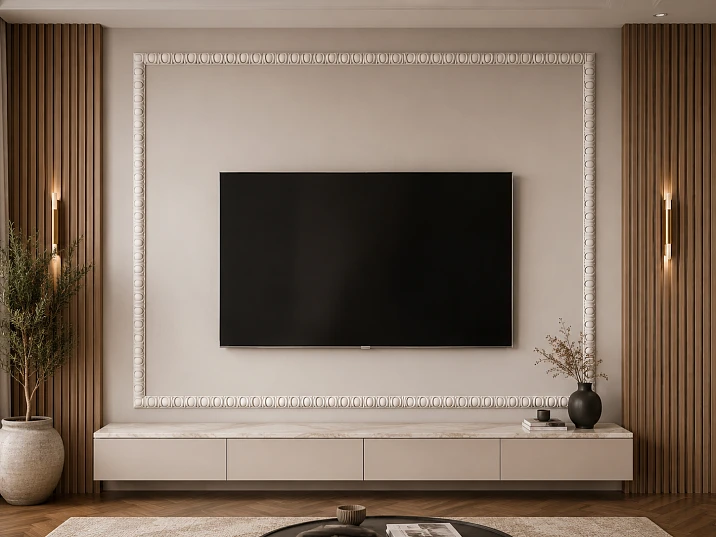
The TV is already mounted on a smooth section of the wall, with slat panels on the right and left. The composition looks neat, but the central field needs to be separated from the vertical rhythm of the slats. One option is to assemble a decorative rectangular frame around the TV from carved polyurethane molding KPU-011.
This solution has a feature that is easy to miss when ordering. KPU-011 is supplied not in linear meters of arbitrary length, but in two-meter strips. Therefore, the perimeter of the future frame and the number of items in the cart are different values.
For example, a frame measuring 1800 × 1100 mm has a perimeter:
1800 + 1800 + 1100 + 1100 = 5800 mm.
By total length, it seems that three two-meter strips are enough:
5800 ÷ 2000 = 2,9.
But if each of the four sides must be made of one solid piece between corners, three strips do not allow getting two pieces of 1800 mm and two of 1100 mm. Four will be needed.
Three strips can theoretically fit the total length only in another way — for example, by dividing the long sides into composite sections and adding transverse joints. For expensive carved molding around a TV, this is already a separate design and installation solution, not automatic savings.
Therefore, KPU-011 should be ordered not by the formula:
perimeter ÷ 2 meters,
but by a different sequence:
size of the future frame → four real pieces → requirements for side integrity → cutting plan → number of strips → cost.
And only after that does it make sense to move on to purchasing.
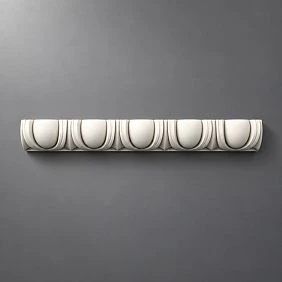
What is carved polyurethane molding KPU-011
KPU-011 is precisely carved polyurethane molding, not a regular smooth trim.
For the TV zone in question, the initial specifications are as follows:
| Characteristic | KPU-011 |
|---|---|
| Type | Carved molding |
| Cross-section | 30 × 24 mm |
| Length of one plank | 2000 мм |
| Material | Polyurethane |
| Price per 1 strip | 15 590 ₽ |
| Order | From 1 pcs. |
| Made to order | 3–7 days |
Clean product URL:
General section:
For calculating the frame, three numbers are important at once.
2000 mm determine the maximum length of a part that can be obtained from one whole plank without transverse connection.
30 mm participate in the visual width of the decorative line and the size of the outer contour of the frame, if this side of the cross-section is the face width in the chosen position according to the drawing.
24 mm needs to be checked as the profile volume relative to the plane of the wall and the TV.
The last two dimensions should not be perceived as a trifle. The frame is located next to the equipment, so its volume affects not only the appearance of the wall, but also access to the screen, connectors, and the movable bracket.




First, determine exactly which frame you are measuring.
The phrase "frame 1800 × 1100 mm" seems unambiguous, but in practice it can mean three different sizes.
Our factory also produces:

Internal light opening
This is the free field inside KPU-011.
If the TV should be inside the frame with a certain offset, this size is first set by the designer.
Get Consultation
Outer frame size
This is the dimension from the outer edge of the left profile to the outer edge of the right, and from the top edge to the bottom.
Cut line length
It depends on the method of joining corners and which edge the craftsman uses to mark the profile.
You cannot use the inner dimension in one diagram and suddenly calculate it as outer in the cutting layout.
Before purchasing, sign the drawing:
W₁ — internal opening;
H₁ — internal opening;
W₂ — external dimension;
H₂ — external dimension.
After that, choose which specific dimensions will be the lengths of the four workpieces.
This is especially important for KPU-011, because one crossing of the 2000 mm boundary can change the quantity of goods by a whole plank costing 15,590 ₽.
The TV size and the frame size are not the same thing
There is no need to calculate KPU-011 by the TV diagonal.
A diagonal of 55, 65, or 75 inches says almost nothing about the actual cutting of the linear profiles.
For the project, the actual dimensions of the housing are needed:
WTV — TV width;
HTV — height of the TV.
Then, the margins from the housing to the frame are set.
If they are the same:
G — free distance from the TV to the inner edge of KPU-011.
Then the inner opening of the frame:
W₁ = WTV + 2G
H₁ = HTV + 2G
If different margins are needed on top, bottom, and sides, calculate them separately:
W₁ = WTV + GL + GR
H₁ = HTV + GT + GB
This is more useful than any universal advice like "leave 10 cm."
The specific distance depends on:
-
screen size;
-
proportions of the smooth TV zone;
-
surrounding slat panels;
-
method of mounting the TV;
-
access to the equipment;
-
desired scale of the decorative frame.
There is no single number that works equally well on all walls.
Check the frame with painter's tape before purchasing KPU-011
Before ordering expensive molding, you can test the composition almost for free.
Mark the future inner or outer contour of the frame with painter's tape of a width close to the face width of KPU-011.
If needed, make a paper strip 30 mm wide.
Mark all four sides.
Now step back from the wall.
Check not only the distance between the TV and the frame.
Check:
-
whether the TV looks cramped;
-
isn't the frame too far from the body;
-
whether there is enough smooth space between the frame and the slat panels;
-
doesn't the central rectangle become disproportionately large;
-
does its axis align with the TV;
-
are the left and right margins the same;
-
doesn't a conflict arise with the cabinet, console, or soundbar.
Such a fitting has one more advantage.
After it, you get the real size of the frame, and thus you can move on to the cutting map.
The 30 × 24 mm profile needs to be seen from the side
A flat tape on the wall shows the width of the frame but does not show its volume.
KPU-011 has a cross-section of 30 × 24 mm.
If 24 mm in the mounting orientation corresponds to the profile's protrusion from the base, the decorative frame gains noticeable depth.
Before purchasing, you need to compare it with the screen's position.
Three situations are possible.
The TV protrudes noticeably beyond the frame
Then the KPU-011 remains an architectural backdrop.
The front surface of the TV and the trim are at approximately similar levels
The side view becomes more complex. It is necessary to check whether there is enough visual and physical distance between the body and the profile.
The frame ends up closer to the viewer than part of the TV housing
This option requires particularly careful fitting.
On the front sketch, everything may look good, but from the side, the decorative trim starts to be perceived as a protruding border around the device.
For a regular fixed TV and for a screen on a swivel mount, these are two different tasks.
A swivel mount changes the requirements for the frame.
A TV on a fixed wall mount is almost always in one position.
A model on an extendable or swivel mechanism can:
-
extend forward;
-
turn to the right;
-
rotate to the left;
-
tilt.
Therefore, checking the frame only when the screen is parallel to the wall is not enough.
Do a simple test before buying the trim.
Move the TV to real working positions.
Mark the outline of KPU-011 with tape.
Then check whether the body crosses the future frame and whether access to the handles or bracket mechanisms remains.
There is no need to try to compensate for the conflict by mounting the KPU-011 closer to the screen.
If the profile interferes with the movement of the TV, the geometry of the frame itself changes.
Access to connectors and cables is checked before decorative finishing.
The frame should not turn a regular HDMI cable connection into dismantling the molding.
Before making the final choice of dimensions, check:
-
side HDMI;
-
USB;
-
antenna connector;
-
network cable;
-
power;
-
soundbar cable;
-
access to the removable media box, if available;
-
technology enclosure behind the screen;
-
sockets near the TV.
If the TV is lifted off the bracket upward, make sure the upper KPU-011 does not block the removal path.
If the screen needs to be tilted away from the wall for cable connection, check the bottom and side edges of the frame.
Specific ventilation and maintenance requirements for the TV should be taken from its manufacturer's instructions. The frame must not cover the ventilation zones provided by the device itself.
The main calculation rule: the four sides first exist separately
Suppose the outer frame size is chosen:
1600 × 900 mm.
Need four parts:
-
1600 mm;
-
1600 mm;
-
900 mm;
-
900 mm.
Don't start with the perimeter.
Start with this list exactly.
Now we lay it out on KPU-011 planks 2000 mm long.
Plank #1: 1600 mm.
Remains 400 mm.
Plank #2: 1600 mm.
Remains 400 mm.
Plank #3: 900 + 900 = 1800 mm.
200 mm remains before accounting for the actual cutting scheme.
Total:
3 planks.
Cost:
3 × 15 590 = 46 770 ₽.
The perimeter here is:
5000 mm.
Simple division of 5000 ÷ 2000 also results in three planks, but this coincidence occurs because both 900 mm pieces indeed fit into one two-meter blank.
With a different frame size, the rule breaks.
Why a frame of 1800 × 1100 mm already requires four planks if the sides need to be solid
Now needed:
-
1800 mm;
-
1800 mm;
-
1100 mm;
-
1100 mm.
The first long section takes a separate plank:
2000 − 1800 = 200 mm of remainder.
The second takes another one:
2000 − 1800 = 200 mm.
Two verticals remain:
1100 + 1100 = 2200 mm.
They cannot be obtained from one two-meter plank.
Therefore, for four solid sides, the scheme looks like this:
Plank No. 1 → 1800
Plank No. 2 → 1800
Plank No. 3 → 1100
Plank No. 4 → 1100
Minimum:
4 planks KPU-011.
Cost:
4 × 15 590 = 62 360 ₽.
This very example shows why the perimeter is misleading.
Perimeter:
5800 mm.
Material in three planks:
6000 mm.
Formally, even 200 mm remain.
But the problem is not the total length.
The problem is in the lengths of individual pieces.
Is it still possible to make a frame 1800 × 1100 mm from three bars
By the total amount of material — potentially yes.
But you'll have to abandon the requirement "one side = one solid piece."
For example, the two verticals can be left solid:
1100 + 900
1100 + 900
The remaining plank and two sections of 900 mm are used to assemble the long sides from multiple parts.
The total length is sufficient.
But additional transverse joints appear directly on the visible sides of the frame.
Now we need to evaluate a different cost of the solution.
Not only:
3 planks = 46,770 ₽
versus
4 planks = 62,360 ₽,
But also:
saving 15,590 ₽ compared to additional visible joints in the carved ornament.
For a simple smooth batten, such a compromise may be almost imperceptible.
For the carved KPU-011, the seam position must account for the pattern.
Therefore, three planks for a 1800 × 1100 mm frame is not a "more economical correct cutting" but an alternative scheme with additional joints.
Cutting table: how many whole planks are needed for different frames
Below is a preliminary map assuming each of the four sides is made from a single piece and the nominal side length fits within a 2000 mm plank.
The master checks actual corner cuts, kerf width, and technological allowances separately.
| Frame size | Required parts | Minimum planks with solid sides | Price KPU-011 |
|---|---|---|---|
| 1200 × 700 mm | 1200, 1200, 700, 700 | 2 | 31 180 ₽ |
| 1300 × 700 mm | 1300, 1300, 700, 700 | 2* | 31 180 ₽ |
| 1400 × 700 mm | 1400, 1400, 700, 700 | 3 | 46 770 ₽ |
| 1500 × 800 mm | 1500, 1500, 800, 800 | 3 | 46 770 ₽ |
| 1600 × 900 mm | 1600, 1600, 900, 900 | 3 | 46 770 ₽ |
| 1800 × 900 mm | 1800, 1800, 900, 900 | 3 | 46 770 ₽ |
| 1800 × 1000 mm | 1800, 1800, 1000, 1000 | 3* | 46 770 ₽ |
| 1800 × 1100 mm | 1800, 1800, 1100, 1100 | 4 | 62 360 ₽ |
*Schemes where the sum of two parts equals exactly 2000 mm are the mathematical minimum. In real production, you need to separately check the type of corner cut, saw kerf width, and the necessary technological allowance. Ordering material "to the last millimeter" without a cutting map is risky.
The table shows another important thing.
The number of planks changes in steps.
Increasing one side by just a few dozen millimeters can make two parts incompatible in one two-meter blank — and the budget immediately increases by 15,590 ₽.
A small change in the offset from the TV sometimes costs an entire plank
It's useful to consider this already at the design stage.
Suppose, after calculating the internal opening, you get two vertical parts of approximately 990 mm each.
In one plank:
990 + 990 = 1980 mm.
Nominally, they fit together.
If you increase the frame so that each vertical becomes 1010 mm:
1010 + 1010 = 2020 mm.
In one workpiece, they no longer fit.
And if the other long sides are taken on a separate strip, the total count can increase from three to four.
This creates an interesting commercial fork in the road.
Sometimes changing the frame size by just 20–30 mm:
-
hardly changes the appearance;
-
but changes the cutting layout;
-
adds one KPU-011;
-
increases the cost of linear footage by 15,590 ₽.
This does not mean that design should be subordinated to savings at any cost.
But if two sizes are visually equivalent, it makes sense to compare the cutting layout before final wall marking.
Why designing a size exactly 2000 mm is risky
It seems logical to make the long side of the frame exactly 2000 mm: one plank — one side.
But such a calculation leaves no room for error.
On a real part, the following may be required:
-
corner cuts;
-
control alignment of the end face;
-
compensation for a damaged end;
-
the width of the cut itself;
-
additional fitting of the ornament.
Therefore, the size mathematically equal to the full length of the product should be considered as a boundary value.
This does not mean that using the entire length of KPU-011 is not allowed.
It only means something else:
It cannot be promised in advance that from a 2000 mm strip a finished frame side of exactly 2000 mm will be guaranteed, regardless of the corner joining technology.
First, an assembly drawing is prepared.
Frame corners: arithmetic ends where the carved pattern begins.
A rectangular frame has four corners.
For a smooth profile, the main task is to achieve a precise geometric joint.
With the carved KPU-011, an ornament is added.
If the sides are joined with a miter cut, symmetrical corner cuts are usually used for a right angle, but the actual geometry of the wall and profile is still checked before mass cutting.
There is one more question:
which part of the carved pattern fits the corner?
If the strips are cut without prior layout, one corner may end up with a whole expressive motif, while another may get a randomly trimmed fragment of it.
Therefore, before the first cut, it is useful to lay out the four future sides on the floor or a long table and determine:
-
where the ornament begins;
-
that comes into every corner;
-
whether the opposite sides match;
-
whether it makes sense to shift the starting point of the cut.
This can slightly increase the consumption.
But for a frame around a TV, the symmetry of the pattern is often more important than minimal leftover.
The rapport of the ornament can change the actual consumption of KPU-011
Molding with a repeating carved pattern cannot always be cut like a smooth construction batten.
Let's imagine that 1600 mm is needed for one side.
Technically, you can cut the first 1600 mm from any plank.
But if the frame is symmetrical, it may be desirable for the left and right sides to start with the same motif.
Then the second segment may start not immediately after the first useful section, but after a shift according to the pattern.
This creates additional waste.
That is why an accurate professional order is better calculated in two stages.
Stage 1 — geometric minimum
How many planks are required based only on lengths.
Stage 2 — decorative cutting
Can the chosen symmetry of the pattern be preserved within this quantity.
If not, a decision is made:
-
simplify the synchronization of the ornament;
-
change the starting points;
-
or buy an additional plank.
Coming up with a universal reserve percentage here is also pointless.
Where it is better not to make an additional joint
If one side is too long or you need to reduce the number of planks, a transverse connection arises.
For a frame around a TV, the most noticeable areas are usually:
-
along the top side;
-
in the central sections;
-
in well-lit places.
A joint located exactly above the center of the screen can constantly fall into the field of view.
If a connection is unavoidable, its position is chosen considering:
-
thread repetition;
-
light;
-
viewing distance;
-
overall symmetry.
Do not automatically divide the long side in half.
Sometimes a joint closer to one third is visually calmer.
But you shouldn't go to the other extreme and make a short insert piece of 100–150 mm just to use up the remainder. Such savings can create two joints where you could have had one neat piece.
Why a 900 mm remainder can be more valuable than a 1200 mm remainder
At first glance, 1200 mm is better: it is longer.
But the value of the remainder is determined by the next piece.
Let's imagine that after cutting, we need two vertical pieces of 900 mm each.
One whole 1800 mm remainder allows us to get both.
Two remainders of 1200 mm also allow obtaining them, but each will leave an additional piece.
In another project, we need a side of 1500 mm.
Then two 1200 mm remainders together give 2400 mm of total material, but without a transverse joint, you can't get a 1500 mm side from them.
Therefore, in the worksheet, do not write:
"2.4 meters of remainders,"
But:
remnant No. 1 — 1200 mm;
remainder No. 2 — 1200 mm.
For long-length decor, the length of each individual piece is important.
Should KPU-011 be automatically purchased with a reserve?
At a price of 15,590 ₽, an extra plank is a serious decision.
Therefore, the rule:
"always add 10% to the length"
is of little use for KPU-011.
Let's take a frame of 1600 × 900 mm.
Three strips give:
6000 mm of material.
The net length of the frame:
5000 mm.
The allowance already arises from the product format.
Buying a fourth plank just for the percentage would mean increasing the purchase length to 8000 mm.
But an additional slat may be justified if:
-
the pattern must be perfectly synchronized;
-
there are complex corner cuts;
-
the frame has non-standard joints;
-
part of the profile should go to another composition;
-
the craftsman sees in advance the risk of damage to a large section;
-
the project cannot be delayed for a re-order.
Stock is purchased for a specific risk, not out of habit.
It is better to calculate the cost of a set after the cutting map.
At a price of 15,590 ₽ for one two-meter KPU-011, the cost of different sets looks like this:
| Number of planks | Purchase length | Cost |
|---|---|---|
| 1 | 2 м | 15 590 ₽ |
| 2 | 4 м | 31 180 ₽ |
| 3 | 6 м | 46 770 ₽ |
| 4 | 8 м | 62 360 ₽ |
| 5 | 10 м | 77 950 ₽ |
This is why a cutting error is financially noticeable.
A person who calculated a frame of 1800 × 1100 only by the perimeter may order three planks for 46,770 ₽.
On site, it will turn out that two verticals of 1100 mm do not fit into the remaining two-meter plank after two full horizontals.
To preserve four solid sides, a fourth KPU-011 will be required.
Summary:
62 360 ₽.
The difference:
15 590 ₽.
It is better to know such information before ordering, not during installation.
How the distance between the frame and slat panels affects the composition
The frame is not in an empty room.
To the right and left, there is already a vertical pattern of slats.
Therefore, after choosing the TV size and KPU-011, you need to check the outer margin:
the distance from the outer edge of the frame to the beginning of the slat panel.
If it is very small, the two systems may merge.
The result will be:
carved frame → a few millimeters of wall → vertical slat.
If the margin is too large, the frame may lose its connection to the slat composition and look like a random rectangle around the TV.
The optimum cannot be assigned a universal number.
Make a mockup.
It is especially useful to compare two options at once:
the frame closer to the TV;
frame closer to the slat panels.
They can have the same KPU-011 and completely different character.
Center the frame relative to the TV or the entire TV zone.
More often these centers coincide.
But not always.
For example:
-
to the right of the TV there is a vertical soundbar;
-
the cabinet is offset;
-
one slat panel is wider than the other;
-
the TV is installed closer to the edge of the wall due to furniture;
-
the smooth field itself is asymmetrical.
In such a situation, mechanical centering of the KPU-011 relative to the TV body may increase the asymmetry of the entire wall.
Before marking, draw three axes:
center of the TV;
center of the smooth field;
center of the entire TV composition.
If they differ, you need to consciously choose the main one.
This is already a design question, but it directly affects the length of the sides and the number of slats.
The top side of the frame should not conflict with the viewing height
The higher the KPU-011 rises, the more smooth field it occupies.
If the TV is mounted high, a large decorative frame may come close to the ceiling cornice, light fixtures, or the top edge of slat panels.
Therefore, the size is calculated not only by width.
Need to check vertically:
This is especially important in rooms with a ceiling around standard apartment height, where several horizontal lines may end up too close to each other.
This is especially important in rooms with ceilings around standard apartment height, where several horizontal lines may end up too close to each other.
The bottom side of the frame may conflict with the cabinet and soundbar.
If there is a hanging console under the TV, the decorative profile should not accidentally end up behind it or right above its top.
Check:
-
opening of doors;
-
access to the top surface;
-
position of the soundbar;
-
cables;
-
decorative items;
-
possible future replacement of the TV.
Sometimes this makes the frame asymmetrical in the vertical fields: the distance at the top is larger, at the bottom smaller.
Such a solution is acceptable if it looks intentional.
There is no need to artificially force all four gaps to be identical just for mathematical symmetry.
The KPU-011 frame is not a TV mount.
These are fundamentally different systems.
The TV is attached to the base using the bracket and fasteners intended for it.
KPU-011 performs a decorative function.
Do not:
-
rest the screen on the bottom profile;
-
use the carved molding as a bracket limiter;
-
attach cable structures to it;
-
Calculate the frame as a load-bearing part of the TV zone.
First, secure mounting of the equipment is resolved.
Then, decorative framing is built around the already defined system.
What to check on the wall before cutting the first plank
After the KPU-011 arrives, do not start with the corner miter cut.
First, lay out the full project.
The following must be marked on the wall:
-
the central axis;
-
inner contour of the frame;
-
outer contour;
-
four corner points;
-
TV position;
-
bracket work area;
-
position of sockets and outlets;
-
boundaries of the slat panels.
Now the slats can be applied without glue.
Even at this stage, it sometimes turns out that the frame is better:
-
raise by 20 mm;
-
make slightly narrower;
-
move away from the slats;
-
Reduce the vertical size.
Before cutting, this change costs almost nothing.
After cutting expensive KPU-011, it may mean losing a usable segment.
A dry layout is also needed for the ornament.
Before installation, lay out all the planks in the future sequence.
Assign them roles:
the top;
bottom;
left side;
right side.
Compare the drawing.
Do not use the first piece you find just because the length fits.
For the top and bottom sides, you can check the similarity of the central motifs.
Compare the left and right sides with each other.
If one section has a more favorable start to the pattern, it's better to find out before cutting the entire batch.
What to do with corner offcuts
Short remnants after forming corners shouldn't be thrown away immediately.
They are useful for:
-
testing stain;
-
checking glue;
-
saw settings;
-
test joint;
-
checks of the joint sealing method.
This is especially convenient with expensive carved moldings: the technological experiment is carried out on a leftover piece, not on the main visible part.
But short pieces should not become a reason to assemble the visible side of the frame from many inserts just for the sake of "waste-free" production.
The mounting compound is selected after checking the base.
The smooth field between the slat panels can be executed in different ways:
-
painted plaster;
-
puttied surface;
-
MDF;
-
furniture panel;
-
other decorative base.
Therefore, the same adhesive cannot be automatically recommended for any wall without checking the instructions.
In related products for KPU-011, KUDO HIGH TACK mounting adhesive is provided.
If this composition suits the project, you can separately buy adhesive for installing polyurethane moldings.
There is no need to make up the consumption rate in advance.
The amount of adhesive depends on:
-
wall condition;
-
actual contact surface;
-
the method of application;
-
the number of slats;
-
additional elements.
First the linear footage map, then the mounting system.
Paint KPU-011 to match the smooth field or highlight it
The carved profile can be made either part of the wall architecture or a noticeable independent contour.
In the color of the smooth field
The frame is read primarily through relief and shadows.
The solution is calmer.
Especially useful if the slat panels themselves are already contrasting.
In the color of the slats
The central frame connects with the side zones.
This can unify the entire TV wall.
Contrast option
Each side of the 30-mm profile becomes more graphic.
Around the black screen, an additional dark outline can visually enlarge the TV, while a light one can, on the contrary, separate it from the wall.
You cannot evaluate color on a single small sample.
You need to see at least a significant part of the four sides.
When KPU-011 30 × 24 mm may turn out to be too massive
A large and expensive profile is not automatically better than a small one.
KPU-011 is worth double-checking if:
-
the TV is small;
-
the smooth zone is narrow;
-
the distance to the slats is small;
-
there are already many decorative details in the room;
-
the screen is installed almost flush against the wall, and the profile protrudes noticeably;
-
the top and bottom sides of the frame end up too close to other furniture.
In this case, the problem is not solved by reducing the offset.
Perhaps a more compact linear footage is needed.
there is a general section for this polyurethane molding.
When a frame around the TV is not needed at all.
sometimes a smooth field between slat panels already works as a ready-made frame.
For example:
-
The slats end strictly at the sides;
-
the TV is properly centered;
-
There is enough calm space between the screen and the slats;
-
The lower console completes the composition;
-
The additional carved line creates an unnecessary fourth contour.
In that case, the absence of KPU-011 is also a full-fledged design solution.
A good commercial test should answer not only:
"how much to buy?"
But also:
"Is it worth buying at all?"
When it is more reasonable to use the molding only partially instead of a four-sided frame
The classic rectangle is not the only option.
In some compositions, decorative molding is used:
-
only on top;
-
on top and on the sides;
-
as a horizontal bottom belt;
-
in a different architectural scheme.
But such a variant needs to be designed from the start.
You should not turn an incomplete frame into an emergency solution after running out of material for the fourth side.
If the composition is intended as a rectangle, it's better to correctly calculate all four sides.
Why ordering three strips and "then, if needed, a fourth" is not always advantageous
At first glance, this reduces the initial budget.
But for KPU-011, the source data specifies production to order in 3–7 days.
If the shortage is discovered during installation, the project may come to a halt.
Additionally, for a decorative product, it makes sense to plan out the full pattern layout in advance.
Therefore, the doubt between three and four planks is resolved not by the principle:
"let's take fewer, we'll buy more later,"
but by a proper cutting map.
If it shows four whole elements, four are ordered.
If three truly allow obtaining all four sides in the chosen scheme, three are ordered.
How to calculate an order if the dimensions of the four sides are different
Not every TV zone is visually perfectly rectangular.
For example, due to a console or wall architecture, you might get:
-
top — 1700 mm;
-
bottom — 1600 mm;
-
left — 950 mm;
-
right — 900 mm.
Don't try to average.
Write down all four lengths.
Next, the problem of packing these parts into 2000 mm segments is solved.
For example:
1700 — a separate plank;
1600 — separate;
950 + 900 = 1850 — the third.
Total three.
This approach is universal.
Not the perimeter.
Not the average length.
But a list of parts.
Universal cutting worksheet
Before ordering, make a simple table.
| Detail | Required length | From which strip | Remainder |
|---|---|---|---|
| Top | ___ mm | № ___ | ___ mm |
| Bottom | ___ mm | № ___ | ___ mm |
| Left side | ___ mm | № ___ | ___ mm |
| Right side | ___ mm | № ___ | ___ mm |
Then below:
Quantity of whole KPU-011: ___ pcs.
Cost: quantity × 15,590 ₽.
Additional joints on sides: yes / no.
Pattern alignment checked: yes / no.
Additional allowance justified: yes / no.
After filling out such a table, it is much harder to make a mistake.
Ready-made order scheme for a frame 1600 × 900 mm
If these are the lengths of four solid sides:
1600 + 1600 + 900 + 900 mm.
Map:
KPU-011 №1 → 1600
KPU-011 №2 → 1600
KPU-011 №3 → 900 + 900
Preliminarily:
3 planks.
Price:
46 770 ₽.
After that, corner cuts and the allowance for the selected pattern alignment are checked separately.
Ready-made order scheme for a frame 1800 × 1100 mm
For whole sides:
1800 + 1800 + 1100 + 1100 mm.
Map:
KPU-011 №1 → 1800
KPU-011 №2 → 1800
KPU-011 №3 → 1100
KPU-011 №4 → 1100
Total:
4 slats.
Cost:
62 360 ₽.
If the budget is critical, a three-plane scheme with additional joints on the sides can be developed separately. But first, we need to see these joints in the sketch and check the KPU-011 pattern.
You can't just say:
"the perimeter is less than six meters, so three."
Final algorithm: from the TV to the number of KPU-011
Before adding the product to the cart, go through the entire process once.
- Measure the actual width and height of the TV body.
- Determine the working position of the screen on the bracket.
- Check access to connectors and for disassembly.
- Choose the inner offset to the decorative frame.
- Mark out the future frame with painter's tape.
- Look at it from a normal distance.
- Check the distance to the slat panels.
- Look at the intended profile from the side.
- Note which frame size you are considering—inner or outer.
- Get four actual side lengths.
- Decide whether each side should be a single piece.
- Lay out four pieces along the 2000 mm slats.
- Separately check edge combinations close to 2000 mm.
- Plan the corners.
- Check the repeat of the carved pattern.
- Determine whether additional transverse joints are acceptable.
- Only now fix the quantity of KPU-011.
- Multiply it by 15,590 ₽.
- Add reserve only for a specific reason.
- Before cutting, perform a dry layout of all planks.
- After that, proceed to installation and painting.
Result: how many KPU-011 are needed for the frame around the TV
There is no single answer without frame dimensions.
KPU-011 has a length of 2000 mm, so the order is determined by cutting four sides.
For a frame of 1600 × 900 mm, three strips are logically laid out as follows:
1600 / 1600 / 900 + 900.
We get:
3 KPU-011 = 46 770 ₽.
For a frame of 1800 × 1100 mm, if each side must be solid:
1800 / 1800 / 1100 / 1100.
We get:
4 KPU-011 = 62 360 ₽.
This is where the main perimeter calculation error appears: the total 5800 mm fits into 6000 mm of material, but the four required solid pieces do not.
Three slats for such a frame are only possible with a different scheme — with additional transverse joints on the sides.
Therefore, before order KPU-011 made of polyurethane, you need to know not only the perimeter.
Need to know:
four lengths → number of solid pieces → corner positions → joint acceptability → cutting by two meters → cost.
If after a full-size fitting the 30 × 24 mm profile looks too massive next to the screen or does not combine well with the distance to the slat panels, it is better to first open the section carved polyurethane molding and choose a more suitable cross-section.
And if the TV zone is still being designed together with the side trim, you can in advance Buy slatted panels for wall finishing and lay out the smooth central field already taking into account the future frame.
For the overall interior design system, a section is available where you can You can buy ready-made stucco matching the Baroque style. Calculate the quantity: linear meters of cornices and moldings, number of rosettes, pilasters, consoles, corner elements. Add a ten to fifteen percent allowance for trimming..
The main thing is not to force expensive carved moldings to adapt to random sizes after the order has been placed.
First, the frame is calculated as four real parts.
Then these parts are laid out across two-meter KPU-011.
And only after that is the correct quantity known.
FAQ
Can a frame be made if one side is longer than 2000 mm?
A solid side from a single KPU-011 plank 2000 mm long cannot be obtained.
You will either have to change the frame size or provide a transverse connection between the two sections. It is better to choose the joint position simultaneously with the layout of the carved pattern.
What to do if two parts together give exactly 2000 mm?
Mathematically, they fit within one bracket.
For a real order, you need to separately consider the cutting technology, kerf width, and end condition. A scheme without a single millimeter of reserve is better to first confirm on the installation drawing.
Can the leftover KPU-011 be used on another wall?
Yes, if its individual length is sufficient.
Record each remainder separately. Two pieces of 700 mm give 1400 mm of total material, but they do not replace one solid 1200 mm section without an additional joint.
What to do if the TV is later replaced with a larger one?
It is better to design the frame taking into account the likely upgrade of the equipment.
If the internal opening exactly matches the current casing, a larger TV may not fit into it. If a replacement is planned, it is useful to first determine the maximum reasonable TV dimension.
Can the TV be installed after the frame is mounted?
It depends on the TV mounting method.
If the screen needs to be lifted up or angled onto the bracket for mounting, the decorative profile must not obstruct this path. Check the disassembly sequence before securing the KPU-011.
Can the side edges of the frame be shorter than the top and bottom?
Yes, if the design allows it. Then it is no longer a classic closed rectangle, and the four lengths are calculated individually.
What to do if the left and right slat zones have different widths?
Do not try to hide the asymmetry by randomly shifting the frame.
First, compare the center of the TV, the center of the smooth field, and the center of the entire composition. After that, the axis of the KPU-011 is deliberately chosen.
Is a gap needed between the KPU-011 and the TV for ventilation?
Specific ventilation distances are determined by the TV manufacturer's instructions.
The decorative frame should not cover the intended ventilation openings or hinder equipment maintenance.
Can a soundbar be placed inside the frame?
This option can be considered if the inner field is sufficient and access to the device and cables is maintained.
In this case, the lower side of KPU-011 is calculated relative to the entire pair of "TV + soundbar," not just the screen.
Should the joint be made directly above the TV?
Not necessarily. The central position is often the most noticeable.
If an additional connection is unavoidable, it is better to first lay out the pattern and evaluate several possible locations.
Can the frame be placed flush against the slat panels?
Physically — depending on the project. Visually, two active textures may blend together.
Full-scale layout will help determine whether a small calm zone is needed between the carved molding and the slats.
What to do if 30 × 24 mm looks too bulky?
Do not reduce the frame just for a specific item.
Compare other products in the section polyurethane molding and choose a cross-section that better matches the TV and the smooth floor.
Can the frame be assembled from leftover KPU-011 from another project?
Yes, if the lengths allow obtaining the needed parts and the pattern aligns properly.
First, map out each available leftover, then decide how many new two-meter strips need to be purchased.
Is it necessary to buy four KPU-011 for a 1800 × 1100 mm frame under any circumstances?
No.
Four are required for the considered scheme with four solid sides.
If additional transverse joints are acceptable, the total length allows developing a version from three strips. But it will have a different joint structure.
Where to buy KPU-011?
Carved molding can be selected in the product card KPU-011 30 × 24 × 2000 mm.
According to the provided material data, the price is 15,590 ₽ per two-meter plank. Therefore, before placing an order, it is especially important to first complete the cutting layout map, and then determine the quantity.