Article Contents:
- First, decide which metal specifically belongs to the furniture
- The hand level is stronger than a random coincidence at the top
- Large equipment and a small handle are perceived differently
- Separate permanent elements from those that are easy to replace
- Walnut remains the common base for both options
- The size 29 × 24 × 19 mm needs to be checked on the facade
- Two metals do not change the model's article number
- Brass makes the walnut warmer
- Stainless steel makes the walnut more graphic
- Shine and shade cannot be compared by names
- Open appliances form a cold contour
- Built-in appliances can almost disappear
- Only the faucet may remain silver
- The appliances are in the adjacent zone
- Ceiling metal can be a standalone accent
- Wall sconces have a stronger effect on furniture
- The base of a table lamp belongs to the furniture level
- Lights can have a conditionally golden tint
- Card of permanent elements
- Card of furniture level
- Card of decorative accents
- Final repetition check
- Make a table before going to the cart
- Brass on a white background
- Stainless steel on a white background
- White kitchen with golden light and silver appliances
- How to decide without visualization
- Steel continues the gray scale
- Brass changes the mood of graphite
- Gray-beige facades require a sample
- On the green facade
- On the blue facade
- On turquoise and gray-blue
- Brass creates a bright warm rhythm
- Steel supports a strict palette
- Matte and glossy surfaces change the result
- Walnut on light wood
- Walnut on dark wood
- Several species in one room
- The wood palette does not cancel out metal
- Dresser with multiple drawers
- Bedside table
- Tall cabinet
- Kitchen fronts
- Freestanding sideboard
- Hallway cabinet
- Commercial space furniture
- One metal on identical adjacent facades
- Different metals for different furniture groups
- Separation by level
- Walnut connects two finishes
- Collage check
- What counts as a repeat
- Why one large item is sometimes enough
- When repetition turns into overload
- How many repeats are enough for an open-plan layout
- Overall rectangle — only the first stage
- Check on a small box
- Check on a wide door
- Paired doors
- Frame front
- Painted facade
- Legs and Supports
- Count the opening facades
- Divide furniture groups
- Specify the finish in each item
- Reserve is not hidden in rounding
- Sum check
- Example of a list
- For brass finish
- For stainless steel finish
- What cannot be shortened
- One line — one execution
- The room and the piece of furniture are needed in the work sheet
- Check the names on the packaging and in the invoice
- Compare handles of one visible group
- Do not give out the entire batch without a diagram
- One test facade before the whole series
- Rely only on technique
- Copy only the lamp
- Compare names, not samples
- Mix metals on adjacent identical doors
- Forget about the legs
- Not check the dimensions
- Leave only the article number in the invoice
- Split one series into random deliveries
- Consider household 'gold' as an exact name
- Fix the price in an article or old estimate
- Choose metal before shape
- Ignore evening light
- Need to close old staple holes
- Need a full long grip
- Facade is too large
- Interior requires complex classical plasticity
- Walnut conflicts with the wood palette
- Fully metal hardware is required
- Good scenario for brass
- Doubtful scenario for brass
- Good scenario for steel
- Doubtful scenario for steel
- Frame from the entrance
- Frame of the work area
- Frame in evening light
- Close-up frame of the facade
- Do not use a duplicate card address
- Save the set of documents
- Will brass Antey suit stainless steel appliances?
- Can steel handles be combined with a brass lamp?
- Which finish to choose for a white kitchen?
- What to choose for a gray kitchen?
- Which Antey suits a dark green facade?
- Can Antey be installed on black furniture?
- Is the model suitable for a dresser?
- Can the handle be used on a tall cabinet?
- Do the handles need to match the furniture legs exactly in color?
- Can brass and steel be mixed in one kitchen?
- Do I need to order a spare handle?
- How do I check the size before ordering?
- Can an old bracket be replaced with Antey without repairs?
- Is the mounting hardware included in the set?
- What is the difference between brass and stainless steel in this model?
- Can different metals be ordered for different rooms?
- How to coordinate Antey with a gold-toned faucet?
- What to do if the appliances are silver but the legs are brass?
- Can the steel finish be used in a bedroom?
- Do I need to repeat the metal of door handles?
- How to check the combination remotely?
- Where to buy Antey HL-052-2M?
- Can I order one handle first to test it?
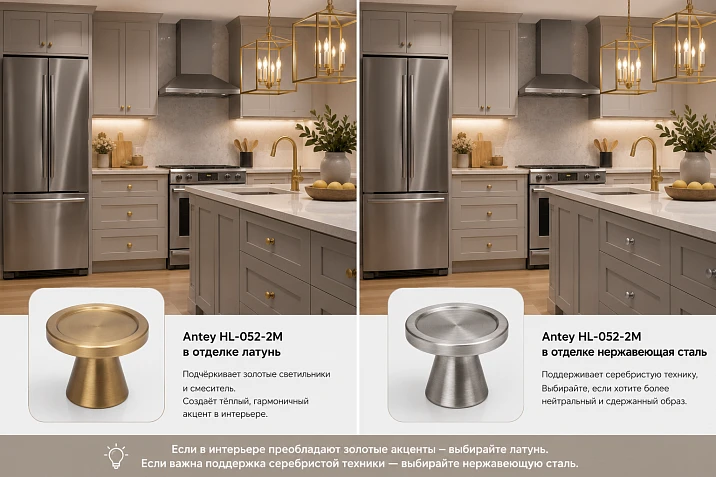
The kitchen is already half assembled. The refrigerator and oven give a silver shine, warm golden-toned lamps hang above the table, and the facades still have no handles. It is at this moment that the choice seems almost impossible: support the appliances with stainless steel or repeat the lamps with brass? Antey HL-052-2M complicates the task not by a lack of options, but by their precision: the same compact handle made of solid walnut is available in two versions of the metal part. The model has a common size — 29 × 24 × 19 mm, but the impression of the furniture turns out different.
The search phrase "Antey HL-052-2M buy" usually appears not at the beginning of the project, but closer to its completion, when most of the materials have already been chosen. Therefore, you cannot choose a handle separately from the room. You need to look at which metal is near your hands, which is repeated at the facade level, how noticeable the appliances are, whether the golden tone is supported by legs, profiles, or a faucet. After such a check, you can buy the furniture handle Antey HL-052-2M not by a random coincidence with one item, but as part of a well-thought-out furniture composition.
The answer does not come down to the rule "silver to silver, gold to gold." Built-in appliances can almost disappear behind facades, and a small faucet can remain the only cold accent. A brass lamp can be far from the kitchen and not affect the furniture level. It can also be the opposite: golden profiles, table legs, and wall sconces form a noticeable system, next to which a steel handle looks lonely. So, you need to compare not two colors in a photo, but the repeatability of the metal, the distance between elements, lighting, and the role of the furniture itself.
Below is not a general guide to hardware or a list of trendy combinations. This is a practical breakdown of the specific Antey HL-052-2M: what brass and stainless steel offer next to walnut, which finish to choose for white, gray, green, black, and wooden facades, when mixing metals looks intentional, how to count handles for a visible furniture series, and what to check in the product card before paying.
First, decide which metal belongs specifically to the furniture
Ceiling, walls, work surface, and cabinet furniture are at different visual levels. The metal of a light fixture is perceived overhead, appliances occupy large rectangular planes, and the handle repeats dozens of times where a person touches the facade. Therefore, the closest item in color is not always the right reference.




The hand level outweighs a random match above
Handles, faucet, display case profile, furniture legs, and a table lamp are roughly in the same zone of attention. A person sees them simultaneously when approaching a kitchen, dresser, or cabinet. If cold metal already dominates at this level, stainless steel in Antey supports the existing system. If brass repeats, the warm finish ties the furniture to the other details.
A ceiling light can be bright but solitary. It does not have to dictate the metal of every handle. First, count the repetitions at the furniture level, then decide whether the light should join this group or remain an independent accent.
Our factory also produces:
Large appliances and a small handle are not perceived equally
The silver surface of a refrigerator occupies a large area, but sometimes it is off to the side of the main cabinet line. Small handles repeat on each facade and create rhythm. One large silver rectangle does not always outweigh ten golden details on furniture and lighting.
The opposite situation is also possible. If the appliances are open—range hood, oven, cooktop, sink, and faucet—supporting cold metal, a brass handle will require additional repetition. Without it, the warm insert may look like a late replacement rather than part of the project.
Get Consultation
Separate permanent elements from those that are easy to replace
Technique, mixer, and built-in profiles are chosen for a long time. A lamp, chair, or table lamp is easier to change. Handles can also be replaced, but the new version must match the mounting and construction. Therefore, it is better to base the solution around permanent elements, and use mobile decor to support the chosen palette.
The practical question is: if you replace the lamp in two years, will the chosen handle remain convincing next to the facades, appliances, countertop, and furniture legs? If yes, the choice is based on architecture, not on a single accessory.
Antey HL-052-2M: confirmed parameters without guesswork
The model has several characteristics that can be fixed in the specification precisely. Other details — mounting method, delivery contents, length of fasteners, current price, and availability of a specific version — are checked in the product card before ordering.
| Parameter | Confirmed value |
|---|---|
| Name | furniture handle Antey |
| Article number | HL-052-2M |
| Size | 29 × 24 × 19 mm |
| Main material | walnut wood |
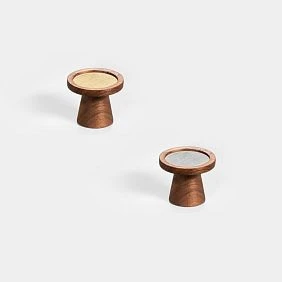
| Metal finish 1 | Brass |
| Metal finish 2 | Stainless steel |
| Catalog section | Handles with coating |
| What to clarify before purchasing | drawing, mounting, completeness, price, and availability of the selected version |
The size is recorded as a full string. You cannot leave only "Antey 29 mm" in the list: it is unknown which axis the number refers to and which model of the series is selected. The correct entry includes the article HL-052-2M, 29 × 24 × 19 mm, walnut, the selected metal, and quantity.
Walnut remains the common base for both options
In both versions, warm wood softens the metal. Therefore, brass and stainless steel should not be compared as two fully metal handles. Most of the look is built on the combination of walnut with a small metal part. Brass enhances warmth, while stainless steel creates a more noticeable temperature contrast.
Walnut can connect the handle with a wooden countertop, facade, dining table, shelf, or frame. Exact shade matching is not required, but the wooden elements should be perceived as one palette: warm, neutral, or contrasting.
The size 29 × 24 × 19 mm needs to be checked on the facade
The product photo enlarges a small detail and hides its real scale. Make a paper or three-dimensional mock-up of the dimension 29 × 24 × 19 mm, attach it to the facade, and look at it from a normal distance. On a small drawer, the handle may read confidently, but on a tall massive door, it may look too compact.
The mock-up helps evaluate not only proportion. It shows whether it is convenient to place fingers, whether the frame interferes, and whether there is enough space between the handle and the adjacent facade. Accurate installation is checked against the official drawing, not the outer rectangle.
Two metals do not change the model article
Both brass and stainless steel belong to Antey HL-052-2M. In the specification, it is not enough to write only the article number: the manager and the picker need the selected metal. For a large series, each item must be identical, unless the project provides for a deliberate division of furniture into different groups.
One walnut cabinet — two different impressions
It is more convenient to compare not by the abstract words "warm" and "cold", but by what changes in a specific room.
| Criterion | Brass | Stainless steel |
| Connection with walnut | enhances the warm palette | emphasizes the contrast of wood and metal |
| Next to silver appliances | requires repetition of warm metal | directly supports cold metal |
| Next to golden lamps | connects furniture with light | leaves the lamps as a separate level |
| On white facades | gives a soft warm accent | creates a clean cool touch |
| On gray facades | warms up the composition | continues the neutral gray scale |
| On green and blue facades | makes the color deeper and warmer | enhances restraint and graphic quality |
| On black facades | provides noticeable contrast | supports a strict monochrome system |
| Next to wooden legs | requires inspection of metal support parts | requires the same inspection |
| For the entire furniture series | order in one agreed finish | order in one agreed finish |
The table does not assign a universal winner. It shows the direction in which the image changes. After that, the decision is tested on one's own materials.
Brass makes the walnut warmer
Warm metal and wood work within a close temperature range. The handle looks calmer next to milky, beige, olive, and deep green surfaces. Brass reveals itself especially convincingly when there is another repetition in the room at the furniture level: legs, a thin profile, a faucet, a mirror frame, or the base of a table lamp.
If brass is present only in a single ceiling light, the connection may be weak. Then you will need to look at the overall perspective: whether the light is visible simultaneously with the facades, whether the character of the shine matches, and whether the zones are separated by a wall or a tall cabinet.
Stainless steel makes the walnut more graphic
Cold metal emphasizes the boundary between natural wood and modern appliances. This option can support a gray countertop, a steel sink, a chrome faucet, silver profiles, or legs. On a warm facade, stainless steel does not necessarily look cold: the walnut retains its natural base and does not allow the detail to turn into a fully technical accessory.
The steel version is especially logical where silver elements repeat below eye level. If cold metal is present only on the refrigerator at the other end of the room, its influence needs to be checked in real perspective.
Shine and shade cannot be compared by names
"Brass" in different items may differ in tone depth and surface character. "Stainless steel" also looks different next to mirror chrome, satin profiles, or matte appliances. Do not demand absolute matching without samples. The goal is a coordinated temperature and visual character, not laboratory identity.
Before a large order, place next to each other a sample of the facade, a photo or sample of the metal part, a fragment of the countertop, and the handle itself. Day and evening light can give different results.
Silver appliances do not always require stainless steel
The most common mistake is to consider any silver appliance as the main metal of the room. The appliances are indeed noticeable, but their role depends on integration, placement, and quantity.
Open appliances form a cold contour
A freestanding refrigerator, an open oven, a range hood, a sink, and a faucet create a strong group. If all of them are visible from one point, stainless steel in Antey continues this system without additional explanation. Walnut softens the transition from metal to the facade and adds tactile warmth.
In such a project, brass is also possible, but it needs repetition. One golden light fixture high above the table may not be enough. Add warm metal on legs, a shelf, a wall sconce, or a profile, otherwise the handles will compete with the appliances.
Built-in appliances can almost disappear
When the refrigerator is covered by a facade, the dishwasher is hidden, and the oven is built into a tall cabinet, the silver area shrinks. Sometimes only narrow frames and a small panel are visible from the front. In such a kitchen, light fixtures, the faucet, and furniture details gain more weight.
If golden elements are repeated, brass Antey may be more convincing despite the presence of appliances. You should count not the number of appliances in the specification, but their actual visibility.
Only the faucet can remain silver
One chrome faucet does not have to dictate the metal of all furniture. It is connected to the sink and the work area, while the handles form a separate repetition on the facades. If there are brass light fixtures, legs, and decor in the room, the warm finish can become the main line, and the faucet can be a functional exception.
But the exception must be the only one and clear. If steel profiles, appliances, and supports are added to the faucet, the cold group becomes too noticeable to ignore.
The equipment is in the adjacent zone
In the kitchen-living room, the refrigerator can stand in a niche, and the Antey dresser in the living area. Between them there is different lighting, textiles, and furniture. Then it makes more sense to match the dresser handles with the lamps, legs, and decor of the living room, rather than with the appliance in the kitchen.
The decision is made based on the zone of simultaneous perception. If two items are never seen together, their metals can differ without feeling like a mistake.
Gold lamps do not always require brass handles
A golden lamp often becomes the most noticeable item in a visualization. Due to its size, its color seems dominant. In a real room, it is higher, farther away, and lit differently than furniture hardware.
Ceiling metal can be an independent accent
A large chandelier above the table works as a separate center. Steel handles in the kitchen can match the appliances and faucet, while brass remains at the upper level. This separation looks cohesive if the boundary is clear: cold metal — work area and furniture, warm — decorative lighting.
The problem appears when metals are distributed chaotically: a brass chandelier, steel handles, golden legs of one cabinet, chrome legs of another. Then there is no system either by level or by function.
Wall sconces have a stronger influence on furniture
Sconces are located closer to facades, mirrors, or dressers. If their brass details are visible next to the handles, the warm finish of Antey connects the elements more directly. Steel can also work, but you will have to support it on the furniture with another item.
The smaller the distance between metals, the more noticeable the difference in shades. Therefore, adjacent parts are checked especially carefully.
The base of a table lamp belongs to the furniture level
A table lamp on a dresser or console is perceived together with the handles. If the base is brass, warm Antey creates a calm pair. If the base is steel or black with a cold insert, stainless steel supports it.
The lamp is easy to replace, so it should not be the only argument. But as a repetition of an already chosen metal, it works confidently.
Luminaires may have a conditionally golden color
Not every golden body is perceived as brass. Some coatings lean toward champagne, bronze, copper, or a pinkish tint. Compare samples under both turned-on and turned-off light. A warm lamp enhances gold, a cold one makes it paler.
If the difference is noticeable, do not try to achieve a literal match. Check whether the handle and the luminaire belong to the same warm group or conflict in saturation.
Three cards that replace the 'gold or silver' debate
When opinions in a family or team diverge, abstract conversation drags on. Simple fixation of metals on a plan and in photographs helps.
Map of permanent elements
Mark the appliances, mixers, built-in profiles, door hardware, and fixed lighting. This is the base that is expensive or difficult to change. Next to them, label the visible metal and the degree of prominence: large, medium, or point accent.
Do not combine all silver items into one line. A refrigerator that takes up almost the entire cabinet and a thin oven frame have different visual weight. The same applies to a large chandelier and a small decorative screw.
Furniture level map
This includes handles, legs, supports, frames, decorative inserts, table lamps, and hardware for open shelves. This map most often determines the Antey finish. If one metal prevails here, the handles support it.
When furniture is only being designed, you can simultaneously buy wooden legs for furniture and coordinate the visible metal parts of the supports with the chosen handle. First, compare the actual options of specific models, and then finalize the decision in the specification.
Decorative accents map
The third map includes vases, frames, candlesticks, small tables, textiles with metallic thread, and replaceable accessories. They can support the chosen metal, but should not solely determine it.
If the permanent elements and the furniture level are already coordinated, decor easily completes the composition. If the base is debatable, accessories only mask the problem.
Final repetition check
For each metal, answer two questions:
-
Where does it repeat besides one item?
-
Are these repeats visible simultaneously?
If brass is only on the chandelier, and steel repeats on appliances, faucet, and profiles, the steel finish of Antey looks more natural. If appliances are hidden, and brass appears in lighting, legs, and furniture decor, the warm option gains more justification.
Make a table before going to the cart
| Element | Metal or shade | Visibility | Level | Can be a guide for handles |
| Refrigerator | silver | high or partial | large appliances | yes, if visible near facades |
| Oven | silver | Medium | Work area | Yes |
| Mixer faucet | chrome or other metal | high nearby | hand level | Yes |
| Pendant light | golden | High | top level | Not always |
| Furniture legs | metal of specific execution | Medium | furniture level | Yes |
| Mirror frame | metal of specific execution | depends on location | Walls | yes, if located nearby |
Such a table turns a taste dispute into verifiable facts. After filling it out, it is usually clear which metal repeats systematically and which is present singly.
White and milky facades: both options work, but differently
A light facade does not dictate the metal. It enhances contrast and makes a small handle more noticeable.
Brass on a white background
The brass insert together with the walnut softens the pure white color. This combination is associated with warm light, beige stone, wooden flooring, and cream textiles. The handle becomes a small warm accent rather than a cold point.
If the white facade has a distinctly cool undertone, check the combination in daylight. Too yellow brass next to bluish white can look harsher than expected.
Stainless steel on a white background
Steel supports a clean, calm, and cooler palette. It is associated with appliances, gray stone veining, mirrors, and a chrome faucet. The walnut prevents the composition from becoming sterile.
On a milky facade, the cool insert looks more contrasting. This is not a flaw if the project needs a sharp accent.
White kitchen with golden light and silver appliances
In this scenario, you need to determine what is visible from the entrance. If silver appliances occupy an entire column and the lights are above a separate table, steel on kitchen facades often looks more consistent. If the appliances are hidden and brass pendants are directly above the island, the warm handle gets strong support.
How to decide without visualization
Take two photos of the same facade with metal samples, placing a piece of walnut nearby. Shoot in daylight and evening lighting. Then reduce the photos to a size where the furniture is visible from the room entrance. In close-up, differences seem stronger than in the real interior.
Gray and graphite facades: the metal temperature becomes more noticeable
Gray color easily supports stainless steel, but brass can bring furniture out of monotony.
Steel continues the gray scale
On a light gray facade, stainless steel looks calm and technological. On graphite, it creates a clear bright point. The connection with appliances becomes direct, especially when the countertop and backsplash also have cool tones.
Walnut adds an intermediate warm note. Thanks to it, the handle does not blend with the gray surface and does not turn into an ordinary metal button.
Brass changes the mood of graphite
Warm metal is more noticeable on a dark gray background. It can support lighting fixtures and make furniture more livable. But repetition is mandatory: a single brass insert on each facade creates rhythm, but at least one connecting element must appear outside the furniture.
For a gray kitchen with gold lighting and silver appliances, compare which group is closer to the facades. If the handles are near the oven and sink, steel may be more logical. If the facades form a separate wall opposite brass lighting, the warm option has more justification.
Gray-beige facades require a sample
Greige, taupe, and complex gray-beige shades change depending on the light. During the day they may seem gray, in the evening — warm. Brass emphasizes the beige part, steel pulls out the gray. A decision based on a screen is unreliable.
Green and blue facades: brass deepens the color, steel makes it stricter
Deep colored facades show the difference between the two Antey versions well.
On the green facade
Brass supports olive, pine, and dark green shades, especially next to warm wood. Walnut and metal form a rich group. Stainless steel makes green cooler and ties it to modern appliances.
On a bright green facade, it is better to check a sample: an active color can clash with both yellow brass and cold steel. Calm, complex shades give more freedom.
On the blue facade
Brass creates a pronounced warm-cold contrast. This is a noticeable solution that requires support from light or legs. Steel continues the cool palette and makes the composition more restrained.
If the blue facade is located next to silver appliances, stainless steel connects the surfaces. If it is a freestanding sideboard under a brass sconce, the warm finish can work more strongly.
On turquoise and gray-blue
Intermediate shades change under lighting. During the day they may seem cool, in the evening — greenish. Comparison is carried out in both modes. Brass enhances evening warmth, steel preserves the cool character.
Black facades: the handle becomes a graphic sign
On a black background, the small Antey is noticeable not by its size, but by the contrast of materials.
Brass creates a bright, warm rhythm
A black facade and brass form a strong pair. Walnut softens the transition and adds natural texture. On a large series of handles, the rhythm can become dominant, so check not just one door, but the entire row of cabinets.
If the light fixtures are golden, the connection is read quickly. Silver appliances can remain a separate functional group if there are not too many of them.
Steel supports a strict palette
Stainless steel next to a black facade looks clearer and calmer. It suits black-and-silver appliances, cool stone, and metal profiles. Walnut saves the composition from excessive rigidity.
Matte and glossy surfaces change the result
On a matte black handle, the material and slight metallic sheen stand out. On a glossy facade, there are many reflections, and the difference between brass and steel is perceived differently. The sample is checked on the actual finish, not on a similar color.
Wood-look facades: the walnut handle should be part of the palette, not a random spot
A wooden handle on a wooden facade requires careful comparison of textures. It is not necessary to find an exact tone-on-tone match. Sometimes a slight contrast looks more convincing than an imitation of a match.
Walnut on light wood
On an oak, ash, or light veneered facade, walnut reads as a dark accent. Brass enhances warmth, steel adds modern contrast. The choice depends on the other metals.
If the facade has an active pattern, a small handle may get lost. Check the scale and readability from a distance.
Walnut on dark wood
On a dark surface, the handle body may blend in, and the metal becomes the main distinguishable element. Brass provides a warm point, steel a cold one. With low contrast, assess whether it is visually easy to find the handle.
Several wood species in one room
The floor, table, facades, and handle may be in different wood tones. Matching them exactly is not necessary. A common temperature and a clear hierarchy are enough: one main wood, one supporting, and small accents.
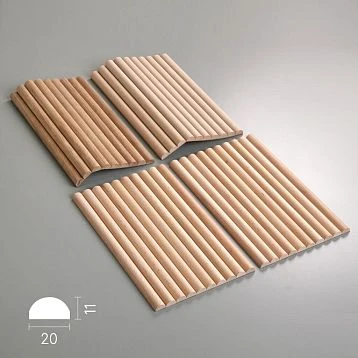
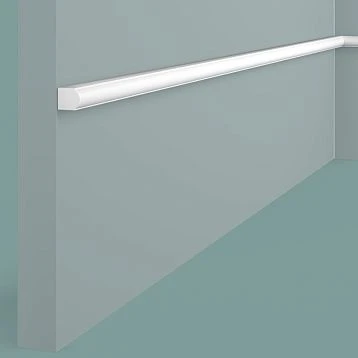
The walnut handle can be tied to the overall room finish. For example, near furniture it is appropriate buy wooden skirting board in a coordinated warm palette, without trying to literally replicate the shade of a small detail. The baseboard supports the room around the perimeter, and the handles at the furniture level.
The wood palette does not cancel out metal
Even when the nut is well connected to the facade, choosing between brass and steel remains a separate task. Wood is responsible for material and warmth, metal for the connection with hardware, lighting, and fittings. Do not replace one analysis with another.
Dresser, wardrobe, or nightstand: the installation location changes the decision
Antey HL-052-2M can be used on different pieces of furniture, but its compact size is perceived differently on facades. The same metal on a kitchen cabinet, a tall wardrobe, and a bedside table gets different visual weight.
Chest of drawers with multiple drawers
On a dresser, the handles repeat in horizontal rows. The metal becomes more noticeable than on a single nightstand. Brass creates a warm rhythm, steel a calm, cool one. First place mockups on all drawers, not just one.
If the dresser stands under a wall lamp or a mirror with a metal frame, these elements become the main reference points. Silver appliances in the adjacent kitchen may have almost no influence on freestanding living room furniture.
Bedside table
A small nightstand is located near the bed base, lamp, and outlets. A brass handle can support the wall lamp, a steel one the legs or lamp body. Since there are few items, a single repetition is especially noticeable.
For paired nightstands, the same finish is ordered. Different metals on the left and right look random unless asymmetry is built into the entire interior.
Tall cabinet
On a large door, the size 29 × 24 × 19 mm may appear visually small. Before you Buy wooden furniture handles for a tall wardrobe, compare Antey with other shapes and check comfort on a mockup. Do not transfer the decision from a small drawer to a door as tall as a person.
A tall door requires movement of the whole arm. A compact handle may fit the style but not the familiar grip. A trial installation on a sample will show this better than a visualization.
Kitchen facades
In the kitchen, handles are used frequently and repeated on a large number of doors. Here it is especially important to order the entire visible group in one metal. The solution is linked to appliances, the faucet, profiles, countertop, and lighting.
For lower and upper cabinets, one model can be used if the scale and convenience are tested at both levels. If the upper fronts are noticeably smaller, they are mocked up separately.
Freestanding sideboard
The sideboard can have its own character and not copy the kitchen. If it stands in the dining area under a brass lamp, a warm Antey finish is acceptable even with steel handles in the kitchen. The separation should coincide with the boundary of the furniture and the zone.
Hallway cabinet
In the hallway, the reference points are door handles, the mirror frame, the lamp, and the console legs. Kitchen appliances may not be visible from here. Therefore, the Antey metal for the hallway is chosen based on the local composition, not the overall apartment specification.
Commercial space furniture
In a showroom, office, or hotel room, handles are repeated in series and perceived as part of the branded environment. Here, a unified specification is especially valuable: one article number, one metal, the same orientation, and a clear distribution across the furniture. Accidental mixing of batches is much more noticeable than in a room with two nightstands.
Can brass and stainless steel be mixed in one interior?
Yes, but the mixing must follow a rule. The safest option is to separate metals by function, level, or furniture group.
One metal on identical adjacent fronts
The entire line of lower cabinets or all doors of the tall unit receive one finish. Alternating brass and steel on identical fronts rarely looks intentional. The eye reads it as a configuration error.
An exception is possible in a designer composition where the alternation is supported by the color of the fronts, geometry, and other details. But such a solution requires a precise layout of the entire wall, not improvisation during installation.
Different metals for different furniture groups
The kitchen can have steel handles, and a freestanding sideboard can have brass ones, if there is a visual boundary and a repetition of the warm metal between them. A dresser in the living room doesn't have to copy the kitchen either, even in an open space.
For the boundary to be readable, the groups must differ not only in metal: location, front color, function, or lighting. Then the difference looks deliberate.
Division by level
Cool metal can be left on work fronts and appliances, warm metal on lighting and decorative furniture. This scheme is understandable without explanation, if not disrupted by random details.
Walnut connects the two finishes
A common walnut body helps the two Antey variants belong to one family. But this is not permission to mix them without a system. The wood unifies the form, while the metal marks different groups.
Check on a collage
Take a frontal photo of the room and replace the handles with two options. Do not consider a separate close-up sample. Evaluate the repetition of metal throughout the room. If brass or steel remains unmatched, the composition needs refinement.
The rule of two repetitions instead of a strict prohibition
There is no standard requiring each metal to appear exactly twice. But for an interior solution, a practical check is useful: visible metal should have at least one clear repetition besides the handles.
What counts as a repetition
For brass, this could be a lamp, legs, a frame, a profile, a faucet, or a decorative insert. For steel — appliances, a sink, a profile, supports, a lamp, or hardware of an open shelf.
A small screw or an inconspicuous hinge does not create a visual connection. The repetition must be visible from a typical viewing point.
Why one large item is sometimes enough
A large refrigerator or a massive chandelier already creates a strong color field. But if the item is located far away, repetition at the furniture level is still useful. Evaluate not only size but also proximity.
When repetition turns into overload
There is no need to paint every metal item in one color. A few calm repetitions form a system; an excessive amount of identical brass can make the interior heavy, and an excess of steel — too technical. Antey walnut helps to dose the metal because the metal part does not occupy the entire handle.
How many repetitions are enough for an open-plan layout
In a kitchen-living room, it is useful to have one main metal at the furniture level and one supporting metal in the adjacent zone. For example, steel is repeated in the kitchen, brass in the lighting and sideboard. A third random shade is better not to add without a reason.
Scale 29 × 24 × 19 mm: what the mockup checks
The size of a compact handle cannot be assessed from an enlarged product card. The mockup shows four critical properties: visibility, proportion, finger access, and position relative to the frame.
The bounding rectangle is only the first stage
Cut out a 29 × 24 mm template and add a conditional depth of 19 mm. Simple flat paper shows the scale from the front but does not reflect the protrusion. The volume can be assembled from several layers of cardboard or soft material.
Check on a small drawer
On a compact front, the handle can take up a sufficient share of the free field. Leave space to the edge, frame, adjacent handle, and opening line. Exact mounting coordinates are taken from the drawing.
Check on a wide door
On a large surface, the handle can get lost. Step back to a normal distance and see if it is easy to find with your eyes. If the front opens daily and requires effort, additionally check the grip on a real sample.
Paired leaves
Install two layouts simultaneously. Evaluate the central gap, symmetry, and whether the two handles merge into one small block. A solution with a single door is not sufficient.
Frame facade
Measure not the entire door, but the internal free field. The handle should not accidentally touch the molding or look pressed against the frame. If the free zone is small, the position is agreed upon before drilling.
Painted facade
On finished enamel, any new hole requires precision. First, check the layout and drawing, then one test facade. Only after approval is the template transferred to the entire batch.
What to put in the cart along with Antey HL-052-2M
The set depends on the project. The handle itself does not cancel the check of fastening, quantity, facades, and adjacent elements.
| What to check or add | Why | Where to look or how to confirm |
| Antey HL-052-2M in the selected metal | main face hardware | Product card |
| Confirmed number of handles | close all opening fronts of one series | furniture list |
| Fasteners and related hardware | ensure compatibility with the front | furniture hardware section |
| Wooden legs | coordinate metal and wood palette of furniture | leg category |
| Decorative overlays | link handles with front design | Overlay category |
| Front and metal samples | check combination under real light | Project materials |
| Spare handle, if needed for the project | preserve the possibility of replacement in the series | separate specification line |
For fasteners and related items, open the section where you can buy furniture hardware. Do not assume that any screw or plug fits automatically. The facade thickness, handle design, and delivery contents are verified before installation.
Legs and supports
If metal support parts are visible on a dresser, nightstand, or console, they are compared with Antey. Full coating match is not always possible, but the temperature and nature of the shine should not conflict. First, choose the leg design based on load and size,
Count the opening facades
Each door and each drawer gets a separate line. False facades, fixed panels, and hidden internal drawers are marked separately. An entry like "kitchen — 18 handles" is too rough: it is unclear where they are located.
Divide furniture groups
Lower cabinets, upper cabinets, tall units, island, sideboard, chest of drawers, and nightstand can have different configurations. If the metal is the same, groups are still kept in the table. If the metals differ, separate rows become mandatory.
Specify the finish in each position
Do not put "entire kitchen — stainless steel" in a note that may get lost. In each row, write Antey HL-052-2M, walnut, stainless steel, or brass.
Reserve is not hidden in rounding
If the project needs a spare handle, list it separately. Then the final quantity is clear, and the reserve does not go to the installation of another facade.
Sum check
The total for the card must match the sum of all rows of one finish. If part of the furniture gets brass and part gets steel, two sums are checked.
Example of a list
| Room | Furniture group | Facades | Antey finish | Quantity |
| Kitchen | lower cabinets | 8 | Stainless steel | 8 pcs. |
| Kitchen | Upper cabinets | 6 | Stainless steel | 6 pcs. |
| Dining room | Buffet | 4 | Brass | 4 pcs. |
| Bedroom | paired nightstands | 2 | Brass | 2 pcs. |
| Reserve | selected group | — | specify specific metal | 1 pc., if approved |
Such a table does not offer to mix metals automatically. It shows how to separate conscious groups from a delivery error.
A specification that a designer, a supplier, and a furniture maker will understand
A good line does not require verbal explanations. It contains an exact name, article number, size, material, metal, quantity, and a reference to the approved drawing.
For brass finish
Furniture handle Antey HL-052-2M, 29 × 24 × 19 mm, solid walnut, metal part — brass, quantity per facade list; mounting and completeness to be checked against the card and drawing before drilling.
For execution from stainless steel
Furniture handle Antey HL-052-2M, 29 × 24 × 19 mm, solid walnut, metal part — stainless steel, quantity per facade list; mounting and completeness to be checked against the card and drawing before drilling.
What cannot be abbreviated
The entries "Antey gold", "Antey silver" and "wooden button" are not suitable. They do not record the official metal variant, full article number, and size. Color-based household names are convenient in conversation, but not in the invoice.
The word "walnut" also cannot be omitted. If the project has several handle series, the material helps distinguish Antey from neighboring items and verify the overall wood palette.
One line — one execution
Do not combine brass and stainless steel with a slash. The entry "Antey HL-052-2M, brass/steel, 20 pcs." does not show the distribution. For each metal, a separate line and a separate quantity are created.
Room and furniture item are needed in the working list
The store invoice may contain only product items, but the internal project table must show the installation location. This way, the installer will not confuse the brass handles of the sideboard with the steel handles of the kitchen.
Acceptance of the batch before handing over to installers
The order has been received — this is not the end of the check. Before drilling facades, the entire batch is sorted into groups and compared against the list.
Check the names on the packaging and in the invoice
Check HL-052-2M, size, walnut, and the selected metal. If the order is split between brass and steel, packages are marked by room.
Compare handles from one visible group
Place all items for one wall of cabinets or one dresser side by side. Inspect the metal and wood under the same light. Natural material has a lively pattern, so the goal is not complete fiber identity, but the absence of accidentally mixed articles and finishes.
Do not hand over the entire batch without a scheme
The installer receives not a box with a general label "Antey", but a set: a list, a drawing, facade markings, and group labels. This is especially critical when both metals are used on one site.
One test facade before the entire series
First, install one handle on a sample or approved facade. Check position, grip, fastening, and appearance. After confirmation, the template is transferred to the remaining parts.
Mistakes that cause the metal to be chosen twice
Focus only on the technique
A silver refrigerator does not always belong to the same visual group as handles. Assess the visibility of the technique and the repetition of metal at the furniture level.
Copy only the lamp
The chandelier can be a separate upper accent. Check whether it is visible simultaneously with the facades and whether there is a warm repetition below.
Compare names, not samples
Brass and stainless steel look different under different gloss and lighting. Place real materials, walnut, and the facade side by side.
Mix metals on adjacent identical doors
Without a design reason, alternation looks like a configuration error. Assign one finish for the entire furniture group.
Forget about the legs
Metal parts of the supports are at the furniture level and can influence handles more than a ceiling lamp. Include them in the metal map.
Do not check the dimension
The color is chosen correctly, but the handle turns out to be too small for a tall door. Make a mock-up of 29 × 24 × 19 mm before ordering the batch.
Leave only the article number in the invoice
HL-052-2M is produced in two metals. Add walnut, finish, size, and quantity.
Split one series into random deliveries
If the visible group is assembled in stages, each new order is checked against the first sample. Do not rely only on the verbal color name.
Consider household "gold" as an exact name
In the specification, use the official designation "brass". The words "gold" and "golden" describe the impression, but not the product item.
Fix the price in the article or old estimate
Cost and availability change. Before payment, open the product card and check the current item.
Choosing metal before the shape
Even a beautiful combination won't save an unsuitable handle. First make sure the size, grip, and mounting fit the facade, then choose brass or steel.
Ignoring evening light
A warm lamp enhances brass and changes the facade's shade. Check the composition during the day and in the evening.
When it's better not to order Antey HL-052-2M
An honest refusal of an unsuitable model saves more than trying to adapt a beautiful handle to any furniture.
Need to cover old holes from a bracket
A compact handle doesn't have to cover traces of the previous mounting. First measure the distance between the holes and the damaged area. If the facade is already drilled for a long bracket, a different model or surface repair may be needed.
Need a full long grip
For a heavy or tall door, a small handle may be inconvenient. This is checked on a mockup and a sample. Don't choose Antey just for the metal if the shape doesn't match the hand's movement.
The facade is too large
On a wide smooth surface, a compact detail sometimes gets lost. You can consider a different handle or a composition of facade decor and hardware. The solution is evaluated as a whole.
The interior requires complex classical plasticity
A laconic combination of walnut and metal may not support rich carving, massive overlays, and historical hardware. In this case, it is better to explore other models in the category of handles with coating.
Walnut conflicts with the wood palette
If the furniture is built on cold bleached wood without warm repeats, walnut may look like a separate spot. A sample will show this faster than a visualization.
Fully metal hardware is required
Antey combines walnut with metal. If the project requires only metal without the wood part, you need to choose a different model rather than try to hide the material.
Who suits brass Antey
Brass should be considered when walnut needs to sound warmer, and there are already golden repeats at the furniture level. This could be a dresser under a brass sconce, a kitchen with warm profiles, a nightstand with legs of a matching temperature, or white facades next to milky stone.
It suits mixed interiors where silver appliances remain a functional group, and furniture and lighting are united by warm metal. The main thing is not to leave the handle as the only brass element in the area.
A good scenario for brass
The appliances are built-in and almost hidden, brass pendants hang above the island, the table has warm metal legs, and the facades are milky or green. Here, the handle gets several natural connections.
A questionable scenario for brass
Open silver appliances, a chrome faucet, steel profiles, and only one small golden accessory. Brass will require additional support.
Who suits Antey with stainless steel
Steel is logical next to open appliances, a chrome faucet, cold profiles, gray stone, and metal legs. It makes the walnut more contrasting and connects the wood with the modern work area.
This finish also suits a room with a golden lamp, if the light remains a separate upper level and the furniture supports the cold metal.
A good scenario for steel
Gray facades, a visible oven, a steel sink, a chrome faucet, and silver profiles. Golden lamps are above the dining area and do not mix with the work furniture.
A dubious scenario for steel
The appliances are hidden, the furniture stands on brass legs, next to it a brass sconce and a warm mirror frame. The cool insert remains without repetition.
Who needs a different model
A different handle is needed when the size is too small, a long grip is required, existing holes need to be covered, or the Antey shape does not match the facade style. The general catalog helps Buy wooden furniture handles after comparing sizes, construction, and finish.
Do not replace model verification with choosing beautiful metal. Brass or steel only make sense when the handle itself suits the facade and the movement of the hand.
Final fitting: four frames instead of one impression
Before ordering, it is useful to do a quick photo check. It does not require complex visualization, but shows how the metal works in a real room, not on an isolated sample.
Frame from the entrance
Take a photo of the room from the point where it is most often seen. The photo should simultaneously show facades, appliances, and lighting fixtures. If the golden light barely enters the frame, it affects the handles less than it seemed when choosing from the catalog. If the silver appliances are hidden to the side, their color also does not have to become the main one.
Work area shot
Stand at arm's length from the furniture. Here, the mixer, profiles, legs, handles, and appliance edges become noticeable. This shot best shows which metal corresponds to the facade level.
For the brass version, you can order in advance Antey HL-052-2M with brass only after the warm metal has at least one visible connection at this level. The steel option is checked by the same logic, not because there is a refrigerator in the room at all.
Shot in evening light
Turn on all main lights and retake the photo. Warm lighting enhances brass, changes white and gray facades, and makes walnut deeper. Stainless steel may reflect golden light and look softer than during the day. Therefore, choosing based on a single daytime shot remains incomplete.
Close-up facade shot
The last photo is needed to check the material and scale. The frame should include a handle or mockup, a facade fragment, the nearest metal detail, and a wood sample. Here you can see whether the walnut clashes with the furniture and whether the dimension of 29 × 24 × 19 mm is lost.
If Antey does not fit in scale, it is better choose handles with coating for the entire furniture series, rather than keeping the model just for a good metal. If the dispute is caused by legs or facade decor, first match furniture legs to the dresser и choose wooden facade decor by actual dimensions, then return to the handles.
Four frames give a more honest result than one large render. They show both the overall system, the handle level, evening lighting, and actual material compatibility.
How to place an order for STAVROS
First determine the metal from the interior map, then check the size on the facade. After that, open the product card and check the price of Antey HL-052-2M for the selected finish. Current price and availability are not carried over to an article or old estimate without re-checking.
In the cart, verify:
-
full article number HL-052-2M;
-
size 29 × 24 × 19 mm;
-
material walnut;
-
brass or stainless steel;
-
quantity for each furniture group;
-
associated fittings;
-
order pickup conditions.
If several types of handles are required, it is useful to look at handles from the Esthete collection and select models within the overall design logic. Each article number and size are still recorded separately.
Do not use a duplicate card address
The internal link and working specification are linked to the main product address without an additional suffix. This way, the design documentation, article, and card lead to the same item.
Save the document set
After ordering, save the invoice, facade list, selected drawing, and sample photos. During installation, you won't have to reconstruct the decision from correspondence.
Checklist before payment
| Check | Question |
| Visibility of equipment | how many silver surfaces are visible simultaneously with the furniture |
| Warm repeats | where brass appears besides the lamp |
| Cold repeats | Where else besides hardware is steel or chrome found |
| Facade | Does the color and scale of the handle fit |
| Walnut | Is it related to the overall wood palette |
| Size | Has the dimension 29 × 24 × 19 mm been checked on the mockup |
| Furniture group | Is the finish the same on adjacent identical facades |
| Quantity | Does the total match the statement |
| Mounting | Have the drawing, facade, and completeness been cross-checked |
| Cart | Is the correct metal specified |
| Batch | Are brass and steel separated by room? |
| Documents | Are the invoice, diagram, and samples preserved? |
Frequently Asked Questions about Antey HL-052-2M
Will brass Antey fit with stainless steel appliances?
Yes, if brass is repeated at the furniture or lighting level, and appliances form a separate functional group. With one golden item and many steel parts, a stainless finish may look more cohesive.
Can steel handles be combined with a brass lamp?
Yes. Separate the levels: steel supports furniture, faucet, and appliances, while brass remains in lighting. The composition should be consistent.
Which finish should I choose for a white kitchen?
Brass makes a white facade warmer, stainless steel makes it cooler and more graphic. Look at the countertop, appliances, faucet, and lamps.
What should I choose for a gray kitchen?
Steel continues the gray scale, brass creates a warm contrast. Both options are tested against the actual shade of gray and under real lighting.
Which Antey suits a dark green facade?
Brass enhances the warm depth of green, steel makes it more austere. The decision depends on the other metals and the shade of the facade.
Can Antey be installed on black furniture?
Yes, if the dimensions and mounting are suitable. Brass will add a noticeable warm rhythm, steel will support the black-and-silver palette.
Is the model suitable for a dresser?
It is suitable when the size 29 × 24 × 19 mm looks proportionate to the drawers and is convenient on a test mockup. It is better to order all handles of the dresser in the same finish.
Can the handle be used on a tall cabinet?
Only after checking the scale and convenience. On a large door, a compact handle may appear visually small.
Is it necessary to match the handles exactly to the color of the furniture legs?
Exact match is not required, but the temperature and character of the metal should be perceived consistently. Compare real samples.
Can brass and steel be mixed in the same kitchen?
You can group by furniture sets or functions. Do not alternate two finishes on adjacent identical fronts without a design reason.
Do I need to order a spare handle?
The decision depends on the batch size and the project. If a reserve is needed, list it as a separate line.
How to check the size before ordering?
Make a mock-up of 29 × 24 × 19 mm, attach it to each type of front, and then check the official mounting drawing.
Can an old bracket be replaced with Antey without repair?
Not always. You need to measure the existing holes and the damaged area. A compact handle may not cover them.
Is the mounting hardware included in the kit?
The delivery contents should be checked in the card of the selected version or confirmed with a manager. Do not assume fasteners without verification.
What is the difference between brass and stainless steel in this model?
The main difference is the temperature of the metal accent and its connection to other elements in the room. The size and body material remain the same.
Can I order different metals for different rooms?
Yes. The bedroom, kitchen, and living room can each have their own metal systems. The specification is divided by room.
How do I coordinate Antey with a gold faucet?
If the faucet is near the facades and clearly visible, a brass handle creates a direct repetition. Check the shade on samples.
What should I do if the appliances are silver and the legs are brass?
Determine which group is closer to the handles and repeats more strongly. Furniture legs provide a basis for brass, while the appliances can remain a separate group.
Can steel finish be used in the bedroom?
Yes. If the bedroom has cool-toned supports, a mirror frame, or lighting fixtures of a matching temperature, steel looks appropriate. Kitchen appliances are not part of this choice here.
Do I need to repeat the metal of the door handles?
Only if the doors are visible next to the furniture and their hardware is noticeable. In a remote area, they may not affect Antey.
How to check the combination remotely?
Ask for photos or samples under neutral light, add the facade and walnut to one collage. It is better to confirm the final decision with a real sample.
Where to buy Antey HL-052-2M?
The model is available in the STAVROS card. Before ordering, select the metal, check the size, quantity, price, availability, and completeness.
Can I order one handle first for testing?
The possibility and conditions of such a purchase are clarified in the card or with the manager. Trial fitting is especially useful for painted and non-standard facades.
Antey HL-052-2M should support the system, not just one random item
When the room already has silver appliances and golden lamps, choosing metal by closest match is risky. First, divide the elements by levels: work area, furniture, and lighting. See which metal repeats near the facades, how noticeable the appliances are, whether the brass has support besides the chandelier, and whether the walnut handle is connected to the overall wood palette.
The brass Antey makes the combination with walnut warmer and connects the furniture with golden legs, profiles, sconces, or a faucet. Stainless steel supports appliances, chrome, gray stone, and cool bases. Both finishes can work in a mixed interior if each metal has a clear role.
Before purchasing, apply the 29 × 24 × 19 mm mockup to the facade, check the drawing, count the opening doors and drawers, specify the selected metal in each line of the specification. After that, you can order Antey HL-052-2M in walnut for the entire visible furniture series.
STAVROS combines the card of a specific model, the category of wooden handles, furniture fittings, legs, and decorative overlays. This route helps not to assemble the interior from random details, but to check the material, metal, scale, and set before placing the order.