








































































Article Contents:
- Why an ordinary address plate sometimes looks out of place on a finished facade
- NPU-205 in two sizes: what exactly can be ordered
- NPU-205 is not a frame or a base for a house number
- Which size of NPU-205 to choose next to a house number
- When the size 250 × 84 × 10 mm looks more convincing
- When it is better to look at 350 × 117 × 14 mm
- NPU-205 above the house number
- NPU-205 below the address plaque
- Overlay to the side
- Overlay already on the plate
- Overlay approximately equal in width to the plate
- Overlay wider than the address plate
- NPU-205
- Address plaque
- Frame
- Cartouche
- Can NPU-205 be used on the facade of a house?
- Is NPU-205 a ready-made house number plate?
- Can NPU-205 be glued directly above the house number?
- Which size to choose: 250 or 350 mm?
- What is the price of NPU-205?
- Can I buy just one NPU-205?
- Should the overlay be wider than the number plate?
- Is it worth taking 350 mm if you want the decor to be visible from the road?
- Can the NPU-205 be placed under the sign?
- Can the NPU-205 be installed to the side of the number?
- What to do if there is an intercom nearby?
- Can the NPU-205 be placed next to an outdoor lamp?
- Is full facade stucco needed if the NPU-205 is installed?
- What to do if the NPU-205 does not fit in any size?
- Can the same NPU-205 be used on a door?
- Is the NPU-205 suitable for furniture?
- Do I need to paint the overlay to match the color of the address sign?
- Can I first buy the overlay and then decide where to place it?
- Do I need to drill the facade for installation?
- Which glue should I choose for NPU-205?
- What matters more — the size of the plaque or the size of the door?
- If the house number looks too small on a large wall, will NPU-205 fix the situation?
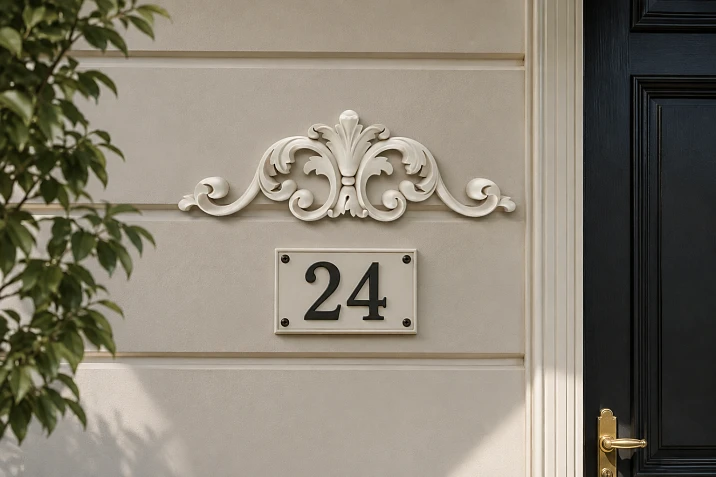
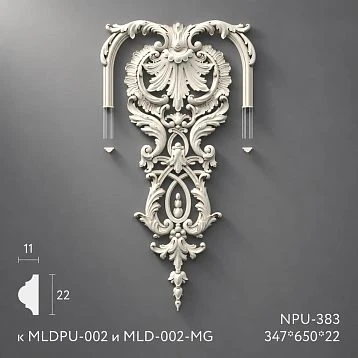
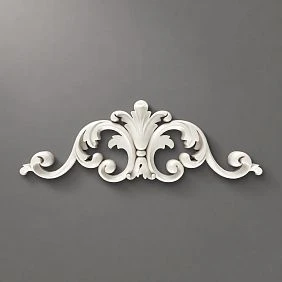
The house number is already fixed next to the entrance door, the facade is finished, the light fixture is installed, everything is neat — and yet the address plaque looks as if it appeared on the wall last and is in no way connected to the entrance architecture. Redoing the entire portal for one small area is illogical. In such a case, the carved NPU-205 overlay made of polyurethane deserves attention: it comes in two sizes — 250 × 84 × 10 mm and 350 × 117 × 14 mm — and can be used as a decorative overlay element on the facade.
The point of such a solution is not to turn the house number into a heavy stucco ensemble. On the contrary: one correctly chosen detail can neatly connect a technical object — the address plaque — with the door, trims, light fixture, and the overall plasticity of the facade. Where an entire portal, pilasters, or a complex pediment would be excessive, a small elongated ornament may be much more precise.
At the same time, NPU-205 is not an address plaque, a frame for the number, or a ready-made cartouche with digits. It is an independent decorative overlay. It can be placed above the plaque, below it, or used to build a different composition with it, but the size, position, and distance to neighboring elements must be determined in advance. A beautiful ornament by itself does not guarantee a beautiful entrance group.
If you already understand that this is exactly the kind of local facade accent you need, you can immediately buy carved overlay NPU-205. But before ordering, it's useful to decide the main question: which of the two sizes will best match your plaque, door, and free wall space?
Why an ordinary address plaque sometimes looks alien on a finished facade
The problem often arises not because of the plaque itself. It can be neat, well-readable, matching in color and font. But the facade's architecture lives by its own lines, and the house number by its own.
For example, the entrance door has pronounced architraves. Above it, a lantern is installed. A vertical finishing line runs along the side. The plinth, cornice, and window frames create a certain rhythm. Against this background, a small rectangle with numbers is perceived as a purely informational detail.
For function, this is enough.
For a finished facade, not always.
This gap is especially noticeable on houses where decorative stucco, paneled doors, expressive architraves, or other architectural elements are already used. The more carefully the entrance itself is designed, the more a random plaque stands out from the overall system.
But it doesn't follow from this that a huge decor is necessarily needed nearby.
Sometimes the facade is spoiled precisely by an attempt to "fix" a small technical item with too large an architectural gesture. Around the number, pilasters, massive frames, and wide cornices begin to appear—and the original task is lost.
In a situation with an already finished entrance, it is wiser to start with minimal intervention.
One NPU-205 can give the tablet architectural context without forcing the entire portal to be rebuilt.
And this is fundamentally different from the general approach to polyurethane stucco molding for the facade of a house, where windows, doors, cornices, rustications, and large elements can be considered simultaneously. Here the task is much narrower: to design a small address area near the entrance without overloading it.




NPU-205 in two sizes: what exactly can be ordered
NPU-205 is a carved decorative overlay made of polyurethane. The model has two sizes, and this is especially convenient for a facade composition: you can choose not between completely different ornaments, but between two scales of the same pattern.
| Parameter | NPU-205, smaller size | NPU-205, larger size |
|---|---|---|
| Product type | Carved decorative overlay | Carved decorative overlay |
| Material | Polyurethane | Polyurethane |
| Size | 250 × 84 × 10 mm | 350 × 117 × 14 mm |
| Length | 250 мм | 350 мм |
| Height | 84 мм | 117 мм |
| Thickness | 10 мм | 14 мм |
| Price | 1 450 ₽ | 2 280 ₽ |
| Permitted use | Including facade | Including facade |
| Is it suitable for an address zone | Yes, as a separate decorative element | Yes, as a separate decorative element |
| Is it the address plate itself | No | No |
This difference of 100 mm in length seems small on screen. On the facade, it can completely change the impression.
The 250-millimeter overlay works more delicately. It is easier to place next to a compact plate, in a narrow wall section, between a door and a light fixture, or in a small entrance area.
The 350-millimeter one requires more space. It is more noticeable from the street, looks more confident next to a wide door, and can become an independent decorative sign rather than just a light addition to the house number.
Before ordering one of the options, do not judge by price or photo. The first question is always physical: how much free space is there on the facade and what size is the address plate itself?
Our factory also produces:
NPU-205 — это не рамка и не основание для номера дома
Это различие нужно зафиксировать до начала подбора.
Адресная табличка решает информационную задачу. На ней размещаются номер, название улицы или другой адресный текст.
NPU-205 решает декоративную задачу.
Она не требует, чтобы цифры располагались внутри неё. Не нужно воспринимать резной контур как готовую нишу для номера. Гораздо интереснее использовать две вещи рядом, сохраняя за каждой собственную функцию.
Табличка остаётся читаемой.
Накладка создаёт архитектурный акцент.
За счёт этого композиция получается легче, чем попытка спрятать номер внутри сложного лепного орнамента.
Особенно полезно такое разделение, если адресная табличка уже изготовлена и установлена. Не нужно переделывать её только ради нового декора. Можно работать с существующей точкой и аккуратно добавить NPU-205 выше или ниже.
Если же фасад ещё проектируется, место под обе детали лучше определить одновременно. Тогда табличка перестанет выглядеть как последняя техническая добавка после завершения отделки.
Get Consultation
What size NPU-205 to choose near the house number
There is no universal rule that the overlay should be 20% wider than the plaque. Facade architecture is too diverse for such formulas.
But there is a clear verification system.
Need to know:
-
the width and height of the address plaque;
-
the width of the doorway or the outer door frame;
-
the width of the free wall section;
-
the distance from the plaque to the door casing;
-
position of the lamp;
-
the position of the doorbell, intercom, camera, and other devices;
-
the mounting height of the number;
-
the distance from which the entrance is typically perceived from the street.
After this, you can compare 250 and 350 mm not abstractly, but in a specific space.
When the size 250 × 84 × 10 mm looks more convincing
The smaller option is useful when the plaque itself is small and you don't want to turn the address area into a separate architectural center.
It can work well:
-
on a narrow wall section next to the door;
-
near a single-leaf entrance door;
-
with a short distance to the outdoor light fixture;
-
on a facade with already rich decor;
-
in a composition where the number should remain the main informational element;
-
if the ornament is required only as a small touch.
If this exact scale fits, you can NPU-205 250 × 84 mm buy without switching to a larger version just for greater visibility.
On a small facade area, an extra 100 mm can matter more than it seems.
When it's better to look at 350 × 117 × 14 mm
The larger NPU-205 is more appropriate if the entrance group itself has a large scale.
For example, the door is wide, the trim is noticeable, the facade is clearly visible from a distance, and a small plate gets lost on a large surface.
The 350 × 117 mm size creates a more confident horizontal line. It better withstands the proximity of large architectural details and can visually connect the plate to the door frame.
But the word "larger" does not mean "better."
If the free zone around the plate is 400–450 mm wide, a 350 mm long overlay can almost fill it and start to look cramped. This is not visible in the product photo — there, there is no door trim, lantern, or intercom around the item.
This is why a full-size mock-up matters more than a catalog impression.
Make two paper templates before ordering.
This is one of the simplest ways to avoid a mistake.
Cut out two rectangles from paper or cardboard:
-
250 × 84 mm;
-
350 × 117 mm.
Thickness can be ignored at the first stage. The goal is to see the area the decorative element will occupy.
Hold both templates in turn where the overlay is planned.
Look not only up close. Step back to the distance from which the house is usually seen:
-
from the gate;
-
from the path;
-
from the parking spot;
-
from the opposite side of the courtyard;
-
from the point where the visitor first looks for the house number.
That is where the difference will show.
Sometimes, at the door, a 250 mm option looks quite noticeable, but from the path it almost disappears. Then 350 mm proves justified.
In another situation, a large blank next to a small sign starts to draw attention to itself. Then the smaller NPU-205 works much more precisely.
It is useful to perform this test with the address sign already installed, if it exists. Then you see the real proportion of the two elements.
First find the common axis, not a place for a "pretty detail"
Facade decor starts to look random when each item is placed separately.
First, the sign was hung.
Then a lantern appeared nearby.
Then an intercom was installed.
After that, one wants to add molding, and for it they look for the only remaining free piece of wall.
This creates a decorative scatter where objects are physically close but not visually connected.
NPU-205 is better to attach to existing geometry.
The axis can be:
-
the center of the plaque itself;
-
the vertical line of the door casing;
-
the middle of the wall section;
-
the axis of the outdoor light fixture;
-
horizontal line of the door's top edge;
-
line of another facade decor.
It is not necessary to align everything strictly in one line. But the reason why the overlay is placed exactly here should be clear.
If this reason cannot be explained even to oneself, the position is most likely random.
Above the plaque, below it, or to the side: three completely different effects
The placement of NPU-205 changes the character of the entrance group no less than the choice of size.
NPU-205 above the house number
This is the most understandable scheme for an elongated horizontal overlay.
The ornament on top works like a small decorative finish. The plaque gets a "top" but is not enclosed in a massive frame.
This arrangement is especially convenient if a doorbell or intercom is already located below the plaque.
First, check the width of both elements. If the overlay is noticeably wider than the plate, it begins to visually cover the address area. If it is shorter, it is perceived as a separate central detail.
Both options are possible.
The problem starts not with the difference in width, but with the absence of an axis. If a short overlay is shifted relative to the plate by just a few centimeters without a compositional reason, the eye notices the error instantly.
NPU-205 under the address plate
Bottom placement looks different.
The overlay becomes a decorative support for the information block. This option is interesting if there is already a light fixture above the number and the upper part of the wall is better left uncluttered.
The bottom ornament can also support the horizontals of door panels or the base lines of the facade.
But here it is important to check the height. If the plate is installed low, the decorative detail below it should not extend into the area of the door handle, doorbell, or other equipment.
Side overlay
For NPU-205, this is a less obvious but possible scenario if the facade architecture dictates asymmetry.
For example, the house number is on a wide pier, and there is a significant free field nearby.
But side placement requires more attention. An elongated ornament cannot simply be shifted right or left and expect the same effect as with a central position.
It is better to make a layout of the entire area: door, sign, light fixture, and overlay. Even a simple photo of the facade with superimposed rectangles helps to see the imbalance.
Do not tie the NPU-205 only to the sign — there is a door nearby
One of the typical mistakes is to consider a small wall area separately from the entire entrance group.
The buyer measures the sign, chooses an overlay close in width, and considers the task solved.
But a person approaching the house does not see the sign separately.
He sees:
door + frame + number + light fixture + wall + steps + canopy or porch.
Therefore, the size of the NPU-205 should correlate not only with the address sign.
If there is a wide double door nearby, a small 250 mm overlay may be too cautious.
If the door is compact and the wall partition is narrow, 350 mm can become disproportionately large.
It is useful to focus on hierarchy.
The door is the main object.
The address plate is an informational object.
NPU-205 is a decorative object.
If the overlay starts to compete with the door, the hierarchy is disrupted.
For more complex design, it is useful to look at how it is generally structured. Stucco decor for the entrance group. But in relation to NPU-205, the task remains intimate: to complement the existing entrance, not to rebuild its entire architecture.
What to do if a facade lamp is already hanging next to the number
The lamp is one of the strongest neighbors of the address plate.
It has its own volume, mounting, shadow, and often an expressive shape. If the NPU-205 is placed too close, three active objects will appear at once on a small section of the facade:
-
a plaque;
-
a lantern;
-
a carved overlay.
Sometimes this looks rich. More often, it feels cramped.
Therefore, you should evaluate not the distance between edges as a separate number, but the free space between objects.
Take a paper template of the NPU-205 and attach it to the intended location. If only a narrow, random strip of wall remains between the ornament and the light fixture, it is better to reconsider the composition.
There are several options:
-
choose a smaller NPU-205;
-
move the overlay under the plaque;
-
do not add it at all;
-
move the address composition itself if the facade is still being designed.
Good decor doesn't have to fill every free space.
Intercom, doorbell, and camera: the decorative zone should not interfere with the functional one.
A modern entrance group rarely consists only of a door and a number.
Nearby may be located:
-
doorbell button;
-
video intercom;
-
camera;
-
card reader;
-
mailbox;
-
outdoor socket;
-
switch;
-
sensor.
These items cannot be ignored for the sake of symmetry.
The NPU-205 should remain a decorative addition, not obstruct access to equipment.
The situation looks especially bad when the ornament visually "overlaps" a small button or technical panel, even though physically there are several centimeters between them.
Before purchasing, it is useful to photograph the wall section strictly frontally and mark the actual dimensions on the photo. After that, you can overlay a rectangle of 250 × 84 or 350 × 117 mm.
Such a sketch takes a few minutes, but often saves you from buying the wrong size.
Why the central overlay is especially convenient for the address zone
The NPU-205 belongs to the central decorative overlays of the "Classic" collection. This aligns well with the task at hand.
In the address area, the central ornament is convenient because it has its own distinct middle. It is easier to anchor it to the center of the plaque.
There is no need to assemble the left and right halves or decide where to place an asymmetric fragment.
If you like the principle of such elements but want to compare adjacent shapes and sizes, you can buy central polyurethane overlays after comparing several options.
This is especially useful when the NPU-205 fits in character, but one of its sizes turns out to be too small, while another no longer fits into the available field.
Do not force the facade to fit a specific article. It is better to choose decor based on the actual geometry of the entrance.
Small NPU-205 or large: let's compare not the specifications, but the scenarios
| Scenario | 250 × 84 × 10 mm | 350 × 117 × 14 mm |
|---|---|---|
| Narrow pier | More often it is more convenient | May take up too much space |
| Small address plate | Scales well | May dominate |
| Wide plate | May look too short | Often correlates more confidently |
| Large front door | Delicate accent | More noticeable decorative element |
| Facade already rich with stucco | Easier not to overload | Requires caution |
| Minimalist entrance | Can be used very sparingly | Can become the main ornament |
| Viewing from a large distance | Less noticeable | Reads more confidently |
| Little free space near the lamp or intercom | Easier to place | Need more space |
| Only a small touch is needed | Fits better | May be redundant |
| A noticeable connection of the number with the entrance architecture is needed | Possible | Usually more expressive |
The table does not cancel the fitting.
It only helps to understand the direction.
A buyer who chooses based on the situation, rather than on the principle of "more means more impressive," is much less likely to encounter that molding, which is good in itself, looks superfluous on the facade.
One decorative element is often better than a whole set
Let's imagine a typical situation.
The house is already built.
The door is framed.
The porch is finished.
The number is installed.
The owner thinks that near the sign, a small classic motif is missing.
The most common mistake is to open a catalog and immediately start building a full architectural ensemble around that area.
But the entrance group already exists. It doesn't need a second architecture on top of the first.
One NPU-205 may be sufficient precisely because it doesn't try to rewrite the facade.
The option is especially successful when other stucco decor is already present on the house. Then a small motif near the number is perceived as a continuation of the facade's language.
If there are no decorative elements at all, the question is more complex. A single carved ornament on a completely minimalist wall can look no less random than the original sign.
Then it's useful to look at the whole Polyurethane wall decor and understand whether the house needs a single element or a more systematic solution.
The main thing is not to turn this review into a reason to buy more details. The category is needed for comparison, not for mandatory complication.
When one NPU-205 is not enough
There are facades where a small ornament will not solve the original problem.
For example, the door itself looks unfinished: there is no framing around it, a huge empty section of wall, and the proportions of the entrance require larger architectural work.
Then the NPU-205 next to the number will be a cosmetic adjustment.
It will decorate a small area, but will not bring the entire entrance group together.
In such a situation, it is better to first think about the system:
-
door framing;
-
the overall rhythm of the moldings;
-
the connection of the entrance with the windows;
-
cornice lines;
-
the design of the porch;
-
in the overall scale of facade decor.
When you need not a local ornament, but a full-fledged architectural work, it is more rational to order architectural decor made of polyurethane as part of a broader concept.
NPU-205 can remain within the project, but it will no longer be the only decorative tool.
When, on the contrary, it is better to add nothing
A good article about decor should answer not only the question “what to buy,” but also the question “when a purchase is unnecessary.”
NPU-205 may not be needed at all.
For example:
-
the address plate is already built into the door frame;
-
its shape exactly repeats other facade details;
-
there is little free space nearby;
-
the entrance is designed in very strict geometry without ornament;
-
there is already an expressive lamp near the number;
-
the sign is already well readable and compositionally connected to the door;
-
an additional element will disrupt the symmetry;
-
the facade finish does not leave a calm field for the overlay.
You should not decorate the wall just because the product looks good in the catalog.
First, you need to prove to yourself that the new element solves a specific problem.
In our topic, the problem is clear: the house number looks like a random technical object.
If after trying the paper NPU-205 sign, it really starts to be perceived as part of the entrance — the purchase is justified.
If it just becomes "more decor," it's better to stop.
Classic facade: NPU-205 can support an existing language
On a house with cornices, trim, a paneled door, and other classic details, NPU-205 looks natural.
Its ornament does not arise from a void: it continues an existing system.
Then the address plate gets a useful neighbor. It remains a modern informational detail, but an element appears nearby that brings it back into the architectural context.
Repeating principles looks especially convincing.
If the facade already has central decorative motifs above windows or the door, a small central overlay near the number can support the same way of building decor.
Here it's useful not to copy everything literally.
It's not necessary for every ornament to be the same.
Unity of scale, character, and placement is enough.
Modern facade: much more caution is needed
Polyurethane stucco decor cannot be automatically attributed only to historical or palace architecture. But on a strict modern facade, its dosage becomes especially important.
If the house is built on simple rectangles, large planes, and a minimal number of details, the carved NPU-205 can become very noticeable.
In this case, a small model of 250 × 84 mm is often safer than a large one.
Even more important is the future finish.
If the overlay and the facade are perceived as a single whole in color, the relief can read calmly — through light and shadow.
If the decorative element sharply contrasts with the wall, its graphic weight becomes much higher.
Therefore, on a modern facade, they first check not 'whether the ornament is pleasing' but 'whether it has an architectural justification.'
For example, NPU-205 can support the decorative shape of an entrance door or a small classical detail of a lantern.
If there is no such dialogue, a single carved overlay risks looking inserted.
The color of NPU-205 and the color of the sign: don't try to make them identical at all costs.
The desire is obvious: if two parts are next to each other, painting them the same color means they will match.
Not always.
The address sign should primarily perform its informational function well. The number and street name must be readable.
NPU-205 doesn't have to copy its color.
Sometimes it's much neater to tie the overlay to the facade or door framing.
This results in a three-part system:
-
the wall creates the background;
-
NPU-205 relates to the architecture;
-
the address sign remains an informational element.
Then the two different functions don't get mixed up.
Before painting, you should rely on the actual finishing options and technology chosen for the project. Unconfirmed coatings are better not to include in the solution in advance; current possibilities should be verified before ordering.
Orientation by plate width: equal width is not required
It may seem that NPU-205 and the house number must necessarily match in length.
No.
There are several different effects.
Overlay already thinner than the plate
Then it works as a central jewelry accent.
This is especially well read when the centers align.
Overlay approximately equal in width to the plate
The composition becomes calm and cohesive.
The two details are perceived as a connected pair.
The overlay is wider than the address plate.
The ornament begins to architecturally "cover" the information block.
This technique can be successful above a small plate, especially if the large size of the NPU-205 is supported by the width of the door.
No option can be declared universally correct.
The only mistake would be an accidental mismatch, when the difference does not create a clear effect.
The width of the door matters more than it seems.
Suppose the plate is about 250 mm wide. It seems natural to take the same NPU-205.
But next to it is a wide, massive door that visually dominates the entire pier.
As a result, a pair of two 250-millimeter elements may seem too small.
And the opposite situation: the address plate is wide, but the entrance door is small, and the free wall is narrow. Trying to necessarily install a 350-millimeter overlay to match the plate will create cramped conditions.
Therefore, when choosing facade decor, the rule of context always applies:
measure the nearest object, but look at the entire entrance group.
Physical dimensions are needed for installation.
The overall appearance is needed for the decision.
The height at which the house number is placed also affects the decor.
Address plates are installed in different places: to the side of the door, above eye level, on gates, on the facade plane between the door and the window.
NPU-205 must work with the actual position.
If the plate is located high, a small overlay may be harder to read from the street.
If the number is located close to a person, a large deep relief will become more noticeable.
If the plate is placed directly under a lamp, the top overlay may fall into an active light-and-shadow zone.
Therefore, it is useful to photograph the template at different times of day — during the day and with exterior lighting turned on.
The shape does not change.
The perception changes significantly.
Light and shadow: thickness of 10 and 14 mm also plays a role in the choice
The two NPU-205 units differ not only in length and height.
The smaller version has a thickness of 10 mm.
The larger one is 14 mm.
The difference of 4 mm seems small, but the larger part overall has a more pronounced physical volume.
On the facade, the relief is read thanks to shadows. The more active the side light, the more noticeable the plasticity becomes.
An exterior lamp positioned to the side or above can emphasize the overlay in the evening more strongly than diffuse daylight.
This is especially important when choosing between options.
If during the day the 350-mm NPU-205 seems moderate, in the evening next to a directional spotlight it can become much more active.
Therefore, the decorative element near the entrance should be evaluated not only in daylight.
The entrance group is already ready: can NPU-205 be added without major rework
It is for this scenario that the topic is especially relevant.
There is no need to redesign the entire facade just because the address plate looks lonely.
First, evaluate the finished wall:
-
condition of the base;
-
existing coating;
-
the free margin;
-
position of engineering elements;
-
existing symmetry;
-
the ability to neatly place the overlay.
After that, the size is determined.
If the available area is small, the choice may immediately lean toward 250 mm.
If there is plenty of space and a small template gets lost, 350 mm is tried.
At the same time, installation should not begin until the actual part is fitted. Paper shows the dimensions but does not convey the real carved contour.
Installation on an already finished facade: first the base, then the adhesive
The NPU-205 card provides for its use as a decorative overlay element, but the specific installation result depends on the surface.
The adhesive works not with an abstract “facade,” but with the layer to which the product is directly applied.
If the coating is weak, crumbles, or peels off, attaching to it cannot be considered a reliable base just because a good mounting compound was chosen.
Before installation, check:
-
surface strength;
-
absence of peeling areas;
-
marking accuracy;
-
position relative to the plate;
-
the ability to press the overlay across the entire intended contact area;
-
absence of obstructions.
It is better not to choose the composition based on the principle of "any glue for repairs." First, it is useful to understand which one molded decoration adhesive is suitable for the specific task and base.
The decorative idea itself should not outpace the installation reality.
Why it is better to try on the overlay before final finishing
If the house is still at the stage of facade work, the buyer has an advantage.
You can choose NPU-205 before completing all decorative finishing and see the actual part in the right place.
This allows you to decide in advance:
-
position;
-
orientation;
-
color;
-
connection with the nameplate;
-
connection with the door;
-
distance to the light fixture.
If you completely finish the facade first and then try to integrate the decorative overlay into an already formed system, fewer options will remain.
But a finished facade does not make the task impossible. It just increases the importance of precise fitting.
What to buy together with NPU-205 for designing the address area
A small decorative project should not automatically turn into a large cart.
Related products are selected only based on the actual task.
| What are we considering | What for | When it is really needed | Where to go |
|---|---|---|---|
| NPU-205 | Main carved element near the address plate | When a specific ornament in size 250 or 350 mm is needed | buy carved overlay NPU-205 |
| Other decorative overlays | Compare shape and scale | If NPU-205 does not fit by size or pattern | Buy decorative polyurethane overlays |
| Central overlays | Select an ornament with a pronounced central axis | When a different proportion around the house number is needed | buy central polyurethane overlays |
| Other polyurethane decor | Continue the entrance group design | If one overlay is no longer enough | You can buy ready-made stucco matching the Baroque style. Calculate the quantity: linear meters of cornices and moldings, number of rosettes, pilasters, consoles, corner elements. Add a ten to fifteen percent allowance for trimming. |
| Facade decor | Assemble a broader architectural solution | If the issue concerns not only the address plate | buy facade decoration made of polyurethane |
| Mounting solution | Secure the element to the prepared base | After determining the surface type and technology | molded decoration adhesive |
The house number plate is intentionally not included in this table as part of NPU-205. The overlay is sold and considered separately from the address designation.
This protects against the incorrect expectation that after purchasing NPU-205 you receive a ready-made address composition.
Decorative overlay or full-fledged door portal
These are two different scales of intervention.
NPU-205 is needed when:
-
the door is already finished;
-
the entrance as a whole looks complete;
-
The problem is local;
-
We want to specifically connect the address plate to the facade;
-
There is no need to rebuild the architecture of the opening.
A full portal is needed in a different situation.
If the doorway looks too plain on its own, and the house number is just one of many unrelated details, a small overlay won't solve the problem.
It's useful to ask a simple question:
If you remove the plate from the house number, do you like the entrance group itself?
If yes, you can work locally with NPU-205.
If not, a broader project is required.
This helps avoid spending money on a cosmetic fix where the problem lies deeper.
How not to confuse NPU-205 with a cartouche, frame, and other facade decor
In the catalog of decorative elements, different products may have a similar classical language, but the function is determined not only by the pattern.
NPU-205
This is a carved decorative overlay made of polyurethane. In the scenario under consideration, it is placed next to the address plate and works as an ornament.
Address plate
This is an independent informational object. It carries the number and, if necessary, the street name.
Frame
A frame implies framing an object along its perimeter. NPU-205 itself does not become a frame around the plate.
Cartouche
Cartouche —
Mistake: making the house number secondary for the sake of beautiful stucco molding
This is especially important.
No matter how much you like the ornament, the address plate has a practical function.
Do not:
- covering it with a carved element;
- overlapping part of the text;
- placing the decor so close that the contours merge;
- creating a background on which the number loses readability;
- making a complex ornament the main center of a small address area.
A beautiful entrance remains an entrance to a residential building, not a showcase of decorative possibilities.
Function and architecture should support each other.
Mistake: not checking the appearance from the street
At the door, everything looks larger.
From a distance, it looks smaller.
This simple thing is often forgotten.
The buyer holds the NPU-205 against the wall, steps back two paces, and decides the size is right.
But the visitor starts looking for the number much earlier.
So after trying it on, walk the entire usual route home.
If the digits are readable and the overlay feels like a calm framing addition, the scale is well chosen.
If the decor disappears completely, a larger version may be needed.
If the ornament is noticed before the number, the composition should be toned down.
Mistake: choosing based on a close-up photo of the carving
The product card helps to examine the pattern.
It does not show the scale of your house.
In the catalog, a small element takes up a significant part of the screen, so the brain automatically perceives it as larger.
On a real wall, a length of 250 mm is only 25 cm.
350 mm is 35 cm.
Place a ruler against the facade, and the perception will instantly change.
For this theme, a natural template is more useful than a dozen enlarged photos.
Mistake: mixing several different patterns in a small area
Suppose there is already one decorative motif near the door.
Above it is another one.
On the lantern — the third one.
Next to the number, an NPU-205 with the fourth one is purchased.
Each item can be good on its own, but the entrance starts to fall apart into a collection.
If there is already a lot of ornament around, the NPU-205 should be checked especially strictly.
Sometimes it is better to repeat an existing principle or refuse a new detail.
If a wider choice within one product group is required, it is more useful to compare Polyurethane decorative appliques and find an option that better aligns with the existing facade.
Mistake: buying decor before measuring technical elements
The lantern seems far away.
The bell seems small.
The casing seems narrow.
After measuring, it turns out that the free field is significantly smaller than it seemed.
Before ordering, you need to take at least basic measurements:
| What to measure | Why |
| Width of the plate | Compare with the length of NPU-205 |
| Height of the plate | Estimate the total height of the address block |
| Distance to the casing | Check if the decor will fit without crowding |
| Distance to the luminaire | Do not collide two active elements |
| Distance to the intercom or doorbell | Preserve ease of use |
| Width of the wall segment | Understand the maximum scale of the composition |
| Width of the door | Match the small address zone with the main entrance object |
| Height of the sign placement | Assess visibility from the street |
No complex construction calculations are needed here.
Accurate initial data is required.
Practical scenario: a small sign beside a single-leaf door
Let's imagine a calm entrance.
A standard-sized door, a small house number next to it, and a separate light fixture above.
The sign seems a bit lonely, but the facade itself doesn't require much decoration.
In such a situation, the NPU-205 measuring 250 × 84 × 10 mm is checked first.
It can be tried along the central axis of the sign, either above or below.
If the relief supports the entrance and doesn't conflict with the light fixture, there's no need to increase the size.
Here, a small overlay is good not because it's cheaper, but because it fits the task.
Practical scenario: a wide wall section next to a large door
Another house.
The door is wide, the facade is massive, and the sign is located on a large empty field.
The small number really looks like a random dot.
A 250-mm NPU-205 may turn out to be too weak after fitting.
Then 350 × 117 × 14 mm gives a clearer horizontal line.
But even in this case, the overlay should not fill the entire empty wall. Free space around it is necessary for normal perception.
If even 350 mm gets lost, the problem may already go beyond one decorative element. Then it's time to consider Facade decoration made of polyurethane wider.
Practical scenario: the sign is located between a door and a window
Such a section is more complex because there are two architectural systems right next to each other.
The door has its own vertical line.
The window has its own.
The number is located between them.
NPU-205 cannot be attached only to the center of the plate without checking how that center relates to the wall section.
Sometimes it is better to orient the entire address composition relative to the width of the wall between openings.
Then it looks like part of the facade, not an attribute of the door or window.
Here, a frontal photograph with markings is especially useful.
Practical scenario: the number is located directly next to the trim.
There is little free space.
In such a situation, the large 350 mm option more often requires special caution.
If the overlay almost touches the trim, it begins to be perceived as part of the door frame. This is not necessarily bad, but then the entire portal needs to be evaluated.
If such a connection was not planned, it is better to leave a visually calm field between the decor and the trim.
The small NPU-205 250 mm gives more freedom.
Practical scenario: the number is installed under a lantern
A vertical composition already exists:
lantern → number.
Adding NPU-205 creates a third level.
The most natural question: where to put it?
If the overlay fits between the light fixture and the plate, first make sure the distance does not become too tight.
It is often better to place the ornament below the number to give the light fixture its own space.
But the final decision is determined by the geometry of the specific entrance.
Practical scenario: a facade with almost no decoration
Here, the NPU-205 becomes not an addition, but one of the few ornamental elements of the house.
This increases its visual responsibility.
On a classic, richly decorated facade, a small overlay dissolves into the overall system.
On a smooth wall, it comes under close scrutiny.
Therefore, first try the smaller one.
Check whether the ornament has a connection with the door or the light fixture.
If not, perhaps a minimalist address plate without additional carving would suit the facade better.
Practical scenario: the house already has a lot of stucco molding
Then the task is the opposite.
There is no need to add another independent style.
NPU-205 should support the existing decor.
Look at:
- the character of the carving;
- the scale of nearby elements;
- their axes;
- density;
- the color scheme.
Sometimes a new plate near the number makes the facade more logical precisely because it repeats an already familiar language.
Sometimes it becomes the last unnecessary detail.
The difference can only be seen on a mockup of the overall facade.
Can the NPU-205 be used not only near the house number
Yes. The card provides for the use of the plate not only on the facade, but also on doors and furniture.
This is interesting for projects where one decorative motif needs to be repeated in several places.
For example, NPU-205 is used near the address plate outside, and similar decorative plate logic appears on a door or furniture facade.
But the repetition should not become mechanical.
The fact that one element is acceptable on different surfaces does not mean it should be placed everywhere.
A good interior and facade are united not by the number of identical details, but by the consistency of decisions.
Why a polyurethane overlay is convenient as local decor
In the context of our task, the main property of the product is the ability to use a ready-made carved element without needing to create a complex ornament directly on the facade.
The buyer chooses a specific pattern and size.
This is especially convenient when the house is already finished and you want to make a limited change.
There is no need to turn the design of an address plate into a separate production of a complex decorative shape.
If NPU-205 fits in proportions, the remaining issues are fitting, installation, and finishing.
If it does not fit, it is better to move on to other ready-made decorative polyurethane elements, rather than trying to change the architecture around an unsuitable piece.
How to buy NPU-205 from STAVROS without a size error
Before order NPU-205 made of polyurethane, it's better to go through a quick check.
First, choose a location.
Not an approximate "somewhere near the number," but a specific position.
Then measure the plate.
After that, make two paper mock-ups.
Look from a distance.
Check the proximity to the light fixture and technical devices.
Only after this choose 250 or 350 mm.
This order seems obvious, but it changes the quality of the purchase: the product is chosen for the task, not the task is invented after receiving the product.
What to check in the product card before finalizing the order
Even if the model is already selected, before completing the purchase, double-check:
- exact size;
- price;
- the material;
- the selected modification;
- permitted use;
- up-to-date product information;
- conditions related to future finishing and installation.
For NPU-205, two sizes are confirmed:
250 × 84 × 10 mm — 1,450 RUB.
350 × 117 × 14 mm — 2,280 RUB.
Prices are current as of the preparation of the article's source data; it is reasonable to re-check them in the product card right before purchasing.
Is it worth buying two NPU-205 at once?
For the scenario in question — not always.
One central plate near one address sign usually has a clear compositional function.
Two pieces may be needed if you are deliberately building a symmetrical system, for example on two sides of a separate zone.
But buying a pair just because "symmetry is always prettier" is not necessary.
Two identical plates can look especially strange on a narrow wall section where one would have been enough.
First, the layout.
Then the quantity.
Not the other way around.
Can NPU-205 be placed above the door, leaving the sign on the side?
Yes, but then the plate stops working specifically as decor for the address sign.
It becomes part of the door design.
That is a different scenario.
If your original problem is that the number looks random, decor above the door may not solve it at all. It will decorate the entrance, but the sign will still remain separate.
So keep the task in focus.
NPU-205 must be in such a relation to the number that the viewer reads the connection.
When to move from one overlay to a full facade project
There is a simple sign.
You started with a question about NPU-205, and after a while you are discussing:
- framing of the entire door;
- window trims;
- cornices;
- corners of the house;
- pediment;
- rusty;
- decorative belts.
So, the original local task has grown.
This is normal.
But then there's no need to continue designing the facade around a single plate.
It's better to move to a general system and buy facade decoration made of polyurethane only after defining the overall architecture.
NPU-205 can remain next to the number as a small finishing element.
Who NPU-205 next to the house number is really suitable for
This solution is especially appropriate if:
- the address plate is already installed and looks isolated;
- The entrance is generally complete;
- A large portal is not needed;
- There is a free facade field nearby;
- The classic ornament matches the door or other decor;
- A small but noticeable architectural accent is needed;
- One wants to choose between two scales of the same pattern;
- The facade allows for neat surface mounting.
In such a situation, NPU-205 answers exactly the task at hand.
It does not require complicating the entire entrance.
Who should better look at another solution
Another option is more reasonable if:
- the facade is very minimalist and carved decor looks alien;
- the number is already well integrated into the architecture;
- there is no free space near the sign;
- the problem concerns the entire doorway, not just the address area;
- even 250 mm is too large;
- 350 mm, on the contrary, is not noticeable enough on a large-scale facade;
- a frame directly around the address sign is required;
- a different type of decorative product is needed;
- one detail does not connect with the existing stucco molding.
In these cases, it is worth Buy decorative polyurethane overlays only after comparing other forms or moving to a broader architectural solution.
Ready-made check before ordering
Before purchasing, go through ten questions.
- Where exactly is the address plate located?
- What is its width?
- How much free space is above and below it?
- How close is the door?
- Where is the lamp located?
- Is there a doorbell, intercom, or camera nearby?
- What does the 250 × 84 mm template look like?
- What does the 350 × 117 mm template look like?
- Which option is easier to read from the street?
- Does the overlay solve the original problem or just add another ornament?
If there is no clear answer to the last question, it is better not to rush the order.
If the answer is obvious, choosing the right size becomes much easier.
FAQ: carved overlay NPU-205 near the address plate
Can NPU-205 be used on the facade of a house?
Yes. Facade use is provided for NPU-205. The overlay can be used as a decorative element of the entrance group, including next to the address plate, if it fits in size and composition.
Is NPU-205 a ready-made house number plate?
No. NPU-205 is a carved decorative overlay made of polyurethane. The house number itself, street name, or other address text is placed on a separate plate.
Can the NPU-205 be glued directly above the house number?
Yes, if the chosen position fits the base and does not interfere with other facade elements. Before installation, it is better to align the center of the overlay relative to the address plate or another selected architectural axis.
Which size should I choose: 250 or 350 mm?
First, compare both sizes with the actual width of the plate, the wall section, and the door. For an accurate visual decision, make two full-size templates — 250 × 84 and 350 × 117 mm — and hold them against the facade.
What is the price of the NPU-205?
The source data confirms two options: 250 × 84 × 10 mm — 1,450 RUB, 350 × 117 × 14 mm — 2,280 RUB. The current price should be checked on the product page before placing an order.
Can I buy just one NPU-205?
Yes. For a local address composition, one central overlay is often exactly what is needed. There is no requirement to buy several identical elements without a pre-planned layout.
Should the overlay be wider than the number plate?
Not necessarily. It can be narrower, roughly equal to it, or wider — each option creates a different effect. What matters much more is the alignment of the axes and the connection with the overall architecture of the entrance.
Is it worth taking 350 mm if you want the decor to be noticeable from the road?
A large size is indeed more noticeable, but it should remain proportional to the plaque and door. If a 350-millimeter overlay starts to dominate the house number, it's better to check the 250 mm option.
Can the NPU-205 be placed under the plaque?
Yes. The lower placement is especially convenient when there is already a facade light above the address plaque. The overlay then works as a decorative base for the composition.
Can the NPU-205 be installed to the side of the number?
It's possible, but this layout requires a more careful balance check. The elongated central ornament is easiest to perceive above or below the plaque, but a specific facade may dictate a different position.
What to do if there is an intercom nearby?
First, preserve the convenience of using the intercom. The overlay should not obstruct access, visually cover the equipment, or create too tight a group of several objects.
Can the NPU-205 be placed next to an outdoor lantern?
Yes, but there should be enough visual space between two decoratively active elements. The actual position is best checked with a paper template with the lighting both on and off.
Is full facade stucco molding needed if NPU-205 is installed?
No. The point of the solution in question is precisely the ability to add one local decorative element to an already finished entrance. A broader facade system is only needed when the problem concerns the entire architecture of the doorway.
What to do if NPU-205 does not fit in any size?
Do not try to adjust the facade to a specific article number. You can buy central polyurethane overlays after comparing other shapes and proportions.
Can the same NPU-205 be used on a door?
The product card allows the use of NPU-205 for doors. But the decision must be made separately for each specific door composition: a successful facade placement near a room number does not mean that the same piece must necessarily be repeated on the door leaf.
Is NPU-205 suitable for furniture?
Yes, use on furniture is also provided. This expands the possibilities for repeating the ornament, although in each case the size and installation location must be assessed separately.
Do I need to paint the overlay to match the color of the address plate?
No. It is often more harmonious to match the NPU-205 with the color of the facade or door frame, while leaving the plaque with an independent contrasting solution for good readability.
Can I first buy the plaque and then decide where to place it?
Technically, yes, but this order increases the risk of errors. It is better to first determine the location and check the dimensions with a paper template, and only then order NPU-205 made of polyurethane.
Do I need to drill the facade for installation?
The specific mounting method depends on the base and the adopted technology. NPU-205 is considered a decorative overlay element, so before installation, you need to determine a suitable mounting adhesive and prepare the surface.
Which glue should I choose for NPU-205?
The choice depends on the base and installation conditions. Instead of a random universal adhesive, it is better to study the recommendations on the topic in advance adhesive for relief decoration and match them with the specific surface.
What is more important — the size of the plaque or the size of the door?
Both parameters are needed. The plaque defines the local composition, while the door sets the main scale of the entrance group. NPU-205 should work well in both respects.
If the house number looks too small on a large wall, will NPU-205 fix the situation?
Sometimes yes. A larger NPU-205 can add extra visual weight to the address area. But if the entrance group itself looks unfinished, a single overlay won't be enough — it's better to consider the facade decor more broadly.
One precise ornament instead of unnecessary facade complexity
When a house number plate looks random on the facade, the first reaction is "something is missing here." It's important not to turn this feeling into endless addition of details.
Sometimes what's missing isn't the amount of decor, but one clear connection.
The carved overlay NPU-205 can create this connection if its scale, position, and pattern truly match the entrance group. The size 250 × 84 × 10 mm allows for delicate work. The 350 × 117 × 14 mm option provides a more noticeable horizontal line for a large entrance. The price of the first size is 1,450 rubles, the second — 2,280 rubles.
But you shouldn't make a decision based only on these numbers.
Before ordering, measure the plate, the wall section, and the distances to neighboring elements. Make two templates. Look at the entrance from the street. Check that the number remains the main informational object. Make sure the decor doesn't conflict with the lantern, doorbell, camera, and door framing.
After such a check, the choice becomes simple.
If you need a local ornament and NPU-205 fits the proportions exactly, you can buy carved overlay NPU-205.
If you like the shape but the sizes don't fit, it's better Buy decorative polyurethane overlays after comparing other models.
If it becomes clear that the problem is much broader than one address plate, it makes sense You can buy ready-made stucco matching the Baroque style. Calculate the quantity: linear meters of cornices and moldings, number of rosettes, pilasters, consoles, corner elements. Add a ten to fifteen percent allowance for trimming. already for coordinated design of the entire entrance group.
In such a project, STAVROS is useful precisely for its ability to move from small to large: first choose a specific decorative overlay, then, if necessary, select adjacent elements without assembling the facade from random parts.
That's why NPU-205 next to the house number makes sense not as "another decoration," but as a precise tool. If without it the plate looks technical and alien, and after fitting, the ornament connects the number with the door and the facade architecture — the detail is in its place. If the overlay only makes the wall richer, it's better to keep the entrance calm.
In a good facade, it's not the amount of stucco that matters. What matters is the feeling that every detail appeared there not by chance.