Article Contents:
- Building materials with delivery: why shipping costs for trim are calculated after order assembly
- 200 meters of molding and 200 meters of cornice are completely different cargoes
- Wooden skirting board: when plank length affects delivery cost
- Wooden molding: when it is more cost-effective to combine several SKUs into one shipment
- Wooden cornice: why a large profile can determine the transport for the entire order
- Delivery of building materials: what data to request before placing an order
- Consolidated cargo or a dedicated vehicle: which is better for wooden trim
- Consolidated shipping
- Dedicated transport
- Mistake 1. Calculating delivery by total square footage
- Mistake 2. Agreeing on the tariff before choosing the execution
- Mistake 3. Choosing transport based on the most numerous SKU
- Mistake 4. Comparing only the tariff
- Mistake 5. Splitting the order based on readiness
- Mistake 6. Not accounting for packaging in the dimensions
- Mistake 7. Not checking the last leg of the route
- Error 8. Do not link packaging to the specification
- 1. Choose profiles
- 2. Approve finishes
- 3. Calculate products
- 4. Determine the composition of cargo units
- 5. Find the limiting dimension
- 6. Prepare packaging
- 7. Compare shipping methods
- 8. Calculate the total cost
- 9. Split into batches and label
- 10. Only then confirm the shipment
- Can I calculate the delivery cost before placing the final order?
- Why is the skirting board length of 2400 or 2600 mm so important for logistics?
- Should skirting boards, mouldings, and cornices be combined into one shipment?
- Which is more cost-effective: consolidated cargo or a dedicated vehicle?
- Should packaging be counted separately?
- How can I determine how many cargo units there will be?
- What should I do if part of the order is needed earlier?
- Can I order STAVROS delivery to another region?
- What matters more when comparing two transport options?
- What data must be saved after sending?
- Should the carrier be informed in advance that the cargo is long-length?
- Can transport be calculated by volume without a list of SKUs?
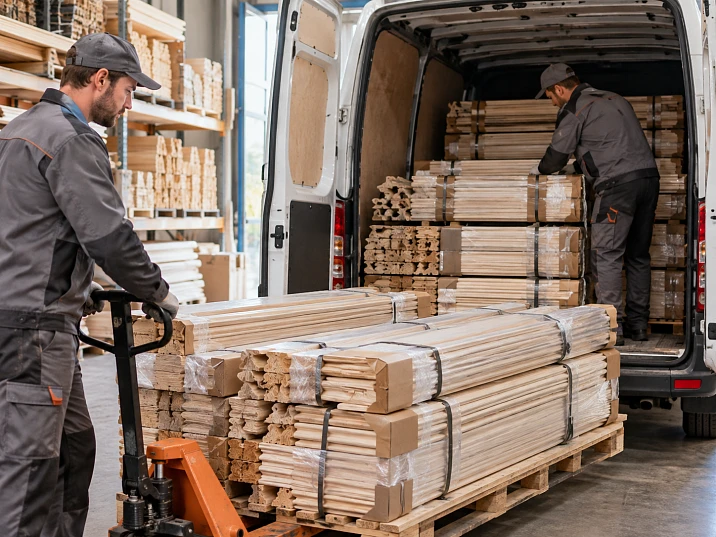
When an order includes a wooden skirting board, moulding and cornice, the transport cost cannot be properly estimated from a single figure of “so many linear metres”. For logistics, what matters is not only the metres, but also the number of strips, the length of each item, the profile cross-section, the number of packages, the maximum dimension of a single piece, the total weight, and whether different items can be combined into one safe shipment.
Let's imagine an order for a single interior project: 180 m of skirting board, 240 m of moulding and 80 m of cornice. That comes to 500 linear metres in total. For a finishing estimate, this figure is useful. For the carrier, it is almost useless. Five hundred metres can turn into a large number of relatively compact strips or into several dozen large-sized packages, where the length of the largest cornice sets the requirements for the entire transport.
Therefore building materials with delivery it makes sense to calculate in this sequence: first approve the specific profiles and their designs, then convert the linear metres into the number of whole items, determine the composition of the packages, and only after that compare transport methods.
This article focuses specifically on choosing a logistics scheme before shipment. Not on how to unload material at the site and where to store it after receipt, but on how to determine the real volume of cargo in advance, avoid unnecessary splitting of the order, compare consolidated shipping with dedicated transport, and avoid an unexpected surcharge after the purchase.

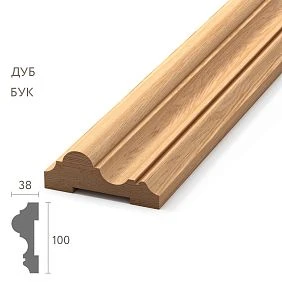
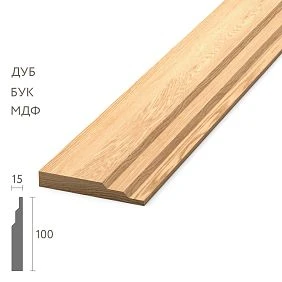
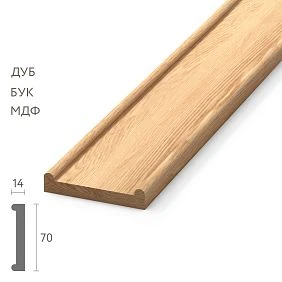
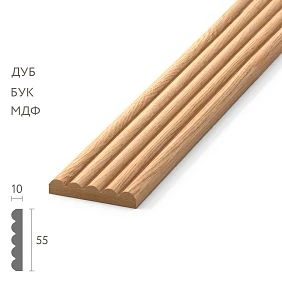
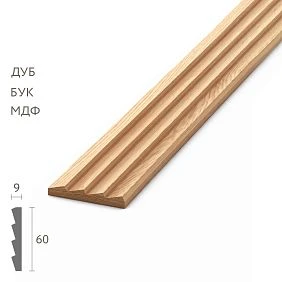
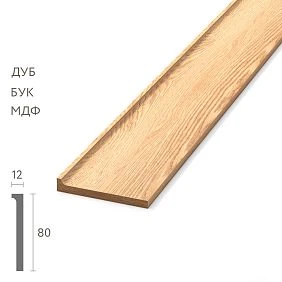
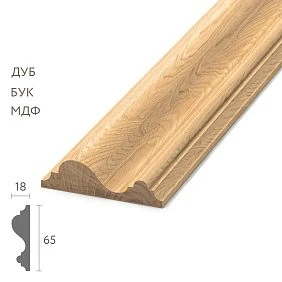
Building materials with delivery: why for mouldings the cost of transportation is calculated after the order is assembled
Let's return to the example:
-
skirting board — 180 m;
-
moulding — 240 m;
-
cornice — 80 m.
If you add up the items, we get 500 m. But the carrier physically transports not "meters." It transports planks assembled into cargo units.
To turn an order into a logistics task, you need to know at least five parameters:
-
How many whole items are included in the order.
-
What is the length of each SKU in the selected version.
-
What is the profile cross-section.
-
How many cargo places will there be after packing?
-
What are the maximum dimensions and total weight of the prepared cargo?
Even within a single model, the length may depend on the material. For example, in the current STAVROS product page, the PLT-005 skirting board measures 120 × 16 × 2600 mm in the MDF and moisture-resistant MDF variants, while the beech and oak variants are 2400 mm long. If the customer first selected the profile and changed the material later, not only does the product itself change — the cutting layout and the number of whole strips change, and along with them the cargo may change as well.
Suppose a conditional section requires 48 m of PLT-005. At a length of 2.4 m, mathematically that is 20 whole strips. At a length of 2.6 m, a clean division gives 18.46, meaning a minimum of 19 strips is needed before checking the actual cutting layout. A difference of just 20 cm in the length of one item changes the number of product units.
But for transport, the opposite effect occurs: 19 strips 2.6 m long require a larger usable dimension than 20 strips of 2.4 m. Therefore, one cannot automatically assume that a longer strip is more advantageous logistically.
The correct sequence looks like this:
product → variant → length → number of strips → cutting layout → packaging → cargo dimensions → transportation.
If you start from the last point, the calculation will be approximate.




200 meters of moulding and 200 meters of cornice are completely different cargoes
A linear meter describes the length of the product, but says almost nothing about how much space it will occupy in the vehicle.
Let's take two conditional batches of the same linear meterage:
-
200 m of relatively compact moulding;
-
200 m of large cornice.
They have the same total length, but the cornice usually has a larger cross-section. If the profiles are packed into bundles, the larger cross-section will increase the height and width of each cargo unit. Additional spacers or more rigid packaging may be needed to protect the pronounced relief. As a result, the same 200 m will produce cargo of different volumes.
There is also a second difference — the number of items. The current product page for wooden moulding K-097 specifies a length of 2000 mm. Two hundred metres of such a profile is 100 two-metre strips before accounting for reserve and cutting. For cornice KZ-006, the current product page lists versions with lengths of 2400 and 2600 mm. The same 200 m in the 2.4 m version will require at least 84 strips, and in the 2.6 m version — at least 77.
But a smaller number of strips is not enough to conclude that delivery is cheaper. The cross-section must be taken into account. KZ-006 has different version lines with dimensions of 55 × 20 × 2400 mm or 55 × 22 × 2600 mm. K-097 has variants with a width of 100 or 200 mm, a thickness of 16 mm, and a length of 2000 mm. Therefore, the volume of the batch depends on the specific product line, not on the word “moulding” or “cornice” in the name.
For a practical comparison, use not just one “metrage” column, but at least four:
| Position | Length of one strip | Number of planks | Section |
|---|---|---|---|
| Profile A | By card | By calculation | By card |
| Profile B | By card | By calculation | By card |
| Profile C | By card | By calculation | By card |
After packaging, two more columns are added: “number of cargo units” and “dimensions of the largest unit”.
Hence the main rule: the logistics of trim moulding cannot be calculated based on the product price or the total linear metres alone.
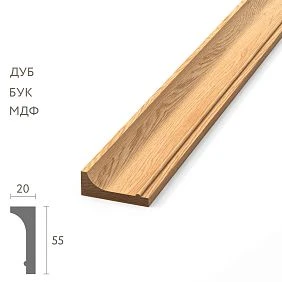
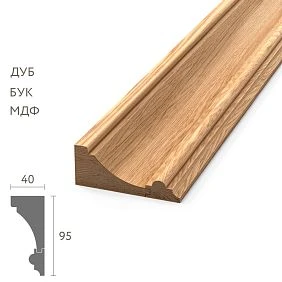
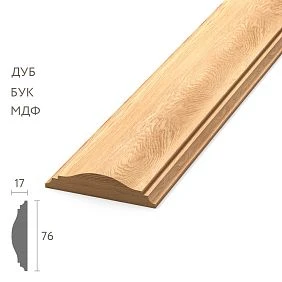
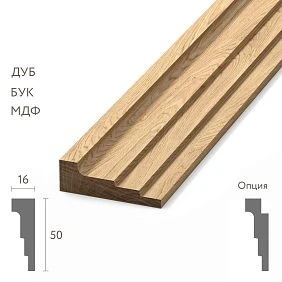
Our factory also produces:
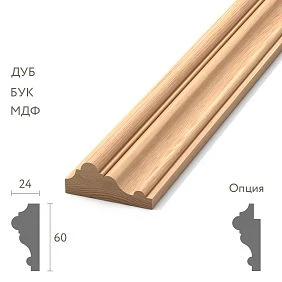
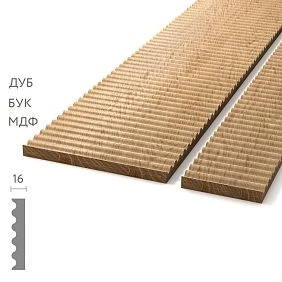
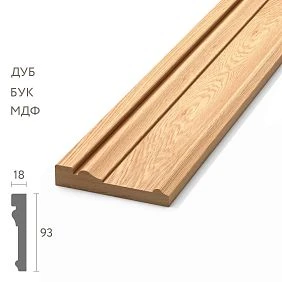
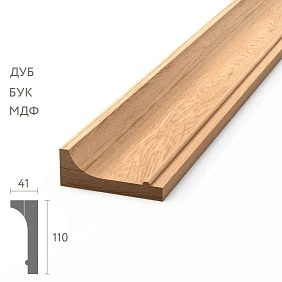
Wooden skirting board: when the length of the plank affects delivery cost
For skirting boards, length is both an installation and a logistics parameter.
A long plank reduces the likelihood of an extra joint on a long wall. But it requires more usable space in the vehicle, at the terminal, during loading and when carrying. Therefore, the choice of length must be assessed on two levels at once: how the product is cut on site and how it travels to the site.
On the current STAVROS product pages, the difference between versions is clearly visible. For PLT-005, the MDF and moisture-resistant MDF options are 2600 mm long, while beech and oak are 2400 mm. Another profile may have a different combination, so the length of PLT-005 cannot be applied to the entire catalogue.
Suppose eight straight sections of 4.7 m each need to be covered. The net linear metres are 37.6 m.
If planks of 2.4 m are used, it is convenient to allow two whole planks per section: 4.8 m before cutting. For eight sections, that is 16 planks, i.e. 38.4 m of material.
If the profile in the selected version is 2.6 m long, simply dividing the total linear metres by 2.6 gives 14.46, i.e. 15 planks. However, fifteen planks may be inconvenient for cutting specifically for eight separate walls. The actual cut lengths need to be distributed, rather than settling for general arithmetic.
The situation is also ambiguous for logistics. A batch of 2.4 m planks is shorter, but there may be more of them. A batch of 2.6 m planks is longer, but potentially consists of fewer units. Which option turns out to be more economical depends on the packaging and the tariff of the specific carrier.
If the product page of the selected profile offers a 3 m version, it can be considered in the same way, but the length cannot be assumed in advance. For ordering, the actual line of the product page is recorded: item code, material, size A × C × L and quantity.
And one more detail: the maximum length of the product must fit not only in the vehicle body, but also along the entire transportation chain. If the cargo is delivered to a terminal, then reloaded into a city vehicle, and at the site carried through a narrow corridor or a freight elevator, an extra 20–40 cm can be of practical significance.
Get Consultation
Wooden moulding: when it is more advantageous to combine several SKUs into one shipment
A project rarely uses just a single moulding. For example, a specification may include:
-
120 m MLD-A;
-
80 m MLD-B;
-
40 m MLD-C.
If all three items are ready at the same time and intended for the same site, it makes sense to consider them as candidates for a single consolidated shipment. In this case, the overall logistics are planned for the entire set, rather than for three separate orders.
But consolidation is not automatically advantageous.
Let's imagine that MLD-A and MLD-B are ready now, while MLD-C will be ready later. There are two options.
Option 1 — wait for the entire set. Advantage — one packing operation, one shipment, one acceptance. Disadvantage — the ready items remain waiting, and the site may lose time.
Option 2 — ship the finished part. Pro — installation can start earlier. Con — there is one more package, one more transport, and one more checkpoint.
The decision is made based on the project schedule. If MLD-C is needed only at the second finishing stage, delaying the first batch for one item may be irrational. If all three moldings must be installed simultaneously in one area, shipping the first part separately provides no real benefit.
For comparison, it is convenient to calculate the full cost of the scenario:
transportation cost + packaging + delivery to the final address + additional operations + the cost of possible downtime.
It is often the last point that changes the decision. Delivery that is several thousand rubles cheaper is not worthwhile if, due to waiting for materials, the crew loses a workday worth significantly more than that saving.
Wooden cornice: why a large profile can determine transport for the entire order
In a mixed batch, transport is often chosen not by the most numerous item, but by the one most demanding in terms of dimensions.
Let's imagine that the order contains:
-
180 m of skirting board;
-
240 m of molding;
-
only 40 m of large cornice.
In terms of linear footage, the cornice occupies a small share. But if its packaging turns out to be the longest, widest, or most load-sensitive, it is precisely this packaging that may set the minimum requirements for the cargo compartment.
This is an important principle for any mixed batch: transport is selected based on the limiting cargo item.
Such a "limiter" can appear for various reasons:
-
maximum length;
-
large cross-section;
-
pronounced relief;
-
need for a rigid frame;
-
prohibition on placing heavy packages on top;
-
requirement to transport the element in a specific position.
For KZ-006, for example, the current product page offers options with lengths of 2400 and 2600 mm. Even if there are only a few cornices, transporting the entire batch must take this length into account. If the rest of the order consists of two-meter moldings, transport cannot be selected based on those alone.
Before requesting a rate, it is useful to find the longest, widest, and heaviest item in the shipment. Sometimes these are three different packages.
Delivery of building materials: what data to request before placing an order
To delivery of building materials was compared not by approximate promises, but by comparable conditions; before placing an order, you need to collect the actual characteristics of the prepared cargo.
Minimum set:
-
number of packages;
-
maximum length of one item;
-
width and height of the largest package;
-
approximate total volume;
-
total weight;
-
type of packaging;
-
city of departure;
-
receiving city;
-
whether delivery to the address is required or only to the terminal;
-
whether there are restrictions on time or the type of vehicle at the site.
STAVROS, in its current delivery information, indicates the possibility of shipping via transport companies, and in product pages the delivery cost is linked to size, weight, and address. For wooden moulding this is especially logical: the physical parameters of the batch change along with the design and quantity.
When requesting a shipping quote, provide the carrier with the same set of initial data. Otherwise one offer may be calculated "to the terminal" and another "to the door," one may account for long-length cargo and another may not.
As a result, the figures will look comparable, even though the services are different.
Groupage cargo or a dedicated vehicle: which is better for wooden moulding
There is no universal answer. You should compare not the names of delivery methods, but the economics and shipping conditions of a specific batch.
Groupage shipping
Groupage cargo is usually of interest when the order is relatively small and a dedicated vehicle would be underloaded. The batch travels together with cargo from other shippers, and the shipping cost is distributed more efficiently.
But the scheme has its peculiarities. Additional terminal operations, transshipments, and proximity to other people's goods are possible. For decorative moulding, protective packaging is therefore especially important.
The groupage format is worth considering if:
-
the volume is small;
-
the packaging is quite rigid;
-
the timelines allow for a standard logistics chain;
-
the route and acceptance conditions are clear;
-
the maximum length of the cargo unit is accepted by the chosen carrier without an unexpected change in the tariff.
For a small order, this may be the most rational scheme. But the word "consolidated" by itself does not mean "cheap": you need to look at the final price to the required delivery point.
Dedicated transport
A separate vehicle becomes more interesting with a large volume, long cargo units, a high value of the batch, or the need to reduce the number of intermediate operations.
The main advantage is that the cargo compartment is planned for a single order. It is possible to determine in advance the placement of the long-length item, eliminate the pressure of someone else's heavy cargo, and agree on the unloading sequence.
But a separate vehicle is not automatically the best solution. If the batch occupies a small share of the body, the customer may pay for unused volume.
Therefore, they compare not the formula "consolidated is cheaper, dedicated is safer," but the bottom line:
how much it costs to deliver this specific batch to the required point under acceptable cargo handling conditions.
Why the cheapest delivery method is not always the cheapest for the project
Suppose there are two offers:
-
option A — 15,000 ₽;
-
option B — 19,000 ₽.
At first glance, A is 4,000 ₽ cheaper. But price alone is not enough.
Let's clarify the terms. Option A delivers the cargo only to the terminal. Then the customer separately hires a vehicle to the site. There will be a transshipment at the intermediate warehouse. Rigid additional packaging is paid for separately.
Option B is more expensive, but it delivers the cargo directly to the site without intermediate transshipment, and the agreed packaging is already included in the calculation.
After adding the last mile, loading operations, and packaging, option A may match B in cost or become more expensive.
There is also the price of risk. If the decorative profile is damaged, the savings on the first tariff quickly disappear: you will have to arrange a replacement, repackage part of the order, pay for reshipment, and postpone installation.
Therefore, compare the full cost of the logistics scenario, not just the "transportation" line item.
Minimum formula:
goods + packaging + mainline transportation + terminal operations + last mile + additional loading operations.
For a complex project, you can add the cost of downtime if deadlines are critical. This does not mean that the expensive method is automatically better. It means that two proposals need to be brought to the same set of services.
Delivery of construction materials: packaging is part of logistics
When required delivery of construction materials, the packaging of wooden moulding cannot be considered a decorative addition to the order. It affects the dimensions, weight, stability of the cargo unit, and the permissible method of transportation.
For moulding, it is necessary to protect:
-
front surface;
-
relief;
-
edges;
-
end faces;
-
the long parts themselves from bending and local loads.
The current PLT-005 STAVROS product page explicitly states the addition of a rigid packaging frame for safe transportation. This is a good example of why the final cargo differs from the "bare" dimensions of the product.
A 120 × 16 × 2400 mm plank after packaging is no longer a cargo unit of exactly 120 × 16 × 2400 mm. Protective layers, backing, or a frame appear, and it is the final overall dimensions that matter to the carrier.
For a small order, the packaging surcharge on volume can be noticeable relative to the product itself. For a large batch, on the contrary, several items are combined into larger units.
Therefore, the final cargo dimensions are best recorded after assembly and packaging calculation, rather than reconstructed manually from product cards.
Another nuance is that packaging must match the method of transportation. What is sufficient for a direct trip in a dedicated vehicle may be insufficient for a scheme involving a terminal and multiple transshipments. The more operations between the sender's warehouse and the site, the greater the importance of rigidity and securing of long items.
Why heavy construction cargo and decorative trim cannot be mixed without planning
Different categories often travel to the site at the same time:
-
boxes with fasteners;
-
equipment;
-
consumables;
-
heavy packages;
-
decorative wooden profile.
The problem is not with combined transportation as such. The problem arises when long-length items are placed "wherever they fit."
If a heavy box can shift during a turn and hit the cornice, that is a poor arrangement. If a load with a small support area is placed on top of a stack of moldings, local pressure may fall on the relief. If long planks protrude into the walkway, the risk of impact appears already during unloading.
Before shipping a mixed load, it is necessary to determine:
-
what can be placed on top;
-
what must be stored separately;
-
which packages must not be pressed;
-
which places need to be secured against shifting;
-
where the most vulnerable relief is located;
-
in what order unloading will take place.
If separate transport is used, the placement scheme can be agreed upon in advance. In consolidated shipping, the packaging must provide the main protection.
Saving space at the expense of risking the decorative surface is irrational: a single damaged visible area can render an entire plank unsuitable for the planned wall.
How to label several types of trim before shipping
The more items there are, the less effective a generic label like "skirting" or "molding" becomes.
It is better to use a format that unambiguously links the packaging to the specification:
PLT-XXX / DUB / 24 PCS
MLD-XXX / BUK / 40 PCS
KZ-XXX / DUB / 16 PCS
For a project with multiple zones, you can add:
CORPUS A
FLOOR 2
STAGE 1
or Russian designations:
BUILDING A / FLOOR 2 / PHASE 1
If a single SKU is distributed across several floors, zone-based labeling reduces the number of unnecessary movements after delivery.
There is a useful rule: labeling should be readable without fully opening the packaging.
An internal tag is useful as an additional check, but during receiving, the contents should be identifiable from the outside.
For a large order, prepare a packing list:
| Package No. | Article | Material | Quantity | Zone |
|---|---|---|---|---|
| 1 | PLT-… | Oak | … | Floor 1 |
| 2 | MLD-… | Beech | … | Floor 1 |
| 3 | KZ-… | Oak | … | Hall |
Then the number of packages can be verified before opening. If the packing list shows 12 packages but the carrier accepted 11, the discrepancy is visible even before shipment.
Order building materials with delivery: why transport must be calculated before paying for the goods
A bad sequence looks like this:
choose the product → pay → only then ask how much the transport costs.
For a small order, such a mistake may be unpleasant. For a large regional project, it can significantly change the entire budget.
If you plan to order building materials with delivery, before confirming the purchase, it is useful to have at least a preliminary full calculation:
goods + mandatory packaging + transport to the required point.
If the exact dimensions only become known after configuration, this must be taken into account in advance, and you need to understand which part of the logistics total is still an estimate.
The situation is especially sensitive when choosing between two profile versions. A more expensive product may yield a better cut and fewer strips, while a cheaper one may mean a larger batch volume. The opposite can also happen.
Therefore, comparing options by the price of a single strip alone is not enough.
Example:
-
version A: 20 strips;
-
version B: 18 strips;
-
with B, each strip is longer and requires a more expensive rate based on dimensions.
Product savings and logistics savings do not always point in the same direction.
Before paying for a large batch, ask a simple question: what approximate budget is needed not just to buy the goods, but to actually receive them in my city or at the site?
One large delivery or two smaller ones
Combining the entire order into one shipment often reduces the number of repeated operations. We assemble once, pack once, arrange transport once, and receive once.
This is rational if:
-
all trim is ready;
-
the site is ready to receive the material;
-
all SKUs are approved;
-
there is suitable storage space;
-
installation begins at approximately the same time.
But sometimes two shipments are better than one.
For example, finishing proceeds in stages. Baseboards and moldings are already needed on the first floor, while the second floor will not be ready for another month. Storing the second part of the batch at the construction site all that time means extra handling and the risk of damage.
Another scenario is a delay in one product group. Suppose 90% of the order is ready, but a small decorative cornice is produced later. If this cornice belongs to the second phase, there is no point in waiting for it just to ship everything together.
To decide whether to count two shipments, compare:
-
the difference in transport costs;
-
additional packaging costs;
-
storage cost and risk;
-
impact on the installation schedule;
-
the need for re-acceptance.
If a second shipment allows a major phase of work to start on time, it may be economically justified even with a higher logistics cost.
Why splitting an order into ten small shipments is also unprofitable
The opposite extreme also creates unnecessary costs.
Each new shipment is a separate operation:
-
gather the required items;
-
verify the quantity;
-
prepare the packaging;
-
prepare the documents;
-
hand over to the carrier;
-
accept at the site;
-
check and distribute.
If one large batch is randomly split into ten smaller ones, the customer repeatedly pays for and organizationally repeats the same actions.
Therefore, splitting should follow the actual construction phases.
A good scheme:
-
first shipment — floors 1–2;
-
second — floors 3–4;
-
third — common areas.
Bad scheme:
-
five packages today because they are already ready;
-
three days later, two more;
-
then one pack;
-
then the remainder of one SKU.
Such logistics quickly lose transparency. It becomes harder to understand what has already arrived, what is in transit, and what has not yet been shipped.
If staged delivery is needed, include the "queue" field directly in the goods and logistics specification.
Ordering building materials with delivery: how to create a logistics specification
When placing a large order of building materials with delivery, it is useful to have not only a goods list, but also a separate logistics view of the order.
Minimal template:
| Article | Product | Execution | Quantity | Plank length | Cargo places | Queue |
|---|---|---|---|---|---|---|
| PLT-… | Baseboard | Per order | … | … mm | … | 1 |
| MLD-… | Molding | Per order | … | … mm | … | 1 |
| KZ-… | Cornice | Per order | … | … mm | … | 2 |
After packing, add:
-
dimensions of each place;
-
weight of the place;
-
final total weight;
-
maximum length;
-
city and pickup address.
If the carrier rates oversized cargo or applies separate rules to large places, these parameters will allow the quote to be recalculated without a full review of the order.
A good specification also helps compare delivery options. You send the same file to several carriers and receive calculations for the same cargo.
Without it, one manager will count 12 places, another — 10, a third will assume a standard length, and comparing rates will lose its meaning.
For a complex project, it is useful to add two more columns: "room/zone" and "date when the material is needed on site." Then the logistics decision is tied to the construction schedule instead of existing separately from it.
How to compare two delivery quotes
Let's take the conditional 15,000 ₽ and 19,000 ₽ again. First, let's bring the quotes into a single structure.
| Parameter | Option A | Option B |
|---|---|---|
| From → to | Clarify | Clarify |
| To the address or terminal | Clarify | Clarify |
| Number of transshipments | Clarify | Clarify |
| Lead time | Clarify | Clarify |
| Type of transport | Clarify | Clarify |
| Packaging | included/no | included/no |
| Last mile | included/no | included/no |
| Acceptance conditions | Clarify | Clarify |
After filling in the table, it may turn out that a more expensive quote actually includes more services.
Always clarify what the stated timeframe means: from the moment the cargo is handed over to the carrier to the terminal in the destination city, or to the actual address of the site.
For a long-haul vehicle, separately check whether the carrier included the maximum length of the item in the calculation. An error in this parameter can change the rate already at the moment the cargo is handed over.
If the comparison is being made for a project rather than a one-off private purchase, record the quotes in writing. Then in a few days you won't have to reconstruct exactly what was included in the verbal figure.
It is equally important to compare the requirements for the recipient. One option may involve standard pickup from the terminal, while another involves the vehicle arriving at the site within a specific time window. If the site has an access control regime, entry restrictions, or a narrow unloading window, this point can affect the actual cost more than the difference between the base rates.
When savings on consolidation become false
Consolidation usually looks attractive: gather everything into one vehicle and pay for a single shipment. But sometimes waiting for one item creates costs greater than a separate shipment.
Let's imagine:
-
the first part of the batch is fully ready;
-
one cornice is delayed;
-
installation of the main part must begin in two days;
-
waiting for the cornice will take another week.
If the entire project stalls because of one item, the savings on combined shipping become nominal.
There is also the opposite case. If installation will not begin for another two weeks anyway, there is no point in sending the finished part now. It will simply be stored at the site, take up space, and be exposed to risk.
To decide, ask:
does earlier shipping change the actual work schedule?
If not, it is often wiser to wait for the complete set.
If yes, calculate the cost of the delay and compare it with the price of additional logistics.
Another factor is the receiving party's readiness. Even if the first part of the order can arrive earlier, there must be someone at the site to receive it, verify it, and place it safely. Otherwise, premature delivery creates not a time saving, but a new organizational risk.
What to check before handing the cargo over to the carrier
Before the order enters the transport chain, any discrepancies must be resolved — they are cheapest to fix at the sender's warehouse.
Check:
-
the final specification matches the order as actually prepared;
-
the number of cargo units is known;
-
each unit is labeled;
-
item codes and materials are not mixed up;
-
the maximum length matches the carrier request;
-
the packaging has no visible damage;
-
vulnerable ends and profiles are protected;
-
the recipient and their phone number are entered without errors;
-
the address of the site or terminal is confirmed;
-
it is clear who will receive the shipment;
-
if there are multiple shipments, the correct sequence is indicated on the packaging.
For a large batch, take several photos before handover: the general view of the cargo, the markings, and the condition of the packaging. This does not replace the carrier's documents, but it creates a clear record of the condition at the starting point.
Pay especially close attention to the number of pieces. When a batch consists of different moldings, skirting boards, and cornices, an error of "11 instead of 12" must be detected before the vehicle departs.
If part of the order receives a separate shipment number, write it directly in the logistics sheet next to the corresponding packages. Then at the site there will be no need to figure out which of several vehicles a specific item belonged to.
Mistakes that most often make logistics more expensive
Mistake 1. Calculating delivery by total linear meters
Why it happens: the estimate already includes the number of linear meters, and it seems that this is enough.
Consequence: the actual volume and length of the packages are discovered too late.
How to prevent: convert the linear meters into the number of whole planks for specific article numbers and finishes.
Mistake 2. Agreeing on the rate before choosing the finish
Why it happens: the profile is chosen visually, but the material and length have not yet been approved.
Consequence: after switching, for example, from MDF to solid wood, the length of the products and the cutting layout change.
How to prevent: calculate transport after finalizing the specific finish line.
Mistake 3. Choosing transport based on the most numerous SKU
Why it happens: it seems that this is what determines the order volume.
Consequence: a small batch of a larger cornice does not fit into the chosen scheme or requires different placement.
How to prevent: separately identify the maximum length and the largest cargo unit.
Mistake 4. Comparing only the rate
Why it happens: only one final figure is visible in the commercial proposal.
Consequence: later, terminal, last mile, additional packaging, or a new loading appear.
How to prevent: compare the same scope of services.
Mistake 5. Splitting the order based on readiness
Why it happens: there is a desire to ship each ready item immediately.
Consequence: the number of packages, documents, acceptances, and shipments grows.
How to prevent: define logistics queues in advance by project stages.
Mistake 6. Not accounting for packaging in dimensions
Why it happens: dimensions are taken directly from the product card.
Consequence: the prepared space turns out to be larger than stated.
How to prevent: for the final tariff, use the data of the already prepared cargo unit.
Mistake 7. Not checking the last leg of the route
Why it happens: attention is focused on the mainline transportation between cities.
Consequence: long cargo arrives at the terminal, but a regular city vehicle is not suitable for further delivery or cannot enter the site.
How to prevent: calculate the route in advance from the sender's warehouse to the actual unloading point, including the last mile.
Mistake 8. Not linking packaging to the specification
Why it happens: item codes are specified in the documents, but the marking on the packages themselves is too generic.
Consequence: at the site, several packages have to be opened just to find the required profile.
How to prevent: the outer marking must contain the item code and, if necessary, the site zone.
When you should not look for the cheapest tariff
There are situations where the minimum shipping price should not be the main criterion.
The first is an expensive or hard-to-replace profile. If re-manufacturing and delivering a single item costs more than the entire savings on the tariff, the value of a more predictable scheme increases.
The second is a critical installation deadline. If damage or delay halts the finishing work, the cost of risk becomes part of the project economics.
The third is a large long-length item. The more difficult the handling of the packaging, the more important the conditions for transshipment and placement become.
The fourth is a site with a complex last mile: restricted access, a pass system, a specific unloading window, inability to accept a long vehicle. Cheap delivery to the nearest terminal here can create an expensive separate task on the final leg.
The fifth is mixed cargo, where heavy commodity groups travel alongside decorative profile. If the cheap option does not allow the cargo to be properly separated, the difference in tariff may not justify the risk.
Economical logistics is not the minimum line on the tariff, but the minimum total cost of receiving the order in usable condition and on time.
How to evaluate logistics at the profile selection stage
Although the final transport cost is calculated after assembly, some risks can be seen earlier.
When comparing two suitable products, open their current product pages and write down:
-
length;
-
cross-section;
-
material;
-
required quantity;
-
packaging specifics, if specified.
Next, ask four questions.
First: will one option change the number of whole strips after cutting?
Second: will it change the maximum length of the cargo unit?
Third: will the profile become substantially larger in cross-section?
Fourth: does one version have additional packaging requirements?
Such a preliminary analysis does not replace the carrier's calculation, but it allows you to see in advance a scenario where saving on the product itself can lead to more expensive logistics.
In the case of PLT-005 this is especially clear: the same item has variants of 2600 mm for MDF and 2400 mm for beech and oak. Therefore, the material affects not only the appearance and price, but also the transport geometry of the batch.
A ready-made ordering scheme for wooden moulding with delivery
A reliable process can be put together in ten steps.
1. Select profiles
Lock in specific SKUs for skirting boards, moldings, and cornices.
2. Approve finishes
Take the material, size, and length from the selected row of the current product card, not from the general category description.
3. Calculate products
Convert the net linear meters into the number of whole planks and check the cutting layout. Simply dividing the total linear meters by the product length is not enough if the project has many separate sections.
4. Determine the composition of cargo units
Understand which items can be combined and how many packages will result.
5. Find the limiting dimension
Record the maximum length, width, and height among the prepared units. It is this parameter that may determine the minimum transport requirements.
6. Prepare the packaging
Account for protection of the front surface, relief, ends, and the rigidity of long-length packs.
7. Compare transportation methods
Compare consolidated cargo, dedicated transport, and phased shipments using the same initial data.
8. Calculate the full cost
Not just the tariff, but packaging, transportation, intermediate operations, and delivery to the actual point of receipt.
9. Split by phases and label
If the site is large, specify the building, floor, or phase in advance. The packing list must correspond to this breakdown.
10. Only then confirm shipment
Before handing over to the carrier, verify the specification, number of packages, labeling, packaging, address, and recipient.
As a result, logistics becomes an extension of order assembly rather than a separate unexpected expense line after the order is paid.
This is especially important for wooden mouldings. The difference between a two-metre moulding, a skirting board 2.4 or 2.6 m long, and a larger cornice shows up not only in the interior but also in the vehicle: the number of pieces, the dimensions of the cargo spaces, and the placement requirements all change.
That is why the right question is not "how much does it cost to deliver 500 metres?" but:
which exactly 500 metres are we shipping, how will they be packaged, how many cargo spaces will there be, and which mode of transport is best for this particular batch?
If the answer to these questions is obtained before payment and before the cargo is handed over to the carrier, the customer can compare logistics as part of the purchase rather than reacting to the shipping cost after the fact.
FAQ
Can the delivery cost be calculated before the final order?
Preliminarily, yes, if the specific item codes, finishes, quantity, and estimated package dimensions are known. It is more accurate to make the final calculation after the actual cargo spaces have been determined. If some parameters are still changing, it is useful to label the calculation as preliminary right away.
Why is a skirting board length of 2400 or 2600 mm so important for logistics?
It affects both the number of whole items and the maximum package length. A longer profile can reduce the number of joints and pieces but may require a different transport dimension. That is why length is assessed for cutting and shipping at the same time.
Is it worth combining skirting boards, mouldings, and cornices in one shipment?
Yes, if they are ready at roughly the same time, are intended for the same stage, and can be transported together safely. If one item is holding up a critical stage of the work, a separate shipment may be justified.
Which is more cost-effective: consolidated cargo or a dedicated vehicle?
For a small batch, it is often worth checking the consolidated option; for a large, bulky, or sensitive batch, compare it with dedicated transport. The decision is made based on the total cost and handling conditions for the specific cargo, not on the name of the scheme.
Should packaging be counted separately?
Yes. Packaging increases the actual dimensions and weight, and for long decorative profiles it may include rigid protective elements. The carrier needs the parameters of the prepared cargo unit, not just the dimensions of a single plank.
How can you determine how many cargo units there will be?
After final assembly, you need to determine which identical or compatible items are combined into bundles and obtain a packing list. For a large order, it is useful to number each unit and link it to the SKU.
What should you do if part of the order is needed earlier?
First, check whether early shipment actually changes the installation schedule. If yes, compare the cost of separate transport with the cost of waiting. If not, consolidation is usually more rational.
Can STAVROS delivery be ordered to another region?
On the current STAVROS pages, shipment of orders across Russia by transport companies is indicated. Before placing a specific batch, the terms and cost should be calculated based on its size, weight, and delivery address.
What matters most when comparing two transport quotes?
They need to be brought to the same scope: route, delivery to the address or terminal, number of transshipments, timelines, packaging, last mile, and acceptance terms. Only then should the final price be compared.
What data must be saved after dispatch?
The final specification, packing list, number of cargo units, marking, transport details, and photos of the prepared cargo. This makes acceptance and identifying discrepancies easier.
Should the carrier be informed in advance that the cargo is long-length?
Yes, if the package lengths differ from the standard ones for the selected service. In the request, it is better to provide the actual maximum length of the cargo unit so that the tariff and transport feasibility are checked before the batch is handed over to the terminal.
Can transport be calculated by volume without a list of SKUs?
For a rough estimate, sometimes it is possible. For a final budget, this is a weak approach, because without SKUs and finishes, the actual length of the planks, their quantity, and packaging requirements are unknown.