










































































Article Contents:
- Why walls 'like furniture' look more expensive than everything else
- What exactly creates the feeling of an 'expensive wall'
- What is boiserie: history and modern interpretation
- Boiserie from moldings: what is the advantage over joinery
- Polyurethane moldings: how to assemble wall architecture from linear elements
- How molding turns into a panel system
- Which molding to choose for boiserie
- How much molding is needed: how to calculate
- Molding decor: corner blocks as part of boiserie
- Decorative stucco: how to make boiserie come alive
- Where exactly decorative stucco works in boiserie
- How to choose decorative stucco for boiserie
- Paired decorative stucco: symmetry enhances the effect
- Stucco decor: individuality of the system
- Options for using stucco decor in boiserie
- Ceiling stucco: boiserie doesn't end at shoulder level
- How ceiling stucco works in the boiserie system
- What to buy for the ceiling in the boiserie system
- Ceiling rosette: the final touch of the system
- Boiserie without palace heaviness: how to make it modern
- Moldings in wall color
- Calm profiles, not overloaded with ornament
- Air between the frames
- One main decorative accent
- Connection with furniture and light
- Where the boiserie effect from moldings works especially well
- Living room: accent wall behind the sofa
- Bedroom: architectural backdrop behind the headboard
- Study: solidity and seriousness
- Entryway: First Impression
- Restaurant, salon, showroom: an expensive backdrop for business
- Practical algorithm: how to assemble boiserie from moldings step by step
- Three ready-made purchase scenarios
- Scenario 1: «Boiserie without carpentry» — basic
- Scenario 2: «Accent panel wall»
- Scenario 3: «Room as a single expensive set»
- Table: polyurethane moldings vs custom carpentry
- About the company
- Frequently Asked Questions
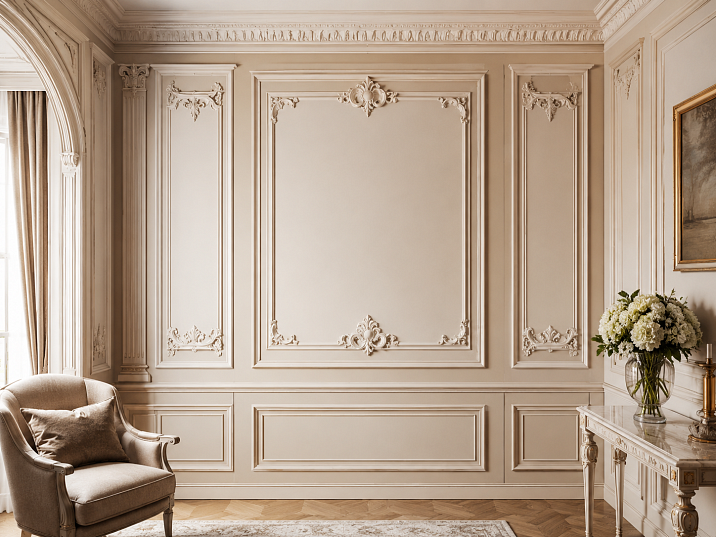
There are interiors that are remembered not for furniture or color. They are remembered for walls. Walls that themselves are architecture: divided into panels, frames, tiers. Walls that look as if they are backed by years of refined carpentry skill — wood, MDF, profiles, insert panels, multi-stage painting.
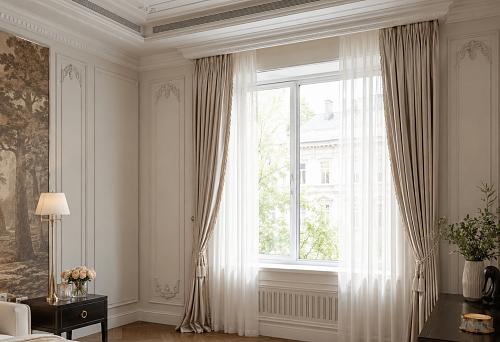
This is called boiserie. The word is French, meaning wooden wall paneling. In classic palace interiors — oak panels with gilded frames. In modern architecture — strict rectangular fields dividing the wall into geometric cells. Both share one thing: the wall ceases to be a plane and becomes a volumetric architectural surface.
The problem is that custom carpentry is expensive. Expensive in materials, expensive in labor, expensive in timelines. MDF panels with painting from a workshop — a project that is planned for months and approved in the estimate several times.
But there is a way to get a very similar result — without carpentry, without MDF, without long timelines, and without a heavy estimate. The wall can look like an expensive carpentry panel without real carpentry: Moldings made of polyurethane create frames, Decorative stucco adds an accent, Relief Decoration makes the composition unique, and a unified color turns everything into a cohesive architecture.
This is exactly what this article is about. How boiserie from moldings turns from an expensive carpentry fantasy into a feasible task. And about what exactly is needed Buy molding and moldings, so that the wall becomes part of the architecture, not just a surface for paint.



Why walls 'like furniture' look more expensive than everything else
Let's honestly break down this phenomenon. Why does one room with simple furniture and paneled walls look more expensive than another room with expensive furniture and bare walls?
The answer lies in the architecture of the surface. The human eye is designed to read 'intention.' When a wall is divided into panels, frames, and tiers, it indicates that someone thought about this space. Made decisions. Built a system. That is the feeling of 'expensive.'
A bare wall is neutral. It is neither bad nor good. It is just a plane.
A wall with molding frames, vertical division into fields, a decorative accent, and a ceiling transition — that is already architecture. The eye finds structure, rhythm, and scale in it. And this is precisely what is perceived as a sign of a high-level interior.




What exactly creates the feeling of an "expensive wall"
If we break down the phenomenon into elements, the following emerges:
Vertical division. When a wall is divided into fields by vertical lines, it acquires rhythm. This is the principle of boiserie — not a solid surface, but a system. Frames create cells that the eye reads as "panels."
Horizontal division. Dividing into upper and lower tiers is another technique. The lower tier (panels up to about 90–120 cm from the floor) and the upper tier (above this line) create a two-tier system that is associated with real joinery paneling.
Profile depth. A molding is not a drawn line, but a three-dimensional volume. The shadow it casts under side lighting creates depth. This depth is the main physical sign of an "expensive wall."
Uniform painting. When both the moldings, the fields between them, the baseboard, and the door jambs are painted in one color, the wall is perceived as a monolithic system. This is a key principle of modern boiserie.
None of these elements require custom joinery. All of this is created boiserie moldings made of polyurethane.
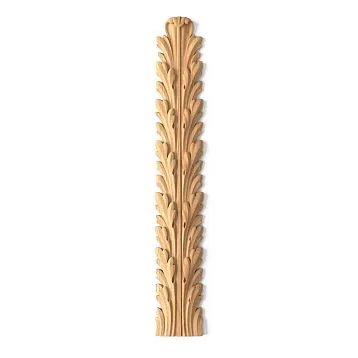
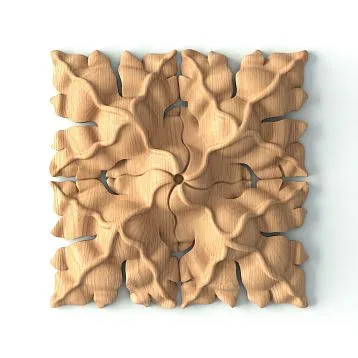
Our factory also produces:





What is boiserie: history and modern interpretation
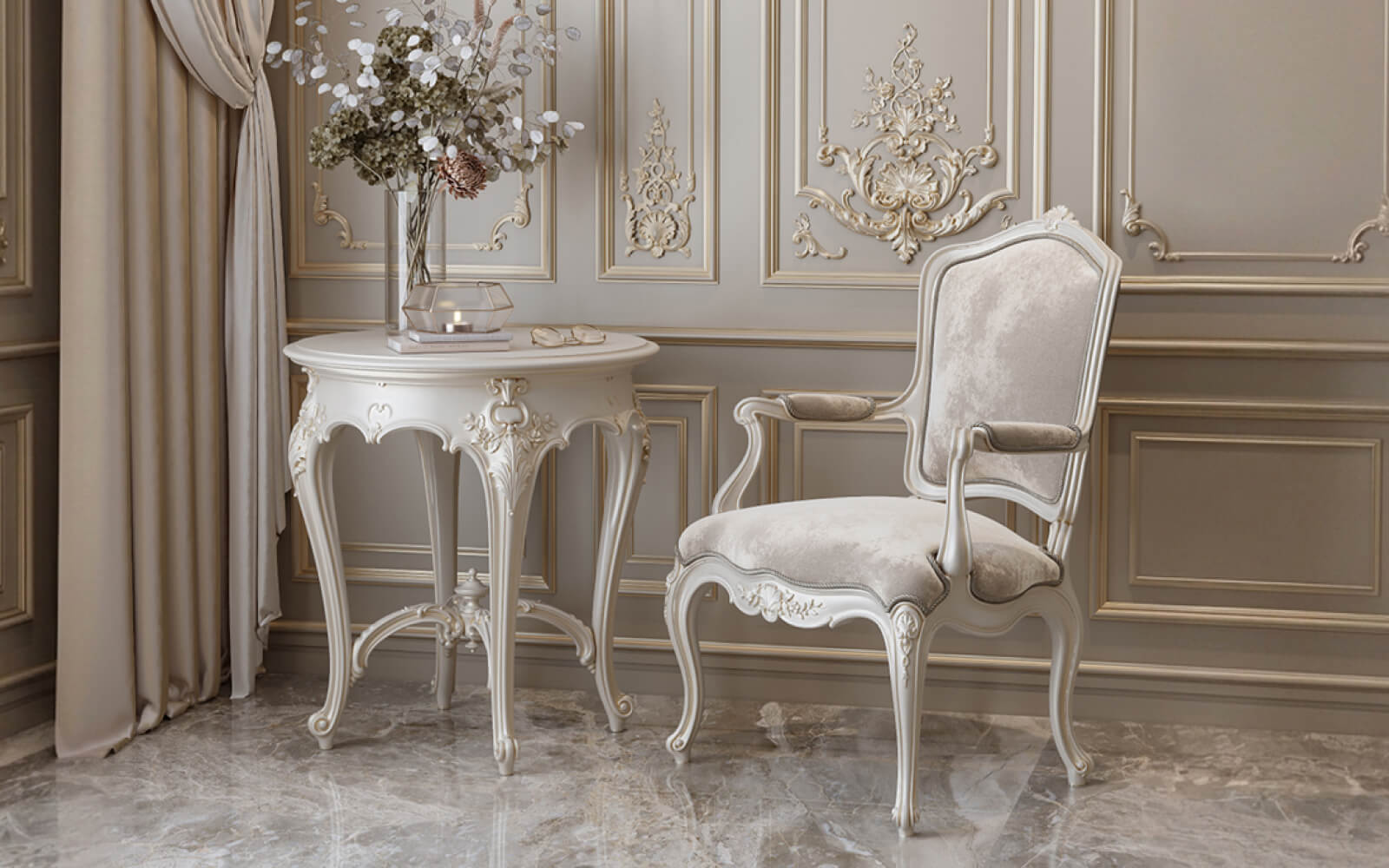
Boiserie is a French word literally meaning "woodwork." In an architectural context, it refers to a system of wooden panels used to cover walls in interiors of the 17th–18th centuries. Versailles, Peterhof, Parisian mansions—that's where boiserie reached its peak. Carved wooden panels with gilding, intricate ornaments, and inset painted panels.
But in the modern understanding, boiserie is not necessarily wood and not necessarily gilding. It's a principle: the wall is divided into tiers and fields. An upper cornice, a horizontal dividing line, lower panels, upper panels, frames within each field.
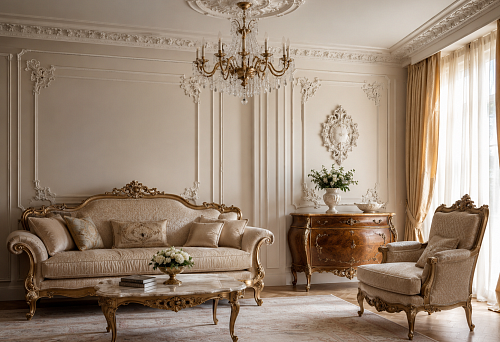
Modern boiserie is calm geometry. White moldings on a white wall. Gray frames on a gray surface. A dark green wall with white moldings—a contrasting option. No gilded curls, no palace baroque (unless you intentionally want that).
That is why the effect of boiserie on the wall works so well in modern interiors. It provides architecture without historical quotes. Structure without overload.
Get Consultation
Boiserie from moldings: what is the advantage over joinery
A custom wooden panel has its own beauty. But it has four serious limitations:
-
Price. Wood joinery includes the cost of material, craftsman's work, painting, installation.
-
Timeline. Custom manufacturing takes from several weeks to several months.
-
Inflexibility. The panel is made for a specific size. Changing the layout or moving means losing the finish.
-
Humidity and deformation. Wood and MDF react to changes in humidity. In bathrooms, on verandas, in rooms with temperature fluctuations — wood behaves unpredictably.
Polyurethane moldings for wall panels solve all four problems:
-
Significantly lower in cost than joinery.
-
Sold ready-made, delivered quickly.
-
Easy to cut, adjust, and re-glue.
-
Polyurethane is not afraid of moisture, does not deform with temperature changes.
At the same time, the visual result — with proper installation and painting — is almost indistinguishable from wooden joinery. Especially if the molding is chosen with a good profile and painted in a single color with the wall.
Polyurethane moldings: how to assemble wall architecture from linear elements
The central element of any boiserie effect is the molding. Not a decorative overlay, not a rosette, not a cornice — it is the molding, because it creates the frame structure.
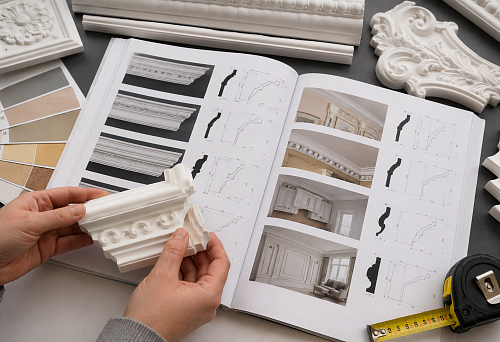
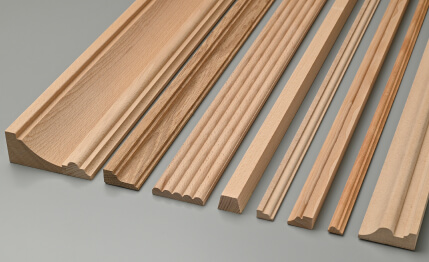
Moldings made of polyurethane — these are linear products with a profile. The back side is flat, the front side is embossed. Mounted with glue. Cut at an angle. Joined end-to-end or through a corner block.
How a molding turns into a panel system
One molding is a line. Four moldings forming a rectangle is a frame. Several frames on a wall is a system. A system properly aligned vertically and horizontally is boiserie.
The principle is simple. Take a wall. Mark rectangular fields on it — future "panels." Install molding along each field. The wall gains vertical and horizontal division, volume, shadow, structure.
This is decorative panels from moldings — without MDF, without carpentry, without custom manufacturing.
Which molding to choose for boiserie
By width:
-
20–30 mm — for delicate frames in the bedroom, children's room, small spaces.
-
35–55 mm — universal width for most interiors.
-
60–90 mm — for formal areas, high ceilings, commercial spaces.
By profile:
-
Smooth rectangular profile — modern boiserie, minimalist solution.
-
Profile with fillet and shelf — classic geometry, suitable for most styles.
-
Profile with ornament (leaves, geometry) — for a more expressive classic solution.
For modern boiserie, it's better to choose a calm profile with clear lines and shallow depth. It works in the wall color and creates exactly that "architectural minimum" that distinguishes an expensive interior from an overloaded one.
How much molding you need: how to calculate
Let's take a wall 3.6 × 2.8 meters. We plan three frames 1 m wide and 1.8 m high.
Perimeter of one frame = (1.0 + 1.8) × 2 = 5.6 m. Three frames = 16.8 m. 15% reserve = ~19.5 m. Total — order 20 meters of molding.
Plus corner elements: 4 corners × 3 frames = 12 corner blocks. If you cut at 45° — no blocks needed, but a slightly larger reserve for cutting.
buy polyurethane moldings must be ordered as one order with a reserve. Reordering individual meters always costs more in total cost.
Decor for moldings: corner blocks as part of boiserie
Decor for Molding — corner blocks and inserts — complete the frame. Without them, the molding is simply cut at 45° and joined. With a corner block, the frame's corner gets a decorative accent that enhances the boiserie feel.
Corner blocks come in:
-
Geometric — a simple square or rectangle matching the width of the molding. For a strict modern boiserie.
-
With ornament — rosette, leaves, geometric pattern. For a more expressive classic system.
The seating width of the corner block must exactly match the width of the molding — this is a technical detail to check when ordering.
Decorative stucco: how to make boiserie come alive
Clean frames made of moldings are already good. That's architecture. But empty frames can look strict to the point of coldness. This is where Decorative stucco.
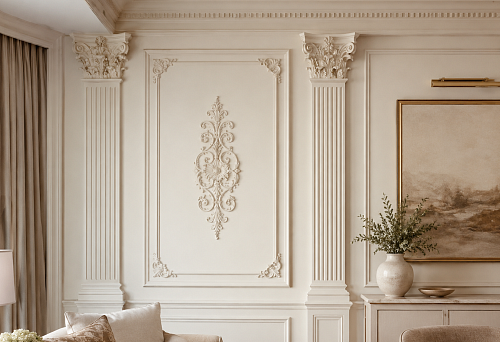
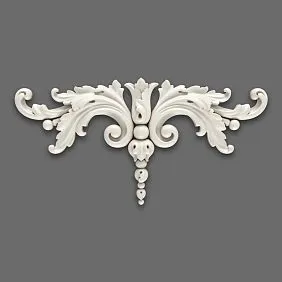
Decorative stucco inside the frame is an accent. One element in the center of the field. Or a pair of symmetrical elements. Or a horizontal frieze in the upper part of the frame. This is what turns a geometric frame into a decorative panel with character.
Where exactly decorative stucco works in boiserie
In the central panel. The main frame on the wall — the one in the center or in the accent zone — receives a central medallion or a small frieze. This is the focal point of the entire system.
Above the console. If there is a console against a wall with boiserie, an overlay above it turns a functional piece into an interior group. Console + decor above it + frames on the sides = architectural niche.
Above the headboard in the bedroom. Boiserie behind the bed + decorative overlay above the headboard is a classic solution for an accent wall in the bedroom. It works as a built-in architectural backdrop.
In the study. A study with boiserie is a space that conveys authority and seriousness. Decorative stucco in the central panel enhances this effect.
In the hall. An entry area with boiserie and a decorative accent on the main wall is the first impression. And it should say: 'They thought about the interior here.'
In a commercial space. A restaurant, beauty salon, or showroom with boiserie on the walls is an expensive backdrop for photos, products, and lighting fixtures. buy decorative moldings for a commercial interior means investing in the visual image of the brand.
How to choose decorative stucco for boiserie
The main rule: decorative stucco should not compete with moldings. Moldings are the architecture (base). Decorative stucco is the accent (superstructure). If the moldings are calm, the overlay should also be delicate.
The size of the decorative element inside the frame should be no more than 30–40% of the smallest side of the frame. For a frame of 900 × 600 mm, the decor should be no larger than 200–250 mm on the larger side.
The motif should match the style of the moldings. Geometric molding + geometric or neutral decor. Classic molding + floral or ornamental decor.
Paired decorative molding: symmetry enhances the effect
Two identical or mirrored decorative elements on both sides — in two symmetrical panels, or on the sides of a central panel — create symmetry that reads as an expensive solution. This is a technique from real boiserie: symmetry was a fundamental principle of classical finishing.
buy decorative moldings in a paired version — means investing in symmetry. Two positions in the order, but the result is incomparable to a single element.
Molding decor: individuality of the system
If moldings create a frame architecture, and decorative molding adds accents at key points, then Relief Decoration — this is what makes the system custom. Not like a standard "wall with moldings," but specifically a specific, well-thought-out interior.
Molding decor in boiserie is used sparingly. The rule of one or two accents works especially clearly here: you don't need to decorate every frame — one or two key points are enough.
Options for using molding decor in boiserie
One central element. In the main frame on the wall — one expressive medallion or central overlay. Everything else is clean frames. This is a strict, elegant option.
Paired decor in two outer panels. The left and right frames receive identical elements. The central one remains clean. Symmetry creates a "frame for the center" — a feeling that the space is organized.
Decorative accent above the mirror in boiserie. A mirror integrated into a boiserie system receives a decorative accent at the top. This is a small element — 150–250 mm — but it transforms the mirror from a functional object into an architectural detail.
Decorative overlay at the top of the frame. A horizontal frieze or small ornament in the upper third of the frame is a technique characteristic of historical boiserie. The upper part of the panel is decorated, the lower part is plain.
Natural motif in a soft interior. If boiserie is created in a bedroom or a library with a warm atmosphere, stucco decor with a plant motif — leaves, branches, flowers — adds organic feel and softness. Strict frame architecture + natural accent = balance of structure and warmth.
Strict element for a study. In a study or business space — a geometric or architectural decorative accent. A square medallion, laurel wreath, meander ornament. Structure and authority.
Buy Molded Decoration It should be done after the moldings are selected and the frame system is outlined. Then it will be clear at which points an accent is needed and what size it should be.
Ceiling stucco: boiserie doesn't end at shoulder level
Here is a common mistake. The wall with boiserie is done — beautiful, architectural, cohesive. Moldings, frames, decorative accent. Everything is wonderful. And then the gaze rises to the ceiling — and sees emptiness. A bare corner between the wall and the ceiling. No transition, no cornice.
It's like an expensive suit without a tie. Everything is fine, but something is unfinished.
Ceiling molding — is a logical completion of the boiserie system. A cornice around the ceiling perimeter picks up the vertical rhythm of the moldings and translates it into a horizontal line. The room acquires a 'top frame'.
How ceiling stucco works in a boiserie system
Sets the upper boundary. Wall moldings work from bottom to top — from the baseboard to the cornice level. It is the ceiling molding that serves as the upper horizontal line completing the system.
Connects the wall to the ceiling. A bare corner between the wall and ceiling is a visual "break." The cornice covers this break and makes the transition smooth.
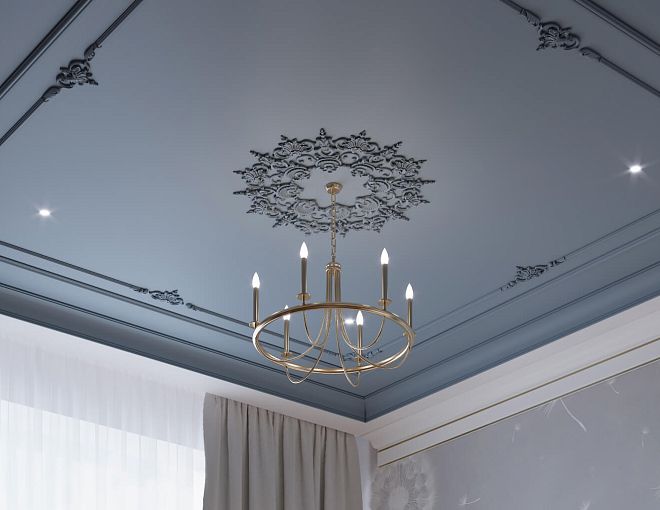
Supports the rosette. If there is a chandelier and a rosette on the ceiling, the ceiling cornice creates a frame around the ceiling area. Rosette in the center + cornice around the perimeter = a complete system.
Creates a three-level architecture. Baseboard — wall moldings — cornice. Three horizontal levels. This is the formula of true boiserie: lower profile, middle zone with frames, upper transition.
What to buy for the ceiling in a boiserie system
Buy ceiling molding It should be from the same stylistic group as the wall moldings. The width of the cornice should be slightly larger than the width of the wall molding. For a 40 mm molding — a cornice of 60–80 mm. For a 60 mm molding — a cornice of 80–100 mm.
If ceiling height allows, you can create a ceiling contour: a square molding on the ceiling, set back from the cornice by 50–70 cm. Inside the contour — a rosette. This is a complete ceiling system that turns boiserie on the walls into a full-fledged architectural interior.
Ceiling rosette: the final point of the system
ceiling rosettes In a boiserie system, it is not a mandatory element. But in a room with a chandelier, it makes the system significantly more complete.
The rosette and cornice should be from the same stylistic family. The rosette and wall moldings should also be from the same family. The size of the rosette corresponds to the diameter of the upper part of the chandelier: approximately equal or slightly larger.
Boiserie without palace heaviness: how to make it modern
This is an important block for those who want boiserie but fear the wall will look 'like in the Hermitage.' Modern boiserie is a fundamentally different solution from historical baroque.
Here are a few specific techniques that make boiserie from moldings modern.
Moldings in the color of the wall
This is the main technique. When the moldings and wall are painted the same color, the contrast disappears. Only relief and shadow remain. This effect is called 'tonal boiserie' — it is very popular in neutral interiors: white moldings on a white wall, gray frames on a gray wall.
No palace grandeur. Only architectural structure — delicate, nuanced, modern.
Calm profiles, not overloaded with ornament
Choose a profile without complex ornament. A fillet, a shelf, a simple protrusion — that's enough for modern boiserie. Complex ornament with acanthus leaves is appropriate in a formal classical interior, but not in a Scandinavian-style bedroom.
Air between frames
The distance between frames should be at least 10–15 cm. Frames should not be placed close to each other. The space between them is a 'field' that is as important as the frame itself. If there are too many frames, the wall becomes overloaded, losing air and lightness.
One main decorative accent
There is no need to decorate every frame. One — maximum two — decorative elements per wall is enough. This rule works everywhere, but for modern boiserie it is especially important.
Connection with furniture and light
Boiserie works best when the wall is connected to the furniture. If the lower part of the boiserie (up to the horizontal molding belt) matches the height of the sofa back or the top edge of the cabinet, the wall and furniture system reads as a single whole.
Recessed spotlights or sconces placed symmetrically in the boiserie panels are another way to make the system voluminous and lively.
Where the effect of boiserie from moldings works especially well
Living room: accent wall behind the sofa
The living room is the main testing ground for false panels from moldings. The wall behind the sofa is an accent zone visible from the entrance and from any point in the room.
Three or four frames behind the sofa, one decorative accent in the central frame, a ceiling cornice on top — this is a full-fledged boiserie wall that makes the living room presentable without a single MDF board.
Option with contrasting painting: the wall behind the sofa in a dark tone (deep blue, rich green, noble anthracite), the moldings white or matching the wall. This is a very expressive solution, characteristic of a modern high-end interior.
Bedroom: architectural backdrop behind the headboard
Boiserie behind the bed is built-in architecture instead of a headboard. One or three frames behind the bed, one decorative panel in the center, crown molding on top. When painted in a single color, it creates the effect of a built-in wooden panel without a single wooden detail.
The height of the lower frame should roughly match the height of the mattress and pillows. The upper boundary of the system is at the level of the ceiling cornice.
Study: solidity and seriousness
A study with boiserie on the walls is a space that conveys professionalism. Molding for an expensive wall in the study — these are moldings with an expressive profile, a strict decorative accent, a ceiling cornice.
Optimal solution: a dark rich wall (deep green, blue, gray-beige) with moldings in a lighter tone or matching the wall color. A library or built-in shelves integrated into the boiserie system complete the look.
Entryway: first impression
Entryway with decorative panels made of moldings — this is the first thing a guest sees upon entering. With a small entryway, boiserie makes it neat and well-finished.
The main wall of the hallway (the one you immediately look at upon entering) — one or two frames, a decorative accent above the mirror, a ceiling molding. This is the minimum set that gives the maximum effect.
Restaurant, salon, showroom: an expensive backdrop for business
In a commercial space interior with boiserie and stucco molding — is an investment in a visual image. Walls with a molding system create an expensive backdrop for furniture, products, and photographs.
A restaurant with boiserie on the walls is a restaurant where the guest feels the level of the establishment. A beauty salon with a molding system is a salon that people want to photograph and recommend.
Practical algorithm: how to assemble boiserie from moldings step by step
Let's move from theory to action. Here is a specific sequence.
Step one: decide which wall to decorate.
Start with one wall — an accent wall. Don't do all four at once. One completed wall will give you an understanding of the scale and result.
Step two: determine the number and size of frames.
Mark the wall on paper. Determine how many frames you want, what size they will be, with what spacing between them and from the edges of the wall.
Step three: choose the molding.
Style, width, profile — based on the overall character of the interior.
Step four: calculate the molding.
Total length of frames + 15% reserve. Plus corner blocks or reserve for trimming.
Step five: decide on the decorative accent.
Will there be Decorative stucco inside the frames? In which ones? Single or paired?
Step six: include the ceiling.
Ceiling molding — cornice around the perimeter and, if necessary, a rosette. From the same stylistic group.
Step seven: place a single order.
Moldings, corner blocks, decorative overlays, ceiling cornice, rosette, glue. All at once.
Step eight: installation and painting.
Marking, glue, joint putty, unified painting.
Three ready-made purchase scenarios
Scenario 1: "Boiserie without joinery" — basic
Goal: create wall architecture without decorative excess. Only frames and structure.
What to buy:
-
Moldings made of polyurethane — calm profile 35–50 mm.
-
Decor for Molding — corner blocks for frames.
-
Construction adhesive — 1 tube per 3–4 m.
-
Acrylic putty.
-
Paint in the color of the wall.
Result: clean panel structure. Modern, neutral, architectural.
Scenario 2: "Accent panel wall"
Goal: frames + decorative accent at a key point.
What to buy:
-
Moldings made of polyurethane — medium profile.
-
Decor for Molding — corner blocks.
-
Decorative stucco — one central accent.
-
Relief Decoration — above the mirror or above the console.
-
Glue, putty, paint.
Result: a lively, expressive wall with character.
Scenario 3: "Room as a single premium set"
Goal: a complete system — walls + ceiling + decor.
What to buy:
-
Moldings made of polyurethane — expressive profile.
-
Decorative stucco — paired accents.
-
Relief Decoration — at key points.
-
Ceiling molding — cornice around the perimeter.
-
ceiling rosettes — under the chandelier.
-
Glue, supplies, paint.
Result: an interior where walls, ceiling, and decor form one architectural system. Buy moldings as a single set — the most effective strategy.
Table: polyurethane moldings vs custom joinery
| Parameter | Polyurethane moldings | Custom joinery/MDF |
|---|---|---|
| Cost | Significantly lower | High |
| Timelines | Days (delivery of finished products) | Weeks and months |
| Installation | Glue, DIY | Requires a master |
| Flexibility | Easy to adjust | Hard to change |
| Moisture resistance | High | Depends on material |
| Visual result | Close to carpentry | Original |
| Painting | Easy in any color | Requires preparation |
About the Company
STAVROS — Russian supplier of polyurethane stucco decor. STAVROS company offers a full range of products for creating a boiserie effect: boiserie moldings of various widths and profiles, Decor for Molding — corner blocks and inserts, Decorative stucco for accent zones, Ceiling molding to finish the upper part of the room, ceiling rosettes.
All STAVROS products are made of solid, high-density extruded polyurethane: a moisture-resistant, stable, and easy-to-install material. Buy molding at STAVROS means getting everything you need for boiserie wall in one order, with precise parameters and professional consultation.
Frequently asked questions
Can you make boiserie from moldings without carpentry?
Yes. Moldings made of polyurethane create a framed wall structure that visually reads as boiserie. When painted uniformly, the result is close to real wood paneling.
What to buy for a boiserie wall?
Moldings of the required width and profile, corner blocks for frames, mounting adhesive, putty, and paint. Optionally — Decorative stucco for central accents and a ceiling cornice to complete the system.
Why are moldings better than custom panels?
In terms of price — significantly more affordable. In terms of timing — ready for installation immediately after delivery. In terms of flexibility — easy to change frame sizes or add elements. In terms of moisture resistance — polyurethane is not afraid of humidity.
Is decorative stucco needed inside boiserie frames?
Not necessarily. Clean frames work well on their own — especially in modern interiors. Decorative stucco is needed if you want to make the system more expressive or add a custom accent.
How to make boiserie modern rather than palatial?
Paint the moldings the same color as the wall, choose calm profiles without complex ornamentation, leave space between frames, use one or two accents instead of ornamentation in each frame, and align the system with furniture height.
Is ceiling decor needed with boiserie on walls?
Yes — if you want a finished interior. Ceiling molding — the cornice around the perimeter is the top line of the system, without which walls with boiserie look unfinished.