










































































Article Contents:
- The window wall: why it always feels slightly unfinished
- The logic of window area design: first the opening, then everything else
- Three layers of window composition
- Why breaking the order leads to poor results
- Moldings around the window: how to design the opening and give it architectural character
- Framing the window opening: vertical and horizontal moldings
- Moldings on the slopes: designing the opening's "tube"
- Spaces between windows: vertical molding lines
- Lower zone under the windowsill: molding belt
- Molding frame on the wall next to the window
- Curtain rod: how to connect it with stucco
- When to choose a wooden curtain rod
- When to choose ceiling stucco as a cornice system
- Wooden curtain rod vs. ceiling stucco: comparison
- How the curtain rod should be connected to moldings by height
- Decorative stucco around the window: where to place the accent
- Above the window: keystone and above-opening decor
- Corner overlays on the window frame
- Between windows: vertical ornament on the pier
- Next to the sconce: architectural frame for a wall light
- At the top of the wall: frieze above the cornice
- Five window styling scenarios: from minimal to formal solution
- Scenario one: "Moldings only"
- Scenario two: "Wooden cornice + moldings"
- Scenario three: "Hidden cornice behind ceiling molding"
- Scenario four: "Multiple windows in a row"
- Scenario five: "Formal window"
- Technical details: how to install moldings around a window
- Marking Before Installation
- Corner joints of the frame
- Adhesive and Fixation
- Sealing of joints and abutments
- Painting of the window area
- Special cases: non-standard windows and complex areas
- Arched window
- French window (floor to ceiling)
- Multiple windows in a bay window
- Balcony door next to a window
- What to buy for window decoration: final table
- Mistakes in window decoration with stucco: what is strictly forbidden
- Frequently Asked Questions
- STAVROS: window area as an architectural solution


Window wall: why it always feels slightly unfinished
Look at the window wall in your room. Honestly — not with the accustomed eye of the owner, but with the eye of a guest seeing it for the first time. There is a window. Perhaps curtains. Maybe a cornice — a wooden tube or a metal profile. And a large empty plane around it that says nothing and leads nowhere.
This is not a reproach. This is the architectural reality of most modern apartments: the window is inserted into the opening, the curtains are hung on the cornice, and that's where the decoration ends. Everything is functional. But not cohesive.
The window wall is the most 'looked-at' surface in the room. It is what catches the eye when you enter. It determines how 'expensive' the space looks. And it is most often left architecturally unfinished.
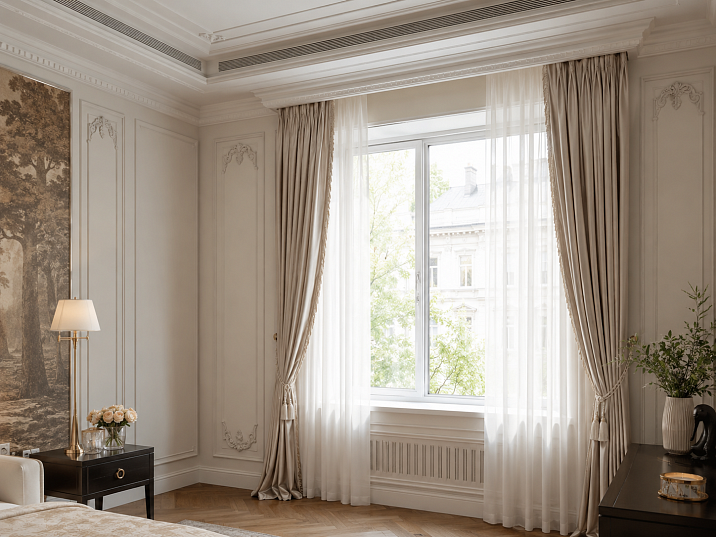
What changes the situation? Stucco around the window — moldings, cornice, decorative elements working as a single system. The window looks more expensive when the cornice, curtains, moldings, and stucco work together: wooden cornice or Ceiling molding assembles the top, Moldings made of polyurethane frame the opening, Decorative stucco adds emphasis, and the entire window area becomes part of the interior, rather than a separate curtain on an empty wall.
This article is about how to do it.




The logic of window area design: first the opening, then everything else
Before buying anything, it's important to understand the order of decisions. The window area is a system of several layers, and if you start in the middle, the result will be random.
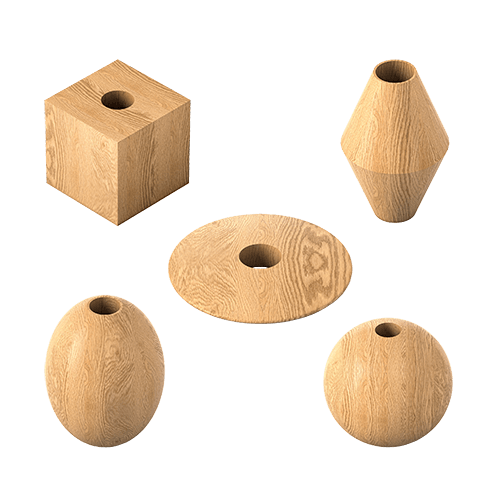
Our factory also produces:


Three layers of window composition
The first layer is the opening itself. Slopes, windowsill, framing around the window perimeter. This is the "frame" for the glass. Moldings around the opening perimeter are the first step to architectural design.
The second layer is the cornice. A horizontal line above the window that unites the curtains with the architecture. This is either wooden cornice as an independent decorative element, or built into a ceiling molding system behind which the curtain rod is hidden.
The third layer is the wall around it. Molding frames on the piers, decorative accents above the window or between windows. This is what connects the window opening to the rest of the wall and makes the entire plane architecturally unified.
Get Consultation
Why breaking the order leads to a bad result
If you start with a decorative trim above the window, but the moldings and cornice are not thought out, the trim will look like a random ornament. If you buy a beautiful cornice but don't finish the slopes and piers, the top will be beautiful, but everything else will be empty.
The system only works as a system. Each of the three layers reinforces the others.
Moldings around the window: how to frame the opening and give it architectural character
buy polyurethane moldings for the window area is one of the most cost-effective solutions in decor. A small investment, but the result changes the perception of the entire space.
Framing the window opening: vertical and horizontal moldings
The most direct way to make a window look 'more expensive' is to frame it with molding around the perimeter. Vertical moldings on the sides of the opening + a horizontal molding above it = an architectural frame that turns the window into an architectural portal.
This is a classic technique used in interiors since the 16th century. The casing — wooden or stucco — has always been an integral part of the window opening in any serious building.
Parameters of the molding for framing the window:
-
Profile width: 25–45 mm for standard windows (120–160 cm wide). For large windows — 40–60 mm.
-
Overhang: 12–20 mm. This is enough for good shade and expressive relief.
-
Profile: for classic — with several levels, for modern neoclassicism — rectangular or with one rounded protrusion.
How to install: the molding is glued strictly along the perimeter of the slopes or along the outer edge of the window frame. Corners — at 45°. Joints — acrylic sealant.
Moldings on slopes: finishing the opening "pipe"
Slopes — the inner surface of the wall along the perimeter of the window opening — often remain bare or simply painted. Meanwhile, a molding on the slope, at the transition from the slope to the wall, makes this area neat and finished.
A narrow molding 15–20 mm at the "slope — wall" transition is a delicate but very clear architectural signal: everything here is thought out.
Piers between windows: vertical molding lines
If there are several windows next to each other in a room, the piers between them are an important architectural zone. A vertical molding or molding frame on the pier creates rhythm between the window openings.
The width of the pier determines the solution:
-
Up to 25 cm: one vertical molding 15–20 mm in the center.
-
25–50 cm: two vertical moldings or a narrow frame.
-
Over 50 cm: a full molding frame with horizontal elements.
Lower zone under the windowsill: molding belt
The area under the windowsill — the part of the wall from the floor to the bottom edge of the window — is often ignored. A horizontal molding belt at the windowsill level (or slightly below) completes the vertical window "frame" from below.
If the room has a horizontal molding belt at a height of 90–100 cm from the floor, it should also pass under the windows continuously. This creates an architectural horizontal line around the entire perimeter of the room.
Molding frame on the wall next to the window
The window wall is not limited to the opening area. On the side parts of the wall — to the left and right of the window, if there is distance from the slope to the corner — molding frames create a "panel" structure. A 30–40 mm frame on the wall next to the window connects the window opening with the rest of the wall and creates a sense of a well-thought-out system.
Curtain rod: how to connect it with stucco
The curtain rod — a horizontal line above the window — is a stylistic solution that determines the character of the entire window area. The rod "holds" the curtains, but it also sets the tone: expensive or utilitarian, classic or modern.
When to choose a wooden curtain rod
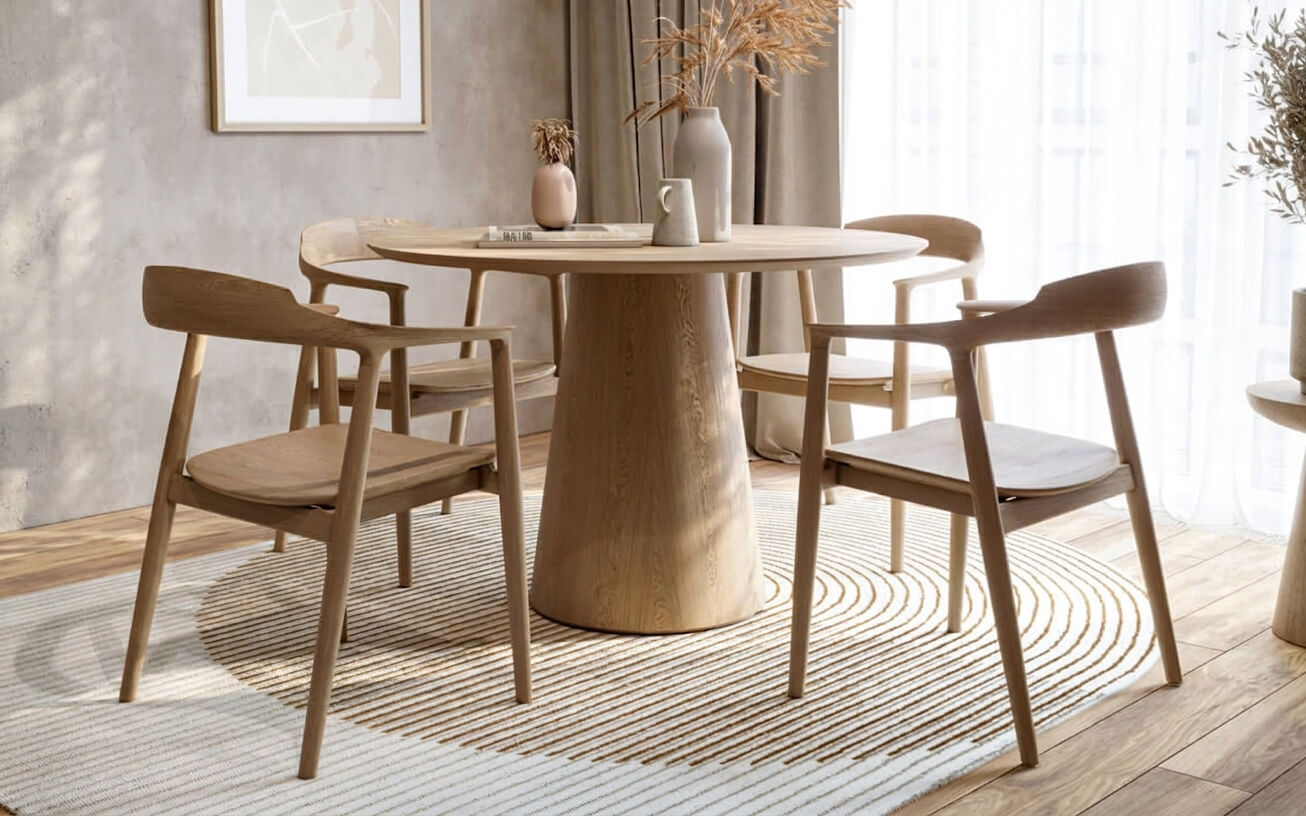
wooden cornice — это самостоятельный декоративный элемент. Он виден, он читается, он имеет фактуру. Деревянный карниз не прячется — он демонстрирует себя.
Когда деревянный карниз — лучший выбор:
-
Интерьер в стиле классики, английского кантри, рустика, неоклассики.
-
Шторы из тяжёлых тканей — бархат, лён, плотный хлопок — которые сами по себе декоративны.
-
Окна без ламбрекена: когда карниз виден полностью — деревянный профиль смотрится богато.
-
Интерьеры, где дерево присутствует как основной материал: паркет, деревянная мебель, деревянные двери.
Деревянный карниз монтируется на кронштейнах. Он может быть окрашен в цвет молдингов и лепнины — монохромная схема — или оставлен в натуральном цвете дерева как тёплый акцент.
Как связать деревянный карниз с молдингами: если карниз окрашен в тот же цвет, что и Moldings made of polyurethane на стенах — они образуют единую систему. Белый карниз + белые молдинги + белая декоративная лепнина над окном = цельная монохромная архитектурная зона.
Когда выбирать потолочную лепнину как карнизную систему
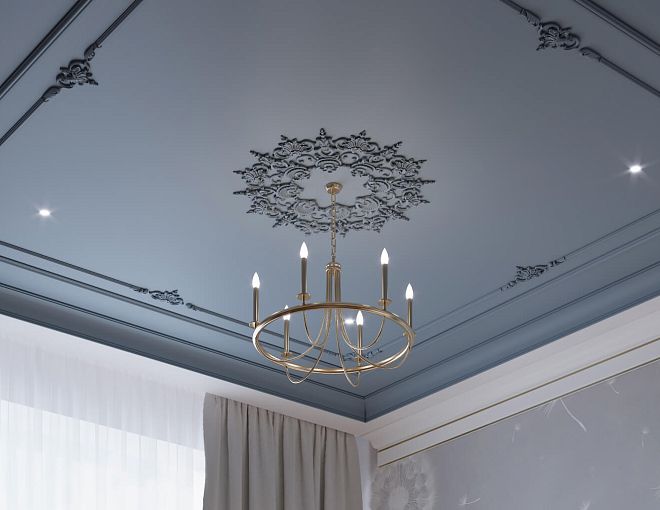
Ceiling molding — a cornice installed along the top line of the room — can simultaneously serve as an architectural ceiling element and conceal the curtain rod. This is the so-called "hidden cornice": the curtain rod is attached to the ceiling, curtains hang from under the stucco cornice, and the rod itself is not visible.
When ceiling stucco as a cornice system is the best choice:
-
Interiors with high ceilings from 270 cm, where a substantial cornice is architecturally logical.
-
Floor-length curtains with or without a lambrequin — when the upper zone should be "clean."
-
The desire to create a maximally architectural interior without visible fastening elements.
-
Rooms where the cornice runs along the entire perimeter — and not just above the window.
The horizontal projection of the cornice must be sufficient to conceal the curtain rod: typically from 50 mm. Check this parameter in the product card before purchasing.
Wooden cornice vs. ceiling stucco: comparison
| Parameter | Wooden cornice | Ceiling stucco |
|---|---|---|
| Visibility | Open, decorative | Hides the pipe |
| Style | Classic, rustic, country | Classic, neoclassic |
| Installation difficulty | Simple (brackets) | Medium (precise marking) |
| Connection with the interior | Through color and material | Through architectural line |
| Repairability | Easy to remove and replace | Part of the finish |
How the cornice should be aligned with the moldings in height
This is a subtle but important point. The top edge of the window molding frame and the bottom edge of the cornice must be aligned in height. If the molding frames the window at the top at 220 cm, and the cornice hangs at a height of 240 cm, there is a 20 cm "no-man's land" between them. This looks like a mistake.
Rule: a wooden cornice or curtain system is mounted either directly above the top molding of the window frame (with a gap of 3–5 cm), or flush with the ceiling cornice. A cornice "hovering" in empty space always looks accidental.
Decorative stucco around the window: where to place the accent
The third layer is decorative. This is not the structure and not the cornice — it is the focal point of attention. Buy decorative stucco for the window area means choosing one or two elements that will turn an ordinary window into an architectural portal.
Above the window: keystone and over-window decor
A keystone is a decorative element at the top central point of the window frame — it is a classic of architectural decor. It imitates the keystone of an arch and creates the impression that the window "holds" a structural element.
In the interior, a keystone is a decorative overlay above the top horizontal molding of the window frame. Size: 80–150 mm in width, 60–120 mm in height. Profile: rectangular with relief, floral or geometric ornament.
Buy Moldings for the over-window area means choosing from the category of cartouches, medallions, and keystones.
Corner overlays on window trim
Corner decorative inserts in the corners of molding trim — an element often found in classic interiors. They cover the corner joints of the molding and simultaneously provide a decorative accent at four points of the frame.
Size of corner inserts: 50–100 mm, square or rectangular. Profile: floral ornament, rosette, geometric insert.
This is especially important for window trims: four corners — four points that are always "visible" and require neat finishing.
Between windows: vertical ornament on the pier
On a wide pier between two windows — with a width of 50–80 cm — the central vertical zone can carry one decorative element: a palmette, a small medallion, or a vertical ornamental module.
Size: 100–180 mm vertically, 60–120 mm horizontally. Placement: along the axis of the pier, at the height of the upper third of the wall.
Next to sconces: architectural frame for wall light
If sconces are planned in the window area — on the sides of the window or on the piers between windows — a molding frame around each light fixture creates an "exhibition" point. A molding frame 25–35 mm, size 30×50 cm, with a sconce in the center + a small overlay above the light fixture — this is a full-fledged architectural element.
At the top of the wall: frieze above the cornice
If there is a strip of wall between the cornice and the ceiling — a frieze zone — Decorative stucco in the form of a horizontal ornament or individual overlays in the rhythm of the windows creates a "header" for the window wall. This technique is characteristic of classic interiors with high ceilings.
Five window design scenarios: from minimal to formal solution
Scenario one: "Only moldings"
A minimalist yet striking solution for a modern interior.
Set:
-
Molding window frame — 25–30 mm, rectangular profile.
-
Horizontal molding strip under the windowsill.
-
The existing cornice remains unchanged.
Color: moldings in the wall color — monochrome.
Effect: the window gets a clear architectural frame. The space looks neater and more expensive without radical changes.
Scenario two: "Wooden cornice + moldings"
For a classic or neoclassical interior with an open cornice.
Set:
-
wooden cornice — mounted above the window, above the molding frame.
-
Window molding frame — 30–40 mm.
-
Vertical moldings on the piers.
-
Decorative corner inserts on the frame.
Color: cornice matching the moldings (white or cream) or in natural wood color as a warm accent.
Effect: the window area acquires a complete classic look. Curtains on a wooden cornice look elegant.
Scenario three: "Hidden cornice behind ceiling stucco"
For high ceilings and architectural interiors.
Set:
-
Ceiling molding — cornice along the entire perimeter of the room, with a horizontal projection of 50 mm or more. The curtain rod is mounted to the ceiling, hidden behind the cornice.
-
Moldings made of polyurethane — window framing + frames on the piers.
-
Buy Moldings — one accent element above the window.
Color: monochrome or two-tone scheme (dark walls + white decor).
Effect: maximally architectural solution. Curtains 'emerge' from behind the cornice, the rod is not visible. The interior looks professionally designed.
Scenario four: 'Several windows in a row'
For a living room with three to four windows on one wall.
Set:
-
A single cornice line above all windows — wooden cornice or a polyurethane ceiling cornice — a continuous horizontal line.
-
Molding frames for each window — identical profile and size.
-
Molding frames on the piers between windows.
-
One decorative accent above the central window.
Effect: all windows read as a single architectural system. The wall looks like a grand facade, not a set of separate openings.
Scenario five: "Grand Window"
For a country house, study, or classic living room with one large representative window.
Set:
-
Bold molding frame — 45–60 mm, classic profile.
-
Decorative corner inserts on all four corners of the frame.
-
Keystone above the opening.
-
wooden cornice — massive, with stucco bracket consoles on the sides.
-
Buy decorative stucco — symmetrical overlays above the cornice.
-
Molding frames on the side sections of the wall.
Color: two-tone — the wall in a warm shade, all decor white.
Effect: the window becomes the main architectural element of the room. It is not "framed" — it is "erected".
Technical details: how to install moldings around a window
Marking before installation
Before gluing anything — marking. Laser level, pencil, tape measure. All vertical moldings must be strictly vertical, horizontal ones strictly horizontal. Indentations from the edge of the window opening must be the same on both sides.
Optimal indentation of the molding from the edge of the slope: 2–5 cm. More — the molding loses connection with the window. Less — the cornice overlay above the window will interfere with opening the sash.
Corner joints of the framing
The four corners of the molding frame around the window are cut at 45°. A miter saw is mandatory. Sandpaper for sanding the ends.
Important: when cutting corner joints, always dry-fit before applying glue. A deviation of 1–2° results in a noticeable gap. It's better to trim twice than to fill a large gap with sealant.
Adhesive and fixation
Acrylic mounting adhesive for polyurethane productsApply zigzag to the back side of the molding, press against the wall for 30–60 seconds, secure with painter's tape until fully dry (2–4 hours).
For window areas it is especially important: near the window, temperature and humidity fluctuations are possible. The adhesive must withstand conditions in rooms with high humidity (kitchen, bathroom, glazed loggia).
Sealing of joints and abutment areas
Acrylic sealant — for all joints and areas where the molding meets the wall. Silicone sealant — not allowed: it cannot be painted, and painting over it is impossible.
A gap up to 3 mm is filled with sealant using a spatula. A gap up to 5 mm — first putty, then sealant. More than 5 mm — redo the cutting.
Painting the window area
After installation and sealing — priming of all elements. Acrylic primer, one or two coats. After 4–6 hours — finish paint. For the window area, acrylic paint with a semi-matte finish is recommended: it does not glare under side lighting from the window.
Monochrome painting: wall + moldings + Decorative stucco — in a single color. This is the most elegant result.
Special cases: non-standard windows and complex areas
Arched window
An arched window is a special case. Straight moldings do not work along the curve. Solutions:
-
Molding only along the straight part of the opening (side verticals + horizontal lintel under the arch), the arched part remains without molding.
-
Flexible polyurethane profile for the curve — if available in the catalog.
-
Decorative keystone at the top point of the arch — as an architectural accent without going around the entire curve.
French window (floor to ceiling)
For a tall floor-to-ceiling window, the molding frame should be proportional: a wider profile, 35–55 mm. A narrow molding on a tall window gets lost.
A wooden curtain rod for a French window is mounted as high as possible — 10–15 cm from the ceiling. Curtains at full height from the rod to the floor visually "raise" the ceiling.
Multiple windows in a bay window
This is covered in detail in the article about bay windows. Here is just the key principle: with multiple windows in a bay window, the molding frame for each window should be identical, and the curtain rod line should be single, continuous along the entire perimeter of the bay window.
Balcony door next to the window
The balcony door and the adjacent window often form a single composition. The molding framing for both should be identical in profile width and style. The horizontal molding above the door and window should be at the same height.
What to buy for window decoration: summary table
| Task | What to buy |
|---|---|
| Make the opening more expensive | Moldings made of polyurethane for framing |
| Decorate curtains beautifully | wooden cornice or hidden curtain rod behind ceiling moldings |
| Connect the window with the walls | Moldings on the piers and side areas |
| Add a classic accent | Decorative stucco above the window, keystone |
| Design multiple windows | Unified moldings + unified cornice line |
| Finish corner joints | Corner decorative inserts |
| Assemble a complete set | Cornice + moldings + Relief Decoration + glue + sealant + primer + paint + 20% reserve |
Mistakes when decorating a window with stucco: what absolutely should not be done
Molding too wide for a narrow wall. A 60 mm molding on a 25 cm wide wall — it will take up almost all the space and create a feeling of tightness. For narrow walls — profile no wider than 20–25 mm.
Cornice at the wrong height. The cornice is hung 30 cm from the ceiling, while the molding frame of the window ends at 50 cm. There is an undefined empty space between the cornice and the frame. The cornice should be mounted as high as possible — at least 5–10 cm from the ceiling, and ideally flush with the ceiling cornice.
Decorative overlay without an architectural frame. A cartouche above the window without a molding frame is an ornament on an empty wall. It doesn't 'work'. The decorative element should be placed in the context of a molding system.
Different molding styles in one room. A baroque profile on the window frame and a strict geometric molding on the walls — a conflict. That's all. Polyurethane Items in one room should be in the same style register.
Lack of allowance for trimming. To frame one window, you need four pieces with corner cuts. Each cut is a loss of material for cutting. Order with a 20% margin.
Silicone sealant for joints. It cannot be painted. Then — rework.
Frequently asked questions
How to decorate a window in an interior?
The optimal solution is a three-layer system: a molding frame of the opening made of of polyurethane moldings, a curtain rod (wooden or built into the ceiling molding), and one decorative accent — a keystone or cartouche above the opening.
What is better: a wooden curtain rod or ceiling stucco?
It depends on the task. wooden cornice — decorative, visible, good for open curtains on rings. Ceiling molding — architectural, hides the rod, connects the window to the ceiling. For formal interiors with high ceilings — a stucco cornice. For a classic living room with visible wood — a wooden cornice.
Can moldings be glued around the window?
Yes, without restrictions. Moldings made of polyurethane they are glued with acrylic adhesive to a plastered, painted, or finished wall. The main thing is to mark correctly, cut the angles precisely, and treat the joints with acrylic sealant.
What to buy for a window with curtains and stucco?
wooden cornice or a cornice made of ceiling moldings + Moldings made of polyurethane for framing + Buy decorative stucco for accent + mounting adhesive + acrylic sealant + primer + paint + 20% spare for cutting.
Are corner inserts needed for molding window framing?
Preferably. Corner decorative inserts cover corner joints and add a decorative point at the four corners of the frame. Especially recommended for classic interiors — they make the framing resemble a real stucco portal.
At what height should the cornice be mounted above the window?
As high as possible. Optimal: 10–15 cm from the ceiling. Minimum: flush with the upper molding of the window frame, with a gap of 3–5 cm. A "low" cornice at 30–40 cm from the ceiling visually lowers the entire space.
STAVROS: window zone as an architectural solution
A window is not just an opening in the wall. It is an architectural task that requires a systematic solution. Buy moldings for the window zone means choosing a well-thought-out set of moldings, cornice, and decorative accents that work together.
STAVROS produces a full range polyurethane products for designing window zones: Moldings made of polyurethane of all profiles and sizes, ceiling molding for creating hidden cornice systems, buy decorative moldings for above-opening accents. In parallel — Wooden cornices from natural solid wood for those who want the warmth of a living material above the window.
All of this — in one catalog. A single style, a single scale, a single quality.
STAVROS. Delivery across Russia. Pickup in Moscow and St. Petersburg.
Your window deserves more than just curtains. Make it an architectural statement.