










































































Article Contents:
- What to Buy Right Away: Material Kit
- Oak: aristocrat among species
- Why Oak is Premium
- Oak Layout: Where It's Needed
- Oak Moldings: Durable Decorative Contour
- Oak in the Interior: What to Pair It With
- Beech: The Workhorse of a Classic Interior
- Beech Character: Stability and Precision
- Beech Balusters: Staircase as an Architectural Object
- Beech furniture legs: turned silhouette
- Beech furniture handles: tactile contact with furniture
- Polyurethane: lightweight decorative relief
- What polyurethane decor actually is
- Polyurethane moldings: architectural rhythm of walls
- Polyurethane stucco: ceiling and upper zones
- Decor for moldings: corner solution without complex trimming
- Wood and polyurethane in one interior: rules of combination
- Principle of zone distribution
- Style coordination
- Finish coating: unity of tone
- Ready-made sets by zones and projects
- Set: classic living room with oak and stucco
- Set: staircase in a classic house
- Set: study with oak panels
- Set: hallway with beech and polyurethane
- How to avoid mistakes: principles of selection and combination
- Principle 1: one material — one task
- Principle 2: do not mix species without a concept
- Principle 3: scale of details — uniform
- Principle 4: one main accent per zone
- Principle 5: finish coating — a single solution in advance
- Mistakes in selection and procurement
- Mistake 1: buying oak, beech, and polyurethane without an overall plan
- Mistake 2: choosing wood only by photo
- Mistake 3: not accounting for the finish coating
- Mistake 4: placing polyurethane in impact or grip zones
- Mistake 5: not calculating moldings around the perimeter
- Mistake 6: forgetting glue, sealant, primer
- Mistake 7: too many wood species
- Special zones: non-standard applications of wood and polyurethane
- Zoning walls with oak layout
- Oak coffered ceilings
- Beech supports in seating areas
- STAVROS: when three materials work as one
- Frequently Asked Questions
Imagine a person who comes to a building materials store and says: "I want oak." The seller asks: "Where?" Silence. Because oak is not the answer to the question "what interior", it is the answer to the question "from what". But "from what" without understanding "where" and "why" is money down the drain.
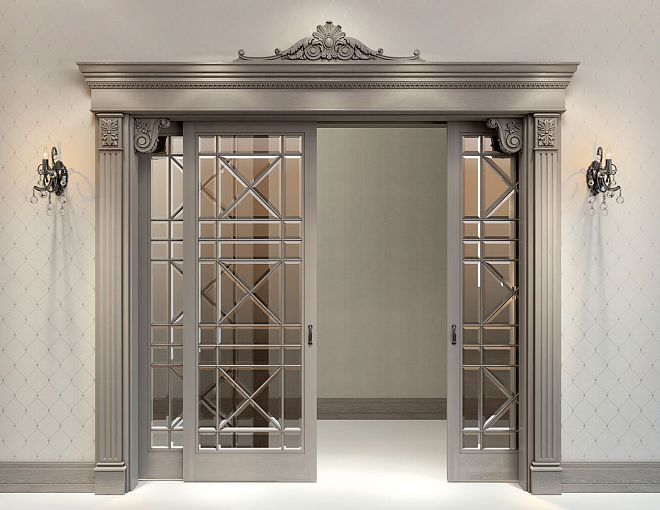
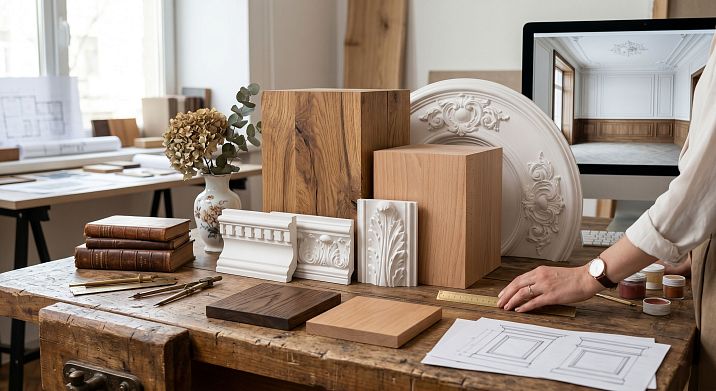
Oak, beech and Polyurethane moldings — three materials with different characters, different tasks, and different areas of application. This distribution of tasks is the main idea of this article. Not "what is better", but "what goes where". Not "wood versus polyurethane", but wood and polyurethane as partners in a single interior.
Those who learn to properly distribute these materials across zones will get a classic interior where every detail is in its place. Those who do not will get an expensive chaos of beautiful but mismatched elements.



What to buy immediately: a set of materials
For designers, decorators, and everyone who already knows what they are building — a specific list without introductions.
Oak positions:
-
Oak veneer — decorative contour, panels, frames, furniture accent;
-
Solid oak molding — molding profile, baguette, glazing bead, trim strip.
Beech positions:
-
Wooden balusters (beech) — stair posts, turned supports;
-
staircase components — handrails, support posts, railings;
-
Furniture legs — turned furniture legs from solid beech;
-
Furniture Handles — 32 models, 4 finishes.
Wooden decor:
-
Wooden decor and overlays — furniture overlays, decorative elements, relief inserts from solid wood.
Polyurethane items:
-
Moldings made of polyurethane — frames, wall profiles, horizontal belts;
-
Polyurethane moldings — cornices, rosettes, relief details;
-
Polyurethane appliqués — decorative elements without load;
-
Decor for Molding — corner and lock inserts;
-
Polyurethane trim — baseboard, transition profile.
Mounting materials:
-
Adhesive for polyurethane — the right choice;
-
fasteners for wooden elements;
-
acrylic sealant;
-
Primer for painting polyurethane;
-
Paint, varnish or oil for wood;
-
Allowance 10–15%.




Oak: the aristocrat among species
Our factory also produces:




Why oak is premium
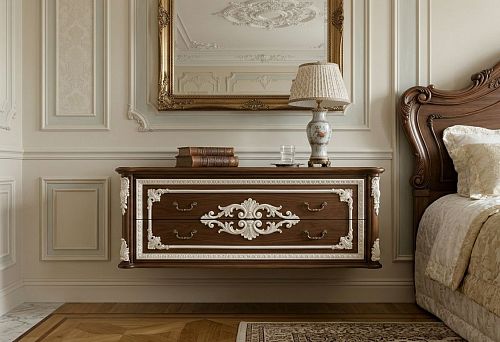
Oak is not just a hardwood. It is a species with character. A large expressive grain pattern, a warm golden-brown hue, slow growth that yields high density and strength. Oak is not afraid of mechanical loads, holds its shape stably during seasonal humidity changes, and only darkens over the years, acquiring a patina — that noble maturity that cannot be faked.
That is why in a classic interior, oak occupies the "foreground" zone — where it is visible, where it is touched, where its texture works as an independent decorative element.
Get Consultation
Oak layout: where it is needed
Oak molding is a thin decorative element with profiled edges that creates contours, frames, and plane divisions. Molding works where a clear line is needed — not just a straight one, but a volumetric one, with shadow and relief.
Where to use oak molding:
-
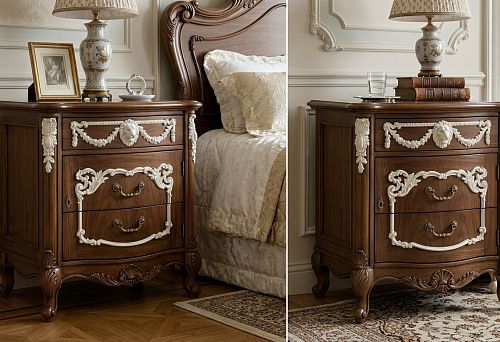
Furniture facades — frames on cabinet, sideboard, and dresser fronts. Molding turns a flat facade into a visually complex surface with depth;
-
Wall panels — horizontal division of the wall into zones: lower belt with molding, middle belt, upper frieze;
-
Ceiling coffers — frames made of molding on the ceiling, creating a coffered structure;
-
Window and door casings — framing of openings;
-
Frames around door panels — inner field of the panel;
-
Furniture inserts — decorative frames on the surface of case furniture.
Oak molding works both in its natural form (under varnish or oil) and for painting — in the latter case, its natural pattern is hidden, but the volume and shadow from the profile remain.
Oak molding: durable decorative contour
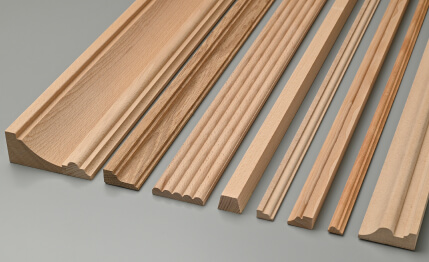
Pogonazh iz massiva — is a long-length wood profile: glazing bead, batten, cove molding, corner strip, baseboard, cornice. Oak molding is especially good where the line needs to look substantial — in junction areas, on furniture edges, in panel contours.
Where oak molding works:
-
Upper horizontal belt of wall panels;
-
Baseboards in interiors with oak parquet — a visual rhyme between floor and wall;
-
Battens and trims for built-in furniture;
-
Horizontal slats on vertical slatted panels;
-
Frame molding for mirrors, paintings, decorative niches.
Oak in the interior: what to combine with
Oak is a warm material. It harmoniously combines with:
-
Fabrics in natural tones — linen, cotton, wool;
-
Metal in warm shades — brass, bronze, gold;
-
Leather — natural or its high-quality alternatives;
-
Neutral walls — warm white, light gray, cream, beige;
-
polyurethane moldings for painting in warm white — contrast of wood grain and white stucco molding.
Oak pairs poorly with cool bluish or steel-gray tones — they "dampen" its warmth.
Beech: the workhorse of classic interiors
Character of beech: stability and precision
Beech is a wood that isn't noticed at first, but is missed as soon as it's gone. Fine uniform texture, high density, excellent workability on a lathe — these qualities make beech ideal for parts that must hold shape, turn well, paint evenly, and maintain geometry for years.
Beech is a working wood, not decorative. Its grain is even, without a prominent pattern. Under varnish, it looks neat and restrained. Under stain, it takes on any shade — from light honey to dark walnut. Under paint, it provides a perfectly smooth surface without the grain showing through.
That is why beech is the material of choice for turned products: balusters, legs, brackets, load-bearing support parts.
Beech balusters: a staircase as an architectural object
balusters for staircases made of solid beech — one of the most important decorative elements of a home. A staircase in a classic interior is not just a transition between floors. It is the architectural axis of the house, a vertical dominant that is viewed from the hallway, the living room, and the upper floor.
Beech balusters — turned posts with a profiled relief — create the rhythm of the staircase railing. Each baluster: a vertical decorative object repeated along the entire staircase. Even beech holds the turned profile without chips or deformations, which is critical for load-bearing parts (balusters support the handrail).
staircase components — this is a whole system: balusters, support posts, handrails, handrail rail, plugs. All elements are coordinated in material and style — which is fundamental for a professional result.
Beech furniture legs: turned silhouette
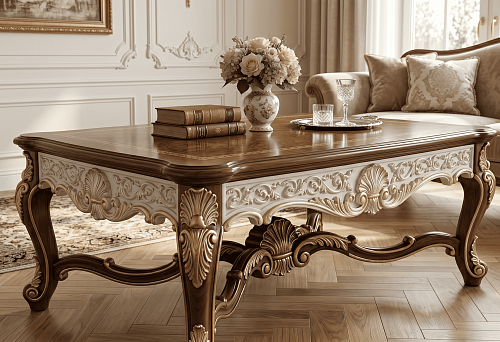
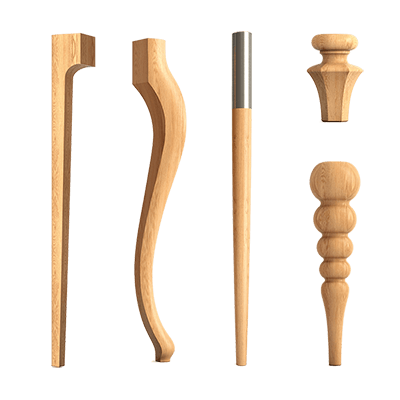
Solid beech furniture legs — this is not a structural element or a hidden support. In classic furniture, legs are always visible: from below, from the side, through and through. Turned shape, correct profile, stable geometry — all this is provided precisely by beech.
Legs for:
-
Sofas and armchairs in classic style;
-
Coffee and side tables;
-
Consoles and dressing tables;
-
Beds with wooden legs;
-
Chaise lounges, benches, poufs.
Beech wood with walnut, wenge, or dark oak stain — a standard scheme for interiors where all furniture is in dark wood. Under white enamel — for modern classic and Provence style.
Beech wood furniture handles: tactile contact with furniture
Furniture Handles — this is an area of constant contact with furniture. They are touched every day. That is why the material is important not only visually, but also tactilely.
Solid beech wood handle:
-
Warm to the touch — unlike metal or plastic;
-
Dense and durable — does not deform over time;
-
Turned or milled shape — with a classic profile;
-
Available in 32 models and 4 finishes — from natural beech to tints and paints.
Beech handles work especially well in combination with wooden legs made of the same solid wood — a single material, a single tint, a single character.
Polyurethane: lightweight decorative relief
What polyurethane decor really is
There is a persistent misconception: polyurethane is a "substitute" for wood, a cheap replacement. This is not true. polyurethane decor — it is an independent material with its own advantages that make it indispensable in specific areas of a classic interior.
Polyurethane:
-
Lightweight — does not create load on the wall or ceiling;
-
Does not absorb moisture — stable in damp rooms;
-
Takes paint perfectly — after proper priming, the surface is completely smooth;
-
Reproduces fine relief with high precision — small details of stucco decoration;
-
Cut with a hacksaw, glued with assembly adhesive — easy installation.
Polyurethane decor does not replace wood — it does what wood does worse or more expensively: reproduces fine stucco relief, creates long linear profiles without joints, mounts on the ceiling without risk of collapse.
Polyurethane moldings: architectural rhythm of walls
Moldings made of polyurethane — are the main tool for creating decorative frames, horizontal bands, and vertical wall divisions.
Where moldings work:
-
Wall frames — rectangular or square frames made of molding create "inset" panels on the wall, imitating architectural panels;
-
Horizontal bands — molding at the level of door lintels divides the wall into upper and lower zones;
-
Facade frames — framing of cabinet fronts, display cases, built-in furniture;
-
Transition profiles — a link between different materials or zones.
The size of the molding is selected according to the scale of the space: for high ceilings (280 cm and above) — profile 40–60 mm; for standard ones (250 cm) — 20–35 mm.
Polyurethane stucco: ceiling and upper zones
Polyurethane moldings — cornices, rosettes, coffered frames — this is a category of ceiling and upper decor. This is where polyurethane is absolutely unrivaled:
-
Ceiling cornice weighing 200–400 g per linear meter — versus plaster one at 2–5 kg;
-
Attached with glue and polymer sealant, without dowels and heavy-duty fasteners;
-
The profile is uniform along the entire length — no deformations, no shrinkage.
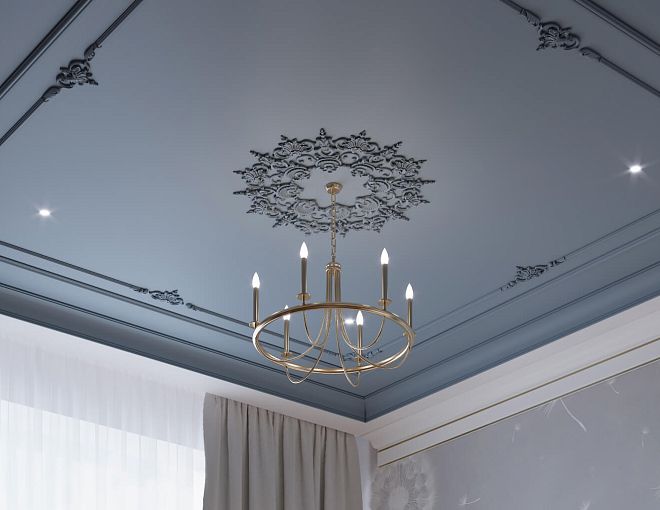
Ceiling rosette made of moldings under the chandelier — a classic solution that gives the ceiling a finished look. Polyurethane appliqués decorative accents in the corners and along the ceiling axes without additional installation.
Molding decor: corner solution without complex cutting
Decor for Molding — these are shaped inserts for corner joints of molding: rosettes in the corners of the frame, keystones at the top. They solve the main practical problem of frame installation: a 45° angle on a complex profile is precise work requiring experience. The corner insert makes this joint decorative, and cutting is no longer needed.
For one rectangular frame — 4 corner inserts. For a frame with a lock — 2 lower corners + 1 upper lock insert.
Wood and polyurethane in one interior: rules for combining
Principle of zone distribution
The most important rule: wood — in load and tactile contact zones, polyurethane — in decorative zones without load.
| Zone | Material | Reason |
|---|---|---|
| Stair balusters | Wood (beech) | Load, tactile contact |
| Stair railing | Wood (beech, oak) | Daily grip |
| Furniture legs | Wood (beech) | Load-bearing function |
| Furniture handles | Wood (beech) | Daily tactile contact |
| Layout on facades | Wood (oak) | Visible contour, may catch |
| Wall moldings | Polyurethane | No load, relief decor |
| Ceiling cornice | Polyurethane | No load, lightness |
| Sockets on ceiling | Polyurethane | No load, thin relief |
| Overlays on facades | Polyurethane | Decorative, without handle |
| Baseboard | Polyurethane | Profile, ease of installation |
Style coordination
Oak, beech and polyurethane in one interior should be linked by a unified style. This does not mean the same color. It means the same scale of details and the same style group.
For example:
-
Oak layout with a neoclassical profile → polyurethane moldings with a similar profile → beech balusters with a classic turned pattern. All from the same 'family'.
-
Large heavy layout in baroque style → rich cornice with stucco → balusters with developed relief. All proportionate.
You don't need to aim for a perfect profile match. Proportionality is enough: if the layout is thin, the molding is thin. If the baluster has a large relief, the cornice can be more developed.
Finish coating: unity of tone
The most common mistake when combining wood and polyurethane is a different finish tone. Warm golden beech + cold gray moldings are different worlds in one room.
Three possible strategies:
-
Single color — wood for painting with white enamel + polyurethane for the same white paint. Everything is the same tone, the material differs only in texture;
-
Contrast by design — dark wood (stain in walnut, wenge) + white polyurethane. A deliberate and harmonious contrast;
-
Natural wood + polyurethane in a neutral tone — oak with oil finish in natural shade + moldings in warm cream.
Ready-made kits by zones and projects
Kit: classic living room with oak and stucco
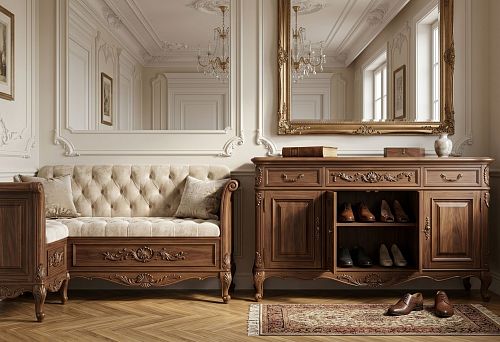
Task: living room 22 m², neoclassical style, oak accents + white moldings.
Wooden items:
-
Oak molding — frames on the facades of the built-in wardrobe, horizontal belt of the wall panel;
-
Pogonazh iz massiva — top rail of the panel under varnish;
-
Furniture legs — for the coffee table, stain in dark oak;
-
Furniture Handles — for cabinets, brass stain.
Polyurethane items:
-
Moldings made of polyurethane — frames on the wall behind the sofa, painted white;
-
Polyurethane moldings — cornice along the ceiling perimeter;
-
Decor for Molding — corner inserts for all frames;
-
Polyurethane trim — baseboard, white.
Finish strategy: oak under oil, natural shade + polyurethane in warm white. Contrast of warm wood and white molding.
Set: staircase in a classic house
Task: straight staircase to the second floor, 14 steps, wood + molding on the wall.
Wooden items:
-
Beech balusters — 28 pieces (2 per step), turned profile;
-
staircase components — support posts, handrail, handrail rail;
-
Pogonazh iz massiva — glazing bead for the wall panel next to the staircase.
Polyurethane items:
-
Moldings made of polyurethane — decorative frames on the wall near the staircase;
-
Polyurethane appliqués — accent elements in transition zones;
-
Polyurethane moldings — cornice on the second floor landing.
Finish strategy: beech in «light walnut» tint + white moldings. Classic contrast.
Set: study with oak panels
Task: home office 14 m², English style, oak panels + library cabinets.
Wooden items:
-
Oak veneer — frames on wall panels, lower wall band;
-
Pogonazh iz massiva — horizontal panel band, baseboard under wood finish;
-
Wooden decoration — decorative inserts on library cabinet facades;
-
Furniture Handles — in «dark walnut» color.
Polyurethane items:
-
Polyurethane moldings — ceiling cornice, painted to match the wall above the dado;
-
Moldings made of polyurethane — horizontal band at the junction of the oak panel and the upper zone.
Finish strategy: oak with dark oil, walls above panels — dark green or burgundy, molding — to match the upper wall zone.
Set: hallway with beech and polyurethane
Task: hallway 8 m², height 270 cm, style — strict classic.
Wooden items:
-
Beech furniture legs — for the bench at the entrance;
-
Furniture Handles — for a built-in wardrobe or cabinet with fronts.
Polyurethane items:
-
Polyurethane trim — baseboard 100 mm, white;
-
Polyurethane moldings — cornice 80 mm;
-
Moldings made of polyurethane — one frame on the wall opposite the entrance as a decorative accent.
How to avoid mistakes: principles of selection and combination
Principle 1: one material — one task
Do not try to replace beech with polyurethane in balusters or furniture legs. polyurethane panels — this is decor without load. Load-bearing elements must be wooden.
Principle 2: do not mix species without a concept
Oak and beech in one interior is normal. But oak, pine, ash, and cherry in one room are different species with different characters that compete rather than complement each other. Choose 1–2 wood species for the interior and stick to them.
Principle 3: scale of details — uniform
Thin oak layout 8 mm → thin molding 25 mm. Large powerful cornice profile → developed wooden trim underneath. The scale of wooden and polyurethane elements must be proportionate.
Principle 4: main accent — one per zone
Each interior zone has one visual hero. In the living room: either oak panels, or wall moldings, or rich staircase balusters. All three at once is a competition, not an ensemble.
Principle 5: finish coating — a single solution in advance
Decide before ordering: will the wood be natural (varnish, oil) or painted? If natural — polyurethane should be in warm paint tones. If the wood is painted — a single color for wood and polyurethane is possible.
Mistakes when selecting and purchasing
Mistake 1: buying oak, beech, and polyurethane without an overall plan
Order oak layout, then buy moldings, then add legs and handles — and find that the proportions don't match. Before ordering, you need a plan: what goes where, in what quantity, in what finish.
Mistake 2: choosing wood only from a photo
In photos, stains look different than in reality. Request samples or visit a showroom — it's an investment that will save much more when reordering.
Mistake 3: not considering the finish coating
Wooden decoration For painting and for varnish — these are fundamentally different products in terms of surface preparation. An oil-coated element cannot be repainted without special treatment.
Error 4: placing polyurethane in impact or grip zones
Polyurethane appliqués on the lower belt of the wall, where chairs constantly hit or hands brush against — this is quickly ruined decor. In areas up to 1 meter from the floor in walkways — only wood.
Error 5: not calculating moldings by perimeter
Moldings are ordered by linear meters with a reserve for cutting. An error in calculation = buying later = risk of batch mismatch.
Error 6: forgetting glue, sealant, primer
Correct glue for polyurethane, acrylic sealant for joints, special primer for painting — all this needs to be ordered simultaneously with the decor. Replacing the glue with "what was at hand" is a common cause of poor installation.
Error 7: too many wood species
Oak layout + beech legs + pine baseboard + ash handrail — these are four different wood shades in one space. With different finishes, they will compete. Choose 1–2 species, the rest — for painting.
Special zones: non-standard applications of wood and polyurethane
Zoning walls with oak trim
One of the most elegant techniques of classic interior design is zoning a wall with a horizontal wooden belt. Oak molding at a height of 90–100 cm from the floor divides the wall into a "lower zone" (skirt) and an "upper zone". The lower part is in one color or finish, the upper part in another. The border is a horizontal oak strip with a profile.
This technique works in a study, living room, hallway, bedroom, dining room. It creates a horizontal rhythm without complex panels.
Oak coffered ceiling
Oak trim on the ceiling — coffered frames — is a special technique that creates a voluminous ceiling. Pogonazh iz massiva forms a grid of coffers. Inside each coffer is either natural wood or a painted surface in a contrasting tone.
For high ceilings (310 cm and above) — oak coffers give the ceiling "weight" and reduce the feeling of emptiness overhead.
Beech supports in seating areas
Wooden supports are not just table legs. Beech furniture supports Used as individual decorative stands: supports for shelf systems, brackets for consoles, vertical elements of sectional shelving.
In a classic study or library, wooden supports under the shelf beam create the feel of an architectural order: column, entablature, shelf.
STAVROS: when three materials work as one
You can assemble an interior from oak, beech, and polyurethane from different suppliers. This is time-consuming, risky, and almost always yields a mismatched result: different profile proportions, different tint shades, incompatible relief styles.
You can choose one manufacturer whose entire range is created within a unified system. STAVROS is exactly that kind of manufacturer.
STAVROS has been operating since 2002, with production in Saint Petersburg. Wooden products from solid beech and oak, and polyurethane decorative elements are created in consistent proportions, within a single style catalog.
What STAVROS offers for interiors made of wood and polyurethane:
-
Pogonazh iz massiva — trim, bead, batten, cove molding, baguette, horizontal slats;
-
Wooden decor and overlays — furniture overlays, relief inserts;
-
Beech balusters — turned profiles for stair railings;
-
staircase components — complete system: posts, handrails, slats;
-
Solid beech furniture legs — turned furniture supports;
-
Furniture Handles — 32 models, 4 finishes;
-
Moldings made of polyurethane — profiles for walls and facades;
-
Polyurethane moldings — ceiling cornices, rosettes, relief bands;
-
Polyurethane appliqués — decorative accents without load;
-
Decor for Molding — corner and lock inserts;
-
Polyurethane trim — baseboard, transition profiles.
Order — from one piece. Shipment of stock items — from 3 business days. Delivery across all of Russia. Showrooms in Saint Petersburg and Moscow.
STAVROS is a manufacturer that understands: oak layout on the facade and Polyurethane molding on the wall — these are not two separate products. They are details of a single interior. And it is this systemic understanding of materials that distinguishes STAVROS from a mere profile supplier.
Frequently asked questions
What is better for the interior: oak, beech or polyurethane?
These are three different materials with different purposes. Oak is for layouts, moldings and decorative contours where expressive texture is important. Beech is for balusters, legs, handles and load-bearing parts. polyurethane decor — for moldings, cornices, overlays and stucco relief. All three work together, each in its own area.
Where to use oak decor in the interior?
In layouts on furniture facades, in wall panels, in horizontal belts, in ceiling coffers, in baguettes and door/window framing. Oak veneer is especially expressive where its texture is visible in contrast with light walls.
Where to use beech balusters?
Beech balusters are used in stair railings, in decorative galleries, in balcony railings. Beech is an ideal wood for turned supports: dense, uniform, holds geometry well.
Can oak layouts and polyurethane moldings be combined?
Yes, this is a classic combination in interiors in the neoclassical and modern classic style. Oak molding — in wooden details, Moldings — on the walls. Both are painted, or one is natural and the other white.
How to properly glue polyurethane molding?
Only with special mounting glue for polyurethane, without solvents. Details on choosing glue and installation technology — here.
Is a material reserve needed?
Mandatory: for layout and linear footage — 15%, for moldings — 15%, for balusters — 5–10% (considering possible defects during installation), for overlays — 10%. The reserve will save time and nerves if reordering is needed.
Which furniture handles match beech legs?
The same ones — from the same beech wood array, in the same tint. In the STAVROS catalog — 32 handle models in 4 coatings, which allows you to find an exact match with the selected legs.