Article Contents:
- Slat panel PAN‑005 1010×9×2670 mm: which two MDF versions are we comparing
- Three PAN‑005 for a 3000 mm wall: why the quantity is the same for regular and primed MDF
- Why 3000 mm per design and 3000 mm on site are different things
- Why you can't simply remove 70 mm from each panel in advance by height
- Regular PAN‑005 made of MDF: what really needs to be done before enamel
- Primed PAN‑005: which operation does the buyer pay for in advance
- When it is more rational to buy regular PAN-005 even if it will be painted later
- When it is more reasonable to order primed PAN-005
- Why the triangular relief of PAN-005 complicates comparing priming with smooth MDF
- Why manual intermediate sanding is more expensive on relief
- Why compound consumption cannot be calculated from the product card
- The same RAL does not mean the same perception of a smooth wall and PAN-005
- RAL/NCS should be agreed upon together with the gloss level
- When side lighting is especially critical
- Why it is worth checking OPAN-005 before purchasing three full-size panels
- Can regular and primed PAN-005 be compared just by photo
- Option A — regular MDF
- Option B — primed version
- Slat wall panels for painting: when to prime before installation
- What is beneficial to do before installation
- What may remain after installation
- What happens to factory primer after cutting PAN-005 to 2600 mm height
- Why trimming is better done before final finish
- Where to distribute the extra 30 mm across the wall width
- Remove 30 mm from one edge
- Distribute nominally 15 mm from each edge
- Shift the entire layout to align with furniture or an architectural axis
- Why you can't paint three PAN-005 panels first and then decide the layout
- Where the joints of three PAN-005 panels should be on the wall
- When the price difference of three PAN-005 panels is offset by preparatory work
- The cost of time can also be calculated
- Why you can't choose only the cheapest PAN-005 in the product card
- How to request comparable estimates from a painter
- "Prestige" and "Primed Prestige" — why these are not the same sanding quality
- Painting PAN-005 before or after installation: why primer economics cannot be calculated separately from installation
- Scenario A — primer and main finish before installation
- Scenario B — preparation before installation, finish after
- Scenario C — primed version + local preparation + finish
- Installation adhesive, micro-pins, and finish: what to add to the estimate for a finished wall
- Practical scenario: own painting workshop does all MDF in one cycle
- Practical scenario: the apartment is almost ready, they don't want to prime the relief on site
- Practical scenario: the chosen finish system requires its own primer
- Practical scenario: primed PAN-005 reduces time, but not cost
- Estimate sensitivity: three conditional examples without inventing market prices
- If the actual wall is not 3000 but 2970 mm: how the edge changes
- If the actual wall is 3040 mm: three PAN-005 panels are no longer enough by nominal width
- If the wall height is 2640 mm: a 30 mm allowance instead of 70 mm
- If the wall height is 2680 mm: the long PAN-005 is no longer sufficient
- How to choose the edge at the floor and ceiling before buying the primed version
- Sockets, switches, and furniture on a 3000×2600 mm wall: why they affect preparation costs
- If PAN-005 will be partially covered by furniture: don't reduce the quantity without a cutting map
- Production time for the primed version: how to include it in the project schedule
- Why it's better to order three panels in one batch
- How to accept primed PAN-005 before final painting
- How to accept regular PAN-005 before priming
- What to do if a contractor suggests priming an already installed regular PAN-005
- Control example: regular PAN‑005 is cheaper even after preparation
- If one of the three panels requires many cutouts: identical execution is still usually more logical
- When factory primer loses most of its value due to non-standard processing
- When primed PAN‑005 is especially logical on a simple rectangular wall
- Mistake 1. Compare 30,010 and 47,310 ₽ and stop
- Mistake 2. Consider the primed panel as ready white finish
- Mistake 3. Prime regular PAN‑005 like a smooth wall
- Mistake 4. Paint panels before dry layout
- Mistake 5. Not treating the fresh cut of the primed panel
- Error 6. Taking design dimensions 3000×2600 as actual
- Error 7. Comparing only one RAL without gloss
- Error 8. Not making two technological paint samples
- Error 9. Ignoring mounting points
- Error 10. Overpaying for factory primer that the workshop will completely redo anyway
- Error 11. Buying regular MDF without having the space and technology for preparation
- Error 12. Choosing RK-002 as a "cheap PAN-005" without a new design
- Break-even point per panel: a simple way to check a painter's quote
- Why it's useful to calculate both per panel and for the entire wall
- What should be written in the painter's estimate to make the comparison fair
- Why the price of a finished wall should include the risk of rework
- Checklist before payment
- How does regular PAN‑005 differ from primed?
- What is the size of the long PAN‑005 made of MDF?
- How many PAN‑005 panels are needed for a wall 3 meters wide?
- Will 2670 mm be enough for a 2600 mm wall?
- Do I need to prime regular PAN-005?
- Do I need to paint primed PAN-005?
- Is primed PAN-005 a ready white panel?
- Which is cheaper — regular or primed MDF?
- How to calculate the cost of priming?
- Do I need to prime the cut edge of primed PAN-005?
- Can I paint PAN-005 after installation?
- How to distribute the extra 30 mm across the width?
- Can I use the same RAL as the wall?
- Why buy OPAN-005?
- Which panels are better for painting?
- When is regular MDF more advantageous?
- When is the primed version more advantageous?
- When should you switch to separate interior slats?
- Where to order PAN‑005?
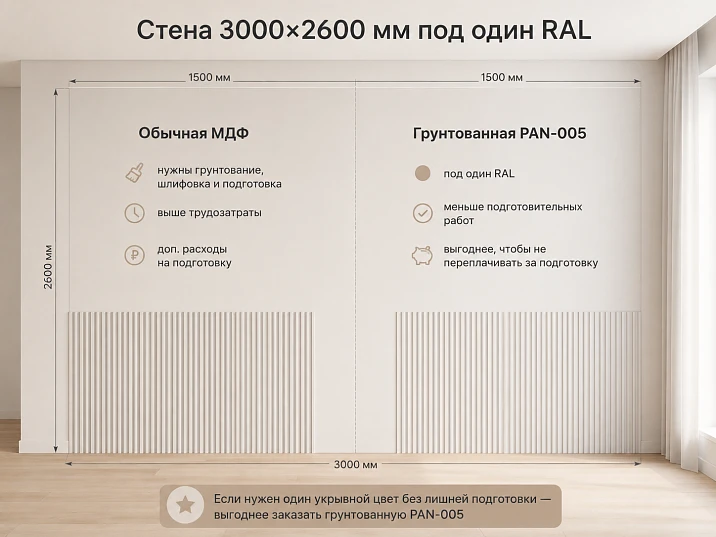
The relief is already chosen: PAN-005 with a triangular profile 9 mm deep is needed. The wall is about 3000×2600 mm, natural wood texture is not needed, the entire surface must be painted in one agreed RAL or NCS. On the PAN-005 card, there are two visually similar MDF options 2670 mm long: regular "Prestige" and "Prestige primed". The price difference is noticeable, and the number of panels for this wall is the same — three pieces. A natural question arises before purchase: is it worth paying extra for factory primer, or is it better to take regular MDF and have your painter do the preparation?
You need to compare not the price of one panel, but the cost of the finished painted wall. Regular PAN-005 is cheaper as a product, but before enamel it requires full priming and intermediate preparation. The primed version is more expensive, but part of this cycle is already done at the factory. Which scheme is more profitable depends on the cost of your painting workshop's work, the chosen coating system, timelines, logistics, and finish quality requirements.
For a wall 3000 mm wide, the calculation is simple: 3000 ÷ 1010 = 2.97, so three vertical modules are needed. Their total nominal width is 3030 mm. In height, PAN-005 2670 mm gives a 70 mm nominal margin relative to a 2600 mm wall. So both versions solve the same geometric problem without a horizontal joint — after checking the actual finished height. The buyer pays not for a different size, but for a different level of factory preparation.
If PAN-005 is still compared with other systems, you can first buy slat panels for walls for interior finishing After checking dimensions, profile, and available materials. This article already assumes that the PAN‑005 shape is suitable, and the main choice is between two MDF versions of the same article.
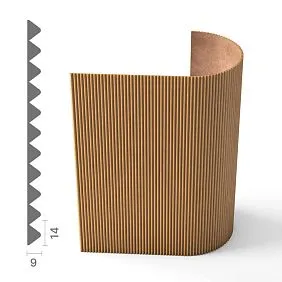
Slat panel PAN‑005 1010×9×2670 mm: which two MDF versions we compare
The current PAN‑005 card shows identical geometry for regular and primed MDF: A=1010 mm, C=9 mm, L=2670 mm. The surface condition before final painting differs.
| PAN-005 version | Size | Price at the time of check | What has already been done | What remains |
|---|---|---|---|---|
| MDF "Prestige" | 1010×9×2670 mm | 30 010 ₽ | Detailed sanding | Priming, intermediate preparation, finish |
| MDF "Prestige primed" | 1010×9×2670 mm | 47 310 ₽ | Sanding + factory primer | Preparation according to the accepted system and finish |
Ordinary Slat panel PAN-005 made of MDF is described by the manufacturer as a deep-milled product for painting with enamels. The page also provides a specific recommendation: before painting, MDF requires priming, two coats of polyurethane-based primer-sealer with intermediate sanding of raised grain are recommended; priming should be done before installation.
Primed version is not a finished white decorative panel. It is a prepared base. The final RAL/NCS, gloss level, and final covering system must still be executed in the project.




Three PAN-005 panels for a 3000 mm wall: why the quantity is the same for regular and primed MDF
The quantity does not depend on the primer, because both versions have the same size 1010×9×2670 mm.
3000 ÷ 1010 = 2,970...
We round up: a minimum of three modules in width.
1010 × 3 = 3030 mm.
Nominal width excess:
3030 − 3000 = 30 mm.
By height:
2670 − 2600 = 70 mm.
These 30 and 70 mm cannot be immediately considered ready cut lines. The actual wall may have deviations in width and height. Measurement is taken after the finished floor, ceiling, and wall leveling. For three vertical panels, it is especially important to measure the width at least at the bottom, center, and top: if the wall narrows, the distribution of edge trims will change.
Our factory also produces:





Why 3000 mm in the project and 3000 mm on site are different things
The design size is often rounded. After plastering, one point may give 2992 mm, another 3004 mm. If three panels are already painted and trimmed "according to the drawing," the edge has to be corrected on the finished finish. Therefore, dry layout precedes final painting.
Get Consultation
Why you cannot simply remove 70 mm from each panel in advance by height
The ceiling may have a difference in level, and the finished floor line may differ by a few millimeters. For vertical relief, even a slight slanted gap at the top is noticeable. It is better to tie each panel to its actual position after layout.
Regular and primed MDF: what operations the buyer pays for in two scenarios
Regular PAN-005 made of MDF: what really needs to be done before enamel
The manufacturer's card directly describes the preparation of regular MDF. This is important because the article should not invent its own technology. For PAN-005 made of MDF, priming before painting is specified, two coats of polyurethane-based primer-sealer, and intermediate sanding of raised grain. The manufacturer also notes that it is advisable to prime before installation.
In the estimate for regular PAN-005, not only the can of primer should be considered. The full preparatory cycle may include unpacking, dust removal, first primer coat, drying, intermediate sanding of the relief, repeated dust removal, second coat, surface inspection, local touch-up after cutting, and final painting.
If the workshop only calculates priming per square meter, ask to separately confirm that the price refers specifically to the relief PAN-005, not to a smooth MDF sheet. The triangular profile requires working on sloped faces and inter-slat areas.
Primed PAN-005: what operation the buyer pays for in advance
The difference between the two card items is not white panel versus unpainted. The buyer of the primed version pays for part of the production cycle of base preparation. The panel arrives at the site with the primary operation already completed at the factory.
This can reduce the amount of work in your own workshop, shorten the calendar timeline, and reduce the risk of inconsistent primary preparation of three large modules.
But factory primer does not eliminate the finish. You cannot order primed and consider the wall ready for use as a decorative white surface. The final color, gloss, and hiding power are created by the subsequent coating system.
MDF slat panels for painting: you need to compare the cost of the finished wall
The buyer sees the difference in panel price, but the decision needs to be reduced to one formula:
finished wall = panels + preparation + consumables + labor + finish + local treatment after cuts + installation + logistics.
For a wall of 3000×2600 mm, the product portion is already known.
| Option | 3 panels |
|---|---|
| Standard MDF | 3 × 30 010 = 90 030 ₽ |
| Primed MDF | 3 × 47 310 = 141 930 ₽ |
Surcharge for factory primer on three panels:
141 930 − 90 030 = 51 900 ₽.
It is precisely 51,900 ₽ that needs to be compared not with the "price of a can of primer," but with the entire cost of preparing three regular PAN‑005 panels to a state comparable to the primed version. If a workshop charges less than 51,900 ₽ for material, labor, sanding, and related logistics, regular MDF may be more cost-effective. If the entire preparation cycle costs more or creates a critical timeline, the primed version gains an economic justification.
If a general category selection is still needed, the request buy MDF slatted panels logically leads to a section where PAN‑005 can be compared with other MDF panels.
When it is more rational to buy regular PAN‑005 even with subsequent painting
The regular version is stronger not because it is "cheaper", but when the project already has an efficient painting cycle: the workshop primes all MDF elements in one process, there is a professional spray booth and sanding equipment, the chosen enamel requires its own compatible primer system, the panels are still transported to the workshop along with doors and facades, and the estimate for preparing three panels is noticeably lower than the surcharge of 51,900 ₽.
When it is more reasonable to order primed PAN‑005
The primed version gains an advantage if there is no separate painting workshop, the renovation is already close to completion, extra sanding dust is undesirable, the number of technological cycles on site needs to be reduced, the contractor prices the preparation of relief MDF expensively, or the calendar deadline is more important than the minimum product price.
After calculation, you can order primed PAN-005 already as a conscious choice, not as a more expensive line in the product card.
Relief, RAL/NCS and a reference sample before ordering three panels
Why the triangular relief PAN‑005 complicates the comparison of priming with smooth MDF
A wall of 3000×2600 mm has a geometric area of 7.8 m². But preparing PAN‑005 is not equal to priming a flat wall with an area of 7.8 m². The triangular profile creates additional actual surface: there are peaks, sloped faces, and recesses between elements. The painter works not only on the frontal projection.
Therefore, the estimate "MDF priming — X ₽/m² × 7.8 m²" may be underestimated. For a fair comparison, you need to get a price specifically for three PAN‑005 panels, not for a conditional flat surface. The contractor must see a sample or the profile card and understand the 9 mm depth.
Why manual intermediate sanding is more expensive on relief
A smooth wide surface is convenient to process with a flat tool. With PAN-005, part of the work has to be done with control over edges and recesses. You cannot aggressively remove primer from the peaks and leave insufficiently processed inner areas. The working time depends on the tool and the technology adopted by a specific workshop.
Why the consumption of the compound cannot be calculated from the product card
The card provides recommendations for priming but does not publish the consumption rate specifically for PAN-005. Consumption depends on the specific primer, application method, equipment, dry residue, and layer requirements. Therefore, the article does not substitute invented grams per square meter.
The same RAL does not mean the same perception of a smooth wall and PAN-005
Even if a smooth wall and a slat panel are painted with the same paint from the same can, the relief creates light and shadow edges. The triangular profile appears darker on one side and lighter on the other. With side lighting, the effect intensifies.
Therefore, the task of "making PAN-005 exactly match the wall color" should be understood correctly: the formula of the finish color matches, but the visual brightness of the relief surface may differ from a smooth plane.
RAL/NCS should be agreed upon together with the degree of gloss
Matte and semi-matte finishes of the same shade behave differently on triangular edges. Higher gloss emphasizes the direction of light and individual peaks more strongly. Therefore, in the technical specification for a painter, a single color number is not enough.
When side light is especially critical
If there is a window, wall lamp, track light, or hidden LED backlighting near the panel, the sample should be viewed in that specific light. Even overhead light in a workshop can hide a nuance that will become key in the finished interior.
Why you should check OPAN‑005 before buying three full-size panels
A photo of the card shows the pattern, but does not give an accurate sense of the 9 mm depth, the scale of the triangular elements, and the behavior of the enamel on the relief. Therefore, before ordering the entire wall, it is useful buying a sample OPAN-005.
According to the editorial passport, OPAN‑005 has dimensions of 197×9×310 mm and is suitable for checking the real profile. On the sample, you can work out:
- the primer system;
- the finish RAL/NCS;
- gloss level;
- the behavior of side light;
- coverage on peaks and in recesses;
- the combination with furniture, doors, and the wall.
The sample does not replace the wall calculation and does not show inter-panel joints, but it allows you to check the most expensive risk—the finish itself—before buying three large modules.
Can you compare regular and primed PAN‑005 just from a photo
No. For an honest technological comparison, two samples finished to the same final stage are needed.
Option A — regular MDF
Regular PAN‑005 or test MDF of appropriate quality goes through the accepted priming system, intermediate sanding, and the same finish that will be on the wall.
Option B — primed version
The factory-prepared surface only undergoes the operations that are truly needed according to the accepted painting system and is covered with the same finish.
After drying, the samples are compared under the same light. The buyer cares not only about color and gloss, but also about micro-relief, uniformity of recesses, quality of peaks, and presence of sanding marks.
Cutting, primer, and finish: in what order to prepare PAN‑005
Slat wall panels for painting: when to prime before installation
For regular MDF, the manufacturer directly recommends priming before installation. This is logical for a relief panel: on a horizontal or specially organized work surface, it is easier to control application, drying, and sanding.
But this does not mean that absolutely all finishing must be completed before installation. After layout and cutting, fresh edges appear, and after installation, local corrections may be needed at fastening points and inter-module areas. The scheme should be agreed upon in advance.
What is beneficial to do before installation
- basic priming of regular MDF;
- basic intermediate sanding;
- checking uniformity of three modules;
- part of the finishing cycle, if the project allows it.
What may remain after installation
- local work with fresh cuts;
- mechanical fastening points;
- minor defects after fitting;
- final alignment of the visual result.
What happens to the factory primer after cutting PAN‑005 to a height of 2600 mm
The primed panel has a length of 2670 mm, while our wall is about 2600 mm. This means a fresh cut will appear at the bottom or top. This new edge does not have the factory primer in the same form as the face surface.
Therefore, the formula 'primed PAN‑005 = no primer needed anywhere' is incorrect. After trimming, local areas are treated according to the accepted system. The same applies to accidental chipping, deep sanding, or other damage to the factory layer.
Why it is better to finish trimming before the final finish
If the panel is fully painted first and then cut on site, fresh material appears on the edge and there is a risk of damaging the finished face surface. Dry layout and main finishing cuts before the final layer reduce the number of such repairs.
Wall layout 3000×2600 mm: edges, seams, and actual dimensions
Where to distribute the extra 30 mm across the wall width
Three PAN‑005 panels give 3030 mm, while the nominal wall width is 3000 mm. In pure arithmetic, 30 mm needs to be removed. But the method of distribution changes the appearance of the edge strips.
Remove 30 mm from one edge
The simplest option in terms of calculation. The two inter-panel joints remain standard, and all adjustment falls on the edge panel. The drawback is that the last triangular element near the wall may end up with an unfavorable width.
Distribute nominally 15 mm from both edges
The composition becomes more symmetrical, but both outer panels require a longitudinal cut. It is necessary to check how this cut runs relative to the actual rhythm of PAN-005.
Shift the entire layout to align with furniture or an architectural axis
If the wall has a TV, bed, console, or central portal, it is sometimes more correct to tie the panels to the axis of the composition rather than to the mathematical symmetry of the wall. Then the edge trims may be unequal but visually logical.
The decision is made on the front layout with the actual profile, not by a single formula.
Why you cannot first paint three PAN-005 panels and then decide the layout
After a dry fit, it may turn out that the edge needs to be shifted, one panel must swap places with another, the seam is better moved away from the light fixture, and the trim distributed differently. If the entire finish is already done, every change creates a risk of damage.
Work sequence:
precise measurement → front layout → panel marking → rough trimming → dry fit → approval of edges and seams → full finish → installation → local touch-up.
Where the joints of three PAN-005 panels should be located on the wall
On a 3000 mm wall, there will be two vertical inter-module connections. The panels are modular, but this does not exempt from visual inspection of these lines.
Need to match them with:
- furniture center;
- with a TV;
- doorway;
- sockets;
- wall sconces;
- strong side light;
- main viewing point.
If one seam falls directly on the edge of the TV or under a bright light line, it can be more noticeable. Sometimes it's enough to reverse the order of the trims or slightly shift the entire layout.
Regular or primed MDF PAN‑005: how to make an honest comparative estimate
| Expense item | Regular PAN‑005 | Primed PAN-005 |
|---|---|---|
| 3 panels 1010×9×2670 | 90 030 ₽ | 141 930 ₽ |
| Initial priming | Count separately | Part of the factory preparation has already been completed |
| Primer material | Calculate | Clarify requirement locally/by system |
| Intermediate sanding | According to the recommended cycle | According to the adopted finishing system |
| Finish paint | Need | Need |
| Processing fresh cuts | Need | Needed locally |
| Delivery to the paint shop | Count if required | Count if required |
| Installation | Needed | Needed |
The table intentionally does not include invented painter rates. In St. Petersburg, Moscow, or another city, one workshop may calculate work by module, another by area, and a third by standard hours. You need to obtain two real estimates for the same final result.
When the price difference of three PAN-005 panels is offset by preparatory work
Surcharge for the primed version:
51 900 ₽.
Let us denote the total cost of preparing three regular panels to a comparable state as P. Then:
- if P < 51,900 RUB, regular MDF is cheaper in direct costs;
- if P ≈ 51,900 RUB, timelines, quality, and logistics become decisive;
- if P > 51,900 ₽, the primed version may be cheaper even before accounting for the rework risk.
But P should include not only the primer. Add labor, sanding, consumables, transport to the workshop, loading, storage, and re-inspection if these operations actually occur.
The cost of time can also be calculated.
If regular panels add several calendar days and delay furniture installation or project handover, the timeline has a financial value. It cannot be universally estimated, but in a commercial interior or renovation with a fixed date, this factor may be more important than a few thousand rubles.
Why you cannot choose only the cheapest PAN‑005 in the card
Regular MDF is cheaper as a product. But the wall is not bought for three unprocessed rolls, but for a finished surface. If the project lacks painting infrastructure, the low entry price may lead to more expensive on-site preparation.
The opposite mistake is to consider the primed PAN‑005 automatically more advantageous. If the workshop has already included priming of all MDF in a fixed price and does not offer a discount for factory primer, the buyer simply pays twice for one preparation stage.
How to request two comparable estimates from the painter
To ensure the comparison is not fictitious, both estimates must describe the same final result: three PAN‑005 1010×9×2670 mm, trimmed to fit a 3000×2600 mm wall, one RAL/NCS, one gloss level, and the same quality requirement.
Wording for the regular version:
«Calculate the full cycle of preparation and painting of three PAN‑005 from MDF “Prestige” 1010×9×2670 mm to a finished finish RAL/NCS ___, including recommended priming, intermediate sanding, and edge treatment.»
For primed:
«Calculate the preparation of factory-primed PAN‑005 of the same size to the same final finish, taking into account the condition of the factory layer and local cuts.»
Only after two comparable answers can you see how much each scheme actually saves.
Installation and surface: what changes after priming, cuts, and fastening
«Prestige» and «Prestige primed» — why these are not the same sanding quality
In the PAN‑005 card, both versions belong to the «Prestige» quality, but one is additionally primed. It is important not to mix them up. «Prestige» refers to the quality of preparation and sanding of the product, while «primed» refers to an additional surface stage before painting.
Therefore, the regular PAN‑005 «Prestige» is not a rough blank. It is already thoroughly sanded, but the manufacturer still requires priming before painting MDF. The primed version gets the next technological step in advance.
It is useful for the buyer to ask the contractor a precise question: «What part of your usual preparation cycle does the factory primer of PAN‑005 eliminate?» If the answer is — «none, we still fully re-prime», the extra cost for the factory version may not pay off. If the contractor eliminates a separate operation and reduces the price, the comparison becomes substantive.
Painting PAN‑005 before or after installation: why the economics of primer cannot be considered separately from installation
The card recommends priming regular MDF before installation, but the installation process still affects the finish. PAN-005 is fixed with contact adhesive; the manufacturer also recommends, if necessary, additional mechanical fastening with micro-pins followed by local puttying and sanding of the fastening points.
This creates three possible technological scenarios.
Scenario A — primer and main finish before installation
Panels are convenient to paint off the wall, but after installation you need to work carefully with fastening points and seams. The risk is damaging the finished coating during trimming or installation.
Scenario B — preparation before installation, finish after
Regular MDF is primed and sanded in advance, panels are fitted and installed, then final painting is done. This scenario reduces the risk of damaging the final layer during cutting, but requires painting protection already on site.
Scenario C — primed version + local preparation + finish
Part of the initial work is already done, but fresh cuts, pin points, and local damage are still refined before the finish. Therefore, even primed PAN-005 does not turn installation into a "glue and paint without preparation" operation.
Mounting adhesive, micro-pins, and finish: what to add to the estimate for a finished wall
When comparing regular and primed PAN-005, installation for both versions is mostly the same, so it is often excluded from the difference. But it is important for the total project cost and for the painting sequence.
The estimate must take into account:
- glue for the selected base;
- micro-pins if necessary;
- masking of attachment points;
- local sanding;
- protection of the floor, ceiling, and adjacent walls during finishing;
- final inspection of seams and edge cuts.
If the contractor offers different installation costs for primed and unprimed panels, ask them to explain which operation changes. The size and relief are the same.
Practical scenarios: when regular and when primed PAN‑005 wins
Practical scenario: an in-house painting workshop processes all MDF in one cycle
In the project, doors, furniture facades, moldings, and PAN-005 are painted simultaneously. The workshop still runs a separate MDF priming cycle and does not reduce the price if the panel arrives factory-primed. In such a case, three regular PAN-005 panels for 90,030 ₽ may be more rational, because the surcharge of 51,900 ₽ does not eliminate a real cost item.
But before choosing, you need to confirm that the workshop is ready to work qualitatively with the triangular relief and performs the preparation cycle recommended by the manufacturer.
Practical scenario: the apartment is almost ready, and they don't want to prime the relief on site
The floor is laid, the ceiling is painted, and the furniture should arrive in a week. There is no separate workshop, and priming and sanding three relief panels on site create dust and additional time. Here, a factory-primed PAN-005 may be more rational even with a high surcharge, if the contractor actually reduces the cost and time of preparation.
The key word is "actually." A written estimate of both options is needed, not an assumption that the primed version automatically saves labor.
Practical scenario: the chosen finishing system requires its own primer
The painter claims that to guarantee adhesion of a specific enamel, he uses his own system and must separately check compatibility with the factory primer. In this case, regular MDF may be technologically simpler: the workshop starts with a known base and fully controls all layers.
This is a good example of why factory primer cannot be considered a universal advantage. Material compatibility is more important than the number of pre-completed operations.
Practical scenario: primed PAN-005 reduces time, but not price
The contractor says: "The painting cost is the same, but we'll do the primed one three days faster." Then the choice stops being purely price-based. If the renovation delay has no cost, the regular version saves 51,900 ₽ on the product. If these three days shift furniture installation, rent, or project handover, the time gets a separate price.
This price is individual. The article does not set it, but forces it to be included in the decision.
Estimate sensitivity: three conditional examples without inventing a market price
To see the logic, you can substitute any real quotes from your workshop into the formula. Below are not "average rates," but mathematical examples.
| Full preparation of regular 3 panels | Surcharge for the primed version | What is cheaper in direct costs |
|---|---|---|
| 30 000 ₽ | 51 900 ₽ | Regular MDF for 21,900 ₽ |
| 51 900 ₽ | 51 900 ₽ | Parity; time and quality decide |
| 65 000 ₽ | 51 900 ₽ | Primed for 13,100 ₽ |
You need to substitute not the price of "priming the wall," but the full cost of bringing regular three PAN-005 to a comparable state before the same finish.
Wall boundary dimensions: what changes at 2970, 3040, 2640, and 2680 mm
If the actual wall is not 3000 but 2970 mm: how the edge changes
Three panels are still needed because two modules of 2020 mm are insufficient. But the total excess is now:
3030 − 2970 = 60 mm.
If distributed symmetrically, nominally you get 30 mm of trimming on each of the two outer edges. This affects the pattern of the outer rail more strongly than the original 15 mm for a 3000 mm wall.
Before finishing, you need to draw the actual rhythm and ensure both outer lines look intentional.
If the actual wall is 3040 mm: three PAN‑005 panels are no longer sufficient in nominal width
Three modules give 3030 mm. If the finished wall width is indeed 3040 mm and the panel must cover it completely, there is a deficit of 10 mm. You cannot 'stretch' a finished system arithmetically.
You need to change the edge node, leave a design gap, use a different filler, or reconsider the layout. A fourth full PAN‑005 just for 10 mm is usually economically pointless, but the decision depends on the wall architecture.
This shows why the original 3000 mm must be confirmed after finishing work.
If the wall height is 2640 mm: allowance of 30 mm instead of 70 mm
PAN‑005 with a length of 2670 mm still potentially covers the height, but the allowance for leveling decreases. With ceiling or floor unevenness, a few millimeters become more significant. Each vertical must be measured on site, rather than cutting all three panels to the same length according to the project.
If the wall height is 2680 mm: the long PAN‑005 is no longer sufficient
The difference:
2680 − 2670 = 10 mm.
Even a small deficit means that one solid panel does not cover the full height. You cannot promise "almost enough." You need to change the bottom/top joint, leave a deliberate gap, tie it to the baseboard or ceiling line, or choose a different architectural scheme.
How to choose the edge at the floor and ceiling before purchasing the primed version
If the panel starts above the baseboard, the working height decreases. For example, with a wall of 2680 mm and a baseboard of 100 mm, the working area may be 2580 mm — PAN‑005 at 2670 mm is again sufficient with allowance. But this is only acceptable if the design truly includes a baseboard under the panel.
You cannot introduce a baseboard just to save the length. The top and bottom boundaries must be part of the overall interior.
When instead of the ready-made PAN‑005 it is better to consider a separate interior rail
The ready-made module is convenient when the factory rhythm and width fit. If the wall requires a non-standard pitch, a special edge rail, or precise alignment with furniture, you can compare PAN‑005 with Interior Rail RK-002.
RK-002 is a different system, not a "PAN-005 piece by piece." It has its own cross-sections, a length of 2750 mm, and mounting logic. Such an alternative makes sense if the 1010 mm modularity specifically creates inconvenient edge trims or the project requires its own rhythm.
For a general search of individual profiles, you can also look at Wooden trim, but PAN-005 should not be replaced with a rail just for a slight price advantage without recalculating the entire composition.
When it is better not to buy PAN-005 at all
Even the chosen relief should be reconsidered if, after precise measurement, it turns out that:
- edge trims make the pattern unsuccessful;
- a height of 2670 mm is insufficient and a horizontal joint is unacceptable;
- most of the wall is covered by furniture;
- an individual step is more important than a ready-made module;
- the cost of preparation and finishing exceeds the budget;
- The panel conflicts with doors, sockets, or built-in furniture.
An expert commercial article should allow you to decline the purchase if the system does not solve the task.
Cutouts, furniture, production lead time, and batch acceptance
Sockets, switches, and furniture on a 3000×2600 mm wall: why they affect preparation costs
The calculation of three modules by width remains the original scheme, but cutouts for electrical add fresh edges. On regular MDF, these areas still fall within the overall priming cycle. On factory-primed PAN-005, each new cutout creates a local spot that needs to be prepared again.
Therefore, before the final estimate, note:
- Outlets;
- switches;
- lighting outputs;
- TV mounts;
- wall sconces;
- furniture points where the panel will be drilled after painting.
The more such places, the less sense it makes to treat the primed panel as a product "without painting work." Factory preparation saves the main area, but local finishing remains.
If PAN‑005 will be partially covered by furniture: do not reduce the quantity without a cutting map
For example, a cabinet or TV stand covers the lower 600 mm of the central part of the wall. It seems that material can be saved. But three vertical panels are still needed in width if the slat pattern continues from floor to ceiling on the sides and top.
Savings only appear if the composition is deliberately divided into separate zones and the offcuts are actually used. You cannot subtract the furniture area from 7.8 m² and proportionally reduce the quantity of PAN‑005: a module 1010 mm wide remains a whole purchased unit.
Production time for the primed version: how to include it in the project calendar
The current product card shows regular long MDF in stock, while the primed version is made to order with an average production time of 5–10 working days. This status changes, so it needs to be checked again before purchasing.
For comparison of time savings, a paradox arises. The primed version reduces part of the painting preparation, but if you have to wait for production, the calendar advantage may disappear. Regular PAN‑005 from stock plus your own workshop can sometimes finish faster than waiting for the primed version.
Correct calendar calculation:
wall readiness date = panel delivery time + preparation + finish + installation + technological pauses.
Two complete chains are compared, not just the number of operations after delivery.
Why it's better to order three panels in one batch
For a 3000 mm wall, three modules stand side by side and form one surface. Different levels of preparation, storage damage, or different paint batches can be noticeable on the overall relief. Therefore, it's more practical to receive three panels in one finish and process them in a single finishing cycle.
If one panel is purchased later, it can still be brought to a common finish, but additional control of color, gloss, and substrate condition will be required. For the primed version, it's also checked whether the nature of factory preparation matches.
How to accept primed PAN‑005 before final painting
Factory primer does not mean the panel can be sent to the wall immediately. Before finishing, inspect the surface under raking light and check:
- integrity of the primer layer;
- scratches and scuffs after transportation;
- evenness on the peaks of the relief;
- areas that will be trimmed;
- correspondence of quantity and size;
- absence of damage to the fabric base.
If a local defect is found, it is corrected before the finishing enamel. Do not expect that a thick colored layer will automatically hide damage to the base.
How to accept regular PAN‑005 before priming
For regular MDF, the quality of sanding of "Prestige", the geometry of the relief, the integrity of the base, and the cleanliness of the surface are checked. The panel must not be sent to primer until final marking: the left, central, and right parts may have different edge cuts.
Convenient marking:
- L — left panel;
- C — central;
- R — right;
- top/bottom — if the pattern or cutting requires orientation.
After dry layout, this marking is preserved until installation, so that the edge trims do not get swapped after painting.
What to do if a contractor offers to prime an already installed regular PAN‑005
This is not necessarily a mistake, but the proposal should be compared with the manufacturer's recommendation to prime MDF before installation. Ask the contractor how they will sand the recesses properly, protect the finished floor and ceiling, and control the uniformity of two coats on a vertical textured surface.
If the technical answer is convincing and the contractor takes responsibility for the result, the scheme can work. If the answer comes down to "we'll roll a roller over the wall," the risk of uneven texture is higher.
Control example: regular PAN‑005 is cheaper even after preparation
Suppose the workshop gave a fixed price of 36,000 ₽ for the full initial preparation cycle of three regular panels to a state comparable to primed ones. This is not a market recommendation, but an example calculation.
Regular option before the final finish:
90 030 + 36 000 = 126 030 ₽.
Primed product:
<If one of the three panels requires many cutouts: identical execution is still usually more logical
Suppose the left and central PAN‑005 are barely cut, and the right one gets a socket, a switch, and a complex trim near the door casing. The idea arises to buy two primed panels and one regular one, so as not to pay for factory primer on a heavily processed module.
Economically this can be calculated, but technologically a mixed wall becomes more complicated. Three adjacent modules have different base surfaces, and the painter needs to bring them to one micro-relief and gloss. If the price difference of one primed panel is 17,300 ₽, ask the contractor whether the savings really justify the additional control.
For one solid wall, it is often simpler to choose one finish for all three modules, and process local cuts of the primed version according to the accepted system. Mixing should only be done after the painter confirms that the final surface will be identical and the estimate actually decreases.
When factory primer loses most of its value due to non-standard processing
If PAN‑005 needs deep rework — making numerous cutouts, removing a significant part of the surface, assembling complex edges — the share of new unprimed areas grows. In such a project, the value of factory preparation decreases because local painting work still becomes significant.
This does not mean that the primed version cannot be cut. The point is in the economics: the more factory surface is preserved without intervention, the more preparatory work the buyer actually receives with the product.
When primed PAN‑005 is especially logical on a simple rectangular wall
A wall of 3000×2600 mm without doors, niches, sockets, and complex corners is almost an ideal scenario for comparing two factory finishes. Three panels only get trimming at the edges and height, the main area remains unchanged. Here you can most cleanly measure how many operations the factory primer eliminates and how much this effect costs.
This is why the 3000×2600 mm example is useful not only for arithmetic. It separates the economics of preparation from complex installation geometry and allows a decision to be made on transparent initial data.
Mistakes when choosing regular and primed PAN‑005
Mistake 1. Compare 30,010 and 47,310 ₽ and stop there
The price of the product does not reflect the cost of the finished wall. You need to compare the full preparatory cycle.
Mistake 2: Treating a primed panel as finished white finish
Factory primer is preparation, not a final RAL/NCS.
Mistake 3: Priming regular PAN-005 like a smooth wall
The relief requires different labor intensity. The estimate must account for triangular facets.
Mistake 4: Painting panels before dry layout
Trims and module rearrangements damage the finished surface.
Mistake 5: Not treating the fresh cut of a primed panel
Factory preparation does not extend to the new edge after trimming.
Mistake 6: Treating design dimensions 3000×2600 as actual
After final finishing, dimensions may change and disrupt the edge distribution.
Mistake 7. Compare only one RAL without gloss
Matte and semi-matte PAN-005 are perceived differently on relief.
Mistake 8. Not making two technological paint samples
It cannot be proven that regular and primed bases yield the same final result.
Mistake 9. Ignoring mounting points
After micro-pins or local touch-ups, new painting operations may be required.
Mistake 10. Overpaying for factory primer that the workshop will completely redo anyway
The actual reduction in work should be clarified in advance.
Mistake 11. Buying regular MDF without having the space and technology for preparation
The low price of the product results in complex work on an almost finished object.
Error 12. Choosing RK‑002 as a 'cheap PAN‑005' without a new design
This is a different modular system with a different pitch and geometry.
Break-even point and control calculations for preparation costs
Break-even point per panel: a simple way to check a painter's quote
Price difference for one long panel:
47 310 − 30 010 = 17 300 ₽.
This is a convenient control figure. If a painting workshop estimates the entire excluded primary preparation cycle of a regular PAN‑005 cheaper than 17,300 ₽, then in direct costs regular MDF remains more profitable. If more expensive, factory priming starts to pay off.
But you need to compare the same scope of work. These 17,300 ₽ should not include finish paint if it is the same for both versions. Conversely, you must not forget sanding, consumables, and additional transport of the regular panel if they actually occur only in that option.
Why it is useful to calculate both per panel and for the entire wall
Per panel, it is easier to check the workshop's rate. For the entire wall, the absolute budget is visible: three modules multiply any estimation error by three. Therefore, the workshop can first give a price for preparing one sample, and after confirming the technology, a total for three items.
What should be written in a painter's estimate to make the comparison fair
The phrase "preparation and painting — 40,000 ₽" is too general. To make a decision, you need to see which operations are included. A minimally useful estimate lists:
- primary priming;
- number of technological passes according to the adopted system;
- intermediate sanding;
- dust removal;
- treatment of trimmed edges;
- final painting;
- number of finish coats;
- materials included or paid separately;
- delivery to the workshop and back, if applicable;
- local finishing after installation.
For primed PAN-005 in the same estimate, it should be visible which items disappear or decrease. If the work list remains practically the same, the economic value of factory priming requires additional explanation.
Why the price of a finished wall should include the risk of rework
Risk cannot be honestly turned into a universal percentage, but it should be considered qualitatively. If the contractor is working with PAN-005 for the first time and regular relief MDF will be primed on site, the likelihood of local rework is higher than in a well-established production cycle. If the workshop regularly paints such MDF and shows samples, the risk decreases.
The primed version also does not guarantee a perfect finish by itself: it can be damaged during cutting, transportation, or installation. Therefore, the decision is based not on the slogan "factory is always better," but on which chain in your project is better controlled from the incoming panel to the finished wall.
Decision tree: regular or primed MDF PAN-005
| Question | If yes | If no |
|---|---|---|
| Is there a professional painting workshop with its own MDF cycle? | First calculate regular PAN-005 | Check the benefit of factory priming |
| Does the workshop reduce the price for the primed base? | Compare the new estimate with an additional payment of 51,900 ₽ | The primed version may not pay off |
| Is the repair timeline critical? | Consider savings in calendar days | Compare direct costs |
| Does the selected enamel require its own priming system? | Check compatibility of factory primer | The primed version is simpler |
| Is the wall precisely measured after final finishing? | Proceed to the layout | Do not run panels into the finish |
| Are the extreme 30 mm distributed according to the actual rhythm? | Approve the cuts | Make a mockup/layout |
| Are there two technological cutouts? | Compare quality and color | Don't buy three panels blindly |
What to send to the painter and STAVROS manager before ordering PAN-005
To get not general advice but a working estimate, it's useful to provide the same set of initial data to both the seller and the painter.
- Item PAN-005.
- Wall — design 3000×2600 mm.
- Actual width at bottom, center, and top.
- Actual height on left, center, and right.
- Selected RAL/NCS.
- Degree of gloss.
- Finish paint type.
- Regular and primed MDF are compared.
- Preliminary quantity — three panels 1010×9×2670 mm.
- Distribution scheme of 30 mm across width.
- Locations of two inter-module joints.
- Who performs priming.
- Who performs the sanding.
- Who performs the finishing.
- Where will the panels be painted — on site or in the workshop.
- How will fresh cuts be treated.
- Is a sample of OPAN-005 needed.
Thus, both sides have the same task: a finished wall, not two incomparable prices — "panel" and "painting."
Where to buy PAN-005 after comparing two preparation options
If you need to review the category again and compare alternatives, you can Buy slatted panels for wall finishing after checking the material, size, and current price.
If the choice of PAN-005 is final and you need exactly a long MDF panel for the full height, after precise measurement you can buy PAN-005 1010×9×2670 mm in regular or primed finish.
For a broader decorative search, the query Buy decorative slatted wall panels leads to the same category, but does not replace the calculation of a specific PAN-005 for your wall.
Final comparative specification for a 3000×2600 mm wall
| Parameter | Regular PAN‑005 | Primed PAN-005 |
|---|---|---|
| Material | MDF | MDF |
| Module size | 1010×9×2670 mm | 1010×9×2670 mm |
| Quantity | 3 pcs. | 3 pcs. |
| Total nominal width | 3030 мм | 3030 мм |
| Nominal height allowance | 70 мм | 70 мм |
| Price of 3 panels at the time of check | 90 030 ₽ | 141 930 ₽ |
| Primary primer | Required per manufacturer's recommendation | Factory preparation already included |
| Intermediate preparation | Full cycle | According to the adopted system |
| RAL/NCS finish | Needed | Needed |
| Fresh cuts | process | Process locally |
| Installation | Identical geometry | Identical geometry |
| Main selection criterion | Cost and quality of my painting cycle | Value of factory preparation and time savings |
Checklist before payment
- actual wall width confirmed;
- actual height confirmed;
- three modules are sufficient for the real geometry;
- distribution of the extreme 30 mm approved;
- OPAN-005 paint sample checked in real light;
- RAL/NCS and gloss level recorded;
- estimate for preparation of regular MDF received;
- estimate for finish of primed MDF received;
- it is clear which operation is actually excluded by the factory primer;
- compatibility of the primer and the finishing system is confirmed;
- fresh cuts are included in the technology;
- seam locations are checked against furniture and lighting;
- assembly adhesive and fastening are coordinated;
- current price and availability are rechecked before payment.
FAQ about PAN-005 from regular and primed MDF
How does regular PAN-005 differ from primed?
The geometry is the same. The primed version has a factory-applied preparation layer, while regular MDF needs to be primed according to the recommended system before painting.
What is the size of the long PAN-005 made of MDF?
1010×9×2670 mm for regular and primed versions.
How many PAN-005 panels are needed for a wall 3 meters wide?
At least three panels: 3000 ÷ 1010 ≈ 2.97. After that, you need to check the actual wall width and edge trims.
Will 2670 mm be enough for a wall of 2600 mm?
Nominally yes: 70 mm remains. But the final length is determined by the actual finished height at several points.
Does regular PAN-005 need priming?
Yes. The manufacturer recommends priming MDF before painting with two coats of primer-sealer and intermediate sanding of raised grain.
Does primed PAN-005 need painting?
Yes. Factory primer is a preparatory stage, not a finished decorative RAL/NCS.
Is primed PAN-005 a ready white panel?
No. It needs to be brought to the accepted finish.
Which is cheaper — regular or primed MDF?
Regular product is cheaper. For three long panels, the difference at the time of check is 51,900 ₽. Which is cheaper as a finished wall depends on the cost of preparing regular MDF.
How to calculate the cost of priming?
Get an estimate specifically for three relief PAN‑005 panels, including primer, labor, intermediate sanding, consumables, and related logistics.
Is it necessary to prime the cut edge of primed PAN‑005?
A fresh cut does not have factory preparation in the same form, so it is locally treated according to the accepted painting system.
Can PAN‑005 be painted after installation?
Yes, within the agreed technology, but the manufacturer recommends priming regular MDF before installation. The final order depends on the project and the mounting method.
How to distribute the extra 30 mm across the width?
You can remove them from one edge, distribute them along two edges, or shift the layout relative to the architectural axis. The solution is checked against the real slat rhythm.
Can one RAL be used with the wall?
Yes, but the PAN‑005 relief will be perceived differently due to light and shadow. You need to check the actual paint sample and the degree of gloss.
Why buy OPAN‑005?
To check the 9 mm depth, color, gloss, and behavior of the relief under lighting before ordering three large modules.
Which panels are better for painting?
If we are specifically talking about PAN‑005 made of MDF, you need to choose between the regular and primed versions based on the full preparation and finishing cycle, not just the name.
When is regular MDF more advantageous?
When your own workshop performs the initial priming and sanding well and cheaper, or the chosen coating system requires its own surface preparation.
When is the primed version more advantageous?
When the cost of excluded preparatory works and time savings justify the surcharge for factory preparation.
When should you switch to separate interior slats?
If the ready-made modularity of PAN‑005 does not allow achieving the desired edge or pitch, and the project requires an individual layout.
Where to order PAN-005?
In the product card after precise wall measurement and comparison of two technological estimates.
Bottom line: the surcharge for primed PAN‑005 should be compared with the cost of excluded operations, not with the price of a can of primer.
For a wall of 3000×2600 mm, both versions of PAN‑005 solve the same geometric task: three panels of 1010×9×2670 mm are needed, total width — 3030 mm, nominal height allowance — 70 mm. The difference lies in preparation.
At the time of verification, three regular panels cost 90,030 ₽, primed ones — 141,930 ₽. The surcharge of 51,900 ₽ must be justified by real excluded works, materials, logistics, or time. If a professional workshop prepares regular PAN‑005 cheaper and with better quality, regular MDF is more rational. If the primary cycle on site is expensive, complex, or delays the project, factory priming may justify the surcharge.
Before payment, two things need to be done: obtain comparable painting estimates and physically approve the layout. After that, the choice ceases to be a dispute over "expensive or cheap panel" and becomes a simple calculation of the finished wall.
The correct sequence: precise measurement → three modules of 1010 mm → scheme of edge trims → OPAN‑005 and two technological samples → two comparable estimates → check of finish and timelines → choice of regular or primed PAN‑005 → order.