








































































Article Contents:
- Under-stair space is a furniture object, not a technical corner
- Complete set: what to buy for a wardrobe under the stairs
- How a wardrobe under the stairs differs from a regular furniture task
- The sloping line as the main challenge and main resource
- Adjacency to the staircase structure
- Different heights of door sections
- Where and why wood is needed in an under-stair wardrobe
- Facade frame and horizontal belts
- Lower base
- Side joining strips
- Decorative overlays on facades
- Furniture handles: a detail touched every day
- Inclined strip along the top contour
- Polyurethane in the under-stair area: a decorative frame that ties everything together
- Moldings around the niche perimeter: wall frame
- Polyurethane trim: horizontal connecting lines
- Wall decor near the niche
- Polyurethane overlays: point details
- Decor for moldings at key points
- Five ready-made solutions: from hallway to library
- Solution 1: Classic wardrobe in the hallway of a country house
- Solution 2: Open niche with shelves
- Solution 3: Storage area with drawers in modern classic style
- Solution 4: Classic under-staircase library
- Solution 5: Dark wardrobe in an interior with a wooden staircase
- Complete purchasing map: one order without gaps
- Technical nuances: measurements and calculations before ordering
- Mistakes when designing a wardrobe under the stairs: detailed analysis
- Not accounting for the slope angle when ordering material
- Buying a profile without extra for trimming
- Forget about door opening
- Install oversized handles on low doors
- Not connecting the cabinet to the baseboard
- Use polyurethane in high-impact areas
- Leave no access to utilities
- Make facades separate from the overall staircase style
- Mix different profiles without a scheme
- FAQ: most common questions about a staircase cabinet
- What to buy for a classic-style staircase cabinet?
- Can polyurethane molding be used under the staircase?
- How to close the sloped upper contour of the niche?
- How to make a cabinet under the stairs not look like a technical box?
- Is a material reserve needed for the under-stair area?
- How to properly glue moldings to the wall in the niche area?
- What to do if there are pipes under the stairs?
- About STAVROS
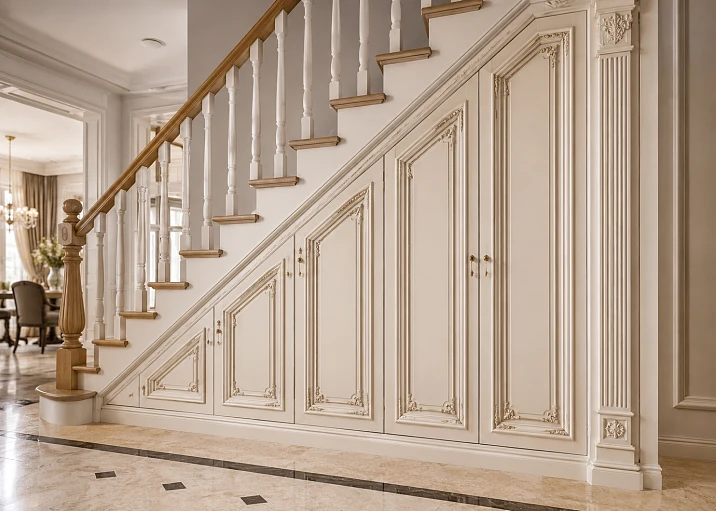
The space under the stairs is perhaps the most honest place in the house. It is either used wisely, or it stands closed, stuffed with random things, and the owners pretend it doesn't exist. Meanwhile, in a country house or a multi-level apartment, the under-stair area is one to three square meters of usable space with a ready-made three-sided frame. It doesn't need to be built from scratch. It just needs to be properly designed.
A cabinet under the stairs in a classic style is a challenging but rewarding task. The sloping line that goes from one corner of the space to another makes this place non-standard. And it is this non-standardness that turns it from 'technical' into 'architectural' — if approached with intelligence: Pogonazh iz massiva on the front frame and lower base, Wooden handles on the doors, Moldings made of polyurethane around the perimeter of the niche — and the under-stair cabinet becomes not a hidden inconvenience, but the best furniture accent of the hallway or foyer.

Under-stair space is a furniture object, not a technical corner
Let's immediately set the right perspective. Most people perceive the space under the stairs as a forced compromise: 'well, there's something there, we'll put a cabinet, close the door and forget about it.' But someone who thinks in terms of classic interior sees this place completely differently.
The under-stair area is a niche with ready-made walls. It has side abutments, a back wall, a lower base, and one sloping line — the stair stringer or flight cladding — which defines its unique geometry. It is this sloping line that makes the cabinet under the stairs unlike any other piece of furniture in the house.
In a classic interior, such a shape is not a problem but an opportunity. The sloped upper contour of the facade, framed solid wood millwork, a decorative frame of of polyurethane moldings around the perimeter of the niche on the wall — and the non-standard shape begins to work as an architectural element. Asymmetry becomes character.




Complete set: what to buy for a cabinet under the stairs
An under-stair cabinet requires a systematic approach to purchasing materials. Due to the non-standard shape — sloping lines and beveled abutments — material consumption here is higher, and a larger allowance is needed than in standard furniture tasks.
Wooden elements:
-
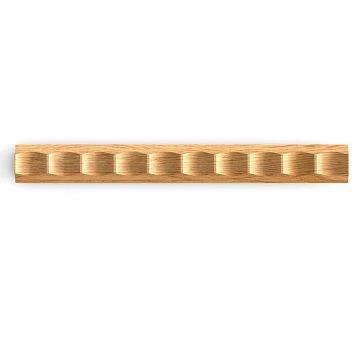
Pogonazh iz massiva — for the facade frame, horizontal belts, lower base, and side abutments
-
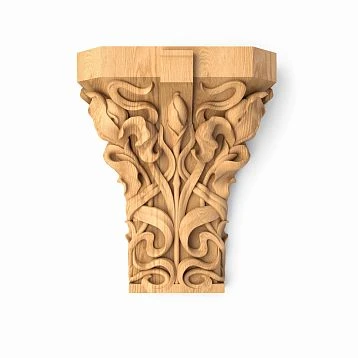
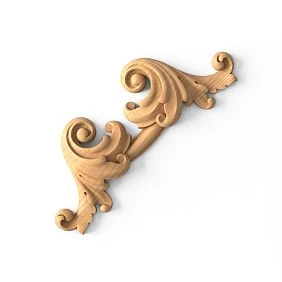
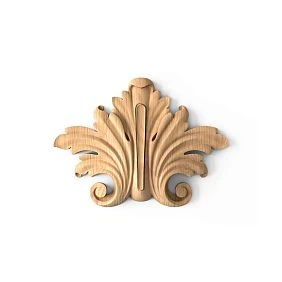
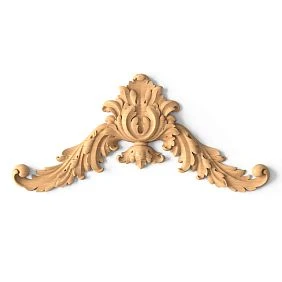
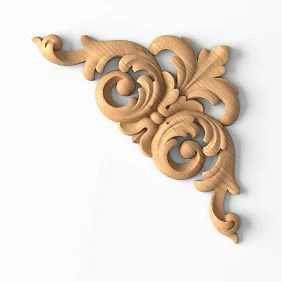
Wooden decor and solid wood overlays — decorative strips and accent details on facade planes
-
decorative elements for furniture — rosettes, inserts, cartouches on door panels
-
Wooden furniture handles — for all doors and drawers of the under-stair cabinet
-
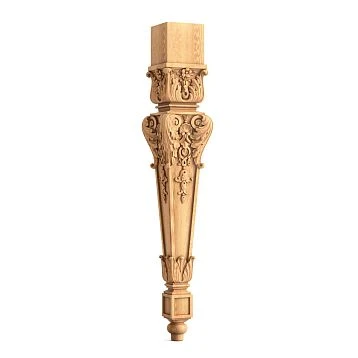
Staircase Components and Elements — wooden slats and profiles for framing the junction with the stair stringer
Polyurethane elements:
-
Moldings made of polyurethane — decorative frame around the perimeter of a wall niche
-
Polyurethane trim — horizontal connecting lines, baseboard trim, secondary decorative profiles
-
Polyurethane appliqués — additional decorative details on walls near the niche
-
Decor for Molding — corner blocks at intersections of moldings around the niche perimeter
-
Polyurethane wall decor — wall panels and frames near the under-stair niche
-
Polyurethane moldings — general decorative resource for rich classical styling
Consumables:
-
Fasteners — screws and dowels for wooden elements
-
Construction adhesive — for polyurethane moldings and overlays
-
Sealant — for all joints with surfaces, including sloped junctions
-
Primer — before painting all wooden and polyurethane parts
-
Paint, varnish, or oil
-
A 10–15% reserve is mandatory due to the large number of angled cuts
Our factory also produces:

How a cabinet under the stairs differs from a regular furniture task
There are three fundamental differences that make designing an under-stair cabinet unique.
Get Consultation
The slanted line as the main challenge and the main resource
In a regular cabinet or niche, all angles are right: 90 degrees at the top, 90 degrees on the sides, horizontal top. Trim is cut at 45 degrees or left straight — and everything fits.
In an under-stair cabinet, the top line is angled. The angle depends on the steepness of the staircase — typically from 30 to 45 degrees. And each trim element along the top contour needs to be cut precisely at this angle. This requires accurate measurement of the slope angle and additional material allowance — hence the increased reserve of 10–15%.
But if you view the slanted line not as a problem but as an opportunity — it gives the cabinet a unique profile. solid wood millwork along the slanted top contour and Moldings made of polyurethane along the perimeter of the niche, following this slope, create a non-standard decorative frame — and that is what is remembered.
Adjacent to the staircase structure
The cabinet is not freestanding — it is adjacent to the stair stringer. The junction between the upper sloping line of the cabinet and the stringer or stair cladding is a critical area. It must be covered with a decorative element: either a sloping strip made of solid wood trim, or special staircase components — trims or profiles that close the gap between the cabinet and the stairs.
Not finishing this junction means leaving an unsightly gap in the interior that will stand out precisely because everything else is neatly finished.
Different heights of door sections
A cabinet under the stairs almost always has several sections with doors of different heights: tall ones at the edge of the niche, low ones near the stair stringer. Wooden handles should be placed at a convenient height on each door, Pogonazh iz massiva on the front frames should be proportional to the size of each section. A single profile — a different scale of application.
Where and why wood is needed in an under-stair cabinet
Facade frame and horizontal belts
Pogonazh iz massiva The perimeter of each door is the facade frame. It is what gives the cabinet its furniture character. Without a frame, it's just a flat facade, boring and faceless. With a frame made of wooden molding, it's a classic furniture facade with pronounced geometry.
Horizontal belts made of solid wood trim divide the facade plane horizontally: at the joints between sections of different heights, at the transition level between storage zones, at the bottom and top edges. This is furniture anatomy — division into parts that makes the overall volume clear and proportionate.
Lower base
The bottom base is a horizontal belt at the base of the cabinet. Pogonazh iz massiva on the bottom base serves a dual function: it decoratively completes the cabinet from below and continues the baseboard line along the entire area. The height of the bottom base should match the height of the baseboard in the room — this creates horizontal continuity.
Side attachment strips
The side panels of the cabinet adjoin the walls of the hallway or foyer. Pogonazh iz massiva on the side attachments covers gaps, creates a neat transition between furniture and wall, and visually 'fits' the cabinet into the niche.
Decorative overlays on facades
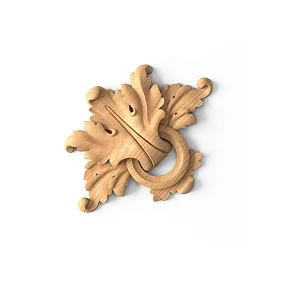
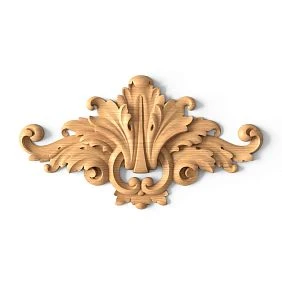
Wooden decor and overlays on the door surfaces are elements that turn a flat panel into a classic furniture facade. A small rectangular overlay frame, a wooden cartouche in the center of the door, a shaped strip horizontally — each of these details contributes to a recognizable classic look.
decorative elements for furniture — rosettes, medallions, diamond-shaped inserts — add a point accent. In classic style, it is customary to decorate the center of the facade panel — this is where the wooden overlay works most effectively.
Furniture handles: a detail touched every day
Wooden furniture handles for an under-staircase cabinet — this is not just hardware. It is a point of tactile contact and a visual accent on each door. In classic style, the correct handle is either a vertical bracket with a shaped profile, or a horizontal rail-handle, or a button with a decorative base.
Important: handles on all cabinet doors must be from the same series. Mixing different profiles and shapes is the first sign of "homemade" furniture that has nothing to do with classic style. Furniture Handles made from one material and one profile — that is what creates an ensemble.
The size of the handle is selected in proportion to the height of the door. For a tall door 100–140 cm — a handle 130–160 mm. For a low door 40–60 cm — a handle 80–100 mm or a button.
Inclined strip along the upper contour
Along the upper inclined contour of the cabinet — where the facade adjoins the staircase cladding or stringer — a special inclined strip is needed. It is here that staircase components — wooden profiles and overlay strips — solve a technical problem in a beautiful way. The strip is cut exactly to the angle of the staircase flight and covers the joint between the cabinet and the staircase structure.
Polyurethane in the under-staircase area: a decorative frame that ties everything together
Wooden elements decorate the cabinet itself — its facade, frames, base, and handles. The task moldings from polyurethane is to connect the cabinet with the space it occupies. Without this connection, the cabinet will be beautiful but isolated. With it, it becomes part of the interior.
Moldings along the perimeter of the niche: a wall frame
The main polyurethane element in the under-stair area is Moldings made of polyurethane along the perimeter of the niche itself on the wall. They run:
-
along the left vertical edge of the niche
-
along the right vertical edge of the niche
-
along the slanted line of the upper contour, following the slope of the staircase
This is a decorative frame that officially marks the under-stair area as an architectural element — like a niche intentionally highlighted in the wall structure. The cabinet inside this frame looks not like something shoved under the stairs, but like furniture specifically designed for this spot.
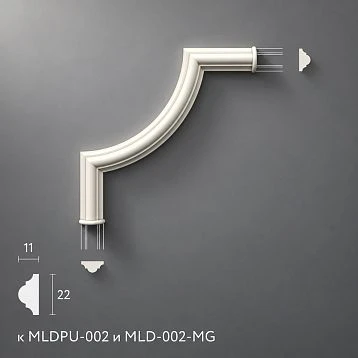
Technically correct installing polyurethane molding In sloping points, it is a more complex task than horizontal or vertical installation. Sloping molding joints require precise calculation of the cutting angle. If using Decor for Molding — corner blocks — at the transition points of a sloping line to a vertical one, the task is significantly simplified.
Polyurethane trim: horizontal connecting lines
Polyurethane trim is used for horizontal connecting lines on walls near a niche. This is a belt at the baseboard that continues the line of the lower cabinet base onto the wall. This is a horizontal profile above the door level that connects the cabinet height with the decor of the adjacent wall.
These horizontals are not a mandatory element in modest decoration. But in a full-fledged classic interior, they set the wall order and transform the hallway from a "passage" into a "space."
Decor for walls near a niche
Polyurethane wall decor — wall geometric frames and panels — on walls near the under-stair area create a decorative context for the cabinet. If there is a free hallway wall to the right of the niche, decorative wall frames on it support the styling of the niche's molding framing and create a unified decorative ensemble.
Polyurethane overlays: point details
Polyurethane appliqués — small flat decorative elements — can be placed on the wall inside the molding frame around the niche perimeter. This is appropriate in rich classic interiors where the decor is fully developed. In a more restrained version, their role is taken by wall frames without additional overlays.
Decor for moldings at key points
In the under-stair area, the intersection points of the moldings are non-standard: in addition to right angles (lower corners of the frame), there is an acute angle at the transition point of the sloping upper contour to the vertical line. Decor for Molding at this point — a corner block with a profile adapted to the non-standard angle — solves the problem cleanly and beautifully.
Five ready-made solutions: from hallway to library
Solution 1: Classic wardrobe in the hallway of a country house
A hallway with a staircase in a country house is typically a space with high ceilings, wooden staircase elements, and walls painted in a neutral tone.
Pogonazh iz massiva — wide, with a shaped profile — along the contour of each door. The lower base is wide, matching the height of the wooden baseboard. Decorative solid wood overlays — rectangular frames in the center of each door. Wooden handles — long vertical handles, in the same wood as the wooden staircase.
Along the perimeter of the niche — Moldings made of polyurethane in the color of the walls, with decor for moldings in the lower corners. On the wall next to it — Polyurethane wall decor: one vertical frame supporting the rhythm of the moldings at the niche.
Finish: white RAL 9010 with a slight gloss. Handles and trims — in the tone of the main wooden elements of the staircase.
Solution 2: Open niche with shelves
Doors are not always needed under the stairs. If the space is deep and tall enough — you can make an open niche with shelves: for books, decor, shoes, or baskets.
Pogonazh iz massiva along the horizontal shelves — as a front binding profile. decorative elements for furniture along the side walls of the niche. Moldings made of polyurethane along the entire perimeter of the opening — as a frame that turns the niche into an architectural element.
Inside the niche — Polyurethane trim as a horizontal divider between the shelves. The entire system in white — the niche looks like a built-in library.
Solution 3: Storage area with drawers in modern classic style
Several drawers at the bottom of the under-stair cabinet and vertical doors above — a working scheme for the hallway.
Pogonazh iz massiva — rectangular cross-section, without complex profile. The lower base is high, 15–20 cm, with a pronounced horizontal belt. Wooden handles — laconic handles of the same size on all doors and drawers. Decorative Inserts — minimal, one per door.
Moldings made of polyurethane along the perimeter of the niche — thin, 20–25 mm, matching the wall color. No decor above the niche level. This is soft classic — restrained, modern, practical.
Solution 4: Classic under-stair library
If there is enough space in the hallway or foyer near the stairs, the under-stair area can be turned into a library corner. Open shelves under the stairs, a decorative frame around the opening.
Pogonazh iz massiva — trim of each shelf, vertical dividers between sections. Decorative solid wood overlays — on vertical dividers. Moldings made of polyurethane along the entire perimeter of the opening on the outside — wide, 35–45 mm, with decor for moldings in the lower right corners. Wall Decor on the walls nearby — wall frames in the same system as the niche moldings.
Finish: shelves — painted white or natural oak with varnish. Moldings — in the color of the wall.
Solution 5: Dark cabinet in an interior with a wooden staircase
A house with a wooden oak staircase, dark floors, and neutral walls. Here, the under-stair cabinet should be a "relative" of the staircase.
Pogonazh iz massiva — made of oak or to match the oak staircase. decorative elements for furniture — shaped planks on the doors, made of the same material. Wooden handles — long, in the same wood species as the steps.
Moldings made of polyurethane around the perimeter of the niche — painted in the color of the wall (light gray, linen, warm white). The contrast of the dark wood of the cabinet and the light molding frame creates expressive but restrained graphics. Polyurethane appliqués Not used — the richness of wooden decor is enough.
Complete purchasing map: one order without gaps
| Element | Type | Page |
|---|---|---|
| Facade frames, horizontal belts, lower base | Solid wood molding | link |
| Decorative strips and accent details on facades | Wooden decor / overlays | link |
| Roses, inserts, medallions | Decorative elements for furniture | link |
| Handles on doors and drawers | Wooden furniture handles | link |
| Inclined strip at the junction with the staircase | Staircase components | link |
| Decorative frame around the niche perimeter | Polyurethane moldings | link |
| Horizontal connecting belts on the wall | Polyurethane molding | link |
| Point details on the adjacent wall | Polyurethane overlays | link |
| Corner blocks at intersection points | Decor for moldings | link |
| Wall frames on adjacent walls | Wall decor from polyurethane | link |
| General decorative resource | Polyurethane stucco molding | link |
Technical nuances: measurements and calculation before ordering
Before placing an order, several parameters need to be fixed.
The angle of the staircase flight. This is a key parameter. It determines the cutting angle of all the linear elements along the sloped upper contour. It is measured with a protractor or inclinometer — with an accuracy of at least ±1 degree.
Overall niche dimensions. Width, depth, maximum height (at the high edge of the niche) and minimum height (at the low edge).
Number of sections and doors. Determines the number of handles and the volume solid wood trim on the facade frames.
Length of moldings. Perimeter of the niche along the contour: left vertical + sloped top line + right vertical (the bottom base is covered by a wooden base). Plus a 15% margin.
Length of linear elements. Total length of all horizontal and vertical wooden elements. Plus a 10–15% margin for cutting.
Presence of utilities. Under some staircases, there are pipes, wiring, or conduits. All these utilities must remain accessible — the cabinet must have a dismountable structure in areas where pipes pass through.
Mistakes when designing a cabinet under the stairs: detailed analysis
Not accounting for the slope angle when ordering material
The most technical and most costly mistake. If you order Pogonazh iz massiva without accounting for the slope and don't add a reserve for trimming — there won't be enough material. You'll have to place an additional order, wait, and then join new and old linear pieces from different batches — this risks a mismatch in color or texture.
Buying a profile without a reserve for trimming
Specifically for the under-stair task, a reserve of 10–15% is not over-insurance, but a practical necessity. Each cut for a non-standard angle is waste. Several reworked cuts mean even more waste. Calculate with a reserve.
Forgetting about door opening
Some configurations of an under-stair cabinet involve doors in the area where a person bends down to low sections. You need to check how each door opens — whether it hits a stair step or a wall. Wooden handles should be placed in convenient positions taking this into account.
Installing too large handles on low doors
A door 40 cm high with a 160 mm handle is a disproportionate pair. The handle takes up a third of the door's height and looks awkward. For low sections — small knob handles or brackets no longer than 80 mm.
Not connecting the cabinet to the baseboard
The bottom base of the cabinet should match the height of the room's baseboard — or be its continuation. If the baseboard goes under the cabinet unevenly or is interrupted — it's noticeable. Pogonazh iz massiva on the lower base it should join cleanly with the baseboard.
Use polyurethane in areas of constant impact
The lower corner of the niche, the area near the floor, the edges of the doors — these are places that are constantly hit by a foot or a bag. Here Moldings made of polyurethane are not suitable — they are replaced by wooden Pogonazh iz massiva. Polyurethane — only above the zone of physical contact.
Do not leave access to utilities
If a heating pipe, cold water supply pipe, or electrical cable runs under the stairs — at least one section of the cabinet must have a removable panel or an inspection hatch. A beautiful cabinet with a tightly sealed heating pipe is a problem that will be discovered at the most inconvenient moment.
Make the facades separate from the overall style of the stairs
The under-stair cabinet is not an independent object, but part of the stair ensemble. Its facades, handles, and Pogonazh iz massiva should be in the same style and tone as the wooden staircase components. If the staircase is oak with a dark stain and the cabinet is painted white, that's a conflict that will be noticeable.
Mixing different profiles without a diagram
A random set of trim profiles, moldings of different widths, and handles of different styles is not 'rich decor', it's chaos. All profiles should be one scale and one style. All handles should be one series. Before ordering, a clear diagram is needed: which profile, which size, in which area.
FAQ: most common questions about a cabinet under the stairs
What to buy for a cabinet under the stairs in a classic style?
Pogonazh iz massiva for face frames and base, wooden overlays and decorative elements for facades, Wooden furniture handles for doors, staircase components for angled abutment, Moldings made of polyurethane around the perimeter of the niche, Polyurethane trim for horizontal belts, Decor for Molding at corner points, glue, fasteners, sealant, primer, and finish coating.
Can polyurethane molding be used under the stairs?
Yes. Polyurethane moldings works great in the molding framing zone around the niche perimeter, in horizontal belts on adjacent walls, and in decorative overlays above the level of contact with feet and objects. In the working areas of the cabinet — only wood.
How to close the sloped upper contour of the niche?
Through Pogonazh iz massiva, cut precisely to the angle of the staircase flight, and Moldings made of polyurethane along the same contour on the outside. At the transition point of the sloped line to the vertical — Decor for Molding.
How to make a cabinet under the stairs not look like a utility box?
Add Wooden trim on the facade frames, Decorative Inserts on the doors, Wooden handles in a unified style, the lower base matching the baseboard, and Moldings made of polyurethane along the perimeter of the niche on the wall — and the cabinet immediately acquires a furniture-like and architectural character.
Is a material reserve needed for the under-stair area?
Absolutely — and more than for ordinary tasks. For solid wood trim — a reserve of 10–15%, for of polyurethane moldings — 15%. A large number of angled cuts and non-standard joints will inevitably consume additional material.
How to properly glue moldings to the wall in the niche area?
The choice of glue depends on the wall surface. Application technology and recommendations for compositions are in the article installing polyurethane molding with a detailed breakdown of all nuances, including non-standard angles and joints.
What to do if there are pipes under the stairs?
One of the cabinet compartments should be equipped with a removable or drop-down panel. All wooden elements in this area should be fastened with screws (not glue) so that they can be dismantled without damage if necessary.
About STAVROS
STAVROS is a Russian manufacturer of decorative products made from solid wood and polyurethane for furniture and interiors. Full range for designing a wardrobe under the stairs: Pogonazh iz massiva, Wooden decorative inlays, decorative elements for furniture, Wooden furniture handles, staircase components, Moldings made of polyurethane, Polyurethane trim, Polyurethane appliqués, Wall Decor и Decor for Molding. Production using 3D milling method, custom sizes available, retail and wholesale operations. Contact us to confirm shipping to your destination. and CIS, warehouses in Moscow and St. Petersburg. Loyalty program for designers and furniture manufacturers.