








































































Article Contents:
- The wardrobe side is not a technical end if it is constantly visible from the room
- Why a long carved line works well on a tall wardrobe
- KPU-081: parameters that really affect the project
- Width 70 mm: this is already a full ornamental band, not a thin strip
- The 12 mm relief also needs to be seen not in a drawing, but next to the furniture
- Length 2000 mm is not a drawback, but the boundary of a ready-made module
- Why 200 mm at the top and bottom can look better than a decorative line from floor to ceiling
- A random 400 mm piece at the top is the most obvious, but not the neatest scheme
- The joint must have a reason
- A mezzanine module can naturally solve the length problem
- Do not automatically move the joint to 2000 mm
- A horizontal molding can turn the connection into an architectural feature
- But adding molding just to hide the joint is also not worth it
- Three main schemes for a side panel 2400 mm high
- One vertical line in the center: the calmest option
- The central axis is not always better
- Two vertical lines make the side panel look like an architectural panel
- A paper template 70 mm wide is needed before purchasing
- Why additionally imitate a 12 mm relief
- One solid 2000 mm strip: how many KPU-081 will be needed
- A 2400 mm strip at full height: geometrically, two pieces will be needed
- Can the remaining 1600 mm be used on another side panel
- Two vertical lines of 2000 mm each: a simple calculation without joints
- Two vertical lines at full height of 2400 mm: the calculation is already different
- Why the calculation "total length / 2000" gives only a lower bound
- A frame made of KPU-081 is a completely different project scale
- Formula for a preliminary frame calculation
- Why the corners of a carved molding frame require separate design
- KPU-081 plus smooth molding: often more flexible than a frame entirely made of carved profile
- KPU-081 or regular smooth molding
- KPU-081 or separate decorative overlay
- When a separate overlay is stronger than linear molding
- When KPU-081 is stronger than a separate overlay
- 70 mm versus thin molding: don't compare only the price per piece
- The price of KPU-081 especially makes pre-cutting necessary
- How to use horizontal division of a cabinet for a beautiful transition
- Breaking the ornament is sometimes better than a joint
- A symmetrical break can be a standalone technique
- What to do if the cabinet is already installed and there is no horizontal division on the side panel
- The top cornice can visually reduce the required height of the decorative field
- Measuring 'from the floor to the top of the cabinet' is almost always insufficient
- What to buy together with KPU-081
- When decor for moldings is truly necessary
- Carved line matching the cabinet color or contrasting
- Why you cannot choose KPU-081 color separately from the facades
- The strip can echo the decorative logic of the facades without copying them literally
- When the side panel, on the contrary, should be designed as a full-fledged facade
- KPU-081 in the bedroom
- Polyurethane and furniture base: do not mix the decor material with the cabinet material
- An already painted cabinet is not a reason to give up the idea
- The joint cannot be designed after painting and cutting
- What you don't need to do from scratch if you have a ready-made KPU-081
- But "ready-made" does not mean "install without a project"
- Mistakes that make the joint the main element of the side panel
- Starting with a whole two-meter piece from the floor
- Assuming the joint must be at the 2000 mm mark
- Making a short top piece without reason
- Not considering the option of a single solid KPU-081
- Measuring only the full height of the cabinet
- Ignoring the 70 mm width
- Ignoring the 12 mm relief
- Buying two pieces 'just in case'
- Assuming the 1600 mm remainder is guaranteed useful
- Making two lines without a template
- Trying to assemble a frame without assessing angles
- Using KPU-081 where only a smooth contour is needed
- Placing a separate overlay on top of an already saturated carved pattern
- Decorating the side panel more richly than the facade
- Not linking the decor with the cornice and plinth
- Running KPU-081 all the way to the edges just because it's easier to measure
- Not checking side lighting
- Choosing color based on a small sample
- Marking two verticals independently
- Cut before final fitting
- Buy by total length without a cut map
- Try to make the joint 'invisible' where it can be made logical
- Scheme A: one solid line 2000 mm
- Scheme B: two solid lines of 2000 mm each
- Scheme C: one line 2400 mm
- Scheme D: two lines of 2400 mm each
- Scheme D: frame
- What is KPU-081?
- What is the size of KPU-081?
- What does the 2000 mm length mean for a cabinet 2400 mm high?
- Is it mandatory to run KPU-081 from the very bottom to the top?
- If you place KPU-081 in the center, what fields will remain?
- Won't this option look too short?
- Can I add a 400 mm piece on top?
- Where is the best place to make the joint?
- Can I connect 2000 and 400 mm in the middle of an empty side panel?
- Does the first segment have to be exactly 2000 mm long?
- Can you make two segments of 1200 mm?
- How many KPU-081 are needed for one strip 2400 mm high?
- How much material will be left after one 2400 mm line?
- Can I use these 1600 mm on the second side panel?
- How many KPU-081 are needed for two full strips of 2000 mm?
- How many are needed for two verticals of 2400 mm?
- Do three pieces guarantee a beautiful joint of two strips?
- Can a KPU-081 frame be placed on the side panel?
- How to calculate the quantity for a frame?
- Can you simply add up the entire perimeter and divide by two meters?
- Why is the 70 mm width so important?
- Will the 12 mm relief be noticeable?
- Can one KPU-081 be placed strictly in the center?
- What about two parallel strips?
- Which is better — one line or two?
- How is KPU-081 different from molding?
- Can KPU-081 and molding be combined?
- Where to buy moldings for such a composition?
- How does KPU-081 differ from a decorative overlay?
- When is an overlay better than trim?
- Where can I see the overlays?
- Do I need to cover the entire side panel?
- Can I leave 200 mm at the top and bottom?
- What if the cabinet has a plinth and a cornice?
- Can I start KPU-081 directly from the plinth?
- Do I need to run the molding up to the top cornice?
- Can I use KPU-081 on an already finished cabinet?
- Will it work for painted MDF?
- And for a laminated side panel?
- Can KPU-081 be painted to match the cabinet color?
- Can I make it a contrasting color?
- What affects perception more—width or length?
- Do I need to consider lighting?
- Is KPU-081 suitable for a bedroom?
- Can it be used in the hallway?
- Will it suit the living room?
- Do I need to repeat KPU-081 on both sides of the wardrobe?
- Can I use the leftover linear footage on the wardrobe facade?
- How much KPU-081 should I buy 'with a reserve'?
- Does the price affect the choice of scheme?
- Where to buy KPU-081?
- Where can I see other trim options?
- What should you check right before ordering?
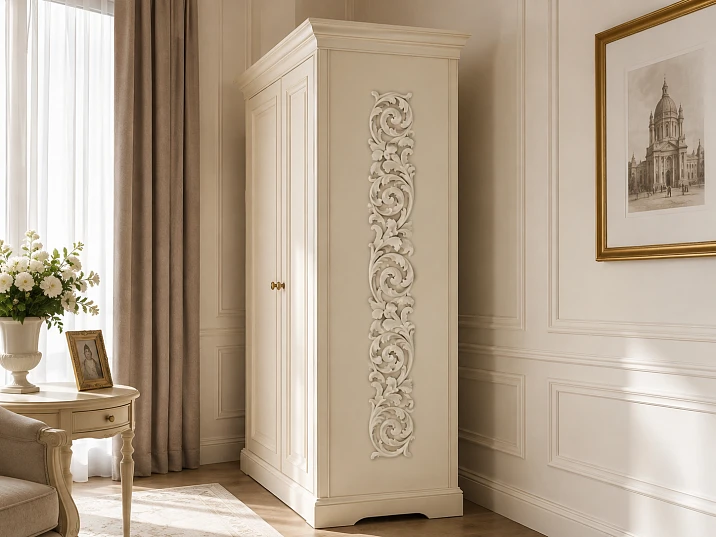
A tall cabinet can look great from the front and unexpectedly lose from the side that was considered "just a side panel" during design. The problem is especially noticeable if a cabinet about 2.4 m high stands not between walls, but with its end facing the room. From the living room, bedroom, hallway, or kitchen-living room, a person sees not the facades, but a large vertical plane almost from floor to ceiling. It can occupy a significant part of the field of view and remain completely empty.
Filling such a side panel with the first overlay that comes to hand is not always successful. One small ornament gets lost at a great height. A too-large central detail, on the contrary, turns the cabinet end into a decorative panel and changes the character of the entire furniture. There is another way — use carved polyurethane molding KPU-081 as a long vertical ornamental line that works together with the proportion of the tall cabinet.
But here a specific task arises that cannot be solved with a beautiful catalog photo. The size of KPU-081 is 70 × 12 × 2000 mm, and the cabinet in our scenario has a height of 2400 mm. One two-meter piece is physically insufficient to cover the entire height of the side panel from bottom to top. If you simply install 2000 mm of molding and add the remaining 400 mm on top as a second piece, you get a technically understandable but visually random pattern. At the joint of the ornament, a seam will appear exactly where nothing in the cabinet's construction explains it.
Therefore, the question should be posed differently: not "how to stretch the two-meter KPU-081 to 2.4 m," but which decorative scheme to choose for a side panel 2400 mm high, so that the finished molding length of 2000 mm becomes part of the design intent, not an installation problem.
This could be a single solid two-meter vertical insert with thoughtfully designed empty margins at the top and bottom. Two lines. A frame composition. A joint aligned with a real horizontal division of the cabinet. A combination of carved molding with smooth trim or a separate decorative overlay. Each option requires its own calculation of quantity.
That is why, before you buy furniture molding KPU-081, it is worth first designing the entire visible side panel at full scale.
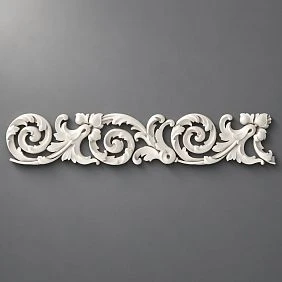
The side panel of a cabinet is not a technical end if it is constantly visible from the room.
When a cabinet is installed from wall to wall, its side panels practically disappear. A person uses the facades and does not think about the ends of the body.
With a freestanding or built-in cabinet that ends in the middle of a wall, everything is different. The side panel becomes part of the interior on par with the door, wall panel, or furniture facade.
Imagine a cabinet with a depth of about a typical furniture body and a height of 2400 mm. From the entry point of the room, the facades may be visible at an acute angle, while the large side plane is almost frontal. It is this that first comes into view.
If the doors have frames, handles, milling, or carved details, and the end is a blank smooth plane, a noticeable break occurs. The front of the furniture looks designed, the side looks left "as it turned out."
This is especially noticeable in classic interiors and neoclassicism, where a large plane usually has internal structure.
The decor of the cabinet side in such a case does not have to be complex. Sometimes one well-calculated vertical line is enough.
And here, furniture molding is more interesting than many individual overlays.




Why a long carved line works well on a tall cabinet
A cabinet 2.4 m high has a very strong vertical proportion. Any decor can either support it or start to fragment it.
A small horizontal overlay creates a transverse point.
A large rosette shape forms a center.
A frame divides the side into an inner rectangular field.
Vertical carved molding works differently: it directs the gaze along the height.
Therefore, decorating the side of a cabinet with a long ornamental strip is especially interesting where you don't want to cover the entire panel with decorative elements.
The molding leaves most of the surface free. On the side, it's not a "picture" that appears, but an architectural line.
Such a scheme can be:
single;
paired;
framed;
combined with horizontal division;
work together with an overlay;
support moldings on the facades.
The main thing is to determine it before cutting.
Our factory also produces:
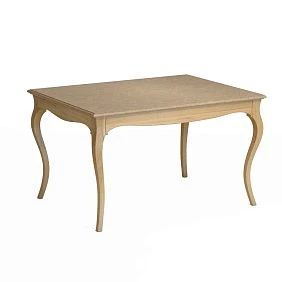

KPU-081: parameters that really affect the project
KPU-081 — carved polyurethane molding. For the model in question, the size 70 × 12 × 2000 mm is confirmed.
| Characteristic | KPU-081 |
|---|---|
| Product type | Carved molding |
| Article number | KPU-081 |
| Material | Polyurethane |
| Size | 70 × 12 × 2000 mm |
| Width | 70 мм |
| Relief | 12 мм |
| Length of one part | 2000 мм |
| The task in question | Decor of the visible side of a tall cabinet |
| Cabinet height in our scenario | 2400 мм |
| Difference between cabinet height and length of one piece | 400 мм |
| Price at time of check | 13,500 ₽ per 1 piece. |
| What to check before ordering | The actual height of the decorative field, the width of the side panel, the joint pattern, the direction of the ornament, the number of lines, and the cutting layout |
The three dimensions here serve completely different functions.
70 mm determines the width of the decorative strip.
12 mm shows that this is not a flat pattern on the surface, but a noticeable relief.
2000 mm sets the main theme of the entire project: with a side panel height of 2400 mm, you cannot blindly rely on a single piece spanning the full height.
Get Consultation
Width of 70 mm: this is already a full ornamental band, not a thin strip.
Seven centimeters on a furniture surface look noticeable.
This is important to understand before purchasing.
In the photo of the product itself, the eye is occupied by the carving, so 70 mm may seem compact. On an actual cabinet side panel, a strip of this width becomes an independent vertical element.
If you place a single line along the center of the edge, it defines the central axis.
If you use two, the side panel transforms into a more architectural panel.
If you build a frame, the width of the ornament itself will start to significantly affect the dimensions of the inner field.
Therefore, before ordering, it is useful to take masking tape or paper 70 mm wide and transfer this measurement to the furniture.
Not five centimeters "approximately".
Not a palm.
Exactly seven centimeters.
On a large side panel, the difference between a 20–30 mm profile and a 70 mm carved strip is huge.
A relief of 12 mm also needs to be seen not on a drawing, but next to the furniture.
The side panel of a cabinet is usually flat.
There are no handles or hinges on the outside, so even a relatively moderate relief is perceived clearly.
12 mm — more than a centimeter of protrusion.
With side lighting, a pronounced chiaroscuro will appear. The relief will be especially noticeable if the cabinet stands near a window or a light source that runs along the panel.
This depth also affects the placement.
If the side panel is near a narrow passage, the protruding decor cannot be ignored.
If the cabinet ends at the doorway, it is worth checking the path of movement.
If there is a table, nightstand, or another object nearby, you need to assess the distance between it and the future strip.
The linear molding remains a decorative element, but its volume is quite real.
A length of 2000 mm is not a drawback, but the boundary of the finished module.
The most useful thought for working with KPU-081 is this: you don't need to force one decorative line to match the full height of the cabinet at any cost.
A two-meter part already has a finished commercial size.
A cabinet 2400 mm high is 400 mm taller than it.
You can perceive these 400 mm as a problem and try to cover it with a piece.
Or you can use the difference to form a decorative field.
For example, leave 200 mm of free surface at the top and bottom.
Then one solid KPU-081, 2000 mm long, ends up exactly centered on the side panel 2400 mm high:
2400 − 2000 = 400 mm.
400 ÷ 2 = 200 mm.
This results in one continuous carved strip without a single joint, and the free margins at the top and bottom have clear symmetry.
This is no longer a compromise.
This is a complete compositional scheme.
Why 200 mm at the top and bottom can look better than a decorative line from floor to ceiling
The molding does not have to touch the boundaries of the furniture.
When the carved ornament starts right from the bottom edge and ends at the top, it becomes part of the cabinet's outline.
When a smooth field remains around it, the line is perceived as an insert.
For a furniture side panel, the second option often looks lighter.
Especially if there is a cornice at the top and a plinth at the bottom.
The carving does not conflict with them.
It occupies its own central field.
In addition, the absence of a joint reduces the risk that the pattern will look interrupted.
That is why for a 2400 mm cabinet, one solid KPU-081, 2000 mm long, can be more convincing than trying to assemble a line for all 2400 mm from two parts.
A random 400 mm piece on top is the most obvious, but not the neatest scheme.
Let's look at simple arithmetic.
There is a 2400 mm cabinet.
There is a KPU-081 2000 mm.
Remains 400 mm.
The first thought: we place the long piece at the bottom, and add a 400 mm segment from the second one on top.
What happens visually?
The bottom 2000 mm is perceived as one continuous element.
Then a joint appears.
Above is a relatively short fragment only 400 mm long.
Even if the joint is done neatly, the question arises: why is the line divided exactly at this point?
If there is no shelf, horizontal belt, lintel, molding, or other element nearby, the answer is one—because the product length ran out.
And a technical limitation should not become the main explanation for an interior decision.
The joint must have a reason
A good joint is not necessarily completely invisible.
It should be clearly positioned.
If the cabinet has a real horizontal division, you can try to connect the trim joint with it.
For example:
boundary of the mezzanine section;
horizontal molding;
belt between the main body and the upper module;
decorative frame;
a line coinciding with the division of facades on the other side.
Then the eye sees not "the two-meter strip has ended," but a planned transition.
But the joint location needs to be designed before ordering and cutting.
The mezzanine module can naturally solve the length problem.
Consider a cabinet with a total height of 2400 mm, which has a separate mezzanine zone at the top.
Suppose its boundary runs at a certain height.
If this division is visible on the side panel or can be supported by a molding, the decorative vertical does not have to run continuously through it.
The lower field can be designed with one pattern, and the upper field with another.
Then KPU-081 does not have to be artificially extended.
The option where a two-meter carved strip ends before the horizontal belt, leaving a calm mezzanine part above, is especially convincing.
Do not automatically transfer the joint to 2000 mm
This is a fundamental point.
If the first whole piece has a length of 2000 mm, it is not at all necessary to connect the second one exactly at the 2000 mm mark from the floor.
You can pre-cut both parts so that the connection point is in a more favorable zone.
For example, a decorative line 2400 mm long theoretically can consist not only of:
2000 + 400 mm,
but also from:
1200 + 1200 mm;
1400 + 1000 mm;
1600 + 800 mm;
or another ratio.
Which option is better depends on the KPU-081 pattern, the position of the horizontal elements, and the ability to align the ornament.
The very possibility of a specific pattern joint must be checked against the actual product and its ornament. It cannot be promised in advance that any arbitrary cut will result in a seamless continuation.
But compositionally, the principle itself matters: the joint location is determined by the furniture, not by the end of the first purchased plank.
A horizontal molding can turn the joint into an architectural node.
If a frame or horizontal belt is planned on the side panel, the joint can be hidden compositionally.
Suppose the vertical KPU-081 fits with a horizontal smooth profile.
Another section begins above.
The eye catches the intersection of two decorative levels.
It is precisely in such a zone that the joint of vertical fragments is perceived much more naturally than in the middle of an empty panel.
If such a scheme suits the furniture, it is possible buy polyurethane moldings and use a smooth profile not as a way to "mask an error," but as a deliberately designed horizontal line.
But adding molding just to hide the joint is also not worth it.
The decorative belt must have a reason.
If the cabinet is completely smooth, the fronts have no horizontal frames, and a transverse molding suddenly appears on the side panel only because the KPU-081 is 400 mm shorter, the design may look even more artificial.
In that case, it is better to abandon the full-height line altogether and use a single solid two-meter insert.
Sometimes the absence of a joint is more important than the desire to fill all 2400 mm.
Three main schemes for a side panel 2400 mm high
Let's summarize the options in a table.
| Scheme | How KPU-081 is used | Joint | For which case it is suitable |
|---|---|---|---|
| Solid decorative insert | 2000 mm at the center | No | Need a clean vertical line and free margins |
| Strip for the full height | Total length 2400 mm from two parts | Present | The joint can be aligned with an architectural division |
| Frame or combined scheme | KPU-081 is used in separate segments | Several planned connections | The side panel should look like a full decorative panel |
For most buyers who just want to remove the feeling of an empty tall side panel, the first option deserves to be tried first.
It requires fewer parts.
It does not create joints inside the ornament.
And immediately uses the product length of 2000 mm as an advantage.
One vertical line in the center: the calmest option
Imagine a side panel several tens of centimeters wide and 2400 mm high.
Along its central axis runs a KPU-081, 70 mm wide and 2000 mm long.
At the top — 200 mm of smooth surface.
At the bottom — 200 mm.
Around is a large, calm flat surface.
Such a design does not turn the cabinet into a carved panel. It only sets a vertical center.
If the cabinet is in a bedroom or living room where there is already other decor, this option may be sufficient.
The central axis is not always better
Sometimes the side is visible at an angle, and nearby there is a wall, a doorway, or another cabinet.
Then the geometric center does not necessarily coincide with the visual one.
You can check a slight shift of the line.
For example, closer to the front edge, so that KPU-081 is more strongly connected with the styled facades.
Or closer to the wall side, if the interior composition continues there.
But such a shift should first be shown with a template.
On a tall surface, random asymmetry is noticeable.
Two vertical lines make the side panel look like an architectural panel.
If one KPU-081 seems too lonely, the next option is two parallel strips.
Now the inner part of the side panel forms its own field.
This is already close to the frame principle, but without the top and bottom horizontals.
Two lines emphasize height more strongly than one.
However, the width of each is 70 mm.
That is, two strips already occupy 140 mm of the surface, not counting the free distance between them.
On a narrow side panel, such a scheme may be too dense.
A paper template 70 mm wide is needed before purchase.
For a simple vertical fitting, complex visualization is not required.
Take a paper strip 70 mm wide.
Make the length 2000 mm or mark the corresponding height with painter's tape.
Secure it to the side panel.
Close the cabinet doors.
Put away random items nearby.
Look from the point where the end face is usually visible.
Take a photo.
After that, make a second version with two stripes.
The comparison immediately shows how actively 70 mm work on specific furniture.
Why additionally imitate the 12 mm relief?
Flat paper shows only the area.
The real KPU-081 protrudes from the surface.
Therefore, for a final assessment, you can make a rough three-dimensional model by placing strips of material of approximate thickness under the template.
There is no need to copy the thread.
The task is to see the shadow and the protrusion.
This is especially useful if the cabinet is located near a passageway or if light comes from the side.
One solid strip of 2000 mm: how many KPU-081 will be needed
If one solid line of 2000 mm length is planned on one side panel, geometrically one KPU-081 part is needed.
This is the most material-efficient cutting option.
Nothing needs to be extended.
No remainder arises from the attempt to reach 2400 mm.
But you must definitely ensure that the free 400 mm are actually distributed as intended.
The most obvious scheme:
200 mm at the top;
200 mm at the bottom.
You can also make asymmetric margins if they are related to the cabinet's architecture.
For example, more free space at the top due to the cornice.
But asymmetry is better explained by a real furniture element.
A 2400 mm strip at full height: geometrically, two parts will be needed
For one line with a full height of 2400 mm, a single KPU-081 is not enough.
Need a second one.
Total available length of two parts:
2000 + 2000 = 4000 mm.
One vertical requires 2400 mm.
By pure arithmetic, what remains is:
4000 − 2400 = 1600 mm.
But these 1600 mm cannot automatically be considered a useful finished remainder.
Why?
Because with carved moldings, the cut location, pattern direction, and the possibility of using the remaining part in another position matter.
Therefore, the actual cutting layout is designed not only by meters.
Can the remaining 1600 mm be used on another side panel?
Perhaps, but first we need to know the second task.
If another side surface of the cabinet is visible, the remainder can become part of its design.
But the length of 1600 mm already differs from the first line of 2400 mm.
If the side panels are visible simultaneously, strips of different heights may look random.
If the second side is almost hidden and a separate short field is provided there, the situation changes.
You cannot consider any remainder as a "free second decor."
First, the second surface is designed, then the suitability of the remainder is checked.
Two vertical lines of 2000 mm each: a simple calculation without joints
If the side is finished with two solid strips of 2000 mm each, two KPU-081 units are needed.
Each is used entirely.
There are no joints.
This is a good scenario from a cutting perspective.
But two pieces are a noticeable cost and significantly greater decorative richness.
Therefore, the decision should be made after the template.
Two vertical lines at full height of 2400 mm: the calculation is already different
Required total length:
2400 × 2 = 4800 mm.
One KPU-081 is 2000 mm.
Two give 4000 mm — not enough.
Three give 6000 mm.
Therefore, by pure geometry, for two lines of 2400 mm, at least three two-meter pieces are required.
Total length remainder before considering pattern and cutting:
6000 − 4800 = 1200 mm.
But this calculation does not mean that three items will automatically allow assembling two flawless ornamental verticals.
It is necessary to separately check how to position the joints and whether the pattern can be matched at the chosen locations.
Why the calculation "total length / 2000" gives only a lower bound
For a smooth batten, mathematical calculation almost completely solves the task.
For carved molding, this is not enough.
Imagine that the total requirement is 5100 mm.
Mathematics says: three pieces of 2000 mm give 6000 mm, so it will be enough.
But if specific sections require certain whole segments, and the pattern cannot be joined at random places, the actual cutting layout may turn out differently.
Therefore, first a parts map is compiled:
vertical No. 1 — such length;
vertical No. 2 — such;
horizontal — such;
second field — such.
After that, the segments are distributed into two-meter blanks.
The frame made of KPU-081 is a completely different project scale.
KPU-081 can be perceived not only as a single vertical line.
Carved molding allows for designing more complex decoration.
For example, a frame field.
But the width of 70 mm makes such a frame significantly more active than a regular thin molding one.
On the side of a tall cabinet, it can look impressive if the panel itself is wide enough.
On a narrow end, it looks too massive.
Formula for preliminary frame calculation
Let:
H is the height of the decorative rectangle;
W is its width.
For a simple geometric frame, without considering joints and ornament features, the total length is:
2H + 2W.
For example, if the decorative field has a height of 2000 mm, and the width is determined after measuring, the calculation uses the width of the future frame, not the full depth of the cabinet.
After that, the resulting length cannot simply be mechanically divided by 2000 and used to place an order.
Need to break down each segment into specific details.
Why do corners of a frame made of carved molding require separate design
A smooth molding is easily perceived as a geometric profile.
The carved KPU-081 has an ornament.
When rotated 90 degrees, the pattern meets another pattern.
It cannot be stated in advance that any corner joint will look equally good.
If the main task is a strict rectangular frame, it is worth comparing KPU-081 with smooth profiles.
Sometimes it is better to leave carved molding as a vertical insert and build the geometry with a molding.
KPU-081 plus smooth molding: often more flexible than a frame entirely made of carved profile
The combined scheme can look like this:
vertical carved line KPU-081;
around it — a calmer frame;
horizontal division — with smooth molding.
Then the ornament gets the role of the main decorative element.
Molding — the role of architectural geometry.
If a side panel requires exactly this system, it can buy polyurethane moldings be done separately, without making KPU-081 perform all functions at once.
KPU-081 or a regular smooth molding
This is an important commercial fork.
| Criterion | KPU-081 | Smooth molding |
|---|---|---|
| Type | Carved molding | Profile decorative line |
| Width of KPU-081 | 70 мм | Depends on the selected model |
| Relief KPU-081 | 12 мм | Depends on profile |
| Length of KPU-081 | 2000 мм | Depends on the selected product |
| Main effect | Ornamental strip | Architectural geometry |
| One vertical | Self-sufficient | Usually looks stricter |
| Frame | More decorative and demanding on joints | Easier perceived as a frame contour |
| High side profile | Gives a strong carved accent | Gives a calmer structure |
| When to choose | Need a noticeable carved line | Need primarily a frame |
If the customer specifically wants carved decor for the cabinet, a smooth molding is not a direct replacement.
If the task is only to divide the plane into rectangles, then, on the contrary, the carved KPU-081 may be excessive.
KPU-081 or a separate decorative overlay
The second choice is between a long line and a central ornament.
A separate overlay concentrates attention in one area.
The trim stretches the decorative theme along the height.
This is especially noticeable for a 2400 mm cabinet.
The overlay can look like a medallion or a central motif.
KPU-081 connects the top and bottom of the side panel.
If you want to compare both approaches, you can Buy decorative polyurethane overlays after a paper template of the KPU-081 strip has already been made on the cabinet.
Then the choice is made not between product photos, but between two real compositions on the same piece of furniture.
When a single overlay is stronger than the molding.
If the side is relatively wide, but the low decorative field is already set by other frames.
If there are large elements at the top and bottom.
If you need to decorate only the center.
If a long line conflicts with horizontal shelves or divisions.
If the interior does not need a strong vertical pattern.
In such cases, a short standalone ornament may be more precise.
When KPU-081 is stronger than a single overlay.
If the side panel is very tall.
If it's specifically the vertical that seems empty.
If you want to connect the lower and upper parts of the furniture.
If a single central medallion gets lost.
If you need decorative molding for furniture, not a single accent.
On a 2.4 m wardrobe, these arguments are especially noticeable.
70 mm versus thin molding: don't compare only the price per piece
The items have different decorative functions.
A thin profile may be needed for a larger perimeter.
KPU-081 can be used as a single continuous strip.
Therefore, comparing only the cost of one unit is incorrect.
First, you need to determine the layout scheme.
How many linear meters are required?
How many joints are there?
Which elements are continuous?
Is a frame needed?
Are there any offcuts that can actually be used?
Only after this is the cost of the entire composition compared.
The price of KPU-081 especially makes pre-cutting necessary.
At the time of checking, one KPU-081 costs 13,500 ₽.
With such a product, it is especially unreasonable to buy "about two or three pieces" and then decide on the spot where to use the leftovers.
First, unfold.
Then the quantity.
If one solid two-meter line solves the task, buying one part differs significantly from a project where two verticals of 2400 mm require at least three products by pure geometry.
The commercial solution here is directly related to the design.
How to use the horizontal division of a cabinet for a beautiful transition.
Tall furniture often already has levels.
For example, the main body and the mezzanine.
Base.
The top cornice.
Shelves that are visible through open sections.
Different facades at different heights.
If the side panel is completely smooth, these levels can be partially supported decoratively.
But there is no need to draw every internal shelf on the end panel.
It's enough to choose one significant line.
It is this line that can become the place where two parts of the vertical decor meet or separate.
A break in the ornament is sometimes better than a joint.
It is not necessary to connect two segments of KPU-081 directly to each other.
You can create:
lower carved vertical;
small horizontal decorative belt;
upper separate vertical.
Then there is a deliberate break between the fragments.
This is no longer an attempt to hide the connection, but an independent composition.
This technique is especially useful if the KPU-081 pattern is difficult to continue with a direct joint at the chosen point.
A symmetrical break can be an independent technique.
Let's imagine a side panel of 2400 mm.
Instead of a continuous line, you can make two equal vertical segments separated by a central gap.
For example, the upper and lower parts are mirrored relative to the middle.
Specific lengths need to be determined after checking the pattern and overall composition.
This option changes the character: instead of one column-like vertical, two ornamental fields appear.
It is not suitable for every piece of furniture, but it shows an important idea — the absence of continuity is not necessarily a drawback.
What to do if the cabinet is already installed and there is no horizontal division on the side panel
There is no need to artificially invent it just for the sake of KPU-081.
First, try a single two-meter strip.
For a height of 2400 mm, this is a particularly simple and logical option.
If the result seems too short, try:
raise the strip;
lowering it;
leave different fields;
add a smooth architectural element at the top or bottom;
comparing the two verticals.
Only after this does it make sense to design a complex joint.
The upper cornice can visually reduce the required height of the decorative field.
The total height of the cabinet being 2400 mm does not mean that the decorative molding must occupy all 2400 mm.
If there is already an expressive cornice at the top, its area is actually excluded from the free side panel.
The same applies to the plinth at the bottom.
Then the actual field between them may turn out to be much closer to the length of KPU-081.
This is another reason to measure not the nominal height of the furniture, but the clean area that is planned to be decorated.
Measuring 'from floor to top of cabinet' is almost always insufficient.
Before purchasing, take at least the following measurements:
-
full height of the side panel;
-
clean height between the plinth and the cornice, if they exist;
-
full width of the visible side panel;
-
distance from the front edge to the future KPU-081 line;
-
distance from the rear edge;
-
position of existing horizontal divisions;
-
height of the mezzanine area;
-
distance to adjacent furniture or wall;
-
width of the passage next to the side panel.
These dimensions allow moving from the idea of "I want carved moldings" to an actual layout.
What to buy together with KPU-081
For the basic scheme, nothing additional may be needed: a single solid carved vertical can itself finish the end.
But a more complex side panel sometimes requires other categories.
| What to consider | When needed | What task does it solve | Link |
|---|---|---|---|
| KPU-081 | A carved vertical line is needed | Creates the main ornament | buy furniture molding KPU-081 |
| Section of carved molding | KPU-081 did not fit in scale or pattern | Allows comparing other models | buy carved polyurethane moldings |
| Moldings | Need calm frame geometry | Form a contour or horizontal division | buy polyurethane moldings |
| Decorative overlays | Need a separate central motif | Fill an independent field | Buy decorative polyurethane overlays |
| Decor for moldings | A more complex frame composition is being designed. | Helps develop frame nodes | buying polyurethane molding decor |
| General polyurethane molding | The cabinet decor needs to be tied to the interior. | Allows assembling a broader system | You can buy ready-made stucco matching the Baroque style. Calculate the quantity: linear meters of cornices and moldings, number of rosettes, pilasters, consoles, corner elements. Add a ten to fifteen percent allowance for trimming. |
Don't turn this list into a mandatory set.
The side of one KPU-081 may be beautifully finished.
Additional elements are connected only after evaluating the base option.
When decor for moldings is really needed
If the side turns into a complex classic panel.
There is a frame.
There are corners.
There are several internal fields.
Then additional decorative elements can help tie the composition together.
But if the whole concept consists of a single vertical KPU-081, a separate Decor for polyurethane moldings purchase just "to make it richer" is not needed.
A carved line matching the cabinet color or contrasting
The same KPU-081 can look completely different depending on the finish.
If the molding is close in color to the side panel, the relief reads first.
The line becomes part of the furniture.
With side lighting, the ornament is revealed through shadows.
This is a calm option for neoclassicism and furniture, where the decor should not be noticeable immediately.
Contrasting trim works differently.
The 70 mm width is visually enhanced.
The vertical becomes graphic.
On a 2400 mm side panel, it can become one of the main elements of the room.
Therefore, contrast should be checked on a large mockup, not just on a small color sample.
Why you cannot choose the color of KPU-081 separately from the facades
The side panel belongs to the same cabinet.
If the facades already have contrasting decor, KPU-081 can support it.
If the facades are very calm, a sudden bright carved strip on the edge can look alien.
It is especially important to look at the cabinet at an angle, when both the facade and the side panel are visible at the same time.
The two sides should be perceived as one piece of furniture.
The strip can echo the decorative logic of the facades without copying them literally.
Suppose the doors have rectangular frames.
It is not necessary to make the same frame on the side panel.
You can leave just one KPU-081.
It will support the classic character through the ornament, but the end will remain distinguishable from the facade.
This is a useful principle: the side should be connected to the front, but it does not have to pretend to be another door.
When, on the contrary, the side panel should be designed as a full-fledged facade
If the cabinet's end forms an important part of the room.
For example, it separates the dressing area.
It stands next to the sofa.
It forms a passage.
It is located opposite the entrance.
Then the side is almost equal in importance to the door facade.
In such a situation, you can use a frame, two verticals, a central overlay, and a more complex composition.
But the more complex the scheme, the more important the calculation of KPU-081 for two-meter parts.
KPU-081 in the bedroom
A tall wardrobe next to the bed is often seen from the side.
Too active a side panel can compete with the headboard.
Therefore, a variant of one solid two is especially good here.
Polyurethane and furniture base: do not mix the decor material with the cabinet material
KPU-081 is made of polyurethane.
The side panel of the cabinet can be made of a different material and have a different finish.
Therefore, the method of preparation and fixation depends not only on the linear footage.
You need to know the surface on which the decor is installed.
You cannot automatically transfer one technology to any furniture.
Painted MDF, laminated surface, wood, veneer, and other bases may require different approaches.
An already painted cabinet is not a reason to give up the idea
Overlay furniture decor is interesting precisely because it allows working with a ready-made surface without manufacturing a new side panel.
But the condition of the coating should be assessed in advance.
If the surface is peeling or damaged, the base problem is solved first.
If the sidewall is strong and preparation is possible, KPU-081 can be considered as a separate decorative layer.
The joint cannot be designed after painting and cutting.
The most unpleasant scenario looks like this:
the parts have already been purchased;
painted;
the first one is glued;
400 mm remain to the top;
only now it turns out that the continuation of the ornament looks bad.
Therefore, the layout is done earlier.
It is better to move the paper template several times than to make a mistake once with the real product.
What you don't need to do from scratch if you have a ready-made KPU-081
For a carved vertical line, you don't need to develop the ornament yourself.
You don't need to manually cut a two-meter strip.
You don't need to assemble the pattern from dozens of small overlays.
You don't need to mill the entire side of the cabinet.
There is no need to look for several similar decorative parts and try to turn them into one line.
The ready-made KPU-081 already has dimensions of 70 × 12 × 2000 mm.
The buyer's task is not to make the thread, but to correctly integrate the finished form into the furniture.
But "ready" does not mean "install without a project"
The molding has a finished length.
The cabinet — its own.
It is at the intersection of these two dimensions that design emerges.
You need to decide:
whether to end the strip at 2000 mm;
to extend;
divide;
to build two lines;
to make a frame;
to use leftovers.
Ready-made goods simplify manufacturing but do not eliminate composition.
Mistakes that make the joint the main element of the side panel
Start with a whole two-meter piece from the floor
This automatically gives you the remaining 400 mm at the top.
First, define the entire layout.
Assuming the joint must be at the 2000 mm mark
No. The connection point can be designed according to the cabinet's architecture.
Making a short top piece without a reason
If there is no horizontal division nearby, it looks random.
Not considering the option of a single solid KPU-081
For a 2400 mm cabinet, 200 mm fields at the top and bottom give a very clear scheme.
Measure only the full height of the cabinet
You need to know the pure decorative field between the plinth, cornice, and other elements.
Ignore the 70 mm width
On the side panel, this is a noticeable strip.
Ignore the 12 mm relief
It affects the light and shadow and close passages.
Buying two parts "just in case"
First, you need cutting.
Consider the 1600 mm remainder as guaranteed useful.
The possibility of use depends on the next element and the ornament.
Making two lines without a template
140 mm of total width of carved decor can greatly change the side panel.
Trying to assemble a frame without assessing the angles
The carved pattern requires careful joining.
Using KPU-081 where only a smooth contour is needed
Sometimes molding solves the task better.
Placing a separate overlay on top of an already rich carved scheme
Not every empty area needs to be filled.
Decorating the side panel more richly than the facade
This is only possible deliberately. Otherwise, the end starts to look like the main element.
Do not tie the decor to the cornice and plinth.
The top and bottom of the furniture set the boundaries of the composition.
Run KPU-081 all the way to the edges just because it's easier to measure
A free field often makes the decor more expressive.
Not checking side lighting.
The 12 mm relief becomes much more active under certain lighting.
Choosing color based on a small sample.
A two-meter strip is perceived more strongly.
Marking two verticals independently.
They should have a common level and distances.
Cut before final fitting.
First marking, then decide on cutting.
Buy by total length without a cut map
Mathematical linear meters may be enough, but suitable whole pieces may not be.
Try to make a seam "invisible" where it can be made logical
Sometimes an architecturally justified transition is better than masking.
Who is especially suited for KPU-081 on the side of a cabinet
For those whose tall cabinet stands with its end facing the room.
Those who see a large smooth side panel every day.
For those for whom a separate small overlay seems insufficient.
For those who want vertical carved decor for a cabinet.
For those for whom the 70 mm width scale is suitable.
For those who are ready to calculate the length and joint placement in advance.
For those who consider one solid two-meter strip as an independent composition.
When KPU-081 may not be suitable
If the side panel is very narrow and 70 mm takes up too large a share of the surface.
If the passage next to the cabinet is so tight that relief decor is undesirable.
If the interior is extremely minimalist.
If the cabinet is already overloaded with carved facades.
If only a thin frame is required.
If a very short central accent is needed.
If the KPU-081 ornament does not match other furniture elements.
In such cases, it is more useful buy carved polyurethane moldings after comparing other models, either move to another product group.
How to calculate the KPU-081 order without random surplus
The first number is not 2400 mm.
The first decision is which scheme is chosen.
Scheme A: one solid line of 2000 mm
Requirement: 1 pc. KPU-081.
There are no joints.
Scheme B: two solid lines of 2000 mm each
Requirement — 2 pcs.
There are no joints.
Scheme C: one line of 2400 mm
According to geometry, a minimum of 2 pcs. is required.
After using 2400 mm out of the total 4000 mm, up to 1600 mm of material remains before accounting for actual cutting and pattern.
Scheme D: two lines of 2400 mm each
Total length — 4800 mm.
By simple arithmetic, a minimum of 3 pcs. of 2000 mm is required.
But the actual cutting is checked at the joint locations.
Scheme E: frame
First, the length of each individual segment is calculated.
Only then are they laid out into two-meter pieces.
It is this order that allows understanding how much KPU-081 is really needed to order in the size of 70 × 12 × 2000 mm.
Why the allowance cannot be set as a universal percentage
For smooth material, it is often convenient to talk about a percentage for trimming.
In the case of specific carved moldings, such universal advice can be misleading.
Material loss depends on the layout.
With one solid two-meter insert, cutting along the length may not be required at all.
With a frame, corners and several separate segments appear.
For a vertical of 2400 mm, the joint is important.
Therefore, it is more accurate to count specific details rather than buying abstract "plus ten percent."
Route before purchase: from an empty side panel to the exact quantity
First, stand at the point in the room where the wardrobe is most often visible.
Take a photo of the end face.
Measure the side panel.
Separately note the plinth and the top cornice.
Apply a paper strip 70 × 2000 mm.
Try the center.
Then two strips.
If you want a full-height line, do not cut the template automatically in the 2000 + 400 mm proportion.
Try several locations for the intended joint.
Match them with the actual horizontals of the cabinet.
After that, draw an alternative with a smooth molding.
If one of the schemes clearly wins, proceed to cutting and quantity.
How to consciously buy KPU-081 on STAVROS
If after a full-size fitting KPU-081 fits, open the product page and double-check again:
SKU — KPU-081;
type — carved molding;
material — polyurethane;
size — 70 × 12 × 2000 mm;
current price;
the required quantity.
After that, you can buy furniture molding KPU-081 to a specific layout, not "by eye."
If the size of 70 mm or the ornament did not fit, it is wiser to open the section and buy carved polyurethane moldings another model after a new fitting.
If the side panel requires not only linear footage
For a large classical composition, the project can be expanded.
Smooth frames — through Moldings made of polyurethane.
Central independent ornament — through Polyurethane decorative appliques.
More complex frame nodes — via Decor for polyurethane moldings.
And if the cabinet should be connected to the stucco decoration of the entire room, you can You can buy ready-made stucco matching the Baroque style. Calculate the quantity: linear meters of cornices and moldings, number of rosettes, pilasters, consoles, corner elements. Add a ten to fifteen percent allowance for trimming. and consider the furniture as part of a unified interior system.
The main thing is not to add product categories automatically. Each new detail must perform a separate job.
FAQ: KPU-081 on the visible side of a tall cabinet
What is KPU-081?
KPU-081 is a carved polyurethane molding. In the scenario under consideration, it is used as a long decorative element for finishing the visible side panel of the cabinet.
What is the size of KPU-081?
The confirmed size is 70 × 12 × 2000 mm.
What does the length of 2000 mm mean for a cabinet with a height of 2400 mm?
One part is 400 mm shorter than the full height of the cabinet. Therefore, you either need to leave a decorative field of 2000 mm in length, or design a connection of two parts in advance.
Is it mandatory to run KPU-081 from the very bottom to the top?
No. For a 2400 mm cabinet, it is very logical to use one solid two-meter strip and leave free space at the top and bottom.
If you place the KPU-081 in the center, what fields will remain?
With a height of 2400 mm and a decorative line of 2000 mm, 400 mm remains. With symmetrical placement, that's 200 mm at the top and bottom.
Won't this option look too short?
This depends on the specific side panel. That's why you need to make a full-size template of 70 × 2000 mm.
Can I add a 400 mm piece at the top?
Physically, the line can consist of several parts, but a random short top fragment often looks unconvincing. The joint should be designed in advance.
Where is the best place to make the joint?
In an area that can be tied to a real horizontal division of the furniture: a mezzanine, a decorative belt, a frame, or another architectural line.
Can I connect 2000 mm and 400 mm in the middle of an empty side panel?
This option is technically possible only after checking the specific joint, but compositionally it often reveals the product's length limitation. It's better to consider other schemes first.
Is it necessary to make the first segment exactly 2000 mm long?
No. If the line must have a total height of 2400 mm, the joint can be designed differently if the pattern and cutting allow it.
Can two segments of 1200 mm each be made?
In terms of total length — yes, but the possibility of a beautiful pattern match needs to be checked on KPU-081. Not every cut of the pattern can be considered automatically invisible.
How many KPU-081 are needed for one strip 2400 mm high?
By pure geometry, at least two pieces of 2000 mm each are needed.
How much material will remain after one 2400 mm line?
From two products with a total length of 4000 mm, after using 2400 mm, up to 1600 mm remains by pure arithmetic. The actual usable remainder depends on the cutting and pattern.
Can these 1600 mm be used on the second side panel?
It can be considered if such a length suits the second composition and the segment is suitable in terms of the pattern. The second side panel is designed first.
How many KPU-081 are needed for two full strips of 2000 mm?
Two pieces — one for each vertical.
How many are needed for two verticals of 2400 mm?
The total length is 4800 mm. By simple geometry, at least three KPU-081 pieces of 2000 mm each are required.
Do three pieces guarantee the possibility of a beautiful joint of two strips?
No. The mathematical length is sufficient, but the cut locations and the continuation of the pattern need to be checked separately.
Can a KPU-081 frame be made on the side panel?
Yes, the molding can be considered for a more complex decorative composition, but the corners, joints, and cutting layout need to be designed in advance.
How to calculate the quantity for a frame?
First, determine the length of each vertical and horizontal segment, then lay them out across pieces of 2000 mm length.
Can you simply add up the entire perimeter and divide by two meters?
This will only give a theoretical lower bound for the quantity. The actual cutting depends on the lengths of individual segments and the ornament.
Why is the 70 mm width so important?
Because on a furniture side panel, seven centimeters form a noticeable decorative strip. KPU-081 is significantly more prominent than a thin smooth molding.
Will the 12 mm relief be noticeable?
Yes. Especially with side lighting. Therefore, it's better to assess not only the flat pattern but also the approximate volume.
Can you place a single KPU-081 strictly in the center?
Yes. For a tall smooth side panel, this is one of the most straightforward layouts.
And two parallel strips?
That can also be considered. But two lines already take up 140 mm in total width of the molding itself, so a sufficiently wide side panel is needed.
Which is better — one or two lines?
One looks calmer and leaves more smooth surface. Two turn the side into a more architectural panel. The choice is verified with a mockup.
How is KPU-081 different from molding?
KPU-081 is carved trim with an expressive ornament. Molding primarily forms a profile line and is convenient for calmer frame geometry.
Can KPU-081 and molding be combined?
Yes. For example, use KPU-081 as the main vertical carved insert, and molding for the frame or horizontal division.
Where can I buy moldings for such a composition?
You can buy polyurethane moldings after determining the dimensions of the future frame.
How is KPU-081 different from a decorative overlay?
Trim creates a long linear composition. An overlay is an independent ornament of fixed shape.
When is an overlay better than a molding?
If you only need to decorate the central point of the side panel and a long vertical line is not required.
Where can I see the overlays?
You can Buy decorative polyurethane overlays and compare them with the full-size template KPU-081.
Do I need to decorate the entire side panel?
No. A large smooth surface around the molding can be part of the design concept.
Can I leave 200 mm at the top and bottom?
For a cabinet 2400 mm high and a solid piece 2000 mm, this is a mathematically precise symmetrical scheme. It still needs to be visually assessed on the specific furniture.
What if the cabinet has a plinth and a cornice?
Then measure the clear field between them. The decorative zone may turn out to be smaller than the total height of 2400 mm.
Can KPU-081 be started directly from the base?
It can be considered if it fits the composition. But don't do it automatically just for marking convenience.
Do we need to run the molding up to the top cornice?
No. Often a free gap helps separate the ornament from the cornice.
Can KPU-081 be used on an already finished cabinet?
Such a scenario is possible, but you need to check the condition and material of the side surface, as well as a suitable mounting technology.
Will it work for painted MDF?
The possibility of mounting depends on the actual coating and chosen fixing materials. Giving a universal recipe for any painted facade would be incorrect.
What about a laminated side panel?
That also requires checking the specific surface and compatibility of the mounting system.
Can KPU-081 be painted to match the cabinet color?
Such a scheme can be considered. Monochrome helps perceive the molding as part of the furniture, and the relief is revealed through light and shadow.
Can a contrasting color be made?
Yes, but then the 70 mm wide strip becomes much more active. It is better to make a colored template in advance.
What influences perception more — width or length?
Both parameters work together. The length supports the vertical of the cabinet, the 70 mm width determines the strength of the ornamental strip itself.
Do I need to consider lighting?
Yes. The 12 mm relief with side light creates noticeable shadows and may look more active than with frontal lighting.
Is KPU-081 suitable for a bedroom?
Yes, if the long carved vertical matches the furniture style and does not compete with other large bedroom decor.
Can it be used in the hallway?
Yes, but you need to check the width of the passage and the location of the protruding relief.
Will it suit the living room?
Yes, especially if the end of the cabinet is clearly visible from the main part of the room and requires architectural finishing.
Do I need to repeat KPU-081 on both sides of the cabinet?
No. It makes sense to finish primarily visible surfaces. The other side may have a different situation.
Can I use the remaining molding on the cabinet facade?
Only if such a fragment corresponds to an independent composition and the pattern ends correctly. The remainder should not be installed solely for the sake of using it.
How much KPU-081 should I buy 'with a reserve'?
There is no universal percentage. First, make a map of all segments, and only then determine the number of whole two-meter pieces.
Does the price affect the choice of scheme?
Yes. At a price of 13,500 ₽ per part, it is especially useful to first compare the option with a single solid KPU-081 and more complex schemes requiring two or three items.
Where to buy KPU-081?
After calculation, you can buy furniture molding KPU-081 in the required quantity.
Where can I see other molding options?
In this section you can buy carved polyurethane moldings and compare KPU-081 with other models.
What should be checked right before ordering?
Check the article number, size 70 × 12 × 2000 mm, the actual height of the decorative field, the selected scheme, the number of verticals, joint locations, and the calculation of whole parts.
For a 2.4 m cabinet, the two-meter KPU-081 does not have to be "short"
The difference between 2400 and 2000 mm is just one arithmetic step — 400 mm. But it is these 400 mm that determine the quality of the entire composition.
They can be perceived as a lack of material.
Then a piece appears at the top, a random joint, and an attempt to hide a technical limitation.
Alternatively, 2000 mm can be perceived as the ready height of the decorative field.
Then on the side of the cabinet, 200 mm remains at the top and bottom, and one KPU-081 works as a solid continuous carved strip without a joint.
Or you can deliberately design a vertical line for the full height, but first determine the transition point based on the horizontal architecture of the furniture, and only then calculate two pieces.
Or use two two-meter lines.
Or build a frame.
Or combine carved molding with a calmer profile.
The choice of scheme should precede the purchase.
If one solid vertical line solves the task, you can order KPU-081 70 × 12 × 2000 mm without unnecessary cutting and random leftovers. If a different ratio of width, pattern, or length is required, it is better to first buy carved polyurethane moldings after comparing several models.
If the side panel needs a geometric frame rather than a carved vertical, it is worth buy polyurethane moldings. If you want a separate central ornament instead of a long line — Buy decorative polyurethane overlays. And with comprehensive furniture and room decoration, you can You can buy ready-made stucco matching the Baroque style. Calculate the quantity: linear meters of cornices and moldings, number of rosettes, pilasters, consoles, corner elements. Add a ten to fifteen percent allowance for trimming. and build a unified decorative system.
STAVROS company in such a project allows working not with an abstract “decor for furniture,” but with a ready-made part of a known size. For KPU-081 this is especially valuable: width 70 mm, relief 12 mm, and length 2000 mm allow building a full-size layout on the cabinet side panel before ordering and understanding how many elements are actually needed. If you first decide where the ornament starts and ends, whether a joint is needed and what explains it, the two-meter length ceases to be a limitation. It becomes a module from which you can assemble a neat decoration of a tall cabinet without a random piece in the last 400 mm.