








































































Article Contents:
- What is a wide ceiling cornice
- When you need a wide cornice instead of a standard one
- How to choose the width of the cornice based on ceiling height
- STAVROS models: HI WOOD cornices for high ceilings
- A70 — for standard ceilings and versatile interiors
- A70V2 — elongated profile for medium scale
- L1902S — strict wide profile for high rooms
- A100 — for ceilings from 3 meters and spacious living rooms
- A150V1 — large cornice for high halls and lobbies
- A178 — monumental cornice for ceilings 3.5–5.5 meters
- A130 and A130V1 series — for intermediate heights
- How to choose a cornice to match your interior style
- Modern classicism
- Neoclassicism
- Classic
- Palace interior
- Minimalism
- What to pair a wide ceiling cornice with
- Painting a wide ceiling cornice
- How to calculate the amount of cornice: precise algorithm
- Installation of a wide ceiling cornice
- Mistakes in selection and installation
- About the Company STAVROS
- Answers to popular questions
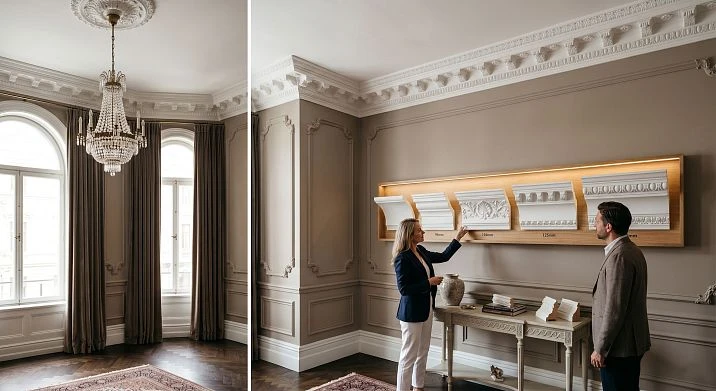
Wide ceiling cornice for high ceilings — this is not a technical consumable that covers the gap between the wall and ceiling. It is an architectural belt, a horizontal line that completes the upper perimeter of the room and sets its scale. In an interior with a 3-meter ceiling, a narrow cornice of 40–50 mm is perceived as a trowel mark — a thin, barely noticeable strip that does not hold the space and does not create a sense of completeness. For a spacious living room, grand hall, lobby, restaurant, or home with room heights from 3 to 5.5 meters, a different scale is needed.
STAVROS presents the line of HI WOOD cornices — decorative ceiling profiles made of high-density polystyrene 680 kg/m³. Range: from compact A53 (37.7 × 37.7 mm) to monumental A178 (110 × 140 × 2000 mm). White matte paintable surface, 100% moisture resistance, glue installation without mechanical fasteners for most profiles, geometry accuracy ±0.5 mm. This article is a complete guide to choosing a wide ceiling cornice: from proportions and styles to specific models, mistakes, and answers to frequently asked questions.

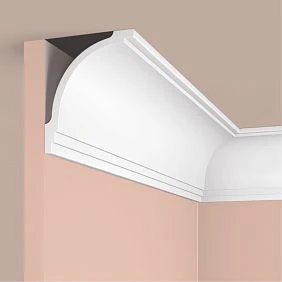


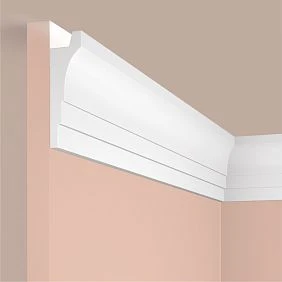
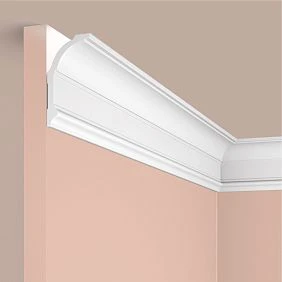

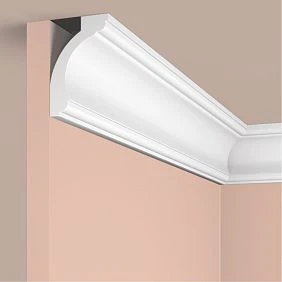
What is a wide ceiling cornice
A ceiling cornice is a decorative profile installed at the junction of the wall and ceiling. In various professional sources, it is called differently: ceiling plinth, coving, ceiling molding, decorative cornice. The essence is the same — it is a horizontal profile element that hides the joint line of two planes and creates a smooth or expressive architectural transition.
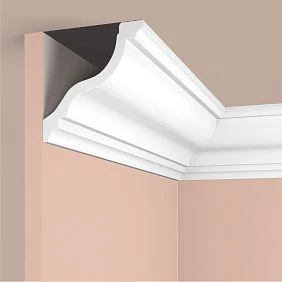
The difference between a regular and a wide cornice is fundamental. A narrow ceiling plinth 35–50 mm is a technical element. Its task: to hide the gap, smooth the seam. A wide decorative cornice from 70 to 140 mm is an architectural detail. Its task: to set the scale, create a horizontal frame, visually structure the space vertically, and connect the ceiling with walls, moldings, high baseboards, and stucco decor into a single system.
In classical architecture, the ceiling cornice is part of the order system. In the Ionic and Corinthian orders, it forms the upper part of the entablature: layer by layer, profile by profile, with drip edges, cymatiums, dentils. In modern interior practice, a simplified reproduction of this logic — a wide profile with or without relief — gives the same effect: the room acquires architectural hierarchy and a sense of completeness.
In the line of HI WOOD cornices from STAVROS, cornices are made of high-density polystyrene (phytopolymer) from the South Korean manufacturer HI WOOD using precision extrusion. Material density — 680 kg/m³. It is 5–7 times lighter than plaster with comparable strength. Water absorption — less than 0.1% in 24 hours. Planks 2000 mm long are packed and transported without risk of deformation. The surface is white matte, accepts acrylic paints without priming.




When a wide cornice is needed instead of a standard one
Sometimes you hear: "Why pay extra for a wide cornice if a narrow one also covers the joint?" This is the logic of a worker, not an architect. A narrow cornice covers the gap. A wide one completes the interior. The difference is the same as between a seam and a frame.
A wide ceiling cornice is the right solution in the following situations:
-
Ceilings higher than 2.8–3 m — at this height, a narrow cornice of 40–50 mm visually "disappears" and does not hold the upper perimeter of the space.
-
Large living room from 25 m² — the scale of the room requires proportionate architectural details on all planes, including the ceiling transition.
-
Hall or staircase — vertical and complex spaces especially need a strong horizontal line that provides orientation and structure.
-
Classic or neoclassical interior — in these styles, the cornice is a mandatory element of the architectural order. Without it, the interior remains unfinished.
-
High doors with wide architraves — if the architrave is 80–100 mm, the cornice should be proportionate: 70–110 mm.
-
There are moldings on the walls — Moldings made of polyurethane on the walls require a proportionate ceiling "finish."
-
A high baseboard is used — High skirting board for painting sets the lower horizontal line. The cornice sets the upper one. They should be proportionate: if the baseboard is 90 mm, the cornice is at least 70–90 mm.
-
The ceiling looks empty — a large white horizontal plane without a supporting perimeter creates a feeling of incompleteness and cheapness.
-
A premium architectural line is needed — in an expensive renovation, every detail should be readable and confirm the level. A thin cornice in a premium interior is a signal of saving in the wrong place.
-
Restaurant, hotel, salon, showroom — a commercial interior works on impression. A wide cornice creates status and scale.
Our factory also produces:
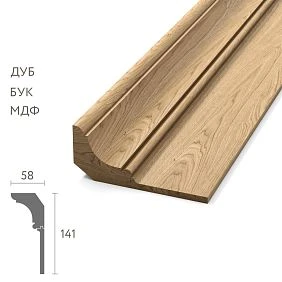
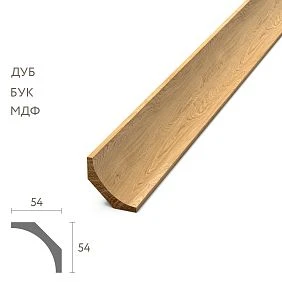



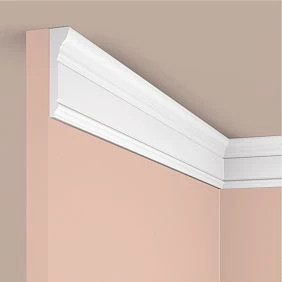

How to choose the width of the cornice based on ceiling height
The main selection parameter is ceiling height. This is not just aesthetics: if the proportion is violated, the cornice either presses on the space (if it is too wide) or gets lost (if it is too narrow). Practical rule: the total height of the cornice (vertical component of the profile) should be about 2–3% of the ceiling height.
| Ceiling Height | Recommended cornice |
|---|---|
| 2.5–2.7 m | Compact profiles 37–50 mm |
| 2.7–3.0 m | Medium profiles 50–80 mm |
| 3.0–3.5 m | Expressive profiles 80–110 mm |
| 3.5–5.5 m | Large cornices 110–140 mm |
| Large hall / double-height room | Maximum architectural profiles A178 |
An additional factor is the projection from the wall (horizontal component of the profile). A wide cornice with a large projection creates a deep shadow from below and visually makes the ceiling appear "higher." The A178 cornice (110 × 140 mm) with a 140 mm projection from the wall is no longer just a profile, but a horizontal architectural accent comparable in scale to a full-fledged cornice in classical architecture.
Another parameter is the thickness of the profile in cross-section. A massive profile with a large projection creates a volumetric shadow that "lives" in the space. This is especially noticeable under artificial lighting: in the evening, the cornice looks different than during the day, and in both cases, it looks good.
Get Consultation
STAVROS models: HI WOOD cornices for high ceilings
A70 — for standard ceilings and universal interiors
Cornice A70 — 50 × 50 × 2000 mm. This is a symmetrical square profile with equal vertical and horizontal parameters. It reads well with ceilings of 2.6–2.9 m. The profile is wide enough to create a noticeable horizontal line, but does not overload a low space.
A70 is a popular choice for standard apartments in modern style, neoclassicism with standard ceiling height, kitchens, bedrooms, and studies. It is versatile: the smooth surface accepts any acrylic paint, and the symmetrical shape looks good both when painted white and when tinted to match the wall color. The price is 850 rubles for a two-meter strip. An optimal balance of scale and cost for a standard interior.
A70V2 — an elongated profile for medium scale
Cornice A70V2 — 70 × 37 × 2000 mm. Asymmetrical profile: vertical component 70 mm with projection 37 mm. This shape creates an elongated vertical line — the cornice "raises" the ceiling and adds height to the wall.
A70V2 is the right choice for rooms with ceilings of 2.7–3 m, where you want to emphasize height rather than the width of the transition. A profile with a dominant vertical is organic for living rooms, halls, and studies. In combination with a high baseboard of 80–90 mm, this cornice creates a slender vertical system: at the bottom — a high baseboard, at the top — an elongated cornice, the walls between them — clear and tall.
L1902S — a strict wide profile for high rooms
Cornice L1902S — 80 × 27 × 2000 mm. Narrow in projection but tall in vertical parameter. This is a laconic profile with expressive height and minimal projection from the wall. It creates a clear graphic line — strict, architectural, without unnecessary details.
L1902S is a choice for modern classics, neoclassicism with clean lines, Scandinavian classics, and interiors with ceilings of 2.9–3.3 m, where you want a wide decorative cornice without heavy projection. When painted to match the ceiling, the profile "dissolves" into the plane — the wall visually rises to the very ceiling, maximizing height. When painted white, it works as a pure architectural line.
This cornice pairs especially well with polyurethane moldings on the walls — creates a unified system of vertical frame elements and a wide horizontal top line.
A100 — for ceilings from 3 meters and spacious living rooms
Cornice A100 — 100 × 53 × 2000 mm. This is a fully wide ceiling cornice with a projection of 53 mm and a height of 100 mm. This profile creates a voluminous transition between the wall and ceiling with a good shadow along the bottom edge. The right choice for spacious living rooms with ceilings of 3–3.5 m, for open-plan layouts, for classic interiors with molding panels on the walls.
A100 organically completes the system in which polyurethane ceiling decor includes ceiling rosettes, molding frames on the ceiling, and hidden perimeter lighting. Price point — 1950 rubles per two-meter strip.
A150V1 — large cornice for high halls and lobbies
Cornice A150V1 — 105 × 110 × 2000 mm. This is a powerful double-sided profile with a large projection of 110 mm. This cornice creates a deep horizontal niche — with additional installation of LED lighting in the niche, it provides a pronounced contour floating light around the entire perimeter of the ceiling. A height of 105 mm with a ceiling of 3.5 m is an architecturally convincing detail.
A150V1 — the choice for formal living rooms, halls of country houses, restaurant halls, and representative spaces. In combination with polyurethane ceiling rosettes and a molding frame on the ceiling, a complete classic ceiling system is obtained.
A178 — monumental cornice for ceilings of 3.5–5.5 meters
Cornice A178 — 110 × 140 × 2000 mm. This is the widest profile in the HI WOOD line. Projection 140 mm, height 110 mm. It creates a maximum horizontal architectural accent. With a ceiling of 4–5 m, the A178 cornice is the only profile that looks proportionate: it doesn't get lost, doesn't overwhelm, but holds the space with monumental confidence.
The weight of a two-meter plank is 3.0–3.3 kg. Installation is recommended by two people with additional anchor screws 80–100 mm long. The cost is 4600 rubles per plank. This cornice is used in formal halls of residences, double-height living rooms of luxury homes, hotel lobbies, banquet halls, concert and theater spaces.
It's important to understand: A178 is not just a "wide cornice." It is an architectural statement. An interior with such a cornice automatically becomes formal. It requires proportionate surroundings: high baseboards 100–120 mm, molding frames on walls, large-format ceiling rosettes, massive chandeliers.
A130 and A130V1 line — for intermediate heights
Between A150V1 and A178 is the A130 cornice (130 × 65 × 2000 mm) and A130V1 (100 × 83 × 2000 mm). These are profiles for ceilings 3.2–4 m with noticeable projection and moderate height. A130 with a projection of 65 mm creates a deep horizontal shelf with expressive shadow — a good choice for a classic interior where the ultimate monumentality of A178 is not needed. A130V1 with a more square cross-section (100 × 83) is for those who want a balanced ratio of height and projection.
How to choose a cornice for interior style
The profile shape is not just a matter of size. It's a matter of architectural character.
Modern classic
Medium width profile 60–90 mm, clean geometry, minimal decorative details. Painting to match the ceiling or pure white. L1902S or A70V2 — a precise hit. With this shape, the cornice works as an architectural line, not as a decorative ornament.
Neoclassicism
Neoclassicism requires a pronounced architectural gesture with restrained decorativeness. Cornice height 70–100 mm, moderate projection, calm profile. A70V2, L1902S or A100 with molding frames on walls and high baseboard for painting form a flawless system. The combination with decor for moldings — with corner elements, sockets, accent inserts — enhances the system.
Classic
For full classic style — a cornice 90–130 mm with projection, relief or massive profile, white or patinated finish. A100 or A130 — a strong choice. It is important to build the system: cornice — ceiling frame of moldings — Polyurethane ceiling rosettes — these are interconnected elements, not independent parts.
Palace interior
A178. Only A178. With a ceiling of 4.5–5.5 m, pilasters, molded decoration made of polyurethane on the ceiling and walls, wide baseboards 120–140 mm and massive chandeliers. This is an interior where architecture speaks first.
Minimalism
Smooth profile with minimal relief. A53 (37.7 × 37.7 mm) or A70 (50 × 50 mm). Painted to match the ceiling — the profile disappears, the wall 'grows' to the ceiling without a visible line. A technique that visually increases height by 15–20 cm with a 2.7 m ceiling.
What to pair with a wide ceiling cornice
The cornice does not work alone. In an architectural interior, it is part of the system, and the more consistent this system — the more expensive and convincing the result.
Cornice + high baseboard. The upper and lower horizontal lines of the room. They must be proportionate: with an 80 mm cornice, the baseboard cannot be 40 mm. Guideline: the baseboard is equal to or slightly smaller than the cornice. The full HI WOOD baseboard system can be selected in the catalog. baseboards made of polystyrene from 58 to 140 mm.
Cornice + wall moldings. Moldings made of polyurethane create framed panels on vertical surfaces. The cornice completes this system from above. The scale of the molding must match the scale of the cornice.
Cornice + ceiling rosettes. The cornice frames the ceiling along the perimeter, Ceiling rosette — its central axis. This is a classic double structure: a frame at the edges + an accent in the center.
Cornice + hidden lighting. Profiles with sufficient projection (A150V1, A178) allow placing an LED strip in the niche behind the cornice. Floating light around the ceiling perimeter is a strong modern technique in classical and neoclassical interiors.
Cornice + decor for moldings. Decor for Molding — corner rosettes, accent inserts, decorative joints — complement the horizontal line of the cornice with point accents.
Cornice + decor for ceilings. polyurethane ceiling decor — ceiling kits with molding frames and central elements — together with a wide cornice form a complete ceiling architectural system.
Cornice + wall decor. Polyurethane wall decor — pilasters, overlay panels, corner elements — the vertical component of the same system.
Painting a wide ceiling cornice
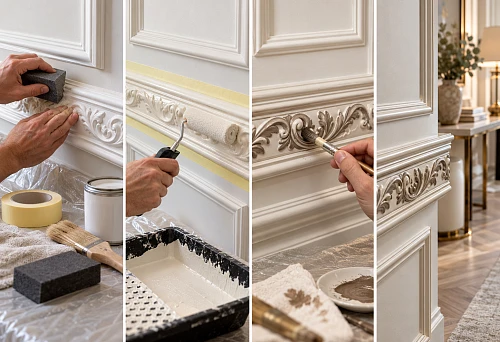
The white matte surface of HI WOOD cornices is already finished; it does not need priming before painting. However, painting is not a mandatory step: most buyers leave the cornice white, and this works in 80% of interiors. When a different color concept is needed, the profile easily accepts paint.
Rules for painting polystyrene:
Only water-based paints: acrylic, latex, silicone. Apply in 2 coats with a 3–4 hour interval. For profiles with relief, use a brush with synthetic bristles. For smooth profiles, use a velour or foam roller.
Strictly prohibited: alkyd enamels, nitro varnishes, oil paints, any paints with organic solvents. Acetone, white spirit, solvent 646 — destroy the structure of polystyrene, the surface becomes soft and sticky.
Color concepts:
-
A white cornice with a white ceiling is a classic. The relief works due to light and shadow, the profile is readable but does not draw attention.
-
A cornice in the color of the ceiling with colored walls — the ceiling 'expands' onto the cornice, the walls are limited by a clear horizontal line.
-
Cornice matching the wall color — the ceiling "floats" above the walls, the wall rises to the ceiling without a break. Visually adds height.
-
Contrasting dark cornice with light walls and ceiling — a graphic horizontal line characteristic of modern design.
-
Gilding or bronze patination on relief — for Baroque and classical interiors with stucco.
How to calculate the amount of cornice: precise algorithm
-
Measure the perimeter of the room — the length of all walls along the perimeter.
-
Subtract areas where the cornice is not installed — door openings with frames (if the cornice goes into the door niche, calculate separately).
-
Divide the total length by the length of one plank — HI WOOD standard is 2000 mm. Round the result up to a whole number.
-
Add 10–15% allowance for corner cutting — each internal corner requires two cut planks at 45°. For a room with four corners, the minimum allowance is 4 × 0.1 linear m = 0.4 linear m beyond the perimeter, plus allowance for cutting defects.
-
Check the profile length in linear meters — a 2000 mm plank = 2 linear m.
-
Select the profile according to ceiling height — according to the selection table above.
-
Check the cornice overhang from the wall — ensure no conflict with door frames, furniture, or slopes.
-
Resolve the lighting issue — if an LED strip is planned behind the cornice, profiles with sufficient overhang are needed.
-
Select adhesive and sealant — specialized adhesive for polystyrene profiles based on MS polymers or hybrid polymers. Corner joints — white acrylic sealant.
-
Order the entire volume in one batch — to ensure identical geometry of all strips in the project.
For complex rooms with niches, pilasters, bay windows — pre-draw a scale plan with markings of all walls and openings.
Installation of a wide ceiling cornice
Installing the HI WOOD cornice is fundamentally simpler than installing gypsum or polyurethane moldings. However, for wide profiles, there are several mandatory rules.
Surface preparation. The wall-ceiling joint is cleaned of dust and old peeling paint. Loose areas are reinforced or puttied. For better adhesion — deep penetration primer.
Marking. Using a laser level or chalk line, mark a horizontal installation line around the perimeter of the room. If the ceiling has differences > 3 mm, the line is measured from the ceiling, not the floor.
Applying adhesive. Apply a continuous strip of adhesive to both mounting surfaces (to the ceiling and the wall). For profiles with an overhang greater than 80 mm (A178, A150V1) — additional adhesive points in the center of the wide part of the profile.
Installation. The strip is applied to the joint, pressed for 10–15 seconds, removed, left "open" for 3–5 minutes (to activate the adhesive), then finally pressed into place. For large cornices (A178) — additional anchor screws at 250–300 mm intervals into the structural base.
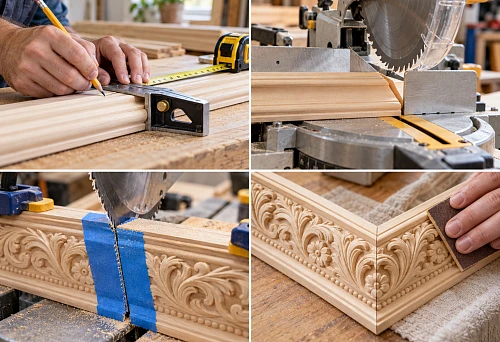
Corner joining. Internal corners — cut at 45° with a fine-tooth miter saw. Gap in the joint — white acrylic sealant, smoothed with a finger or spatula. External corners — special ready-made corner pieces or cut at 45° with careful fitting.
Finishing. After the adhesive has fully dried (12–24 hours) — fill joints between strips, sand, paint.
Errors in Selection and Installation
Over decades of working with decorative profiles, a consistent list of mistakes emerges that are repeated from project to project.
Choosing a wide cornice for a low ceiling. A100 with a 2.5 m ceiling feels oppressive and heavy. The proportion is off. For a 2.5 m ceiling, the maximum is 50–60 mm.
Choosing too thin a profile for a tall hall. A70 with a 4 m ceiling looks like a thread. Scale is lost, the interior doesn't work.
Not accounting for the cornice's projection from the wall. A profile with a 140 mm projection (A178) can conflict with door frames or window reveals. Always check clearances at the selection stage.
Buying a cornice without extra for corners. A standard mistake — "linear meters of perimeter = amount of cornice". Add 15% for cutting, otherwise you'll run short at the last corner.
Mixing a cornice with a baseboard of a different scale. A wide 100 mm cornice and a thin 40 mm baseboard create proportional disharmony. The system should be proportionate across all horizontal lines.
Painting the profile before final fitting at corners. Corners are cut, fitted, then joints are sealed with sealant. Painting before this ruins the finish seam.
They do not consider the style of doors and moldings. A wide classic cornice with a profiled relief combined with smooth minimalist doors is a stylistic conflict.
They do not check joints in corners before painting. After the glue and sealant have dried, be sure to inspect all corners and fill micro-gaps with putty.
They buy the cornice separately from the rest of the decorative system. Moldings, baseboards, cornices, ceiling rosettes are a single system. Buying piecemeal risks incompatibility in scale and style.
They do not look at the price per linear meter for different plank lengths. Prices should be compared specifically per linear meter, not per plank — otherwise the project cost calculation will be inaccurate.
About the company STAVROS
STAVROS is a Russian manufacturer and distributor of architectural decor made from polyurethane, polystyrene, and wood since 2002. The company was founded by artists Andrey Ragozin and Evgeny Tsapko as a workshop for carved wood products. Already in 2003, STAVROS participated in the reconstruction of the Konstantinovsky Palace in Strelna, and later worked on cultural heritage sites — the Hermitage, the Alexander Palace, the Trinity-Izmailovsky Cathedral, and the Sheremetev Mansion.
Today, STAVROS is the official partner of the South Korean manufacturer HI WOOD in Russia, offering a full range of decorative profiles: HI WOOD cornices from 37 to 140 mm, Moldings made of polyurethane, baseboards, ceiling rosettes, ceiling decor, Wall Decor и molded decoration made of polyurethane. Production and warehouse are in Saint Petersburg. Showrooms are in Saint Petersburg and Moscow. Contact us to confirm shipping to your destination. and CIS countries. Shipment from warehouse — from 3 working days. 264 reviews with a rating of 5.0.
Answers to Popular Questions
What is a wide ceiling cornice?
A decorative profile made of high-density polystyrene, installed around the perimeter of the room at the junction of the wall and ceiling. Width from 70 to 140 mm. Creates an architectural horizontal line, completes the upper perimeter of the interior, and connects the ceiling with moldings, baseboards, and stucco decor.
Which cornice should I choose for a 3-meter ceiling?
Profiles 80–110 mm high: L1902S (80 × 27 mm), A100 (100 × 53 mm), or A130V1 (100 × 83 mm). The choice depends on the interior style: for laconic neoclassicism — L1902S, for classic — A100 or A130V1.
Which cornice is suitable for a 3.5-meter ceiling?
A150V1 (105 × 110 mm) or A178 (110 × 140 mm). A150V1 — for classic and neoclassical, A178 — for formal, palace, and representative interiors.
How is a wide cornice different from a regular ceiling plinth?
A regular ceiling plinth 35–50 mm is a technical element that hides the joint. A wide cornice 70–140 mm is an architectural detail that creates a horizontal frame for the room, sets the scale, and connects the decorative system.
Can HI WOOD cornice be painted?
Yes. The white matte surface accepts water-based acrylic paints without priming. Alkyd enamels and solvent-based paints are prohibited.
How to calculate the quantity of ceiling cornice?
Perimeter of the room minus door openings, divided by the length of the strip (2 m), plus a 10–15% reserve for trimming. Order in one batch.
Is a wide cornice suitable for neoclassicism?
Yes. A70V2 (70 × 37 mm) or L1902S (80 × 27 mm) combined with molding frames on the walls and a high baseboard is a classic neoclassical solution.
How to combine a ceiling cornice with a high baseboard?
The baseboard and cornice should be proportionate. With an 80 mm cornice, the baseboard should be 70–90 mm. With a 110 mm cornice, the baseboard should be 90–120 mm. Both profiles are preferably from the same HI WOOD line.
Can a wide cornice be used in an apartment?
Yes, if the ceiling height is from 2.8 m. For standard 2.5 m, profiles of 50–70 mm are preferable. For apartments with ceilings of 3 m and higher — A100, L1902S, A130V1.
Where to buy a wide ceiling cornice for high ceilings?
In the Stavros catalog — HI WOOD cornices from 37 to 140 mm. Showrooms in Saint Petersburg and Moscow. Phone: +7 (800) 555-46-75. Delivery across all of Russia, shipment from warehouse from 3 working days.