Article Contents:
- What sizes of RPU-003 are currently shown in the product card
- What exactly is added to the cart
- The price applies to one socket, not to a pair
- One SKU does not mean one size
- What to evaluate during the fitting
- RPU-003 30 × 30 × 9 mm: a quiet part for a small field
- RPU-003 40 × 40 × 11 mm: confident scale for most facades
- RPU-003 50 × 50 × 14 mm: noticeable center for large surfaces
- Narrow door
- Medium furniture facade
- Wide door or wall panel
- Frame center
- Top part of the door
- Repetition on several drawers
- Door with one large panel
- Door with multiple panels
- Paired doors
- Tall pencil case
- Center of one frame
- Repeating grid
- Connection between furniture and wall
- Is a reserve needed
- How not to confuse sizes in a large batch
- Why you cannot transfer the price of one size to another
- Check on phone
- Checking multiple identical positions
- When to choose polyurethane
- When to Choose Wood
- Can both materials be combined
- When beech is more convenient
- When oak is indispensable
- When polyurethane is more rational
- Mounting compound
- Materials for finishing
- Other Decorative Elements
- Marking paired facades
- Marking a series
- Why you can't align 'by eye'
- In the color of the facade
- Contrast color
- Finishing Before or After Installation
- Modern classicism
- Neoclassicism
- Eclecticism
- Commercial interior
- Kitchen
- Living Room
- Bedroom
- Entry Hall
- Children's room
- Study or Library
- Relying on old numbers in the description
- Deciding that the price is for a set
- Choosing a size based on a large photo
- Mixing sizes in one series
- Not accounting for thickness
- Ordering exactly half a set
- Not checking the handles
- Buying random glue
- Marking each door separately
- Painting without a test sample
- Ordering different sizes in two cart lines
- Not checking the quantity after changing the size
- Order for one room
- Order for furniture production
- Order for multiple rooms
- For new furniture
- For an existing facade
- For furniture after repainting
- Attitude to molding
- Attitude to the handle
- Attitude to the free field
- Control facade
- Mounting template
- Batch marking
- Control after painting
- Side lighting
- Uniform frontal light
- Dark finish
- Maintenance
- What size of RPU-003 is considered current?
- Why may 70 and 100 mm appear in the description?
- Is the price for one piece or a set?
- How many should I order for two doors?
- What size should I choose for a small door?
- What would suit a medium facade?
- What size is best for a wall panel?
- Can I mix different sizes?
- Should I order extra?
- How is RPU-003 different from R-003?
- What to choose for enamel?
- What should I choose for clear tinting?
- Can RPU-003 be used as a handle?
- Is the socket suitable for a door?
- How do I check the size before ordering?
- How do I check the selected option in the cart?
- Where can I see other polyurethane sockets?
- Where to choose larger decor?
- Where can I see the installation materials?
- Can I order RPU-003 with delivery?
- Where can I see current available options?
- How to know that 30 mm won't get lost after painting?
- Can I buy one piece for a sample?
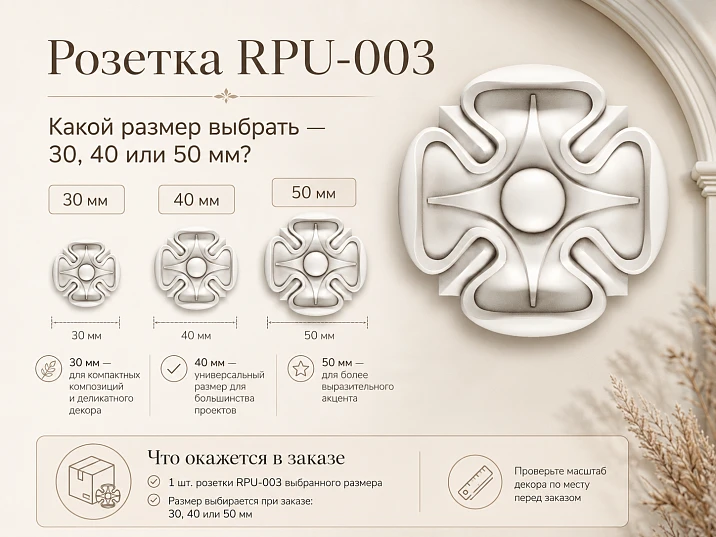
A small decorative element has an unpleasant feature: on the screen it seems almost the same in all sizes, but on the finished facade a difference of ten millimeters can completely change the impression. The polyurethane rosette RPU-003 is available in three variants — 30 × 30 × 9 mm, 40 × 40 × 11 mm, and 50 × 50 × 14 mm. The buyer needs to choose not an abstract "small" or "medium" model, but a specific variation that suits the door width, the scale of the molding frame, and the number of repeating elements.
Additional confusion is created by the product card itself: the variant table shows sizes 30, 40, and 50 mm, while the old description may contain values of 70 and 100 mm. For ordering, you should rely on the selected variation in the current table and on the parameters of the item that goes into the cart. Before payment, you should see the article RPU-003, size A × B × C, quantity, and price per piece again. If the data in different parts of the page do not match, it is better not to confirm the order until clarification.
Buy a polyurethane rosette RPU-003 of the required size can be purchased individually: the price in the table refers to one rosette, not to a set for two doors or four facades. Therefore, two symmetrical doors require two identical elements, four drawers — four, and repeating decor on a wall panel is calculated by the number of intended centers.
The main question of the article is not whether the rosette is beautiful. The four-leaf clover motif is readable in both compact and larger versions. The buyer needs to understand something else: which size will not be lost after painting, which will not overload a narrow door, how to check the selected option in the cart, and when it is more reasonable to choose a wooden R-003 made of beech or oak instead of polyurethane RPU-003.

What sizes of RPU-003 are currently shown in the product card
The current table of options shows three versions. They differ not only in width and height, but also in relief: the thickness of the element increases with the size.
| Option | Size | Price per piece at the time of writing the article | What to check before ordering |
|---|---|---|---|
| Compact | 30 × 30 × 9 mm | 410 ₽ | Will the relief be lost on the facade and after painting |
| Medium | 40 × 40 × 11 mm | 510 ₽ | Does the scale match the molding and the width of the door |
| Large | 50 × 50 × 14 mm | 600 ₽ | Does the element look heavy on a small surface |
Prices may change, so before paying you need to check the dimensions and price of RPU-003 in the selected variation. The cart should contain not just a line with an article number, but a clear item: RPU-003, specific size, quantity, and total amount.
Old values 70 × 70 × 13 mm and 100 × 100 × 19 mm cannot be used to calculate the current order until they are confirmed in the variations table. The buyer should not have to guess which version the numbers from the description refer to. It is safer to rely on the parameters of the selected option and, in case of any discrepancy, clarify the size before payment.




What exactly is added to the cart
The cart records the buyer's decision. It is there that it becomes clear which option is actually selected. Before payment, check seven points:
-
article number RPU-003;
-
size 30, 40, or 50 mm;
-
full line A × B × C;
-
price per unit;
-
quantity;
-
total amount for the item;
-
current information on availability or production time.
The same card combines several variations. Simply navigating to the page is not enough: the buyer must click the required size, ensure the selection is saved, and only then add the item to the cart. Special attention should be paid when placing an order from a phone, where some characteristics may be below the first screen.
Our factory also produces:

The price refers to one socket, not a pair
The socket is often used symmetrically, so the buyer may habitually assume that the order includes a pair. But the table indicates the price per single piece. For two doors, set the quantity to "2", for four identical drawers — "4".
This rule affects not only the total amount. A single missing socket can halt the finishing of an entire furniture series: the craftsman will not be able to complete the symmetrical composition, and a later ordered element may fall into a different production batch.
Get Consultation
One SKU does not mean one size
RPU-003 is the model name and motif. The size is selected within the card. Therefore, the wording "need RPU-003, ten pieces" in the request is incomplete. The correct way is: "RPU-003, 40 × 40 × 11 mm, ten pieces".
This format is useful both for personal orders and for a designer working with production. It eliminates the situation where the customer had 50 mm in mind, but the craftsman was oriented toward 30 mm.
Why a difference of ten millimeters is so noticeable
On a ruler, ten millimeters look modest. On a furniture door, it is already a change in scale by a quarter or a third. A 30 mm socket next to a 40 mm variant appears noticeably thinner, while a 50 mm element is perceived as an independent center rather than a small mark.
The thickness also increases:
-
30 mm — 9 mm;
-
40 mm — 11 mm;
-
50 mm — 14 mm.
A deeper relief gives a pronounced shadow. On light solid enamel this is especially noticeable: a small rosette reads softly, a large one creates a contrasting pattern of light and shadow. On a dark surface, the outer contour may blend in, but the relief becomes more dramatic with side lighting.
Scale is not assessed separately from the furniture. Next to a wide molding, a small four-leaf clover may get lost. In the center of a narrow frame, a large one may crowd out the free space and make the composition cramped.
Paper mock-up: five minutes that save the entire set
Choosing by photo almost always distorts the scale. A close-up of the product fills the screen, so a 30-millimeter rosette looks significantly larger than on a real door. The most reliable preliminary test is three paper mock-ups.
Cut out squares:
-
30 × 30 mm;
-
40 × 40 mm;
-
50 × 50 mm.
Sign each option and attach it to the facade at the intended location. Paper will not show the relief, but it will honestly show the area. Step back two to three meters, look at it in daylight and evening lighting, and photograph all three options from the same point.
What to evaluate during the fitting
Do not ask yourself the vague question "is it beautiful or not." Check specific relationships:
-
how much free space remains around the socket;
-
whether its center coincides with the center of the frame;
-
whether it seems like a random point;
-
whether it overlaps a thin molding;
-
whether the element is visible from a normal distance;
-
whether it looks the same on narrow and wide facades;
-
is there enough space for the handle;
-
does the decor not clash with the panel;
-
does the larger version not become visually heavier than the entire door.
A paper square can be supplemented with a printed photo of the relief at a 1:1 scale. Such a mockup already better conveys the character of the quatrefoil.
Three sizes — three different roles
RPU-003 30 × 30 × 9 mm: a quiet detail for a small field
The most compact option is appropriate where decor should support the composition but not argue with it. These are small furniture doors, narrow decorative posts, miniature frames, and a repeating pattern of several elements.
Thirty millimeters work well in a series. One rosette may seem modest, but four or eight identical centers create a neat rhythm. This size is convenient for paired doors, small drawers, and furniture where handles or carved molding play the main role.
The compact option has one risk: after painting in the color of the facade, it can get lost. On a paper mockup, the square is noticeable due to the contrast of white paper, but a real rosette after monochrome finishing is read mainly through shadow. Therefore, before ordering, you need to check how pronounced the side lighting is and whether the furniture is too far from the viewer.
RPU-003 40 × 40 × 11 mm: a confident scale for most facades
The medium option is the easiest to fit into a regular furniture door. It is already noticeable as a decorative center, but does not yet take up too much space. The 40 mm size suits medium facades, door panels, wall panels, and molding frames.
It is the forty-millimeter rosette that makes sense to take as a starting point when the project is not yet approved. First, apply the 40 mm, then compare it with 30 and 50. This makes it easier to understand whether a more delicate or more expressive option is needed.
The medium size connects the rosette well with a molding of moderate width. But the word "universal" does not mean "always suitable." On a narrow drawer, 40 mm may seem large, and on a tall wide door, too subdued.
RPU-003 50 × 50 × 14 mm: a noticeable center for a large surface
Fifty millimeters are chosen when the quatrefoil needs to be readable from a distance. This is a large furniture facade, a wide wall panel, the center of a large decorative frame, or a separate accent on a door.
This option has the most pronounced thickness — 14 mm. It casts a stronger shadow and looks more voluminous. On a spacious surface, this is an advantage. On a small door, the same relief may feel heavy and reduce the free field.
Before purchasing, check not only the width of the facade but also the neighboring details. A large handle, a massive molding, and a 50 mm rosette can compete with each other. One element should be the main one, the others should support it.
How to choose the size based on the facade width
There is no rigid formula for RPU-003. Two facades of the same width can have different architecture: one smooth, another framed; one has a large handle, another has a small button. Therefore, the rosette size is chosen based on the visible free field, not just the door width.
Narrow door
On a narrow door, first check 30 mm. If the element gets lost, move to 40 mm. Fifty millimeters should only be considered after a full-size trial: a large quatrefoil may leave too little air on the sides.
Particular attention is paid to doors with a narrow frame. The rosette should not extend onto a height difference, cross a panel, or look squeezed between the molding and the edge. Applied decor works well where it has a flat mounting surface.
Medium furniture front
Here, 40 and 50 mm are usually compared. A medium rosette looks restrained, a large one is more noticeable. The choice depends on the molding, the handle, and the overall richness of the decor.
It is useful to check the front not only up close, but also from a normal viewing point. A dresser is viewed from two to three meters away, kitchen doors from the passage, a tall cabinet almost entirely. A size that seems expressive up close may get lost at a distance.
Wide door or wall panel
On a large surface, 30 mm often turns into a small dot. Forty millimeters suits a repeating rhythm, fifty for a central accent.
Useful trick: photograph the entire front, not just the section with the mockup. The correct size should work at the scale of the whole piece of furniture, not just win in a close-up.
RPU-003 for furniture front
Applied decor for a furniture front helps change a smooth surface without complex hand carving. The rosette can become the center of a panel, complete a small molding frame, or repeat across a series of doors.
For furniture applications, the following are especially important:
-
even base;
-
sufficient free space;
-
symmetry relative to edges;
-
no conflict with the handle;
-
uniform height on paired doors;
-
compatible mounting and painting system;
-
identical size for the entire batch.
Before buy polyurethane decor for furniture facade, determine whether a miniature rosette or a larger overlay is needed. RPU-003 works as a precise local accent. It does not replace an elongated ornament on a wide empty panel.
Frame center
The clearest scenario is placing the four-leaf rosette at the geometric center of the molding frame. Here, the size is related to the profile width and the inner field. A small rosette leaves more air, while a large one more strongly ties the four sides of the frame together.
First, build the frame, determine its inner size, and only then choose the rosette. The reverse order leads to having to squeeze a beautiful individual element into an unsuitable field.
Upper part of the door
Sometimes the rosette is placed not in the center of the entire facade, but in the upper decorative zone. This solution suits tall cabinets and sideboards. You need to check that the element does not look randomly raised and does not intersect with the panel.
In a tall composition, a common horizontal line works well: all rosettes on adjacent doors are placed at the same level. Even a difference of a few millimeters is noticeable when the elements are next to each other.
Repeat on several boxes
On the RPU-003 dresser, you can repeat it on each drawer. It is better to keep the size the same, even if the drawer heights differ. Changing 30, 40, and 50 mm across rows requires a strong design reason, otherwise the series looks assembled from different sets.
If the upper drawers are very narrow, another approach is possible: rosettes are placed only on the large lower facades, while the upper ones are left calm. This solution is checked on a general sketch so that the decor does not break off accidentally.
Rosette for door decor
On a door leaf, a miniature element is perceived differently than on furniture: the viewer sees it from a greater distance. A 30 mm option may turn out to be too delicate, especially on a tall door. More often, you should compare 40 and 50 mm.
The position is linked to panels, trims, and the handle. The four-leaf rosette should not fall into the grip zone, where it is constantly touched. If the door has a complex relief, the rosette is installed only on a flat field with sufficient support.
For a double door, a paired order is needed. Identical elements are placed mirror-symmetrically relative to the central gap. Even a slight difference in height will be noticeable, so marking is done along a common horizontal axis.
Door with one large panel
On such a surface, a rosette can become the exact center. The 50 mm option is usually read more confidently, but it needs to be matched with the panel width. If little free space remains around it, 40 mm looks lighter.
Door with multiple panels
Here it is important to decide which part is the main one. There is no need to place a rosette in every field just for the sake of filling. One element in the upper panel often looks more convincing than several identical motifs at all levels.
Decorative rosette for a cabinet
On a cabinet, RPU-003 can link several facades into one series. For example, identical four-leaf clovers are placed on the lower panels of four doors or in the centers of the upper frames.
Here, the calculation of quantity is especially important. A built-in cabinet often includes blind panels, false facades, and working doors. Not all rectangles on the sketch should be counted: only the actual placement points need to be marked.
For a large series, it is better to order identical RPU-003 rosettes in one order. This makes it easier to maintain a uniform size and avoid mixing different variants during installation.
Paired leaves
On paired doors, the element may repeat twice or form a single overall composition. In the second case, the rosettes are placed closer to the central gap, but they must not collide when opening.
Tall pencil case
On a narrow, tall facade, a 30 mm rosette may get lost. First, check 40 mm, then 50 mm. The position is chosen relative to the handle and the lines of adjacent cabinets.
RPU-003 on a wall panel
A small polyurethane rosette is suitable not only for furniture. It can be used in the center of a decorative frame on a wall panel, in a repeating grid, or as a small connecting motif between moldings.
Queries like "buy decorative wall overlays" and "buy decorative wall overlays" belong to a broader group. RPU-003 is appropriate when the wall decor should be miniature. For a large free wall, it is better to choose a larger polyurethane overlay, otherwise the rosette will get lost in the scale of the room.
Center of one frame
For a single small frame, 40 and 50 mm are usually compared. Thirty millimeters are suitable when the frame is thin and the overall composition is very restrained.
Repeating grid
Several sockets of 30 or 40 mm can create a rhythm on the panel. The distances between centers must be the same, otherwise the eye immediately notices a glitch.
The grid is first drawn entirely. You cannot glue the first element and then lay out the rest "approximately at equal distances." The edge fields and center-to-center intervals must be coordinated before installation.
Connection between furniture and wall
One motif can be repeated on facades and wall panels. The size does not have to match: a larger version is acceptable on the wall, a compact one on furniture. But the shape, color, and mounting height must be coordinated in advance.
How to calculate the quantity without complex formulas
The quantity equals the number of actual placement points plus a justified reserve. First, create a diagram of the facades or wall and mark each place where a socket will be.
| Scenario | Basic calculation |
| Two symmetrical doors | 2 pieces |
| Four identical facades | 4 pieces |
| Six drawers | 6 pieces |
| Three wall frames | 3 pieces |
| Two frames with four corner elements | 8 pieces |
| Series of ten points | 10 pieces plus agreed stock |
Do not multiply the number of packages: RPU-003 is sold individually. In the cart, you need to set the total number of items.
Is a reserve needed
For one cabinet with two sockets, the stock may be excessive if installation is done carefully and repeat purchase is not a problem. For a large batch of furniture, one extra piece is often justified: it protects against damage during finishing or installation.
The stock should be deliberate, not an automatic percentage. For ten items, one extra socket is understandable. For two, the decision depends on the cost of reordering, project timeline, and finishing complexity.
How not to mix up sizes in a large batch
In one composition, you should not mix 30, 40, and 50 mm without a project. In the order, the size is written next to the quantity. After delivery, boxes are labeled before handing over to painters and installers.
Example of a statement:
| Zone | Size | Quantity | Finishing |
| Upper kitchen fronts | 30 × 30 × 9 mm | 8 | In the color of the fronts |
| Buffet | 40 × 40 × 11 mm | 4 | Contrasting |
| Wall panel | 50 × 50 × 14 mm | 3 | Wall color |
What does "price per piece" mean
Price per piece is the cost of one physical socket of the selected size. It does not automatically include a second piece for a symmetrical door, mounting materials, painting, or craftsman labor.
A simple formula is used to calculate the item:
Socket cost = price per piece × quantity.
At the time of writing the article, the table listed:
-
30 mm — 410 ₽;
-
40 mm — 510 ₽;
-
50 mm — 600 ₽.
Before payment, you should check the current values in the product card, as the price may change. The final cart total should match the selected quantity.
Why you cannot transfer the price of one size to another
Each variation has its own price. If a buyer switches from 30 mm to 50 mm, the price per piece should change. Do not rely on the first price shown in the catalog or search results: it may refer to the minimum option.
How to check an order before payment
The final check takes less than a minute, but it is this check that answers the main question: what size will actually be in the order.
| Check | What should be visible |
| Model | RPU-003 |
| Size | 30 × 30 × 9, 40 × 40 × 11, or 50 × 50 × 14 mm |
| Quantity | Number of actual placement points |
| Price | Per one item of the selected size |
| Total | Price multiplied by quantity |
| Material | Polyurethane |
| Delivery time or availability | Current value in the product card |
| Address and pickup | Verified during checkout |
If the cart does not show the size clearly enough, save a screenshot of the selected variation and clarify the item before payment. An order for "RPU-003 without size" should not go into production or picking.
Check on phone
On the mobile screen, specifications are sometimes hidden in a collapsible block. After selecting a variation, scroll down to the table, then return to the order button. In the cart, open the item description again. Do not rely on the system "remembering the last viewed size."
Check multiple identical items
If sockets were added to the cart multiple times, make sure they are combined into one line of the same size. Two lines of RPU-003 may mean two different variations, even if the name looks the same.
RPU-003 or wooden R-003
Polyurethane RPU-003 and wooden R-003 use a similar four-leaf clover motif, but the material changes both the appearance and the subsequent finishing.
Wooden rosette R-003 made of beech or oak available in sizes 30, 40, 50, and 60 mm. Polyurethane RPU-003 is offered in current variants of 30, 40, and 50 mm.
| Task | RPU-003 made of polyurethane | R-003 from array |
| Painting in a single color with the surface | Suitable after selecting a compatible technology | Beech can be considered under enamel |
| Visible natural texture | Not a task of the material | Oak reveals the wood grain pattern |
| Size 60 mm | Not specified in the current line | Available for wooden R-003 |
| Light applied decor | Natural scenario | The wood feels denser |
| Wood tinting | Does not replace natural wood species | Oak is suitable for transparent finishing |
| Series on wall panel | Convenient scenario | Requires coordination with the base |
| Connection with wooden facade | Through color and shape | Through material, color, and texture |
When to choose polyurethane
RPU-003 is suitable for painted compositions, light applied decor, and repeating elements on furniture or walls. It is convenient when shape and relief matter, and natural wood texture is not required.
In a series of multiple elements, the polyurethane version helps maintain a unified motif without the need to match grain direction. After painting, attention is focused on the shape of the quatrefoil.
When to choose wood
R-003 is worth considering for solid wood furniture, veneered facades, and projects with visible oak texture. The 60 mm option is also available specifically in the wooden line.
A wooden rosette is especially appropriate where the decor should continue the facade material, not just repeat its color. With a transparent finish, each piece has a natural pattern, so the set is evaluated as a whole.
Can both materials be combined
Yes, if after finishing they look coordinated and the difference in materials does not disrupt the concept. But in one pair of doors, it is better not to place a polyurethane rosette on one leaf and a wooden one on the other. For symmetry, identical items are needed.
Combining is more reasonable to build by zones: for example, a polyurethane motif on the wall and a wooden one on furniture. Then the difference in materials looks intentional.
How to choose material for a painted facade
A buyer often reasons like this: since the facade is wooden, the decor should also be wooden. This is not a mandatory rule. After opaque painting, what matters most is not the original material, but the precision of the shape, quality of preparation, compatibility of coatings, and reliability of installation.
RPU-003 can be used on painted furniture facades, but the finishing system should be tested on a sample. Compounds intended for one substrate do not always behave the same on another.
For a project where handles, moldings, and rosettes are painted together, the workshop should know in advance that part of the decor is made of polyurethane. Then the primer, paint, and sequence of work are chosen deliberately.
When beech is more convenient
Wooden R-003 made of beech is suitable when furniture production is accustomed to working with solid wood and plans to use an opaque enamel. Such a part remains part of the wooden set.
When oak is indispensable
Oak is chosen for its grain and natural feel of the material. Polyurethane should not imitate oak texture in a project where genuine wood is important.
When polyurethane is more rational
RPU-003 is convenient for lightweight applied decor, painted wall panels, and series where shape matters more than material. Additionally, there is no need to match the grain pattern between elements.
What to buy together with RPU-003
One rosette is enough only for a visual trial. For installation and finishing, accompanying materials will be needed, and sometimes other decorative elements.
| What to add | Purpose | Where to look |
| Mounting compound | Fix the socket to the prepared surface | Adhesive for mounting polyurethane decor |
| Finishing materials | Prepare the element for painting | Materials for installing and finishing molding |
| Other rosettes | Select a different size or motif | Polyurethane rosettes for furniture and interiors |
| Larger overlay | Fill a wide decorative field | Decorative elements for walls and furniture |
| Wooden version | Preserve the texture of beech or oak | Similar four-leaf clover made of solid wood |
| Template | Mark identical centers | Manufactured for a specific facade |
Do not buy glue just because it says "universal." It must be suitable for polyurethane, the substrate, and the conditions of subsequent painting.
Mounting compound
Glue is chosen after the substrate material is known: painted facade, MDF, wood, prepared wall, or panel. A weak top layer of the substrate can tear off along with the rosette, even if the compound holds well.
Materials for finishing
The project package may include preparation agents, primer, and paint, but the specific set depends on the technology. Do not buy random enamel at the same time as rosettes without checking its compatibility.
Other decorative elements
If RPU-003 seems too small even in the 50 mm size, the problem is not solved by increasing the quantity. A wide field requires a larger overlay or a different composition.
How to glue a small rosette without shifting
A small element seems simple to install, but it is the compact size that highlights an error of a few millimeters. The socket must be exactly on the axis, especially in a pair or a repeating series.
Before starting work, it is useful to study how to glue a small polyurethane element without shifting. The general logic is as follows:
-
the surface is cleaned and checked;
-
the center is marked with two intersecting axes;
-
the socket is applied dry;
-
the position is photographed or outlined;
-
the mounting compound is applied using a compatible technique;
-
the element is installed according to the markings;
-
the position is checked before fixing;
-
Excess compound is carefully removed;
-
Painting is done after preparing the joint.
Marking paired fronts
Two doors are marked from a common line, not each separately from a random edge. First, check whether the fronts themselves and the gaps are identical. Then draw a common horizontal line and mark the centers.
If the doors have a slight difference in height, the rosettes should still appear level after the cabinet is installed. Therefore, the final line is sometimes determined on the assembled furniture, not on individual parts.
Marking a series
For four, eight, or ten elements, a template is needed. It can be made of paper, plastic, or thin sheet material. The key is the same base size and the same reference edges.
The template is labeled: top, left edge, front size, article number, and rosette size. Without a label, it is easy to flip it over or use it on the wrong door.
Why you cannot align "by eye"
The quatrefoil has pronounced axes. Even a slight rotation is noticeable next to the straight lines of the front. After gluing, correcting the angle is harder than checking it before contact with the surface.
Finishing of RPU-003
The exact appearance of the coating depends on the project. The rosette can be included in a monochrome painted composition or made contrasting, but the technology must be compatible with polyurethane and the substrate.
In the color of the facade
This option emphasizes the relief without adding a new color. It is especially good for furniture where moldings and panels already exist. The rosette becomes part of the architecture, not a separate sticker.
On a light facade, the shadow reads softly. On a dark one, the contrast between protrusions and recesses can be stronger. The final appearance depends on lighting and the degree of gloss.
Contrast color
Contrast enhances the motif but requires a neat boundary. On a small detail, any run-off is visible. First, a test sample is made, and only then the entire batch is painted.
A contrasting rosette should not argue with the handle. If both elements are bright and located close together, the facade looks overloaded.
Finishing before or after installation
Part of the work is more convenient to do before installation, but the final sequence depends on the joint, the substrate, and the chosen coating. If the rosette should look seamless with the facade, the finishing layer is often tied to the overall surface finish.
When painting separately, the rear mounting area must be protected from a thick layer of coating, which can impair adhesion.
How RPU-003 looks in different styles
The four-leaf clover motif has a classical origin, but its small size allows it to be used not only in a rich historical interior.
Modern Classic
The socket is painted in the color of the facade and works together with thin frames. The decor is read through shadow, not contrasting gilding.
In such an interior, 30 or 40 mm usually wins. Fifty is chosen for a large panel where a confident center is needed.
Neoclassicism
The 40 or 50 mm option becomes the center of a symmetrical panel. It is important not to overload the surface with additional curls.
Eclecticism
A miniature four-leaf clover can be used on a minimalist cabinet as a single historical sign. Here, precision of scale is especially important: a too-large detail will turn a light quote into a theatrical gesture.
Commercial interior
In a salon, cafe, boutique, or hotel, repeating rosettes help create a recognizable decorative motif. For a series, the size, color, and installation template should be approved in advance.
Application in Different Rooms
Kitchen
RPU-003 can be installed on decorative facades, a sideboard section, or an island. In high-contact areas, the finish should be practical, and the socket should not interfere with the handle.
On a small kitchen, excessive decor quickly becomes tiring. The four-leaf clover is best used sparingly: for example, only on the display section or on a couple of central facades. A size of 30 or 40 mm helps maintain lightness.
Living room
On cabinets, nightstands, and wall panels, the element can echo the overall molding motif. For a large wall, 50 mm or a larger overlay is often more suitable.
If the living room has a lot of textiles, paintings, and lamps, the rosette is painted in the color of the surface. In a calm interior, a more noticeable contrast is acceptable.
Bedroom
The rosette is appropriate on cabinet facades, bedside tables, and decorative panels. Soft monochrome painting makes the relief calm.
On paired cabinets, the quantity is counted separately: one rosette on each facade means two pieces. If the cabinets have multiple drawers, decide in advance whether the motif is repeated on each one.
Hallway
On a wardrobe or wall panel, the decor is visible from a close distance. It is important not to place a convex element where clothing constantly brushes against it.
A narrow corridor enhances the perception of the relief. The 50 mm option may appear larger than in a spacious room, so a paper mock-up is mandatory.
Children's room
The shape can be used on calm, classic furniture, but the placement must be safe and not in an area of constant contact.
It is better to choose a solid finish and not overload the facade with several decorative motifs at the same time.
Office or Library
On bookcases, the quatrefoil can support the classic architecture of the facades. For tall doors, 40 and 50 mm are more often checked. The 30 mm size is suitable for repeating small drawers.
How not to confuse a rosette with a furniture handle
RPU-003 is a decorative overlay, not hardware for opening. It cannot be used as a handle without a specially designed mechanism. It should not bear the force of the hand and is not intended for regular tension on the facade.
The handle is responsible for function. The rosette is for the decorative center. These elements can be located nearby, but they need enough space.
If a buyer sees a round or square overlay element in a photo without scale, it is easy to mistake it for a knob handle. The dimension line and the absence of functional fastening purpose help avoid the error.
How not to confuse RPU-003 with a ceiling rosette
The name "rosette" is used for different products. A ceiling rosette is usually significantly larger and decorates a light fixture or the central part of the ceiling. RPU-003 is a miniature surface-mounted element for furniture, doors, frames, or wall panels.
Dimensions of 30–50 mm immediately show the scale. For a buyer looking for decor for
When it's better to choose a different decor
Another model is needed when:
-
the field is too large for 50 mm;
-
a size of 60 mm is required;
-
natural oak or beech is required;
-
an elongated ornament is needed;
-
the element must function as a handle;
-
the surface is uneven;
-
no possibility to select a compatible mounting compound;
-
the quatrefoil motif does not match the style;
-
a solid large composition is required.
In such cases, you can select a decorative rosette of a different size or move to the category of larger overlays.
Mistakes that cause the order to be redone
Relying on old numbers in the description
For the current selection, you need to look at the table of variations 30, 40, and 50 mm. Values of 70 and 100 mm should not be used without confirmation.
Deciding that the price is indicated for a set
The price refers to one piece. Pair doors require a quantity of "2".
Choose the size based on a large photo
The photo does not convey the real scale. A paper mockup is needed.
Mixing sizes in one series
Thirty and forty millimeters next to each other can look like a mistake, not an artistic choice.
Not accounting for thickness
The 50 mm option is not only wider, but also deeper. Its shadow and protrusion are more noticeable.
Order exactly half of the set
The buyer counts pairs, but in the cart indicates the number of pairs instead of the number of pieces. For four pairs, eight sockets are needed.
Not checking the handles
The socket and handle may be too close or compete in scale.
Buy random glue
An incompatible composition can ruin the material or fail to provide fixation.
Mark each door separately
Different levels appear on paired facades.
Paint without a test sample
The relief may be lost, and the coating may not be applied evenly.
Order different sizes in two cart lines
The name is the same, but the variations differ. Before payment, the items need to be combined or the erroneous one removed.
Do not check the quantity after changing the size
When switching a variant, the cart may keep the old line and create a new one. The final number of items is checked again.
How to order identical sockets in one batch
For a small home project, it is enough to select the size and quantity in one cart. For a large series, it is better to prepare a short specification:
RPU-003, size 40 × 40 × 11 mm, quantity 24 pieces, application — furniture facades, finish — according to the project. Please confirm the identical variation of all elements and the current price of the item.
Such text eliminates ambiguity. When ordering for several rooms, each group can be placed in a separate line, even if the size is the same.
After receiving, check:
-
number of elements;
-
size;
-
absence of mixed variants;
-
relief integrity;
-
identical motif;
-
compliance with the order.
Order for one room
Specify the object and quantity: “wardrobe in the bedroom, six facades, RPU-003 40 mm, six pieces plus one spare.” Such a formulation is clearer than a list without purpose.
Order for furniture production
A list by article numbers, sizes, and quantity is needed. The finish is recorded in a separate field. One responsible employee receives the set and distributes it across the facades.
Order for multiple rooms
Do not mix groups. Even identical sockets should be labeled by room if the finish differs. This simplifies the work of painters and installers.
Acceptance upon receipt
Open the packaging on a clean surface. Do not pass a closed box directly to the painting workshop. First, compare the goods with the order.
Checked:
-
article number;
-
size;
-
quantity;
-
relief integrity;
-
absence of mixed variants;
-
price compliance with documents;
-
availability of a spare piece if it was ordered.
Place one element of 30, 40, and 50 mm side by side only for a deliberate comparative order. In a regular batch, all sockets must match.
Storage until installation
Compact parts are easy to lose or mix up. They are stored in labeled packaging, separate from tools and heavy materials. The relief must not come into contact with sharp objects.
After trial painting, keep the sample with its marking. Do not put the painted control rosette back with unpainted parts: the coating may be damaged, and the craftsman might accidentally install it prematurely.
How to place an order for STAVROS
-
Open the RPU-003 card.
-
Select 30, 40, or 50 mm.
-
Verify the full size line.
-
Check the price per piece.
-
Specify the number of items, not the number of pairs.
-
Check the cart.
-
For a different scale, open the STAVROS molded rosette catalog.
-
For natural wood, consider choice R-003 for enamel or tinting.
-
Before payment, clarify any discrepancies between the description and the selected variation.
This order helps to order exactly the size that was attached to the facade on the paper mockup.
Checklist before payment
| Question | Your answer |
| Which article number is selected? | RPU-003 |
| What size? | 30 / 40 / 50 mm |
| What is the full line? | ___ × ___ × ___ mm |
| How many actual placement points? | ___ |
| How many pieces in the cart? | ___ |
| Is the price indicated for one piece? | Yes |
| Is the final amount correct? | Yes / check |
| Has a paper fitting been done? | Yes / no |
| Does the size fit the molding? | Yes / no |
| Does it interfere with the handle? | Yes / no |
| Has the mounting compound been selected? | Yes / no |
| Is the finish approved? | Yes / no |
| Is a spare piece needed? | Yes / no |
| Do the card and cart data match? | Yes / clarify |
New furniture and replacing decor on a finished facade are different tasks
RPU-003 can be chosen for two completely different situations. In the first, the furniture is still being designed: the position of the socket, frame, and handle is specified on the drawing. In the second, the facade is already manufactured and painted, and the decor must fit into the existing geometry. The same size is checked differently in these cases.
For new furniture
The designer freely chooses the center, offsets, and quantity. The socket can be linked to the molding frame before the facade is cut. The drawing specifies:
-
the size of RPU-003;
-
center coordinates;
-
distance to the handle;
-
the inner size of the frame;
-
finishing;
-
quantity;
-
the mounting template.
The advantage of new furniture is the ability to adjust proportions in advance. If 50 mm looks cramped, the frame is enlarged or 40 mm is chosen. There is no need to adapt to already-made holes and panels.
For an existing facade
On finished furniture, there is less freedom. You cannot move the handle, widen the frame, or change the shape of the panel without repair. A paper template is applied directly to the surface to check if there is a flat area for mounting.
Special attention is paid to the condition of the coating. Old enamel may have chips, greasy marks, or weak adhesion to the base. The socket holds not because of a nice color, but because of a strong, prepared surface. If the layer is peeling, it is restored first.
For furniture after repainting
The most convenient moment to install an overlay decor is before the final coat. Rosettes can be precisely marked, glued, prepared at the joint, and then painted together with the facade. But the chosen size is approved earlier, while the surface can still be adjusted without issues.
How to connect a rosette with a molding and a furniture handle
RPU-003 rarely exists on a facade alone. Nearby are a frame, handle, panel, and edges. A beautiful individual element won't save the composition if these details conflict in scale.
Relation to the molding
The wider and more relief the molding, the more confidently the central rosette should read. In a thin frame of 30 mm, they can look neat, while 50 mm may be too heavy. In a wide frame, the situation changes: a small four-leaf clover gets lost, a large one brings the composition together.
There is no mandatory percentage ratio. A full-size mock-up is more reliable than a formula. It's useful to cut out not only three rosette squares but also a strip equal to the width of the future molding. Then the scale is assessed in combination.
Relation to the handle
The handle should remain comfortable. The decor cannot be placed so close that fingers constantly touch the relief. On doors with a knob handle, two small elements may look similar in function. They are separated by position or chosen at different scales.
With a long pull handle, the rosette is more often placed higher or in the center of the decorative field. On a drawer with a central handle, the four-leaf clover can be moved to the upper part of the frame, but this technique is checked on the entire series.
Attitude to the free field
Free space is not a void that must be filled at any cost. It helps to see the outline of the socket. If there is too little air around the four-leaf clover, the facade looks overloaded.
Control of the furniture series: how to maintain the same result
For one door, a craftsman can adjust the position on site. For twenty-four facades, a repeatable process is needed. Otherwise, the sockets will differ in height, angle, and color.
Control facade
First, one typical facade is completely finished: marking, installation, preparation, and painting. It is approved as a sample. Only after that, the rest of the batch is launched.
On the control facade, the following are checked:
-
socket size;
-
position;
-
distance to the frame;
-
handle convenience;
-
coating thickness;
-
relief readability;
-
quality of the joint.
Mounting template
The template must rest on identical edges. For right and left doors, mirror versions are sometimes needed. Do not flip one template without checking: front and back orientation can give different coordinates.
Batch marking
On the packaging, the article number, size, and installation area are recorded. The label "sockets for cabinet" is insufficient if two sizes are used in the project. Better: "RPU-003, 40 × 40 × 11 mm, upper fronts, 12 pieces".
Control after painting
A thick layer can soften fine relief. After the first finished element, it is compared with an unpainted socket. If the pattern has noticeably lost depth, the technology is adjusted before the entire batch.
Light, shadow, and care for small relief
The size is chosen not only by the area of the facade. Lighting can make a compact socket noticeable or almost invisible.
Side light
Side light emphasizes the depth of the quatrefoil. In such a room, 30 mm can read better than expected. The 50 mm option creates a stronger shadow and sometimes looks heavier.
Uniform frontal light
With soft lighting, the relief looks calmer. For a distant wall or a tall cabinet, a larger size may be required.
Dark finish
On a dark facade, contours and recesses are perceived differently. Before ordering, it is useful to paint a paper mockup approximately in the color of the furniture, otherwise a white square will appear brighter than the actual decor.
To keep the decor attractive, it is enough to periodically wipe it with a soft dry or slightly damp cloth. For heavy soiling, use a mild soap solution. Avoid aggressive chemical agents and stiff brushes, which may damage the finish.
A small relief collects dust in the recesses. The surface is cleaned gently, without sharp tools or aggressive compounds. The specific care method depends on the finish coating, so you should rely on the requirements of the chosen paint.
It is better not to place the rosette where it is constantly grabbed by hand or bumped by objects. The decorative element retains a neat appearance longer in a calm area of the facade.
What to tell the manager before ordering
The more precisely the request is formulated, the lower the chance of getting the wrong size. Five lines in the message are enough:
Need a polyurethane rosette RPU-003. Selected size — ___ × ___ × ___ mm. Quantity — ___ pieces. Application — furniture facade / door / wall panel. Please confirm the price per piece, the final quantity, and the availability of the selected variation.
If there is a discrepancy between the description and the table, add: "Please confirm that the order will include exactly the 30, 40, or 50 mm option selected in the cart."
Such a question does not seem like excessive caution. It fixes the specific product and protects both parties from different interpretations of the same card.
Frequently asked questions about RPU-003
What size of RPU-003 is considered current?
The options table shows 30 × 30 × 9 mm, 40 × 40 × 11 mm, and 50 × 50 × 14 mm.
Why might 70 and 100 mm appear in the description?
This is a mismatch between the old text and the current table. For ordering, refer to the selected variation and confirm any discrepancy before payment.
Is the price for one piece or a set?
For one socket.
How many should I order for two doors?
Two pieces, if each door has one element.
What size should I choose for a small door?
Start with a 30 mm paper mockup and compare it with 40 mm.
What would suit a medium facade?
40 and 50 mm are more often compared. The decision depends on the free field, molding, and handle.
What size is best for a wall panel?
For a small frame, 40 or 50 mm can be considered. On a large wall, even 50 mm may look too small.
Can different sizes be mixed?
Only as a deliberate design choice. In a regular symmetrical series, it is better to use one size.
Should I take a reserve?
For a large batch, one extra piece can be useful. For a pair, the decision depends on the project and the possibility of reordering.
How does RPU-003 differ from R-003?
RPU-003 is made of polyurethane. R-003 is a wooden rosette made of beech or oak, also available in 60 mm size.
What to choose for enamel?
Both options can be considered after checking the technology. For wood under a covering finish, beech is often chosen; for polyurethane, a compatible coating system is needed.
What to choose for transparent tinting?
Wooden R-003 made of oak, if natural texture is required.
Can the RPU-003 be used as a handle?
No. It is a decorative element, not a functional furniture handle.
Is the rosette suitable for a door?
Yes, on a flat decorative surface and with the correct scale.
How to check the size before ordering?
Cut out paper squares of 30, 40, and 50 mm and apply them to the surface.
How to check the selected option in the cart?
Verify the article number, the full size line, quantity, price per piece, and the total amount.
Where can I see other polyurethane sockets?
In the section polyurethane rosettes for furniture and interiors.
Where to choose larger decor?
In the category that features Decorative elements for walls and furniture.
Where can I see the materials for installation?
In the section where you can assemble a kit for mounting RPU-003.
Can I order RPU-003 with delivery?
Terms and available pickup methods are checked when placing an order on the website.
Where can I see current available options?
In the RPU-003 product card before adding the item to the cart.
How to know that 30 mm won't be lost after painting?
Make a test mockup and evaluate it from a normal distance. Keep in mind that monochrome decor is read through relief and shadow, not through paper contrast.
Can I buy one element for a trial?
The quantity is selected in the product card. For a complex project, buying one control socket helps check the scale and finish before ordering the entire batch.
Conclusion: first the size on the facade, then the size in the cart
RPU-003 is a small decorative element, but you cannot choose it blindly. Between 30, 40, and 50 mm there is a noticeable difference: the area, thickness, shadow depth, and the role of the rosette in the composition change. The compact version supports thin decor, the medium one becomes a confident center of a furniture frame, and the large one reads better on a wide panel.
Before ordering, attach three paper mockups, choose one size, calculate the actual placement points, and set the quantity in the cart. Do not rely on old values of 70 and 100 mm if they are not among the selectable variations. The price refers to one rosette, so a symmetrical pair requires two elements.
STAVROS allows you to compare RPU-003 with other polyurethane rosettes, select larger overlays, view the wooden R-003 made of beech or oak, and gather materials for installation. Such a choice is based not on a random photo, but on the real scale of the facade, the exact size line, and a verified cart. This is how a small rosette becomes a neat part of furniture, rather than a detail that has to be replaced after finishing.