Article Contents:
- Why N-113 doesn't have to be placed only in the center
- What is N-113
- Two sizes of one pattern — two different roles
- N-113 65 × 93 × 8 mm
- N-113 110 × 157 × 13 mm
- Four facades — one overlay each
- Two tall doors — three overlays vertically
- Wall panel — a row of five elements
- Six cabinet doors: three possible routes
- Chest of drawers with drawers: handle more important than geometric center
- What to check on the door before purchasing
- Row of five elements within a single frame
- Repeat on multiple panels
- What changes with opaque finish
- One finish for multiple items
- How to check 1:1 print
- Why one circuit is not enough
- Installation on multiple facades
- Painting the entire batch
- Separate overlay or ready-made kit
- Do I need to add other overlays
- N-113 and the central medallion
- N-113 and corner decor
- N-113 and C-026 set
- Small cabinet with two doors
- Tall swing door wardrobe
- Chest of drawers with four drawers
- Interior door
- Wall panel
- Multi-piece furniture collection
- Kitchen front series
- Door and furniture in one room
- Choosing size by photo
- Buying one piece at a time before approving the entire layout
- Divide distance by number of elements, not by number of intervals
- Ignore thickness
- Mix two sizes without a composition center
- Choose oak for dense enamel without visible reason
- Buy different batches for the same furniture
- Use an overlay as a handle
- Try to cover a large defect
- Paint without a test piece
- Mark each facade separately
- Glue before adjusting doors
- Decorate invisible surfaces
- Overload one facade with different ornaments
- Who should consider N-113
- Who should stop and reconsider their choice
- Commercial specification for ordering
- What sizes does N-113 have?
- Which size to choose for a furniture facade?
- Can I place one N-113 exactly in the center?
- Can I use two or three overlays on one door?
- How do I calculate the spacing between multiple overlays?
- Do I need to order all parts in one batch?
- What to choose — beech or oak?
- How does Standard differ from Prestige?
- Can I use N-113 on an interior door?
- Is N-113 suitable for a wall panel?
- Can I combine both sizes?
- Do I need a spare overlay?
- Should I paint the overlay before or after installation?
- Can I glue N-113 onto a finished painted facade?
- How is the individual N-113 different from the C-026 set?
- Can N-113 be used on kitchen fronts?
- How to tell if N-113 is too small for the facade?
- How to tell if a large N-113 is overwhelming the surface?
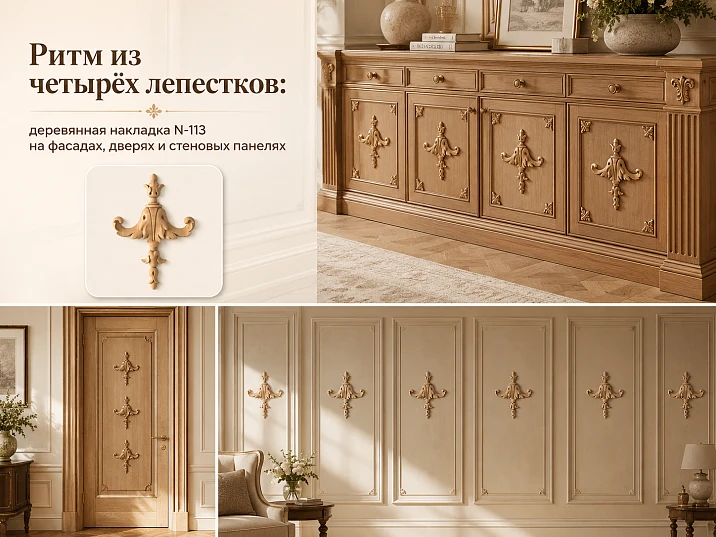
A single carved element can work in different ways. It can be placed in the center of the facade to create an independent accent. It can be repeated on paired doors to tie them into a single composition. Several identical pieces can be arranged vertically, spread across a series of drawers, or turned into an ornament within a wall panel. This is how the wooden overlay N-113 reveals itself: not only as a single decoration, but also as a repeatable four-petal module.
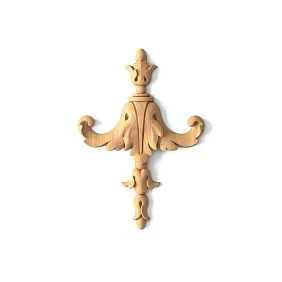
The model has two confirmed sizes — 65 × 93 × 8 mm and 110 × 157 × 13 mm. Both retain the same motif but serve different roles. The compact version is easier to repeat across multiple facades and does not take up all the available space. The larger one is more noticeable on a door leaf, wide panel, central buffet door, or wall panel. However, the size cannot be chosen from a photo: it is necessary to check the actual width of the decorative field, the distance to the handle, frame molding, door edge, and adjacent elements.
Beech and oak are available for order, as well as Standard and Prestige preparation options. The material and quality of preparation are not chosen in isolation: they are linked to the future finish, the number of pieces, and how labor-intensive the finishing of the entire series will be. When there are four, six, or ten overlays, a small difference in the preparation of each piece turns into a noticeable difference in the amount of manual work.
Before calculating the composition, you can open the card and view the wooden overlay N-113 in two sizesBut buying it based on just one card is premature. First, you need to decide whether the element will be single, paired, or repeating, choose the scale, determine the quantity, and create a general installation template. Then N-113 becomes not a random decoration, but part of a furniture or interior system.
Why N-113 doesn't have to be placed only in the center
The center of the facade is a familiar place for a carved overlay, but not the only correct one. It works when the door has a clear open field, the handle does not cross the ornament, and the overlay itself is proportionate to the frame or panel. However, the same motif often looks more expressive not alone, but in repetition.
Repetition brings order to the interior. If six identical overlays are placed at the same height on six cabinet doors, the eye perceives not six separate decorations, but a single line. If three elements are placed vertically on two tall doors, an elongated ornament emerges that supports the proportions of the panel. If the same four-petal motif appears on a chest of drawers and a wall panel in the same room, the furniture and architectural finish begin to speak the same language.
Mixing different overlays works differently. It can be justified in a complex composition, but requires more control: you need to coordinate the size, relief, direction, and visual weight of each element. A single repeating N-113 reduces the risk of a random set. The buyer chooses one motif, tests it on a template, and then transfers it to the required number of facades.
Repetition also has a practical side. One common template helps maintain the same position. One batch reduces the risk of noticeable differences in wood preparation and grain. A unified painting scheme allows maintaining the same coating thickness on all parts. Even future restoration becomes more predictable if a spare overlay is kept in advance.
| Scenario | How the overlay works | Where it is especially appropriate | Main risk |
|---|---|---|---|
| One detail | An independent accent in the center or on the axis | Cabinet door, central facade of a sideboard, individual panel | Scale too small or too large |
| Paired composition | Connects two doors or two side panels | Swing wardrobe, symmetrical chest of drawers, double door | Different heights and misaligned axes |
| Vertical row | Supports elongated proportion | Tall door, narrow facade, wall panel | Uneven spacing and conflict with handle |
| Repeat across a series of facades | Creates a unified rhythm for the entire piece of furniture | Kitchen, library, wall unit, sectional cabinet | Purchasing in different batches and inaccurate marking |
The main idea is simple: the overlay does not need to be automatically placed in the geometric center of each surface. First, the role is determined. Sometimes the center is needed. Sometimes a common horizontal line on several facades is better. Sometimes the composition is built around the first and last axis, and the intermediate elements are distributed evenly. A good result appears where the decision is made before installation, not during the gluing of the first part.




What is N-113
N-113 is a wooden carved overlay with a four-petal floral motif and elongated proportions. The relief is compact enough to work as a repeatable element, and two sizes allow you to keep one pattern at different scales. This is important for a furniture collection or wall composition: you don't have to look for two similar but still different ornaments.
| Parameter | Confirmed data | What this gives when choosing |
| Article number | N-113 | Allows you to order the same motif for the entire series |
| Product type | Wooden carved overlay | Used as an overlay decor on a prepared surface |
| Motif | Four-petal floral ornament | Suitable for single and repeated placement |
| Small size | 65 × 93 × 8 mm | Suitable for small facades, drawers, and rhythmic rows |
| Large size | 110 × 157 × 13 mm | More noticeable on large facades, doors, and wall panels |
| Materials | Beech, oak | The choice is linked to future finishing and other wooden details |
| Preparation options | Standard, Prestige | Affect the amount of self-finishing before final finishing |
| Orientation | Elongated | Allows emphasizing the vertical or using a motif along the axis |
| Completeness | Separate overlay | The quantity is calculated according to the chosen scheme, not by the number of furniture items |
| Product card | View dimensions and price of N-113 | Before ordering, check the size, material, preparation quality, and current conditions |
The overlay is sold as a separate element. This is an important difference from a ready-made decor set: the buyer determines the quantity and layout themselves. One facade may require one piece, for two doors — two or six, for a wall panel — five, eight, or another number depending on the decorative field boundaries.
The small thickness does not make N-113 a flat image. The 8 mm version provides a relief that must be considered near the handle, frame edge, and moving parts. The 13 mm version protrudes more and requires even more careful checking of contact areas. On an interior door, it is important not only the opening of the leaf but also whether the overlay will hit the wall, stopper, trim, or the user's hand.
The four-petal motif cannot be evaluated only from the front. After painting or tinting, its perception changes due to shadows. Opaque enamel unifies the decor with the facade and makes the form more architectural. A transparent finish preserves the wood grain and enhances the feeling of a separate carved detail. Therefore, the material, preparation, and layout scheme must be coordinated in advance.
Our factory also produces:
Two sizes of the same pattern — two different roles
The dimensions 65 × 93 × 8 mm and 110 × 157 × 13 mm cannot be perceived as "a small and a large option to choose according to taste." The difference affects the free field, distance to the handle, number of repeats, and the overall visual weight of the composition.
Get Consultation
N-113 65 × 93 × 8 mm
The compact version is convenient when the decorative field is limited or one motif needs to be repeated several times. It can be considered for dresser drawers, small cabinet doors, narrow stiles, wall panel frames, and serial kitchen facades. This is not a rigid manufacturer's assignment, but a design scenario that needs to be checked at a 1:1 scale.
On a facade 300–400 mm wide, the small overlay leaves more air on the sides. If there is already a frame, handle, and noticeable profile inside the panel, this free space reserve is especially important. A large detail in the same area may start touching the frame or visually fragment the facade.
In a vertical row, the small size allows placing two or three overlays without the feeling that the door has been turned into one massive medallion. However, the quantity cannot be chosen only because the elements physically fit. There must be an equal interval between them, and the first and last details must be at a meaningful distance from the field boundaries.
N-113 110 × 157 × 13 mm
The large version is suitable for wider and taller surfaces. It can become a central overlay on a cabinet door, an expressive element on an interior door, an accent inside a large wall frame, or a decor for the central facade of a sideboard.
The large size fills the empty field faster. This is useful if the surface looks too bare and one small N-113 gets lost. But the 13 mm thickness enhances the relief and increases the requirements for installation. On a door leaf, it is necessary to check the areas of constant contact. On furniture, check the distance to the protruding handle and the adjacent facade when opening.
A large N-113 doesn't always have to be alone. Two pieces can work on a very tall door, and combining large and small versions allows building a hierarchy. But mixing sizes requires a rule: the large element becomes the center, the small ones become repeating satellites. A chaotic sequence on adjacent identical facades usually looks random.
| Criterion | 65 × 93 × 8 mm | 110 × 157 × 13 mm |
| Visual role | Compact module, convenient for repeats | Expressive accent or center of composition |
| Suitable field | Small or divided into several sections | Large, tall, or wide |
| Number of repeats | Easier to place several elements | More often used singly or in a short row |
| Risk | Get lost on a too large facade | Overload a narrow or small panel |
| Thickness | 8 мм | 13 мм |
| Pre-order check | Visibility from a distance and free field | Opening, contact zones, and relief depth |
A reliable choice is made through two paper outlines. Print both sizes at 1:1 scale, attach with painter's tape, and photograph the surface from the distance it is usually seen. Large decor can look impressive up close and heavy from the entrance. Small decor, on the contrary, appears neat on a table but disappears on a tall door. Only a real trial shows which scale works in a specific composition.
One overlay on the facade: the center is not just half the width
When N-113 is used alone, the first thought is to place it exactly in the geometric center. For a simple rectangular facade without a handle, this might be correct. But in real furniture, the center of the free field often does not coincide with the center of the entire door.
A framed facade consists of an outer contour, a frame, and an inner panel. The overlay usually relates specifically to the panel. If you focus on the overall door size, the ornament may end up too close to the top or bottom of the inner field. First, measure the actual area where the decor should 'breathe', then determine its axes.
The handle changes the balance. A vertical handle at the edge visually weighs down one side. The overlay does not necessarily need to be shifted to the opposite edge, but you should check if they form a tight pair. There should be space for the palm between the relief and the handle. If the user constantly touches the carving, the decorative detail will get dirty and accumulate mechanical marks faster.
On a drawer, the horizontal axis is important. The handle often occupies the center, so N-113 has to be placed above, below, or on the side sections. Sometimes the right conclusion is to skip the overlay on the drawer and repeat it only on the doors. A unified rhythm does not require decorating every possible surface.
The orientation of N-113 emphasizes the vertical due to its elongated proportions. On a low, wide drawer, this can create an interesting contrast, but the solution needs to be seen in scale. Rotating the element by 90 degrees is only acceptable as a deliberate design move, not an attempt to squeeze decor into an inconvenient field. If the model is visually designed for vertical reading, a horizontal position may look unnatural.
The empty space around an ornament is just as important as the carving itself. An overlay that almost touches the frame looks cramped. A detail that is too small in a huge empty panel looks lost. A full-size template helps evaluate not individual millimeters, but the relationship of the decor to the surface.
Paired composition: two details must be connected by one axis
A paired scheme seems simple: take two identical overlays and place them on adjacent doors. But the human eye is very sensitive to small differences in height. If one detail is shifted by a few millimeters, symmetry breaks down faster than with a single placement.
For paired swing fronts, first determine the common horizontal line. Marking each door separately along its top edge is risky: the fronts may have a slight adjustment difference. It is better to use a common template or a laser line, and after installation, check the composition with the doors closed.
The second option is two N-113s one above the other on a tall door. Here, not only the equal distances between the details are important, but also the position of the entire pair within the field. If the top element is too close to the frame and the bottom one has a large margin, the vertical looks "raised." First, mark the center of the entire group, then distribute the elements relative to it.
Paired overlays can be repeated on the side panels of a cabinet. This works when the sides are visible and play a role in the interior. However, you should not transfer the decor to a surface that is almost completely covered by a wall or adjacent furniture. In such a situation, the buyer increases the quantity and labor costs but does not get a visual result.
If the fronts open towards each other, you need to check that the reliefs do not come too close together. The overlays should not interfere with the grip of the handles or touch each other when adjusting the doors. A thickness of 8 or 13 mm becomes a structural parameter, not just a characteristic of the relief.
Paired does not necessarily mean mirroring the pattern. N-113 is an independent symmetrical motif, not a left and right detail. If the project requires a mirror pair with a directional ornament, you need to choose a different model or a ready-made set. You cannot expect that the same overlay will automatically turn into the left and right ends of the composition.
Rhythm on multiple furniture fronts
Repeated decor is especially convincing on furniture consisting of sections. Six cabinet doors, four dresser drawers, a row of kitchen fronts, or a library with identical modules create a natural grid. N-113 can support this grid if placed sequentially.
The first solution is one overlay on each door. In this case, a single height and identical position relative to the frame are determined. Even if the width of the outer facades differs, it must be decided in advance whether a common line is maintained or each element is centered within its own field. Both approaches are possible, but they cannot be mixed without a rule.
The second solution is overlays only on the central doors. This technique creates a hierarchy: the center of the furniture becomes more expressive, while the side sections remain calm. It is suitable for a sideboard, cabinet, or furniture wall where the middle module should be perceived as the main one.
The third solution is alternation. For example, N-113 is placed on every other facade. It works if the number of sections and overall symmetry support the rhythm. On five doors, the first, third, and fifth can be highlighted. On six, such a scheme requires a separate solution, otherwise one side will appear visually heavier.
The fourth solution is vertical rows on the outer sections. They form decorative "brackets" that gather the composition at the edges. Here it is especially important not to confuse N-113 with a corner or directional element: the symmetrical motif will repeat identically, not mirror.
For a series of facades, it is better to order all parts simultaneously. The reasons are practical: identical size and chosen preparation quality; uniform material; the ability to compare parts before installation; shade control after trial finishing; one installation template; a spare overlay from the same batch.
Buying one part at a time with intervals of several months increases the risk that some furniture will be prepared and painted differently. Even with the same article number, natural oak or beech may differ in grain. If a transparent finish is planned, the parts should be laid out side by side and distributed across the facades before installation.
How to choose the spacing between elements
Spacing is the distance between identical points of adjacent overlays, most often between their centers. It allows building a uniform rhythm regardless of the element's size. However, it is easier for the buyer to start not with a formula, but with the boundaries of the decorative field.
First, mark the area within which the row should be located. This could be the inner panel of a door, the free zone between the frames of a wall panel, or the height from the handle to the top edge of the facade. Then choose the number of overlays. After that, determine the axes of the first and last part.
If the row consists of five elements, there will be four equal intervals between their centers. The allowable length between the first and last axes is divided by four. If there are three elements, there are two intervals. An error occurs when the total length is divided by the number of overlays: the outer elements then shift, and the margins at the edges become random.
You need to consider the actual thread size. Even with the same center-to-center spacing, a large N-113 leaves less free distance between edges than a small one. Therefore, the calculation is always checked with templates. On paper, the axes may be uniform, but the reliefs will be too close.
For multiple facades, it is better to create not a separate template for each overlay, but a common mounting jig made of thick cardboard or other suitable material. It marks the edges of the facade, the center, the handle position, and the N-113 axis. The template is applied identically to all doors, which reduces error accumulation.
After marking, the composition is evaluated from a distance. Mathematically equal spacing is not always perceived as equal if handles, frames, or lights are nearby. In this case, not each individual detail is adjusted, but the entire system, while maintaining a clear rule.
How to calculate the number of N-113
The quantity depends on the scheme, not just the number of facades. One cabinet with four doors may require four, two, eight, or even one large overlay on the central section. Therefore, the order begins with the layout.
Four facades — one overlay each
Basic calculation: four working elements. For a furniture series, it is reasonable to consider a fifth part as a spare or finish sample. If the overlays will be painted together with the facades, a spare part allows checking the primer, enamel, patina, or other approved scenario without risking the finished composition.
Two tall doors — three overlays vertically each
Each door requires three elements, six in total. An additional seventh part can be used for control finishing or saved for future restoration. Before ordering, it is necessary to check that three overlays actually fit with equal spacing and do not intersect with handles.
Wall panel — a row of five elements
One row requires five parts. If the panel is repeated on two walls, the quantity increases to ten. A reserve is especially useful here: damage to one overlay after painting may require repeating complex finishing. A spare part prepared simultaneously with the others simplifies replacement.
| Diagram | Working quantity | Reasonable reserve | Total for discussion before ordering |
| 4 facades with one overlay each | 4 | 1 | 5 |
| 2 doors with 3 overlays each | 6 | 1 | 7 |
| 1 panel, row of 5 elements | 5 | 1 | 6 |
| 6 facades with one overlay each | 6 | 1–2 | 7–8 |
| 4 drawers with 2 elements each | 8 | 1 | 9 |
The reserve is not a mandatory manufacturer rule. It is a practical design measure, especially useful for large batches, complex transparent finishes, or objects where reordering a single part would be inconvenient. The buyer decides whether a spare is needed, but it is better to make this decision before painting and installation.
N-113 on a wardrobe, chest of drawers, and sideboard
On a wardrobe, the overlay can work as the center of each facade, as an accent only on the middle doors, or as a vertical row on the outer sections. The choice depends on the furniture's structure. If the wardrobe already has a strong cornice, carved pilasters, and expressive handles, repeating N-113 on every door may be excessive. If the facades are calm, a single motif helps tie together a large surface.
On a chest of drawers, the connection between doors and drawers is important. It is not necessary to place the same number on each level. For example, two large N-113s can highlight the side doors, while the drawers remain without carving. Another option is small elements on each drawer, if the handles are positioned so that there is free space left. The main thing is not to turn the facade into a competition between the handle and the overlay.
A sideboard often has a central door or an upper display section. A large N-113 can become a single accent at the bottom, while small ones can be repeated in the upper panels. Combining sizes is acceptable if it emphasizes the furniture's hierarchy. The large element should have a clear main role, and the small ones should repeat it, not compete with it.
Side panels are suitable for decoration if they are visible. An overlay on the end of a wardrobe can connect the furniture with wall frames or a room door. But before installation, you need to check whether the side panel will be flush against a wall, curtain, or other furniture.
The upper furniture frieze requires a separate orientation check. N-113 has an elongated shape and naturally reads vertically. On a low horizontal frieze, it may not fit or look random. Sometimes it is better to leave the frieze calm and concentrate the motif on the facades.
For a general understanding of combining carving, handles, frames, and free space, the following are useful: general rules for decorating furniture facades with overlays. In the case of N-113, these rules need to be applied to the specific motif and the chosen number of repetitions.
Six cabinet doors: three possible layouts
A cabinet with six identical doors clearly shows how one model creates different compositions. In the first option, one small N-113 is placed on each facade. This creates an even rhythm of six repeats. It works when the doors are the same width and have enough free space.
In the second option, only the two central doors receive decoration. One large N-113 can be placed on each. The center becomes more expressive, while the side facades support it with a calm background. This approach reduces the amount of carving and works better next to a prominent cornice or pilasters.
The third option is vertical rows on the outer doors. Two or three small overlays on the first and sixth sections create decorative borders. The middle facades remain clean. This scheme requires precise symmetry and an overall height of the rows.
Before choosing, it is helpful to photograph all three paper layouts. Often a solution that seems convincing on one facade turns out to be too fragmented when viewing the entire cabinet. Furniture is perceived as a whole, so the number of N-113 is calculated after a general fitting.
Chest of drawers with drawers: handle more important than geometric center
On a drawer, the central place is usually occupied by the handle. If you install N-113 directly under it, the details may merge into a tight group. If placed higher, there is sometimes not enough free space. Therefore, for a chest of drawers, it is useful to consider side paired placement or decoration only on the doors, if any.
Two small overlays on the sides of the handle require equal indents. Their centers should be tied to the overall axis of the drawer, not to the edges of the hardware itself: the handle may have decorative ends and visually appear wider than the mounting size. The paper layout should show the entire set, including the handle.
On four identical drawers, it is important to maintain one scheme. You cannot place two parts on the top one, one on the second, and omit them on the third without a clear hierarchy. If the top drawer differs in height, the composition can be changed, but the rule must be visible.
N-113 on an interior door
The door leaf is larger than the furniture facade, so a small overlay may get lost, while a large one often looks proportionate. However, the direct rule "only 110 × 157 mm for a door" is incorrect. It all depends on the panels, frames, and number of elements.
On a classic paneled door, one large N-113 can be placed in the center of the upper or middle panel. If the door has multiple frames, small versions can be repeated one in each. On a smooth leaf, a vertical row is possible, but its position must account for the handle and opening direction.
The handle and lock form a functional zone. The overlay cannot be placed where it will be constantly touched by hand. The 13 mm thickness makes this issue especially noticeable. It is necessary to check not only the static distance but also the actual movement: a person approaches, grabs the handle, pushes or pulls the door.
The opening direction determines possible wall contact. If the door swings open almost 180 degrees, the protruding decor may hit the wall before the leaf or fall into the door stopper zone. A paper template does not fully show the depth, so after selecting the contour, the thickness of 8 or 13 mm must be additionally modeled.
On an interior door, a unified finish is especially important. If the N-113 is painted together with the leaf, the relief looks integrated into the architecture. If the oak overlay retains its texture on a painted door, it becomes an independent accent and must be supported by other wooden details.
The query "buy interior door overlay" covers different products: protective plates, decorative panels, carved elements. N-113 belongs to decorative carved decor. It does not cover the lock, does not reinforce the door, and is not intended for repairing a large defect. It is chosen for composition.
What to check on the door before purchase
First, measure not the entire leaf, but each mounting field. On a paneled door, the upper and lower panels may differ in size. A large N-113 suitable for the upper field may not fit in the lower one.
Then mark the handle, lock plate, and possible palm contact zone. On a double-leaf door, additionally check symmetry when closed. If the leaves have different widths, identical centering may look uneven. Sometimes it is better to maintain a common line rather than an individual center.
The third step is checking the opening. Not only the leaf trajectory is needed, but also the distance to the wall, furniture, curtain, and casing. A 13 mm protrusion can change the actual contact point.
The fourth step is the finishing decision. If the door is already painted, installation and local touch-up differ from working with a new panel. If the entire set is painted simultaneously, N-113 can be included in the general preparation cycle. The specific technology is determined by the base material and the chosen coating system.
N-113 in wall panel and boiserie
The wall panel allows the overlay to be used not as a furniture detail, but as an architectural ornament. One element can be placed in the center of each frame. Several can be arranged vertically. Identical N-113s can repeat on adjacent panels and tie the entire wall together.
The calmest scenario is one overlay in each frame. The size is chosen based on the inner field. The small version is suitable for compact rectangles, the large one for tall panels. If the frames are not identical, it must be decided whether to keep one size or give the central fields a larger N-113.
A vertical row works well on a narrow, tall panel. It supports the proportion and can visually lift the composition. However, the relief should not come too close to the molding. The same center-to-center spacing is checked with a common template.
Alternating between large and small versions is acceptable when the wall has a center and side sections. For example, a large N-113 is placed in the central frame, and small ones in the symmetrical side frames. This scheme creates hierarchy. Chaotic mixing of two sizes in a row destroys order.
The connection with a cabinet or door is especially valuable. If the same motif is repeated on the wall panel and the central furniture fronts, the interior looks cohesive without needing to use many different ornaments. But the repetition should not be literal everywhere. Sometimes one large overlay on the wall and small versions on the furniture are enough.
For the wall panel, the base material, surface preparation, and installation technology must be checked. The article cannot prescribe a universal adhesive for all materials. The base must be clean, strong, and compatible with the chosen fixing method. The relief should not be used to mask significant unevenness or defects: the overlay will follow the irregularity and may not adhere well.
A row of five elements within one frame
First, the working height is determined — the distance between the upper and lower boundaries of the decorative field minus the desired free zones. Then the centers of the first and last N-113 are marked. Between the five centers, there will be four intervals.
If using a size of 65 × 93 mm, it is necessary to check not only the center-to-center spacing but also the actual distance between the top and bottom edges of adjacent overlays. If the gap is too small, individual floral motifs will merge into a dense strip. If it is excessive, the row will lose cohesion.
A large version in a quantity of five will require a significantly taller panel and may turn a light ornament into a massive vertical block. Therefore, for long rows, the small N-113 is often more convenient, although the final decision is made based on the template.
Repeat on multiple panels
If the wall system consists of three identical frames, you can place one overlay in each. Another option is a large element in the center and small ones on the sides. A third is to leave the central panel without decoration if it will have a mirror, painting, or light fixture, and repeat N-113 on the edges.
The composition must account for future furniture. An overlay behind a tall cabinet or headboard provides no benefit. First, mark the actual visible zones, then calculate the quantity.
Can two sizes of N-113 be combined
Yes, because both sizes retain the same motif. But the combination must be justified by the structure of the composition.
A logical scheme is built as follows: the large N-113 marks the center; small elements are repeated on the sides; all details are subordinate to a single vertical or horizontal axis; intervals between small versions are equal; the large element has more free space.
On a cabinet, a large overlay can be placed on the central door, and small ones on the side doors. On a wall panel, the large version occupies the middle frame, and small ones the adjacent frames. On a sideboard, the large element highlights the lower central facade, and small ones are repeated in the upper sections.
A bad scheme has no hierarchy. If on six identical doors the sizes alternate without reason, the eye looks for a rule and does not find it. If the large and small N-113 are placed at almost the same distance from the frame, the large one looks cramped, and the small one looks lost. Each size requires its own free space.
Mixing complicates quantity calculation and patterns. For two sizes, two 1:1 contours are needed, and sometimes two assembly jigs. All items should be ordered simultaneously to see them side by side and check the difference before painting.
| Mixing scheme | When it works | When it looks random |
| Large in the center, small on the sides | There is a clear central axis | The central facade does not differ from the others |
| Large on the door, small on the furniture | The motif connects the room, and the scale matches the surfaces | Details are arranged without a common height or material |
| Large in the central panel, small in the adjacent ones | The wall composition is symmetrical | Frames have random sizes and intervals |
| Small ones in a row, large one separately | The large detail serves as the final accent | The large one falls within the same uniform row |
Beech or oak: the material is linked to the finish
Confirmed materials N-113 are beech and oak. The choice affects not only the wood grain but also how the series will look after finishing.
Beech is often considered for opaque enamel and painting together with the facade. Its calmer texture does not conflict with dense color, and a single coating unifies the overlay and base. However, specific surface preparation and compatibility of the finishing system must be checked before work.
Oak is chosen when the texture should remain visible: under clear varnish, oil, stain, or tinting within the approved project. On repeating decor, the wood grain becomes part of the rhythm. It is better to lay out the parts side by side and distribute them across the facades so that natural differences look appropriate.
Buying oak and then completely covering it with dense opaque enamel just for the sake of the species name is not always rational. If the texture is not used, beech may better suit the task. But the final decision depends on other furniture elements and project requirements.
| Material | Practical scenario | What to check | Risk of error |
| Beech | Painting together with the facade, calm surface, series of identical elements | Preparation and compatibility of the finishing system | Assuming that any part is immediately ready for enamel |
| Oak | Transparent finish, tinting, visible texture | Drawing of all parts, test color, placement on facades | Ordering one part at a time and getting a noticeably different series |
If a broader overview of models and species is required, you can open the catalog of wooden decorative overlays. But the comparison should not lead away from the chosen scheme. First, decide if a repeatable four-petal motif is needed, then compare size and material.
What changes with opaque finishing
When painted together with the N-113 facade, it is perceived as part of the relief, not as a separate wooden insert. This is especially useful for a series of identical items.
One finish for multiple items
When N-113 is repeated on a cabinet, chest of drawers, and door, the color sample needs to be checked on all substrates. The same composition may be perceived differently on oak, beech, and painted facade. If a perfect match is required, the finishing project must account for this difference.
You should not choose a material based solely on a photo of the finished product. Lighting, screen, and neighboring colors change the shade. A real sample and test finish provide more information, especially when ordering a large batch.
Standard or Prestige for one detail and for a series
The Standard and Prestige options are related to the quality of surface preparation. For the buyer, it is especially important to evaluate them not on a single overlay, but on the entire quantity.
If four, eight, or twelve elements are required, the independent finishing is repeated that many times. Every recess and petal requires equal attention. A difference of a few minutes on one detail turns into hours on the entire batch. Therefore, the quality of preparation should be chosen considering the material, finish, and your own resources for manual work.
For dense opaque enamel, the requirements differ from transparent finish. Enamel can unify the color but does not hide rough geometry and does not eliminate relief preparation. Transparent coating, on the contrary, preserves texture and makes surface quality especially noticeable. You cannot assume that any option automatically suits any finish.
Prestige may be rational for a series where the buyer wants to reduce the amount of independent finishing. Standard may suit a workshop that plans its own preparation cycle and has tools for uniform processing of all parts. The specific content of the options should be checked in the product card before ordering, without attributing unconfirmed operations to them.
Before purchasing, it is useful to calculate not only the price of one overlay but also the cost of time for the entire composition. Ten elements require tenfold checking. If the finish is complex, additional preparation may be more important than the difference in initial price.
| Situation | What is more important when choosing preparation |
| One overlay for covering enamel | Ability to independently bring one part to the desired result |
| Ten identical overlays | Surface repeatability and total amount of manual finishing |
| Oak for transparent finish | Quality of visible areas and precision of relief |
| Restoration project | Compatibility of preparation with the technology adopted on site |
| Workshop with its own cycle | Ability to include parts in an existing grinding and finishing process |
Full-size template: solution before ordering, not after delivery
1:1 template — the main tool for selecting N-113. It does not require a complex layout. It is enough to get an accurate outline of both sizes, print without scaling, and cut out.
First, the template is applied to one facade. The distance to the frame, handle, and edges is checked. Then it is transferred to adjacent doors to see the rhythm. For a vertical row, all paper elements must be fixed at once, otherwise evaluating one part does not show the overall step.
The composition is photographed straight on and at an angle. The photo helps to see misalignments and compare options. One shot is taken close up, the second from the room entrance. The overlay should work from a normal viewpoint, not only when examined from twenty centimeters away.
Opening is checked separately. Paper does not simulate thickness, so a temporary spacer of 8 or 13 mm is added to the outline, or the protrusion is modeled in another safe way. This is especially important for doors, adjacent facades, and furniture near the wall.
For a series, a common template with reference edges is created. The overlay axis and handle position are marked on it. If the facades are of different widths, two templates may be needed, but the placement rule should remain clear.
It is worth ordering after comparing at least three schemes: one overlay, a paired composition, and repetition. Even if the buyer is initially confident in the center of the facade, a paper layout often shows that a specific piece of furniture works better with rhythm.
How to check 1:1 printing
Before cutting, measure the control segment with a ruler. Printer settings may automatically fit the page and reduce the image. If a size of 93 mm becomes 88 mm, the fitting no longer reflects the actual product.
It is useful to label the size and thickness on the sheet. With multiple templates, it is easy to confuse the small and large versions, especially after cutting. For a series, you can make several copies of the small contour and one or two large versions.
Why one contour is not enough
The contour shows the area but not the relief. After choosing the position, you need to evaluate the thickness. On a cabinet, this is the gap between doors and handle; on a door, it is contact with the wall; on a panel, it is the depth relative to the frame molding.
Also, paper does not show shadows. If the choice between beech under enamel and oak under a clear finish is critical, it is useful to look at a real carving sample or photos of the model in suitable lighting, without replacing the full-size layout.
Installation and painting without losing the same step
The base must be strong, clean, and prepared for the chosen finish. Dust, grease, and a weak old layer impair adhesion. The overlay should not be glued over peeling coating.
The installation method depends on the material of the facade, door, or panel, the surface condition, and subsequent finishing. One universal compound cannot be assigned for wood, MDF, painted base, and other surfaces. The chosen mounting material must be compatible with both sides and ensure fixation without damaging the relief.
The main mistake in a series is gluing each part according to individual marks. A common template is more reliable. It controls height, axis, and offset. After installing the first overlay, the template is not changed for small facade deviations, otherwise the error will start to accumulate.
Fixation before drying should not press on the petals and damage the carving. Temporary clamping is organized in safe zones. Excess compound is removed according to the technology before it turns into a noticeable bead around the ornament.
Painting can be done before or after installation — the choice depends on the project. Painting together with the facade unifies the detail and the base, but complicates even coating around the relief. Separate finishing provides access to all sides, but after installation, the joint must be carefully treated.
On repeating elements, varying coating thickness is especially noticeable. If on one overlay the recesses are filled with enamel, while on another the relief remains sharp, the rhythm breaks down. A test piece helps to select the application before working with the entire batch.
Installation on multiple facades
Facades should be removed and laid out in the correct order, if the work technology allows. Each one is marked with a number and position. The template is applied from the same reference edge. After fixing the part, the overall line is checked again before the compound reaches final strength.
If the doors remain on the cabinet, they are adjusted beforehand. Overlays cannot be aligned on facades that themselves hang at different heights. First, the geometry of the furniture is restored, then the decor is transferred.
Painting the entire batch
Overlays are laid out in one direction and numbered. This is especially useful for oak under a transparent finish. A test is done on a spare part or a suitable material sample. After color approval, all elements undergo the same number of operations.
Runs more often occur in the recesses of the four-petal relief. They need to be controlled at every stage, because after drying, local correction may differ in color or gloss.
What to buy and check together with N-113
N-113 can be used independently or as part of a more complex composition. The accompanying selection should not turn into a random list of parts.
| What to consider | Why | When it fits | What to check | Inner page |
| Required quantity N-113 | Create a single, paired, or rhythmic pattern | Any project with the selected motif | Size, material, Standard/Prestige, reserve | Select execution N-113 |
| Other overlay models | Compare scale or find a directional ornament | When N-113 doesn't fit the shape | Don't mix many motifs without a general scheme | the catalog of wooden decorative overlays |
| Ready-made set C-026 | Get a pre-assembled composition instead of laying out yourself | When you need a decor set, not a modular repeat | Composition, dimensions, and facade compliance | N-113 as part of the ready-made set C-026 |
| General facade scheme | Coordinate overlays, handles, and frames | Wardrobe, kitchen, chest of drawers, sideboard | Free field, axes, opening | general rules for decorating furniture facades with overlays |
| Overview of wooden decor | Understand what types of carved elements exist | A project where N-113 should combine with other parts | Do not duplicate functions and scale | What other wooden overlays are used for furniture |
The C-026 set is useful as an alternative to an independent rhythm. N-113 is already included in it, so the buyer can compare two routes: order separate overlays and build their own scheme, or choose a ready-made composition. One option is not automatically better than the other. A separate module gives freedom of quantity and spacing. The set helps when a connected group of elements is needed.
Separate overlay or ready-made set
A separate N-113 is suitable when the project requires repetition. The buyer chooses the quantity themselves and can use one motif on facades of different formats. This is convenient for a sectional cabinet, wall panel, and furniture collection.
A ready-made C-026 is appropriate when the composition should include several coordinated parts. It reduces the need to independently search for adjacent ornaments. But the dimensions of the complete set still need to be checked on the specific facade.
Do I need to add other overlays?
Not always. One four-petal motif can give a more cohesive result than five different types of carving. Other models are needed if N-113 does not solve a specific role: for example, a corner element, a long horizontal overlay, or a large central medallion is required.
How not to confuse N-113 with similar solutions
N-113 is a separate symmetrical overlay, not a left and right pair. If the project requires directional endings, corner elements, or mirrored parts, the model may not be suitable.
This is not a large central medallion. Even the large version 110 × 157 mm remains compact compared to decor intended to cover a significant area. On a very wide facade, one N-113 may get lost, and then either repetition or another model is needed.
This is not a repair plate. The overlay is not intended to hide large damage, strengthen a crack, or restore the geometry of the facade. The base is first repaired and leveled, then the decor is installed.
This is not a polyurethane element. The confirmed materials are beech and oak. If the project requires moisture-resistant polyurethane decor, you need to choose a different category and not transfer the properties of another material to N-113.
This is not a handle or functional hardware. The door should not be pulled by the carving. The placement should exclude habitual user grip.
This is not a complete set, although N-113 is included in C-026. When purchasing a separate overlay, other parts of the set do not appear automatically. Completeness is checked in the card of each product.
N-113 and the central medallion
The central medallion usually fills most of the decorative field itself. N-113 works more subtly: it leaves free space and repeats more easily. If the customer wants one dominant element on a wide facade, it's worth comparing N-113 with other models and checking larger overlays.
N-113 and corner decor
The corner overlay is subordinate to the frame and has a directional shape. N-113 is symmetrical and does not fill the corner automatically. It can be placed inside the frame, but cannot be used as a random replacement for a corner element.
N-113 and set C-026
A separate N-113 provides a module. C-026 provides a ready-made composition that already includes it. If you need your own vertical or horizontal layout, choose individual elements. If a coordinated set is required, consider the set.
Practical choice for different situations
A small cabinet with two doors
Start with a small N-113. Place one piece on each door at a common height. Check if it competes with the handle. If the facades are very small, it might be better to leave one overlay on the central axis of the entire cabinet or choose a more compact decor.
If the handles are at the inner edge, the overlays can be placed closer to the center of each field, but there should be clearance between the hand and the relief. Do not evaluate the composition with the doors open: symmetry is read in the closed position.
Tall double-door wardrobe
Consider a large N-113, one per door, or three small ones vertically. The first option is calmer, the second emphasizes height more. Do not mix patterns on adjacent identical doors.
If the wardrobe has six sections, decide whether to decorate all or only the central ones. A full set creates an even rhythm. Accenting the two central facades makes the composition hierarchical. Both options are better than random placement on three doors without symmetry.
Chest of drawers with four drawers
If the handles are in the center, N-113 can be placed in pairs on the sides, but only if there is enough width. Another option is to use overlays on the side doors and leave the drawers undecorated. First, check the hand clearance when opening.
On low drawers, the large version often overwhelms the field. The small one fits better, but it also requires space around the petals. If the handle is long, it is better to forgo the carving than to compress the elements.
Interior door
It is often worth trying the large size, but the final decision depends on the panels. Simulate a thickness of 13 mm and check clearance with the wall, stopper, and hand. For a row of several elements, the small size may be more suitable.
On a two-leaf door, the overall line is especially important. If the leaves are of different widths, each overlay can be centered within its own panel, but the result should be checked with the doors closed from a distance.
Wall panel
Define the frames and common axes. One large overlay in the central panel and small ones in the side panels create hierarchy. For a row of five elements, the compact version is more convenient.
If a sconce, mirror, or painting is planned within the frame, N-113 should not compete with them. The decor can be moved to adjacent panels, preserving the overall motif without overloading the center.
Furniture collection of several items
Choose one size as the main one and order all parts in one batch. Use the second size only for the main item or central facade. Keep one common motif and one finishing system.
For example, a large N-113 can appear on a wardrobe, and a small one on cabinets. The connection will be clear due to the same pattern, but each item will get a suitable scale.
Series of kitchen fronts
The kitchen contains many functional zones: handles, appliances, hood, upper and lower cabinets. Repetition on each door can quickly become excessive. It is better to choose one level — for example, tall cabinets or a central group — and check the rhythm on the entire wall elevation.
Small N-113 is more convenient for a series, but on a surface subject to constant dirt and wet cleaning, you need to agree on the material, finish, and care in advance. You cannot automatically transfer the properties of one decor to beech or oak.
Door and furniture in one room
The same N-113 can connect a door leaf and cabinet fronts. A large version can be used on the door, a small one on the furniture. A common axis is not required, but the material and finish must be coordinated.
If the door is painted and the furniture retains an oak texture, the connection will be built only through the shape. This is acceptable but requires checking samples: the same relief in two finishes is perceived differently.
Mistakes when buying and laying out N-113
Choosing size from a photo
The photo does not show the actual scale of the facade. A large overlay may appear compact on a white card background, but on a narrow door it can take up almost the entire field. The fix is two 1:1 templates and a photo of the overall composition.
Buying one piece at a time until the entire scheme is approved
After fitting, it may turn out that six or ten overlays are needed. Ordering one does not show the rhythm and complicates obtaining a single batch. First, all furniture is calculated, then the working quantity and reserve are determined.
Dividing the distance by the number of elements, not by the number of intervals
For five overlays, there are four intervals between the first and last axis. A formula error shifts the entire row and creates uneven margins at the edges.
Ignoring thickness
8 and 13 mm affect opening, wall contact, and handle operation. A contour without modeling the protrusion is insufficient. This error is especially dangerous on interior doors and narrow paired facades.
Mixing two sizes without a composition center
Large and small versions should have different roles. Chaotic alternation destroys rhythm. First, determine the main element, then the repeating ones.
Choosing oak for opaque enamel without visible reason
If the texture is covered, the advantage of oak is not utilized. First, the finish is determined, then the material. For a covering solution, beech is often considered, but the final choice depends on the entire project.
Buying different batches for the same piece of furniture
With a transparent finish, differences in wood become more noticeable. It is better to select all elements of the series at the same time, lay them out next to each other, and distribute them across the facades.
Using an overlay as a handle
The relief is not a functional grip. The overlay is placed outside the constant force zone. The handle should remain comfortable after installing the decor.
Trying to cover a large defect
Decor does not replace base repair. Unevenness impairs fit and may emphasize damage. First restore the surface, then mark N-113.
Painting without a test piece
Too thick a coating clogs the relief, and different techniques on a series ruin uniformity. A spare overlay allows you to check the finish.
Mark each facade separately
Independent marking creates error accumulation. One common template or jig ensures consistent height and offsets.
Glue before adjusting doors
If facades hang at different heights, overlays will also be on different lines. First adjust the furniture, then transfer the template.
Decorate invisible surfaces
An overlay on the side panel that will be pressed against the wall increases cost and labor without visual benefit. The bill of materials is compiled based on actual viewpoints.
Overload one facade with different ornaments
N-113, a large handle, complex molding, and several other carved details can compete. Repeating one motif often looks more cohesive than a random set.
When N-113 is suitable and when to choose a different decor
N-113 is suitable when a symmetrical four-petal motif is needed that can be repeated on multiple surfaces. It is convenient for furniture series, paired facades, vertical rows, doors, and wall panels. Two sizes allow building a hierarchy without changing the pattern.
It is especially useful for a buyer who wants to order several identical door panels without assembling a composition from different overlays. One SKU simplifies the template, quantity calculation, and finish repetition.
Another model is better if a large central medallion, corner element, mirrored left and right pair, or decor for a very narrow surface is required. N-113 is also not suitable when the handle inevitably crosses the relief, the door touches the wall, and the base has a complex deep panel without a flat mounting area.
If the project requires a ready-made composition, you can view the ready-made composition with N-113. If freedom of spacing and quantity is needed, individual overlays offer more possibilities.
Who should consider N-113
A furniture workshop assembling a series of facades and wanting a repeatable element. A designer linking a cabinet, door, and paneling with a single motif. An owner of ready-made furniture who has pre-checked the base and plans a conscious update. A door manufacturer needing a compact symmetrical decor in two scales.
Who should stop and reconsider their choice
A buyer who has not yet measured the free field. A customer expecting a moisture-resistant polyurethane element. A project requiring a functional handle or protective overlay. Furniture with deep relief lacking a flat mounting area. A composition already overloaded with multiple ornaments.
How to order N-113 at STAVROS
Before ordering, record the size of each surface, the selected layout, the number of workpieces, the reserve, the size N-113, the material, the preparation option, the future finish, the position of handles and frames, and the method of transferring markings.
Don't limit yourself to the phrase "need four overlays." In the specification, it's better to write: four N-113 65 × 93 × 8 mm from the selected material for four fronts, one spare piece for testing, a single preparation option. Such a record reduces the risk of mixing sizes and incomplete ordering.
After that, open the card, check the current parameters and order N-113 overlays in one batch. For a large series, it is useful to agree on the quantity before starting furniture finishing, so that all elements can be tried on, distributed, and prepared simultaneously.
You should not order only the exact working number without considering test painting and possible restoration. An extra piece may be more practical than reordering after project completion.
Commercial specification for ordering
| Field | What to specify |
| Article number | N-113 |
| Size | 65 × 93 × 8 mm or 110 × 157 × 13 mm |
| Material | Beech or oak |
| Preparation | Standard or Prestige |
| Working quantity | According to the approved layout |
| Reserve | For trial, complex installation or restoration, if needed |
| Purpose | Facade, door or wall panel |
| Finishing | Planned type of coating without assigning a finished finish to the product |
| Special conditions | One batch, paired selection, wood grain control |
Current price, availability, lead times and exact content of preparation options are checked in the product card or with a STAVROS manager before ordering. The article does not replace this data and should not promise unconfirmed conditions.
FAQ about wooden overlay N-113
What sizes does N-113 have?
Two options are confirmed: 65 × 93 × 8 mm and 110 × 157 × 13 mm. The first two values describe the planar dimensions, the third — thickness or relief protrusion. The small and large variants retain the same four-petal motif, so they can be used separately or combined in a hierarchical composition. Before ordering, both sizes should be checked with 1:1 templates: the numbers in the card do not show how much free space will remain next to the frame, handle, and surface edge.
What size should I choose for a furniture facade?
For a small facade, drawer, or series of repeats, 65 × 93 mm is often more convenient. For a large door, central facade, interior door, or wall panel, it's worth trying 110 × 157 mm. These are design scenarios, not strict manufacturer specifications. The actual free field area determines the choice. If a small overlay gets lost, you don't necessarily have to switch to a larger one immediately: sometimes it's better to repeat a compact motif twice and keep more air around each element.
Can I place one N-113 exactly in the center?
Yes, if the center of the free decorative field aligns with a favorable position relative to the handle, frame, and other details. The geometric center of the entire door is not always the correct center of the composition. On a framed facade, align with the panel. On a drawer, consider the handle. On a door, consider touch zones and opening. Before installation, it's useful to mark both axes with painter's tape and view the surface from a normal vantage point.
Can I use two or three overlays on one door?
Yes. Two N-113s are placed along a common vertical axis, and three form a rhythmic row. It's important to first determine the center of the entire group, then distribute the elements. You cannot simply measure the same distance from the top edge sequentially: the error will accumulate. For multiple repeats, the 65 × 93 × 8 mm size is often more convenient, but a tall and wide door can accommodate large details after a full-size check.
How do I calculate the spacing between multiple overlays?
Mark the axes of the first and last detail. Divide the distance between them by the number of intervals, not the number of elements. For five overlays, there are four intervals; for three, two. Then apply paper outlines and check the actual distance between the edges of the threads. Equal center-to-center spacing may look too tight for the 110 × 157 mm size and normal for 65 × 93 mm, so one formula is not enough.
Do I need to order all details in one batch?
For one furniture or wall composition, this is preferable. It makes it easier to compare preparation, distribute the natural wood grain, perform a test finish, and maintain a uniform result. Ordering oak overlays for a transparent coating simultaneously is especially important. Buying one detail at a time is not prohibited, but it increases the risk that later you will have to separately match the texture, repeat the color, and reconfigure the installation template.
What to choose — beech or oak?
Beech is often considered for opaque coating along with the facade, when the natural texture should not dominate. Oak is chosen when the wood grain is planned to be preserved under a transparent or tinted finish. No single species can be called universally the best. First, decide whether the texture will be visible, then coordinate the material with the furniture, door, or wall panel, and check a sample of the future coating.
How does Standard differ from Prestige?
These are confirmed preparation options for the product. The exact content of each execution should be checked in the product card or with a STAVROS manager before ordering. For the buyer, not only the label is important, but also the amount of their own finishing work. One overlay and a batch of twelve parts require different amounts of time. For transparent finishes, requirements for the visible surface are usually higher, and for opaque coating, one still cannot assume that a thick layer will completely fix preparation flaws.
Can N-113 be used on an interior door?
Yes, as a decorative carved overlay. You need to check the panel dimensions, handle and lock position, opening direction, wall clearance, and the 8 or 13 mm protrusion. The model is not a protective plate, keyhole escutcheon, or handle. If the door swings toward the wall, you should ensure in advance that the relief does not become the first point of impact. On a double door, the layout is evaluated with both leaves closed.
Will N-113 fit a wall panel?
Yes, if there is a flat area of sufficient size inside a frame or on the surface. Overlays can be placed one per frame, in a vertical row, or repeated on several panels. The large version is suitable for a central accent, the small one for a series. Before installation, check the base, adjacent moldings, furniture, and light fixtures. N-113 should not be used as a way to cover a significant unevenness or wall damage.
Can both sizes be combined?
Yes, when the large N-113 plays the main role, and the small ones are repeated on the sides, on adjacent facades, or on another item in the same room. The combination should have an axis and hierarchy. Chaotic alternation of large and small overlays on identical doors usually disrupts the rhythm. For two sizes, separate templates are made, and the quantity is calculated after the overall layout.
This is not a mandatory manufacturer rule, but for a large series, trial painting, complex installation, and future restoration, a spare is useful. One extra part allows you to test the coating without risking the working composition. For a project of ten or more elements, the customer may plan for a larger reserve if a repeat order later would be difficult. The decision is made consciously and included separately in the specification.
Is a spare overlay needed?
Should the overlay be painted before or after installation?
Both scenarios are possible. Painting after installation unifies N-113 with the facade and allows treating the joint, but requires careful painting of the relief. Separate finishing provides access to all sides, but after fixing, a clean connection with the base must be maintained. The choice depends on the material, coating, and workshop technology. In any case, a test is performed first, and care is taken to ensure that recesses are not filled with an excessive layer.
Can N-113 be glued onto a ready-painted facade?
The possibility depends on the strength of the existing coating, the overlay material, and the compatibility of the mounting compound. If the paint is peeling, it cannot serve as a reliable base. Do not choose an adhesive solely by the general name "mounting": it must be suitable for both surfaces and subsequent usage conditions. Before work, conduct a test on an inconspicuous area or sample and follow the technology of the chosen system.
How does the separate N-113 differ from the C-026 kit?
The separate overlay provides freedom of quantity, spacing, and placement. The buyer can install one piece, repeat it on six facades, or assemble a vertical row. In C-026, N-113 is part of a ready-made composition with other elements. This route is convenient when a connected kit is needed, rather than an independent module. Before choosing, compare the dimensions of the full set and the free field of the facade.
Can N-113 be used on kitchen facades?
As a decorative element — yes, if the material, finish, and installation are coordinated with the conditions of the specific kitchen. Wood cannot automatically be considered moisture-resistant or resistant to any cleaning method. It is better to place the overlay outside areas of constant gripping and heavy soiling. First, make a layout of all facades: repetition on every door may overload the kitchen, so the motif is left only on the central group or tall cabinets.
How to tell if N-113 is too small for the facade?
Secure the 65 × 93 mm outline and step back to the usual viewing distance. If the motif disappears in a large empty field, does not connect with the frame, and looks like a random dot, try a larger size or several small elements. At the same time, do not evaluate only the close-up: in a photo taken up close, almost any carving seems noticeable. The decision is made based on the perception of the entire piece of furniture.
How to tell if a large N-113 is overloading the surface?
Signs of overload — insufficient free space, petals too close to the frame, conflict with the handle, and the feeling that the overlay covers most of the panel. On a door, additionally consider the 13 mm thickness. If the outline physically fits but visually compresses the surface, it's better to switch to the small version or choose another placement method. The size should support the facade, not overwhelm it.
The rhythm is assembled before installation
The N-113 is valuable not only for its four-petal pattern. Its strong point is the ability to repeat one motif in two scales and build a clear system from it. One overlay creates an accent. Two connect paired facades. A vertical row supports a tall door. A series of identical elements unifies a cabinet, kitchen, or wall panel.
A good composition starts with measurements and paper templates. Before purchasing, you need to check the free space, handles, opening, spacing, and quantity. Then choose beech or oak, Standard or Prestige, plan the finish, and order the entire series at once.
STAVROS allows you to select a specific item in two sizes and create your own layout without accidentally mixing ornaments. When the scheme is approved in advance, buy N-113 in beech or oak it can already be part of a finished project — with a clear quantity, scale, material, and place for each detail.