








































Article Contents:
- Regional request: what's behind it
- Slat panels for interior spaces: material decides everything
- Solid oak: the benchmark of durability
- Solid ash and birch: an affordable alternative
- MDF with decorative coating: stability and affordability
- MDF for painting: color freedom
- Thermowood: wet areas without compromises
- Stucco decor in the interior: how it actually works
- Ceiling cornice: the boundary of two planes
- Wall moldings: the framing structure of walls
- Rosettes and central accents
- Architraves and door/window framing
- Combination scenarios: living room, bedroom, hall
- First scenario: living room in modern classic style
- Second scenario: bedroom as a place of restoration
- Third scenario: hall and entrance in a private house
- What to check before purchase: a checklist without discounts for 'good enough'
- For slatted panels
- For stucco decor
- Selection and Installation Errors: Analysis with Explanations
- First Error: Slats Without Framing
- Second Error: Too Many Accent Surfaces
- Third Error: Installation Without Acclimatization
- Fourth Error: Choosing a Cornice from a Photo Without a Sample
- Fifth Error: Ignoring Cornice Proportion
- Sixth Error: Buying at Minimum Price Without Quality Check
- Slat Panel Formats: Practical Navigator
- Slat Panels and Molded Decor in Different Styles: Compatibility Table
- Installation: Key Principles
- STAVROS: where to buy wall slat panels and stucco decor as a system
- FAQ: Answers to Popular Questions

There is a special type of renovation that is found everywhere — both in Ufa and in any other city. Everything in it seems fine: expensive flooring, new wallpaper, a beautiful cornice, a slat panel on one of the walls. But at the same time, the interior doesn't work. It falls apart into fragments that exist side by side, but not together. Each element on its own is not bad — but there is no whole.
This is precisely the problem of choosing without architectural logic. When each material is selected separately — by price, by photo, by the seller's advice. When slat panels are bought from one supplier, stucco decor from another, and how they will work together is not thought through at all.
This article is about how to avoid that. About how to buy wall slat panels in Ufa and simultaneously selectRelief Decor in Interiorso that everything together forms a unified, well-thought-out, architecturally consistent picture. Without random decisions. Without 'let's add this too'. Without compromises that are later regretted.


Regional query: what lies behind it
When a person searches for 'buy slat panels in Ufa' — this is not just a geographical clarification. Behind this query lies a specific life situation: the renovation is underway, materials are needed here and now, they want to see the product or at least get it quickly with a guarantee. This is the query of a buyer who is making a decision.
And it is at this very moment — the moment of decision-making — that it is most important to understand not 'where to buy', but 'what exactly to buy and why'. Because there are many slat panels on the market. And they all look similar in catalog photos. The difference becomes apparent after installation — after a year, after three years, after five.
Ufa is a city with a sharply continental climate. Winters are cold and long, summers are hot and dry. The temperature amplitude throughout the year is up to 70–80 degrees. Humidity in heated rooms in winter drops to 15–20% with a norm of 40–60%. This means that natural wood in a Ufa apartment actively dries out in winter — and if the panels are chosen without considering this fact, cracks, deformations, and gaps may appear after the very first heating season.
This is not a reason to refuse wood. This is a reason to choose correctly.




Slat panels for interior spaces: material makes all the difference
Before discussing specific applications, we need to understand the material.Rafter panels— is not a single product. It's a category encompassing several fundamentally different materials with distinct properties, price ranges, and applications.
Our factory also produces:


Solid oak: the benchmark of durability
Oak is a dense wood species with high mechanical strength and a beautiful, lively grain.Wooden slat panelsSolid oak panels, when properly treated, last for decades. In the Ufa climate — only with an oil finish, which allows the wood to 'breathe' without forming a cracking film. Oil with wax penetrates the cell structure, protects from external moisture, and does not hinder internal moisture movement during air humidity fluctuations.
A mandatory requirement for Ufa: treatment of not only the front surface but also the back side and the ends. An unprotected end absorbs moisture 5–7 times faster than the front surface. Deformation begins precisely through the ends.
Get Consultation
Solid ash and birch: an affordable alternative
Ash is lighter than oak, with a pronounced 'flowing' grain. Birch is softer, lighter, with a less pronounced grain. Both materials require the same treatment conditions as oak. Ash works well in Scandinavian and contemporary styles. Birch — in children's rooms, hallways, bright, minimalist spaces.
MDF with decorative finish: stability and affordability
MDF Slatted Wall Panel— the optimal choice for most residential spaces in Ufa. MDF is significantly more stable than solid wood under humidity fluctuations. The film coating seals the surface, prevents moisture absorption, and does not require periodic oil treatment.
Wide range of decors: oak, ash, walnut, concrete, fabric, solid colors. Ability to precisely match the interior color. Quick installation, affordable cost.
The key question when choosing MDF for Ufa: are the edges sealed? MDF board is hygroscopic at the edges—it absorbs moisture. In Ufa's climate with its significant humidity swings, unsealed edges will cause problems within the first year. Demand proof from the supplier that the edges are treated.
MDF for Painting: Color Freedom
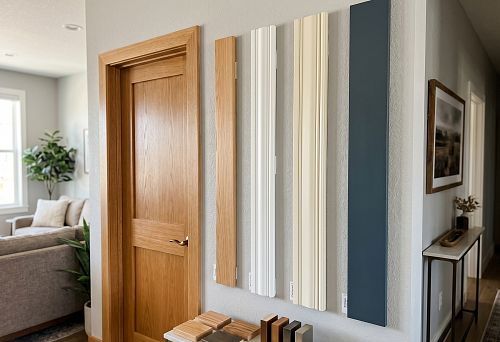
paintable slatted wall panels— profiles without a decorative layer, ready for painting with any paint. Absolute color freedom. Excellent in monochrome interiors: slats and polyurethane cornice painted in the same tone—a powerful modern technique.
Paired withinterior moldingfor painting, this solution creates a cohesive architectural image where the boundary between 'wooden' and 'molded' disappears—leaving a unified architectural surface.
Thermowood: Wet Areas Without Compromises
Thermally treated wood—natural wood whose cells have lost the ability to absorb moisture under high temperature. For Ufa apartments, this is a material for bathrooms, kitchen backsplashes, balconies, loggias. The characteristic dark chocolate tone with a matte surface adds contrast to light interiors.
Plaster decor in interiors: how it actually works
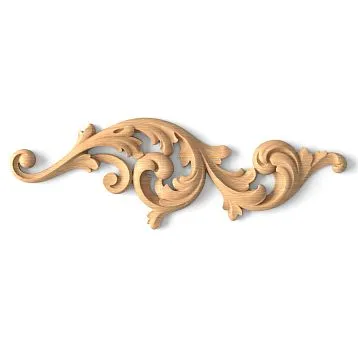
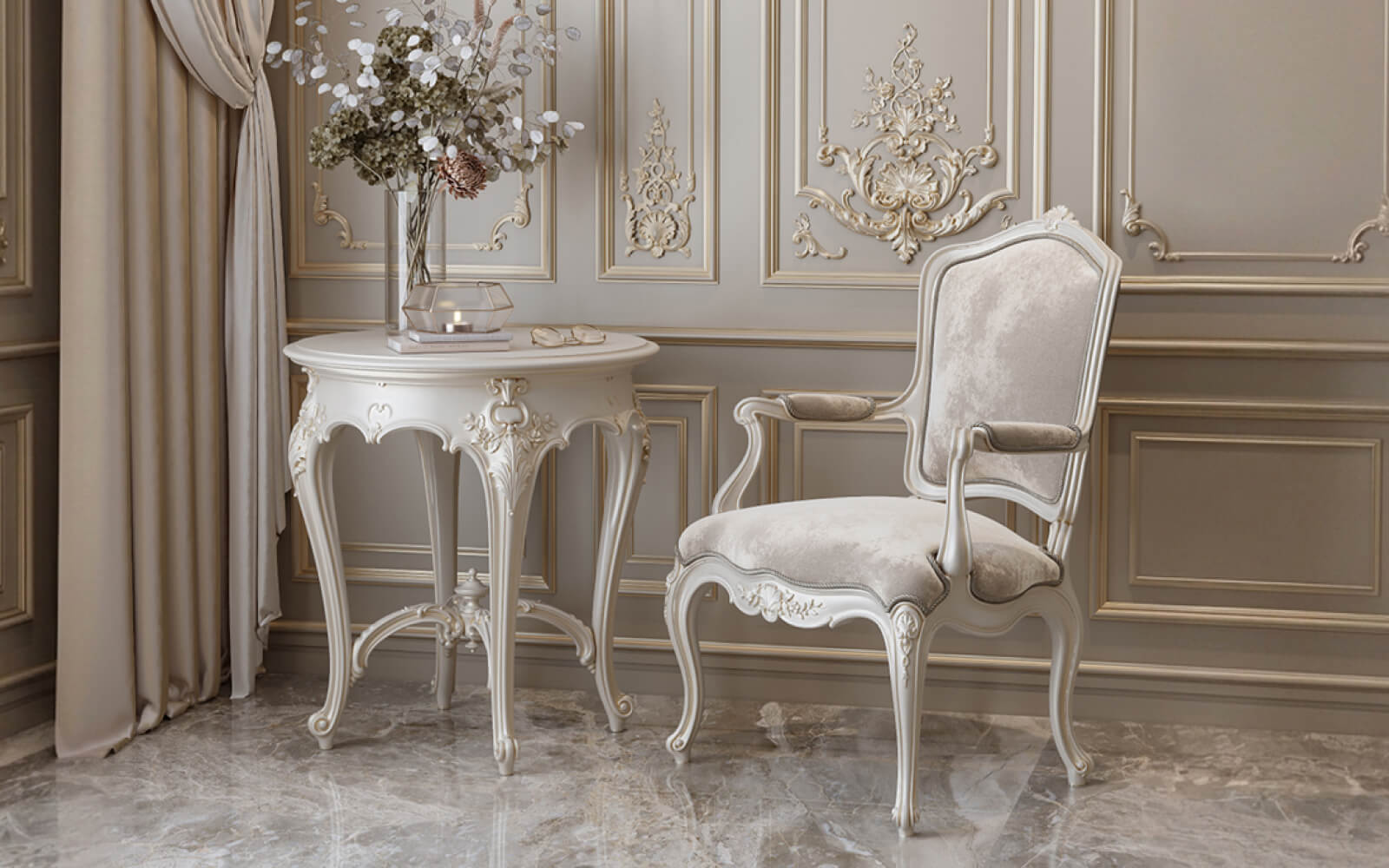
Relief Decoration— is not a synonym for 'classical' and certainly not a synonym for 'old-fashioned'. It is an architectural tool. And like any tool, it works well where it is applied for its intended purpose, and poorly — where it is taken because it 'looks nice in the picture'.
What is plaster decor functionally? It is a system of profiles, flat and relief elements that structure surfaces: they mark boundaries, create transitions, accentuate architectural nodes — corners, perimeters, ceiling centers, door/window surrounds.
Ceiling cornice: the boundary of two planes
The ceiling and wall are two planes that meet at a right angle. Without a cornice, this meeting looks unfinished: a technological joint, possible shrinkage cracks, just a boring line. The cornice turns this boundary into an architectural accent.
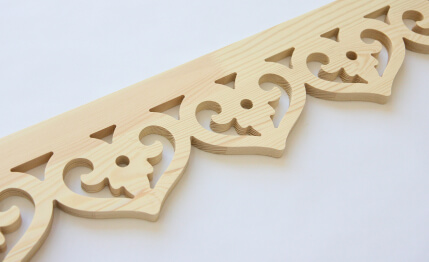
Important: a cornice does not have to be 'classical' with scrolls and egg-and-dart. ModernRelief Decor in Interiorincludes strict geometric profiles — a right angle, a soft ogee, a simple quarter round — which work equally well in Scandinavian minimalism and in neoclassicism.
Height rule: the cornice should be no more than 1/25–1/30 of the ceiling height. For a standard 2.6 m ceiling — a cornice of 85–100 mm. For a 3 m ceiling — up to 120 mm. For a ceiling of 3.5 m and above — 140–180 mm is possible.
Wall moldings: the frame structure of walls
Moldings create a geometric frame structure on the wall. In a classical interior, this is an imitation of expensive wooden paneling. In a modern one — it is simply architectural geometry, adding depth to the wall.
How do they work in combination with slats? The logic of a two-level wall:
-
The lower third is a slatted panel up to the horizontal strip.
-
Above is a wall with molding frames.
-
The transition is covered by a horizontal profile.
This scheme is one of the most elegant in modern interiors. It creates complexity without heaviness, richness without overload.
Sockets and central accents
A ceiling rosette is appropriate under three conditions simultaneously: the ceiling is not lower than 2.7 m, there is a classic chandelier in the center, and the interior style suggests at least some note of classic or neoclassical. Under other conditions, the rosette is unnecessary.
Casings and framing of openings
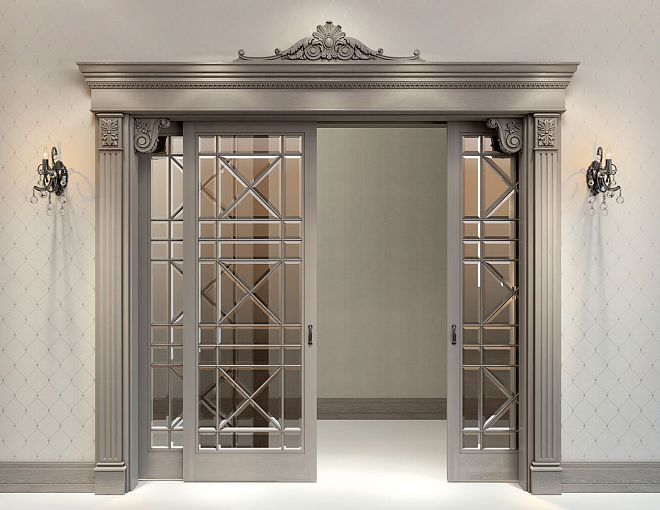
A door or window casing made of polyurethane is the boundary of the opening. With casing, the opening looks like a completed architectural element. Without it, it's just a hole in the wall. This is not an exaggeration: it is the casing that gives the opening 'framing', completeness, and presence in the space.
Combination scenarios: living room, bedroom, hall
Theory without examples is a lecture. Examples without theory are a set of pictures. Both are needed. Let's examine three specific scenarios.
Scenario one: living room in modern classic style
Initial conditions: 25 m² living room, 2.8 m ceiling, combined with kitchen. Task — create an expressive but not overloaded interior.
Solution:
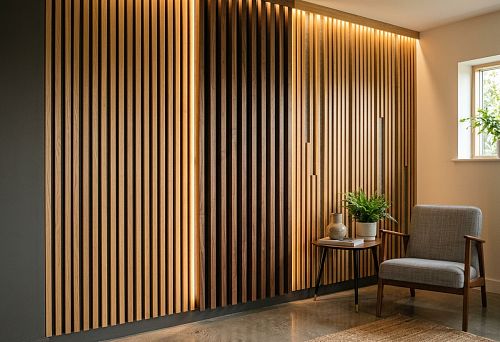
Slatted wall behind the relaxation area — solid oak in a warm tone, slat width 90–100 mm, floor to ceiling. This is the only active surface in the living room — everything else is neutral.
Cornice along the ceiling perimeter —interior moldingsin warm white, profile with soft ogee, height 105 mm. The cornice unites the entire ceiling perimeter — including the area above the kitchen — and creates a sense of integrity of a single space.
Moldings on the walls of the living area — thin rectangular profile 18–22 mm, frames 60–70 cm high along the lower third of the wall (except the slatted wall). Create a 'paneled' effect on the lower part of the wall without physical panels.
TV area:slatted panel for the television— if the TV area coincides with the slatted wall, the television is mounted directly to the wooden surface. If not — the TV wall is separated from the slatted wall by a pause: a neutral wall with molding frames.
Result: three tools (slats, cornice, moldings) create a unified architectural system. Each performs its own role, none competes with another.
Scenario two: bedroom as a recovery space
Initial conditions: bedroom 16 m², ceiling 2.6 m. Goal — maximum coziness, minimum irritants.
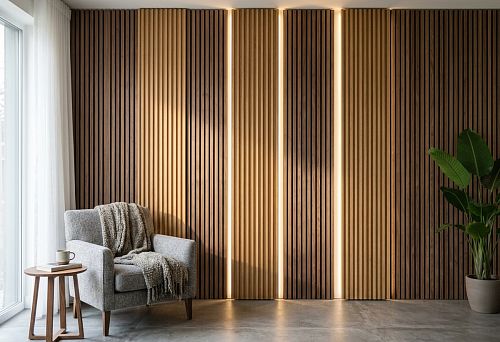
Slatted wall behind the headboard —slatted panels in the bedroommade of solid ash or light MDF, slat width 70–80 mm, dense rhythm. Warm milky or amber tone — not dark.
Cornice — simple geometric profile 65–75 mm, without ornament. In the bedroom, the cornice should not aspire to a leading role — it simply creates perimeter completeness.
No sockets — spot lighting in the bedroom is preferable to a central chandelier. A socket above the bed creates 'solemnity,' incompatible with the function of a rest space.
Slatted wall backlighting —Slatted panels with lightingwith warm LED strip 2700K in the gaps: soft light that emphasizes the wood texture, does not glare, creates a cozy evening mode.
Result: minimalist, warm, finished space. Slats are the only decorative element. Cornice — only perimeter completion. Lighting — functional and atmospheric simultaneously.
Scenario three: hall and entrance in a private house
Initial conditions: hall 12 m², ceiling 3.2 m, tall door 2.4 m. Task — to create a representative, memorable first impression.
Slatted wall opposite the entrance —Wooden slat panels— made of solid oak, slat width 110–120 mm, from floor to ceiling 3.2 m. Full format. With a 3.2 m ceiling, slats running from floor to ceiling create a powerful vertical accent — this is exactly what the hall needs.
Cornice —Relief Decor in Interior— with an expanded profile of 130–150 mm. With a 3.2 m ceiling, such a cornice is absolutely appropriate and gives the space the necessary scale.
Door architraves made of polyurethane — wide profile 80–90 mm, matching the height of the cornice. They frame the tall doors, creating a sense of architectural thoughtfulness.
Molding frames on the side walls of the hall — large, proportional to the height of the space. They create rhythm on the walls free of slats.
Result: a hall that is memorable. Where every element works towards a unified image — solid, architectural, without random details.
What needs to be checked before purchase: a checklist without discounts on 'good enough'
Before confirming the order for slatted panels and stucco decor, go through this list. It is written not for order's sake — each point eliminates a specific mistake.
For slatted panels
Slat geometry. Place on a flat surface — the slat should lie without gaps, not twist, not sag. Check several pieces from the batch.
Coating. Run your finger over the front surface — uniformity, absence of bubbles and drips. Inspect the ends: for solid wood — evenly oiled or varnished. For MDF — sealed, without delamination.
Tone. Lay the slats side by side in daylight. The tone should be uniform within the batch.
Smell. A sharp chemical odor is a warning sign. Oil coating has a light neutral aroma. A sharp chemical smell indicates poor-quality varnish or formaldehyde in MDF.
Solid wood moisture content. Optimal moisture content for Ufa before installation is 8–10%. Wood that is too dry at 5–6% will absorb moisture after installation and expand — gaps will close, but 'humps' may appear.
Availability of additional elements. Starter profile, finishing strip, corner elements — all of this should be included in the order. Without additional elementsinstallation of slatted panels on the wallwill look unfinished.
For stucco decor
Material density. High-quality polyurethane is elastic and dense—not soft like foam or hard like stone. When tapped, it produces a soft, muted sound, not a hollow one.
Clarity of relief. The ornament should have clear, even edges. Blurred relief is a sign of a poor-quality mold or low-grade material.
Tonal matching. Compare the cornice and slats under your lighting. Warm white and cool white are different tones that will clash if used together.
Element length. To minimize joints, choose cornices of the maximum possible length. A joint in the middle of a straight wall is an undesirable element.
Selection and installation mistakes: breakdown with explanations
First mistake: slats without framing
Installed a slatted wall and stopped. The top and bottom edges are unfinished. The slats 'hang' in space without a beginning or end. The result is a feeling of incompleteness that's hard to put into words but immediately visible to the eye.
Minimal solution: a horizontal molding or profile along the bottom edge (adjacent to the floor), a cornice or molding along the top edge (adjacent to the ceiling). This is enough to make the panel 'settle' into the space.
Second mistake: too many accent surfaces
Slatted wall + accent paint on another wall + ornamental ceiling + bright carpet. Each element demands attention. The eye jumps around, the brain gets tired. This isn't 'rich'—it's anxiety-inducing.
Rule: one decorative accent per room. All other surfaces serve as a neutral background that enhances the accent through contrast.
Third mistake: installation without acclimatization
Especially relevant in Ufa. The solid wood was delivered in winter when it was minus 25°C outside, and the apartment had dry heating air with 20% humidity. It was installed immediately. After a month—gaps between the planks; after two—small cracks along the grain.
Solution: acclimatize for at least 7 days in the room with heating on before installation. This is not an option—it's a mandatory condition for a quality result in a dry continental climate.
Mistake four: choosing a cornice from a photo without a sample
On screen, 'warm white' and 'neutral white' look almost identical. In a real room under your lighting—they are two different colors. The difference is especially noticeable under warm (2700–3000K) lighting: warm white becomes creamy, cool white becomes bluish.
Solution: always order a sample before the main order. View it in the room under the lighting that will be in the finished interior.
Fifth mistake: ignoring cornice proportion
A 160 mm cornice with a 2.5 m ceiling creates pressure that 'lowers' the ceiling. A small 40 mm cornice with a high 3 m ceiling looks accidental and doesn't work. Proportion is not an aesthetic whim—it's an architectural calculation.
Rule: cornice height = ceiling height (mm) / 25–30. For a 2500 mm ceiling—cornice 83–100 mm. For 3000 mm—100–120 mm.
Mistake six: buying at the lowest price without checking quality
"Why overpay — everything is the same." This is the most costly mistake in renovation. MDF with unsealed edges will swell after the first heating season. A polyurethane cornice with low density will deform during installation. Solid wood without edge treatment will start cracking within a year.
Redoing it costs more than making the right choice from the start. Always.
Slat panel formats: a practical navigator
Types of slat panelsdiffer not only in material but also in construction:
Single slat — installed individually on battens or directly on the wall. Maximum flexibility in pattern design: you can vary spacing, width, alternate materials.
slatted modular wall panel— slats pre-mounted on a backing as a ready-made module. Quick installation, guaranteed geometry, convenient for DIY installation.
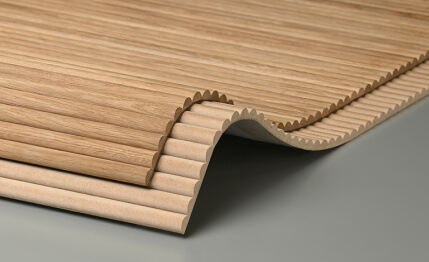
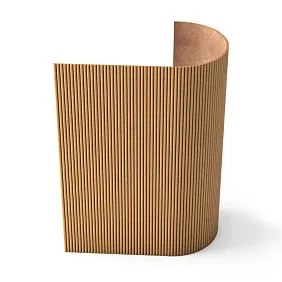
Soft (flexible) slat panels— slats on a flexible base that can follow curved surfaces. Relevant for arched openings, rounded columns, non-standard geometries.
Ceiling slat panels — Batten panels for ceilingsfeature a lightweight design with a hidden mounting system to the ceiling profile. Wall slats cannot be used on ceilings — the weight and mounting system are different.
Slat panels and stucco decor in different styles: compatibility table
| Interior style | Type of slat panel | Type of stucco decor |
|---|---|---|
| Scandinavian | Light MDF or ash, width 50–70 mm | Straight geometric cornice 50–70 mm without ornament |
| Modern Classic | Warm-toned oak, width 80–110 mm | Cornice with soft profile 90–120 mm, thin moldings |
| Neoclassical | Dense rhythm of slats in light wood | Cornice with ornamental belt 120–160 mm, rosette |
| Loft | Dark brushed wood or metal | Straight geometric cornice without ornament or without cornice |
| Eco | Thermowood or solid wood with matte oil | Minimalist skirting-cornice, without ornament |
| Minimalism | White or light gray MDF, narrow slat | Straight cornice 40–55 mm, perfectly straight angle |
Installation: key principles
How to install slatted panelsto the wall in a Ufa apartment — several mandatory principles:
Acclimatization — 7 days for solid wood, 3 days for MDF.
Battens — mandatory for solid wood, with a ventilation gap of 10–15 mm. For MDF, direct mounting on the wall with adhesive and fasteners is acceptable — if the wall is even.
Fastening spacing — no more than 400–500 mm along the length of the slat. Frequent fastening prevents the appearance of waves due to humidity changes.
Temperature gap — for solid wood, 1–2 mm between slats compensates for expansion. For MDF, the gap is according to the project or minimal.
Accessory elements — starter profile at the bottom, finishing profile at the top, corner trims.Installation of slatted panels on the wall without accessories — an unfinished result in any case.
Marking the first slat — the most critical stage. The first slat must be strictly vertical according to the level. All subsequent ones are mounted relative to it. If the first one is off — the entire plane 'leads'.
STAVROS: where to buy slatted panels for walls and stucco decor as a system
When you decide to buy slatted panels in Ufa and simultaneously select Relief Decorationas a unified finishing system — STAVROS is a manufacturer that operates precisely within this logic.
STAVROS producesRafter panelsfrom solid oak, ash, thermowood, MDF with film coating and for painting — in a wide range of formats and finishes. Simultaneously — a complete lineinterior moldingsmade of polyurethane: cornices, skirting boards, moldings, rosettes, architraves, overlay elements. All in one catalog, with guaranteed tonal and stylistic consistency.
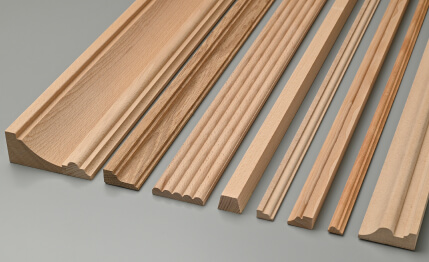
Pogonazh iz massivaSTAVROS — skirting boards, architraves, additional elements — covers all spatial transitions, ensuring that completeness which distinguishes a professional result from an amateur one.
Delivery to Ufa — standard service for any project scale. Order samples in advance, compare under your lighting in your space.
STAVROS is not just a materials supplier. It is a manufacturer that understands that an interior is a system where every element works for the whole. And this is precisely the difference between an interior that 'falls apart into techniques' and one that holds together as a unified architectural statement.
FAQ: Answers to popular questions
Is it possible to buy slatted wall panels with delivery to Ufa?
Yes. Most manufacturers of quality slatted panels work with delivery across Russia. It is recommended to order samples before the main order.
Which material for slatted panels better withstands the Ufa climate?
MDF with sealed edges is the most stable. Solid oak — with oil coating of the edges and back side, with acclimatization before installation. The main thing: proper treatment is more important than the wood species.
How does stucco molding combine with slatted panels?
By following the principles: tonal unity, scale correspondence, one accent per room. A delicate geometric cornice paired with a slatted wall is a safe solution for most styles.
Is sheathing needed when installing slatted panels on a wall?
For solid wood — mandatory. For MDF — optional if the wall is even. Sheathing with a ventilation gap is preferable in any case for durability.
Can slatted panels be used in the bathroom?
Yes, when using thermowood or WPC. Regular solid wood and standard MDF in a bathroom will not withstand constant moisture.
How to correctly determine the height of a cornice for your room?
Divide the ceiling height in mm by 25–30. The result is the recommended cornice height in mm. For a 2700 mm ceiling: 2700/27 = 100 mm.
How many slatted panels to take with a reserve?
10–15% of the calculated volume. In Ufa, considering logistics and possible reorders, it's better to take 15%.