Article Contents:
- What is KPU-121 and why 20 mm matters more here than it seems
- Two side lines: when 2 slats provide a more precise solution than a full frame
- When two verticals are especially appropriate
- Why two separate segments do not require a complex corner joint
- What the top line visually does
- When the third slat is justified
- Cutting of two strips for side lines
- Cutting of three strips for a U-shaped contour
- Why a nominal remainder of 1800 mm does not mean 'almost another frame for free'
- What to check before cutting
- Miter joint or direct abutment
- Along the outer edge of the slat field
- Along the edge of the substrate or smooth mounting strip
- With partial overlap onto the slat composition
- High soft upholstered bed headboard
- Low bed without a tall headboard
- Paired sconces
- Painting or panel above the bed
- Floating shelf
- Matching the painted wall
- In the color of the slats
- Contrast color
- 1. Record the actual dimension, not the design one
- 2. Make a full-size mock-up of 20 mm
- 3. Mark all obstacles
- 4. Lay out three slats before cutting
- 5. Perform a dry fit
- 6. Only after this proceed to adhesive installation
- How to check the proportion without buying a third slat
- What changes if the slat field is later increased in height
- For two verticals, the main reference is the real side boundaries of the field
- For a U-shaped contour, a unified geometry of all three sides is needed
- The bed is not always an exact template for the decorative field
- Why this affects the top line of 1800 mm
- A simple verification scheme
- Two verticals under side lighting
- Top line under directed light
- Distance changes the role of ornament
- Why cheap savings on cutting can turn out to be expensive visually
- Why first cut a small test section, not the main horizontal line
- One batch for three sides
- When a torn top is justified
- Why you can't automatically consider this option a way to save a third plank
- How a torn top differs from an installation error
- Pre-painting is convenient for protecting the finished wall
- Painting after installation helps assemble three parts into one contour
- For two verticals, the requirements are simpler
- The wall color does not mean the profile completely disappears
- The finish should be included in the test layout
- Mistake: buying a U-shaped option just for the sake of "completeness"
- Mistake: counting only 4200 mm and not looking at the pattern
- Mistake: running the profile along the uneven edge of the slats
- Mistake: gluing the molding over the relief without continuous support
- Mistake: choosing the color before checking the lighting
- Can KPU-121 be installed on only one side of the headboard?
- Do I need to run KPU-121 down to the floor behind the bed?
- Can the top line be made from two pieces to use up the leftovers?
- Should I make the bottom horizontal line and turn the П into a full rectangle?
- What to do if the finished headboard turned out to be 1815 mm wide instead of 1800?
- Can KPU-121 be mounted after painting the wall?
- What is better for hidden lighting around the headboard — two lines or a П?
- Can I use KPU-121 on adjacent furniture from leftovers?
- Do I need to buy a spare fourth slat for the U-shaped layout?
- What to choose if you want the most modern interior without the classic frame feel?
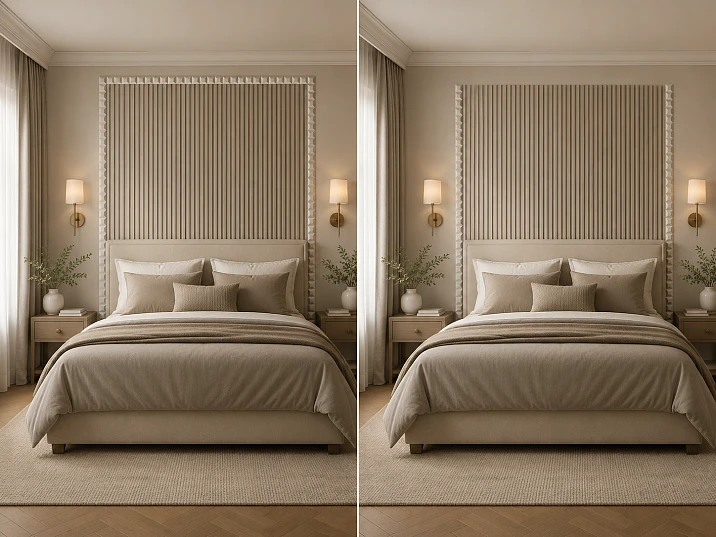
The slatted headboard is already assembled, the bed is in place, the vertical rhythm works — and it is precisely after finishing that a question often arises that didn't seem important in the visualization: do I need to additionally outline the edges of the slatted field?
For an area of 1800 × 1200 mm with decorative molding KPU-121 20 × 6 × 2000 mm, there are two reasonable scenarios. The first is to place the molding only on the two vertical sides. The second is to add the top horizontal line and get a U-shaped contour. In terms of pure length, this immediately changes the specification: for two side lines you need 2 slats, for the U-shaped option — 3 slats.
But buying a third slat just because "the frame looks more finished" is not worth it. The top line changes not only the length, but also the very character of the headboard. Two verticals support the direction of the slats and leave the composition open at the top. The U-shaped contour turns the slatted field into a standalone decorative panel with a clearly defined top boundary. In a bedroom, this can be both an advantage and an unnecessary architectural gesture.
Therefore, before ordering, three tasks need to be solved: calculate the length, check the cutting and joints, and understand whether the upper horizontal is needed for this particular room.
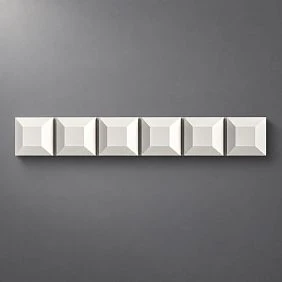
What is KPU-121 and why 20 mm matters more than it seems
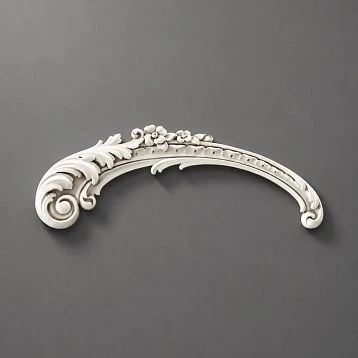
KPU-121 is a decorative polyurethane molding. The product has one current size — 20 × 6 × 2000 mm. In the working orientation, 20 mm is the visible width of the decorative strip on the surface, 6 mm is the relief protrusion, and 2000 mm is the length of one plank. The price of one plank at the time of preparing the material is 5,190 ₽.
| Parameter | KPU-121 |
|---|---|
| Type | decorative linear molding |
| Material | Polyurethane |
| Size | 20 × 6 × 2000 mm |
| Length of one plank | 2000 мм |
| Price per 1 pc. | 5 190 ₽ |
| 2 planks | 10 380 ₽ |
| 3 planks | 15 570 ₽ |
Buy decorative polyurethane molding KPU-121 can be purchased individually. For the headboard in question, the difference between two and three planks is 5,190 ₽, so the compositional solution has a very specific price.
The 20 mm width makes KPU-121 noticeably more delicate than a wide carved frieze. Against the background of vertical slats, such molding works primarily as a thin architectural boundary. It should not draw attention away from the wood, color, or rhythm of the panels. This is especially important near the bed, where a too complex frame quickly begins to be perceived not as finishing, but as a separate decorative object.
At the same time, 20 mm cannot be evaluated in isolation. The same profile on a 900 mm headboard and on an 1800 mm field will be perceived differently. Here, the horizontal width of the zone is 1800 mm, and the height is 1200 mm, so a thin strip along the edges works as a contour of a large object, not as an independent stucco detail.
Another significant parameter is the 6 mm protrusion. It is small, but with side lighting it gives its own shadow. If wall sconces are placed nearby, directed along the wall, the KPU-121 line can be read more noticeably than under diffused ceiling light. Therefore, the molding should be evaluated not only frontally, but also in the evening under the real lighting scenario of the bedroom.




Two side lines: when 2 planks give a more precise solution than a full frame
The most economical and at the same time the most calm option is to design only the left and right borders of the slat field.
The headboard height is 1200 mm. For two sides, you need:
1200 + 1200 = 2400 mm.
One KPU-121 slat has a length of 2000 mm, so it is impossible to get two whole verticals of 1200 mm from one. The minimum purchase is 2 slats.
Total purchased length:
2 × 2000 = 4000 mm.
Usable length of two verticals:
2400 mm.
Nominal remainder before accounting for cuts and fitting:
4000 − 2400 = 1600 mm.
Cost of two slats:
2 × 5 190 = 10 380 ₽.
Here, it's not so much the remainder that matters, but the character of the composition. Two vertical lines reinforce the already existing direction of the slats. The eye reads the vertical on the left, then the rhythm of the slat field, then the vertical on the right. The top remains visually open, and the slat zone does not turn into a frame.
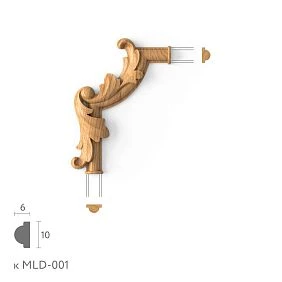
Our factory also produces:
When two verticals are especially appropriate
The first scenario — there is already a separate horizontal object above the bed. This could be a long painting, a composition of posters, a shelf, a linear light fixture, or a soft bed headboard with a pronounced upper horizontal line. If you add KPU-121 on top as well, several competing horizontal lines will appear in one zone.
The second scenario — the slats should visually stretch upward, even if they physically end at a height of 1200 mm. The open top preserves the sense of movement. A U-shaped frame, on the contrary, clearly fixes the finiteness of the field: here the panel begins and here it ends.
The third — the headboard is intentionally asymmetrical relative to the wall. For example, on the right there is a tall cabinet or door, on the left — a free plane with a wall sconce. Two side lines can correctly hold the boundaries of the local slat field, while the upper crossbar will enhance the feeling of a separate "portal" that will begin to compete with the asymmetry of the room.
The fourth — the upper edge of the slats is already made very neatly. If the ends and the transition to the painted wall are clean, with no technological gap that needs to be hidden, the upper KPU-121 performs an exclusively decorative function. In such a situation, it can be omitted without a feeling of unfinished renovation.
Get Consultation
Why two separate segments do not require a complex corner joint
In the variant with two verticals, there are no two upper corners where the horizontal profile must meet the vertical one. This reduces cutting requirements. Each side is an independent straight segment 1200 mm long.
If the top end remains visible, it needs to be thought through in advance. There are three approaches: a neat straight end, a decorative return to the wall, or finishing at a point that is covered by another architectural element. Which option to choose depends on the pattern of the KPU-121 itself and on how closely a person looks at the profile.
It is precisely the simplicity of these two lines — the main practical advantage. If the task is to make the edges of the slat zone neater, but not to turn it into a separate framed composition, 2 strips are a logical starting option.
U-shaped contour: why the third strip changes not only the price, but also the architecture of the headboard
For the U-shaped scheme, an upper line 1800 mm long is added to the two verticals.
Full net length:
1200 + 1800 + 1200 = 4200 mm.
Two KPU-121 planks total 4000 mm. Even without accounting for cuts, 200 mm is missing. So, at least 3 planks are needed.
Total purchased length:
3 × 2000 = 6000 mm.
Nominal remainder after net length:
6000 − 4200 = 1800 mm.
Cost:
3 × 5 190 = 15 570 ₽.
Compared to two side lines, the surcharge is 5,190 ₽.
At first glance, it seems the third plank is bought for one upper segment of 1800 mm. But practically, it provides two more things: cutting freedom and the ability to better position the ornament in the corners. This is especially useful if the decorative pattern of KPU-121 has pronounced repeating fragments and you don't want to join the profile randomly.
What the upper line does visually
The U-shaped framing fixes the upper boundary of the slat field. After installation, the headboard is perceived not as part of the wall finish, but as a separate decorative panel. For a bedroom with a symmetrical bed, paired nightstands, and paired sconces, this often works convincingly: a single central composition appears, inside which the bed is located.
But the same frame can become superfluous if the interior is built on free verticals and a minimal number of contours. The more rectangular shapes already exist around the bed — a soft headboard, two nightstands, posters, a niche, ceiling lighting — the more carefully you need to add another U-shaped perimeter.
A 20 mm wide molding doesn't look heavy on its own. The risk of overload comes not from the profile's thickness, but from duplicating geometry. If the top line repeats an already existing line of the bed's headboard, a picture frame, and a niche cornice, the composition becomes too "drawn out."
When a third slat is justified
It is justified if the top of the slat field truly looks unfinished. For example, slats end on a painted wall without another transition element, and at a distance of a few meters, the top edge is perceived as an accidental break in texture.
Another strong scenario is when the slat field acts as an independent panel rather than part of the wall. Then the U-shaped outline tells the viewer that the boundary is set intentionally: two vertical edges and the top form one architectural figure.
The third situation is when you need to separate a warm wood texture from a contrasting painted wall. If there is light paint above the slats and the slats themselves are dark, a thin polyurethane strip can create a clean intermediate contour.
Finally, the U-shaped scheme is convenient if the bedroom composition is strictly symmetrical. In this case, the top line connects the two verticals and makes the entire block complete.
You can't choose 2 or 3 slats just by length: first check the cutting layout
Pure arithmetic only answers the question of how much material is needed in ideal geometry. The real cutting layout must account for saw cuts, end trimming, pattern placement, possible wall defects, and the method of forming the top corners.
Cutting layout of two slats for side lines
The simplest scheme:
-
plank #1 → left segment 1200 mm;
-
plank #2 → right segment 1200 mm.
The remainder of each plank is about 800 mm before accounting for the cut.
This scheme is good because both sides can be cut from identical sections of two planks. If the pattern repeats, the craftsman can start both vertical segments from a similar point in the design so that the left and right sides are perceived as a pair.
It is impossible to get both verticals from one plank due to length: 1200 + 1200 = 2400 mm. Therefore, in the two-side option, there is no point in saving on the second plank through complex joining of the verticals. A joint at a height of 1200 mm for the sake of saving provides no benefit — a second plank will still be needed.
Cutting three planks for a U-shaped contour
The most clear scheme:
-
plank #1 → left vertical 1200 mm;
-
plank #2 → right vertical 1200 mm;
-
plank #3 → upper horizontal 1800 mm.
This cutting leaves large remnants but gives maximum freedom in selecting the pattern.
A more economical scheme is possible, where part of the upper line is obtained from the remnant after the vertical, and the remaining section from another plank. However, this introduces an additional joint on the upper horizontal. For decorative molding above the bed, such a joint is not always justified: it is in the most visible area and may disrupt the pattern.
Therefore, saving material within the already purchased three planks should not be done at any cost. If the third plank is paid for anyway, it is more logical to make the top from the longest possible solid piece and use the remnants elsewhere in the interior.
Why the nominal remnant of 1800 mm does not mean "almost another frame for free"
After the U-shaped contour, 1800 mm remains arithmetically. But the remnant is distributed among several planks. It may consist, for example, of 800 + 800 + 200 mm. This is not the same as one solid piece 1800 mm long.
When planning other elements, one must consider the lengths of specific remnants, not just their sum. They are useful for short decorative inserts; for a long continuous line, they are not.
The upper corners are the main technical node of the U-shaped variant
In the variant with two side lines, the upper ends simply terminate. In the U-shaped scheme, two junctions appear: on the left and right, the horizontal KPU-121 must connect with the vertical.
It is here that the quality of execution determines whether the composition will look like a single frame or like three glued strips.
What to check before cutting
First, check the actual geometry of the headboard. The 1800 × 1200 mm size in the project does not guarantee that the finished corners are exactly 90°. Even a slight deviation of the wall or panel edge becomes noticeable on a thin decorative profile.
Second, the KPU-121 pattern. If the ornament is directional or has a pronounced center of a repeating fragment, a standard corner miter can break the motif in an unfortunate place. Before cutting, it is useful to lay out the slats on the floor and choose which sections will meet at the two upper corners.
Third, the position of the molding relative to the edge of the slats. You need to decide what exactly is considered the boundary: the outer edge of the last slat, the edge of the backing, the edge of the finished panel assembly, or a specially left smooth strip. These options give different external widths of the U-shaped contour.
Mitered joint or direct abutment
For many frame compositions, a 45° miter is used because it connects the horizontal and vertical into a single turn. But the specific method needs to be checked against the profile relief. On carved molding, the pattern in a diagonal seam may align worse than on a smooth molding.
Direct abutment of one piece into the end of another is technically simpler, but visually creates a priority of one line: either the horizontal lies on top of the verticals, or the verticals butt into it. For a calm modern bedroom, this is sometimes acceptable, but the decision must be made symmetrical on both sides.
Do not determine the type of corner after gluing the two verticals. The U-shaped scheme should be laid out and checked entirely before installation.
Where exactly to run KPU-121 relative to the slat field
Even if the number of slats has already been chosen, the question of position remains. An error of 10–15 mm can change perception more strongly than the transition from two slats to three.
There are three main ways.
Along the outer edge of the slat field
The molding is installed directly next to the outermost slat and outlines the overall dimensions of the finish. This is the most "framing" option. It works well if the edge of the slats is even, identical on the left and right, and the molding noticeably differs in color from the wood.
Risk — visual merging. If KPU-121 is flush against the volumetric outermost slat, two different reliefs may be perceived as one overly complex edge. Verification is done with a full-size profile fragment or a rigid template.
Along the edge of the substrate or smooth mounting strip
If the slat system is mounted on a background panel, a narrow smooth zone may remain around the perimeter. Then KPU-121 can be placed on this plane. A small background appears between the last slat and the molding, separating the two textures.
This option usually looks calmer and makes the thin polyurethane line independent.
With partial overlap onto the slat composition
This method is only possible after checking the actual flatness. The molding must have sufficient support for adhesive mounting. You cannot expect a long profile to lay correctly across alternating protruding slats and gaps if there is no continuous base behind it.
For an already finished headboard, it is more practical to use the adjacent smooth plane rather than trying to turn KPU-121 into a "bridge" across the slat relief.
Two verticals or P: comparison by five criteria
| Criterion | Only two side lines | P-shaped contour |
| Number of KPU-121 | 2 pcs. | 3 pcs. |
| Cost of linear footage | 10 380 ₽ | 15 570 ₽ |
| Net length of decor | 2400 мм | 4200 мм |
| Character of composition | Open upward, vertical | Finished panel, framed |
| Top corner joints | No | 2 pcs. |
| Risk of conflict with picture/sconce | Below | Higher |
| Cutting requirements | Simple | higher due to two corners and the top line |
| When to choose | need to emphasize the edges | need to finish the entire block |
This table shows the main thing: the third plank is bought not for abstract "beauty." It adds 1800 mm of top horizontal, two corner joints, and a new compositional contour.
If the room benefits from these three changes, the U-shaped solution is justified. If not, two verticals give a cleaner result and at the same time cost less.
How the solution depends on furniture, sconces, paintings, and bed height
The headboard cannot be considered separately from the objects in front of it. After installing the bed, the visible part of the slatted zone decreases, and part of the vertical lines may be covered by a soft headboard.
High soft bed headboard
If the soft back rises to 900–1100 mm, the slatted field 1200 mm high remains open at the top as a relatively narrow strip. In such a situation, the upper KPU-121 may be too close to the top edge of the soft headboard and create a "box" around a small visible area.
Two side lines here are often more stable: they are visible on the sides of the bed and do not require a large open top area.
Low bed without a high headboard
With a low headboard, most of the slat field remains visible. Then the U-shaped contour can work much better: the viewer sees the entire panel as a whole, and the top line truly completes a standalone decorative block.
Paired sconces
If the sconces are located inside the slat field and are symmetrical, the U-shaped frame enhances this symmetry. But you need to check the distance from the upper KPU-121 to the light fixture housings and their shadows.
If the sconces are placed outside the slats, the side lines may end up near them. Then it is important that the molding does not pass through the mounting bases of the fixtures and does not create too cramped a decorative node.
A painting or panel above the bed
A large horizontal painting already sets the top line of the composition. The U-shaped KPU-121 below it forms another one. If the distance between them is small, the two lines compete.
In such a case, it is reasonable to first model only the side profiles. If the field looks complete without the top line, the third plank is not needed.
Floating shelf
The shelf is stronger than the painting because it has real thickness and shadow. The upper horizontal KPU-121 next to it almost always requires a separate check: two parallel lines can visually "pinch" a section of painted wall.
Color of KPU-121: matching the wall, slats, or as a separate contrast
Polyurethane molding can be incorporated into the composition in different ways. The color determines whether it becomes a frame or remains an almost invisible border.
Matching the painted wall
This is the most delicate option. KPU-121 retains relief and shadow but does not create a color edging. Suitable if the goal is to architecturally finish the edges without adding another material.
For a U-shaped scheme, this is especially useful: the upper line does not become a rigid graphic strip above the bed.
In the color of the slats
This approach visually expands the wooden composition. But achieving a convincing match with natural wood using paint alone can be harder than it seems. Wood color changes depending on lighting, and painted polyurethane reflects light differently.
Therefore, the "matching the slats" option is better evaluated on a physical sample rather than on a screen.
Contrast color
Contrast turns the 20-millimeter KPU-121 into a graphic outline. For example, a dark line around a light slat field or a light line around a dark one.
This is no longer neutral finishing. Especially a U-shaped frame will be noticeable at first glance. This option makes sense if the framing effect is a conscious part of the project.
For the two side lines, contrast works differently: verticals become more noticeable and can visually make the headboard taller.
When it's better not to use KPU-121 at all
A commercial article is only useful when it helps not only to buy but also to refuse an unsuitable purchase.
The first case is when the slat field itself already has a finished edge. For example, the outer slats are wider, there is a wooden finishing profile, or a frame is part of the panel's construction. Adding polyurethane will create a second contour next to the first.
The second is when the bedroom has too many other decorative lines. Wall panels, ceiling cornice, tall ornate baseboard, door framing, complex sconces, and carved furniture can make even a thin KPU-121 unnecessary.
The third is when the headboard is in a narrow niche. If the edges of the slat field already align with the side walls of the niche, separate verticals don't add a boundary—it exists structurally.
The fourth is when there is no flat mounting surface. If only a textured surface remains around the slats or the edge of the backing is unstable, the structural joint needs to be resolved first. Decorative trim should not compensate for poor base geometry.
The fifth is when an absolutely minimalist interior is needed. Sometimes a clean transition from slats to a painted wall looks better than any additional frame. Especially if the slats themselves are high-quality and their ends are part of the design.
In such situations, it's better to either leave the headboard without stucco decor or compare KPU-121 with a simpler profile in the section of polyurethane moldings.
When instead of KPU-121, it's worth looking at other trim or molding
KPU-121 has a specific pattern and width. If its character doesn't suit the bedroom, you don't have to give up on the idea of framing itself.
In the section polyurethane molding You can compare products with a different pattern and scale. This is useful if the "two verticals" or "U" scheme is already chosen, but the decorative molding KPU-121 itself seems too prominent or, on the contrary, not expressive enough.
A smooth molding is better when the border should be almost technical. It supports the geometry but doesn't add a separate ornamental layer.
Decorative trim is more appropriate if there are already classical or neoclassical motifs around the bed: profiled nightstand fronts, a molded ceiling cornice, decorative handles, upholstered furniture with pronounced geometry.
When choosing an alternative, compare not only the width. The relief, depth, pattern repetition character, and how the profile looks at the corner are important. For a U-shaped scheme, the ability of the pattern to neatly pass through the two upper turns is especially important.
Installation on an already finished slatted headboard: an order that reduces the risk of rework
Since the slatted field is already installed, the task is simpler in one respect and more complex in another. The geometry is visible in person, but a marking error can damage the finished paint or adjacent panels.
1. Fix the actual dimension, not the design one
Re-measure the width along the top edge, the width in the lower visible part, and the height on the left/right. If the values differ, first determine along which line the trim should run.
For a U-shaped contour, it's especially important to understand what will be considered a right angle — the geometry of the wall or the geometry of the slatted field.
2. Make a full-size layout 20 mm
Use masking tape about 20 mm wide to mark two vertical lines. Look at the headboard from the bedroom entrance, from the bed, from the side, and with the sconces on.
Then add a top line of the same width. This is the cheapest way to understand whether the third plank is worth its 5,190 ₽ visual change.
3. Mark all obstacles
Check outlets, sconce wiring, cables, decorative switches, the edge of nightstands, trim of the adjacent door, and ceiling drops. The KPU-121 must run along a continuous base area.
4. Lay out the three planks before cutting
If the U-shaped option is chosen, do not cut each plank separately right after unpacking. First, select a section for the top horizontal and two sections for the verticals. Match the pattern at the future corners.
5. Perform a dry fit
All pieces are placed without glue. Check height, symmetry, angles, joints, gaps, and the outer contour.
6. Only after this proceed to adhesive installation
The type of adhesive and surface preparation must comply with the recommendations for polyurethane decor and the actual wall surface. Painted walls, plaster, MDF backing, and other substrates require different preparation.
If necessary, it is better to choose installation materials at the same time as the decorative profile, rather than after receiving it.
What to do with leftovers after 2 or 3 slats
Leftovers are not a reason to buy extra decor, but with proper planning, they can be useful.
After two verticals, approximately two long pieces of about 800 mm remain. They can be kept as a repair reserve. This is more practical than immediately turning leftovers into random frames: if one of the side profiles is later damaged, material from the same batch and with the same pattern will be useful.
After the U-shaped scheme, larger total reserves remain, but their lengths depend on the cutting layout. They can be used to make a small line above a cabinet, an accent on a furniture facade, or short decorative inserts—only if such an element is already planned in the project.
Do not try to "utilize" every centimeter in the same bedroom. Repeating KPU-121 on several small objects near the bed can destroy the advantage of a local accent.
Proportions 1800 × 1200 mm: why the same framing is perceived differently on a wide and tall headboard
The size of the slat field affects the decision more than it seems. In this case, the width of 1800 mm is one and a half times greater than the height of 1200 mm. That is, the panel itself already has a pronounced horizontal proportion, although the pattern of slats inside it is vertical.
This creates an interesting balance. On one hand, the vertical slats visually stretch the composition upward. On the other, the overall rectangle of the headboard remains wide. The two side lines of KPU-121 support the vertical component and do not enhance the horizontal format. The top line, on the contrary, makes the width of 1800 mm visually obvious and makes the rectangular geometry more apparent.
Therefore, the U-shaped variant more strongly changes the perception of a wide headboard. It says: before us is a finished panel 1.8 m wide. Two verticals say something else: before us is a section of wall with a special texture, bounded on the sides, but continuing the visual movement upward.
How to check the proportion without buying a third slat
Take painter's tape or a paper strip about 20 mm wide and first mark only the side boundaries. Then add a top line 1800 mm long. After that, step back not half a meter, but to the distance from which the headboard is most often seen: from the entrance to the room, from the opposite corner, from the window.
At close range, the relief of KPU-121 captures attention. From two to three meters, it is no longer the pattern that is read first, but the geometry of the contour. It is at this distance that it becomes clear whether the top line turns the headboard into a neat panel or makes it visually too rigid.
It is also useful to take a photo with your phone strictly from the front. In a static frame, it is easier to see an excess of horizontals: the top of the soft bed, KPU-121, a picture, a cornice, a shadow from a shelf. If there are too many of these lines, two verticals give a cleaner structure.
What changes if the slat field is later increased in height
If 1200 mm is not the final size and the panels are planned to be raised in the future, buying a U-shaped frame in advance is risky. The top profile ties the composition to the current height. Two side lines leave more freedom: they can be extended or replaced without redoing the entire top boundary.
If the dimensions of 1800 × 1200 mm are final, and the top of the slats is specially finished at this mark, the U-shaped scheme has more justification. In this case, the top line fixes an already accepted design decision, not a random intermediate height.
What to anchor KPU-121 to: the edges of the slats, the bed, or the central axis of the room
One of the common reasons for a visually "crooked" frame is not poor installation, but an incorrect coordinate system. In a bedroom, there are at least four axes simultaneously: the center of the wall, the center of the bed, the center of the slat field, and the axis of the decorative contour. In an ideal project, they coincide, but in a real room, this is not always the case.
For example, a wall may be 3600 mm wide, the bed may sit slightly to the right due to a door, and the slat panel may be aligned precisely with the bed. If the KPU-121 is positioned relative to the wall rather than the finished headboard, a few millimeters or centimeters of misalignment will appear, which will be especially noticeable on the U-shaped frame.
For two verticals, the main reference points are the actual side boundaries of the field.
If the option with two slats is chosen, each line must work with a specific edge of the slats. Here, the most important thing is the same principle on the left and right: the same offset, the same abutment, the same starting and ending height.
With slight asymmetry in the room, two verticals can "absorb" it: the viewer primarily perceives the local area of the bed.
For a U-shaped contour, a unified geometry of all three sides is needed.
After the top line appears, errors become more noticeable. The horizontal must be perpendicular to both side lines and visually correspond to the top edge of the slat field. If one vertical follows a slightly tilted edge of the panel, while the top runs strictly level, the corner reveals the discrepancy.
Therefore, before marking the U, you need to decide what is more important: to follow the actual edge or to create an ideal geometric frame. Sometimes it is reasonable to leave a small visual gap between the KPU-121 and the outermost slat, which will absorb micro-irregularities and allow the trim to be run along its own straight line.
The bed is not always an exact template for the decorative field.
The width of the slat headboard of 1800 mm may match the bed's dimensions, or it may be wider. You should not automatically align the KPU-121 with the edges of the soft backrest. If the trim outlines the slat field specifically, its boundary is determined by the wall finish. If the task is to create a unified "portal" around the bed, then the connection to the furniture becomes more important.
These two approaches cannot be mixed. In the first case, the KPU-121 is a frame for the finishing material. In the second, it is an architectural framing of the furniture composition. For our task, it is safer to start from the actual 1800 × 1200 mm slat field and only then check how well it aligns with the bed.
External or internal contour: one KPU-121 can change the actual size of the composition
The phrase "frame a field of 1800 × 1200 mm" does not fully define the cutting layout. You need to understand where the axis of the 20-millimeter trim runs relative to the edge of the slats.
If the KPU-121 is completely outside the slat field, the internal frame size retains the original 1800 × 1200 mm, while the external dimension increases by approximately the profile width on the corresponding sides. Two side lines give a wider composition, a U-shaped one also gives a taller external dimension.
If the trim partially overlaps the edge of the slat zone, the external dimension increases less, but part of the outermost slats is visually eaten up. With a profile width of 20 mm, this can be noticeable, especially if the outermost slat is itself narrow.
The third option is to place the KPU-121 on a separate smooth strip between the slats and the painted wall. Then a small buffer appears. This technique often works better with an active wood grain pattern, because it does not push two reliefs close together.
Why this affects the top line of 1800 mm
If two verticals are placed outside and the top horizontal runs between their inner or outer edges, the actual length of the top segment may differ from the original 1800 mm. Therefore, the 1800 mm size in the article is the original dimension of the slat field, not a universal command to "cut exactly 1800" before marking.
The correct sequence is the reverse: first determine the position of the side lines on the finished wall, then take the actual size between the junction points, and only then cut the top KPU-121.
The number of slats does not change from this: the U-shaped scheme still needs three two-meter blanks. But the quality of the top corners depends on the exact installation size.
Simple verification scheme
Draw three lines on painter's tape or the wall: the edge of the slats, the inner edge of KPU-121, and the outer edge of KPU-121. Do this at least over a 300–400 mm section near one corner. This makes it clear whether the profile covers part of the wood, whether a smooth background remains, and how far the decorative contour extends onto the painted wall.
Such a local test is more useful than the abstract phrase "the profile is only 20 mm." At a real joint, these 20 mm interact with the width of the outermost slat, the gap between the lamellas, and the wall color.
Lighting and viewing distance: why a 6 mm profile can become the main feature in the evening
Decorative trim is evaluated not only by its frontal width. KPU-121 protrudes from the base by about 6 mm, thus creating its own light-and-shadow pattern. In a bedroom, this is critical: daytime and evening scenarios here often differ more than in a living room.
With diffused ceiling light, the profile may look like an almost flat thin line. If wall sconces are installed on both sides of the bed, light hits the wall tangentially, so even a slight relief is noticeable. Then the vertical KPU-121s become more visible, and the top horizontal line may get a pronounced shadow.
Two verticals under side lighting
If the sconces are placed symmetrically, the two side lines receive similar illumination and reinforce the vertical organization of the composition. This is a good scenario for a calm interior: the trim is noticeable in the evening but almost disappears during the day.
However, if one sconce is closer to the profile and the other is farther, the shadows may differ. Before purchasing, it is useful to simulate the line not only with flat tape but also with a thin slat or cardboard strip with a slight protrusion.
Top line under directed light
The horizontal KPU-121 can cast a shadow downward onto the painted wall or the top of the slat field. Depending on the placement of the light fixtures, this shadow either enhances the frame effect or creates an additional horizontal band that was not present in the daytime version.
That is why the U-shaped contour should be evaluated in the evening. If the shadow makes the top too heavy, two side lines may be better even in a perfectly symmetrical room.
Distance changes the role of ornament
From a distance of 50–70 cm, a person sees the texture of KPU-121 and the quality of the joint. From two to three meters, the pattern becomes secondary, and the overall contour remains the main thing. Therefore, the decision about two or three planks should be made from the main viewing point, and the quality of the corners should be checked up close. These are two different checks and they do not replace each other.
The cost of the solution is not just 10,380 or 15,570 ₽
The price of the planks themselves allows you to quickly compare two options, but for a real estimate, you need to take into account installation and finishing. At the same time, you cannot assign a universal amount for glue, painting, and work without knowing the base, the chosen composition, and the installation method.
But you can understand in advance which items will appear in the cart and in the work.
For the option with two verticals, you will need two KPU-121 planks, a suitable mounting compound, materials for treating cut areas, and the chosen finishing coating if the molding is painted.
Why cheap savings on cutting can turn out to be expensive visually
Attempting to assemble the top line from several scraps instead of a solid 1800-millimeter section can reduce the amount of waste, but not the number of planks purchased: there are still three of them. If an extra joint falls in the center and disrupts the pattern, there is no savings—the material is already paid for, and the quality is worse.
Therefore, after switching to three planks, the main cutting criterion changes: not minimal waste, but the best appearance and reliable installation.
Two-meter strips before installation: how not to lose geometry even before fitting
KPU-121 has a length of 2000 mm. For the headboard in question, this is convenient: the top horizontal 1800 mm fits into one blank, and each vertical 1200 mm — even more so. But long decorative elements require careful handling before cutting.
Do not lean a two-meter strip on one end and store it at an angle for a long time near the work area. Before marking, it is better to lay the piece on a flat surface and inspect it along its entire length, checking edges and pattern.
For a U-shaped scheme, it is useful to immediately mark the blanks: "left", "top", "right". If the pattern has a pronounced direction, also mark the top and bottom of each future element. Such simple marking reduces the risk of mixing up parts after trimming.
Why first cut a small test section, not the main horizontal
If the craftsman is working with this profile for the first time, it is logical to check the cut quality on the area of the future remainder. This way, you can see whether the edge chips, how cleanly the relief is cut, and what actual allowance the tool takes.
After that, the main segments are marked. Particular care should be taken with the top 1800-mm piece: if it is damaged, it can only be replaced with a whole piece from another two-meter strip.
One batch for three sides
If the U-shaped contour should look unified, it is reasonable to order all three strips at once. Even with subsequent painting, this simplifies pattern matching and installation organization. After completion, it is better to label the leftovers and store them with article information — they may be useful for local repairs.
Information link: when you first need to resolve the issue of the slat panels themselves
This article assumes that the headboard is already finished. If the slat zone is still only being designed, the sequence should be different: first, the dimensions of the field, material, and rhythm of the slats are chosen, then the method of finishing the edges, and only after that the specific linear footage.
In the broader STAVROS material on slat panels in the bedroom and polyurethane decor the role of the slat headboard in the bedroom composition is examined. For our task, this material is useful as a previous level of choice: first determine the architecture of the zone, then decide whether it needs the KPU-121 frame.
If the 1800 × 1200 mm field already exists, there is no need to return to general theory. Here the decision is local and measurable: two verticals, a U-shaped contour, or a complete rejection of additional trim.
Alternative to two schemes: a broken upper contour if the center above the bed is already occupied
Sometimes the choice of "two verticals or a solid U-shape" turns out to be too rigid. If a painting, decorative panel, or central light fixture is already planned above the bed, a third compositional principle can be considered: two side lines plus short upper sections only near the corners, leaving the center open.
This is no longer the original U-shaped frame and requires a separate sketch, but the option has practical meaning. It preserves the connection of the verticals with the upper boundary without running a long 1800-millimeter strip directly under the painting.
When a broken top is justified
It is appropriate if the central object above the bed itself forms the upper boundary. For example, a wide panel starts slightly above the slats and visually covers the middle. A full horizontal KPU-121 in this case runs parallel to the lower edge of the painting and can create unnecessary duplication.
Short upper "shoulders" allow you to frame the corners of the slat field while keeping the center calm. But this technique only works as a deliberate symmetrical composition. Two random short segments of different lengths will look like a shortage of material.
Why you cannot automatically consider this option as a way to save a third slat
If two vertical segments of 1200 mm are used plus additional upper sections, their actual length must be calculated. The remnants from two slats after the verticals are approximately 800 mm each before accounting for cuts. Theoretically, the material may be enough for the short shoulders, but the length, pattern repeat, and corner cuts must be checked on actual workpieces.
The main point of this option is not savings, but aligning the frame with the central object. If a third slat is still needed for a beautiful pattern, that does not make the solution wrong.
How a broken top differs from a mounting error
A deliberate break must be obviously symmetrical and connected to another object. For example, the edges of the upper sections end on the same line as the side borders of the picture. Then the viewer understands the logic.
If the top is simply assembled from remnants and breaks off without reference to the composition, it is perceived as incompleteness. Therefore, such a scenario cannot be accepted directly on site after cutting. It must first be drawn or assembled from painter's tape.
For most calm bedrooms, the initial choice is still simpler: either two clean verticals or a full U-shaped contour. A broken top should only be used when the central element truly requires free space.
Painting KPU-121 before or after installation: what changes on an already finished wall
Since the slat headboard and painted wall are already finished, the finish of the molding becomes a separate task. There is no single universal order for all coatings, but there is a clear logic of choice.
Pre-painting is convenient for protecting the finished wall
If KPU-121 needs a contrasting color, pre-applying the main finish coat reduces the amount of painting work near the battens. This is especially convenient when the wood surface is already coated with oil or varnish and you prefer not to cover it with painter's tape unnecessarily.
However, after cutting, fresh ends appear, and after installation, there are joints and fitting spots. These still need to be touched up locally. Therefore, "painting everything in advance and never returning to the finish" is usually unrealistic for a U-shaped frame with two corners.
Painting after installation helps assemble three parts into one contour
When KPU-121 is painted in the wall color, the finish after installation can visually unify the profile with the base and make joints less noticeable. However, this method requires particularly careful protection of the battens.
If there are only a few millimeters between the trim and the wood edge, the painter's tape must be applied without overlapping the decorative coating of the battens. Before starting work, it's worth checking how the tape peels off the specific surface to avoid damaging oil, wax, varnish, or film.
For two verticals, the requirements are simpler
Two straight segments have fewer joints, so they are easier to prepare and partially paint in advance. The top ends can be finished after cutting, while the long face surfaces will already have the base color.
In a U-shaped layout, the main problem areas are the two top corners. If the pattern requires fitting, the final finish is more logically done after a test assembly, when you can see where correction is actually needed.
Wall color does not mean the profile completely disappears
Even with an exact color match, KPU-121 remains three-dimensional. Its 6-millimeter relief creates a shadow, so the profile reads as an architectural line without separate color contrast. This is a good way to make the U-contour calmer.
Contrast painting works the opposite way: the geometry becomes noticeable even in low light. For two verticals, this can emphasize height; for a U-shape, it turns the headboard into a distinct graphic frame.
The finish should be included in the test mockup.
White painter's tape on a dark wall and future KPU-121 in the wall color give completely different impressions. Therefore, after deciding on the geometry, it is useful to make a small painted sample or at least simulate the future color with a paper strip.
First, the shape of the contour is chosen, then the color, and only then the quantity and installation scheme are finally confirmed. This order protects against a situation where the third plank has already been purchased, but after choosing contrast painting, the U-shaped frame turns out to be too active.
Practical choice: 2 or 3 KPU-121
Before ordering, you can go through a short algorithm.
Choose 2 planks if:
-
you need to emphasize only the side boundaries;
-
the vertical rhythm of the slats should remain the main focus;
-
there is already a picture, shelf, or other horizontal element above the bed;
-
the top of the slat field is finished cleanly;
-
there is no desire to turn the headboard into a framed panel;
-
a calmer composition is important;
-
it is desirable to keep the budget for the molding itself around 10,380 ₽.
Buy 2 decorative molding strips KPU-121 it makes sense after checking two vertical templates of 1200 mm.
Choose 3 strips if:
-
the top of the slat field looks cut off;
-
the entire area should be perceived as a finished decorative panel;
-
The composition of the bed and nightstands is symmetrical;
-
There is no competing horizontal line above;
-
The two corner nodes can be done neatly;
-
The KPU-121 pattern suits a U-shaped contour;
-
The surcharge of 5,190 ₽ is justified by the visual result.
For such a scheme Order 3 KPU-121 slats 20 × 6 × 2000 mm Needed after checking actual dimensions and ornament layout.
| Solution | Quantity | Cost | Main result |
| Only two verticals | 2 planks | 10 380 ₽ | Emphasized edges, open top |
| P-shaped contour | 3 planks | 15 570 ₽ | finished decorative panel |
| Without KPU-121 | 0 | 0 ₽ | maximally clean slat field |
If the slat finish itself is still only being designed, it first makes sense to determine its actual dimension and only then calculate the linear footage. In the catalog you can Buy slatted panels for wall finishing and then form a decorative contour based on the actual width/height.
Mistakes due to which the third slat does not improve the headboard
Mistake: buying a U-shaped option just for the sake of "completeness"
Reason — the belief that any frame automatically looks more finished. Consequence — an extra horizontal line above the bed that competes with furniture or a painting.
Check: first a mockup from painter's tape with only two verticals, then with the top line.
Solution: the third slat is purchased only after comparing two full-size options.
Error: measure only 4200 mm and do not look at the drawing
Reason — focusing only on linear footage. Consequence — awkward corners, accidental cutting of the ornament, visible seam.
Check: lay out the planks before cutting and mark future corner zones.
Solution: use the third plank as cutting freedom, rather than trying to minimize every leftover.
Error: running the profile along the uneven edge of the slats
Reason — attempting to replicate actual geometry even with a slight deviation. Consequence — the thin KPU-121 line makes the curvature more noticeable.
Check: laser or regular marking of verticals and the top horizontal line regardless of visual impression.
Solution: define a base geometric line and understand in advance how it relates to the outer slats.
Error: gluing the trim over the relief without continuous support
Reason — desire to bring the profile as close to the slats as possible. Consequence — insufficient contact area and a visually uneven line.
Check: apply the back side of the molding to the base along the entire length.
Solution: use a smooth mounting strip or another provided base.
Mistake: choosing the color before checking the lighting
Reason — decision based on a small sample in daylight. Consequence — in the evening, the profile becomes much more contrasting due to side shadow.
Check: paint a small sample and look at it next to the slat field under the bedroom's working lighting.
Result: for a headboard of 1800 × 1200 mm, 2 or 3 slats are needed — depending on the role of the top line
The pure calculation is simple. Two side sections of 1200 mm each require 2 KPU-121 slats with a total cost of 10,380 ₽. A full U-shaped contour of 1200 + 1800 + 1200 = 4200 mm requires 3 slats costing 15,570 ₽.
But the correct decision is determined not by the number 4200 mm, but by what the top horizontal line should do.
If you need to preserve the vertical rhythm, keep the headboard visually open, and only emphasize the side edges, two slats are a complete solution, not an "unfinished frame."
If the slat field should be perceived as a finished panel, its top currently looks cut off, and there is no conflicting horizontal line in the area above the bed, it makes sense to buy a third slat and assemble a U-shaped contour.
Before ordering, make a mockup 20 mm wide, check two options under real lighting, re-measure the finished headboard, and lay out the ornament in the two upper corners in advance. Then the "2 or 3" decision will be based not on abstract symmetry, but on the actual architecture of the bedroom.
FAQ
Can KPU-121 be installed on only one side of the headboard?
Technically, yes, but that is a different compositional task. A single line is justified with deliberate asymmetry: for example, the second edge of the slat field abuts a wall, wardrobe, or a ready-made niche. For a symmetrical headboard of 1800 × 1200 mm, a single side line is usually perceived as unfinished.
Is it necessary to run KPU-121 down to the floor behind the bed?
Not necessarily. In the scheme under consideration, the height of the decorative field is 1200 mm, so the trim ends together with the slat zone. Extending it to the floor changes the object: it is no longer a headboard frame, but a vertical architectural line of the entire wall.
Can the top line be made from two pieces to use up leftovers?
Yes, if the joint can be positioned and finished so that it does not disrupt the pattern. But on the top horizontal above the bed, a central joint is clearly visible, so if a third two-meter plank is available, it is usually more rational to use a solid 1800 mm piece.
Should I add the bottom horizontal and turn the U-shape into a full rectangle?
Only if the bottom of the slat field is actually visible and not covered by the bed. In most headboard schemes, the lower area is hidden by furniture, so an additional horizontal adds material cost without a comparable visual effect. If the bed stands away from the wall and the entire bottom edge is exposed, the calculation should be redone as a full perimeter.
What to do if the finished headboard turned out to be not 1800, but 1815 mm wide?
Use the actual size. For a U-shaped contour, the top workpiece must match the real design line, not the original sketch. The 15 mm difference does not change the number of slats — there are still three — but it affects the angles and symmetry.
Can KPU-121 be installed after painting the wall?
Yes, the scenario itself assumes a finished headboard and a finished wall. However, it is necessary to check the adhesion of the specific mounting compound to the existing coating and prepare the substrate in accordance with the recommendations for the chosen adhesive.
What is better for hidden lighting around the headboard — two lines or a U-shape?
This depends on the light path. If the lighting already creates a U-shaped light contour, an additional physical KPU-121 contour may be redundant. If the light runs only along the sides, two verticals can logically support its direction. It should be evaluated in the evening on a full-size mockup.
Can KPU-121 be used on adjacent furniture from leftover pieces?
Yes, if it is provided for by the overall composition and the lengths of the specific leftovers are suitable. But you should not add trim to nightstands just for the sake of material utilization: repeating the pattern on several nearby objects can make the bedroom visually overloaded.
Do I need to buy a spare fourth slat for the U-shaped scheme?
By pure geometry — no: three slats give 6000 mm with a requirement of 4200 mm. A fourth makes sense only with a special requirement for pattern selection, complex cutting, a high probability of damage during installation, or if the same trim is planned for another object.
What to choose if you want a maximally modern interior without the classic frame feeling?
First, try a version without the top horizontal line or without KPU-121 at all. If the edges of the slats still require finishing, compare decorative molding with a calmer, smooth profile. The fewer ornamental lines around the bed, the more modern and lighter the composition usually feels.