








































Article Contents:
- Why the bedroom is especially sensitive to finishing
- The brain in a state of relaxation perceives everything differently
- Sound and acoustics: what is rarely talked about
- Human scale: space should 'hug'
- How slat panels work at the headboard: the main accent zone
- Vertical rhythm of slats and a 'frame' for the bed
- Slat parameters for the headboard
- Panel height: to the ceiling or not
- Headboard lighting: when the slat is also a light
- Slatted panels on a long side wall: space in perspective
- Depth effect: why slats make a room look bigger
- Full wall vs partial solution
- Joining a slatted wall with niches and openings
- Polyurethane Decor for Bedroom Interiors: Why It's Not 'Pompous'
- What polyurethane decor is today
- Polyurethane molding in the bedroom: what it does to the space
- Polyurethane cornice: the ceiling boundary
- Frame decor: fields and panels
- How to combine slatted panels and polyurethane decor without overloading
- The principle of 'one zone — one main element'
- Rule: wood and polyurethane are two different languages of the same style
- Tonal coordination: wood and polyurethane in the same space
- Scenarios for different types of bedrooms: light, dark, contrasting
- Scenario 1: light bedroom — Scandinavian character
- Scenario 2: dark bedroom — depth and monumentality
- Scenario 3: contrasting interior — two tones, one system
- Bedroom lighting: how lighting works with slats and decor
- Contour hidden lighting: cornice as a lighting tool
- Headboard slat panel lighting: nighttime atmosphere
- Spot lighting and sconces: not instead, but in addition
- Textiles, furniture and rhythm: how it all comes together
- Bed: scale and height
- Textiles: tone and texture
- Bedside tables: wood continues
- Rug: horizontal under vertical
- Mistakes that make a bedroom feel anxious: honest breakdown
- Mistake 1: slat panels on all four walls
- Mistake 2: polyurethane decor on a slat wall
- Error 3: bright lighting in the gaps of the slats
- Error 4: dark slats in a small bedroom without compensation
- Error 5: heavy classical molding with thin minimalist slats
- Error 6: ignoring the ends of the slatted panel
- Error 7: violation of the skirting-slat-cornice proportion
- Error 8: mixing warm and cool tones in wooden elements
- Practical guide: choosing materials for the bedroom step by step
- Step 1: determine the style and tonal group
- Step 2: choose an accent wall
- Step 3: select a slatted panel
- Step 4: choose polyurethane decor
- Step 5: plan the lighting
- Step 6: coordinate textiles and furniture
- Table: combinations of slatted panels and polyurethane decor in the bedroom
- STAVROS: slatted panels and polyurethane decor — one system for the bedroom
- FAQ: Answers to Popular Questions
The bedroom is the only room in the apartment that a person sees at the moment of greatest vulnerability: falling asleep and waking up. Not with the alert gaze of a guest evaluating the interior, but with a relaxed, uncritical, open attitude to any signal that the space sends. And if the walls are 'nervous' — with clutter, material chaos, cheap imitations — this signal is read every day. It accumulates. It interferes.
slatted panels in the bedroom— is not a social media trend that will pass in two seasons. It is an architectural solution tested over millennia: vertical rhythm, natural texture, warm wood. Everything that the human brain reads as 'safe, warm, one's own.' AndPolyurethane decor for interiors— moldings, cornices, rosettes, frame profiles — adds plasticity, architectural depth, and a sense of thoughtfulness to this space that cannot be created with paint alone.
How to combine these two tools in the bedroom so as not to overload or oversimplify? Let's examine it in real depth.



Why the bedroom is particularly sensitive to finishing
This is not intuition or aesthetic preferences. This is physiology.


The brain reads everything differently when in a state of relaxation.
In a waking state, a person filters visual signals: critically evaluates, compares, analyzes. In a state close to sleep, the filters are turned off. Space is perceived directly, without analysis. This is why an 'uncomfortable' bedroom feels oppressive, even if the person cannot explain why.
Too bright colors are stimulating. Too chaotic textures are anxiety-inducing. Too bare walls do not provide a sense of protection. The ideal bedroom is a space with a moderate but rich sensory environment: there is something for the eye to 'catch' onto, but nothing that requires active attention.
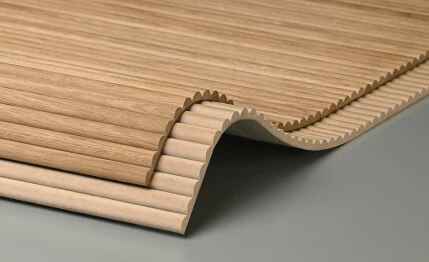
Vertical rhythmof slatted panels in the bedroom interior— is precisely such an environment. It is structured but not aggressive. Ordered but alive. The wood texture is warm and tactilely pleasant even visually.
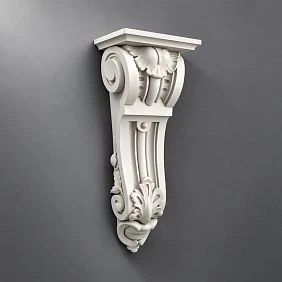
Our factory also produces:




Sound and acoustics: what is rarely discussed
Wooden slatted panels act as a soft acoustic element. The slats scatter sound waves, the gaps between them create a diffusion effect — the room sounds softer, quieter. This is not acoustic isolation in the strict sense, but the subjective feeling of silence increases. In a bedroom, this is critical.
Polyurethane decor for interiors— cornices, moldings, frame profiles — work similarly: textured surfaces scatter sound. A bedroom with wooden slats and polyurethane moldings is acoustically more comfortable than a room with bare, smooth walls.
Get Consultation
Human Scale: Space Should 'Embrace'
A bedroom is not a living room that you want to make spacious. A bedroom should be proportionate to a person. Too large, empty, with bare walls—cold and lifeless. Architectural elements—slats, moldings, frame decor—make the space 'denser,' fill it, create a feeling of 'fullness' without furniture.
How Slatted Panels Work at the Headboard: The Main Accent Zone
The wall behind the bed is the most visually loaded point in the bedroom. It is the first thing that catches the eye upon entering. It is what a person sees upon waking up. This is the place where any architectural solution works with maximum force—for better or worse.
Vertical Rhythm of Slats and a 'Frame' for the Bed
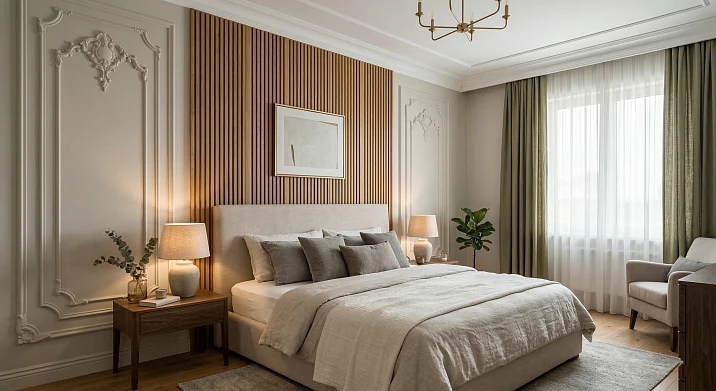
slatted panels in the bedroomat the headboard create a visual 'frame' around the bed. Vertical slats lift the gaze upward—the space appears taller. The rhythm of the slats structures the wall, giving it architectural character.
At the same time, proportion is important: the width of the slatted zone should correspond to the width of the bed or slightly exceed it. A slatted panel narrower than the bed—and it 'gets lost,' is not perceived as an architectural element. Wider by 30–50 cm on each side of the bed—an optimal solution.
Slat Parameters for the Headboard
| Parameter | Recommendations for the Headboard |
|---|---|
| Slat width | 45–75 mm—a delicate rhythm |
| Gap between slats | 35–55 mm — does not overload |
| Panel height | Entire wall or from headboard to ceiling |
| Species | Oak, ash, thermowood |
| Finish | Matte oil — no glare in the bedroom |
| Tone | Natural, gray, mocha — according to the scenario |
Thin slats (35–45 mm) with narrow gaps — more jewel-like, delicate character. Wide slats (70–90 mm) — architectural monumentality, for bedrooms with high ceilings.
Panel height: to the ceiling or not
Slatted panel from floor to ceiling — a complete architectural statement. The entire wall space — wooden rhythm. Powerful, but requires restraint in other elements.
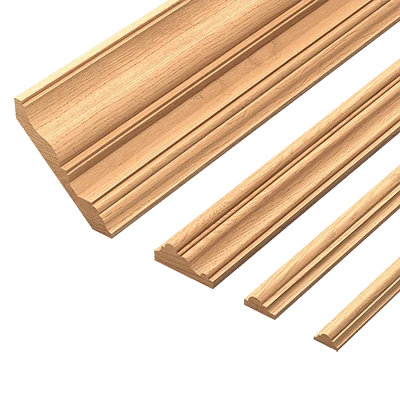
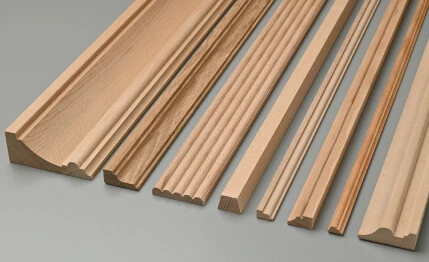
Slatted panel only behind the headboard (from the top edge of the mattress + 200–300 mm to the ceiling or to the cornice) — a delicate option. The lower part of the wall is neutral: plaster, paint, wallpaper. The upper edge of the panel is finishedwith wooden cornicesor with polyurethane molding — this completes the zone and visually 'closes' it.
Slatted protective zone (lower 110–130 cm) — from the floor to the height of the headboard. A practical and elegant solution: protects the wall from mechanical contact and creates an architectural plinth.
Headboard lighting: when the slat is also light
Slatted panels with lightingat the headboard — one of the most atmospheric techniques in a modern bedroom. LED strip in the gaps between the slats creates a warm, diffused glow that filters through the wooden rhythm. Night light, floor lamp, sconce — all these are tools for spot lighting. Lighting in the slats is background light, creating atmosphere without a source.
Warm white (2700–3000K) — for sleep and relaxation. Cool white (4000K+) — too invigorating for a bedroom. The choice is only in favor of the warm spectrum.
Slatted panels on a long side wall: space in perspective
The long wall of the bedroom is not always the wall behind the bed. Often it is the side wall, visible from the door, which creates the perspective of the entire room. And it is hereWooden slat panelsthat they reveal their main spatial property.
Depth effect: why slats make a room appear larger
Vertical lines of the slatted panel on a long wall create visual perspective: the eye glides along the slat, assessing the depth of space. The room appears longer. This is not an optical illusion in the crude sense—it's the work of a rhythmic structure that the brain interprets as a spatial signal.
This effect is enhanced with a dark tone of the slat. A dark surface on a long wall 'recedes'—visually increasing the distance.
Full wall vs partial solution
A full slatted wall from floor to ceiling is an architectural scenario. The long wall becomes the dominant feature of the room. It requires restrained solutions on all other surfaces: neutral ceiling, floor, and opposite wall.
Partial solution—the lower third or lower half of the wall. The rest is a neutral surface. Wooden molding orpolyurethane profilealong the upper boundary of the zone. This is the architectural 'plinth' of the long wall.
Joining the slatted wall with niches and openings
A long bedroom wall often contains a doorway, a niche for a built-in wardrobe, a window opening. Each of these elements is a point whereslatted panels for wallsrequires a clean finish. The end of the slat at the doorway is either covered by a solid wood casing or closed with a corner profile. An open end is the first detail by which the quality of installation is judged.
Polyurethane decor for bedroom interiors: why it's not 'ostentatious'
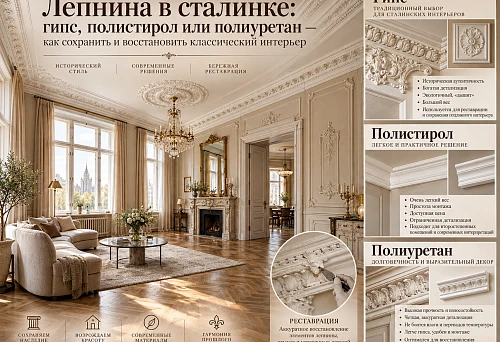
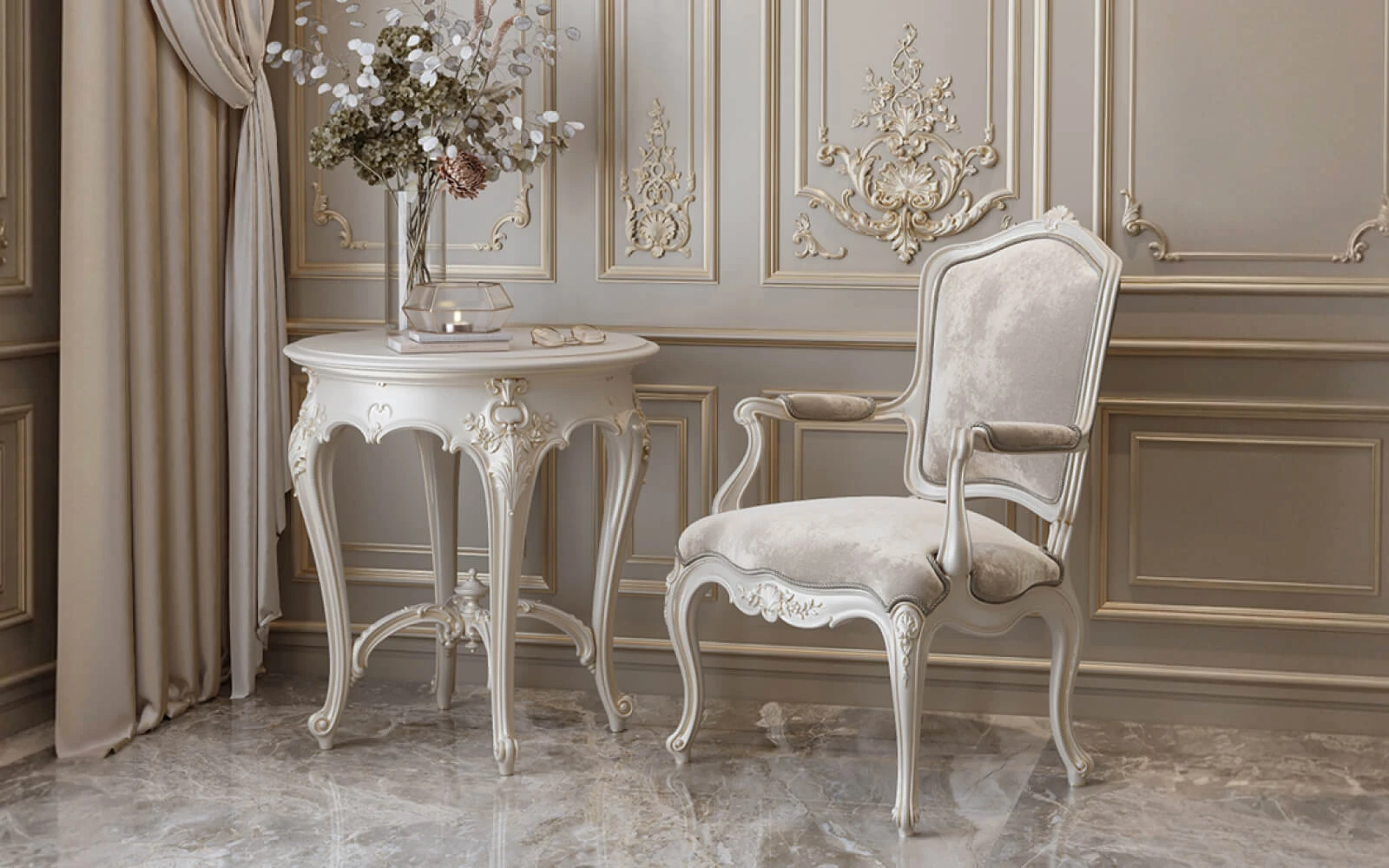
When people hear 'molding in the bedroom,' many imagine Baroque rosettes, intricate cornices, and heavy ceiling medallions. That's the molding of past centuries. ModernPolyurethane decor for interiors— offers fundamentally different possibilities.
What is polyurethane decor today
Polyurethane is a synthetic material with characteristics that make it ideal for interior decor:
-
Lightweight — 6–8 times lighter than plaster of the same volume. Does not overload floor structures, does not require reinforced fastening
-
Precise profile reproduction — pressure casting provides perfect geometry and detailed relief
-
Durability — does not crack upon impact (unlike plaster), does not react to humidity, does not deform with temperature fluctuations
-
Paintable — with any water-based paint, accepts decorative finishes: aging, bronzing, patination
-
Easy installation — with liquid nails or mounting adhesive. No anchors, dowels, or expensive installation work required
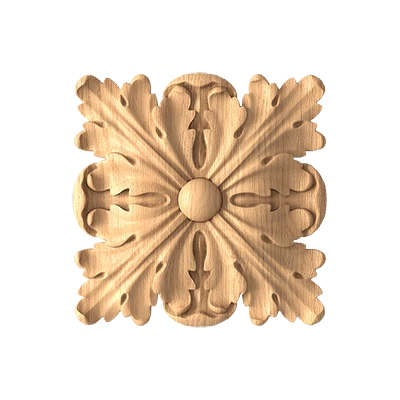
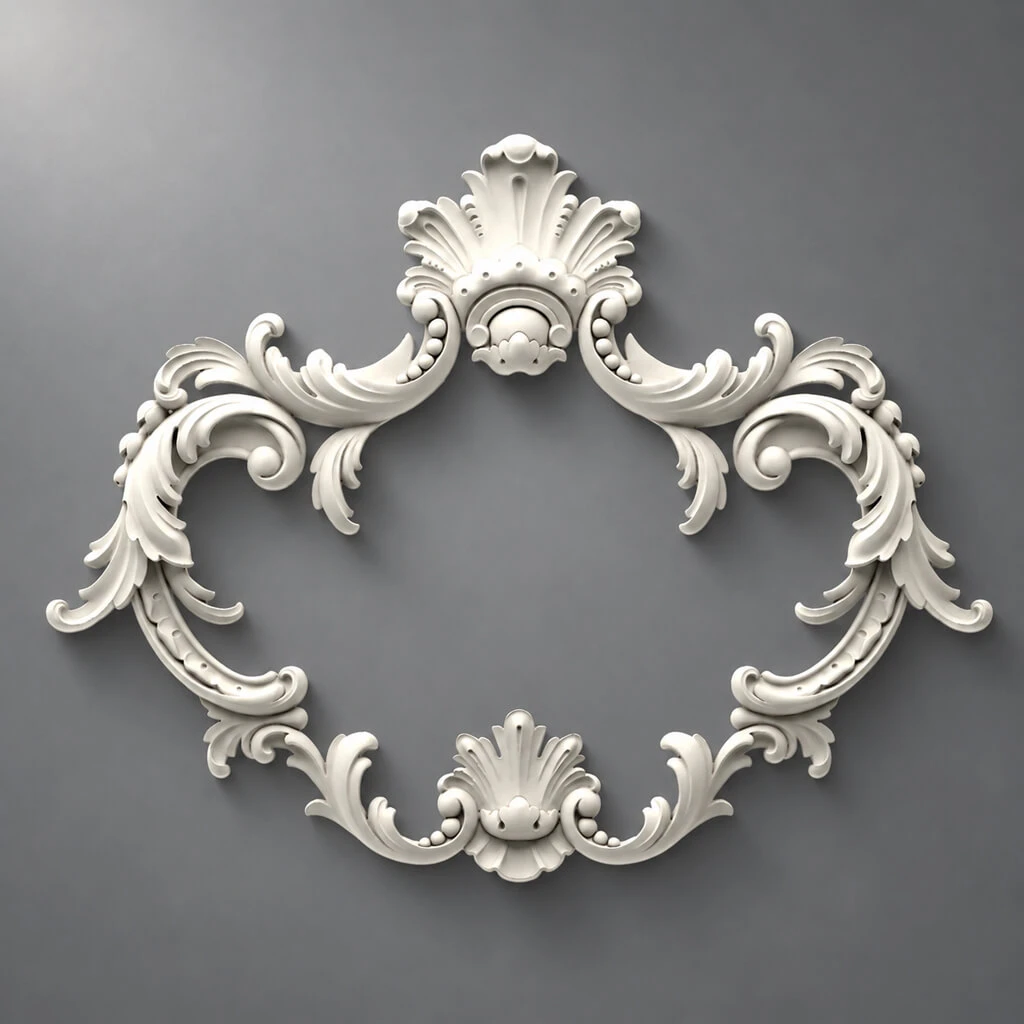
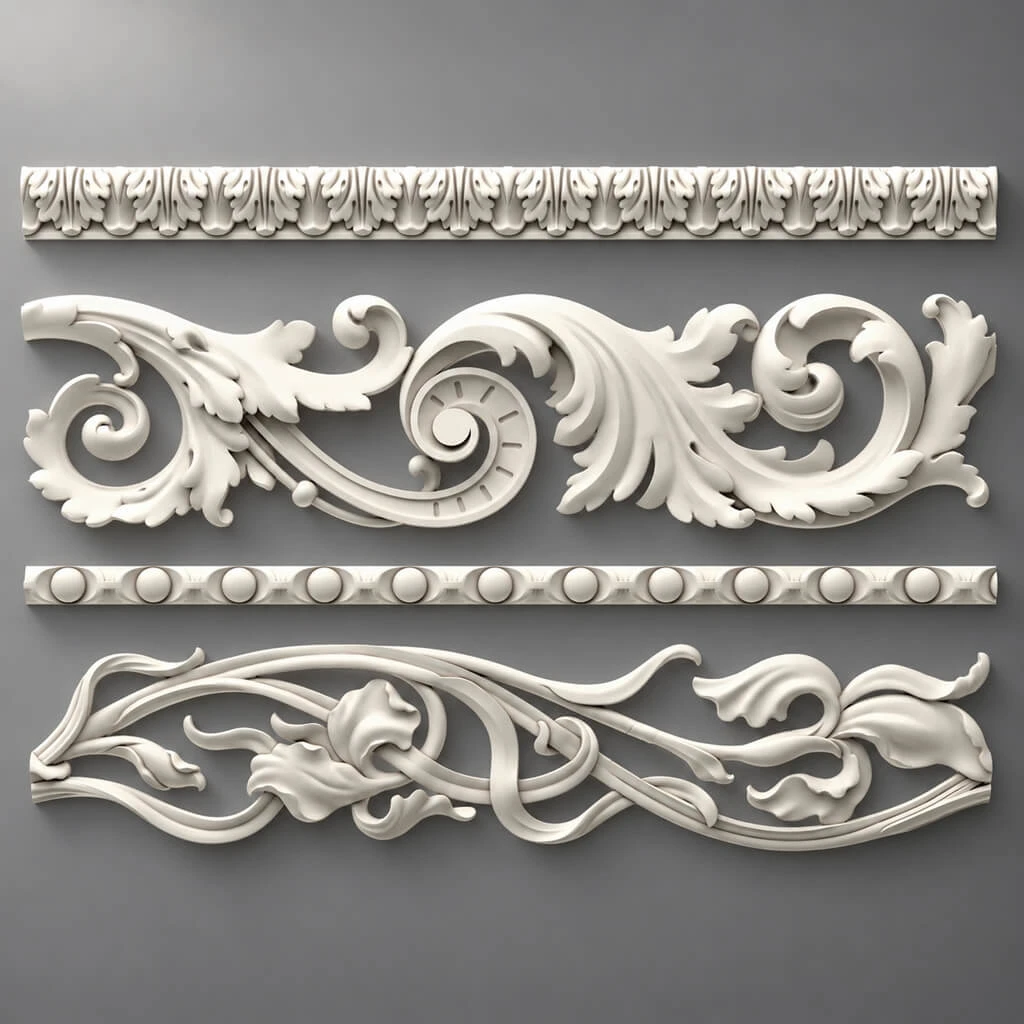
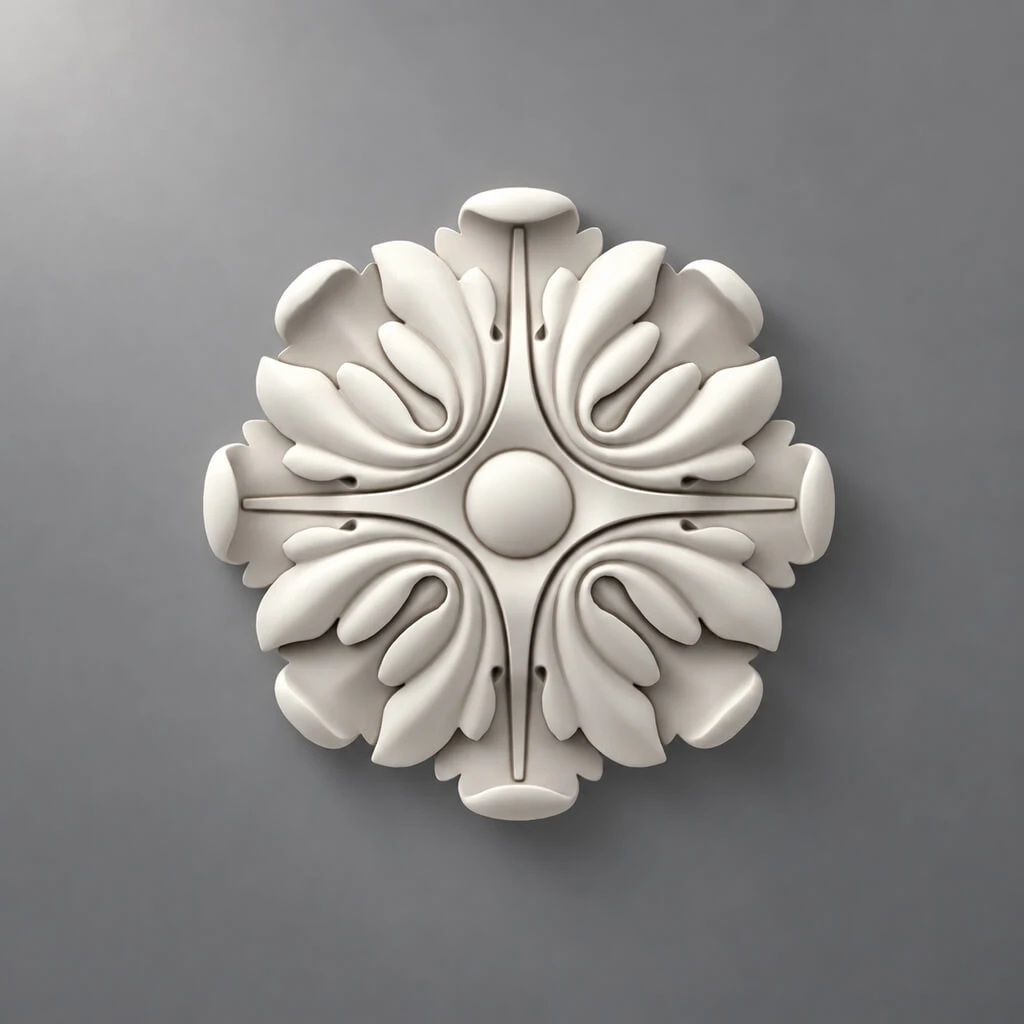
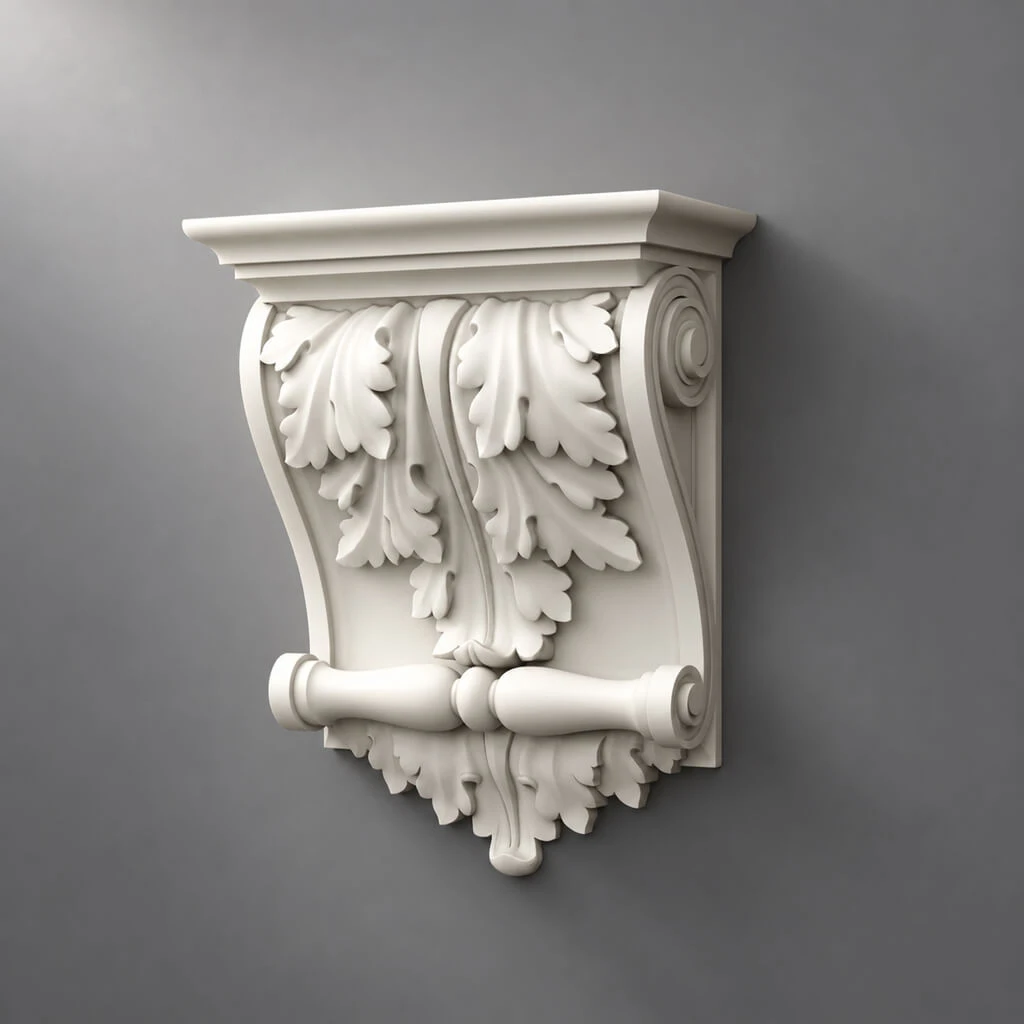
Decorative stuccoMade of polyurethane — this is not an 'imitation of real molding'. It is a modern material with its own merits.
Polyurethane molding in the bedroom: what it does to the space
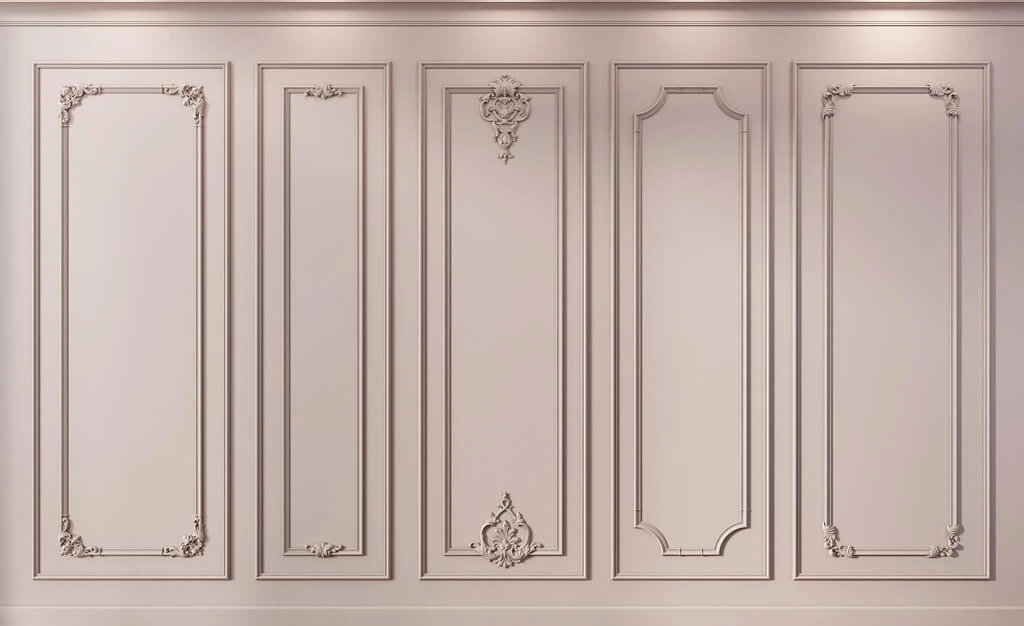
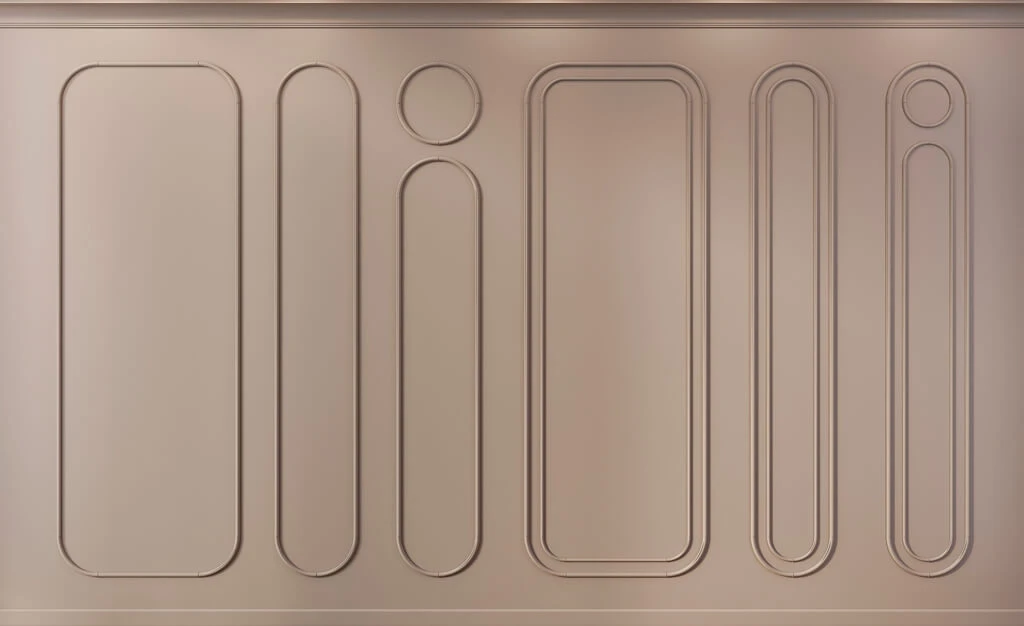
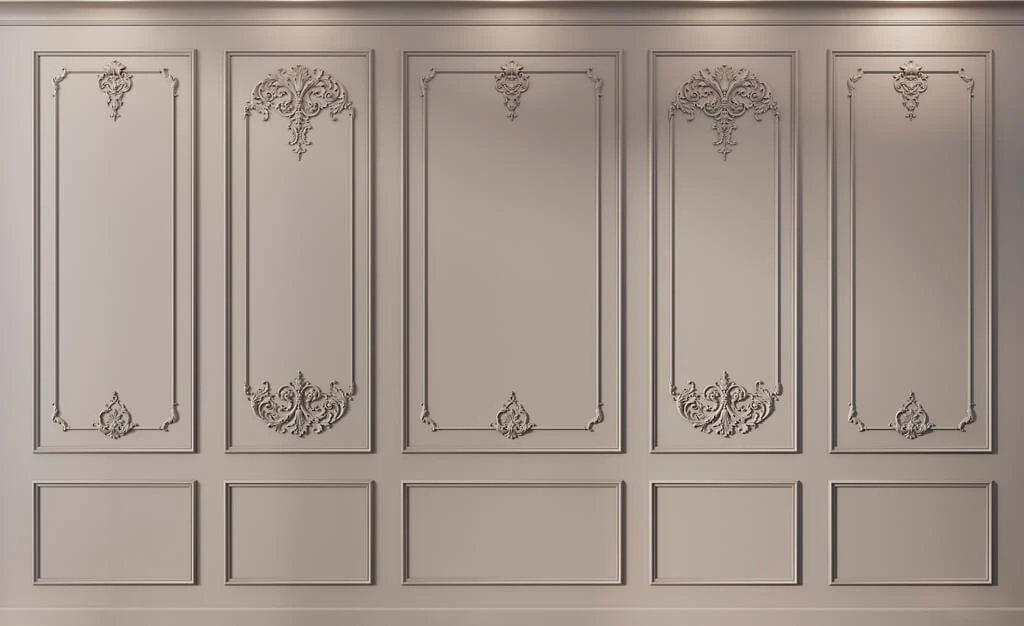
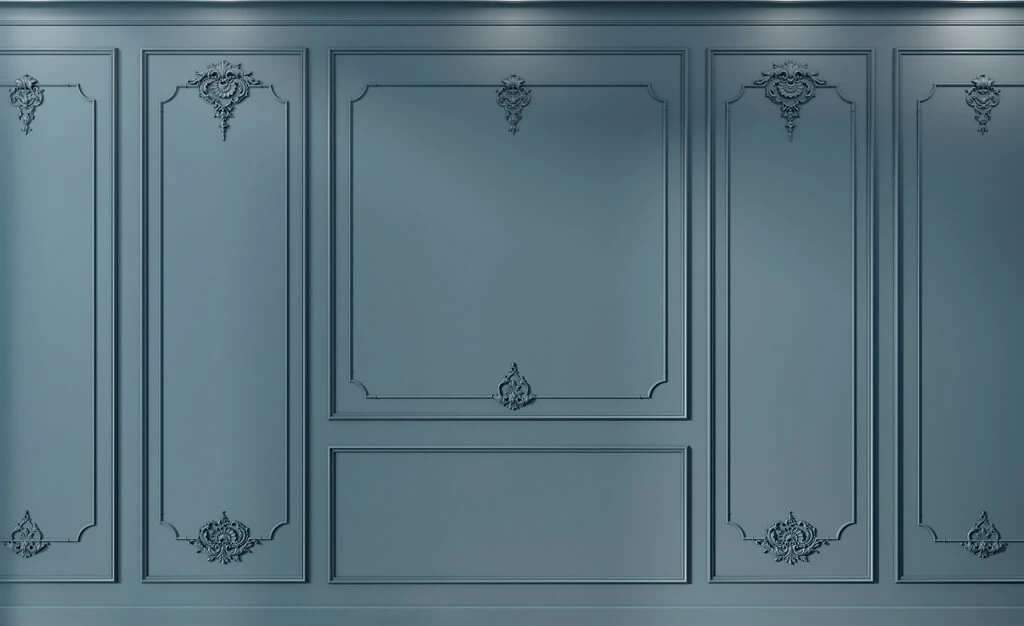
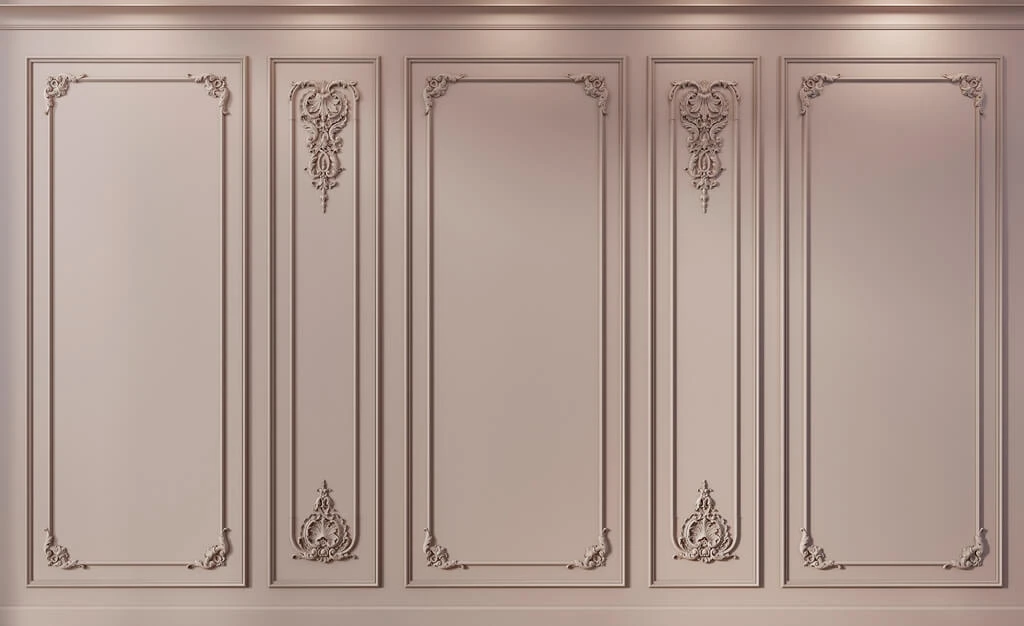
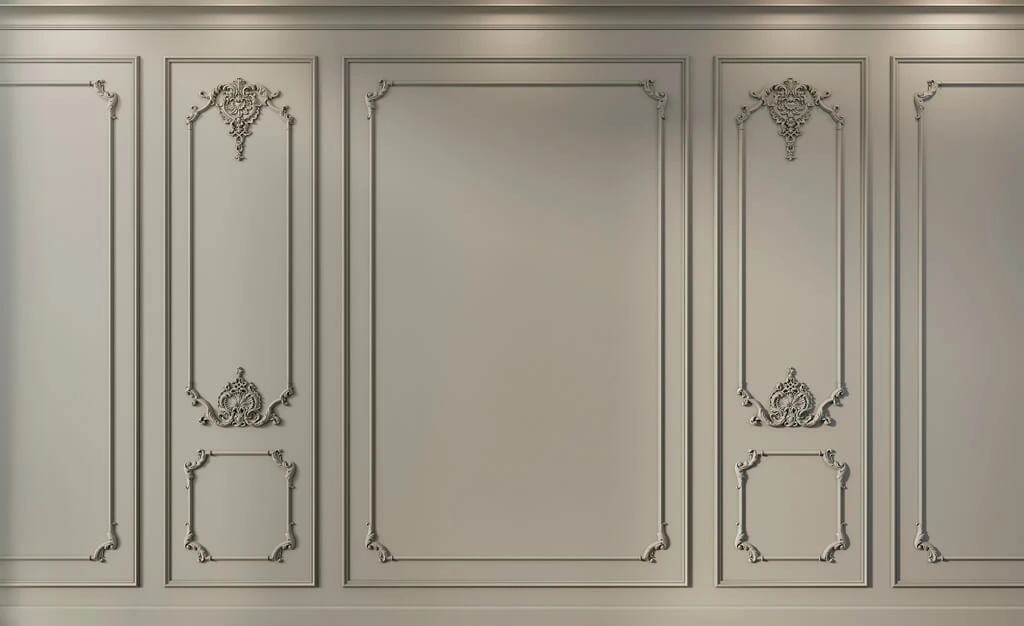
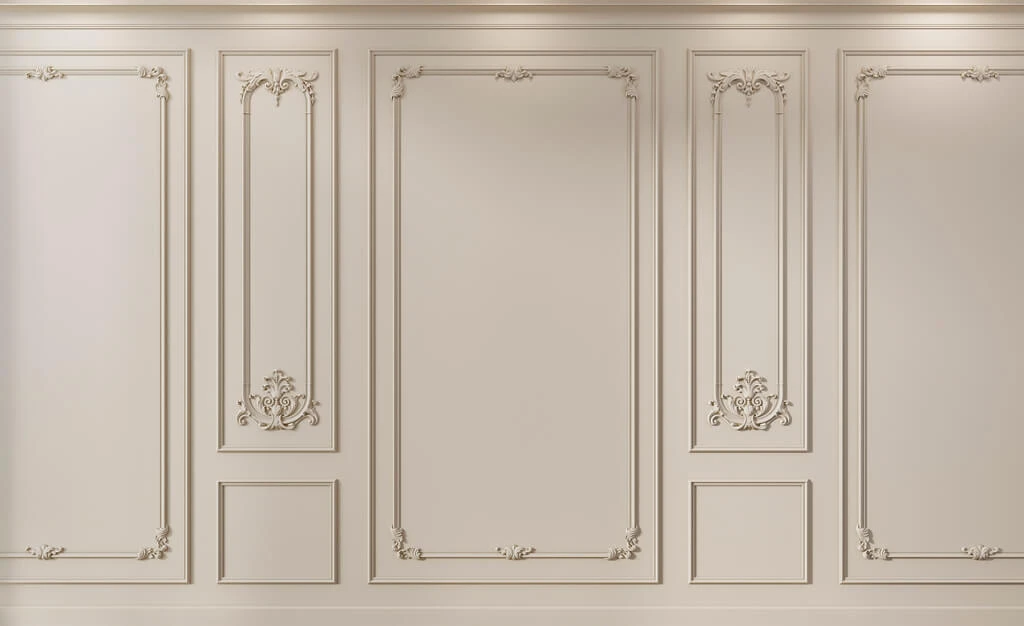
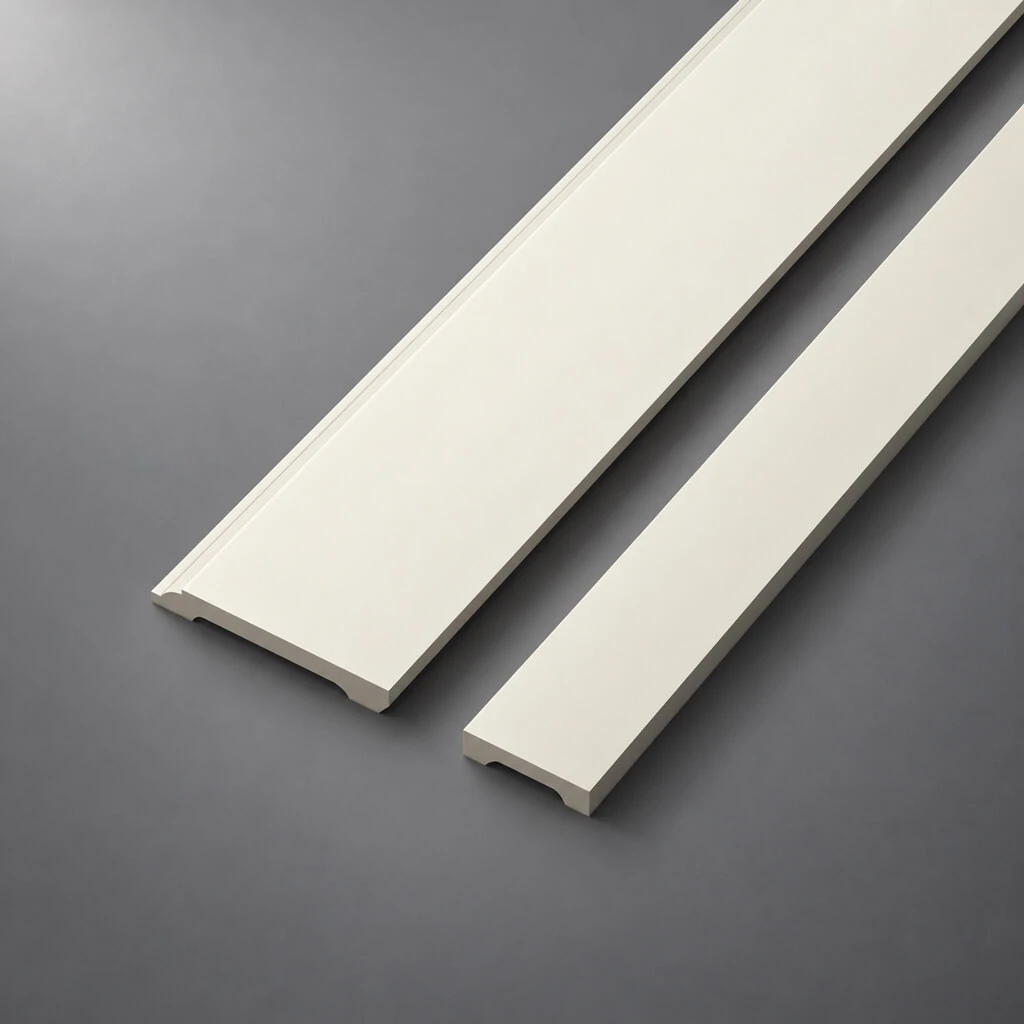
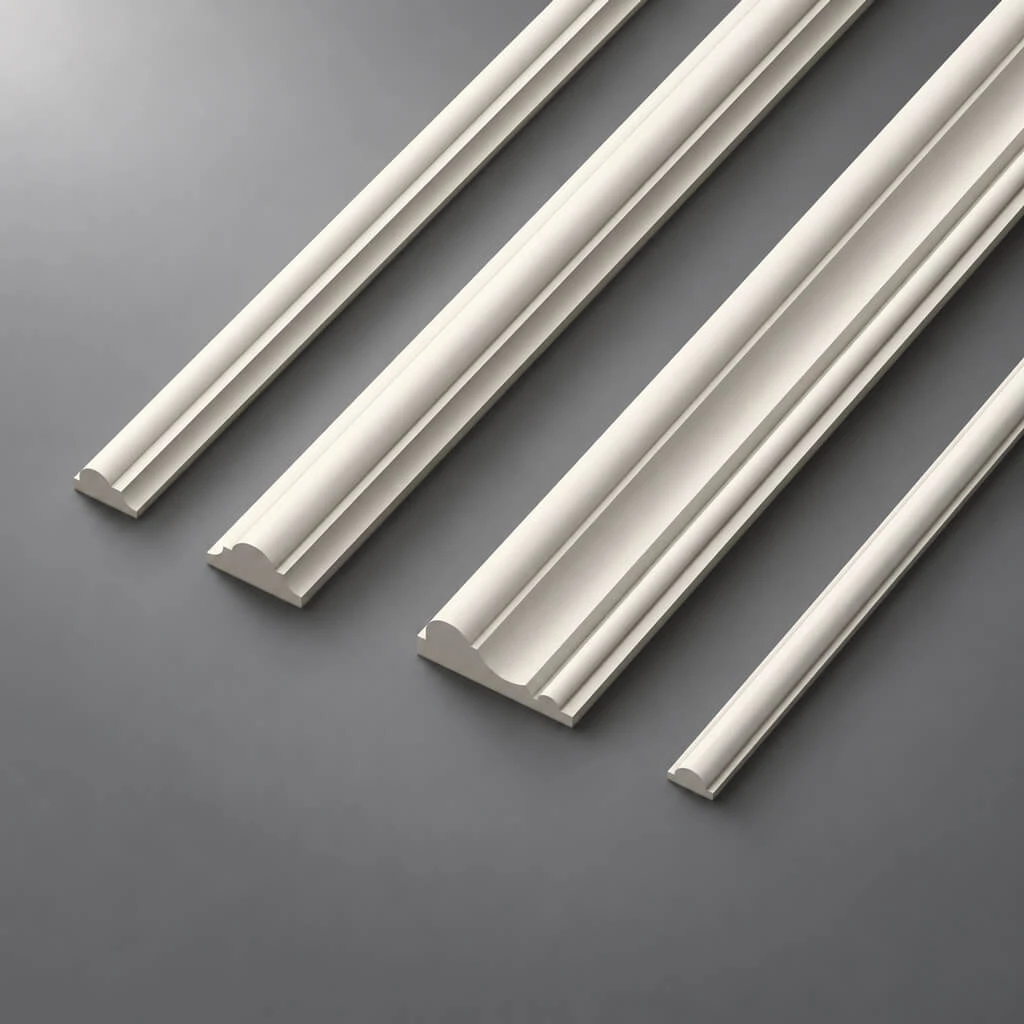
Moldings made of polyurethane— horizontal and vertical profiles — divide the wall into fields. The field above the molding and the field below the molding can be painted in different tones, wallpapered, or covered with decorative plaster. Molding is a boundary that organizes the wall.
In the bedroom, a horizontal molding at a height of 110–130 cm divides the wall into a 'lower' (dark, heavy) and an 'upper' (light, airy) field. This is a classic architectural solution that worked in palace interiors and works in modern apartments.
Polyurethane cornice: the ceiling boundary
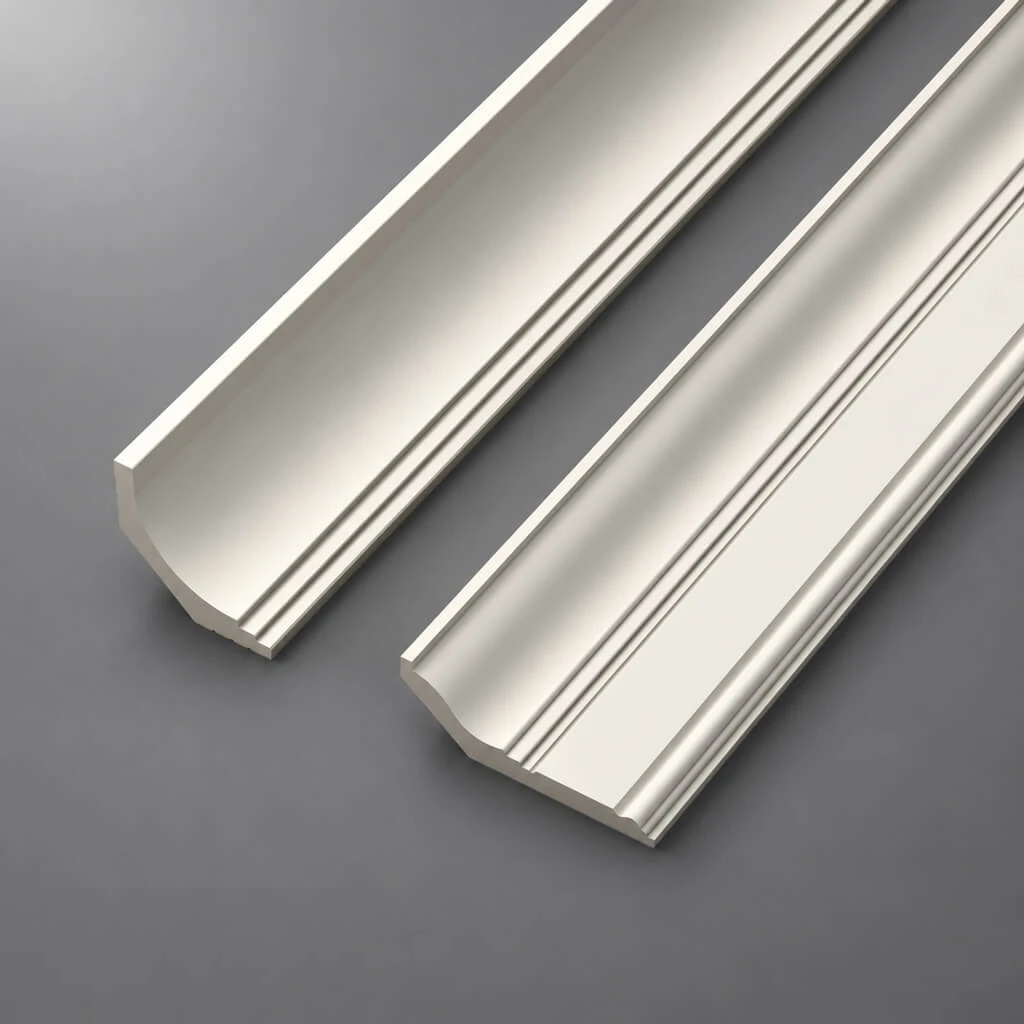
a polyurethane cornice— a ceiling profile that covers the joint between the wall and ceiling. In the bedroom, it serves three functions:
-
Architectural — creates a clear horizontal boundary that finishes the walls around the perimeter
-
Practical — conceals LED strips when organizing contour lighting for the ceiling
-
Psychological — the horizontal line of the cornice 'calms' the space, adding a sense of order
In the bedroom, a cornice with a shelf is the perfect channel for hidden lighting. Warm light, reflected from the ceiling through the cornice, creates soft, even, relaxing illumination. This is the best option for evening lighting in a bedroom.
Frame decor: fields and panels
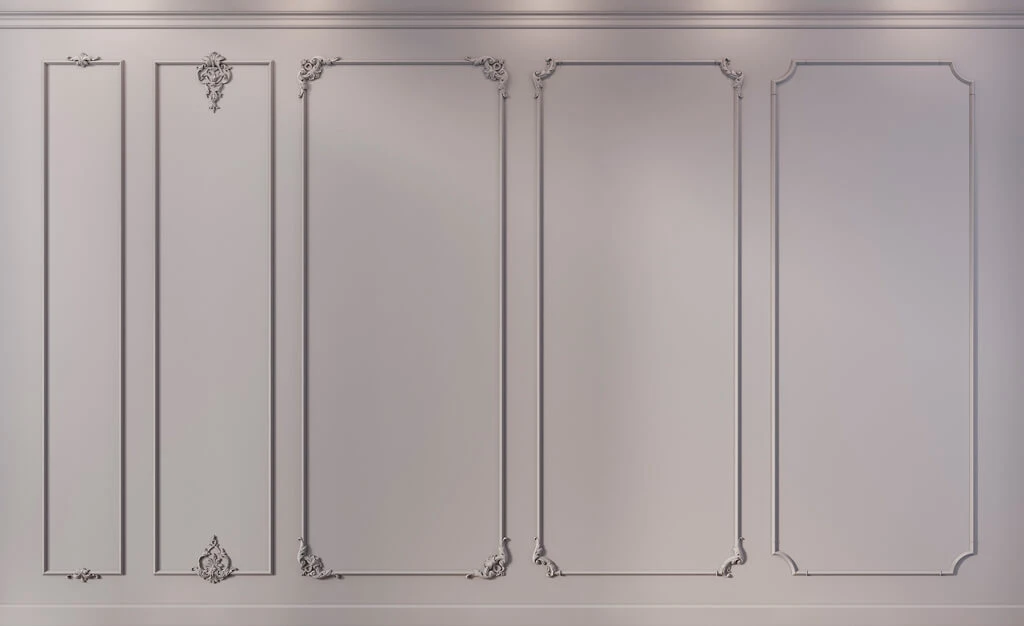
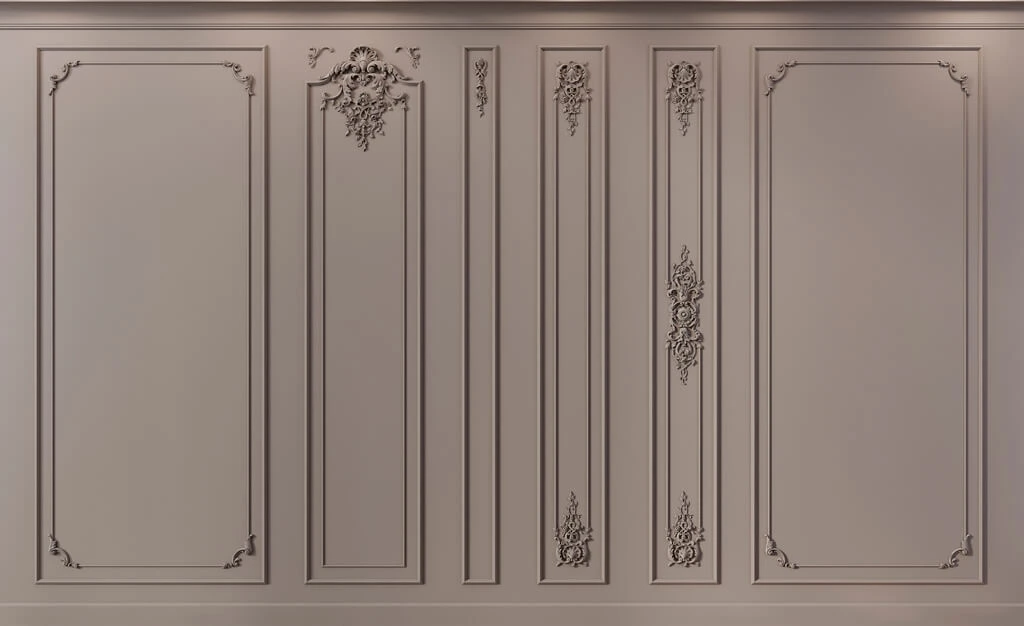
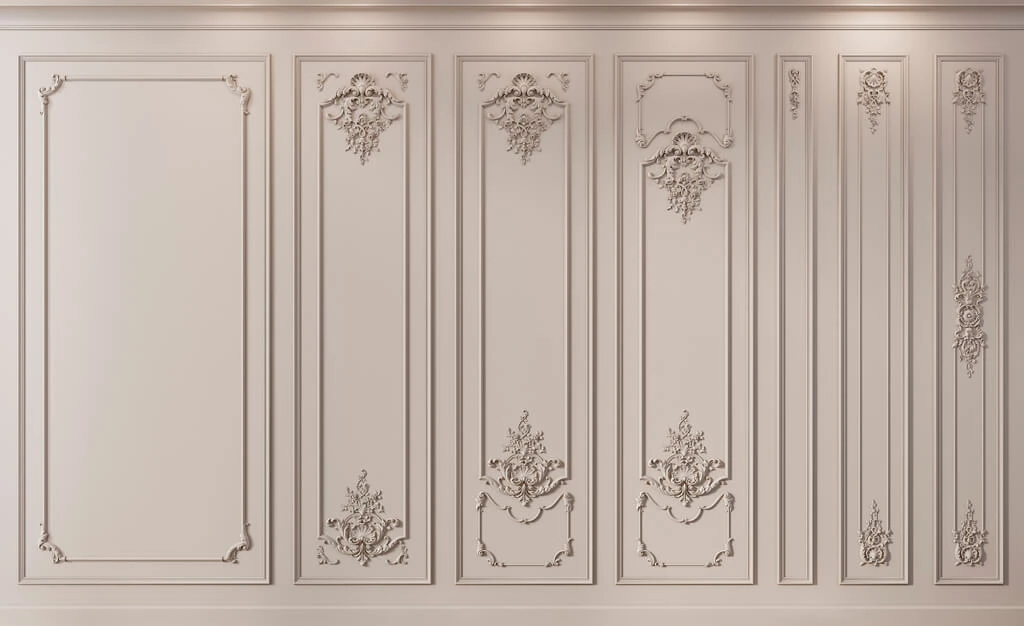
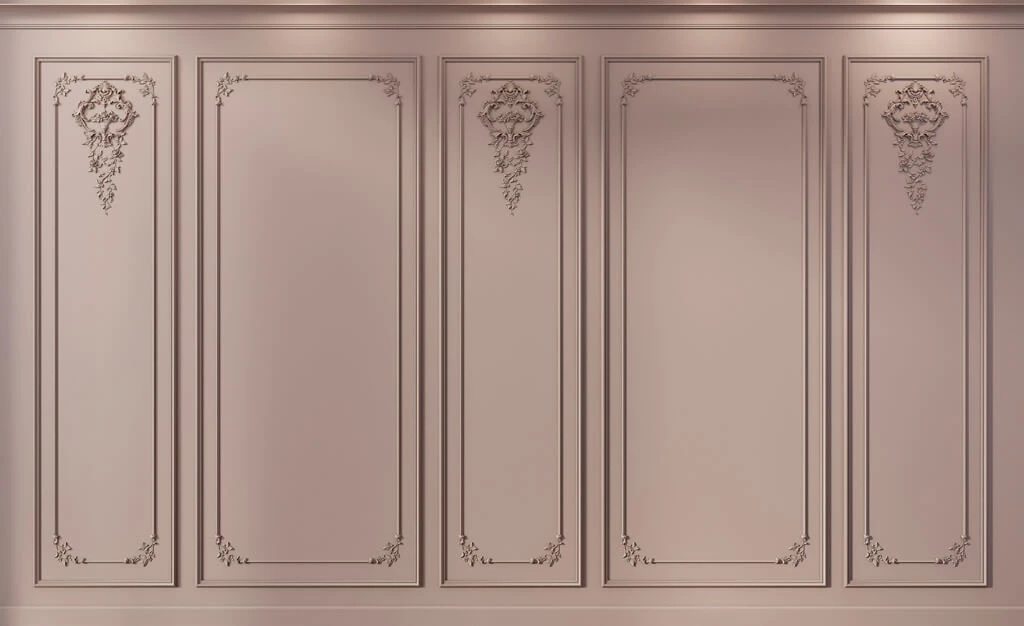
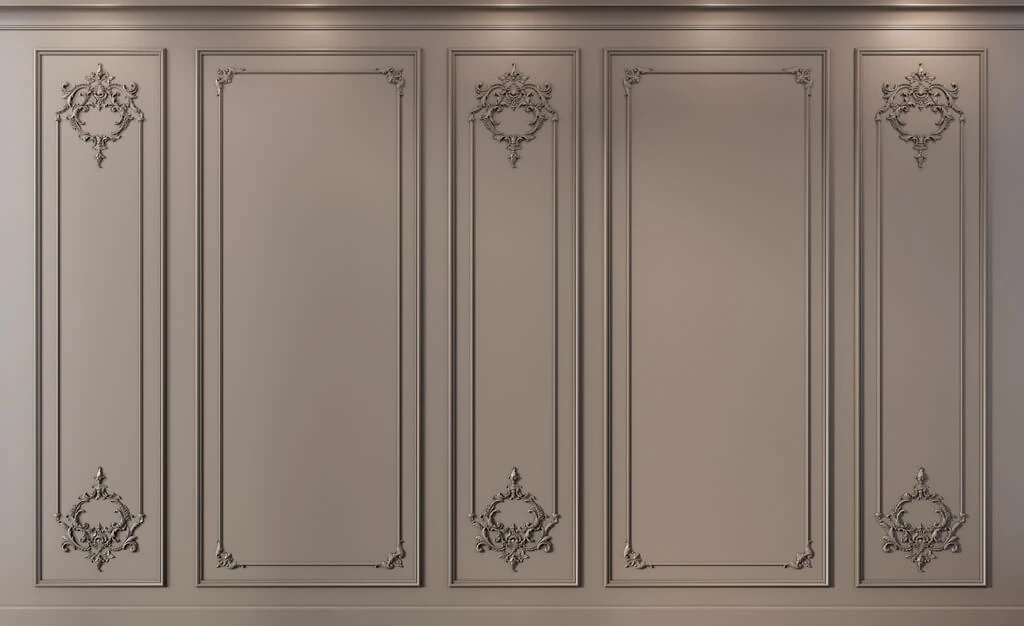
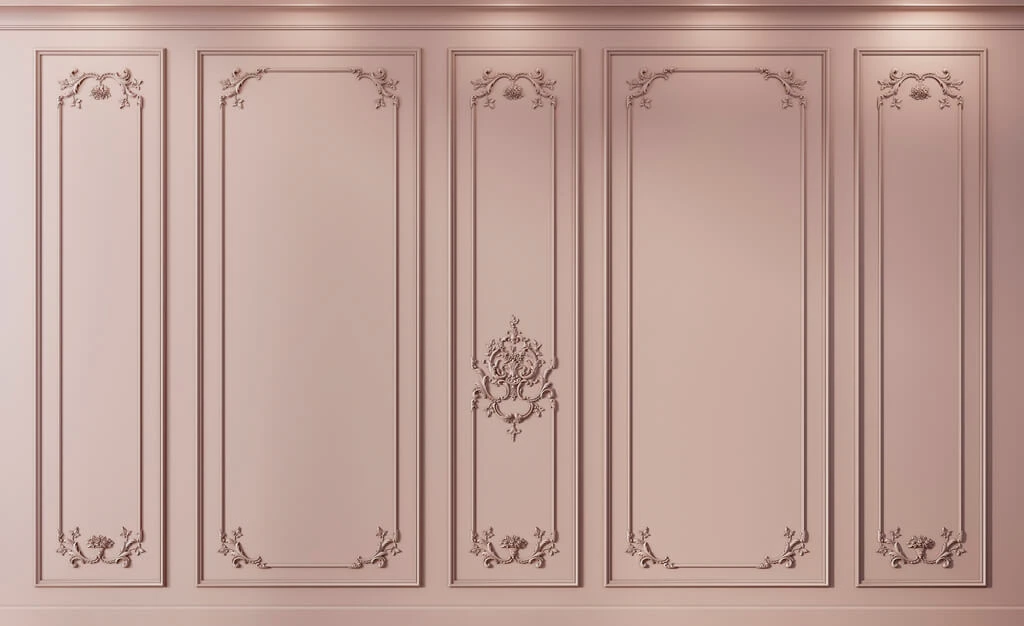
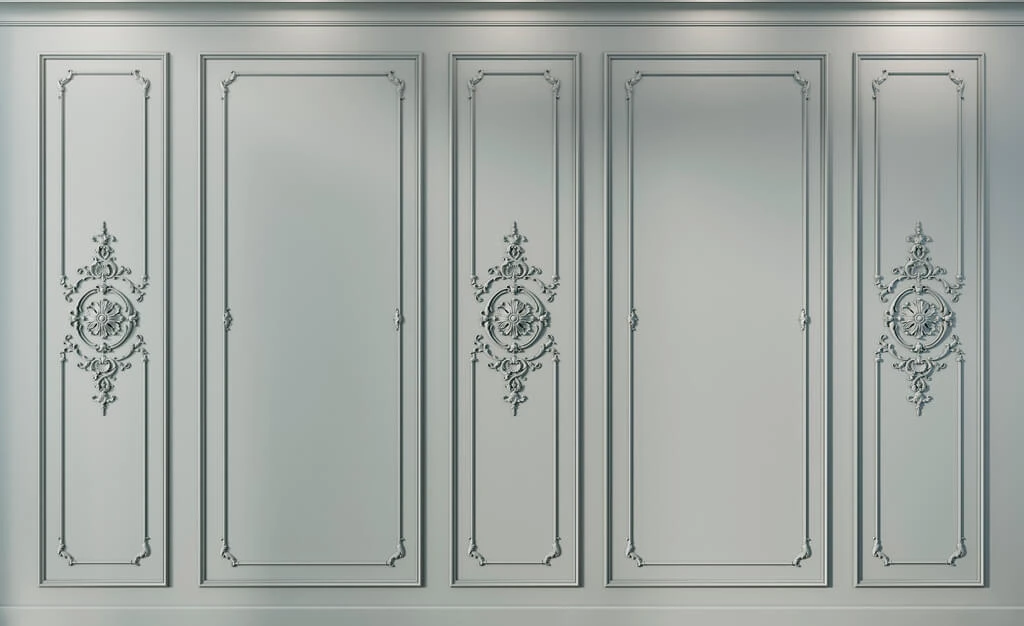
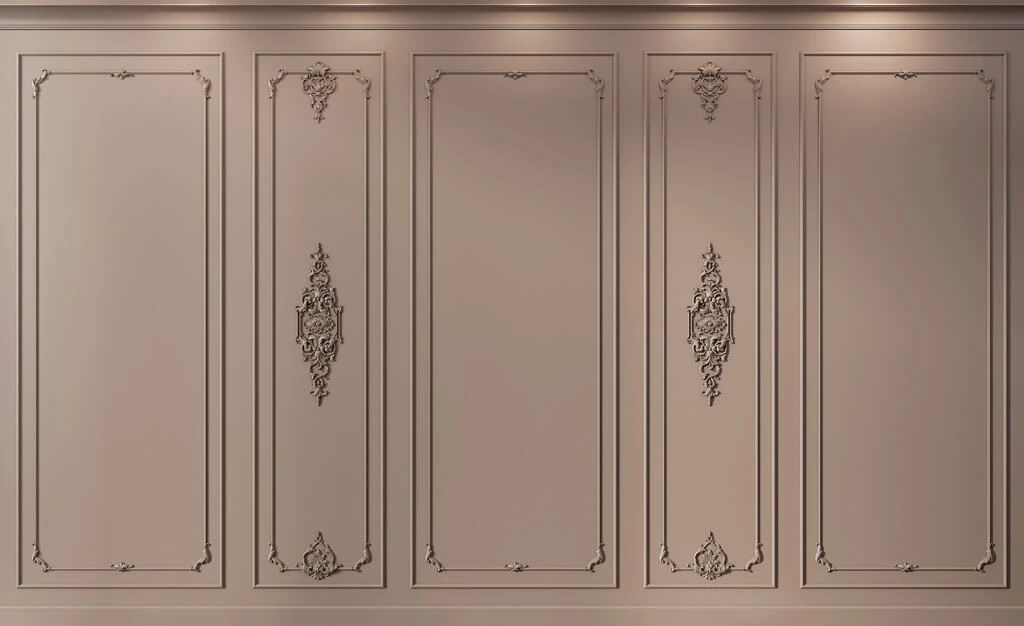
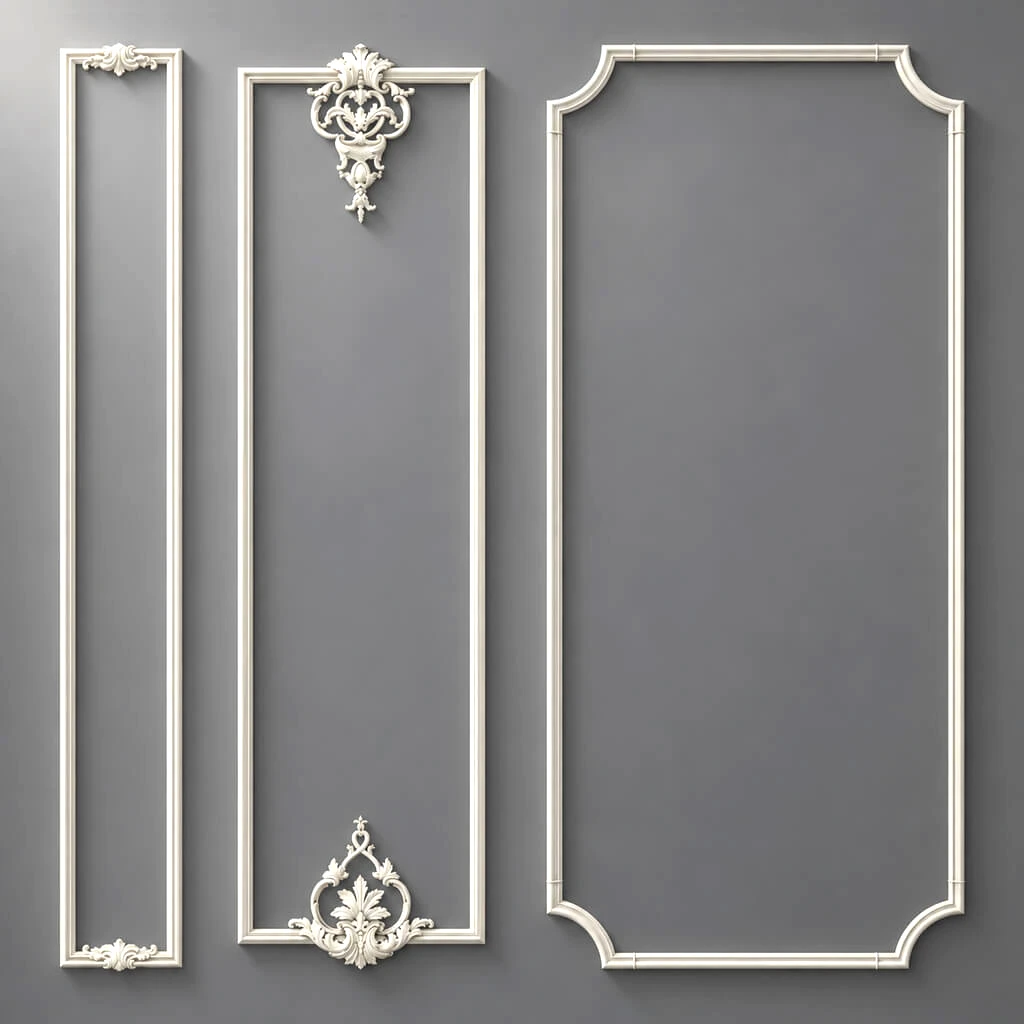
interior decorationIn the form of frame moldings — creating decorative 'paintings' on walls. Rectangular or shaped frames made of polyurethane profile are mounted on the wall; inside the frame — a different color or texture.
In the bedroom, frame decor works especially well on the wall opposite the bed: several frames in a row, inside — a neutral tone with a barely noticeable texture, outside — a darker wall tone. Depth. Rhythm. Architectural quality without bulkiness.
How to combine slatted panels and polyurethane decor without overload
The key question of this article. The mistake made in pursuit of 'beauty' — applying everything at once. Slats + moldings + cornice + frames + stucco = visual noise, not harmony.
The principle 'one zone — one main element'
The wall behind the bed — slatted panel as the main element. Molding or cornice along the top edge — finishing, not a competitor. Frame decor on the same wall — excessive.
The wall opposite the bed — frame decor made of polyurethane. Without slatted panels. A neutral surface with architectural plasticity. Or — completely neutral, if the headboard is already sufficiently saturated.
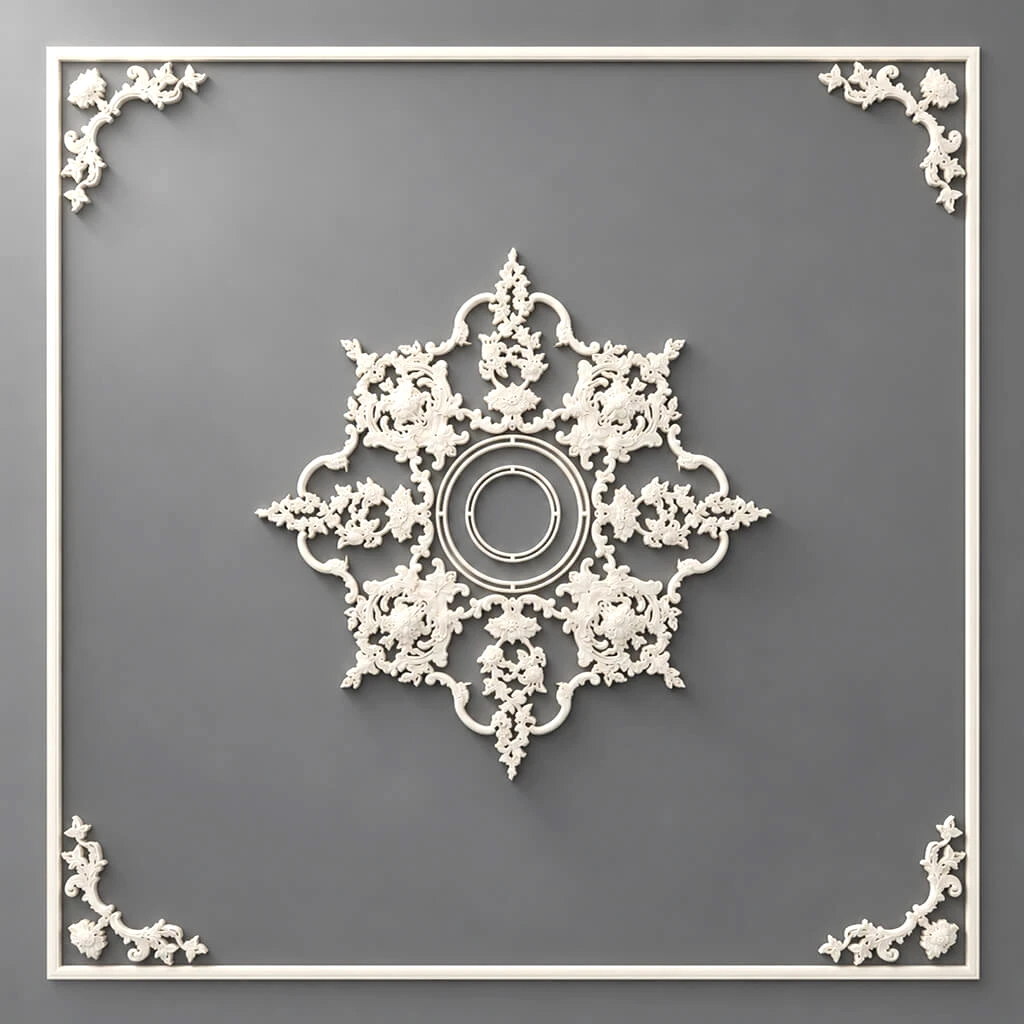
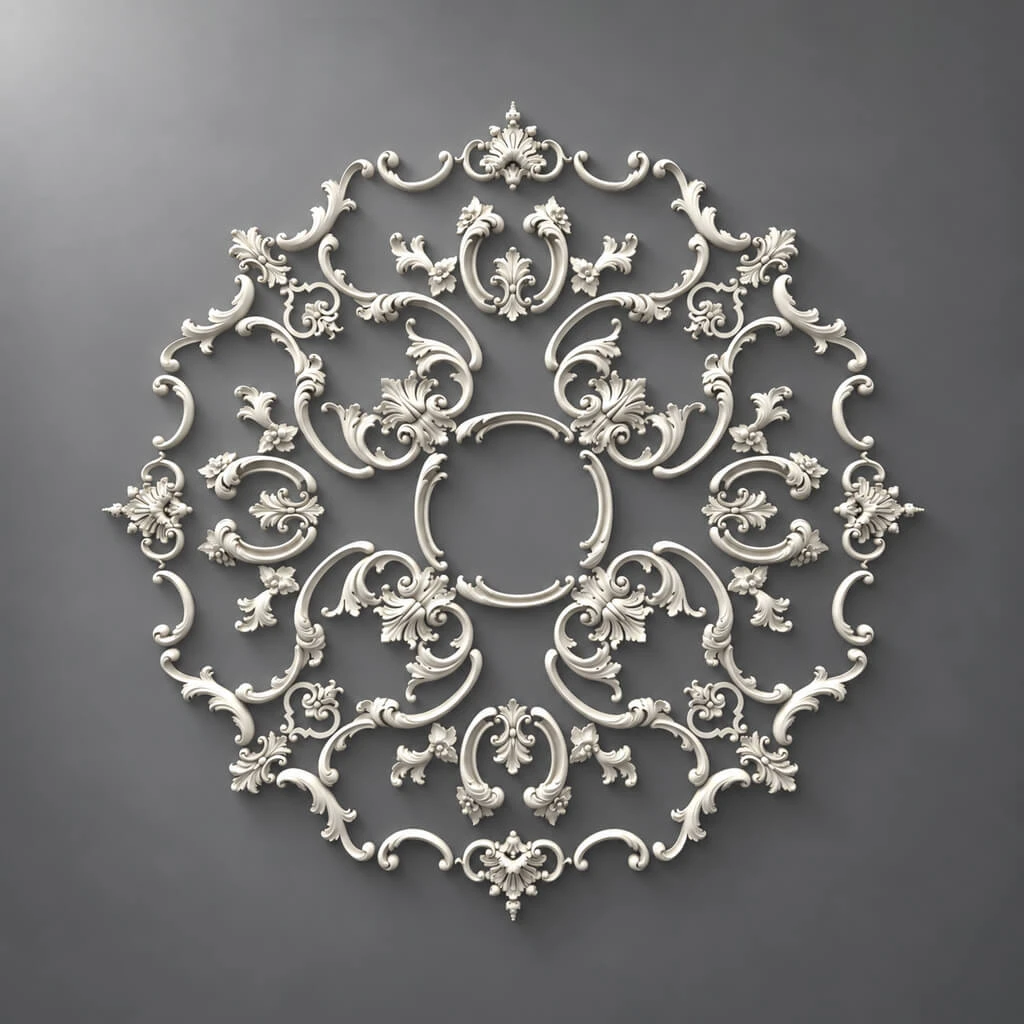
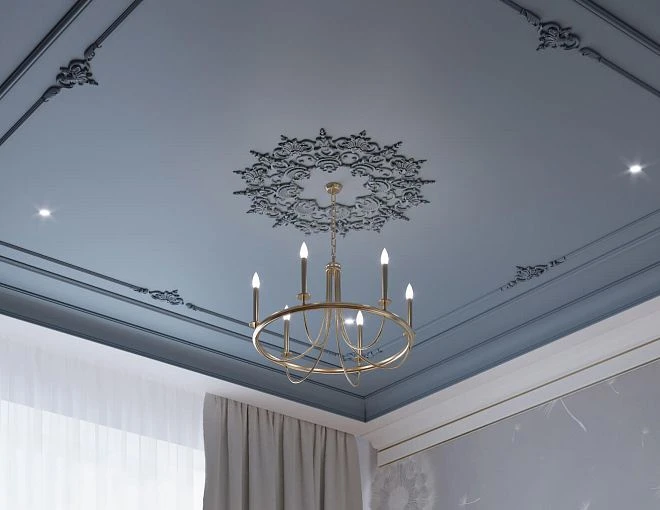
Ceiling — polyurethane cornice around the perimeter. Hidden lighting. Decorative rosette in the center — only if the ceiling is high (from 2.9 m) and the room is spacious.
Side walls — neutral. Either with horizontal molding dividing the fields by height. Do not compete with accent walls.
Rule: wood and polyurethane are two different languages of the same style
Wood is a natural, warm, tactile material. Polyurethane is architectural, precise, geometric. They don't compete — they complement. Wood provides warmth and vitality, polyurethane provides order and architectural precision.
This duo works in classic, neoclassic, modern classic, Scandinavian style, eclecticism. It doesn't work in strict minimalism, where any decorative element is superfluous.
Tonal coordination: wood and polyurethane in one space
Polyurethane elements in the bedroom are almost always white or cream. Wooden slats are warm natural tones, gray or dark. The contrast of white decor and natural wood is a classic and foolproof combination.
If polyurethaneinterior decorationis tinted (patina, bronze, aging) — it should coordinate with the wood tone: warm bronze with warm oak, cold patina with gray or silvery wood.
Scenarios for different types of bedrooms: light, dark, contrasting
Scenario 1: light bedroom — Scandinavian character
Color foundation: white and off-white walls, white ceiling, floor — light parquet or tile.
Slatted panels:ash slatted panelsor oak with a white oil finish. A gray-whitish tone, light and airy. Slat width 45–62 mm, gap 35–50 mm.
Polyurethane decor: white cornice around the perimeter, thin profile (65–80 mm height). Horizontal molding on the side walls. Framed decor on the wall opposite the bed — in white on white (different relief, no tonal contrast — this is subtle and refined).
Overall tone: very light, almost monochrome. Depth is created by relief — slats and moldings in the same light tone provide volume without color contrast.
Accent: beige or powder-colored textiles on the bed. Wooden bedside tables. No color explosion.
Scenario 2: dark bedroom — depth and monumentality
Color foundation: walls — dark blue, anthracite, deep taupe. Ceiling — lighter or white. Floor — dark parquet.
Slatted panels:thermo-oak slatted panelsor oak with a 'mocha' / 'black graphite' finish. Dark slats on a dark wall — the subtlest rhythm, almost hidden in the wall tone. Or: light slats on a dark background — sharp contrast.
Polyurethane decor: a white cornice against dark walls creates a strong contrast, visually raising the ceiling. Alternatively, a cornice painted to match the wall color offers a more restrained solution.Decorative stuccowith bronze or antique patina — in dark interiors, it creates the feeling of an old mansion.
Accent: white or cream textiles — contrast against a dark background. Spot lighting. Hidden lighting in the cornice — warm light diffused across the ceiling.
Scenario 3: contrasting interior — two tones, one system
Color foundation: the wall behind the bed — dark (anthracite, blue, bottle green). The remaining walls — neutral (off-white, beige). Ceiling — white.
Slatted panels: only on the accent wall behind the bed, natural oak or ash against the dark wall background. The warmth of wood against a cold, dark background — a powerful tonal contrast.
Polyurethane decor: a white cornice around the entire perimeter unites the dark and light walls into a single space. Moldings on neutral walls — white, matching the walls themselves (relief decor of a single tone). On the dark wall, molding is not needed: the slatted panel is already sufficiently saturated.
Bedroom lighting: how lighting works with slats and decor
The bedroom has several levels of lighting, each operating at its own time of day.
Contour Concealed Lighting: The Cornice as a Lighting Tool
Hidden backlight behind polyurethane cornice— an LED strip directed upward toward the ceiling. Reflected light evenly fills the space without creating shadows or glare. This is evening light for the bedroom: not for reading, not for work—for transitioning into a state of rest.
Power: 7–10 W/m of tape for warm white (2700K). Control via dimmer or smart home system.
Backlighting in the slatted panel at the headboard: nighttime atmosphere
LEDs in the gaps of the slatted panel—accent lighting filtered through the wooden rhythm. Perfect for late evening: warm, subdued glow that doesn't interfere with falling asleep. Technically: the tape is mounted on the batten substrate before installing the slats. Wiring runs through a hidden channel to the dimmer.
Accent lighting and sconces: not instead, but in addition
Recessed ceiling lights—task lighting for dressing and navigating the space. Sconces by the bed—for reading. A lamp on the nightstand—for ambiance.
In a bedroom with slatted panels in the interior sconces are mounted either on a neutral wall or brought directly out of the slatted panel—the cable is routed behind the slat during installation, with the outlet or cable exit organized in the gap between slats.
Textiles, furniture and rhythm: how it all comes together
Slatted panels and polyurethane decor are the walls. But a bedroom also includes furniture and textiles, which shouldn't interfere with architectural solutions but rather enhance them.
Bed: scale and height
Whenslatted panels at the headboarda bed without a tall soft headboard is the right solution. A tall soft headboard competes with the slatted wall, covering its lower part. A low headboard or platform bed without a headboard allows the slatted wall to work at full strength.
If the bed has a headboard, choose a headboard made from natural materials: linen upholstery, velour, leather in neutral tones. No gloss, no prints.
Textiles: tone and texture
Bedding and curtains with wooden slatted panels should be in neutral tones. Linen, cotton, velvet in beige, milky, gray, muted green. The textiles don't compete with the wood texture—they complement it.
Printed, bright, graphic bedding with a pronounced wooden wall creates visual conflict. One of the two elements should be accent, the other neutral.
Bedside tables: the wood continues
Solid wood nightstands against a wooden slatted wall are not a coincidence but a continuation of the system. Same wood species, same finish tone or a similar one. The nightstands 'echo' the wall, creating a unified material code for the bedroom.
Metal or lacquered nightstands against a wooden wall are an acceptable contrast in a modern style. The key: the metal should be matte (black, gold, bronze), not mirror-like or chrome-plated.
Carpet: a horizontal under a vertical.
A carpet in a bedroom with vertical slatted panels serves as a horizontal counterbalance. The carpet's geometry: a clean rectangle, no diagonals. The tone should be neutral or match the wall color. A long-pile carpet against a wooden wall enhances the tactile contrast: hard, structured wood + soft, warm pile underfoot.
Mistakes that make a bedroom feel tense: an honest breakdown.
Mistake 1: slatted panels on all four walls.
Slats on all walls are not 'more of a good thing'. It's overload. The eye has nowhere to rest: rhythm from all sides creates tension. One accent wall with slats — and three neutral ones. That's the rule.
Mistake 2: polyurethane decor on a slatted wall.
Moldings, frames, orDecorative stuccoon top of a slatted panel — two competing rhythms on one surface. The result: visual noise. Polyurethane decor belongs on neutral walls. A slatted panel is self-sufficient.
Error 3: bright lighting in the batten gaps
LEDs with a color temperature of 5000K+ in the gaps of the batten panel at the headboard — cold, harsh light. Unacceptable in a bedroom. Only warm white 2700–3000K. Only dimmable.
Error 4: dark battens in a small bedroom without compensation
Thermo oak or 'mocha' battens in a small bedroom (up to 14 m²) without a white ceiling and light floor — the room 'collapses'. Dark battens require compensation: white ceiling, light floor, powerful spot lighting. Without compensation — darkness, not depth.
Error 5: heavy classical molding with thin minimalist battens
Baroque cornice with rich relief with thin oak battens — a style conflict. Classical-style molding requires wide battens and a monumental scale. With thin, delicate battens — a light, geometric polyurethane profile. Stylistic unity is not an option.
Error 6: ignoring the ends of the batten panel
An open, untreated end of a wooden batten at the junction with a casing or in a corner — immediately reveals unprofessional installation. All ends must be finished, covered with a corner profile or casing.
Error 7: violating the baseboard-batten-cornice proportion
Thin batten (45 mm) + massive cornice (130 mm) = disproportion, which is subconsciously perceived as an error. The scale of all architectural elements must be coordinated: light batten — light cornice, wide batten — developed cornice. Proportion is the language of architecture.
Error 8: mixing warm and cool tones in wooden elements
Warm oak (golden-amber) + cool ash with gray oil in one space — tonal conflict. All wooden elements in the bedroom should be from one temperature group: either warm (gold, amber, brown) or cool (gray, ashy, bleached).
Practical guide: choosing materials for the bedroom step by step
Step 1: determine the style and tonal group
First — style. Modern classic, neoclassic, Scandinavian, minimalism, eclectic. The style determines: slat width, finish tone, polyurethane profile character.
Step 2: choose an accent wall
Almost always — the wall behind the bed. Sometimes — a long side wall if it creates a better perspective from the entrance.
Step 3: select a slatted panel
Slatted wall panelsFor the bedroom: slat width 45–75 mm, gap 35–55 mm, wood species — oak, ash, thermowood. Finish — matte oil (for tactile feel and texture vibrancy).
Step 4: choose polyurethane decor
Polyurethane DecorFor neutral walls and ceiling transitions. Cornice around the perimeter. If necessary, moldings for dividing side walls. Profile — according to the style (geometric or classic).
Step 5: plan the lighting
Three levels: hidden lighting in the cornice (background light), lighting in the slats near the headboard (ambient light), spotlights and sconces (task light). Warm spectrum only. Dimmers on all circuits.
Step 6: coordinate textiles and furniture
Neutral tones, natural textures. No prints competing with the wooden wall. Furniture scale — appropriate to the room.
Table: combinations of slatted panels and polyurethane decor in the bedroom
| Style | Rail | Finish | Polyurethane | Wall tone | Accent |
|---|---|---|---|---|---|
| Modern Classic | Oak 62 mm | Natural oil | White cornice + moldings | Off-white | Beige textile |
| Scandinavian | Ash 45–55 mm | White oil | White thin cornice | White | Gray/linen textile |
| Dark neoclassicism | Thermo oak 75–90 mm | Mocha | White or antique cornice | Anthracite/blue | White linen |
| Contrast | Natural oak 65 mm | Natural oil | White cornice | Dark accent wall | Neutral textiles |
| Eclectic | Oak 80 mm | Bronze patina | Cornice with bronze patina | Taupe/dusty pink | Velvet in wall color |
STAVROS: slatted panels and polyurethane decor — one system for the bedroom
The bedroom is the most personal space. And it makes sense not to gather materials from different sources, but to get a coordinated system from a single manufacturer.
STAVROS producesSlatted wall panelsmade of natural oak, ash, and thermowood — in a wide range of widths, profiles, and finishes. And at the same time — a full assortment ofpolyurethane decor for interiors: cornices, moldings, frame profiles, rosettes,Decorative stucco— for walls and ceilings. All elements are designed as a unified system: coordinated profiles, scale, style groups.
You don't guess whether the cornice will match the slat. You choose from ready-made combinations that are already verified for proportion and character.
Consultation on selection, finish samples, material quantity calculation. Delivery across all of Russia.
A bedroom you want to stay in is no accident. It's a choice of the right materials in the right proportions.
FAQ: Answers to popular questions
Are slatted panels suitable for a small bedroom?
Yes, with the right selection. Light slats on one accent wall work even in small bedrooms. Dark slats in a small room require a light ceiling, light flooring, and powerful lighting.
Can slatted panels and decorative molding be used in the same bedroom?
Yes, with zoning. The slatted panel goes on the accent wall (headboard). Polyurethane decor goes on neutral walls and the ceiling. Mixing them on the same surface is a mistake.
Which polyurethane cornice to choose for a bedroom with a 2.7 m ceiling?
A cornice 70–90 mm high with moderate relief. A too elaborate cornice (120+ mm) on a standard ceiling visually 'lowers' the ceiling.
How to mount a polyurethane cornice above a slatted panel?
The cornice is mounted on the ceiling and on the wall above the slatted panel—in the neutral zone. It is not applied over the slats but finishes the slatted panel zone along the top edge.
How to choose the tone of slatted panels for a bedroom?
Based on three parameters: room lighting (low light – lighter slats), area (small room – lighter), style (classic – warm natural or dark oak; Scandinavian – whitewashed ash; modern – gray or thermo oak).
Where to buy slatted panels for the bedroom and polyurethane decor in Saint Petersburg?
STAVROS manufactures and sells both types of products. Delivery across all of Russia. Consultation – before ordering, with selection tailored to your specific project.
Do wooden slatted panels in the bedroom require special treatment?
Mandatory coating – oil or varnish. In the bedroom, matte oil is recommended: it preserves the natural texture of the wood, does not create glare in the light of floor lamps and sconces, and can be renewed without complete reinstallation.