

























Article Contents:
- What exactly is being purchased: KPU-034 is a carved decorative molding, not a flexible trim by default
- The main answer: measuring the radius is not enough — you need to compare it with the confirmed tolerance of the specific profile
- What to consider as the radius of a rounded pilaster
- Constant radius
- Variable radius
- Not an arc, but a rounded corner
- How to take a chord measurement
- How to remove the arrow
- When the formula doesn't fit
- The wall is still being built
- The wall is already ready
- Where the slat finish should end relative to the radius
- The slats end before the start of the curvature
- The rails enter at the start of the radius
- The rails approach the radius only with part of the composition
- Why KPU-034 should not mask poor-quality geometry of a curved wall
- How to choose the line height at the transition from rails to a rounded wall section
- Lighting on the radius can make a subtle relief more noticeable than on a straight wall
- Can a radius be made from several short straight pieces of KPU-034
- Mounting adhesive should not compensate for an unsuitable radius
- What changes if the curved wall section is already painted
- How to check the radius at different heights
- How to account for the transition from a straight section to an arc
- Why you can't rely only on the 10 mm width
- How to prepare a photo for consultation so the task can be understood from it
- Step 1. Fix the line
- Step 2. Find the start and end of the curve
- Step 3. Determine the type of geometry
- Step 4. Measure the radius
- Step 5. Measure the arc along the surface
- Step 6. Check the base
- Step 7. Determine the bend direction
- Step 8. Prepare the request for KPU-034
- Step 9. Only count the planks after confirmation
- Step 10. If KPU-034 is not suitable — change the product type, not the wall's physics
- Scenario 1. Large smooth radius and short arc
- Scenario 2. Small radius at a rounded corner
- Scenario 3. Variable curve near flexible rack panels
- Error: assuming any polyurethane is flexible
- Error: measuring the arc by chord length
- Error: transferring 1.5 m from KPU-119 to KPU-034
- Error: checking only the radius, but not the base
- Error: considering forced pressing as proof of compatibility
- Can the suitability of KPU-034 be determined only by the size 10 × 6 mm?
- If the wall radius is 2 m, will KPU-034 definitely fit?
- Do I need to measure the radius if the curve seems very smooth?
- What to do if the radius changes along the length of the wall section?
- Can I rely on recommendations for KPU-119?
- How to measure the arc length without complex formulas?
- If KPU-034 is not suitable, is it mandatory to buy a flexible molding?
- Can I make a joint of two KPU-034 pieces directly on the curve?
- Do I need to consider the radius if KPU-034 is installed vertically on a curved wall?
- What matters more before ordering: price or radius testing?
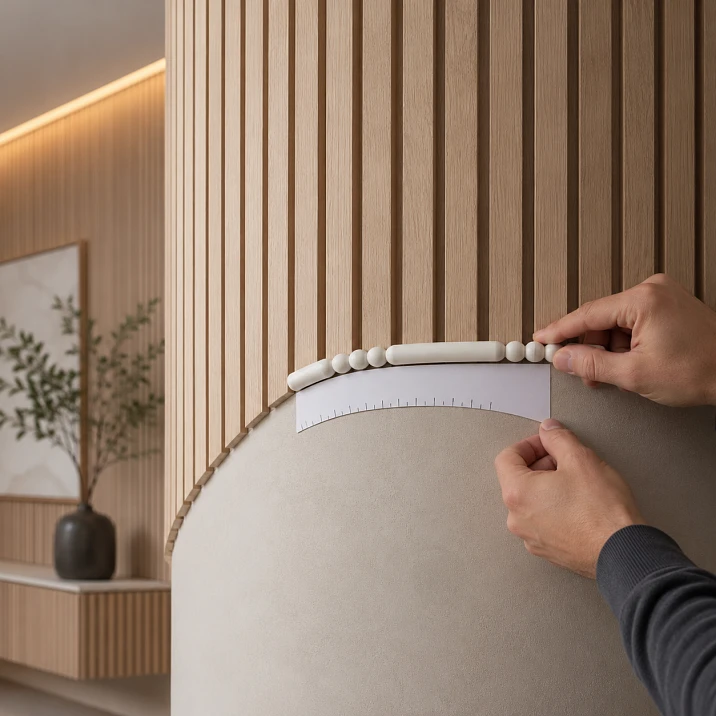
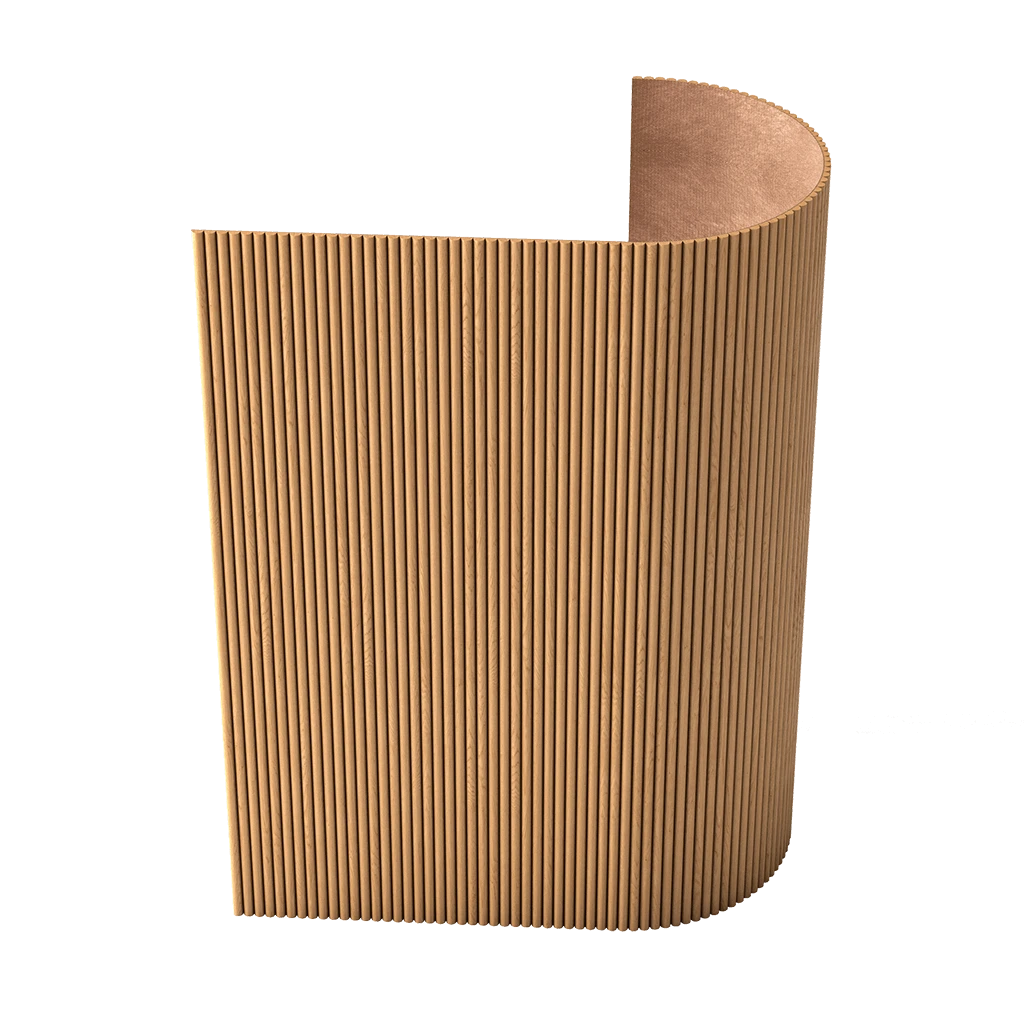
Vertical slat panels work well on flat surfaces, but near them a rounded wall section often appears: a rounded external corner, a smooth transition into a corridor, a semicircular partition, or a radiused part of the wall. If a thin decorative line already runs along the straight section, there is a natural desire to continue it along the curved surface with the same pattern. In such a situation, the carved decorative molding KPU-034 made of polyurethane seems like a convenient solution: the profile is compact, the plank length is 2000 mm, and the material is polyurethane.
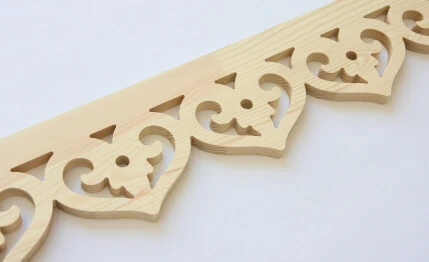
But this does not mean that KPU-034 can be bent to any radius. For this specific article, the manufacturer specifies size A 10 mm, C 6 mm, L 2000 mm, material polyurethane, and a price of 2,040 ₽ per plank, but a separate minimum allowable bending radius is not provided in the product card. Therefore, the correct order is the reverse of the usual one: first measure the wall geometry, determine the radius and arc length, then request confirmation of suitability specifically for KPU-034 for such bending, and only then place the order.
If the check shows that the specific KPU-034 is suitable, it can be used as a thin ornamental line connecting the straight slat surface and the rounded wall section. If there is no confirmation or the radius is too small for a standard straight plank, it is safer to abandon the attempt to "force" the product and move on to selecting a special flexible profile.
What exactly is being purchased: KPU-034 is a carved decorative molding, not a flexible molding by default
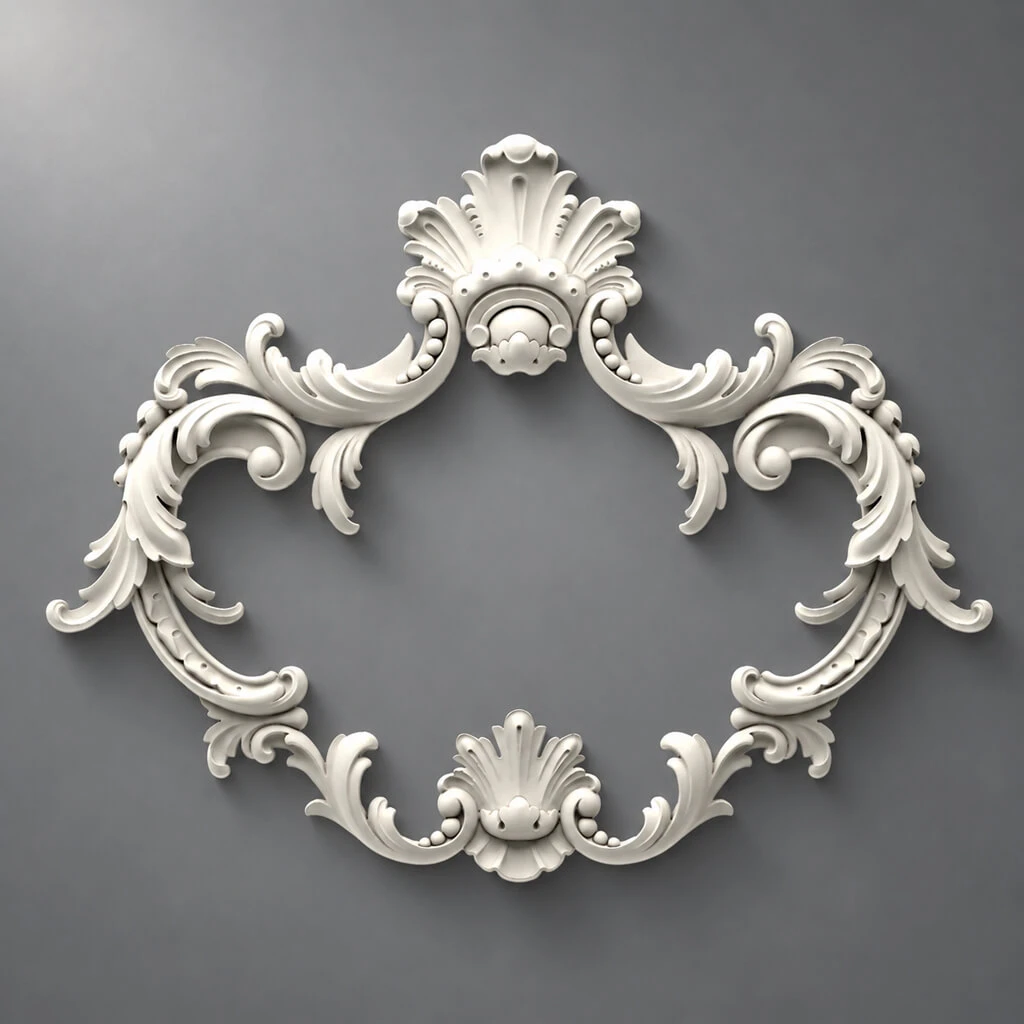
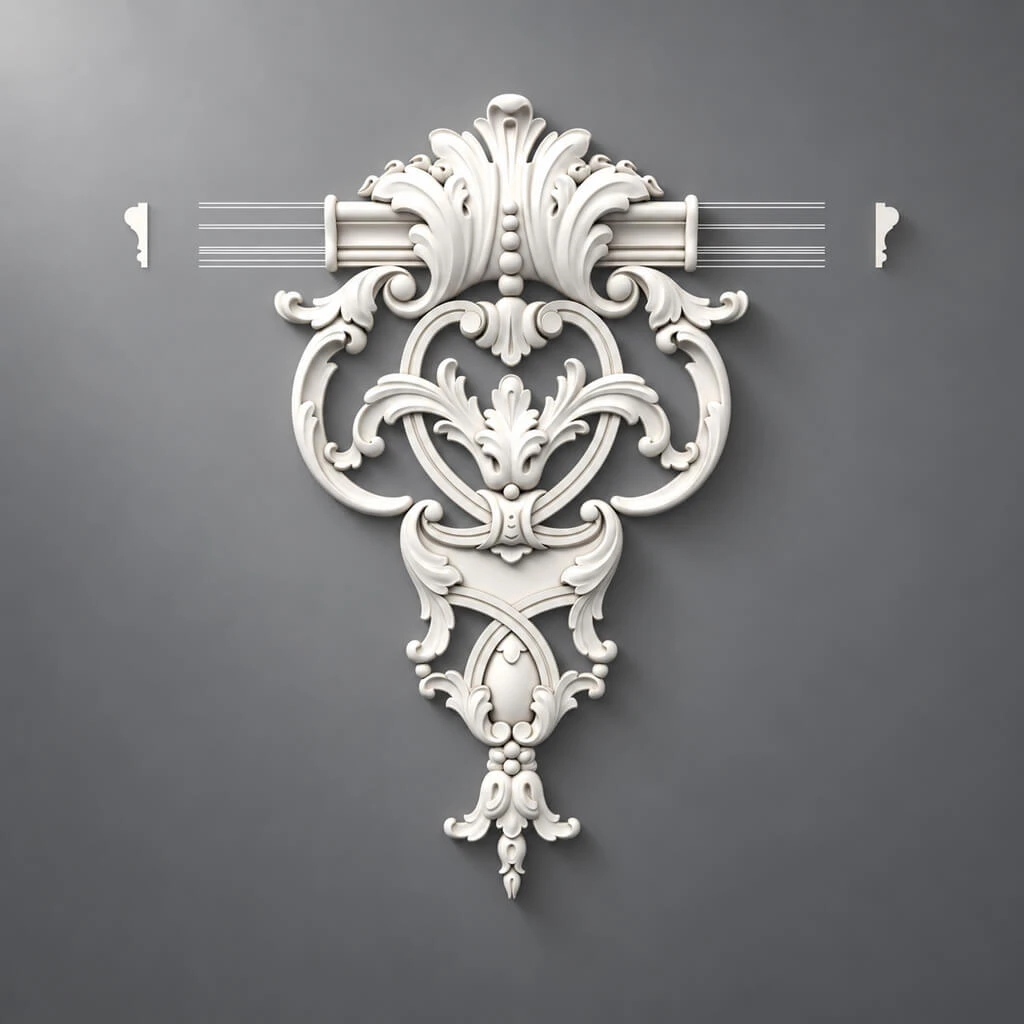
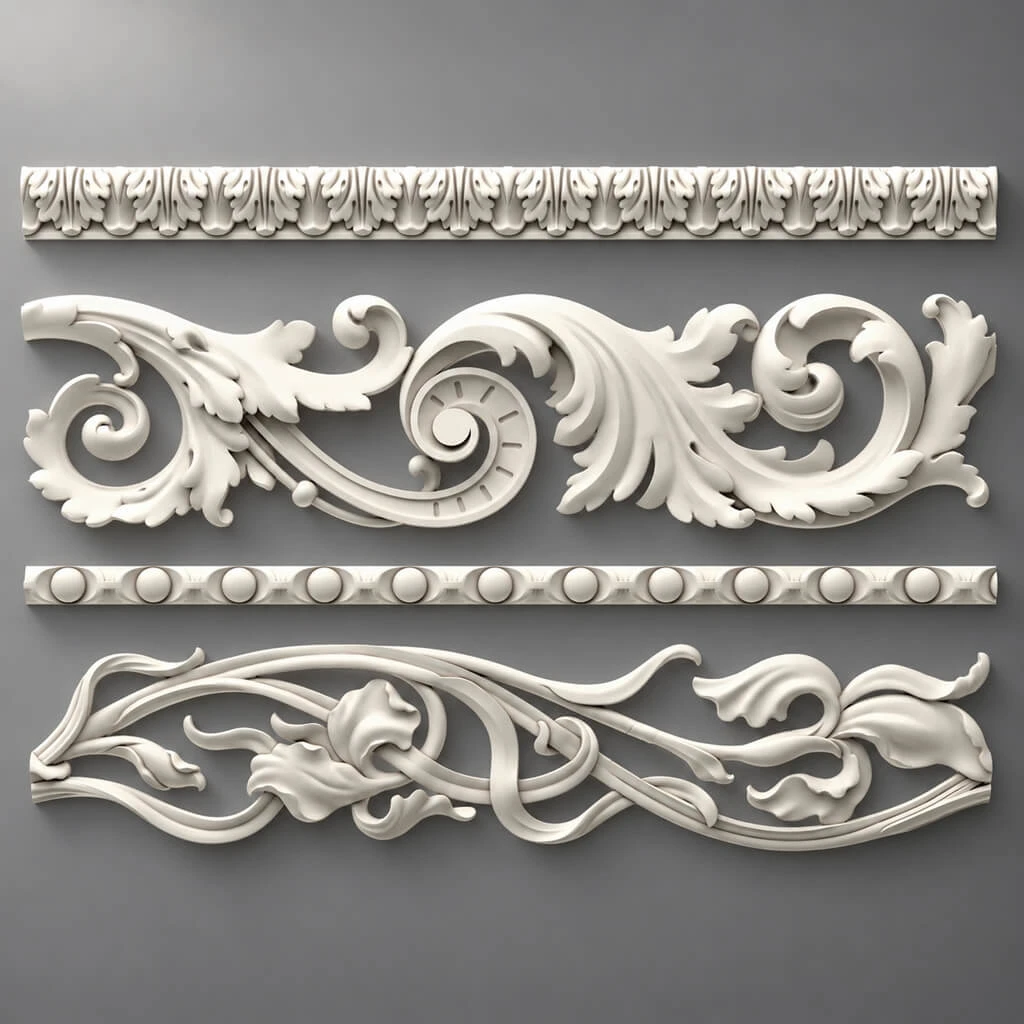
In this task, terminology is critical. KPU-034 is a carved decorative polyurethane molding. It should not be called a trim, corner, bead, or automatically categorized as a flexible molding. The product type matters not only for the article text. It determines the buyer's expectations regarding geometry and installation.
The current KPU-034 product card shows the following basic data:
| Parameter | KPU-034 |
|---|---|
| Product type | Carved decorative molding |
| Material | Polyurethane |
| Size A | 10 мм |
| Size C | 6 мм |
| Length L | 2000 мм |
| Price per 1 strip | 2 040 ₽ |
| Minimum bending radius specifically for KPU-034 | Not specified in the card |
If, after measurements and compatibility checks, the product is suitable for the project, buy carved decorative molding KPU-034 made of polyurethane it is logical after confirming the radius, not before it.
Dimensions A, C, and L also cannot be interpreted arbitrarily. In the product card, they are marked as parameters of the product itself. For calculating consumption, we are primarily interested in the length L = 2000 mm. Dimensions A = 10 mm and C = 6 mm describe the cross-section of the profile, but by themselves they do not indicate how much the strip is allowed to bend along its length.
This is where the most common mistake arises: a small profile seems "thin," and polyurethane is perceived as an elastic material, so the buyer mentally equates KPU-034 with a flexible decorative tape. Such logic is unreliable. The product may have some elasticity while remaining a straight linear element, for which a small radius creates excessive stress, deformation of the ornament, or detachment from the base.
The main answer: measuring the radius is not enough — it must be compared with the confirmed tolerance of the specific profile
Measuring the wall is not the final approval for installation. It provides initial data for verification.
The correct sequence looks like this:
wall geometry → actual radius → bending direction → arc length → pattern requirements → confirmation of KPU-034 suitability → quantity calculation → order.
If one of the steps is skipped, you can get a very precise calculation of the quantity of a completely unsuitable product.
Suppose a rounded wall section has a smooth arc. You measured the radius and got 1200 mm. This is a useful number, but it does not automatically mean that KPU-034 is suitable. You need to know the second value — the minimum allowable bending radius specifically for this article in the required direction. The current product card does not contain such a value. Therefore, the correct conclusion is not "1200 mm is enough," but "the wall radius is 1200 mm; now this value needs to be sent to STAVROS and obtain confirmation for KPU-034."
The general STAVROS article on openwork linear elements shows that for another article — KPU-119 — during curved installation, preheating is considered, and large radii from 1.5 m are called simpler. But transferring this figure to KPU-034 as a technical tolerance is not allowed. KPU-034 has a different cross-section and a different ornament, and the product card does not establish its own limit.
Therefore, the article should not promise the buyer a universal "magic number." Its task is to provide a way to measure the object so that a consultant or technical specialist can answer for a specific product without guessing.
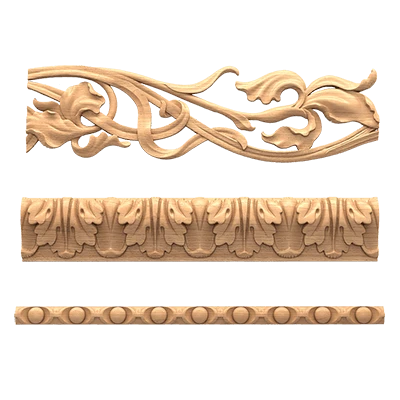
Our factory also produces:
What to consider the radius of a rounded wall section
In everyday conversation, the radius is often simply called "how strongly the wall is rounded." This is not enough for ordering. A geometric characteristic of the line along which the molding must actually run is needed.
Let's imagine a wall section in plan. A straight slatted wall approaches a smooth outer curve. The molding must continue along the surface at the same height. Viewed from above, the installation line forms an arc. The radius of this arc is one of the key parameters.
But there are three different cases.
Get Consultation
Constant radius
The most convenient option is when the wall section is part of a circle. Then the radius is the same along the entire arc. It can be calculated from measurements of the chord and sagitta, or taken from the design documentation. This is the best scenario for profile verification: one number truly describes the entire curved section.
Variable radius
Sometimes the "curve" is made manually with plaster or assembled using a complex template. The curvature changes: at the beginning of the arc the wall is almost straight, then the bend becomes stronger, and at the exit it straightens out again. A single radius does not exist here.
In such a case, it is dangerous to take an average value. The profile experiences maximum stress not at the average, but at the steepest fragment. For ordering, a template of the entire line is needed, or at least a record of the minimum local radius.
Not an arc, but a rounded corner
There is also a simpler node: two straight walls are connected by a small rounding. The decorative line runs straight, then along a short radius segment, and then straight again. Here the main difficulty is not the length, but precisely the short section with maximum curvature. A two-meter strip can lie almost entirely on straight surfaces, but the entire compatibility check is determined by a few dozen centimeters in the center.
Therefore, before ordering, you first need to draw a simple top view diagram and mark where the line is actually curved. This is faster and more useful than trying to immediately calculate linear meters.
How to measure the radius without a construction project
If the wall project already specifies a radius, it is better to use the design value and then check it on the finished base. If there is no documentation, the radius can be determined on site.
For a circular segment, it is convenient to measure two quantities:
-
c — the chord, the straight distance between two selected points of the arc;
-
h — the segment height, the maximum distance from the middle of the chord to the arc itself.
For a circular arc, the radius is calculated using the formula:
R = c² / (8h) + h / 2
For example, between two control points along a straight line it is 1000 mm, and the maximum deviation of the wall from this line in the middle is 100 mm:
R = 1000² / (8 × 100) + 100 / 2 = 1250 + 50 = 1300 mm.
The resulting radius of 1300 mm is not a resolution to use KPU-034. It is an object parameter that needs to be passed when checking the product.
How to measure the chord
Select the start and end of the truly curved section. Do not include large straight fragments in the chord — they will artificially increase the calculated radius. Stretch a cord, a laser line, or apply a straight edge between the points.
How to measure the sagitta
From the middle of the chord, measure the perpendicular to the wall surface. If the wall is already finished, the measurement is taken to the finished face plane — it is on this that the trim will rest.
When the formula is not suitable
The formula works for a circular segment. If the wall has variable curvature, an S-shape, or noticeably differs from a circle, the calculated value may create false confidence. In that case, it is more useful to make a physical template of the line and send its dimensions or a photo with reference markings to a specialist.
A curve template is more useful than the words "I have a smooth curve"
For remote consultation, expressions like "large radius", "smooth angle", and "almost straight wall" are practically useless. One person considers a radius of 600 mm large, another — 3 m.
Before ordering, make a curve template. For this, a strip of thick cardboard, thin hardboard, a flexible plastic batten, or another material that can follow the surface without its own rigid deformation is suitable.
Working order:
-
Mark the exact height of the future KPU-034 line on the wall.
-
Apply the flexible strip along this line.
-
Transfer the bend contour.
-
Mark the beginning and end of the curved section.
-
Write down the actual arc length.
-
Record where the straight adjoining sections are located.
-
Take a photo of the template next to a tape measure.
-
If possible, transfer the contour to paper at a 1:1 scale for a short section.
Such a template solves several tasks at once. It shows not only the nominal radius, but also the smoothness of the transition, the absence of local "kinks," the length of the curve, and the direction of geometry changes.
The template is especially useful on an already finished wall. Plaster, putty, decorative coating, and the slat panels themselves can slightly alter the geometry relative to the rough project. For carved molding, the final face surface matters, not the perfect circle from the drawing.
Why the arc length matters more than the straight distance between its ends
After the radius, the second commercial mistake is calculating consumption by the chord.
If you measure a curved wall section with a tape measure "straight across" from start to end, you get the chord. But KPU-034, if its use on a radius is confirmed, must run along the wall surface, i.e., along the arc. The arc is always longer than the chord.
For a practical order, the easiest way is to measure it with a flexible tape measure or a non-stretchable cord directly along the installation line. Lay the cord on the surface, mark the start and end, then remove it and measure it on a straight line.
If the geometry is truly circular and the radius R and central angle θ in radians are known, the arc length is defined as:
Larc = R × θ.
But in a real renovation, direct measurement on the surface is often more reliable than complex geometry. The formula is useful for verification, not as a mandatory ritual.
For a segment where the radius R and chord c are known, the angle can be calculated:
θ = 2 × arcsin(c / (2R)).
After that, the arc length is calculated. This calculation makes sense when measuring the length on the finished surface is inconvenient—for example, if the wall section is tall or covered by temporary structures.
How to count the number of two-meter slats after confirming the radius
Factory length of KPU-034 is 2000 mm. The quantity is calculated based on the actual length of the entire decorative line, not just the length of the curve.
If the molding starts on a straight slat wall, wraps around a pilaster, and continues further, you need to add:
Ltotal = Lstraight1 + Larc + Lstraight2 + other sections.
Base number of slats:
N = round up (Ltotal / 2000 mm).
But this is only the geometric minimum. Before purchasing, you need to separately check the repeat of the carved pattern, joint locations, and the need for trimming. For ornamental molding, the remainder cannot be considered solely as "useful millimeters": a short piece may physically fit in length, but may not allow the pattern to continue beautifully.
Below is only an illustration of the basic math without allowance for the repeat:
| Total line length | Geometric minimum of slats | Cost: 2,040 ₽ per piece. |
| 1500 мм | 1 | 2 040 ₽ |
| 2000 мм | 1 | 2 040 ₽ |
| 2600 мм | 2 | 4 080 ₽ |
| 3900 мм | 2 | 4 080 ₽ |
| 4300 мм | 3 | 6 120 ₽ |
The table only answers the question of quantity by length. It does not confirm the possibility of radius installation and does not account for losses due to pattern matching.
If a decision is made after technical verification, order KPU-034 10 × 6 × 2000 mm it makes sense to proceed with the already calculated quantity and clear joint locations.
Where is the best place to position the joint of two planks on a radius wall
If the length of the decorative line exceeds 2000 mm, the joint becomes part of the project. On a straight wall, it is usually easier to fit, press, and finish. On a curve, an additional factor comes into play: both pieces must not only match in pattern but also continue the same curvature.
Therefore, when there is a choice, it is more reasonable to move the joint from the most stressed section of the curve to a straight or flatter part. This is not a universal technical requirement from the manufacturer, but rather the practical logic of preliminary layout: the more complex the geometry at the connection point, the more parameters need to be controlled simultaneously.
Before ordering, lay out the two-meter segments on the diagram. Mark:
-
the start of the first plank;
-
start of the radius section;
-
point of maximum curvature;
-
end of the radius;
-
assumed joints;
-
places where the pattern will be most visible.
If the joint falls exactly on the steepest section, try shifting the start of the layout. Sometimes changing the starting point allows you to move the connection to a straight part without increasing the number of planks.
But you should not automatically buy an extra plank based on this principle alone. First, assess the actual composition and repeat. If an additional length is truly required for a neat pattern, then it is a deliberate part of the order, not a "just in case" reserve.
Radius in plan and radius in height are two different tasks
A rounded wall section is usually curved in plan: when viewed from above, the surface follows an arc. But sometimes the wall simultaneously changes geometry in height — for example, transitioning into a vault, a rounded slope, or a decorative niche.
For straight trim, these are fundamentally different situations.
If the KPU-034 line runs horizontally around a cylindrical pier, the profile must bend in a single plane along its length.
If the line rises or falls while the wall turns, spatial twisting occurs. The trim must not only bend but also change the orientation of its cross-section. This is a much more complex deformation, and the usual talk of a "radius" is no longer sufficient.
Before ordering, look at the line not only from above but also from the side. A laser level helps determine whether it stays at the same height. If it does, the task is two-dimensional. If not, be sure to show the spatial geometry to a specialist and do not rely on standard installation based on a single R value.
A convex and a concave pier create different stress in the ornament
The curvature can be convex—like an external rounded corner—or concave—like a semicircular niche.
For a decorative trim, this is not the same. When bending, one side of the profile is on the outer radius and must travel a longer path, while the other is on the inner radius and compresses. For a relief ornament, the change is distributed not only across the base but also across the details of the pattern.
It cannot be stated in advance that KPU-034 equally allows both bending directions. If the manufacturer has not specified the radius and direction, the consultation request should explicitly state:
-
convex or concave surface;
-
radius;
-
arc length;
-
horizontal or vertical direction of the line;
-
Will the profile pass through the transition from a straight wall to a curve?
A top-down photo with a labeled radius is often more informative than a long description.
This check is especially important for carved moldings. Even if the base can physically accommodate the curvature, the buyer cares about the appearance of the ornament: the pattern should not visually "bunch up" on the inner side or stretch excessively on the outer side.
Why a slat wall complicates the task, even though the radius itself is on a smooth wall section
Slat panels are not the main technical subject of this article, but they affect the composition and the installation joint.
First, the slats create a strong vertical rhythm. KPU-034 next to them works as a thin ornamental line. If it needs to transition from the slatted section to a smooth curved wall, you need to determine in advance where its base is on the straight section.
You cannot automatically glue thin molding across the deep relief of the slats and expect continuous support. If the decorative line crosses the slats and the gaps between them, the actual contact surface may be discontinuous. Then, a smooth strip, backing, or another base is designed first, depending on the construction of the specific panel.
Second, the line must visually continue through the material transition. If it "jumps" over the slat protrusions on the straight wall and suddenly lies on a smooth surface on the radius, the change in depth will be noticeable even with a perfectly calculated radius.
Third, the end of the slat panels may have its own edge profile. KPU-034 should not automatically be assigned as the technical edge element of the panel. It is a decorative molding. The technical termination of the slat cladding and the decorative line are different functions.
If the panels themselves are still being selected, buy slat panels for walls for interior finishing it makes sense after the entire geometry of the joint is clear: panel thickness, end face, smooth zone, and transition to the radius.
On which surface should the radius be checked: against the rough wall or the finished finish
The radius should be checked against the surface to which the molding will actually be glued.
If the partition is only rough-plastered so far, and ahead are finishing plaster, panels, underlayment, or another coating, the final radius may change slightly. On a large radius, the difference is often small, but on a short curve, even a thin layer along the entire arc alters the contact line.
This is especially sensitive at the point where a straight wall transitions into a curve. Uneven putty can create a local "break" that was not in the design geometry. The trim piece will react precisely to this actual shape.
Therefore, there are two modes of operation.
The wall is still being built
The radius can be used as a design parameter. In this case, it is possible to adjust the substrate in advance to the chosen solution, make a control template, and ensure a smooth transition without local bumps.
The wall is already finished
Measurements should be taken against the finished face surface. The design radius becomes reference information, and the decision is made based on the actual contour. Here, a template and a long flexible batten are especially useful: they show not only the average curvature but also local defects.
For the buyer, this is a significant difference. At the construction stage, the joint can be adjusted to the decor; after renovation, the decor must adapt to the existing joint — within the confirmed capabilities of the product.
Why you cannot test KPU-034 with a force "fitting" bend after purchase
Sometimes the simplest method is suggested: buy one strip and try bending it on site. For a meaningful order, there is a more rational approach.
First, before purchasing, you can already measure the radius and get a consultation. Second, a force bend without a confirmed method can damage the product or alter the relief. Third, even if the strip was temporarily pressed by hand, this does not prove that it will work properly after gluing.
Three states need to be distinguished:
the strip is pressed to the arc by hand — a short-term force holds it;
the strip independently follows the arc without excessive tension — a more favorable situation, but still not an official approval;
the manufacturer confirmed the possibility of installation on the measured radius and the recommended preparation method — this is exactly what is needed before forming the final cart.
If STAVROS recommends heating or another preparation method for a specific case, their instruction for the product must be followed. You cannot independently transfer the temperature regime from an article about a different item just because the material is called polyurethane in both cases.
What the recommendation about radii from 1.5 m in the general STAVROS article means
This figure can easily be incorrectly turned into a rule: "KPU-034 can be bent from a radius of 1.5 m." This should not be done.
In the general STAVROS article on openwork moldings, curved installation is discussed using the example of KPU-119. There, the standard strip is described as straight, for work along an arched contour preheating is mentioned, and radii from 1.5 m are called simpler for such an operation. For small radii or complex geometry, it is suggested to consult on a suitable product.
From this, only a methodological conclusion can be safely drawn:
the more complex and steeper the curvature, the more important it is to check the specific article; the general ability of the material to deform does not replace the technical tolerance of the product.
But it cannot be transferred to KPU-034:
-
minimum radius of 1.5 m;
-
specific heating temperature;
-
guaranteed suitability for arches;
-
identical behavior of the ornament.
This approach protects the buyer both from an overly bold purchase and from the opposite mistake — prematurely rejecting KPU-034 where a manufacturer's specialist would have confirmed its use.
When instead of KPU-034, you should look towards a special flexible profile
A special flexible molding is needed not because it is "better" than regular trim, but because it has a different purpose. Its material and construction are designed for curved surfaces, and for specific models, the minimum radius must be specified or confirmed.
Scenarios where the alternative should be considered especially carefully:
-
small radius;
-
long continuous curved section;
-
deep convex or concave surface;
-
the need to obtain a uniform line without constant force pressing;
-
complex transition straight — radius — straight;
-
spatial geometry;
-
risk of noticeable deformation of the carved pattern of KPU-034.
On the STAVROS website, there is a separate article about how to choose a flexible polyurethane molding for arches and curved walls. It is useful to use as a next step if there is no confirmation for KPU-034.
At the same time, in the current check there is no reason to substitute the special flex catalog with a regular molding category and label such a link as "buy flexible molding". Commercial interlinking should lead to a truly suitable product type, not to the nearest section with a similar name. Therefore, after a negative answer for KPU-034, the required radius of the flexible product is first determined, and only then a specific item is selected.
This is an important point for the buyer. The alternative should appear not from a general concern "it probably won't bend", but from a specific check result: the radius, bending direction, or geometry complexity require a profile with documented flexibility.
How to compare KPU-034 and a flexible profile before talking to a consultant
Before contacting, it is useful to prepare a short project table.
| Object parameter | What to record |
| Radius | R value or curve template |
| Curve type | constant / variable radius |
| Direction | convex / concave |
| Length of curved section | on surface |
| Total length of decorative line | straight + arc |
| Base | smooth wall / prepared strip / other |
| Adjacent finish | Slatted panels |
| Pattern requirement | carved ornament KPU-034 must be preserved |
| Color | to match the wall / slats / contrast |
| Is continuity needed | one line without segmentation |
After this, the question to the specialist sounds specific: "A carved molding KPU-034 is needed along a convex arc with a radius of 1800 mm, arc length 1100 mm, then straight sections on both sides. Can KPU-034 be used specifically, how should the plank be prepared, and is there a radius limitation?"
Such a request is much more effective than the phrase "is it flexible?"
If the answer is negative, you can go to the catalog and You can buy ready-made stucco matching the Baroque style. Calculate the quantity: linear meters of cornices and moldings, number of rosettes, pilasters, consoles, corner elements. Add a ten to fifteen percent allowance for trimming. only after choosing the appropriate profile type, rather than trying to force one article to solve a task for which it is not confirmed.
How to check the appearance of the ornament on the arc before purchasing
Technical compatibility and visual compatibility are not the same thing.
Even if the profile allows the required radius, a carved pattern on a curve is perceived differently than on a straight wall. On a convex surface, the outer parts of the ornament recede from frontal view. On a concave one, the pattern gathers more strongly into the field of vision.
For KPU-034, width A is 10 mm. This is a delicate line, so geometric distortion may be visually minor, but the result depends on viewing distance and light placement.
Before purchasing, you can make a simple mock-up:
-
Cut a strip of paper 10 mm wide.
-
Apply a conditional repeating pattern to it.
-
Secure it along the future installation line with masking tape.
-
Look at the wall from key points — from the entrance, from the adjacent area, directly opposite.
-
Check the line in daylight and evening light.
-
Take photos frontally and at an angle.
The paper mock-up does not test the physical flexibility of KPU-034. It solves a different task: it shows whether a decorative line is needed on this arc at all.
Sometimes after such a test it becomes clear that slat panels already create a sufficiently active rhythm, and an additional carved belt on the pier overloads the transition. Then the right decision is not to buy the molding, even if technically its use is possible.
How the radius interacts with the slat wall, the base, and the visual composition
Radius compatibility by itself does not guarantee a good result. After the technical check of KPU-034, you need to see how the line meets the slat finish, how evenly the base is prepared, and whether the new belt creates an unnecessary visual conflict.
Where the slat finish should end relative to the radius
There are several structurally different options, and they change the role of KPU-034.
The slats end before the curvature begins
This is the most straightforward scenario. The straight field of panels has a clean end, then a smooth radius surface begins. The molding can connect the two zones as a continuous decorative line if the base beneath it is prepared and the curve is confirmed.
The slats extend onto the start of the radius
Then the slat cladding itself changes the geometry. If the panels are flexible and wrap around the pier, the KPU-034 line can run over the textured surface, which brings back the question of continuous support. You need to decide in advance whether a smooth mounting strip is provided.
The slats approach the radius only as part of the composition
For example, panels occupy the lower or central part of the wall, and KPU-034 runs along a smooth band above them. Then technically the molding does not contact the slats at all, and the slat wall only affects the visual rhythm. This is a cleaner scenario for a decorative line.
If the project is still being formed and needs Buy slatted panels for wall finishing, it is useful to first determine the future boundary of the panels and only then assign the decorative band.
Why KPU-034 should not mask poor geometry of a radius wall
Thin molding can emphasize a line, but not fix the base.
If the curvature is assembled with waves, local flat spots, sharp transitions, or poorly finished plaster, a thin decorative strip will rather reveal the defect. The eye reads continuous lines well: any change in their curvature becomes a reference point by which the unevenness of the wall is visible.
Before ordering, apply a long flexible batten or template to the radius. If alternating gaps appear between it and the wall, first correct the base.
It is especially undesirable to try to compensate for unevenness with a thick layer of adhesive. If for normal contact of one part of the strip you have to create a significantly thicker adhesive pad, while another part lies almost flush, the decorative profile becomes a leveling tool. That is not its job.
The order should be as follows:
geometrically prepared surface → verified radius → confirmed profile → installation.
Not the other way around.
How to choose the height of the line at the transition from slats to a rounded wall section
The radius is a technical matter, but the decorative band also needs to be at the right height.
The KPU-034 has a narrow profile, so it can easily be mistaken for a neutral line and placed "wherever it fits." But next to vertical slats, even a thin horizontal ornament can noticeably change the composition.
Usually, it is worth checking three alignments:
-
to furniture;
-
to an architectural element;
-
to the panel system itself.
If there is a console nearby, the line can relate to its countertop or upper decorative level. If there is a doorway on the wall section, it is useful to compare the height with the trim. If the slat panel has its own horizontal edge, KPU-034 can visually continue it.
There is no need to try to align the molding to all objects at once. Choose one dominant axis.
Before ordering, run a line of painter's tape about 10 mm wide along the straight wall and around the radius. This allows you to simultaneously check the height, curvature, and compositional necessity of the element.
Lighting on a radius can make a thin relief more noticeable than on a straight wall
A curved surface changes the angle of light incidence along the entire arc. Therefore, the same thin molding on a flat plane and on a radius is perceived differently.
On a straight wall, side light creates a relatively stable shadow along the relief. On a convex wall section, part of KPU-034 turns toward the light source, part away from it. The shadow may gradually intensify and disappear.
It is useful to check this before ordering, especially if nearby there are:
-
linear lighting;
-
wall sconce;
-
track light;
-
a window providing strong side light;
-
backlighting of the slat panels themselves.
Too contrasting coloring of the molding on a radius can enhance the effect of a "tape glued over the wall," while coloring matching the base turns the ornament into a thin relief belt.
The color question does not solve the radius problem, but it can determine whether it is worth keeping KPU-034 in the project at all after a technical check.
Mounting restrictions that cannot be corrected by force
After checking the radius, there remains a temptation to resolve incompatibility with mounting techniques: cutting more often, pressing harder, using stronger adhesive. These methods should not substitute for the compatibility of the product with the geometry. If the profile is not confirmed for the required curve, mounting "ingenuity" only shifts the problem to the next stage.
Can a radius be made from several short straight pieces of KPU-034
Theoretically, any curve can be approximated by a polygon. In practice, for decorative carved molding, this technique creates a new problem.
If you cut a two-meter plank into many short segments and join them at slight angles, you get not a smooth arc, but a broken line. The shorter the segments, the softer it appears from a distance, but the more joints need to be fitted.
For a carved pattern, a repeat is added: each joint must account for the continuation of the ornament. After puttying and painting, the geometric "staircase" may still show up in side light.
Therefore, segmentation cannot be considered a standard alternative to a flexible profile. If KPU-034 does not allow the required bend, it is more correct to compare a special flexible solution than to cut an expensive decorative plank into dozens of pieces.
An exception is possible only as a deliberate design technique, when a faceted rather than a smooth line is required. But that is already a different design intent.
Mounting adhesive should not compensate for an unsuitable radius
Another dangerous logic: "if the profile tends to straighten out, good adhesive will hold it." For product selection, this is an incorrect way of framing the problem.
The adhesive must ensure adhesion of the prepared product to a suitable substrate. It should not become a permanent force tie that forcibly holds the profile in a geometry not confirmed for this product.
If after a dry fit performed according to the manufacturer's recommended method, the strip tends to detach from the center of the arc or from the edges to such an extent that it must be constantly pressed with strong force, this is a signal to return to the issue of compatibility.
Before ordering the adhesive, it is useful to first understand the type of substrate: paint, plaster, MDF, wood, prepared insert. The STAVROS catalog contains separate materials for installation and finishing, but the choice of a specific composition should take into account the substrate and the manufacturer's instructions for the trim.
The correct sequence is simple: first, the profile and radius must be compatible, then the fastening method is selected. These steps should not be swapped.
Additional checks of the finished curved surface
On a real site, the ideal geometry from the drawing may differ from the finished wall. Before the final order, it is worth checking several signs that are not limited to a single R value: the condition of the finish, the uniformity of curvature at different heights, the smoothness of the tangential transition, and the quality of the original photos for consultation.
What changes if the curved wall section is already painted
A finished painted surface deprives the craftsman of some opportunities to correct the substrate after purchase.
At the rough finishing stage, it is still possible to adjust the curvature, form a smooth mounting strip, or correct the transition from the slats. After the final painting
How to check the radius at different heights
Even if the wall section visually appears cylindrical, its geometry may vary along the height. This is especially common with manual plastering or complex frame assembly.
If KPU-034 is planned at a height of 900 mm from the floor, it is pointless to measure the radius only near the ceiling or along the baseboard. You need to check directly along the installation line.
For a long curved wall section, it is useful to make three control cross-sections:
-
below the future molding;
-
exactly along the molding line;
-
above the line.
If the values differ noticeably, the surface is not a regular cylinder. This does not necessarily make installation impossible, but it means that photographs and a template are more important than a single radius value.
Such control is especially useful if several parallel decorative lines are planned in the future. A profile that fits one trajectory should not automatically be considered suitable for another height without checking.
How to account for the transition from a straight section to an arc
Even with a large radius, the point where the straight surface begins to curve can be problematic.
A good geometric transition is tangential: the line changes direction smoothly, without a visible break. If builders have created a small "kink" between the straight and circular sections, the molding will be forced to follow it exactly.
You can check the transition with a long flexible straightedge. It should lie flat against the straight section and smoothly curve into the radius. If a local gap forms at the transition point or the straightedge changes direction abruptly, fix the base first.
For a decorative line, this is often more important than the average radius of the entire wall. A large radius does not save a section with a local sharp break.
Why you cannot rely only on the 10 mm width
The narrow width of KPU-034 indeed makes the profile visually delicate. But flexibility is not determined by width alone.
The behavior of the product is influenced by:
-
the material of the specific formulation;
-
thickness;
-
the shape of the cross-section;
-
the depth and nature of the relief;
-
the direction of the required bend;
-
length of the curved section;
-
presence of heating or other permissible preparation;
-
temperature and installation conditions.
Therefore, the search logic "narrow = flexible" is only suitable as a reason to check the product, but not as a technical conclusion.
It is for this reason that the article about KPU-034 should remain product-problem oriented. It does not promise universal properties of polyurethane, but teaches how to obtain data that is missing in the product card.
How to prepare a photo for consultation so that the task can be understood from it
One photo of a "beautiful wall" is usually not enough. A set of four shots is needed.
Shot 1 — general view.
Show the slat wall, the entire pier, and the adjacent area. This provides context.
Shot 2 — top view or as close to a plan as possible.
Needed to understand convexity, concavity, and the start of the radius.
Frame 3 — radius with measurement.
The chord, arrow, or template must be visible together with the tape measure.
Frame 4 — installation line close-up.
Show the base and the transition point of the slat panels to the smooth surface.
In the message, include: KPU-034, estimated height, radius, arc length, and total line length.
Such a set reduces the risk that the consultant and the buyer imagine two different assemblies under the same word "rounded wall."
How the radius affects the repeat of the carved pattern KPU-034
For a smooth molding, it is enough to check the geometry of the profile itself. For carved trim, another variable appears — the repetition of the ornament. Even if KPU-034 is technically allowed to be laid on the chosen arc, the buyer must see how the pattern passes through the start of the radius, its central part, and the exit to the straight line.
On a straight wall, the distance between repeating ornament elements is perceived as uniform. On a convex arc, the viewer sees different sections at different angles. Part of the pattern visually shortens in perspective, and the edge zone gradually moves out of frontal view. On a concave surface, the opposite effect occurs: several repeats may fall into the field of view simultaneously and appear denser.
This does not mean that the ornament is necessarily physically deformed. Here, it is first about the visual repeat. It can be checked before purchase on a paper strip: print or conditionally draw the repeating motif, lay it along the future trajectory, and view it from the actual viewpoint.
Separately mark the joint of two planks. On carved molding, the joint must account not only for millimeters of length but also for the continuation of the pattern. If geometric calculation gives a remainder of 300 mm, this does not guarantee that such a piece can be used without loss after matching the repeat. Therefore, it is advisable to calculate the final consumption after both the arc and the pattern logic are known.
For a long composition, it is useful to decide in advance which section is more important to keep whole: the central part of the radius, the transition from a straight wall, or the most visible area opposite the entrance. Then the cutting of two-meter planks is built not from a random edge of the wall, but from visual priority.
Control fitting at 1:1 scale without purchasing the KPU-034 itself
A full-size fitting does not have to mean buying one plank "for an experiment." At the decision stage, you can reproduce the line's dimensions with cheap materials and check several parameters at once.
For the mock-up, you need a strip of cardboard or flexible plastic about 10 mm wide, painter's tape, a tape measure, and a marker. If you want to assess the protrusion, you can add conditional volume close to size C = 6 mm to the strip, but such a mock-up still does not model the mechanical properties of real polyurethane.
First, lay the strip along the straight part, then along the arc. Mark places where it starts to pull away from the wall on its own. This is not a flexibility test of KPU-034 — the mock-up material is different — but it does reveal local kinks, complex spatial trajectories, and areas without a proper support surface.
Then evaluate the composition with real slats. If the thin line disappears against an active texture, there is no point in complicating the radius just for the formal continuation of the ornament. If, on the contrary, the line connects the straight and curved surfaces well, there is an argument to continue technical verification.
Finally, mark the mock-up at 2000 mm intervals. This is a simple way to see future joints of two-meter planks even before calculating the basket. Sometimes it immediately becomes apparent that one joint falls into the most inconvenient section of the arc. Then you can change the starting point of the layout or decide that an extra plank is justified by the quality of the pattern.
The 1:1 mock-up answers questions of scale, trajectory, and layout. It does not replace manufacturer confirmation of the radius, but it sharply reduces the number of uncertainties before contacting STAVROS.
Practical algorithm for checking KPU-034 before ordering
Below is a sequence that allows you to make a decision without guessing or buying "on trial."
Step 1. Mark the line
Use painter's tape to mark the exact trajectory of the future paneling on a straight slatted wall and a curved partition. This will immediately show whether the decorative line should actually continue along the arc or whether it is more logical to end it before the curve.
Step 2. Find the start and end of the curve
Separate the straight sections from the truly curved part. This is needed both for the radius and for laying out two-meter planks.
Step 3. Determine the type of geometry
Constant radius, variable curve, short rounding, or a spatial line. If the radius changes, do not try to replace the entire geometry with one average number.
Step 4. Measure the radius
For a circular arc — by chord and sagitta or by the project. For a complex curve — make a template and determine the steepest section.
Step 5. Measure the arc along the surface
Use a flexible tape measure or non-stretchable cord. Do not use the chord as the length of the material.
Step 6. Check the base
The linear product must have a clear mounting surface. If the line crosses a slatted relief, decide in advance on a smooth support.
Step 7. Determine the direction of the bend
Convex or concave surface; horizontal or vertical line. For a spatial trajectory, prepare a separate diagram.
Step 8. Prepare a request for KPU-034
Send STAVROS the article number, radius, arc length, photos, and bend direction. Ask about the admissibility of use and the recommended preparation method specifically for KPU-034.
Step 9. Only after confirmation, calculate the planks
Add the length of straight sections and the arc, divide by 2000 mm, round up, then account for actual losses on joints and pattern.
Step 10. If KPU-034 is not suitable — change the product type, not the wall's physics
Check a special flexible profile, a more suitable cross-section, or abandon the decorative line on the radius.
Such an algorithm can lead both to the purchase of KPU-034 and to its rejection. In both cases, the article fulfills a commercial task: it helps to form the correct cart.
When you should not buy KPU-034
Rejecting the product is a normal result of the check.
It is better not to order KPU-034 for a specific radius unit if:
-
the manufacturer does not confirm application on the measured radius;
-
the line requires strong spatial twisting;
-
the wall has variable curvature with local sharp sections;
-
the base does not allow for normal contact;
-
the radius section is so short and active that the ornament is visually deformed;
-
for installation, one would have to constantly hold the strip with excessive force;
-
the only plan is to cut it into many short segments;
-
the decorative belt overloads an already active slat composition;
-
there is a special flexible profile that solves the task more predictably.
Don't perceive such a conclusion as a loss of purchase. The price of one KPU-034 strip is 2,040 ₽. An error with two or three strips is already 4,080–6,120 ₽ just for the product, not counting installation, painting, and rework.
When one or more KPU-034 seem like a logical choice
The reverse scenario should also be clearly formulated.
KPU-034 can be considered for ordering when:
-
the actual decorative line is clear;
-
the radius is measured;
-
geometry is smooth;
-
bend direction is known;
-
base is prepared;
-
specialist STAVROS confirmed the use of exactly KPU-034 on this radius and the preparation method;
-
length is calculated along the surface;
-
joint locations are planned;
-
the ornament visually suits the slat wall;
-
the buyer has a clear reason to continue the decorative line along the pier rather than cutting it off before the radius.
Only after this, the transition Buy polyurethane trim becomes part of a meaningful choice: one can compare KPU-034 with other carved linear elements by scale and pattern.
Three scenarios that lead to different solutions
Scenario 1. Large smooth radius and short arc
The slats end on a straight wall, followed by a smooth partition. The decorative line runs along a smooth strip. The radius is measured, the arc is short, and KPU-034 is needed to continue an existing ornamental belt.
Solution: send the parameters to the manufacturer. If KPU-034 is confirmed for this geometry, calculate the total length and order the required quantity.
Scenario 2. Small radius at a rounded corner
Two straight walls are connected by a short but very steep rounding. Most of the trim will lie straight, but a strong bend is required in the central section.
Solution: do not assess compatibility based on the total wall length. It is the small section that determines the risk. If KPU-034 is not confirmed, look for a special flexible profile.
Scenario 3. Variable curve near flexible slat panels
The slat cladding itself extends onto the radius, and the decorative line must follow a complex contour without a constant radius.
Solution: the simple R formula is no longer sufficient. A template of the entire line is needed, along with a check of the base and separate approval of the product. It may be more appropriate to change the composition and stop KPU-034 on the straight part.
These scenarios differ not in numbers, but in the very mechanics of the solution — that's why it's useful to consider them separately.
Errors when ordering KPU-034 for a rounded pilaster
Mistake: considering any polyurethane to be flexible
Why it occurs: the material does have some elasticity, and there are flexible polyurethane profiles in the catalog and informational materials.
Consequence: the buyer transfers the properties of a special flexible product to standard carved molding.
Check: look for the minimum radius specifically in the KPU-034 card or request it from the manufacturer.
How to avoid: do not order until the specific radius is confirmed.
Mistake: calculating the arc by the chord
Why it occurs: it's easier to stretch a tape measure between two points in a straight line.
Consequence: the quantity and locations of joints are calculated based on an underestimated length.
Check: measure the path along the surface with a flexible tape measure or cord.
How to avoid: separately record the chord for the radius and the arc length for the consumption.
Error: transferring 1.5 m from KPU-119 to KPU-034
Why it occurs: both products belong to polyurethane trim.
Consequence: a general recommendation turns into a non-existent factory tolerance.
Check: look at which article the original recommendation refers to.
How to avoid: use the number only as context and consult separately for KPU-034.
Error: checking only the radius, but not the base
Why it occurs: attention is focused on the bend.
Consequence: a profile suitable by radius turns out to be impossible to glue properly over battens or an uneven surface.
Check: run the installation line and assess the contact along the entire length.
How to avoid: prepare a smooth and stable installation area.
Mistake: considering force pressing as proof of compatibility
Why it occurs: the strip temporarily takes shape under the hand.
Consequence: after installation, internal stress tends to straighten it, and the adhesive is forced to hold what is structurally inconsistent.
Check: obtain manufacturer recommendations on radius and installation method.
How to avoid: do not turn adhesive into a means of constant struggle with profile elasticity.
How to form an order without unnecessary items
After the check, one of three decisions should remain.
Solution A — KPU-034 confirmed.
Calculate the total line length, joint locations, repeat pattern, and place the order for KPU-034.
Solution B — KPU-034 is not confirmed, but a decorative line is needed.
You are selecting a flexible profile with a documented or confirmed radius. The carved pattern may change, but the technical logic will be correct.
Solution C — a decorative line on the radius is not needed.
KPU-034 ends on the straight section or is completely excluded. The rounded wall remains clean and acts as a transition between the active slats and the next zone.
This is better than automatically buying several slats just because the wall length divided by 2000 mm.
Checklist before adding KPU-034 to the cart
Before ordering, answer "yes" to each item:
-
the installation line is drawn on the wall;
-
the start and end of the radius are defined;
-
the type of curve is clear;
-
actual radius measured or template made;
-
arc length measured along the surface;
-
convex/concave direction recorded;
-
base for molding is solid and prepared;
-
transition from slats to smooth surface resolved;
-
KPU-034 checked specifically for this radius;
-
preparation/installation method confirmed for KPU-034;
-
quantity calculated based on 2000 mm;
-
joints and pattern repeat taken into account;
-
visual mockup shows that the ornament is indeed needed;
-
There is an alternative scenario if KPU-034 is not suitable.
If there is no answer at the item "KPU-034 checked specifically for this radius," the cart is not ready yet.
Conclusion: KPU-034 should be ordered based on the measured and confirmed radius, not on assumptions about polyurethane flexibility.
For a rounded wall section next to a slat wall, the carved decorative molding KPU-034 can be an interesting way to continue a thin ornamental line. Its compact cross-section of 10 × 6 mm and length of 2000 mm are convenient for delicate decor, and the price of one strip is 2,040 ₽.
But neither the compact size nor the material alone proves the possibility of bending along a specific wall. The current KPU-034 product card does not specify a separate minimum radius. Therefore, the main purchase parameter is not in the cart, but on the site.
First, measure the radius and the actual arc length. If the curve is complex, make a template. Separately record the bending direction, the base, and the transition from the slat panels. Then provide this data to STAVROS and ask them to confirm the use of KPU-034 specifically and the preparation method. Only after a positive response, calculate the number of two-meter strips.
If the radius is too small or the geometry requires special elasticity, do not try to force the standard carved molding into a flexible one. Choose a profile designed for curved surfaces, or leave the radius without an additional line.
This approach allows making a commercially correct decision: buy KPU-034 where it is truly suitable, and do not spend money on a product whose capabilities for a specific radius are not confirmed.
FAQ
Can the suitability of KPU-034 be determined only by the size 10 × 6 mm?
No. A small cross-section may affect the overall flexibility of the profile, but the size itself is not a stated minimum radius. A tolerance for the specific product or manufacturer confirmation is required.
If the wall radius is 2 m, will KPU-034 definitely fit?
Such a conclusion cannot be drawn from the available card. The 2 m radius needs to be communicated to STAVROS to confirm the suitability of KPU-034 specifically for the required bending direction.
Do I need to measure the radius if the curve seems very smooth?
Yes. Visual assessment is subjective. Measurement allows you to ask the manufacturer a specific question and compare alternatives on an equal basis.
What to do if the radius varies along the length of the wall section?
Make a template of the entire curve and mark the section with maximum curvature. A single average R value for variable geometry may be insufficient.
Can I rely on the recommendations for KPU-119?
They can be used as evidence that curved installation requires separate verification. However, the radii and preparation mode of KPU-119 cannot be automatically transferred to KPU-034.
How to measure the arc length without complex formulas?
Use a flexible tape measure or a non-stretchable cord laid exactly along the future installation line. After removal, the cord is measured on a straight line.
If KPU-034 is not suitable, is it mandatory to buy a flexible molding?
No. There is another option to change the decorative composition: finish the trim on a straight wall or leave the radius completely clean.
Can a joint of two KPU-034 pieces be made directly on the curve?
The joint location depends on the layout and the confirmed installation method. If there is a choice, it is more convenient to move a complex joint to a straight or more gentle section in advance, but this is decided based on the specific composition and pattern repeat.
Do I need to consider the radius if KPU-034 is installed vertically on a curved wall?
If the vertical line runs along one generatrix of a cylindrical surface and remains straight, it may not require bending along its length at all. Therefore, first you need to draw the exact trajectory, rather than considering the mere fact of a curved wall as a sufficient condition.
What is more important before ordering: price or radius test?
First, compatibility. The price of 2,040 ₽ per strip makes sense only after answering the question of whether a specific KPU-034 can work with the measured geometry.