










































































Article Contents:
- Why interrupt vertical slats with a horizontal strip at all?
- KPU-130 is not a thin line, but a noticeable ornamental belt
- Key characteristics of KPU-130
- Starting from the floor is the weakest approach
- Above the console
- Behind the Sofa
- Above the lower panel zone
- Between two sections of slats
- Belt 930 mm long
- Belt 1860 mm long
- Belt 2790 mm long
- Wall 3000 mm
- Purchase kit
- 1. Full width of the decorative zone
- 2. Height of the intended KPU-130 line
- 3. Height and width of furniture
- 4. Position of doors, sockets, and switches
- 5. Geometry of the slatted surface
- The rack zone is small
- The interior is extremely minimalist
- There is no clear level for the horizontal belt
- A plain smooth dividing line is needed
- The belt must pass through many complex junctions
- The wall is already saturated with several types of decor
- You are counting on KPU-130 as a way to hide construction defects
- Is KPU-130 a molding?
- Is KPU-130 an overlay?
- Is KPU-130 a slatted panel?
- What is the exact size of KPU-130?
- What is KPU-130 made of?
- What is the pattern of KPU-130?
- Can KPU-130 be installed horizontally on a slatted wall?
- Why is KPU-130 more interesting than an additional slatted panel?
- When is it better to buy additional slatted panels after all?
- How many KPU-130 are needed for a wall 1860 mm long?
- How many will be needed for 2790 mm?
- How many KPU-130 are needed for a three-meter wall?
- Is it necessary to make a belt across the entire width of the wall?
- Can only one KPU-130 be used?
- Where is it better to place the belt — in the center of the wall?
- Can the KPU-130 be installed above a sofa?
- Will the KPU-130 be suitable for a wall behind a TV?
- Can the KPU-130 be used in a bedroom behind the headboard?
- Can the KPU-130 be made in a contrasting color?
- Is it better to paint KPU-130 in the color of the slats or separately?
- Can KPU-130 be installed over already finished slats?
- What to do if the slat wall is only being designed?
- Can KPU-130 be continued around a corner?
- How to hide the joint between two KPU-130s?
- Can KPU-130 be cut arbitrarily?
- Do I need to buy a spare?
- Where can I see other molding models?
- Where can I see only floral ornaments?
- Where can I see all polyurethane moldings?
- What glue should be used for KPU-130?
- Can KPU-130 be installed on furniture instead of a wall?
- Is it worth buying KPU-130 if the slat wall already looks finished?
It is in this situation that it makes sense to consider
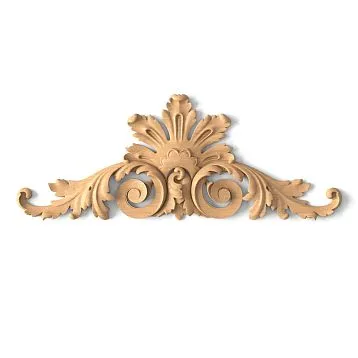
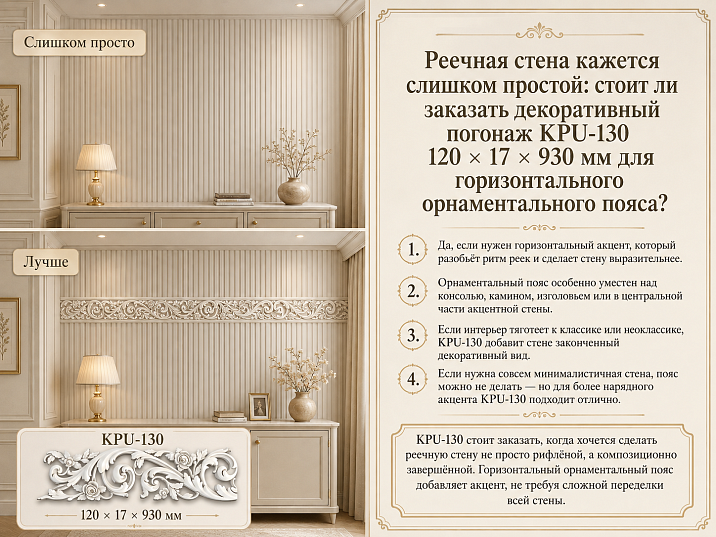
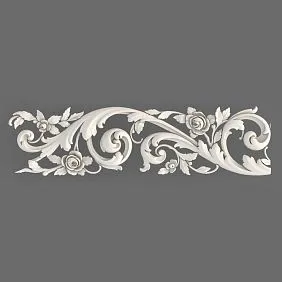
decorative polyurethane molding KPU-130 . This is not a molding, not an overlay, and not a slat panel. KPU-130 belongs to decorative polyurethane moldings, features a floral ornament, and measures 120 × 17 × 930 mm. It can be used as a standalone ornamental strip, including when you want to deliberately cross the vertical texture of a wall with a horizontal decorative line.The most interesting thing here is not the mere fact of combining slats and stucco. Such materials can be combined in dozens of ways. The question is much more specific: does a rhythmic slat wall really need an ornamental strip 120 mm high with a single element length of 930 mm — or will it be superfluous?
The answer depends on the scale of the wall, the pattern of the slats, the height of the room, the furniture, the placement of the strip, and the role you assign to it. KPU-130 can make a monotonous slat surface much more complex and expressive. But the same element, placed without a compositional reason, can cut the wall in a random spot and destroy its vertical rhythm.
Therefore, you should buy it not as "a bit more decor," but as a horizontal architectural boundary.
Vertical slats have already done their job: the wall has become textured, a steady rhythm has emerged, and light now falls on the surface differently. But after a few days, another feeling arises. The slats run from bottom to top identically, repeating meter after meter, and the large area still seems too calm. Adding another slat panel is pointless: there are already enough verticals. A different gesture is needed — a horizontal decorative belt that will cross this rhythm and give the wall a compositional center.
Why interrupt vertical slats with a horizontal strip at all?
Vertical rhythm is very strong. That's exactly why people love it slatted panels for interior wall finishing: repeating lines gather the surface, visually guide the eye upward, and allow turning a smooth wall into a textured one.
But any rhythm has a downside.
The larger the area, the more the repetition begins to be perceived as a background.
On a section 700–1000 mm wide, this is almost not a problem. The slats work as a local texture.
On a large wall several meters long, the same verticals can become too predictable. The eye glides along them and stops nowhere.
A horizontal line changes this mechanic.
It creates a pause.
The wall gains a level relative to which you can place:
-
console;
-
the back of the sofa;
-
the headboard;
-
mirror;
-
the decorative panel;
-
the furniture group;
-
the painting;
-
the wall light;
-
another architectural detail.
And if this horizontal line is not smooth but has a floral ornament, another contrast arises: the geometry of the slats meets the plasticity of the plant relief.
It is here that KPU-130 starts to work more interestingly than a regular flat strip.




KPU-130 is not a thin line, but a noticeable ornamental belt
The size 120 × 17 × 930 mm should be understood correctly.
120 mm is not a few millimeters of thin edging. If you install KPU-130 horizontally, the decorative strip gains noticeable height.
Twelve centimeters on the wall is already an independent visual layer.
Therefore, KPU-130 should not be "hidden" between slats. Its strength lies elsewhere: giving the wall a horizontal pause that the viewer perceives even from a distance.
17 mm is the second important dimension. The trim has a pronounced relief relative to its plane, so you need to check in advance how its profile will relate to the protrusion of the slat finish and other adjacent elements.
930 mm is the third value and simultaneously the main calculation module. One element covers less than a meter in length. If a horizontal belt is needed on a wall wider than 930 mm, the project automatically moves to the question of several KPU-130 units and the arrangement of their connections.
This results in a very distinctive product: it is quite noticeable in height, but in length it requires deliberate assembly on most full-size walls.
Our factory also produces:




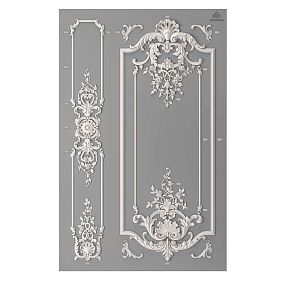
Key characteristics of KPU-130
| Parameter | Value | What this means for the wall |
|---|---|---|
| Product type | decorative linear molding | it is not a slat panel, not a molding, and not an overlay |
| Article number | KPU-130 | a specific card is checked by article number |
| Material | Polyurethane | the product belongs to polyurethane molded decor |
| Ornament | Floral | the horizontal becomes not just a line, but a decorative motif |
| Size | 120 × 17 × 930 mm | it should be compared with the belt height, relief, and wall length |
| Nominal length of one element | 930 мм | a wide wall will require several elements |
| Possible role in the project under consideration | Horizontal ornamental belt | contrasts with the vertical rhythm of the slats |
| Current price at the time of material preparation | 9 990 ₽ | the cost should be re-checked before ordering |
| Category | Polyurethane molding | other models can be compared nearby |
| Product card | buy decorative molding KPU-130 | parameter check point before ordering |
This leads to the first practical conclusion: KPU-130 should not be bought "to try with slats" without determining its place. On a large surface, a strip 120 mm high will be noticeable. If it lands at the wrong level, the eye will see the mistake immediately.
Get Consultation
A slat wall without a belt, with a smooth horizontal line, or with KPU-130 — these are three different interiors
It is useful to compare not two products, but three ready-made scenarios.
| Scenario | What happens to the rhythm | When it works best |
|---|---|---|
| Only vertical slats | continuous vertical texture | when a calm, solid surface is needed |
| Reiki + simple horizontal line | Vertical rhythm is divided into zones but remains geometric | Modern minimalist interior |
| Reiki + KPU-130 | Geometric vertical rhythm intersects with floral ornament | When the wall needs a more decorative, classic, or eclectic accent |
| Only KPU-130 on a smooth wall | The ornamental strip becomes independent | If slat texture is not needed at all |
| Several decorative belts | the wall is divided into several tiers | only with a well-thought-out architectural composition |
The most important difference lies between the second and third options.
An ordinary horizontal line simply changes direction.
KPU-130 also adds a relief narrative.
Therefore, decorative molding is especially interesting where a simple slat wall seems too technical or too monotonous, and the interior requires more plastic detail.
When it's better not to touch a slat wall at all
Not every slat surface needs a decorative band.
Sometimes its strength lies precisely in continuity.
Imagine a narrow vertical TV zone. The slats run from floor to ceiling, the screen is centered, and there is no complex classical furniture nearby. A horizontal floral pattern could disrupt the clear composition.
Another example is a very modern minimalist hallway, where all lines are built on strict geometry.
Or a small wall section only about a meter wide, which is already quite saturated with the relief itself.
In such cases, adding KPU-130 would not be a development of the idea, but a new decorative language that would need to be supported by something.
Therefore, before buying, ask yourself:
is the wall really boring, or is it just calm?
These are completely different states.
A calm surface can be correct.
A boring one requires an additional point of attention.
When a horizontal plant ornament truly saves the composition
There are several situations where this solution looks especially convincing.
The first is a very wide slat wall.
The verticals repeat for several meters in a row, and the eye has nothing to catch on.
The second is that the slat finish occupies the lower or middle part of the wall and requires a clear upper termination.
The third is that nearby there is furniture with classical or neoclassical motifs, and the geometric slat surface looks too neutral against its background.
The fourth is that the interior is deliberately built on a mix of modern and classical decor.
The fifth is that the wall needs to be compositionally connected to a console, sofa, or another long horizontal object.
In all these cases molding with a floral ornament can become not a random decoration, but a connecting element.
120 mm vertically: at what height to place such a belt
This is one of the main questions.
There is no universal height for KPU-130. It should be chosen relative to interior items.
Starting from the floor is the weakest approach
The phrase "we'll install it at a height of 900 mm" means nothing without context.
Why 900?
What is nearby?
How tall is the furniture?
Where does the eye line pass?
Are there doors?
Is there a windowsill?
A good level arises from connection with other horizontal lines.
Above the console
If a console stands along a slat wall, the belt can be tied to its top line.
Not necessarily flush.
The main thing is that the two horizontals don't look randomly spaced apart.
Behind the sofa
Here you need to take the backrest into account.
If the decorative belt runs directly behind the top edge of the sofa, part of the pattern may be visually lost.
Sometimes it's better to raise it higher.
In another project, it's precisely the alignment with the furniture line that creates a strong connection.
Above the lower panel zone
If only the lower part of the wall is finished with slat panels, KPU-130 can serve as a decorative finish for that zone.
Then the horizontal belt becomes a true boundary between materials.
Between two sections of slats
An interesting technique — the vertical rhythm starts from the bottom, then an ornamental band appears, after which the verticals continue.
This is already a complex architectural composition.
On a small wall, it may be overloaded.
On a large one, it can look very expressive.
Why the middle of the wall is not always the best place
A novice decorator has a natural desire to divide everything in half.
A wall 2.8 m high?
Let's place the belt at 1.4 m.
But an interior composition does not have to obey the mathematical center.
The horizontal line can be positioned lower or higher.
The lower position has an effect of a base and support.
The upper one has an effect of completing a panel or a frieze.
The central position most strongly "cuts" the vertical surface into two parts. Sometimes that's exactly what's needed. But sometimes the wall becomes visually shorter.
Therefore, the height of the KPU-130 should be viewed not only on the drawing, but also in the scale of the room.
A simple way is to stick a strip of painter's tape about 120 mm high at the intended location and live with it for at least a few hours.
That's already enough to understand whether the level is well chosen.
Why a floral ornament is especially interesting next to strict slats
Vertical slats are a repetition.
The repetition is direct.
Regular.
Rational.
Floral ornament works differently.
Even if the pattern itself repeats, the eye perceives it as more plastic and alive.
Therefore, combining these two textures creates an effect that cannot be achieved by simply changing the color.
Slats are responsible for order.
Ornament is for decorativeness.
The horizontal orientation of KPU-130 further enhances the difference.
The result is a composition based on two contrasts at once:
vertical versus horizontal;
geometry versus a floral motif.
That is why one molding can change a wall more than adding a few extra square meters of slat panels.
But the contrast must be intentional
If the entire room is built on strict minimalism—flat facades, hidden doors, straight light fixtures, absence of ornamental details—the KPU-130 may look out of place.
A beautiful floral pattern by itself does not make it right for any interior.
It is better when the ornament has at least one ally:
-
the shape of the furniture handle;
-
a framed facade;
-
cornice;
-
mirror;
-
furniture legs;
-
another molding element;
-
textile with a plastic pattern;
-
classic lamp shape.
It is not necessary to repeat the ornament literally.
It is enough that the language to which KPU-130 can respond is already present in the space.
One color with the slats: the calmest way to introduce KPU-130
If in doubt, do not start with contrast.
Suppose the slatted surface is painted in a calm light shade. KPU-130 gets the same color.
What happens?
The horizontal stripe is still perceived thanks to the relief and change in direction, but it does not turn into a separate colored band.
The ornament is revealed through light and shadow.
This option is especially useful when you want to complicate the wall but not make it colorful.
The plant pattern remains noticeable up close and is perceived more calmly from a distance.
This is a good way to connect a classic motif with a modern slat base.
The specific finishing system must be selected taking into account the materials of the slat surface, the polyurethane product itself, and the recommendations for the compounds used.
Contrasting KPU-130: a strong technique that is easy to overestimate
Now let's imagine the opposite.
The slats are light, the belt is dark.
Or the slats are of a wood tone, and the ornamental strip is painted in the color of the wall.
In this case, KPU-130 turns almost into a graphic horizontal line.
From a distance, the color contrast is read first, then the plant relief.
This option is needed if the belt should be the main compositional accent.
But it is much more demanding regarding the height of placement.
An error of five to ten centimeters in a calm monochrome version can be almost unnoticeable. With a contrasting stripe, any incorrect position stands out.
Therefore, the color is chosen after the location has already been found.
Not the other way around.
Wall wider than 930 mm: a real project begins
One KPU-130 has a length of 930 mm.
For a small decorative area, this may be sufficient.
But a standard accent wall is almost always wider.
This means a connection of several elements appears.
And here you cannot simply divide the wall length by 930 and press the order button.
First, you need to understand how the pattern will continue at the joints.
A plant pattern is much more sensitive to compounds than a simple smooth profile.
The joint must be perceived consciously.
If the ornament has a pronounced repeat, it is necessary to visually check how two elements meet each other.
It is impossible to promise in advance that the connection of any two KPU-130 will be completely invisible without a specific fitting and preparation.
The simplest calculation of the number of KPU-130
For a preliminary estimate, we use the length of one element — 930 mm.
Formula:
N = L ÷ 930
Where:
-
N — approximate number of KPU-130;
-
L — length of the decorative belt in millimeters.
If the result is not an integer and the belt must fully cover the specified length, the number is rounded up.
Belt length 930 mm
930 ÷ 930 = 1.
Need one element.
Belt length 1860 mm
1860 ÷ 930 = 2.
Nominally — two elements.
Belt length 2790 mm
2790 ÷ 930 = 3.
Nominally — three.
Wall 3000 mm
3000 ÷ 930 ≈ 3,23.
For a full set, you will need to aim for at least four elements, taking into account trimming.
But this is only an arithmetic calculation.
The final order depends on the pattern, joints, direction of the ornament, and how the edges are finished.
Why "four pieces for a three-meter wall" is not yet a ready layout
Let's imagine a wall 3000 mm wide.
Three full KPU-130 panels give:
930 × 3 = 2790 mm.
That leaves 210 mm.
You can add a part of a fourth element.
Mathematically, it's simple.
Compositionally, it's not.
Where to place the short fragment?
At one edge?
Split the missing length between both sides?
Is it even possible to use such a fragment beautifully, given the botanical pattern?
Would it not be wiser to make the belt not from corner to corner, but, for example, 2790 mm long, and leave meaningful margins?
This is already a design decision.
Sometimes a partial wall width looks better than a full one, because the decorative strip gets its own boundaries.
It is not necessary to run KPU-130 from corner to corner
This is a crucial thought.
A horizontal belt does not have to be a structural border that mechanically wraps around the room.
It can relate only to a specific composition.
For example, behind the sofa.
The sofa width is 2200 mm.
A decorative belt can be made slightly wider than the furniture and stopped before the corners.
Or above a console 1600 mm wide.
Or between two tall cabinets.
Or only inside the central slatted panel.
Then the length is calculated not by the room size, but by the actual decorative field.
This often helps avoid awkward short inserts and at the same time makes the wall more expressive.
Three KPU-130 are sometimes better than four simply because they provide a clear boundary.
Let's take the same example:
3 × 930 = 2790 mm.
If the wall is 3200 mm wide, after centering such a belt, approximately 205 mm of smooth field will remain on each side.
This may look quite deliberate.
If you add a fourth element and start trimming, the composition becomes more complex.
Therefore, the calculation of quantity should not automatically aim to cover the maximum surface.
An ornamental strip is not wallpaper.
It can be ended where it is compositionally justified.
What is more important: the seam of the ornament or the seam of the slat panels?
If there is already decorative slatted panels, they also have modularity.
This results in two grids at once:
the vertical grid of panels;
Horizontal grid KPU-130.
It is not necessary to align all joints.
Sometimes this is even undesirable, because the coincidence of many connecting lines makes the wall too technical.
But completely random placement can also look untidy.
A good approach is to draw the wall frontally and mark:
-
the width of each slat module;
-
joints;
-
KPU-130;
-
connections between elements;
-
furniture;
-
sockets;
-
switches;
-
door openings.
After that, it becomes clear where the horizontal belt really works.
Should KPU-130 be crossed with protruding slats
This is no longer just an artistic question, but also a structural one.
If the slat surface has a pronounced protrusion, you need to know in advance which plane the decorative trim will be installed on.
You cannot automatically assume that KPU-130 can simply be glued over any textured slat surface and achieve a tight fit.
The base must match the chosen installation method.
If the band is meant to run across the entire wall, the surface architecture may need to be planned at the panel installation stage.
For example, leave a separate horizontal plane for the ornamental element.
This is much neater than trying to force a wide decorative strip to follow a complex relief after the slat finish is complete.
If the slat wall is already finished, first examine its profile from the side.
Often, the decision to use KPU-130 comes after the renovation.
The wall is already done.
Then there's no need to order the linear footage right away.
Look at the section from the side.
How much do the slats protrude?
Is there a flat surface to mount the element on?
Can a neat horizontal break be made?
What will the end look like?
Will the belt pass over the protrusions or between them?
If the slat structure doesn't provide a clear support plane, a different finishing method may be needed.
This is a case where a beautiful idea needs to be technically verified before purchase.
If the slat wall is only being designed, KPU-130 should be included from the start.
Everything is simpler here.
If the decision about the horizontal belt is made in advance, the slat layout can be subordinated to it.
The lower section ends at the specified elevation.
A strip under the KPU-130 with a height of 120 mm is formed, taking into account the selected installation scheme.
The next section begins above.
Then the decorative trim truly becomes an architectural part of the wall.
Not as "decor applied after renovation," but as a planned horizontal line.
It is for a new project that this scenario is most manageable.
Slat panel + KPU-130 behind the sofa
The living room is almost an ideal platform for such an experiment.
The long sofa already forms a powerful horizontal line.
The vertical slat wall behind it creates an opposite direction.
KPU-130 can become a connecting element.
But it needs to be placed carefully.
If the belt is placed too low, the sofa back will cover the botanical pattern.
If too high, it will lose its connection with the furniture.
It is usually useful to first mark on the wall:
-
the top of the sofa;
-
the possible line of pictures;
-
lighting fixtures;
-
the intended belt.
Then look at the composition from the opposite side of the room.
A monochrome solution works especially well here, when the slats and KPU-130 are united by color, and the contrast is built on geometry.
Slat wall behind the TV: the molding can both help and hinder
The TV itself creates a strong horizontal form.
Therefore, adding another horizontal strip nearby should only be done after checking.
A good option is when KPU-130 runs below the TV and connects with the console.
Another is above the screen, as the upper boundary of the decorative field.
The riskiest option is to run the ornament directly through the middle of the TV or too close to its edge.
Then the screen and the molding start competing for the same line.
In the TV zone, it is generally useful to follow the rule: one main horizontal accent at one level.
If the TV already dominates, the KPU-130 must obey it.
Behind the headboard, the horizontal belt works differently.
The bed is an even more obvious horizontal object.
Vertical slats behind the headboard visually stretch the wall upward.
The KPU-130 can make the composition more classic and intimate.
Especially if the ornamental belt is connected to the top of the headboard or is located above it at a deliberate distance.
But here it is easy to overload the space.
If the headboard itself:
-
tufted;
-
carved;
-
high;
-
with a decorative frame,
The plant molding can become a third active relief after the slats and furniture.
Then it's better to abandon it.
If the headboard is simple and smooth, KPU-130 gets more freedom.
Console area: perhaps the most convenient scenario
A small console, a mirror, and a slatted wall.
There are many verticals:
slats;
mirror;
the legs or supports of the console.
Horizontal molding can bring them together into a composition.
For example, KPU-130 runs at a level slightly above the countertop.
Or it forms the upper boundary of the lower slat field.
The main advantage of this scenario is its relatively small width.
If the composition spans 1800–2800 mm, it can be assembled from two or three elements without needing to run the belt across the entire room.
Entryway: not every decorative belt needs to run along the entire corridor
In a long entryway, there is a temptation to run KPU-130 continuously along several walls.
But a length of 930 mm means a large number of joints.
Moreover, a repeating plant belt around the perimeter can significantly change the style of the room.
Sometimes it is much more expressive to decorate only one zone:
-
behind the console;
-
near the mirror;
-
on the end wall;
-
next to the door group.
In this case decorative polyurethane molding works as an accent, not as a mandatory line throughout the room.
Dining room: the horizontal ornament naturally connects with the long table
The long dining table already sets the direction.
The vertical slat wall behind it creates a good contrast.
KPU-130 can add a third level of composition if it is run along the table area.
However, the ornament should not accidentally coincide with the level of the chair backs.
It is better to look at the wall in advance in a fully furnished state.
An empty room is deceptive.
What looks beautiful on a free wall may end up partially covered after furniture is installed.
Study: the decorative belt does not have to be visually loud.
In a study, a fluted wall often serves as a backdrop for a desk, bookshelves, or a meeting area.
KPU-130 can be used very discreetly — in the same color as the wall.
Then the floral pattern does not turn into a historical quote, but is perceived as a subtle refinement of the surface.
This is especially interesting in interiors where furniture has classic proportions, but the overall color scheme is modern.
Commercial interior: the belt helps divide a tall wall into a human scale.
In a restaurant, salon, showroom, or hotel, walls can be larger than in an ordinary apartment.
A long vertical slatted surface at a height of three meters or more can look monumental.
A horizontal decorative level helps divide it.
But for a commercial object, calculating repeatability is especially important.
If KPU-130 is used on five identical walls, an error in one joint turns into a systemic error of the entire project.
Therefore, first assemble one typical fragment.
Only after checking — order the quantity for the entire object.
How to understand whether 120 mm will be too much
Do a simple scale check.
On the wall, mark a strip 120 mm high with painter's tape.
Not a line.
Exactly a strip.
Look at it:
from three meters;
from the sofa position;
from the entrance;
with lighting on.
A common mistake is to think of 120 mm as a "narrow decorative profile."
In fact, 12 cm reads well.
If such a strip already seems too massive without ornament, KPU-130 is better not used at this level.
If it divides the surface well, the plant relief can make it even more interesting.
How to understand if 17 mm is too deep for your wall
This size is hard to assess from a frontal photo.
You need to look at the profile.
17 mm is especially important near:
-
door casing;
-
mirror frame;
-
baseboard;
-
adjacent smooth panel;
-
built-in furniture;
-
with sockets;
-
decorative profile of a different type.
If one element protrudes much more than another, an end grain appears at the junction.
Sometimes this is acceptable.
Sometimes a separate solution is needed.
Therefore, KPU-130 is checked not only from the front, but also in cross-section.
Why a plant ornament cannot be cut off randomly
For a smooth profile, the end is relatively neutral.
For an ornamental one, it is not.
There is movement in the pattern.
Leaves, curls, and repeating elements create direction.
If the molding ends in the middle of a noticeable wall section, the end may look unfinished.
Therefore, the length of the decorative field should be tied to architectural boundaries:
-
a corner;
-
a door;
-
with a cabinet;
-
with a vertical frame;
-
with another decorative element.
Or the belt itself must have convincing endpoints.
How not to confuse KPU-130 with a regular molding
This is fundamental.
Molding is usually chosen as a profile line, frame, or border.
KPU-130 is a decorative trim with a floral ornament.
Its size of 120 × 17 × 930 mm and the richness of the relief make it a standalone decorative strip.
If you need a narrow smooth frame around a panel, KPU-130 is the wrong product.
If you need an ornamental belt that should be noticeable on its own, it fits the task much more precisely.
Therefore, it is better to look for it in the section where you can Buy polyurethane trim, rather than among ordinary linear moldings.
How not to confuse KPU-130 with an overlay
An overlay is usually perceived as a separate local ornament: a center, a corner piece, a medallion, a standalone composition.
Molding works in a continuous manner.
KPU-130 has a length of 930 mm and is used as a strip.
The main logic is continuation horizontally or an independent elongated fragment.
That is why in the article under consideration we consistently call it decorative molding KPU-130.
How not to confuse KPU-130 with a slat panel
Here the difference is even more obvious.
The slat panel creates a large repeating surface.
KPU-130 creates an ornamental strip.
The panel answers the question:
"What to cover this area with?"
KPU-130:
"What to divide or emphasize an already finished area with?"
That is why the request buy wall slat panels and the request "buy KPU-130" may appear in the same project, but lead to different products.
They do not compete.
They perform different roles.
Is it necessary to use the same material in the slats and the decorative belt?
There is no rule that the entire composition must be made from a single material.
In this case, KPU-130 is polyurethane.
Slat panels in the catalog are presented in other materials and constructions depending on the specific model.
The key is not mechanical material matching, but visual and technical compatibility.
From a design perspective, different materials can be unified by a common color.
Or, conversely, emphasize the difference.
From an installation standpoint, you need to separately check the base, mounting method, and finish of each product.
Do not transfer installation rules from one material to another.
What to do if the slats have a wood texture
There are two main approaches here.
The first is that KPU-130 is painted to match the color of the adjacent smooth wall.
It becomes an independent decorative strip and does not try to imitate wood.
The second is that the entire composition is built on the contrast between the wood vertical and the painted polyurethane ornament.
This can look more interesting than trying to artificially bring two different textures to full visual identity.
The main thing is to make a color sample in advance.
The plant ornament is very sensitive to light and shadow, so the chosen shade looks different on a smooth sample and on the relief.
What to do if slat panels are meant for painting
This scenario is simpler in terms of visual unification.
If the finishing system allows, the slats and KPU-130 can be made close in color.
Then the wall is perceived almost as a single architectural object:
vertical slat rhythm;
horizontal ornamental stripe;
vertical rhythm again.
However, the painting technology for each material should be chosen according to its requirements. A common color does not automatically mean identical surface preparation.
Why the belt cannot be placed directly "at eye level" just because it is advised so
Eye level changes.
Standing person.
Sitting.
Tall.
Short.
Therefore, this is too abstract a reference point.
It is much more useful to tie KPU-130 to stable interior elements:
-
countertop;
-
sofa backrest;
-
door panels;
-
windowsill;
-
lower or upper edge of the panel zone;
-
furniture;
-
other architectural lines.
Then the belt works even when the viewpoint changes.
Mistake: using KPU-130 only because there are "few" slats.
If a wall seems empty, it doesn't necessarily mean an ornament is needed.
Perhaps the problem is something else:
incorrect width of the slat zone;
too weak lighting;
unfortunate color;
lack of furniture;
disproportionate panel.
KPU-130 should not fix a basic composition error.
First, make sure the vertical structure itself is built correctly.
Only then add the horizontal element.
Error: placing the belt where it is convenient to join panels
A technical joint and a compositional line are not the same thing.
If slat panels end at a certain height only because of the material size, it does not mean that the KPU-130 should be located there.
The level should be chosen by eye and according to the architecture.
The technical layout is then adjusted to fit it.
Error: considering one KPU-130 without the entire wall length
In the card, one element looks complete.
On a wall three meters wide, it becomes part of a series.
Therefore, you should buy several pieces only after you have seen the full belt in scale.
You can make paper rectangles 930 × 120 mm and place them on the wall.
Even without the ornament itself, the modularity becomes clear.
Error: forgetting about vertical seams between elements
Ornamental band of length n
When three KPU-130 units provide a particularly convenient scale
Three elements — 2790 mm.
This is already almost a three-meter band.
This size is suitable for a large furniture zone or a wide accent wall.
And here an interesting opportunity arises: instead of filling up to every corner, leave symmetrical margins on the sides.
That is why three KPU-130 units can look better than four even on a wall wider than three meters.
When the quantity becomes so large that it's time to reconsider the idea
If the decorative belt must pass through several walls of the room, the number of elements grows quickly.
For example, the total perimeter of the decorative line is 10 meters.
10 000 ÷ 930 ≈ 10,75.
Nominally, we are already talking about at least 11 elements before accounting for the layout.
In such a project, you need to seriously evaluate:
- budget;
- number of connections;
- pattern repeat;
- external and internal corner;
- end of the belt;
- installation;
- painting;
- general style of the room.
Perhaps KPU-130 is still suitable.
But this is no longer "let's add one strip." This is a full-fledged decor system.
Price of KPU-130: the entire belt needs to be calculated
At the time of writing the article, the card shows 9,990 ₽ for one KPU-130.
The price of one element is important, but for a long belt it does not reflect the project budget.
If three elements are needed in advance, the cost of the KPU-130s themselves is calculated for three pieces.
If four — for four.
Installation materials and, if necessary, other finishing elements are added.
Therefore, before comparing such a scenario with additional slat panels, the actual length of the decorative strip needs to be determined.
The customer query "slat panels for walls for interior finishing price" and the price of KPU-130 cannot be compared per single item.
One panel and one ornamental element serve completely different purposes.
What to choose: more slat panels or KPU-130
Let's imagine that the existing slat area seems small.
If the reason is that the relief physically takes up too little wall space, it makes more sense to expand the slat finish.
Then Buy slatted panels for wall finishing it is indeed logical.
If the area is already sufficient, but the surface seems monotonous, an additional panel will only continue the same pattern.
Then KPU-130 can solve exactly the problem of monotony.
So the choice is very simple:
not enough area — add panels;
there is a lack of compositional accent — we are considering a decorative belt.
What to buy together with KPU-130
Buying decorative molding should not start and end with a single product card.
First you need the itself molding KPU-130 120 × 17 × 930 mm.
If the slat wall is only being designed, at the same time are selected slatted panels for walls.
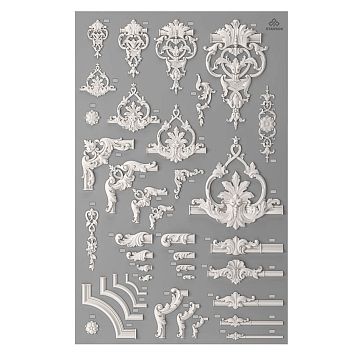
If KPU-130 does not fit in ornament or scale, you need to look at the entire decorative polyurethane molding.
If you need a natural motif specifically, you can open molding with a floral ornament and compare neighboring options.
For a more complex composition, it is useful to look at the entire assortment and You can buy ready-made stucco matching the Baroque style. Calculate the quantity: linear meters of cornices and moldings, number of rosettes, pilasters, consoles, corner elements. Add a ten to fifteen percent allowance for trimming. already as a system, not a set of random details.
Purchase kit
| What to order or check | Why | When necessary |
| KPU-130 | form a horizontal plant belt | Main article scenario |
| Polyurethane trim | Compare other sizes and patterns | if KPU-130 does not match the wall scale |
| molding with a floral ornament | select a similar ornament type | if you like the idea of a plant belt itself |
| Rafter panels | form or expand the vertical base | for a new project or expanding the slat zone |
| molded decoration made of polyurethane | select other composition elements | if the wall is designed as a complex system |
| Mounting and finishing materials | prepare the installation part | after determining the base and installation method |
| KUDO HIGH TACK adhesive | one of the accompanying products presented with KPU-130 | compatibility and application are checked according to the instructions |
The main principle of the kit: first the wall architecture, then the number of KPU-130, then the installation materials.
Not the other way around.
How to prepare a project before ordering
Only five dimensions are needed.
1. Full width of the decorative zone
Not the entire room, if the band relates only to furniture or the central part of the wall.
2. Height of the proposed KPU-130 line
From the finished floor to the bottom edge or to the centerline — the key is to use one clear reference point.
3. Height and width of furniture
Without this, you cannot understand the scale.
4. Position of doors, outlets, and switches
The belt should not unexpectedly cross an important element.
5. Geometry of the slatted surface
You need to understand which plane the KPU-130 will be mounted on.
After these measurements, you can proceed to the frontal diagram.
A frontal sketch of the wall is the cheapest way to avoid an expensive mistake
No professional drawing is needed.
A wall rectangle on graph paper is enough.
Mark:
- floor;
- ceiling;
- Furniture;
- batten zone;
- KPU-130;
- all vertical boundaries;
- Doors;
- main outlets.
Then try three belt heights.
For example:
below;
in the center;
above.
Even a rough sketch will show which option looks more logical.
After that, you can make a mock-up with painter's tape on the actual wall.
Installation begins with checking the base, not with beautiful markings.
KPU-130 is a decorative polyurethane element.
The base must match the chosen installation solution.
It cannot be universally stated that the same adhesive is equally suitable for:
- painted MDF;
- wood;
- plaster;
- an existing slatted surface;
- on other grounds.
Therefore, the specific composition is chosen after checking the wall or panel material and the manufacturer's instructions.
In the section materials for installation and finishing you can view the corresponding products.
Why dry layout of several KPU-130 is mandatory
If the belt consists of two, three, or four elements, first lay them out without final fixation.
Check:
- the general direction of the pattern;
- connection points;
- length;
- trims;
- edges;
- position relative to furniture.
Ornamental molding cannot be installed using the principle "glue the first one, we'll figure it out later".
The first element sets the entire subsequent horizontal line.
The horizontal line must be truly horizontal.
This sounds trivial, but on a slat wall the error is especially noticeable.
Why?
Because behind the KPU-130 there are already many vertical lines.
If the belt is even slightly tilted, the verticals act as a visual measuring grid and emphasize the deviation.
Therefore, the layout is checked with a level, not by relying on the floor or furniture.
The floor may have a deviation.
Furniture too.
The eye reads precisely the relationship of the multitude of lines.
The joints cannot be left for the very last moment.
When planning a long belt, determine the connection points in advance.
If the wall can be divided symmetrically, do this already in the sketch.
If the edge is covered by furniture or an architectural detail, this is also taken into account.
If trimming is required, think about which end it will be less noticeable on.
The plant relief makes this stage especially important.
It is better to think through the painting before the final fixation of the entire composition.
It is not necessary to paint everything in advance — the specific technology depends on the project.
But the color scheme needs to be decided.
What will be the same?
Slats and KPU-130?
KPU-130 and a smooth wall?
Will the belt become contrasting?
Will the background behind the slats differ?
At this stage, it is useful to make small paint samples, because the relief greatly changes the perception of the shade.
When KPU-130 fits almost perfectly
The scenario looks especially convincing if several conditions are met simultaneously:
- the slat wall is already large enough;
- the vertical rhythm seems monotonous;
- the interior allows for a floral ornament;
- there is a clear horizontal reference;
- The belt width is pre-calculated;
- Connections of several elements can be placed neatly;
- The base allows for installation;
- The belt does not conflict with furniture, sockets, and doors.
Then order KPU-130 made of polyurethane — a logical development of the already chosen slatted finish.
When it is better to refuse KPU-130
The slatted zone is small
It is expressive enough as it is.
The interior is extremely minimalist
A floral pattern may turn out to be stylistically alien.
There is no clear level for the horizontal belt.
If you cannot explain why it runs exactly here, it is better not to install it for now.
A regular smooth dividing line is needed
Then a different type of product is required.
The belt must pass through many complex junctions
Doors, cabinets, corners, and outlets can make the project unreasonably difficult.
The wall is already saturated with several types of decor
Another ornament will not necessarily improve the composition.
You are considering KPU-130 as a way to hide construction defects
This is a decorative element, not a universal masking system.
Ready-made selection scheme in three questions
First question: are there too few slats or are the slats boring?
If too few — add more slat area.
If boring — move on to the second question.
Second question: do you need a geometric or ornamental accent?
If geometric — KPU-130 may be too decorative.
If ornamental — we move on.
Third question: is there a logical horizontal level on the wall?
If yes — KPU-130 becomes a strong candidate.
If no — first we design the composition.
These three questions protect against buying decor just for the sake of decorating.
Where to buy decorative molding KPU-130
You need to start with KPU-130 card 120 × 17 × 930 mm.
Before ordering, double-check:
- article number;
- size;
- the material;
- current price;
- quantity;
- installation location.
If KPU-130 doesn't fit in height or pattern, it's better not to change the whole wall for one product. Go to the section and choose decorative polyurethane molding.
If you need a floral motif specifically, it's convenient to immediately look at polyurethane molding with floral ornament.
If it turns out that the wall actually lacks not an ornament but the slatted surface itself, return to the section where you can buy slat panels for walls for interior finishing.
So the choice remains honest: the product is selected for the task, not the task rewritten to fit a preferred item.
FAQ: popular questions about KPU-130 and the horizontal belt on a slat wall
Is KPU-130 a molding?
No. In this article, KPU-130 is considered strictly as decorative polyurethane trim with a floral ornament. For a regular thin profile line, you need to choose a different product group.
Is KPU-130 an overlay?
No. KPU-130 should not be called a decorative overlay. Its product category is trim.
Is KPU-130 a slat panel?
No. A slat panel forms an extended relief surface, while KPU-130 is a separate ornamental trim.
What is the exact size of KPU-130?
The product size is 120 × 17 × 930 mm.
What is KPU-130 made of?
Material — polyurethane.
What is the ornament pattern of KPU-130?
The model belongs to molding with a floral ornament.
Can KPU-130 be installed horizontally on a slat wall?
This exact scenario is considered in the article: decorative molding is used as a horizontal ornamental belt. The specific installation solution depends on the construction of the slat surface and the base.
Why is KPU-130 more interesting than an additional slat panel?
Only if the wall problem is the monotony of the vertical rhythm. An additional panel will continue the same pattern, while KPU-130 introduces a horizontal line and a floral ornament.
When is it better to buy additional slat panels after all?
When the textured area is physically too small or you need to continue a continuous slat surface. In this case, it is more correct buy wall slat panels.
How many KPU-130 units are needed for a wall 1860 mm long?
Nominally, two elements of 930 mm give 1860 mm. Before ordering, you need to check how the pattern connects and how the edges are finished.
How many will be needed for 2790 mm?
Three elements give a nominal length of 2790 mm.
How many KPU-130 are needed for a three-meter wall?
To fully cover 3000 mm, arithmetically you will need to aim for at least four elements, since three give only 2790 mm. But before ordering a fourth, it is worth checking whether the strip is needed strictly from edge to edge.
Do you need to make the strip across the entire width of the wall?
No. A local horizontal strip can look better than a full one. It can be tied to a sofa, console, panel, or another compositional center.
Can only one KPU-130 be used?
Yes, if the decorative field fits within a length of 930 mm or one element is used as an independent accent.
Where is it better to place the strip — in the center of the wall?
Not necessarily. It is often more useful to tie it to furniture, the top edge of the lower panel zone, a door, or another real architectural level.
Can the KPU-130 be installed above a sofa?
Yes, as a designer scenario. You need to check the height of the backrest, the position of pictures and lights, so that the ornament is not partially covered or squeezed between several horizontal lines.
Will the KPU-130 suit a wall behind a TV?
It may work, but the TV itself is a strong horizontal line. It is better to position the belt so that it follows the composition of the TV zone, rather than crossing the screen randomly.
Can the KPU-130 be used in a bedroom behind the headboard?
Yes, if the plant ornament matches the interior and does not conflict with the decor of the headboard itself. You need to be especially careful when working with already richly decorated furniture.
Can the KPU-130 be made in a contrasting color?
As a design technique — yes. Contrast strengthens the horizontal line, so it is especially important to choose its height precisely.
Is it better to paint the KPU-130 in the color of the slats or separately?
Both scenarios are visually possible. A single color makes the composition calmer, while a contrasting one makes it more noticeable. The color system should be selected taking into account the materials and compounds used.
Can KPU-130 be installed over already finished slats?
This depends on the profile of the slatted surface and the base. It cannot be assumed in advance that a wide decorative strip will fit tightly on any relief. First, the surface needs to be checked in cross-section.
What to do if the slatted wall is only being designed?
It is better to include the horizontal KPU-130 strip in the project before installing the panels. Then the correct plane and height can be planned for it in advance.
Can KPU-130 be continued around a corner?
This requires a separate layout and a solution for the corner joint. You should not order a long strip across several walls without drawing it out in full.
How to hide the joint between two KPU-130 pieces?
The specific treatment depends on the pattern, base, installation, and finishing. The main thing is to determine the joints during dry layout, not after fixing the first element.
Can KPU-130 be cut arbitrarily?
Trimming must account for the floral ornament. Not every offcut can be considered visually equivalent to a whole element.
Is it necessary to buy a spare?
The quantity is calculated after the final layout. The allowance depends on the number of trims, joints, and the complexity of the area, so it is incorrect to give a universal number without a project.
Where can I see other molding models?
In this section you can Buy polyurethane trim and compare different models by size and pattern.
Where can I see only floral ornaments?
For this, there is a separate collection — molding with a floral ornament.
Where can I see all polyurethane moldings?
You can open the general catalog and You can buy ready-made stucco matching the Baroque style. Calculate the quantity: linear meters of cornices and moldings, number of rosettes, pilasters, consoles, corner elements. Add a ten to fifteen percent allowance for trimming., if the project requires not only moldings and slat panels.
What adhesive should I use for KPU-130?
In the KPU-130 card, among related products, KUDO HIGH TACK is presented. Before use, check the instructions and compatibility with the specific base. View KUDO HIGH TACK adhesive for installing decorative elements it in the corresponding section of the catalog.
Can KPU-130 be applied to furniture instead of a wall?
The product card considers decorative molding beyond a single wall scenario, but a specific facade needs to be checked separately for dimensions and construction. For this article, the horizontal band on the wall remains the main focus.
Is it worth buying KPU-130 if the slatted wall already looks finished?
Probably not. A decorative band is not meant to increase the number of details, but to solve a specific compositional problem. If the wall is already balanced, additional ornament can only overload it.
Slatted wall and KPU-130: when the horizontal line is truly worth its money
A vertical slatted surface does not automatically become better just because stucco decor was added to it. Sometimes the right decision is to leave the slats alone.
But if a large wall really looks too monotonous, adding another slatted panel will not change anything fundamentally. The vertical line will simply continue.
KPU-130 offers a different approach.
The size of 120 × 17 × 930 mm makes it not a thin edging, but a noticeable decorative belt. The floral ornament is contrasted with the strict repetition of the slats. The horizontal orientation crosses the vertical rhythm. As a result, a compositional pause appears, capable of connecting the wall with a sofa, console, bed, furniture group, or another architectural horizontal.
But the solution only works when the belt can be explained.
Why is it located exactly here?
Why is it this height?
Why does it continue for such a length?
Where does it end?
How do several elements connect?
How does it relate to the relief of the slatted surface?
If there are answers, you can move on to the product.
Open decorative molding KPU-130 120 × 17 × 930 mmtransfer its actual dimensions to the wall, determine the length of the belt, and only then calculate the quantity.
If it turns out that the floral ornament is too active or the size itself is not suitable, do not change the project for the sake of one article. Look at decorative polyurethane molding and a separate selection of moldings with a floral ornament.
If the problem turned out to be simpler — the slatted texture is simply insufficient in area — return to the section where you can choose and buy slatted panels for interior wall finishing.
It is this order that makes a project professional: first determine what the wall lacks — area or accent, and only then buy the material.
In the STAVROS catalog, you can assemble both levels of one composition: the slatted base and the polyurethane decorative accent. KPU-130 deserves attention not because there must necessarily be stucco on the wall, but because in the right place one horizontal ornamental strip can do what several more identical vertical panels cannot: stop the rhythm, set the scale, and turn a repeating texture into a complete interior composition.