Article Contents:
- Building materials supplier: why acceptance begins before unloading
- What documents the person responsible for acceptance must have
- Why you should not accept wooden trim based only on the number of packages
- Wooden skirting board: what to check first
- How to check the item code before opening the entire batch
- What to do if the labeling and contents do not match
- Wooden molding: why a visually similar profile cannot be automatically accepted as correct
- Checking molding by the end face
- Why a photo of the molding face is worse than a photo of the end
- Wooden cornice: what to check on long-length profiles
- How to check a long plank
- Four types of discrepancies during acceptance
- Building material suppliers: why 'defect' and 'transport damage' should not be mixed
- Why you should describe the fact first, not assign blame
- How to create a photo report
- Why a photo should show context
- How to number detected issues
- How to record shortages
- Why recalculation is needed before distribution by floors
- How to receive a very large shipment
- GOOD / HOLD / DAMAGED — three zones after unloading
- GOOD
- HOLD
- DAMAGED

The truck has arrived, installers are waiting at the gate, the driver is in a hurry, and the foreman is simultaneously dealing with several other tasks. It is precisely at such a moment that the phrase is most often heard: "Let's unload and sign, then we'll recount everything later." For wooden trim, this is a risky approach. Once the packages have been opened, the profiles carried to different floors, some planks cut, and some already installed, it becomes significantly harder to establish the condition in which the batch actually arrived.
Therefore, working with construction materials supplier does not end with order payment. On site, a clear acceptance procedure is needed: first, batch identification and external condition, then verification of SKUs and quantities, and after that — separating acceptable material from disputed material. If a shortage, a different SKU, or damage is found, the fact must be recorded before installation.
It is convenient to divide the entire process into four types of discrepancies:
- QUANTITY — the quantity does not match;
- SKU — a different SKU arrived;
- DAMAGE — there is mechanical or other visible damage;
- SPECIFICATION — the product does not match the agreed characteristics.
The main principle: first describe the fact, then determine the cause and method of resolution. There is no need to immediately assign blame. The wording “during acceptance, 6 MLD-XXX planks with end damage were found” is more useful than the emotional “the supplier delivered defective goods.”
Building materials supplier: why acceptance begins before unloading
The first check is performed even before the cargo begins to be carried around the site. The person responsible for acceptance verifies the order or delivery number, address, number of cargo places, integrity of the external packaging, visible signs of impact or opening, and the presence of readable marking.
If the packaging is already damaged on the outside, this must be recorded before moving the pack. After the box or package has been carried in, turned over, and opened, the context of the defect changes.
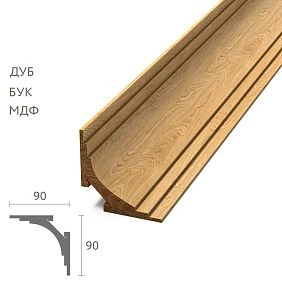
For long-length mouldings, it is useful to inspect not only the front side of the packaging but also the ends. That is where it is easier to notice an impact, a geometry violation, or a shift of elements inside the pack.




What documents should the person responsible for acceptance have
You do not need a huge folder. A current working specification is enough, containing the item code, SKU, name, material, size or cross-section, length, ordered quantity, and the number of the current revision.
If the project is large, a packing list is also useful: package number, SKU, quantity, and zone. It allows you to first count the packages and only then open them according to the project procedure.
Our factory also produces:
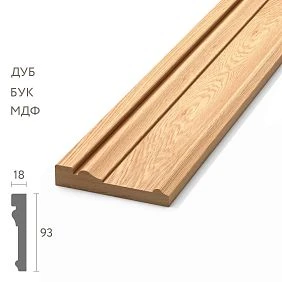
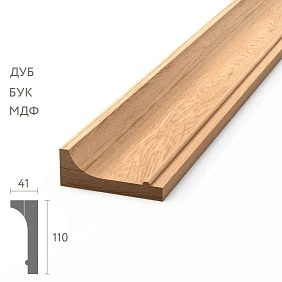
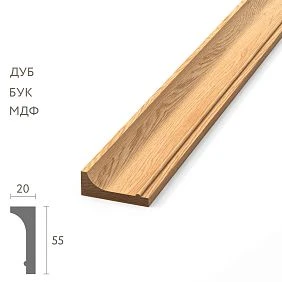
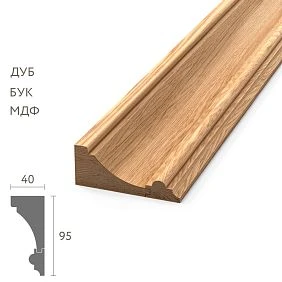
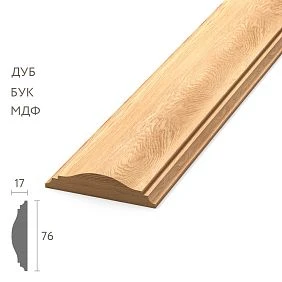
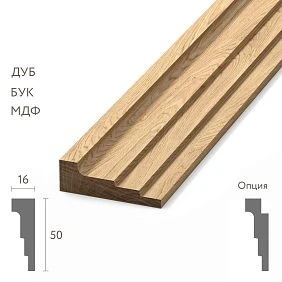
Why wooden mouldings cannot be accepted by the number of packages alone
Suppose 20 packages were ordered and exactly 20 arrived. Formally, the number of packages matches. But inside there may be a different SKU, a different length, fewer strips, a different finish, material from a different species, or an item from a different phase of the project.
Therefore, the number of packages is only the first level. The second is identification of the contents, the third is the actual quantity, and the fourth is the condition of the products.
Get Consultation
Wooden skirting board: what to check first
- article number;
- profile;
- height and thickness;
- the material;
- length;
- surface integrity;
- quantity.
If the project specifies PLT-XXX, a line item reading "wooden skirting" on the delivery note is not enough. It is important to prove that the exact profile specified in the project was delivered.
How to verify the article number before opening the entire batch
If the marking is readable from the outside, it is first checked against the specification. Then it makes sense to open several units from different parts of the batch and check whether the contents match.
If a discrepancy is found already at the first stage, there is no point in chaotically opening everything. It is better to put the disputed part on HOLD and separately agree on the next step.
What to do if the marking and the contents do not match
The pack is given HOLD status — do not hand it over for installation until the matter is clarified.
Next, record what is stated on the marking, what is actually inside, how many items are affected, the batch or unit number, and photographs. After that, the buyer or the person responsible for the delivery contacts the supplier through the agreed channel.
Wooden moulding: why a visually similar profile cannot automatically be accepted as correct
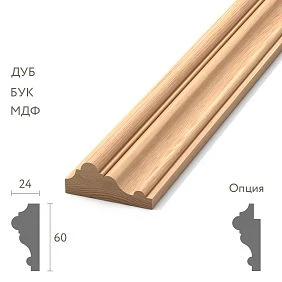
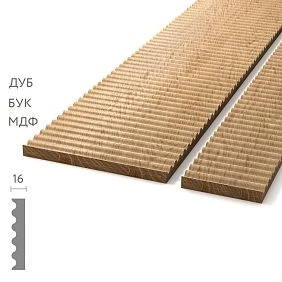
MLD-024 was ordered, but MLD-042 arrived. The width is similar, the wood is the same, and from a frontal angle the mouldings look alike. For a framed composition, they are still different products. A different cross-section shape changes the light and shadow, the joint at the corner, and the overall pattern of the wall.
Therefore, a similar moulding does not become an acceptable substitute just because it looks visually "almost the same."
Checking the molding by its end face
For quick identification, it is useful to look at the end cross-section. It shows the geometry significantly better than a frontal photo.
- width;
- thickness;
- relief;
- radii;
- grooves;
- shelves;
- edge shape.
If a dispute arises, a photo of the end face next to the marking is one of the most informative shots.
Why a photo of the molding's front face is worse than a photo of its end face
From the front, two profiles often look similar due to the same width and similar texture. The end face shows the real shape.
For the photo report, it is better to take two shots: one general — the profile as a whole, and the second — the end face close-up. Then the supplier and the designer can understand not only the condition of the surface, but also the correctness of the geometry.
Wooden cornice: what to check on a long-length profile
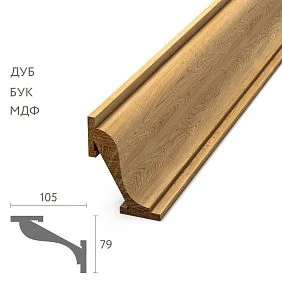
A cornice is usually larger than a molding, so during acceptance, special attention is paid to the end faces, protruding profile elements, edges, the front surface, the overall straightness of the packaging, and the presence of local fractures or severe impacts.
Do not turn on-site acceptance into a laboratory examination. The goal is to detect obvious discrepancies before the product is cut and installed.
How to inspect a long plank
The inspection is carried out along the entire accessible length. If the packaging allows opening according to the project procedure, the plank is examined from both sides, the ends, surface, and edges are checked.
For large volumes, control can be divided into two levels: 100% identification and quantity, plus a more in-depth selective inspection of surface and geometry, if that is how control is organized on site.
The sample size cannot be assigned as a universal number — it depends on the order requirements, the contract, and the project's internal procedure.
Four types of discrepancies during acceptance
| Type | What happened | First action |
|---|---|---|
| QUANTITY | Quantity does not match | Recount and record the shortage/excess |
| SKU | A different item code arrived | Separate and place on HOLD |
| DAMAGE | There is visible damage | Photograph and separate the damaged part |
| SPECIFICATION | The agreed specifications did not match | Verify against the final specification |
This classification helps keep the discussion specific. Instead of the general phrase "there's a problem with the delivery," you get a concrete category, a quantity, and a list of affected SKUs.
Building material suppliers: why it's better not to mix up "defect" and "transport damage"
When working with building material suppliers for internal accounting, it's useful to distinguish between PRODUCT ISSUE, TRANSPORT DAMAGE, SHORTAGE, and WRONG ITEM.
This is not a legal classification or a determination of fault. These are working categories that help route the issue to the right person faster.
Why you should first describe the fact rather than assign blame
Bad: The supplier broke ten moldings.
Better: During acceptance, 10 MLD-XXX strips were found with damage to the end portion. Package place No. 4 has a mark from an impact.
The second wording separates the observation from the conclusion. Then the parties can establish the cause based on documents, packaging, and transportation circumstances.
How to make a photo report
You do not need 60 random shots. You need informative frames:
- general view of the batch;
- outer packaging;
- marking;
- damage close-up;
- damage in the context of the entire strip;
- article or item code;
- if necessary — an end-face cross-section.
It is better to take photos before moving the disputed item.
Why a photograph should show context
A close-up of a crack without an article number and without understanding which bundle it belongs to is of little use. One of the shots should link the defect to a specific item and its packaging.
For example: location No. 7, label MLD-A, then an overview of four damaged slats, then a close-up of the end face.
How to number detected issues
For a large batch, it is convenient to assign each case a code: ISSUE-01, ISSUE-02, ISSUE-03.
| Issue | SKU | Quantity | Issue | Photo | Status |
|---|---|---|---|---|---|
| 01 | MLD-A | 4 pcs. | Damaged end face | IMG-01 | HOLD |
| 02 | PLT-B | 12 pcs. | Different SKU | IMG-02 | HOLD |
Such a table is far more convenient than a dozen voice messages.
How to record a shortage
Ordered: MLD-A — 120 pcs.
Received: MLD-A — 116 pcs.
Recorded: SHORTAGE — 4 pcs.
Not “it seems like one package is missing,” but a specific quantity for a specific SKU.
Why a recount is needed before distribution across floors
If 30 planks have already gone to the second floor, 40 to the third, and another 20 have been unpacked by installers, recounting the original batch is more difficult. That is why quantitative receiving must be completed before internal distribution.
How to receive a very large batch
For a large delivery, it helps to split the tasks. The first layer — place number, SKU, material, length, and quantity. The second layer — surface, cross-section, geometry, and finish quality, if included in the order.
If a project uses selective in-depth inspection, its scope must be defined in advance by an internal procedure or the order terms.
GOOD / HOLD / DAMAGED — three zones after unloading
GOOD
Identified, inspected, approved for use.
HOLD
There is an issue with the SKU, specification, quantity, or condition. Until it is resolved, it is not released for installation.
DAMAGED
The damage has been recorded. The material is separated from the usable stock and linked to an ISSUE code.
For a large project, these three zones are best marked physically and in the records.
Why material with HOLD status must not be “temporarily” given to installers
An hour later it may be cut, painted, or glued. After that, its original condition will change, and the compliance question will become significantly more difficult.
HOLD must be a real prohibition on use, not a decorative note in a table.
Building materials supplier: whom to notify about a discrepancy
If building materials supplier must receive information about the problem; it is better to use a single clear channel.
The message contains the order number, delivery number, SKU, ordered quantity, actually received quantity, description of the discrepancy, photos, and the status of the disputed item.
If the site foreman calls the driver, the installer writes to the manager, and the customer separately sends photos to the designer, the information falls apart.
What should be in a problem report
Order: No.…
SKU: MLD-…
Ordered: 80 pcs.
Received: 80 pcs.
Discrepancy: 6 pcs. with end damage.
Status: postponed, not used.
Attachment: IMG-01 — IMG-05.
The deadlines, notification form, and further procedure must be verified against the contract and the terms of the specific delivery. In the acceptance itself, the main thing is to quickly and objectively record the actual condition.
Why it is important to specify the quantity of problematic goods
The phrase "some moldings are damaged" does not allow the scale to be assessed. Better: "Of the 80 received strips, 6 have visible end damage."
After that, it can be decided separately whether the entire batch is blocked or only six specific items.
What must not be done before a response regarding the disputed part of the batch
- cut;
- paint;
- mill;
- install;
- mix with good material;
- move to another zone without marking.
The more the product is reworked on site, the harder it is to show its original condition.
Can work continue with the good part of the batch
If the problem is localized, the good part is identified and separated, it is not always necessary to stop the entire site.
For example, out of 80 moldings, six are on HOLD, while 74 have been checked and meet the specification. Installation can continue with the GOOD part if this does not violate the project and the settlement terms.
The specific decision depends on the nature of the problem and the order terms.
Construction materials suppliers: what to do if a different SKU arrives
If within the request construction materials suppliers a different SKU arrived at the site; the main rule remains the same: a similar profile does not automatically become an acceptable replacement.
- separate;
- record;
- place on HOLD;
- do not pass to installers;
- agree on the next decision.
What to do if the wrong item code is already needed today
Urgency does not override the project. Before accepting a replacement, check whether the transition is visible, whether the new profile joins with the old one, whether the width or cross-section changes, whether a new cut is required, whether the design changes, and who has the authority to approve the replacement.
How to distinguish a natural wood characteristic from an unacceptable defect
Natural wood has natural variation in pattern, texture, and shade. But this does not mean that any deviation is automatically acceptable.
The assessment depends on the wood species, grade, technical specification, finish, approved sample, and order conditions.
Therefore, one cannot declare any knot a defect, nor attribute any flaw to the "naturalness of wood" without reference to the agreed requirements.
Why a reference sample is useful in a dispute
If a physical sample was approved before ordering, it helps compare the profile, material, finish, and visual character of the surface.
This is especially useful for custom interior projects, where the same item must be repeated in several rooms.
What to check on painted wooden moulding
If the order includes a finished surface, during acceptance one checks the uniformity of the visible surface, the integrity of the coating, scratches and chips, conformity to the agreed option, and the condition of the ends and relief.
There is no need to invent tolerances on your own. The criteria must be based on the technical documentation and the conditions of the specific order.
Acceptance in 15 minutes and full acceptance are different things
During unloading, one can quickly check the order, the number of packages, the marking, and obvious external damage.
Detailed control — unpacking, recount, geometry, surface, finish — may require a separate procedure.
The key is to understand in advance exactly what is being confirmed by signature at each stage.
Why the responsible person must be appointed in advance
There should be no scheme of “whoever is free today will accept it.” The responsible person has the current specification, access to the order history, an understanding of SKU codes, the right to record a discrepancy, and contact with the buyer and supplier.
Building material suppliers: checklist before signing
Before completing acceptance of the delivery building material suppliers it is convenient to run a quick check:
- the order matches the site;
- SKUs have been verified;
- material and length match;
- quantity verified;
- obvious damage recorded;
- disputed items separated;
- photos taken;
- documents and issue numbers saved.
Why problem data should be saved even if the issue is resolved quickly
After a few months, the acceptance log reveals patterns: whether the same types of packaging are often damaged, whether errors occur in item codes, whether there are regular shortages, which SKUs require enhanced incoming inspection, and where labeling questions most often arise.
This is no longer a one-off claim, but supply analytics.
How to keep a supply log for wooden mouldings
| Date | Order | SKU | Quantity | Issue | Result |
|---|---|---|---|---|---|
| … | … | PLT-A | 120 | No | ACCEPTED |
| … | … | MLD-B | 80 | 3 damaged | Claim / HOLD |
For a regular B2B buyer, such a log shows quality not by impressions, but by facts.
What to do after a claim is resolved
After settlement, the object's working data must be updated.
Received — 120 m. Of these, 10 m remain on HOLD or are returned. Working available balance: 110 m.
The site foreman must see exactly 110 m, otherwise the installation schedule will be based on material that is not actually available.
Why a claim is also a matter of the construction schedule
If the disputed part is 5% of secondary moulding, it may be possible to restructure the work and continue in another area.
If the main skirting board for an entire floor is missing, the impact on the schedule is different.
Therefore, it is useful to assign an object-level priority to each issue:
- P1 — halts the nearest installation;
- P2 — limits part of the front;
- P3 — can be resolved without immediate impact on the work.
This is an internal project classification, not a characteristic of product quality.
How to separate quick unloading from detailed acceptance
On a large site, unloading and technical acceptance do not have to be a single operation. If the vehicle cannot be kept at the gate for several hours, first record the fact of arrival: the number of cargo units, markings, external condition of the packaging, and obvious damage. After that, the batch receives the status RECEIVED, but not necessarily ACCEPTED yet.
Detailed acceptance is performed in a controlled area. There, packages are opened according to the site procedure, and the SKU, length, quantity of items, surface, and geometry are verified. This two-stage approach makes it possible not to turn the signature at unloading into formal confirmation of the entire contents of the batch.
For each stage, it is useful to determine in advance exactly what is confirmed by the signature and who has the right to change the status of the goods. This is especially important when the driver leaves before a full recount is completed.
How to physically organize the GOOD, HOLD, and DAMAGED zones
Statuses must exist not only in the table. If GOOD, HOLD, and DAMAGED are mixed together, the installer can easily take a disputed plank by mistake.
At the site warehouse, three simple zones can be designated. In GOOD are inspected items approved for installation. In HOLD is product with an issue: SKU, quantity, specification, or condition. In DAMAGED is material with an already recorded defect.
A tag like this on the disputed package is sufficient HOLD / ISSUE-02 / MLD-A / 6 pcs.. It links the physical pack to the log entry. If the issue is resolved, the status changes both documentarily and physically: the material either moves to GOOD or goes to return, replacement, or separate storage.
How to calculate the remaining balance available for installation after acceptance
Physical balance and available balance are different figures. Suppose 120 m of skirting arrived at the site, of which 10 m are in HOLD. For installation planning, 110 m are available, not 120.
After replacing the disputed 10 m, the working balance becomes 120 m again. The issue history is preserved. This kind of accounting prevents the situation where a foreman plans work front for material that is physically present but cannot yet be used.
For large sites, it is convenient to keep four indicators: RECEIVED, GOOD, HOLD, and DAMAGED. Their sum should account for the entire actually received volume.
When sampling inspection needs to be expanded
For a large batch, a deep inspection of every plank may not be provided for by the project procedure. But if the same defect repeats in several opened packages, the sample should be expanded. Repetition means that the problem may be systemic rather than isolated.
For example, if identical end damage is found in three different places, further inspection should determine how widely the batch is affected. This is more useful than continuing the usual sampling and counting each defect as a separate random incident.
The depth of inspection is determined by the order requirements and internal procedure, not by a universal percentage from an article.
How to close an ISSUE after the supplier's response
Recording a problem does not end with sending photos. Every ISSUE must have a resolution: additional delivery, replacement, return, confirmation of conformity, partial compensation, or another agreed option — depending on the contract and circumstances.
It is useful to add columns for resolution, responsible person, and closing date to the log. Then, after a few months, you can restore not only the fact of the problem but also the way it was settled.
After closing an issue, the working balance of the site must be updated. If a replacement arrives, it is added to GOOD. If part of the goods is sent back, it is excluded from the available quantity. Only after that does the installation schedule again rely on up-to-date data.
How to use claims history in future purchases
One claim is an operational task. A series of claims is a source of data. If the same problem repeats, the buyer can see a pattern: for example, issues with a particular packaging, regular confusion of similar SKUs, or frequent discrepancies in labeling.
For regular B2B purchases, it is useful to count the number of issues by type: SHORTAGE, WRONG ITEM, DAMAGE, SPECIFICATION. The average closing time can be tracked separately. This helps to understand where to strengthen incoming inspection and which items require special attention even before unloading.
Thus, acceptance ceases to be a formality at the gate and becomes part of the quality of the entire procurement system.
Final algorithm for acceptance of wooden moulding
- Prepare an up-to-date specification.
- Assign a responsible person.
- Inspect the cargo before unloading.
- Verify the number of packages and markings.
- Check the item codes and variants.
- Recalculate the quantity.
- Check the length and main dimensions.
- Inspect the surface and geometry to the specified extent.
- Divide the material into GOOD / HOLD / DAMAGED.
- Assign an ISSUE code to each discrepancy.
- Create a photo record.
- Record the exact SKU and quantity of the problematic item.
- Provide the supplier with structured information.
- Do not use the disputed portion until a decision is made.
- After settlement, update the available stock.
- Save the result in the delivery log.
Proper receiving does not mean that every profile must be thoroughly investigated before work begins. It means that the site does not lose control of the batch in the first minutes after the truck arrives. First, it is recorded what exactly arrived, how much, in what condition, and which order it belongs to. Then the acceptable portion is released for installation, while the disputed portion remains separated until a decision is made.
This procedure benefits both the customer and the supplier. Instead of vague complaints a few days later, there is a specific record: SKU, quantity, type of discrepancy, photo, and status. And the site understands how much material is actually available to continue work.