Article Contents:
- MLDPU-001 and MLDPU-003: confirmed specifications
- How MLDPU-001 differs from MLDPU-003
- When to buy thin molding MLDPU-001
- When to choose wide MLDPU-003
- Why widths of 10 and 35 mm change proportions
- How the 6 and 12 mm protrusion affects light and shadow
- Which molding to choose for a small room
- Which profile suits a tall and long wall
- MLDPU-001 for frequent geometric layout
- MLDPU-003 for one large panel
- Which molding to choose for a bedroom
- Which molding to choose for a living room
- Which molding to choose for a hallway
- MLDPU-001 or MLDPU-003 for a wall frame
- Which molding to choose for a large mirror
- Can MLDPU-001 be used on a furniture facade
- Can MLDPU-003 be used on furniture
- How to design a door and doorway
- How to use wide molding under the ceiling
- How to choose a profile for the lower part of the wall
- How to choose molding for an office
- Which molding to choose for a children's room
- Which molding to choose for a commercial interior
- How to combine MLDPU-001 and MLDPU-003 in one room
- How polyurethane molding interacts with wallpaper
- How to use molding on a painted wall
- How to choose the color of molding
- Do I need to prime moldings before painting
- What paint to use for polyurethane profile
- How to calculate the number of slats for one frame
- How to calculate the footage for multiple frames
- What margin to add for trimming
- How to properly finish corners
- How to join slats lengthwise
- How to prepare the wall before installation
- Which glue to choose for polyurethane molding
- Why aggressive solvents are dangerous
- How to glue MLDPU-001 without waves
- How to glue MLDPU-003 without skew
- How to prepare joints before painting
- When to paint molding before installation
- When to paint molding after installation
- Can you glue molding over wallpaper
- Can you install molding on tile
- Can you install molding on MDF furniture
- How not to confuse molding with a ceiling cornice
- How not to confuse MLDPU-001 with a constructive glazing bead
- How not to confuse wide molding with a load-bearing frame
- Common mistakes when choosing MLDPU-001
- Main mistakes when choosing MLDPU-003
- Common installation mistakes
- Who is MLDPU-001 suitable for
- Who is MLDPU-003 suitable for
- When it's better to choose a different profile
- How to buy molding on STAVROS
- Practical comparison of two profiles
- How to check the frame with a full-size mockup
- How to choose the frame size relative to furniture
- How to distribute multiple frames on a wall
- How to design a wall with a window
- How to design a wall with doors
- How to choose a profile for a stair hall
- How to choose a profile for a wall behind a sofa
- How to choose a profile for a wall behind a bed
- How to choose a profile for a wall with a TV
- How to choose a profile for a bathroom
- How to choose a profile for a kitchen
- How to choose a profile for a showroom and store
- How to maintain the same result on multiple walls
- How to replace a damaged section
- How to care for painted molding
- Why a finished profile is better than a random batten
- Final check before adding to cart
- Table of 'what to buy together'
- How to compare samples in a store or on site
- How to coordinate molding with baseboard and cornice
- How to choose a profile for modern classic
- How to choose a profile for a minimalist interior
- How to choose a profile for a classic interior
- How to accept a finished wall layout
- Why the same profile looks different in different colors
- How to maintain a consistent result from project to installation
- How to choose between one large frame and several small ones
- How to select molding for ceiling height
- How to work with uneven walls
- How to store and transport 2600 mm slats
- How to order molding for multiple rooms
- How to check compatibility with sockets and covers
- How to estimate cost without quantity errors
- Pre-installation checklist
- How to choose a profile based on viewing distance
- How to choose a profile for a wall with active furniture
- How to choose a profile for an empty wall
- Why the final choice should be made on the wall
- FAQ: questions about MLDPU-001 and MLDPU-003
- How is MLDPU-001 different from MLDPU-003?
- Which molding suits a small room?
- Which profile to choose for a large wall?
- Can MLDPU-001 be used on a furniture facade?
- Can MLDPU-003 be used on a furniture door?
- Is MLDPU-003 suitable for a large mirror?
- What length do both models have?
- What material are the profiles made of?
- Do I need to prime the molding?
- What paint should I use?
- How to miter the corner of a frame?
- Can molding be glued over wallpaper?
- How to calculate the number of planks?
- What margin is needed?
- Can I combine MLDPU-001 and MLDPU-003?
- How is decorative glazing bead different from structural?
- Can I use MLDPU-003 instead of a ceiling cornice?
- What glue won't damage polyurethane?
- How can I check the scale before purchasing?
- Where to buy MLDPU-001 and MLDPU-003?
- What should I check before ordering?
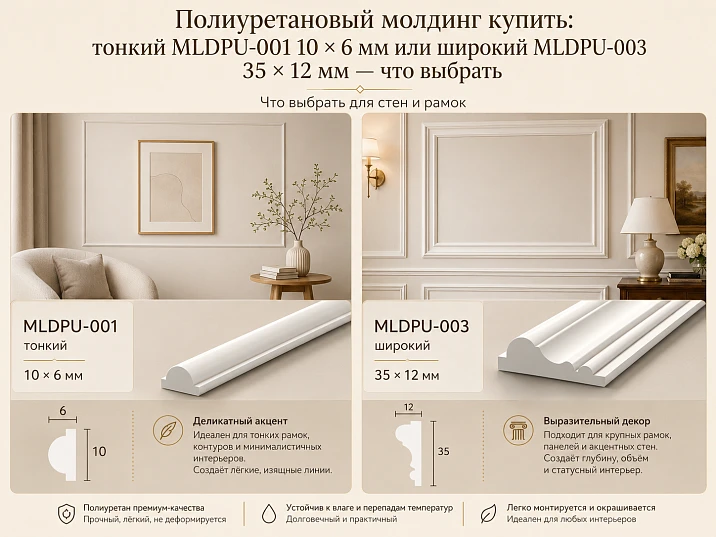
It is not difficult to buy polyurethane molding when it comes to choosing color and length. The real difficulty begins when you need to determine the profile scale. The thin MLDPU-001 measuring 10 × 6 × 2600 mm and the wide MLDPU-003 measuring 35 × 12 × 2600 mm are made of the same material, supplied white, primed for painting, and installed using adhesive. But their interior tasks are different: the first draws a delicate line, the second creates a full architectural division.
MLDPU-001 is a semi-circular decorative bead. It is chosen for small wall frames, frequent geometric layouts, furniture facades, cabinet doors, small mirrors, and projects where the profile should not compete with sockets, overlays, or an active wall color. The width of 10 mm and projection of 6 mm provide soft chiaroscuro and allow the use of several frames without a feeling of heaviness.
MLDPU-003 is a multi-tiered profile with a central shaft. The width of 35 mm and projection of 12 mm make it noticeable from a distance. This molding is suitable for large wall panels, big mirrors, a tall wall, one expressive frame, upper architectural division, and interiors where the decorative line should become an independent part of the composition.
In the article, we will analyze a specific product fork: MLDPU-001 or MLDPU-003, 10 × 6 or 35 × 12 mm, thin bead or wide architectural profile, furniture facade or large wall. The buyer will be able to understand which profile to put in the cart, how to calculate the number of planks 2600 mm long, what margin to provide, how to finish the corners, how to choose the glue, and how to paint the finished layout.
Short answer. For a small frame, furniture facade, cabinet door, thin mirror border, and frequent wall geometry, choose MLDPU-001 measuring 10 × 6 mm. For a large panel, tall wall, big mirror, and pronounced architectural division, MLDPU-003 measuring 35 × 12 mm is suitable.
Both models have a length of 2600 mm, are made of two-component polyurethane, and are supplied white, primed for painting. The choice is made based on the surface scale, viewing distance, number of frames, depth of chiaroscuro, and furniture placement.
Buy polyurethane molding MLDPU-001 Buy wide molding MLDPU-003 View all MLDPU sizes Select mounting adhesive
MLDPU-001 and MLDPU-003: confirmed specifications
| Parameter | MLDPU-001 | MLDPU-003 |
|---|---|---|
| Type | Thin decorative bead | Wide architectural molding |
| Profile | Semi-circular | Multi-tiered with central shaft |
| Profile size | 10 × 6 mm | 35 × 12 mm |
| Length | 2600 мм | 2600 мм |
| Material | Two-component polyurethane | Two-component polyurethane |
| Surface | White, primed | White, primed |
| Finish | For painting | For painting |
| Chiaroscuro | Soft | Deep |
| Main scale | Small frame, furniture front | Large panel, tall wall |
| Installation | Adhesive, composition without aggressive solvents | Adhesive, composition without aggressive solvents |




How MLDPU-001 differs from MLDPU-003
The difference starts with scale. MLDPU-001 has a width of 10 mm, MLDPU-003 — 35 mm. The second profile is three and a half times wider and protrudes twice as much above the wall plane.
The semicircular MLDPU-001 creates a calm line. It emphasizes the frame's border but does not draw attention away from the painting, mirror, furniture, or decorative rosette.
MLDPU-003 is built from several tiers and a central shaft. Light falls differently on the protrusions, so the profile is perceived as an independent architectural detail.
The buyer chooses not a more expensive or more noticeable option, but a profile that matches the surface. A small frame requires a thin line, a large wall requires a confident scale.
Our factory also produces:
When to buy a thin molding MLDPU-001
MLDPU-001 is suitable for small wall frames, a frequent grid of several rectangles, furniture facades, cabinet doors, and compact mirrors.
The 10 mm width does not take up much space inside the frame. This is important when there are several panels on the wall, between which air needs to be preserved.
The profile is useful in a small room and on busy wallpaper: a thin line organizes the surface but does not turn it into a heavy stucco composition.
For such a project you can buy a thin molding 10 × 6 mm and check the length of 2600 mm in the card.
Get Consultation
When to choose the wide MLDPU-003
MLDPU-003 is needed where the thin line is lost. On a high wall, large panel, or big mirror, the 35 mm width maintains readability from a distance.
The multi-tiered profile creates deep chiaroscuro and supports neoclassical, classical, and eclectic interiors.
One large frame made of MLDPU-003 often looks more convincing than many small ones. The profile becomes part of the wall's architecture, not just a contour.
For a large composition, you can Buy wide molding MLDPU-003 and match the size 35 × 12 mm with the room height.
Why widths of 10 and 35 mm change proportions
The profile width reduces the inner field of the frame. On a small panel, 35 mm on each side can take up a significant portion of the surface.
On a large wall, 10 mm, on the contrary, can look like a thin random line, especially if there is a wide baseboard, cornice, or large furniture nearby.
The size should be assessed not on a ten-centimeter sample, but on the actual wall. A full-size paper strip shows proportions more accurately than a photograph.
With the same length of planks, the amount of material may be the same, but the visual result will be completely different.
How a 6 and 12 mm projection affects chiaroscuro
MLDPU-001 protrudes by 6 mm and creates a soft shadow. When painted in the wall color, the profile reads delicately and suits calm modern interiors.
MLDPU-003 protrudes by 12 mm. Light lingers on the multi-tiered profile, making the shadow deeper. Even a monochrome paint job does not hide its architectural character.
Side lighting enhances the contrast. Under directed light, the wide profile becomes much more noticeable.
If the wall already has an active color or pattern, a deep shadow may overwhelm it. In that case, choose MLDPU-001.
Which molding to choose for a small room
In a small room, not only the wall area matters, but also the viewing distance. A person is close to the decor, so a wide profile appears larger.
MLDPU-001 allows creating several frames without visually reducing the space. Thin lines help build geometry without heaviness.
MLDPU-003 is possible on one accent wall or a large mirror, but its scale needs to be checked with a mockup.
In a compact room, it is rational to start with a card of a thin molding for a frame and compare it with a wider option on the wall.
Which profile suits a tall and long wall?
On a tall wall, a thin profile often gets lost, especially if there is a single frame and the viewing distance is large.
MLDPU-003 with a width of 35 mm better maintains scale and allows dividing the wall into large vertical panels.
MLDPU-001 can be used as a secondary line inside a wider system, but such a combination requires a project.
If the wall is long, the number of frames is calculated so that the edge margins and distances between panels look the same.
MLDPU-001 for frequent geometric layout
Frequent layout means several frames on one wall. The more lines, the calmer the profile should be.
MLDPU-001 is suitable for squares, rectangles, narrow vertical and horizontal inserts. The width of 10 mm maintains lightness.
Angles and distances must be repeated. A slight misalignment of a thin line is noticeable next to adjacent frames.
Before cutting, a diagram of the entire wall is made and each side is calculated, rather than cutting the strips on site without an overall plan.
MLDPU-003 for one large panel
One large panel requires a profile that is read along the perimeter and does not dissolve on the wall.
MLDPU-003 creates an independent frame around a painting, mirror, textile insert, or decorative field.
Sufficient free space is left inside the large panel. If the profile almost touches the object, the composition looks cramped.
The height and width of the frame are determined by the furniture and the center of the wall, not just by the length of the 2600 mm strip.
Which molding to choose for the bedroom
In the bedroom, a calm rhythm is usually needed. MLDPU-001 is suitable for the wall behind the headboard, small panels, and symmetrical layouts next to nightstands.
MLDPU-003 is appropriate on a high wall with one large frame or a large mirror, if the rest of the decor is restrained.
The profile color can be made equal to the wall so that the shape is read through the shadow. Contrasting coloring enhances the geometry.
The placement of the frames is coordinated with the bed, lights, sockets, and switches.
Which molding to choose for the living room
In the living room, the furniture size and viewing distance are larger, so the wide MLDPU-003 opens up better.
MLDPU-001 is suitable for a group of small frames, a console area, a display case, or a wall with active artwork.
If there is a TV on the wall, the frame should not interfere with ventilation, mounting, or cables. The molding remains a decorative element.
The main axis of the layout is tied to the furniture, not to a random midpoint of an empty wall.
Which molding to choose for the hallway
In a narrow hallway, wide stucco quickly starts to feel heavy. MLDPU-001 more often keeps the passage visually clear.
Thin frames can be used above a console, around a small mirror, or on the doors of a built-in wardrobe.
MLDPU-003 is suitable for a spacious hall or a tall accent wall where there is viewing distance.
The profile should not protrude into the area of constant contact with clothing, bags, and doors.
MLDPU-001 or MLDPU-003 for a wall frame
For a small frame, MLDPU-001 is often chosen. A 10 mm wide strip leaves enough inner margin and does not make the corners heavy.
For a large frame, MLDPU-003 is more suitable because the profile is visible from a distance and matches the scale of the wall.
If there are several frames of different sizes on one wall, it is better to unify them with one profile. Mixing widths of 10 and 35 mm without a system creates visual disarray.
Practical calculation principles are revealed in the material about how to make a frame from baseboard and molding, and the choice between two profiles is made based on scale.
Which molding to choose for a large mirror
A large mirror requires noticeable framing, but the molding does not replace the load-bearing frame and glass fastening.
MLDPU-003 visually matches a large mirror surface better. The deep profile creates an architectural outline and does not get lost on the wall.
MLDPU-001 is suitable for a small mirror, thin edging, or a situation where the mirror surface already has its own frame.
Before installation, check that the decorative profile does not block access to the fasteners and does not touch the edge of the mirror without the intended gap.
Can MLDPU-001 be used on a furniture front?
MLDPU-001 is suitable for large cabinet doors, dressers, wardrobes, and decorative panels. The 10 mm width does not overload the front and leaves room for a handle.
The profile can be used as a decorative glazing bead for a rectangular frame. However, it is not a structural glazing bead for holding glass.
On finished furniture, check the coating, door opening, and gap to the adjacent front. The 6 mm protrusion should also be taken into account.
To purchase, you can open glazing bead for furniture front and compare the length and profile.
Can MLDPU-003 be used on furniture
MLDPU-003 can only be used on large facades where the 35 mm width matches the scale.
On a small door, a wide profile reduces the inner field, interferes with the handle, and may catch adjacent panels.
More often, MLDPU-003 is suitable for a furniture wall, a large blank panel, a tall cabinet, or a decorative portal.
Before purchasing, make a paper template of the 35 × 12 mm profile and check the facade in both open and closed positions.
How to design a door and doorway
MLDPU-001 is suitable for a thin frame on the door leaf or the wall next to the opening. It does not compete with the casing.
MLDPU-003 can emphasize a tall opening and create a large panel above the door, but should not replace the structural casing.
The distance to hinges, handle, and edge of the leaf should be checked before installation.
On a frequently used door, the profile must be attached particularly carefully, and the finish coating must match the operating conditions.
How to use a wide molding under the ceiling
MLDPU-003 can be applied at the top of the wall, creating a frame or border between the panel and the free field.
This is not a classic ceiling cornice. The profile is not automatically designed to close the wall-ceiling joint like a cornice.
The 35 mm width reads well on a high wall and supports large architectural divisions.
If a ceiling cornice is specifically needed, you should look at the corresponding category, not replace it with a wall molding just because of the width.
How to choose a profile for the lower part of the wall
The lower panels are near the baseboard and furniture, so the scale of the profile should be coordinated with them.
MLDPU-001 suits a frequent grid and small panels. It does not conflict with a wide baseboard.
MLDPU-003 is appropriate for large boiserie and high lower panels where a deep frame is needed.
The height of the lower field is determined by furniture, switches, and the overall proportions of the room.
How to choose molding for an office
In the office, MLDPU-003 helps create strict large panels, especially near the library and massive desk.
MLDPU-001 is suitable for small frames, cabinet facade design, and more modern geometry.
Dark coloring enhances the depth of the wide profile. Light coloring makes the composition calmer.
Frames should not intersect with shelves, outlets, and task lighting.
Which molding to choose for a children's room
In a children's room, MLDPU-001 is often chosen. The thin line suits a calm layout and does not create heavy stucco.
The profile can be painted in the wall color or made with a soft contrast.
MLDPU-003 is acceptable on one large panel if it is outside the constant contact zone.
Installation and coating must be reliable and suitable for a room where walls are more often subject to impacts and cleaning.
Which molding to choose for a commercial interior
In a hotel, salon, restaurant, or showroom, decor is viewed from a greater distance. MLDPU-003 better maintains readability.
MLDPU-001 is suitable for small offices, display cases, and frequent wall grids.
For a series of rooms, first assemble a control panel. On it, check color, light and shadow, joints, and installation stability.
The article number and layout diagram are fixed in the specification so that all rooms look the same.
How to combine MLDPU-001 and MLDPU-003 in one room
Combination is possible if the profiles serve different roles. MLDPU-003 can be the main contour, MLDPU-001 the inner line.
They cannot be randomly alternated on identical frames. The width difference is too great and requires hierarchy.
It is better to make the color uniform so that the system is perceived as a single solution.
Before installation, it is useful to create a digital or paper visualization of the entire wall.
How polyurethane molding interacts with wallpaper
Thin MLDPU-001 is easier to use on active wallpapers because it does not cover the pattern and does not create a heavy shadow.
MLDPU-003 is better suited for a calm background or solid color.
You can glue the profile over wallpaper only after checking the strength of the coating and the glue recommendations. Weak wallpaper may peel off along with the molding.
It is more reliable to plan the order in advance: wall preparation, profile installation, painting, and finishing.
How to use molding on a painted wall
On a durable painted surface, molding can be installed after checking adhesion and glue compatibility.
If the profile is painted in the wall color, finishing is done after installation and joint treatment.
A contrasting color requires particularly careful protection of the adjacent surface.
MLDPU-003 shows base irregularities more strongly because the wide line creates a noticeable shadow.
How to choose the color of molding
Painting in the color of the wall makes the geometry calm and emphasizes the shape with light and shadow.
A contrasting profile creates a graphic pattern. For MLDPU-001, such contrast may look light, for MLDPU-003 — very active.
The color can be tied to doors, furniture, or baseboards, but shades are tested on a sample.
The degree of gloss also affects the relief: a more glossy surface reflects light more strongly.
Do moldings need to be primed before painting
Both models are supplied with a white primed surface ready for painting.
This does not eliminate the need to check the condition after cutting, puttying joints, and sanding. Local areas may require additional preparation.
The specific paint and primer are chosen according to the recommendations of the coating and polyurethane base manufacturer.
Before mass painting, a test coat is done on a scrap piece.
What paint to use for polyurethane profile
The choice of paint depends on the finishing system and manufacturer's recommendations. Compatibility with any composition cannot be guaranteed.
The paint must be suitable for primed polyurethane and not contain components that could damage the material.
On MLDPU-003, it is important to evenly paint the profile tiers without drips.
On MLDPU-001, too thick a layer can smooth out the neat semicircular shape.
How to calculate the number of planks for one frame
Add the lengths of all four sides of the frame and convert the result to meters.
Then divide the total length by 2.6 m — the length of one plank. Round the result up.
The calculation must include a margin for corner cuts, trimming, and possible errors.
You cannot calculate only the net perimeter, as short pieces from one plank may be unusable for the next side.
How to calculate the footage for multiple frames
First, compile a list of all vertical and horizontal segments.
Then group the parts by length and lay them out on 2600 mm planks to reduce waste.
For MLDPU-001, the fine grid creates many short elements. For MLDPU-003, long sides of large panels are more commonly used.
Optimal cutting can reduce the number of planks compared to simply dividing the total length.
What margin to add for trimming
A universal percentage cannot be considered mandatory for any project. The margin depends on the number of corners, the installer's experience, and the complexity of the layout.
The more frames and short segments, the greater the potential waste.
For a single simple panel, the margin is smaller than for a complex grid of dozens of rectangles.
Before ordering, create a cutting map and only then determine the additional quantity.
How to properly design corners
For a rectangular frame, planks are usually cut at 45 degrees so that two elements form a 90-degree angle.
Precision is especially important for MLDPU-003: the multi-tier profile shows pattern misalignment.
MLDPU-001 is simpler in shape, but a thin joint is also noticeable with contrasting paint.
Before gluing, each corner is assembled dry and checked for alignment.
How to join planks along the length
If the frame side is longer than 2600 mm, a straight joint will be required. It is better to place it in a less noticeable spot rather than in the center of the main panel.
The ends must be straight and precisely fitted. A gap becomes more noticeable after painting due to the shadow.
MLDPU-003 requires particularly careful alignment of the profile tiers. A slight shift disrupts the continuity of the pattern.
After fixing, the joint is treated with a suitable material, sanded, and only then painted.
How to prepare the wall before installation
The base must be dry, clean, level, and strong. Dust, grease, peeling paint, and loose wallpaper reduce the reliability of adhesion.
Unevenness is especially noticeable under MLDPU-003 because the wide profile casts a deep shadow and can follow the wave of the wall.
Before installation, mark all frames and check horizontals and verticals.
If the wall requires repair, it should be done before purchasing the full quantity of molding so that the final dimensions do not change.
Which glue to choose for polyurethane molding
MLDPU cards recommend adhesive installation with a compound for decorative elements without aggressive solvents.
As an affordable option, you can buy glue for polyurethane molding, but the compatibility of TYTAN Prof. Classic Fix with the specific base and conditions must be checked according to the instructions.
The glue must hold the profile, not damage the polyurethane, and be suitable for the wall, furniture, or other base.
You cannot choose a composition based solely on transparency or quick setting. The material, working time, and ability to adjust are important.
Why aggressive solvents are dangerous
Some adhesive compositions contain solvents that can damage the decorative material or primed surface.
The reaction may not appear immediately: the profile deforms, the coating becomes soft, or adhesion changes.
Before working, check the instructions and perform a test on a scrap piece.
If the composition is not intended for polyurethane decor, it cannot be used just because it holds other materials well.
How to glue MLDPU-001 without waves
Thin profile easily follows wall unevenness. Therefore, marking and base preparation are especially important.
Apply the glue evenly so that individual sections do not come loose or create a bend.
Press the long strip along its entire length, controlling the line with a level or template.
Before gripping, the profile is fixed in a safe way that does not damage the primed surface.
How to glue MLDPU-003 without skew
A wide profile shows deviation from vertical and horizontal more noticeably.
Marking is done not with a single point, but with a full line. The strip is applied dry and the joints are checked.
The glue is distributed so that the profile fits tightly across its entire width.
After installation, excess is immediately removed according to the technology of the chosen composition, without smearing it over the relief.
How to finish joints before painting
Gaps between the strips and the wall reduce the quality of the entire composition. They are treated with a material compatible with polyurethane and the future paint.
Corner joints are checked under side light: it reveals even a small step.
After drying, the surface is carefully sanded without damaging the profile.
MLDPU-003 requires more attention to the tiers, MLDPU-001 to maintaining a thin, even line.
When to paint the molding before installation
Pre-painting is convenient if the profile should contrast with the wall and free access to the side surfaces is needed.
However, after trimming and joint treatment, local restoration of the coating will be required.
On MLDPU-003, a pre-painted surface may get scratched when fitting complex corners.
The solution is chosen before starting work and tested on one strip.
When to paint the molding after installation
Painting after installation helps to unify the molding and the wall with one color.
Joints, corners, and abutments are first finished, then the final coat is applied.
This method is convenient for a solid-color panel, but requires careful protection of adjacent surfaces.
On a wide profile, the paint is distributed across all tiers, avoiding drips.
Can molding be glued over wallpaper
The technical feasibility depends on the strength of the wallpaper, the adhesive underneath, and the compatibility of the mounting compound.
If the wallpaper is peeling from the wall, the molding will adhere to it rather than to a solid base.
The wide MLDPU-003 creates a large contact area, but this does not fix a weak substrate.
Before installation, it is better to test a small area or prepare the base before wallpapering.
Can molding be installed on tiles
Installation on tiles is only possible with suitable adhesive and a clean, degreased surface.
Glossy tiles may require special preparation, which cannot be prescribed without instructions.
MLDPU-001 is suitable for a thin frame around a mirror, MLDPU-003 for a large decorative panel, if the scale and fastening are confirmed.
In the bathroom, humidity and compatibility of the entire finishing system are additionally considered.
Can a molding be installed on MDF furniture?
MLDPU-001 is suitable for large MDF facades after checking the coating and adhesive.
Wide MLDPU-003 is used only on a large panel where there is space for a 35 × 12 mm profile.
On a laminated surface, adhesion differs from primed or painted surfaces, so a test is needed.
The profile should not cover the handle fasteners, hinges, or technological gaps.
How not to confuse molding with a ceiling cornice
Molding creates a decorative line on the wall, furniture, or around a mirror. A ceiling cornice decorates the transition from wall to ceiling and has a different geometry.
MLDPU-003 can be used on the upper part of the wall, but this does not make it a classic cornice.
A buyer's mistake is choosing a profile only by width without checking its purpose.
A broader context helps to understand the article about how to choose polyurethane moldings, cornices, and rosettes.
How not to confuse MLDPU-001 with a structural glazing bead
MLDPU-001 is called a decorative glazing bead due to its thin semicircular shape.
It is not automatically intended for holding glass in a furniture door or window structure.
On the facade, the profile performs a decorative function and creates a frame.
For structural fixation of glass, solutions designed for load and safety are used.
How not to confuse a wide molding with a load-bearing frame
MLDPU-003 frames a mirror, painting, or panel but does not bear their weight.
The mirror must have its own attachment to the wall or a load-bearing frame.
The molding is installed after determining a safe mounting system for the main object.
Mixing decorative and load-bearing functions can lead to damage to the finish and a dangerous situation.
Main mistakes when choosing MLDPU-001
The first mistake is to use a thin profile on a huge wall and expect a strong architectural effect.
The second is to make too large distances between frames, causing the lines to look random.
The third is to consider the decorative bead as a structural element.
The fourth is to buy the exact length without accounting for cutting and trimming.
Main mistakes when choosing MLDPU-003
The first mistake is to install a wide profile on a small furniture door.
The second is to use it in a narrow room without a full-size mockup.
The third is trying to replace a curtain rod or mirror support frame with them.
The fourth is underestimating the precision of matching multi-tier patterns at corners and joints.
Common installation mistakes
Installation without full marking leads to different frame sizes and uneven margins.
Unsuitable glue can damage polyurethane or detach from the base.
Painting before joint treatment leaves visible seams.
Working without a cutting map increases waste and the risk of plank shortage.
Who MLDPU-001 is suitable for
MLDPU-001 is suitable for a buyer who needs a thin frame, decorative glazing bead for the facade, frequent wall grid, or delicate line.
It is especially useful in a small room, on an active wall, and next to other decorative elements.
The profile may not suit a high empty wall where strong architectural articulation is required.
Before ordering, you should open the card MLDPU-001 2600 mm long and check the required quantity.
Who MLDPU-003 suits
MLDPU-003 suits a large room, high wall, large panel, mirror, and neoclassical composition.
It remains readable from a distance and creates deep chiaroscuro.
The profile may be superfluous on a small frame, narrow door, and wall with busy wallpaper.
For a large project, it is useful to open polyurethane molding 35 × 12 mm and check the scale on the layout.
When it's better to choose a different profile
If MLDPU-001 is too thin and MLDPU-003 is too wide, there is no need to choose an uncomfortable compromise.
In the category you can choose wall molding among other MLDPU sizes.
An intermediate profile can more accurately match the room, furniture, and number of frames.
The decision is made after comparing samples on the actual surface.
How to buy molding from STAVROS
First, determine the task: a small frame, furniture facade, large panel, or mirror.
Then choose MLDPU-001 or MLDPU-003, calculate the length of all sides, and create a cutting plan.
After that, add a margin, mounting adhesive, and materials for joint treatment and painting.
Prices, availability, and current specifications are checked in product cards before ordering.
Practical comparison of two profiles
| Scenario | MLDPU-001 | MLDPU-003 | What to Check |
|---|---|---|---|
| Small wall frame | Preferred | May look heavy | Inner field and number of frames |
| Large panel | May get lost | Preferred | Wall height and viewing distance |
| Furniture front | Suitable | Only for large panel | Handle, hinges, and gaps |
| Large mirror | For fine edging | For architectural framing | Independent mirror mounting |
| High wall | Secondary graphics | Main line | Scale of baseboard and furniture |
| Active wallpaper | Fits better | Requires caution | Contrast and adhesion of the base |
| Painting in wall color | Soft chiaroscuro | Deep chiaroscuro | Test swatch |
| Commercial space series | For small areas |
| What to add | Why | For which scenario | What to Check |
|---|---|---|---|
| MLDPU-001 | Assemble a thin frame or furniture decor | Small room, facade, small mirror | Number of slats and cutting map |
| MLDPU-003 | Create a large architectural framing | High wall, panel, large mirror | Scale, corners, and straight joints |
| Other moldings for painting | Find intermediate size | When 10 and 35 mm don't fit | Profile, length, and purpose |
| TYTAN Prof. Classic Fix mounting adhesive | Secure the decorative profile | Wall or other confirmed base | Compatibility with polyurethane and surface |
| Material for joints | Close corners and straight connections | Any frame | Compatibility with paint and profile |
| Paint | Perform finishing | Painting to match the wall or contrast | Compatibility with primed polyurethane |
| Template and tool for miter cutting | Preserve precise corners | Multiple frames and multi-tier profile | 45-degree accuracy |
How to compare samples in store or on site
Better to hold two short samples against the actual wall nearby. On a white table, both profiles look different than in the room.
MLDPU-001 should be viewed not only up close but also from a distance: the thin line reveals itself within the finished geometry.
MLDPU-003 is important to evaluate from the side, because the 12 mm protrusion changes the shadow and sense of depth.
If the project is large, one sample can be temporarily painted in the intended color.
How to coordinate molding with baseboard and cornice
The width of the lower baseboard and upper cornice sets the scale of the wall composition.
MLDPU-001 is suitable when surrounding profiles are thin or frames should be secondary.
MLDPU-003 pairs better with a wide baseboard, tall cornice, and large door casings.
Random mixing of scales can only be seen on the overall wall sketch.
How to choose a profile for modern classic
Modern classic allows both options. MLDPU-001 creates light geometry, MLDPU-003 creates more formal architecture.
Monochrome painting in the wall color helps remove unnecessary contrast.
The number of frames is chosen sparingly: a thin profile can be repeated more often, a wide one less often.
Furniture, lighting, and textiles should support the chosen scale.
How to choose a profile for a minimalist interior
In minimalism, MLDPU-001 works as a thin graphic line and does not overload the surface.
MLDPU-003 is acceptable as one large architectural gesture on a calm wall.
Contrasting colors are used carefully so that the molding does not become a random decoration.
If the profile is not connected to the furniture and geometry of the room, it is better to avoid an extra frame.
How to choose a profile for a classic interior
A classic interior better accepts MLDPU-003 due to its multi-tiered pattern and deep chiaroscuro.
MLDPU-001 can be used for secondary frames, furniture facades, and internal edging.
A wide profile should align with cornices, rosettes, and architraves.
The more decorative elements, the more important a strict hierarchy.
How to accept a finished wall layout
Check the same frame sizes, verticals, horizontals, and gap width.
Inspect corners and straight joints under side lighting.
Run your hand near the profile, avoiding sharp glue protrusions and coating irregularities.
Compare the color of all elements and save the remaining paint for repairs.
Why the same profile looks different in different colors
White MLDPU-003 on a light wall looks calmer than the same profile in a contrasting dark color.
MLDPU-001 in the wall color almost disappears frontally and appears only as a shadow.
Dark paint emphasizes every joint irregularity, so preparation must be especially precise.
A test paint helps evaluate not only the shade but also the depth of the profile.
How to maintain a consistent result from project to installation
The working document records the article number, profile size, color, lengths of all segments, and the cutting diagram.
The installer must see the approved sketch of the entire wall, not just a separate photo of the sample.
Any change in the frame size recalculates adjacent fields and the amount of material.
This discipline is especially important for several identical walls and commercial projects.
How to choose between one large frame and several small ones
One large frame suits a calm wall, a large mirror, a painting, or a furniture group. For it, MLDPU-003 is often chosen because the wide profile holds the scale.
Several small frames help organize a long wall, distribute sconces, paintings, and furniture. Here, MLDPU-001 is more convenient: the thin line does not turn the grid into a heavy stucco surface.
The number of frames is determined by the entire wall, not by the free spaces between objects. A random grid looks less neat than a single simple panel.
Before purchasing, compare both layouts on the sketch and calculate the actual footage of each.
How to choose a molding for ceiling height
A low ceiling does not prohibit a wide profile, but MLDPU-003 can visually reduce the wall if the frames are too dense and tall.
MLDPU-001 works more easily in a room of standard height and allows you to preserve more free plane.
In a tall room, a 35-millimeter profile looks more proportional and does not get lost next to large doors and cornices.
The height of the frames is determined by the finished floor and ceiling, taking into account the baseboard, cornice, and furniture.
How to work with uneven walls
A long molding emphasizes deviations. Thin MLDPU-001 can follow the wave of the base, while wide MLDPU-003 can form noticeable gaps.
Before marking, check the wall with a straightedge or long level. Serious unevenness is better corrected in advance.
Glue should not be used as the only way to compensate for large differences. A thick layer complicates fixation and can push the profile out of plane.
After preparation, the frames are measured again because alignment can change the net dimensions.
How to store and transport planks 2600 mm long
Long profiles are transported with support along the entire length, avoiding strong bending and pressure from heavy objects.
Planks are stored horizontally on a flat surface in a dry room. The packaging is removed carefully to avoid damaging the primed surface.
Before installation, MLDPU-001 and MLDPU-003 are not mixed if both articles are used on site. Marking prevents errors during cutting.
Trimmings are kept until painting is complete: they are needed for test glue, paint, and local repairs.
How to order molding for multiple rooms
A separate diagram and list of segments are made for each room. The total footage is then distributed across 2600 mm planks.
MLDPU-001 can be used in the bedroom and hallway, and MLDPU-003 in the living room, maintaining a single color and overall geometry.
It is better to calculate the cutting plan for the entire order: leftovers from one room may fit another.
The specification records the article number for each room so that installers do not confuse the profiles.
How to check compatibility with sockets and trims
The molding should create a frame around the decor, not accidentally touch it. A free field is left between the line and the socket.
MLDPU-001 pairs better with small trims and frequent geometry. MLDPU-003 supports large central elements and wide panels.
If there are many decorative details, a wide profile can overload the wall. Then a thin bead preserves the hierarchy.
All elements are checked on one full-size mockup before ordering.
How to estimate cost without quantity errors
The price of one strip does not show the cost of the entire wall. First, calculate the amount of profile, then add glue, joint materials, paint, and labor.
A complex grid of MLDPU-001 may require more strips and corners than one large frame of MLDPU-003.
A wide profile may be more expensive per linear meter, but simple cutting reduces waste. Therefore, compare the entire project, not a single item.
The current price of each model and mounting adhesive is checked in the product cards right before ordering.
Pre-installation checklist
The site must have an approved sketch, frame dimensions, cutting map, profile article, and selected finishing system.
The wall is checked for strength, cleanliness, and evenness. The slats are inspected, sorted, and only then cut.
Each corner is assembled dry. The adhesive is first tested on a scrap piece, and the paint on a small sample.
Installation begins with a control frame. After its approval, the technique is applied to the remaining panels.
How to choose a profile based on viewing distance
Viewing distance changes perception more than it seems. In a narrow hallway, a person sees the molding almost up close, while in a living room, from several meters away.
MLDPU-001 reveals itself up close and is suitable for rooms where the decor is examined nearby. MLDPU-003 is designed for more distant perception and retains its character on a large wall.
If the profile is needed for a passage area, the layout is checked from the entry point and in motion, not just standing opposite.
This test helps avoid a situation where a wide molding seems too heavy or a thin one completely disappears.
How to choose a profile for a wall with active furniture
A massive wardrobe, bright sofa, large paintings, and complex lighting fixtures already create strong accents. In such a room, MLDPU-001 usually works more precisely.
MLDPU-003 is appropriate if the wall remains calm and should balance out large furniture.
The profile should not compete with handles, cornices, and carved facades. The richer the items, the more restrained the frames should be.
Visualizing the entire wall helps to understand which element should be the main one.
How to choose a profile for an empty wall
An empty long wall requires a more confident structure. MLDPU-003 allows you to create large panels and avoid a feeling of incompleteness.
MLDPU-001 is suitable if you plan to have several paintings, sconces, or small decorative inserts.
The number of frames is calculated together with the future content. Empty panels without connection to furniture may look formal.
Before installation, it is useful to temporarily place paper silhouettes of all objects inside the frames.
Why the final choice should be made on the wall
A catalog photo shows the profile separately but does not convey the scale of a specific room.
A sample of 10 × 6 mm may seem too small in hand yet work perfectly in the finished grid. A profile of 35 × 12 mm looks expressive on its own but can overwhelm a small wall.
A full-size template, real lighting, and furniture provide a more accurate answer than any universal recommendations.
Only after such a check should you calculate the final quantity and place the order.
Before final purchase, it is useful to photograph the wall with two paper samples of 10 and 35 mm width. In the photo, it is easier to see which profile better relates to furniture, doors, baseboards, and room height. Such a simple check protects against choosing a line too thin for a large wall or an excessively wide profile for a small frame.
For a project with multiple rooms, it is useful to keep one approved sample of each profile. It helps the installer avoid confusing MLDPU-001 and MLDPU-003, and the painter to replicate the same color and gloss level. Such control is especially important when a thin bead is used on furniture and a wide molding on walls.
FAQ: Questions about MLDPU-001 and MLDPU-003
How is MLDPU-001 different from MLDPU-003?
MLDPU-001 — semi-circular bead 10 × 6 mm with soft shading. MLDPU-003 — multi-tiered profile 35 × 12 mm with deep architectural relief.
Which molding suits a small room?
More often MLDPU-001. It does not overload the wall and allows making several frames.
Which profile to choose for a large wall?
MLDPU-003, if a noticeable outline and large panels are needed.
Can MLDPU-001 be used on a furniture facade?
Yes, after checking the facade size, coating, handle, and gaps.
Can MLDPU-003 be used on a furniture door?
Only on a large panel. On a small door, the width of 35 mm may be excessive.
Will MLDPU-003 suit a large mirror?
As a decorative frame, but the mirror must have its own load-bearing system.
What length do both models have?
2600 mm.
What material are the profiles made of?
Two-component polyurethane.
Do I need to prime the molding?
The surface is already white and primed for painting, but local joints and treated areas may require additional preparation.
What paint should I use?
A composition compatible with primed polyurethane. Check the specific system according to the manufacturer's instructions.
How to miter the frame corner?
Usually at 45 degrees to obtain a 90 degree angle. The joint is first assembled dry.
Can molding be glued over wallpaper?
Only if the wallpaper and its base are strong, and the glue is compatible. Weak covering should be removed in the installation area.
How to calculate the number of planks?
Add up the lengths of all sides, create a cutting plan using 2.6 m planks, and add a reserve for trimming.
What reserve is needed?
It depends on the number of corners, joints, and cutting complexity. A universal percentage cannot be assigned without a diagram.
Can MLDPU-001 and MLDPU-003 be combined?
Yes, if the wide profile is the main one and the thin one plays a secondary role. Random alternation is not recommended.
How does a decorative bead differ from a structural one?
MLDPU-001 creates a decorative frame and is not automatically intended to hold glass.
Can MLDPU-003 be used instead of a ceiling cornice?
It can work at the top of the wall, but is not a classic cornice.
Which glue will not damage polyurethane?
Installation compound for decorative elements without aggressive solvents, compatible with the base.
How to check the scale before purchasing?
Apply paper strips 10 and 35 mm wide to the wall and view them from a normal distance.
Where to buy MLDPU-001 and MLDPU-003?
In STAVROS product cards after calculating the length and number of strips.
What should be checked before ordering?
Article, size, length, quantity, cutting map, glue, base, color and purpose of the profile.
Result: MLDPU-001 or MLDPU-003
MLDPU-001 size 10 × 6 × 2600 mm is chosen for small wall frames, furniture fronts, doors, thin mirror edging and frequent geometric layouts. The semicircular profile creates a soft light-and-shadow effect and does not distract from other interior elements.
MLDPU-003 size 35 × 12 × 2600 mm is suitable for large wall panels, a high wall, a large mirror and one expressive architectural frame. The multi-tiered profile with a central shaft remains noticeable from a distance and forms a deep shadow.
Both models are made of two-component polyurethane, have a white primed surface ready for painting, and are installed using adhesive. Before ordering, you need to check the scale on a full-size template, calculate all segments, create a cutting map, and select an adhesive without aggressive solvents.
On the STAVROS website, you can open the product pages for MLDPU-001 and MLDPU-003, compare other polyurethane moldings, and add mounting adhesive. This approach helps you buy a specific profile for your task, rather than choosing a thin or wide molding based only on a photo.