Article Contents:
- Material Revolution: Why Polymers Are Replacing Stone
- Weight: From Kilograms to Grams
- Moisture resistance: universal application
- Durability: Life Without Chipping
- Stability: Geometry for Decades
- Wall Solutions: Speed of Interior Renewal
- Panels: From Flat Wall to 3D in a Day
- Overlays: Spot Dramatization
- Molding Compositions: Structuring the Plane
- Integrated Decor: Unity of Walls and Ceiling
- Cornice as a Connecting Link
- Rosette as the Center of Composition
- Baseboard as a Finishing Touch
- Variety of Forms: From Minimalism to Ornament
- Minimalism: purity of lines
- Neoclassicism: Balance of Strictness and Decorativeness
- Classicism and Baroque: Ornamental Splendor
- Art Nouveau: Organicity and Fluidity
- Installation: From Unpacking to Finished Interior in a Day
- Surface Preparation: Minimal Requirements
- Adhesive: The Chemistry of Reliable Bonding
- Cutting and Joining: Precision of Connections
- Painting: Final Transformation
- Durability and Moisture Resistance: An Investment for Decades
- Moisture Test: From Bathroom to Pool
- Temperature Stability: From Frost to Heat
- Mechanical Strength: Life Without Restoration
- UV Stability: Color Without Fading
- Frequently Asked Questions
- Polymer Future of Classical Aesthetics
Plaster reigned for centuries. Heavy, fragile, requiring the skill of a sculptor and the patience of a saint during installation. Polyurethane arrived quietly, without manifestos, but radically changed the rules of the game.Polyurethane wall cladding— this is not an imitation of classic style with cheap plastic, but a new philosophy of decor, where practicality does not contradict aesthetics, the lightness of the material does not mean a lightweight impression, and affordability does not equal simplification.


Material Revolution: Why Polymers Are Replacing Stone
Every technological revolution in architecture began with a new material. Reinforced concrete freed us from thick load-bearing walls, glass opened facades to light, steel made it possible to build skyscrapers. Polyurethane in decor is a revolution of the same scale, though invisible to the uninitiated.




Weight: From Kilograms to Grams
An 80 cm diameter gypsum ceiling rosette weighs 15-20 kg. Installation requires two people, reinforced fasteners, and hours of work. A similar polyurethane rosette weighs 1.5-2 kg — ten times lighter. One person installs it in 15-20 minutes, holding it with one hand and gluing it with the other.
Polyurethane density is 280-320 kg/m³ versus 1200-1400 kg/m³ for gypsum. This is a fundamental difference that determines everything else — transportation, storage, installation, and durability of fastening. A 2-meter long gypsum cornice weighs 8-12 kg and requires mechanical fastening with screws every 30-40 cm. A polyurethane cornice of the same size weighs 2-3 kg and holds on with glue without a single screw.
The lightness of the material expands application possibilities. Decor on suspended drywall ceilings — polyurethane is no problem, gypsum is risky. Decor on facades — polyurethane is durable, gypsum requires constant protection from precipitation. Decor on curved surfaces — polyurethane is flexible, gypsum cracks.
Our factory also produces:

Water resistance: universal application
Gypsum is hygroscopic. It absorbs moisture from the air, swells, loses strength, and becomes covered with mold. Humidity above 70% is critical for gypsum stucco. Bathrooms, saunas, pools, kitchens, basements — areas where gypsum requires special protection or is generally inapplicable.
Polyurethane is closed-cell. The water absorption coefficient is less than 1% by mass after 24 hours of full immersion. In practice, this means: a polyurethane cornice in a bathroom, where steam and water splashes occur daily, looks like new after five years. A gypsum cornice over the same five years without special protection will develop cracks, darken from mold, and partially delaminate.
The moisture resistance of polyurethane frees the designer from limitations. Classic stucco in a bathroom — easy. Carved rosettes above a sink — no problem. Cornices in a sauna — last for decades.Decorative wall and ceiling finishingPolyurethane works everywhere gypsum capitulates.
Get Consultation
Strength: Life Without Chips
Gypsum is brittle. An impact — a chip, a fall during installation — a crack, careless transportation — a broken element. Restoring gypsum stucco requires sculptor skills. Polyurethane is elastic. An impact is absorbed by the material without visible damage. A fall from human height — the element remains intact.
Transporting polyurethane does not require special delicacy. Packaged elements are transported by regular transport without risk. Gypsum elements require individual packaging, careful loading, and gentle transportation — any carelessness results in defects.
The operational strength of polyurethane is critical for high-traffic areas. Baseboards in office corridors, cornices in public buildings, decor in shopping malls — zones where elements are subjected to accidental impacts, scratches, and mechanical stress. Polyurethane withstands, gypsum crumbles.
Stability: Geometry for Decades
Gypsum changes over time. Microcracks from temperature fluctuations, shrinkage from moisture loss, deformations from vibrations. After 10-15 years, gypsum stucco requires restoration — filling cracks, repairing chips, repainting.
Polyurethane is stable. Thermal expansion is minimal — does not cause joint cracking. Does not shrink — an installed element maintains its geometry for decades. Does not crack from vibrations — can be used in buildings with intense nearby traffic.
The service life of polyurethane decor is 30-50 years without loss of appearance or functionality. Gypsum decor of the same age typically requires serious restoration or replacement.
Wall Solutions: Speed of Interior Renewal
Renovation drags on for months. Wall leveling, plastering, puttying, sanding, priming, painting — each stage requires time and drying. Polyurethane panels and overlays radically shorten deadlines, turning weeks of work into days.
Panels: From Flat Wall to Textured in a Day
Polyurethane wall panels are ready-made relief elements ranging in size from 30×30 cm to 120×240 cm. They are mounted on a flat, painted wall with glue, without additional finishing. A 15-square-meter room with one 8-square-meter accent wall is decorated with panels in 4-6 hours by one person.
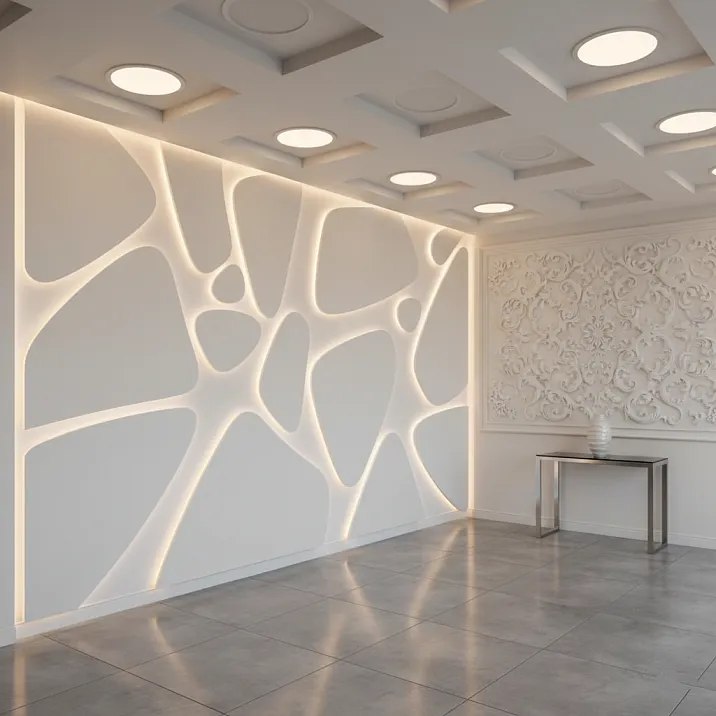
The variety of reliefs is enormous. Geometric patterns — squares, rhombuses, honeycombs, waves — for modern interiors. Floral ornaments — leaves, flowers, climbing stems — for classic and eco-styles. Abstract compositions — chaotic protrusions, organic forms — for avant-garde spaces.
Relief depth varies from delicate 5-10 mm to expressive 40-50 mm. Fine relief creates texture, noticeable under certain lighting, not dominating the space. Deep relief — dramatic effect, play of shadows, architectural expressiveness.
Color solutions are flexible. Panels are supplied white and can be painted with acrylic paints in any color. Monochrome solution — panels and background the same color, relief is only visible through shadows. Contrast solution — dark panels on a light background or vice versa. Gradient solution — panels in different shades of one color, creating a tonal flow.
Overlays: Point Dramatization
Decorative overlays — small relief elements ranging in size from 10×10 cm to 60×80 cm — create focal points on a wall without full panel coverage. An overlay above a doorway, symmetrical overlays on either side of a fireplace, a composition of overlays on an accent wall — the application methods are countless.
Ornamental overlays — rosettes with floral motifs, cartouches with scrolls, medallions with relief scenes — for classic interiors. Geometric overlays — circles, squares, polygons with abstract relief — for modern spaces.
The size of the overlay determines the scale of impact. Small overlays 10×15 cm — delicate accents, multiple applications without overload. Medium overlays 30×40 cm — expressive focal points, 2-4 pieces per wall. Large overlays 60×80 cm — dominant elements, one per wall as the center of the composition.
Installation of overlays is extremely simple. Marking the position with a pencil, applying glue to the back side, pressing against the wall for 30-60 seconds until the glue sets. No screws, dowels, or complex structures. One person installs 10-15 overlays per hour.
Molding compositions: structuring the plane
Moldings — straight profiled strips from 20 to 150 mm wide — create frames, panels, and geometric compositions on walls. Rectangular frames of different sizes divide the wall into zones. Horizontal moldings at a height of 90-100 cm create a panel effect. Vertical moldings structure the space with vertical lines.
Polyurethane moldings are cut with a utility knife or miter saw. Corners are joined at 45 degrees, forming neat connections. Joining adhesive chemically fuses the ends, creating a monolithic joint without visible seams.
The variety of profiles allows selecting a molding for any style. Simple rectangular profiles — minimalism, modern interiors. Profiled with coves and beads — neoclassicism. Ornamented with relief patterns — classic, baroque.
Painting moldings creates different effects. Moldings in wall color — delicate relief. Contrasting moldings — white against colored walls — clear graphics. Gilded or silvered moldings — luxury of classic interiors.
Comprehensive decor: unity of walls and ceiling
Disparate elements do not create harmony. A beautiful ceiling cornice on bare walls, luxurious wall panels on a flat ceiling — visual dissonance. A comprehensive approach connects all planes with a unified stylistic line.
Cornice as a connecting element
Ceiling cornice — the boundary between wall and ceiling — is a natural place to unify decor. The cornice repeats the profile of wall moldings, creating visual continuity. The cornice ornament echoes the relief of wall panels.
Cornice width determines the scale of decor. Narrow cornice 50-70 mm — delicate framing for minimalist interiors. Medium cornice 80-120 mm — classic choice for most rooms. Wide cornice 150-250 mm — monumental solution for high ceilings and formal spaces.
Cornice with lighting creates a dramatic effect. LED strip is installed behind the cornice, light is directed at the ceiling or wall. Soft diffused glow emphasizes the cornice profile, creates a floating ceiling effect.
Rosette as the center of composition
Ceiling rosette — the visual center of the room, especially in classic interiors. The rosette under the chandelier attracts the eye, organizes the space around itself. The rosette style must match the wall decor.
The rosette relief echoes the relief of wall overlays. Plant motifs of the rosette are repeated in wall elements. The rosette geometry aligns with panel geometry. This creates visual unity, perceived subconsciously.
Rosette size is proportional to room size and chandelier. For a 15-20 square meter room, a rosette 50-80 cm in diameter is optimal. For formal halls of 40-60 square meters — rosette 100-150 cm. A small rosette in a large room gets lost, a large one in a small room — overloads.
Baseboard as finishing
Floor baseboard — the lower boundary of the wall — completes the composition. Polyurethane baseboard repeats the profile of the ceiling cornice, creating symmetry of top and bottom. Baseboard height 80-150 mm is visually substantial, protects the wall from mechanical damage.
Baseboard with cable channel hides wires, adding functionality to decorativeness.MoldingsPolyurethane combines aesthetics with practicality — beauty without compromising convenience.
Baseboard painting aligns with the overall concept. Baseboard in floor color — visual continuation of the horizontal. Baseboard in wall color — visual increase in wall height. Contrasting baseboard — clear boundary between planes.
Variety of forms: from laconic to ornamental
Polyurethane is molded under pressure, allowing reproduction of any relief complexity. From perfectly smooth minimalist profiles to baroque swirls with detail down to the millimeter.
Minimalism: purity of lines
Minimalist profiles — rectangular or trapezoidal sections without ornament. Purity of geometry, precision of angles, perfect surface smoothness. Such profiles work as architectural lines, structuring space without decorativeness in the traditional sense.
Polyurethane panels with minimalist relief — parallel grooves, checkerboard grid of recesses, wavy surface — create texture without ornamentation. Play of light and shadow on the relief — the only decorativeness.
Overlays of geometric shapes — circles, squares, triangles with minimal relief — point accents in minimalist interiors. Not ornament, but highlighting zones, creating focal points.
Neoclassicism: balance of strictness and decorativeness
Neoclassical profiles — moderate profiling with coves, beads, egg-and-dart. Ornament is present, but restrained. Not baroque excess, but classical measure.
Rosettes with laurel wreaths, geometric patterns, stylized plant motifs. Detailing is high, but not overwhelming. Moldings with meander, palmettes, pearls — classical motifs in modern interpretation.
Panels with relief frames, geometric divisions, symmetrical compositions. Strictness and elegance, functionality and beauty in equal proportion.
Classicism and Baroque: Ornamental Splendor
Classical and Baroque profiles — abundant ornamentation, botanical motifs, intricate scrolls. Acanthus leaves, rosettes, cartouches, masks, garlands — the full arsenal of historical styles.
Polyurethane reproduces detailing unattainable by handwork on an industrial scale. Every leaf with veins, every scroll with smooth transitions, every rosette with symmetrical precision. Casting quality allows creating elements indistinguishable from 18th-19th century plaster stucco.
Large overlays with narrative compositions, putti figures, mythological scenes.Wall Finishing Elementsin Baroque style transform a room into a semblance of palace halls — scale, luxury, theatricality.
Art Nouveau: Organicity and Fluidity
Art Nouveau — the early 20th century style — is characterized by smooth organic lines, botanical motifs with asymmetry, and the rejection of right angles. Polyurethane is ideal for reproducing such forms.
Moldings with winding stems, stylized flowers, flowing lines. Overlays with images of irises, lilies, dragonflies — typical Art Nouveau motifs. Panels with wavy relief, imitating water surfaces or fabric movement.
Asymmetry of compositions is a characteristic feature. Not mirror repetition, but dynamic development of form. Polyurethane elements allow creating such compositions without cost increase — complexity of form does not affect cost after the casting mold is made.
Installation: From Unpacking to Finished Interior in a Day
Installation complexity is a barrier between the desire to update an interior and its realization. Plaster stucco requires professionals, polyurethane is accessible to amateurs with minimal skills.
Surface Preparation: Minimal Requirements
Perfectly flat surface is not mandatory. Polyurethane elements are flexible, compensating for irregularities up to 5 mm. Surface must be clean, dry, sturdy — the main requirements.
Cleaning from dust, grease stains, old wallpaper. Wet cleaning, drying. Deep penetration primer strengthens loose substrates, improves adhesive bond. Primer is mandatory for concrete and drywall surfaces.
Marking element positions — a critical stage. A pencil line on the wall or ceiling shows where to place the element. Horizontal alignment is checked with a laser or bubble level. Deviation of even 2-3 mm over a 2-meter length is noticeable to the eye.
Adhesive: The Chemistry of Reliable Bonding
Mounting adhesive for polyurethane — a specialized composition based on polyurethane or acrylic. Available in cartridges for a caulking gun or cans for application with a spatula. Sets in 15-30 minutes, full polymerization in 24 hours.
Adhesive is applied to the back of the element in a zigzag or dotted pattern. For light moldings, a line every 5-7 cm is sufficient. For heavy cornices and rosettes — a continuous layer. The element is placed against the marked spot, pressed firmly for 20-40 seconds until initial setting.
Seam adhesive is applied to the ends of connecting elements. The adhesive chemically fuses the polyurethane, creating a monolithic joint. The seam is pressed with painter's tape until complete setting — 2-4 hours. After tape removal, the seam is practically invisible.
Cutting and Joining: Precision of Connections
Straight joints — element ends are cut at 90 degrees with a utility knife or miter saw. Corner joints — ends are cut at 45 degrees to form a right angle when joined. Cutting precision is critical — deviation of 1-2 degrees creates a noticeable gap.
Miter box — a simple tool for precise cutting at standard 45 and 90 degree angles. The molding is placed in the miter box, a saw or knife moves along the guide slots, ensuring an accurate angle. For complex angles, a miter saw with adjustable angle settings is used.
Sealing minor gaps in joints — white acrylic sealant or sealant matching the element color. Sealant is squeezed from the tube into the gap, smoothed with a wet finger. After drying, the sealant is sanded with fine sandpaper until smooth. The joint becomes invisible after painting.
Painting: Final Transformation
Polyurethane elements are supplied white, painted with acrylic paints. Primer is not mandatory but improves paint adhesion. Paint is applied with a roller for smooth surfaces, a brush for ornamented ones.
Two to three thin coats of paint are better than one thick coat. A thick coat runs, hides relief details, dries slowly. Thin coats with intermediate drying of 2-4 hours create an even coverage without drips, preserving relief clarity.
Glossy paints emphasize relief but reveal minor surface defects. Matte paints hide defects, create calm elegance. Satin paints — a compromise between gloss and matte.
Patination — an artificial aging technique, popular for classical interiors. Base coat of light paint, second coat of dark paint or patina, partial wiping of the second coat on raised areas. Creates the effect of antique stucco with patina accumulated in recesses.
Durability and Moisture Resistance: An Investment for Decades
Polyurethane's affordability compared to plaster does not mean a short service life. On the contrary, the polymer's durability surpasses natural stone under conditions of humidity, temperature fluctuations, and mechanical impacts.
Moisture Resistance: From Bathroom to Pool
Polyurethane does not absorb water. Its closed-cell structure prevents moisture from penetrating the material. Elements installed in bathrooms, where humidity regularly reaches 90-100%, look like new after ten years.
Water immersion tests show: a polyurethane sample gains less than 1% of its mass in moisture after a month in water. A gypsum sample gains 15-25% of its mass in the same time, turning into a loose substance.
Use in pools, saunas, hammams — areas of extreme humidity — proves durability. Polyurethane cornices, rosettes, and columns in pools last 15-20 years without signs of degradation. Gypsum elements in the same conditions require replacement after 3-5 years.
Temperature Stability: From Frost to Heat
Polyurethane retains its properties within a temperature range of -60°C to +80°C. This allows its use on facades in any climatic zone — from Sochi to Yakutsk.
Frost resistance is critical for facade decor. Water that gets into the material's micropores expands when frozen, destroying the structure. Polyurethane does not absorb water, therefore it is not damaged by frost. Polyurethane facade decor in Moscow withstands 100-150 freeze-thaw cycles without damage.
Heat resistance is important for rooms with high temperatures. Cornices near fireplaces, decor in saunas are subjected to heating up to 60-80°C. Polyurethane retains its shape and properties without deforming.
Mechanical Strength: Life Without Restorations
The impact resistance of polyurethane is 5-7 times higher than that of gypsum. An impact that leaves a deep dent in gypsum leaves no marks on polyurethane. This is critical for rooms with children, pets, and high traffic.
A polyurethane baseboard in the hallway of an apartment building, where it is regularly hit by shoes, bags, and strollers, has no chips or cracks after five years. A gypsum baseboard in the same conditions requires annual restoration.
The material's elasticity absorbs mechanical energy. Gypsum is brittle — the energy of an impact shatters the material. Polyurethane is elastic — the energy of an impact is absorbed by deformation, then the material restores its shape.
UV Stability: Color Without Fading
High-quality polyurethane contains UV stabilizers that prevent polymer degradation from ultraviolet light. Facade decor under direct sunlight, interior elements near large windows — situations where UV stability is critical.
Polyurethane without UV protection yellows, becomes brittle, and cracks after 3-5 years in the sun. Polyurethane with UV stabilizers retains its whiteness and strength for 15-20 years. Painted elements are additionally protected by paint containing its own UV filters.
Frequently asked questions
Can polyurethane molding be painted with regular paints?
Yes, water-based acrylic paints are the optimal choice. Oil-based paints are not recommended — they dry slowly and yellow over time. Alkyd enamels are possible but require good ventilation during application. Latex paints provide a wear-resistant coating for elements subject to contact.
How much does a 2-meter long cornice weigh?
Depends on the width and complexity of the profile. A simple cornice 60 mm wide weighs 1.5-2 kg. A complex ornamental cornice 150 mm wide weighs 4-6 kg. For comparison — a gypsum cornice of the same dimensions weighs 10-18 kg.
Can polyurethane decor be used on a facade?
Yes, provided facade adhesives and paints are used. Polyurethane is frost-resistant, moisture-resistant, and UV-stable. Polyurethane facade decor lasts 20-30 years in the climate of central Russia without restorations.
How long after installation can it be painted?
The adhesive must be completely dry — usually 24 hours. After that, you can prime and paint. For wet rooms, it is recommended to wait 48 hours to ensure complete polymerization of the adhesive.
Polyurethane
Wet cleaning with a soft cloth and neutral detergents. Avoid abrasive cleaners and stiff brushes — they scratch the painted surface. For relief elements, use a soft brush to remove dust from recesses.
How much does it cost to decorate an 18-square-meter room?
Budget option — cornice around the perimeter (approx. 18 meters) at 400 rubles per meter — 7200 rubles, a 60 cm diameter rosette — 2500 rubles, baseboard 18 meters at 350 rubles per meter — 6300 rubles. Total for materials: 16000 rubles. DIY installation — no additional costs. Premium option with panels on an accent wall — 35000-50000 rubles.
Can polyurethane elements be bent?
Yes, polyurethane has a certain flexibility. Moldings up to 80 mm wide can be bent to a radius of 1.5 meters without damage. For smaller radii, there are flexible polyurethane profiles of special composition. Heating with a construction heat gun to 60-70°C increases flexibility.
What should be used to seal joints between elements?
Polyurethane joint adhesive is the best choice for end connections. For gaps between an element and the wall — white acrylic sealant or one suitable for painting. Gypsum putty is not suitable — it is rigid and cracks with temperature fluctuations.
Polymer Future of Classical Aesthetics
Polyurethane does not kill classicism. It makes it accessible, practical, durable. Molding has ceased to be a privilege of palaces and mansions, becoming an element of mass housing improvement. This is the democratization of beauty without compromising its quality.
Technology is constantly improving. High-density polyurethane for facades in extreme climate zones. Flexible polyurethane for curved surfaces. Polyurethane with antistatic additives that does not attract dust. Colored polyurethane that does not require painting. Each enhancement expands application possibilities.
The environmental friendliness of modern polyurethane meets the strictest standards. Safety certificates for residential premises, children's institutions, medical facilities. Absence of volatile organic compounds after polymerization. Neutral odor, non-allergenic.
The company STAVROS has been working with polyurethane decor for twenty years, offering professional solutions for any interior. The catalog includes over 2000 items — cornices of 300 profiles, moldings of 250 types, rosettes of 150 designs, overlays of 400 shapes, panels of 100 collections, baseboards of 180 variants.
European-level production ensures consistent quality. Pressure casting at 80-120 bar creates a dense structure without cavities or voids. Geometric accuracy of ±0.5 mm guarantees perfect joining of elements. Relief detailing up to 1 mm reproduces the finest nuances of original models.
The stock program in Moscow and St. Petersburg ensures immediate shipment of popular items. 80% of the assortment is in stock, shipment on the day of order. Non-standard sizes, custom profiles, and original overlays are produced to order within 10-20 days.
Technical support assists at all stages. Consultations on selecting elements to match interior style and operating conditions. Calculation of required quantities considering trimming and reserve. Installation instructions with video materials. Recommendations for painting and maintenance. Troubleshooting during operation.
Logistics delivers throughout Russia. Packaging in shrink film and cardboard boxes protects against damage. Long-length elements are transported by specialized vehicles. Delivery time to regions is 3-14 days depending on distance.
Create interiors where modern technologies serve eternal ideals of beauty. Where practicality does not contradict aesthetics, accessibility does not mean primitiveness, durability is guaranteed by the material of the future. STAVROS turns the polyurethane revolution into the everyday reality of thousands of homes, where classical molding finds a second life through modern material, preserving its soul while renewing its body.