








































































Article Contents:
- An office is not a living room or a bedroom. It has its own logic
- How slatted panels discipline office space
- Rhythm as an architectural tool
- Verticality as a symbol of power
- Acoustics of the workspace
- Classic furniture for the study: what works and what doesn't
- Writing desk: the main piece
- Executive chair: function and image
- Bookcases and Shelves: Storage System as Architecture
- Guest Chairs and Meeting Area
- Wood with Wood: How to Work with Material Rhyme
- Three Working Models
- When Dark Shades Are Appropriate in an Office
- Why a Dark Office Works
- Conditions Under Which a Dark Office Doesn't Become Gloomy
- Dark Office and Classic Furniture
- Book Systems, Shelves, and Slat Walls: How to Avoid Creating Informational Chaos
- Surface Separation Rule
- Bookshelf Organization
- Slat Panel Integration with TV or Monitor Niche
- Office Color: The Authority Palette
- Green: Intellectual Tradition
- Blue: Calm Concentration
- Neutral Darks: Universal Authority
- Light Office: When Airiness is Needed
- Office Lighting with Slat Panels: Three Levels
- Task Lighting
- Accent Lighting
- General Lighting
- Wall finishing with slatted panels in the office: technical solutions
- Electrical wiring and sockets
- Heavy objects on a slatted wall
- Installation of slatted panels: adhesive or frame
- Home office in an apartment: compact space with big character
- Niche as an office
- Small office: light solutions
- Mistakes that make an office gloomy and stuffy
- First mistake: dark walls without sufficient lighting
- Second mistake: overloaded desk
- Mistake three: too many classical details
- Fourth mistake: low-quality materials
- Mistake five: lack of zoning
- Mistake six: wrong curtains
- Comparison table: materials of slatted panels for a study
- FAQ: popular questions about a study with slatted panels and classical furniture
- About the Company STAVROS
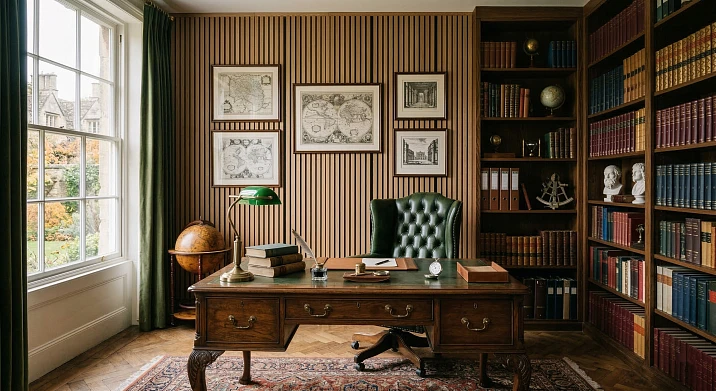
There are rooms that speak more about a person than any business card. A home study is one of them. Here decisions are made, negotiations are conducted, texts are created, strategies are built. Here is concentrated what is commonly called professional identity. And that is why the study forgives neither frivolity in decoration nor randomness in the choice of furniture.
Combinationof slatted panelsandclassical furniture for a study— is not a designer's whim or following fashion. It is an architectural statement in which the modern rhythm of a wooden slat meets the precise plasticity of a classical form, and from this meeting a space of special quality is born: authoritative, structured, intellectually rich. A space in which one wants to work — and in which work proceeds differently than at a desk by a window with white walls.

A study is not a living room or a bedroom. Its own logic
Most design mistakes in a study occur precisely because the logic of other rooms is applied to it. They try to make it 'cozy, like a bedroom' or 'representative, like a living room.' But a study has its own function — and its own aesthetic task.
A study should discipline. Not oppress, not pressure—specifically discipline. Entering a properly arranged study, a person automatically switches to work mode: the back straightens, attention concentrates, thoughts organize. This is not magic—it's the physiology of spatial perception. The architectural order of walls, quality of materials, depth of color, presence of wood—all this affects the nervous system at a level preceding conscious evaluation.
Exactly thereforeClassical office furnitureAnd slatted wall panels fit the task of this space perfectly. Classic carries stability—a form tested by centuries. Slats carry rhythm and structure. Together they create an environment where a person feels not like a guest, but the master of the situation.
Let's break down how this really works—not in general terms, but in specific solutions.




How slatted panels discipline the space of a study
The word 'discipline' applied to interior design may seem strange. But that is exactly what a slatted panel does to a study wall—it introduces order.
Our factory also produces:


Rhythm as an architectural tool
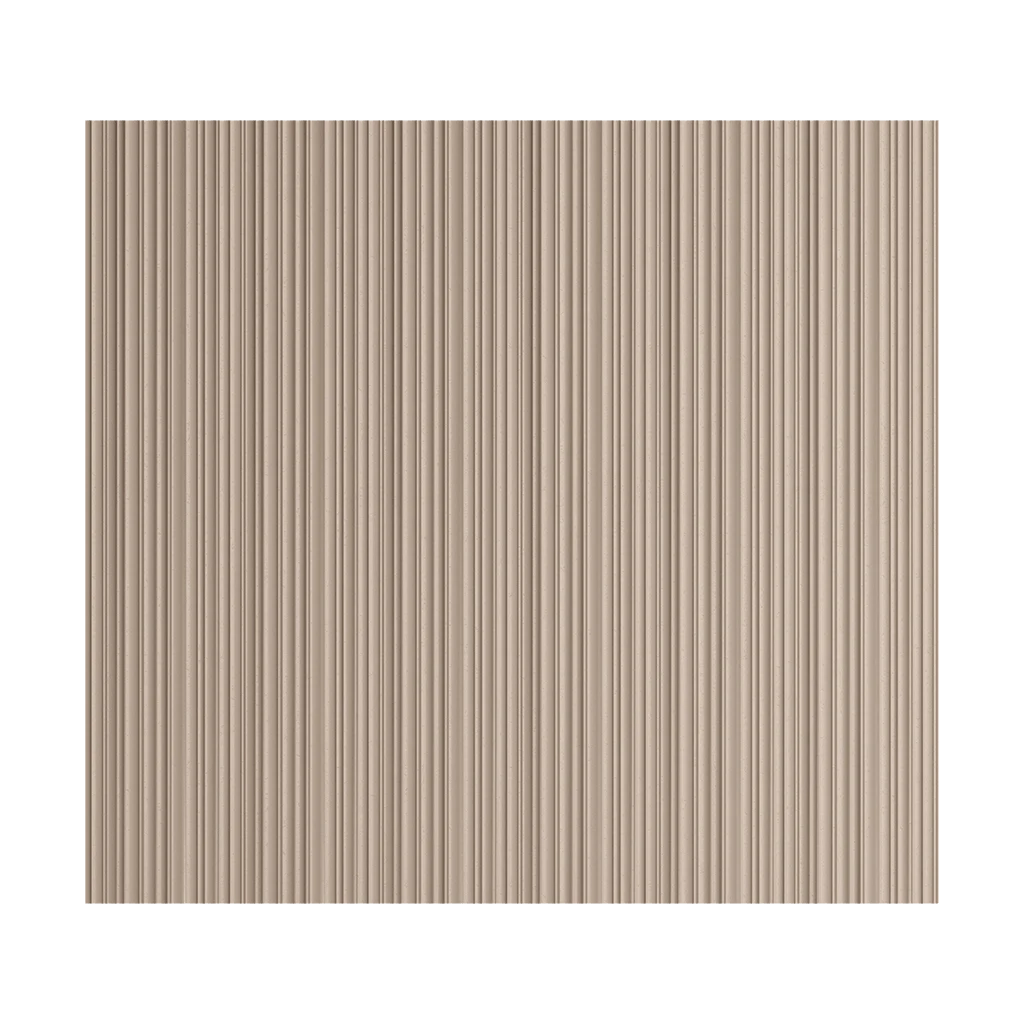
Slatted wall panelsare built on repetition. Slat—gap—slat—gap. This uniform rhythm is not accidental: it creates a sense of predictability, orderliness, controllability. In the psychology of spatial perception, a repeating module is associated with reliability and stability—qualities that are absolutely functional for a study.
Compare with a chaotic ornamental wall, a mosaic of differently shaped objects, colorful wallpapers. All these surfaces stimulate, excite, scatter attention. A slatted panel does the opposite: it calms background perception and frees up attention resources for work.
This is not theory—it's practice that architects designing spaces for intellectual work have long understood: libraries, university studies, courtrooms. They all use rhythmic vertical surfaces—panels, pilasters, bookshelves with uniform spacing—precisely because this rhythm works.
Get Consultation
Verticality as a symbol of power
Vertical orientation of slats also carries a symbolic dimension that cannot be ignored. Verticality represents growth, aspiration, height. In the office space, the vertical rhythm of walls creates a sense of scale and significance. Tall slatted panels from floor to ceiling in an office with ceilings of 2.7–3.0 m transform an ordinary room into an architecturally substantial space, requiring neither moldings nor expensive cladding.
Exactly thereforeWooden slat panelsin the office are so convincing: they give walls height and significance—something previously achieved only through expensive architectural finishes.
Acoustics of the workspace
A practical aspect rarely discussed in the context of aesthetics: slatted panels with padding significantly improve the acoustics of an office. Negotiations, phone calls, podcast recordings, or video calls—all require a space without hollow reverberation.Slatted panels in interior designwith acoustic padding absorb reflected sound, making speech clearer and more intelligible.
An office with good acoustics is not a luxury, it's a professional requirement. And slatted panels solve this task incidentally, without requiring separate solutions.
Classic office furniture: what works and what doesn't
Not every classic piece of furniture is equally appropriate in a modern office with slatted walls. It's important to distinguish between a 'historical replica' and 'modern classic'—a difference that determines whether the office will look like a museum hall or like the workspace of an intelligent person.
Writing desk: the main piece
The writing desk is the heart of the office. Everything else is built around it.Classic wooden furnitureIn the execution of a writing desk, this is a massive tabletop on profiled legs, possibly with pedestal bases, featuring a leather or felt insert on the work surface. It is an object that has weight—not only physical but also visual.
Paired with a slatted wall, such a table operates on the principle of 'sculpture against a background.' The slats create a neutral architectural surface, with the table standing before it as an independent object. The eye perceives the table in full force, without losing it in the wall's pattern.
What is important when choosing a desk for a study with slatted panels:
-
Material—solid oak, walnut, cherry. Natural wood rhymes with the wooden slats, creating a material cohesion in the space.
-
Color—not necessarily identical to the slats, but from the same tonal group. If the slats are in a tobacco tone, a desk made of dark walnut is a deliberate contrast within the warm palette.
-
Leg shape—profiled, on conical supports, or curved cabriole. Carving is appropriate in details but should not turn the table into an ornamental object.
Executive chair: function and image
The office chair in a classic study is a special item. It must be both ergonomic (the back will be in it for hours) and visually convincing. A classic chair with a high back, wooden armrests, and leather upholstery is the canonical answer to this requirement.
Leather in dark brown, burgundy, khaki—colors traditionally associated with the study environment. Against a backdrop of oak slatted walls, such a chair creates an image that Western culture unmistakably reads as 'a decision-maker.'
Important detail: the high back of the chair in front of a slatted wall works as a silhouette against the background. The slats are vertical graphics, the chair is a volumetric form, and this contrast is perceptible even when the chair is empty.
Bookcases and Shelves: Storage System as Architecture
A bookcase in a classic study is not just storage. It is a display. A library as part of a study is a historically established tradition that speaks about the owner more eloquently than any diploma on the wall.
modern classic furniture offers bookcases with glazed doors in profiled frames, with open shelves, with decorative pilasters on the sides. Paired with slatted walls, such a cabinet works as follows: it occupies one or two walls of the study, the slatted panel occupies another (usually the wall behind the desk or opposite it). Two different rhythms—the rhythm of book spines and the rhythm of slats—create a dialogue of textures that makes the space visually rich without being overloaded.
A fundamental point: bookcases and slatted panels should not compete on the same wall. Place them on different surfaces so that each element has its own space for expression.
Guest Chairs and Conversation Area
A study often serves as a meeting space. Two chairs or a small sofa of classic shape with a coffee table—a conversation area that is placed away from the desk and creates a second functional center in the study.
Classical Furniture for the Apartment in the form of chairs for the conversation area are small but expressive pieces with profiled backs, wooden legs, and upholstery in fabric or leather. Next to a slatted panel—as a background—such chairs look organic and convincing.
Wood with Wood: How to Work with Material Rhyme
When both the walls (oak slatted panels) and the furniture (desk, cabinets, chair) in a study are made of wood, a question arises that many answer incorrectly: should they match in tone?
The answer is no. A perfect match in tone deprives the space of depth. It becomes monotonous, one-dimensional. Wood with wood works precisely through difference, through a dialogue of species and tones.
Three working models
Model one: similar tones, different species. Oak slats with a light tobacco stain and a walnut table with a darker, richer stain. Both are warm, both in a brownish-gold palette, but differ in saturation. The table is perceived as a darker, more substantial core against the light rhythm of the wall.
Model two: contrasting tones within one palette. Dark oak slats in a fumed oak or wenge finish on the wall — and a light ash or beech table. The dark background makes the light table a source of visual light in the space, drawing attention to it.
Model three: one species, different finishes. Oak slats with oil, showcasing the open, live grain — and an oak table with a matte lacquer. The material is the same, but the texture is different: the slats are soft and natural, the table is smooth and strict. This contrast is tactile, and it works on the level of perceived quality.
When dark shades are appropriate in a study
A dark study is a separate aesthetic topic that requires discussion. Many fear dark walls in a workspace, associating them with gloom and heaviness. This fear is justified — but only if the dark interior is done incorrectly.
Why a dark study works
Darkness concentrates attention. Dark walls 'disappear,' and only what is illuminated remains in the space: a desk with a lamp, a book, a monitor, an interlocutor. This is not gloom — it's focus. The theater uses a dark stage not to hide the actors, but to make them brighter.
Painted MDF plank panelsIn a dark tone — deep green (Racing Green, Bottle Green), dark blue (Hague Blue, Midnight), anthracite, dark plum — this is a material that accepts color with maximum depth and evenness. It is precisely MDF for painting that gives that velvety, saturated tone, which cannot be achieved with wallpaper or on an ordinary painted wall.
Or —Wooden slat panelsmade of oak with a finish mimicking aged oak: almost black, with a barely discernible wood grain pattern. This is the most 'library-like' option possible — a material that speaks of seriousness and time.
Conditions under which a dark study doesn't become gloomy
-
Sufficient natural light. A dark study without a window or with a small window is truly oppressive. A dark study with a large window is magical.
-
Proper artificial lighting. Warm spotlights directed at the slatted wall, a desk lamp with a warm cone of light on the table, possibly —Slatted panels with lightingwith hidden LED strips behind the slats.
-
Light accents. The ceiling — white. The floor — possibly lighter than the walls. Book spines, decor on the shelves — various tones. A desk made of light material or with a white tabletop.
-
Mirrors and reflective surfaces. A mirror in a classic frame on a side wall multiplies light, doubling the perceived depth of the space.
Dark study and classic furniture
Classic furniture pricesworks in a special way in a dark study: against a dark background, dark furniture made of walnut or dark oak creates a monolithic, total space — luxury of the highest order. Light furniture (beige ash, cream) against a dark background is a contrasting and very powerful technique, where the desk literally glows against the wall.
Gold, bronze, and brass furniture hardware details on a dark background work as decorations: they sparkle in points, without overloading the space, but giving it class and completeness.
Book systems, shelving, and slatted walls: how to avoid creating informational chaos
A study with books is a special space. Bookshelves add an intellectual dimension, but if organized incorrectly, they create visual chaos. How to organically combine a book system and slatted panels?
The rule of separating surfaces
A wall with slatted panels and a wall with bookshelves are different walls. This is a fundamental rule. Slats and book spines are two different rhythms, and they need different spaces to express themselves. A slatted panel belongs behind or opposite the desk. A bookcase belongs on the side walls.
If the study is small and there aren't enough different walls, a compromise: the slatted panel occupies the central part of the wall, and bookshelves are placed at the edges, like a frame. This creates a niche where the slatted surface becomes the background, and the cabinets become an architectural frame.
Organizing bookshelves
A chaotic arrangement of books of different sizes and colors visually ruins any interior. In a study with slatted panels and classic furniture, order on the shelves is especially important:
-
Books of the same height go in one row, without protruding or recessed volumes.
-
Grouping by cover color or tone — rows of warm tones alternate with darker ones.
-
Open shelves alternate with closed ones: behind glass doors are display volumes and rare editions, while open shelves hold working literature freely accessible.
-
Decorative items on shelves are kept to a minimum: a globe, a bronze figurine, a paperweight—no more than two or three items for the entire shelving unit.
Integration of a slatted panel with a niche for a TV or monitor
A modern study often combines a workspace with a viewing area.slatted panel for the television— one of the most in-demand solutions: the screen is mounted flush with the slatted surface, cables are hidden behind the slats, and the wall remains a unified architectural object both when the TV is on and off.
In a classic study, this solution is particularly convincing: a screen in a slatted wall is a modern technological element integrated into a historically evocative space. Past and present in one wall.
Color in the study: the palette of authority
Color works differently in a study than in a bedroom or living room. Here, joy and lightness are not needed—concentration, order, and status are. Let's examine a working palette for a study with slatted panels and classic furniture.
Green: intellectual tradition
Deep green is one of the most 'study-like' colors in the European tradition. It is associated with expensive writing desk cloths, Victorian library wallpapers, leather bindings. An MDF slatted panel in a deep green tone is a direct appeal to this tradition, reinterpreted through modern material and form.
Green study withclassical wooden furniturein dark walnut tone — this is a space with an almost tangible history. Gilded hardware details, a cognac-toned leather armchair, a brass desk lamp — all of these elements integrate organically into the green study, creating an image that is unmistakably read as 'a serious person's place.'
Blue: calm concentration
Dark blue is the color of the sky in the hour before dawn. It doesn't weigh down like black, nor excite like red. It creates an atmosphere of focus without tension. Dark blue slatted panels in a study with light-toned oak furniture is one of the most modern and yet classically justified options.
Neutral darks: universal authority
Anthracite, dark gray-brown, 'wet asphalt' — neutral dark tones that do not appeal to any specific tradition but create a space with weight. This is the choice for those who want austerity without historical rhetoric.Paintable lath panelsin an anthracite tone with classical furniture made of light oak — this is an interior that looks equally convincing within both classical and contemporary value systems.
Light study: when air is needed
A light study is no less convincing an option, especially if natural lighting is limited. Oak slats in a natural or slightly lightened tone, classical furniture in milk walnut or light oak color, a white ceiling, and a light floor — a space that looks collected and professional without dark drama.
A bright study demands stricter order management: every item on the desk, every book on the shelf, every detail must be in its place. A light-colored space is merciless to clutter.
Lighting in a study with slatted panels: three levels
Proper lighting in a study is not a single source, but a system of several levels, each performing its own role.
Task lighting
A desk lamp with a directed cone of light is a classic of study lighting. A lamp made of brass or bronze with a green glass shade (banker's lamp) is an item with history, organic in a classic study. It provides warm, directed light onto the work surface without flooding the entire space.
Accent lighting
Directional ceiling lights angled towards the slatted wall are a mandatory element. They create a play of shadows in the gaps between the slats, giving the surface depth and volume. Without this accent lighting, the slatted panel appears flat, losing its main advantage—tactile expressiveness.
Slatted panels with lighting— an LED strip hidden behind the slats—in a dark study creates an effect of glowing wall depth. Warm, diffused light from behind the slats turns the wall into a source of atmospheric light that doesn't glare, doesn't distract, but creates a background sensation of warmth and liveliness.
Ambient lighting
A chandelier or ceiling lights set to minimum brightness—for general room illumination. In a study, ambient light should not be the main source: it only provides a base level of illumination; everything else is done by task and accent lighting.
Color temperature — strictly 2700–3000 K. In a study with wooden surfaces and classic furniture, cool light (4000+ K) makes wood look gray and gold details appear dull.
Wall finishing with slatted panels in a study: technical solutions
A practical question that arises for anyone planning a study: how exactly are slatted panels installed, what is behind them, and how to account for the technical features of the workspace.
Electrical wiring and outlets
In a study, it is necessary to provide a sufficient number of outlets in the work area. When installing slatted panels, outlets and switches are either set flush with the slatted surface (concealed installation) or placed in special niches or boxes. Planning the location of outlets — before installing the panels, not after.
Wall finishing with slatted panelsIn a study, installation is done on a flat, prepared surface. If cables are planned to be routed behind the panels, provide an air gap — installation on a metal frame with a 30–50 mm offset from the wall.
Heavy objects on a slatted wall
Bookshelves, wall lights, large mirrors — all of these require embedded supports in the wall before panel installation. An MDF or oak slatted panel will not hold a heavy object without support from the wall's load-bearing structure. Embedded elements — plywood or metal plates — are mounted into the wall at planned fastener locations, then the slatted panel is installed over them. Fasteners pass through the slat into the embedded support and the load-bearing wall.
Installation of slatted panels: adhesive or frame
installation of slatted panelsIn a study — typically adhesive for flat walls or frame-based if there are irregularities. Adhesive installation is faster; frame-based is more reliable under heavy loads and allows concealing utilities. For a study with extensive electrical wiring, frame-based installation is preferable.
Home office in an apartment: compact space with big character
A separate office is a luxury not available to everyone. But even in an apartment where only a niche or a corner of a room is allocated for an office, the logic of slatted panels and classic furniture works.
Niche as an office
Slatted panels on three walls of the niche create an independent architectural volume—'an office within a room.' A classic desk and chair in the niche, slatted walls around, shelves on the sides—this is a full-fledged workspace, separated from the living area not by a partition, but by the architectural logic of the finish.
This is exactly what is meant when talking about zoning with slatted panels: they create space not physically, but visually—through a change in the character of the surface.
Small office: light solutions
A small space does not tolerate dark walls—or rather, it tolerates them, but requires impeccable lighting. If the office is less than 10 m², light slatted panels made of oak in a natural tone are preferable: they provide texture and depth without absorbing space.Classical Furniture for the ApartmentSmall in size—a compact desk on elegant legs, a single chair—does not overload the space but preserves the classic character.
Mistakes that make an office gloomy and stuffy
After analyzing what works—here's what ruins it. An office with slatted panels and classic furniture can become gloomy and dysfunctional due to the following mistakes.
First mistake: dark walls without sufficient light
Deep green or anthracite on a slatted wall without a well-thought-out lighting system creates a space that is physically difficult to stay in for more than 20 minutes. A dark interior requires mandatory compensation: accent wall lights, a task lamp on the desk, natural light from the window.
Second mistake: an overloaded desk
A desk in a classic study is not a storage unit. It is a surface. A monitor or laptop, a desk lamp, one organizer, a maximum of two decorative items. Everything else goes into drawers or onto shelves. A cluttered desk against a beautiful slatted wall creates a sense of dissonance: the walls speak of one level, the desk of another.
Third mistake: too many classic details
A carved desk plus a carved cabinet plus a carved chair plus ceiling molding plus heavy curtains with tassels—the space ceases to be functional and turns into an exhibit. A slatted wall is a modern element, and it requires that the classic elements around it be moderate in detail. One accent piece with rich carving; the others with minimal decor.
Fourth mistake: low-quality materials
PVC slatted panels with wood imitation and chipboard furniture with a classic-style film are imitations that are especially obvious in a study. A study is a space where people work with concentrated attention, and cheap material is immediately noticeable. Natural wood in the slats and solid wood in the furniture are not a luxury; they are a professional standard for a serious workspace.
Fifth mistake: lack of zoning
A work zone and a meeting zone mixed in one space without clear demarcation is an organizational problem that is felt physically. A slatted panel behind the desk, a neutral wall or a bookcase by the meeting zone—this is architectural zoning that makes the space functionally readable.
Sixth mistake: wrong curtains
Tulle in the office — no. Thick curtains with decorative fringe — no. Horizontal blinds — no. A workspace with classic furniture and slatted walls requires restrained and functional textiles: dense blackout roller blinds or plain linen curtains without decoration, strictly floor-length.
Comparison table: materials for slatted panels in the office
| Material | Color options | Texture | Best scenario | Care |
|---|---|---|---|---|
| Solid oak, natural tone | Limited to natural tones | Lively, with wood grain pattern | Light and neutral office | Oil/varnish once every 2–3 years |
| Oak array, tinting | Dark tones in a warm palette | Live with tinting | Dark 'library' study | Polish 1–2 times a year |
| MDF for painting | Any RAL/NCS color | Smooth, velvety | Dark accent study | Minimal |
| Flexible slat | Any color | Smooth | Niches, arched openings | Minimal |
FAQ: popular questions about a study with slatted panels and classic furniture
Can a home study be combined with a living room using slatted panels as a divider?
Yes, this is one of the most elegant zoning options.Rafter panelsas a visual divider between the living room and the work area—this is an architectural solution that creates a boundary without a solid partition. On the study side—a slatted wall with accent lighting. On the living room side—the reverse side of the same structure, which can be finished differently.
What slat size is optimal for a study?
For high ceilings (from 2.7 m) — a slat width of 30–40 mm with a gap of 10–15 mm. This creates an expressive rhythm that is easily readable from a working distance. For ceilings 2.4–2.5 m — a narrower slat, 20–25 mm with a gap of 8–10 mm, so the rhythm doesn't appear heavy.
How to combine slatted panels and built-in wardrobes in a small study?
A slatted panel on the wall behind the desk, built-in wardrobes on the opposite wall. If the built-in wardrobes have framed fronts in a classic style, they create an interesting contrast with the slatted wall: the geometry of the frame versus the rhythm of the slats. Wardrobe fronts in the same tone as the slatted panel — a solution for a small space where tonal unity is more important than contrast.
Is classic wooden furniture suitable for a home study with video calls and filming?
Perfectly suitable. A slatted wall made of oak or MDF in a dark tone is one of the most popular backgrounds for professional video calls. It looks expensive and authoritative on camera, doesn't distract, and doesn't create a cluttered background.Classical office furnitureon camera adds an image of professional competence.
Is a rug needed in a study with slatted panels and parquet flooring?
In a study, a rug serves an acoustic function: it absorbs the sound of footsteps and reduces reverberation. With slatted panels that have acoustic padding, a rug is less mandatory but desirable under the conversation area—to create a tactilely warm space. A rug under the desk is optional, but if there is a chair with wheels, a rug under it is undesirable or a special protective mat is needed.
How to determine the budget for a study with slatted panels and classic furniture?
The starting point is one quality item (a desk or chair) and one accent wall with slatted panels. This is the minimum set that already creates the desired character for the space. Further furnishing—bookcases, guest chairs, decor—is added gradually. This approach allows creating a space with quality without sacrificing it for quantity.
About the company STAVROS
The study is the most demanding space in the house. It does not forgive cheap solutions and immediately exposes the discrepancy between concept and execution. It is here that the quality of materials determines the difference between a workspace you want to be in and a room you try to leave as soon as possible.
STAVROS is a manufacturer that understands this difference. Here they produceslatted panels made of MDF and solid oakwith a precision of workmanship visible in the gaps, the ends, the quality of the finish—in everything that distinguishes a professional product from standard production. And here they also createclassic furniture for the studySolid wood desks, chairs with wooden details, bookcases with glass doors — items that serve for years without losing their dignity over time.
Choosing STAVROS means choosing more than just material or furniture. You choose a solution where both elements of the space — the wall and the object — exist within a unified quality system. This is what transforms a study from a collection of things into a space with character.