











































































Article Contents:
- How molding differs from a decorative strip
- Decorative strip: an element of rhythm
- The architectural function of molding
- When molding enhances a slatted wall
- First case: a large plane without reference points
- Second case: transition from a slat panel to a smooth surface
- Third case: an accent niche or panel
- Fourth case: a wall with different elements
- How to divide large planes into sections: practical mechanics
- Horizontal division: wall belts
- Vertical division: fields and frames
- Panel proportions: the golden ratio and practice
- Vertical rhythm of battens and rectangular molding frames: how they coexist
- The rule of scale contrast
- Rule of tonal subordination
- The rule of direction
- Interior styles where the union of slatted panels and moldings is especially organic
- Modern classic: basic context
- Neo Art Deco: Geometry as Religion
- Classic New York Style: Paneled Walls with Moldings
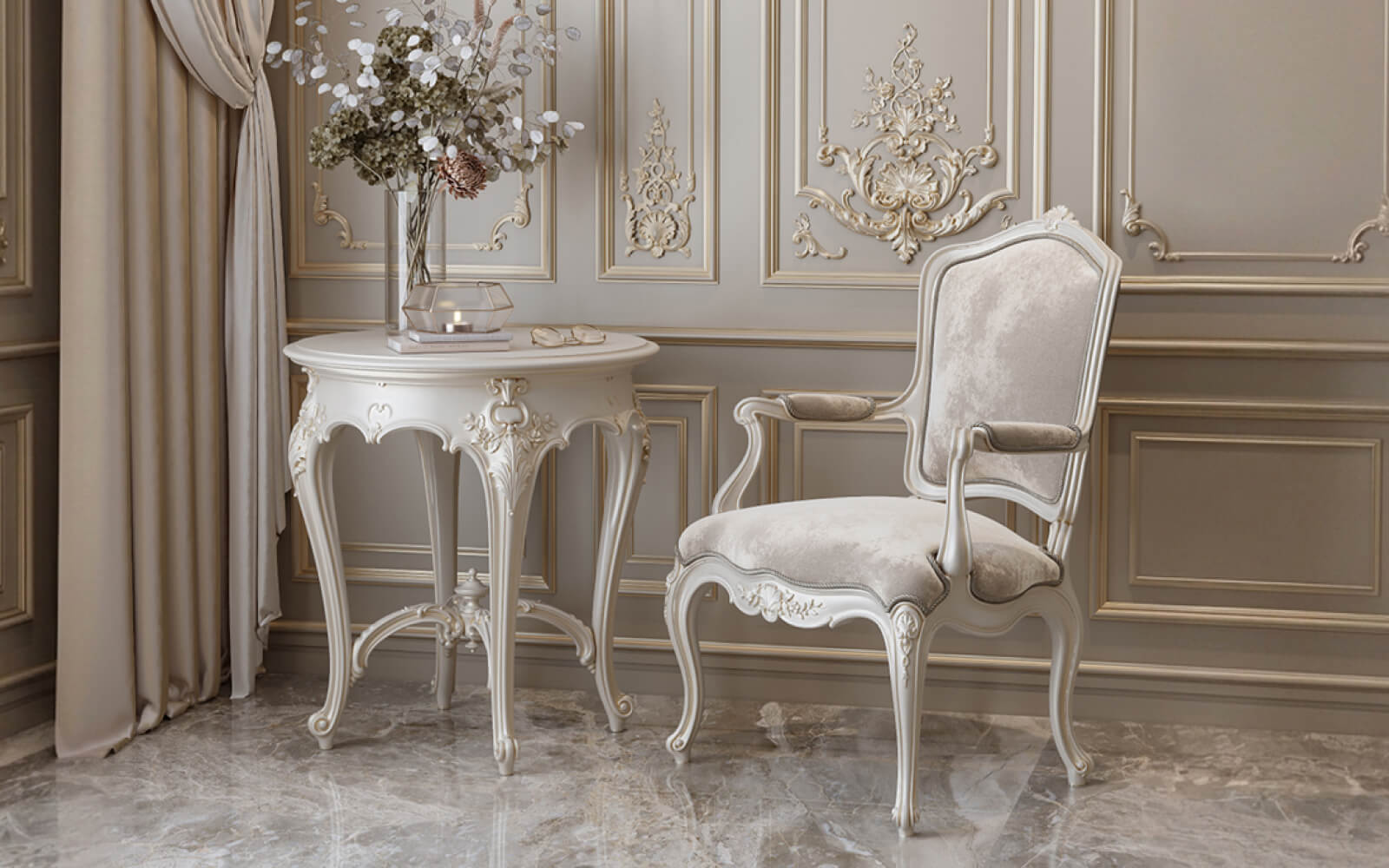
- Parisian Style: Neutral Wealth
- Scandinavian Interior with a Classic Detail
- Technical Principles for Creating Molding Fields on a Slat Wall
- Option A: Molding Over a Slatted Panel
- Option B: Molding as a Boundary for Zones Without a Reeded Background
- Option B: planning for slat insertion into a molding frame
- Chiaroscuro as an Architectural Material
- Slat and Light
- Molding and light
- Recessed Wall Lighting with Moldings
- Color and tone in the recessed panel and molding system
- Monotone Model
- Two-tone model
- Contrast Model
- Material contrast: oak and white polyurethane
- Space fragmentation errors: when there are too many moldings
- First Error: Small Fields on a Large Wall
- Second error: moldings on every wall when there is a recessed panel
- Third mistake: moldings inside the slatted field
- Mistake four: different molding profiles in one space
- Fifth mistake: incorrect joint of molding with slatted panel
- Mistake six: moldings without considering furniture
- Slatted panels with moldings: room by room
- Living room: large scale, status result
- Bedroom: delicacy above all
- Hallway: verticality and scale
- Study: serious architecture
- Practical table: molding parameters for different wall formats
- FAQ: Answers to Popular Questions
- About the Company STAVROS
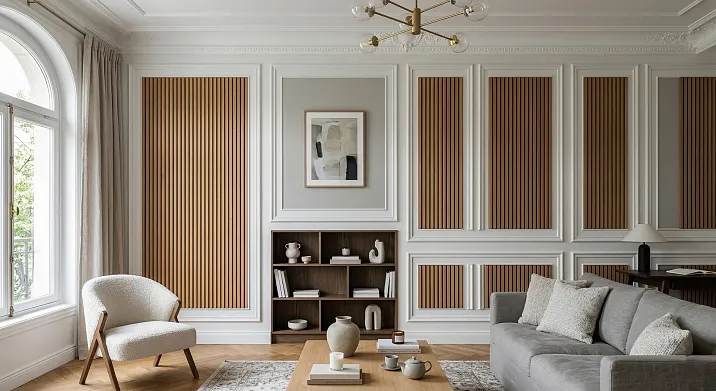
Imagine a wall where two completely different architectural principles are at work simultaneously. The first is linear, rhythmic, modern: vertical battens, uniform spacing, predictable geometry. The second is framed, structuring, historically rooted: moldings, rectangular panels, decorative plasterwork that divides the surface into meaningful sections. It would seem they should interfere with each other. But it is precisely in their interaction that an interior of special quality is born—a space that has both rhythm, hierarchy, and architectural completeness.
Rafter panelsandMolding— they are not competitors for dominance on a single wall. They are two tools from different eras that, in skilled hands, create a dialogue. The main thing is to understand the logic of each tool and the principles by which they can coexist without conflict.

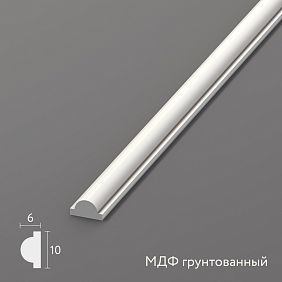


How does molding differ from a decorative strip?
A question that is rarely asked but determines all further understanding of the topic. At first glance, molding and a decorative batten are similar things: both are profiled elements attached to a surface. But functionally, they are fundamentally different.




Decorative strip: an element of rhythm
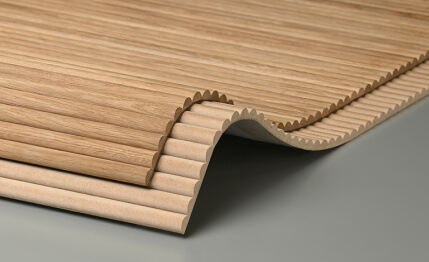
A slat is a module of rhythm. It exists in the context of repetition: one slat means nothing, twenty slats create a surface. A slat has no hierarchy—all slats in a panel are equal. Its expressiveness lies in infinity: the slat runs from floor to ceiling, from corner to corner, needing no beginning or end.
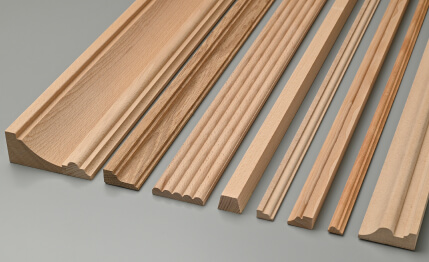
Relief Decorationworks on a different principle. Molding is a boundary. It outlines a field, defines the beginning and end of an architectural element. Molding exists not in repetition, but in completion: it frames a niche, forms a border, creates a transition between zones. A single molding already carries meaning—even alone, it creates order.
This distinction—rhythm versus boundary, repetition versus completion—explains why their combination is so productive. The slat creates the infinite fabric of the surface; the molding organizes it, divides it into readable parts, gives it scale and hierarchy.
Our factory also produces:


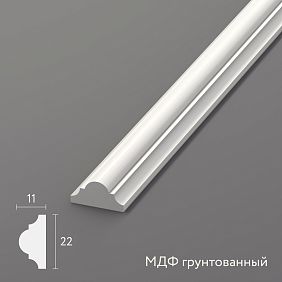


The architectural function of molding
Decorative stucco— in the form of molding has historically performed four functions that remain relevant:
-
Surface articulation — breaking down a large plane into fields of a human-scale proportion.
-
Transition between zones — marking the boundary between different materials, textures, or planes.
-
Visual completion—'closing' an architectural element at the top, bottom, or sides.
-
Play of light and shadow — a relief molding profile creates shadow, enriching the surface without additional color.
A slatted panel without molding is an incomplete architectural gesture. A slatted panel with properly chosen molding is a finished statement.
Get Consultation
When molding enhances a slatted wall
Not every slatted panel needs molding. There are spaces and situations where the slats are self-sufficient — and adding molding would only harm. But there are cases wherewall moldingit precisely enhances the slatted surface, solving tasks that slats alone cannot handle.
First case: a large plane without reference points
A wall 5 meters wide and 2.8 meters high, covered with slatted panels from corner to corner — that's a lot of fabric without hierarchy. The eye doesn't know where to look. The space seems monotonous despite the texture. This is exactly where molding acts as an organizer: a horizontal strip at a height of 1.8–2.0 meters divides the wall into two bands, vertical moldings break it into fields of a proportionate scale.
A large slatted surface without moldings is just a wall. With moldings, it is architecture.
Case two: transitioning from a slatted panel to a smooth surface
One of the most common scenarios: a slatted panel occupies the lower two-thirds of the wall, the upper third is a smooth painted surface. The boundary between the slatted and smooth parts needs to be defined. A horizontal molding at the transition line makes this transition deliberate, architecturally justified—and not looking like an unfinished renovation.
— everything must correspond to the chosen era.In the form of a horizontal dividing molding—one of the most functional applications of decoration in combination with slatted panels.
Third case: an accent niche or panel
A slatted panel in a 'frame' format—a bounded rectangle on the wall—is organically framed by molding around the perimeter. The molding transforms the slatted field into an independent architectural object: a panel, embedded in the wall. The entire surrounding wall is neutral, the slatted insert is an accent niche highlighted by molding.
Fourth case: a wall with different elements
A slatted panel, a framed mirror, a console—all on one wall. Without a unifying decorative system, this is a collection of separate items. With moldings that create decorative frames around each element, the wall becomes a unified composition, where each part occupies its place in the hierarchy.
How to divide large planes into sections: practical mechanics
Dividing a large plane with moldings is not an arbitrary exercise. It follows the rules of proportion developed by the European architectural tradition over several centuries. Let's examine these rules as applied to slatted walls.
Horizontal division: wall belts
Classical architecture divided the wall into three horizontal belts:
-
Plinth (lower belt) — from the floor to the level of a table or windowsill, approximately 0.8–1.0 m.
-
Middle belt — the main area of the wall, the place for the main decor.
-
Frieze (upper belt) — from the cornice to the ceiling or from the upper molding to the cornice.
In a modern interior with slatted panels, this division transforms:
-
Lower belt — a wide baseboard or lower horizontal molding.
-
Slatted panel — occupies the middle or middle plus lower belt.
-
Upper belt – smooth surface with a ceiling cornice.
Or in another version: the slatted panel occupies the entire height of the wall, and a horizontal molding at a height of 1.8–2.0 m creates a conditional 'belt,' visually dividing the wall without changing the material.
Vertical articulation: fields and frames
Vertical articulation of a wall with slatted panels using moldings – creating rectangular 'panels,' each framed by a profiled frame. This is a technique characteristic of classical interiors of the French and Italian Renaissance, Georgian style, and Russian Empire.
In a modern interpretation: a slatted wall is divided into three or four vertical fields of equal width using vertical moldings. Each field is an independent architectural module. This does not destroy the unity of the slatted surface if the moldings are thin (30–50 mm) and match the tone of the slats. If the moldings are contrasting, they create a pronounced frame structure over the slatted background.
Field proportions: the golden ratio and practice
The textbook rule of proportions – the golden ratio (1:1.618) – in architectural wall articulation serves as a guideline, not a strict requirement. A practical rule: the height of a panel should be greater than its width in a proportion from 1:1.3 to 1:2. Square panels look static, overly elongated ones look restless. A moderately vertical rectangle is the optimal format for wall panels.
On a wall 4.0 m wide and 2.6 m high, three fields each 1.2 m wide with 50 mm vertical moldings between them are correct proportions. Two wide fields at 1.8 m each are overloaded and seek division. Five narrow fields at 0.7 m each are too fine, fragmenting the space.
The vertical rhythm of slats and the rectangular molding frame: how they coexist
This is the key question of the topic, and the answer is not obvious. The vertical rhythm of slats is a small, repeating module (20–50 mm slat width plus a gap). The rectangular molding frame is a large, singular element (300–1200 mm in cross-section). Two different scales, two different principles of surface organization.
How to make sure they don't fight?
The rule of scale contrast
The molding frame should be sufficiently large so as not to blend with the rhythm of the battens. If the width of the molding frame is comparable to the spacing of the battens, the eye gets lost—it's unclear what is more important: the frame or the battens. The frame should overlap at least 8–10 battens in width to be read as an independent element of large scale against a fine-grained background.
Analogy: a pattern of large checks on fabric with a fine texture—both patterns are read simultaneously, without interfering with each other, precisely because their scales are fundamentally different.
Rule of tonal subordination
If both the battens and the moldings are of the same tone—the frame is read only through relief and shadow. This is the most delicate solution: the surface is rich but not gaudy. The eye reads both elements sequentially—first the large frame, then the fine rhythm of the battens inside it.
If the molding contrasts with the batten, it immediately comes to the foreground, becoming the dominant element. The battens turn into a background texture within the frame. This is also a workable model, but it requires stricter editing: a contrasting molding is loud, and there should be no extra elements next to it.
Rule of direction
Moldings decorationIn the form of a vertical molding next to vertical battens—redundancy of one direction. A molding that repeats the direction of the battens does not create architectural contrast—it simply adds another vertical element to an already vertical system.
Most productive: a horizontal molding on a vertical batten surface. Or a rectangular frame in which horizontal elements intersect the vertical rhythm of the battens—creating a lattice structure in which both directions are read.
Interior styles in which the union of batten panels and moldings is especially organic
Not in every stylistic context does the combination of batten geometry and frame molding work equally convincingly. Let's consider the styles in which this union unfolds with the greatest strength.
Modern Classic: The Basic Context
Modern classic is a style where historical architectural principles are reinterpreted through contemporary materials and simplified forms. This is precisely where the combinationslatted wall panelsanddecorative moldingfits most organically: the slat carries a modern character, the molding carries historical architectural logic. Together, they create the language of an 'educated compromise' between past and present.
A slat panel in a neutral tone, moldings along the perimeter and as a horizontal divider, classic furniture with moderate decor — this is modern classic space at its best.
Neo Art Deco: Geometry as Religion
Art Deco, with its cult of geometry and symmetry, is a style where molding frames have historically taken center stage. In the modern interpretation of this style,Slatted wall panelsfit organically into a system of strict rectangular fields bounded by moldings.
Characteristic features of an Art Deco solution: restrained geometric molding without ornament (straight profiles, 90-degree corner joints without fillets), contrasting tones (black moldings on a cream slat wall or gold moldings on an anthracite background), symmetrical field structure.
Classic New York Style: Paneled Walls with Moldings
In the tradition of New York classic design — the so-called 'paneled' wall style, where the entire surface is divided into fields by rectangular moldings. In the modern interpretation, the fields are filled with slat panels instead of smooth paint — resulting in a solution where the historical frame structure is filled with a contemporary material.
This is one of the most elegant ways to work with moldings and slats: the molding is the primary structure, the slat is the filling of this structure. They do not compete because they occupy different hierarchical levels.
Parisian style: neutral richness
In the Parisian tradition of residential interiors, historical moldings and cornices are an integral part of the architecture, not an added decoration. High ceilings, wide cornices, paneled walls with frames—all of this is inherited from pre-revolutionary architecture. In a modern interpretation, a slatted panel within a historical molding frame creates an interesting effect: a contemporary material in a historical architectural context, an 'upgrade' without demolishing history.
Scandinavian interior with a classical detail
Scandinavian minimalism in its pure form does not involve moldings. But its 'warm' variety—a Scandinavian interior with wood and a classical detail—quite organically accepts thin moldings as an architectural detail. A simple rectangular molding in the tone of the slatted wall—not as historical decoration, but as a geometric element—creates structure without losing Scandinavian clarity.
Technical principles for creating molding fields on a slatted wall
How exactly is a frame structure created on a wall with slatted panels? Let's break it down technically.
Option A: molding over the slatted panel
The molding is mounted directly over the installed slatted panel. This is the most common option for a horizontal divider and perimeter framing. The molding is attached to the slatted surface with adhesive and thin finishing nails.
An important nuance: when installing molding over a slatted panel, the molding overlaps part of the slats, creating a smooth, continuous profile over the rhythmic surface. This only works with sufficient molding width: a narrow molding will follow the rhythm of the slats below with 'teeth'—it looks untidy.
The minimum molding width for installation over a slatted panel is triple the slat width. With a 30 mm slat, the molding should be no narrower than 90 mm to overlap several slats and lay down as a smooth, continuous line.
Option B: molding as a boundary for zones without a slatted background
The molding frame is mounted on the smooth surface of an adjacent wall, next to the slatted one. The slatted panel is an independent accent, while the molding fields are on other walls. This is an option where the two elements work in different zones and do not come into direct contact—only into a visual dialogue through the space of the room.
Option C: Planning for a slatted insert within a molding frame
The most precise architectural solution: first, molding frames are installed on a prepared smooth wall, then slatted sections, precisely fitted to size, are inserted within the frames. The slat is recessed relative to the outer plane of the molding or is flush with it.
This option requires preliminary planning with exact dimensions and a perfectly flat wall. The result is an impeccable frame system with slatted infill, which looks like a built-in architectural detail, not like two separately installed elements.
Light and shadow as an architectural material
A discussion about slatted panels and molding trim is impossible without understanding the role of light. Both elements live in shadow—literally: their expressiveness is determined by how light falls on the surface and what shadows it creates.
Slats and Light
A vertical slat under side lighting creates an alternation of shadow and light in the gaps. The deeper the gap (greater distance between slats), the more pronounced the play of light and shadow. A wide gap (15–20 mm) under side lighting creates an expressive rhythmic shadow. A narrow gap (5–8 mm) creates a more delicate, almost imperceptible texture.
With overhead lighting (chandelier or recessed fixtures above the center of the room), a slatted wall loses most of its expressiveness—the light falls directly, creating minimal shadow. With directed side lighting—maximum play of light and shadow.
Molding and Light
Polyurethane DecorFor an interior in the form of molding creates a different type of chiaroscuro: the volumetric relief of the profile casts horizontal shadows (for horizontal molding) or vertical ones (for vertical). This is a different scale and character of shadow—large, linear, architectural.
The most expressive effect: a slatted wall with fine vertical texture of shadows plus horizontal molding with a large horizontal shadow. Two perpendicular directions of shadows create a surface with a rich chiaroscuro structure—tactilely dense and visually deep.
Backlighting of a Slatted Wall with Molding
Slatted panels with lighting—a hidden LED strip behind the slats or in the upper part of the panel—creates an additional effect. Molding over a backlit slatted panel casts a shadow on the slats, creating a contrast between the illuminated slatted field and the dark line of the molding.
When installing LED backlighting behind the top horizontal molding, the light shines downward, evenly illuminating the entire slatted surface. This is one of the most effective ways to present a slatted wall with molding framing.
Color and Tone in the System of Slatted Panels and Molding
Let's examine the working color models in more detail.
Monotone Model
Everything — battens, moldings, cornices, baseboards — in one tone. The surface is perceived as a single architectural volume, where decorative elements are only discernible through relief. This is the most 'quiet' and most modern option. Requires impeccable execution of joints.
Tones for the monotone option: warm white (RAL 9001–9010), cashmere beige, soft gray-green, anthracite.Painted MDF plank panelsIn this option, it is the optimal material: the smooth surface accepts a single tone with perfect depth.
Two-tone model
Battens in one tone, moldings in another — close but distinguishable. For example, battens in warm linen, moldings in pure white. Or battens in dark anthracite, moldings in soft gray. The two-tone system creates a clear distinction between the 'filling' (batten) and the 'frame' (molding), without resorting to sharp contrast.
Contrast model
Dark battens, gold or white moldings — or vice versa. A strong visual effect requiring strict balance: the contrasting molding should be either very simple in profile (so as not to draw excessive attention) or used sparingly (only as framing, not as a grid across the entire wall).
Material contrast: oak and white polyurethane
Wooden slat panelsOak with natural tinting paired with white polyurethane moldings — a classic material contrast: the warmth of wood against the coolness of white plasterwork. This is a solution with a long history (precisely this combination was used in English country houses of the 18th–19th centuries) and absolute relevance today.
Errors in spatial fragmentation: when there are too many moldings
Let's move on to practical mistakes — those that turn a potentially strong interior into a visually fragmented space.
Mistake one: small panels on a large wall
A 5-meter-wide wall divided by moldings into eight panels, each 0.6 meters wide — this is fine fragmentation that creates a sense of fussiness. Many small-scale frames are perceived as a chaotic pattern, not as an architectural structure. Panels should be proportionate to a person: a panel width of 0.8–1.5 meters is a comfortable range.
Second mistake: moldings on every wall when there is a slatted panel
A slatted wall is already a decoratively rich surface. If all other walls are also covered with molding panels, the space becomes overloaded. The rule: one slatted accent wall plus moldings on background walls is the maximum. And even then, only if the moldings on the background walls are simple and the same tone as the wall.
Mistake three: moldings inside a slatted panel
A vertical molding dividing a slatted panel into two parts—over the slats—creates a conflict between two equally fine systems. A molding the same width as the slats gets lost in the rhythmic formation of the panel. A molding slightly wider looks like a 'knocked-out' slat, not like an architectural element.
Vertical moldings inside a slatted panel work only when they are significantly wider than the slats (3–4 times) and in an obvious contrasting tone — then they are perceived as columns dividing the slatted panel into sections.
Fourth mistake: different molding profiles in one space
A ceiling cornice with a complex ornamental profile, a horizontal divider with a simple rectangular profile, a baseboard with yet another type of profile, frame moldings with a fourth profile — four different cross-sections in one room. The space seems designed 'in parts,' without a unified concept.
Rule: no more than two types of profile in one space. Cornice and baseboard are one profile or the same with slight scale variations. Frame moldings and horizontal divider are the second profile, simpler.
Fifth mistake: incorrect joint of molding with slatted panel
Molding laid on a slatted panel that does not fully cover the slats creates a 'jagged' bottom edge—an uneven line following the rhythm of the slats. This results from using narrow molding on wide slats.
Solution: the molding should at minimum completely cover the width of several slats, not 'jump' along their edges. If this is impossible due to the molding's narrow width—mount it on a smooth surface next to the slatted panel, not on top of it.
Sixth mistake: moldings without considering furniture
Molding frames on a wall not coordinated in height with furniture is a common mistake. A horizontal molding line passing exactly through the middle of a sofa back's height creates a visual conflict of two horizontal lines. Wall molding divisions should be designed considering furniture placement: molding lines should either pass above the furniture or align with its horizontals.
Slatted panels with moldings: room by room
Living room: large scale, prestigious result
In the living room, the combination ofslatted panels in the interiorwith molding frames works at full capacity. The high ceilings of the living room allow for wide cornices (130–180 mm) and the creation of a two- or three-part wall structure.
Scenario: the lower third of the wall is slatted panels in a dark tone, above the horizontal molding is a smooth surface with two decorative frames in the same tone, a polyurethane ceiling cornice. Classic furniture within this space is perceived as an organic element of a historically evocative environment.
Bedroom: delicacy above all
In the bedroom, moldings work subtly. The slatted panel at the headboard, framed by a simple molding — a rectangle of 90–120 mm — creates a niche-frame into which the bed 'enters'. The ceiling cornice in the same tone as the wall is barely noticeable, creating a transition without decorative pathos.
slatted panels in the bedroomwith molding framing require a single tone: slat, molding, ceiling—monotonous, without contrasts. The bedroom is a space of tranquility, and any contrast reduces its quality.
Hallway: verticality and scale
In the hallway and corridorRafter panelswith molding framing solve a problem that they cannot handle separately: the vertical rhythm of the slat stretches a low room upward, moldings create scale and completeness for a narrow space.
A horizontal molding at a height of 0.9–1.0 m (the 'handrail' level) divides the hallway wall into lower and upper sections — a classic chair rail technique, characteristic of English interiors. The lower section is a slatted panel, the upper is a smooth surface with or without decorative frames.
Study: serious architecture
In the study, a molding system over slatted panels creates the feel of a study-library—a space with historical roots and professional dignity.Wooden slat panelsDark oak, white or tone-on-tone moldings, and a wide cornice—this is an architectural language that Western culture unmistakably reads as 'a space for an intelligent person.'
Practical table: molding parameters for different wall formats
| Space format | Ceiling height | Crown Molding | Frame molding | Horizontal divider | Skirting board |
|---|---|---|---|---|---|
| Small living room | 2.4–2.5 m | 80–100 mm | 40–60 mm | 50–70 mm | 60–80 mm |
| Medium living room | 2.6–2.8 m | 100–130 mm | 60–80 mm | 60–80 mm | 80–100 mm |
| Large living room | 2.9–3.2 m | 130–180 mm | 80–110 mm | 80–100 mm | 100–130 mm |
| Bedroom | 2.4–2.7 m | 80–100 mm (simple) | 40–60 mm | Not recommended | 60–80 mm |
| Hallway | 2.4–2.6 m | 60–80 mm | 40–50 mm | 70–90 mm (chair rail) | 60–80 mm |
| Office | 2.5–3.0 m | 100–150 mm | 60–90 mm | 60–80 mm | 80–110 mm |
FAQ: Answers to popular questions
Can polyurethane molding be installed directly on a solid oak plank panel?
Yes, provided the correct adhesive is chosen and the molding is wide enough. Use an adhesive without aggressive solvents—polyurethane adhesive or acrylic mounting adhesive. The molding must be wide enough to span several planks and lie flat. Narrow molding on a plank surface creates a jagged bottom edge.
Does polyurethane decor need to be painted to match the plank paneling?
Not necessarily—it's a matter of stylistic choice. A monochrome solution (decor and planks in the same tone) is maximally modern and restrained. A contrasting solution (e.g., white molding on a dark plank wall) is classic and expressive. The choice is determined by the overall style of the space and the desired level of decorativeness.
Which molding should be chosen if you want to create a 'Parisian' look on walls with plank inserts?
For the 'Parisian' variant, frame moldings with a simple profile are characteristic — one or two rail elements without ornament. Frames 0.8–1.2 m high and 0.6–1.0 m wide, filled with plank inserts, will create the desired look.Decorative stuccoIn this case, it should be painted to match the wall or in white if the wall is warm-toned.
Can MDF slatted panels, moldings, and painting be combined into one color in a bathroom?
MDF in a bathroom requires moisture-protective coating — special moisture-resistant enamel and thorough edge treatment. Polyurethane decor in a bathroom is absolutely appropriate. When painting together in a wet room, it is important to use moisture-resistant paint and ensure good ventilation. Alternative: oak slatted inserts with varnish coating instead of MDF.
How to avoid the mistake of different white tones between molding and wall?
"White" is not one color: there are hundreds of shades of white with different temperatures. Cold white molding on a warm linen wall is a visible dissonance. Solution: always check the final tone in real lighting conditions by placing a molding sample against a painted surface sample. Or choose a unified tone from one color chart.
How many molding frames are permissible on one wall with a slatted panel?
On a wall where the slatted panel is an accent element, additional molding frames are not needed. A molding frame is the framing of the panel itself, and that is sufficient. Additional frames on the same wall create overload. Molding frames as independent decor — on adjacent walls where there are no slatted panels.
About the company STAVROS
An interior where slatted panels and molding stucco work as a unified system is the result not of random selection, but of a thoughtful design solution. Materials must match each other in quality, geometric precision, and finishing capabilities.
STAVROS manufactures both key elements of this system.slatted panels made of MDF and solid oak— with geometric precision ensuring smooth joint lines and predictable installation results.Stucco, moldings, and decorative decor made of polyurethane— with detailed relief work, stable dimensions, and a surface ready for professional painting in any shade.
By choosing both products from STAVROS, you work with materials created under one quality system. This means the molding will fit precisely on the slatted panel, and the final surface will look exactly as intended—not 'almost,' but exactly. This is the difference between a good product and a professional solution.