Article Contents:
- Carved furniture leg MN-037: three sizes that cannot be considered interchangeable
- Wooden leg MN-037 600×57×68 mm
- Carved furniture support MN-037 740×70×84 mm
- Table leg MN-037 900×85×102 mm
- Why the profile massiveness increases with height
- Height A
- Size E
- Size F
- Top zone geometry
- Connection point with the side rail
- Main output for specification
- The leg becomes taller
- The leg becomes wider
- The proportions of the carving change
- The mounting volume around the side rail changes
- Distance between inner planes of the side rails
- Height of the side rail belt
- Position of the side rail on the carved leg
- Thickness of the mounting zone
- Corner joint
- Free space for fasteners
- Scenario 1. The joint has sufficient clearance
- Scenario 2. The side rail rests against the wider part of the leg
- Scenario 3. The attachment point changes
- The aprons are being checked
- Corner joints
- Fasteners
- Table width
- Tabletop weight
- Leg placement
- Option A. Install four new MN-037 740 mm
- Option B. Rework the existing underframe for MN-037 740
- Option C. Keep MN-037 600 and modify the upper part of the furniture
- Option D. Choose a different leg model
- Why the decision is made based on the final furniture height
- MN-037 600 mm
- MN-037 740 mm
- Tabletop thickness
- Actual leg seating
- Example of checking without invented tolerances
- Why 900 mm particularly well demonstrates the principle
- Can a 900 mm be installed in a 600 mm underframe
- When 900 mm might be needed
- Beech MN-037
- Oak furniture leg MN-037
- Why wood species doesn't solve the size problem
- When beech is convenient for covering finishes
- When oak is needed for natural texture
- "Standard"
- "Prestige"
- Why carved relief is especially sensitive to subsequent sanding
- What to choose for your own painting workshop
- Option A. Keep MN-037 600
- Option B. Buy 4×MN-037 740 and rework the aprons
- Option C. Buy 4×MN-037 740 without rework
- Option D. Choose a different model
- Key commercial conclusion
- Transfer E=70 mm
- Transfer F=84 mm
- Mark the aprons
- Mark the tabletop edge
- Check the corner joint
- Only after that pay for four legs
- What wording is needed for the carpenter
- FUR-021
- FUR-027
- Why four legs are equipped with one type of floor glide
- Why the floor glide cannot be used to compensate for a 140 mm difference
- A wider leg may reduce the visual inset
- Edge of the apron
- Tabletop overhang
- What will change with a larger E/F
- Top view
- Side view
- Front view
- Why three types are better than one
- Size E
- Size F
- 1. Measure the distance from the outer edge of the leg to the inner plane of the apron
- 2. Measure the position of the fasteners
- 3. Measure the overhang of the tabletop
- 4. Measure the height of the apron
- 5. Photograph the assembly with a scale ruler
- Mistake 1. Thinking that only A changes
- Mistake 2. Ordering four 740 mm before fitting
- Mistake 3. Checking only one corner
- Mistake 4. Using old mounting holes automatically
- Mistake 5. Filing down the carved part
- Mistake 6. Ignoring rigidity
- Mistake 7. Calculating the final height only as A
- Mistake 8. Choosing oak before checking geometry
- Error 9. Buying "Prestige" without assessing your workshop
- Error 10. Compensating 140 mm with a thrust bearing
- Error 11. Not checking the countertop overhang
- Error 12. Not accounting for finishing after rework
- 600 → 740
- 600 → 900
- The tsars are cut to size without adjustable connections
- The leg has a prepared tenon or groove
- The corner boss fits almost flush
- The tabletop overhang is minimal
- The fasteners were drilled on site
- Question 1. Is a new height really needed
- Question 2. Does 740 fit by E/F
- Question 3. Does the working area of the tsar match
- Question 4. Is the fastener suitable
- Question 5. Is the rigidity maintained
- Question 6. Is the external overhang acceptable
- Old scheme
- New scheme without rework
- New scheme with rework
- Full replacement of the underframe
- Can be returned
- Can be used in another project
- Will remain unclaimed
- Why a mistake is costly
- What sizes are available for MN-037?
- How does MN-037 600 differ from 740 mm?
- Does the leg width change when the height is increased?
- Can MN-037 600 be replaced with 740 without modifying the table?
- What is the E dimension of MN-037 740?
- What is the F dimension of MN-037 740?
- What is the geometry of MN-037 900?
- Is MN-037 suitable for a table?
- What to choose — beech or oak?
- How is "Standard" different from "Prestige"?
- How to calculate the final table height?
- Which floor glides are compatible with MN-037?
- What should I choose — FUR-021 or FUR-027?
- How many MN-037 should I order for a regular four-leg table?
- Where can I buy wooden table legs?
- Where can I buy MN-037?
- How to order MN-037 740 mm?
- How to check the current price?
- Can I use the old aprons from MN-037 600?
- Do I need to change the aprons if the new leg is only 13–16 mm wider?
- Can I file down MN-037 740 to fit the old apron?
- Why might 740 mm wobble more?
- Do I need to buy one leg for testing?
- Can I put different floor glides on the four legs?
- How much does FUR-021 add to the height?
- Can MN-037 600 be raised to 740 with a spacer?
- What to do if 740 mm doesn't fit?
- Does MN-037 900 fit a 600 underframe?
- How to know if the tabletop overhang will become too small?
- How to quickly check all four corners?
- Do I need to keep the drawing after rework?
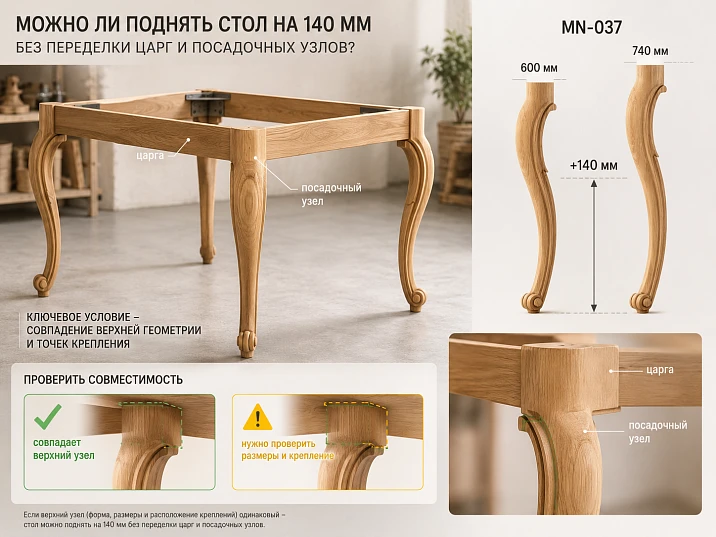
The underframe is already ready. The aprons are cut, corner joints are assembled, and the seating areas are calculated for the carved furniture leg MN-037 with a height of 600 mm. After fitting, the customer decides that the table or console turned out too low, opens the same card, and sees MN-037 with a height of 740 mm. It seems like a simple task: order four taller legs and get an extra 140 mm without interfering with the finished structure.
For MN-037, such a conclusion is dangerous.
According to the card, not only height A changes. For the 600 mm version, dimensions E×F are 57×68 mm, for the 740 mm version — 70×84 mm, and for the 900 mm — 85×102 mm. That is, MN-037 740 mm cannot be considered the same leg to which the manufacturer simply "added 140 mm from below." Along with the height, the scale of the product, the mounting volume around the aprons, and the geometry of the upper zone change.
Therefore, the main question before purchase is:
will MN-037 740 mm fit into the already manufactured corner joint of the underframe, designed for 57×68 mm, if the new leg requires 70×84 mm, and will normal rigidity, tabletop overhang, and apron position be maintained after replacement?
If the answer is confirmed by a drawing or a full-size template, switching from 600 to 740 mm may be possible without a complete rework. If the wider leg body conflicts with the apron, fasteners, or the tabletop edge, buying four new supports will not solve the problem — you will have to rework the underframe itself or choose a different model.
The most important comparison:
| Parameter | MN-037 600 mm | MN-037 740 mm | Difference |
|---|---|---|---|
| Height A | 600 мм | 740 мм | +140 mm |
| Size E | 57 мм | 70 мм | +13 mm |
| Size F | 68 мм | 84 мм | +16 mm |
This is the central table of the entire article.
In the finished underframe, the additional 13 and 16 mm may be no less important than the additional 140 mm of height. If the apron already fits the body of MN-037 600 with almost no clearance, the larger 740-millimeter version may simply not fit into the same assembly.
Before to buy a carved furniture leg MN-037, you need to do at least three things:
-
retrieve the old underframe drawing or take actual measurements;
-
apply E=70 mm and F=84 mm to it for MN-037 740;
-
check the tsargs, fasteners, tabletop overhang, and the carved transition area at a 1:1 scale.
Only after this does it make sense to pay for four new legs.
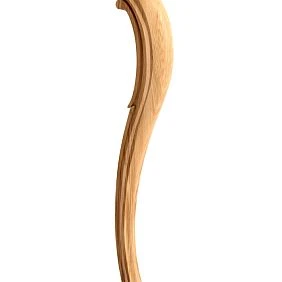
Carved furniture leg MN-037: three sizes that cannot be considered interchangeable
MN-037 has three main heights, and each has its own mounting geometry.
| Height | E | F |
|---|---|---|
| 600 мм | 57 мм | 68 мм |
| 740 мм | 70 мм | 84 мм |
| 900 мм | 85 мм | 102 мм |
The card also offers beech and oak, in "Standard" and "Prestige" quality. But material and sanding are secondary choices. First, you need to understand whether the physical size of the new leg fits the existing structure.




Wooden leg MN-037 600×57×68 mm
This is the original version of our scenario.
The following have already been manufactured for it:
-
aprons;
-
corner node;
-
position of the leg relative to the edge;
-
fasteners;
-
furniture height.
If the underframe is made tightly and without allowance, this geometry is the "frozen" part of the project.
Our factory also produces:
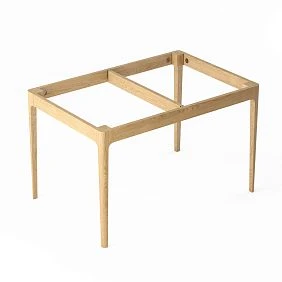
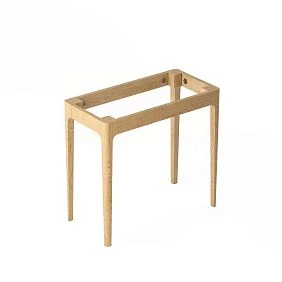
Carved furniture support MN-037 740×70×84 mm
The height increases by 140 mm.
But at the same time:
-
E increases by 13 mm;
-
F increases by 16 mm.
For the corner unit, this means the leg takes up more space in the plan.
If the 57 mm size previously determined the distance between the aprons or the offset from the edge, the new 70 mm size may change the placement of the entire structure.
Get Consultation
Table leg MN-037 900×85×102 mm
The 900-millimeter version is even larger.
Compared to 600 mm:
-
height +300 mm;
-
E: 57 → 85 mm;
-
F: 68 → 102 mm.
This is clearly a different scale.
If 740 mm can still be perceived as "almost the same leg," 900 mm shows the fallacy of that logic especially clearly.
Why the profile's massiveness increases with height
A carved leg is not a telescopic stand.
Its proportions must match the height.
Therefore, the higher version becomes more massive.
This is good for design: a long leg does not look like a thin "stick."
For modifying a finished table base, this means a mandatory compatibility check.
Buy table legs: why height A alone is not enough for order MN-037
If the user enters a query legs for a table to buy, they often filter products by height. For MN-037, this is not enough.
Height A
It defines the main vertical geometry.
But A does not describe the entire product.
Size E
This parameter is involved in the overall dimension of the leg body.
When transitioning from 600 to 740, it increases by 13 mm.
Size F
It grows from 68 to 84 mm — by 16 mm.
Geometry of the upper zone
It is the upper part that interacts with the rails and the mounting.
Therefore, even if the lower thread looks visually similar, the mounting assembly cannot be considered identical.
Connection point with the rail
The rail must come into a structurally acceptable part of the leg.
If in the new version the carved transition is positioned differently relative to the overall height, the old assembly needs to be checked against the drawing.
Main conclusion for the specification
Entry:
MN-037, 740 mm, 4 pieces
insufficient.
Need to record the full variant:
MN-037 / A=740 / E=70 / F=84 / material / quality / finish / quantity.
MN-037 600 vs MN-037 740 mm: what really changes
Let's break down not just the numbers, but the consequences.
The leg becomes taller
This is the obvious part.
If all other elements are the same, the support base rises by approximately 140 mm.
But the final surface height cannot be calculated only by A without checking the mounting diagram.
The leg becomes wider
Plus 13 and 16 mm in plan.
In the corner of the table this can:
-
reduce the internal clearance between the aprons;
-
bring the leg closer to the edge of the tabletop;
-
change the visual overhang;
-
require shifting the fasteners.
The proportions of the thread change
The taller version has a different scale.
Therefore, the line where the apron elegantly meets the 600-millimeter leg may not align with the most suitable zone for the 740-millimeter one.
The mounting volume around the apron changes.
By "mounting volume," we mean the actual space that the leg occupies within the corner joint.
This is especially important if the aprons:
-
are thick;
-
are tall;
-
fit closely;
-
are joined with a tenon;
-
have metal hardware;
-
are reinforced with corner blocks.
Ready-made apron and new wooden leg MN-037: what dimensions to check before purchasing
Need to take actual dimensions of the existing underframe.
Distance between inner planes of the aprons
Checked at each corner.
If a 600-mm MN-037 is already installed there, need to understand how much free space remains around it.
Height of the apron belt
The apron must fit into the part of the leg designed for the connection.
It cannot be automatically raised or lowered on the carved relief.
Position of the apron on the carved leg
On the 740 mm template, need to draw the actual line of the old apron.
If it hits complex threading or a narrowing, compatibility is questionable.
Mounting zone thickness
Sufficient wood is needed for fastening.
Holes cannot be transferred based on the principle of "roughly in the same place."
Corner joint
Checked:
-
tenons;
-
screws;
-
tie rods;
-
corner blocks;
-
metal plates.
Free space for fasteners
A wider leg may block previous access to tools or hardware.
This is also a real reason for rework.
Buying furniture legs MN-037 740 mm: can you keep the old stretchers
If you need buy furniture legs for an already finished underframe, there are three scenarios.
Scenario 1. The joint has sufficient margin
For example, the stretchers fit MN-037 600 with plenty of free space.
On the 70×84 mm template, the new leg still fits.
The fasteners remain in the permissible zone.
Then the transition can be done without replacing the stretchers.
But the final decision is made by the carpenter based on the actual joint.
Scenario 2. The stretcher hits the wider part of the leg
The old leg 57×68 fit normally.
The new 70×84 crosses the contour of the apron.
Then you need:
-
change the length of the aprons;
-
change the seating;
-
or abandon the 740-millimeter version.
Buying four legs without this calculation will create an expensive set that physically cannot be assembled.
Scenario 3. The attachment point changes
Even if the leg fits geometrically, the old holes may not align with the new safe zone.
You cannot simply "file it down a bit" or move the screw without a project.
Why 140 mm of additional height may require a new calculation of the table's rigidity
It cannot be claimed that MN-037 740 is weaker than MN-037 600. The card does not say that.
But the mechanics of the finished table change.
With the same lateral force, a taller structure creates a greater bending moment at the joint.
A simple model:
M = F × h
Where:
-
F — lateral force;
-
h — lever arm relative to the joint;
-
M — moment.
If the height increased from 600 to 740 mm, the lever arm for lateral load increased by approximately 23%.
740 / 600 ≈ 1,233.
This does not mean that the load on the joint automatically "becomes 23% worse" in all modes. But it shows why the stiffness needs to be rechecked.
The aprons are checked
High and rigid aprons resist rocking better.
Corner joints
The tenon, tie, or fastener must work in the new geometry.
Fastening
Old fasteners may be designed for a specific lever arm.
Table width
The larger the span, the more pronounced lateral vibrations become.
Tabletop weight
A heavy tabletop increases the inertia of the structure.
Leg placement
Overhang and distance between supports affect stability.
Therefore, after increasing the height, the right question is not "will the leg itself hold," but whether the entire table maintains rigidity.
Buy wooden furniture legs 740 mm or keep MN-037 600 and change the body
If the task is — Buy wooden furniture legs For an already manufactured product, the project has at least four paths.
Option A. Install four new MN-037 740 mm
This is the most visually attractive scenario: do not change anything in the body, just replace the supports.
It only works when:
-
E=70 mm and F=84 mm fit into the corner joint;
-
the aprons do not conflict with the carved body;
-
the fastening remains correct;
-
the tabletop overhang is acceptable;
-
the rigidity is confirmed.
If at least one point is not fulfilled, a "simple replacement" ceases to be simple.
Option B. Rework the existing underframe to fit MN-037 740
For example:
-
shorten or replace the stretchers;
-
change the corner joints;
-
relocate the fasteners;
-
change the position of the leg.
This is already a full-fledged joinery operation.
Its cost should be compared with the price of four new legs.
Option C. Keep MN-037 600 and modify the upper part of the furniture
If the customer's goal is only to raise the finished surface, sometimes it is easier to change:
-
the underframe structure;
-
The thickness of the tabletop;
-
intermediate belt;
-
another project element.
But such solutions must be structurally justified. You cannot just put a random spacer for the sake of 140 mm.
Option D. Choose a different leg model
If MN-037 740 does not fit, perhaps another support of the required height has a smaller mounting footprint.
In this case, it is useful to open the category Buy unpainted wooden legs and compare not only A, but also the dimensions of the mounting area.
Why the decision is made based on the final furniture height
The customer does not buy the leg height as an independent goal.
They need a specific height of the finished surface.
If the furniture needs to be raised by 140 mm, you first need to confirm that the 740-mm MN-037 gives the desired result in the actual construction.
How to calculate the final table height with MN-037
You cannot write:
740 mm leg = 740 mm table.
Leg height is only one component.
Simplified project formula:
H of finished surface = height of the support in the actual mounting assembly + all elements above it to the top surface of the tabletop + all elements below that actually add height.
MN-037 600 mm
If the old construction is already assembled, its actual height can be measured from the floor to the top of the tabletop.
This is the most accurate initial parameter.
MN-037 740 mm
If the mounting point and the top node remain at the same relative elevation, the surface can rise by approximately the difference A — 140 mm.
But such an assumption needs to be verified with a drawing.
Tabletop thickness
If the countertop changes at the same time, the final height changes again.
For example:
-
old countertop 20 mm;
-
new one 40 mm.
The additional 20 mm add up with the change in the support.
Actual leg seating
Some supports go into the underframe to a certain depth or have an upper part hidden by the structure.
Therefore, dimension A needs to be understood in the context of the specific MN-037 drawing.
Example of verification without invented tolerances
Old ready-made furniture:
-
from floor to surface — 650 mm.
The customer wants approximately 790 mm.
The difference is 140 mm.
Theoretically, the transition MN-037 600 → 740 looks logical.
But before ordering, E/F and fit are still checked. If the apron has to shift due to the new design, the final mark may change.
MN-037 900 mm: why the third height cannot be considered another simple step up
The card shows MN-037 900×85×102 mm.
Compared to 600 mm:
-
+300 mm in height;
-
E increases from 57 to 85 mm;
-
F — from 68 to 102 mm.
This is already a significant change in scale.
Why 900 mm is particularly good at demonstrating the principle
If MN-037 were the same leg, just stretched in height, E/F would remain unchanged.
But they grow.
This means each height is an independent geometry within one series.
Can a 900 mm be placed into a 600 mm underframe?
Only after separate verification.
The probability of direct compatibility without modification becomes even lower if the old assembly was compact.
When 900 mm might be needed
For example, for a tall console or other furniture where the design surface is significantly higher.
But that is a different object, not a way to "raise a bit more" an ordinary table.
Carved leg MN-037 made of beech or oak: the material is chosen after checking the design.
The material does not solve the problem of incompatible E/F.
If the 740-millimeter version does not fit into the old assembly, oak is no more suitable than beech.
Beech MN-037
Beech is a dense, non-porous wood.
On the STAVROS website, it is often recommended for products intended for enamel coating.
If the project will be painted with an opaque finish, beech is the natural solid wood choice.
Oak furniture leg MN-037
Oak has a pronounced texture.
It is logical for tinting and translucent coatings when the pattern must remain visible.
Why the wood species does not solve the size problem
Geometry A/E/F is determined by the MN-037 variant, not by whether beech or oak is chosen.
First:
-
compatibility;
-
Then the material.
When beech is convenient for opaque finishing
If all four legs and stretchers are painted with enamel, a beech blank for enamel may be logical.
When oak is needed for natural texture
If the legs are a visible decorative accent and the project requires natural oak.
Then you should choose the tinting option and agree on the finish.
"Standard" or "Prestige" for the carved leg MN-037
This is a supportive choice.
It does not affect the 600/740 mm compatibility issue, but it affects the amount of preparation before finishing.
"Standard"
According to the STAVROS description, this is machine preparation designed for subsequent refinement.
"Prestige"
More thorough manual finishing and higher readiness for the final coat.
Why carved relief is especially sensitive to subsequent sanding
MN-037 has a complex relief.
If the workshop can properly finish sand the carving itself, the "Standard" option may be economically reasonable.
If ready hand-finished work is not available, the extra time for four legs needs to be included in the cost.
What to choose for your own painting workshop
Need to compare:
the price difference between quality vs. hours of internal finish sanding.
If the painting shop fully prepares the product anyway, "Prestige" is not always mandatory.
If legs go straight to finishing, higher readiness can shorten the cycle.
Price of MN-037 600 and 740 mm: you need to consider not just the difference of four legs
Prices of MN-037 depend on:
-
height;
-
wood species;
-
quality;
-
current availability.
The card is updated, so you need to use the current value before ordering.
The main comparison is built on four scenarios.
Option A. Keep MN-037 600
Replacement costs are zero if existing legs are already purchased and fit.
But the furniture remains at the current height.
Option B. Buy 4×MN-037 740 + rework the aprons
Cost:
4 × current price of MN-037 740 + carpentry rework + new finishing of modified components.
This can be significantly more expensive than the difference in leg prices itself.
Option C. Buy 4×MN-037 740 without rework
The most cost-effective scenario — only if compatibility is truly confirmed.
Option D. Choose a different model
Sometimes a different item number of the required height allows preserving the underframe.
Main commercial conclusion
A taller leg may be cheaper than manufacturing new furniture, but more expensive than a 'simple replacement of four parts' if the old corner joint requires serious carpentry rework.
Buy wooden table legs: first make a full-size template MN-037 740 mm
If you need buy wooden table legs, but the underframe is already made, so a physical template is more useful than a 3D render.
Transfer E=70 mm
Onto cardboard, plywood, or thick paper.
Transfer F=84 mm
The outline of the new leg in plan is obtained.
Mark the aprons
The template is placed in the actual corner of the underframe.
Mark the tabletop edge
The new visual and actual offset is checked.
Check the corner joint
They check:
-
intersection with the rails;
-
hardware;
-
tool access;
-
overhang.
Only after this pay for the four legs
Such a test may take less time than returning an unsuitable set.
What to ask the carpenter to check before replacing MN-037 600 with 740
A simple table is useful.
| Node | MN-037 600 | MN-037 740 | Does it fit? |
|---|---|---|---|
| A | 600 | 740 | — |
| E | 57 | 70 | Yes/No |
| F | 68 | 84 | Yes/No |
| Apron | existing project | existing project | Check |
| Fastening | existing | existing/new | Check |
| Tabletop edge | current overhang | new overhang | Check |
| Corner block | actual | actual | Check |
| Tool access | Present | ? | Check |
What wording does the carpenter need
Not:
"Can the leg be placed higher?"
But:
"Instead of MN-037 600×57×68, install MN-037 740×70×84. Check existing aprons, fasteners, overhang, and joint position."
This is a subject-specific task.
FUR-021 or FUR-027 foot: add after selecting MN-037 height
The MN-037 card recommends FUR-021 and FUR-027.
The foot is final hardware, not a tool for resolving incompatibility.
FUR-021
The current card shows dimensions of 19×19×5 mm.
This is a round foot from the SUPER GLIDE series, supplied with a universal screw 3.5×20 mm.
It is designed for easier furniture movement and floor protection.
FUR-027
Felt foot d=24 mm.
The available card specifies approximate dimensions of 25×25×5 mm and a complete screw 3.5×20 mm.
It is designed for soft contact with the floor.
Why four legs are equipped with one type of foot
So that all support points have the same effective height and behavior.
Why the foot cannot be used to compensate for a 140 mm difference
5 mm of hardware and 140 mm of height difference are different tasks.
The foot is selected after solving MN-037 600 or 740.
If FUR-021 is needed, you can Buy FUR-021 base plate.
For the felt version — buy felt glide FUR-027.
Buy table legs: check the MN-037 offset from the outer edge
If you need buy legs for the tabletop, it is important to check not only the inner corner joint, but also the appearance.
A wider leg can reduce the visual offset
Suppose the old leg left 35 mm from the outer edge of the tabletop.
If the new geometry grows toward the edge, this offset may decrease.
The exact result depends on the orientation of E/F.
Edge of the apron
The apron may be too close to the face of the carving.
Tabletop overhang
The overhang is an important part of the proportion of a classic table.
Too small makes the construction heavy.
What will change with a larger E/F
It cannot be calculated universally without a drawing.
A new contour needs to be applied to the top view plan.
Full-size template MN-037 740: how to make it useful
The template should show not just a 70×84 rectangle.
It is better to transfer the entire top contour from the card or drawing, if available.
Top view
For aprons.
Side view
For the belt height.
Front view
For the visual overhang.
Why three views are better than one
A leg may pass on the plan but conflict with the apron height.
And vice versa.
Scenario 1. The old underframe has a large margin
Let's imagine:
-
aprons are installed with a noticeable offset;
-
compact fastener;
-
large tabletop overhang.
Template 70×84 fits.
The apron line comes into the straight mounting part.
In this case, the transition can be simple.
Scenario 2. The apron fits into a groove or tenon of the old leg
If the joint is specially made for MN-037 600, the new geometry almost certainly requires a new tenon or a new apron.
This does not mean impossibility.
But "replacement without rework" is no longer performed.
Scenario 3. Metal corner plate
The plate could have holes for a specific width.
A new leg may allow different fasteners, but the old plate cannot be considered automatically compatible.
Scenario 4. The leg moves closer to the edge of the tabletop
It technically fits, but visually the overhang decreases.
If the table is classic and the carved leg is massive, this can ruin the proportion.
Then the carpenter may shift the leg inward, and this already affects the apron.
Scenario 5. The tabletop is very heavy
Changing the height increases the rigidity requirements for the entire underframe.
You cannot transfer the conclusion 'the leg card withstands vertical load' to the stability of the entire furniture against lateral forces.
Scenario 6. This is not a table, but a console
The console may have a different depth and a different ratio of supports.
MN-037 740 may visually and structurally work differently.
Therefore, the check is performed specifically on the console project.
Scenario 7. The client wants 740 only for the design
If the current height is convenient, but the tall leg seems more beautiful, the transition should be assessed as a furniture redesign.
This is not a height repair.
Scenario 8. The client wants to raise the table by exactly 140 mm
Then MN-037 740 looks logical only if the other vertical dimensions are preserved.
If the structure changes, the actual result needs to be measured after design.
When the new leg may require shortening the apron
If the width E/F grows inward into the corner joint.
The exact shortening size cannot be assigned from a single table.
A drawing is needed.
When the side rail can be preserved
If its length and fit have margin and do not conflict with the new contour.
Why material cannot be removed from MN-037 itself for the sake of the old side rail
This is carved finished geometry.
Unauthorized trimming may:
-
damage the thread;
-
reduce the cross-section;
-
Change view;
-
change the fastening.
Any modification must be approved separately.
Why the drawer rail cannot be sunk deeper into the thread
The drawer rail must rest on a structurally suitable part.
The carved relief is not random excess material.
How to check all four corners, not just one
The finished underframe may have slight differences after assembly.
Therefore, the template must be applied to all four corners.
If one passes and another does not, the solution is still not ready.
How to check the diagonals after rework
If the aprons are changed, check the diagonals of the underframe after assembly.
This is basic joinery acceptance.
How not to lose symmetry of carved legs
All four supports must have the same orientation of the pattern.
Before fastening, it is useful to mark:
-
FL;
-
FR;
-
RL;
-
RR.
When MN-037 740 mm is NOT yet needed to buy instead of 600 mm
Do not buy if:
-
the underframe drawing is lost and dimensions are not taken;
-
E/F of the new version are not marked;
-
the aprons fit the old leg almost flush;
-
the apron line on the 740-millimeter version is unknown;
-
fastener not checked;
-
the tabletop is still changing;
-
final height not approved;
-
stiffness not checked;
-
customer proceeds only from "plus 140 mm".
When carved wooden legs MN-037 740 mm can already be ordered
The order is ready if:
-
final furniture height approved;
-
drawing MN-037 740 checked;
-
E=70 and F=84 applied to the project;
-
each of the four corners checked with a template;
-
aprons fit;
-
fastening unit confirmed;
-
lateral rigidity checked;
-
the tabletop overhang is acceptable;
-
beech or oak is selected;
-
quality "Standard" or "Prestige" selected;
-
finish preparation type selected;
-
glides selected;
-
price and availability rechecked.
How to place an order for MN-037
Example:
MN-037 / A=740 mm / E=70 mm / F=84 mm / beech / Prestige / for enamel / 4 pcs. / FUR-021 / underframe checked against template.
Or:
MN-037 / A=740 mm / E=70 mm / F=84 mm / oak / Prestige / for tinting / 4 pcs. / FUR-027 / compatibility confirmed by carpenter.
After checking, you can order wooden legs MN-037 740 mm.
To choose the material, it is useful to open Materials and quality of wooden legs.
Before payment — delivery conditions for furniture legs.
Practical calculation: how much the occupied rectangle E×F increases
For MN-037 with 600 mm, the conditional rectangle by dimensions E×F:
57 × 68 = 3876 mm².
For the 740 mm version:
70 × 84 = 5880 mm².
The difference:
5880 − 3876 = 2004 mm².
Relative to the 600 mm version:
2004 / 3876 ≈ 51,7%.
This does not mean that the actual support area or contact area with the side rails increases by exactly 51.7%: E×F are overall dimensions, not necessarily a solid rectangular area of the product.
But the calculation clearly shows the scale of the change.
The new version occupies a significantly larger overall rectangle in plan.
That is why compatibility cannot be assessed only by the 140 mm increase.
How much does each dimension increase relative to the old leg
Size E
70 − 57 = 13 mm.
In percentages:
13 / 57 ≈ 22,8%.
Size F
84 − 68 = 16 mm.
In percentages:
16 / 68 ≈ 23,5%.
Both horizontal parameters increase by about a quarter.
This is no longer a minor technical deviation.
What happens if the leg is centered relative to the old mounting point
Suppose the MN-037 600 was centered in the corner, and the new support should also remain on the same axis.
Then the increase may be distributed roughly on both sides of the axis.
Along E:
13 / 2 = 6.5 mm in each direction.
Along F:
16 / 2 = 8 mm in each direction.
This is a conditional geometric model, not a guaranteed actual profile shift.
But it is useful for a first check.
If the old gap between the leg and the apron was, for example, 5 mm, the new version no longer fits with such centering.
If the margin was 15–20 mm, the likelihood of compatibility is higher.
Why even 6–8 mm can be critical
In a furniture corner joint, there may be:
-
tenon;
-
dowels;
-
screws;
-
screed;
-
metal bracket;
-
decorative groove;
-
glue seam.
Therefore, a few millimeters are not always just "cosmetic."
Especially if the structure is made precisely for the old SKU.
How to measure an existing joint without disassembling the entire underframe
If the old MN-037 is not yet installed, the task is simpler.
If it is already in place, you can take measurements on site.
1. Measure the distance from the outer edge of the leg to the inner plane of the apron
In two directions.
2. Measure the position of the fasteners
Where are the screws or ties relative to the center of the leg.
3. Measure the overhang of the tabletop
From the outer edge of the support to the edge of the tabletop.
4. Measure the height of the apron
And the mark of its lower/upper edge on the leg.
5. Photograph the joint with a scale ruler
This is useful if another carpenter will do the check.
If the old MN-037 600 is already installed and glued
Replacement becomes more complicated.
Need to consider:
-
the connection method;
-
possibility of disassembly without damaging the apron;
-
condition of the old glue joint;
-
preservation of the finish;
-
need for reassembly.
In this scenario, the cost of new legs may be less than the cost of careful disassembly.
If the underframe is only glued but not yet painted
This is the best time to change the design.
While the finish has not been applied, reworking the aprons is usually cheaper than after painting.
If the 740-millimeter MN-037 is fundamentally needed, the decision should be made now.
If the underframe is already fully painted
Any rework may require:
-
local sanding;
-
puttying;
-
re-priming;
-
touch-up painting;
-
sometimes a full repaint of the visible part.
These costs need to be added to the comparison.
How to calculate the rework budget for MN-037 740
A convenient formula:
C transition = 4×C leg 740 + dismantling + new/reworked crossbars + fasteners + carpentry work + finish + hardware + logistics.
If old MN-037 600 are already purchased, additionally account for:
-
Can they be returned;
-
Use in another product;
-
Sell;
-
Keep as warehouse stock.
Scenario: old legs not yet purchased, but table base already manufactured
This is an important difference.
If MN-037 600 is physically not yet available, there is no financial loss on the old set.
Then the decision comes down to:
Cost of reworking the table base vs. benefit of the required height 740.
Scenario: four MN-037 600 already purchased
Then switching to 740 creates two sets.
Need to understand the fate of the old one.
If they can be used on other furniture, the loss is smaller.
If not, it's part of the cost of the solution.
Scenario: need to raise the table not by 140, but only by 80 mm
MN-037 740 may be excessive.
You cannot choose the nearest standard height just because it's in the card.
Need to check other models or change the project.
Scenario: the client wants a higher surface because of the chairs
Then the actual seating is checked.
First, a mock-up of the new table height is made.
If +140 mm makes the seating uncomfortable, the entire rework loses its meaning.
Scenario: the console should become visually higher, but not functionally.
One can consider changing the base, the top part, or the proportions of another element.
This is a design task, not a mandatory replacement of MN-037.
How to check the final height with a mockup before purchasing
The existing underframe is used.
Under it, rigid safe blocks with a total height of 140 mm are temporarily placed only for visual verification, not for operation or stability assessment.
This way the client sees:
-
the future mark;
-
the proportion of the tabletop;
-
connection with chairs;
-
height relative to the windowsill and furniture.
After that, the structure is still recalculated.
Why the visual mockup does not confirm the structure
The lining shows only the height.
She does not show:
-
new E/F;
-
actual rigidity;
-
fasteners;
-
aprons;
-
overhang.
Therefore, the mockup is one of the stages, not the final check.
If the table has additional crossbars
Then replacing the legs is especially difficult.
The height position of the legs is related to the supports.
MN-037 740 may require a new node not only at the top, but also at the bottom.
If the underframe has no crossbars
Then the current article partially changes the intent.
Need to check mounting plates and top geometry, not the crossbar connection.
If the underframe uses a metal frame
E/F are still important.
Metal may have rigid fixed attachment points.
Switching to a larger leg is sometimes easier, sometimes more difficult.
Why four legs should be the same height and the same version
Cannot mix:
-
two 600;
-
two 740.
Even temporarily for operation.
This creates different heights and loads.
Can adjustable leveling feet be used for fine compensation
Only within the scope of the specific hardware's task and after compatibility checks.
But the adjustment element does not turn 600 mm into 740 mm.
How to choose FUR-021 and FUR-027 by floor
FUR-021 has a SUPER GLIDE sliding coating.
FUR-027 — felt working part.
If furniture must be moved regularly, one logic applies.
If soft contact and silence matter, another one.
The final choice depends on the floor and usage scenario.
Why you shouldn't put different glides on the same piece of furniture
Even if their nominal height is the same, the contact material differs.
Furniture may behave differently when sliding.
For four supports, one type is better.
Furniture leg hardware: what to order together
If project MN-037 740 is approved, you can check Furniture leg hardware.
But you shouldn't add hardware to the cart before the final SKU of the leg is selected.
How to calculate four sets of glides
If the table has four MN-037:
-
you need four FUR-021;
-
or four FUR-027.
Plus, a reasonable spare of small hardware can be determined separately if the project requires it.
Why the glide also needs to be considered in the final height
Both considered options have a thickness of about 5 mm.
The actual addition depends on the installation.
You cannot automatically add the full 5 mm without understanding the joint.
Errors when replacing MN-037 600 with 740 mm
Error 1. Assuming that only A changes
Reason: the height is visible first in the card.
Consequence: the leg does not fit between the crossbars.
How to prevent: check E/F.
Error 2. Ordering four 740 mm before fitting
Reason: one article number seems to guarantee compatibility.
Consequence: expensive rework after delivery.
How to prevent: template.
Error 3. Checking only one corner
Reason: the underframe seems symmetrical.
Consequence: there is an assembly conflict in the other corner.
How to prevent: four checks.
Mistake 4. Use old mounting holes automatically
Reason: want to avoid carpentry work.
Consequence: the fastener ends up in an unsuitable area.
How to prevent: new drawing of the assembly.
Mistake 5. File down the carved part
Reason: a few millimeters are missing.
Consequence: the profile and cross-section get damaged.
How to prevent: redo the project, not the decor.
Mistake 6. Ignoring rigidity
Reason: the vertical load on the leg seems sufficient.
Consequence: the tall table wobbles.
How to prevent: check the entire frame.
Mistake 7. Considering the final height only as A
Reason: simplified arithmetic.
Consequence: the surface ends up at the wrong level.
How to prevent: calculate the entire structure.
Mistake 8. Choosing oak before checking geometry
Reason: the material is liked.
Consequence: the expensive set doesn't fit.
How to prevent: compatibility → material.
Error 9. Buying "Prestige" without assessing your workshop
Reason: a higher category seems mandatory.
Consequence: overpaying when you have your own final polishing.
How to prevent: compare labor.
Error 10. Compensating 140 mm with a support plate
Reason: mixing hardware and support size.
Consequence: a technically meaningless solution.
How to prevent: choose the correct leg height.
Error 11. Not checking the countertop overhang
Reason: they only look inside the under-table area.
Consequence: the new leg visually appears too close to the edge.
How to prevent: top view.
Error 12. Not accounting for finishing after rework
Reason: the estimate only counts the wood.
Consequence: the budget unexpectedly grows.
How to prevent: include the finish.
When it's better to keep MN-037 600 mm
if:
-
the current height is functionally acceptable;
-
The rework is complex;
-
E/F 740 conflict;
-
Rigidity requires a new frame;
-
The client is not ready to change the side rails.
Then keeping 600 mm may be the most reasonable solution.
When the transition to 740 mm is justified
if:
-
140 mm are really needed;
-
The new geometry fits;
-
Fasteners are confirmed;
-
Rigidity is preserved;
-
visual proportion is better;
-
the cost of rework is acceptable.
When it's better to choose a different model
If a height of about 740 mm is needed, but E/F MN-037 are too large for the old underframe.
Then the table leg category allows searching for a more compact model.
Solution control chart
| Question | Answer |
|---|---|
| Is a height of +140 mm really needed? | Yes/No |
| Does E=70 fit? | Yes/No |
| Does F=84 fit? | Yes/No |
| Are the aprons preserved? | Yes/No |
| Is the fastener preserved? | Yes/No |
| Is the overhang acceptable? | Yes/No |
| Is the rigidity confirmed? | Yes/No |
| Is the finish rework accounted for? | Yes/No |
| Is the material selected? | Yes/No |
| Is the quality selected? | Yes/No |
| Are the foot pads selected? | Yes/No |
If there is a "no" in critical rows, do not order four MN-037 740 yet.
Comparison of MN-037 600, 740, and 900 mm in one project table
To avoid returning to the card during each discussion, it is useful to transfer the base dimensions to the working sheet.
| Option | A, mm | E, mm | F, mm | Change E to 600 | Change F to 600 |
|---|---|---|---|---|---|
| MN-037 600 | 600 | 57 | 68 | — | — |
| MN-037 740 | 740 | 70 | 84 | +13 | +16 |
| MN-037 900 | 900 | 85 | 102 | +28 | +34 |
This table shows that the series develops in three dimensions at once.
600 → 740
Height +23.3%.
E +22,8%.
F +23,5%.
That is, the scale increases quite consistently.
600 → 900
Height +50%.
E +49,1%.
F +50%.
This further confirms: the sizes of the series grow proportionally, rather than remaining the same.
Why proportional growth makes replacement visually logical but technically complex
From a design perspective, this is a plus.
The tall leg preserves massiveness and classic proportion.
From the perspective of the finished underframe, it is a minus for interchangeability.
The more proportionally the body grows, the less reason there is to expect that the old node will fit without changes.
How to determine that the old underframe was "dimensionally tied" specifically to MN-037 600
There are several signs.
The stretchers are cut to size without adjustable connections
This means the internal geometry is rigid.
The leg has a prepared tenon or groove
This means a different dimension will require a new connection.
The corner boss fits almost flush
There is no margin.
The tabletop overhang is minimal
A new, wider leg will change the appearance.
Fasteners were drilled in place
Old holes are not a universal template.
The more such signs, the lower the probability of a "simple replacement."
How to determine if an underframe has a chance to accept MN-037 740 without modifying the aprons
Reverse signs:
-
aprons have length allowance;
-
fasteners are adjustable;
-
there is free space between the leg and the internal assembly;
-
tabletop overhang is large;
-
the upper zone of the 740-millimeter version coincides with the working zone of the apron;
-
the carpenter confirmed the geometry.
Only the combination of these factors gives reason to buy the kit.
Decision tree: MN-037 600 keep or switch to 740
Question 1. Is a new height really needed
If not — keep the 600.
If yes — move on.
Question 2. Does the 740 fit by E/F
If not — new model or rework.
If yes — continue.
Question 3. Does the working area of the tsarga match
If not — rework.
If yes — continue.
Question 4. Is the fastener suitable
If not — a new node.
If yes — continue.
Question 5. Is rigidity maintained
If not — reinforcement or a new structure.
If yes — continue.
Question 6. Is the external overhang acceptable
If not — shift the legs and recalculate the stretchers.
If yes — MN-037 740 can be considered as a direct replacement.
Cost of the solution: how to prepare an estimate without outdated prices
Prices for MN-037 on the website vary depending on the option and availability.
Therefore, for the article it is better to use a formula.
Old scheme
C600 = 4 × current price of selected MN-037 600.
New scheme without modification
C740 = 4 × current price of selected MN-037 740 + thrust bearings + delivery.
New scheme with modification
C740-mod = C740 + carpenter's work + materials for crossbars + fasteners + refinishing.
Full replacement of underframe
Cnew = new legs + new crossbars + fasteners + assembly + finishing.
After this, the comparison becomes substantive.
Why the price of one leg does not determine the economics
Let's say the 740-millimeter version is several thousand rubles more expensive than the 600.
On four supports, the difference increases fourfold.
But if modifying the side rails costs even more, that becomes the main factor.
Conversely, if the component is compatible without modification, the price of four legs accounts for almost the entire transition budget.
How to account for the cost of old MN-037 600
If they are already purchased:
Can be returned
A return is accounted for according to the seller's terms.
Can be used in another project
Then it's not a complete loss.
Will remain unclaimed
Then their purchase cost is attributed to the error of the initial decision.
This is important for the real economy.
How to use category queries without over-spamming
A buyer who wants Buy wooden furniture legs, must understand that MN-037 is one of the options.
If exactly 740×70×84 is not suitable, the category is needed to search for another SKU.
If only MN-037 is needed, there is no need to repeat the link to the card in each section.
"Standard" and "Prestige": how to estimate the cost of preparation on four legs
Suppose a craftsman spends 45 minutes on final sanding of one carved leg.
For four:
3 hours.
If the master's internal rate is X ₽/hour:
C preparation = 3X.
We compare it with the price difference between "Standard" and "Prestige".
This is a universal production model.
You don't need to automatically assume the cheaper leg is more profitable.
When "Prestige" is especially logical
if:
-
expensive finish;
-
thread will be tinted;
-
the workshop doesn't specialize in manual final sanding;
-
The deadline is short.
When "Standard" is rational
if:
-
there is a dedicated sanding section;
-
the legs still undergo full preparation;
-
the workshop can work with carved decor;
-
the price difference exceeds the cost of labor.
Under enamel or under tinting: how not to confuse when ordering
For opaque enamel, the appropriate category of blank is selected.
For semi-transparent finish — under tinting.
This is especially important for oak.
Why a mistake is costly
If you order a blank for enamel and then decide to leave a transparent finish, the contrast of the lamellas may not meet expectations.
How to check the color of four oak MN-037
Before installation, place the legs side by side under the same lighting.
If one differs sharply, it is better to decide on matching before finishing.
How to check the thread before painting
Inspect under side light.
This makes the following more visible:
-
nap;
-
processing marks;
-
minor preparation defects.
Why MN-037 cannot be evaluated only by the load of "100 kg per leg"
The STAVROS website FAQ states that furniture legs withstand a vertical load of at least 100 kg.
This is a characteristic of vertical load.
It does not automatically mean that any tall table with four MN-037 legs will be perfectly rigid.
Lateral stability depends on the entire underframe.
Example of the difference between vertical load and rocking
A table can easily withstand a large weight on top, but have play when pushed sideways.
The reason is the connections and crossbars.
Therefore, vertical load capacity and spatial rigidity are different tests.
What to do if the table wobbles slightly after assembly
First, determine the cause:
-
uneven floor;
-
different heights of the support feet;
-
loose fasteners;
-
skewed underframe;
-
insufficient rigidity.
Do not try to fix everything by replacing the support foot.
How to check the floor before the final choice of FUR-021/FUR-027
Place the furniture in the working position.
If the floor:
-
parquet;
-
tile;
-
stone;
-
laminate;
the movement scenario differs.
Felt and a sliding glider solve different tasks.
Why the glider should be installed after finishing the leg
This way it's easier not to damage it during painting and sanding.
The specific technology is determined by the workshop.
Can MN-037 740 be ordered as a single piece
The product card and STAVROS general policy indicate delivery from 1 piece for many items.
But the availability of the specific MN-037 and the chosen version needs to be checked before ordering.
If one test leg saves the risk of four, it may be reasonable.
How to use a test leg
Not just "place it next to it".
You need to:
-
insert into a real corner joint;
-
check the aprons;
-
check the fasteners;
-
check the overhang;
-
do a temporary assembly without irreversible operations;
-
only then order the rest.
What to do if one test leg fits, but the other corners differ
Check each corner with a template.
Do not assume absolute identity of manual assembly of the under-table.
How to transfer data to STAVROS manager
Do not send only a photo of the table.
Better to specify:
-
MN-037;
-
740 mm;
-
E=70;
-
F=84;
-
material;
-
quality;
-
finishing;
-
quantity;
-
question about drawing/3D;
-
need for FUR-021 or FUR-027.
What to pass to the designer
-
final height;
-
overhang;
-
leg scale;
-
material;
-
finish;
-
photo of the mockup.
What to pass to the carpenter
-
existing node;
-
drawing 600;
-
drawing 740;
-
dimensions E/F;
-
fasteners;
-
final height;
-
stiffness requirements.
Control specification before payment
| Field | Value |
|---|---|
| Article number | MN-037 |
| Height A | 740 мм |
| E | 70 мм |
| F | 84 мм |
| Material | Beech / Oak |
| Quality | Standard / Prestige |
| Re-gluing | For enamel / for tinting |
| Quantity | 4 |
| Thrust bearing | FUR-021 / FUR-027 |
| Aprons | Checked |
| Fastening | Checked |
| Overhang | Checked |
| Rigidity | Confirmed |
| Final height | ___ mm |
| Price | Checked before payment |
FAQ
What dimensions does MN-037 have?
The plan and card consider options 600×57×68, 740×70×84, and 900×85×102 mm for parameters A/E/F.
How does MN-037 600 differ from 740 mm?
Not only in height. E increases from 57 to 70 mm, F — from 68 to 84 mm.
Does the leg width change when the height increases?
Yes, dimensions E/F increase.
Can MN-037 600 be replaced with 740 without reworking the table?
Sometimes yes, if the new contour fits, and the aprons and fasteners are compatible. But this needs to be checked on site.
What is the size E of MN-037 740?
70 mm.
What is the size F of MN-037 740?
84 mm.
What is the geometry of MN-037 900?
A=900 mm, E=85 mm, F=102 mm.
Is MN-037 suitable for a table?
The card and category classify MN-037 as furniture legs for tables.
What to choose — beech or oak?
Beech is more logical under enamel, oak — when a pronounced natural texture is needed under a translucent finish.
How does 'Standard' differ from 'Prestige'?
The difference is in the degree of sanding preparation: "Prestige" has more thorough manual finishing.
How to calculate the final table height?
Consider the entire vertical structure: the leg in the actual assembly, the under-table, the tabletop, and the actual addition of lower hardware.
Which floor glides are suitable for MN-037?
The card recommends FUR-021 and FUR-027.
What to choose — FUR-021 or FUR-027?
FUR-021 — sliding version SUPER GLIDE, FUR-027 — felt. The choice depends on the gender and movement scenario.
How many MN-037 to order for a regular four-legged table?
If the structure is indeed designed for four identical legs — four. But the quantity is determined by the project.
Where can I buy wooden table legs?
In the STAVROS table legs category, if a specific model has not been selected yet.
Where to buy MN-037?
In the MN-037 product card.
How to order MN-037 740 mm?
Select 740 mm, material, quality, finish, quantity, and check availability before payment.
How to check the current price?
Directly in the product card. Prices may change.
Can old crossbars from MN-037 600 be used?
Only if the dimensions and working area are compatible with the 70×84 mm of the new leg.
Do the aprons need to be replaced if the new leg is only 13–16 mm wider?
Possibly. Even a few millimeters can be critical in a tight corner joint.
Can the MN-037 740 be trimmed to fit the old apron?
This should not be done automatically. Modifying a carved leg requires a separate structural solution.
Why might the 740 mm version rock more?
It cannot be claimed that the leg itself is weaker. But taller furniture has a greater lever arm for lateral load, so the entire frame needs to be checked.
Is it necessary to buy one leg for testing?
This can be useful if order and delivery conditions make such a test rational. But a single leg is used only to check geometry, not full rigidity.
Can different glides be installed on the four legs?
It's better to use one type for all supports.
How much does FUR-021 add to the height?
The height dimension is 5 mm, but the actual addition depends on the installation method. Don't automatically add the full 5 mm without checking the joint.
Can MN-037 600 be raised to 740 with a spacer?
This is a separate structural modification and is not equivalent to the standard MN-037 740. Without calculation, this method cannot be recommended.
What to do if 740 mm doesn't fit?
Look for another model of the required height or modify the underframe.
Is MN-037 900 compatible with the underframe from 600?
Don't automatically consider it compatible: E/F is even larger.
How to understand that the tabletop overhang will become too small?
Apply the 70×84 contour on the top view and measure the distance to the outer edge.
How to quickly check four corners?
Make one rigid template and sequentially apply it to all corners.
Do I need to save the drawing after rework?
Yes. It will be useful for repairs and re-manufacturing.
Final algorithm before transitioning from MN-037 600 to 740 mm
-
Record the desired height of the finished furniture.
-
Raise the drawing of the existing underframe.
-
Record old A=600, E=57, F=68.
-
Apply new A=740, E=70, F=84.
-
Make a top view and template.
-
Check all four corners.
-
Check the stretcher line by height.
-
Check the fasteners.
-
Check the tabletop overhang.
-
Check lateral rigidity.
-
Make a visual mockup +140 mm.
-
Choose the material.
-
Select "Standard" or "Prestige".
-
Choose for enamel or for tinting.
-
Choose one type of foot pad.
-
Calculate the full cost of rework.
-
Compare with the 600 mm option and the alternative model.
-
Check current price and availability.
-
Prepare the specification.
-
Only then order four supports.
Conclusion
Switching from MN-037 600 to MN-037 740 mm cannot be considered a simple replacement of four parts.
Yes, the height increases by exactly 140 mm in parameter A. But the overall geometry changes at the same time:
57×68 mm → 70×84 mm.
This is approximately +23% for each of the two dimensions E/F.
Therefore, the old aprons, fasteners, and tabletop overhang must be re-checked.
If the 70×84 mm template fits freely into each corner joint, the apron line aligns with the working part of the leg, the fasteners remain correct, and the carpenter confirms rigidity, MN-037 740 may be a real replacement without major rework.
If the new leg hits the apron, comes too close to the edge, requires moving the fasteners, or changes the structural joint area, there is no need to buy four supports before reworking the underframe.
The material — beech or oak — is chosen only after compatibility. "Standard" or "Prestige" — after assessing one's own preparation. FUR-021 or FUR-027 — after the final choice of legs and floor.
The main practical check before purchase takes minimal resources: a full-size template of the new MN-037 740 and the existing underframe.
After E=70 and F=84 are confirmed on a real joint, one can to buy a carved furniture leg MN-037 already as a compatible part of the project, not as "the same leg, only 140 mm higher."
Control matrix "replacement without rework / partial rework / new project"
To ensure the decision does not depend on the carpenter's overall impression, it is useful to classify the check result.
| Check | Replacement without rework | Partial rework | New joint project |
|---|---|---|---|
| E=70 and F=84 fit | Yes | yes, with correction | No |
| Tsargs approach the work area | Yes | trimming/replacement required | No |
| old fasteners are retained | Yes | new fasteners | unit is replaced |
| countertop overhang is acceptable | Yes | shift required | No |
| rigidity confirmed | Yes | reinforcement needed | No |
| The finish does not suffer | Yes | local rework | complete rework |
If all critical lines are in the first column, buying four MN-037 740 looks like a real replacement.
If several lines go into the second column, you first need to get a carpentry estimate.
If the main geometry goes into the third column, it is more correct to calculate a new under-table assembly or a different leg model.
How to determine the cost of a mistake before purchasing
The risk can be expressed with a simple formula:
Cost of mistake = price of four unsuitable legs + delivery + return/transport + lost time + possible rework of the already finished under-table assembly.
A template and CAD check cost incomparably less.
Therefore, for MN-037 740, the preliminary E/F check is not an "unnecessary over-caution" but part of the commercial calculation.
Why the same height of 740 mm in another model might turn out to be simpler
The category of table legs includes different designs.
Two legs of the same height can have completely different top dimensions.
If MN-037 740 does not fit due to 70×84 mm, another model with a height of about 740 mm may have a more compact mounting area.
This does not make it better overall. It simply fits better with the already prepared table base.
What counts as a successful check of one test MN-037 740
The test is considered passed if the leg:
-
physically fits into the assembly without force;
-
does not require removing material from the carved body;
-
allows maintaining a structurally correct connection;
-
does not conflict with the fasteners;
-
has a normal overhang;
-
provides the required height mark;
-
visually matches the tabletop and aprons.
If the test leg "almost fits" and requires sawing off a few millimeters in a random place, the check is not passed.
What to record after a successful fitting
To ensure the other three legs are installed identically, you need to record:
-
distance from the outer edge of the tabletop;
-
position of the leg relative to the aprons;
-
fastener height;
-
type of fastener;
-
orientation of the carved pattern;
-
position of the foot plate.
Thus, the first fitting turns into an installation template for the entire set of four.
If the transition to 740 mm is canceled
This is also a normal result for the article.
The check may show that:
-
600 mm is structurally ideal;
-
740 mm requires too expensive rework;
-
the required height is better achieved with a different model;
-
or the very idea of raising the furniture by 140 mm worsens the proportions.
In that case, refusing to purchase MN-037 740 saves more money than trying to use the liked SKU at any cost.
Final order check before payment
Before placing an order, one short sequence is enough:
MN-037 740 → 70×84 mm → four under-table corners → aprons → fasteners → rigidity → overhang → material → quality → hardware → price.
If the chain is fully completed, the order is ready.
If the check stops at geometry, it is too early to move on to choosing oak, "Prestige", and the foot pad.
Production conclusion for the workshop
If MN-037 740 is planned to be used not just once but in a series of furniture, the results of the first check are worth saving as an internal standard. It is useful to record the drawing of the corner joint, apron dimensions, fastener position, actual overhang, and selected hardware. Then the next console or table with the same support will not require a repeated search for compatibility from scratch.
For a one-off project, such a package seems excessive. For a workshop, it turns a successful modification into a repeatable solution and reduces the risk that another employee will again perceive MN-037 600 and 740 as fully interchangeable parts of the same size.
It is especially useful to keep two templates nearby — 57×68 and 70×84 mm. They immediately show the client and the carpenter why the difference between the options is not only in height.