Article Contents:
- Table wobbles: in which case an adjustable furniture foot will help
- Quick test without disassembling furniture
- A shim helps determine the cause but should not remain the solution
- When a furniture foot will not eliminate wobbling
- Why platform tilt matters on uneven floors
- The joint does not compensate for an incorrectly drilled hole
- What questions to ask about the drawing
- Signs of uneven floor or different support heights
- Signs of loose fastening
- Signs of body misalignment
- Dining table
- Coffee Table
- Cabinet
- Console
- Small cabinet
- Separate wooden leg
- Diameter match does not prove compatibility
- A ball joint does not make the support safer for a ladder
- Height adjustment on a stepladder changes the geometry
- Safe conclusion for the buyer
- Outer dimension of the end face
- Wood thickness around the hole
- Available depth
- Position of existing fasteners
- Floor level difference
- Floor material
- Why you shouldn't buy a bushing 'by eye'
- Why direct screwing into wood isn't always suitable
- Mounting plate as a separate scenario
- Small height difference
- Large height difference
- Adjusting all supports
- What to include in the mass
- Why you can't divide only the empty mass
- Do you need to install support feet on all legs
- Is a reserve needed
- FUR-019 or FUR-029
- FUR-019 or FUR-018
- FUR-019 or FUR-030
- When D25 is more convenient than D32
- When D32 may be preferable
- Find the geometric center
- Check the internal structure
- Use a depth stop
- Test on a sample
- Do not drill after finishing without protection
- Do not install the foot into a crack
- Why you can't adjust one leg indefinitely
- Levelness and absence of wobbling are not the same thing
- The table wobbles only in one spot in the room
- The table wobbles anywhere
- After moving, a different diagonal wobbles
- The cabinet stands next to the wall
- The console is attached to the wall
- The wardrobe has six supports
- The furniture stands on a carpet
- The furniture stands on parquet
- The table is used in a cafe
- The furniture has slanted legs
- With felt pad
- With nail-in glider
- With caster wheel
- With plastic pipe cap
- With leg for kitchen module
- With ladder support
- Mistake 1. Buying FUR-019 based on the word D25
- Mistake 2. Assuming 25 mm is the actual diameter
- Mistake 3. Not measuring the leg end
- Mistake 4. Not checking the drilling depth
- Mistake 5. Inventing the thread
- Mistake 6. Buying the bushing before receiving the drawing
- Mistake 7. Not clarifying the configuration
- Mistake 8. Not checking the adjustment range
- Mistake 10. Not checking the load
- Mistake 10. Not checking the load
- Error 11. Calculate load on an empty cabinet
- Error 12. Install a support pad on a cracked end
- Error 13. Drill close to the edge
- Error 14. Make a hole at an angle
- Error 15. Install one support pad without assessing the other legs
- Error 16. Lift only one corner of the cabinet
- Error 17. Not check the level
- Error 18. Not tighten the leg attachment
- Error 19. Place furniture on a dirty floor
- Error 20. Promise parquet protection
- Error 21. Use FUR-019 on a stepladder
- Error 22. Consider the hinge a sign of ladder safety
- Error 23. Choose alternative D32 only by larger diameter
- Error 24. Not order a sample for the series
- Error 25. Drill the entire batch using an unverified template
- Error 26. Install hardware after painting without protection
- Error 27. Not account for the minimum height increase
- Error 28. Use different models on the same item
- Error 29. Not recalculate the number of legs
- Error 30. Not check the product upon receipt
- Step 1. Make sure the issue is related to height
- Step 2. Measure the gap
- Step 3. Measure the leg
- Step 4. Open the FUR-019 product page
- Step 5. Get the drawing
- Step 6. Clarify the thread
- Step 7. Clarify the configuration
- Step 8. Check the range
- Step 9. Check the load
- Step 10. Select the quantity
- Step 11. Check compatible products
- Step 12. Calculate delivery
- What is the FUR-019 for?
- Can the FUR-019 be installed on a stepladder?
- Why does the FUR-019 appear when searching for "stepladder foot"?
- What does D25 mean?
- Why are the dimensions 23 × 23 × 27 mm specified?
- Does FUR-019 have a ball joint?
- What is the ball joint for?
- What is the adjustment range of FUR-019?
- What load can one thrust bearing support?
- What thread is used?
- Is the stud included in the set?
- Is the insert included?
- Can FUR-019 be screwed directly into wood?
- Will FUR-019 be suitable for a table with four legs?
- Do I need to install glides on all four legs?
- Can I install only one glide?
- How can I tell if the table is wobbling due to the floor?
- What should I do if a leg moves in its mounting?
- Will FUR-019 work for a heavy cabinet?
- Can I use FUR-019 on parquet flooring?
- Will the glide work on a carpet?
- Can I adjust the height after the furniture is installed?
- How do I measure the floor level difference?
- How many FUR-019 do I need for two tables?
- Is a spare needed?
- How is FUR-019 different from FUR-029?
- How is D25 different from D32?
- Can FUR-019 be replaced with FUR-018?
- Is the FUR-020 mounting plate compatible with FUR-019?
- When is the best time to order a sample?
- Can a foot be installed on an already painted leg?
- What should I do if the hole is already too large?
- How do I check the table after adjustment?
- Will the table rise after installing FUR-019?
- Can different feet be placed on the same table?
- Where to look at ready-made furniture solutions?
The table stands on four legs, but with a light press on the edge it starts to wobble. Cardboard is placed under one support, then a piece of plastic, then a folded napkin. It becomes quieter for a few days, but the furniture does not look neater from this. The shim shifts, collects dust, scratches the floor, and each time reminds: the problem is not solved.
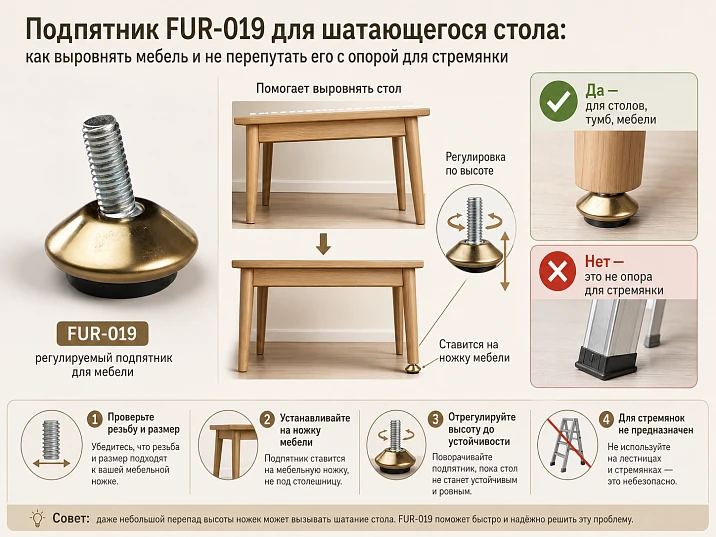
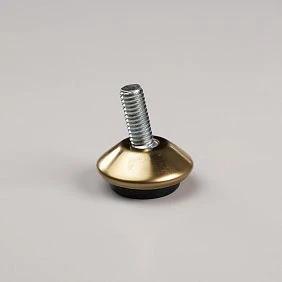
In such a situation, the buyer needs an adjustable furniture foot — a small fitting that helps compensate for the difference between the leg and the floor surface. Model FUR-019 belongs precisely to furniture fittings. In the card, it is designated as an adjustable foot D25 with a ball joint, the size of the product item is 23 × 23 × 27 mm.
But nearby a dangerous confusion arises. FUR-019 may appear to users in searches for "stepladder foot" and "buy stepladder feet". The coincidence of the word "foot" does not mean the coincidence of purpose. A stepladder holds a person, works under variable load, and must maintain stability when transferring weight from one step to another. A furniture foot is selected for a static piece of furniture. The FUR-019 card does not confirm its use on ladders and stepladders.
The direct answer is simple: FUR-019 should be considered for leveling furniture legs, but it cannot be automatically bought as a support for a stepladder. For a table, cabinet, console, or other furniture, first check the fit, thread, load, adjustment range, and the design of the leg itself. For a stepladder, a specially designed support with confirmed safety characteristics is required.
After checking the dimensions and compatibility, you can buy the adjustable foot FUR-019 by the number of furniture supports. But you need to start the order not with counting pieces. First, you need to understand whether the table is actually wobbling due to an uneven floor, and not due to a loose underframe.
The table wobbles: in which case an adjustable foot will help
Furniture rocking looks the same: one of the legs periodically lifts off the floor, the tabletop moves, the cup rattles, and the drawer of the cabinet changes position on its own. The causes of this phenomenon are different, so the same floor protector cannot be a universal remedy.
An adjustable support helps when the furniture is in good condition, but one or more legs do not reach the surface due to a slight floor unevenness. If the connection of the leg to the body is loose, the crossbar is skewed, the wood is cracked, or the base is deformed, adjusting the lower point will not eliminate the structural defect.




Quick test without disassembling furniture
Place the furniture in its intended permanent location. Clean the floor under all supports. Then alternately press on the four corners of the tabletop or body.
Observe the legs:
-
which support lifts off the floor;
-
whether the gap remains constant;
-
whether the gap changes when pressing from the other side;
-
whether the leg itself moves relative to the body;
-
whether clicks are heard in the joints;
-
does the underframe twist;
-
does the floor sag.
If one leg consistently does not touch the floor, but the joints remain immovable, an adjustable furniture foot can solve the problem. If the leg wobbles at the attachment point, first repair the joint.
Our factory also produces:

The shim helps determine the cause, but should not remain the solution
Temporarily place a dense plate of known thickness under the short support. If the rocking disappears, the cause is indeed related to the height of the supports or the floor level difference. The thickness of the temporary plate provides a reference for the required compensation.
However, this reference cannot automatically be considered the adjustment range of FUR-019. The card does not confirm how many millimeters the height of the foot changes. Before purchasing, the range needs to be clarified.
Get Consultation
When the foot does not eliminate the rocking
The adjustable part does not replace repair if:
-
the leg is loose;
-
the fastener is torn out of the wood;
-
the mounting plate is coming away from the base;
-
the drawer frame has lost rigidity;
-
the cabinet body is skewed;
-
the tabletop is incorrectly pulling the underframe together;
-
the legs have different actual lengths due to damage;
-
the floor sags under load;
-
the furniture base is installed on a soft carpet;
-
the floor protector cannot be securely attached to the end of the leg.
In such situations, adjustment may temporarily hide the symptom, but the structure will continue to move. First eliminate the root cause, then level the furniture on the floor.
What is confirmed about the furniture floor protector FUR-019
The buyer does not need a stream of assumptions about thread, load, or material. They need a clear boundary between what is known and what must be requested before ordering.
| Parameter | Confirmed data | Practical significance |
|---|---|---|
| Article number | FUR-019 | Use the full article number in the order |
| Type | Adjustable furniture support foot | Purpose is related to furniture |
| Designation | D25 | Requires interpretation according to the current drawing |
| Dimension line | 23 × 23 × 27 mm | Need to match with the designations on the drawing |
| Construction | Ball joint | The support part can adjust to the angle of the surface |
| Thread type | Not confirmed | Clarify before drilling the leg |
| Thread diameter | Not confirmed | Cannot buy the bushing in advance |
| Adjustment range | Not confirmed | Cannot promise compensation for a specific height difference |
| Permissible load | Not confirmed | Cannot recommend for heavy furniture without testing |
| Kit contents | Not confirmed | Need to find out what is included with the foot |
| Platform material | Not confirmed | Cannot promise protection for any floor |
| Application on a stepladder | Not confirmed | Using as a stepladder support cannot be recommended |
This table does not make the description poorer. On the contrary, it protects the buyer from false confidence. When fittings are installed inside a wooden leg, an error in hole diameter or thread can ruin the finished part. When it comes to load, an unconfirmed figure turns from an inconvenience into a risk.
What a ball joint provides in a furniture leg
The bottom plane of a furniture leg and the floor surface rarely match perfectly. The leg may be installed at a slight angle, the floor may have a local slope, and the furniture itself may not stand strictly vertical until final adjustment.
The ball joint allows the support part to change its tilt relative to the mounting axis. Due to this, the plate can fit the floor more tightly than a rigid foot with a fixed bottom part.
But the joint does not solve all tasks at once.
It does not confirm:
-
a large range of height adjustment;
-
high permissible load;
-
anti-slip properties;
-
protection of parquet from scratches;
-
compatibility with any thread;
-
possibility of installation into a thin leg;
-
use on stairs;
-
resistance to lateral loads.
A hinge is a design feature, not a certificate of universality. Its benefit is revealed only after proper selection of fastening and load.
Why the tilt of the platform is important on uneven floors
A rigid support may touch the surface with its edge. Then the load is distributed over a small area, the furniture seems less stable, and a noticeable mark remains on soft flooring.
The ball joint helps the platform assume a position close to the floor plane. But how freely it rotates and at what angle, the card does not report. These parameters cannot be invented.
The hinge does not compensate for an incorrectly drilled hole.
If the fastener is installed at an angle, the adjustment axis deviates. The ball platform can partially adapt, but it does not correct a gross marking error. The hole or mounting part must be positioned along the leg axis and conform to the drawing.
D25 and the size 23 × 23 × 27 mm: why the numbers cannot be interpreted by eye
The buyer sees the designation D25 and makes a natural conclusion: the platform diameter is 25 mm. Next to it, the dimension line 23 × 23 × 27 mm is indicated, and a new question arises: why is the actual width then 23 mm?
Without an up-to-date drawing, this question cannot be answered precisely. The designation D25 may refer to the nominal size, series, mounting part, or another characteristic. The dimensions 23 × 23 × 27 mm must also be linked to the letter designations and lines on the diagram.
Before checking the drawing, it cannot be stated that:
-
25 mm is the actual outer diameter of the contact pad;
-
23 mm is the base size;
-
27 mm is the maximum height;
-
one of the numbers indicates the thread length;
-
The size includes or does not include the pin.
What questions to ask about the drawing
Ask to show:
-
outer dimension of the support platform;
-
body height without extension;
-
maximum height in working position;
-
size of the threaded part;
-
type and pitch of the thread;
-
seating depth;
-
adjustment range;
-
rotation method;
-
hinge joint size;
-
minimum size of the furniture leg end.
After this, the dimension line becomes a working tool, not a set of numbers.
Adjustable foot or table base repair: how to distinguish two problems
A wobbly table is often leveled before checking the fasteners. This resembles adjusting a door hinge on a cabinet with a cracked side panel: the movement temporarily decreases, but the cause remains.
Signs of an uneven floor or different leg heights
-
one leg does not touch the floor;
-
the gap is in the same place;
-
the connections of the legs to the table base are immovable;
-
after placing a shim of appropriate thickness, the wobble disappears;
-
in another part of the room, the situation changes;
-
the furniture body maintains its geometry.
In this case, an adjustable foot for table legs can indeed help.
Signs of a loose fastening
-
the leg moves by hand;
-
a click is heard when rocking;
-
a gap appears now under one leg, now under the other;
-
the tabletop shifts relative to the base;
-
bolts or screws turn in place;
-
The mounting plate is coming off;
-
The wood around the fastening has cracked.
Here, first tighten, restore, or replace the fastening. In the section, you can select furniture leveling feet and fasteners, but selecting hardware does not replace diagnosing the base.
Signs of cabinet frame misalignment
The cabinet may wobble not because of one short leg, but due to frame deformation. Check the diagonals, the position of the back panel, the tightness of the joints, and the levelness of the top surface.
Installing a leveling foot under a misaligned cabinet can lift one corner, but the doors and drawers will still remain misaligned.
Which furniture can FUR-019 be considered for
Without confirmed load, you cannot compile a list of heavy items and promise compatibility. FUR-019 can be considered for furniture structures after checking the fastening, mass, and number of supports.
Dining table
For a small or medium table on separate legs, glides help compensate for floor unevenness. Before ordering, measure the end of the leg, clarify the thread, and check the load per point.
If the table is massive, has a stone top, or is used in a public space, a general phrase like "furniture glide" is not enough. Confirmed load data is required.
Coffee table
The low weight makes this scenario obvious, but the leg construction may be too thin for the chosen mounting. Be especially careful with narrow turned supports and parts with internal cutouts.
Cabinet
For a cabinet, the weight is distributed between the body, contents, and top surface. Empty furniture can be light, but after filling, the load increases noticeably.
For visual selection, you can look at solutions for dressers and cabinets and assess how furniture bases are constructed. However, compatibility of specific hardware is determined by the drawing, not by a photo of the finished item.
Console
A console often has two front legs and rests its rear part on a wall or cabinet. The number of adjustable elements depends on the design. You cannot automatically order four glides if there are actually two supports.
Small cabinet
FUR-019 can only be considered after checking the weight of the cabinet with contents. An empty body and fully loaded furniture create different loads. For a heavy cabinet, unconfirmed load capacity is sufficient reason to stop the order.
Separate wooden leg
When making a table or cabinet from scratch, the floor glide can be built into the design in advance. This is more convenient than trying to drill and equip an already painted leg.
In the catalog you can Buy wooden furniture legs and coordinate the lower mounting assembly before finishing. For a custom color, suitable are unpainted legs for tables and cabinets, but compatibility with FUR-019 is confirmed by the dimensions of each model.
Why FUR-019 cannot be considered a floor glide for a stepladder
The word "floor glide" is used in different product categories. Furniture floor glides, ladder supports, post tips, and protective caps may look similar. Their purposes are different.
A stepladder must support a person. The load on its supports changes when climbing, descending, turning the body, and carrying tools. Both vertical and lateral forces occur. The support part must be designed for the stepladder leg profile, attachment method, opening angle, and floor contact.
The FUR-019 listing does not confirm:
-
allowable load for a person;
-
use on ladder equipment;
-
resistance to lateral shear;
-
coefficient of friction with the floor;
-
fixation on a metal profile;
-
compliance with the stepladder design;
-
operation under variable load angle;
-
safety requirements for lifting equipment.
This is enough to reject a dangerous recommendation.
Diameter match does not prove compatibility
Even if the end of the stepladder leg is visually close to D25, furniture hardware does not become a ladder support. Matching one dimension does not address questions of load, material, fastening, and slip resistance.
A ball joint does not make the support safer for a ladder.
For furniture, the joint helps the platform adapt to the slope. On a stepladder, the mobility may behave differently under lateral load. Without testing and confirmed purpose, a conclusion cannot be drawn.
Height adjustment on a stepladder changes the geometry
If one support is extended more than another, the position of the structure changes. For furniture, this may be a working adjustment. For a stepladder, any change in supports must be provided by the manufacturer of the stepladder itself.
Safe conclusion for the buyer
FUR-019 is a furniture adjustable foot. For a stepladder, only a specially intended part is chosen, compatible with the specific model and confirmed by its manufacturer.
How to measure a furniture leg before ordering FUR-019
The buyer often measures only the width of the end. This is not enough. The entire mounting area must be assessed.
External size of the end
Measure the width and depth of the lower part of the leg. If the support is round, measure the diameter. If square or rectangular, measure both sides.
The foot pad should not extend beyond the edge so that its surface interferes with the appearance or gets caught by the foot. However, too small a support area can also be unsuitable for soft flooring. The exact outer dimension of FUR-019 is determined from the drawing.
Wood thickness around the hole
The future hole weakens the end grain. The closer it is to the edge, the less material remains around the fastening.
It is impossible to assign a universal minimum offset without data on the fastener, wood species, and leg construction. The craftsman must check whether the part will split during drilling and tightening.
Available depth
Inside a turned leg, there may be metal fasteners, dowels, pins, or a hidden cavity. Before drilling, it is necessary to understand how much solid material is present along the axis.
Position of existing fasteners
If the furniture is already assembled, the bottom end may contain:
-
an old foot pad;
-
a nail element;
-
hole;
-
crack;
-
plug;
-
overlay;
-
trace of repair.
New hardware cannot be installed over a damaged area without restoring the base.
Floor level difference
Measure the gap under the short leg. It is convenient to use a set of shims of known thickness or a feeler gauge. The obtained value is compared with the confirmed adjustment range.
If the difference exceeds the capabilities of the foot, another solution is required. Do not unscrew the fastener beyond the safe limit.
Floor material
Tile, parquet, laminate, natural stone, carpet, and soft vinyl interact with the support differently. Since the material of the contact pad FUR-019 is not confirmed, it cannot be guaranteed in advance that it will not leave marks.
Seven measurements to record
| Measurement | How to take | What it is for |
|---|---|---|
| Width or diameter of the end | At the lowest part of the leg | Checking the placement of the foot pad |
| Depth of the end | For a rectangular leg | Checking the support area |
| Available drilling depth | By the leg drawing or control hole | Selecting the mounting assembly |
| Distance to edge | From the mounting axis to the nearest edge | Risk assessment of splitting |
| Gap under the short leg | Using a feeler gauge or plates | Comparison with the adjustment range |
| Floor covering thickness | According to the project or actual sample | Assessment of marks and indentation |
| Number of supports | Actual calculation | Calculation of the number of support feet |
After taking measurements, request drawing FUR-019. Only comparing two data sets — the furniture leg and the hardware — provides a basis for purchase.
FUR-019 mounting: what to clarify before drilling
The source data does not confirm the thread and the contents of the kit. Therefore, it cannot be stated in advance that the support foot screws directly into the wood, requires a bushing of a certain diameter, or comes with a stud.
Before ordering, ask specific questions:
-
what thread is used;
-
what is its outer diameter;
-
what is the length of the threaded part;
-
is a stud included;
-
Is a bushing included?
-
Is a separate sleeve required?
-
Is direct mounting into wood allowed?
-
Is a metal counterpart element needed?
-
What hole diameter should be drilled?
-
What is the required depth?
-
How is adjustment performed?
-
Can the furniture be adjusted after being installed in place.
Why you shouldn't buy a bushing "by eye"
Two threads of similar diameter may have different pitches. The part may go in for one turn and jam, damaging the connection.
Why direct screwing into wood is not always suitable
The adjustment screw rotates periodically. If the thread works directly in soft or damaged material, the fit can loosen. But it is also impossible to assert the need for an insert for FUR-019 without a drawing.
Mounting plate as a separate scenario
For some furniture structures, a metal mounting plate is used. In the catalog, you can buy the mounting plate FUR-020, but its compatibility with FUR-019 cannot be considered automatic. First, check the thread, dimensions, and purpose of both parts.
Adjustment range: why this number is more important than the overall size
The buyer can select a foot by diameter and find that the required difference is greater than the allowable travel. Another risk is over-screwing the support, leaving too little thread engagement.
The adjustment range should answer two questions:
-
how many millimeters the furniture can be raised;
-
what part of the thread should remain inside the mount.
Without this data, the position "unscrew to the desired height" cannot be recommended.
Small difference
If the gap is fractions of a millimeter or several millimeters, an adjustable support may be more convenient than a random shim. But the specific possibility depends on the minimum and maximum position of FUR-019.
Large difference
If a leg is noticeably shorter than the others, the cause may not be the floor. The part may be damaged, incorrectly manufactured, or installed. In this case, the furniture geometry is checked first.
Adjusting all supports
Sometimes glides are installed on each leg to create a single lower assembly. This simplifies leveling, but raises the entire piece of furniture by at least the height of the hardware body. It is necessary to check whether the overall height of the table, cabinet, or console will change.
Load on one glide: how to reason without a made-up number
The permissible load of FUR-019 is not provided in the source data. Therefore, it cannot be stated that one support withstands 20, 50, 100, or any other number of kilograms.
For selection, you need to calculate at least an approximate working load on each leg and compare it with the confirmed rated value.
Simplified assessment:
Load on one support = mass of furniture with contents and working load ÷ number of supports.
But real distribution is rarely ideal. Weight may be shifted to one edge, a person leans on the tabletop, drawers are pulled out, the floor has a slope. Therefore, the rated limit must have sufficient margin, determined by the designer or furniture manufacturer.
What to include in the mass
For a table, consider:
-
tabletop;
-
underframe;
-
legs;
-
permanently placed items;
-
possible human pressure on the edge.
For the bedside table:
-
body;
-
drawers;
-
contents;
-
top appliances or decor;
-
force when opening.
For the wardrobe:
-
body;
-
doors;
-
shelves;
-
items;
-
possible uneven loading.
Why you cannot divide only the empty mass
An empty cabinet may weigh moderately, but filled drawers noticeably increase the load. Support feet are selected for the working condition.
How many FUR-019 support feet to order
The basic calculation is related to the number of supports, not the number of furniture items.
| Furniture structure | Number of supports | Base quantity of FUR-019 |
|---|---|---|
| Table on four legs | 4 | 4 pcs. |
| Coffee table on four legs | 4 | 4 pcs. |
| Console on two independent supports | 2 | 2 pcs. |
| Cabinet on four legs | 4 | 4 pcs. |
| Wardrobe on six supports | 6 | 6 pcs. |
| Two identical tables | 8 | 8 pcs. |
| Three cabinets with four legs each | 12 | 12 pcs. |
The table shows only arithmetic. It does not confirm that FUR-019 fits each listed piece of furniture.
Is it necessary to install floor glides on all legs
If one leg is already shorter, there is a desire to put an adjustable support only under it. Such a solution may change the appearance and height of one point. In addition, the remaining legs will have a different type of contact with the floor.
A single set on all supports gives the same construction, but raises the entire piece of furniture. The choice depends on the project.
Is a reserve needed
For a single home table, a set is usually ordered based on the number of legs after checking the product. For a production batch, the reserve is calculated according to the internal estimate. A universal percentage cannot be set without data on quantity and assembly conditions.
FUR-019 and other adjustable leveling feet: you need to compare not only D25 and D32
Next to FUR-019 in the catalog, other models are presented. They cannot be considered direct replacements based only on the diameter designation.
| Model | Confirmed designation | What to compare |
|---|---|---|
| FUR-019 | D25 | Drawing, thread, height, load, hinge |
| FUR-029 | D25 | Design and mounting method |
| FUR-018 | D32 | Platform size, fit, load |
| FUR-030 | D32 | Drawing, height, and mounting assembly |
FUR-019 or FUR-029
Both models are associated with the D25 designation, but the same nominal size does not prove interchangeability. Before choosing, you need to compare FUR-019 and FUR-029 with a diameter of 25 mm according to drawings, thread, platform design, and height.
FUR-019 or FUR-018
If the end of the leg allows for a larger support, you can buy a D32 foot FUR-018 after comparing parameters. Size D32 by itself does not mean a high load capacity: it needs to be confirmed separately.
FUR-019 or FUR-030
Another D32 model is adjustable foot FUR-030. The choice between FUR-018 and FUR-030 also cannot be made based solely on diameter.
When D25 is more convenient than D32
A compact support may fit better on a narrow furniture leg. However, the final decision depends on the actual outer size, mounting hole, and material thickness around it.
When D32 may be preferable
A larger base potentially distributes load over a larger area, but this is general geometric logic, not a confirmed advantage of a specific model. Products should be compared according to documentation.
What to buy together with an adjustable furniture foot
FUR-019 may be one part of a mounting assembly. The order composition depends on the leg design and the product's own configuration.
| Position | What it's for | What to confirm |
|---|---|---|
| buy the adjustable foot FUR-019 | Leveling a furniture support | Thread, load, adjustment range |
| Thread insert or threaded bushing | Creating a mating thread | Compatibility with FUR-019 |
| Screw | Connection of parts, if provided | Included in set and size |
| Mounting plate FUR-020 | Formation of assembly unit in separate structures | Thread and size compatibility |
| Wooden furniture legs | New furniture supports | End size and drilling capability |
| Materials for furniture assembly | Preparation and installation | Compatibility with wood and finish |
| Level | Horizontal control | Accuracy and length of the tool |
| Drilling template | Aligning holes | Axis of each leg |
| Drill bit | Hole preparation | Diameter according to the mounting diagram |
| Depth stop | Protection of the leg from through drilling | Required depth |
Not all positions will be needed. The table is for verification, not for automatic cart filling.
Preparing the wooden leg for installation
The most expensive mistake occurs before installing the foot pad — when drilling the finished leg.
Find the geometric center
For a round end, use marking along several diameters. For a square one, use the intersection of diagonals. On a shaped leg, the visual center of the end may not coincide with the axis of the solid wood.
Check the internal structure
The leg may be glued, hollow, composite, or have hidden fasteners. Study the drawing before drilling.
Use a depth stop
The drill must not exit through the side surface or meet the top pin.
Make a test on the sample
For a furniture series, first test one technological blank. A test hole shows how the material behaves and how accurately the fastener fits.
Do not drill after final finishing without protection
Chips and tools damage enamel or varnish. It is better to make the hole before the final finish or use protective devices.
Do not install a foot pad into a crack
The load will expand the damage. Repair the crack or replace the leg.
How to level a table after installing adjustable supports
The exact rotation method for FUR-019 should be clarified based on the design. The general adjustment sequence is as follows.
-
Place the table in its permanent location.
-
Make sure all connections are tightened.
-
Bring the thrust pads close to their original position.
-
Check the rocking along the diagonals.
-
Increase the height of the short support in small steps.
-
After each change, check both diagonals.
-
Control the horizontality of the tabletop with a level.
-
Make sure the threaded part remains deep enough in the mounting.
-
Check stability under working load.
-
Repeat the check after a few days.
Why you cannot adjust one leg indefinitely
Excessive extension reduces the length of the threaded engagement. Without a confirmed maximum, a safe limit cannot be determined.
Horizontalness and absence of wobbling are not the same thing
The table may not wobble but have a noticeable slope. Adjustment should solve both tasks: ensure contact of all supports and level the work surface.
Practical Selection Scenarios
The table wobbles only in one place in the room
Most likely, the problem is related to a local floor difference. Measure the gap and check the FUR-019 range.
The table wobbles anywhere
Check the leg length, underframe, and fastenings. Possibly one support is indeed shorter or the frame is skewed.
After moving, a different diagonal wobbles
The floor has a complex slope, or the underframe is not rigid enough. Four adjustable supports may help if their specifications are suitable.
The cabinet stands next to the wall
Adjustment should account for the baseboard, cabinet position, and drawer opening. You cannot raise only the front leg so that the cabinet tilts toward the wall.
The console is mounted to the wall
First, the supports are leveled, then the position of the wall mount is agreed upon. Rigid fixation of a skewed piece of furniture creates stress in the structure.
The cabinet has six supports
All six points must participate in load distribution. If the middle supports hang above the floor, the body may sag.
The furniture stands on a carpet
A soft surface sinks unevenly. A narrow base may sink into the pile. Without data on the size and material of FUR-019, a decision is made only after a sample.
The furniture stands on parquet
Check whether the base damages the coating. Promising protection of parquet without a confirmed material of the contact part is not possible.
The table is used in a cafe
Constant load, frequent movement, and intensive use require confirmed load capacity. Home selection logic is insufficient here.
The furniture has slanted legs
A ball joint can be useful, but the mounting axis and the angle of the platform need to be checked against the drawing.
How not to confuse a furniture glider with similar hardware
With felt pad
The felt pad protects the surface and makes movement easier, but it usually does not adjust height. FUR-019 solves a different task.
With nail-in glider
The nail-in part is fixed into the end and creates a fixed height. It has no adjustment mechanism.
With caster wheel
The wheel provides movement and noticeably changes the height of the furniture. It is not a replacement for a compact glider.
With plastic pipe cap
The plug covers the end of a metal profile. Its attachment and purpose differ.
With a leg for a kitchen module
A full-size adjustable support holds the body and has a different height range.
With a support for a stepladder
The ladder part must be designed for a person, lateral load, and a specific profile. FUR-019 has no confirmed purpose for a stepladder.
Mistakes that prevent the foot from leveling furniture
Mistake 1. Buying FUR-019 based on the word D25
The nominal designation does not replace a drawing.
Mistake 2. Considering 25 mm as the actual diameter
The size needs to be confirmed.
Error 3. Not measuring the leg end
The support may not fit.
Error 4. Not checking the drilling depth
The drill damages the side part or hidden fastener.
Error 5. Making up the thread
An unsuitable insert ruins the connection.
Error 6. Buying the insert before receiving the drawing
The size and pitch may not match.
Error 7. Not clarifying the package contents
The buyer expects a stud or bushing that is not in the order.
Error 8. Not checking the adjustment range
The support foot does not compensate for the actual gap.
ErrError 10. Not checking the load
Fittings are selected for furniture that is too heavy.
Error 11. Calculating the load based on an empty cabinet
The contents increase the mass.
Error 12. Installing a support foot into a cracked end
The damage expands.
Error 13. Drilling close to the edge
The leg is splitting.
Error 14. Make a hole at an angle
The support stands crooked.
Error 15. Install one support pad without assessing the other legs
Furniture gets different contact points.
Error 16. Lift only one corner of the cabinet
The body is skewed.
Error 17. Not checking the level
The wobble disappears, but the surface remains tilted.
Error 18. Not tightening the leg attachment
The thrust bearing masks the play.
Error 19. Placing furniture on a dirty floor
Small debris changes the height of the support.
Error 20. Promising protection for parquet
The material of the platform is not confirmed.
Error 21. Using FUR-019 on a stepladder
The purpose is not confirmed.
Error 22. Considering a hinge a sign of ladder safety
This is merely a design feature.
Error 23. Choosing an alternative to D32 only by larger diameter
Load and fastening still require checking.
Error 24. Not ordering a sample for the series
The error repeats on dozens of legs.
Error 25. Drilling the entire batch using an unverified template
An incorrect size becomes a serial defect.
Error 26. Installing hardware after painting without protection
The coating gets chips.
Error 27. Not accounting for the minimum height increase
The table becomes taller than the project.
Error 28. Using different models on the same item
The height and type of support may vary.
Error 29. Cannot recalculate the number of legs
Part of the furniture remains without components.
Error 30. Not checking the product upon receipt
The error is detected after drilling.
Who FUR-019 is suitable for
FUR-019 can be considered when:
- an adjustable furniture foot is required;
- the table or cabinet is in good condition but stands on an uneven floor;
- the end face size allows placing the support;
- drawing FUR-019 received;
- thread confirmed;
- adjustment range covers the gap;
- allowable load matches the furniture;
- floor material is compatible with the platform;
- installation is performed according to precise marking;
- quantity is calculated based on the number of supports.
When FUR-019 should not be ordered without additional data
Purchase should be stopped if:
- the product is planned to be placed on a stepladder;
- unknown allowable load;
- thread not confirmed;
- configuration unclear;
- leg end too small;
- leg is hollow;
- wood cracked;
- gap larger than unknown adjustment range;
- furniture is very heavy;
- foot pad will work under strong lateral load;
- impact of platform on expensive floor covering unknown;
- The design requires a specially certified support.
FUR-019 purchase path on STAVROS
Step 1. Make sure the issue is related to height
Check the fasteners and geometry of the furniture.
Step 2. Measure the gap
Determine the floor level difference.
Step 3. Measure the leg
Record the outer dimension, depth, and condition of the end.
Step 4. Open the FUR-019 card
Check the article number and size line.
Step 5. Get the drawing
Decode D25 and dimensions 23 × 23 × 27 mm.
Step 6. Clarify the thread
Do not buy the mating hardware in advance.
Step 7. Clarify the package contents
Find out whether the stud, bushing, or other parts are included.
Step 8. Check the range
Compare it with the actual gap.
Step 9. Check the load
Consider furniture with contents.
Step 10. Select the quantity
Based on the number of supports and the approved scheme.
Step 11. Check compatible products
If necessary, select a mounting plate, legs, or fasteners.
Step 12. Calculate delivery
Before payment, you can calculate delivery of furniture fittings.
Checklist before payment
-
SKU FUR-019 is recorded correctly.
-
Furniture purpose confirmed.
-
The current drawing has been received.
-
Designation D25 has been decoded.
-
Dimensions 23 × 23 × 27 mm are linked to the scheme.
-
The outer size of the platform has been clarified.
-
The overall height has been clarified.
-
The adjustment range has been clarified.
-
The thread type has been clarified.
-
The thread diameter has been clarified.
-
The thread pitch has been clarified.
-
The length of the threaded part has been clarified.
-
The kit composition has been checked.
-
The permissible load has been clarified.
-
The end of the leg has been measured.
-
The available drilling depth has been checked.
-
Checked the distance to the edge.
-
The base has no cracks.
-
The floor level difference has been measured.
-
The platform material matches the floor.
-
The quantity corresponds to the number of supports.
-
Alternatives D25 and D32 have been compared according to the drawings.
-
Compatibility with FUR-020 is confirmed if the plate is needed.
-
FUR-019 is not planned to be used on the stepladder.
-
For the series, a sample is ordered or checked first.
FAQ about the adjustable foot FUR-019
What is FUR-019 intended for?
FUR-019 is intended for furniture supports. It is considered for leveling a table, cabinet, console, or other furniture after checking dimensions, fastening, and load.
Can FUR-019 be installed on a stepladder?
This is not recommended. The card does not confirm use on stepladders or ladders.
Why does FUR-019 appear for the query "stepladder foot"?
The search engine links products by the common word "foot." Such a match does not confirm purpose or safety.
What does D25 mean?
An accurate interpretation requires a current drawing. D25 cannot automatically be considered the actual outer diameter of the platform.
Why are the dimensions 23 × 23 × 27 mm specified?
This is the dimensional line of the product item. Which parameter corresponds to width, height, or a separate part needs to be checked against the diagram.
Does the FUR-019 have a ball joint?
Yes. The ball joint is listed among the confirmed features of the model.
What is the ball joint for?
It helps the base adapt to a slight floor slope or leg position. The allowable rotation angle needs to be clarified.
What is the adjustment range of the FUR-019?
It is not confirmed in the source data. Request the value before purchasing.
What load does one support foot bear?
There is no confirmed figure. The load must be clarified with the seller or in the documentation.
What thread is used?
The type, diameter, and thread pitch need to be checked against the drawing.
Is the stud included in the kit?
Configuration is not confirmed. Please clarify the composition of the item before payment.
Is the bushing included?
This also needs to be clarified. You cannot rely on the presence of the mating sleeve without checking.
Can FUR-019 be screwed directly into wood?
The possibility depends on the mounting design. Without information about the thread and installation scheme, such installation cannot be recommended.
Will FUR-019 fit a table with four legs?
It may fit after checking the load, end dimensions, and mounting. For a complete set, four pieces are usually considered.
Do I need to install glides on all four legs?
This depends on the project. A single set provides identical support construction but increases the overall height of the furniture.
Can only one support foot be installed?
The technical feasibility depends on the design. The height difference and the appearance of the other supports need to be assessed.
How can you tell if the table is wobbling due to the floor?
Place a plate of known thickness under the short leg. If the wobbling disappears, the cause is related to a gap or the height of the support.
What to do if the leg moves in its mounting?
First, repair the joint. The support foot does not eliminate play in the upper mounting.
Will FUR-019 be suitable for a heavy cabinet?
Without confirmed load capacity, it cannot be answered. The cabinet's mass is calculated together with its contents.
Can FUR-019 be used on parquet flooring?
Only after checking the material of the contact pad and a trial installation. Protection of the parquet is not confirmed in the initial data.
Will a floor protector fit under a carpet?
This depends on the support area, carpet density, and load. On soft carpet, furniture may sink.
Can the height be adjusted after furniture installation?
The adjustment method should be clarified based on the FUR-019 design. Access to the mechanism may depend on the furniture.
How to measure the floor level difference?
Use plates of known thickness or a feeler gauge under the short leg. Compare the obtained value with the confirmed range of the floor protector.
How many FUR-019 are needed for two tables?
If each table has four legs to be equipped, the base quantity is eight pieces. Compatibility should be checked for each design.
Is a reserve needed?
For a single piece of furniture, a spare is not necessary. For a production batch, it is determined based on the estimate and assembly conditions.
How is FUR-019 different from FUR-029?
Both models are related to D25, but the design, thread, height, and load need to be compared using the cards and drawings.
How does D25 differ from D32?
By nominal size, but that is not enough for selection. The actual footprint, fit, height, and load are compared.
Can FUR-019 be replaced with FUR-018?
Only after a full verification. FUR-018 is designated as D32 and may require a different mounting zone.
Is the mounting plate FUR-020 compatible with FUR-019?
Automatic compatibility is not confirmed. The thread and drawings need to be compared.
When is it better to order a sample?
Before serial drilling of legs, with expensive finishing, non-standard end, or lack of full confidence in the fastening.
Can a floor glide be installed into an already painted leg?
Only possible with careful marking and protection of the coating. It is preferable to prepare the mounting assembly before final finishing.
What to do if the hole is already too large?
Restoration of the edge or another mounting assembly will be required. Installing hardware in a damaged hole is not allowed.
How to check the table after adjustment?
Press on all corners, check both diagonals and the horizontality of the tabletop. Then repeat the test under normal load.
Will the table rise after installing FUR-019?
Yes, the minimum support height may increase the overall height of the furniture. The exact value needs to be determined from the drawing.
Can different glides be placed on one table?
Not recommended without a special calculation. Different models may differ in height, base, and adjustment.
Where can I see ready-made furniture solutions?
You can view ready-made solutions for tables and other furniture and evaluate the design of the supports, but the fittings are still selected based on technical parameters.
FUR-019 solves a furniture problem, not replaces a stepladder support
A wobbly table doesn't need to be tolerated, and it doesn't need to be constantly leveled with random shims. If the joints are sound and one leg doesn't touch the floor due to a slight difference in height, an adjustable furniture foot helps create a neat and manageable point of support.
FUR-019 has a confirmed furniture purpose, the designation D25, a dimension line of 23 × 23 × 27 mm, and a ball joint. This is enough to consider the model for a furniture project, but not enough to order it blindly. Before purchasing, it is necessary to clarify the thread, adjustment range, permissible load, kit contents, and actual dimensions according to the drawing.
The boundary with stepladders should be especially strict. A matching search query and a similar shape do not turn furniture fittings into a safe support for equipment that holds a person. A ladder requires a specially designed part with confirmed compatibility.
STAVROS combines adjustable feet, furniture fasteners, mounting plates, wooden legs, and assembly materials in one catalog. The buyer doesn't have to pick random parts from different systems. First, the cause of the wobble is checked, then the leg dimensions are taken, then the drawings are compared, and only then is a complete order placed. This procedure helps level furniture neatly, without damaging the finished leg and without using FUR-019 where its purpose is not confirmed.