




























Article Contents:
- When you need a skirting board with a cable channel: an honest answer without unnecessary words
- Which wires can be hidden behind the skirting board
- Low-current cables: the ideal candidate
- Power cables: caution
- MDF skirting board with cable channel or regular MDF skirting board: an honest comparison
- What is the fundamental difference
- What to look for when buying: a technical checklist
- Height and internal volume
- Mounting method and cable access
- Angles and Joints
- Length of the strip
- Coverage and color
- Where a baseboard with a cable channel is especially needed: analyzing by zones
- TV zone and media zone
- Home office and workspace
- Children's room
- Kitchen-living room
- Commercial spaces
- How to choose the color of an MDF baseboard with a cable channel
- White MDF skirting board: a universal solution
- MDF baseboard for painting: ideal for complex interiors
- MDF baseboard in wood finish: a warm natural option
- Gray and graphite: modern and strict
- Black: for loft and contrast aesthetics
- Which height to choose: analyzing proportions
- 60–70 mm: thin profile for delicate tasks
- 80 mm: the gold standard for apartment renovations
- 100 mm: more space and more design
- 120 mm and above: a large-scale solution for spacious rooms
- Fastening and installation: the main technical issue
- Mounting bracket for MDF baseboard: how it works
- Fastening for MDF baseboard with screws
- Glue installation: only if there is no cable
- Combined mounting
- Installation on uneven walls and floors
- Overlay MDF skirting board: installation without interfering with the finish
- How to calculate the quantity: formula and practice
- Standard perimeter calculation
- Calculation along the cable route
- Margin for different scenarios
- Attention to plank length
- Mistakes when buying MDF skirting board with cable channel
- Did not check if the cable fits
- Sealed the cable with glue
- Chose a profile without corner elements
- Did not add spare
- Ran power cable without following standards
- Chose color without comparing with doors
- Did not account for joint with architraves
- Confused decorative skirting board and profile with cable channel
- What to buy together with MDF skirting board with cable channel
- Final conclusion: how to make the right choice
- FAQ: popular questions about MDF skirting board with cable channel
- Can wires be hidden behind MDF skirting board?
- Which skirting board to buy to hide internet cable?
- Which is better: baseboard with cable channel or regular MDF baseboard?
- Can you glue baseboard if there will be a cable inside?
- What color of baseboard should I choose to hide wires?
- What margin should I take when ordering baseboard?
- Are corner pieces needed for the baseboard?
- How to calculate the amount of baseboard for an apartment?
- About the Company STAVROS
Wires on the floor are one of those details that everyone notices, but which are thought about at the very last moment. The renovation is finished, the walls are painted, the floor is laid, the furniture is arranged — and then it turns out that the internet cable to the TV runs along the baseboard on the outside, and the wire from the desk lies on the floor. A familiar picture and, unfortunately, very common.
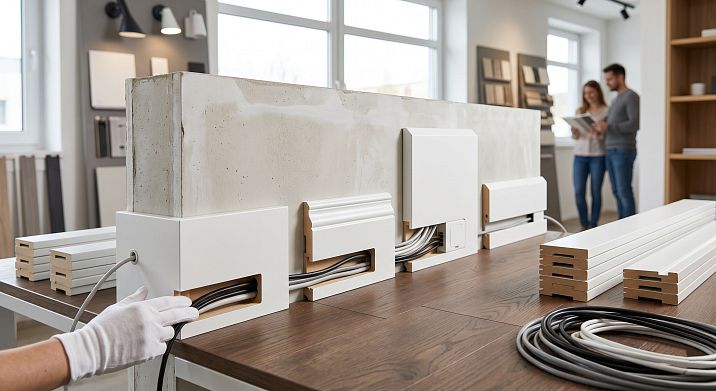
The solution that helps fix this without chasing and redoing the finish is an MDF baseboard with a cable channel. Or a properly selected MDF Skirting Board with sufficient internal space for laying the cable. We'll break down everything: from choosing the profile and height — to mistakes during installation and correct quantity calculation.




When you need a baseboard with a cable channel: an honest answer without unnecessary words
A direct answer to a direct question: a skirting board with a cable channel is needed when the wire appeared after renovation or when its route was not laid into the wall during construction.
Most often, these are the following situations:
-
the apartment is rented or purchased with a finished renovation, and you need to run an internet cable to a workstation or TV;
-
after renovation, new equipment was added — smart home, video surveillance system, additional network access points;
-
in the children's room, you need to remove wires from the floor to a safe place;
-
in the kitchen-living room, appliances are placed along the wall and all their wires converge to one point;
-
in the office, there are several workstations and low-current lines go to each of them.
There is an important point that needs to be stated right away. Power electrical (230 V) cannot simply be laid into the skirting board any way you like. There are installation standards, requirements for cable type, insulation, and access. If it's a power line, consultation with an electrician and compliance with fire safety regulations are needed. For low-current lines — internet, television, acoustics, lighting — the requirements are much more lenient, and the skirting board works as an excellent solution here.
to buy MDF skirting board designed for cable — this is not a specific technical product. It is a standard MDF profile, properly selected in terms of internal space, height, and mounting method.




Which wires can be hidden behind the skirting board
Here it's important to separate cables by type, because not every one of them fits the baseboard equally well.
Our factory also produces:




Low-current cables: the ideal candidate
Low-current lines are the main category of wires for which a baseboard with a cable channel is designed. These include:
Internet cable (twisted pair, cat5e/cat6). Typical scenario: the router is in one spot, the workstation or TV is in another, and a reliable wired internet connection is needed. Twisted pair easily fits into the baseboard, does not overheat, and requires no special installation conditions.
Coaxial cable for TV. The wire to the TV from the antenna jack or receiver is one of the most common reasons to consider a baseboard with a cable channel. A coaxial cable with a diameter of 5–6 mm fits well into a standard baseboard with a height of 80 mm or more.
Acoustic cables. Wires to floor-standing acoustic systems are thin, flexible, and conveniently laid along the wall.
HDMI and other AV cables. Connections between a media player, set-top box, and TV are cables of medium rigidity that require a sufficient bend radius. When choosing a profile, it's important to ensure the cable won't bend sharply at corners.
Cables for the smart home system. Sensors, controllers, actuators — all of this creates a network of low-current lines that logically run along the baseboard.
Charging cables and wires from desktop equipment. Especially relevant for home offices and work areas.
Get Consultation
Power cables: caution
If you need to run an additional outlet along the wall, baseboard is not the first choice. A power cable in a baseboard requires a special profile design and compliance with fire safety regulations. If you have exactly this task, first consult with a qualified electrician. Unauthorized installation of power wiring without following regulations is a risk that outweighs the convenience of the solution.
MDF baseboard with cable channel or regular MDF baseboard: an honest comparison
A buyer often wonders: is a special profile specifically "with a cable channel" needed, or is a regular one sufficient MDF Skirting Boards of the required height?
| Task | Optimal choice |
|---|---|
| Need to hide a wire | Baseboard with cable channel or a wide enough MDF profile |
| Need clean minimalism without wires | Straight or flat MDF baseboard |
| Need a color to match the wall | MDF baseboard for painting |
| Consistency with doors is required | White, wood-like, or painted profile |
| Walls are already finished, installation without chasing | Overlay MDF baseboard on fasteners or glue |
What is the fundamental difference
Regular MDF baseboard profile — is a decorative strip that attaches to the wall and covers the joint between the floor and the wall. Behind it, in the space between the baseboard and the wall, there may be a small gap where a thin cable can theoretically fit. But this is not a cable channel in the strict sense: no fixation, no organized space, the wire just lies behind the baseboard.
A profile with a cable channel is a well-thought-out design: inside there is a dedicated space for laying cables, often with the ability to remove the front panel or cover for access. This is not just a gap, but an organized compartment.
Practice shows that for most apartment tasks — one or two small-diameter cables — an MDF baseboard of the correct height (from 80 mm) with installation on a strip that allows removing the baseboard without damaging the finish when necessary is sufficient. For serious tasks with multiple cables, a profile with a pronounced cable channel is needed.
What to look for when buying: a technical checklist
Buying a skirting board with a cable channel is not just about choosing the color and height. There are several technical parameters that determine whether the solution will work or you'll have to redo it.
Height and internal volume
The profile height directly affects how many cables and of what diameter will fit inside. Minimum guidelines:
-
60 mm — thin cable (lighting, acoustics);
-
80 mm — standard twisted pair, one coaxial cable;
-
100 mm and above — multiple cables, HDMI, thicker wires.
The internal volume should be checked based on actual dimensions, not the declared height: in a profile with a figured relief, part of the space is taken up by the shape of the plank itself.
Mounting method and cable access
This is a key parameter that most buyers overlook. If there will be a cable behind the skirting board that might ever need to be replaced or have another added to it — a blind adhesive installation will block any access.
The right choice when it comes to cable:
-
Mounting strip for MDF baseboard — the base strip is attached to the wall, and the baseboard itself snaps onto it. Removal: without tools or with minimal effort. Wires are accessible at any time.
-
Fastening for MDF baseboard with self-tapping screws and subsequent masking — the baseboard holds securely, and if necessary, it can be removed without damaging the finish.
-
Adhesive mounting — only for cables that will never need access (e.g., a permanent TV antenna line).
Angles and joints
The cable runs behind the baseboard to the corner — and here the question arises: how does the line continue? In a profile with a cable channel, you must check if there are corner connectors (internal and external) that allow the cable to pass through the corner without a sharp bend. A rigid coaxial cable or thick HDMI can be damaged with a sharp bend.
Length of the plank
The standard length of an MDF baseboard strip is 2.4 or 3 meters. For long walls, connectors are needed, which must be in the same color and profile. Check the availability of connecting elements when purchasing.
Coating and color
MDF baseboard with cable channel should blend organically into the interior — it is not a technical element, but a decorative one. The choice of coating: white, paintable, wood-like, or a specific shade — determines how noticeable or unnoticeable the baseboard will be in the finished interior.
Where a baseboard with a cable channel is especially needed: breaking it down by zones
Each zone in a house or apartment has its own requirements for the cable solution.
TV zone and media zone
The most common request. The TV is mounted on the wall, with a cabinet or shelf underneath. From it to the wall run: a power cable, an HDMI cable to the set-top box, a coaxial cable from the antenna, and an internet cable to the Smart TV. That's four cables in one place, all heading to an outlet or media node at the other end of the wall.
An MDF baseboard for the TV zone must:
-
have sufficient internal volume for several cables of different diameters;
-
be mounted on a rail with the ability to be removed (the TV equipment set changes);
-
have corner elements for internal and external corners;
-
match the color scheme of the zone.
If the TV is located in a niche or near an accent wall, the baseboard at that wall is often selected specifically — for example, to match the wall color or tone decorative wooden slatsthat are used there.
Home office and workspace
The workspace is the area with the highest concentration of low-current cables: internet, monitors, chargers, peripherals. Wires from the desk to the wall are what either organizes or disrupts the sense of order in the office.
An MDF baseboard for a home office should:
-
have space for 2–3 cables at once (twisted pair, USB hub, power cable from a surge protector);
-
be detachable — wires will be changed;
-
be in a color coordinated with the furniture and walls.
In an office with neutral or dark walls, it works well — is a horizontal element that frames the room at the bottom of the walls where the wall meets the floor. Skirting boards perform several functions: they hide the technological gap between the wall and floor covering (necessary for thermal expansion), protect the lower part of the wall from mechanical damage, create visual completion, and may conceal wiring. in the shade of the wall — the cable channel becomes virtually invisible against the painted wall.
Children's room
In a children's room, a baseboard with a cable channel is primarily about safety. Wires on the floor of a child's room are a risk. Removing them behind the baseboard, out of reach, is the right decision.
An additional plus: in a children's room, the furniture layout and set of equipment often change. Mounting on a rail allows you to easily revise the cable route when rearranging.
In a children's room, an MDF skirting board in white or matching the wall color is a logical choice: it is neutral, does not compete with the room's decor, and is easy to repaint when the interior changes.
Kitchen-living room
The open space of a kitchen-living room is an area where equipment is concentrated in different places: refrigerator, dishwasher, oven — in the kitchen zone; TV, audio system, lighting systems — in the living room. Wires from all this equipment run in different directions.
A skirting board along the perimeter with a cable channel allows you to organize routes for all low-current lines in one horizontal solution. It is important that the profile is of sufficient height and has several compartments or sufficient volume.
In a kitchen-living room, a single Floor MDF skirting board along the entire perimeter — this is a cohesive solution that looks like a well-thought-out design, not a set of disparate elements.
Commercial Spaces
Offices, meeting rooms, sales floors, studios — everywhere there are workstations, network access points, lighting on low-current control. In commercial spaces, a skirting board with a cable channel is the standard for organizing cable infrastructure without opening walls.
For commercial objects, high profiles (100–120 mm) with several compartments are relevant: power and low-current cables need to be separated. And here a special role is played by fasteners for MDF skirting boards: in an office, equipment changes, and access to the cable route should be quick and convenient.
How to choose the color of an MDF skirting board with a cable channel
A cable channel is a function. Color is design. And design is no less important than function: if the skirting board doesn't fit the interior, it will irritate you every day.
White MDF baseboard: a universal solution
A white MDF baseboard creates visual continuity with white door casings, white ceiling cornices, and white window frames. When all architectural details are executed in the same color, they form a unified system, a spatial framework that connects disparate elements — floor, walls, ceiling, furniture — into an integral composition. This technique is fundamental to Scandinavian design, where white architectural decor creates a light shell within which the most diverse colors and textures can coexist. — the most popular choice for apartments with white or light doors and neutral walls. It matches a wide range of interiors and doesn't require coordination with the floor or furniture.
There is a nuance: white comes in different shades. Make sure the shade of the skirting board matches the shade of the doors and architraves. Cold white next to warm milky is a noticeable conflict at the junction.
MDF skirting board for painting: ideal for complex interiors
If the walls are painted in a non-standard shade, the best choice is — is a horizontal element that frames the room at the bottom of the walls where the wall meets the floor. Skirting boards perform several functions: they hide the technological gap between the wall and floor covering (necessary for thermal expansion), protect the lower part of the wall from mechanical damage, create visual completion, and may conceal wiring., which is painted in the same color as the wall. The skirting board becomes an extension of the wall, the boundary between the wall and floor disappears — this is an architectural technique that makes the interior cohesive and reduces visual fragmentation of the space.
This technique works especially well in rooms with accent dark walls: dark blue, green, graphite. A skirting board in the color of the wall blends in while neatly hiding the cable route.
MDF skirting board with wood finish: a warm natural option
an MDF skirting board with a wood finish is with a textured coating imitating wood works well in interiors with wooden or laminate flooring, wooden doors, or furniture with wooden details. It creates a feeling of naturalness and warmth while solving the functional task with the cable.
If the interior has Wooden planks or Wooden moldings — a wood-effect skirting board blends organically into this wooden system. Or, even better, a real one solid wood baseboard — for rooms where eco-friendliness and natural materials matter.
Gray and Graphite: Modern and Strict
A skirting board in dark gray or graphite shade is a choice for modern interiors with porcelain stoneware imitating concrete, gray or dark walls, an anthracite kitchen, or dark doors. The gray skirting board does not draw attention to itself but is noticeable as an architectural line against a dark or contrasting space.
Black: For Loft and Contrast Aesthetics
In loft, high-tech interiors, or rooms with strong contrasting design, a black skirting board with a cable channel becomes part of the space's graphic pattern. The bottom line of the wall is drawn with a bold horizontal line that supports dark hardware, metal, and contrasting accents.
How to Choose the Height: Analyzing Proportions
The profile height is not only about cable capacity. It's a matter of design and room scale.
60–70 mm: Thin Profile for Delicate Tasks
The 60–70 mm profile is modest and delicate. It can accommodate a thin cable — acoustic, lighting cable, thin USB cable. For multiple cables or rigid coaxial wires, this profile may be insufficient.
From a design perspective — minimalist, almost unnoticeable. Works well in small spaces and interiors where the bottom line of the wall should not attract attention.
80 mm: the gold standard for apartment renovation
MDF skirting board 80 mm is the optimal solution for most apartment tasks. Such a skirting board easily accommodates twisted pair, one coaxial cable, or audio wires.
From a design perspective — a fairly noticeable profile that clearly defines the bottom line of the wall but does not overwhelm the space. For standard apartments with ceilings of 2.5–2.7 meters, this is ideal.
100 mm: more space and more design
A skirting board with a height of 100 mm is already a serious architectural statement. It can accommodate several cables, including fairly thick ones. For a TV area with multiple HDMI cables, coaxial, and internet — this is the right choice in terms of volume.
In terms of design — 100 mm are visible and function as an architectural element. They require space and ceilings of at least 2.7 meters. Paired with with wooden cornices in the same shade — they create a horizontal frame for the space that looks several times more expensive than it costs.
120 mm and above: a large-scale solution for spacious rooms
A wide skirting board with a height of 120 mm or more is a solution for rooms with ceilings of 3 meters and above, for spacious living rooms, executive offices, and commercial spaces with design aspirations.
From the perspective of a cable channel, the volume allows for placing several cables of different types while still leaving room. For multi-cable solutions in an office, this is the optimal option.
Fastening and installation: the main technical issue
The method of attaching a skirting board with a cable channel is no less important a parameter than height or color. And this is where problems most often arise.
Mounting strip for MDF skirting board: how it works
The mounting strip for an MDF skirting board is a plastic or metal profile that is attached to the wall with self-tapping screws or dowels, and the skirting board itself snaps onto it. This is a detachable system: to access the cable, it is enough to pry the skirting board with force or remove it using a flat tool.
Advantages of the strip system:
-
the cable can be replaced or added without dismantling the skirting board (the skirting board is removed and snapped back into place);
-
installation is even: the strip is leveled, and the skirting board is positioned strictly horizontally;
-
if necessary, the entire skirting board can be removed without damaging the wall or floor.
Fastening for MDF skirting board with self-tapping screws
Fastening MDF baseboard with self-tapping screws is a more rigid mounting that ensures reliable contact with the wall without gaps. The screw is driven through the baseboard body into a wall dowel, and the hole is covered with a decorative cap.
This is the right choice for uneven walls where glue or a clip strip does not provide the necessary fixation. Downside: if you need to remove the baseboard, you will have to unscrew the screws and then mask the holes.
Adhesive mounting: only if there is no cable
Mounting with liquid nails or construction adhesive is the fastest and neatest option for a decorative baseboard without a cable. For a baseboard with a cable channel, adhesive mounting is used only in cases where the cable is permanent and access to it will never be needed. Removing a glued baseboard without damaging the wall and floor is extremely difficult.
Combined mounting
In practice, a combination is often used: the main body of the baseboard is attached to a clip strip or screws, and the bottom edge is additionally fixed with a small amount of silicone sealant to eliminate gaps. This approach provides rigid fixation at the bottom and the ability to remove the baseboard from the top if access to the cable is needed.
Mounting on uneven walls and floors
MDF is a rigid material; it does not bend to follow wall unevenness. If the wall has significant deviations (waves, humps), the baseboard does not fit tightly, and a gap forms along the bottom edge, which looks unsightly and requires masking with sealant.
For uneven walls, it is better:
-
to mount on an adjustable clip strip;
-
to use fasteners with a frequent spacing — every 40–50 cm;
-
Close the bottom gap with flexible transparent or painted silicone sealant.
Overlay MDF baseboard: installation without interfering with the finish
The overlay MDF baseboard deserves special consideration — a profile that is mounted on top of the finished finish without chasing or complex fastening. This is relevant when the renovation is complete, the walls and floor are in order, and you just need to neatly close the joint and run the cable.
The overlay profile is attached to the wall over the existing covering — using dowels or adhesive. It does not require removing the old baseboard if one was already in place. This is a quick solution for apartments 'without renovation', for rental housing, for commercial spaces with an already finished finish.
Baseboard MDF in the overlay version — this is exactly the scenario when the wiring appeared after the renovation and you need to solve the problem neatly without disturbing the already completed finish.
How to calculate the quantity: formula and practice
The calculation for a baseboard with a cable channel is slightly different from the standard one, because here you need to consider not only the footage, but also the cable route.
Standard perimeter calculation
If the baseboard runs along the entire perimeter of the room:
Linear meters quantity = Perimeter − Width of doorways + 8–10% margin
Example: room 4 × 5 meters, two doorways of 0.9 meters each.
-
Perimeter: (4 + 5) × 2 = 18 meters
-
Minus openings: 18 − 1.8 = 16.2 meters
-
10% reserve: 16.2 × 1.1 = 17.8 meters → order 18 linear meters
Calculation along the cable route
Sometimes a skirting board with a cable channel is needed only on one wall — for example, from a socket to a workstation along one wall of the office. In this case, the route length + reserve is calculated.
But here it is important to think about design: a fragment of skirting board on one wall looks like an accident if there is no skirting board elsewhere in the room or it is different. In most cases, it is more correct to run the skirting board along the entire perimeter — then the cable route becomes part of a unified decorative solution.
Reserve for different scenarios
-
Skirting board with straight walls and simple corners: 8%.
-
Complex layout, many internal and external corners, niches: 12–15%.
-
Baseboard for painting, which is painted before installation: account for offcuts before painting so that the footage is sufficient after painting.
Attention to plank length
MDF baseboard is supplied in planks of 2.4 or 3 meters. For long walls, connectors are needed: check their availability in the system when ordering. The connector must be of the same profile and color — otherwise the joint will be noticeable.
Mistakes when buying MDF baseboard with cable channel
These mistakes occur regularly. Knowing about them in advance will save you money and nerves.
Did not check if the cable fits
Bought the baseboard, brought it home, started installation — and found out that the coaxial cable does not fit into the profile. Reason: height 60 mm, but the cable in its sheath takes up more space than it seems. Before purchasing: take the actual cable, measure its outer diameter, and check that it fits into the selected profile with a small margin.
Sealed the cable with glue
Installed the baseboard with glue and cable inside; after six months, needed to add a wire or replace the cable. Could not disassemble without damaging the finish. Conclusion: with a cable — only demountable installation.
Chose a profile without corner elements
We bought a good baseboard, but there are no corner connectors for it. We had to cut the corners manually, which on MDF without special tools gives an ugly cut with chipping and crumbling. Before ordering: make sure that the selected profile has system corner elements (internal corner, external corner).
Did not add spare
Standard mistake: calculated the perimeter exactly, did not account for corners and trimming, resulting in one plank missing, and it's no longer in stock. Or it is available, but from a different batch — and the shade is slightly different. Always add a 8–10% spare.
Ran a power cable without complying with regulations
In an effort to hide all wires from view, they laid a power cable in the baseboard without a metal conduit, without considering heating, without the required cross-section. This is a violation that, at best, creates an emergency risk, at worst — a real danger.
Chose a color without comparing with doors
A white MDF baseboard creates visual continuity with white door casings, white ceiling cornices, and white window frames. When all architectural details are executed in the same color, they form a unified system, a spatial framework that connects disparate elements — floor, walls, ceiling, furniture — into an integral composition. This technique is fundamental to Scandinavian design, where white architectural decor creates a light shell within which the most diverse colors and textures can coexist. One article and a white trim from another — these are different shades of white. Bought without comparing, installed — and the difference is visible at the joint. Solution: always compare samples under real lighting.
Did not account for the joint with trims
The baseboard approaches the door opening and butts against the trim. If they are of different thicknesses — one protrudes beyond the plane of the other. If they are of different colors — the joint is jarring. The baseboard and Wooden casings must be coordinated in advance in terms of thickness, color, and style.
Confused decorative baseboard and profile with cable channel
Bought a nice straight baseboard, came home — there's no cable channel or enough space for wiring. Before buying: check with the manager specifically what volume is inside the profile and whether it's intended for cable laying.
What to buy together with MDF baseboard with cable channel
Baseboard is part of the system, not a separate element. For a neat and finished result, a complete set is needed.
Wooden casings — a mandatory element of the door unit, which must be coordinated with the baseboard in color and thickness.
Wooden moldings — for wall accents, wall panels and horizontal details matching the baseboard color.
wooden cornice — the upper horizontal element that forms the room frame together with the baseboard.
Wooden angle — for finishing external corners where the baseboard meets the wall or niche corner.
Wooden planks — for vertical accents and slatted walls that interact with the baseboard at the base.
Decorative wooden lamination — for creating accent slatted walls in a shade coordinated with the baseboard.
wood trim items — for a system order of all linear moldings: baseboards, architraves, cornices, moldings in a unified production logic.
Skirting made of solid wood — if some rooms are designed with natural wood in an agreed shade.
Mounting strip, fasteners, corner connectors, straight connectors, sealant in the color of the baseboard — these are technical elements that should be in the same order as the baseboard. It's better to take extra than to stop installation to search for them.
Final conclusion: how to make the right choice
If we summarize everything said into a few practical steps:
1. Determine the cable task. How many cables, what diameter, is access needed after installation.
2. Choose the profile height based on cable volume and room scale.
3. Choose the mounting method. With cable — only demountable installation (strip, screws). Without cable — glue, if the surface allows.
4. Choose the color. To match doors, walls, wood, or for painting in the desired shade.
5. Calculate the quantity with a 8–10% margin.
6. Form a set: baseboard + architraves + corner elements + fasteners + accompanying linear components.
buy MDF skirting board with cable channel, clarify technical specifications for internal volume, get advice on profile and fastener selection — in the STAVROS catalog.
FAQ: popular questions about MDF baseboard with cable channel
Can wires be hidden behind an MDF baseboard?
Yes, if the profile is tall enough and has space for cable. For low-current cables (internet, TV, audio) — no restrictions. For power cables — only if fire and electrical safety standards are met and after consulting an electrician.
Which baseboard should I buy to hide an internet cable?
Twisted pair (internet cable) easily fits into a profile with a height of 80 mm or more with demountable installation. It is important to ensure the availability of corner connectors for route turns and that the fastening allows the baseboard to be removed if necessary.
What is better: baseboard with cable channel or regular MDF baseboard?
If there are no wires and none are planned, a regular MDF floor baseboard is sufficientIf you need a cable route along the wall, choose a profile with sufficient internal space or a specialized cable channel.
Can you glue the baseboard if there will be a cable inside?
No, if access to the cable may be needed. Glue prevents disassembly without damaging the finish. If there is a cable, use a mounting strip or screw fasteners.
What color baseboard should I choose to hide wires?
Color does not affect the cable channel function. Choose according to the interior: white for white doors and light walls, paintable to match wall color, wood-like for wooden floors and furniture, graphite or black for dark and contrasting interiors.
What margin should I take when ordering baseboards?
8–10% of the net length. For complex layouts with many corners, up to 12–15%. It is better to order the entire volume from one batch: the shade may differ between batches.
Are corner pieces needed for the baseboard?
Yes, definitely. Without system corner pieces, you will have to cut corners manually, which gives an uneven cut on MDF. Check the availability of internal and external corners for the selected profile when placing an order.
How to calculate the amount of baseboard for an apartment?
Sum up the perimeters of all rooms, subtract the width of all doorways, add 10% margin. Order the entire volume from one batch.
About the company STAVROS
Wires behind the baseboard are a function. But the baseboard itself still remains the face of the interior: it must be even, with a clear profile, without coating defects, and with precise geometry that ensures neat installation. This is where it matters who produced this profile.
STAVROS is a manufacturer of wooden and MDF moldings since 2002, St. Petersburg. The company's history began with the restoration of the Constantine Palace in Strelna, then the Hermitage, the Alexander Palace, the Trinity-Izmailovsky Cathedral, and dozens of premium-class projects across Russia. This experience shaped the understanding: moldings must be precise in geometry, stable in shade, and reliable in installation.
Today, STAVROS is a full-cycle production facility, a finished goods warehouse, showrooms in St. Petersburg and Moscow, and streamlined logistics with delivery throughout Russia. The catalog includes MDF Skirting Board, solid wood baseboard, Wooden casings, Moldings, rails, Crown Molding и wood trim items — everything needed for a complete and neat interior.
Over 264 reviews with a rating of 5.0. Shipment from one piece. Consultation on profile selection, height, color, and fasteners is free.
STAVROS is a manufacturer that MDF Skirting Board looks exactly as it should in a good interior: precise, neat, and reliable.