


































































Article Contents:
- Three options: painted, RAL or for painting — what does it all mean
- Painted MDF baseboard in enamel
- MDF baseboard RAL
- Paint-Ready MDF Skirting Board
- How painted MDF baseboard differs from baseboard for painting: detailed comparison
- Ready for Installation
- Shade accuracy
- Coating durability
- Possibility of finishing after installation
- Summary table: what to choose in which case
- MDF skirting board with enamel: when it's the right choice
- Why enamel is valued in interiors
- Matte enamel or semi-matte: which is better for skirting boards
- White painted MDF skirting board: universal standard and its pitfalls
- Shades of white: why it matters
- White skirting board and dark floor: contrast with intelligence
- Practical characteristics of white painted skirting boards
- MDF skirting board RAL: precision as a design tool
- What is the RAL system and why is it needed
- When to order skirting boards in RAL
- What is important when ordering a skirting board by RAL
- MDF skirting board for painting: when it gives the best result
- Scenarios where a skirting board for painting is the best solution
- Technology of painting MDF skirting boards for painting
- What to match the color of a painted skirting board to: the logic of choice
- The principle of the "main element"
- Skirting board in the color of the wall: an architectural technique
- Colored MDF skirting board in a modern interior
- Which profile to choose for a painted MDF skirting board
- Straight profile: ideal for painted
- Flat profile: delicacy of painted finish
- Shaped profile: enamel emphasizes the form
- Wide painted profile
- Mistakes when buying painted MDF baseboard
- Buy a white baseboard without comparing it to the doors
- Choose a baseboard for painting and forget to paint it
- Take a RAL color without a swatch
- Choose a glossy finish for a modern interior
- Don't check the shade under different lighting
- Don't account for cutting allowance
- They don't think through the joint with the architraves
- What to buy together with a painted MDF skirting board
- How to calculate the quantity of painted skirting board
- Final algorithm: how to make a decision
- FAQ: popular questions about painted MDF skirting boards
- Which is better: painted MDF skirting board or one for painting?
- What is an MDF skirting board in enamel?
- Can I order an MDF skirting board by RAL?
- Does a white painted MDF skirting board match any doors?
- Which profile is best for a painted MDF skirting board?
- Can I repaint an already painted MDF baseboard?
- How much extra baseboard should I buy?
- How to properly paint a baseboard for painting?
- About the Company STAVROS

The question of baseboard coating seems secondary until the moment a person stands in a store and looks at two externally similar profiles — one painted, the other for painting — and doesn't understand the difference and what they need. But the difference is fundamental. And the correct answer determines whether the bottom line of the wall will look as intended in the interior, or whether a month after the renovation it will become obvious that the shade is wrong, the joint with the door is ugly, and repainting requires dismantling.
This article is about choosing a coating for MDF Skirting Boards: painted in enamel, white painted, RAL color, or a profile for self-painting. Let's analyze each option honestly, with real scenarios and without empty recommendations like "choose what you like best."


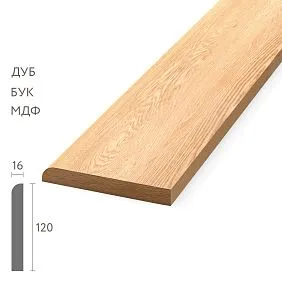


Three paths: painted, RAL, or for painting — what does it all mean?
Before choosing, it's important to understand what we're talking about. Three options — three fundamentally different approaches to coating the profile.




Painted MDF baseboard in enamel
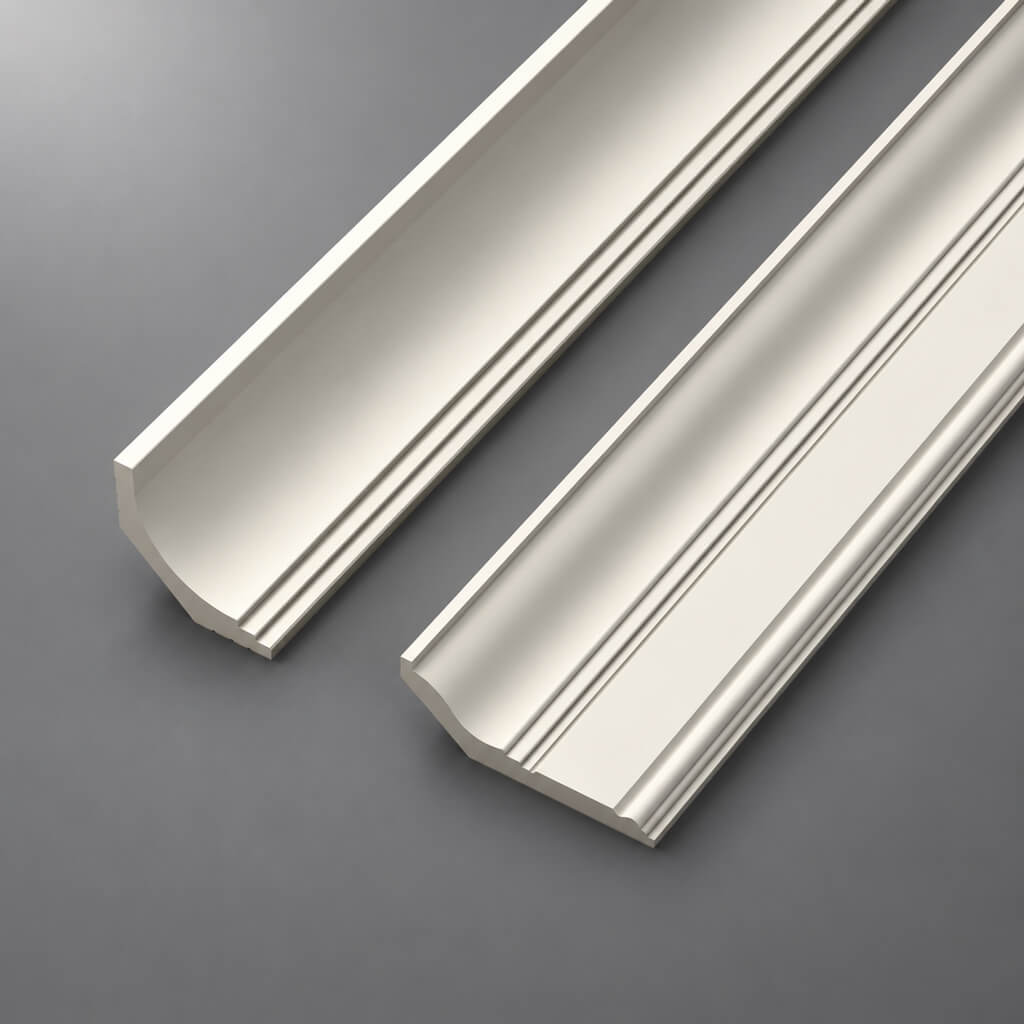
A painted MDF baseboard is a profile with a decorative coating applied under production conditions. Typically, it is acrylic or alkyd enamel applied in several layers with intermediate sanding. The surface is uniform, with a durable finish — matte, semi-matte, or satin.
This is a finished product: buy, install, done. No additional painting work required. That's why MDF enamel skirting board is the first choice for those who want a predictable result without extra steps.
There is one limitation: a ready-made color palette. The manufacturer offers several shades — typically white and a few basic neutrals — and you choose from them. If the desired shade doesn't match the ready palette, you'll either have to look for a paintable skirting board or accept a slight tonal discrepancy.
Our factory also produces:


MDF skirting board RAL
MDF skirting board RAL is an option where the profile is painted in a specific shade from the international RAL system. This is precise color addressing: each RAL code corresponds to a specific shade that is consistently reproduced. The designer or client specifies the code — the manufacturer paints it exactly in that color.
The RAL option is used in design projects, commercial interiors, and anywhere the color is agreed upon down to a specific code. It's not "white," not "gray," and not "graphite" — it's RAL 9003, RAL 7016, or RAL 6003: precise, reproducible, coordinated.
Get Consultation
MDF skirting board for painting
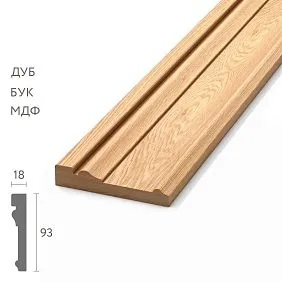
Buying MDF skirting board for painting means getting a profile with a prepared or primed surface that accepts any paint coating. You paint it yourself after installation or before, in any shade, with any enamel.
This is the most flexible option: there is no color limitation. A paintable skirting board is especially convenient when the renovation follows a design project with agreed shades, or when you simply need to paint everything with one color — walls, architraves, and skirting board — in a single painting pass.
How painted MDF skirting board differs from paintable skirting board: a detailed comparison
This question comes up in every other conversation about choosing a skirting board. You can answer it briefly — or in detail, taking into account all the nuances. Let's go into detail.
Ready for installation
Painted MDF skirting board is installed immediately after delivery. The surface is ready, the coating is applied, the shade is determined. The work cycle: delivery → installation → done.
A skirting board for painting requires an additional stage — painting. This is either a separate painting stage or combined with wall painting. Cycle: delivery → installation → painting → finish. Or: delivery → painting → installation → final touch-up of joints.
Shade accuracy
Here, the advantage is clearly on the side of the skirting board for painting. When you paint the skirting board with the same color as the walls, the shade will be identical. This cannot be guaranteed when purchasing a ready-made painted profile, even if the shade is called the same.
For design projects where color consistency is critical, a skirting board for painting is the only correct choice.
Coating durability
The factory coating of MDF skirting boards with enamel is usually applied in several layers with sanding between layers — this is technologically more complex than self-painting. Result: the factory coating is usually stronger and more uniform than painting on site in "field" conditions.
Self-painting is good if you understand the technology: surface preparation, correct primer, correct enamel, correct application. With a careless approach — drips, stains, uneven coating that will quickly start to peel.
Possibility of modification after installation
Here — a clear win for the painting option. Joints in corners, gaps near trims, marks from fasteners, small chips during installation — all of this is puttied, sanded, and painted over in a single finish color. After painting, installation defects become invisible.
On a painted skirting board, any refinement requires careful touch-up exactly in tone — which is difficult in "field" conditions without the original paint. Installation marks on a ready-made painted skirting board must either be removed immediately or tolerated.
Summary table: what to choose in which case
| Criterion | Painted in enamel | For painting | RAL |
|---|---|---|---|
| Ready for installation | Immediately | After painting | As painted |
| Color accuracy | Within the palette | Any shade | Exact code |
| Joint refinement | More difficult | Easy | As painted |
| For the design project | If the color matches | Ideally | Ideally |
| For quick repairs | Yes | No | No |
MDF enamel skirting board: when it's the right choice
The word "enamel" here is not just a technical term for the coating — it's a characteristic of the appearance. Enamel coating provides a dense, opaque, uniform finish. Unlike varnish or transparent coating, enamel completely hides the structure of MDF and forms a clean, smooth surface.
Why enamel is valued in interiors
An enamel skirting board looks neat, even, "store-bought" — in a good sense. Its surface reads as a professional finish, not a DIY paint job. In modern interiors with white doors, smooth walls, and a calm color scheme, it's the material that "falls into place" without extra effort.
MDF enamel skirting board works well:
-
in apartments with a ready-made white shade throughout the finish;
-
in offices where a uniform neutral finish is needed;
-
in corridors and hallways where the skirting board serves not only a decorative but also a protective function;
-
in rooms where there is no possibility to carry out painting work after installation during renovations;
-
when working with a short project deadline.
Matte enamel or semi-matte: which is better for baseboards
This is a question often asked but rarely explained correctly.
Matte enamel — a surface without gloss, calm and architecturally neutral. It fits well into modern interiors, does not glare under side lighting, and does not emphasize small surface imperfections. A matte finish forgives minor flaws.
Semi-matte / satin enamel — a light silky sheen that gives the surface a slightly more "premium" look. Such a surface is easier to clean and more resistant to mechanical wear. Under side lighting, the sheen may be noticeable — this should be considered when choosing.
Glossy enamel — a bright shine suitable for very specific interiors. For most modern apartments, a glossy baseboard looks out of place: it draws attention and highlights any surface irregularities.
Recommendation: for most modern interiors — matte or semi-matte enamel. Gloss only if it is a deliberate design choice.
White painted MDF baseboard: universal standard and its pitfalls
White painted MDF floor baseboard is the most popular item in the MDF baseboard category. And justifiably so: white works in most interiors, pairs well with a wide range of doors, walls, and floors, and is perceived as a neutral background element.
But white baseboards have several features you need to know before purchasing, not after.
Shades of White: Why It Matters
White in interior design is not just one shade. It's dozens of shades that are divided along two axes: warmth (warm/cold) and brightness (pure white/milky/ivory).
The most common conflict: doors in 'white silk' (warm milky) and baseboard in 'super white' (cold bright). Individually, both are beautiful. Together, there's an obvious discrepancy that immediately catches the eye at the junction of the baseboard and the trim.
That's why before buying a white MDF baseboard, you need to:
-
Take a sample of the door leaf or trim.
-
Hold the baseboard sample against it.
-
Check in daylight and under artificial light (they give different results).
If there's no sample, ask the seller for a 30–40 cm strip and check it on site before placing the main order.
White Baseboard and Dark Floor: Contrast with Care
White Painted MDF Floor Baseboard Against a dark parquet or dark porcelain tile, this is a strong contrasting solution. A white horizontal strip between a dark floor and walls of any color reads clearly. This is good when contrast is intentional. This is bad if the walls are dark and you want a smooth transition — then a white baseboard becomes a "screaming" break between dark surfaces.
Practical characteristics of a white painted baseboard
On a white surface, the following are noticeable:
-
dust and dirt — especially in areas near the entrance, in the kitchen, near children's rooms;
-
marks from mops and wet cleaning;
-
small chips, scratches — especially if furniture on wheels passes nearby;
-
yellowing in areas with high insolation (direct sunlight) — with low-quality coating.
For areas with high traffic — hallway, kitchen — it is better to choose a white enamel baseboard with a coating based on high-quality acrylic enamel: it yellows less and is easier to clean.
MDF baseboard RAL: precision as a design tool
The topic of RAL is one of the most underestimated in discussions about baseboards. Most buyers know this system in relation to paint for walls or metal structures. But an MDF baseboard RAL is a full-fledged working tool for design projects.
What is the RAL system and why is it needed
RAL is a European color standardization system that allows any shade to be designated by a numerical code. RAL 9003 is "signal white," pure and neutral. RAL 7016 is "anthracite gray." RAL 9005 is "jet black." Each code corresponds to a specific shade with known colorimetric parameters.
When a designer says "baseboard in RAL 9016" (white with a slight warm tint), it means: not just "white," but a precise, specific shade that can be reproduced on any material — on a door, baseboard, casing, molding — and achieve a uniform color field.
When to order a baseboard in RAL
Scenario one: a design project where all elements are coordinated by codes. In this case buy MDF skirting board in a specific RAL is the only way to match the project's color system exactly.
Scenario two: an apartment without a designer, but with non-standard doors. If the doors are ordered in RAL 7044 (silky gray), and the standard white baseboard doesn't match — you order a baseboard for painting and paint it in RAL 7044, or order a baseboard already painted in that shade.
Scenario three: a commercial space with a brand color. A restaurant, boutique, office with corporate colors — the baseboard becomes part of the room's color identity and must be exactly the right shade.
Scenario four: a baseboard in the color of the wall. If the walls are painted in a complex designer shade — dark green, mustard, graphite, terracotta — and you need to make the baseboard "invisible," blending it into the wall color, an exact RAL code is the only way to guarantee this.
What is important when ordering a baseboard by RAL
Always request a color sample — a small swatch in the desired color — before placing a full order. Screen color and real color may differ. A sample in hand under daylight is the only reliable way to check.
MDF baseboard for painting: when it delivers the best result
Let me ask a direct question: when a renovation follows a design project with agreed-upon shades, why risk using a pre-painted profile whose shade may differ slightly from the walls? Answer: there is no reason. That is why in serious projects, MDF baseboard for painting is the standard choice.
Scenarios where baseboard for painting is the best solution
Walls in a non-standard shade. If the walls are painted blue, green, terracotta, mustard, or any other neutral or designer color — a ready-made white baseboard will be a contrasting element that you either have to accept or redo. A baseboard for painting, painted in the same color as the walls, makes the bottom line of the wall seamless.
Doors and architraves for painting. If doors and Wooden casings are painted on site according to the design project, it is logical to paint the baseboard in the same cycle. A single painting pass — a single finished result. The color variation between elements of the same system is minimal.
Renovation with a designer. In projects where the designer controls every detail, MDF skirting board for painting, buy — is a standard recommendation. It is a tool, not a ready-made solution: you paint it exactly as the project requires.
The need to refine joints and corners. After installing the baseboard, there are always small gaps in the corners that are filled with sealant. If the baseboard is for painting, the sealant is puttied and painted in a single color. If the baseboard is pre-painted, the sealant must be matched exactly to the shade, which is difficult in practice.
MDF baseboard painting technology for painting
Correct sequence for self-painting:
-
Make sure the baseboard surface is dry and clean.
-
Apply a primer-isolator (especially important if painting in a dark shade).
-
Apply the first thin layer of acrylic interior enamel. Let it dry completely.
-
Lightly sand with 240-grit abrasive, wipe off dust.
-
Apply the final coat. Let it dry.
If the technology is followed, the result is a surface indistinguishable from a factory coating.
When to paint: before or after installation? If painting to match the wall color, it's usually more convenient to install the baseboard first, then paint it together with the walls. If painting a different shade, you can paint before installation, leaving the back side unpainted, and do final touch-ups at the joints after installation.
What to match the color of the painted baseboard to: logic of selection
The most frequent question after "painted or for painting" is "what color?" We answer systematically.
| Guide for selection | Effect | When it works |
|---|---|---|
| Wall color | The baseboard "dissolves", the wall is visually monolithic | Dark, saturated, or accent walls |
| In the color of the doors | The baseboard connects the doors with the lower contour | There are dark or colored doors |
| White (neutral) | Background element, universal | Bright interiors with white doors |
| Contrasting RAL | Deliberate accent | Loft, minimalism, contrasting scheme |
| Matching furniture color | Baseboard supports the lower zone | Large furniture against walls of the same shade |
The 'main element' principle
There is a simple rule: choose the baseboard to match the element it visually contacts first. If the doors are dark — match the doors. If the walls are dark and the doors are white — the solution is not obvious, you need to choose. If both walls and doors are light — white baseboard as a background element.
The second principle: the baseboard does not have to match the floor. This is a common misconception. The baseboard stands against the wall, not on the floor. It is logical to match it to the wall or the door, while the floor exists in its own system.
Baseboard in wall color: an architectural technique
When walls are painted in a rich or dark shade, and the baseboard is the same color — the wall "descends" all the way to the floor. The boundary between floor and wall disappears, and the wall is perceived as a monolithic volume. This technique is often used in modern projects with dark accent walls: dark green, dark blue, terracotta, gray.
For this effect, you need exactly an MDF baseboard for painting in the precise wall shade or a baseboard in RAL with the corresponding code.
Colored MDF baseboard in a modern interior
A colored MDF baseboard is not necessarily a bright accent. It is any shade different from standard white. Gray, graphite, greenish-gray, warm beige — all these are colored solutions that, in the right context, look significantly more interesting than neutral white.
In interiors with complex wall shades (which are becoming more common in modern design), a colored MDF baseboard in a matching shade is a way to make the finish cohesive rather than patchy.
Which profile to choose for a painted MDF baseboard
The profile shape and coating type are interconnected. Not every profile looks equally good in a painted finish.
Straight profile: ideal for painted
Straight MDF skirting board in painted finish is a classic of modern renovation. The straight rectangular shape showcases the coating without distracting details: a clean, uniform surface is visible, the horizontal line at the floor reads strictly and architecturally. Painted enamel on a straight profile is the perfect combination.
Straight painted skirting board works across the full spectrum of modern styles: Scandinavian, minimalism, contemporary, modern classic. It does not overload the interior, does not attract attention, and performs its role precisely and neatly.
Flat profile: delicacy of painted finish
Flat MDF skirting board in painted finish is an almost invisible detail that nevertheless is present. A thin strip with minimal projection in white or neutral enamel delicately marks the bottom line of the wall. This is a choice for interiors where nothing should distract — no decor, no details, no accents.
Shaped profile: enamel emphasizes the form
On a shaped profile, the painted surface works interestingly: the enamel evenly covers all relief elements and highlights them with light and shadow. Shelves, heels, radius transitions — everything reads more clearly on a uniformly white or uniformly colored enamel surface than on film or wood texture.
Painted shaped skirting board is classic and neoclassical. Paired with wooden moldings и with wooden cornices in the same shade, it forms a system of horizontal elements in the room.
Wide painted profile
A wide enameled baseboard is an architectural statement. 100 mm or 120 mm of painted surface near the floor carries significant visual weight. It requires a corresponding room scale (ceilings from 2.7–3 meters) and a well-thought-out interior.
In white enamel, a wide baseboard works in modern classics. In a dark painted shade, it works in spacious lofts, large living rooms, and high-end commercial spaces.
Mistakes when buying a painted MDF baseboard
This is not theory. This is practice that repeats from project to project.
They buy a white baseboard without comparing it to the doors
The most common and most frustrating mistake: a white baseboard is bought and installed, but next to the door frame it's obvious the shades are different. The door's "white" is warm, the baseboard's is cool — and at their junction, it's fully noticeable. Five minutes comparing samples under real lighting before purchase — and this situation doesn't exist.
They choose a baseboard for painting and forget to paint it
A baseboard for painting is installed, the renovation is nearing completion — and in the rush of the final stage, painting the baseboard is "forgotten" or postponed. The result: a gray primed baseboard among painted walls and doors. This scenario occurs more often than it seems. Painting the baseboard should be included in the painting plan as a separate item.
They choose an RAL color without a test swatch
"It looks good in the RAL catalog" — but on a real surface under real lighting, it can turn out noticeably different. Screens provide inaccurate color reproduction, especially for complex shades. A test swatch before ordering is a mandatory step for any non-standard RAL.
Choose a glossy finish for a modern interior
Glossy white enamel on baseboards is a legacy of Soviet renovations, when everything was painted with oil-based glossy paint. In a modern interior with matte walls and satin doors, a glossy baseboard looks outdated and inconsistent. Matte or semi-matte is the right choice for most modern interiors.
Don't check the shade under different lighting
The color under daylight and warm LED lighting gives different impressions. This is especially true for shades of white and neutral tones. Warm white under daylight may appear yellow under warm lighting. Cool white under bluish daylight may appear bluish. Check the sample under both types of lighting.
Don't account for cutting waste
A common mistake: buying exactly as much as calculated along the perimeter. As a result, after corners and cuts, 1-2 meters are missing. When ordering painted baseboards, it's not always possible to buy more from the same batch: the shade may differ slightly. A reserve of 8-10% of the perimeter is a mandatory minimum.
Don't plan the joint with architraves
Wooden casings In the door unit system, they must be coordinated with the baseboard in shade and thickness. If the architraves are for painting, it's logical for the baseboard to also be for painting, in the same painting cycle. If the architraves are already installed and painted, the baseboard is selected to match them.
What to buy together with painted MDF baseboard
A systematic approach is to order everything needed in one delivery. This preserves shade consistency and eliminates extra trips.
Wooden casings — in a finish coordinated with the baseboard or for painting in the same shade.
Wooden moldings — for wall panels, niches, and horizontal accent lines in the same color system.
wooden cornice — the upper horizontal element that, together with the baseboard, frames the space. In a painted finish — in the same shade.
Wooden planks — if the project includes slatted walls, the baseboard at their base should match the shade of the slats.
Decorative wooden lamination — for vertical accents in a color coordinated with the baseboard.
solid wood baseboard — if some rooms are finished in natural wood with a painted surface.
wood trim items — for a system order of all linear moldings in a unified color and production logic.
How to calculate the quantity of painted baseboard
The calculation is identical to the standard one, but with special attention to the reserve: for a painted profile, a shade mismatch when purchasing from a new batch is real and noticeable.
Formula: Room perimeter − Doorway width + 8–10% reserve
For multiple rooms, sum the perimeters of all rooms, then subtract all doorways, then add a margin. It's best to order the entire volume at once: painted baseboards from the same batch will have an identical shade. Buying "a little at a time" risks color mismatch.
Example: An apartment with a total perimeter of 85 meters, 6 doors of 0.9 meters each, total 85 − 5.4 = 79.6 meters. With a 10% margin: 79.6 × 1.1 = 87.6 meters → order 88–90 linear meters.
Final algorithm: how to make a decision
1. Determine whether you need a ready-made color or precise matching.
-
If a ready-made shade from the palette works → painted in enamel.
-
If precision matching a specific code is needed → RAL.
-
If you need freedom of choice on site → for painting.
2. Choose the profile. Straight or flat — for modern styles. Shaped — for classic.
3. Determine the height. Proportional to the ceiling and the scale of the room.
4. Calculate the quantity. Total perimeter − openings + 8–10% margin.
5. Include matching elements in your order. Architraves, cornices, moldings, fasteners — all in one system.
buy MDF skirting board in enamel, in RAL color or for painting with consultation on selection and quantity calculation — in the STAVROS catalog.
FAQ: popular questions about painted MDF skirting board
Which is better: painted MDF skirting board or one for painting?
There is no definitive answer — it depends on the task. Painted is convenient if the ready shade suits and a quick result is needed. For painting is better when an exact match with the shade of walls, doors, or furniture is required, or when the skirting board is painted in a single painting cycle with other elements.
What is an MDF skirting board in enamel?
This is an MDF skirting board with a decorative coating based on enamel applied under production conditions. The coating — matte, semi-matte, or satin — creates a uniform, neat finish ready for installation.
Can I order an MDF skirting board by RAL?
Yes. To do this, you need to specify the desired RAL code when placing the order. Before ordering, it is recommended to request a color swatch — a sample in the actual color — to check the match under real lighting.
Does a white painted MDF skirting board suit any doors?
Not always. White can be warm, neutral, or cool. If the doors are in a warm milky shade and the baseboard is in a cool super white, the difference will be noticeable at the joint. Before purchasing, you need to compare samples under real lighting.
Which profile is better for a painted MDF baseboard?
For modern renovations — straight or flat. For classic and neoclassical — shaped. A wide painted profile (100–120 mm) is for spacious rooms with high ceilings and design ambitions.
Can a painted MDF baseboard be repainted?
Yes, but with conditions. The surface needs to be sanded (120–180 grit), apply an insulating primer, then paint with enamel of the desired shade. Repainting from dark to light requires more thorough priming in several layers.
How much baseboard should I take with a reserve?
8–10% of the net perimeter. For painted baseboard, it is especially important to take the entire volume from one batch: the shade between batches may differ slightly, which is noticeable on the finished coating.
How to properly paint a baseboard for painting?
Prepare the surface (ensure it is clean and dry), apply an insulating primer, let it dry, apply the first thin layer of enamel, let it dry, sand with 240-grit abrasive, apply the final layer. Use acrylic interior enamel of the desired shade.
About the company STAVROS
When it comes to the baseboard coating — painted, RAL, or for painting — it is important that the profile has a proper base: precise geometry, quality MDF, a surface without defects that evenly accepts the coating and does not cause dips or stains after painting. This is a matter of production, not just the coating.
STAVROS manufactures MDF Skirting Board since 2002 at our own production facility in Saint Petersburg. The company's history began with restoration work on heritage sites — the Konstantinovsky Palace, the Hermitage, the Alexander Palace, the Trinity-Izmailovsky Cathedral — and it is this experience with materials where surface quality and precision of forms are paramount that forms the basis of our production standards.
Today STAVROS is a full-cycle production, showrooms in Saint Petersburg and Moscow, a finished goods warehouse, and Contact us to confirm shipping to your destination. The catalog includes painted and unpainted MDF Skirting Board, solid wood baseboard, Wooden casings, Moldings, rails, Crown Molding и wood trim items in a unified production and color system.
Over 264 reviews with a rating of 5.0. Shipment from one piece. Consultation on the choice of coating, color, and configuration is free.
STAVROS is a manufacturer whose painted baseboard looks exactly as it should.