Article Contents:
- Why skirting boards for the kitchen and hallway are chosen differently
- Which areas are considered problematic: risk map
- MDF skirting board in wet cleaning areas: honest pros and limitations
- What is MDF in the context of moisture
- When MDF skirting board is suitable for the kitchen
- MDF skirting board for painting: a special case
- White MDF skirting board: practicality in the hallway
- Limitations of MDF skirting board in water-prone areas
- Polystyrene baseboard: a practical choice for wet areas
- Key advantages of polystyrene baseboard
- Limitations of polystyrene baseboard
- Durapolymer baseboard: reinforced version
- Wooden baseboard: when it's appropriate in the kitchen and hallway
- What happens to wooden baseboard when exposed to moisture
- Wooden baseboard in the kitchen: yes or no?
- Wooden baseboard in the hallway
- What to choose for the kitchen: scenario breakdown
- Kitchen run area (along cabinets)
- Sink area
- Dining area and kitchen-living room
- Kitchen in warm natural finish
- What to choose for the hallway: practicality first
- Area near the entrance door
- High-traffic corridor
- Classic interior hallway
- Modern minimalist hallway
- How to protect joints, edges, and corners in problem areas
- Bottom seam (baseboard — floor)
- Top seam (baseboard — wall)
- Doorway ends
- External corners in the hallway
- Baseboard color for wet and high-traffic areas: practice vs. aesthetics
- White baseboard
- Gray skirting board
- Dark and black baseboard
- Baseboard for painting to match the wall
- Wood-look skirting board
- Comparative table of materials for wet areas
- Mistakes when choosing a baseboard for the kitchen and hallway
- What to buy for the kitchen and hallway: complete set
- FAQ: Answers to Popular Questions
- About the Company STAVROS
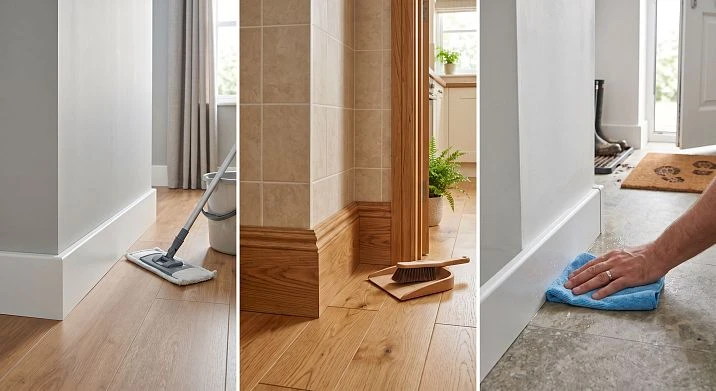
There are rooms where the baseboard lives a truly hard life. Not figuratively — literally. Every day: a wet mop along the bottom edge, drops near the sink, dirty shoes at the entrance, cleaning products, accidental hits from a bucket or vacuum cleaner. A bedroom or living room is a sanatorium for the baseboard. The kitchen and hallway are a testing ground.
And here, the choice of material becomes not an aesthetic, but an engineering decision. Baseboard MDF, Wooden baseboard, polystyrene skirting board — each of them has a different answer to the question: will it survive where the floor is washed every day?
This article is an honest and detailed analysis. Without advertising a specific material, but with clear recommendations for each zone and each usage scenario.


Why baseboards are chosen differently for the kitchen and hallway
In a calm bedroom, the baseboard is a decorative element. It is washed once a week with a dry cloth, at most slightly damp. There are no mechanical loads. There are no temperature changes. Such a baseboard lives easily and long.
The hallway and kitchen are a different story. The hallway encounters street dirt, wet soles in the off-season, frequent wet cleaning, accidental impacts from shoes, umbrellas, bags. The baseboard at the entrance literally works as the lower bumper of the space.
The kitchen adds to this: steam from the stove, grease drops near the lower cabinets, moisture near the sink, frequent cleaning with detergents, sometimes standing water on the floor near the dishwasher or after washing.
A baseboard for wet cleaning must meet several parameters simultaneously:
-
Not swell or deform upon contact with water
-
Maintain the coating when exposed to household chemicals
-
Withstand mechanical impacts in walk-through areas
-
Easy to clean without damaging the surface
-
Not lose shape at joints and corner connections
No material is perfect in every aspect at once. But each has its own area of confident application.




Which areas are considered problematic: risk map
Before choosing a material, you need to understand what specific risk you are dealing with.
Entryway and corridor at the entrance. The main threat is mechanical impacts and dirty water from shoes. Cleaning is frequent, sometimes with detergent. The baseboard here should be impact-resistant and easy to clean.
Kitchen near lower cabinets. Grease, household chemicals, sometimes water drops when washing the floor. The baseboard along the kitchen row is in a zone of constant chemical exposure.
Kitchen near the sink and dishwasher. The wettest spot. Here water can stand on the floor, seep along the wall. Maximum requirements for moisture resistance.
Area near the balcony door. In the off-season, constant dampness, moisture from rain, condensation. The baseboard here is often wet.
High-traffic corridor. In private homes, offices, and commercial spaces, the baseboard is subject to frequent mechanical impacts. Impact resistance is required.
Open-plan kitchen-living room. Conditional transition zone: near the sofa it's calm, near the kitchen island it's a different mode. Here, a unified baseboard line is important despite different requirements for different areas.
Our factory also produces:
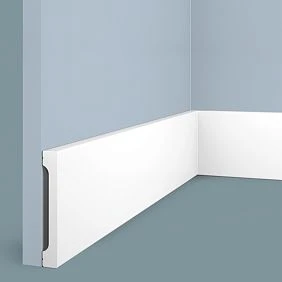
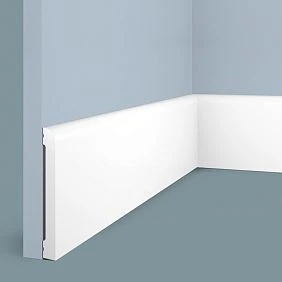
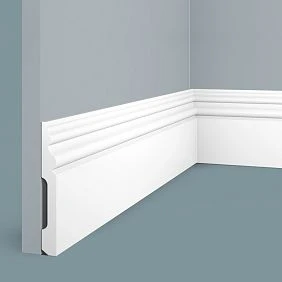
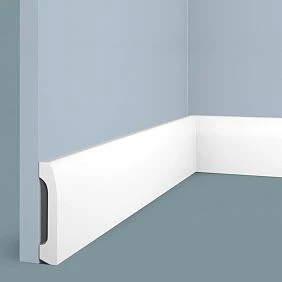

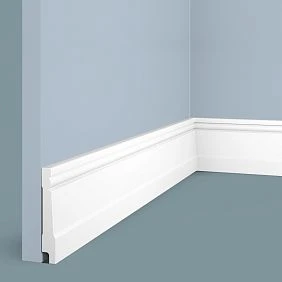
MDF baseboard in wet cleaning areas: honest pros and limitations
MDF Skirting Board — one of the most popular choices for residential spaces. It looks good, mills well, accepts any coating and paint. But MDF has a fundamental feature that is important to understand before purchasing.
Get Consultation
What is MDF in the context of moisture
MDF (Medium Density Fibreboard) is a medium-density fiberboard. Its base is ground wood fibers pressed under pressure with a binder. The density of quality MDF for baseboards is 820–860 kg/m³.
Problem: the open fiber of MDF absorbs water well. If the baseboard gets wet in an unprotected area — end, cut, miter joint, untreated bottom edge — moisture penetrates the structure and local swelling begins.
But: MDF baseboard with a high-quality decorative coating of full encapsulation (polyester film or enamel) is protected on all visible sides. Vulnerable points are only the ends and miter cuts.
When MDF baseboard is suitable for the kitchen
In the kitchen in the living area (not near the sink) — MDF Skirting Board quite appropriate under several conditions:
-
The bottom seam between the baseboard and the floor is sealed with acrylic sealant
-
The ends at doorways and corners are painted with special paint or covered with additional elements
-
Cleaning does not involve standing water near the wall
-
The baseboard is not located directly next to the sink
More details on proper treatment of cuts and ends — in the article sealant, putty, and touch-up paint for MDF baseboard.
MDF baseboard for painting: a special case
— is a horizontal element that frames the room at the bottom of the walls where the wall meets the floor. Skirting boards perform several functions: they hide the technological gap between the wall and floor covering (necessary for thermal expansion), protect the lower part of the wall from mechanical damage, create visual completion, and may conceal wiring. in the kitchen or hallway — a working solution, but only with proper priming and application of a final coat of enamel. A properly painted MDF baseboard for painting is almost as moisture-resistant as a factory coating.
Important: primer is mandatory. Paint is applied in 2–3 coats. Ends and cuts require separate treatment.
White MDF baseboard: practicality in the hallway
White MDF Skirting Board In the hallway, it's a beautiful but high-maintenance solution. The white surface instantly shows streaks from the mop, gray dust and dirt buildup at the base. Not a mistake, but you need to be prepared for regular wiping.
Alternative: a white baseboard with a matte finish hides marks better than a glossy one.
Limitations of MDF baseboard in areas with water
It is not recommended to install MDF baseboard:
-
Directly near the sink (water drips regularly)
-
Near the dishwasher with potential leaks
-
In the area by the balcony where the floor is wet during the off-season
-
In rooms with high humidity and no ventilation
In these spots, the MDF baseboard will eventually start to swell at the base — even with a quality coating, because water finds its way through the bottom edge.
Polystyrene baseboard: a practical choice for wet areas
Polystyrene floor baseboard is made from impact-resistant polystyrene or foamed polyurethane. It fundamentally differs from MDF in its relationship to moisture: water is indifferent to it.
Main advantages of polystyrene baseboard
Complete moisture resistance. Polystyrene does not absorb water. It can be washed with a direct stream, withstands standing water at the base, does not swell or deform. For the kitchen near the sink, hallway, and corridor, this is a key advantage.
Resistance to household chemicals. Floor cleaning products do not damage polystyrene. MDF with a quality coating also handles it, but is more vulnerable to concentrated chemicals.
Easy to clean. The smooth surface of the polystyrene baseboard does not collect residue and wipes clean with one motion of a damp cloth.
Can be painted. polystyrene skirting board for floor accepts water-based paint and acrylic enamel — this allows you to precisely match the desired shade.
Impact resistance. Impact-resistant polystyrene withstands mechanical impacts better than thin MDF profile. In the hallway with regular shoe impacts, this is a real plus.
Limitations of polystyrene skirting board
Less decorative depth. Polystyrene does not provide the same "weight" and naturalness as MDF or wood. In tactile and visual contact, it is perceived as a lighter material.
Sensitive to temperature. With sudden temperature changes (balcony area in winter), polystyrene may cause slight deformation on long walls.
Limited profile range. Decorative options with detailing in polystyrene are poorer than in MDF. But for practical areas, this is not critical.
For a comparison of materials across all parameters, see the detailed overview MDF or polystyrene skirting board.
Duropolymer skirting board: reinforced version
Duropolymer (rigid polyurethane foam) is a denser and heavier material than expanded polystyrene. It more accurately imitates wood and plaster when profiling, is resistant to moisture and mechanical stress. For the kitchen and hallway in a classic or neoclassical interior, it is a suitable alternative.
Comparison of MDF and duropolymer by key parameters — in a separate article MDF or duropolymer skirting board.
Wooden skirting board: when appropriate in the kitchen and hallway
Wooden baseboard — a material with character. It is warm, natural, expressive. But it has a fundamental limitation: wood lives and reacts to moisture.
What happens to a wooden baseboard when exposed to moisture
Natural wood swells when it comes into contact with water. When it dries, it shrinks. This is a natural process that, with regular wetting, leads to deformation, cracking of the varnish, and loss of geometry.
But: a wooden baseboard with proper finish protection — multi-layer varnish, hard oil, or alkyd enamel — is significantly more resistant to household moisture than an unprotected board. The question is how often and how intensely it gets wet.
Wooden baseboard in the kitchen: yes or no?
The answer depends on the zone. Near a kitchen island or dining area, where floor washing is standard cleaning without standing water, a wooden baseboard can last for years. Near a sink or dishwasher, the risk is higher.
Rule: a wooden baseboard in the kitchen — only with high-quality varnish or oil finish treatment, and only where there is no direct regular contact with water.
For warm natural kitchens with parquet or solid wood — buy wooden baseboard for floor and treating it properly is significantly better than installing polystyrene, which will clash with the natural surroundings.
Wooden baseboard in the hallway
In the hallway, a wooden baseboard is appropriate under two conditions: good finish protection and regular maintenance. If the hallway often has a wet floor during the off-season, a wooden baseboard will suffer at the base faster than polystyrene or protected MDF.
For a hallway with parquet or engineered wood — wooden wooden baseboard creates a unity of material that justifies the increased maintenance.
What to choose for the kitchen: breakdown by scenarios
The kitchen is not a uniform space. Different zones require different approaches.
Kitchen run zone (along the cabinets)
Here, the baseboard is subject to regular cleaning with detergent, possibly grease drops and accidental splashes. Requirements: moisture-resistant coating, easy cleaning.
Optimal options:
-
MDF Skirting Board with a quality coating and sealing of the bottom seam — under moderate humidity
-
Polystyrene baseboard — with active cleaning using water
-
— is a horizontal element that frames the room at the bottom of the walls where the wall meets the floor. Skirting boards perform several functions: they hide the technological gap between the wall and floor covering (necessary for thermal expansion), protect the lower part of the wall from mechanical damage, create visual completion, and may conceal wiring., painted to match the kitchen fronts or wall — for a minimalist look
Area near the sink
The most vulnerable spot in the kitchen. A moisture-resistant baseboard is needed here without any reservations.
Optimal choice: polystyrene skirting board for floor or duropolymer with mandatory sealing of the top and bottom seams. MDF here — only with absolutely reliable sealing and regular monitoring of joint condition.
Dining area and kitchen-living room
In the dining area, the conditions are like in the living room. The baseboard here can be chosen based on aesthetic criteria — MDF, wood, paintable. It's only important to maintain a consistent line with the kitchen part.
Practical solution for an open-plan kitchen-living room: a single white MDF baseboard around the entire perimeter, with more thorough sealing near the kitchen row and sink.
Kitchen in warm natural finish
If the kitchen is made with wooden facades, parquet, or solid wood, warm textures — Wooden baseboard here polystyrene is more appropriate. Natural wood in a natural interior — this is the logic of the material, not a whim.
Condition: thorough final treatment + sealing of the bottom seam near the sink.
What to choose for the hallway: practicality first
The hallway is the most "battle-tested" zone for baseboards in an apartment.
Area near the front door
This is a place of daily contact with street shoes, wet umbrellas, and bags. The baseboard here receives impacts, water droplets, and dirt.
Best choice: Impact-resistant polystyrene baseboard or MDF with a lower edge protected by sealant. Baseboard height — at least 70 mm: a narrow profile near the entrance suffers more from mechanical impacts.
Color: white is beautiful but requires frequent wiping. Gray, light beige, or a baseboard for painting to match the wall color is more practical: cleaning marks and small scratches are less noticeable.
High-traffic corridor
In a long corridor with constant traffic, the baseboard receives impacts from vacuum cleaners, furniture, bicycles, and scooters. Impact resistance of the profile is especially important here.
Best choice: Impact-resistant polystyrene or MDF with a profile height of 80–100 mm. A wider profile better "absorbs" touches from furniture and appliances.
Hallway in a classic interior
If the hallway is designed in classic or neoclassical style, with wooden doors, baguettes, and decorative trim — a wooden baseboard is logical here. It supports the character of the space. The same condition applies: final protection and regular maintenance.
Hallway in a modern minimalist style
For quartz vinyl or SPC in the hallway — a straight, laconic MDF profile for painting (matching the wall color) or white MDF. Joints are sealed. Edges are painted.
How to protect joints, edges, and corners in problem areas
The baseboard in the kitchen and hallway "leaks" moisture precisely where there are unprotected connections. Let's break down the key points.
Bottom seam (baseboard — floor)
In areas with wet cleaning — the bottom seam between the baseboard and floor must be sealed with acrylic sealant. This prevents water from seeping under the baseboard. The sealant is applied in a thin, even line, smoothed with a finger or spatula, and dries in 2–4 hours.
Important: acrylic sealant (not silicone). Silicone — cannot be painted, it's hard to disguise.
Top seam (baseboard — wall)
The top seam is also sealed in areas with active cleaning. Kitchen walls often have textured finishes — the gap between the baseboard profile and the wall is closed with a thin line of sealant for painting or under the baseboard.
Ends of door openings
The open end of an MDF baseboard is the most vulnerable point. Moisture penetrates exactly here. Solutions:
-
The end is painted with paint matching the baseboard immediately after cutting
-
A vertical one is installed Wooden angle at the door opening, covering the end
-
The end is impregnated with primer before installation
For polystyrene baseboard, the end is not a problem: moisture does not pass through it.
External corners in the hallway
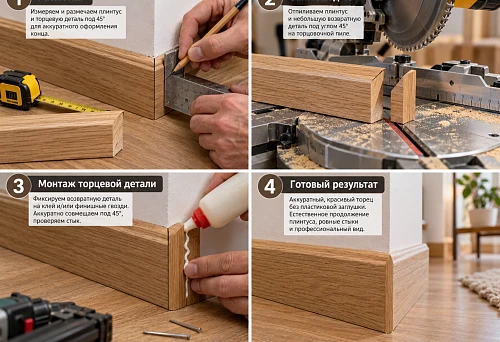
In the hallway, there are often protruding corners at built-in cabinets or niches. The external corner is the place of greatest mechanical stress. For MDF — a neat 45° cut with painting. With frequent impacts — Wooden angle as an overlay protective element.
About how to properly make joints and corners for different types of baseboards — in the guide to installing MDF skirting boards.
Baseboard color for wet and high-traffic areas: practice vs. aesthetics
The color of the baseboard in the kitchen and hallway is not just a design question. It's a question of how quickly the baseboard will 'require' cleaning and how long it will stay looking tidy.
White baseboard
White is an eternal classic. Clean, light, neutral. But in the hallway, a white baseboard is a challenge: gray residue at the base, shoe marks, mop streaks are instantly visible.
Choosing a white baseboard for the hallway and corridor is worth it if you are ready for regular cleaning of this particular element. A white MDF baseboard in the kitchen is more appropriate: cleaning is frequent here anyway, and the white profile fits organically into a light kitchen interior.
Gray skirting board
Gray is the most practical color for wet and high-traffic areas. Cleaning marks are less noticeable, dust does not contrast. With light walls, a gray baseboard looks modern and calm.
For a hallway with SPC flooring imitating concrete or gray stone, a gray baseboard creates a monolithic space without unnecessary accents.
Dark and black baseboard
A dark baseboard in the hallway and kitchen is stylish, but its practicality is ambiguous. Dirt is less noticeable on a dark baseboard than on a white one. But white dust, limescale from water, and detergent marks are clearly visible on a dark surface.
A black baseboard in a black-and-white hallway is a confident design choice. In an ordinary apartment, it requires a deliberate decision.
Baseboard painted to match the wall
Ideal solution for kitchen-living rooms and modern hallways: baseboard For painting painted exactly to match the wall and visually 'disappears'. Dirt on it is no more noticeable than on the wall. Cleaning is standard.
Wood-look baseboard
For a kitchen with wooden facades — a wood-look or natural wooden baseboard creates unity. The warm wood tone hides cleaning marks better than white.
Comparison table of materials for wet areas
| Parameter | MDF | Polystyrene | Wood |
|---|---|---|---|
| Moisture resistance | Medium (higher with sealing) | High | Medium (depends on protection) |
| Impact Resistance | Medium | High | High |
| Decorativeness | High | Medium | High |
| Painting | Yes | Yes | Yes |
| Care | Lightweight | Very light | Requires attention |
| Ends when wet | Vulnerable | Neutral | Vulnerable |
| Price | Medium | Low–medium | Medium–high |
| Best use | Kitchen (not near the sink), hallway | Entryway, area near the sink | Kitchen with natural flooring |
Mistakes when choosing baseboards for the kitchen and entryway
1. Choosing only by color, without thinking about cleaning. A beautiful white baseboard in the entryway will look gray at the base after a month — if you're not ready to wipe it down after every cleaning.
2. Installing MDF where there will be constant water. The area near the sink, near the dishwasher, near the balcony door during the off-season — here, MDF without very reliable sealing will start to swell from the bottom within a year.
3. Leaving untreated ends. An open end of an MDF baseboard near a doorway in the kitchen or entryway is a matter of a few months before visible damage. Ends are always treated.
4. Not considering the mechanics of the entryway. Shoes, bags, vacuum cleaner, umbrellas — all of this hits the baseboard in the entryway daily. Choosing a fragile thin profile for the entrance area is a mistake.
5. Choosing a profile that is too narrow. A baseboard 40 mm high in the entryway visually gets lost and poorly protects the bottom line of the wall. The minimum for the entryway is 70 mm.
6. Not thinking through the joint at the door. The hallway baseboard meets the corridor baseboard at every doorway. If they differ in height or material, the joint looks sloppy.
7. Using silicone sealant where acrylic is needed. Silicone cannot be painted, it yellows over time, and is difficult to remove. Acrylic sealant is the right choice for baseboard joints.
8. Forgetting about spare material. For corners, ends, and trimming, you need a 10–15% reserve. In a hallway with many corners, niches, and doors — 15%.
What to buy for the kitchen and hallway: a complete set
MDF Skirting Board — for the kitchen in a living area, a corridor with moderate humidity. A profile 70–100 mm high with mandatory sealing of joints.
— is a horizontal element that frames the room at the bottom of the walls where the wall meets the floor. Skirting boards perform several functions: they hide the technological gap between the wall and floor covering (necessary for thermal expansion), protect the lower part of the wall from mechanical damage, create visual completion, and may conceal wiring. — for a kitchen-living room and modern hallways where you need to blend the baseboard with the wall color. Priming and painting in 2 coats are mandatory.
polystyrene skirting board — for a hallway with active wet cleaning, the area near the sink, a corridor with high traffic. The first choice where practicality is important.
Wooden baseboard — for a kitchen with natural finishes, a hallway with parquet. Final protection is mandatory.
Wooden corner bracket — for finishing external corners and ends at doorways. Protects vulnerable points of MDF baseboards from moisture and mechanical impacts.
wooden molding — for decorative transitions and frame solutions in kitchens with classic facade design.
Trimming Items — a full range of wooden linear profiles for comprehensive design of a hallway, corridor, or kitchen in a single material.
Please note: for kitchens and hallways where the baseboard is installed after flooring, it is important to correctly calculate the length with allowance for corners and trimming. Detailed method — in the material how to calculate MDF baseboard.
If the walls in the kitchen or hallway are uneven — before installation, it is worth reviewing the recommendations in the guide MDF baseboard for uneven walls.
FAQ: Answers to popular questions
Can MDF baseboard be installed in the kitchen?
Yes, but with conditions. In the living area of the kitchen (not near the sink) — MDF baseboard is quite appropriate when sealing the bottom and top seams and treating the ends. In the area near the sink or dishwasher — it is better to choose polystyrene.
Which baseboard is best for a hallway?
For a hallway with active cleaning and mechanical loads — impact-resistant polystyrene baseboard. For a hallway with parquet and natural finishes — wooden baseboard with final protection. For a modern minimalist interior — MDF for painting with sealing.
What is better for wet cleaning: MDF or polystyrene?
In terms of moisture resistance — polystyrene definitely wins. MDF requires additional protection of seams and ends. If cleaning is daily and active — polystyrene is more practical. If cleaning is standard and with a dry cloth — MDF is sufficient.
Is wooden baseboard suitable for the kitchen?
Suitable for areas without direct contact with water. A mandatory condition is multi-layer final protection (varnish or oil). It is better not to install a wooden plinth near a sink.
Which plinth to choose for the front door?
Impact-resistant profile with a height of 70–100 mm. Material: polystyrene (more practical) or MDF (more expressive) with sealing of the bottom joint. Color: gray, beige, or for painting, more practical than white.
Can the kitchen plinth be painted?
Yes. MDF plinth for painting is painted with acrylic enamel in any color. Polystyrene plinth also accepts water-based paint. Wooden plinth — with alkyd or acrylic enamel.
Immediately after cutting, apply primer or paint matching the plinth color to the exposed cut. Install a wooden corner as an overlay element at the doorway. Seal the seams at the end with acrylic sealant.
Immediately after cutting, apply primer or paint matching the baseboard color to the exposed cut. Install a wooden corner as an overlay trim element at the doorway. Seal the end joints with acrylic sealant.
Gray is the most practical: it does not show dust, combines well with most floor coverings and neutral walls. Plinth for painting in the wall color is ideal for minimalist interiors. White is beautiful but requires regular wiping.
Gray is the most practical: it doesn't show dust, pairs well with most flooring and neutral walls. Baseboards for painting in the wall color are ideal for minimalist interiors. White is beautiful but requires regular wiping.
About the company STAVROS
Choosing a plinth for the kitchen or hallway means choosing something that will work in the toughest operating conditions. You cannot make a mistake with the quality of the coating, profile geometry, and material stability.
STAVROS manufactures MDF skirting boards and wooden baseboards with control of base density, finish layer quality, and geometry stability. The catalog includes white MDF baseboard with factory enamel, baseboard for painting, solid wood baseboard, corners, moldings, and Trimming Items for any finishing tasks. Full range, current MDF baseboard price, and the ability to order with delivery — on the STAVROS website.