Article Contents:
- What to buy for an open shelf: a complete set from the first time
- Load-bearing wooden elements
- Polyurethane items for the wall area
- Consumables
- The shelf and the wall around it: two objects — one system
- What does “shelf as part of the wall” mean
- Wood holds, polyurethane decorates
- Where open shelves work best
- Kitchen: the shelf as a functional and decorative object
- Living room: shelf as a decorative showcase
- Study and home library: shelf as a working tool
- Hallway: shelf for specific tasks
- Niche: shelf as a built-in element
- Area above the console: double decorative axis
- Wooden brackets: characteristics and selection
- Shape and silhouette: the main question
- Load calculation: what you need to know
- Wood species: selection by task
- Polyurethane on the wall: architecture around the shelf
- Molding frame: creating a "portal"
- Corner overlays in the frame
- Keystone: accent at the top
- Horizontal rods: connection with the wall system
- Ready-made kits by zone type
- Kitchen shelf: function and warmth
- Living room shelf: decorative display
- Office shelf: minimalism and dignity
- Shelf in a niche: built-in solution
- Shelf above the console: two axes — one system
- Mistakes when choosing brackets and wall decor
- Mistake 1: bracket chosen for looks, not load capacity
- Mistake 2: not accounting for shelf depth
- Mistake 3: forgetting the fasteners
- Mistake 4: not matching the shelf with wall moldings
- Mistake 5: using polyurethane as a load-bearing element
- Mistake 6: two active decor elements at once
- Mistake 7: not considering kitchen humidity
- Mistake 8: forgetting material allowance
- Finish: one surface or two characters
- First scenario: uniform color
- Second scenario: natural wood, moldings matching the wall color
- Additional scenarios: coffee corner, decorative display case, library section
- Coffee corner with open shelf
- Decorative display case with shelves
- Library section: multiple shelves in a single vertical system
- About the Company STAVROS
- FAQ: Answers to Popular Questions
- Which brackets to choose for an open shelf in a classic interior?
- Can you combine wooden brackets and polyurethane molding?
- What to buy for an open shelf in a classic style?
- Where should polyurethane not be used on a shelf?
- How not to overload the shelf area with decor?
- How to correctly calculate the number of brackets?
- Which finish to choose for wooden shelf elements?
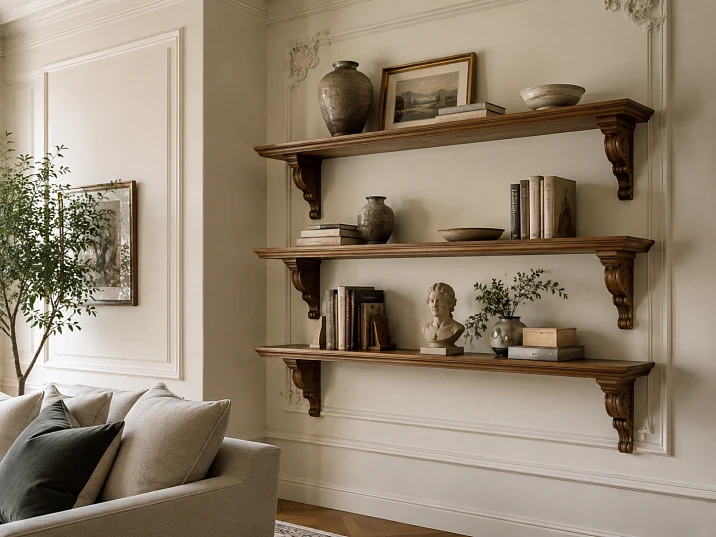
An open shelf is one of those rare interior items that simultaneously bears a load and creates a mood. It stores books, dishes, bottles, plants, beloved items — and is constantly in sight. That is why open shelves in a classic style require special attention: it is not enough to simply attach a board to the wall. Everything matters here — both how it is held and how the area around it looks.
Wooden Brackets create a load-bearing foundation: they take the weight, set the proportions, and are themselves a decorative element. Moldings made of polyurethane decorate the wall area around — turning a separate shelf into an architectural composition. When these two materials work together, an open wall shelf ceases to be just furniture and becomes part of the room's interior language.
This article is for those who want not just to hang a shelf, but to create a complete decorative zone.
What to buy for an open shelf: a complete set the first time
Nothing is as annoying as three extra trips for forgotten little things. So let's start with a complete list — from load-bearing elements to the last jar of primer.




Load-bearing wooden elements
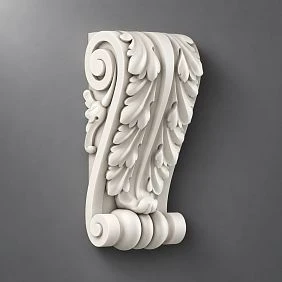
Wooden Brackets — the main load-bearing and decorative element of an open shelf. The bracket bears the entire vertical weight of the shelf with its contents and transfers it to the wall through the mounting points. For a classic interior, profiled brackets made of beech or oak with a figured cutout are best suited — their silhouette itself reads as a decorative object and does not require additional decoration.
The bracket size is chosen according to the shelf depth: standard shelf depth 200–250 mm — bracket overhang 180–220 mm. For a shelf 300 mm deep — bracket overhang 260–280 mm. The number of brackets depends on the shelf length: up to 60 cm — two brackets, 60–120 cm — three brackets, more than 120 cm — a bracket every 50–60 cm.
Shelf board — made of the same or similar solid wood as the brackets. Beech, oak, ash. Board thickness — 20–30 mm for loaded shelves. Width — according to the task: 150, 200, 250, or 300 mm.
Pogonazh iz massiva — for edging the shelf end, side strips, as well as for horizontal bumper elements above and below the shelf, if it is built into a frame decorative system. Molding with a profiled section adds a furniture character to the shelf end.
Wooden decoration — carved and milled overlays for enriching the shelf end or the front faces of the brackets. An overlay with a floral ornament on the vertical plane of the bracket makes it truly classic.
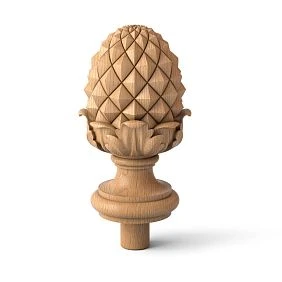
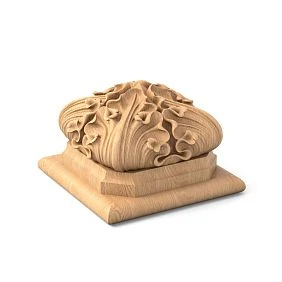
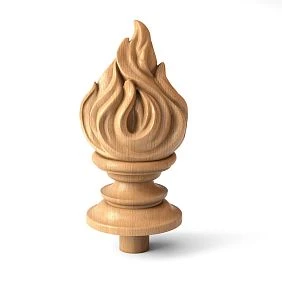
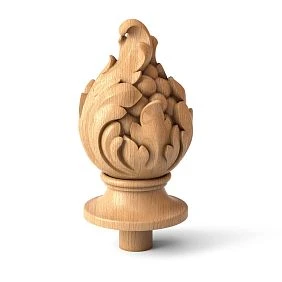
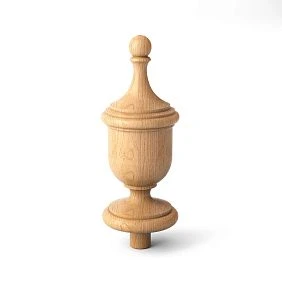
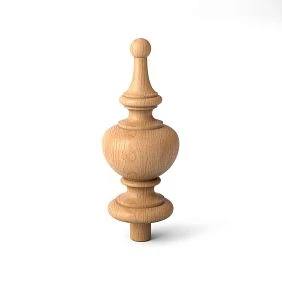
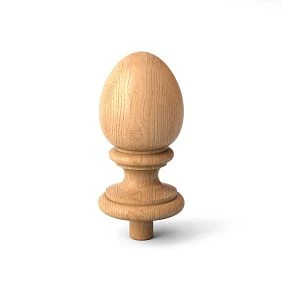
Our factory also produces:

Polyurethane items for the wall area
Moldings made of polyurethane — for a molding frame on the wall around the shelf or for horizontal rods above and below the shelf area. The molding forms a decorative "portal" in which the shelf lives — like a painting in a frame.
Polyurethane appliqués — corner decorative elements at the intersection points of molding rods. Decor for Molding — keystones, bracket overlays above horizontal rods. Polyurethane wall decor — for an expanded decorative area, if the shelf is part of a larger wall composition.
Get Consultation
Consumables
Dowels 8×80 mm — for attaching brackets to the wall. Self-tapping screws for connecting the shelf board to the brackets. Finish nails — for trim details. Polyurethane glue (selection and application technology — in the article what to glue polyurethane molding with). Acrylic sealant — for joints of moldings with the wall. Acrylic primer. Finish enamel for painting or oil and wood varnish. Reserve for all profiles and moldings — 10–15%.
The shelf and the wall around it: two objects — one system
This is a fundamental point that distinguishes a simply "hung shelf" from a thoughtful interior solution. An open shelf in a classic style is not an isolated piece of furniture. It is an element of wall architecture.
What does "shelf as part of the wall" mean
In a classic interior, the wall is a system of horizontal and vertical lines: a baseboard at the bottom, a cornice or molding belt at the top, vertical rods or frame panels between them. The shelf should be integrated into this system — not disrupt it. The horizontal line of the shelf end coincides with the molding belt on the wall or continues it. The molding frame around the shelf matches the relief of adjacent wall panel frames.
If there is no molding system in the room, the shelf with brackets and wall decor itself becomes the starting point of this system. Horizontal rods from the molding frame of the shelf diverge to the right and left along the wall — and the wall begins to acquire an architectural rhythm.
Wood holds, polyurethane decorates
The separation of functions is fundamental. decorative bracket made of solid wood holds the shelf board — this is its first task. The second is to be beautiful. But the load-bearing function is always primary. Polyurethane moldings and overlays on the wall do not bear any load — they are purely decorative. That is why polyurethane cannot be used as a replacement for a bracket: polyurethane does not hold weight, it holds beauty.
Where open shelves work best
Kitchen: the shelf as a functional and decorative object
The kitchen is the most practical place for an open shelf. Spices, oils, bottles, beautiful jars — all of this creates a living decorative display that changes with every dish. In the kitchen, the shelf works daily: items are taken from it, placed on it, and reached for.
For a kitchen shelf, wooden brackets made of beech are the optimal choice. Beech is dense, holds fasteners well, and can withstand the weight of dishes and heavy bottles. Finish: oil or hard wax — they do not form a film, are easy to renew, and hold up well in high humidity. A molding frame on the wall around the kitchen shelf — made of polyurethane, which is resistant to humidity and grease when properly coated.
An important nuance: the kitchen shelf above the work area must be measured. The height of the lower plane of the shelf above the countertop level should be at least 45–50 cm. Too low — it hits the head. Too high — inconvenient to reach.
Living room: the shelf as a decorative display
In the living room, open shelves are primarily a decorative object. They can hold books, objects, art pieces, vases, candles. Here, the decorative aspect of the bracket is no less important than its load-bearing function. Furniture Bracket with a figured profile — a figured cutout, S-shaped silhouette, or a bracket with an applied ornament — itself becomes an object of contemplation.
In the living room above the sofa, above the console, on either side of the fireplace or mirror — each of these places allows you to create a full-fledged decorative wall zone. A frame system made of of polyurethane moldings around the shelf turns this section of the wall into something close to an architectural niche — only without depth.
Study and Home Library: Shelf as a Working Tool
In a study, a shelf carries books. This is a different load — uniform, high, and constant. For a study bookshelf, special rigidity is important: the shelf board should be no thinner than 25–30 mm, brackets spaced no more than 50 cm apart. For a long study shelf, three or four brackets are normal.
The decor of a study shelf is strict. The bracket profile is moderate, without excessive carving. decorative elements for furniture — sparse: a horizontal molding strip above and below the shelf, minimal framing. A study is a place for concentration, not decorative abundance.
Entryway: Shelf for Specific Tasks
In the entryway, an open shelf is a functional object: keys, phone, letters, small items. The shelf height is 150–170 cm from the floor (at eye level). Brackets are compact, without bulky carved decor, so as not to overload an already busy space. The wall area around the shelf is a simple molding frame made of polyurethane decor without corner pieces. The handle is clear, the geometry is precise.
Niche: Shelf as a Built-in Element
A niche is an ideal place for an open shelf. The niche walls themselves create a frame for the shelf, and the decor task is minimized: Pogonazh iz massiva along the perimeter of the niche's inner contour, a shelf on brackets inside, a thin molding along the outer perimeter of the niche opening. With this system, the shelf in the niche looks like part of the furniture, not like an element "inserted" into the wall.
Area above the console: double decorative axis
A console in the hallway or living room creates a horizontal axis at a height of 75–80 cm. An open shelf 50–60 cm higher creates a second axis. The space between the console and the shelf is a decorative area: mirror, painting, wall lamp. A molding frame made of of polyurethane moldings unites the console, mirror, and shelf into a single wall composition.
Wooden brackets: characteristics and selection
Shape and silhouette: the main question
The shape of the bracket determines the character of the entire area. Three typical silhouettes for a classic interior:
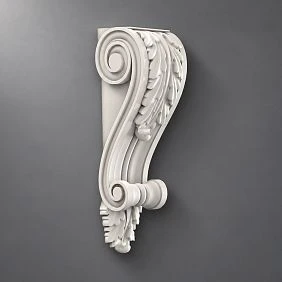
S-shaped bracket — a smooth double curve with a horizontal support platform and a vertical mounting plate. Elegant, visually light, suitable for small shelves with moderate load (up to 15–20 kg per pair of brackets).
Cantilever triangular bracket with a brace — a straight vertical element, a straight horizontal shelf, and a diagonal brace between them. Durable, geometrically strict, carries a heavy load. It may have a straight milled profile along the brace contour — this is a classic furniture option.
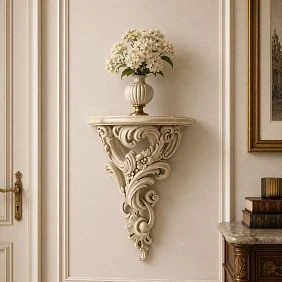
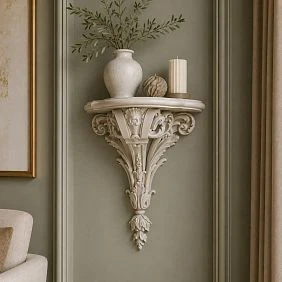
Figural bracket with carved decor — a complex silhouette with floral or geometric ornamentation on the front plane. This is no longer just a load-bearing element — it is a sculptural object. Such a bracket is appropriate in a rich classic interior where details matter. Wooden decoration in the form of applied rosettes or ornamental strips on the vertical plane of the bracket further enriches its surface.
Load calculation: what you need to know
A wooden bracket supports the load through attachment points to the wall — dowels in the load-bearing structure. The critical load is not the weight of the bracket and shelf itself, but the total weight of the shelf's contents. For a kitchen shelf with dishes and jars, the load easily reaches 30–40 kg. For a bookshelf — 25–35 kg per meter. For a decorative shelf in the living room — 5–15 kg.
Rule: the bracket must be designed with a safety factor of 2× the expected load. Two 200 mm long beech brackets, fastened with 8×80 mm dowels into a concrete wall, can withstand a load of 50–70 kg. For a brick wall — similar. For a wall made of aerated concrete — the load is lower, special dowels are required (chemical anchor or dowels for aerated concrete).
Wood species: selection by task
| Species | Hardness (Brinell) | Best application |
|---|---|---|
| Oak | 3,7–4,0 | Loaded shelves, study, living room |
| Beech | 3,4–3,8 | Kitchen, hallway, living room |
| Ash | 4,0–4,2 | Heavy bookshelves |
| Spruce | 1,8–2,2 | Light decorative shelves |
For most kitchen and living room scenarios — beech. For a study with heavy books — oak or ash. For a light decorative shelf in the hallway — beech or even pine with a good coating.
Polyurethane on the wall: architecture around the shelf
Molding frame: creating a "portal"
A molding frame around an open shelf is a decorative picture frame where the shelf acts as the display. The frame is mounted on the wall with an offset from the edge of the shelf and brackets: on the sides — 60–120 mm, on top — 80–150 mm, on the bottom — 40–80 mm. Large offsets give the frame breathing room and make the shelf visually lighter. Small offsets create a sense of dense structure and are suitable for small walls.
The rules for corner cuts of a molding frame, clean joints, and proper painting are detailed in the article about installing polyurethane moldings. This is critically important: a frame made of molding with crooked corners is worse than no frame at all.
For the frame, choose molding with a height of 25–45 mm, depending on the size of the shelf. A frame with 20 mm molding looks delicate and is suitable for small shelves. A frame with 45 mm molding is substantial and suitable for large decorative areas.
Corner overlays in the frame
Polyurethane appliqués in the corners of a molding frame are also a practical solution: the corner overlay hides possible inaccuracies in the corner cut. But the main thing is that it enriches the frame. An ornamental corner rosette or a simple geometric overlay in the four corners of the frame gives it completeness.
Keystone: accent on top
Decor for Molding — a keystone element installed in the center of the upper horizontal molding of the frame. This technique is a direct borrowing from the architecture of doorways. The keystone shifts the gaze upward and gives the frame hierarchy: it has a top, a central axis. The size of the keystone is proportional to the width of the frame: for a frame 60–80 cm wide, the keystone is 50–70 mm high.
Horizontal rods: connection to the wall system
Horizontal molding rods from the sides of the frame along the wall are lines that integrate the shelf into the overall decorative system of the room. Polyurethane trim or molding rods extending from the frame to the right and left to the edges of the wall or to the nearest door trims — create a horizontal decorative belt that structures the entire wall plane.
Ready-made kits by zone type
Kitchen shelf: function and warmth
-
Two or three decorative brackets made of beech with a shaped profile
-
Shelf board 200×25 mm, beech, oil-wax
-
Pogonazh iz massiva — end profile along the front edge of the shelf
-
Two horizontal polyurethane moldings — above the shelf and under the brackets
-
Dowels 8×80 mm
-
Wood oil — for shelf and brackets
In the kitchen, it's better to coat the shelf and brackets with oil or wax rather than enamel: an oil-coated surface is easier to refresh if needed. Moldings — acrylic enamel in the wall color.
Shelf in the living room: decorative display case
-
Two shaped furniture brackets made of oak
-
Shelf board 250×25 mm
-
decor for furniture — overlay relief strip on the shelf end
-
Molding frame made of of polyurethane moldings
-
Polyurethane appliqués — corner elements
-
Decor for Molding — keystone
-
Acrylic primer + white or cream enamel
Wood in the living room — either in its natural color under oil, or painted in a single tone with the moldings. Mixing "painted shelf and painted brackets" with "natural wood" is a poor choice. Choose one path and follow it consistently.
Shelf in the study: minimalism and dignity
-
Three oak console brackets with a strut — a strict geometric silhouette
-
Shelf board 200×30 mm, oak, oil
-
Horizontal polyurethane molding strip above the shelf — one line
-
Chemical anchor dowels (if the wall is made of aerated concrete)
-
Oil or varnish for wood
In the study, decorative conciseness is more important than richness. One horizontal molding line above the shelf is enough. A keystone, a frame with overlays — is excessive.
Shelf in a niche: built-in solution
-
Two compact wooden brackets — attachment to the side wall of the niche
-
Shelf board — from wall to wall, across the width of the niche
-
Pogonazh iz massiva — profile strip along the outer perimeter of the niche opening
-
Molding along the outer edge of the niche — framing the opening
In a niche, brackets can be attached to the side walls rather than the back wall — this is often more reliable. A shelf board from wall to wall creates a sense of built-in quality that distinguishes a niche from just a "shelf on the wall."
Shelf above a console: two axes — one system
-
Two S-shaped decorative bracket made of beech
-
Shelf board 200×20 mm
-
Molding frame made of polyurethane — combines the shelf area and the console area
-
Horizontal molding pulls at the level of the top of the console and the top of the shelf
-
Polyurethane wall decor — frame panels in the space between the console and the shelf
When the horizontal line of the top of the console and the horizontal line of the molding under the shelf are in a single system, the entire wall area between them reads as a decorative niche without physical walls. This is an elegant and simple way to create a rich wall area without serious construction.
Mistakes when choosing brackets and wall decor
Mistake 1: bracket for beauty, not for load
A beautiful carved pine bracket with ornament — and a shelf with books on it starts to "sag" within a month. Load characteristics are primary. You should first look at the wood type and size, then at the decor.
Error 2: not accounting for shelf depth
A bracket 150 mm long and a shelf 250 mm deep means the shelf overhangs the bracket edge by 100 mm. Under load, the shelf will wobble. The bracket projection should equal the shelf depth or exceed it by 10–20 mm. No less.
Error 3: forgetting the fasteners
The dowel length is a key parameter. For thick plaster (20–30 mm) plus 50–60 mm into the load-bearing structure — total dowel 8×80–90 mm. For thin plaster — 8×60 mm. Mismatch — and the bracket tears out of the wall along with the shelf contents.
Error 4: not tying the shelf to wall moldings
A lone shelf with brackets on a wall without a molding frame is just a shelf. With a molding frame, horizontal rods, and connection to adjacent wall elements — it's a decorative zone. The difference in labor is minimal, the difference in result is huge.
Error 5: using polyurethane as a load-bearing element
Attempting to glue a shelf board to the wall through polyurethane moldings or using a polyurethane bracket for a load-bearing shelf is a guaranteed accident. Polyurethane moldings — decorative material. The glue holds it to the wall, but does not support the weight of a shelf with dishes.
Error 6: two active decor elements simultaneously
Carved Decorative brackets With rich ornamentation, the keystone, corner overlays, horizontal rods, and frame panels are all present simultaneously. The result is decorative overload, where there is nothing to focus the eye on. The principle: if the brackets are rich, the moldings are calm. If the moldings are complex, the brackets are minimalist.
Mistake 7: not accounting for kitchen humidity
In the kitchen, wooden Pogonazh iz massiva and brackets require special treatment: oil or wax for surface protection, or hard alkyd-based enamel for film protection. Untreated wood above the kitchen stove darkens from steam and grease within one season.
Mistake 8: forgetting material reserve
Corner cuts of moldings, imprecise trimming, defects — all of this consumes material. A 10–15% reserve of molding, layout, and linear elements is standard. Without a reserve, one unsuccessful cut means a new order and a new wait for delivery.
Finish treatment: one surface or two characters
An open shelf in a classic style allows for two finish treatment scenarios.
Scenario one: uniform painting
Wooden brackets, shelf board, wooden linear elements, polyurethane moldings — everything is coated with acrylic primer and painted in one tone. White, ivory, pastel gray-green — any calm neutral color. With uniform painting, the boundary between wood and polyurethane disappears: the surface reads as a monolithic architectural structure. This is the cleanest and most aristocratic option.
Scenario two: natural wood-colored tree, moldings matching the wall tone
The brackets and shelf board are coated with natural oil or tinted wax — and remain as live wood with texture and color. The moldings on the wall are painted to match the main wall color — and blend into it. In this scenario, the shelf with brackets acts as a warm wooden accent, while the molding frame serves as an architectural wall structure without additional color.
This option requires greater precision in tone matching: natural wood with a warm hue and a cool gray wall — conflict. Natural beech or oak and a warm light gray or beige wall — harmony.
Additional scenarios: coffee corner, decorative display case, library section
Coffee corner with an open shelf
Coffee corner — a small wall area with a coffee machine, cups, coffee jars, and all the accessories. An open shelf on wooden brackets above the work surface, a molding frame on the wall around it — and the coffee corner turns into an independent decorative object. In the coffee zone, the brackets can be slightly more decorative than on a working kitchen shelf: there is no heavy dishware here, and an S-shaped silhouette with an overlay ornament would be appropriate.
Decorative display case with shelves
Several shelves at different levels within a single molding frame — that's already a display case. Three to four shelves on wooden brackets within one large molding frame with horizontal rods between levels — creates the feeling of a cabinet without a back wall, an open bookcase, or a home display. Polyurethane wall decor in this system — frame panels between shelves — makes the area even richer.
Library section: several shelves in a single vertical system
In a study or living room, you can create a library section — a vertical zone of several shelves on one section of the wall. Each shelf has its own brackets, and the entire zone is unified by vertical molding rods on the sides and horizontal rods between levels. With the right scale, such a section reads as part of a built-in cabinet — just without the body and without doors.
About the company STAVROS
Behind every page of this article is a specific production with a specific history. STAVROS is a St. Petersburg company founded in 2002 as a workshop for artistic wood carving. In its early years, it worked on projects in the Konstantinovsky Palace, the Hermitage, the Sheremetev Mansion, the Alexander Palace, and the Trinity-Izmailovsky Cathedral. This is experience working with objects where every decorative bracket, every centimeter of molding, and every molding frame underwent strict quality control.
Today, STAVROS produces a full range of solid wood products — wooden brackets, moldings, trims, furniture handles, decorative overlays — as well as a wide line of polyurethane stucco: moldings, cornices, trims, overlays, decor for moldings, and wall decor. Own production with 3D milling in St. Petersburg. Showrooms in St. Petersburg and Moscow. Contact us to confirm shipping to your destination. All links in the article lead to active catalog pages with current items.
FAQ: Answers to popular questions
Which brackets to choose for an open shelf in a classic interior?
Wooden Brackets made of beech or oak — the optimal choice. For loaded shelves — a cantilever bracket with a brace made of oak. For decorative shelves in the living room — an S-shaped or figured bracket made of beech. The bracket's reach should match the shelf depth.
Can wooden brackets and polyurethane stucco be combined?
Yes, this very combination is the topic of the article. Wood — for the shelf and brackets (load-bearing elements), polyurethane — for the molding frame and wall decor around it (decorative elements without load). A uniform paint finish unites both materials into a monolithic surface.
What to buy for an open shelf in a classic style?
Wooden Brackets, a shelf board, Pogonazh iz massiva for the end profile, Moldings made of polyurethane for the frame, Polyurethane appliqués for corners, fasteners, glue, sealant, primer, and finishing enamel or oil.
Where should polyurethane not be used on a shelf?
At the bracket attachment points to the wall, on the load-bearing plane of the shelf itself, in areas of constant mechanical contact. polyurethane decor — only for the wall around it, for decorative overlays without load.
How not to overload the shelf area with decor?
Choose one decorative accent: either rich carved brackets, or a rich molding frame with corner overlays and a keystone. Both elements at maximum simultaneously create overload. One main thing — the rest subordinate.
How to correctly calculate the number of brackets?
Up to 60 cm shelf length — two brackets. 60–120 cm — three brackets. Over 120 cm — every 50–60 cm. For bookshelves, bracket spacing no more than 50 cm — otherwise the board will sag under load.
Which finish to choose for wooden shelf elements?
For the kitchen — oil or wax (easy to refresh if damaged). For the living room and study — oil or varnish depending on preference. For uniform painting under moldings — acrylic primer plus acrylic enamel. For the hallway — hard alkyd enamel (abrasion resistance).