Article Contents:
- Table bases: not always just four legs
- How it looks in the STAVROS catalog
- When four separate wooden supports are more advantageous
- What the craftsman takes on
- About legs as blanks
- When a ready-made base is more rational than separate legs
- Example: STL-041 base
- What is important to know about the product card
- The main question: what tabletop do you have
- How to estimate the weight
- Tabletop shape
- How to calculate the final table height
- Height guidelines
- Selection example
- Why choose the table height first, not the leg
- Tolerance
- Relationship with chairs
- Span between supports
- What the manufacturer says
- How to reduce the risk
- Tabletop overhang relative to the legs
- Legroom
- About the base
- The mounting area is checked before ordering
- What to look for in a tabletop
- Error based on a photo
- Turned wooden table legs
- What to consider
- Carved legs for a classic table
- Example MN-040
- Geometric leg MN-188: why you shouldn't choose by shape alone
- Geometry and the modern table
- Separate leg vs. ready-made base: the fundamental difference
- Intermediate option
- Four legs or a base: comparison by parameters
- About the price
- When each one is suitable
- Beech or oak for wooden legs
- Gluing grade and sanding
- About the base
- Unfinished legs are convenient for a furniture workshop
- How to check the base before ordering a batch
- Conditions
- What to record
- How many wooden legs to buy
- Price example
- Reserve
- How to add legs to a specification
- What to add to the entry
- Why
- Where to buy wooden table legs
- Order terms
- What to clarify with the manager
- Workshop questions
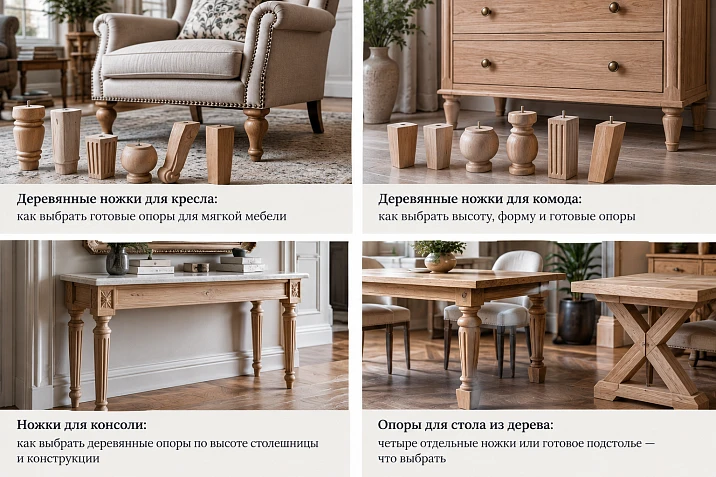
An oak solid wood tabletop rests on trestles: 2200 by 1000 mm, 40 thick. The question that starts almost any project is: "Order four legs and make the apron yourself, or take a ready-made base?" The answer depends not on taste, but on the size of the tabletop, its mass, and how much design work you are willing to take on.
Four separate legs win when you need freedom of size, positioning of supports, and your own apron. A ready-made base wins when you need to get an already assembled structural logic of the base without your own design. You cannot say that one is better than the other: they are different levels of readiness of the furniture structure. Below is an analysis of the fork from tabletop to specification: height, span between supports, overhang, mounting plate, real STAVROS models (carved MN-040, geometric supports, base STL-041), cost calculation, and the rules for recording in the parts list.
A general article on the beauty and styles of wooden table legs is in the article about Wooden legs for table, and a detailed guide on frames and bases is in the material about wooden table frame and base. There is also a separate text about a ready-made base for a stable structure. Here we deal only with the choice between these two paths.
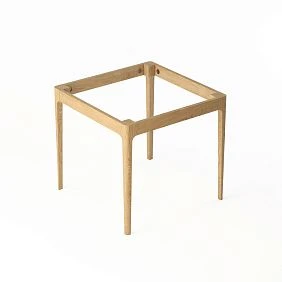
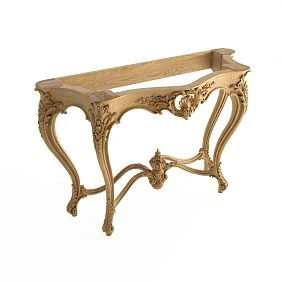

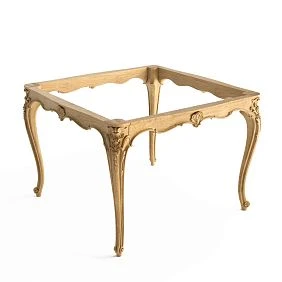
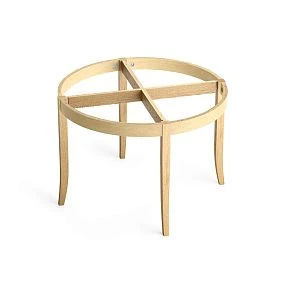
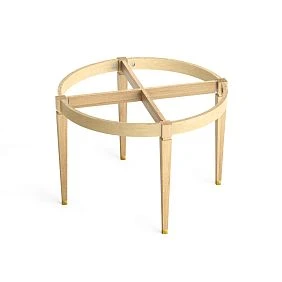
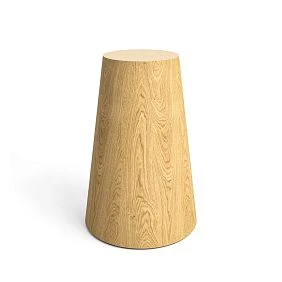
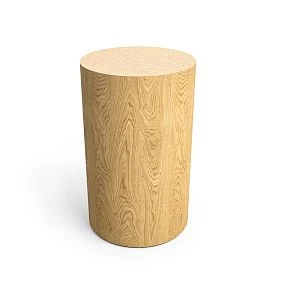
Table supports: not always just four legs
Four base options can be laid under the tabletop.
First: four separate wooden legs. The craftsman designs the rest himself: the apron, stretchers, and position of the supports.
Second: two large supports, such as side panels or cabinets under the ends of the tabletop. The load is transferred to two massive elements.
Third: a ready-made base. This is an already formed base assembly that is attached to the tabletop as a whole.
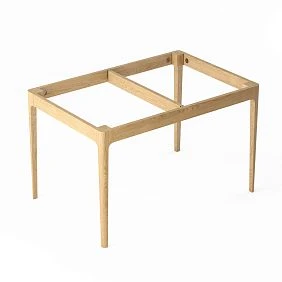
Fourth: a complete furniture frame for the table. The base together with the aprons and stretchers is supplied as a single structure.
The choice depends not only on design. Consider the length of the tabletop, its weight, material, height, required rigidity, and expected load. A reading table and a dining table for ten people have different requirements, even if they look similar.




How this looks in the STAVROS catalog
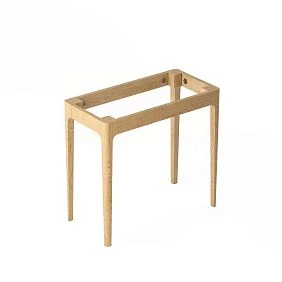
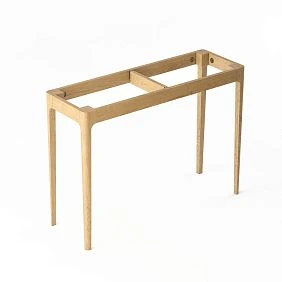
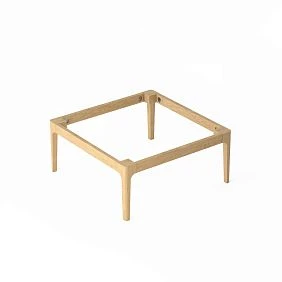
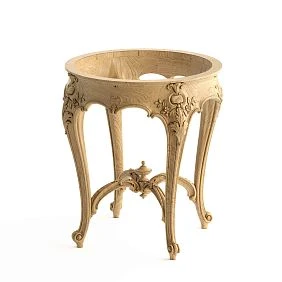
Section Legs for tables combines separate supports and bases in a single list. The first positions are occupied by the STL-041 (from 46,700 rubles) and STL-042 (from 46,460 rubles) bases, followed by modern legs MN-241 (from 13,240), MN-237 (from 8,700), MN-238 (from 8,840), turned MN-221 (from 3,570), MN-234 (from 1,240), MN-145 (from 540), and dozens of others. Prices at the time of checking. This alone shows that on the website catalog, “legs” and “bases” sit side by side as alternatives.
A separate category Furniture Frames and Pedestals contains frames for tables, chairs, armchairs, benches, chests of drawers, consoles, and other furniture bases. In this category, judging by the related product blocks, there are, for example, the STL-031 table frame (from 35,220 rubles), the STL-026-8 coffee table base (from 23,630 rubles) and STL-026-3 (from 29,670 rubles), as well as STL-020 (from 215,350 rubles).
Our factory also produces:
When four separate wooden supports are more advantageous
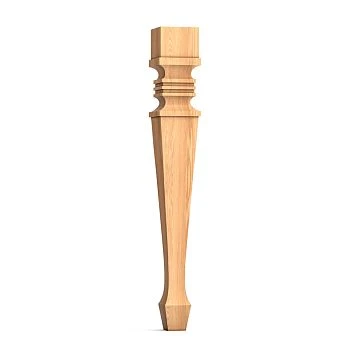
Separate legs are suitable if the craftsman wants to determine the length of the table, the width, the position of the legs, the apron structure, and the appearance of the base himself. This is the path for those who have carpentry experience and a desire to achieve a unique result.
Advantages of this scheme:
-
great freedom of design: the dimensions of the tabletop are not tied to the base;
-
you can choose a specific leg profile to match the table style;
-
before production starts, one type of leg can easily be replaced with another;
-
it is convenient to make a series of tables in different sizes with a single leg SKU.
The last point is especially important for workshops. Suppose you produce dining tables in three lengths: 1400, 1800, and 2200 mm. The leg stays the same, and only the tabletop and aprons change. One SKU, simple purchasing, and a unified look across the line.
Get Consultation
What the maker takes on
Designing the apron or the stretchers between the legs. Rigidity calculation: a set of four legs by itself does not create a rigid structure; the frame provides rigidity. Checking the fastening joints. Finishing all elements with one system. This is additional work, but it gives you control over the result.
About legs as blanks
In the STAVROS catalog, the legs are unpainted: they are supplied without a coating and are ready for your finishing. Orders are possible from one piece. This simplifies work with custom tables and small series.
When a ready-made base is more rational than separate legs
A base is considered when the maker wants to get an already formed foundation system. It should not be claimed that it is automatically stronger than any four legs. Its advantage is different: the structural logic of the base is already assembled into a single unit.
The comparison is not between beautiful legs and a beautiful base, but between two sets of work. On one side, four separate components plus a custom frame. On the other, a ready-made furniture base. In the second case, design work is saved, but you pay for the ready-made solution and size limitations.
Example: STL-041 base
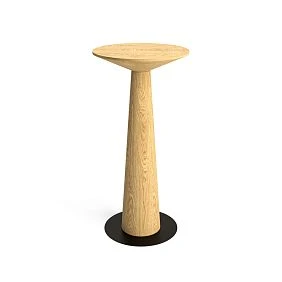
Table base STL-041 in the size table on the product card has dimensions A × B × D: 500 × 740 × 300 mm. This is a geometric cone-shaped table base. According to the description, the structure is hollow, made of MDF and plywood, and designed for high loads. The base version in deeply milled MDF is intended for coating with opaque enamels and comes with a pre-applied insulating primer layer. The veneered version is faced with beech or oak veneer, carefully sanded, and ready for tinting, clear lacquers, and patina. Prices per the table: MDF 46,700 rubles, MDF with oak veneer 55,500, MDF with beech veneer 53,170 rubles, lead time from 5 to 10 days, sanding quality "Prestige." For attachment to the tabletop, the FUR-034 metal mounting plate is recommended (4,390 rubles).
Please note: STL-041 is a single central support, not a replacement for four legs under a long tabletop. This is a pedestal table base. It logically compares to a central leg for a round or square table, not to four legs under a 2200 × 1000 tabletop.
What is important to know about the product card
The table lists the material as MDF and MDF with veneer, while the long promotional text on the same page mentions solid beech or oak. This is a discrepancy. Rely on the size table and the "Specifications and Options" block, and confirm the composition with a manager. The load figures and tabletop sizes also do not match across different paragraphs of the text: in one place the maximum static load is 120 kg, in another up to 150 kg for heavy tabletops, and the allowable tabletops are listed as both 600–1200 mm in diameter and up to 1000 × 1000 mm square. Confirm the allowable load and tabletop dimensions with a manager before ordering.
The main question: what kind of tabletop do you have
Before choosing supports, determine six parameters: length, width, thickness, material, weight, and shape. Tabletops 800 × 800 mm and 2200 × 1000 mm should not automatically receive the same base scheme.
A small square tabletop 800 × 800 mm is well supported on a central table base or on four legs without a complex apron. A long tabletop 2200 × 1000 mm creates long spans, significant mass, and a tendency to sag, so it needs a rigid frame or additional support.
How to estimate the weight
A simple estimate: multiply the tabletop volume by the density. For an oak tabletop 2200 × 1000 × 40 mm, the volume is 0.088 cubic meters. With an approximate oak density of about 750 kg per cubic meter, we get about 66 kg. Add the weight of dishes, elbows, and chairs leaning against the table, and the load can reach one hundred kilograms or more. The density value is approximate and depends on moisture content and the batch; it is needed for order of magnitude.
According to the general text of the section, the manufacturer claims a vertical load of at least 100 kg for all furniture legs. On four legs with even distribution, 166 kg gives approximately 41 kg per support, which fits within the stated rating. But the load is rarely distributed evenly, and the table is also pushed from the side. Therefore, what is critical is not so much the vertical load as the rigidity of the frame.
Tabletop shape
A rectangular tabletop works well on four legs. A round one often requires a central support or a pedestal base, because four legs at the edges create awkward corners. An oval one occupies an intermediate position: two supports or a central base are suitable. Keep in mind that the shape determines where the legs can even be placed and whether there is room for the legs of seated people.
How to calculate the final table height
For a simple scheme, the formula is this: leg height plus tabletop thickness equals the basic final height. If there is an apron, mounting plate, spacer, or another connecting unit, the geometry is calculated according to the specific project.
Example. A 740 mm leg plus a 30 mm tabletop gives about 770 mm to the top surface, even before accounting for additional structural elements. If a mounting plate sits between the leg and the tabletop, its thickness must be added.
For a pedestal base, the formula is the same, but the role of the leg is played by the height of the pedestal base. For STL-041, according to the table, height B is 740 mm. With a 30 mm tabletop, we get about 770 mm, plus the thickness of the FUR-034 plate, which must be checked in its product page.
Height guidelines
In the text of the table legs section, the manufacturer specifies for dining tables legs of 710–730 mm, for writing and work tables 700–720 mm, for coffee tables 350–450 mm, and for bar tables 1000–1050 mm. These are guidelines, not standards. The final height is determined by the users and the purpose.
Selection example
You need a dining table about 750 mm high. Tabletop 30 mm. So you need a 720 mm leg. The carved MN-040 comes in heights of 650, 740, and 900 mm (according to the product page description). The nearest, 740 mm, gives 770 mm, which is 20 mm above the target. Options: accept the 770 mm height, choose a thinner tabletop (10 mm, which is unrealistic for solid wood), cut down the leg (the manufacturer does not trim products, so a workshop would do this at its own risk), or look for another model. The example shows that the target should be set with a tolerance and checked in advance against the actual heights in the catalog.
Why choose the table height first, not the leg
Bad sequence: you liked an 800 mm leg, bought it, and only then calculate the table. The result is a table of an uncomfortable height or a tabletop of a non-standard thickness adjusted to fit the leg.
Correct sequence: table purpose, required final height, tabletop thickness, structural joint, allowable leg height, item number. It is especially important for a desk (height determines ergonomics), a dining table (height must be coordinated with the chairs), a console, and tall furniture.
Tolerance
Set a tolerance for the final height, for example ±10 mm. For a dining table, a difference of a centimeter is barely noticeable; for a desk, it may be noticeable. Select all models in the catalog that fall within the range, and only among them choose by shape.
Relationship with chairs
Chair height and table height must be coordinated. The general text of the section calls a tabletop height of 750–760 mm comfortable with a chair seat height of 450 mm. If the chairs have already been purchased, start from their height, not from abstract guidelines.
Span between supports
A parameter that is often forgotten. With four legs, not only the height matters, but also the distance between the supports. The longer the tabletop, the more important the rigidity of the tabletop itself, the apron, the frame, and additional central support become.
There is no universal maximum span; it depends on the design. Nevertheless, it is useful to estimate the numbers. For a 2200 mm table with legs set back 200 mm from the ends, the span between supports along the length will be 1800 mm. A solid oak tabletop 40 mm thick deflects noticeably less over such a span than a thin 18 mm panel tabletop, but under constant load the deflection accumulates. The specific result depends on the material and the gluing method, and it is determined by the designer.
What the manufacturer says
The text of the section states that four legs are suitable for tables up to 2 meters long, while for long tables from 2.5 meters, six or more supports are used to prevent deflection. This is a guideline and can be used for an initial estimate, but it does not replace calculation of your design.
How to reduce the risk
Add a stretcher or longitudinal brace. Use a thicker tabletop. Install an intermediate support. Choose a base with a frame. Each solution has a cost, and the choice depends on what the design allows.
Tabletop overhang relative to the legs
Supports are rarely placed exactly along the outer edge. There is an end overhang, a side overhang, legroom, and a decorative setback.
Too large a setback visually reduces the base and changes the load distribution: the tabletop "overhangs," and when a load is applied to the edge, the risk of tipping or deflection increases. Too small a setback makes the legs stick out from the corners and creates a risk of the user's legs contacting the support.
Example. Tabletop 1800 mm, legs set back 150 mm from the ends. Overhang 150 mm on each side, span between legs 1500 mm. If the setback is increased to 300 mm, the span will shrink to 1200 mm and deflection will decrease, but the base will look visually shorter, and the space for those sitting at the ends will increase. If the setback is reduced to 50 mm, the span will increase to 1700 mm.
Legroom
Pay especially close attention to the position of the legs at the ends where people sit. A leg too close to the edge makes it hard to place your legs. Usually, free space is left between the legs sufficient for a seated person, and the size is refined according to ergonomics for your table.
About the table base
For a pedestal table base, the overhang is determined by the size of the tabletop and the base: a central support of 500 mm under a tabletop of 1000 × 1000 mm gives an overhang of 250 mm on each side. Too large an overhang requires a more rigid joint and, possibly, a larger mounting plate.
The mounting plate is checked before ordering
For each leg, the top section, mounting area, top geometry, and installation method are important. The carpenter needs to know whether there is physically space for this support inside the structure. This is especially true for designs with an apron: a leg whose upper part is wider than the apron will not sit flush.
Check the dimensions of the item from the product card, the diameter or side of the top, the mounting method, and the recommended hardware. The MN-040 card recommends glides: round FUR-022 (d=30 mm, 170 rubles) and felt FUR-028 (d=28 mm, 70 rubles). For mounting in other legs in the section, a stud and M8 screw are offered (for example, FUR-001-1 for 72 rubles), as well as kits and mounting plates.
What to check in the tabletop
Thickness at the mounting point: a 60 mm long stud requires sufficient thickness. Material: fasteners hold worse in particleboard and MDF than in solid wood. Distance from the edge: too close a hole weakens the edge. Grain direction: fastening into the end grain is weaker than across it.
Mistake based on a photo
You cannot choose the fastener and size from a picture. Check the size table that opens via the "All sizes and prices" button, and the product drawing.
Turned wooden table legs
The turned shape works well when the leg is a visible part of the table, a classic profile is needed, and four separate supports are used. Lathe turning produces a round cross-section, beads, necks, and transitions. Section Turned Legs contains supports of various shapes.
In the list for tables, turned models span a wide price range: MN-145 from 540 rubles, MN-194 from 830, MN-153 from 850, MN-155 from 870, MN-145.1 from 900, MN-234 from 1,240, MN-148 from 1,350, MN-149 from 1,470, MN-152 (with polyurethane decor) from 2,160, MN-029 from 3,510, MN-221 from 3,570, MN-195 from 6,030, MN-202 from 6,540, MN-124 from 17,010, and MN-126 from 17,450 rubles. Prices at the time of checking. The spread shows that the cost is determined by height and profile complexity.
What to consider
For tables, the leg must have a sufficient cross-section: a thin, elegant leg under a massive tabletop looks weak and is indeed less stable. A round cross-section has no front side, so no orientation is needed during assembly.
Carved supports for a classic table
A carved leg is not just decor. Check the purpose of the specific item, the height, the mounting, and the table construction. In the section carved legs supports with relief are collected.
A carved leg must be coordinated with the rest of the table's decor. If there are overlays on the apron, the leg's motif should work with them. A relief a few millimeters deep almost disappears in diffused light, and thick enamel clogs fine carving.
Example MN-040
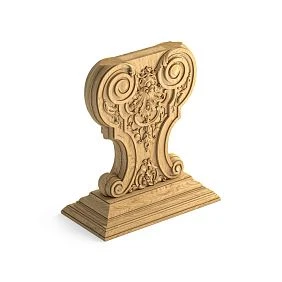
Carved furniture leg MN-040 in the product card it is listed as wooden for a table. According to the description, it has a curved shape, is available in three heights—650, 740, and 900 mm—in oak or beech, and is suitable for a table, console, and other furniture. The price is not displayed openly on the page, so check the size table. In the "Customers also buy" block, other carved legs are shown: MN-005 from 2,310 rubles, MN-039 from 4,300, MN-077 from 4,530, MN-079 from 5,970.
This example shows the scheme of a separate support: item number, four identical legs, its own base construction. The craftsman designs the apron and joints themselves; the legs set the appearance. Note the discrepancy in the product card: the SEO text says the leg is coated with lacquer, although it is listed in the unpainted category. Confirm the surface condition with the manager.
The three heights of MN-040 allow you to assemble three different tables: 650 mm is suitable for a bench or low table, 740 mm for a dining table, 900 mm for a high table or counter. For each option, recalculate the final height with the tabletop.
Geometric support MN-188: why you shouldn't choose by shape alone
Geometric leg MN-188 appears in the list of legs for a console table: price from 4,130 rubles at the time of checking. The product page was not opened while preparing the article, so check its dimensions and height there.
The example is useful as a warning. A beautiful modern shape doesn't yet mean the support suits your project. You need to verify the height, cross-section, tabletop design, final furniture height, and mounting method. If the leg height is fixed and you need a different one, beautiful geometry won't help.
Geometry and the modern table
Geometric supports suit minimalist tables with straight lines. In the section geometric legs there are models from 590 rubles (MN-146) to 6,210 (MN-187). Sharp edges reveal any sanding defect, so the "Prestige" level is often justified for them.
A separate support and a ready-made base: the fundamental difference
MN-040 and MN-188 are separate supports: one leg each, from which you assemble the table. STL-041 is a ready-made base element. The difference is not in design, but in the level of structural readiness.
With separate supports you get a component and create the base yourself. With a base you get a foundation that only needs to be attached to the tabletop. These are different tasks and different labor costs.
The second difference concerns limitations. Separate legs don't dictate the tabletop size: place them at the required distance and that's it. A base has fixed dimensions: STL-041, 500 mm wide, is designed for a certain range of tabletops.
Intermediate option
There are also intermediate solutions. A table frame, for example STL-031 (from 35,220 rubles), is a base with legs and braces that is closer to a full frame. In the catalog, the frame and the underframe are in the same category, but structurally they are different things. Look at the specific product card to understand exactly what you are buying.
Four legs or an underframe: comparison by parameters
| Parameter | Separate supports | Ready-made underframe |
|---|---|---|
| Freedom of tabletop dimensions | Higher | Depends on the base |
| Its own apron and frame | Designed by the craftsman | Partially or fully defined |
| Position of the legs | More freely | Determined by design |
| Repeatability | By article number and drawing | By base article number |
| Number of components | Larger | Smaller |
| Base design | Required | Less custom development |
| Price guide (based on "from" prices) | 4 × 540 = 2,160 ₽ (MN-145) to 4 × 13,240 = 52,960 ₽ (MN-241), plus frame | 46,700 ₽ (STL-041 MDF) to 55,500 ₽ (oak veneer), plus plate 4,390 ₽ |
The table doesn't say what's better. It shows scenarios. If you have a non-standard countertop size and the ability to make a frame, choose individual supports. If you need a quick result for a countertop that fits within the base dimensions, consider a base.
About the price
The cost of four simple turned legs (for example, 4 × 3,570 = 14,280 rubles for MN-221) is significantly lower than a base frame, but you need to add materials and labor for the frame. Four expensive modern legs MN-241 (52,960 rubles) are already comparable to the STL-041 base frame (46,700 rubles). It is worth comparing the full cost of ownership: components plus time.
When each is suitable
Individual legs: non-standard sizes, a series of tables of different lengths, a unique appearance of the base, availability of carpentry capabilities. Base frame: a small tabletop relative to the base dimensions, quick launch, no desire to design the base, need for a ready-made base finish.
Beech or oak for wooden supports
Briefly, since the comparison of species is covered separately. Beech is a dense, non-porous wood that the manufacturer recommends for products intended for enamel. It fits well into enamel projects, painted furniture, and calm, uniform finishes.
Oak is a dense, porous wood with pronounced texture. It is chosen for oil, stain, clear lacquer, and visible texture. A table with an oak tabletop under oil logically belongs on oak legs.
Glue-up grade and sanding
For opaque finishing, choose “for enamel”; for semi-transparent finishing, choose “for tinting.” “Standard” is machine sanding, “Prestige” is detailed hand sanding with no need for additional work.
About the table base
For the veneered STL-041, the species is determined by the veneer: beech or oak, while the core remains MDF. The basic MDF version is intended for opaque enamels. A combination of a solid oak tabletop and a veneered MDF base frame is possible, but the tone and texture of the veneer must be checked against a tabletop sample.
Unpainted supports are convenient for a furniture workshop
If the tabletop and base must have the same finish, an unfinished item follows this sequence: test stain, overall finish, assembly. Section Unpainted legs contains the main part of the catalog.
The manufacturer recommends the following sequence for lacquer and enamel: dust removal, even priming, sanding after the primer dries, and a two-coat topcoat with drying between coats. It is better to paint the legs separately from the tabletop, and assemble after complete drying.
If you are working with a table base, note that the basic version of STL-041 comes with an insulating primer, while the veneered version is ready for applying paint and varnish materials. The manufacturer paints the legs only for orders from 150,000 rubles, so for a single table plan your own finishing.
How to check the base before ordering a batch
For small-scale production, the sequence is as follows: one item, one sample, a construction mockup, a trial assembly, approval, a set or batch.
Check seven points: actual height, cross-section, installation, placement, stability, visual proportions, and finish. For stability, assemble a table mockup using the samples and rock the tabletop, assessing any play. For the table base, check how the tabletop sits on the base, whether there is any skew, and whether the plate is sufficient.
Conditions
Items ship from a single piece, so a sample can be taken without any commitment to a production run. In-stock items ship within three business days (the main part is stored unsanded), while the rest are prepared in an average of 5–10 business days. For the STL-041 table base, the lead time according to the table is 5 to 10 days. Plan your sample order in advance.
What to record
Item number, dimensions, species, gluing grade, sanding level, finishing system, hardware, stability test result, and date. Keep the sample as a reference.
How many wooden supports to buy
If the design is four-legged, the formula is: four multiplied by the number of tables. Ten tables give 40 legs. But the quantity cannot be determined by the name of the furniture item alone. Some designs use two supports, a central base, a one-piece frame, or additional support.
| Scheme | Units per table | Tables | Base purchase |
|---|---|---|---|
| Four legs | 4 | 10 | 40 |
| Two supports | 2 | 10 | 20 |
| Underframe | 1 | 10 | 10 |
Cost example
Ten tables on four turned legs MN-221 (from 3,570 rubles) will require 40 legs, that is, at least 142,800 rubles for the legs, plus hardware, aprons, and labor. Ten tables on a base STL-041 (MDF, 46,700 rubles) cost 467,000 rubles plus ten plates FUR-034 at 4,390 rubles each, that is, another 43,900, for a total of about 510,900 rubles. Prices are "from" as of the time of checking. The comparison shows a difference in orders of magnitude, but does not answer the question of which is better: a base solves the foundation task entirely, while legs require additional work.
Reserve
Determine by risk. For long legs and carved models, the risk of damage during finishing is higher. Record the reserve as a separate line. Order the set in a single delivery so that species and batches do not differ in color.
How to record supports in the specification
The entry must distinguish a separate leg from a ready-made base.
Example for a leg: LEG-01, STAVROS, MN-040, 4 pcs., beech, unfinished. Example for a base: BASE-01, STAVROS, STL-041, 1 pc., oak veneer.
LEG denotes a separate leg, BASE a ready-made base. This division immediately shows what is bought as a component and what as a single unit.
What to add to the entry
Dimensions, height, glue grade, sanding level, finishing system, hardware (studs, plates, glides), status (SAMPLE or APPROVED), revision, inspection date. For the table base, be sure to record the material variant (MDF, oak or beech veneer) and the recommended plate.
Why
Six months later, the client asks for another identical table. You open the specification and order the same SKUs. Without a record, you would have to find the model and check the dimensions again.
Where to buy wooden table legs
Main place for separate legs: the section Legs for tables. For a ready-made base, see the category Furniture Frames and Pedestals.
Additional Items:
-
Wooden furniture legs: general catalog.
-
Unpainted legs: for your own finish.
-
Under-table frame STL-041 as an example of a ready-made base.
Order conditions
Items are shipped from a single piece. Delivery is available across Russia and to CIS countries via CDEK and DPD, with pickup also possible. Showrooms are located in St. Petersburg and Moscow, production is in St. Petersburg. Cutting of items to size is not performed. Non-standard items and custom sizes are made only for bulk orders. Before ordering, the manufacturer recommends preparing a design project by downloading drawings from the website. The table base is supplied in a rigid box. Before placing an order, check the current price and availability in the product card.
What to clarify with the manager
The permissible load and tabletop dimensions for the selected table base, material composition, actual height of individual supports, hardware package, and the possibility of assembling the order in a single delivery.
Workshop questions
Which wooden supports are suitable for a table?
Individual legs of the required height (turned, carved, geometric) with their own apron or a ready-made table base. The choice depends on the size and weight of the tabletop, the design, and how much of the engineering you take on yourself.
Where to buy wooden supports for a table?
In the section Legs for tables the STAVROS catalog, where individual supports and table bases are collected together. Ordering is possible from a single piece.
What is better for a tabletop: four legs or a table base?
Neither is universally better. Four legs give freedom of dimensions and positioning, but require their own frame. A table base saves on engineering, but is limited by the dimensions of the base. Compare the total cost and the work involved.
How to choose the height of the supports?
Subtract the thickness of the tabletop and the thickness of the mounting unit from the final table height. For a 750 mm table with a 30 mm tabletop, a leg of about 720 mm is needed. Look in the catalog for models that fall within the tolerance.
How to calculate the final table height?
Add the leg height, tabletop thickness, and plate: 740 + 30 = 770 mm. The apron in the standard scheme does not add height, but check the assembly against the drawing.
What overhang should the tabletop have relative to the legs?
One that leaves enough room for the legs and does not increase the span and the risk of sagging. Example: with a 1800 mm tabletop and a 150 mm setback, the span will be 1500 mm; at 300 mm, only 1200 mm. The final value is determined by the design.
When does a table need an apron?
When the tabletop is long or heavy and the legs need to be connected for rigidity. For short tables on a base, an apron is usually not needed. The decision is made by the designer.
When is it better to buy a ready-made base?
When the tabletop fits within the base dimensions, you need a quick result, and you do not want to design the base. Keep in mind that STL-041 is a central support 500 mm wide, not a replacement for four legs under a long table.
What to choose: beech or oak?
Beech for enamel and painted furniture, oak for oil, lacquer, and tinting with visible texture. For a veneered base, the species is determined by the veneer.
How to check the supports before manufacturing a series of tables?
Order a sample, assemble a mockup, check the height, stability and finish, approve the article number, and only then order the batch. For the base, additionally confirm the permissible load with the manager.
The contents of the table leg section, prices, specifications of STL-041, MN-040, ordering conditions, glue joint grades and finishing sequence were verified against the STAVROS catalog at the time of preparation. Calculations are conditional.