



























Article Contents:
- The profile starts not with an ornament, but with the wall's task
- Three specific products: a thin line, a wide profile, and a ready-made corner
- MLDPU-001: when the wall needs a thin line, not a heavy frame
- MLDPU-003: when you need exactly a wide polyurethane molding
- MLDPU-002U: why you need a corner polyurethane molding
- What affects the result more: the width or the relief of the profile
- The size of the wall matters more than a trendy tip from the internet
- Viewing distance: a parameter that almost no one measures
- Molding frame: the most understandable task, but not the simplest
- One large frame or several narrow ones
- Thin profile in a complex grid
- Wide profile in a simple composition
- Horizontal molding: not a frame, but a way to change the proportions of the wall
- Vertical lines: when a frame is not needed at all
- Wall behind the sofa: choose the profile together with the furniture
- TV zone: molding should not argue with the screen
- Dining area: the profile must withstand the scale of the table
- Bedroom: moldings should not accidentally turn the headboard into a portal
- Entryway: close distance makes even a thin molding noticeable
- Study: wide moldings work well on a calm, large wall
- Children's room: the decorative idea should account for furniture that changes
- Moldings and ceiling height: there is a connection, but not a mechanical one
- Why wide moldings visually "eat up" the field
- Molding and wall color: three different scenarios
- One color
- Subtle tonal contrast
- Strong contrast
- Which polyurethane moldings should you choose for a wall?
- Which molding is better for a small room?
- Which molding is suitable for a large living room?
- What does a wide polyurethane molding mean?
- Which is better for frames — MLDPU-001 or MLDPU-003?
- Can a thin molding be used in a large room?
- Can a wide molding be used in a small bedroom?
- What is MLDPU-002U for?
- Is it necessary to use decorative corners?
- How many corner pieces are needed for one frame?
- Can MLDPU-002U be used only on the central frame?
- How to Calculate the Amount of Molding?
- Why is it not enough to know the total length?
- What is the length of MLDPU-001?
- What is the length of MLDPU-003?
- What is the size of MLDPU-001?
- What is the size of MLDPU-003?
- What is the size of the corner MLDPU-002U?
- How to try on the molding without buying it?
- Do I need to consider the profile thickness?
- Why does a wide profile look more noticeable even when painted the same color as the wall?
- Can you paint molding the same color as the wall?
- What is better: white or contrasting molding?
- Can you make one large frame behind the sofa?
- How many frames should you make in the living room?
- Do you need to center the frames relative to the wall?
- Do you need to account for the sofa when marking out?
- Can you run molding next to a light switch?
- What to do if a light switch falls directly on the molding line?
- Can you make molding around the TV?
- Will MLDPU-001 fit in a hallway?
- Will MLDPU-003 fit in a hallway?
- Which moldings are best for neoclassicism?
- Which moldings are best for a classic living room?
- Can moldings be used in modern interiors?
- Can you combine thin and wide profiles?
- Where can I buy polyurethane moldings for walls?
- Can I buy specifically MLDPU-001?
- Where can I see MLDPU-003?
- Where can I see the corner element MLDPU-002U?
- What should I check before ordering the entire batch?
- Do I need to buy a spare?
- Why can't I just order as many meters as I got around the perimeter?
- Do I need to buy MLDPU-002U together with MLDPU-003?
- Can I use only corner elements without straight molding?
- Are molding and cornice the same thing?
- Are molding and baseboard the same thing?
- Should you choose a profile based only on price?
- Why can the price of the whole project vary greatly with a similar room area?
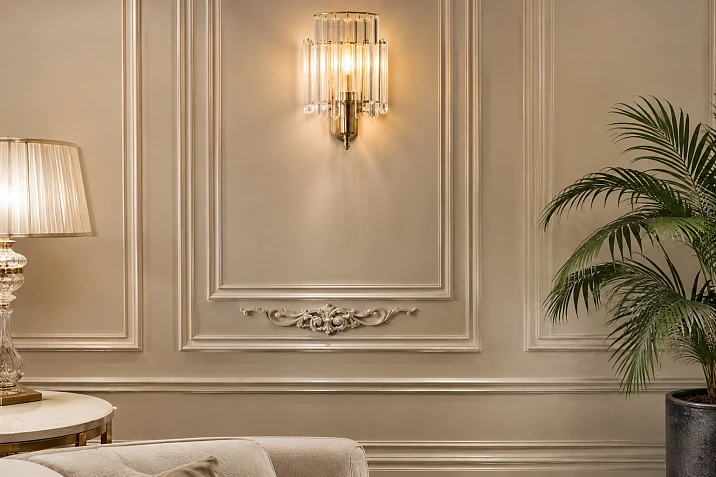
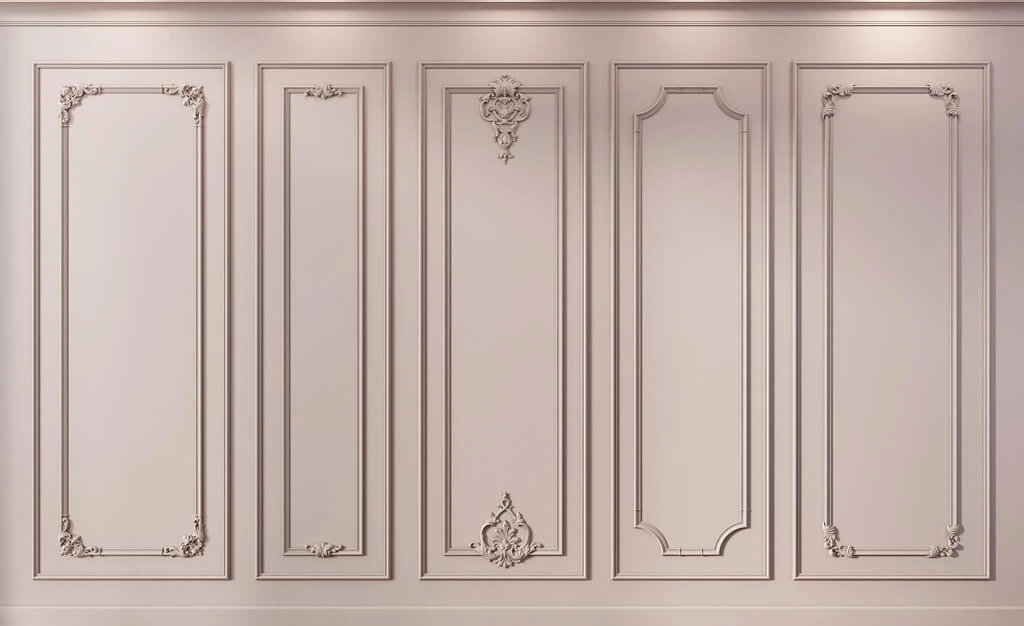
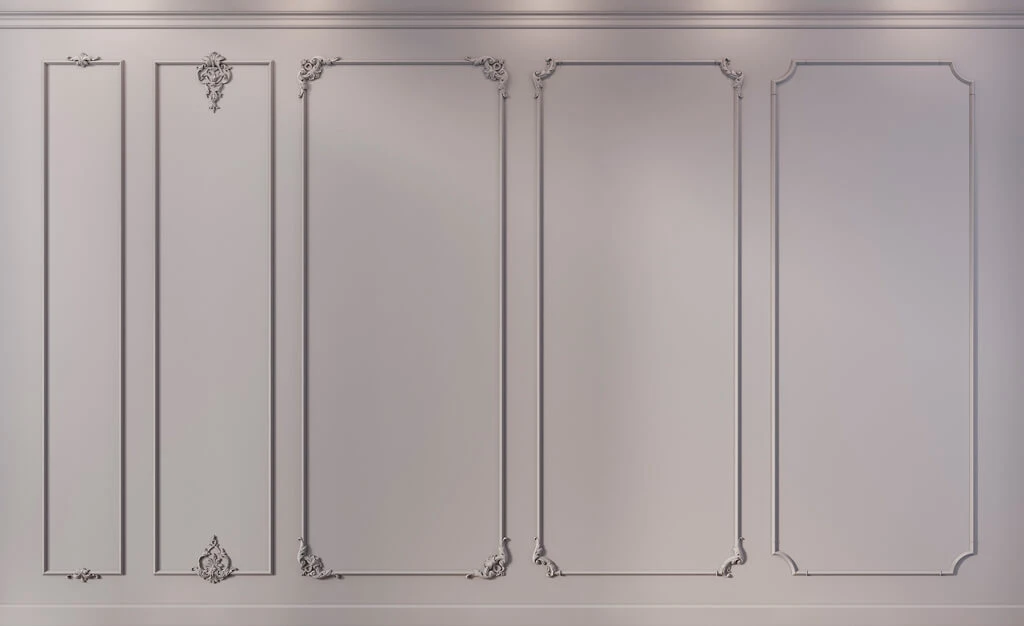
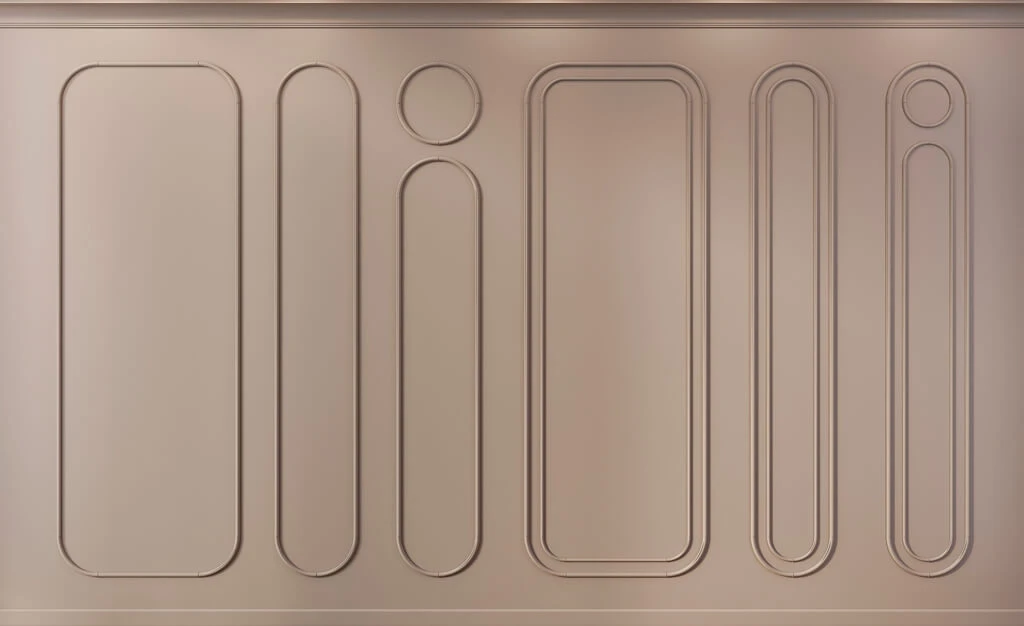
A plain painted wall can be perfectly smooth, well-matched in color — and still look unfinished. The reason is often not the shade or the furniture. What's missing is architecture: a line that will divide a large surface, a frame around a meaningful zone, verticals that can change the wall's proportions, or an expressive profile that will tie the interior into a cohesive system. That's why polyurethane moldings for walls are chosen not as random decoration, but as a tool for structuring the surface.
But after deciding "I want moldings," the harder part begins. Which profile to take? Thin or wide? Do you need a calm molding that will almost blend into the wall color, or should the profile be noticeable from the opposite end of the living room? What's better for frames, and what for a single horizontal line? Should you supplement a regular linear profile with ready-made corner pieces? How many strips to buy? And finally, where to look at specific models, not another collection of pretty photos without dimensions and prices?
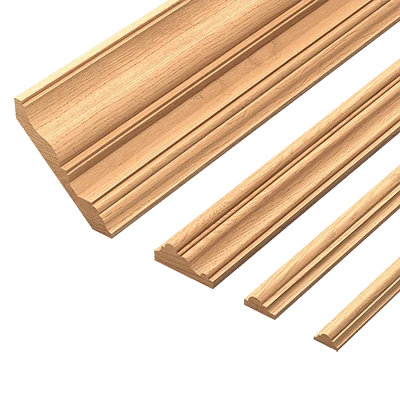
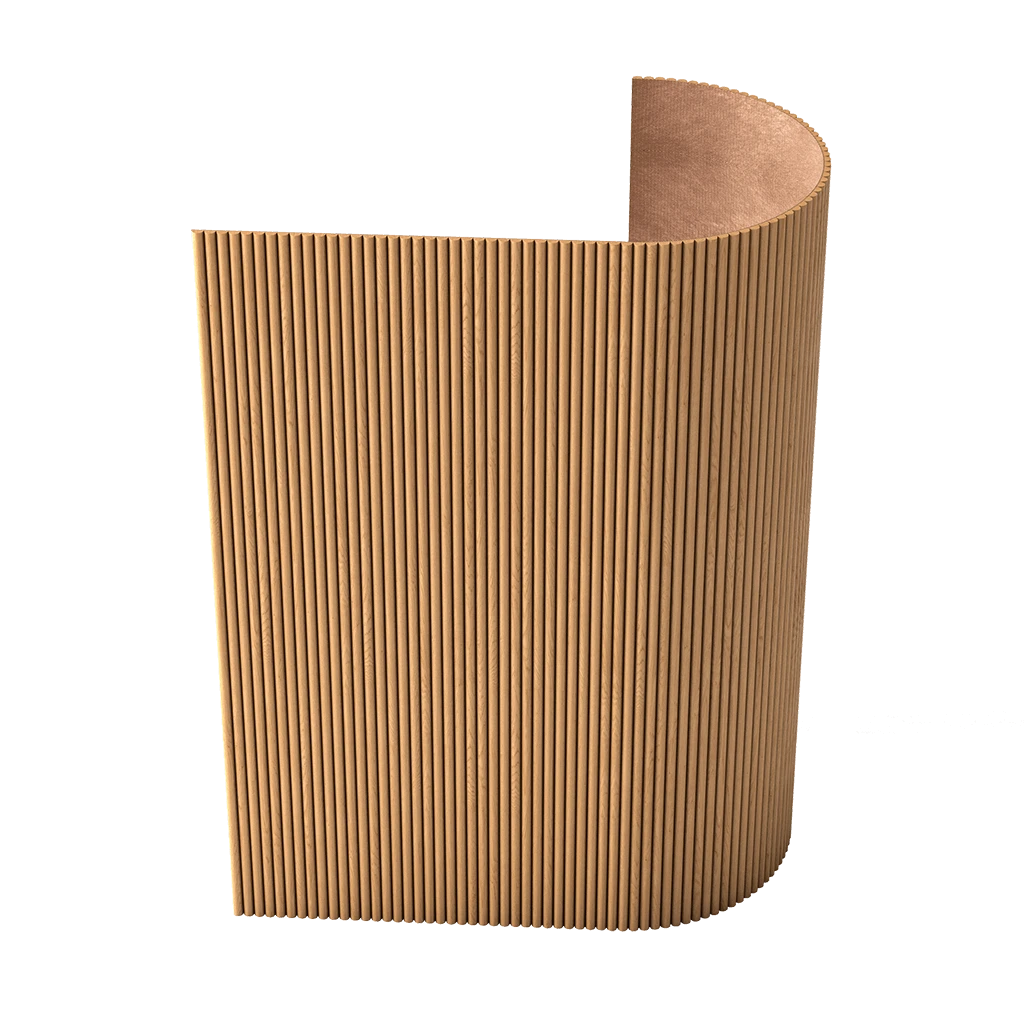
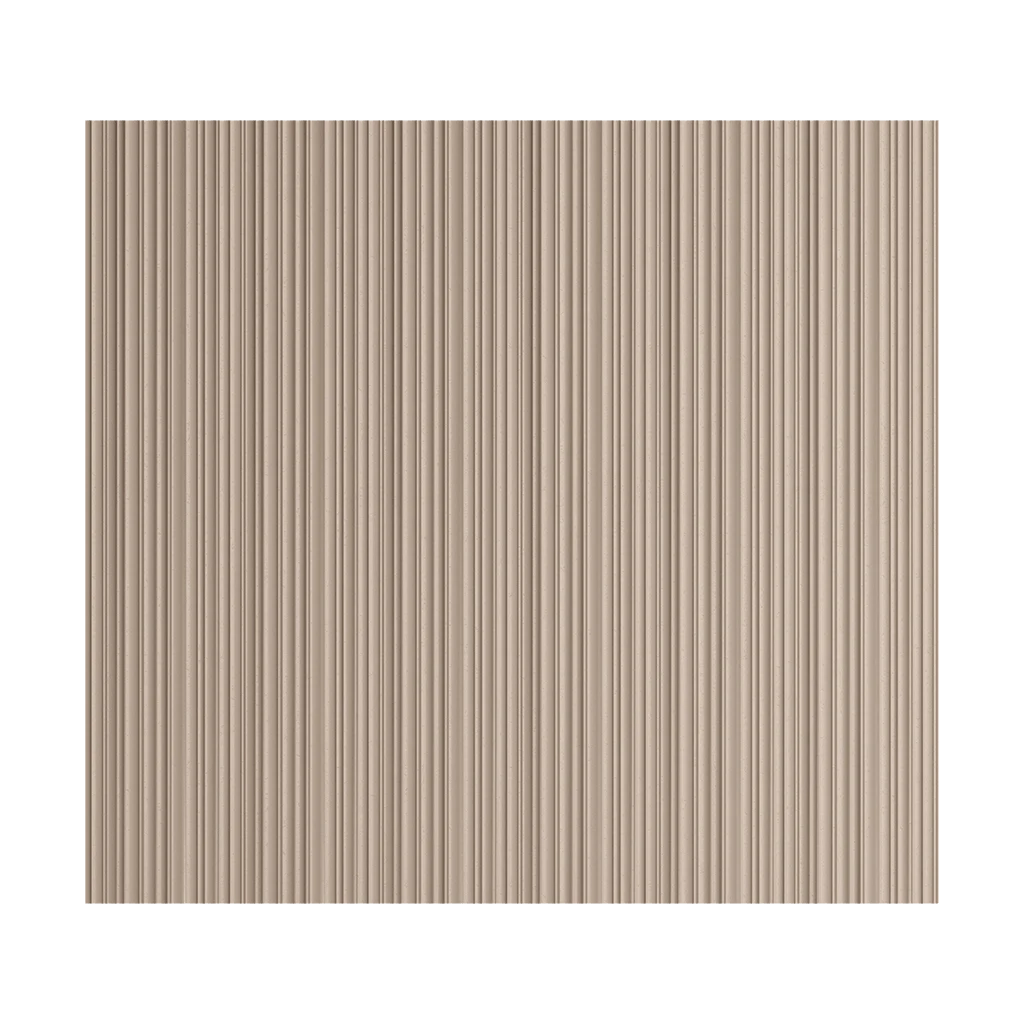
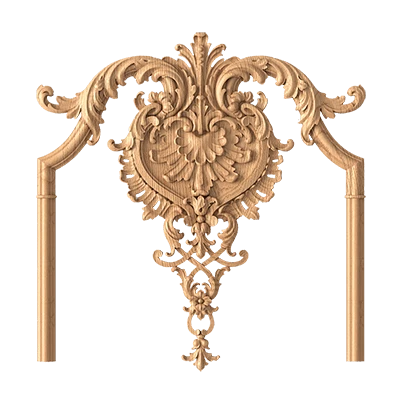
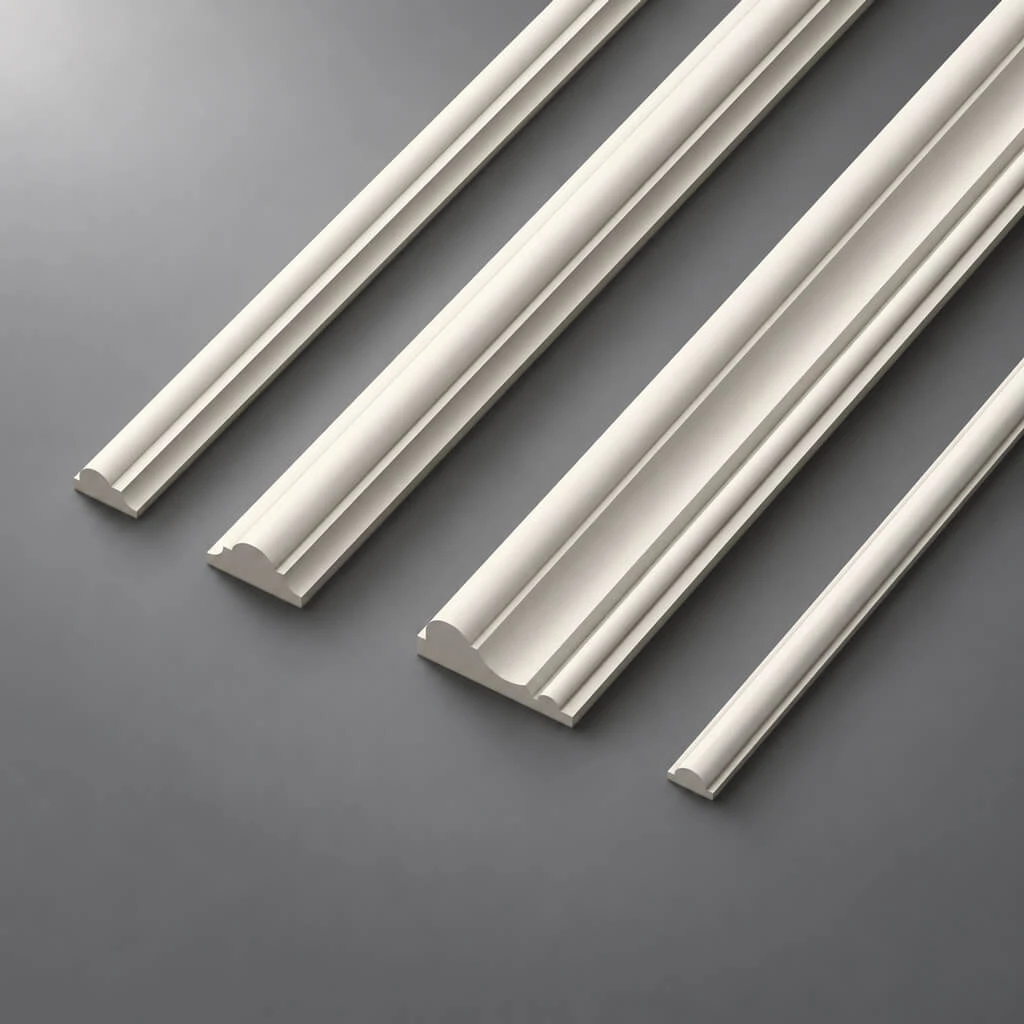
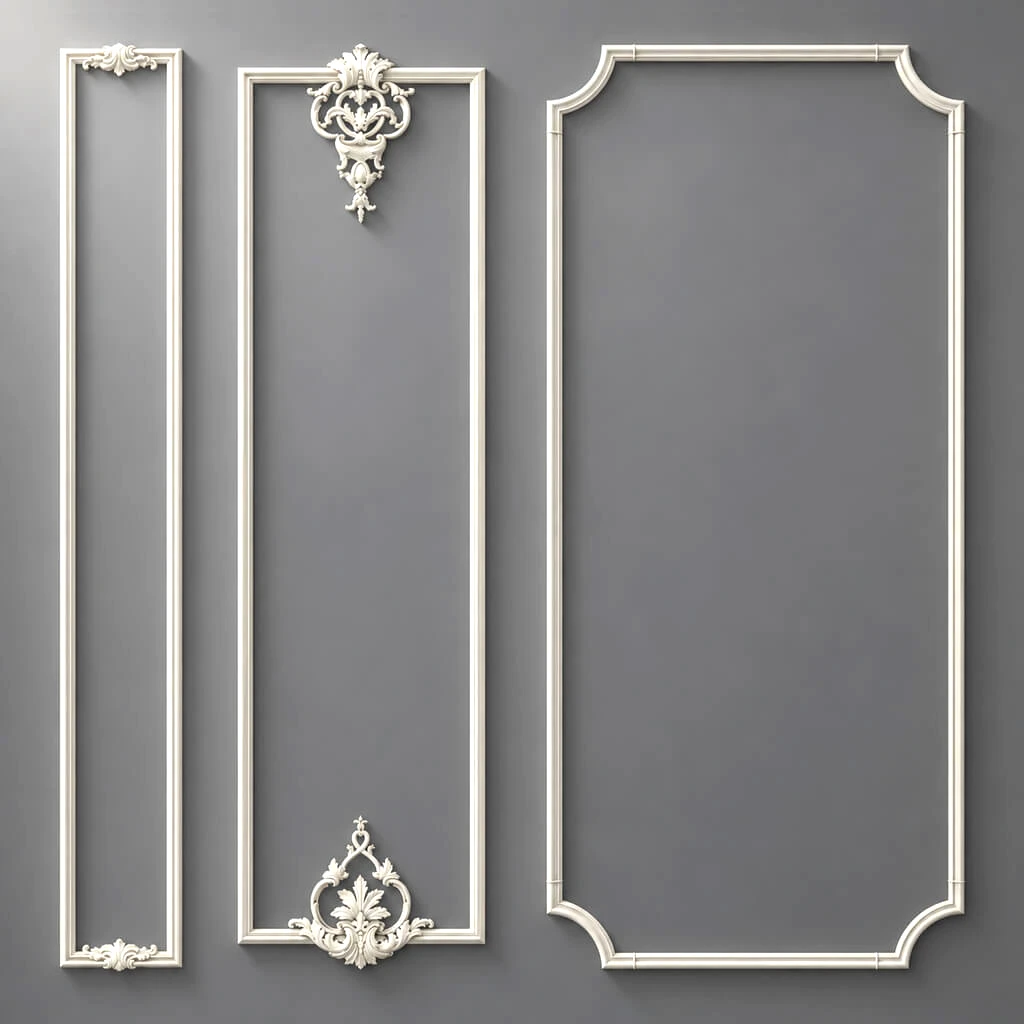
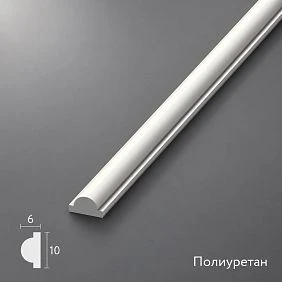
In the STAVROS catalog you can buy polyurethane moldings of different sizes and character. For a concrete comparison, three solutions are especially telling. MLDPU-001 — a thin profile of 10 × 6 × 2600 mm. MLDPU-003 — a noticeably wider profile of 35 × 12 × 2600 mm. MLDPU-002U — a separate decorative corner element measuring 172 × 172 × 13 mm, needed not for forming a straight line, but for decorating the corners of a decorative composition.
These three examples clearly show the main rule of selection: a molding is not bought by photo or by style name. It is chosen for the specific geometry of the wall, room size, viewing distance, and the method of building the decor. Let's break down this logic so that after the article you can not just say "I like decorative polyurethane moldings," but clearly understand which profile you need, how much you'll require, and which product to open in the catalog.
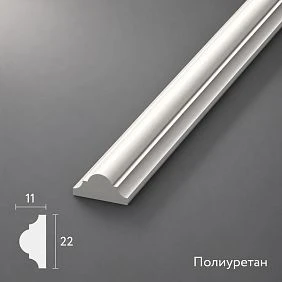
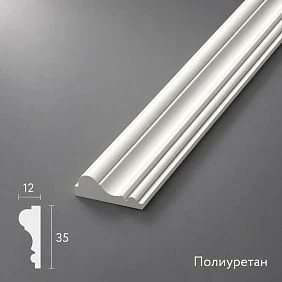
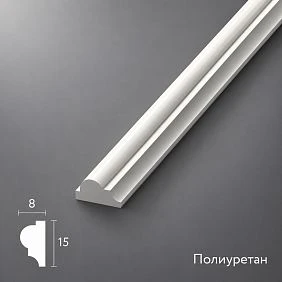
The profile starts not with the ornament, but with the wall's task
The most common mistake is made even before choosing a specific item. The buyer opens the catalog and starts comparing the profile's pattern: this one seems more elegant, that one richer, the third simpler. Meanwhile, the first decision should be completely different.
What exactly should the molding do to the wall?
Create one large frame behind the sofa?
Divide a long hallway with vertical lines?
Create several panels in the living room?
Frame the mirror?
Add subtle paneling to a wall that should stay modern?
Create a classic composition with a well-defined relief?
Combine straight moldings with decorative corner pieces?
The answer to this question immediately eliminates most unsuitable options.
For a small thin frame, a very delicate profile may be sufficient. If you need to form large architectural panels on a wide wall, a too-narrow line will get lost. It will physically be on the wall, but visually it will have almost no effect on the surface.
Therefore, polyurethane wall moldings should be evaluated by at least three dimensions: the width of the face, the projection from the wall, and the length of the plank. These parameters are then linked to the size of the composition itself.
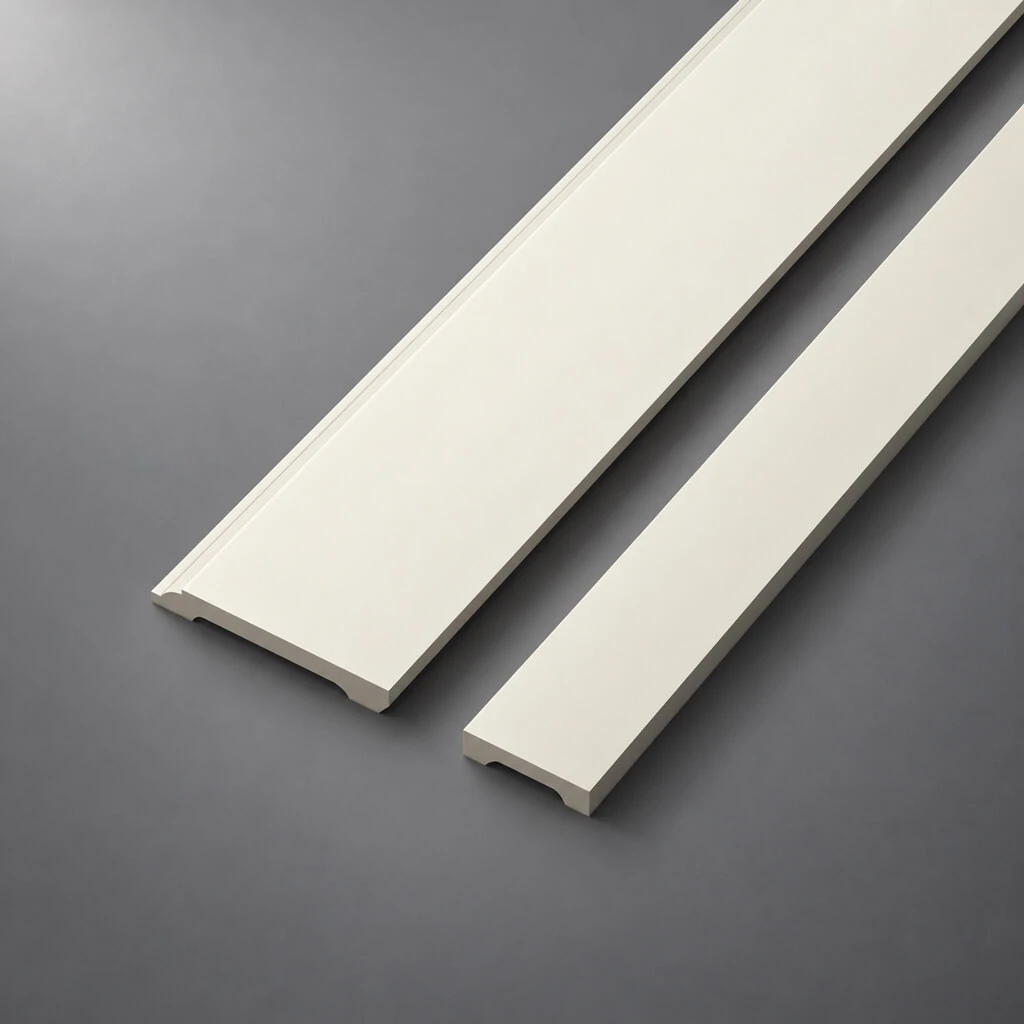
For a concrete comparison, it is convenient to place MLDPU-001 and MLDPU-003 side by side. The difference between 10 and 35 mm in width seems like only 25 mm. On the wall, these are completely different scales.

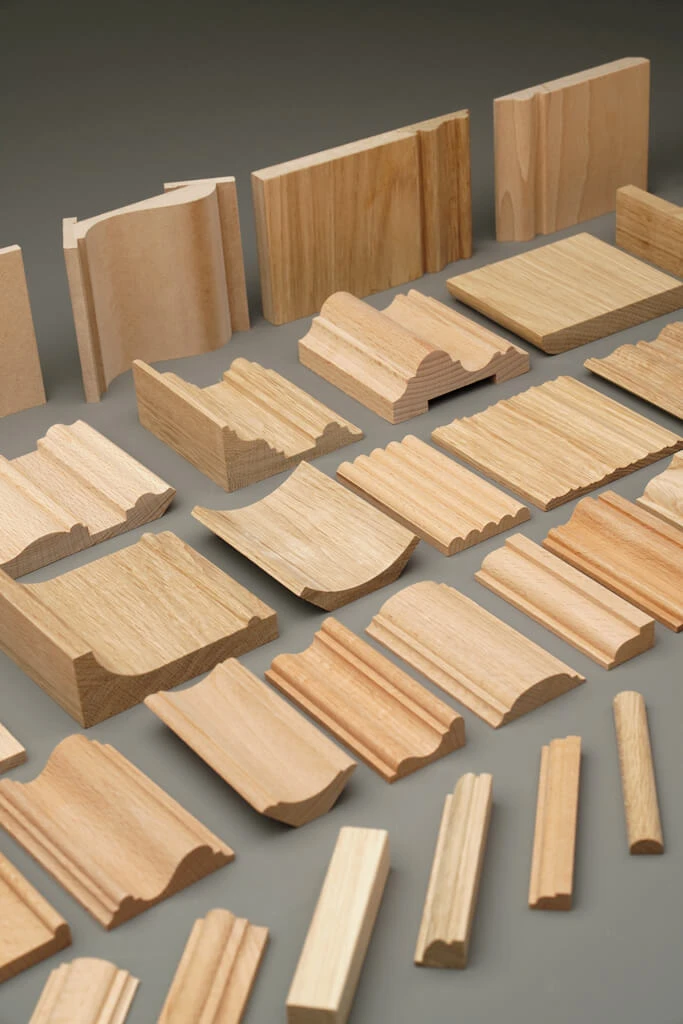
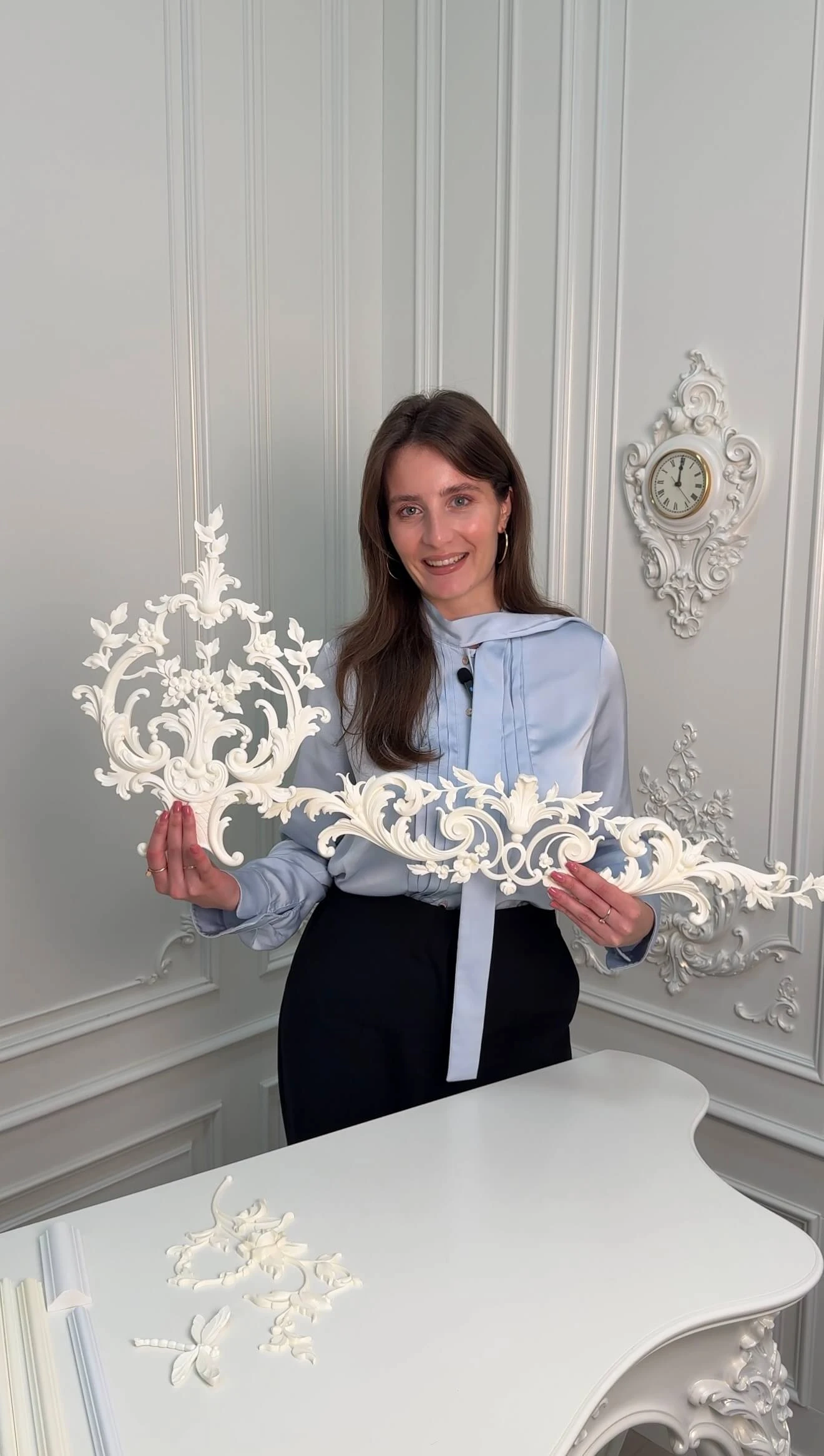
Three specific products: a thin line, a wide profile, and a ready-made corner
To keep the discussion about choice from remaining theoretical, let's look at real items.
| Model | Type | Size, mm | Material | Role in wall decor |
|---|---|---|---|---|
| MLDPU-001 | Straight molding | 10 × 6 × 2600 | Polyurethane | Thin line, small frames, delicate division |
| MLDPU-003 | Straight wide molding | 35 × 12 × 2600 | Polyurethane | Expressive frames, large wall fields, noticeable architectural line |
| MLDPU-002U | Corner decorative element | 172 × 172 × 13 | Polyurethane | Decorative finishing of corners and complicating the frame composition |
This table shows: the word "molding" unites products that can perform different tasks.
MLDPU-001 is almost a graphic line. It is useful where the profile needs to work subtly.
MLDPU-003 is already a noticeable architectural detail. Such a molding does not just draw a line along the wall, but forms a relief framing.
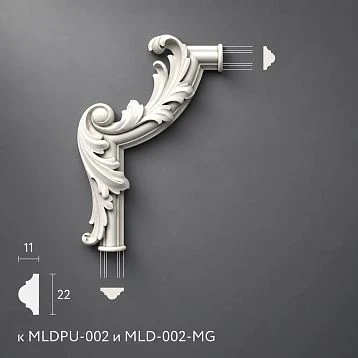
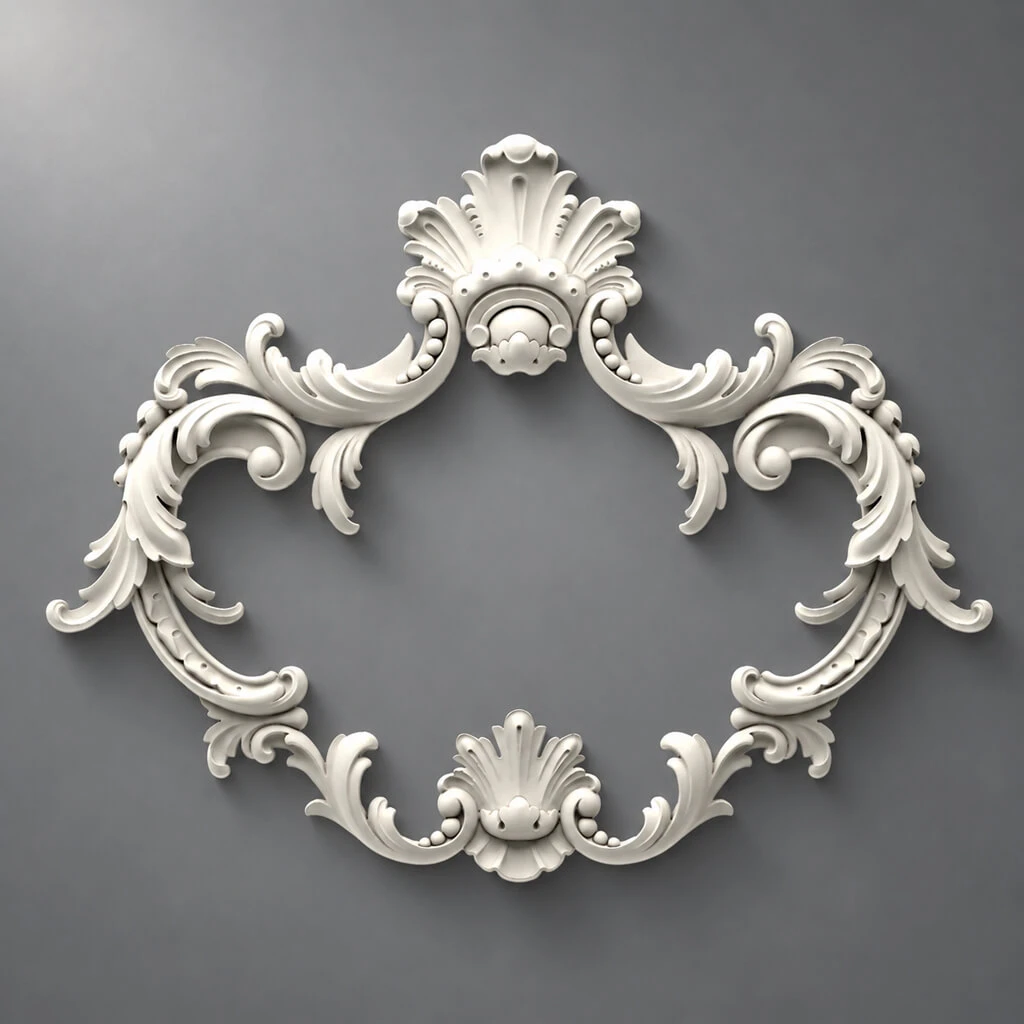
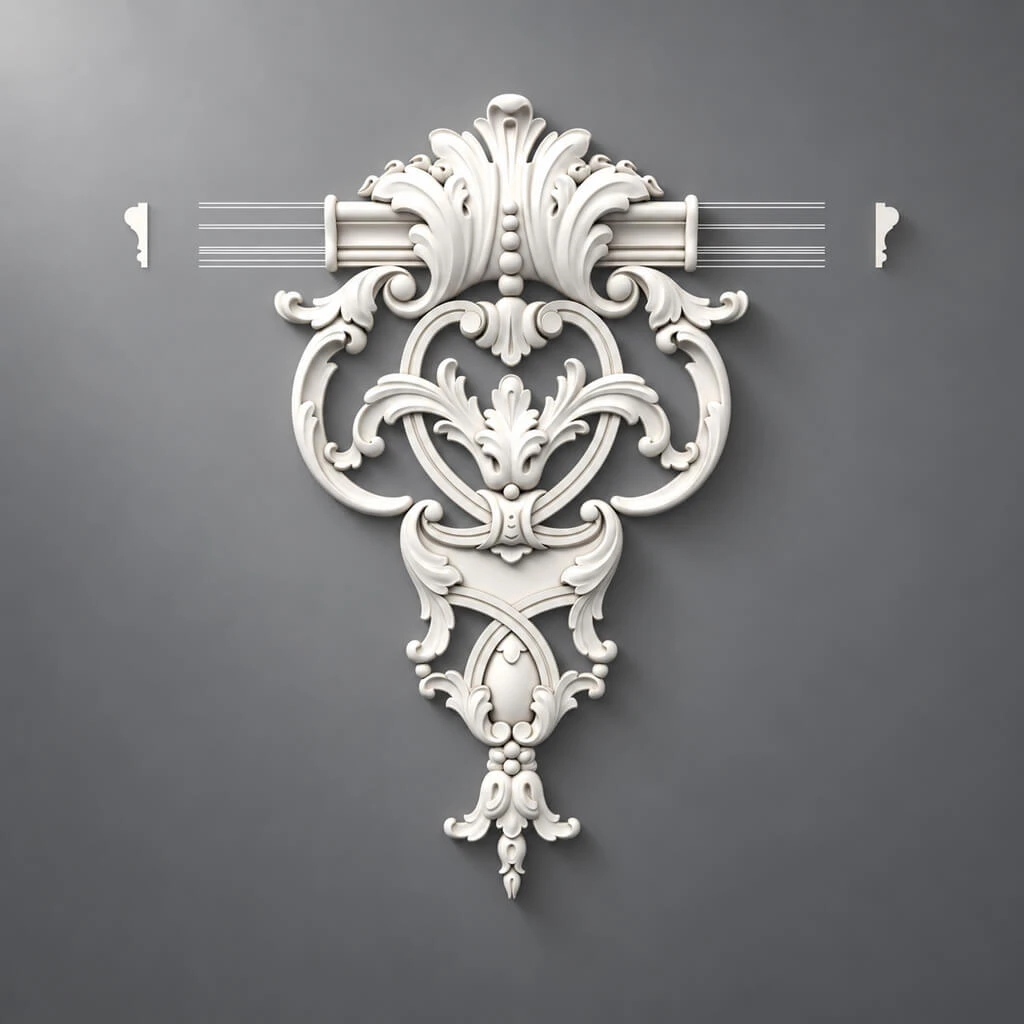
MLDPU-002U cannot be considered a replacement for a regular straight strip at all. It is a corner element. It is purchased when the corner of the frame needs to be given a decorative shape, rather than just joining two straight segments.
Hence the first practical conclusion: before looking for polyurethane moldings by price, determine the composition of the future design. Perhaps only a straight profile is needed. Perhaps a straight profile plus decorative corners. And sometimes, instead of a complex frame, it is better to use one wide molding and keep the corners calm.
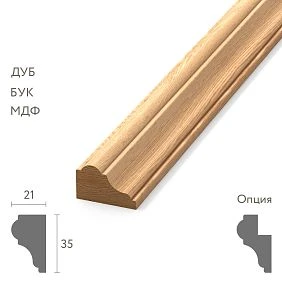
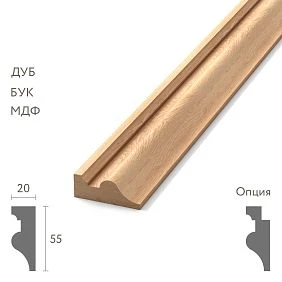
Our factory also produces:
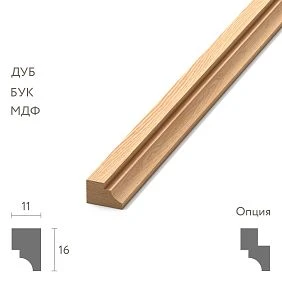
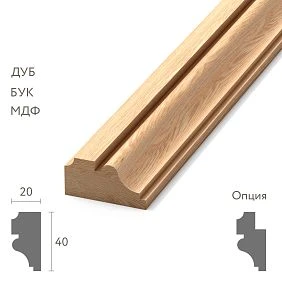
MLDPU-001: when the wall needs a thin line, not a heavy framing
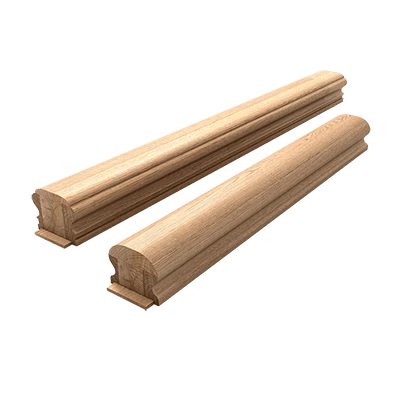
Polyurethane molding MLDPU-001 has dimensions of 10 × 6 × 2600 mm. Even from these numbers, its character is clear: it is a thin profile.
A width of 10 mm makes the line delicate. Such a molding should not imitate a heavy architectural cornice. Its strength is neatness.
Where is this especially useful?
On the wall of a modern apartment, where you want to add frames but not turn the room into an emphatically classic one.
On the front part of built-in furniture, if the profile is used as a decorative division.
In a small bedroom, where wide stucco could visually reduce the free wall space.
In a narrow corridor, where large relief strips quickly start to feel oppressive.
In a composition with several small frames.
A thin molding works well when the wall pattern itself is quite complex. For example, three or four vertical fields instead of one huge frame. If each of them is outlined with a wide profile, the total area of decorative lines becomes too large. The narrow MLDPU-001 leaves more air.
There is also a downside. On a spacious wall several meters long, a thin line can be too weak. Especially if it is viewed from a great distance.
Therefore, MLDPU-001 cannot be called "universal." It is precise. And a precise tool is always good at its task.
Get Consultation
MLDPU-003: when you need exactly a wide polyurethane molding
If the thin profile seems almost graphic, MLDPU-003 works differently. wide polyurethane molding has dimensions of 35 × 12 × 2600 mm.
A width of 35 mm is already noticeable enough for the frame to be perceived as an independent architectural line.
This profile is worth considering for a large living room, a spacious bedroom, a wall behind a sofa, a decorative panel in a dining room, a large TV area, or an interior where other elements also have a confident scale.
Note also the 12 mm protrusion. The relief is more noticeable than that of MLDPU-001 with its 6 mm. Side light creates a more pronounced shadow. This means MLDPU-003 can be readable even when painted the same color as the wall.
This is an important design technique. To make a molding noticeable, it is not necessary to paint it in contrast. Sometimes it is better to keep monochrome and use the depth of the profile.
That is why the request for wide polyurethane moldings cannot be reduced to a simple search for the largest number in the catalog. A wide profile is needed when the wall composition itself is large.
On a small wall, it may be excessive.
On a large one, on the contrary, it can provide the line density that a thin variant lacks.
MLDPU-002U: why you need a corner polyurethane molding
The frame can be assembled from four straight segments. The corners are then formed by joining the profiles.
But there is another way — to make the corner an independent decorative point.
For this, the corner molding made of polyurethane MLDPU-002U measuring 172 × 172 × 13 mm is used.
This is no longer just a meeting point of two lines.
The corner becomes part of the ornament.
This approach is not needed for every wall. In a modern minimalist frame, an additional decorative corner may be superfluous. But in a classic composition, it helps to avoid the feeling of an ordinary rectangle and makes the frame more flexible.
And here it is especially important not to mix products by name.
Straight molding is purchased by the length of the composition.
The corner piece is purchased by the number of corners and by compatibility with the chosen pattern.
If there are several frames, the number of corner elements quickly increases. Therefore, even at the design stage, you need to decide: will they be in all frames or only in the central one.
What has a stronger impact on the result: the width or the relief of the profile
The buyer often looks primarily at the width.
This is understandable: 10 and 35 mm are easy to compare.
However, volume works just as strongly.
A profile with a slight protrusion is closer to the graphic strip. A deeper one creates pronounced chiaroscuro.
Therefore, two moldings of the same width can potentially be perceived differently if their relief differs.
When choosing MLDPU-001 and MLDPU-003, this difference is especially obvious already in the dimensions: 10 × 6 versus 35 × 12 mm.
MLDPU-003 is both wider and deeper.
That is, it gets a double boost: it occupies more wall area and reacts more strongly to side light.
This should be kept in mind if the profile is planned to be painted in the wall color. In the catalog, it may seem calm, but in the evening under directed lighting, the relief will become much more noticeable.
Do a test visualization directly on your wall. For the width, painter's tape is sufficient. To assess the protrusion, you can use a strip of cardboard or another temporary mock-up of similar thickness.
The wall size matters more than a trendy tip from the internet.
You cannot say, "for neoclassicism, a 35-millimeter molding is needed" and consider the task solved.
A neoclassical bedroom of a few square meters and a spacious living room in a country house are different interiors.
The style is the same.
The scale is different.
The molding must take the scale into account.
Let's imagine a wall 2.4 m wide. Three narrow frames are planned on it.
Now let's imagine a wall 6 m wide with two large panels.
The same profile will give a completely different result.
On the first surface, MLDPU-003 may take up too much space.
On the second, MLDPU-001 risks getting lost.
Therefore, before buying, it is useful to forget the style name altogether and first look at the wall as a drawing.
What is its width?
Height?
How many frames?
What free space will remain inside each?
How far will a person be from the wall?
Only after that, return to the profile question.
Viewing distance: a parameter that almost no one measures
A person examines the wall in the hallway from a distance of one to two meters.
A large wall behind the sofa — often from four or five.
Molding in a spacious hall can be perceived from even further away.
The greater the distance, the weaker the thin line reads.
This doesn't mean that MLDPU-001 can't be used in a large room. It can, if you specifically need a thin pattern. But you can't expect it to have the same architectural weight that a wide profile provides.
Do a simple experiment.
Apply painter's tape to the wall about the width of the future molding.
Step back to your usual viewing spot.
Sit on the sofa.
Stand by the door.
Look from the adjacent area.
If the line disappears, the actual profile with relief will be more noticeable, but you still need to reassess the scale.
Molding frame: the most straightforward task, but not the simplest.
From a geometric point of view, everything looks elementary.
Four sides.
Four corners.
The rectangle is ready.
But a good result depends not on the ability to build a rectangle. You need to choose its proportions.
A frame that is too narrow and tall starts to resemble a door leaf.
Too wide and low — a decorative strip.
Too small on a large wall looks like an appliqué.
Too large, almost touching the ceiling and baseboard, deprives the surface of free space.
Therefore, before ordering the profile, frames are first designed, and only then the linear material is calculated.
From this perspective, polyurethane wall moldings are convenient precisely because they allow you to create your own geometry instead of being tied to a ready-made panel of a fixed size.
One large frame or several narrow ones
One large frame creates a calm architecture.
Inside, you can place a painting, mirror, sconce, console, sofa, or leave the field completely empty.
Several frames create rhythm.
They help visually divide a long wall.
Which option is better?
It depends on the furniture.
If there is a large sofa against the wall, one wide central frame often emphasizes its axis.
If it is a long corridor, repeating several vertical fields may be more useful.
If the furniture is arranged asymmetrically, a too strict grid of frames can conflict with it.
First, arrange the furniture on the floor plan.
Moldings should work together with it, not on top of it.
Thin profile in a complex grid
The more lines on the wall, the more carefully you need to choose their width.
Suppose you want to create:
three vertical frames;
horizontal belt;
an additional inner field.
The amount of profile becomes large.
If you use wide MLDPU-003 everywhere, the molding itself may visually take over the wall.
Thin MLDPU-001 in such a composition can provide a more precise pattern.
Especially if the moldings are painted to match the wall.
On the other hand, you can combine scales: make the main outer contour more prominent, and the inner lines calmer. But such combinations are better to sketch out in advance.
Wide profile in a simple composition
MLDPU-003 is especially convincing when there are few lines.
One large frame.
Two symmetrical panels.
Wide horizontal band.
Framing a large wall area.
In such scenarios, the 35-millimeter profile has enough free space and does not overload the wall with many repetitions.
This is an important principle: the richer the profile itself, the fewer additional lines it often requires.
The buyer sometimes tries to compensate for a plain wall with the amount of molding. It is often more effective to choose an expressive profile and reduce the number of frames.
Horizontal molding: not a frame, but a way to change the proportions of a wall
The profile does not have to be closed into a rectangle.
A horizontal line can divide the wall into upper and lower parts.
This technique is useful in a dining room, hallway, study, or room where the lower zone should be perceived as independent.
Here, wide and thin moldings produce different effects.
MLDPU-001 will rather mark the boundary.
MLDPU-003 will make it architectural.
If the lower part of the wall differs in color or finish, a wide line can become a full-fledged transition between two zones.
If the entire surface is monochrome, a thin profile works more delicately.
Vertical lines: when a frame is not needed at all
A long wall can be divided into sections with several vertical moldings.
This is useful when you don't want to make classic rectangular panels.
The result is a more modern geometry.
For this solution, an equal distance between the lines is especially important.
An error of a few centimeters can be more noticeable than on a frame, because the verticals are compared to each other along the entire height.
The narrow MLDPU-001 looks natural here.
The wide MLDPU-003 will create a stronger division and require a larger room.
Wall behind the sofa: choose the profile together with the furniture
The sofa is a large horizontal object.
If you make a too small frame behind it, it will appear visually narrower than the furniture and create a feeling of crampedness.
If the frame is much wider than the sofa, you need to understand what fills the side zones.
If sconces are planned, their position is also included in the calculation.
The molding should not pass directly through an electrical outlet or end up a few millimeters from the light fixture housing.
At the project stage, it is useful to draw on the wall:
the outline of the sofa;
a frame;
the centers of the sconces;
possible paintings.
Only then is the profile width chosen.
TV zone: the molding should not argue with the screen
The TV is already a strong black rectangle.
If you build too tight a decorative frame around it, it creates the feeling of another frame around the frame.
It's better to leave some air.
A thin profile allows the surrounding geometry to be calmer.
A wide one will work if the TV area is built into a large architectural portal or wall system.
But the main thing is not to bring the molding closer to the screen unnecessarily.
Dining area: the profile should match the scale of the table
A large dining table is visually heavy.
Above it, a thin small frame can look indecisive.
If the wall is spacious, it's worth checking MLDPU-003.
But you don't have to make one huge frame.
The system of a central wide field and two narrower side fields looks interesting.
Here, the amount of linear material increases noticeably, so a drawing is needed before purchase.
Bedroom: moldings should not accidentally turn the headboard into a portal.
The wall behind the bed is one of the most popular places for frames.
But the bed itself has a strong axis of symmetry.
The molding scheme should support it.
If the central frame is offset relative to the headboard, the error is immediately noticeable.
If the profile is too wide, it can compete with the soft backrest.
Thin MLDPU-001 is good for a calm neoclassical bedroom.
MLDPU-003 will work if the headboard is large, the wall is high, and a more architectural design is required.
Hallway: close distance makes even a thin molding noticeable
In a corridor, a person rarely looks at a wall from five meters away.
The surface is nearby.
Therefore, a thin relief reads well.
Here, MLDPU-001 may be more interesting than its wide counterpart.
There is also a practical reason: narrow spaces do not like overly massive protruding lines.
However, the placement of the molding needs to be coordinated with door trims, switches, intercom, mirror, and wardrobe.
A narrow corridor especially poorly forgives random joints of decorative systems.
Study: wide moldings work well on a calm, large wall
A study often allows for more strict architecture.
One or two large frames above the desk.
A pair of symmetrical fields.
Library zone.
The wide MLDPU-003 can give such a wall the necessary weight.
The frame itself can be painted in the same color.
The relief will be noticeable due to shadow, not contrast.
Children's room: the decorative idea should account for furniture that changes.
In a children's room, furniture is rearranged more often than in a living room.
Today the bed stands in the center of the wall.
In two years, a desk might end up there.
Therefore, a very rigid frame composition tied to a single object sometimes becomes inconvenient.
A more neutral system of thin verticals or wide but universal fields is more flexible.
This is where design matters more than the profile itself.
Moldings and ceiling height: there is a connection, but not a mechanical one
Sometimes the choice is reduced to a rough formula: low ceiling — thin molding, high ceiling — wide molding.
This is only a starting point.
The width of the room also affects perception.
A small room with a high ceiling can still be too cramped for many wide frames.
A spacious room with moderate height, on the contrary, can handle a larger profile.
Therefore, assess the entire volume of the room.
Why wide moldings visually "eat up" the field
The frame consists not only of the inner space.
The line itself takes up area.
Imagine a rectangle 800 mm wide.
If the profile is thin, the inner field almost retains its original size.
If the frame is assembled from a wider molding, the useful empty space is reduced.
On large panels, this is unnoticeable.
On small ones, it is fundamental.
Therefore, wide polyurethane moldings are especially good where there is enough air around them.
Molding and wall color: three different scenarios
One color
The most architectural option.
The profile and background are perceived as a single surface.
Light and shadow become the main elements.
Here, the depth of MLDPU-003 is revealed particularly well.
Slight tonal contrast
The molding differs by a few tones.
The line becomes more noticeable but does not turn into a graphic frame.
Strong contrast
Dark molding on a light wall, or vice versa.
Now even the very thin MLDPU-001 looks noticeable.
Therefore, contrast can compensate for a small width.
With this scheme, a wide model may turn out to be too active.
White molding on a white wall is not "the decor is invisible"
That only seems so in a flat rendering.
In a real room, the profile casts a shadow.
The deeper the relief, the more noticeable it is.
Therefore, monochrome moldings create interesting architecture without additional colors.
This is especially convenient when the room already has many shades in furniture, textiles, and art.
A contrasting frame requires more precise marking
When the molding is painted to match the wall, a slight geometric inaccuracy is visually softened.
Contrast emphasizes everything.
Uneven top.
Different side margin.
Asymmetric frames.
Therefore, before choosing a contrasting color, make sure the wall layout itself is precise.
Relief profile and lighting
Side light makes the molding more pronounced.
Frontal light is calmer.
If there is a window nearby, the profile on different parts of the wall may be perceived differently.
This is especially noticeable on a long surface.
Before making a final decision, look at the wall in the morning, afternoon, and evening.
Sometimes MLDPU-003 looks moderate in diffuse daylight, but becomes very expressive under evening sconce light.
Polyurethane moldings for walls and pictures
The frame can serve as an architectural backdrop for art.
But you don't need to build the molding exactly to the size of one specific picture if you plan to change the images.
Leave some free space.
This will make the interior more flexible.
If the artwork is large, a wide profile can compete with the picture's frame. A thin one, on the contrary, creates a calm outer contour.
Molding around a mirror: check the thickness and visual distance
The mirror has its own edge.
If the molding runs too close, the two contours merge.
If it's too far, the connection disappears.
You need to find the gap where the mirror and the wall frame read as two parts of one composition.
Here, a paper mockup is especially useful.
Door next to a molding frame
The door casing already forms a vertical line.
A frame that's too close creates a double contour.
Sometimes this looks good.
Sometimes it's accidental.
Before ordering moldings, measure the distance from the casing to the future frame.
If the gap turns out to be too small, it may be worth changing one side of the composition.
Sockets and switches: a small detail that can ruin the frame
Electrical fittings often become a problem after the layout has already been drawn.
The molding runs exactly through the switch.
Or the frame ends a centimeter from the socket.
There is no need to go around it with an unexpected break if a strict rectangle was originally planned.
It is better to change the size of the entire frame.
Architectural logic matters more than a few centimeters.
How to calculate linear material without guesswork
Start with a drawing of each frame.
For a rectangle you need:
two vertical sides;
two horizontal ones.
The perimeter is calculated simply:
2 × width + 2 × height.
If there are several frames, the perimeters are added together.
But this is only the geometric length.
Next, you need to match the obtained value with the length of a specific plank and the cutting scheme.
For MLDPU-001 and MLDPU-003, the length of one plank is 2600 mm.
And here is where the interesting part begins: you cannot simply divide the total length by 2.6 m and round the result.
Why?
Because the individual sides of the frames have specific lengths. The remainder from one plank may either fit for the next side or become too short.
Need layout.
Example calculation of one frame
Suppose a conditional frame with a height of 1800 mm and a width of 900 mm is being designed.
Its geometric perimeter:
1800 × 2 + 900 × 2 = 5400 mm.
But the purchase depends not only on 5.4 m.
From each plank 2600 mm long, specific sides need to be cut.
Two verticals of 1800 mm each will already require separate sections of material.
The remnants need to be matched with the horizontals.
Therefore, before ordering, it is better to write out each cut on paper.
This principle is especially important for several frames.
Why total footage can be misleading
Suppose the total length of all lines is 15 meters.
It seems that six strips of 2.6 m are enough, because their total length is 15.6 m.
But if most of the required parts are long and the leftovers do not combine well, six strips may not be enough.
So, the correct calculation is based on parts, not just on the total.
When it is useful to buy profile in one batch
If the entire room is decorated with one molding, it is reasonable to calculate the full volume in advance.
Buying more in the middle of installation is inconvenient, if only because the process stops.
In addition, before purchasing, it is advisable to check the current product card and availability of the required quantity again.
There is no need to order a huge stock without calculation. A proper cutting layout is needed.
How to count corner elements MLDPU-002U
If a decorative element is installed in every corner of a rectangular frame, one frame requires four corners.
Two identical frames — eight.
Three — twelve.
But this does not mean that any project must use MLDPU-002U in all corners.
Sometimes it is enough to decorate only one central frame, leaving the side ones simple.
This creates a hierarchy.
Simple corners or decorative ones: which looks more expensive
There is no universal answer.
A simple corner can look significantly more noble if the profile itself is expressive and the wall geometry is well calculated.
A decorative corner is needed where it supports the style.
The main mistake is adding it just because it looks richer.
More decor does not equal more quality.
Comparison of three scenarios
| Scenario | MLDPU-001 | MLDPU-003 | MLDPU-002U |
|---|---|---|---|
| Small thin frames | Very appropriate | Can be heavy | Only with specially designed decor |
| Large living room frame | Can be too delicate | Suitable for a pronounced line | Can be added to corners |
| Modern geometry | Suitable | Works at a large scale | Usually requires caution |
| Classic wall panel | Possible as a thin line | Strong main profile | Useful for decorative corners |
| Several frames on a small wall | Especially convenient | May overload | Often redundant |
| Large wall with 1–2 frames | Thin effect | Expressive effect | For the more complex version |
| Horizontal belt | Delicate line | Architectural line | Not a replacement for a direct profile |
| Vertical division | Good for frequent rhythm | For large sections | Not required |
The table shows why the right question is not “which molding is better?” but “which molding is better specifically for my scheme?”.
Moldings for a modern living room
Modern interior has long ceased to mean bare walls.
It can also have architectural articulation.
The difference lies in the density of decor.
Instead of many small frames, one or several large geometric shapes often work better.
Thin MLDPU-001 makes such a system almost graphic.
MLDPU-003 creates a more material relief.
Corner decor is used more cautiously because it immediately enhances the historical character.
Neoclassicism: molding as the main tool
Neoclassicism particularly well accepts wall frames.
But here it is easy to fall into a template: a rectangle behind the sofa, two sconces, two more rectangles on the sides.
To keep the interior from looking like a copy of hundreds of other projects, think not only about the presence of frames, but also about their proportions.
You can make taller, narrower margins.
Or one wide horizontal frame.
Or combine a large MLDPU-003 with a minimal amount of decor.
Classic interior: profile width becomes part of the architecture
In a classic space, a thin profile is not always convincing enough.
If the walls are high, the furniture is massive, and there are cornices, portals, and large doors, MLDPU-003 more easily supports the overall scale.
But even here, you don't need to automatically choose the widest option.
The wall should retain free margins.
Architecture is built not only with decor, but also with the emptiness between it.
Art Deco: geometry matters more than floral ornament
Art Deco is interested in repeating verticals, large rectangular divisions, and symmetry.
Molding here can be very laconic.
The main thing is precise geometry.
If you want a decorative corner element, its shape must be especially carefully coordinated with the overall motif of the room.
Not every classical corner is appropriate in a geometric interior.
Eclecticism: molding connects different objects
In an eclectic room, a modern sofa, vintage dresser, and bold art can coexist.
A molding system helps provide a unified architectural backdrop for everything.
Monochrome is especially useful here.
The profile is painted together with the wall and does not add another color.
Small apartment: fewer lines, more precision
In a compact space, you want to avoid "overloading" it.
Sometimes this leads to the opposite extreme: a molding so thin and frames so small are chosen that the decor becomes unnoticeable.
Better one well-calculated composition than five weak ones.
MLDPU-001 suits small spaces, but the size of the frames themselves should remain confident.
Spacious country house: the scale allows the use of a wide profile
Large walls easily handle MLDPU-003.
Especially if the ceilings are high, doorways are large, and furniture is arranged freely.
A thin profile is also possible here, but then it is used deliberately — as a graphic line.
Commercial interior: viewing distance becomes the main factor
In a restaurant, salon, showroom, or lobby, a person often sees the wall from a distance.
Small molding can get lost.
A wide profile reads more confidently.
Additionally, the decorative system must work in photos of the space.
But the solution still starts with scale, not with the desire to install the most noticeable stucco.
Polyurethane moldings in St. Petersburg: what to check before purchasing
If a buyer is looking for polyurethane moldings in St. Petersburg, the city itself does not change the rules for choosing a profile.
First, determine:
wall size;
the type of composition;
profile width;
number of frames;
need for corner decor;
footage and cutting layout.
Only after this does it make sense to move on to purchasing.
Instead of the query "where are moldings," the buyer comes to a much more precise one: "I need a profile of this scale, so many strips, and such corner pieces."
It is precisely such an order that is much easier to verify.
Price of moldings: you need to compare not only the cost of one strip
The query polyurethane moldings price seems simple.
But the real cost of the project depends on several things.
Price of one strip.
Number of strips.
Number of frames.
Number of corner elements.
Cutting complexity.
Need for additional decor.
A small difference in the price of one profile when decorating a large room is multiplied by the quantity.
Therefore, the budget is calculated after the wall layout, not before it.
Why you cannot evaluate a project by the price per meter without cutting.
Even if the conditional cost per linear meter is known, the actual purchase consists of whole slats.
Remnants may or may not be used.
This means that for the buyer, the cost of the actual number of items is more important.
This is another reason to do the cutting first.
MLDPU-001 and MLDPU-003: the choice should not come down to price
Thin MLDPU-001 and wide MLDPU-003 differ primarily in purpose.
Buying MLDPU-001 just because it is more affordable is pointless if a strong architectural line is needed on a large wall.
Buying MLDPU-003 for the feeling of "more expensive means better" is also a mistake if the room is small.
The profile should first solve the task.
How a molding differs from a cornice
These names are sometimes mixed up.
Wall molding is used to create lines and frames on a flat surface.
A cornice more often works in the area where the wall meets the ceiling or solves another architectural task.
You cannot automatically replace one product with another just because both are long decorative profiles.
How a molding differs from a baseboard
A baseboard is associated with the lower boundary of the wall and the floor.
A molding can be positioned at almost any height on the wall within a decorative scheme.
They have different compositional roles.
How a straight molding differs from a corner element
A straight profile builds the sides.
MLDPU-002U forms a decorative corner.
Without straight sides, a single corner element will not create a frame.
Without a corner element, straight moldings can still form a simple geometric frame.
So, MLDPU-002U is additional, not mandatory
What to check before ordering MLDPU-001
If you are considering MLDPU-001, ask four questions.
Is a width of 10 mm sufficient from the actual viewing distance?
Is there too much empty wall around the thin line?
Is a frame needed, or just light division?
Is the length of the strips sufficient according to the developed cutting scheme?
If the answers are satisfactory, the specific Polyurethane molding can already be considered not an abstract model from the catalog, but a real candidate.
What to check before ordering MLDPU-003
For MLDPU-003, the questions are different.
Is a 35 mm wide profile too active?
Does the wall have enough free space?
Are there equally large architectural elements nearby?
Do all frames need to be made with this profile, or is one main composition enough?
How does the 12 mm protrusion look under side lighting?
If the wide line works confidently, wide polyurethane molding it becomes a more precise choice than trying to make a thin profile noticeable with color or an excessive number of frames.
What to check before ordering MLDPU-002U
The corner piece requires a different approach.
Does its ornament fit the straight profile?
Is the decor too large for a specific frame?
How many corners actually need to be decorated?
Will decorative corners be on all frames or only on the central one?
Is there enough space between the frame and the furniture?
After that, you can proceed to corner molding made of polyurethane.
What to buy together: we assemble not a set, but a system
Buying molding should rarely start with randomly adding related items.
First, the composition is decided.
Only later does it become clear what is actually required.
| What to purchase | When needed | Practical task | What to look at |
| MLDPU-001 | For fine geometry | Small frames, verticals, delicate lines | Is a width of 10 mm sufficient |
| MLDPU-003 | For a large architectural line | Large frames and expressive division | Does a width of 35 mm overload |
| MLDPU-002U | For decorative corners | Complication of the classic frame | Compatibility of scale and pattern |
| Additional straight planks | For large footage | Assemble all sides without material shortage | Cutting layout |
| Additional corners | For several framed frames | Repeat the decorative motif | Exact quantity |
If it's not yet clear which article number will fit, it's wiser to first open the general section and buy polyurethane moldings only after comparing the sizes.
Installation begins long before the glue
A well-installed molding starts with a drawing.
Not with a tube of mounting compound.
Not with the first cut plank.
And not even with the purchase.
First, the entire wall is marked out.
Levels are checked.
Alignment with furniture.
Symmetry.
Frame sizes.
Only after this can you proceed to the actual installation.
The specific mounting compound and surface preparation should be chosen according to the recommendations for the specific product and wall surface.
The wall must be ready for decorative geometry.
Molding does not automatically fix serious curvature.
On an uneven surface, a long line can, on the contrary, emphasize the defect.
If the profile alternately approaches and moves away from the wall, the shadow becomes uneven.
Before installation, assess the flatness.
Especially for long vertical and horizontal lines.
Marking is more important than speed.
If the first frame is installed with an error, the rest often start to adjust to it.
As a result, the entire system shifts.
It's better to spend more time on marking out the first composition.
Check the diagonals.
Position relative to the floor and ceiling.
Connection with furniture.
And only after that fix the profile.
Why you can't start from one corner of the room and "go further"
This method is convenient for some types of finishing, but a frame composition requires a centralized project.
If you start simply from the left edge of the wall, the last gap on the right may turn out to be random.
It's better to see the entire plane in advance.
Molding and uneven ceiling
If the top of the frames is built strictly by level, and the ceiling has a noticeable slope, the distance between them may vary.
What matters more — the geometry of the frames or parallelism to the ceiling?
This is decided based on the specific wall.
But the problem needs to be detected before installation.
Molding and baseboard
The bottom margin of the frame should be related to the baseboard.
Too small a gap creates a feeling of tightness.
Too large a gap can visually detach the frames upward.
Make a mockup of the entire wall from floor to ceiling, not just the decorative middle.
Molding and ceiling cornice
The same applies to the upper zone.
If the ceiling cornice is already wide and expressive, a large MLDPU-003 at a small distance from it can create an overly dense strip of decor.
A thin profile sometimes works better.
Mistake #1: buying a profile before designing the frames
I liked the MLDPU-003 in the store.
Bought several planks.
At home, we started thinking about what frames to make.
This is the reverse order.
First, the scheme.
Then the product.
Mistake #2: choosing the width only based on the card photo
In the photo, any profile takes up most of the frame.
MLDPU-001 can look almost as massive as MLDPU-003.
In millimeters, the difference is huge: 10 vs 35 mm.
Transfer it to the wall.
Mistake #3: thinking that a wide profile always looks more expensive
Sometimes a wide molding looks not more expensive, but just too large.
The quality of the composition is determined by proportions.
Mistake #4: using a too thin profile on a huge wall
The result is a decorative line that is only noticed after it has been pointed out.
If you want an architectural effect, you need to check a larger scale.
Mistake #5: making too many frames
A frequent grid can turn a wall into a visual catalog of moldings.
Especially with a wide profile.
Mistake #6: identical frames without considering the furniture
On an empty wall, the grid looks symmetrical.
After installing the wardrobe and sofa, one frame is half covered.
You need to design together with the furniture.
Mistake #7: not accounting for light switches
After installation, the line runs into the switch frame.
This is easy to avoid in the drawing.
Mistake #8: incorrectly calculating the strips by total length
The total length seems sufficient, but no suitable long pieces remain.
Cutting is needed.
Mistake #9: buying corner elements automatically
MLDPU-002U is not needed for any frame.
Sometimes a simple corner is better.
Mistake #10: randomly placing decorative corners on only some frames
If one frame has ornamental corners and another does not, it should be clear why.
For example, the central one is the main one.
Otherwise, the difference looks like a lack of details.
Mistake #11: painting with contrast before assessing the relief
Contrast makes the profile visually larger.
A molding that seemed calm in the white mockup may become too active after dark painting.
Mistake #12: trying to cover serious wall defects with molding
It can hide a small transition line, but it does not replace base preparation.
A long profile emphasizes the geometry.
Mistake #13: making the frame almost flush with the ceiling
The top margin disappears.
The composition looks cramped.
Mistake #14: placing the frame flush against furniture
A sofa or dresser visually "cuts" the lower part.
Space needs to be left.
Mistake #15: repeating the same scheme in all rooms
The living room, bedroom, and hallway have different scales.
One profile can be used everywhere, but the frame size is better to adapt.
Mistake #16: mixing too many different moldings
Three profiles on one wall require a serious compositional reason.
If there isn't one, a single well-chosen molding looks more cohesive.
Mistake #17: confusing a decorative corner with a connection of straight planks
MLDPU-002U is a standalone decorative element.
It does not mean that a regular corner cannot be assembled without it.
Mistake #18: calculating the price before determining the quantity
The price of one plank says nothing about the wall budget without the footage.
Mistake #19: forgetting about the viewing distance
What looks beautiful at half a meter may disappear from the sofa.
Mistake #20: choosing the profile separately from the lighting
Relief and shadow are connected.
Especially for MLDPU-003.
When MLDPU-001 is really worth considering first
Do you want a modern or restrained neoclassical wall.
There are several frames.
The room is small.
The profile is viewed from a close distance.
Thin geometry is needed.
You don't want the stucco to become the main part of the interior.
In these situations, MLDPU-001 looks like a logical candidate.
When to check MLDPU-003 first
The wall is large.
The room is spacious.
There are few frames.
A noticeable architectural line is needed.
The furniture is large.
The profile should be readable from a distance.
Monochrome coloring implies pronounced chiaroscuro.
Then it makes sense to start with MLDPU-003.
When does MLDPU-002U make sense?
The frame should get decorative corners.
The style allows ornament.
The main composition is quite large.
Straight moldings themselves seem too strict.
Corners are part of the overall pattern, not a random addition.
When a polyurethane molding is not needed at all
Sometimes after marking it becomes clear that the wall looks better without additional lines.
For example, the entire surface is occupied by large stone.
Or expressive wooden panels.
Or complex wallpaper.
Or a large piece of art.
There is no need to add molding just because it is liked in another interior.
Who are polyurethane wall moldings especially suitable for?
Those who want to change the wall's architecture without installing solid decorative panels.
Those who need frames of their own size.
Those who are creating a classic, neoclassical, or modern geometric interior.
Those who need to choose a specific profile width.
Those who want to assemble a complex system of straight and corner pieces.
Who needs a different approach
If a natural wood texture is required, a different material should be considered.
If the wall is already covered with panels that have their own profile, additional molding may be redundant.
If the surface is very uneven, preparation is needed first.
If only a ceiling transition is required, the task is closer to choosing a cornice.
If only a lower transition to the floor is needed — to a baseboard.
Molding or a ready-made wall panel
Molding gives freedom of dimensions.
A ready-made panel sets the entire surface faster.
If the wall is non-standard, a frame system made of linear profile is convenient due to its flexibility.
You can change the width.
The height.
Number of fields.
Distance between them.
But this freedom requires design work.
Molding or painted line
You can also create geometry with paint.
But there will be no relief.
Molding creates a real shadow and physical division of the surface.
A painted stripe is a graphic tool.
These are different effects.
What matters more before buying: style or dimensions
Dimensions.
Style helps choose the character of the profile.
But physical compatibility with the wall is determined by geometry.
First, the size.
Then, the pattern.
Then, color.
Customer journey: from wall to specific product
It is more convenient to proceed in the following order.
Take a photo of the wall straight on, without strong perspective.
Take measurements.
Place the furniture.
Draw the frames.
Determine whether they should be thin or expressive.
Check MLDPU-001 and MLDPU-003 at full scale.
Decide whether corner elements are needed.
Make the layout of the strips.
Count the quantity.
Only after this, open the product cards.
If a specific model has not been selected yet, you can first buy polyurethane moldings through the general section, comparing available profiles.
If a minimal profile is needed
Open MLDPU-001.
Check 10 × 6 × 2600 mm against the actual frame.
Not on the screen.
On the wall.
If the line is readable enough, further increasing the width is not necessary.
If you need an expressive wide profile
Check MLDPU-003 35 × 12 × 2600 mm.
Compare it with the baseboard, door trims, furniture, and ceiling decor.
If the scale matches, wide polyurethane molding it will be much more logical than trying to compensate for a thin profile with many lines.
If the frames need decorative corners
Check MLDPU-002U.
The size 172 × 172 × 13 mm should be transferred to the corner of the future frame at full scale.
Do not buy corner decor based on one beautiful photo.
The real scale may surprise you.
What to check directly in the card before payment
current price.
Size.
Material.
Quantity.
Availability of the desired option.
Data related to installation and finishing.
If the project is large, it makes sense to check the entire order as a whole before payment, rather than each room separately.
Why specific products within an article are more useful than a single link to the catalog
The phrase "look at the moldings" leaves the buyer almost at the same point where they were at the beginning.
Which ones?
Thin?
Wide?
What size?
What for?
Specific examples of MLDPU-001, MLDPU-003, and MLDPU-002U provide reference points.
The buyer is already comparing not abstractions, but three clear scales and three functions.
FAQ: polyurethane moldings for walls
Which polyurethane moldings should you choose for a wall?
First, determine the type of composition and scale. For fine geometry, it is worth checking MLDPU-001 10 × 6 × 2600 mm, for a more pronounced architectural line — MLDPU-003 35 × 12 × 2600 mm.
Which molding is better for a small room?
It is often more convenient to start with a thin profile and a small number of lines. But the final decision depends on the wall size and viewing distance.
Which molding is suitable for a large living room?
A large wall allows you to test a wider profile. MLDPU-003 with a width of 35 mm can be better read from a distance.
What does a wide polyurethane molding mean?
This is a profile with a noticeable face width. In the considered line, MLDPU-003 has a width of 35 mm and is significantly larger than MLDPU-001 with a width of 10 mm.
What is better for frames — MLDPU-001 or MLDPU-003?
MLDPU-001 gives a thin line, MLDPU-003 gives a more pronounced one. The choice depends on the size of the frame and the wall.
Can a thin molding be used in a large room?
Yes. If a deliberately delicate pattern is needed. But first, check whether it is sufficiently visible from the main viewing point.
Can a wide molding be used in a small bedroom?
Yes, if there are few frames and enough free space around the profile. A full-size mockup will show the result more accurately than any general rule.
What is MLDPU-002U for?
This is a corner decorative element for finishing corners of molding compositions.
Is it necessary to use decorative corners?
No. A regular frame can consist only of straight moldings.
How many corner elements are needed for one frame?
If each corner is decorated with a decorative piece, four elements are needed for a rectangular frame.
Can MLDPU-002U be used only on the central frame?
Yes. This way you can highlight the main composition and keep the side frames calmer.
How to calculate the amount of molding?
Calculate the length of all sides of the frames, then create a cutting plan taking into account the length of each plank.
Why is it not enough to know the total footage?
Because planks are cut into pieces of specific lengths. The leftovers are not always suitable for the next sides.
What is the length of MLDPU-001?
2600 mm.
What is the length of MLDPU-003?
2600 mm.
What is the size of MLDPU-001?
10 × 6 × 2600 mm.
What is the size of MLDPU-003?
35 × 12 × 2600 mm.
What is the size of the corner MLDPU-002U?
172 × 172 × 13 mm.
How can I try on the molding without buying it?
Apply the future layout to the wall using painter's tape of the appropriate width. This will help assess the scale of the frames.
Do I need to consider the profile thickness?
Yes. It affects the relief and shadow.
Why does a wide profile look more noticeable even when painted the same color as the wall?
Due to its greater width and more pronounced volume, it creates a more readable light-and-shadow pattern.
Can you paint the molding the same color as the wall?
The color scheme depends on the project. A monochrome scheme allows the relief to be the main focus rather than color contrast.
What is better: white or contrasting molding?
White or matching the wall looks calmer. Contrasting emphasizes the geometry more strongly and requires more precise marking.
Can you make one large frame behind the sofa?
Yes. This is one of the calmest options for decorating a large wall.
How many frames should you make in the living room?
The number is determined by the width of the wall, the furniture, and the desired geometry. You should not choose the quantity separately from the interior.
Do the frames need to be centered relative to the wall?
Not always. Often, the binding to furniture and the main compositional axis of the room is more important.
Do I need to consider the sofa when marking out?
Definitely. The size and position of the frames must align with the furniture.
Can molding be installed next to a light switch?
Yes, if the distance looks neat. It's better to plan the position of electrical fixtures in the drawing.
What to do if the switch falls directly on the molding line?
Change the size or position of the frame before installation. Randomly going around the switch usually disrupts the geometry.
Can molding be made around a TV?
Yes, but you need to leave enough free space so that the decorative frame does not conflict with the screen.
Is MLDPU-001 suitable for a hallway?
Yes, especially if fine vertical or panel division is required at close viewing distance.
Will MLDPU-003 suit a hallway?
It may suit a spacious entryway or hall. In a narrow corridor, the profile must be tried on to scale.
Which moldings are best for neoclassicism?
Different sizes are suitable. For light modern neoclassicism, you can check MLDPU-001; for a more architectural interior, MLDPU-003.
Which moldings are best for a classic living room?
Often an expressive profile matches the scale of classic furniture better, but the decision depends on the wall.
Can moldings be used in a modern interior?
Yes. Simple large frames and vertical lines work well even without traditional classic styling.
Can thin and wide profiles be combined?
It's possible if they have different roles. For example, a wide outer contour and thinner inner lines. Without a project, such a combination is easy to overload.
Where to buy polyurethane moldings for walls?
In the STAVROS catalog you can buy polyurethane moldings and compare straight profiles of different sizes.
Can I buy specifically MLDPU-001?
Yes. For a thin line, you can open the card of the polyurethane molding MLDPU-001 and check the current parameters before ordering.
Where to view MLDPU-003?
If needed wide polyurethane molding, you can go directly to the MLDPU-003 card.
Where to view the corner element MLDPU-002U?
A separate card presents corner molding made of polyurethane MLDPU-002U.
What should be checked before ordering the entire batch?
Profile dimensions, number of slats, cutting layout, number of corner pieces, wall scheme, and current data in product cards.
Is it necessary to buy a spare?
The amount of additional material depends on the specific cutting scheme. It is better to calculate actual segments rather than assign an arbitrary percentage.
Why can't you simply order as many meters as the perimeter calculation gives?
Because the product is supplied in slats of a specific length, and after cutting, leftover segments remain that cannot always be used.
Do I need to buy MLDPU-002U together with MLDPU-003?
Only if the selected frame system actually includes decorative corners. There is no automatic necessity.
Can I use only corner elements without straight molding?
For a complete frame, sides are also needed. The corner piece specifically solves the decorative corner task.
Are molding and cornice the same thing?
No. In a wall composition, molding forms lines and frames on the plane, while a cornice solves a different architectural task, usually related to the upper zone of the room.
Are molding and baseboard the same thing?
No. A baseboard forms the lower boundary of the wall at the floor, while molding is used for decorative division of the surface.
Should you choose a profile based only on price?
No. First, it must match in scale and purpose. After that, the cost of the entire required batch is compared.
Why can the price of an entire project differ greatly with a similar room area?
Because the number of frames, their size, profile width, and the presence of corner pieces can be completely different.
Before paying, check the wall, not just the cart
When the scheme seems complete, it is useful to do a final check.
Not in the catalog.
In the room.
Stand at the door and look at the entire wall.
Sit on the sofa.
Check it from the adjacent zone.
Make sure the molding is visible well enough but does not become the main object unintentionally.
Check if the frames are too cramped near the ceiling.
Check if they are squeezed by furniture.
Check if they pass through switches.
Check if the wide profile conflicts with the trim.
Check if the thin one seems too weak.
After that, return to the calculation.
All sides of the frames must be recorded.
All strips are distributed according to the cutting scheme.
All decorative corners are counted.
Then the purchase becomes technically clear.
Where to buy polyurethane moldings and how not to make a mistake with the first order
It is more convenient to start with the general catalog. There you can buy polyurethane moldings after comparing several profiles.
If you need an almost graphic line, it makes sense to check MLDPU-001 10 × 6 × 2600 mm.
If the task requires a more confident architectural scale, compare MLDPU-003 35 × 12 × 2600 mm.
If a rectangular frame seems too simple, separately evaluate MLDPU-002U 172 × 172 × 13 mm as a decorative solution for corners.
These three products clearly show the logic of selection: thin line — wide line — decorative corner.
You don't need to buy all three.
You need to understand which system your wall specifically requires.
Polyurethane moldings for walls are chosen in millimeters, not in fancy words.
In interior descriptions, it's easy to get carried away with adjectives: elegant, classic, refined, expressive.
But the buyer needs millimeters.
10 mm or 35 mm.
6 mm or 12 mm of protrusion.
2600 mm in length.
172 × 172 mm of corner decor.
And the dimensions of the wall itself.
When these numbers are compared, the choice becomes concrete.
You can know in advance whether the profile will be lost.
Whether the frame will be too heavy.
How many slats will be needed.
Whether corner decor is needed.
How much the whole composition will cost, not just one slat.
A strong wall composition starts not with the amount of molding.
Perhaps this is the main rule.
Moldings work not because there are many of them.
They work because the lines are in the right places.
A large wall may require only two frames from MLDPU-003.
A small one — several thin fields from MLDPU-001.
A classic central composition can benefit from MLDPU-002U.
A modern one — may become worse after adding the same corner ornament.
A decorative profile does not exist separately from the space.
If you are unsure between thin and wide — do not guess.
Draw both versions.
On one photo of the wall.
And directly with painter's tape.
Compare.
Look from afar.
Don't try to imagine 10 and 35 mm mentally.
This difference is easily modeled at full scale.
The same applies to MLDPU-002U.
Cut a 172 × 172 mm square out of paper and apply it to the future corner of the frame. Even after such a check, it will become clear whether the decorative element matches the scale.
Final choice: which profile to buy
MLDPU-001 is reasonably chosen when a delicate line, small frames, modern or calm neoclassical division is required.
MLDPU-003 — when the wall is larger, the viewing distance is greater, and the molding should work as a noticeable architectural part.
MLDPU-002U — when a simple connection of straight profiles is not enough and the project truly requires decorative corners.
If none of these options fits the task, don't adjust the project to them. Return to the general section and compare other profiles.
This is why the catalog is more important than a random photo from the internet: the buyer has the opportunity to evaluate specific products by size and purpose.
Polyurethane moldings for walls: a solution that must be calculated before purchase
A wall does not become expressive simply because a molding has been added to it.
It becomes expressive when the geometry is properly constructed.
When the frame relates to the sofa.
When the verticals align with the architecture of the room.
When the profile is noticeable enough but does not overwhelm the surface.
When corner decor appears where it is needed.
When the cutting layout is calculated before ordering.
When color supports the relief rather than trying to save an incorrect size.
That is when decorative stucco truly works.
If a thin line is required, you can choose Polyurethane molding MLDPU-001. If the wall needs a stronger profile — wide polyurethane molding MLDPU-003. For ornamental corner decoration, there is corner molding made of polyurethane.
And if the task is just being formed, it's better to start with a category and buy polyurethane moldings only after comparing suitable models.
STAVROS company allows you to move from an abstract idea of "I want frames on the wall" to a specific set of profiles with clear dimensions. This is exactly how you should choose stucco decor: not by the loud name of the style, but by the actual wall, the scale of the room, the drawing, and the lines that should appear in the interior.
First, decide on the geometry.
Then the profile width.
After that — the quantity and cutting.
And only then place your order.
Thus, the molding ceases to be a separate decorative strip and becomes part of the room's architecture.