Article Contents:
- MLD-004 15×8 mm: what exactly is included in the purchasing system
- Why the two different orientations here need to be understood on two levels
- Why you cannot order straight MLD-004 first and the corners later
- Why the right corner cannot be automatically replaced with the left
- How to record which is left and which is right
- Why mirrored furniture facades are especially dangerous for configuration
- Why the same perimeter does not mean the same set
- Why straight profile calculation is done in pieces, not in meters
- From 1000 mm
- From 2400 mm
- When one-meter strips are actually useful
- How not to mix regular and primed MLD-004 made of MDF
- How to count mirrored R-02L and R-02R
- R-02L
- R-02R
- Why the frame type must exist before the stock code
- Why two calculations must match in one set
- How to determine the number of fully complete frames
- Why a surplus of right corners does not compensate for a shortage of left ones
- Reserve L
- Reserve R
- Why it is better to store L/R reserves as paired sets
- How to label decorative elements
- Why labeling with only the letter L/R is insufficient
- How to label straight parts after cutting
- How to assemble one facade
- How to assemble 48 facades in batches
- Phase 1
- Queue 2
- Queue 3
- Batch 4
- How to maintain a reserve between batches
- How to perform acceptance of L/R decor
- Why acceptance should not be based on the number of boxes
- Why checking a single standard frame is not enough
- How to record the control result
- What to do with already purchased corners of the old revision
- How to change the number of frames after launching a batch
- Why leftover straight profile cannot be combined with the reserve of decorative corners
- How to calculate remaining completeness after the first phase
- Why a total reserve in pieces creates a false sense of security
- How to build a repair reserve for 48 frames
- Straight Profile
- L
- R
- Set
- Why a whole MLD-004 is more important than a set of short leftovers in repairs
- How to work with natural oak and beech in a paired frame
- When visual sorting of wood is not needed
- How to work with MDF and wooden corners in one system
- Why the control facade should include the actual finish
- How to calculate the cost of one complete facade
- Why a mirrored frame can cost more at the same square footage
- How to compare supplier offers
- Why general B2B inquiries do not replace a product specification
- How to place a reorder for straight profile
- How to place a reorder for corner elements
- What to do if L is out of stock but R remains
- What to do if the straight profile is out of stock but the decor is available
- When it is too early to buy a wholesale batch
- Why orientation cannot be determined from a photo without a diagram
- How to organize warehouse cells
- MLD-004
- MLD-4U-2.1L
- MLD-4U-2.1R
- How to organize issue to the workshop
- How to organize the return of unused decor
- How to handle a damaged but not completely unusable element
- How to track a batch of corners by material
- How to track a batch of corners by finish
- How to accept the control set after painting
- Why the reserve should account for repairs after handover
- How to issue a repair passport for the MLD-004 system
- When MLD-004 and corners should not be used in this frame
- 1. Ordering only straight MLD-004 and calculating corners later
- 2. Counting L and R as a single "corners" line
- 3. Confusing the left facade with the left corner element
- 4. Treating 48 identical facades as 48 identical sets
- 5. Using the 2L+2R rule without checking the drawing
- 6. Counting straight profile only in linear meters
- 7. Choosing 1000 mm only because the part is short
- 8. Mixing MDF 2600 and solid wood 2400
- 9. Mixing regular and primed MDF
- 10. Treating any right element as a replacement for the left one
- 11. Issuing a single shared corner box to the installer
- 12. Keeping one shared corner reserve
- 13. Failing to assemble control mirror versions
- 14. Not specifying the revision after changing the decor
- 15. Reordering “more corners and molding”
- What size is MLD-004?
- What product lengths are available for solid wood?
- What is the length of MDF?
- Is there a primed MLD-004 made of MDF?
- Can I buy MLD-004 wholesale for furniture frames?
- Which decorative elements belong to the mirror system?
- Can the left element be replaced with the right one?
- How many L/R are needed for one frame?
- How many corners are needed for 48 such frames?
- Why can't you just buy 192 corners?
- How to calculate the straight profile?
- Can leftover 2400 pieces be used instead of one-meter strips?
- How to label L/R?
- How do you calculate the reserve?
- How to accept delivery?
- What to keep after installation?
- How to place an additional order?
- Where to buy MLD-004?
- How to check batch readiness before payment
- Project
- Production
- Purchasing
- Final readiness matrix
- What a supplier request should look like
- Pre-order checklist MLD-004
- How to tell that a batch is truly ready for handover to production
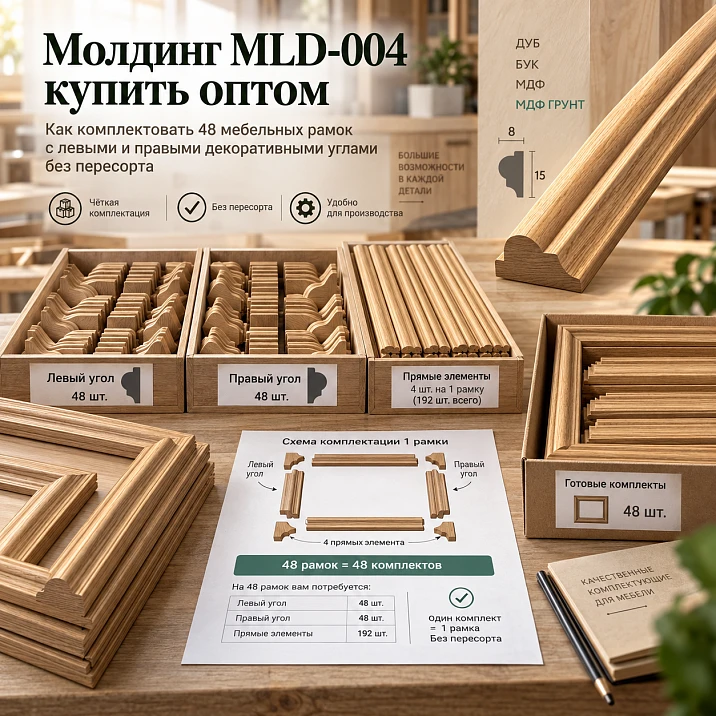
A serial furniture frame made of MLD-004 becomes a purchasing task not when its perimeter needs to be calculated, but when the straight profile is joined with mirrored decorative elements. On a single facade, a mistake is easy to correct by hand. On a batch of 48 facades, a swapped left and right corner, an incorrectly calculated pair, or a mixed reserve turn into a stoppage of assembly for the entire series.
Therefore, molding MLD-004 should be bought wholesale for such a project not by the line “MLD-004 — 350 meters,” but by sets of specific frames:
frame type → straight MLD-004 parts → left decor → right decor → material → length of source strips → cutting map → marking → set per facade → separate reserve → wholesale order.
The main principle of the article:
straight MLD-004, left MLD-4U-2.1L, and right MLD-4U-2.1R form one decorative system, but in accounting these are different items.
You cannot first buy all the straight profile and then "calculate the mirrored corners later." The corner element changes the actual length of the straight sections, sets the endpoint of the molding, and determines the very structure of the frame. This means the complete set for one frame is approved first, and only after that is a batch purchased for 48 facades.
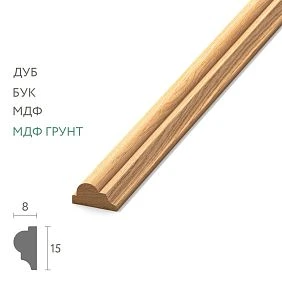
MLD-004 15×8 mm: what exactly is included in the procurement system
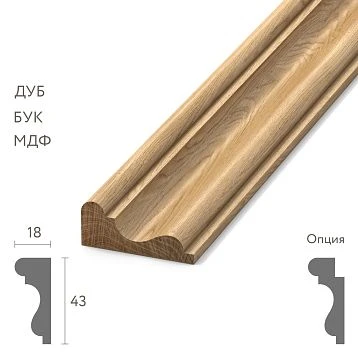
The current MLD-004 product page shows a single 15×8 mm profile in several materials and lengths:
| Material | Section | Product length |
|---|---|---|
| Beech | 15×8 mm | 1000 мм |
| Oak | 15×8 mm | 1000 мм |
| Beech | 15×8 mm | 2400 мм |
| Oak | 15×8 mm | 2400 мм |
| MDF | 15×8 mm | 2600 мм |
For MDF, the preparation options "Prestige" and "Prestige primed" are available. The straight profile and decorative elements may have their own material and finish parameters, so the entire system is fixed in the specification before purchase.
Straight profile product page: buy molding MLD-004.
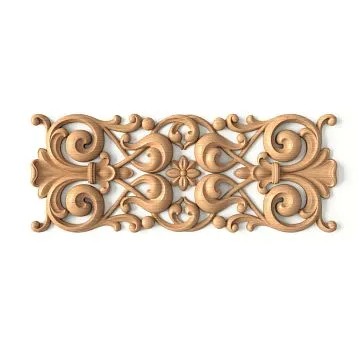
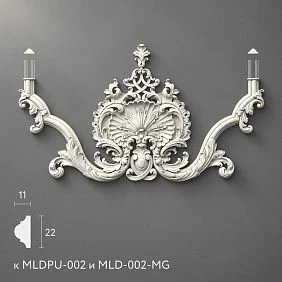
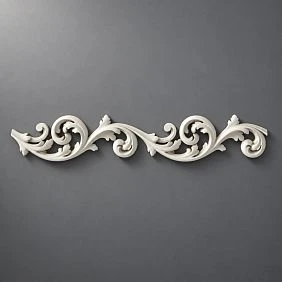
The paired decorative system uses mirrored corner elements:
-
MLD-4U-2.1L — left;
-
MLD-4U-2.1R — right.
The working size of each decorative element is 145×90×16 mm. They must not turn into a nameless line item like "corners for MLD-004".




Why two different orientations need to be understood on two levels
There are two different concepts:
Orientation of the corner element.
Left MLD-4U-2.1L and right MLD-4U-2.1R are mirror-image parts.
Orientation of the entire furniture frame.
For example, two display cabinets on either side of a fireplace can be the left and right modules of a single composition.
These levels must not be mixed up.
Even a "left frame" can contain both left and right corner elements depending on the layout.
Therefore, the specification must include separate fields:
frame type;
orientation of each corner;
number of straight parts.
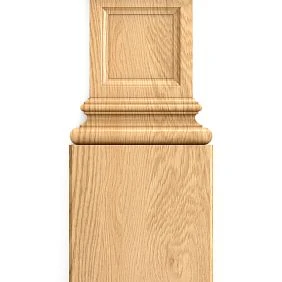
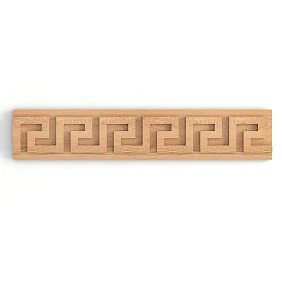
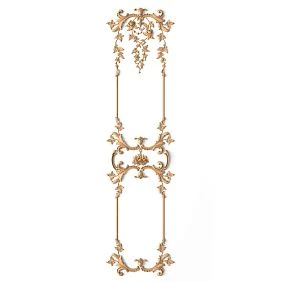
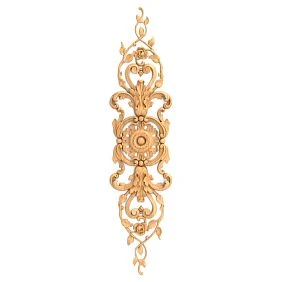
Our factory also produces:

Why 48 identical fronts do not yet mean 48 identical sets
On the plan, a series may look uniform:
-
same width;
-
same height;
-
one MLD-004;
-
one color.
But a decorative system may include:
-
standard frames;
-
mirrored left;
-
mirrored right;
-
are tall;
-
narrow;
-
exceptions for handles or hinges.
For example, 48 fronts can be divided as follows:
-
24 standard R-01;
-
12 mirrored R-02L;
-
12 mirrored R-02R.
The net consumption of straight molding for R-02L and R-02R may be the same.
But the set of decorative elements and their arrangement are mirrored.
If the warehouse sees only:
MLD-004 — 48 sets,
he doesn't understand how many left and right elements are needed for each scheme.
Get Consultation
What is a set of one furniture frame
Before wholesale calculation, the concept of a frame set is introduced.
For example, the standard rectangular frame R-01:
| Position | Quantity |
|---|---|
| upper straight part MLD-004 | 1 |
| lower straight part MLD-004 | 1 |
| left vertical MLD-004 | 1 |
| right vertical MLD-004 | 1 |
| left decorative corner | According to the approved scheme |
| right decorative corner | According to the approved scheme |
In the classic scheme of four corners per one rectangular frame, the following can be used:
2 left + 2 right decorative elements.
Then for 48 identical frames:
96 left;
96 right.
But this is only valid for a specific approved scheme. If decorative elements are not used in all four corners, the quantity is recalculated based on the actual drawing.
Why you cannot order straight MLD-004 first and corners later
Let's imagine a frame without decorative elements.
The finished horizontal is equal to:
760 mm.
After installing the carved corner, the straight section may end earlier because part of the frame geometry is occupied by the corner decor.
Now the straight horizontal run may become, for example:
650 mm.
If the purchaser has already calculated the entire straight MLD-004 at 760 mm, the cutting map is incorrect.
Therefore:
decorative corner — not an additional accessory after calculation;
it is part of the frame geometry.
First, the complete assembly is put together.
Then the straight sections are calculated.
The left and right corner elements are two separate purchasing items
Bad line:
MLD-004 corners — 192 pcs.
It hides the orientation.
Stronger:
MLD-4U-2.1L — 96 pcs.;
MLD-4U-2.1R — 96 pcs.
If the project uses a different ratio:
L — 72;
R — 120.
This is also acceptable if that is the actual composition.
The main rule:
the L/R balance is determined by the drawing, not by an assumption of symmetry.
Why the right corner cannot be automatically replaced with the left
MLD-4U-2.1L and MLD-4U-2.1R have different ornament directions.
If the right element is placed instead of the left:
-
the pattern is reversed;
-
the mirror logic breaks;
-
the joint with a straight profile may be perceived differently;
-
the paired composition loses its symmetry.
Not recommended:
-
flip the element;
-
rotate it 180°;
-
trim it to a “similar” appearance;
if the specific design does not confirm interchangeability.
In the warehouse, L and R are different items.
How to determine which is left and which is right
You cannot rely on the phrase:
the left one is the one on the left.
For mirrored furniture, this quickly creates confusion.
The working diagram must record:
-
front view of the facade;
-
the top;
-
bottom;
-
left side;
-
the right;
-
ornament direction;
-
decorative element code.
For example:
P01-UL — upper left decorative node.
P01-UR — upper right.
P01-DL — lower left.
P01-DR — lower right.
And within each node, it is specified which physical SKU, L or R, is used.
This way, "left" in the facade geometry is not confused with the letter L in the decor SKU.
Why mirrored furniture fronts are especially dangerous for assembly
Let's imagine two display cases:
-
left;
-
right.
They are positioned symmetrically.
The size is the same.
The straight MLD-004 is the same.
But the decorative composition is mirrored.
Bad warehouse approach:
two identical frames.
Stronger:
R-02L;
R-02R.
If each set is packed and labeled separately, the installer does not flip the decor "by eye" or search for the correct orientation among the common box of corners.
Frame type schedule instead of 48 separate rows
You don't have to create 48 unique designs.
Type more strongly.
For example:
| Type | Purpose | Quantity |
|---|---|---|
| P-01 | standard frame | 24 |
| R-02L | mirrored left | 12 |
| R-02R | mirrored right | 12 |
If there are other sizes:
| Type | Purpose |
|---|---|
| P-03 | High |
| P-04 | Narrow |
| R-05 | handle exception |
For each type, the following are recorded:
-
outer dimension;
-
straight parts;
-
L-elements;
-
R-elements;
-
material;
-
finishing.
After this, procurement works not with 48 separate fronts, but with several repeatable sets.
Why the same perimeter does not mean the same set
R-02L and R-02R may have the same perimeter.
For example:
2×900 + 2×650 mm.
The total clean linear meterage of straight MLD-004 is the same.
But the decorative elements are distributed in a mirrored manner.
Therefore:
linear consumption is the same;
the complete set list is different.
This is the key B2B thesis of the article.
Procurement must account for two entities:
-
straight profile by lengths;
-
mirrored decor by orientation.
How to calculate straight MLD-004 after angles are approved
Only after the complete assembly is ready are the straight sections measured.
For example, for one R-01:
-
2 verticals of 820 mm each;
-
2 horizontals of 620 mm each.
For 24 frames:
-
verticals: 48×820 mm;
-
horizontals: 48×620 mm.
R-02L:
-
24 verticals of 920;
-
24 horizontals of 700 each.
R-02R has the same finished lengths if the geometry is mirrored.
Now all parts are combined into a single pool of one material and finish.
Why is the calculation of the straight profile done in parts rather than in meters
Let the net total of straight MLD-004 be:
142 m.
Simple division by 2.4 m:
142 / 2,4 ≈ 59,2.
One can solve:
60 strips.
But real lengths may combine poorly.
For example:
-
920 + 920 = 1840;
-
560 remains;
-
horizontal 620 no longer fits.
So, the total footage is insufficient.
A cutting map is needed.
How lengths of 1000 and 2400 mm work in solid wood
Beech and oak MLD-004 have:
-
1000 mm;
-
2400 mm.
A short plank is useful not because "a short part must always come from 1000 mm."
First, the overall map is checked.
For example, a part of 820 mm:
From 1000 mm
About 180 mm remains before technological losses.
From 2400 mm
You can try:
820 + 820 + 620 = 2260 mm.
Nominally, 140 mm remains before the cut.
So one long plank can be more advantageous than two one-meter ones.
Therefore, the choice of 1000/2400 is a consequence of the map, not a separate topic of the article.
When one-meter planks are actually useful
1000 mm is reasonable to consider for:
-
single short verticals;
-
repair;
-
small frames;
-
a shortage that cannot be covered by leftovers;
-
a supply queue where long-length material creates extra waste.
But first, the 2400 mm leftovers are checked.
If there are already 850–950 mm pieces after the long parts, a new one-meter strip may not be needed.
MDF 2600 mm is counted separately from solid wood
MLD-004 in MDF has a length of 2600 mm.
So, the map:
Beech/oak 2400
and the map:
MDF 2600
do not match.
A combination that does not fit in 2400 may fit in 2600.
For example:
920 + 920 + 620 = 2460 mm.
For the 2400 array:
does not fit before cutting.
For MDF 2600:
nominally 140 mm remains before technological operations.
Therefore, the material and the commercial length must be determined before calculation.
How to avoid mixing regular and primed MLD-004 made of MDF
Within a single MLD-004 MDF product card, there may be different surface preparation options.
If the warehouse has:
MLD-004 / MDF / 2600 / Prestige
and:
MLD-004 / MDF / 2600 / Prestige primed,
these are two different product configurations.
Bad line:
MLD-004 MDF — 60 pcs.
Stronger:
MLD-004 / MDF / 15×8×2600 / Prestige / zone A — 32 pcs.
MLD-004 / MDF / 15×8×2600 / Prestige primed / zone B — 28 pcs.
Why this is especially important in serial furniture production:
-
after painting, the difference in preparation is no longer visible from the labeling;
-
parts may accidentally end up in the same frame;
-
the finishing area receives different substrates for the same coating.
Therefore, the preparation code must be preserved from acceptance through installation.
How to assemble a complete set for one frame in practice
Let's take a conventional R-01.
Finished straight parts:
-
2×820 mm;
-
2×620 mm.
Corner elements:
-
2×MLD-4U-2.1L;
-
2×MLD-4U-2.1R.
Material:
-
Oak.
Finishing:
-
F02.
Full complete-set line:
R-01 / oak / F02 / 2×820 / 2×620 / L×2 / R×2.
Now you can multiply by the number of frames.
For 24 R-01:
-
verticals 820 — 48 pcs.;
-
horizontals 620 — 48;
-
L — 48;
-
R — 48.
This is only one type.
How to calculate mirrored R-02L and R-02R
Let's imagine:
R-02L
12 frames.
Straight parts:
-
2×920;
-
2×700.
Corner composition:
-
according to the approved mirrored scheme.
R-02R
12 frames.
The straight lengths are the same.
But the orientation of the nodes is mirrored.
If a specific system in each rectangular frame uses 2 L and 2 R, then the total number of corners across both groups remains the same.
But if the project introduces an additional left or right accent on only one side, the balance changes.
Therefore, one cannot assume:
mirrored frames automatically have the same corner set.
You need to look at the drawing.
Why the frame type must exist before the warehouse code
If the warehouse receives:
L — 96 pcs.;
R — 96 pcs.,
but does not know which frames consume them, a reorder is then difficult to explain.
Stronger:
Р-01 → L48/R48;
Р-02L → L24/R24;
Р-02R → L24/R24.
Or another actual distribution.
Then any shortage can be tied to a specific series.
How to build a master list for 48 fronts
Convenient format:
| Frame type | Quantity | Straight parts | L | R | Material | Finish |
|---|---|---|---|---|---|---|
| P-01 | 24 | 2×820 + 2×620 | 2 | 2 | Oak | F02 |
| R-02L | 12 | 2×920 + 2×700 | 2 | 2 | Oak | F02 |
| R-02R | 12 | 2×920 + 2×700 | 2 | 2 | Oak | F02 |
If the corner pattern differs, the L/R numbers change in the corresponding rows.
Two independent purchasing calculations are generated from the master list:
-
straight MLD-004;
-
mirrored decor L/R.
Why two calculations must converge in one set
You can perfectly buy the straight profile and still fail to assemble the furniture.
For example:
-
straight parts are enough for 48 frames;
-
L is only enough for 46;
-
R is enough for 50.
Formally, total decor:
192 corners.
But only 46 frames are covered, if each needs paired L/R.
This is the reason why the total count by pieces is insufficient.
You need to count the coverable sets.
How to determine the number of fully complete frames
If a standard frame requires:
-
2 L;
-
2 R,
and in stock:
-
L = 94;
-
R = 100,
then the maximum number of complete frames:
min(94/2, 100/2) = 47 frames.
One set remains incomplete due to two missing L.
This is far more useful than writing:
a total of 194 corner elements.
Why the surplus of right corners does not compensate for the shortage of left ones
In the example given:
-
R has 6 extra remaining;
-
L is short by 2.
The overall balance of decorative elements appears to be positive.
But functionally, the project has a deficit.
This is similar to long and short profile remnants: the total amount of material does not equal the ability to cover a specific part.
How to calculate the reserve of corner elements
Not:
+10% corners.
Stronger:
Reserve L
Separate quantity.
Reserve R
Separate.
For example:
L main — 96;
L reserve — 4.
R main — 96;
R reserve — 4.
Or another number per the project.
The reserve should account for real risk:
-
damage;
-
mismatched items;
-
defects;
-
installation loss;
-
repair after handover.
Why it's better to store L/R reserve as paired sets
If a standard frame uses 2L + 2R, one repair kit might look like this:
L×2 + R×2.
This is more convenient than:
shared corner stock — 8 pcs.
A paired reserve immediately shows:
how many frames can be fully restored.
If the decor is expensive or reorder lead times are long, this logic is especially useful.
How to label decorative elements
Simple code:
U-L / Р01 / batch 03.
U-R / Р01 / batch 03.
For the mirror series:
U-L / Р02L.
U-R / Р02R.
If there are multiple materials in one project:
U-L / oak / F02 / Р02L.
This way the warehouse does not mix:
-
left/right;
-
beech/oak;
-
finishing;
-
frame type.
Why labeling with only the letter L/R is insufficient
Because L/R can mean:
-
orientation of the element;
-
orientation of the front;
-
side of the cabinet.
For example:
R-02L / element R.
This is a perfectly possible string.
If an employee sees only two letters, they may decide that they contradict each other.
Therefore, the code must clearly separate:
-
frame type;
-
physical article number of the corner;
-
position on the facade.
How to label straight parts after cutting
For example:
P01-V-820 / oak / F02.
P01-H-620 / oak / F02.
Where:
-
V — vertical;
-
H — horizontal.
You can use Russian designations:
P01-V-820;
P01-H-620.
The main thing is that the same standard is applied:
-
in the project;
-
in the warehouse;
-
in the workshop;
-
during installation.
How to assemble one facade
Ideal installation kit R-01:
-
vertical 820 — 2;
-
horizontal 620 — 2;
-
L — 2;
-
R — 2;
-
scheme;
-
fasteners/adhesive as per project.
It is not necessary to physically put everything in one box.
But logical completeness must be checked before dispatch.
How to assemble 48 facades in batches
For example:
Phase 1
12 Р-01.
Phase 2
12 Р-01.
Phase 3
12 Р-02L.
Queue 4
12 Р-02R.
For each queue, the warehouse checks:
-
straight profile;
-
L;
-
R;
-
finishing;
-
marking.
There is no need to re-add the full project reserve in each queue.
There is one reserve; its balance changes according to actual consumption.
How to manage the reserve between queues
Example:
Initially:
-
L reserve — 6;
-
R reserve — 6.
After queue 1, one L is damaged.
remains:
-
L = 5;
-
R = 6.
Before queue 2, it is decided:
-
restore L to 6;
-
or accept the new balance.
There is no need to count the reserve as a constant “10% for each delivery.”
How to receive direct MLD-004
Checked:
-
article number;
-
section 15×8;
-
material;
-
length;
-
preparation;
-
quantity;
-
damage;
-
marking.
For the array separately:
-
1000;
-
-
For MDF:
-
2600;
-
Prestige;
-
Prestige primed.
Cannot accept:
MLD-004 — 90 strips
without splitting product variants.
How to inspect L/R decor upon receipt
Checked separately:
-
MLD-4U-2.1L;
-
MLD-4U-2.1R;
-
quantity of each;
-
material;
-
sanding quality;
-
finish configuration;
-
damage;
-
marking.
Poor receiving:
corners — 192 pcs.
Stronger:
L — 96;
R — 96.
Why you should not count by the number of boxes
A single box may contain:
-
different orientations;
-
different materials;
-
different series.
Number of packages — logistics information.
The completeness of the project is determined by the actual product items.
Therefore:
4 boxes of corners arrived
does not mean:
48 frames are fully complete.
Control set before launching the full series
Before mass installation, at least the following must be assembled:
-
one R-01;
-
one R-02L;
-
one R-02R.
Check:
-
geometry;
-
lengths;
-
ornament direction;
-
L/R;
-
straight joints;
-
material;
-
finishing;
-
marking.
If even one set has to be "figured out" on site, the series is not ready yet.
Why checking a single standard frame is not enough
R-01 can be symmetrical.
The main risk of the article is mirroring.
Therefore, be sure to check:
-
the left one;
-
the right mirrored versions.
Otherwise, the error may only appear at the third stage, when the standard frames have already been assembled.
How to record the control result
For example:
R-01.R1
R-02L.R1
R-02R.R1
Each version contains:
-
lengths;
-
L/R count;
-
material;
-
finishing;
-
photo;
-
diagram.
If the project changes, R2 appears.
Old R1 parts must not slip unnoticed into the new version.
How to handle a change to a single decorative element after a series has been approved
Let's imagine that P-02L has already been approved, but after the control assembly the designer changes one upper corner element.
Was:
MLD-4U-2.1L.
Now:
a different decorative element or a different orientation.
This is not a local replacement of one warehouse line.
Need to check:
-
whether the MLD-004 attachment point changes;
-
does the horizontal length change;
-
does the vertical length change;
-
whether symmetry is maintained;
-
is a different material required;
-
does the L/R balance change;
-
does the repair reserve change.
After this, the following appears:
R-02L.R2.
The old R1 version remains in history.
What to do with already purchased corners of the old revision
Do not write off automatically.
Check:
-
are R-01 suitable;
-
are they suitable for another zone;
-
can it be left as repair reserve R1;
-
can it be used in other furniture.
But they cannot be considered reserve R2 if the new assembly is physically different.
How to change the number of frames after starting a batch
For example, the project grew:
there were 48 frames;
it became 52.
Added:
-
2 R-02L;
-
2 R-02R.
You can't just add:
four more MLD-004 sets.
It is necessary to recalculate:
-
straight parts;
-
L;
-
R;
-
material;
-
finishing;
-
useful leftovers;
-
reserve.
If there are already usable offcuts of straight MLD-004 in stock, they can reduce the new order.
Corner elements are counted separately.
How to use offcuts of straight MLD-004
After cutting, the offcut should receive:
-
actual length;
-
material;
-
preparation;
-
status.
For example:
| Code | Length | Material | Preparation | Status |
|---|---|---|---|---|
| O-001 | 860 мм | Oak | F02 | R02-V |
| O-002 | 640 мм | Oak | F02 | R01-G |
| O-003 | 510 мм | Beech | F01 | Spacious |
| О-004 | 940 мм | MDF | primed | Repair |
Entry:
MLD-004 offcuts — 18 m
too coarse.
Why the remaining straight profile cannot be combined with the reserve of decorative corners
These are different functions.
Straight MLD-004 covers:
-
verticals;
-
horizontals;
-
short inserts.
L/R decor covers a specific mirrored point.
Even a large stock of straight profile does not help if the left corner has run out.
Therefore, the final balance has at least three independent groups:
-
straight MLD-004;
-
MLD-4U-2.1L;
-
MLD-4U-2.1R.
How to calculate the remaining completeness after the first batch
Suppose that after 12 standard frames there remain:
-
enough straight MLD-004 for 40 frames;
-
L — 78;
-
R — 81.
If the next standard frame requires 2L + 2R:
L allow closing:
78 / 2 = 39 frames.
R:
81 / 2 = 40 full frames with a remainder of 1 R.
Actual completeness:
39 frames.
That is, the straight profile is enough for 40, R for almost 40, but the project is limited by L.
This needs to be seen before the next installation queue.
Why a total reserve in pieces creates a false sense of security
Suppose after purchase there are:
-
8 spare corner elements.
But of these:
-
L — 1;
-
R — 7.
If the repair frame requires:
-
2L;
-
2R,
not a single complete frame can be restored.
Therefore, the stock is estimated not by the total number of corners, but by the number of complete repair kits.
How to form a repair reserve for 48 frames
A reasonable approach:
Straight profile
-
several whole strips;
-
several ready-made standard parts;
-
usable remnants.
L
Separate quantity.
R
Separate quantity.
Kit
If the project is critical to repair speed, you can pre-assemble:
R-01 repair kit = straight parts + L×2 + R×2.
The specific number of repair kits is determined by the customer.
The article does not set a universal percentage.
Why a whole MLD-004 is more important than a set of short offcuts in repair
A whole plank of 2400/2600 mm is more versatile.
It can be used to make:
-
vertical;
-
horizontal;
-
a new part after inspection.
Short offcuts are already limited.
Therefore, the repair stock should retain at least part of the long-length material.
How to work with natural oak and beech in a paired frame
If the wood remains visible, the straight profile and the decorative corner form a single visual node.
It is useful to check in advance:
-
material of straight MLD-004;
-
material L/R;
-
finishing;
-
tone;
-
Texture direction.
There is no need to promise an absolute match to natural wood.
But a random contrast between the straight part and the carved corner may be noticeable.
When visual sorting of wood is not needed
If the frame is painted with opaque enamel, the main control shifts to:
-
geometry;
-
surface quality;
-
L/R orientation;
-
joint;
-
preparation.
The wood texture becomes less significant.
This allows simplifying assembly without loss of quality.
How to work with MDF and wooden corners in one system
If the straight MLD-004 is selected from MDF, and the corner decor is wooden, the project must confirm:
-
the geometry of the joint;
-
the overall finish;
-
the preparation of two materials;
-
glue;
-
primer;
-
visual result.
You cannot consider:
one article line — meaning everything behaves the same in finishing.
The materials are different.
Such a set is first checked on a control facade.
Why the control facade must include the actual finish
A dry fit shows:
-
sizes;
-
orientation;
-
the geometry.
But after primer/enamel, the following may appear:
-
different surface levels;
-
gaps;
-
differences in preparation;
-
Shadows.
Therefore, for a new mixed system, a fully finished control facade is useful.
How to calculate the cost of one complete facade
Not only:
price of MLD-004 × meters.
Full structure:
-
straight profile;
-
L;
-
R;
-
cutting;
-
finish;
-
marking;
-
packaging;
-
reserve.
Then you can get:
cost of R-01;
cost of R-02L;
cost of R-02R.
This is useful if mirrored facades require different labor intensity.
Why a mirrored frame can cost more at the same square footage
Pure MLD-004 is the same.
But:
-
other decor;
-
different marking;
-
more assembly operations;
-
separate inspection.
Therefore, the cost per linear meter does not show the full cost of the facade.
How to compare supplier offers
for construction materials suppliers the same specification is sent:
-
MLD-004 / specific configuration / quantity;
-
L / quantity;
-
R / quantity;
-
material;
-
preparation;
-
reserve;
-
Delivery.
If you send to one supplier:
MLD-004 — 180 m + corners,
and to another a precise bill of materials, the proposals will not be comparable.
Why general B2B requests do not replace a product specification
The user can search construction materials supplier or construction materials wholesale.
But a production order must still end with precise line items:
MLD-004 / oak / 15×8×2400 / ___ pcs.
MLD-4U-2.1L / oak / ___ pcs.
MLD-4U-2.1R / oak / ___ pcs.
A general commercial request leads to the supplier.
The specification makes the order executable.
How to place a reorder for a straight profile
Bad:
10 more MLD-004.
Stronger:
MLD-004 / oak / 15×8×2400 / F02 / 10 pcs. / R-02 series.
For MDF:
MLD-004 / MDF / 15×8×2600 / Prestige primed / ___ pcs.
This way, the reorder matches the original configuration.
How to place a reorder for corner elements
Bad:
8 more corners.
Stronger:
MLD-4U-2.1L / oak / ___ pcs. / R-02L.R1.
And separately:
MLD-4U-2.1R / oak / ___ pcs. / R-02R.R1.
If the material and finish differ, they are also included in the line.
What to do if L ran out but R remains
Not:
-
move R to the left position;
-
flip;
-
cut;
-
change the pattern.
First, check:
-
whether a specific system can physically use R differently;
-
whether there is confirmation from the manufacturer/project;
-
is there L in reserve;
-
whether an additional order is needed.
If interchangeability is not confirmed, R does not cover the L shortage.
What to do if the straight profile is out of stock but the decor is available
Check:
-
full reserve;
-
remnants;
-
1000/2400;
-
possibility of combined cutting;
-
material;
-
finishing.
If there is no straight profile, the corner decor by itself does not close the frame.
This again shows that the system is supplied as a complete set.
When it is too early to buy a wholesale batch
Do not confirm the main order if:
-
MLD-004 has not yet been approved;
-
L/R decor not approved;
-
unclear how many L/R per frame;
-
no types R-01/R-02L/R-02R;
-
straight lengths calculated without corners;
-
material changes;
-
finish not defined;
-
no control left and right facade;
-
corner reserve is calculated as a total sum.
In this state, a budget is acceptable.
But not the final purchase.
Practical calculation: 48 frames, straight profile, and 192 corner elements
Let's take a hypothetical project in which all 48 rectangular frames use the same basic layout:
-
2 verticals MLD-004;
-
2 horizontals MLD-004;
-
2 left MLD-4U-2.1L;
-
2 right MLD-4U-2.1R.
-
-
perspective;
-
mirror reflection;
-
smartphone rotation;
-
installation orientation
-
material;
-
length;
-
preparation.
-
straight parts;
-
L;
-
R.
-
defects;
-
repairable;
-
sample;
-
write-off.
-
L/R are not mixed up;
-
the straight profile arrived at the corner elements without a step;
-
color and gloss match;
-
the joint does not open up;
-
the ornament direction is mirrored;
-
the outer frame matches the drawing.
-
straight profile card;
-
material;
-
product length;
-
preparation;
-
frame types;
-
lengths of straight parts;
-
L/R article;
-
amount of repair reserve;
-
photos of control frames;
-
batch date;
-
coating code.
-
the facade is too small for a corner decoration;
-
the corner takes up too much of the straight section;
-
handle nearby;
-
the decorative element conflicts with the hinge;
-
the relief visually overloads the furniture;
-
the mounting base is not suitable.
-
how many strips go into R-01;
-
how many go into R-02L/R;
-
how many remain in reserve;
-
which remnants are already assigned to short parts.
-
base requirement;
-
installation reserve;
-
an operational reserve.
-
L96 — production;
-
L4 — reserve;
-
R96 — production;
-
R4 — reserve.
-
the reserve is already implicitly included in the production requirement;
-
L/R totals match, but the orientation balance is incorrect;
-
the straight profile was purchased by net linear meters without a real cutting map.
-
L — 96;
-
R — 96.
-
MLD-004;
-
decorative system;
-
L/R;
-
frame types;
-
material;
-
finish;
-
Dimensions.
-
finished straight parts;
-
cutting map;
-
codes;
-
revisions;
-
control R-01/R-02L/R-02R;
-
assembly rules.
-
number of straight strips;
-
L;
-
R;
-
reserve of each group;
-
delivery batches;
-
marking;
-
reorder format.
-
MLD-004;
-
15×8 mm;
-
material;
-
1000/2400/2600 for the selected configuration;
-
surface preparation;
-
frame types;
-
number of frames of each type;
-
straight verticals;
-
straight horizontals;
-
MLD-4U-2.1L;
-
MLD-4U-2.1R;
-
L quantity per type;
-
R quantity per type;
-
finished lengths after decor allowance;
-
cutting map;
-
usable leftovers;
-
stock code;
-
assembly code;
-
revisions;
-
standard control frame;
-
left mirrored control frame;
-
right mirrored control frame;
-
straight profile reserve;
-
reserve L;
-
reserve R;
-
repair passport;
-
reorder format.
-
all 48 frames are distributed by type;
-
each type has an approved scheme;
-
straight MLD-004 recalculated into whole product strips;
-
the number of L and R matches the number of sets;
-
the L/R reserve is not mixed with the main requirement;
-
the whole straight reserve is physically not included in the current cutting plan;
-
the mirrored versions have passed trial assembly;
-
the warehouse can use the remaining stock to answer how many complete frames can still be assembled.
Why orientation cannot be determined from a photo without a diagram
In the photo:
may knock down an employee.
The production diagram must show the facade frontally and label the physical SKUs.
Photo — supplementary.
Not the primary source of orientation.
How to organize warehouse bins
At least three separate zones:
MLD-004
Straight profile.
Inside:
MLD-4U-2.1L
Left.
MLD-4U-2.1R
Right.
If everything is stored in a single box, "MLD-004 system", the risk of mis-sorting increases.
How to organize issue to the workshop
The workshop does not receive:
12 meters of molding and a box of corners.
But:
R-02L ×6 sets.
Inside the list:
The warehouse writes off actual items per set.
This way, the balance in accounting matches actual production.
How to arrange the return of unused decor
If one set is not assembled, L/R are returned while preserving orientation and status.
Not:
4 corners back to the warehouse.
But:
L — 2;
R — 2;
R-02L / not used.
This helps the next queue.
How to handle a damaged but not completely unusable element
A damaged L cannot be automatically returned to the "usable reserve".
It is assigned the status:
If it is used as a color or finish sample, this is a separate function.
But it should not be counted as a full-fledged repair corner.
How to track a batch of corners by material
For example:
L / oak / F02.
R / oak / F02.
If part of the project is beech:
L / beech / F01.
R / beech / F01.
Now there are already four material-orientation groups.
Summary line:
corners MLD-004
completely loses its meaning.
How to manage a batch of corner pieces by finish
With a transparent or tinted finish, the material is especially important.
With a covering enamel, the visual difference in the wood is smaller, but the preparation must still match the project.
Therefore, the finish code is retained even for L/R.
How to accept a control set after painting
Check:
If the geometry is good before painting but poor after, the problem may be in the preparation/finishing.
Why the reserve must account for repairs after handover
After a year, damage may affect only one R.
If all spare R were used during installation, only reordering remains.
Therefore, the operational reserve is separated from the installation reserve.
The installation reserve can be used during the project.
The operational reserve is retained after handover.
How to create a repair passport for the MLD-004 system
Save:
Then the service team does not look for:
the same beautiful corner.
It sees the exact article.
When MLD-004 and corners should not be used in this frame
Even an approved idea may not work if:
In that case, it is better to change the project before purchasing.
How to verify the final specification in reverse
Before payment, it is useful to go through the calculation in reverse: from each custom item to the specific frames it covers.
For example, the request contains:
MLD-004 / oak / 15×8×2400 / F02 — 68 pcs.
MLD-4U-2.1L / oak / F02 — 100 pcs.
MLD-4U-2.1R / oak / F02 — 100 pcs.
Now we need to explain each number.
For the straight profile:
For L/R:
If in a hypothetical project 48 full frames require 2L+2R each, the base requirement is:
L96 + R96.
Therefore, when ordering L100/R100, one can explain:
If the order looks like:
L103 / R97,
there must be a real reason for such an imbalance: a separate frame type, a different composition, or an already accounted-for remainder. The phrase “that’s roughly how it turned out” is not sufficient.
Such a reverse check catches three typical errors:
The final specification is considered ready when any employee can open a single table and answer how many full frames each material group covers, how many sets remain in reserve, and what specific shortage a reorder will cause.
Fifteen mistakes when purchasing MLD-004 with mirrored decor in bulk
1. Order only the straight MLD-004 and calculate the corners later
Why it happens: the straight profile seems to be the main product item.
Consequence: after the corners are approved, the lengths of the straight parts and the entire cutting map change.
How to prevent it: first the complete frame set, then purchasing.
2. Treat L and R as a single “corners” line
Why it happens: the overall design looks symmetrical.
Consequence: the total count matches, but one orientation ends earlier.
How to prevent: count MLD-4U-2.1L and MLD-4U-2.1R separately.
3. Confusing a left facade with a left corner element
Why it happens: the project contains both frame R-02L and the physical article L at the same time.
Consequence: employees misinterpret the labeling.
How to prevent: separate the frame type code from the physical element code.
4. Treating 48 identical facades as 48 identical sets
Why it happens: the dimensions match.
Consequence: mirrored groups are lost.
How to prevent: standardize R-01/R-02L/R-02R.
5. Use the 2L+2R rule without checking the drawing
Why it happens: this pattern is typical for a full rectangular frame.
Consequence: a project with corners only on top gets extra decor.
How to prevent: the number of corners is determined by the actual composition.
6. Count straight profile only in linear meters
Why it happens: it is convenient for the estimate.
Consequence: the 1000/2400/2600 map and leftovers are not taken into account.
How to prevent: count finished straight parts.
7. Choose 1000 mm only because the part is short
Why it happens: it seems that a short product is automatically more economical.
Consequence: profitable 2400 mm combinations are lost.
How to prevent: compare the cutting map.
8. Mixing MDF 2600 and solid wood 2400
Why it happens: the cross-section is the same.
Consequence: the calculation of the number of planks becomes incorrect.
How to prevent: separate maps by material and length.
9. Mixing regular and primed MDF
Why it occurs: both are called MLD-004 MDF.
Consequence: the finish gets different bases.
How to prevent: full execution in the warehouse code.
10. Treating any right element as a replacement for the left
Why it occurs: the parts are mirrored.
Consequence: the ornament direction is disrupted.
How to prevent: do not assume interchangeability without confirmation.
11. Give the installer a single shared box of corners
Why it happens: it is physically easier to transport this way.
Consequence: L/R are sorted on site by eye.
How to prevent: separate bags and labeling.
12. Use a single shared reserve of corners
Why it happens: it is easier to write “8 spares.”
Consequence: seven R and one L do not cover even one full frame with a 2+2 norm.
How to prevent: reserve by orientation or as ready-made repair kits.
13. Not assembling control mirrored versions
Why it happens: the standard R-01 already looks correct.
Consequence: the error only appears on R-02L/R in the middle of the series.
How to prevent: at least one L- and one R-module before mass installation.
14. Not specifying the revision after changing the decor
Why it happens: it seems that only one corner has changed.
Consequence: R1 parts end up in R2.
How to prevent: a new revision of the entire frame.
15. Ordering additional “corners and molding”
Why it happens: the manager knows the project.
Consequence: orientation, material, preparation, and length are lost.
How to prevent: full line for each item.
Practical questions before payment
What size is MLD-004?
The cross-section of the straight profile is 15×8 mm.
What stock lengths are available for solid wood?
For beech and oak, 1000 and 2400 mm are available.
What is the length of MDF?
2600 mm.
Is there a primed MLD-004 made of MDF?
The current product page includes the “Prestige primed” version alongside “Prestige”.
Can MLD-004 be purchased wholesale for furniture frames?
Yes. But the quantity of the straight profile must be calculated after approving the corner decor and the actual lengths of the straight sections.
Which decorative elements belong to the mirror system?
MLD-4U-2.1L — left, MLD-4U-2.1R — right.
Can the left element be replaced with the right one?
Do not consider them interchangeable without confirmation of the specific design. Their purpose is a mirrored pair.
How many L/R are needed per frame?
For a complete rectangular layout with four decorative corners, 2L+2R may be used. But the actual quantity is determined by the drawing.
How many corners are needed for 48 such frames?
If each requires 2L+2R:
Plus a separate reserve.
Why can't you just buy 192 corners?
Because 100 L + 92 R also totals 192, but a complete set covers only 46 frames at the 2+2 standard.
How to count a straight profile?
Create a list of verticals and horizontals after accounting for corner geometry, then build a 1000/2400/2600 map for the selected material.
Can 2400 remnants be used instead of one-meter strips?
Yes, if the length is sufficient and the material and finish match. That is why one-meter versions are counted after inventorying remnants.
How to label L/R?
The physical L/R SKU must be a separate field, not mixed with the left/right frame designation.
How to calculate the reserve?
Separately straight MLD-004, L, and R. For a critical series, ready-made repair kits can be created.
How to accept the delivery?
Check the straight profile by version and length, and L/R by SKU, orientation, and quantity of each group.
What to keep after installation?
Whole straight profile, repair L/R, frame codes, finish, batch date, and control photos.
How to place an additional order?
Repeat the full configuration: SKU, material, length/orientation, finish, quantity, frame type, and revision.
Where to buy MLD-004?
Once the bill of materials is ready, you can order MLD-004 in the required material and commercial length.
How to check batch readiness before payment
Before the final order, three levels need to be finalized.
Project
Approved:
Production
Available:
Procurement
Known:
If only the following is known:
48 frames and 180 meters of profile,
wholesale specification is not ready yet.
Final readiness matrix
| Check | Status |
|---|---|
| MLD-004 15×8 approved | Yes/No |
| Frame types defined | Yes/No |
| L and R separated | Yes/No |
| Number of L/R per type known | Yes/No |
| Straight lengths calculated after corners | Yes/No |
| Material selected | Yes/No |
| Surface preparation encoded | Yes/No |
| Map 1000/2400/2600 ready | Yes/No |
| Remaining stock distributed | Yes/No |
| Straight profile reserve allocated | Yes/No |
| L reserve allocated | Yes/No |
| R reserve allocated | Yes/No |
| Control mirror frames have been assembled | Yes/No |
| Acceptance scheme approved | Yes/No |
| Additional order is placed as a full line | Yes/No |
If several key lines remain "no", it is too early to pay for the entire batch.
What a supplier request should look like
Please calculate the wholesale batch MLD-004 15×8 mm for a series of 48 furniture frames. The frame types and finished straight parts are specified in the complete bill of materials. Material, commercial length, and surface preparation are specified in separate lines. The system uses mirror decorative elements MLD-4U-2.1L and MLD-4U-2.1R; the quantity of each is calculated separately according to the approved frame types. The production and repair reserve of the straight profile, left and right elements is allocated in separate lines. Please confirm the current price, availability or lead time, packaging, marking, and delivery.
Such a request does not force the supplier to reconstruct the furniture project from the total linear meters.
Checklist before ordering MLD-004
Before payment, the following must be determined:
If only the line remains at the end:
MLD-004 — ___ meters, corners — ___ pcs,
work is not completed.
How to determine that the batch is truly ready for handover to production
The final criterion is not the total meters or the total number of boxes. Production must receive a kitting system in which, for each frame type, the straight parts, L, R, material, finish, and revision are known.
For a conditional batch of 48 frames, the check can be as follows:
If at least one item requires the answer “we’ll calculate it on site,” the batch is not yet ready for serial launch. For wholesale purchasing this is critical: any decision left to the installer will be repeated not once, but dozens of times across the entire series.
Final logic for the MLD-004 wholesale order
For a series of 48 furniture frames, the order should be as follows:
MLD-004 15×8
→ FRAME TYPES
→ DECORATIVE CORNER DIAGRAM
→ MLD-4U-2.1L / MLD-4U-2.1R
→ QUANTITY L/R PER TYPE
→ FINISHED STRAIGHT PARTS
→ material
→ PREPARATION
→ MAP 1000 / 2400 / 2600
→ USABLE OFFcuts
→ number of whole strips
→ MARKING
→ FACADE SET
→ CONTROL R-01 / R-02L / R-02R
→ STRAIGHT PROFILE RESERVE
→ RESERVE L
→ RESERVE R
→ SUPPLY QUEUES
→ ACTUAL BALANCE
→ REPAIR PASSPORT
→ REORDER IN FULL CONFIGURATION
The main question of wholesale purchasing here is not:
How many meters of MLD-004 and how many corners are needed in total?
But:
What specific types of furniture frames are included in the series, how many straight pieces, left and right decorative elements make up each set, how many such sets are repeated, and what real reserve preserves the ability to assemble or restore a frame without mixing up parts?
Once this question is resolved, 48 facades stop being a general pile of moulding and decor. Each module becomes a manageable set, where the straight MLD-004, left and right corners have a precise purpose, and the warehouse can at any moment answer not "how many pieces are left," but how many complete frames can still be assembled.