Article Contents:
- Why the frame should be calculated by corners, not just by perimeter
- How to understand whether such a frame fits into the smooth field at all
- First, measure the smooth field between the slat panels
- Four MLDPU-003U are needed almost always for a closed rectangular frame
- MLDPU-003 2600 mm long: why you need to calculate four specific segments
- Example #1: frame 900 × 1400 mm
- Example #2: frame 1200 × 1800 mm
- Example #3: frame 1500 × 2000 mm
- Example No. 4: frame 1800 × 2200 mm — why the total footage is misleading
- Summary table of four frames
- When one straight side is no longer enough for a 2600 mm plank
- Why you don't need to cut MLDPU-003U to reduce the frame
- 15 mm for MLDPU-003U and 12 mm for MLDPU-003: the numbers are not the same
- Before ordering, make four templates of 218 × 218 mm
- How to choose the distance from the frame to the slat panels
- What to place inside a large frame
- If there is just a painted wall left inside
- If there will be a console inside
- If there is a painting or mirror inside
- If inside the TV
- If inside a switch or socket
- 1. Mark the outer rectangle
- 2. Check the verticals and horizontals
- 3. Place four MLDPU-003U templates
- 4. Mark the beginnings and endings of MLDPU-003
- 5. Compare them with the calculated X and Y
- 6. Look at the composition from the main viewpoint
- 7. Check the furniture and lighting
- Corners
- Straight sides
- Main decorative elements
- Additionally
- Mistake: ordering only four MLDPU-003U
- Mistake: calculating the outer perimeter of the frame as the length of MLDPU-003
- Mistake: dividing the total footage by 2600 and rounding up
- Mistake: not accounting for the actual length of individual parts
- Mistake: trying to reduce the frame by cutting MLDPU-003U
- Error: measure the smooth field, but do not leave space around the frame
- Error: start gluing corners without a complete layout
- Error: use trims only because their total length is sufficient
- Can you make a square frame instead of a rectangular one from four MLDPU-003U?
- What to do if the wall does not actually form a perfect rectangle?
- Can you rotate MLDPU-003U by 90 degrees?
- Can you use only two MLDPU-003U on top, and make the bottom corners regular?
- Do you need to account for the kerf width when cutting two pieces from one plank?
- Can you use the 472 mm remainder after a 1200 × 1800 mm frame?
- Why does the MLDPU-003U have a depth of 15 mm, while the MLDPU-003 has 12 mm?
- What should I do if the straight section turned out to be 2700 mm?
- Can I make a frame from leftover pieces of several planks instead of buying a new one?
- Can I buy the molding first and decide the frame dimensions on site?
- Is a separate spare plank needed for a 1200 × 1800 mm frame?
- Can I place the frame flush against the slat panels?
- If two frames are planned, do I just double the quantity of MLDPU-003?
- Will one package of KUDO HIGH TACK be enough for the frame?
- Can I make the frame without MLDPU-003 and connect the four corners directly?
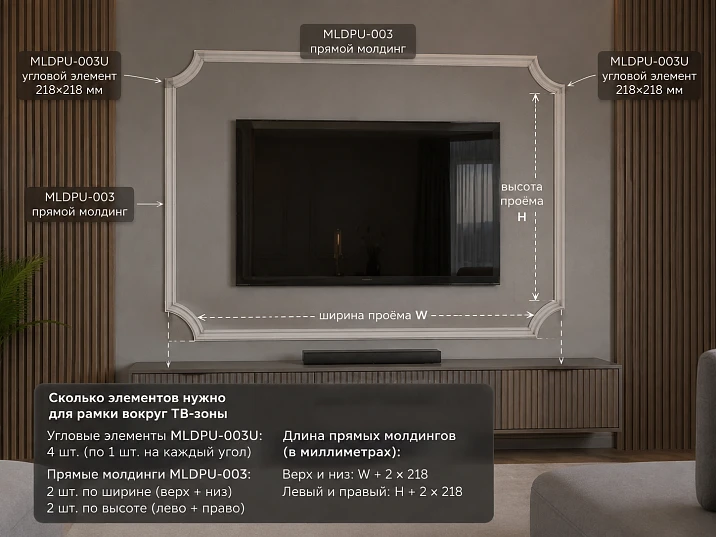
Between two sections of slat panels, you can deliberately leave a smooth painted field. It relieves the rhythmic surface and creates space for a separate decorative composition. If you simply run four straight moldings around the perimeter, you get a calm rectangular frame. But when a more expressive corner is needed, you can assemble a system of four corner moldings MLDPU-003U and a straight molding MLDPU-003.
Here, it is not enough for the buyer to decide whether they like the pattern of the corner element. They need to obtain a specific order list in advance:
4 × MLDPU-003U + the required number of MLDPU-003 strips + mounting material.
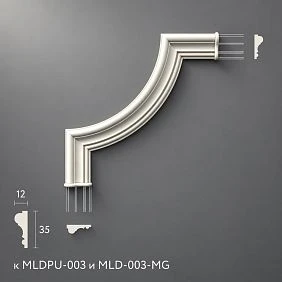
MLDPU-003U has a confirmed size of 218 × 218 × 15 mm, is made of polyurethane, and at the time of verification costs 3,140 ₽ per piece. The product card shows sales starting from one piece.
The straight MLDPU-003 has a size of 35 × 12 × 2600 mm, is also made of polyurethane, and currently costs 7,580 ₽ per plank 2600 mm long. In its card, MLDPU-003U is directly listed among related products, so the pairing of the two products is not artificially invented.
For example, for a frame with an external size of 1200 × 1800 mm, four corner elements take up 218 mm from each corner along the corresponding sides. Between them remain straight sections:
- horizontally — 764 mm;
- vertically — 1364 mm.
From one MLDPU-003 plank 2600 mm long, you can obtain:
1364 + 764 = 2128 mm.
So, one plank covers one vertical and one horizontal side between corner pieces, and for the entire frame, two MLDPU-003 planks are needed.
We get the base cart:
- 4 × MLDPU-003U = 12 560 ₽;
- 2 × MLDPU-003 = 15 160 ₽;
- total decorative elements = 27,720 ₽.
Installation compound, delivery, and packaging are not included in this amount.
This is the main point of the article: after measuring the smooth field, a person should not just choose molding, but understand the exact number of corners, the length of each straight section, the cutting scheme for 2600-millimeter planks, and the final cost of the set.
After calculation, the corners can be purchased as corner molding MLDPU-003U, and straight sections can be assembled from molding MLDPU-003.
Why the frame should be calculated by corners, not just by perimeter
A regular frame made of four straight moldings is calculated relatively simply: the perimeter is measured, a margin for trimming is added, and the number of planks is determined.
With MLDPU-003U, the logic is different.
Each ready-made corner already has its own dimension of 218 × 218 mm.
Therefore, a straight MLDPU-003 does not go from one outer corner of the frame to another. It only fills the gap between two corner elements.
For a rectangular closed frame, first fix the four corners:
- top left;
- top right;
- bottom right;
- bottom left.
Consequently, the number of MLDPU-003U for one regular rectangular frame is 4 pieces.
After that, four straight inserts are calculated.
If we denote:
- W — the external width of the finished frame;
- H — the external height;
- 218 mm — the length of the corner element along each side,
then the horizontal straight section:
X = W − 218 − 218
Or:
X = W − 436 mm.
Vertical:
Y = H − 436 mm.
Total length of straight MLDPU-003 without accounting for waste:
L = 2X + 2Y.
It can also be written as a single formula:
L = 2(W + H) − 1744 mm.
This formula is useful for a preliminary estimate of material volume. But by itself, it does not yet determine the number of 2600 mm slats.
Why — we will examine below on a large frame, where the arithmetic of the total length will give too optimistic a result.




How to understand whether such a frame fits at all in a smooth field
Before calculating the planks, a simpler question needs to be resolved: is there enough space for the four large MLDPU-003U corners.
By pure geometry, two adjacent corners on one side occupy:
218 + 218 = 436 mm.
This means that with an external side size of 436 mm, the straight gap mathematically becomes zero:
436 − 436 = 0 mm.
But this does not mean that a 436 × 436 mm frame should be assembled from four MLDPU-003U units.
This is merely the mathematical boundary of the chosen formula.
The original system is built exactly as:
corner → straight MLDPU-003 → corner.
Therefore, for an expressive large frame, a meaningful straight section must remain between the corner elements.
Let's see what happens with different sizes of one side:
| External side size | Two corners occupy | Straight gap |
|---|---|---|
| 500 мм | 436 мм | 64 мм |
| 600 мм | 436 мм | 164 мм |
| 700 мм | 436 мм | 264 мм |
| 900 мм | 436 мм | 464 мм |
| 1200 мм | 436 мм | 764 мм |
| 1500 мм | 436 мм | 1064 мм |
| 1800 мм | 436 мм | 1364 мм |
With a side of 500 mm, the two large corner elements almost meet each other.
At 1200–1800 mm, the direct MLDPU-003 already has an independent role.
There is no universal standard like "the minimum should be 700 mm." Product cards do not provide such a figure.
The correct way is to make corner templates of 218 × 218 mm at full scale and place them on the wall.
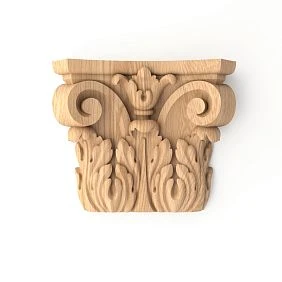
Our factory also produces:
First, measure the smooth field between the slat panels.
The size of the frame itself and the size of the smooth insert are not the same thing.
Suppose a strip 1400 mm wide is left between the slat zones.
If the frame is 1200 mm wide and centered, the free field will be:
1400 − 1200 = 200 mm.
With symmetrical placement:
200 / 2 = 100 mm
left and right.
This is already a useful value: you can stick two strips of masking tape at a distance of 100 mm from the slat zones and see the future outer contour.
If you try to fill the same field with a width of 1400 mm with a frame of 1350 mm, only the following will remain free:
50 / 2 = 25 mm
on each side.
Mathematically, the frame fits.
Compositionally, it may look too cramped between the slat panels.
There is no need to invent a mandatory minimum gap. You need to see it at a 1:1 scale.
For a centered frame, the side margin formula is:
M = (P − W) / 2,
Where:
- P — width of the smooth insert;
- W — external width of the frame.
The same check is performed for height.
Get Consultation
Four MLDPU-003U are almost always needed for a closed rectangular frame.
If the task is specifically a closed rectangular composition, the logic of quantity is simple:
one corner = one MLDPU-003U.
A rectangle has four corners.
Therefore:
4 × MLDPU-003U.
At the current price of 3,140 ₽/pc., a set of four corners costs:
3 140 × 4 = 12 560 ₽.
This is a fixed part of the budget for the frame in question.
What changes is the quantity of straight MLDPU-003 units.
That is why it is useful to first count the planks: switching from two planks to three increases the decorative part of the order by 7,580 ₽ at once, and switching from three to four adds the same amount again.
For one large project, a cutting error becomes financially noticeable.
MLDPU-003 with a length of 2600 mm: why you need to calculate four specific segments
One MLDPU-003 strip is 2600 mm long. Its profile is 35 × 12 mm.
After calculating the frame, you get not an abstract total length, but four specific parts:
- X;
- X;
- Y;
- Y.
For example:
764 + 764 + 1364 + 1364 mm.
The next task is no longer like calculating the perimeter, but rather a small cutting layout.
You need to distribute four segments among 2600 mm blanks so that:
- each segment physically fits into the plank;
- combinations of segments do not exceed 2600 mm;
- actual cutting is taken into account;
- ideally, no extra joints appear in the middle of a straight side.
In the calculations below, we adopt a practical condition:
each straight section between two MLDPU-003U units is made as a single solid MLDPU-003 part.
That is, we do not try to compose a 1364 mm side from two short offcuts.
This way the frame gets fewer joints, and the calculation remains clear.
Example #1: frame 900 × 1400 mm
Corner elements take up 218 mm on each side.
Horizontal straight section:
900 − 436 = 464 mm.
Vertical:
1400 − 436 = 964 mm.
We need to get:
- 464 mm;
- 464 mm;
- 964 mm;
- 964 mm.
Total length:
2856 mm.
One plank of 2600 mm is not enough.
Two give a total of 5200 mm and allow placing all four parts without intermediate joints.
For example:
Plank No. 1: 964 + 964 = 1928 mm.
Plank No. 2: 464 + 464 = 928 mm.
Result:
- MLDPU-003U — 4 pcs.;
- MLDPU-003 — 2 planks.
Cost of main decorative elements:
- corners — 12,560 ₽;
- straight molding — 15,160 ₽;
- total — 27,720 ₽.
Here the waste of the straight profile is quite large, but a third plank is still not required.
Example No. 2: frame 1200 × 1800 mm
This is the original scenario of the article.
Straight horizontal sections:
1200 − 436 = 764 mm.
Vertical:
1800 − 436 = 1364 mm.
Need four parts:
- 764;
- 764;
- 1364;
- 1364 mm.
Optimal simple cutting:
Strip #1: 1364 + 764 = 2128 mm.
Strip #2: 1364 + 764 = 2128 mm.
From each 2600-mm strip, after accounting for the saw kerf width, remains:
2600 − 2128 = 472 mm.
Two MLDPU-003 are enough for the frame.
The cart again amounts to:
4 × MLDPU-003U + 2 × MLDPU-003 = 27,720 ₽ without installation, delivery, and packaging.
Please note: the frame has become significantly larger than the previous one, but the number of purchased slats has not changed. That is why the cost cannot be calculated simply proportionally to the frame size.
Example No. 3: frame 1500 × 2000 mm
Now there is a transition to three slats.
Horizontal gap:
1500 − 436 = 1064 mm.
Vertical:
2000 − 436 = 1564 mm.
Required:
- 1064;
- 1064;
- 1564;
- 1564 mm.
Let's try to connect one vertical and one horizontal segment in one slat:
1564 + 1064 = 2628 mm.
The plank has a length of only 2600 mm.
It doesn't fit — 28 mm is still missing before accounting for the cut.
But two horizontal parts:
1064 + 1064 = 2128 mm
fit into one plank.
Therefore, a practical cut:
- plank #1 → 1564 mm;
- plank #2 → 1564 mm;
- plank #3 → 1064 + 1064 mm.
Need 3 planks of MLDPU-003.
Cost:
| Position | Quantity | Price | Total |
|---|---|---|---|
| MLDPU-003U | 4 pcs. | 3 140 ₽ | 12 560 ₽ |
| MLDPU-003 | 3 pcs. | 7 580 ₽ | 22 740 ₽ |
| TOTAL | 35 300 ₽ |
Prices correspond to current product cards.
That is, increasing the frame from 1200 × 1800 to 1500 × 2000 mm raises the cost of the main decorative parts from 27,720 to 35,300 ₽ precisely because of the switch to the third plank.
Example #4: frame 1800 × 2200 mm — why the total footage is misleading
This is the most useful example.
Horizontal straight parts:
1800 − 436 = 1364 mm.
Vertical:
2200 − 436 = 1764 mm.
You need to:
- 1364;
- 1364;
- 1764;
- 1764 mm.
Total length:
2 × 1364 + 2 × 1764 = 6256 mm.
If we count only linear meters:
6256 / 2600 ≈ 2,41.
One might hastily conclude:
So, three planks are needed.
But three planks don't solve the problem if each side is made from a single solid piece.
Let's check the options for laying two segments into one strip.
The two shortest:
1364 + 1364 = 2728 mm.
Already more than 2600 mm.
Short + long:
1364 + 1764 = 3128 mm.
Even more so, it doesn't fit.
Two long ones:
1764 + 1764 = 3528 mm.
They don't fit.
It turns out that no pair of the four required parts can be cut from a single MLDPU-003 strip.
Each straight section requires its own 2600-millimeter blank.
Summary:
4 strips of MLDPU-003.
Cost of decorative elements:
- 4 corners — 12,560 ₽;
- 4 straight moldings — 30,320 ₽;
- total — 42,880 ₽.
This clearly shows why buying molding only by total length is risky.
First four specific segments → then cutting map → then number of planks.
Summary table of four frames
| Outer frame size | Horizontal segment | Vertical segment | Total straight length | Theoretical minimum by length | Actually MLDPU-003 without joints | Cost of corners + straight pieces |
|---|---|---|---|---|---|---|
| 900 × 1400 mm | 464 мм | 964 мм | 2856 мм | 2 | 2 | 27 720 ₽ |
| 1200 × 1800 mm | 764 мм | 1364 мм | 4256 мм | 2 | 2 | 27 720 ₽ |
| 1500 × 2000 mm | 1064 мм | 1564 мм | 5256 мм | 3 | 3 | 35 300 ₽ |
| 1800 × 2200 mm | 1364 мм | 1764 мм | 6256 мм | 3 | 4 | 42 880 ₽ |
It is the last line that is the reason to do cutting before ordering.
When one straight side is no longer enough for a 2600 mm plank
There is another boundary.
Each straight section must be no longer than the MLDPU-003 plank itself, if we want to make it without an intermediate joint.
For horizontal:
W − 436 ≤ 2600.
Hence:
W ≤ 3036 mm.
Similarly for height:
H ≤ 3036 mm.
This does not mean that frames larger than 3036 mm are impossible.
It only means the following:
if the outer side is larger than 3036 mm, the straight section between corners exceeds the length of one MLDPU-003 plank, and the simple scheme "one side = one solid piece" stops working.
Then you will need:
- joining several straight pieces;
- separate design of the joint location;
- or a different composition.
For a regular smooth insert between slat panels, such a scale is less common, but with a large wall, it is useful to know the limitation in advance.
Why you don't need to cut MLDPU-003U to reduce the frame
If the smooth field turns out to be narrower than planned, there is a temptation to reduce not the straight MLDPU-003, but the corners themselves.
This is a bad starting point.
MLDPU-003U is a ready-made decorative corner element with dimensions of 218 × 218 × 15 mm.
It is its ornamental shape that creates the corner.
If the frame is too small, first you need to ask the question:
is the corner element chosen for this field too large?
And not:
"how many centimeters should be cut off from the pattern?"
In the original system, the size is adjusted primarily by the length of the straight gaps.
If the two corners themselves almost meet, the composition needs a different scale.
Then it is more reasonable to go to the section buying polyurethane molding decor and compare other corner elements.
15 mm for MLDPU-003U and 12 mm for MLDPU-003: the numbers are not the same
For the corner element, the third dimension is 15 mm.
For the straight MLDPU-003, the profile depth is specified as 12 mm.
The difference:
3 mm.
There is no need to automatically declare it a compatibility issue. For the decorative corner, the relief may naturally protrude more than the straight profile.
But before final installation, it is useful to do a dry fit of the actual parts.
Check:
- how the ornament lines continue;
- where the corner ends and the straight profile begins;
- how the relief difference is perceived;
- Is the orientation of the element not mixed up?
This is especially important before painting: after a single color, the relief is read primarily by shadows.
Before ordering, make four templates 218 × 218 mm
The corner size is quite large, so one small printed fragment does not give an idea of the future frame.
Four full-size corner templates are needed.
Make four squares of 218 × 218 mm from paper or cardboard and mark the inner direction of the frame on each.
Secure:
- first at the top left;
- second top right;
- third bottom right;
- fourth from the bottom left.
After that, connect them with painter's tape, depicting MLDPU-003.
This way, in a few minutes, you can check:
- the real scale of the angles;
- the position of the frame relative to the slats;
- the width of the free field;
- height;
- furniture inside or under the frame;
- sockets and switches;
- how large the decorative corners look from a normal viewing point.
Such a mockup is especially useful for a field where the frame takes up almost the entire width.
How to choose the distance from the frame to the slat panels
A universal value like 50, 80, or 100 mm would be a made-up rule here.
You need to look at the actual composition.
For example:
- smooth field — 1400 mm;
- frame — 1200 mm.
We get 100 mm on each side.
If visually this is enough, we leave it.
If the slats are very deep or contrasting and start competing with the 218-mm corners, the frame can be reduced.
If the field is wider, on the contrary, increasing the offset sometimes helps separate the classic molding ornament from the linear structure of the slats.
The main criterion is that the frame should be perceived as an independent shape inside the smooth insert, not randomly squeezed between the outer slats.
If the textured part of the wall is still being designed, the section Buy slatted panels for wall finishing allows you to first determine the actual width of the panel zones. The catalog does contain slat wall solutions.
What to place inside a large frame
An empty frame is a normal option.
It is not necessary to fill it with additional molding.
But its size calculation depends on what is inside.
If inside there remains just a painted wall
You can allow the corners to be the main decorative detail.
If there will be a console inside
Check the width of the furniture relative to the inner field of the frame, not relative to its outer size.
If there is a painting or mirror inside
First set the place for the main object, then the frame around it.
If there is a TV inside
Consider not only the TV body, but also the ability to access cables and mounting.
If there is a switch or socket inside
It is better to rearrange the composition so that the molding does not run over electrical fixtures and access to them is preserved.
That is, the size 1200 × 1800 mm by itself does not indicate the suitability of the frame for a specific object inside.
Why the width of the MLDPU-003 itself — 35 mm — also affects the inner field
Previously, we calculated the outer contour and the length of straight inserts.
But MLDPU-003 has a profile width of 35 mm.
This means that the visible frame takes up part of the space inward from the selected line.
If a mirror, painting, or furniture is planned inside, you need to work not only with external dimensions.
Suppose the outer contour is chosen correctly, but the object inside almost touches the molding.
Then the visual composition may feel cramped.
Therefore, after marking the outer rectangle with painter's tape, add a second line showing the approximate visible width of the profile.
The corners of MLDPU-003U have their own ornamental geometry, so for an accurate inner contour it is better to use an actual drawing or a full-size template rather than trying to derive the entire pattern using arithmetic alone.
How to calculate the cost before ordering
Fixed part of the frame:
4 corners = 12,560 ₽.
The cost then depends on the number of MLDPU-003 units.
| MLDPU-003 slats | Cost of straight molding | 4 × MLDPU-003U | Total cost of main parts |
|---|---|---|---|
| 2 | 15 160 ₽ | 12 560 ₽ | 27 720 ₽ |
| 3 | 22 740 ₽ | 12 560 ₽ | 35 300 ₽ |
| 4 | 30 320 ₽ | 12 560 ₽ | 42 880 ₽ |
Current prices in the table are based on product cards: MLDPU-003U — 3,140 ₽/pc., MLDPU-003 — 7,580 ₽/plank.
This does not include the cost of:
- adhesive;
- delivery;
- consumables;
- finishing;
- possible additional stock;
- packaging.
The MLDPU-003 card separately notes the addition of a rigid packaging frame for 390 ₽ for transporting this item, so the actual final order amount is best viewed in the cart.
Is a spare MLDPU-003 plank needed?
Not always.
At a price of 7,580 ₽, an additional plank noticeably increases the budget.
Therefore, buying it 'just in case' without calculation is not necessary.
Instead, make a cutting map.
For each MLDPU-003, write down:
Plank No. 1 → parts...
Plank #2 → parts...
and so on.
After that, take into account:
- the width of the actual cut;
- the need for final trimming;
- possible edge defects;
- installer requirements.
An exact technological allowance cannot be assigned universally without knowing the tool and processing method.
If the cutting turns out to be literally "tight," an additional plank may be justified. But this is already a decision for a specific project, not a mandatory rule.
Can leftovers from the first frame be used in the second
Yes, if the dimensions fit.
For example, after one frame, sufficiently long straight sections of MLDPU-003 may remain.
But the second frame must be calculated from the actual leftovers, not from the original 2600 mm.
For each leftover, record the actual length after cutting.
This is especially useful if two or three frames of different sizes are planned on one wall.
Sometimes, proper distribution of parts between multiple frames can reduce the number of purchased slats.
Here, it makes sense to calculate the entire project at once, rather than each frame as a separate order.
Why multiple frames need a shared cutting layout
Suppose you are making two identical small frames.
If you calculate each separately, it may seem that you need:
2 slats + 2 slats = 4 slats.
But the first frame leaves large offcuts that can cover the sides of the second.
Therefore, with two or more compositions, the order changes:
- calculate the straight parts of all frames;
- list them in one list;
- sort them from longest to shortest;
- distribute along 2600 mm planks;
- only after that determine the number of MLDPU-003.
For one frame, you can calculate manually.
For a large set, it is useful to make a separate cutting map.
Join two pieces of MLDPU-003 in the middle of a side or buy another plank
Sometimes an extra plank is needed only because two segments do not fit into the existing cutting layout.
Then there is a temptation to assemble one straight side from two remaining pieces.
Technically, a solution with a joint may be possible in a specific technology, but it adds:
- one more seam;
- additional fitting;
- risk of visible line after painting;
- new point of geometric error.
Therefore, the baseline calculations in this article assume a single straight segment between two corners.
If the project is expensive and the frame is located in a well-lit central area of the wall, saving one plank does not always justify an additional joint.
What to do if the field is too narrow for MLDPU-003U
The sign of the problem appears even before purchase.
Secure four templates 218 × 218 mm.
If it turns out that the corners:
- almost touch;
- leave too short straight sections;
- occupy almost the entire smooth insert;
- they come too close to the slat panels,
there is no need to manually reduce the ornamental detail.
Better to look at Decor for polyurethane moldings of a different scale.
If a pronounced corner ornament is not needed at all, you can go to the section buy polyurethane moldings and assemble a calmer frame using only straight profile.
When the frame with MLDPU-003U is truly redundant
Not every smooth field between slats necessarily needs to be framed.
The frame should be omitted if:
- the slat panels themselves already create a sufficiently active pattern;
- the field serves as a visual pause;
- there is expressive furniture inside;
- there is a large painting or TV;
- four corners of 218 × 218 mm visually overload the surface;
- a simple straight molding is better suited for the room.
A commercially useful article should help not only to buy a product, but also to understand in time that a particular composition is not suitable.
How to mark a frame on a finished wall
Once the outer size is determined and the cutting is calculated, you can proceed to dry marking.
Work from the overall geometry to details.
1. Mark the outer rectangle
For now, just with painter's tape.
2. Check the verticals and horizontals
Especially near the slat panels: their lines immediately show any misalignment.
3. Place four MLDPU-003U templates
Do not start with a straight molding.
4. Mark the beginnings and endings of MLDPU-003
After the four corners, you will see the real straight gaps.
5. Compare them with the calculated X and Y
If the wall gives a different value, look for the cause before cutting.
6. Look at the composition from the main viewpoint
Not just from a distance of 30 cm.
7. Check the furniture and lighting
After this, the external size can be considered approved.
How to prepare the cutting of MLDPU-003
Before the first cut, it is useful to label each future part.
For example, for a frame of 1200 × 1800 mm:
- H1 = 764 mm;
- H2 = 764 mm;
- V1 = 1364 mm;
- V2 = 1364 mm.
Bar No. 1:
V1 + H1.
Bar No. 2:
V2 + H2.
Such a simple designation reduces the risk of confusing the blanks.
For a 1500 × 2000 mm frame, the scheme is different:
- V1 — a separate bar;
- V2 — a separate one;
- H1 + H2 — the third one.
And for 1800 × 2200 mm, each of the four segments requires a separate bar.
Therefore, there is no universal scheme of "one bar = one vertical plus one horizontal."
Installation kit: what to add to the cart
In the MLDPU-003 card, among related products, KUDO HIGH TACK 280 ml for 990 ₽ is currently shown.
The glue card itself indicates a price of 990 ₽ and claims a consumption of up to 16 linear meters when applied in a single line.
But for our frame, we cannot automatically write based on this single figure:
"one tube will definitely be enough."
Why?
Because there are:
- four large corner pieces;
- straight molding;
- different actual contact area;
- joints;
- specific wall substrate;
- chosen application pattern.
Therefore buy glue for installing moldings can be together with the kit, but the number of packages should be determined by the actual installation technology.
Ready-made ordering algorithm
If you need one large rectangular frame between slat panels, the sequence is as follows:
- Measure the smooth field.
- Determine the desired side and top margins.
- Get the outer frame size W × H.
- Make four templates 218 × 218 mm.
- Make sure MLDPU-003U are not too large.
- Calculate the horizontal gap: W − 436.
- Calculate the vertical one: H − 436.
- Write out four straight pieces.
- Do not limit yourself to the sum of their lengths.
- Lay out the pieces on MLDPU-003 planks of 2600 mm.
- Take into account actual cutting and the necessary technological allowance.
- Determine the number of planks.
- Calculate the cost.
- Transfer the composition to the wall with painter's tape.
- Check it next to the slat panels.
- Do a dry fit of MLDPU-003U and MLDPU-003.
- Only after this, place the order and perform the final cutting.
What to put in the basket for a frame 1200 × 1800 mm
For the considered main example:
Angles
4 × MLDPU-003U 218 × 218 × 15 mm
Cost:
12 560 ₽.
They can be ordered as four MLDPU-003U for the frame. The current card shows a price of 3,140 ₽/pc.
Straight sides
You need to:
- 764 mm × 2;
- 1364 mm × 2.
For this, two MLDPU-003 strips of 2600 mm are enough.
Cost:
15 160 ₽.
A straight profile can be purchased as MLDPU-003 molding.
Main decorative elements
27 720 ₽.
Additionally
- installation kit;
- preparation and finishing of joints;
- packaging;
- delivery.
If other interior decor is selected together with the frame, you can go to the section You can buy ready-made stucco matching the Baroque style. Calculate the quantity: linear meters of cornices and moldings, number of rosettes, pilasters, consoles, corner elements. Add a ten to fifteen percent allowance for trimming..
Mistakes that lead to purchasing the wrong quantity
Mistake: ordering only four MLDPU-003U
Corners alone will not create a large frame with long sides.
Reason: attention is focused on the expressive product.
Consequence: after delivery, it turns out that the direct profile is missing.
Solution: immediately count the set MLDPU-003U + MLDPU-003.
Error: count the outer perimeter of the frame as the length of MLDPU-003
For a 1200 × 1800 frame, the outer perimeter is 6000 mm, but only 4256 mm of direct MLDPU-003 is required, because part of each side is already occupied by corner elements.
Solution: first subtract 436 mm from each outer side.
Error: dividing the total length by 2600 and rounding up
On a 1800 × 2200 frame, this method gives three strips, although four are needed without intermediate joints.
Solution: after calculating the total length, always build a cutting map.
Error: not accounting for the actual length of individual pieces
Even if there is a lot of common material, two long segments may not fit into one strip.
Solution: count each segment separately.
Error: trying to reduce the frame by trimming MLDPU-003U
This can interfere with the shape of the finished decorative corner.
Solution: adjust the size with straight gaps or choose a different corner decor.
Error: measuring the smooth field but not leaving space around the frame
The frame technically fits, but ends up almost pressed against the rails.
Solution: first determine the outer size of the frame within the field, rather than automatically using the entire available width.
Error: starting to glue corners without a full layout
The fourth corner may not match the calculated geometry.
Solution: first, the entire rectangle and all four corners are marked out.
Error: using offcuts just because their total length is sufficient
Two short offcuts are not equal to one long solid piece.
Solution: compare each remainder with a specific part.
When it is better to choose a different system instead of MLDPU-003U
MLDPU-003U is large: 218 × 218 mm.
It is especially appropriate where corners should be a prominent part of a large frame.
Another option should be sought if:
- the smooth field is narrow;
- the frame is small;
- 218-millimeter corners take up almost the entire side;
- the ornament seems too active next to the rails;
- a simpler geometry is desired;
- the dimensions lead to extremely uneconomical cutting.
For another corner solution, there is a section buying polyurethane molding decor.
If ready-made corner elements are not needed at all, you can look at buy polyurethane moldings and assemble a regular rectangular system from straight profiles.
FAQ
Can a square frame be made from four MLDPU-003U instead of a rectangular one?
Yes, the calculation scheme itself remains the same if all four sides are equal. Then the horizontal and vertical straight segments will be of the same length. But the number of planks still needs to be determined by cutting, not just by the total sum.
What to do if the wall does not actually form a perfect rectangle?
Do not automatically transfer dimensions from one edge to another. Measure the top, bottom, left, and right sides separately and check the diagonals of the layout. A pronounced skew is better detected before cutting the molding.
Can the MLDPU-003U be rotated 90 degrees?
The footprint is square at 218 × 218 mm, but that doesn't prove the pattern itself has full rotational symmetry. Before laying out, check the design against a photo or drawing and determine the correct orientation for each corner.
Can I use only two MLDPU-003U units at the top and make the bottom corners regular?
This is a different, open, or asymmetric composition. The formulas for a closed frame with four identical corners cannot be applied to it; the quantity and cutting layout must be recalculated.
Do I need to account for the kerf width when cutting two pieces from one plank?
Yes. The arithmetic schemes in the article show nominal lengths. Before actual cutting, account for the tool used, kerf width, and required final fit. A universal kerf value can't be specified without a specific tool.
Can I use the 472 mm leftover after the 1200 × 1800 mm frame?
Yes, if it is suitable for another part of the project after accounting for the actual length, edge quality, and subsequent trimming. Do not discard large leftovers until the entire installation is complete.
Why does the MLDPU-003U have a depth of 15 mm, while the MLDPU-003 has 12 mm?
The cards do show different values. That's not a reason to sand down the corner element yourself. First, do a dry fit and check the intended relief transition.
What to do if the straight section turned out to be 2700 mm?
One MLDPU-003 plank, 2600 mm long, does not cover it. An additional joint will be needed, or the frame dimensions must be changed. The location of such a joint is better designed separately.
Can I make a frame from leftover pieces of several planks instead of buying a new one?
Yes, but then additional seams will appear. If the frame is in the central zone of the wall and well lit, the savings should be weighed against the labor of aligning the joints.
Can I buy the molding first and decide the frame dimensions on site?
For this system, the reverse order is safer. The price of one MLDPU-003 plank is currently 7,580 ₽, so changing the frame size can move the project from two planks to three or four. Preliminary cutting immediately shows the budget.
Is a spare plank needed for a 1200 × 1800 mm frame?
By nominal cutting, two are enough. An additional third one makes sense to buy only for a specific reason: complex trimming, installer requirements, insufficient technological allowance, or the need to have a spare part.
Can a frame be placed flush against slat panels?
Physically, the possibility depends on the specific wall, but compositionally such a solution must be mocked up. Large corners of 218 × 218 mm can visually blend with the textured area, so a small smooth gap is often more useful than direct abutment — its size is chosen based on a real mockup, not a universal standard.
If two frames are planned, do we simply double the number of MLDPU-003?
Not necessarily. Four corners per frame indeed give eight MLDPU-003U, but straight molding is better calculated as a single cut across all eight straight sections. Offcuts from the first frame can be used in the second.
Will one package of KUDO HIGH TACK be enough for a frame?
The adhesive card indicates consumption of up to 16 linear meters when applied in a single line, but the frame has large corner elements with a different contact geometry. Therefore, guaranteeing one package only for the frame perimeter is incorrect.
Can a frame be made without MLDPU-003 and connect four corners together?
With an outer side of 436 mm, the straight gap arithmetically becomes zero. But this does not confirm that the four corner ornaments are designed for direct connection in such a mini-frame. For such a solution, the pattern and joint need to be checked separately, rather than transferring the calculation of a large system with MLDPU-003 to it.
Summary: first four corners, then four straight segments, and only then the number of planks
For one closed large rectangular frame, the initial configuration starts with:
4 × MLDPU-003U 218 × 218 × 15 mm.
Four corners at the current price cost:
12 560 ₽.
After that, for the external size W × H, the following are calculated:
horizontal straight section = W − 436 mm;
vertical = H − 436 mm.
You need to get four pieces:
X + X + Y + Y.
And only after that is the quantity of MLDPU-003 with a length of 2600 mm determined. The current price of one strip is 7,580 ₽.
For the frame:
- 900 × 1400 mm — 2 strips;
- 1200 × 1800 mm — 2 strips;
- 1500 × 2000 mm — 3 strips;
- 1800 × 2200 mm — already 4 strips, although dividing the total footage by 2600 erroneously suggests three.
That is why the correct sequence looks like this:
measure the smooth field → choose the outer frame size → make four templates 218 × 218 mm → calculate X and Y → compose four straight segments → lay them out on 2600 mm strips → check the real cutting allowance → calculate the basket → create a mockup on the wall → order.
For the main example of 1200 × 1800 mm, the buyer needs:
- 4 MLDPU-003U;
- 2 MLDPU-003;
- mounting material.
The cost of the main decorative items is 27,720 ₽ at current card prices.
After checking the dimensions, you can buy the corner molding MLDPU-003U и buy molding MLDPU-003 already in the calculated quantity.
If four corners of 218 × 218 mm turn out to be too large for a smooth insert, it is better not to reduce them by cutting, but to open buying polyurethane molding decor and choose a different scale.