Article Contents:
- What a “small batch” means for a furniture workshop
- Three signs of a small series
- How a small series differs from buying piece by piece
- Why one successful part does not yet mean readiness for a series
- Where the piece-by-piece approach breaks down
- What “ready for a series” means
- A ready-made series part or custom manufacturing
- Ready-made SKU
- Custom furniture parts manufacturing
- Be careful with promises
- Quick selection test
- Why a ready-made element is especially advantageous in small batches
- How to calculate it yourself
- What else a ready-made element gains
- Which elements are reasonable to source as ready-made
- Furniture Legs and Supports
- Wooden Handles
- Carved Inlays
- Wooden rosettes
- Trim and moldings
- Modular wooden elements
- What is more profitable to make yourself
- One sample before purchasing the entire batch
- What to check on the sample
- How samples are available in the catalog
- When a sample is not needed
- How to lock the approved SKU in the project
- Which fields are required
- Why the date is needed
- What to store alongside the specification
- How to calculate quantity for a small batch
- Linear footage is calculated differently
- Math and practice
- Sets with different availability
- Why SKUs cannot be mixed within one series
- What is a revision
- How to avoid the trap
- Exception
- Beech or oak for a furniture series
- Oak
- Oak
- How to record this
- Example solution
- STANDARD and CUSTOM cannot be mixed in a specification
- How it looks in the statement
- Practical effect
- Don't turn CUSTOM into a habit
- Furniture parts to customer dimensions: where the line is
- Three options for action
- How to make a decision
- What not to force-fit
- Repeat batch six months later: what to keep now
- What to check before reordering
- What to do if the item code has changed
- Archive as an asset
- Small-batch specification: what a working schedule looks like
- Conditional batch example
- Procedure for working with the schedule
- Checking consistency during acceptance
- Where to source parts for a small batch
- Procedure
- What to clarify with the manager
- Workshop questions
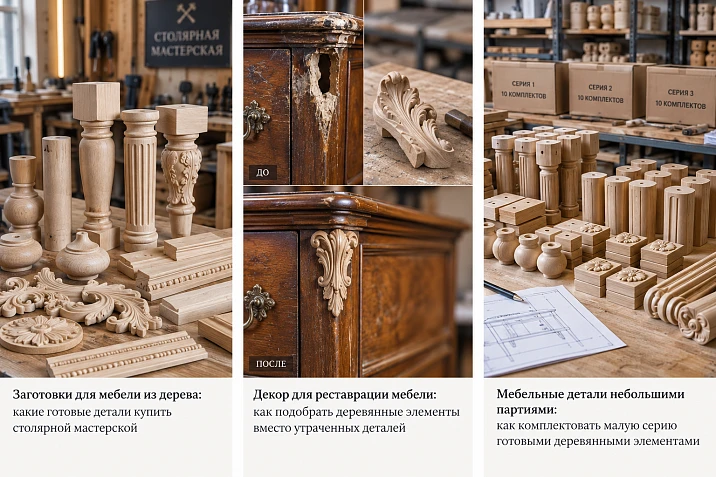
An order for ten identical nightstands looks simple until it comes to the legs. A carpenter turns one turned leg in the evening, fits it, and nods with satisfaction. Forty legs mean repeating the same shape forty times, and the last one must be indistinguishable from the first. This is exactly where a small batch stops being "a few one-off orders" and turns into production with its own logic of purchasing, inspection, and repeatability.
For a workshop that produces five, ten, or twenty identical items, it is advantageous to assemble the batch from ready-made wooden elements with an approved article number. Not because it is faster, but because a ready-made serial element provides what is hard to achieve on your own machine at a small run: known geometry, a proven sample, and the ability to order the same part six months later. This text describes the end-to-end procedure: sample, approved article number, specification, quantity per item, number of items, batch purchase, uniformity inspection, reserve, repeat order. Buying one or two parts for a single project is not covered here; for that, there is material about wooden elements for furniture.
What "small batch" means for a furniture workshop
A small batch cannot be defined in units. For a factory, a batch starts at thousands of items. For a workshop, a small series is measured in items, but the number of parts in it is several times greater. Six chairs yield 24 legs. Ten nightstands will require 40 legs and 20 handles. Eight consoles will take 16 supports and 8 decorative overlays. An order for "eight consoles" looks modest on paper, but in terms of components it is already three positions with different counting rules.
Hence a simple observation. A small furniture series requires serial component sourcing, even if the workshop itself is not a factory. When a part is repeated 16, 24, or 40 times, any deviation stops being an accident and becomes a pattern: if the legs differ slightly in height, the dresser wobbles on every third unit.




Three signs of a small series
First: the items are identical by design. The client was promised the same design, so replacing parts with "similar" ones is not allowed. Second: the run is repeatable. The workshop expects to receive five more of the same in a quarter. Third: the part is expensive relative to the material, meaning it involves many operations rather than a lot of wood. A leg with a turned profile, a carved overlay, a rosette with relief fall into this category.
When these three signs coincide, working "one-off" is unprofitable, but buying "factory-style" is premature. It is for this middle ground that serial ready-made elements with the option of shipping from one piece are needed. According to the STAVROS catalog description, the solid wood products section presents more than 4,000 models and 20,000 modifications in 39 product groups, and the stock program allows shipping from 1 piece. For a workshop, this means: first you can take a sample, then a series, then a reorder.
Our factory also produces:
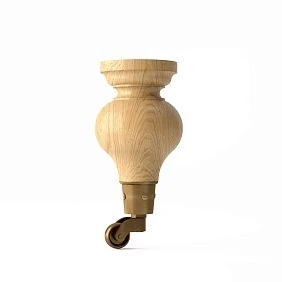
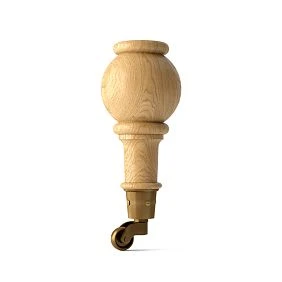
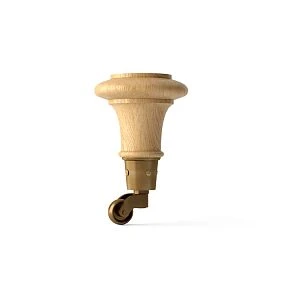
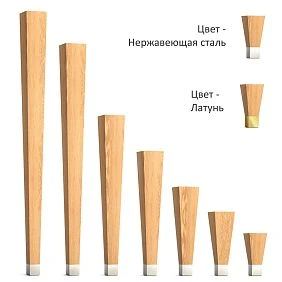
How a small series differs from one-off purchasing
With one-off purchasing, the main question is: can a specific element be bought without a large batch. With a small series, the question is different: how to make the first and last unit of the batch identical and how to reorder the set. The first question is about availability. The second is about reproducibility.
Get Consultation
Why one successful detail doesn't mean readiness for a series
A single chest of drawers forgives a lot. A leg can be sanded down, a hole redone, a gap filled with putty, a shade touched up with a brush. The craftsman keeps ten small corrections in his head, and the result looks fine. With twenty identical pieces, this method falls apart: the corrections that were made "by eye" for one item cannot be reproduced from memory for the other nineteen.
A series requires a different sequence: a specific article number, dimensions, material, sample, finishing method, assembly method, approval. Until all seven steps are closed, it's too early to launch the series.
The main thesis is this: for a small series, what matters is not just the availability of a part, but its repeatability. An available part that is slightly different in each batch is worse for a series than a slightly more expensive but stable one.
Where the one-off approach breaks down
First place: measurements from memory. The craftsman remembers that the leg was "about 220 mm," but in reality the sample is 218, the second batch is 222. A four-millimeter difference on a set of four legs causes wobbling, and on a series of ten chests of drawers it produces ten different chests.
Second place: mixing of processing. One batch was sanded with P180 grit, another with P240. After tinting, the texture looks different because the smoother surface absorbs less stain.
Third place: replacing a part with "the same thing, but a different color." For a single item, this is just a compromise. In a series, these are already different items.
What "ready for a series" means
Let's formulate a checklist that can be applied to a project. A part is ready for a series if it has an article number, known dimensions, an approved material, a completed sample, and a recorded finishing scheme. If even one item is missing, the part is ready for a sample, but not for a batch. This checklist will be useful later, in the section on the sample and securing the article number.
Ready-made standard part or custom manufacturing
For a furniture maker who needs a non-standard part, there are two paths, and the choice between them must be made deliberately. Both paths are legitimate, but they carry a different cost of error.
Ready-made SKU
The advantages are obvious. The geometry already exists, the dimensions are known and listed in the product card, you can order a sample, no separate development is needed, and reordering comes down to opening the same SKU. Moreover, a ready-made product has a history: the same dimensions and the same shape repeat from batch to batch until the manufacturer releases a new revision.
Custom manufacturing of furniture parts
It is needed when there is no ready-made option. This happens in five cases: the required shape is unavailable, the required size is unavailable, unique geometry is required, an author's element needs to be replicated, or a standard part is structurally unsuitable. Then the queries "custom manufacturing of furniture parts" and "custom furniture parts" become a real task rather than a search formula.
The order here must be strict: first we check the standard assortment, then we create an individual item. The reason is simple. An individual part requires a drawing, approval, production of a prototype, and inspection, which means weeks and minimum batch sizes. A ready-made SKU can be ordered today.
Be careful with promises
You should not perceive any catalog as a promise to make any item in any size. A ready-made SKU has the size indicated in the product card. An individual part is a separate service with separate terms. For example, on the STAVROS profile products page it says that manufacturing to individual drawings is possible, and the minimum batch for non-standard profiles is from 50 linear meters. For legs and other groups, the terms must be clarified with managers directly, because there is no universal rule. For a small batch where ten parts are needed, such thresholds may be unaffordable, and then the standard SKU wins.
Quick selection test
Ask three questions. Is there a part in the catalog with the required function and a close size? If so, order a sample. Can the design be changed by two or three millimeters to fit the standard? Often it can, and that is cheaper than development. Is a unique shape worth its cost in a run of ten pieces? If in doubt, do the math: development plus the minimum batch, divided by ten items.
Why a ready-made element is especially advantageous in a small series
The phrase “a ready-made element saves time” is true, but useless. It is more useful to break down the operations. Suppose a workshop needs a shaped leg that is not on the machine. Making it in-house looks like this: drawing, model, machine program, setup, first test part, adjustment, series, sanding. The first five steps are performed once regardless of the run size.
Now let's look at the difference. If you make 500 legs, the preparation is spread across the run and becomes almost unnoticeable. If you make 8, 12, or 20, that entire block falls on a small batch, and the price of each part rises. With a ready-made SKU, the preparatory operations have already been performed by the manufacturer and distributed across its entire output. The workshop buys the result without that burden.
How to calculate it yourself
Take the preparation time, machine time, and changeover time and convert them into money at the workshop's rate. Add the cost of material, accounting for defects on test parts. Divide the sum by the run size. Compare it with the price of the catalog SKU. This calculation often shows that for runs of up to 20–30 pieces, a ready-made element is cheaper than in-house processing, while for runs in the hundreds, your own machine wins.
An example of the logic without price figures. Program preparation and setup take, say, one working day. For a series of 8 parts, that day falls on each one as one-eighth. For a series of 80 parts, each takes one-eightieth. Therefore, the break-even point shifts as the run size grows, and you can only decide in advance whether to “buy or make” by doing the math.
What else a ready-made element wins on
First: repeatability without your involvement. The manufacturer controls the geometry, not your turner at the end of a shift. Second: surface quality. According to the catalog description, the decor undergoes additional hand sanding, and products are divided into two quality levels: “Standard” and “Prestige.” Third: speed of launch. A sample can be obtained and checked while the main work on the cabinets is underway.
There is also a downside. A ready-made element limits you to the catalog. If the project is built around a unique shape, buying from the catalog will not save it. Then the logic of choice changes, and the section on the separation of STANDARD and CUSTOM addresses this.
Which elements make sense to source as ready-made
Not every part deserves to be purchased. The criterion is this: complex, repetitive, expensive to process in-house, and easy to verify against the catalog. Let's go through them by group.
Furniture legs and supports
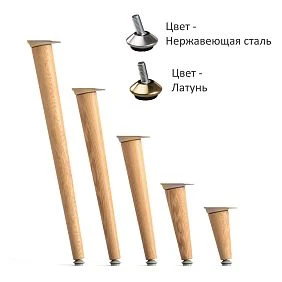
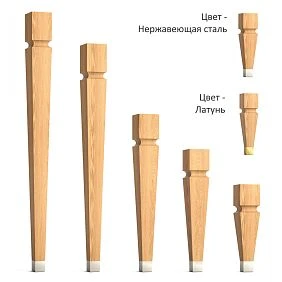
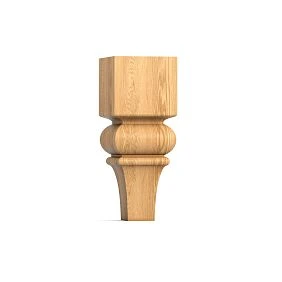
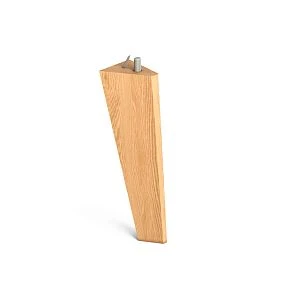
Legs are the best candidate for a small series. They repeat in multiples of the number of items, their geometry is critical for stability, and making a complex profile in-house requires a lathe and a template. They suit cabinets, chests of drawers, consoles, chairs, and tables. In the section wooden furniture legs of the STAVROS catalog there are over 130 models of supports, with options both unfinished and coated. For a series, unfinished ones are convenient: you finish all the legs in one batch of material in a single way.
Wooden handles
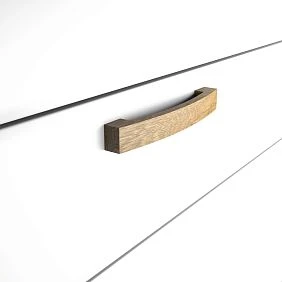
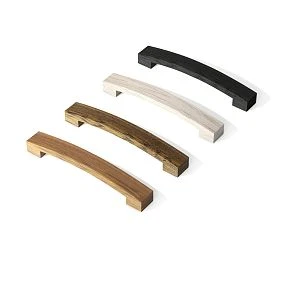
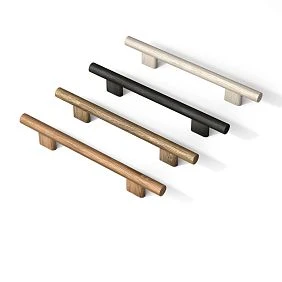
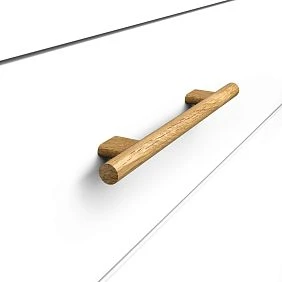
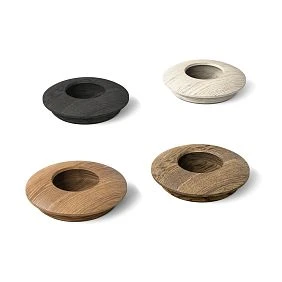
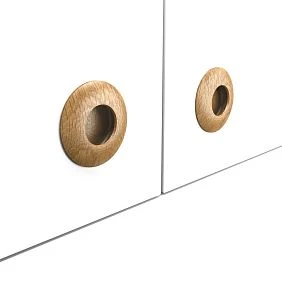
In a series, uniformity of size, holes, projection, shape, and material is especially important. A difference of two millimeters in center-to-center distance means that some handles won't fit the pre-drilled drawers. The section Wooden furniture handles contains, according to the description, 32 surface-mount models made of beech and oak, produced by 3D milling, with a hardware kit and ordering from one piece. Painted options come in four colors, while unfinished ones let you apply the finish yourself.
Carved Appliqués
Making your own carving for the sake of 8–20 identical fronts turns into a separate production operation with its own equipment and program. A ready-made overlay removes this operation. In the section Carved decorative inserts for furniture center, corner, and other options are gathered, as well as overlays with a reverse rebate for the molding profile, which is convenient for frame fronts.
Wooden rosettes
Rosettes work well in repetitive fronts: one rosette per front across ten fronts gives ten identical SKUs. They are inexpensive: according to the decorative elements section, R-055 costs from 200 rubles, R-057 from 250, R-084 from 300, R-085 from 330 (prices at the time of checking). A spread within a hundred rubles does not justify making your own carving. Choose in the section Carved outlets from wood.
Millwork and moldings
Here the unit of purchase is no longer a piece, but a linear meter or a strip. For a small series you need to calculate: the length per item multiplied by the number of items, plus a production allowance. Section wooden moulding for furniture includes moldings, cornices, skirting boards and architraves; at the time of checking, the list contains 92 items. Molding MLD-001 costs from 220 rubles, MLD-027 from 350, MLD-060 from 2,210 rubles. For framed facades, corner elements are convenient: according to the section description, they eliminate the need for precise cutting of the molding at 45 degrees and make the corner complete. For a series, this is a significant argument: a corner element is reproducible, while manual sawing on twenty facades is not. Corner element MLD-001U costs from 550 rubles, MLD-027U-2 from 520.
Modular wooden elements
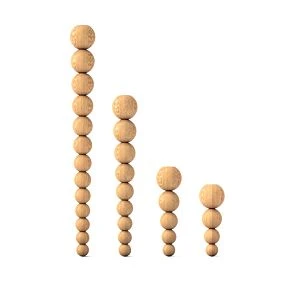
For assembled legs, posts, balusters and partitions there is a section wooden constructor elements. Parts with a mounting hole are assembled on an axle in the required sequence. For a series, standardization of the combination is critical here: identical modules in the same order on all legs.
What is more profitable to make yourself
Straight bars, body parts, internal elements, non-standard dimensions tied to the project. Their processing does not require complex setup, and there is no point in buying them ready-made.
One sample before purchasing the entire batch
You liked the photo, and forty pieces were ordered. This is exactly how the most expensive mistakes of small workshops are born. A photo does not convey scale, surface, or the behavior of the part during finishing. The correct scheme looks different: sample, fitting, processing, finishing, installation, approval, batch.
Let's go through it step by step. You order one unit of the selected article; for legs, it is better to order two at once to check the variation between units. You place it against the product or mockup. You do a trial processing: sanding, preparation for finish. You apply the finish according to the scheme that will be used in the series. You install the part on the product. Only after that do you assign the status “approved.”
What to check on the sample
Seven checkpoints. Actual size: measure with a caliper and compare with the product card. Geometry: check for skew, whether the leg base is even. Surface: sanding quality, machining marks. Mounting method: how the part seats into the assembly. Behavior during sanding: check for chipping on the edges. Color after finishing: the tone of beech and oak under stain and oil may differ from expectations. Proportion on furniture: how it looks on the actual piece, not on a sketch.
How samples are available in the catalog
For linear moldings, the catalog offers ready-made samples: the list includes the item "Samples of linear moldings" and a set of molding samples OMLD-005 (5,400 rubles at the time of checking). According to the description, items can be shipped from a single piece, so a sample of any SKU can be obtained without commitment to a production run. Check lead times: some items are listed as "in stock", while others take 5–10 days.
When a sample is not needed
If the SKU has already been used in your workshop and has passed approval, the sample is skipped: you have a specification with verified dimensions. A sample is also not needed when ordering a single part for a one-off project: the order itself serves as the sample. For a new series on a new SKU, skipping the sample is a gamble.
How to lock an approved SKU into the project
After approval, the entry "beautiful wooden leg" is useless. A month later you won't remember which one it was. You need a structure in which each part is described unambiguously: manufacturer, SKU, size, material, finish version.
Example entry: LEG-01, STAVROS, SKU from the product card, size 220 mm, beech, for enamel. The entry LEG-01 is the internal name of the part in the project; the rest are fields by which the part can be found and reordered. This way the craftsman doesn't have to search for the item again for the next batch.
Which fields are mandatory
Internal part code, so that drawings and orders speak the same language. Manufacturer. SKU exactly as in the catalog. Dimensions in millimeters, actual, not just from the product card. Material. Quality level, if the manufacturer divides items into "Standard" and "Prestige": this is also part of the part's identity. Finish: not "tinting", but a coating system with the material name and number of layers. Link to the product card. Approval date. Status.
Why the date is needed
Catalogs get updated. An item may be discontinued, changed, or replaced. The approval date tells you which version you checked the dimensions against. If the dimensions in the product page change a year later, you will see the discrepancy right away, not after receiving the package.
What to store next to the specification
Photos of the sample with a ruler in the frame. The sample itself, if you still have it, with the tag. A test panel with the finish showing how the finish looks. Without these three things, the specification describes the part rather than showing it, and showing is far more reliable.
How to calculate quantities for a small batch
The formula is short: the quantity of a part per unit multiplied by the number of units gives the base purchase. Ten cabinets with four legs each is 40 legs. Ten cabinets with two handles each is 20 handles. Ten fronts with one overlay each is 10 overlays. The math is simple; mistakes happen elsewhere.
| Detail | Per product | Products | Base purchase |
|---|---|---|---|
| Leg | 4 | 10 | 40 |
| Handle | 2 | 10 | 20 |
| Overlay | 1 | 10 | 10 |
| Rosette | 1 | 10 | 10 |
After the base calculation, you decide separately whether a production reserve is needed. There is no universal percentage: it depends on the type of part and the process. A simple smooth leg under enamel almost never produces defects. A carved overlay under patina, where the raised areas are rubbed by hand, gets damaged more often. A tinted part may not match in tone and may need to be replaced.
Molding is calculated differently
For molding, the purchase unit is a meter or a stick. Formula: length per unit multiplied by the number of units, plus a production allowance. Take a frame on a 500 × 700 mm front. The perimeter is 2.4 m. For ten fronts that comes to 24 m. But molding is cut at an angle, some of the length is lost to the cut, and sticks are sold in fixed lengths. If a stick is 2.4 m, it will not be enough for the frame once the cut is taken into account. That is why the calculation by sticks is done separately: how many frames come out of one stick and what offcut remains. The manufacturer in the section description gives reference allowances for molding, around 5% for straight runs and 10% for right angles, but for your own series it is more reliable to check the cutting layout on a sample.
Math and practice
Mathematically, 40 legs are enough for 10 cabinets. In practice, if one is ruined during finishing, the batch is left with 39 and one dresser without a support. That is why the reserve is set not "just in case" but for a specific risk. Record it as a separate line in the bill of materials rather than dissolving it into the total figure. Then, on a repeat order, you can see how much was actually needed for defects and adjust accordingly.
Sets with different availability
If some items are in stock and some take 5–10 days, plan assembly so you don't wait for the last one. Start with the carcasses and the parts that are already in the warehouse, and plan the finishing after receiving the entire set, so that everything is finished in one batch of material.
Why you can't mix SKUs within one series
A situation from the practice of any workshop. The first batch of eight nightstands was assembled with leg A. A month later, two more nightstands arrived, but leg A was out of stock, so a similar leg B was used. In the photo, the difference is almost invisible.
In a series, it shows. Height, profile, radius, heel shape, transitions between elements, and the shadow from the relief all differ. For designer furniture, this is critical: a client who bought two nightstands from the series places them next to each other and sees two different legs. One series equals one approved SKU, unless the change is formalized as a new revision.
What a revision is
A revision is a deliberate change to the specification. You decided that leg A was too bulky and replaced it with leg B. Then you assign a new version of the project, note from which item number it applies, and do not mix. Items of the first revision and items of the second revision must not be in the same set.
How to avoid falling into the trap
If a SKU is discontinued or out of stock, do not replace it silently. First check whether you can wait for the delivery, then check the replacement against all dimensions on a sample, then formalize a revision and notify the client if the items have already been sold. A silent substitution is the most common cause of complaints in small series.
Exception
Mixing is acceptable if the parts are not visible next to each other. Internal supports under the tabletop, fasteners, and technical elements may be replaced with equivalents provided the strength is equal. Everything that is visible and forms the "face" of the product must remain from a single SKU.
Beech or oak for a furniture series
The species is chosen not by price, but by what you intend to do with the part next and how it will fit into the series. The main rule: the species is fixed together with the SKU. The specification must not contain a line "leg LEG-01" without specifying the material.
Beech
It is suitable when the entire series is painted with enamel, a uniform surface is important, and the wood grain is not part of the concept. A calm, fine-pored structure provides an even background for an opaque coating, and the difference between blanks is leveled out by the paint. For a series of white, gray, or colored products, beech is rational and predictable.
Oak
It is chosen when the texture is preserved, oil, transparent tinting, or lacquer is used, and the wood must work visually. There is a nuance here for series. The oak grain differs from part to part, and after a transparent finish these differences are visible. If the product concept is built on expressive texture, the differences between individual pieces are part of the material, not a defect. If strict uniformity is required, oak under a transparent coating will require selecting parts by grain pattern.
How to record this
Record the species, the type of finish, and the quality level. Changing the species within a series is equivalent to changing the SKU: even with identical geometry, the appearance is different. Also check that the sample you approved is made from the same species as the series. A sample made of beech will prove nothing about oak.
Example solution
A series of twelve cabinets for white enamel: we choose beech because the enamel hides the texture, and surface uniformity is more important. A series of six consoles for oil, where the client wants to see the wood: we choose oak, agree in advance on the acceptable variation in grain pattern, and make a trial panel with oil. This way the species becomes part of the project, not a random procurement parameter.
STANDARD and CUSTOM cannot be mixed in a specification
This is a fundamental distinction, and it is often overlooked. A single product may combine ready-made catalog parts and individually manufactured ones. From the standpoint of procurement and reordering, these are different entities, and in the bill of materials they must be listed separately.
STANDARD is a ready-made catalog item: a product code plus fixed geometry. It can be ordered again without coordinating dimensions. CUSTOM is an individual part: a drawing, dimensions, material, and revision number. Reordering it depends on whether the drawing and production terms are preserved.
| Sign | STANDARD | CUSTOM |
|---|---|---|
| Base | Catalog item | Drawing and approval |
| Geometry | Fixed by the manufacturer | Determined by the project |
| Sample | Ordered from stock or made to order | Prototype based on a drawing |
| Repeat order | By article number | By drawing and revision |
| Lead time | From the product page | Coordinated separately |
| Minimum order quantity | Often from a single unit | There may be a minimum run |
| Risk of changes | The item may be discontinued | Depends on agreements |
How it looks in the bill of materials
Example: LEG-01 denotes STANDARD, DEC-CUSTOM-01 denotes CUSTOM. The code immediately shows what is bought from the catalog and what requires development. This way the workshop understands what can be quickly repeated and what depends on individual production.
Practical effect
When a client asks for "ten more just like these," the bill of materials immediately shows which items can be ordered within a day and which will require negotiations with the manufacturer. The lead time planning turns out honest. Conversely, if everything in the bill of materials looks the same, the lead time is determined by the slowest item, which no one flagged in advance.
Don't turn CUSTOM into a habit
A custom part is expensive. Before introducing it into the project, check whether it can be replaced with a standard one. Often a small design adjustment allows using a catalog SKU, and the series becomes cheaper while repeatability grows.
Custom-sized furniture parts: where the line is drawn
The request "custom-sized furniture parts to customer specifications" is clear: the craftsman needs a part of a specific size. What matters here is precise wording, so as not to create false expectations.
A finished SKU has the size specified for that particular variant. You cannot expect to order any catalog item in any size. If a standard component does not fit the dimensions, that is a separate task, not a choice from the catalog.
Three options
First: adjust the project. Perhaps changing the leg height by 10 mm or the overlay width by 5 mm makes the standard part suitable. This is the cheapest route. Second: choose another SKU that is close in size. The catalog has filters by dimensions A, B, and C, and often a neighboring item fits. Third: order a custom part. For moldings, the section page states the option of manufacturing to drawings and a minimum batch for non-standard profiles from 50 linear meters. For other groups, terms must be confirmed with managers.
How to decide
Calculate what adjusting the project will cost: redrawing, rechecking assemblies, coordinating with the client. Compare it with the cost of a custom part: development, minimum run, lead time. If the series is small and the minimum run for a custom part exceeds your requirement, the standard with adjustment is almost always more cost-effective.
What not to adjust
Mounting dimensions and hole diameters for the axle. Adjusting them in the workshop weakens the assembly. If a standard part does not fit the mounting, change the part, not the assembly.
Repeat order six months later: what to save now
Six months later, the client orders five more dressers. The craftsman opens the project folder and wants one thing: to order the same parts in one call. What should be in the folder?
-
The SKU exactly as in the catalog.
-
A link to the product page.
-
Actual dimensions taken from the sample.
-
Material: beech or oak.
-
Quality level, if specified.
-
Approved finish: coating system, number of coats, tone.
-
Photos of the sample and the finished product.
-
The sample itself with a tag or a test panel.
-
Approval date and last inspection date.
-
Quantity per product and per previous batch.
-
Project or order where the part was used.
Six months later, the craftsman isn't looking for "roughly the same leg." He opens the specification.
What to check before reordering
Open the product page using the saved link. Compare the dimensions with the recorded ones. Make sure the item code has not been discontinued and has not changed. Check the price and availability: the catalog price is listed as "from" and may vary depending on the configuration. If anything has changed, first order one sample of the new version and only then order the batch.
What to do if the item code has changed
If the dimensions have shifted by a millimeter or two, assess whether this is critical for the assembly. If the part has been discontinued, create a revision: find a replacement, approve it on a sample, and specify from which product the new version starts. If a client already has products from the first batch installed, tell them in advance that the new ones may differ.
The archive as an asset
A specification that is maintained carefully gradually turns into a workshop reference guide. A new project begins by reviewing approved parts: perhaps there is already a proven leg that fits the size. This is how the library of proven solutions grows, and each subsequent project is cheaper to prepare.
Small-batch specification: what a working bill of materials looks like
Let's put everything said into a single document. The parts list contains fields that allow you to calculate procurement, check consistency, and repeat the order.
| Field | What to specify |
|---|---|
| Code | LEG-01, HND-01, DEC-CUSTOM-01 |
| Type | STANDARD or CUSTOM |
| Article number | Exactly as in the catalog |
| Material | Beech or oak |
| Size | Actual, in millimeters |
| Finishing | Coating system |
| Per item | Number of parts per item |
| Items | Number of items in the series |
| Base purchase | Product of the two previous |
| Reserve | Separately, with justification |
| Status | SAMPLE, APPROVED, REJECTED |
| revision | Version number |
Conditional series example
A workshop makes ten consoles. Each one needs 4 supports (LEG-01), 1 decorative overlay (DEC-01), and a molding frame. Parts order: 40 supports, 10 overlays. If the front has one rosette R-055 (from 200 rubles), then ten pieces will cost about 2,000 rubles; if you choose R-084 (from 300 rubles), about 3,000 rubles. Prices are as of the time of checking; before ordering, check the product page. These figures show the order of costs for the decor and say nothing about the cost of the supports, since their item codes depend on the project.
Procedure for working with the list
Initially, all lines are in SAMPLE status. You order samples. After fitting and finishing, set APPROVED where everything matched, and REJECTED where it did not, with a reason. Only APPROVED lines go into batch purchasing. REJECTED lines are replaced, and the cycle repeats. This way you do not buy a series while at least one key item remains in question.
Checking uniformity upon acceptance
When the batch arrives, do not put it straight into production. Select several parts from different places in the batch and compare them with the approved sample: dimensions, shape, surface. Check that the dimensions are within the tolerance of your assembly. Lay the parts out on the table next to each other and look at the line: a noticeable difference is visible to the eye immediately. If the deviation is greater than allowed, record it with a photo and inform the supplier before processing begins, because after finishing the claim becomes disputable.
Where to find parts for a small series
The selection logic follows the schedule: from part type to catalog section, from section to item code.
-
General section wooden products and furniture components for a first overview of the groups.
-
decorative elements for furniture: rosettes, brackets, corner elements, and molding end caps in the Art Deco, Classic, and Modern collections.
-
wooden furniture legs for the supports of nightstands, dressers, consoles, armchairs, and tables.
-
Wooden furniture handles for series where consistency of hardware is important.
-
Carved decorative inserts for furniture for fronts.
-
Carved outlets from wood for frame centers.
-
wooden moulding for furniture: moldings, cornices, skirting boards, architraves.
-
Ready-made wooden elements for furniture posts and legs from the configurator section.
Procedure
Create a list of part types. In each section, select candidates by sizes A, B, and C and by application. Order one sample of each. Carry out a fitting and a trial finish. Approve the SKUs. Calculate the purchase. Check availability: in the list, some items are "in stock" (with Moscow and St. Petersburg listed separately in the filters), and some are "5–10 days". Place the order and, upon receipt, verify the batch against the sample.
What to clarify with the manager
Availability of the complete set on the required date. The possibility of reserving SKUs for a repeat order. Terms for custom manufacturing if a standard part is not suitable: minimum order quantity, lead time, and the sample approval procedure. How the supplier communicates changes in SKUs. These questions take five minutes but save you from complaints.
Workshop questions
Where can you buy furniture parts in small batches?
In the STAVROS catalog, ready-made parts can be ordered from a single piece, so both a sample and a series will work. Start with the sections for legs, handles, overlays, rosettes, moldings, and the configurator, then check availability and lead times.
Which wooden parts are more cost-effective to buy ready-made for a small series?
Turned and carved elements that require machine setup: legs, overlays, rosettes, complex-shaped handles, corner elements. Simple body parts are usually more cost-effective to make yourself.
How does a small series differ from a piece-by-piece order?
A piece-by-piece order addresses the availability of a single part. A small series addresses repeatability: the first and last part of the batch must be identical, and the set must allow for a repeat order. Hence the sample, the approved SKU, and the list.
When is a ready-made article more cost-effective, and when is custom manufacturing of a furniture part better?
A ready-made article is more cost-effective for small batches and when the catalog contains a suitable shape. Custom manufacturing is justified for unique geometry or a size not in the catalog, but it requires a drawing, a sample, and often a minimum order quantity. Check the catalog first.
Should you buy one sample first?
For a new article, yes. A sample verifies the size, surface, installation, and color after finishing. For an article already approved in your workshop, a sample is not needed.
How do you check that parts are identical before starting a series?
Compare several parts from different places in the batch with the approved sample: measure the key dimensions, lay them side by side, and assess the shape and surface. Do this before finishing, while a claim can still be made.
How do you calculate the number of furniture parts for a small batch?
Multiply the number of parts in one item by the number of items: 10 cabinets with 4 legs each give 40 legs. Determine the reserve separately based on the defect risk. For linear moldings, calculate the length taking into account the cut and the length of the strip.
Can you reorder the same article?
Yes, if it remains in the catalog. Before ordering, open the product page, check the dimensions and price against those recorded in the specification, and check availability. If the item has changed, order a sample of the new version.
How to record furniture parts in the specification?
Specify the internal code, type (STANDARD or CUSTOM), SKU, material, size, quality level, finish, quantity, status, and revision. Keep a link to the product card, photos, and a sample.
Can I order a ready-made furniture part in a different size?
A ready-made SKU is produced in the specified size. A different size is a separate custom task with separate terms: for linear mouldings, the manufacturer specifies production to drawings and a minimum batch of non-standard profiles from 50 linear meters; for other groups, terms must be confirmed. First check whether the catalog has a close SKU.
Prices, section contents, and shipping terms were verified against the STAVROS catalog at the time of preparation. The calculations in the text are illustrative, prices are listed as "from"; before ordering, check the current price and availability in the product card.