Article Contents:
- After a leak, the first action is STOP ISSUE, not drying and not ordering a replacement
- First, we determine the boundary of the accident
- Why packs that are dry on the outside cannot be returned to the general warehouse right away
- INCIDENT ID links all actions for a single leak
- Photos must answer two different questions: what it is and what happened to it
- Identification
- Condition
- Check wooden moulding and thin profiles separately from solid skirting boards
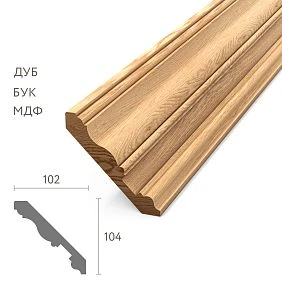
- Wooden cornice: complex relief requires a separate check
- Four statuses after initial sorting
- A surface that feels dry does not mean it is ready for installation
- DRY CONTROL: a control dry group makes testing more informative
- Wholesale building materials: check groups, not one random plank
- What not to do to speed up drying
- What to do with painted, stained, or lacquered trim
- Can the damaged section be cut off and the rest used
- Why a reorder cannot be placed in the morning after a leak
- An emergency reorder differs from a normal shortage
- Wholesale building materials: we preserve the causal link of the new order
- How to reschedule the installation timeline while one group is on HOLD
- Why a “similar skirting board” cannot be returned to the general stock
- How to re-inspect the MONITOR / CHECK group
- How to check geometry without complex laboratory equipment
- How to make a decision on material with minimal visible change
- How to handle MDF mouldings after a leak
- How to handle packaging after an incident
- How to organize a physical quarantine
- How to prevent dry material from an adjacent zone from being stopped
- How to account for a repeat leak or a second incident
- When it makes sense to contact the supplier or manufacturer
- How to calculate an emergency order without double purchasing
- What to do with HOLD during urgent installation
- How to close the Water Incident Register
- When material cannot be returned to installation without an additional decision
- If one LOT is distributed across multiple floors
- How to keep the link to the original order after repacking
- How to account for usable offcuts after an incident
- How to avoid using the restored remainder in an unsuitable zone
- What to do if the incident affected the service reserve
- How to record the Incident Zone plan so you don't argue later about where the packs were located
- How to act if the water was not clean
- How to select a dry control group when an identical batch is not available
- How to document measurements so that a repeat inspection is comparable
- How to restore the installation plan after RELEASE
- How to check whether the incident created a new shortage by product lengths
- How to check the emergency stock before a new PO
- How to return material from QUARANTINE to the regular warehouse
- If installation must start tomorrow, the emergency procedure is still not cancelled
- How to prioritize inspection when many SKUs are affected
- How to verify that after the incident the warehouse and the table match again
- When a new order is not needed at all
- How to determine that an emergency purchase is truly not required
- 1. Immediately resume installation
- 2. Treat a dry surface as proof of readiness
- 3. Mix affected packs with dry ones
- 4. Discard wet labels before documenting
- 5. Consider the entire batch ruined
- 6. Check only one plank
- 7. Apply a single "drying" time to all profiles
- 8. Use aggressive local heating
- 9. Do not separate the painted material
- 10. Lose the order number or LOT
- 11. Do not create a physical quarantine
- 12. Do not use a dry control group
- 13. Order a replacement before inventory
- 14. Quietly use the operational reserve
- 15. Treat short remnants as full-length material
- 16. Confuse accidental damage with a supplier claim
- 17. Stop the entire site because of one zone
- 18. Return material to installation without RELEASED status
- If the cardboard gets wet, should the entire trim package inside be replaced automatically?
- Can installation of dry material from the adjacent room continue?
- How many days does wooden trim need to dry?
- Can a moisture meter be used?
- What should be done if only the end is wet?
- Can service stock be used so we don't have to wait for a reorder?
- When should a Replacement Order be created?
- If a leak occurred at the site after acceptance, is this a claim to the supplier?
- What should be done if the SKU is unknown after repackaging?
- Should the Water Incident Register be kept after installation?
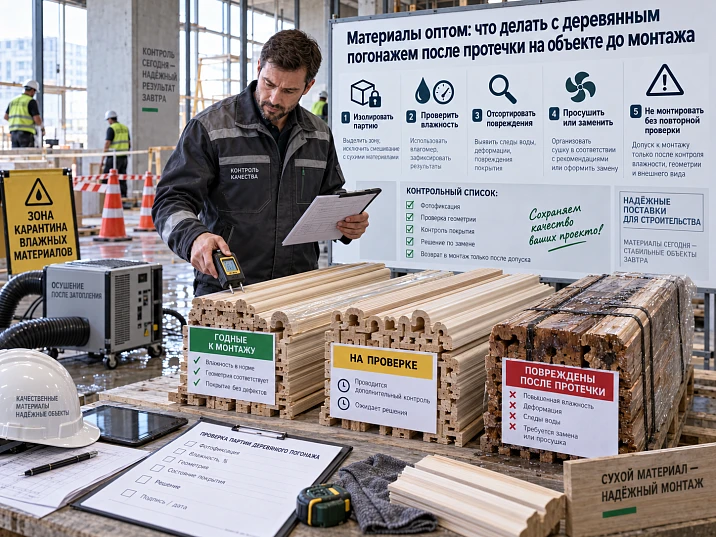
500–700 pieces of wooden trim for three floors have already been delivered to the site: skirting boards, mouldings and cornices are lying in the prepared area before installation begins. At night, a temporary water supply leak occurs. By morning the water has already been removed, but the picture is ambiguous: some packs are dry, several stood next to the wet area, some have wet cardboard, one package is open at the bottom, and two packs had direct contact with water. Installation is due to begin in a few days.
The two extreme reactions are equally dangerous. The first: “it’s already dry outside — install it.” The second: “since there was water, write off the entire batch and buy it again.” Both decisions are made before the site understands the scale of the event.
The correct sequence is different:
STOP ISSUE → INCIDENT ZONE → IDENTIFICATION → QUARANTINE → DRY CONTROL / AFFECTED GROUPS → CHECK → RELEASE / HOLD / REPLACE → USABLE STOCK → REPLACEMENT QTY.
That is, first they stop issuing material from the affected area, record the boundary of the incident and the identity of the items, separate questionable packs from the dry stock, compare condition by groups, and only after that decide what can be returned to installation, what needs to be held for further inspection, and what will actually require replacement.
materials in bulk after an incident they require a separate regime: the entire warehouse cannot be considered lost, and questionable trim cannot be released for installation based on a single external sign.
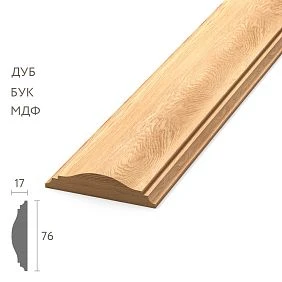
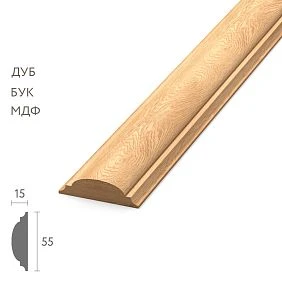
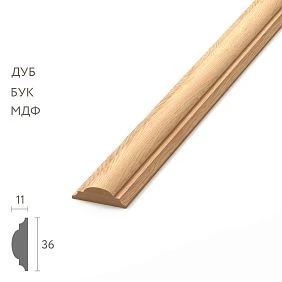
After a leak, the first action is STOP ISSUE, not drying and not ordering replacements
Until the site understands which packs could have been affected, material from this area cannot be issued to installers. This is the STOP ISSUE status.
It is needed for a simple reason: if in the morning several packs are quickly distributed across the floors, within an hour their origin will be lost. One conditionally dry package will end up in room 214, another in the corridor, the third will be opened in the warehouse, and then no one will be able to say with confidence which items were near the leak.
STOP ISSUE applies only to the potentially affected group. It does not mean that the entire facility must stop work. If the material for Floor 1 was stored in another dry room and its connection to the incident has been ruled out, it may be excluded from the emergency procedure.
The task of the first hour is to preserve the boundary of the event and not mix the unknown with the confirmed dry.




First, we determine the boundary of the incident
A water event rarely affects the entire warehouse equally. Therefore, instead of a single "wet" status, it is useful to create four working zones.
| Zone | Condition | Primary action |
|---|---|---|
| ZONE 0 — NOT AFFECTED | Material was outside the event zone | Keep the normal warehouse status |
| ZONE 1 — EXPOSURE POSSIBLE | No direct contact is visible, but the material was nearby | Identify and check |
| ZONE 2 — PACKAGING AFFECTED | Packaging got wet or damaged | Quarantine, opening according to procedure, product inspection |
| ZONE 3 — DIRECT WATER CONTACT | Confirmed contact of the product or open packaging with water | Separate quarantine group and detailed inspection |
The boundary should be based on the actual location of the material at the time of the event, not on where the packs are lying after cleanup. Therefore, it is useful to immediately record the room plan or make a simple diagram with storage locations.
If water flowed only along one wall and the opposite rack was not affected, there is no reason to automatically move the entire warehouse to ZONE 3.
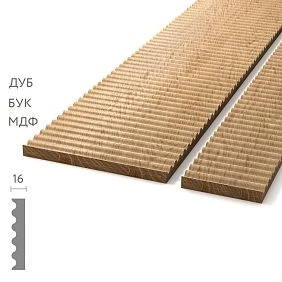
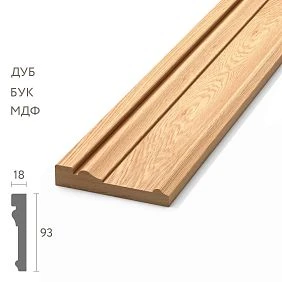
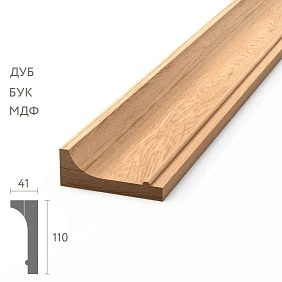
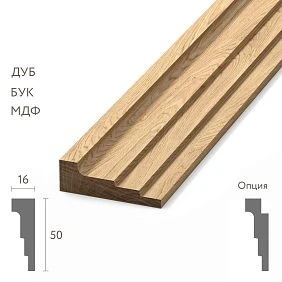
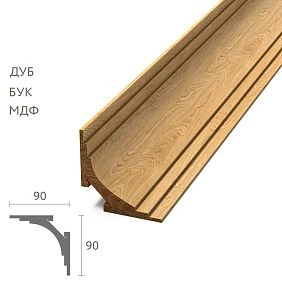
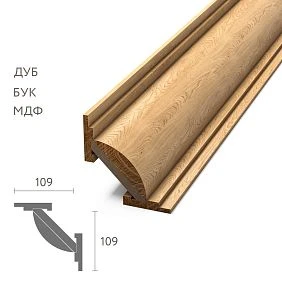
Our factory also produces:
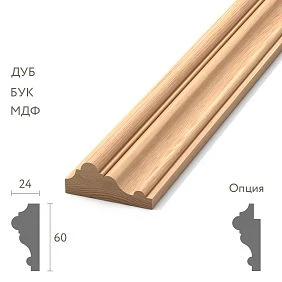
Why packs that are dry on the outside cannot be immediately returned to the general warehouse
After a few hours, wet cardboard may look significantly better, the puddle disappears, and the outer surface of the wood becomes dry to the touch. But the main risk at this moment is loss of identity.
If a pack from ZONE 2 is returned to a regular stack, the next day no one will remember whether it was the packaging whose bottom got wet or the neighboring dry one. Therefore, the sequence should be:
IDENTIFY → QUARANTINE → CHECK → DECISION.
Only after the RELEASED status is the material returned to the general installation stock.
Get Consultation
construction material wholesale: first we save the marking, then the packaging
If the box, film, or label has gotten wet, the first practical task is to preserve the product's identity. A physically usable profile without a clear SKU, material, and length can become as much of a problem as a damaged plank.
Before repackaging, you need to photograph and record:
- SKU;
- name;
- the material;
- commercial length;
- quantity;
- order number;
- the batch or Delivery ID, if specified;
- the destination zone;
- the place where the pack was located during the leak.
After that, the packaging can be replaced, but the new container must receive the same identification and a new emergency status.
The INCIDENT ID links all actions for a single leak
For the event, it is convenient to create a short code, for example:
WI-01.
Then all affected items get linked:
WI-01 / PLT-A
WI-01 / MLD-B
WI-01 / KZ-A
The Incident ID is needed not for bureaucracy, but so that a week later you can distinguish a regular reorder of PLT-A from a replacement that arose after a specific leak.
Photographs, an inspection report, new measurements, replacement, and the final incident closeout can be linked to WI-01.
Photographs must answer two different questions: what it is and what happened to it
A single general photo of a wet stack proves almost nothing. Two groups of shots are needed.
Identification
- label;
- SKU;
- the material;
- length;
- quantity;
- order or batch number.
Condition
- general view of the packaging;
- bottom of the stack;
- ends;
- visible contact area;
- floor and shelving around;
- individual items after opening.
This is how a photograph becomes evidence rather than just an illustration of the accident.
Wet packaging and a wet item are not the same thing
The outer cardboard could have absorbed the water, while the inner film kept the items dry. The opposite situation is also possible: the packaging looks almost normal, but it was opened from the bottom and water got inside.
Therefore, the PACKAGING AFFECTED status is not automatically a REPLACE status.
The actual product must be checked:
- surface;
- ends;
- geometry;
- finish;
- the condition of individual elements inside the pack;
- measurement results, if used.
The decision is made based on the item, not on the appearance of the box.
Wooden skirting board: after a leak, pay especially close attention to the ends and geometry
У wooden baseboard they check not only the front surface. The ends, straightness, and position of the profile on a flat reference surface are important.
After direct water contact, it is useful to record separately:
- whether there are visible changes to the end;
- whether the profile has changed along its length;
- whether there is any warping;
- whether there are any new cracks or delamination;
- whether the finish has been preserved;
- whether there is any local discoloration;
- whether the condition matches the dry control group.
You cannot promise that a specific plank will "recover in three days." The outcome depends on the actual moisture level, cross-section, material, and post-incident conditions.
We check wooden moulding and thin profiles separately from solid skirting boards
wooden molding may have a smaller cross-section, a different profile, and different packaging. Therefore, a single solution cannot be given for the entire "wooden trim" group.
Checks are performed by SKU and configuration. A thin profile may react visually differently than a solid piece. For profiled moulding, the geometry of the face and the stability of the long line must be inspected separately.
If three SKUs are in the same incident zone, each gets its own Incident Register line.
Wooden cornice: complex profile requires separate inspection
У wooden cornice may have a large width, deep grooves, and protruding elements. If the packaging is damaged, it cannot be automatically assessed by the same criteria as a straight skirting board.
Check:
- overall straightness;
- condition of protruding parts;
- relief;
- ends;
- finish;
- comparison with a dry sample of the same item.
The more complex the profile, the less reason there is to make a decision based on one external side of the packaging.
building materials wholesale: the affected group receives QUARANTINE
The entire potentially affected group must receive a physical status:
QUARANTINE — NOT FOR INSTALLATION.
Quarantine must exist not only in the table. The material is physically separated from RELEASED MATERIAL: a separate area, rack, marked pallet, or another clear method.
The goal is to prevent accidental issuance. If an employee sees an available pack, they should not decide by appearance whether it can be taken.
Four statuses after initial sorting
| Status | Meaning | Can it go to installation? |
|---|---|---|
| RELEASED | After inspection, there are no grounds to hold the material | Yes |
| MONITOR / CHECK | Additional observation or measurement is needed | No |
| HOLD | Decision not made | No |
| REPLACE / CLAIM REVIEW | A separate decision is needed on replacement or a further procedure | No |
A single "wet" status is not enough. It does not say what to do next.
A surface that feels dry does not equal readiness for installation
Wood reacts to moisture, so an external tactile sign is too weak to return the material to installation. A product may look dry on the outside, but its condition must be assessed in the context of the material, cross-section, conditions, and control data.
Therefore, after a leak, you must not introduce the rule:
"not wet to the touch = RELEASED."
Return to installation must be a separate confirmed status.
How to use a moisture meter after an incident without a "magic number"
A moisture meter is useful as a tool for comparison and observation, but a single number by itself should not automatically turn into RELEASED or REPLACE status. Readings are influenced by the material, device, measurement location, temperature, cross-section, and methodology.
In practice, it is more useful to work comparatively:
- Identify a dry control group of the same SKU or the closest possible configuration.
- Measure several DRY CONTROL elements.
- Measure the affected products at comparable points.
- Do not limit yourself to a single plank from a large batch.
- Repeat the measurement later if the group remains MONITOR / CHECK.
- Compare the dynamics with the visual geometry and surface condition.
If there are technical requirements for moisture before installation for a specific product, project, or technology, they should be followed. A universal figure for all species, profiles, and conditions cannot be invented.
DRY CONTROL: a control dry group makes the check more informative
If a known dry pack of the same PLT-A, MLD-A, or KZ-A remains on site, it becomes a useful control group.
Comparison:
DRY CONTROL ↔ INCIDENT GROUP.
What can be compared:
- moisture meter readings;
- geometry;
- straightness;
- end condition;
- coating type;
- perceived mass only as a supporting indicator, but not as a control method;
- behavior after exposure under identical conditions.
The control group is especially valuable if both batches belong to the same purchase and were stored in the same room before the incident.
wholesale building materials: we check groups, not a single random plank
If twelve packs ended up in QUARANTINE, checking one nice-looking plank says nothing about the whole group. The impact could have been uneven: the bottom package stood on a wet floor, the top one only got increased air humidity, and the edge pack was in contact with water from the side.
Therefore, control is distributed:
- across different packages;
- across different stack levels;
- across different SKUs;
- by varying degrees of exposure;
- by the outer and inner elements of the packaging;
- at several points along the long plank.
There is no need for an arbitrary mandatory inspection percentage. What is needed is a sample that genuinely represents the different conditions within the incident.
Why the universal "let it dry for three days" is bad advice
The calendar alone does not confirm the condition of the wood. The same three days can produce completely different results for a thin molding, a wide cornice, and a massive baseboard. The room conditions, actual contact with water, cross-section, and packaging all differ.
Therefore, time is only part of the process. The RELEASED status appears based on the inspection result, not automatically after a conventional period expires.
Weak logic:
"N days have passed → it can be installed."
Working logic:
product stabilized → inspected → compared with the control group → geometry approved → RELEASED.
What should not be done to speed up drying
After an accident, it is easy to swing to the other extreme — trying to quickly "drive out" moisture with localized overheating. For wooden trim, this should not be done without an agreed-upon procedure:
- directing a strong hot stream at a single point;
- placing the planks directly on the heating appliance;
- heating only one end;
- creating a large localized temperature differential;
- drying the packaging in such a way that a closed, humid environment remains inside;
- returning the material to sealed, wet packaging.
The goal is to return the items to controlled conditions and monitor their condition, not to force the process at any cost.
What to do with painted, tinted, or lacquered trim
The finished coating creates an additional layer of control. It is necessary to assess not only the wood itself but also the coating.
Check:
- stains;
- cloudiness;
- change in gloss;
- local delamination;
- end condition;
- the difference between the front and back sides;
- comparison with the dry FINISH reference.
Painted material should be listed on a separate line from unfinished material, even if the SKU is the same. The decision on finish restoration and the decision on geometric suitability are two different matters.
If only one end of a long plank got wet
Such an element should not automatically be considered either fully usable or completely lost. It gets a HOLD.
Check:
- Record the length of the contact zone.
- Check the condition of the end and the geometry.
- Check the rest of the plank.
- Match with DRY CONTROL.
- Check whether the damaged section can be safely excluded from future cutting.
- If yes — record the new usable length as RECOVERED LENGTH.
- If no — leave as REPLACE / HOLD.
This is exactly where emergency control transitions into procurement calculation.
Can the damaged section be cut off and the rest used
Sometimes, after inspection, part of a long plank remains usable. But the phrase "we'll cut off the wet end" oversimplifies the decision.
Before transferring the remainder to the free stock, you need to check:
- the condition of the remaining part;
- its geometry;
- finish;
- the exact usable length;
- which segment of the project it can cover;
- whether an additional joint is needed;
- whether the section is a visible one.
RECOVERED LENGTH ≠ automatically suitable material.
Suitability is confirmed only after it is tied to a specific cutting plan.
wholesale building materials: after verification, we recalculate the suitable stock
Once the initial check is complete, the buyer needs a new material picture.
| SKU | Was | RELEASED | MONITOR / HOLD | REPLACE | Recovered length |
|---|---|---|---|---|---|
| PLT-A | 120 | 102 | 8 | 10 | ___ |
| MLD-A | 84 | 80 | 4 | 0 | ___ |
| KZ-A | 36 | 30 | 4 | 2 | ___ |
This table shows not only losses but also uncertainty. HOLD does not turn into REPLACE prematurely.
Why a reorder cannot be placed in the morning after a leak
In the morning after the incident, the site knows only that the event occurred, but does not yet know the actual loss.
Unknown:
- how many items actually got wet;
- how many can be returned to installation;
- how much usable length will remain after inspection;
- what dry stock is already available;
- what can be covered by service reserve;
- which SKUs are affected at all.
If you order a replacement immediately, after inspection it may turn out that half of the batch is RELEASED and the new order creates excess stock.
REPLACEMENT QTY appears only after incident inventory
Work sequence:
INCIDENT INVENTORY → INSPECTION → RELEASE / HOLD / REPLACE → CUTTING REVIEW → STOCK / RESERVE CHECK → REPLACEMENT QTY.
Replacement Qty is not the number of wet packages. It is the actual purchasing shortfall after all inspections.
For example:
| Position | Quantity |
|---|---|
| Initially in the affected zone | 40 pcs. |
| RELEASED | 28 pcs. |
| HOLD | 4 pcs. |
| REPLACE | 8 pcs. |
| There is dry free stock | 3 pcs. |
| Actual Replacement Qty now | 5 pcs. |
HOLD in this formula is not yet counted as either usable or lost. If two RELEASED items appear later, Replacement Qty may decrease.
Operational reserve cannot be silently consumed after an accident
If the installation batch was damaged, a SERVICE RESERVE of the same SKU may be available at the site. A quick solution is to take the reserve and continue installation. But then the site's future stock decreases.
If the reserve is used:
- this is recorded;
- the balance is recalculated;
- it is decided whether the reserve needs to be replenished with a new order;
- new Replacement Qty accounts for both installation and reserve restoration separately.
For example, installation is short by 3 planks, while the reserve contains 8. You can use 3 and leave 5, but the project must consciously accept that the service stock has decreased, or add those 3 to the new order.
An emergency reorder differs from a regular shortage
With a regular shortage, the original quantity was insufficient for the project.
After a leak:
the original quantity was sufficient, but part of the stock temporarily or permanently lost its usable status.
Therefore, the primary document becomes the Water Incident Register, not a new invoice.
The new order must reference the reason:
Replacement after WI-01.
This way, a year later it is clear why a second PO appeared for one SKU.
wholesale construction materials: we preserve the causal link of the new order
For each procurement line after an incident, it is useful to store:
- Incident ID;
- original PO;
- SKU;
- configuration;
- REPLACE Qty;
- stock used;
- final Replacement Qty;
- new PO.
Example:
PO-NEW / PLT-A / 5 PCS / Replacement after WI-01 / Ref PO-018.
This makes the second order explainable in the object's history.
If only one zone is affected, the quarantine should be local
A leak on Floor 2 is not grounds to automatically stop dry material on Floor 1 and Floor 3 if it was stored separately and any connection to the incident has been ruled out.
For example:
- Floor 1 — RELEASED / NOT AFFECTED;
- Floor 2 — STOP ISSUE / QUARANTINE;
- Floor 3 — RELEASED / NOT AFFECTED.
Localization allows installation to continue where there is no risk, instead of fully stopping the object.
How to restructure the installation schedule while one crew is on HOLD
If the inspection takes time, the crew does not have to stand idle.
Possible transitions:
- to a dry floor;
- to another SKU;
- to another finished zone;
- to preparatory work that does not require questionable trim.
This is better than installing HOLD material just to preserve the old schedule.
If the marking has become wet and the SKU is no longer clear
After a leak, the material can be physically preserved, but its identity can be lost. This is a separate risk. If the label has become wet, part of the text has been erased, and visually similar profiles are inside, you cannot simply return the pack to the general stock from memory.
Such a group receives the status:
UNIDENTIFIED HOLD.
Further identification is based on several sources:
- the original specification;
- photos taken during acceptance;
- cross-section;
- width and thickness;
- length;
- material;
- a control dry sample;
- an adjacent intact package;
- the batch number sequence, if documented.
Only after SKU confirmation is the material returned to inventory.
Why a “similar skirting board” cannot be returned to the general stock
After emergency repackaging, the risk of mis-sorting is higher than usual. If there are several similar profiles on site, visual similarity alone is not enough.
The restored group must receive full labeling again:
SKU / MATERIAL / LENGTH / ZONE / INCIDENT ID / STATUS.
If there is a FINISH or LOT, they are also preserved.
It is labeling that turns physically salvaged material back into a manageable construction resource.
WATER INCIDENT REGISTER — the central document after a leak
Instead of a regular warehouse log, a separate incident register is needed after an accident.
| Incident | SKU | Zone | Qty | Exposure | Status | Replacement Qty |
|---|---|---|---|---|---|---|
| WI-01 | PLT-A | ZONE 3 | 40 | Direct contact | 28 RELEASED / 4 HOLD / 8 REPLACE | 5 |
| WI-01 | MLD-A | ZONE 2 | 24 | Packaging affected | 22 RELEASED / 2 CHECK | 0 |
| WI-01 | KZ-A | ZONE 1 | 12 | Exposure possible | 12 RELEASED | 0 |
The register can include:
- original PO number;
- LOT / Delivery ID;
- the material;
- FINISH;
- measurement results;
- re-inspection dates;
- photo;
- responsible person;
- reservation decision.
This way, the entire incident history stays in one place.
How to re-check the MONITOR / CHECK group
MONITOR is needed when an immediate decision is premature. For example, there is no visual deformation, but the group differed in exposure conditions and requires observation.
The re-check must be comparable to the first one:
- the same SKUs;
- the same control points;
- the same dry-control group;
- equally clear product labeling;
- recording of the date and result;
- RELEASED / HOLD / REPLACE decision.
The goal is not to accumulate many measurements, but to see whether the condition has stabilized and whether an installation decision can be made.
How to check geometry without complex laboratory equipment
On a construction site, basic comparative methods are often sufficient:
- level reference surface;
- comparison with a dry plank of the same SKU;
- visual inspection of a long line;
- checking the fit of multiple components;
- measuring the key cross-section with calipers or another suitable tool;
- checking the end joint.
If the profile after the incident differs noticeably from the dry control, this is grounds to keep it on HOLD and not try to "force" the problem through installation.
How to make a decision on material with minimal visible change
The hardest part is not a clearly damaged plank, but material that is "almost normal." For example, there is a slight change in straightness that is visually noticeable only on a loose plank.
Then the decision needs to be tied to the actual installation scenario:
- whether it is a visible area;
- whether it is a long continuous line;
- does installation allow safe correction without stress;
- will the joint with the adjacent part create a defect;
- will excessive force be required during installation;
- is dry replacement possible.
If suitability is in doubt, HOLD is better than a premature RELEASE.
How to handle MDF trim after a leak
If a batch contains not only solid wood but also MDF, it cannot be automatically assessed by the same logic as oak or beech. The material is different, and the reaction to direct contact with water may differ.
For such items, inspection is carried out by a separate group:
- geometry;
- edges;
- local swelling;
- condition of the coating;
- comparison with a dry sample;
- suitability for project installation.
If the manufacturer or project specifies special requirements for a particular material, they take precedence over the general advice in the article.
How to handle packaging after an incident
Wet packaging must not be left as the only protection for the material. After the marking is recorded, it is replaced so that the new packaging:
- does not hide the QUARANTINE status;
- does not mix different SKUs;
- does not hold water near the product;
- preserves the ability to observe;
- protects the already inspected material from new damage.
The new packaging must receive an Incident ID and the original product data.
How to organize a physical quarantine
A quarantine must have a clear boundary. For example:
- a separate rack;
- a separate pallet;
- a fenced-off floor area;
- bright NOT FOR INSTALLATION marking;
- a list of SKUs at the entrance to the zone.
You must not place HOLD mixed with RELEASED and rely only on the table. The system must protect against accidental error even when an employee has not opened the registry.
How not to stop dry material from an adjacent zone
After an incident, emotions often lead to an overly broad quarantine. If the actual layout shows that one part of the warehouse was physically separated and unaffected, it can be left in NOT AFFECTED.
For this, it is useful to have:
- a storage diagram;
- photos of the floor and shelving;
- the time of the event;
- an understanding of the water's direction;
- the condition of the packaging;
- testimonies from employees who discovered the leak.
This makes it possible to keep the quarantine local and continue work in other zones.
How to account for a repeat leak or a second incident
If a second event occurs a week later, there is no need to keep writing everything under WI-01. WI-02 is created.
If the same batch was affected by both events, it develops a history:
PLT-A / WI-01 RELEASED → WI-02 QUARANTINE.
This makes it possible to distinguish an initial inspection from a new impact.
When it makes sense to contact the supplier or manufacturer
Reaching out is useful when the item has already gathered specific data. Not just:
"everything got wet, what should we do?"
But:
- order number;
- SKU;
- the material;
- quantity;
- the nature of the event;
- which part came into direct contact;
- photographs;
- the results of the actual inspection;
- a question about a specific group.
This makes the discussion specific.
INCIDENT DAMAGE and SUPPLIER CLAIM are different processes
If the goods were accepted normally and were damaged later at the construction site due to a leak, this is INCIDENT DAMAGE.
If there is a question about the condition of the goods upon delivery, completeness, or compliance with the order, this may be a SUPPLIER CLAIM REVIEW.
There is no need to automatically turn a construction accident into a supplier claim. The cause of the event and responsibility must be determined based on facts and documents.
In the Water Incident Register, it is useful to have a separate field:
Incident responsibility / Claim status.
How to calculate an emergency order without double purchasing
After the final check, there are three sources of covering the shortage:
- RELEASED material;
- FREE dry stock;
- SERVICE RESERVE, if a decision has been made to use it.
And only the remainder after them becomes BUY.
| SKU | Project need | Released after incident | Dry free stock | Reserve used | Replacement order |
|---|---|---|---|---|---|
| PLT-A | 120 | 102 | 6 | 4 | 8 |
| MLD-A | 84 | 80 | 4 | 0 | 0 |
| KZ-A | 36 | 30 | 2 | 0 | 4 |
This calculation shows the real loss of the project after the accident, not the number of wet boxes.
What to do with HOLD during urgent installation
If the schedule is tight, there is a temptation to consider HOLD either usable or lost. Both decisions are premature.
In practice, the installation can be split:
- continue dry areas;
- process BUY according to the already confirmed REPLACE;
- leave HOLD out of the calculation until the next decision;
- if HOLD is later RELEASED, reduce Remaining Need;
- if HOLD is later REPLACED, add it to the next confirmed calculation.
If the order has already been sent, additional RELEASED material becomes stock, so it is better to wait for sufficient certainty before purchasing whenever possible.
How to close the Water Incident Register
An incident is not closed when the floor is dry and the emergency service has left. It is closed when every affected item has an outcome.
Checklist:
- The incident boundary is fixed.
- All affected SKUs are identified.
- Marking is preserved.
- QUARANTINE is physically separated.
- Each group has received RELEASED / HOLD / REPLACE.
- HOLD is either resolved or remains a separate open task.
- Sellable stock is recalculated.
- Recovered Length is accounted for.
- Service Reserve is recalculated.
- Replacement Qty determined.
- New order created if necessary.
- Installation schedule updated.
- Causal link of the new order to WI-01 preserved.
After this, the Incident can be set to CLOSED.
When material cannot be returned to installation without an additional decision
The RELEASED status must be a conscious decision. If at least one of the key questions remains open, it is better to keep the material on HOLD.
Reasons not to return the item to installation automatically:
- SKU not confirmed;
- material unclear;
- there is noticeable deformation;
- the profile does not match the dry control group;
- there are cracks, delamination, or other new damage;
- the finish has changed;
- the product remains unstable on repeat inspections;
- suitability for the specific area has not been confirmed;
- a technical assessment is required for the specific material;
- there is a risk of contamination that goes beyond a normal construction leak.
The last point is especially important: if the water contained contaminants, the material cannot be assessed by geometry and moisture alone. In that case, additional sanitary and site-specific procedures apply.
RELEASE criteria: what must be clear before returning to installation
There is no universal "one-number checkmark." But a checklist is useful for an object-specific decision.
| Check | Question |
|---|---|
| Identification | Are the SKU, material, and length known for certain? |
| Geometry | Is the profile comparable to dry control? |
| Ends | Are there no new visible changes? |
| Surface | Are there no defects that would prevent project use? |
| Finish | Has the coating been accepted? |
| Measurements | Do the results give no grounds to hold the material? |
| Stability | Does the condition not worsen upon re-inspection? |
| Application area | Is the item suitable for the specific future area? |
If the answers are confirmed, the status can be changed to RELEASED. If some fields are not applicable, this is also recorded so that the decision remains clear.
How to work with multiple LOTs within a single emergency zone
Two receipts of the same PLT-A may be stored in one room: LOT-03 and LOT-05. The leak affected only the lower stack, LOT-05.
If they are merged after the incident, the object will lose an important link. Therefore, the Water Incident Register is maintained at minimum by:
SKU + LOT / Delivery ID + Incident Zone.
For example:
| SKU | LOT | Incident zone | Qty | Status |
|---|---|---|---|---|
| PLT-A | LOT-03 | ZONE 0 | 60 | NOT AFFECTED |
| PLT-A | LOT-05 | ZONE 3 | 40 | QUARANTINE |
This way, the dry batch continues installation, and the inspection remains local.
If one LOT is distributed across multiple floors
The situation is more complex: part of LOT-05 had already been issued to Floor 1, while the remainder of the same batch was in the warehouse and was affected by water.
In this case, a distinction must be made between:
- LOT-05 / previously issued / outside the event;
- LOT-05 / remaining stock in the warehouse / WI-01;
- LOT-05 / future issue / HOLD until decision.
A batch number alone does not make previously installed material part of the incident. A Water Incident refers to the physically affected group.
How to maintain the link to the original order after repackaging
After an incident, part of the packaging is often replaced. In this case, not only the SKU but also the origin must be transferred.
The new labeling may look like this:
WI-01 / PLT-A / OAK / 2400 / LOT-05 / REF PO-018 / HOLD.
After RELEASE:
WI-01 / PLT-A / OAK / 2400 / LOT-05 / RELEASED.
This way, even after several weeks, it is clear that the material passed the incident check and was deliberately returned to the stock.
Practical example: out of 96 items, only 14 were replaced
Let's imagine that the affected area contained 96 items of three SKUs.
| SKU | Total | RELEASED | HOLD | REPLACE |
|---|---|---|---|---|
| PLT-A | 48 | 36 | 4 | 8 |
| MLD-A | 32 | 28 | 2 | 2 |
| KZ-A | 16 | 12 | 0 | 4 |
After the first check, REPLACE = 14. But at the site there are:
- 3 dry free PLT-A;
- 2 dry MLD-A;
- 1 KZ-A in installation stock.
Then the actual purchasing requirement before the HOLD decision:
- PLT-A: 8 − 3 = 5;
- MLD-A: 2 − 2 = 0;
- KZ-A: 4 − 1 = 3.
Preliminary Replacement Order = 8 items, not 96 and not 14.
If later two more PLT-A from HOLD receive RELEASED, the PLT-A requirement decreases from 5 to 3. That is why a premature order after the leak creates excess material.
How to account for usable offcuts after an accident
If part of the strip is deemed unusable and the remaining section is accepted, it becomes a usable remnant only after measurement.
In the log:
| SKU | Source | Recovered length | Status | Potential use |
|---|---|---|---|---|
| PLT-A | WI-01 / piece 07 | 1450 мм | RELEASED OFFCUT | Short section |
| MLD-A | WI-01 / piece 12 | 820 мм | RELEASED OFFCUT | Frame / short side |
Thus, recovered material participates in cutting and reduces Replacement Qty where it actually fits.
How not to use recovered leftover in an unsuitable zone
After removing the damaged end, the plank may be usable at a length of 1450 mm. But this does not mean it should be used on the first available 1400 mm section.
Checked:
- visibility of the zone;
- need for a solid part;
- the material;
- FINISH;
- grain direction, if it matters;
- quality of the new end;
- link to a specific SKU.
Recovered Length is a full-fledged resource only in a suitable scenario.
What to do if the accident affected the service reserve
Sometimes water hits not the installation batch, but the reserve that had already been set aside for operation. Then the current installation may experience no shortage at all, but the site loses its future repair readiness.
Must be recalculated separately:
- what reserve was planned;
- how many reserve items are RELEASED;
- how many are HOLD;
- how many
Who is responsible for what in the first hours after a water incident
Even a simple leak quickly becomes a cross-functional task. If roles are not divided, one employee starts drying the packaging, another is already creating a reorder, a third continues issuing to installers, and a fourth photographs only the general view.
It is practical to assign at least four roles:
Role Task Incident coordinator Records the event boundary and WI-01 status Warehouse / logistics Stops issuance, marks and moves groups to quarantine Technical check Checks material condition, dry control, and geometry Procurement Does not order a replacement until Replacement Qty appears On a small site, these functions can be performed by one person. What matters is not the number of positions, but the sequence of actions and a single source of data.
How to record the Incident Zone plan so you don't argue later about where the stacks were located
After cleanup, the water disappears, and along with it, part of the evidence disappears. Therefore, it is useful to mark the location of the material on a floor plan or a simple diagram right away.
The diagram indicates:
- location of the water source;
- direction of spread;
- racks and pallets;
- ZONE 0–3;
- which SKUs were in each zone;
- which packs were opened;
- what was moved before the freeze.
This scheme helps later explain why one LOT ended up in QUARANTINE while the neighboring one remained NOT AFFECTED.
How to proceed if the water was not clean
If the leak is not related to clean tap water but to a contaminated environment, the task goes beyond a routine moisture check. Material cannot be returned to installation just because it has retained its geometry.
In such a scenario, the sanitary risk must be assessed separately and action taken according to site-specific safety and hygiene requirements. For the Incident Register, it is useful to add a field:
Water type / contamination status.
If the type of exposure is unknown, this is an additional reason to keep the group on HOLD until it is clarified.
How to choose a dry control group if the exact same batch is not available
The ideal DRY CONTROL is the same SKU, material, length, and FINISH from the same purchase. But in practice, such a reserve is not always available.
Then the control is selected in descending order of closeness:
- the same SKU and the same batch;
- the same SKU from a different dry batch;
- the same material and a similar cross-section;
- a retained sample;
- technical data and the documented condition before the incident.
The further the control is from the actual configuration, the more cautiously the comparison should be interpreted.
How to document measurements so that re-inspection is comparable
If a moisture meter or other measurements are used, it is important to record not only the number but also the context.
Minimum entry:
Field Example Incident WI-01 SKU PLT-A Piece / package Pack 07 / Piece 03 Point End A / Middle / End B Reading ___ Dry control ___ Date / check CHECK-1 / CHECK-2 This way, the next inspection compares comparable points rather than random measurements at different locations on the plank.
Decision Matrix: how to translate observations into RELEASE / HOLD / REPLACE
Condition Identification Geometry Finish Solution Contact not confirmed Present No changes No changes RELEASED after inspection Packaging is wet, item is stable Present No changes No changes MONITOR / possible RELEASE There is doubt about the geometry Present Not confirmed Any HOLD Pronounced damage Present Violated Damaged REPLACE / REVIEW SKU lost No Any Any UNIDENTIFIED HOLD The matrix is not a technical standard. It helps the object avoid jumping from observation straight to purchase.
How to restore the installation plan after RELEASE
When part of the group returns to the pool, it needs to be re-linked to specific installation zones. You can't just write "102 planks Released" and leave them in a common pile.
For example:
- PLT-A / RELEASED 60 → Floor 2;
- PLT-A / RELEASED 42 → Floor 3;
- PLT-A / HOLD 8 → quarantine;
- PLT-A / REPLACE 10 → Replacement Qty calculation.
This is how controllable logistics is restored after an incident, not just the technical status.
How to check whether the incident created a new shortage by product lengths
Even if the total Released footage has barely changed, it's the long elements that may be lost.
Example:
- before the incident there were 12 planks L2400 and 20 planks L1000;
- REPLACE received 5 long L2400;
- the short L1000 are almost all RELEASED.
The total lost footage may look moderate, but long walls can no longer be covered. Therefore, Replacement Qty must be calculated by lengths, not just by the sum of meters.
How to check the emergency pool before a new PO
Before sending the Replacement Order, the buyer must confirm:
- All affected SKUs are identified.
- There are current RELEASED / HOLD / REPLACE statuses.
- HOLD is not counted as lost without a decision.
- Dry free stock has been checked.
- Recovered lengths are distributed across actual segments.
- Service Reserve is accounted for separately.
- Commercial lengths are matched with future cutting.
- The new PO contains only confirmed shortage.
This is the point that prevents double purchasing after an incident.
How to return material from QUARANTINE to regular warehouse
Return is a separate operation. After the RELEASED status, you need to:
- remove the NOT FOR INSTALLATION marking;
- save the Incident ID in the history;
- restore the product marking;
- assign the installation zone;
- move to RELEASED storage;
- update the Water Incident Register.
Simply physically moving the pack is not enough: the table and the warehouse must match again.
If installation must start tomorrow, the emergency procedure is still not cancelled
An urgent schedule does not make HOLD suitable. If installation was supposed to start in the morning, the project is better off quickly reassigning the crew to dry zones than using the material just because "there is nothing else right now."
Practical order under a tight deadline:
- Separate NOT AFFECTED and QUARANTINE.
- Release dry confirmed SKUs to available zones.
- Prioritize checking the items that block the critical front.
- Do not lift HOLD for the sake of the calendar.
- Count Replacement Qty only for confirmed losses.
- In parallel, reschedule the installers.
This way the site keeps pace where it is safe and does not carry the consequences of the accident into the already finished interior.
How to prioritize checks when many SKUs are affected
When baseboard, molding, and cornice for several floors all end up in quarantine at the same time, checking everything in random order is inconvenient. It helps to consider the item's impact on the schedule.
High priority is given to:
- SKU without which the nearest installation stops;
- items from ZONE 3 with direct contact;
- batches without dry stock;
- rare configurations with a long potential reorder lead time;
- items where labeling is at risk;
- material that was planned to be issued first.
Low priority can temporarily be given to a batch that belongs to a future queue and has a sufficient dry equivalent. This does not mean it can be forgotten: the status remains open, but the technical team first clears the critical path.
How to verify that after the incident the warehouse and the table match again
After several days of verification, some material is repackaged, some is RELEASED, some is shortened, and some is written off to REPLACE. At this point, it is especially easy to get a discrepancy between the physical warehouse and the Water Incident Register.
Before closing the incident, a final reconciliation is useful:
Category What to check RELEASED Physically located in the permitted zone and has marking HOLD Physically remains in quarantine REPLACE Excluded from the installation stock RECOVERED OFFCUT Has length, SKU, and status SERVICE RESERVE Separated from the current installation NEW PO Linked to WI-01 and the actual shortage If the table says RELEASED 28, but 27 are physically found in the warehouse, the incident cannot yet be considered closed. It is necessary to understand where one item went: into installation, to another rack, or into the wrong group.
When a new order is not needed at all
A leak does not have to end in a purchase. For example, after checking it turned out:
- of 60 elements, 52 RELEASED;
- 4 are usable after removing the damaged end;
- another 4 are covered by dry free stock;
- Service Reserve remains untouched.
Replacement Qty = 0.
In that case, the correct commercial outcome is not to order anything. The article should lead to a precise decision, not to a purchase at any cost.
How to determine that an emergency purchase is truly not required
After a leak, the site may go through the entire procedure and arrive at a zero Replacement Qty. This is a normal outcome, not a sign that the check was unnecessary.
For example, some packages ended up in ZONE 2, but after opening, the items retained their geometry and received RELEASED. A few short parts are replaced with dry leftovers, one long section is covered by a strip from FREE STOCK, and the service reserve remains untouched. In that case, a new purchase is not needed at all.
Before deciding on "BUY = 0", it is useful to confirm four things:
- all HOLDs are either resolved or not involved in the upcoming installation;
- dry free stock actually matches in length and configuration;
- Recovered Length has already been allocated to specific segments;
- Service Reserve was not quietly used as ordinary installation leftover.
Only after this can the project honestly close WI-01 without a new PO. This logic is especially important for a commercial article: the right decision after an accident does not have to end in a purchase.
18 mistakes after a leak
1. Immediately continue installation
Cause: deadlines matter more than verification. Consequence: questionable items go into the interior, and their origin is lost. Prevention: STOP ISSUE.
2. Treat a dry surface as proof of readiness
Cause: the external water disappeared. Consequence: a decision is made without assessing the actual condition. Prevention: CHECK + dry control.
3. Mix affected packs with dry ones
Cause: after cleaning, the packaging looks similar. Consequence: the incident cannot be localized. Prevention: physical QUARANTINE.
4. Discard wet labels before recording
Cause: the packaging is damaged. Consequence: the goods are physically saved, but the SKU is lost. Prevention: photo and record before repackaging.
5. Consider the entire batch damaged
Cause: there was water in the warehouse area. Consequence: unnecessary purchase of the full volume. Prevention: Incident Zones.
6. Check only one plank
Cause: a quick assessment is needed. Consequence: one plank does not represent the different conditions inside the packs. Prevention: sampling by exposure groups.
7. Apply a single “drying” period to all profiles
Cause: a calendar rule is desired. Consequence: different materials and cross-sections are assessed the same way. Prevention: decide by condition, not by time.
8. Use aggressive local heating
Cause: desire to speed up the process. Consequence: new deformations or finish damage can be created. Prevention: controlled conditions.
9. Do not separate painted material
Cause: SKU matches. Consequence: finish damage is lost among the untreated group. Prevention: separate configuration.
10. Lose the order number or LOT
Cause: the label got wet. Consequence: it is impossible to link the replacement to the original delivery. Prevention: Incident ID + PO + LOT.
11. Do not create a physical quarantine
Cause: the status exists only in Excel. Consequence: material accidentally goes to installers. Prevention: separate NOT FOR INSTALLATION zone.
12. Do not use a dry control group
Cause: only affected items are checked. Consequence: no project comparison point. Prevention: DRY CONTROL.
13. Order a replacement before inventory
Cause: the schedule needs to be restored urgently. Consequence: after RELEASE, excess material appears. Prevention: Replacement Qty only after Incident Inventory.
14. Quietly use the operational reserve
Cause: it matches by SKU. Consequence: the object loses future stock. Prevention: a separate decision and restoration if needed.
15. Treat short remnants as full linear footage
Cause: the sum of lengths seems sufficient. Consequence: long segments of the project remain uncovered. Prevention: a segment map.
16. Confuse emergency damage with a supplier claim
Cause: new goods are needed. Consequence: a construction incident is incorrectly described as a supply defect. Prevention: INCIDENT DAMAGE separate from CLAIM REVIEW.
17. Stop the entire object because of one zone
Cause: there is no event boundary map. Consequence: dry floors sit idle without justification. Prevention: local quarantine.
18. Return material to installation without RELEASED status
Reason: the employee believes the pack has already been checked. Consequence: HOLD loses its meaning. Prevention: formal RELEASE only.
Final emergency workflow
LEAK / WATER INCIDENT
↓
STOP ISSUE
↓
INCIDENT ZONES 0–3
↓
PHOTO + SKU + PO + LOT
↓
QUARANTINE
↓
DRY CONTROL / AFFECTED GROUPS
↓
VISUAL + GEOMETRY + MEASUREMENT CHECK
↓
RELEASED / MONITOR / HOLD / REPLACE
↓
RECOVERED LENGTH + STOCK + RESERVE
↓
REPLACEMENT QTY
↓
NEW PO IF REQUIRED
↓
RELEASED MATERIAL BACK TO INSTALLATION
↓
INCIDENT CLOSEOUT
Bottom line: after a leak, you must first preserve batch controllability, and only then decide what to reorder
A water incident in the finished goods warehouse is not just a question of "did it dry or not." It is simultaneously a task of identification, quarantine, condition control, preserving the cutting plan, and recalculating purchasing needs.
A proper system does not automatically discard the entire batch and does not return it to installation based on appearance.
Main logic:
localize → identify → separate → inspect → classify → recalculate usable stock → determine Replacement Qty.
If this is done consistently, the incident remains a local event and does not turn into mixed sorting, double purchasing, and hidden risk after installation.
Frequently asked questions
If the cardboard got wet, should all the trim inside be automatically replaced?
No. Wet packaging means the goods must be inspected. The decision is based on the actual condition of the items, not just the box.
Can installation of dry material from an adjacent room continue?
Yes, if its connection to the incident has been ruled out and it was not mixed with the affected group. The quarantine must be local.
How many days does wooden trim need to dry?
There is no universal timeframe. It depends on the actual exposure, material, cross-section, and conditions. Readiness is confirmed by condition and technical requirements, not by the calendar.
Can a moisture meter be used?
Yes, especially as a comparative tool between a dry control group and the affected items. Specific acceptable values should be taken from the material and project requirements, not from a universal number.
What should be done if only the end got wet?
Place the item on HOLD, inspect the entire profile, and determine whether a usable length remains after excluding the damaged section. There is no need to automatically write off or release the entire strip.
Can the service reserve be used to avoid waiting for a reorder?
Only as a conscious decision. After that, the remaining quantity must be recalculated and a decision made on whether to restore the reserve with a new order.
When should a Replacement Order be created?
After the Incident Inventory, inspection, RELEASED / HOLD / REPLACE calculation, dry stock check, recovered lengths, and reserve.
If a leak occurred on site after acceptance, is this a supplier claim?
Not automatically. Construction Incident Damage and Supplier Claim are different processes. Liability is determined by the facts and specific documents.
What should be done if the SKU is unknown after repacking?
Move the group to UNIDENTIFIED HOLD and identify it by specification, cross-section, dimensions, samples, and adjacent confirmed packages.
Should the Water Incident Register be kept after installation?
Yes. It explains why part of the material was in quarantine and why an additional order appeared for some SKUs.