Article Contents:
- Short answer: how to choose stucco for interior style
- Why style is more important than individual element
- Stucco in Classical Interior
- Cornices
- Recessed Outlets
- Appliances and Molding
- Coordination with interior
- Molding in neoclassicism
- Principles of neoclassicism
- What to choose
- Stucco in art deco style
- What distinguishes art deco from other styles
- How to apply
- Modern stucco: how to avoid palace effect
- Principles of modern application
- Stucco for minimalist interior
- What works in minimalism
- Stucco in the living room
- Wall behind the sofa
- TV Area
- Fireplace zone
- Living room ceiling
- Symmetry and furniture
- Stucco in the bedroom
- Wall at the headboard
- Cornice in the bedroom
- Rosette in the bedroom
- How not to overload a small bedroom
- Stucco in the hallway and corridor
- Moldings on narrow walls
- Protection of the lower wall zone
- Framing Doorways
- Why you shouldn't choose large overlays
- Ceiling stucco: when a rosette is needed and when a cornice
- How to choose the color of stucco
- Mistakes when choosing stucco by style
- What to buy for styling with stucco
- FAQ: answers to important questions
An interior is not a set of beautiful things. It is a system where every element speaks the same language as the others. Furniture, doors, wall color, lighting — and stucco. It is the latter that most often becomes a point of disagreement: a beautiful molding is bought, a cornice is installed — but the result is not right. Why?
Because molding in interior it only works within a style system. The same molding profile in a classic interior creates a sense of luxury, while in a modern minimalist space it feels like awkward historical quoting. It's not about the quality of the element. It's about whether this element is right for the given style.
This article is about how to choose polyurethane molding for a specific interior style. Without general words — with specific elements, dimensions, principles, and application examples.
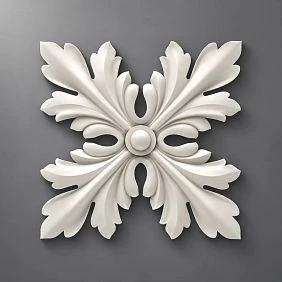
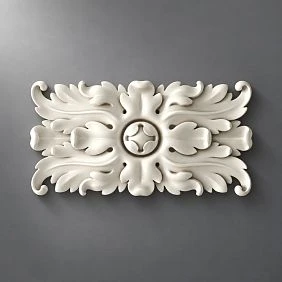
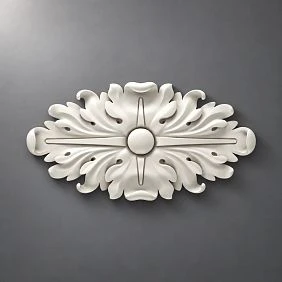
Short answer: how to choose stucco molding for an interior style
If you know your style — here's a quick guide:
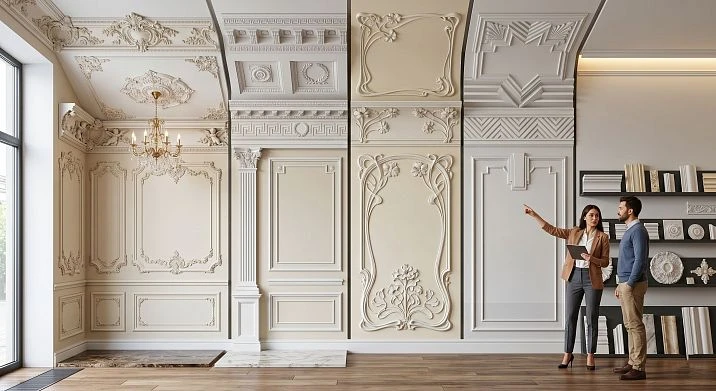
Classic — expressive multi-tiered cornices, ceiling rosettes with ornamentation, applied decorative elements on walls, symmetrical frames made of moldings. Everything is rich, thoughtful, historically accurate.
Neoclassical — calm moldings with a clean profile, rectangular frames on walls, neat cornice without complex ornamentation, Polyurethane moldings matching the walls. Principles of classic — without opulence.
Art Deco — geometric profiles, vertical rhythm, accent lines, contrasting colors. Stucco here is graphic, not ornament.
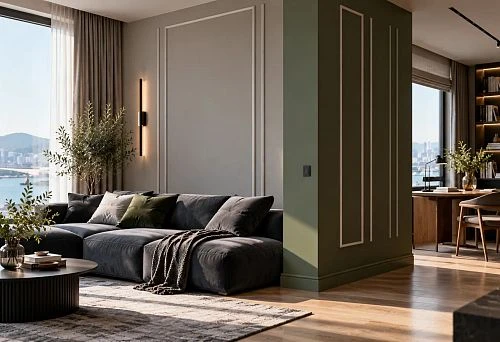
Modern classic — minimal ornament, neat profiles, monochrome painting. Decoration creates structure without drawing attention.
Minimalism — thin moldings matching the walls, barely noticeable transitions, no ornament. Stucco as an architectural line, not decoration.
Country house — more voluminous cornices, wall and ceiling decor, rich window decor, emphasis on the entrance group. The space allows it — and stucco takes advantage of that.




Why style matters more than an individual element
Here is the paradox that everyone who chooses faces decorative molding for the first time: everything looks beautiful in the catalog. The moldings are expressive, the cornices are architectural, the rosettes are rich. But when you install a single element without an overall system, the result disappoints.
Why? Because the beauty of stucco lies not in the element itself, but in the context. The same cornice with a three-step profile in a high-ceilinged room with classic furniture is architecture. The same cornice in an apartment with minimalist furniture and concrete accents is a foreign body.
Plasterwork design is built on the principle of consistency: stucco must match the furniture (in terms of decorativeness), the doors (in terms of profile style and color), the baseboards (in terms of scale), the lighting (a ceiling rosette only works with a properly chosen chandelier), and the wall color.
The most expensive mistake in an interior with stucco is buying a beautiful element without an overall scheme. It's like buying a beautiful button without a coat. The button can be magnificent. But without the coat, it means nothing.
Therefore, the first step is to determine the interior style. Classic, neoclassical, art deco, modern classic, minimalism, country house? The answer to this question determines everything else.
Our factory also produces:
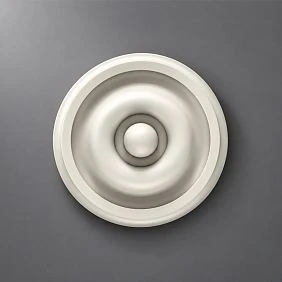
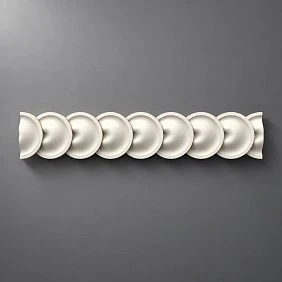
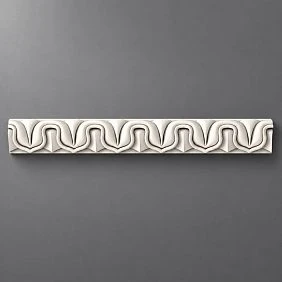
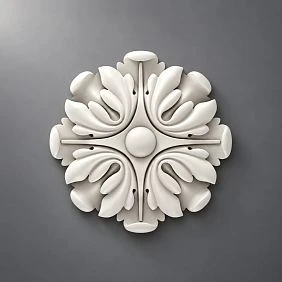
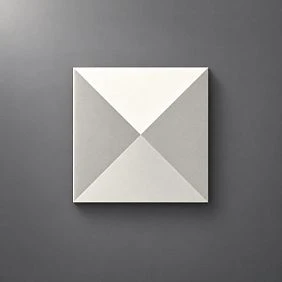
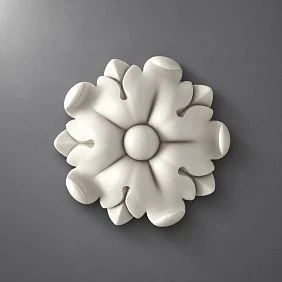
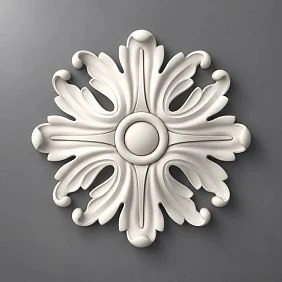
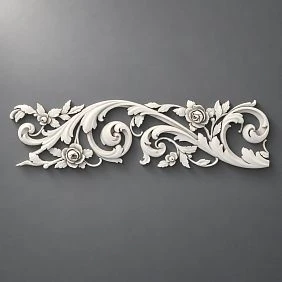
Molding in a classic interior
Classic is a style that needs no justification. It has existed for thousands of years, evolving through Greek orders, Roman architecture, the Renaissance, Baroque, Classicism—and has reached our days as the most stable aesthetic system.
Molding in classical style is richness, symmetry, hierarchy. Each element occupies its place in the architectural system of the room, and together they create a space that is perceived as a complete work.
Get Consultation
Crown mouldings
A ceiling cornice in a classic interior is not just a transition between wall and ceiling. It is an entablature: a horizontal architectural band that 'closes' the wall from above and creates the feeling that the room is an architectural space, not just a box.
For classic style: a cornice with a profile height from 100 to 200 mm. The profile is multi-tiered, with two to three tiers and an ornamental band. The ornamental band of the cornice: "ionics" (egg-shaped ornament), "beading", "dentils" (toothed frieze), "acanthus" — any of the historical classical motifs.
Polyurethane Crown Molding for classic style, they are mounted in the corner of the wall and ceiling with a projection comparable to the profile height. Cornice 150 mm → projection 130–150 mm. This creates a deep shadow under the cornice, which is the main decorative effect.
Rosettes
cornice under the chandelier in classic style — a mandatory element. A chandelier without a rosette in a classic interior is an incompleteness that everyone feels, even those who do not understand the reason.
Size of the rosette for a classic hall: diameter from 60 to 120 cm. Profile — ornamental, with several decorative bands: inner circle, leaf band, ornamental frieze, outer finishing profile.
The rosette is always chosen in pair with the chandelier — not smaller than the diameter of the lampshade and not larger than a third of the room's width. For a living room of 20 m² with a chandelier with a 60 cm lampshade — a rosette of 70–90 cm.
Overlays and moldings
Walls in a classic interior are not just a background. They are structured: a lower panel zone (from the floor to approximately 900–1,000 mm), a middle zone (the main "canvas" of the wall), and an upper frieze under the cornice.
Moldings made of polyurethane create this division: a horizontal band at a height of 900–1,000 mm, molding frames in the lower zone, molding frames in the middle zone. Decorative Inserts — ornamental corner elements in the corners of the frames, central accents, medallions above doorways.
For classic style, symmetry is important. The left half of the wall should mirror the right half. This is not an artistic principle — it is an architectural law that all historical classicism obeys.
Combination with the interior
Classic Molding on the Wall combines with: carved wooden furniture (Baroque, Empire, Louis XVI), fabric upholstery with historical patterns, geometric parquet flooring, heavy curtains with lambrequins, decorative mirrors in classic frames.
Color: white stucco on warm colored walls (ochre, warm beige, dusty pink, deep blue). Or gilded details on a white background — for the most formal option.
Molding in Neoclassicism
Neoclassicism is classicism filtered through modern thinking. The same principles — symmetry, hierarchy, system — but the presentation is different: calmer, less ornate, with an emphasis on form rather than ornament.
polyurethane moldings in neoclassicism works as an architectural structure that is barely noticed — but without which the interior loses all its character. This is the highest skill: to create decor that is invisible but indispensable.
Principles of Neoclassicism
First: a calm profile. Cornice 70–100 mm with two steps and no ornamental band. Moldings with a smooth semicircular or stepped cross-section — without leaf ornaments or rocaille curls. Polyurethane wall decor in neoclassicism — these are frames, not ornaments.
Second: monochrome. All stucco is the color of the walls or ceiling. This removes the visual weight of the decor and leaves only the form. A room with white walls and white stucco, with proper lighting, creates a rich chiaroscuro play — the stucco is 'read' through shadow, not contrast.
Third: symmetry, but not excessive. Frames on the walls — yes. Cornice — yes. Rosette — only in formal rooms and small, geometric. Overlaid ornamental elements — only as point accents, not systematically.
What to choose
For neoclassics from molding catalog: cornice with a simple profile 70–100 mm, moldings 20–40 mm with a smooth or semicircular cross-section, baseboard of a consistent profile and scale, minimal corner inserts from decoration for moldings — for neat finishing of frame corners.
Combination with interior: furniture with calm straight lines and minimal carving, light natural materials, neutral palette with one or two rich accents, classic lighting without overload.
Stucco molding in Art Deco style
Art Deco is a style born in the 1920s–30s as a response to historical ornamentalism. There are no acanthus leaves or rocaille curls here. Here — geometry, rhythm, luxury through form and contrast.
Art Deco stucco is a completely different language of decor. Not ornament, but graphics. Not a curl, but a straight line. Not pomp, but a measured rhythm.
What distinguishes Art Deco from other styles
Key Features:
Stepped profiles. Cornices and moldings with clear rectangular steps — without rounding and fillets. Each step of the profile is an architectural layer that creates shadow and volume.
Vertical rhythm. Unlike classicism with its horizontal emphasis, Art Deco often plays with verticality. Vertical molding lines on walls, rhythmically repeated, are a characteristic technique for Art Deco living rooms and halls.
Contrasting colors. Decorative stucco in Art Deco is rarely monochrome. White on black, gold on a dark background, silver on graphite — these are strong contrasting solutions that make stucco the main visual accent.
Accent walls. One wall with an expressive molding pattern with minimal decor on other surfaces is a characteristic solution for Art Deco.
How to apply
Moldings made of polyurethane for Art Deco: rectangular stepped profile, width 20–60 mm. Placement on the wall: vertical rhythmic stripes with a step of 40–60 cm, or horizontal belts at different levels with an emphasis on the upper zone.
Cornice for Art Deco: stepped, without ornament, height 80–130 mm. Geometric rosette on the ceiling — concentric rectangles or a radial pattern of straight lines.
Combination: dark furniture with lacquered surfaces, metal accents (bronze, brass, chrome), mirrors in geometric frames, lampshades with angular shapes.
Modern stucco: how to do it without a palace effect
This question is asked most often: I want stucco, but I don't want the apartment to look like a 19th-century palace. Can I use Relief Decoration in a modern interior without a historical touch?
It is possible. And this is perhaps the most interesting decorative challenge — to use an architectural tool with a thousand-year history in a space that belongs to today.
Principles of modern application
Thin profile. A molding of 10–20 mm is not "stucco," it is an architectural line. It creates structure but does not draw attention to itself as a decorative object. This is exactly what is needed in a modern interior.
Painting in the color of the wall. If the moldings are the same color as the wall, they read as relief, not as "applied decor." This is the most important principle of modern use. polyurethane decor.
Without complex ornaments. A simple rectangular profile or a basic quarter-round — without leaves, scrolls, or rocaille. Form, but not ornament.
Spot application. Not the entire interior, but one zone. The wall behind the sofa — molding frames. The ceiling — only a cornice, without a rosette. The TV area — a molding frame. The headboard of the bed — one frame. This is spot decor, not systemic.
Combination with modern furniture. Molding on the Wall in the tone of the walls + modern furniture with clean lines + neutral textiles = a modern interior with architectural precision. Here, stucco is not the main character, but a professional "supporting actor."
Stucco for a minimalist interior
Minimalism and stucco — seems like a contradiction. In reality, it's not. Minimalism doesn't forbid decor. It forbids excess.
A thin cornice in the color of the ceiling is not a "decoration." It's an architectural line that adjusts the perception of space. In this sense, a minimalist interior with a properly chosen with polyurethane moldings more precise and richer than the same interior without any decor.
What works in minimalism
Hidden cornice: a 30–40 mm profile painted in the ceiling color. It creates a horizontal line near the ceiling, almost invisible — but remove it, and the interior will lose its upper anchor point.
Thin moldings in the color of the walls: 10–15 mm, rectangular profile. Light frames on an accent wall — a geometric pattern that creates structure without ornament.
No ornament, no overlays, no rosettes. Only lines.
Wall Decor in minimalism: frame structures made of thin moldings on one accent wall. The rest — without decor.
Stucco in the living room
The living room is the main room of the house. A place where you receive guests, spend evenings, and showcase taste. And it is here molding in interior works most expressively.
Wall behind the sofa
This is the main accent zone of the living room. The wall that is seen first when entering. The wall against which photos are taken. It is here Molding on the Wall gives maximum results.
Two options.
Option one: molding frames. The bottom row from the floor to 900 mm (frame width — matching the sofa width or slightly wider). The top row from 900 mm to the cornice. A horizontal dividing band at the 900 mm level. This is a classic two-tier system. In the top frames — you can add decorative inlays at the corners.
Option two: one large frame in the upper zone, occupying the entire width of the wall. Inside the frame — contrasting paint or wallpaper. Outside — the main wall color. This is a more modern technique.
TV area
molding frame around the TV — a technique where the appliance is integrated into the interior as an architectural element. The frame is slightly wider and taller than the TV itself, with corner overlays — and the TV zone transforms from a "panel attached to the wall" into a well-thought-out interior object.
Fireplace zone
Above the fireplace — framing the mantelpiece with moldings. This is a traditional architectural solution: moldings around the perimeter of the mirror above the fireplace, a horizontal cornice above the mantelpiece.
Living room ceiling
Cornice around the perimeter — mandatory. Rosette — for classic living rooms with high ceilings from 2.8 m. In small modern living rooms — cornice without rosette. Ceiling coffers — only with ceilings from 3.0 m.
Symmetry and Furniture
molding in interior The living room should be symmetrical relative to the furniture axis. The sofa is centered on the wall — the molding frames are symmetrical relative to the central vertical line. The fireplace is centered — the cornice above it and the mirror frame are symmetrical.
Molding in the Bedroom
The bedroom has a different mood. Here, the molding should be calm. Its task is to create a soft architectural shell for relaxation, not to showcase the decorative possibilities of the material.
Wall at the headboard
This is the main zone of the bedroom. Molding on the Wall At the headboard — one large rectangular frame made of moldings, the width of the bed, from the headboard to the ceiling or to the cornice. Inside the frame — a contrasting color or neutral wallpaper. Outside — the main wall color.
This is an "architectural headboard": no soft panel, no wooden structure — just a molding frame that creates a visual accent behind the bed.
Frame size: width — the width of the bed (160–200 cm for a double bed), height — from the top of the headboard to the cornice or to a conditional line 30–50 cm below the cornice.
Cornice in the Bedroom
The ceiling cornice in the bedroom is always calm. Profile 50–80 mm without ornament, matching the walls or ceiling. The task of the cornice in the bedroom is to create a soft transition, not an architectural accent.
Socket in the bedroom
For a bedroom with a chandelier above the bed — a small geometric rosette 30–50 cm. For a bedroom with recessed lights or wall sconces — no rosette is needed at all.
How not to overload a small bedroom
For a bedroom up to 14 m²: only one decorative element on the walls — a frame behind the headboard. The cornice is thin, matching the walls. No applied ornaments, no complex rosettes. Types of moldings in a small bedroom, there should be a minimum of one or two elements, no more.
Stucco molding in the hallway and corridor
The hallway is a transitional space that forms the first impression. It is here that a person makes the first judgment about the interior: how well thought out it is, how cohesive it is.
At the same time, the hallway is often small — 4–8 m², with narrow walls, many doors, and low ceilings. And it is here that stucco molding requires a special approach.
Moldings on narrow walls
Polyurethane wall decor in the hallway — thin moldings on the walls. For a wall width of 40–60 cm: one vertical molding along the axis of the wall. For a wall of 80–120 cm: a thin vertical frame. This creates rhythm and order without 'filling up' the narrow space.
Protection of the lower wall zone
The lower part of the walls in the hallway is the most vulnerable spot. Here the wall comes into contact with furniture, bags, and shoes. A horizontal molding belt at a height of 800–900 mm and a baseboard at the bottom create visual and functional protection for the lower zone. Below the belt, the wall can be painted in a darker or more durable color.
Framing doorways
There are usually several doorways in the hallway. Moldings made of polyurethane for framing openings — this is a lightweight trim framing: a simple profile 30–50 mm around the perimeter of the doorway. All openings are designed identically — this creates rhythm and unity in a space with multiple doors.
Why you shouldn't use large overlays
In a small hallway, a large decorative overlay is a dominant element that takes up most of the visible wall area. This is overload. It's better to have one thin molding running the full height of the wall section than one overlay in the middle.
Ceiling stucco: when a rosette is needed and when a cornice
| Task | What to choose |
|---|---|
| Cover the transition between wall and ceiling | a polyurethane cornice |
| Highlight the chandelier area | Ceiling rosette |
| Create a coffered ceiling pattern | Thin Moldings Into the grid |
| Classic ceiling decor | Cornice + socket |
| Low ceiling (up to 2.6 m) | Thin cornice matching the ceiling color |
| Modern interior | Laconic profile without ornament |
| Minimalism | Monochrome cornice without rosette |
| Neoclassical | Cornice + geometric rosette |
Key rule: a cornice is always needed — it creates a horizontal line that completes the walls. A rosette is only needed with a chandelier, and only if the style allows it. Ceiling coffers made of moldings — only with a ceiling height of 3.0 m or more.
How to choose the color of stucco molding
Color is half the result. The same element polyurethane molding in different color schemes produces radically different visual effects.
In the color of the wall. The most modern and versatile solution. The molding blends with the wall in color but remains visible due to the shadow from the profile. This is "hidden decor" — it creates structure without drawing attention to itself. Works in neoclassicism, modern classicism, and minimalism.
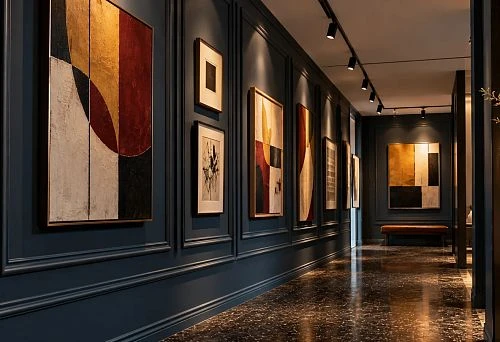
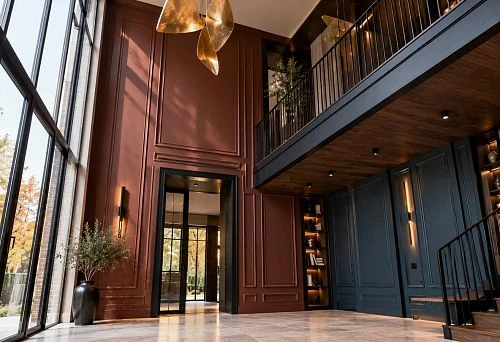
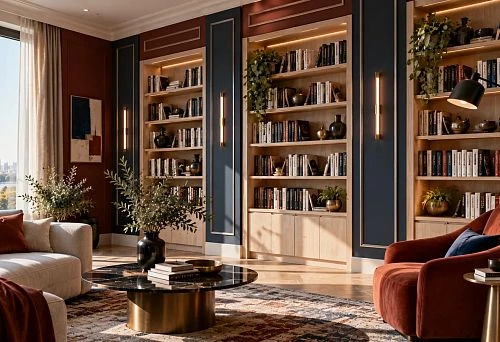
White molding on a colored wall. Classic contrast. White moldings, cornice, and baseboard on a gray-blue, terracotta, olive, dark green, or graphite wall. This reads as a classic architectural technique — light decor on a dark or saturated background.
Contrasting colored molding. Dark molding (gray, anthracite, bronze) on light walls. Or colored — for example, dark blue on a white wall. This is a bolder and more modern solution, characteristic of Art Deco or a modern contrasting interior.
In the color of the ceiling. When the cornice is painted the same color as the ceiling, it visually extends the ceiling plane downward. This increases the perceived height of the room. Works well with a white ceiling and white cornice on colored walls.
Coordination with doors and baseboards. The color of the molding should be part of a unified system: Buy moldings — and immediately plan its color in coordination with the door casing, baseboard, and window frame. White molding + white doors + white baseboard = a unified white system. This is a professional interior design technique.
Metallic accents. In classic style — gold. On the cornice, on overlay details, on the rosette profile. Gold is applied as an accent on the protruding parts of the profile, while the main tone is white or the wall color. This creates the effect of gilded decor without full gilding.
Mistakes when choosing molding by style
Even professional finishers make them. Not because they don't know how to install, but because they don't think of style as a system.
Choosing elements from different styles. A classic ornamental cornice with ornament and minimalist furniture with straight lines is not eclecticism, it's a stylistic contradiction. Plasterwork design must belong to the same stylistic direction as everything else in the interior.
Overloading a small room. A 150 mm cornice, an 80 cm rosette, molding frames on all walls, applied accents — for a 60 m² hall this is harmony. For a 12 m² room, it's overload.
Ignoring ceiling height. A cornice without considering the room's height is either a "strip" or "pressure." The rule is simple: the cornice profile in centimeters ≈ ceiling height in meters × 3–4.
Not planning the painting in advance. polyurethane decor requires painting. The decision on color should be made before installation, not after. After installation, changing the color is significantly more difficult.
Breaking symmetry without intent. Random asymmetry in decor is not a design technique, it's a mistake. If there is no symmetry, it must be deliberately broken, with an understanding of the result.
Not matching with baseboards. A classic cornice and a cheap plastic baseboard is a break in the architectural system that immediately catches the eye. The baseboard should be coordinated with the cornice in style and scale.
What to buy for decorating with stucco by style
Element guide for each style — with links for easy selection:
Moldings made of polyurethane — for frames, cornices, belts, trims. Basic element for any style.
PU overlays — ornamental accents for classic and neoclassical styles, corner inserts for frames.
Decor for Molding — corner elements, ornamental inserts, central accents for frame systems.
Polyurethane wall decor — wall panels and frame structures for neoclassical and modern classic styles.
Moldings — cornices, baseboards, rods — all linear decor for systematic room design.
Stucco molding under chandelier — rosettes — for classic and neoclassical living rooms, dining rooms, bedrooms with a chandelier.
Molding catalog — full assortment — complete Moldings shop broken down by categories.
Facade molding — for country houses and cottages, exterior decor coordinated with interior style.
FAQ: answers to important questions
Which stucco molding to choose for a classic interior?
For classic style, a full system is needed: an expressive multi-tiered cornice (100–180 mm) with an ornamental band, a ceiling rosette with leaf decor, molding frames on walls with overlay decorative elements, and door frame surrounds. Everything — white or with gold accents.
Which stucco molding is suitable for neoclassicism?
For neoclassicism — calm moldings 20–40 mm with a smooth profile, a cornice 70–100 mm without an ornamental band, a geometric rosette (only for formal rooms). Everything polyurethane moldings — in monochrome, matching the color of the walls or ceiling.
Can stucco be used in modern interiors?
Yes. Thin moldings 10–20 mm in the color of the walls, a laconic cornice without ornament, spot application (one accent wall or just the TV area). Decorative stucco in monochrome does not look "palatial" — it creates an architectural structure.
How to choose the color of moldings?
The most universal solutions: in the color of the walls (relief effect without contrast), white stucco on colored walls (classic contrast), in the color of the ceiling (the cornice visually lifts the ceiling). It is important to coordinate the color with doors, baseboards, and window frames — all should belong to the same color system.
How to avoid overloading the interior with molding?
Start with one task: wall or ceiling. Use profiles proportional to the room height. Maintain a uniform ornament style. Paint the stucco in the color of the surfaces it is mounted on. Add elements gradually — removing stucco after installation is much more difficult than adding it.