Article Contents:
- Short answer: what determines the price of stucco
- Why you cannot calculate the price of stucco based on just one element
- Which stucco elements have the greatest impact on the budget
- Moldings
- Cornices
- PU overlays
- Recessed Outlets
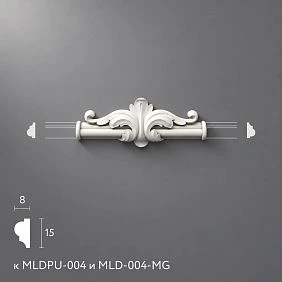
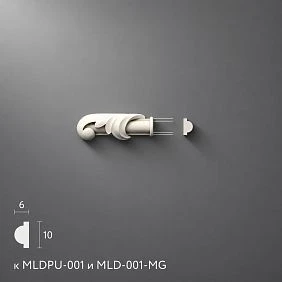
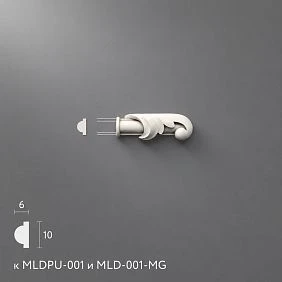
- Decor for moldings
- How to calculate stucco for walls
- Step one: measuring the wall
- Step two: determining the frame layout
- Step three: calculating the linear footage of moldings
- Step four: corner and connecting elements
- Step five: additional zones
- How to calculate ceiling molding
- Cornice
- Rosette
- Decorative ceiling frames
- Molding for one wall or the whole room: which is more profitable
- How to choose molding by budget
- Minimum budget
- Average budget
- Premium option
- Why large molding is not always more expensive in perception
- How not to overpay for molding
- Molding price and installation: what to consider separately
- Errors in calculating stucco molding
- What to buy for calculating and designing with stucco molding
- FAQ: answers to important questions
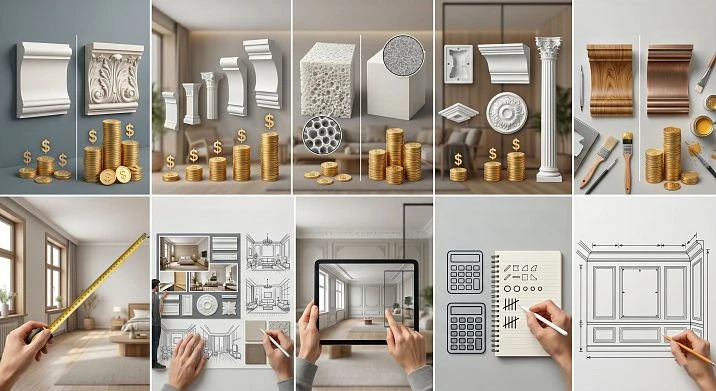
When a person first comes to a stucco molding store with the question "how much does it cost?" — they usually get an answer that surprises them. Not because it's expensive or cheap. But because the question is imprecise. The price of one molding is not the price of stucco for a room. It's like asking the cost of one brick when you mean a house.
Molding price — is a complex concept. The final budget consists of the type of elements, their quantity, profile size, ornament complexity, room area, ceiling height, number of corners and joints, as well as installation and painting. Understanding all this means learning to calculate stucco correctly, without overpaying and without running out of material at the most inconvenient moment.
This article is a practical guide. There is no fluff here. Only specific approaches to calculation, specific scenarios, and clear answers to the question that everyone planning polyurethane molding in their interior asks.
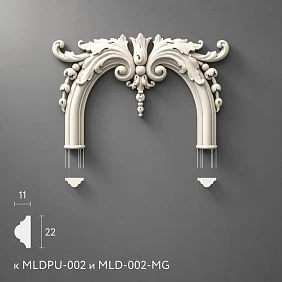
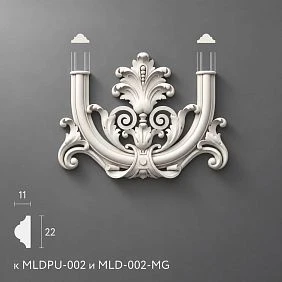
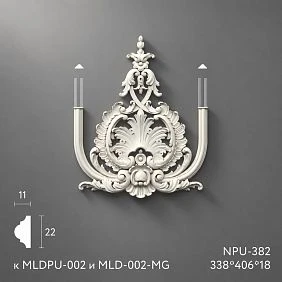
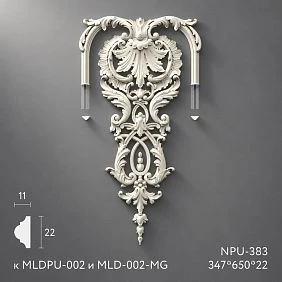
Short answer: what determines the price of stucco molding
If you need a quick reference, here is a complete list of factors that shape the final cost decorative molding:
Type of element. Molding, cornice, applique, rosette, decor for moldings — these are different price categories. Linear elements are measured in meters. Piece items are counted individually. Large rosettes and complex appliques cost more than simple profiles.
Profile size. A 15 mm molding and an 80 mm molding are different price points even with the same profile style. A cornice 60 mm high and a cornice 150 mm high — different material consumption and different price per linear meter.
Complexity of the pattern. A simple rectangular profile is cheaper than a profile with an ornamental band. A smooth molding is cheaper than a molding with sheet decor. A rosette with a geometric pattern is cheaper than a rosette with multi-level ornament.
Number of linear meters. For moldings and cornices, this is the main calculation indicator. It is determined by the perimeter of the room, the perimeter of the frames, and the length of the horizontal bands.
Room area. A large room means more meters of cornice, more frames, more overlays.
Ceiling height. It affects the size of the cornice (higher ceiling means larger profile) and the cost of installation.
Number of corners and joints. Each internal and external corner involves cutting at 45 degrees and a small amount of material waste. In a room with niches, bay windows, and columns, there are many corners.
Chosen style. A classic interior with a full stucco system is more expensive than neoclassicism with two or three elements. A minimalist approach is even more economical.
Installation and painting. The cost of the elements themselves is not the entire cost. Glue, joint putty, primer, paint, and the craftsman's labor all add a significant portion to the final total.




Why you cannot calculate the price of stucco based on just one element
Here is a typical planning mistake: a person looks at a molding in molding catalog, sees the price per linear meter, multiplies it by the length of one wall, and gets a seeming 'total'. But this is only a small part of the real estimate.
Why? Because molding is not a standalone element. It works within a system.
First: molding for wall frames is needed in a quantity that is a multiple of the perimeter of each frame. One frame 100×60 cm is 3.2 linear meters for just one frame. If there are eight frames on the wall, that's already 25.6 m plus a reserve for trimming.
Second: the molding requires corner elements or decorative inserts made of decoration for moldings — for the corners of the frames. This is a separate line item in the estimate.
Third: a cornice is usually added to wall moldings. The cornice is calculated along the perimeter of the room — again by linear footage. And the cornice is four times wider than a typical molding — meaning it has a different cost.
Fourth: if the interior is classic or neoclassical — the system is supplemented with PU overlays, ceiling rosettes, baseboards. Each item has its own price and its own quantity.
That is why the correct approach is to create a layout of the interior, list all elements by type, calculate the quantity of each — and only then look at the total cost in molding catalog.
Facade decor is a separate story. It has different material requirements, different installation, and a different scale of elements. Interior and facade estimates cannot be mixed — the calculation principles are different.
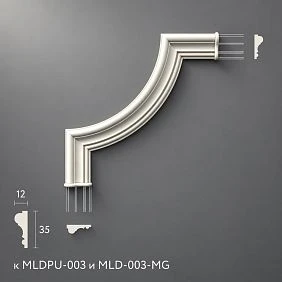
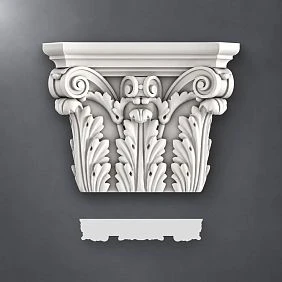
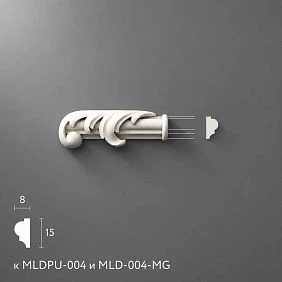
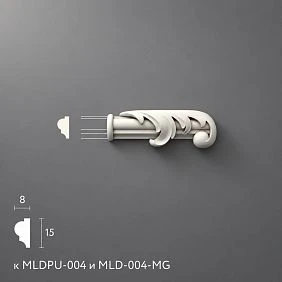
Our factory also produces:
Which stucco elements have the greatest impact on the budget
Get Consultation
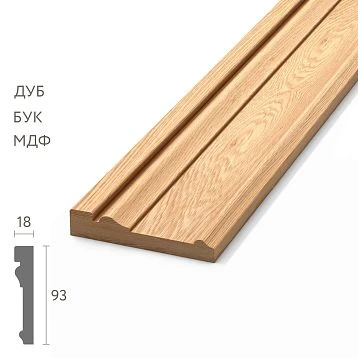
Moldings are linear profiles used to create framed compositions, zone walls, and frame openings. They come in various widths (from 20 to 150 mm) and relief complexity — from smooth to richly decorated.
Moldings made of polyurethane — the main consumable material in most interior projects with stucco molding. They are sold by linear meters, and it is their quantity that determines the base cost of the project.
Key parameters affecting the price of molding: width (from 10 to 120 mm), profile height, cross-section shape (rectangle, cove, quarter round, compound), and the presence of ornament.
Thin molding 15–20 mm with a simple profile is a budget solution. Molding 60–80 mm with a multi-step profile is the mid-price segment. Wide molding 100+ mm with an ornamental frieze is a premium item.
Calculation: perimeter of each frame × number of frames + 12–15% allowance for trimming and joints.
Example: living room, wall 4.5 m × 2.8 m, planned four frames 100×60 cm in the lower row and four frames 100×120 cm in the upper row.
-
Lower frames: (1.0 + 0.6) × 2 × 4 = 12.8 m
-
Upper frames: (1.0 + 1.2) × 2 × 4 = 17.6 m
-
Horizontal band at a height of 900 mm: 4.5 m
-
Total: 34.9 m + 15% allowance = 40.1 linear meters
Crown mouldings
Polyurethane Crown Molding — the largest linear element. Their price per meter is higher than moldings because the profile is wider and requires more material.
The price depends on: profile height (from 40 to 200+ mm), complexity of the stepped profile (number of "layers"), presence of an ornamental belt (smooth profile is cheaper), and overhang from the wall.
Cornice calculation: room perimeter + 10% reserve (for cutting corners). For a room 5 × 4 m: (5 + 4) × 2 = 18 m + 10% = 19.8 m. Plus — if the cornice also runs along a niche wall, bay window, or partition — additional meters are added.
Important: each corner of the room (internal or external) requires a 45-degree cut. A standard rectangular room has 4 internal corners. A room with a niche has 6–8 corners. Each corner results in ~5–8 cm of material loss during cutting.
PU overlays
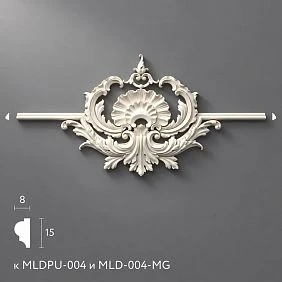
Decorative Inserts are counted individually. The price of each element depends on size, relief complexity, and type of ornament.
A small corner overlay for a frame is a budget element, of which 8–16 pieces are needed for a typical living room (4 corners × number of frames). A large ornamental medallion for the wall is a separate item with a higher cost.
Calculation principle: based on the number of application points. Corner inserts — by the number of frame corners. Central accents — by the number of horizontal or vertical moldings on which they are installed. Independent ornamental elements — according to the wall design scheme.
Rosettes
Ceiling rosettes are counted individually. One rosette per chandelier. Less often — two: a main one and an additional decorative frame around it.
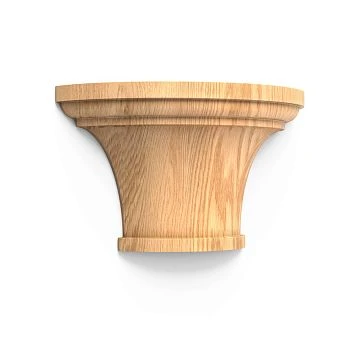
cornice under the chandelier — a ceiling rosette costs more the larger its diameter and the more complex the ornament. A geometric rosette with a diameter of 40 cm is an affordable item. An ornamental medallion of 90 cm with multi-level leaf relief is a different price category.
Decor for moldings
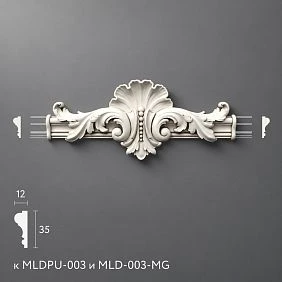
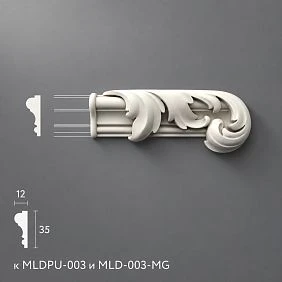
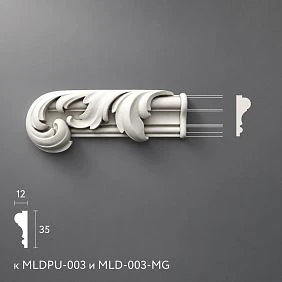
Decor for Molding — corner inserts, central elements, ornamental connections — small in size, but collectively can significantly change the final budget. Especially if there are many frames and a decorative element is installed at each corner point.
Calculation: 4 corner elements per frame + central accents according to the design scheme. With eight frames — at least 32 corner decorative details.
How to calculate wall molding
This is the practical part that most decorative instructions skip. Let's break down the calculation step by step.
Step one: measuring the wall
Measure the width and height of the wall. Record the positions of doorways, windows, and protrusions. Draw a diagram of the wall on paper at an arbitrary scale.
Step two: determining the frame layout
How many frames will be on the wall? This depends on the width of the wall and the width of each frame.
A 4 m wall — optimally four frames about 80 cm wide with gaps of 30–40 cm between them. Or three frames 100 cm wide with gaps of 25–30 cm. Principle: frames should not be too wide (more than 130 cm looks messy) and not too narrow (less than 50 cm looks cluttered).
Frame height:
-
Bottom row (panel zone): from the baseboard to the horizontal belt at a height of 800–1000 mm.
-
Top row: from the belt to the cornice or to a mark 200–300 mm below the cornice.
Step three: calculating the molding footage
Formula for one frame: (width + height) × 2 = frame perimeter.
Total molding = sum of perimeters of all frames + length of horizontal belts + 12–15% reserve.
Calculation example for a wall 4 m × 2.7 m, six frames:
-
Three lower frames 80×80 cm: (0.8 + 0.8) × 2 × 3 = 9.6 m
-
Three upper frames 80×130 cm: (0.8 + 1.3) × 2 × 3 = 12.6 m
-
Horizontal belt: 4.0 m
-
Total: 26.2 m + 15% = 30.1 m
Step four: corner and connecting elements
Number of corner decorative inserts = 4 × number of frames. Six frames → 24 corner elements from decoration for moldings.
Central accents on horizontal molding belts — according to the design scheme: usually one per horizontal molding longer than 80 cm.
Step five: additional zones
Calculated separately:
-
TV zone: one frame around the TV perimeter, typically 130–160×90–100 cm
-
Area behind the sofa: frames or molding belt along the sofa width (200–250 cm)
-
Bed headboard: one frame 160–200×120–150 cm
-
Piers: vertical moldings or narrow frames
Wall molding for each of these zones, it is calculated separately and added to the overall list.
How to calculate ceiling molding
Ceiling — a different logic. Here there are three independent tasks: cornice (wall and ceiling transition), rosette (central point), decorative frames on the ceiling plane.
Cornice
ceiling molding For the cornice, it is calculated along the perimeter of the room.
Formula: (length + width) × 2 = perimeter + 10% allowance.
For a room 5 × 3.5 m: (5 + 3.5) × 2 = 17 m + 10% = 18.7 m. Round up to 19 m.
Cornice size — depends on ceiling height:
-
2.4–2.6 m → cornice 40–60 mm
-
2.7–3.0 m → cornice 70–100 mm
-
3.0–3.5 m → cornice 100–140 mm
-
Above 3.5 m → 150–200+ mm
A cornice that is too small on a high ceiling gets 'lost' — it is not visible. One that is too large on a low ceiling feels oppressive and reduces the perception of space.
Rosette
The rosette is counted per piece. One chandelier — one rosette. Rosette size:
-
Chandelier/shade diameter + 15–25 cm = minimum rosette diameter
-
For a room 15–20 m² → rosette 40–60 cm
-
For a hall 30–50 m² → rosette 70–100 cm
cornice under the chandelier selected for a specific light fixture. Buying a rosette without knowing what chandelier will be used is a common mistake leading to scale mismatch.
Decorative ceiling frames
Ceiling coffers — only with ceiling height from 2.9–3.0 m. Calculated as a grid: number of rows × number of columns = number of cells. Perimeter of each cell × total number of cells = linear footage of moldings for the ceiling.
For a ceiling 5 × 4 m with a 2×2 grid (four coffers): each coffer 250×200 cm → perimeter (2.5 + 2.0) × 2 = 9.0 m → four coffers → 36 m + 10% = 39.6 m of moldings only for the ceiling. This is a significant volume that is added separately to the wall linear footage.
Stucco for one wall or the entire room: which is more profitable
| Task | Elements | Approximate composition |
|---|---|---|
| Accent wall | Moldings, applique, Decor | 20–40 m of moldings, 8–16 corner pieces |
| Entire living room | Cornice + frames + decor | 18–25 m of cornice + 60–90 m of moldings |
| Ceiling only | Cornice + socket | 16–22 m of cornice + 1 rosette |
| Bedroom | Headboard + cornice | 5–10 m of moldings + 14–18 m of cornice |
| Hallway | Moldings + baseboard | 10–20 m of moldings, no rosette |
| Full room (classic) | All | Cornice + moldings + rosette + overlays + baseboard |
The question "one wall or the whole room" is not just a budget question. It's a concept question. One accent wall with molding frames while the rest are simple is a modern technique. It looks thoughtful and doesn't require systematic decoration of the entire space. This is an economical and effective scenario.
A full room with a cornice, moldings, rosette, and baseboards is a classic systematic approach. It requires more material and precise calculation, but creates a complete architectural result.
What is more profitable? Profitable is what matches the task. An accent wall with a minimal budget is more profitable than a half-hearted attempt to do "a little bit everywhere."
How to choose stucco molding by budget
Minimal budget
With a limited budget — one task, one element.
Options:
-
Molding frames on one accent wall (wall behind the sofa, headboard, TV area). Need Moldings made of polyurethane thin profile (15–25 mm) and corner inserts. Painting to match the wall color — no extra costs for paint of a separate color.
-
A thin cornice around the perimeter. A small profile (50–60 mm), without ornament, matching the ceiling color. This is a minimal investment that nevertheless makes the room architecturally complete.
With a minimal budget, you shouldn't spread it across several small elements. One well-calculated accent is better than several cheap solutions without a system.
Medium budget
Cornice around the perimeter + molding frames on one or two walls + Polyurethane wall decor in key areas.
This is already an architectural system: the top line (cornice) and wall decor (frames) create a space with vertical rhythm. Adding PU overlays to the corners of the frames takes the interior to the next level of decorativeness with a moderate increase in budget.
For a standard living room (18–22 m²), the medium option is a cornice around the perimeter, molding frames on two walls (accent wall and TV area), and corner decorative inserts.
Premium option
Complete system. For classic or neoclassical interiors: cornices in all rooms, molding frames on all walls, decorative inlays, ceiling rosettes for chandeliers, baseboards of a matching profile, Decor for Molding for all corner joints, door frame surrounds, window slope decor.
This is not overload — it's an architectural system where each element is in its place and performs a specific function. Important: in the premium version, the role of style becomes critical. All stucco must belong to one stylistic direction.
Buy molding for a complete system, it's better to get everything in one place — then all elements will be coordinated in profile, material density, and finishing capabilities.
Why large stucco is not always more expensive in perception
This is a counterintuitive but important design principle.
One large expressive cornice of 120 mm can visually cost more than ten small applied decorative details chaotically placed on the wall. Scale and precision of application create a sense of richness — not the number of elements.
Overloading with small decor is a common mistake in DIY design. You want to add something else, something more — and as a result, the wall turns into a decorative catalog, not an interior. Each element is good on its own, but together they lose meaning.
The principle of 'less, but more precise' works flawlessly in stucco. One properly selected cornice + symmetrical frames on one accent wall will give a stronger visual result than the same budget spent on a set of small applied elements without a system.
Decorative stucco works through proportion and symmetry — and this is more important than the density of decor per square meter.
How not to overpay for stucco molding
Here is a proven practical algorithm that helps avoid overpayments and mistakes when purchasing.
Make a wall plan in advance. On paper or in any simple editor. Mark all walls, doorways, windows, niches. Draw the placement of frames, cornices, overlays. This takes an hour — but saves money when purchasing.
Don't buy 'with a reserve' without calculation. 'I'll take a few more meters just in case' — a standard phrase that turns into extra expenses. The correct reserve is 10–15% for trimming. Not 30 or 50.
Account for trimming at corners. Each corner of the room involves trimming the molding or cornice at 45 degrees. Trimming consumes 5–10 cm of material from each end. In a room with 4 corners — 8 trims — that's 40–80 cm of waste. This waste is already included in the 10–15% reserve.
Don't mix different collections. Molding from one series + cornice from another may not match in profile and create a stylistic inconsistency that cannot be fixed with paint.
Choose elements according to the actual ceiling height. A 150 mm cornice in a room with a 2.6 m ceiling — a visually unjustified dominant. This also means extra costs for a large profile where a medium one is needed.
Don't overload small spaces. A 5 m² hallway, a 12 m² bedroom, a narrow corridor — here molding and baseboard are enough. Rosettes, large overlays, and multi-tiered frames are for spaces that can 'handle' such a volume of decor.
Decide on painting in advance. Paint polyurethane molding Matching the wall color means zero extra cost for a separate paint color. Painting white with colored walls requires two cans of different colors. Gilding accent details is a separate job. All of this must be accounted for in the estimate.
Use ready-made schemes. molding catalog There are often recommendations for combining elements. This helps avoid inventing a system from scratch.
Stucco molding cost and installation: what to consider separately
The cost of the elements themselves is only part of the budget. The full estimate includes several items that are often overlooked in the initial calculation.
Surface preparation. Before installation, the wall must be level, clean, and free of peeling paint. If the wall is in poor condition, preparation is needed: priming, leveling. These are separate expenses not directly related to the molding but affecting the quality of installation.
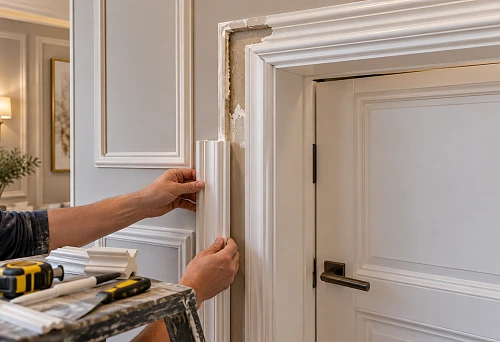
Glue. Polyurethane moldings It is mounted with construction adhesive (liquid nails or special polyurethane glue). Consumption: approximately one cartridge per 8–12 linear meters of molding. For 50 linear meters — 4–6 cartridges of glue.
Puttying joints. Joints between elements and between molding and wall/ceiling are puttied with a thin layer of acrylic putty. After drying — light sanding. This is a small but mandatory expense for materials and time.
Dowels. For the ceiling, especially when working with a drywall ceiling, additional attachment points are needed. Dowels at the frame rail locations are mandatory for heavy cornices and large rosettes.
Primer. Before painting, it is recommended to prime the polyurethane element if the paint does not have a built-in primer layer. One or two coats of acrylic primer — low consumption.
Painting. Two finish coats of paint. Consumption depends on the surface area of the stucco. For a large project with 50 meters of cornice + moldings + overlays — 3–5 liters of paint for monochrome painting.
Cost of installation work. If installation is done by a professional craftsman, this is a separate item. For a standard living room with a cornice and molding frames — from 4 to 12 hours of work depending on the complexity of the scheme, ceiling height, and number of corners.
Facade installation. For exterior decor — additional requirements: special facade adhesive, brackets for heavy elements, sealing joints with weather-resistant compound. This significantly increases the estimate compared to interior installation.
Mistakes when calculating stucco
Knowing the mistakes means already not making them. Here is a complete list of typical miscalculations encountered during independent planning.
Counting only the wall length, forgetting about frames. Molding for frames is not meters along the wall length. It is the perimeters of the frames. A 4 m wall with eight frames requires three to four times more molding than just "four meters."
Not adding a reserve for cutting. Molding is cut at 45 degrees at each corner. Minimum reserve — 10–15%. Without a reserve, an odd joint will always be short by a few centimeters — and you will have to buy more.
Buying a cornice without considering corners. Each corner consumes several centimeters for cutting. In a room with a niche or protrusion, there are twice as many corners as in a simple rectangle.
Choosing a rosette without the chandelier size. A rosette smaller than the lampshade "hides" behind the light fixture. This is not decor — it is a missed opportunity. The rosette should always be slightly larger than the chandelier.
Do not include painting in the estimate. "White stucco on white walls — no need to buy extra paint." This is a mistake: walls are painted before installation, and stucco after. A final coat is always needed.
Installing too large Relief Decoration in a small room. A 140 mm cornice in a room with a height of 2.5 m is decor that literally "eats" space. Proportionality is the first law of stucco.
Buying moldings and overlays from different styles. An ornamental cornice with rocaille + a strict rectangular molding is stylistic incompatibility. Choose elements from the same collection or from collections with a similar profile style.
Not linking stucco with baseboards, furniture, and doors. The baseboard is the lower point of the system. If the cornice is classic and the baseboard is thin plastic, the whole system falls apart. Decorative Molding for Interior must be coordinated with all architectural elements of the room.
What to buy for calculating and designing stucco
Full list by categories for easy selection:
Moldings made of polyurethane — linear profile for frames, belts, trims, and horizontal lines.
PU overlays — ornamental decorative elements for walls, frame corners, accent areas, door trims.
Decor for Molding — corner inserts, central accents, ornamental connections for frame systems.
Polyurethane wall decor — wall frame panels and architectural reliefs for neoclassical and modern classic styles.
Moldings — cornices, baseboards, rods — linear decor for systematic decoration of the entire room.
cornice under the chandelier — ceiling rosettes and medallions for classic and neoclassical interiors.
Buy stucco molding — full catalog — complete Moldings shop with breakdown by categories, styles, and sizes.
Types of moldings — reference article for understanding the purpose of each element type before preparing an estimate.
For those who are planning Stucco molding St. Petersburg and wants to select elements considering the specific task — the catalog is grouped by type, which simplifies calculation without unnecessary searches.
FAQ: answers to important questions
What determines the price of polyurethane stucco molding?
Polyurethane molding price is formed from several factors: element type (molding, cornice, overlay, rosette), profile size, ornament complexity, number of linear meters or pieces, room area, ceiling height, number of corners and joints. Installation materials (glue, putty), primer, and paint are added to the cost of the elements themselves.
How to calculate moldings for a wall?
You need to measure the wall, determine the number of frames and their sizes, calculate the perimeter of each frame, and sum all perimeters. Add horizontal belts and a 12–15% allowance for trimming to the resulting number. Count corner inserts separately — 4 pieces for each frame.
What is cheaper: moldings or overlays?
Moldings made of polyurethane are calculated by linear meters — the final cost depends on the total linear footage. applique are calculated per piece. For one accent zone, several overlays may be cheaper than a complex molding system. For a full room, moldings are the main expense item.
How much stucco molding is needed for a room?
Depends on the task. For an accent wall: 20–40 m of moldings + corner pieces. For a full room (living room 20–25 m²): 18–25 m of cornice + 60–100 m of moldings + overlays + rosette + baseboard. Accurate calculation — only based on the room layout.
How not to overpay for stucco molding?
Make a layout before purchasing, calculate the exact quantity of each element, add only the standard reserve of 10–15%, choose elements from the same collection or style, do not buy "just in case" without understanding where it will go. And always include installation and painting costs in the estimate.